




Abstract
Artificial Intelligence (AI) tools are having a significant impact on the field of education, particularly when used by educators. This study aims to explore the acceptance of AI tools among university-level educators. Researchers adapted the UTAUT2 (Unified Theory of Acceptance and Use of Technology) model to the Chinese educational context and surveyed 402 university educators. The findings revealed several predictors related to educators’ behavioral intention to use AI tools in teaching including performance expectancy, effort expectancy (which emerged as the strongest predictor), and hedonic motivation. Additionally, the study showed that the predictors of actual AI tool usage are facilitating conditions, habit (identified as the strongest predictor), and behavioral intention. Notably, the study found that gender, age, and experience did not have a moderating effect. This study contributes to the existing body of evidence on AI tool acceptance among university educators and holds implications for their training and professional development.
Introduction
Artificial intelligence (AI) is revolutionizing the methods employed in the field of education (Chassignol et al., 2018). In instructional design, generative artificial intelligence can furnish teachers with visual resources like images and videos, and generate course outlines for reference (Baidoo-Anu & Owusu Ansah, 2023). Within classroom management, AI tools empower teachers to automate administrative tasks such as attendance tracking, sending notifications, and managing assignments, thereby saving valuable time and energy (Luckin et al., 2022). In terms of teaching assessment, teachers can harness AI tools to analyze data, provide personalized learning paths and recommendations tailored to individual student needs and proficiency levels, and offer timely feedback (Luckin et al., 2022).
University educators can enhance teaching efficiency through the use of AI tools, allowing them to focus more on valuable tasks (Wang et al., 2021). For example, AI can enhance education by tailoring learning pathways for individual students through the analysis of their learning data and performance, ultimately improving course design (Bhutoria, 2022). Through the application of probabilistic calculations, AI can aid educators in identifying areas of instructional content that may require additional explanation and practice (Chen et al., 2020). For practical courses, higher education instructors can offer students virtual experiments and simulation tools, providing a more engaging and personalized learning experience, and thereby increasing student participation and satisfaction (Shadbad et al., 2023). Moreover, AI can supply educators with resources related to the latest trends and best practices in the field of education, enabling them to stay updated and refine their educational approaches (Lomis et al., 2021).
The utilization and adoption of AI tools have emerged as prominent areas of research (Anis Ibrahim & Morcos, 2002; Berdejo-Espinola & Amano, 2023; Choi et al., 2023; Esmaeilzadeh, 2020). Although the use of AI tools has enormous potential for advancing higher education, integrating these tools into classrooms often requires overcoming numerous challenges. Teachers need to prepare for the AI-supported educational future (Luan et al., 2020). Therefore, there is a need to survey university educators’ acceptance of AI and the factors that influence it. Among the existing studies, Ma and Lei (2024) surveyed various factors influencing the acceptance of AI technology among Chinese teacher education students using the Technology Acceptance Model (TAM). Wu et al. (2022) constructed a model with six hypotheses based on the Unified Theory of Acceptance and Use of Technology (UTAUT) model and the theory of perceived risk to examine Chinese university students’ willingness to accept AI-assisted learning environments. An et al. (2023) surveyed the behavioral intent of Chinese secondary school English teachers to use AI, combining UTAUT and TPACK theories. The UTAUT model has gained substantial recognition in the study of AI tool acceptance (Andrews et al., 2021; Y. Du et al., 2023; Lin et al., 2022; V. Venkatesh, 2022).
Based on existing research, the purpose of this study is to explore the acceptance and intention to use AI tools by Chinese university educators through the UTAUT2 model. Firstly, the UTAUT2 model is applicable to explain the drivers of teachers’ acceptance and intentions to use cutting-edge information technology (W. Du & Liang, 2024). Secondly, understanding educators’ acceptance and usage intentions of AI tools can help educational managers and policymakers develop more effective policies and training programs, promoting the application and popularization of AI technology in the field of education (Wang et al., 2021). Additionally, it is possible to reveal the acceptance and active use of this technology by university educators to improve teaching and learning (Chan, 2023), and it is possible to explore in depth what factors influence the intention of university educators to use AI tools (George & Wooden, 2023).
Theoretical Framework
The UTAUT2 model serves as the theoretical framework for this research. UTAUT2 is an extension of the original UTAUT model (Zacharis & Nikolopoulou, 2022). The original UTAUT model proposed that Performance Expectancy (PE), Effort Expectancy (EE), Social Influence (SI), and Facilitating Conditions (FC) were the strongest predictors of Behavioral Intention (BI) and Use Behavior (UB) (V. Venkatesh et al., 2003).
UTAUT2 builds upon the original model by introducing three additional constructs: Motivation (HM), Price Value (PV), and Habit (HT) (V. Venkatesh et al., 2012). These additions aim to provide a more comprehensive explanation and prediction of user acceptance and usage behavior of information technology (Brandford Bervell et al., 2021). UTAUT2 comprises seven main constructs: Performance Expectancy (PE), Effort Expectancy (EE), Social Influence (SI), Facilitating Conditions (FC), Hedonic Motivation (HM), Price Value (PV), and Habit (HT). Furthermore, age, gender, and experience are considered factors that influence the relationships among the seven constructs and Behavioral Intention (BI) and Use Behavior (UB) (V. Venkatesh et al., 2012).
Many studies have already used the UTAUT model to explore user behavioral intentions and willingness to use AI (Alhwaiti, 2023; Cabrera-Sánchez et al., 2021; Chu et al., 2022; Gansser & Reich, 2021; Maican et al., 2023; Setiyani et al., 2023). This study applied the model to investigate the acceptance and usage intentions of AI tools among university educators. In the research model (Figure 1), the independent variables include PE, EE, SI, FC, HM, PV, and HT. PE, EE, SI, FC, HM, PV, and HT impact Behavioral Intention (BI), while BI, FC, and HT influence Use Behavior (UB). Additionally, age and gender influence FC, HM, PV, and HT, and experience affects FC, HM, HT, and BI.
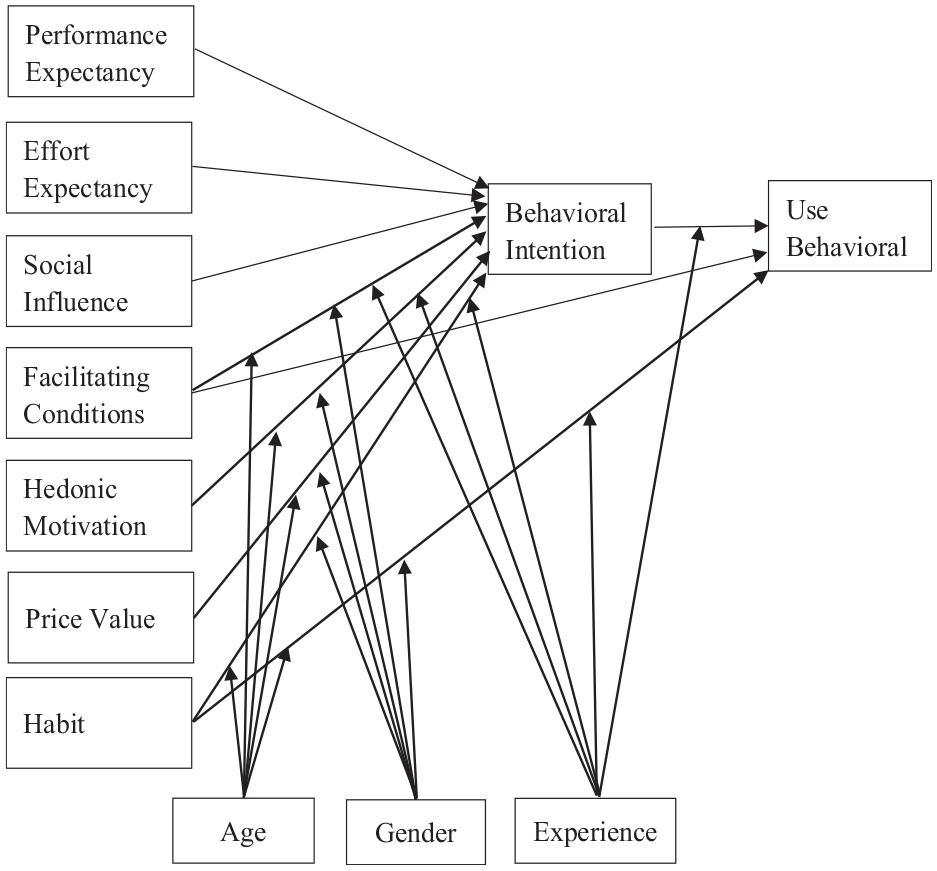
Research model.
Performance Expectancy (PE)
According to V. Venkatesh et al. (2003), Performance Expectancy (PE) refers to the degree to which users believe that technology can enhance their job performance and working conditions. It has been demonstrated as one of the most influential factors in predicting Behavioral Intentions (BI) (V. Venkatesh et al., 2012). In the context of this study, it can be defined as the extent to which university educators believe that using AI tools will result in improved teaching outcomes. PE has a positive effect on university educators’ BI to use AI tools. The hypothesis suggests that if university educators perceive that the use of AI tools can improve teaching efficiency, increase student engagement, etc., then they will be more motivated to incorporate AI tools into their teaching practices (Wang et al., 2021). Hence, Hypothesis 1 is formulated as below.
H1. PE has a positive effect on university educators’ BI to use AI tools.
Effort Expectancy (EE)
Effort Expectancy (EE) signifies the ease or difficulty with which users perceive the use of new technology (V. Venkatesh et al., 2003), and it stands as one of the most robust predictors of BI (V. Venkatesh et al., 2012). In the context of this study, EE can be characterized as the degree to which university educators believe that using AI tools will not entail significant physical or mental exertion. EE has a positive effect on university educators’ BI to use AI tools. Teachers who perceive the use of AI tools to be simple and easy to use will be more motivated to adopt AI tools (Ayanwale et al., 2022). Accordingly, the following hypothesis is proposed.
H2. EE has a positive effect on university educators’ BI to use AI tools.
Social Influence (SI)
Social Influence represents the influence of individuals whom users consider important on their intention to use (V. Venkatesh et al., 2003), and it is also regarded as one of the significant predictors of BI (V. Venkatesh et al., 2012). In this study, SI is defined as the opinions of other teachers, family members, and friends regarding the use of AI tools in teaching. SI has a positive effect on university educators’ BI to use AI tools.This hypothesis states that if university educators feel support and approval from others for using AI tools, the stronger their intentions are to use AI tools (Wang et al., 2021). The research hypothesis associated with this construct is H3.
H3. SI has a positive effect on university educators’ BI to use AI tools.
Facilitating Conditions (FC)
Facilitating Conditions refer to users’ perception of having sufficient awareness, trust, and technical resources to support the use of technology (V. Venkatesh et al., 2003). FC is also considered one of the important factors influencing Behavioral Intentions (BI) (V. Venkatesh et al., 2012). In this study, Facilitating Conditions are described as the extent to which university educators believe there are adequate organizational and technical foundations to support the use of AI tools in teaching. FC has a positive effect on university educators’ BI to use AI tools. Intention to use AI tools is positively influenced if university educators perceive the use of AI tools to be convenient and fast, and if there is a relevant technological base to support their use of AI tools (Javaid et al., 2023). Consequently, hypothesis 4 is proposed as follows.
H4. FC has a positive effect on university educators’ BI to use AI tools.
Hedonic Motivation (HM)
Hedonic Motivation represents the enjoyment users derive from using technology (V. Venkatesh et al., 2012). In this study, HM is described as the pleasure and enjoyment that university educators experience from using AI tools. HM has a positive effect on university educators’ BI to use AI tools. This hypothesis states that the more university educators enjoy the use of AI tools, the stronger their intentions to use AI tools will be (Choi et al., 2023). Thus, hypothesis 5 is put forth as follows.
H5. HM has a positive effect on university educators’ BI to use AI tools.
Price Value (PV)
Price Value refers to the significant impact of costs and pricing structures associated with the use of technology (V. Venkatesh et al., 2012). In this study, PV is described as the costs incurred and the value generated by university educators from using AI tools. PV has a positive effect on university educators’ BI to use AI tools. If university educators perceive that the price cost of using AI tools is proportional to enhancing teaching effectiveness or solving problems, then they are more motivated to use AI tools (Alhwaiti, 2023). The research hypothesis associated with this construct is H6.
H6. PV has a positive effect on university educators’ BI to use AI tools.
Habit (HT)
Habit pertains to the degree to which users engage in routine behaviors automatically, without conscious decision-making (V. Venkatesh et al., 2012). In this study, HT is described as the degree to which university teachers automate their use of AI tools. HT has a positive effect on university educators’ BI to use AI tools. This hypothesis indicates that if university educators are able to routinize the act of being subjected to AI tools, the intention to use them will increase (Walker et al., 2020). The hypothesis linked to this construct is designated as H7.
H7. HT has a positive effect on university educators’ BI to use AI tools.
Behavioral Intention (BI)
Behavioral Intention is a pivotal factor within different intention models, recognized for its influence on the actual usage of technology (V. Venkatesh et al., 2003). In this study, we define “Behavioral Intention” as the disposition of university teachers toward integrating artificial intelligence tools into their teaching practices. BI has a positive effect on university educators’ UB to use AI tools. This hypothesis states that the stronger the behavioral intentions of university educators toward the use of AI tools, the likelihood that they will actually use these tools will be higher. Therefore, hypothesis eight is established.
H8. BI has a positive effect on university educators’ UB to use AI tools.
Use Behavior (UB)
Use Behavior (UB) refers to the behavior of an individual with respect to the actual use of a particular technology or system (V. Venkatesh et al., 2012), which in this study we define as the extent to which university teachers use different AI tools in their teaching. The empirical results show that FC has a direct effect on UB and goes beyond what is explained by BI (V. Venkatesh et al., 2003). Kim and Malhotra (2005) found that prior use is a strong predictor of future technology use, and habit has been shown to be a key predictor of technology use (Limayem et al., 2007). Considering this structure, we propose the following hypotheses:
H9. FC has a positive effect on university educators’ UB to use AI tools.
H10. HT has a positive effect on university educators’ UB to use AI tools.
Contextual Variables
The factors of age, gender and experience may moderate the effect of an individual’s intention to use a tool or technology (Moura et al., 2020). First, age, gender and experience have an effect on the link between FC and BI (Morris et al., 2005); second, age, gender and experience have been found to have a moderating role in the effect of HM on BI (V. Venkatesh et al., 2003); third, drawing on Social Role Theory (Deaux & Lewis, 1984), the effect of PV on BI is moderated by age, gender and experience (V. Venkatesh et al., 2003); and fourth, age and gender reflect differences in people’s behavior (V. Venkatesh et al., 2003), which in turn affects their reliance on habitually guided behaviors due to the fact that repeated behaviors strengthen the relationship between experience and habit (Limayem et al., 2007).Therefore, we propose the following hypothesis:
H11. Age, Gender and Experience moderate the effect of FC, HM, PV and HT on university educators’ BI to use AI tools, as well as the effect of FC and HT on UB.
As experience increases, daily behaviors become automated (Jasperson et al., 2005), psychological research has found that experience moderates the effect of behavioral intentions on behavior (Verplanken et al., 1998). Individuals with higher levels of experience may be more likely to translate behavioral intentions into actual use behaviors (Mailizar et al., 2021), whereas individuals with lower levels of experience may have certain gaps or barriers to overcome. Therefore, we propose the following hypothesis:
H12: Experience moderates the effect of BI on university educators’ UB to use AI tools.
Method
This study adopts a quantitative research method to collect data extensively through questionnaires and systematically analyze them with Chinese university educators as the research subjects. After clarifying the theoretical concepts of the relevant variables based on the literature review, the reliability and validity of this study were tested through reliability analysis and validating factor analysis. On the basis of ensuring the validity of the study, the research hypotheses were tested through regression analysis and path coefficient analysis.
Participants
Under the premise of safeguarding the diversity and richness of the research sample, the researcher selected one higher education institution each in Liaoning, Jiangsu, Hunan and Sichuan Provinces during the period of 1st October 2023 to 24th October 2023, according to the principle of economic and geographical division of Northeast China, East China, Central China and West China, for a total of four higher education institutions to participate in this survey. Although the four universities showed a high level of IT development in their respective provinces, there was still significant heterogeneity among them due to regional economic and cultural differences. This study used convenience sampling method, using wjx, an online questionnaire distribution platform in mainland China, which is functionally equivalent to SurveyMonkey, to send electronic questionnaires with informed consent forms to the respondents, all surveys were voluntary and anonymous, and all participants were made aware of the informed consent form prior to commencement, and the results of the survey were only used for the purpose of the study. To avoid data distortion, the researcher collated and verified the returned questionnaires based on the time of completion and whether they were characterized by regularity of completion, resulting in 402 valid questionnaires.
Table 1 provides a detailed overview of the research sample, including 207 male and 195 female participants. The age distribution of teachers in the sample was as follows: 29 teachers were under 25 years old, 72 were aged 26 to 30, 113 were aged 31 to 35, 113 were aged 36 to 40, and 75 were above 41 years old. Regarding experience with AI tools, 75 participants had 1 to 2 years of experience, 89 had 3 to 4 years, 92 had 5 to 6 years, and 146 had 7 or more years of experience.
Demographic Information of Participants (N = 402).

Note. This table presents an overview of the study sample based on gender, age and experience.
Measures
UTAUT2 has been widely used in research in different fields and industries, including education, healthcare, finance, etc. (Raza et al., 2021; Tseng et al., 2022). Many empirical studies have verified the validity and applicability of UTAUT2 in different contexts, proving its important role in explaining and predicting new technology adoption behaviors (An et al., 2023; Faqih & Jaradat, 2021; Meet et al., 2022). UTAUT2 is able to explain the motivations and factors that underlie users’ behavior toward the adoption and use of cutting-edge technologies (Beh et al., 2021). Therefore, the UTAUT2 questionnaire adapted by V. Venkatesh et al. (2012) was used in this study in order to capture the acceptance and intention to use AI tools among university educators.
The questionnaire utilized a seven-point Likert scale, ranging from 1 (strongly disagree) to 7 (strongly agree), to assess the respondents’ actual levels. In addition to collect demographic information such as gender, age, and years of experience using AI tools, the questionnaire included four items each for PE, EE, FC, and HT, three items each for SI, HM, PV, and BI, and six items for UB, covering a total of 34 items across nine dimensions.
Previous research has confirmed that the questionnaire demonstrates good internal consistency and psychometric properties across different constructs (Arain et al., 2019; Avcı, 2022; Brandford Bervell et al., 2021; Faqih & Jaradat, 2021; García-Murillo et al., 2023; Meet et al., 2022; Nikolopoulou et al., 2020; Sitar-Taut & Mican, 2021; Tseng et al., 2022; Zacharis & Nikolopoulou, 2022). In this study, the questionnaire was adapted to better suit the research objectives. With the assistance of language experts, it was translated from English to Chinese and adjusted to fit the Chinese context. The UTAUT2 questionnaire adapted by V. Venkatesh et al. (2012) showed good internal consistency reliability (ICR of 0.75 or better) and construct validity (AVE both greater than .70). Specifically, the Cronbach’s alpha coefficient for the questionnaire in this study was .783, and the Cronbach’s alpha coefficients for the dimensions ranged from .811 to .906, which were higher than the standardized value of .7. In addition, the AVEs for the dimensions were also greater than .7. For detailed data on the AVEs, please see Table 2.
Descriptive Statistics, and Reliability and Convergent Validity Measures.

Note. SD = standard deviation; CR = composite reliability; AVE = average variance extracted.
Data Analysis
This study utilized SPSS and AMOS software, in conjunction with the method of least squares and Structural Equation Modeling (SEM), for data analysis. The entire analysis process was divided into two main stages to ensure the reliability of the data and robust support for the research findings.
Stage 1 involved the analysis of the measurement model. The primary objective of this stage was to obtain the basic characteristics of the data through descriptive analysis. Based on reliability analysis, including calculations of Average Variance Extracted (AVE) (Farrell, 2010) and Composite Reliability (Churchill, 1979), these indicators were used to validate the reliability of the measurement model, ensuring the authenticity and objectivity of the data.
Stage 2 involved structural model analysis. Based on the results of the measurement model, this stage aimed to build a structural model for the study. It included regression analysis to verify relationships between variables, and confirmatory factor analysis to assess the effectiveness of the measurement model, including testing construct validity and convergent validity. Additionally, the study examined the path coefficients in the structural model to determine their significance and quantify the relationships between variables. Notably, we conducted a moderation analysis, focusing on the interaction effects of gender, age, and experience on relationships between various constructs.
Based on these analytical steps, these procedures not only contribute to ensuring the credibility and effectiveness of the study but also provide robust data support for the study’s conclusions. In the results section, we will discuss in detail the assessment results of the measurement and structural models to validate and explain the research hypotheses.
Results
Measurement Model
Based on the data in Table 2, it can be observed that each dimension of PE (M = 8.687, SD = 2.939), EE (M = 8.781, SD = 2.889), SI (M = 8.654, SD = 2.872), FC (M = 8.918, SD = 2.859), HM (M = 8.435, SD = 2.978), PV (M = 8.764, SD = 2.933), HT (M = 8.729, SD = 2.873), BI (M = 8.871, SD = 2.905), and UB (M = 8.714, SD = 2.948) all exhibit a slightly below moderate level.
However, it is important to note that the factor loadings of the items in the questionnaire range from 0.662 to 0.827, all of which are higher than the reference value of 0.400 (Guadagnoli & Velicer, 1988). The Composite Reliability (CR) values range from 0.811 to 0.906, all exceeding the threshold of 0.7 (Churchill, 1979). Additionally, the Average Variance Extracted (AVE) values range from within 0.595 to 0.644, all surpassing the standard of 0.500 (Farrell, 2010). In summary, the scale demonstrates a high level of internal consistency reliability, indicating satisfactory reliability and construct validity.
Structural Model
From the data in Table 3, it can be observed that the correlation coefficients (r) between dimensions range from .214 to .366, with all values being less than 0.8 and statistically significant (p < .010). This indicates a significant positive correlation among dimensions and generally no issues of multicollinearity (Sedgwick, 2012). These findings provide a solid foundation for further analysis. Additionally, the square root of the AVE for each construct is greater than the correlation coefficients between the constructs (Fornell & Larcker, 1981), indicating that the measurement model exhibits good convergent validity.
Discriminant Validity Matrix.

Note. Diagonals in parentheses are square roots of the AVE from items. Off-diagonal correlations among constructs.
The path analysis results in Table 4 indicate that PE (β = .168, p < .05), EE (β = .173, p < .01), and HM (β = .154, p < .05) have a significant positive impact on BI. Notably, EE has the strongest influence on BI. Consequently, the findings support hypotheses 1, 2, and 5. However, SI (β = .119, p > .05), FC (β = .011, p > .05), PV (β = .101, p > .05), and HT (β = .053, p > .05) do not influence BI. Thus, hypotheses 3, 4, 6, and 7 are rejected. At the same time, BI (β = .218, p < .001), FC (β = .251, p < .001), and HT (β = .279, p < .001) exhibit a significant positive impact on UB, leading to the acceptance of hypotheses 8, 9, and 10.
Structural Path Model’s Hypothesis Testing Results.
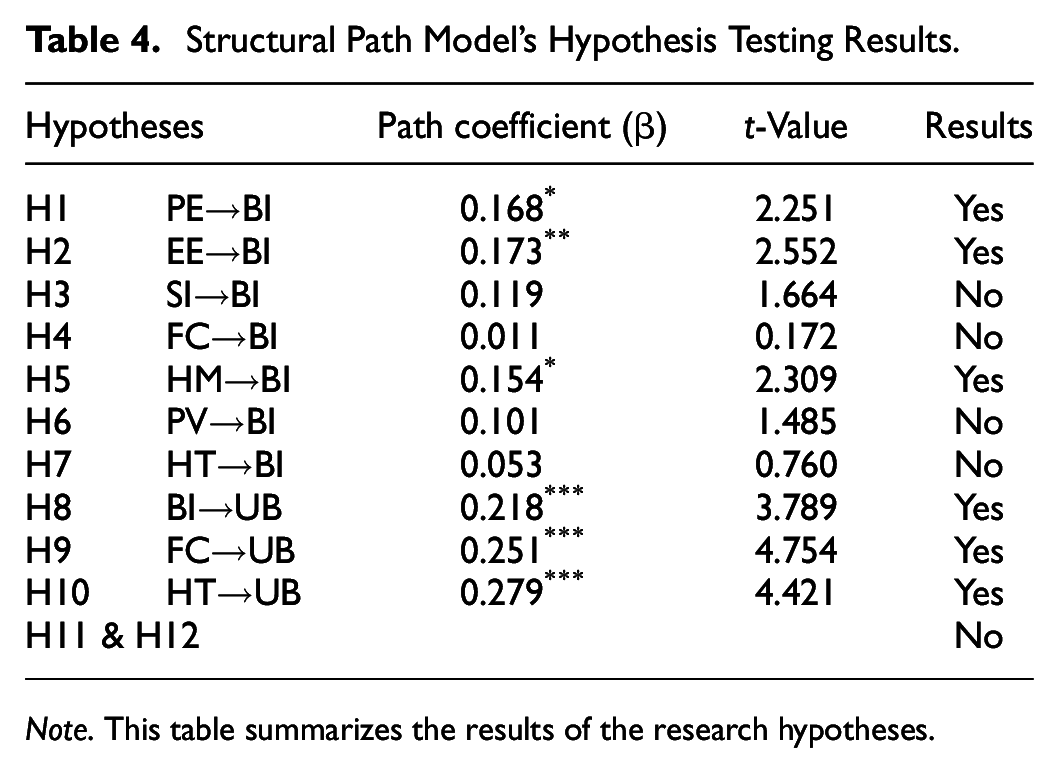
Note. This table summarizes the results of the research hypotheses.
Regarding the hypotheses of moderating effects, the results of the study showed that the effects of gender, age, and experience for FC, HM, PV, and HT to BI have not reached a statistically significant level; therefore, hypothesis 11 is rejected. Also, the effect of experience for BI on UB also did not reach a statistically significant level and hypothesis 12 was also rejected. This suggests that gender, age and experience did not have a significant moderating influence in these structural relationships.
In the path analysis, the relationships between hypotheses were identified, and values supporting the hypotheses were established (Figure 2). The path coefficients supported six hypotheses (H1, H2, H5, H8, H9, H10). These data indicate that SI, FC, PI, and HT cannot influence the BI of university teachers in using AI tools. However, FC and HT can influence the UB of university teachers in using AI tools.

Structural measurement model.
Discussion
In this study, drawing inspiration from the UTAUT2 model, we have delved into the behavioral intentions and acceptance levels of Chinese university educators when it comes to incorporating AI tools into their teaching practices. Investigating the behavioral intentions of university teachers regarding AI tool adoption is of paramount importance because the effective integration of AI tools in teaching depends on teachers embracing and using them (Choi et al., 2023). The outcomes of this research could prove valuable to university educators, academic administrators, and policymakers, offering valuable insights for the future application of the UTAUT2 model in the domain of AI tool utilization.
The research results reveal that university educators show agreement and endorsement of the potential of AI tools in their teaching roles. SI, FC, and PV have no significant impact on BI. Specifically, PE, EE, and HM significantly impact the BI of university teachers to use AI tools. Furthermore, FC, HT, and BI have a significant influence on the UB.
In particular, it’s worth noting that PE significantly impacts BI. This discovery is consistent with the findings of Arain et al. (2019) and Tseng et al. (2022), implying that teachers believe using AI tools can significantly enhance teaching effectiveness. Some university faculty may have already learned about the potential of AI tools through practical applications (Celik, 2023), professional training, or peer recommendations, thus increasing positive expectations about their effectiveness.
EE also influences BI, in line with the research conducted by Faqih and Jaradat (2021). This suggests that teachers find it relatively easy to master and use AI tools. EE is the strongest predictor of BI, indicating that university educators have a high perception of the actual utility of AI tools and believe that the use of AI tools can improve the efficiency and quality of teaching, matching their teaching tasks and needs (Singh & Hiran, 2022).
HM has a notable impact on BI, which aligns with the results found by Meet et al. (2022) and Sitar-Taut and Mican (2021), indicating that when teachers find AI tools engaging, their probability of using these tools increases. Interesting work or activities are often associated with cognitive stimulation and challenge, and university educators may be more motivated (Alzahrani & Alhalafawy, 2023) to adopt AI tools to satisfy their curiosity and desire to explore when they feel that the use of these tools can provide new learning and application challenges.
Zacharis and Nikolopoulou (2022) also confirmed the impact of FC on UB. This suggests that university instructors believe that the availability of diverse technological resources and a supportive technological infrastructure enhances their willingness to use AI tools in their teaching practices.
HT emerged as the strongest predictor of UB, a finding supported by the studies of Sitar-Taut and Mican (2021) and Brandford Bervell et al. (2021). This suggests that university instructors who use AI tools more frequently tend to exhibit a higher level of automatization in integrating these tools into their teaching practices, enhancing their proficiency in utilizing AI tools for instructional purposes. This is due to the fact that the accumulation of experience makes university educators more proficient and confident in their practical use (Graham et al., 2020), and that the repeated use of the AI tool’s operational steps creates cognitive automation, saves cognitive resources and improves efficiency, and the positive feedback loop motivates educators to continue to optimize the way in which they use it.
BI also significantly impacts UB, a finding consistent with Avcı (2022). In other words, teachers intend to continue using AI tools in their teaching practices. Three demographic variables, gender, age, and experience, did not show moderating effects in the effects of FC, HM, PV, and HT on BI. The possible high degree of consistency in the goals, motivations, and expectations of university educators (Daumiller & Dresel, 2020) regarding the use of AI tools for teaching and learning resulted in no significant variability in the influence of these demographic factors on behavioral intention. In addition, university educators usually have similar professional backgrounds, resulting in a more consistent pattern of behavior in the use of AI tools. Experience did not to be a moderator in the effect of BI on UB, and university educators may receive the same technical support and resources in their work (Chan, 2023), and therefore exhibit relatively consistent behavioral intentions and actual behaviors of AI tool use.
Conclusion
The primary objective of this study is to explore the level of acceptance and willingness to use AI tools among university teachers. According to the research findings, the most significant predictors affecting teachers’ usage of AI tools in their teaching are PE, EE, and HM in the case of BI. In terms of the outcomes of 12 hypotheses, the study found that SI, FC, PI, HT, and background variables did not influence university educators’ BI of using AI tools, which suggests that university educators tend to favor tools that they can enjoy the process of using and that can enhance their teaching and learning, and that they are also influenced by the degree of ease of operation. Therefore, the promotion and application of AI tools among university educators should focus on improving ease of use, emphasizing practical utility, and establishing a good user experience to promote wider adoption by teachers. This also means that developers and educational institutions need to focus on user interface design, functional optimization, and the provision of relevant training and support when designing and promoting AI tools to ensure that teachers are able to make full use of them to improve the quality and effectiveness of their teaching. The most significant predictors affecting the UB of university teachers are HT, BI and FC, and experience does not influence the UB of university teachers.This suggests that teachers are influenced by AI their willingness to use, information base support, subjective cognitive norms, and unconscious factors when deciding whether to use AI tools consistently, and therefore, the operational base, usage habits, and habit-formation of university educators need to be taken into account in practical application as well Therefore, it is necessary to take into account the operating bases, usage habits and habit formation of university educators in the actual application, and to strengthen the cultivation of cognitive norms of university educators in order to promote their continuous and active use of AI tools in teaching practice.
The results of the study investigating university educators’ acceptance and willingness to use AI tools based on the UTAUT2 model reveal several important implications. Firstly, in order to improve university educators’ behavior toward using AI tools, universities can enhance training and dissemination of information about the utility of AI tools for teaching practice and facilitating processing work to enhance university educators’ utility expectations. Second, universities can collaborate with those who design and develop AI tools to focus on ease of use and user experience to reduce operational difficulties and enhance perceived ease of use. Finally, universities can establish institutional mechanisms to support and incentivize the use of AI tools by teachers based on the information technology bases of different university educators, and provide resources and support on different bases to promote wider adoption of AI tools by university educators of all information technology levels, and to promote the digital transformation of the education sector and the improvement of teaching quality. For university educators, they can enhance their knowledge and competence of AI tools through active participation in relevant training and learning, while embracing and accepting the development trend of digital education, and continuously exploring and experimenting with new teaching techniques and methods to enhance teaching effectiveness and student experience.
With the rapid advancement of AI technology, it has permeated various aspects of our lives (Adiguzel et al., 2023). Therefore, we expect educators to possess a certain level of foundational knowledge in this regard. Based on this premise, academic institutions’ administrators can encourage teachers to learn and utilize AI tools relevant to their teaching by organizing specialized training sessions and lectures (Shang et al., 2022). Additionally, they can motivate educators to incorporate AI tools into their teaching practices through performance-based incentives.
The UTAUT2 model has been validated as an effective tool for revealing the impact of PE, EE, and HM on teachers’ BI to use AI tools in teaching, and it is also applicable for studying the effects of FC, HT, and BI on UB. However, this study has some significant limitations related to the homogeneity of the sample. Future research could consider expanding the scope of the study to include other populations, such as vocational teachers or elementary education professionals, to obtain a more comprehensive understanding. Additionally, introducing qualitative research elements could allow for a deeper exploration of other structural factors influencing teachers’ use of AI tools.
Footnotes
Appendix
Survey Item.

| Performance expectancy (PE) | |
| PE1. | I find AI tools useful in my teaching. |
| PE2. | Using AI tools increases my opportunities to achieve important goals. |
| PE3. | Using AI tools helps me complete teaching tasks more quickly. |
| PE4. | Using AI tools improves my work efficiency. |
| Effort Expectancy (EE) | |
| EE1. | Learning to use AI tools is easy for me. |
| EE2. | My interaction with AI tools is clear and understandable. |
| EE3. | I find AI tools easy to use. |
| EE4. | Becoming proficient in using AI tools is easy for me. |
| Social Influence (SI) | |
| SI1. | People important to me think I should use AI tools. |
| SI2. | People who influence my behavior think I should use AI tools. |
| SI3. | People whose opinions I value prefer me to use AI tools. |
| Facilitating Conditions (FC) | |
| FC1. | I have the resources necessary to use AI tools. |
| FC2. | I have the knowledge necessary to use AI tools. |
| FC3. | AI tools are compatible with other technology tools I use. |
| FC4. | When I encounter difficulties using AI tools, I can get help from others. |
| Hedonic Motivation (HM) | |
| HM1. | Using AI tools is enjoyable. |
| HM2. | Using AI tools is a pleasure. |
| HM3. | Using AI tools is very exciting. |
| Price Value (PV) | |
| PV1. | The price of AI tools is reasonable. |
| PV2. | Purchasing AI tools is worthwhile. |
| PV3. | At the current price, AI tools provide considerable value. |
| Habit (HT) | |
| HT1. | Using AI tools has become a habit for me. |
| HT2. | I am addicted to using AI tools. |
| HT3. | I must use AI tools. |
| HT4. | Using AI tools has become natural for me. |
| Behavioral Intention (BI) | |
| BI1. | I intend to continue using AI tools in the future. |
| BI2. | I will strive to use AI tools in my daily life. |
| BI3. | I plan to continue using AI tools. |
| Use Behavior (UB) Please select your frequency of use for each of the following: | |
| Instructional design tools (e.g., Tome AI, ClassPoint AI, LessonPlans AI, etc.) | |
| Visual teaching material tools (e.g., Pictory AI, Leonardo Ai, Speechify, etc.) | |
| Online classroom tools (e.g., Tencent Classroom, NetEase Classroom, Zoom, etc.) | |
| Classroom management tools (e.g., Zapier, Virtual Classroom, Khanmigo, etc.) | |
| Chat tools (e.g., ChatGPT, Bing AI, Google BERT, etc.) | |
| Teaching assessment tools (e.g., Gradescope, SmartGrade, Formative AI, etc.) | |
Declaration of Conflicting Interests
The author(s) declared no potential conflicts of interest with respect to the research, authorship, and/or publication of this article.
Funding
The author(s) disclosed receipt of the following financial support for the research, authorship, and/or publication of this article: This work was supported by the Jiangsu Province’s 14th Five-Year Plan Project, grant number C-c/2021/03/70.
Ethical Approval
Ethics Approval was obtained from the University Ethics Committee.
Consent to Participate
The data collected in this work had been agreed by all participants.
Consent for Publication
Written/online informed consent for publication was obtained from all participants.

Data Availability
Data can be made available upon request to the authors.
Code Availability
Not applicable.