




Abstract
COVID-19 has caused a surge in scientific publications, with increased collaboration. This study aims to elucidate scientific output, focal topics, emerging themes, and trends and patterns of productivity, visibility, and collaboration within social sciences research (SSR) on COVID-19. A scientometric analysis was conducted utilizing Biblioshiny and VOSviewer software. About 65,742 records published on WOS between 2020 and 2022 were analyzed. Topics such as “telehealth,”“well-being,” and “inequalities,” were among the key topics while “interventions” and “mental well-being” were among emerging key topics. Collaboration patterns were regional. Harvard Medical School, the University of Toronto, and the University of Oxford emerge as leaders in collaboration, productivity, and influence. The USA, Italy, India, Spain, and Brazil serve as regional hubs for facilitating collaboration. The USA, England, and China exhibit leadership and influence, playing pivotal roles In shaping the global research. These findings are important for policymakers, funding agencies, and researchers in cultivating future research topics and collaborative efforts. The findings can inform strategic decision-making, resource allocation, and policy development to address present and future health crises. Additionally, these efforts contribute to advancing global sustainability initiatives and promoting human well-being. Encouraging international collaboration is essential, particularly for tackling the regional challenges encountered by countries with limited domestic research capabilities. Future research can improve the methodology used by di-versifying data sources beyond WOS.
Introduction
In December 2019, the Severe Acute Respiratory Syndrome Coronavirus 2 (SARS-CoV-2) pandemic first appeared in China, spread worldwide, and infected people in different waves. This pathogen is known in media discourse as coronavirus disease 2019 (COVID-19). This pandemic prompted an unprecedented surge in scientific research across various disciplines. Scientists worldwide mobilized resources and expertise to understand the virus, develop vaccines, and assess its impacts on health, society, and the economy (Belli et al., 2020; Casado-Aranda et al., 2020). Research efforts encompassed epidemiology, virology, immunology, public health, economics, psychology, and many other fields (Clemente-Suárez et al., 2021). Consequently, COVID-19 has disrupted development goals globally, presenting a direct threat to the sustainability of human life (Chopra et al., 2022). The SARS-CoV-2 emergency led to increased collaboration among scientists and data sharing at an unprecedented pace. This collaborative effort has been instrumental in advancing our understanding of SARS-CoV-2 and devising strategies to mitigate its impact (Belli et al., 2020; Casado-Aranda et al., 2020).
Natural science researchers have contributed their efforts to combat this health crisis, while social sciences researchers has provided insights into epidemic management and ensuring the implementation of policies, as well as efforts for long-term recovery, with evidence of collaborations within and across different subject areas (Cheng et al., 2023; Yusnaini et al., 2023). This scenario led to extensive research publications on the health crisis related subjects (Andersen et al., 2020; Aristovnik et al., 2020). However, the majority of published studies have concentrated on the medical aspects, with limited coverage of social sciences research (SSR) publications, and their contributions are not adequately valued (Baji & Jowkar, 2022). Hence, there is a need to explore output in SSR, particularly indicators, relationships, relevant topics, and collaboration efforts. In this article, we aim to provide a deeper understanding of the global scientific interests of researchers, emerging themes, significant contributing institutions and countries, and their collaborative efforts in COVID-19 research across SSR.
Scientometric and bibliometric studies are quantitative techniques for evaluating and quantifying literature information and relationships (Moed et al., 1995), employing indicators such as productivity and collaboration. By analyzing publications associated with a specific topic or field, scientometrics can identify key research authors, institutions, or countries and the extent of collaboration among them. Scientometrics can also identify keyword bursts (Han et al., 2020). Moreover, these investigations enable the understanding of the relationships between research outcomes and significant subjects like economic growth (Azmeh, 2022). Additionally, they shed light on the scientific contributions of institutions in critical medical fields such as cancer (Al-Raeei et al., 2023).
Litrature Review
Scientific Collaboration During COVID-19
Collaboration is a fundamental source of novel ideas, including new products and services to ad-dress uncommon challenges (Al-Omoush et al., 2022). Existing literature reveals the positive correlation between elevated levels of collaboration and improved innovation outcomes (Al-Omoush et al., 2022; Yeşil & Doğan, 2019). According to Larivière et al. (2015), scientific collaboration refers to cooperative studies involving two or more researchers that result in scientific publications. Moreover, collaboration among researchers of different competencies, cultures, and previous experiences can also enhance group creativity (Abramo et al., 2022). Furthermore, scientific collaboration could occur across multiple tiers, including the levels of countries, academic institutions, and individual authors. Research collaborations have been shown to positively affect publication quality (Ferligoj et al., 2015) and scientific performance (Abramo et al., 2009; S. Lee & Bozeman, 2005). Collaborations at the international level hold particular significance (Abramo et al., 2011; Barjak & Robinson, 2007; Schmoch & Schubert, 2008).
Collaboration among institutions that share collective interests can foster the creation and transformation of diverse knowledge and ideas into innovations. Universities have played a significant role in the fight against COVID-19 (Bachmann & Frutos-Bencze, 2022), yet their impact can be further enhanced through effective collaboration. Co-authorship is essential for measuring country- and institution-level collaborations, thus highlighting the significance of coordinated efforts. Social networks technique derived from co-authorship data can measure scientific cooperation (Newman, 2001). It allows for a comprehensive understanding of collaborative dynamics. Understanding international collaboration can assist in enhancing local funding policies and identifying fields of strengths and weaknesses (Glänzel, 2002; Owen-Smith et al., 2002).
Because of these collaborations, creativity can be developed, and opportunities for resource sharing, knowledge transfer, and training can be created (Khor & Yu, 2016; Rodrigues et al., 2016). Global scientific collaboration is growing, and an increasing number of papers have authors from a variety of territories (Jiang et al., 2018; Leydesdorff & Wagner, 2008). Scientific collaboration in SARS-CoV-2 research within social sciences, at both university and country levels, has been essential in understanding and addressing the multifaceted impacts of the pandemic on society.
A considerable body of studies has examined international scientific collaboration during the health crisis from multiple perspectives. These studies have investigated collaborations in several areas, including vaccine development (Druedahl et al., 2021), collaboration between Chinese institutions (Gao et al., 2020), mathematics education (Hasumi & Chiu, 2022), virology research (D. Lee et al., 2020), mental health research (Liang et al., 2022), nervous system studies (Schober et al., 2021), the social network of an institution (di Bella et al., 2021), psychology categories (Ho et al., 2021), vaccination (Pratici & Singer, 2021), collaboration in funding COVID-19 related projects (D. Lee et al., 2020), multidisciplinary collaboration (Cunningham et al., 2021), and collaboration in tourism (Viana-Lora & Nel-lo-Andreu, 2022).
At the onset of the pandemic, many studies reported that SARS-CoV-2 publications were produced by fewer authors, highlighting the need for international scientific cooperation (Cai et al., 2021; Homolak et al., 2020; Li et al., 2020). It is expected that scientific collaboration of SSR on COVID-19 could accelerate addressing the consequences of the crisis, suggesting the imperative for ongoing collaboration efforts. Therefore, there is a need to evaluate international collaboration.
Social Sciences Research During COVID-19
SSR includes various disciplines, including social statistics, demography, education, psychology, environmental planning, law, business, politics, management, social work, social anthropology, economics, and political studies (Kaase et al., 2002). The influence of COVID-19 on these fields has been investigated extensively, with global research focusing on the particular fields of concern (Casado-Aranda et al., 2020; Mohadab et al., 2020). SSR can provide insight into how local power dynamics both influence and are influenced by SARS-CoV-2 by examining common experiences with and reactions to the crisis (Lees et al., 2021). Despite facing challenges during the initial stage of the pandemic, social sciences researchers persisted in their work, employing qualitative methods to navigate issues related to knowledge production, research ethics, and epistemological frameworks (Silva, 2020). These scholars have actively investigated the consequences of the pandemic, developing strategies to mitigate its adverse effects.
Social sciences researchers have delved into the psychological impact of COVID-19 on individuals and communities (Ho et al., 2021; Holmes, 2020). They have explored mental health challenges arising from isolation and quarantine measures, anxiety related to health risks and uncertainty, grief due to loss of loved ones or economic stability, and the psychological toll on frontline workers (Mourad et al., 2020).
Furthermore, social scientists have focused on understanding how societies respond to public health measures implemented during the crisis (Lees et al., 2021; Van Bavel et al., 2020). They have examined compliance with public health provisions or vaccination campaigns by analyzing factors such as trust in authorities or cultural beliefs (Atkins et al., 2022; Henderson et al., 2020). Additionally, they have also investigated how misinformation spreads through social networks and its impact on public health behaviors (Mourad et al., 2020).
Moreover, economics researchers have examined the consequences imposed during the pandemic. They have analyzed job losses, disparities exacerbated by the crisis, governmental policies for economic recovery, and long-term effects on industries such as tourism or retail (Gössling et al., 2020; Sharif et al., 2020; Yue et al., 2023). Social researchers have also highlighted existing societal inequalities (Ahmed et al., 2020; Brown & Zinn, 2021; Dorn et al., 2020). They investigated how marginalized communities were disproportionately affected by COVID-19 due to factors like limited access to healthcare services or higher exposure risks in certain occupations (Ferreira et al., 2020; Masino & Enria, 2023). Researchers examined issues related to race/ethnicity disparities in infection rates or vaccine distribution inequities. Additionally, political scientists have studied government responses to the pandemic (Barberia et al., 2021; Kallemose et al., 2023). They analyze policy decisions made by governments regarding lockdowns or travel restrictions while considering their effectiveness and potential ethical implications.
Moreover, communication scientists have focused on understanding public perceptions of risk and trust in information sources during a crisis (Ferreira et al., 2020; Grant & Sams, 2023). They examined how media coverage influences public opinion about COVID-19 prevention measures or vaccination campaigns. The empirical results demonstrated that publications relevant to social sciences have addressed the mental health, economic, sociocultural, political, and other (non-medical) consequences of SARS-CoV-2. This publication output reflects an urgent need to understand the impact and consequences of the pandemic on individuals’ well-being as well as society. This research offers a thorough framework for comprehending the essential themes identified by social science scholars in tackling the diverse challenges presented by COVID-19.
The existing literature reveals that several recent studies have investigated the SSR publications on COVID-19. Among these studies, Shaukat et al. (2020) highlighted visible documents, terms, researchers, and research themes in SSR. Concurrently, Aristovnik et al. (2020) explored SARS-CoV-2 studies across science domain. The authors extracted 3,631 documents from PubMed, 1,528 from Scopus, and 16,866 articles from Scopus. Their investigation revealed an exponential growth in scientific output, particularly within health sciences categories, while non-medical sciences exhibited a significant lag. Roychowdhury et al. (2022) examined approximately 9,289 articles related to SSR to explore the most studied themes of COVID-19. Their findings underscored psychology and economic topics as the most thoroughly investigated, with the study advocating for increased collaboration among social scientists to delve into less explored topics. Y. L. Liu et al. (2022) noted a predominant focus on mental health and psychology research fields within COVID-19 literature in SSR. Notably, the USA emerged as the most productive country, with Harvard University contributing the most publications. Baji and Jowkar (2022) employed the Scopus database in 2020 to analyze 2,587 publications in SSR on COVID-19. Their findings unveiled emerging terms such as quality of life, culture, climate change, vulnerable populations, and social identity. Meanwhile, Nasir et al. (2020) conducted a comprehensive study using WOS, Scopus, Emerald, and Google Scholar databases, spanning the period 2003 to 2020. Their exploration of SSR literature aimed to discern influential aspects, main trends, and key themes. Results revealed the University of Hong Kong as the top affiliation, while the USA ranked highest in total publications, with Hong Kong leading in citations.
Despite a variety of previous studies mapping COVID-19 research in SSR, these studies have primarily focused on a limited number of publications and specific disciplines within social sciences. There is a gap in literature that comprehensively understands the broader impacts of the pandemic from a SSR perspective. Additionally, as the field rapidly evolves, new perspectives and gaps may emerge. Hence, the aim of this study is to offer a comprehensive overview of COVID-19 literature within SSR, focusing on research output, hot topics, emerging themes, and scientific collaboration trends. It also aims to shed light on the performance of international collaboration among universities and countries during COVID-19. The study aims to fill the literature gap by providing a comprehensive analysis of COVID-19 research within SSR, offering valuable insights for policymakers, funding agencies, and researchers to address present and future public health challenges effectively. The importance of this study comes from highlighting common experiences with and responses to the crisis within the context of SSR while also offering valuable insights into the forms of international collaboration dynamics supporting collaborative initiatives, and mitigating the consequences of the pandemic. This could provide lessons learned, thereby enhancing our understanding of how to navigate societal challenges arising from crises in the future. This study is crucial for responding to future pandemics and other crises, which are not just biological events but are intertwined with social, political, and economic worlds.
This study attempts to address these questions:
(1) What is the scientific output within COVID-19 literature in SSR?
(2) What are the most pertinent research topics within COVID-19 literature in SSR?
(3) What patterns characterize collaboration within SSR concerning COVID-19 literature both at the institution and country levels?
(4) Who are the prominent figures of SSR in COVID-19 literature in terms of production, citation, and international collaboration assessed at both institution and country levels?
Methods
Data Sources and Search Strategy
The research data sourced from the WOS database, specifically the Web Core Collection. WOS was chosen due to its reputation for indexing journals of superior quality in comparison to other databases (Furstenau et al., 2021). It stands as one of the largest academic multidisciplinary databases, housing over 171 million records from renowned indexes such as SCIE, SSCI, and A&HCI (Web of Science, 2022). The study focused on the SSCI index encompassing over 3,500 journals as well as records exceeding 10 million, with comprehensive coverage across 47 disciplines in the social sciences (Ho et al., 2021). This selection indicates the potential to create a high-quality dataset by integrating COVID-19 research sources relevant to SSR, which closely aligns with the focus of this study. The database was searched using these terms (“covid-19” OR “COVID19” OR “COVID2019” OR “SARS-CoV-2” OR “2019-nCoV” OR “coronavirus disease 2019” OR “severe acute respiratory syndrome coronavirus 2” OR “coronavirus 2019” OR “novel coronavirus 2019”). The search strategy was the topic field, focusing on querying the title, abstract, author keywords, and keywords plus to maximize the retrieval of relevant results. The retrieved records were filtered to include only articles and reviews written in English and published between January 1, 2020, and October 31, 2022. This period was selected to coincide with the cessation of pandemic-related public health measures globally, signifying a return to normalcy. Furthermore, to ensure that the scientific community commenced investigating the ramifications of COVID-19 to its fullest extent. Additionally, conference papers, short notes, editorial notes, and similar materials were omitted to maintain a focus on peer-reviewed articles, thereby enhancing the quality of the dataset.
The initial search query resulted in 79,932 articles. The inclusion criteria mentioned earlier were then used to determine the relevance of the retrieved literature to the study’s objectives. As a result, the search strategies produced 65,742 documents, which were then evaluated for further analysis (refer to Figure 1). Access to WOS was obtained on November 1, 2022.

Schematic representation of the study flow.
Data Extraction and Pre-processing
The authors exported full bibliographic information for each document from the database as a “plain text” file. Retrieving 1,000 records at a time, they merged the obtained files into a single document using copy-and-paste operations. Subsequently, the combined file was converted into a Microsoft Excel worksheet utilizing Google Sheets. The records underwent inspection and cleaning procedures to ensure accuracy. During this phase, singular keywords were augmented with their plural forms, and synonyms were amalgamated. Additionally, American English keywords were also appended to those in British English (see Figure 2a). Moreover, the search strings and special characters, including punctuation marks, symbols, and non-alphanumeric characters, were removed (see Figure 2b). Due to the substantial volume of records suitable for software processing, records were imported based on their publication year, resulting in the creation of three distinct datasets: the 2020 dataset, the 2021 dataset, and the 2022 dataset.

(a) A list of merging synonyms, spelling differences, and plurals used during conducting the keyword co-occurrence analysis and (b) a list of the search strings and meaningless characters, such as letters, numbers, and symbols that were removed during conducting the keyword co-occurrence analysis.
Data Analysis
The three datasets obtained were independently analyzed using the bibliometrix software package within the R environment, facilitated by RStudio version 3.4.3 and Biblioshiny, all operating within the Windows 10 platform. Biblioshiny was chosen for its robust statistical algorithms and integrated data visualization capabilities, offering a comprehensive suite of tools for bibliometric analyses (Aria & Cuccurullo, 2017). This software has been utilized in numerous studies (Felice & Polimeni, 2020; Homolak et al., 2020; Kawuki et al., 2020; Yang et al., 2020). In the present investigation, Biblioshiny was employed to conduct descriptive analyses, including performance evaluation.
Performance analysis involved assessing various aspects of publication output, such as the number of documents, document types, author count, keyword count, collaboration index, and citation count. Following this initial analysis. The three datasets were merged into a unified, enriched dataset, serving as the primary dataset for the present study (Hamdan & Alsuqaih, 2024). This comprehensive dataset was subsequently subjected to further analysis.
Data Visualization
The comprehensive dataset was subjected to scientific mapping techniques, including keyword co-occurrence analysis and collaboration social networks by country and university, utilizing VOSviewer software (version 1.6.16). This software facilitates the creation and visualization of networks derived from bibliometric data, based on co-authorship relations and bibliographic coupling (Romero & Portillo-Salido, 2019; van Eck & Waltman, 2010). Bibliographic coupling evaluates significance by identifying shared references among articles, while co-authorship reflects the publication volume related to specific variables (e.g., countries, authors, institutions) and their interrelationships. Keyword co-occurrence analysis focuses on identifying and quantifying relationships between terms, enabling researchers to uncover connections not immediately evident in the dataset. This approach fosters a better understanding of potential research areas for further exploration, highlights any gaps or limitations, and stimulates the emergence of new ideas (Deng et al., 2020).
To generate a keyword-network in VOSviewer, the authors generate a keyword-network by selecting “Create” function and then opting for “Create a map based on bibliographic data,” which facilitates keyword-analysis. Within this function, the authors specified the data source as “WoS.” Subsequently, the authors selected the type of analysis and counting method. For keyword co-occurrence analysis, the “author keywords” option is employed. Conversely, for collaboration networks, co-authorship serves as the analysis type, with one option designated for “organizations” and the other for “countries.”
The labels in the network chart correspond to the examined indicators, with label size indicating frequency, node and line colors denoting distinct clusters, and links between nodes revealing activity incidence. Each link possesses a strength value, with higher values indicating greater robustness. The keyword occurrence network was examined to investigate whether the pandemic prompted a reconfiguration of research priorities, where co-occurrence on the same line indicates frequency, with closer items reflecting higher co-occurrence frequency (Hamidah et al., 2020). To prevent network bias from documents with numerous co-authors, documents with more than 25 co-authors were excluded during software adjustment (Perianes-Rodriguez et al., 2016), while no minimum cluster size was defined. The “total link strength” (TLS) standard weight attribute was applied.
VOSviewer has been extensively utilized as a key technique for constructing relationships in bibliometric data and generating network visualization maps in various COVID-19 related studies (Bashar et al., 2023; Chernysh & Roubík, 2020; Gao et al., 2020; Liu et al., 2023; Viana-Lora & Nel-lo-Andreu, 2022; Yu et al., 2020; Zhai et al., 2020). Its selection was motivated by its suitability for moderately large record sets, ability to illustrate link intensity, and provision of efficient visual representations (van Eck & Waltman, 2010; Van Eck & Waltman, 2017). However, VOSviewer exclusively supports distance-based maps, where the distance between items reflects the strength of their relation, occasionally posing challenges in labeling all items without encountering label overlap issues (van Eck & Waltman, 2010). The study flow chart is presented in Figure 1.
Results
RQ1
Table 1 outlines COVID-19 literature in SSR. It includes 65,742 documents: 61,395 articles, 3,976 reviews, authored by 227,335 researchers, from 8,247 sources spanning 2020 to 2023. The authors omitted 2,023 articles, yet they are present in the dataset, possibly due to methodological tools. With fewer 2023 documents, the analysis will emphasize those from 2020 to 2022. In 2021, the paper volume peaked, but 2020 papers received the most citations (679,622), averaging 15 per document. Approximately 6,334 papers had single authors, and 59,408 involved multiple authors, with an average collaboration index of 4 and 0.3 document-per-author ratio.
Main Information About the Collected Dataset.

RQ2
Author keyword co-occurrence was analyzed to capture publication themes. The analysis establishes co-occurrence relationships when two terms appear within the same publication. VOSviewer software built the co-occurrence network using a full counting method, setting a minimum threshold of 25 co-occurrences. Among 79,979 keywords, only 880 met this threshold for analysis.
Figure 3 displays 16 clusters. Cluster 1 (red) includes 208 keywords, emphasizing COVID-19 issues like inequalities, economic aspects, and recovery strategies. Prominent terms include “inequalities” (348), “telework” (191), and “USA” (172), “working from home” (155), “efficacy” (151), and “supply chains” (145). Geographical keywords involve “USA,”“UK,” various “EU” countries, “Brexit” nations, and “South America” countries. Cluster 2 (green) features 122 keywords, focusing on lockdown measures, health inequalities, and disparities in healthcare access. Terms include “Risk factors” (354), “coronavirus infections” (234), and “disparities” (181) with mentions of “Argentina,”“England,” and “New York City.”
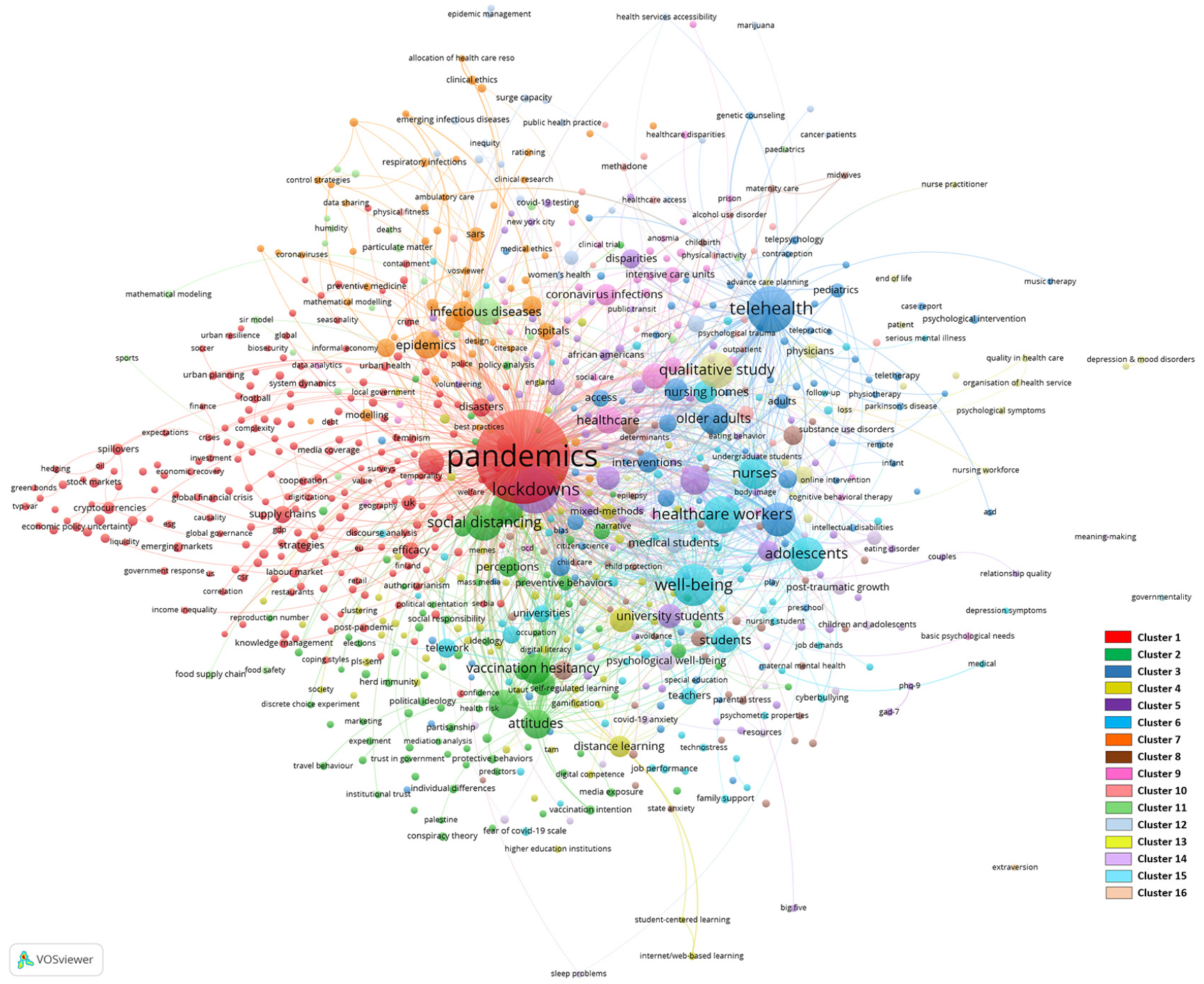
Keyword co-occurrence network, based on author keywords, of social sciences related COVID-19 research.
Cluster 3 (blue) involves 79 keywords, focusing on emotions and university-level educational experiences. It emphasizes learning processes, with terms like “university students” (303) and “distance learning” (237). Cluster 4 (yellow), with 77 keywords, explores demographic aspects, highlighting post-traumatic stress disorder and family support interventions. Key terms include “children” (649), “adolescents” (641), “young adults” (446), “families” (218), and “interventions” (214). Cluster 5 (purple), with 72 keywords, focuses on social distancing and vaccines, featuring ““social distancing” (738), “vaccines” (570), “vaccination hesitancy” (499), “attitudes” (456), and “risk perceptions” (451). Geographically, it mentions “Middle East” countries and “Croatia.”
Cluster 6 (cyan) includes 69 keywords, focusing on social issues during pandemics and benefits of social work. Key terms are “pandemics” (5,797), “disasters” (168), “masks” (127), and “health workers” (98), with mentions of countries like “Zimbabwe,”“Ireland,”“Southeast Asia,”“Ecuador,”“Cuba,” and “Palestine.” Cluster 7 (orange) has 69 keywords, emphasizing community well-being with terms like “well-being” (1,004) and “healthcare workers” (782), and “nurses” (571) alongside topics related to mental health such as “psychological well-being,”“posttraumatic stress,” and “basic psychological needs.” Geographically, “Qatar” is associated. Cluster 8 (brown) comprises 38 keywords, focusing on telehealth, including terms like “telehealth” (1,288) and “older adults” (511), and “aging” (265).
Cluster 9 (pink) comprises 37 keywords without central nodes, revolving around infectious diseases, with prevalent themes including “infectious diseases” (416) and “epidemics” (380). Cluster 10 (salmon) contains 36 keywords, focusing on health systems, with prominent terms such as “health systems” (234), “infections” (181), and “bibliometrics” (173). Cluster 11 (light green) consists of 35 items, focusing on qualitative studies of healthcare services, with key terms such as “qualitative study” (705), “healthcare” (394), and “perceptions” (210). Cluster 12 (light blue) includes 26 keywords, centered on nursing homes, with key terms such as “nursing homes” (270), “decision-making” (190), and “hospitals” (150). Clusters 13 (light yellow) and 14 (light purple) each contain only one term: “Extraversion” (20) and “cardiovascular diseases” (33), respectively. Furthermore, the network reveals several emerging topics interconnected within distinct clusters. Notable themes include “interventions” (282), “posttraumatic-stress-disorder” (182), “generalized anxiety disorder” (143), “mental well-being” (109), and “mental health problems” (72).
Table 2 presents the top 25 keywords by frequency in the dataset. Notable keywords with the highest occurrence include “pandemics,”“lockdowns,”“telehealth,”“well-being,” and “healthcare workers.” The cumulative occurrence of these keywords amounted to 19,542 instances, covering various themes. About 45.6% relate to public health and epidemiology, including “pandemics,”“lockdowns,”“social distancing,”“infectious diseases,” and “epidemics.” Keywords associated with demographics and risk factors represent 13.3%, including “children,”“adolescents,”“older adults,”“young adults,” and “risk factors.” COVID-19 vaccines account for 7.8%, with terms like “vaccines,”“attitudes,” and “vaccination hesitancy.”
The top 25 Keywords, Ranked Based on the Number of Occurrences.

RQ3
Institutions Collaboration
The international collaboration was examined using the software to compute the cumulative TLS for each institution and generate a network map. A higher TLS value indicates greater collaboration. A total of 39,067 institutions were identified in the main dataset, with 525 meeting the thresholds set at a minimum of 60 documents and no citations required.
Figure 4 illustrates 10 clusters in the network map with 24,307 links and 24,238.5 TLS. Cluster 1 (red) is the largest, encompassing 135 USA-based organizations. Harvard Medical School leads with 563 TLS, followed by Columbia University with 385 TLS, and Johns Hopkins University with 381 TLS. Cluster 2 (green) includes 71 institutions from the UK and Africa. University College London is the most collaborative institution with 506 TLS, followed by the University of Oxford with 506 TLS, and King’s College London with 433 TLS.

Global collaboration network at institution-level, based on co-authorship, of social sciences related COVID-19 research.
Cluster 3 (blue) includes 70 Australian affiliations, with the University of Melbourne as the most collaborative, gathering 428 TLS. Monash University and the University of Sydney follow closely, with 359 TLS and 290 TLS, respectively. Cluster 4 (yellow) contains 67 universities from EU countries. The Karolinska Institute leads with 192 TLS, followed by the University of Amsterdam with 151 TLS and the University of Copenhagen with 132 TLS.
Cluster 5 (purple) comprises 63 institutions, mainly Chinese institutions. Hong Kong Polytechnic University leads with 285 TLS, followed by the University of Hong Kong with 261 TLS, and the Chinese University of Hong Kong with 250 TLS. Cluster 6 (cyan) has 43 Spanish- and Latin American-based affiliations, led by the University of Sao Paulo. Leading institutions included the University of Sao Paulo with 170 TLS, the University of Barcelona with 118 TLS, and the University of Porto with 89 TLS. Cluster 7 (orange) comprises 63 Italian organizations. Collaborative affiliations included the University of Milan with 170 TLS, the University of Padua with 166 TLS, and the Sapienza University of Rome with 156 TLS.
Cluster 8 (brown) comprises 30 Canadian institutions. The University of Toronto leads with 688 TLS, followed by the University of British Columbia with 309 TLS, and McGill University with 235 TLS. Cluster 9 (light purple) consists of six Israeli universities, with Tel Aviv University and the University of Haifa prominent with 156 TLS and 143 TLS, respectively. Cluster 10 (salmon) composes of five institutions, notably the Tehran University of Medical Sciences with 77 TLS.
Countries/Regions Collaboration
The main dataset comprised 211 countries, of which 147 met thresholds: at least 10 documents and no citations.. Figure 5 presents country clusters with 5,345 links and 26,651 TLS. At the center of the visualization, cluster 1 (red) emerges as the largest cluster, encompassing 40 countries, led by the USA. Collaborators within this cluster include Canada, France, and Switzerland. A significant African presence was observed, with South Africa and Nigeria acting as central hubs facilitating collaboration with nations such as Kenya, Ghana, and Uganda. Cluster 2 (green) comprises 40 countries, predominantly European nations, with Italy as the most productive. Notable collaborations follows from Germany, Italy, the Netherlands, Sweden, and Portugal, with Germany notably contributing to global publishing efforts. Italy is notable in both productivity and visibility and is positioned in the bottom-left quadrant in the visualization.

Global collaboration network at country-level, based on co-authorship, of social sciences related COVID-19 research.
Cluster 3 (blue), with 39 countries, led by India, the main publications producer, sees significant collaboration, notably from Pakistan, Saudi Arabia, and South Korea. This cluster includes Japan, Taiwan, the UAE, and Egypt. Cluster 4 (yellow), with 19 countries, shows notable connectivity, especially among Spain, Brazil, and Chile, featuring Argentina, Peru, and Ecuador. Spain and Brazil serve as key hubs. It is located in the bottom-left quadrant in the visualization. Cluster 5 (purple), centrally located, has eight countries, led by England, with Australia, Scotland, and Ireland as major contributors. Cluster 6 (light blue) represents China.
RQ4
Figure 6 shows the top 20 organizations by paper production, citation, and collaboration. The University of Toronto (TLS = 688), Harvard Medical School (TLS = 563), and the University of Oxford (TLS = 506) led the collaborations. For productivity, the University of Toronto (n = 844) ranked first, followed by University College London (n = 725) and the University of Oxford (n = 768). In terms of influence, the University of Oxford (TC = 16,374), University College London (TC = 16,050), and the University of Toronto (TC = 14,084) were the most influential. In Figure 6a, 45% of the top organizations were in the USA, UK comprised 20%, Australia 15%, and Hong Kong and Canada 10% each. Figure 6b showed 30% of influential organizations in the UK, 25% in the USA, 15% in China, and 10% in Singapore. In Figure 6c, 50% of the top collaborating institutions were in the USA, 20% in the UK, and 15% each in Australia, Canada, and Hong Kong. Figure 6d illustrated global collaboration percentages for each affiliation.

The topmost organizations in the COVID-19 scientific research in social sciences, based on the dataset of the current study and arranged by various indicators: (a) the number of articles published, (b) the number of citations collected, (c) the number of TLS, and (d) the global percentage of collaboration.
Figure 7 presents the top 20 countries by publications, citations, and TLS values. The USA led in document production (n = 20,114), citations (n = 230,458), and TLS (n = 6,850), contributing to 25.7% of the total documents. England ranked second, with 18.6% of TLS, 11.4% of production, and 119,309 citations. China secured third place, with a TLS of 13.6%, 12.7% of production, and 114,073 citations.

The topmost countries in the COVID-19 scientific research in social sciences, based on the dataset of the current study and arranged by various indicators: (a) the number of articles published, (b) the number of citations generated, (c) the number of TLS, (d) the global percentage of collaboration, and (e) the proportion of TLS to the number of documents.
In the top 20 partnerships, North America was represented by the USA and Canada. Europe dominated with ten entries: England, Germany, Italy, Spain, France, the Netherlands, Switzerland, Sweden, Poland, and Turkey. Asia had six representatives: China, India, Saudi Arabia, South Korea, Japan, and Israel. Brazil represented Latin America. Figure 7e shows the TLS values relative to document production. The USA, China, and Italy had relatively low TLS with 0.34, 0.43, and 0.43 links per publication, respectively. Conversely, Sweden, Switzerland, and France had higher values (0.73, 0.72, and 0.7 links per document, respectively), despite contributing 1.7%, 1.8%, and 2.4% of the total documents.
Discussion
This study aimed to map COVID-19 research in SSR, identifying hot spots, emerging topics, global collaboration networks at organizational and country levels, as well as trends and patterns. It provided insights into research volume, distribution, and collaboration. With 227,335 authors contributing to 65,742 documents, researchers widely engaged in COVID-19 study, reflecting scholarly commitment. These documents appeared in 8,247 scientific sources, indicating broad dissemination. The year 2021 saw the highest paper count, reflecting evolving pandemic urgency. Despite fewer publications, 2020 had higher citation counts, signifying early research impact.
Research collaboration is evident, with 59,408 documents authored by multiple authors, compared to 6,334 by single authors, Table 1. This emphasizes knowledge exchange’s importance in addressing challenges like COVID-19. The collaboration index, averaging 4, indicates moderate collaboration per document, highlighting SSR’s collaborative nature. The 0.3 average document-per-author ratio implies each author contributes to multiple documents on average, emphasizing collective researcher engagement.
Key Topics and Emerging Themes
Identifying key topics in COVID-19 research within SSR is crucial for efficient resource allocation. It allows researchers and institutions to prioritize impactful areas, address knowledge gaps, and respond promptly to emerging issues. This supports pandemic mitigation efforts and informs policymakers for informed decisions. Recognizing hot topics prevents research duplication, enables focus and methodological adaptation, ensuring ongoing relevance and impact.
Subjects discussed in the present study were problems raised during the health crisis, including inequalities in receiving health services, providing distance health care through telehealth, economic problems, people’s well-being, and education challenges. The topmost terms included “telehealth,”“well-being,”“healthcare workers,”“vaccines,”“inequalities,” and “emotions.” The identified key topics on COVID-19 provides valuable insights into the direction and priorities of SSR.
Telehealth
Telehealth, defined as patient care delivery via telecommunications (NEJM Catalyst, 2018). During SARS-CoV-2, telehealth played a crucial role in providing healthcare services, enabling healthcare access while reducing infection risks. It facilitated remote work for healthcare providers, prescription refills, mental health support, and access expansion in rural areas (Giles et al., 2021; Kodjebacheva et al., 2023; Smith et al., 2020). Telemedicine is important, particularly for special groups such as the elderly who are facing serious difficulties, especially those in social isolation and loneliness (Y. L. Liu et al., 2022). The heightened focus on telehealth indicates an imperative shift toward exploring innovative and technology-driven solutions to ensure the continuity of healthcare services while adhering to social distancing measures.
Well-being
The consistent focus on people’s “well-being” acknowledges the pandemic’s profound impact on individuals and communities. Research in this area likely delves into understanding the multifaceted dimensions of well-being, including mental health, social connectedness, and overall quality of life, in the context of the ongoing COVID-19 crisis. This reflects a growing concern for the psychological and social ramifications of the pandemic, emphasizing efforts to address the challenges associated with prolonged periods of isolation and disrupted social interactions. Technology served as a vital communication tool, fostering connectedness and social support (Esposito et al., 2021). Nevertheless, prolonged exposure to smartphones can increase the risk of smartphone addiction and contribute to cognitive, emotional, and behavioral disorders, affecting psychological well-being (Popescu et al., 2022). Prioritizing longitudinal studies on well-being can provide valuable insights into the evolving nature of psychosocial challenges over time. This can inform adaptive strategies and interventions to support individuals and communities throughout the different phases of the pandemic.
Healthcare Workers
Healthcare workers have played a crucial role during COVID-19, serving on the front lines to provide care, support, and expertise. Their efforts have saved lives, prevented the spread of the virus. Research in this area “healthcare workers” likely delves into the occupational challenges faced by healthcare workers, including issues related to workload, shortage of personal protective equipment, burnout, mental health, coping strategies, and the emotional toll of dealing with a protracted health crisis (Al-Tawfiq & Temsah, 2023). Challenges faced by healthcare professionals can inform policies and interventions aimed at supporting this critical workforce during and beyond the pandemic.
Vaccines
The development of COVID-19 vaccines is crucial in the global pandemic response, controlling virus spread, preventing severe illness, and safeguarding public health (Mahdi & Almukhtar, 2023). The continued attention to “vaccines” as a key topic signifies a sustained focus on intervention, vaccine development, distribution, and acceptance efforts. This area of research likely explores vaccine efficacy, public perceptions, hesitancy barriers, and equitable distribution strategies, considering socio-cultural influences. Notably, clinical studies have shown that the benefits of vaccination outweigh the risks caused by adverse reactions (Wang et al., 2023). International research can enhance understanding of vaccine challenges and global solutions.
Emotions
The inclusion of “emotions” as a key topic highlights the complex interplay between psychological responses and COVID-19. Research in this area likely seeks to explore the emotional dimensions of individuals and communities in response to the uncertainties, challenges, and disruptions brought about by the pandemic. Understanding and addressing the emotional impact of the crisis is essential for comprehensive public health responses. Mental health support, community engagement, and fostering a sense of resilience are integral components of mitigating the emotional challenges associated with COVID-19 (Córdova et al., 2023). Insights emotional well-being and coping mechanisms provide a foundation for designing targeted interventions and support systems for individuals and communities affected by the crisis.
Inequalities
COVID-19 has highlighted and exacerbated existing inequalities in health care access and outcomes globally. Several factors contribute to these disparities, including socioeconomic status, race, ethnicity, geography, and existing healthcare infrastructure. Actively working to mitigate these disparities is crucial for a more equitable and effective response to SARS-CoV-2 (Ahmed et al., 2020; Dorn et al., 2020; Ferreira et al., 2020). SSR can inform policies aimed at reducing health inequalities, understanding the social determinants of health, and ensuring equitable access to healthcare resources.
This investigation explored the key topics across diverse community demographics, including children, adolescents, older adults, and young adults. These topics constitute areas of focus in COVID-19-related research in SSR and are expected to remain relevant. Consequently, it is imperative for forthcoming studies to persist in concentrating on these themes. This highlights the need for stakeholders, funders, and policymakers to understand the challenges examined by scientists to address the COVID-19 impacts for long-term social development. Achieving sustainable social development requires focused investment in these key research areas, offering benefits such as resolving tangible societal issues, conserving resources, and accelerating knowledge creation.
The term “pandemics” is central in the network due to its strong connections with other terms in different clusters, as researchers often associate it with various research topics. Despite the preventive measures such as “lockdowns” and “social distancing” are not in place, this study found them to be prominent keywords, extending previous research findings (N. Liu et al., 2020). This prevalence is likely due to the significant number of publications addressing issues related to these terms. Due to quarantines and social distancing measures, individuals’ well-being has been greatly affected. As a result, recent COVID-19 research often focuses on the well-being of community members. Nasir et al. (2020) identified a rising interest in “well-being” research, echoed in the present study, highlighting its central significance in the network. This parallels earlier COVID-19 research identifying key terms like “vaccine,”“lockdown,”“healthcare,” and “pandemic” (Aristovnik et al., 2020). The present study builds upon the findings of Y. L. Liu et al. (2022), indicating that COVID-19 had affected education. Because of the lockdowns, most students were shifted to distance learning due to the inability to attend regular in-person classes.
Observable among the emerging topics are “posttraumatic-stress-disorder,”“generalized anxiety disorder,” and “mental well-being.” A comprehensive understanding of these topics is essential for grasping the evolving research landscape and guiding future scholarly pursuits. Post COVID-19 patients experienced a challenging and stressful situation, leading to the development of post-traumatic stress disorder (Castillo et al., 2022; Halouani et al., 2023). Moreover, COVID-19 has affected the mental health of individuals, resulting in an increased prevalence of generalized anxiety disorder (Alphonsus & Abayateye, 2022; Zakeri et al., 2021). Additionally, public health protective measures and limited resources have affected the mental well-being of individuals, including healthcare workers, serving as stressors in their lives. These stressors have elicited negative mental health reactions (Levacher et al., 2023; Seidi et al., 2020; Vanhaecht et al., 2021). It was important to address these challenges and implement appropriate interventions to overcome these threats and decrease the deleterious impact of the pandemic on mental health.
The findings of this study extend those of Roychowdhury et al. (2022) elucidating the continued significance of topics pertaining to mental health problems among individuals, healthcare workers, and disruptions in business and supply chains within COVID-19-related research. Additionally, the present investigation builds upon the observations made by Nasir et al. (2020) wherein terms such as “pandemics,”“epidemics,”“infectious diseases,” and “labor markets” were identified as prominent topics.
In the early stage of COVID-19, the scientific community responded by prioritizing public health safeguarding, as evidenced by keyword trends such as “viral disease,”“China,”“disease transmission,”“mortality,”“respiratory disease,” and “drug efficiency” (Aristovnik et al., 2020). Contrarily, themes related to mental health, psychology, social media, infodemics, and physical activities as identified by Y. L. Liu et al. (2022) were not prominent.
Notably, with the persistence of the pandemic, the initial research trends examining the origins of COVID-19 and methods of identification and diagnosis did not feature prominently in the present study’s trends. A shift from health-related topics to other relevant scientific topics is observable. In the present state, the global community is confronted with the imperative task of addressing the adverse effects of the pandemic on mental health and the economy, while simultaneously enhancing the overall well-being of humankind. Consequently, future investigations within SSR should study the influence of COVID-19 on individuals, communities, and their environments, which are commonly connected with business economics and quality of life, as mentioned by Roychowdhury et al. (2022). In the midst of COVID-19, global universities’ output in SSR underwent significant shifts, as reflected in the keyword trends outlined in Table 2. The analysis of these keywords offers insights into the evolving research priorities and focal points during different phases of the pandemic. Future scientometrics could discuss each key topic prominent in this study in detail.
The dynamic analysis of keyword trends presented in Table 2 offers insights into the evolving research priorities during different phases of the pandemic. The substantial increase in occurrences of keywords such as “Pandemics” and “Lockdowns” across the years highlights the heightened focus on understanding and mitigating the impacts of the pandemic itself. This likely corresponds to a surge in research aimed at analyzing the epidemiological aspects of the virus and assessing the efficacy of various public health interventions, including lockdown measures. The rise in occurrences of “Telehealth” and “Healthcare workers” underscores the necessity for innovative healthcare delivery models and the essential role played by healthcare professionals. This suggests a significant shift toward exploring telemedicine solutions and supporting frontline workers.
Furthermore, keywords related to mental health and social dynamics, such as “Well-being” and “Social distancing,” also experienced an upward trajectory. This indicates a growing concern for the psychological and social ramifications of the pandemic, as well as efforts to understand and address the challenges associated with prolonged periods of isolation and disrupted social interactions. The inclusion of “Vaccines” and “Vaccination hesitancy” reflects the intensifying focus on vaccination strategies and public attitudes toward immunization. As vaccination campaigns gained momentum, research attention likely shifted toward assessing vaccine efficacy, addressing hesitancy barriers, and strategizing equitable distribution. Keywords such as “Children,”“Adolescents,”“Students,” and “University students” emphasize the multifaceted impacts of the pandemic on education systems and student populations.
Moreover, the persistence of keywords like “Risk factors” and “Health behavior” highlights ongoing efforts to identify and mitigate factors contributing to the spread of the virus and to promote health-conscious behaviors within communities. Understanding the determinants of infection risk and encouraging adherence to preventive measures remained crucial areas of investigation throughout the pandemic. These trends reflect the dynamic nature of scientific research, with researchers adapting their focus to address emerging challenges and priorities throughout different phases of the global health crisis.
Institutions Collaboration
Understanding scientific collaboration patterns among universities in COVID-19 research within SSR lies in optimizing resource utilization, improving research quality, fostering knowledge transfer, gaining diverse perspectives, identifying research priorities, accelerating responses to challenges, and strategically planning for future pandemics. These patterns serve as a valuable roadmap for creating a more resilient and collaborative global research community.
Figure 4 illustrates the key leaders within the clusters of the social network of collaborative institutions Harvard Medical School, University College London, University of Melbourne, Hong Kong Polytechnic University, University of Milan, and University of Toronto. Notably, while these clusters played potential roles in the network, none occupies a central position on the network map. All clusters were close to the center by the same distance, suggesting similar roles among these institutions in COVID-19 research in SSR.
Furthermore, prominent institutions such as the University of Toronto and the University of Oxford play fundamental roles in fostering collaborative research on COVID-19 within SSR. Oxford University serves as a central hub for knowledge exchange among local and global universities. It maintains connections with respected institutions, including Washington University and Harvard University in the USA, Monash University in Australia, the University of Toronto in North America, and the National University of Singapore in Asia. Acting as a vital link, the Chinese University of Hong Kong facilitates knowledge transfer between Chinese universities and Oxford University. These partnerships have enabled Oxford University to contribute to a global understanding of the social dimensions of COVID-19and to foster collaborative responses. The university’s research centers, such as the Oxford Martin School and the Blavatnik School of Government, have facilitated interdisciplinary collaboration among social scientists, epidemiologists, and policymakers. Oxford’s expertise in public policy, economics, sociology, and psychology has contributed to understanding how individuals and communities respond to public health measures, vaccine hesitancy, and the social inequalities exacerbated by the pandemic (Oxford University, 2024).
Likewise, the University of Toronto fosters collaborative ties with institutions across North America and various continents, such as Melbourne University in Australia, Oxford University in the UK, and the National University of Singapore. Departments such as sociology, psychology, economics, public health, and political science have been involved in studying various aspects of the pandemic’s social impact. The university has facilitated interdisciplinary research and collaborative efforts by creating research networks, organizing seminars, and providing funding opportunities for interdisciplinary projects related to COVID-19. The university’s expertise in data analytics and social research methods has been instrumental in understanding the behavioral responses to the pandemic, the effectiveness of public health interventions, and the socioeconomic implications of COVID-19 (University of Toronto, 2024).
The outcomes of this investigation build upon the findings reported by Y. L. Liu et al. (2022). The proximity of geographical locations impact the degree of collaboration among nations, owing to the inherently regional nature of social challenges. It is discernible that individuals across the globe inhabit varied social atmospheres, thereby eliciting diverse responses (Y. L. Liu et al., 2022). Consequently, it might be anticipated a reduction in international collaborations, with a prevailing trend toward domestic collaborations.
In Figure 6a to d, institutions within the USA were the most collaborative and led the publication efforts among the top 20 institutions, contributing to 20,114 articles, conversely institutions located in England emerged the most influential, as depicted in Figure 6b. Notably, within the top 20 universities, the University of Toronto made the most substantial contributions to COVID-19-related SSR and emerged as the most collaborative institution, while the University of Oxford had the highest number of citations. At the initiative of COVID-19, the University of Hong Kong demonstrated leadership among the most productive institutions, followed closely by the University of Toronto, as indicated by Nasir et al. (2020). In the present investigation, the volume of publications from the University of Toronto surged more than eightfold, from 95 to 844, compared to the figures reported by Nasir et al. (2020).
Aristovnik et al. (2020) highlighted the important roles played by the California Department of Public Health and Public Health–Seattle and King County in SSR. Furthermore, Y. L. Liu et al. (2022) reported that Harvard University exhibited exceptional levels of productivity and international collaboration (TLS = 305) with The University College London (TLS = 75) and the University of Oxford (TLS = 81) following closely in second and third, respectively. Roychowdhury et al. (2022) observed that the University of Oxford ranked first in scientific productivity (n = 105), followed by the University of Toronto (n = 95). Additionally, the USA, England, and Australia are home to the most contributing affiliations in COVID-19 research within SSR. The present study extends previous findings, demonstrating that the majority of publishing universities are based in the USA.
Countries Collaboration
In Figure 5, key collaborative partners of the clusters were the USA, Italy, India, Spain, England, and China. Researchers from the USA have worked extensively in partnership with researchers from Canada, France, and Switzerland. Roychowdhury et al. (2022) found England, Canada, and China were the most important contributors in research to the USA. In the present study, the USA, England, and Germany gain more central positions in the network, with China positioned toward the lower end of the map. This indicates the significant roles of the USA, England, and Germany in research production and international collaboration. Additionally, collaborations among the USA, England, China, and Australia exceeded those between any other countries, aligning with previous findings (Roychowdhury et al., 2022). Moreover, geographic location can influence collaboration patterns among countries or regions, with a greater volume of publications often correlating with a broader network of connections, as noted by Y. L. Liu et al. (2022).
The present investigation highlights the USA as the foremost contributor to document production, despite being the nation most profoundly impacted by the pandemic in terms of infection rates and fatalities (Melendez, 2021; Saladino et al., 2020). This dominance is expected given the USA produces most output of SSR worldwide (Y. L. Liu et al., 2022). Furthermore, the USA has the largest number of international collaborations, in parallel to the fact that 45% of the top productive institutions being located within its borders.
In the initiatives of COVID-19, China emerged as a key scientific center for pandemic research. However, as the pandemic progressed, the USA surpassed China in global scientific production (Duan & Xia, 2021). These findings extend previous literature identifying the USA, China, and England as the top three nations in terms of productivity, citation rates, and collaboration (Nasir et al., 2020; Roychowdhury et al., 2022). Aristovnik et al. (2020) identified India as following the USA and China in an investigation conducted at the onset of COVID-19.
Moreover, Nasir et al. (2020) noted limited collaboration among countries, with China leading, followed by the USA and the UK. Additionally, the USA ranked highest in document production, followed by Canada and China. In terms of citations, Hong Kong held the top position, followed by the USA and the UK. These insights underscore the complex dynamics of global collaboration and productivity in SARS-CoV-2 research. England, Scotland, North Ireland, and Wales, along with Italy, France, and Spain were among the European nations that experienced both first- and second-wave COVID-19 in April and September 2021 (Cai et al., 2021). Despite this, these countries demonstrated a significant presence in scholarly publications within the dataset of the present study. This suggests a positive correlation between the volume of scholarly research output and the overall number of COVID-19 cases in Europe (Sachini et al., 2021). In contrast, Russia reported a high number of pandemic infections and did not feature among the top 20 collaborative countries. The analysis revealed that African nations had the smallest share in the publication, while North American, European, and Australian countries demonstrated significantly higher levels of publication output compared to South American and Asian nations. These findings align with the result reported in prior literature (Roychowdhury et al., 2022). To bridge this gap and address regional challenges faced by countries with limited research capacities, there is a pressing need for increased global collaboration among social science researchers. Such collaborations can contribute to addressing regional challenges of countries with limited domestic research capabilities.
Enhancing global collaboration, especially with regions that have limited domestic research capabilities, is crucial for promoting knowledge exchange and addressing global challenges. Such collaboration could be facilitated by encouraging international meetings to expand connections. This could establish the formation of partnerships and networks between researcher, institutions, and universities from different countries. Further, governments and international organizations should offer funding programs specifically targeted at supporting collaborative research projects between institutions in developed and developing countries. More, researchers should be encouraged to share their data openly with the global scientific community. This will allow scientists from regions with limited capabilities to access valuable datasets for their own analyses and contribute to global research efforts. Moreover, developing online platforms that enable researchers from different parts of the world to connect virtually for collaborative projects. These platforms can facilitate communication, data sharing, joint publications, and virtual conferences or seminars. Governments should advocate for policies that promote international collaboration in scientific research and allocate resources accordingly.
In Figure 6a to d, despite having a substantial number of links, the total link strength values for institutions like University of British Columbia, University of North Carolina, University of California San Francisco, and University of California Los Angeles are relatively low compared to other universities in the table. This suggests that although these institutions have connections to a significant number of documents, the strength of those connections in terms of citations or collaborations may be weaker compared to other universities listed. This could indicate potential challenges or limitations in the influence of research output from these institutions within their respective clusters or research domains.
In Figure 7b to e, a direct correlation between the number of citations and the number of links was observed. Notably, countries like the USA, England, and China stood out for their high citation counts relative to their large number of gathered links. However, Italy presented an exception, displaying a high citation count despite a relatively lower TLS, confirmed by only 0.43 links per document (Figure 7e). The TLS value in relation to the number of produced documents was notably low in countries such as the USA, China, and Italy, with 0.34, 0.43, and 0.43 links per publication, respectively, despite their substantial international production shares of 30.6%, 12.7%, and 6.3%, respectively. This suggests a lower number of countries involved per document in these cases, resulting in a lower level of global collaboration per document. In contrast, countries such as Sweden, Switzerland, and France exhibited higher TLS values of 0.73, 0.72, and 0.7 links per document, respectively despite their lower contributions to international production at 1.7%, 1.8%, and 2.4%, respectively. This finding indicates a broader involvement of countries in document production, resulting in a higher level of global collaboration per document. These observations highlight the importance of considering both number of citations and link strength in assessing the collaborative nature of research outputs across different countries.
Despite having a substantial number of documents (1,599), the average citation rate is relatively low (2.43), indicating that the research output from South Korea may not be receiving as much recognition or impact within the academic community compared to other countries. Similar to South Korea, Japan also exhibits a low average citation rate (1.96) despite having a considerable number of documents (1,290), suggesting potential challenges in the visibility or impact of research output from Japan.
Comparing with the findings of earlier studies (Y. L. Liu et al., 2022; Nasir et al., 2020; Roychowdhury et al., 2022), the dataset examined in this study reveals a growing trend of international collaboration over time, with an increasing number of countries involved. This trend correlates with the rise in both publication volume and scientific contributions, allowing researchers to benefit diverse expertise, resources, and perspectives. By coining together insights, methodologies, and data from different countries, this collaborative approach enriches the quality and depth of the research, thereby contributing to a more comprehensive understanding of the complex and multi-dimensional facets of SARS-CoV-2.
Implications
The identified key themes provide a strategic framework for prospective SSR endeavors concerning COVID-19, facilitating stakeholders in addressing critical concerns, fostering collaborative efforts, and shaping policy interventions to navigate the ongoing global health emergency. These insights provide researchers an opportunity to conceive interdisciplinary studies that probe the intricate dynamics of healthcare provision, technological integration, and societal dynamics amidst the pandemic. Policymakers can utilize these insights to devise evidence-based strategies prioritizing healthcare personnel’s well-being, fortifying telehealth infrastructure and mitigating socioeconomic disparities. Furthermore, academic institutions stand to benefit by adapting their research agendas, curriculum development initiatives, and resource allocations to accord with the identified principal themes. Researchers can adopt similar approaches to topic exploration from multifaceted perspectives as demonstrated in this study. This analysis reveals connections between the primary topic and specific influencing variables, thereby offering valuable insights into the interrelated dimensions of the subject matter.
Moreover, the findings suggest a list of potential collaborative research partners based on geographical proximity, with esteemed institutions such as Harvard Medical School, University College London, the University of Melbourne, Hong Kong Polytechnic University, the University of Milan, and the University of Toronto emerging as frontrunners in scientific collaboration. Furthermore, the study highlights Sweden, Switzerland, and France as particularly conducive environments for collaborative scientific endeavors, offering opportunities for stakeholders to address localized challenges effectively.
Limitations
The methodology employed in this study was limited to sources written exclusively in English. While this constraint may not significantly affect the interpretation of the findings, it is acknowledged that WoS may offer a constrained representation of SSR output from non-English-speaking countries (Lariviere & Macaluso, 2011). This study relied on data extracted from the SSCI. Notably, certain medical journals are indexed in both the SCIE and SSCI, including titles such as The Lancet and The New England Journal of Medicine. However, papers published in these journals were not manually screened for relevance to ensure alignment with the objectives of this study, potentially introducing bias into the dataset. Additionally, the inclusion criteria were confined to research and review articles, excluding participations presented at conferences, short notes, and other formats. However, given the burgeoning volume of publications on this subject, it was imperative to refine the data by focusing solely on research and review articles to obtain the most pertinent information and enhance the quality of the dataset.
Future Research
Future research may seek to enhance the methods employed in this investigation. While the manuscript utilizes WoS, future improvements could involve incorporating data from multiple sources. Diversifying data sources can provide a more comprehensive understanding of the research landscape. Moreover, future studies might incorporate efforts to validate and calibrate the proposed model by openly disseminating the datasets utilized. This could ensure the reliability and accuracy of the methodology across different conditions and contexts. Furthermore, conducting temporal studies can elucidate evolving indicators, relationships, and relevant scientific topics, contributing to a dynamic comprehension of COVID-19 impacts and responses.
Conclusions
The aim of this investigation was to provide scientific output, highlight key research themes, emerging trends, and patterns, dynamics, and trends of scientific collaboration at both institution and country levels in COVID-19 research within the social sciences domain. A notable surge in research output was observed during the initial phase, reaching its zenith in the year 2021. The findings emphasize the collaborative nature inherent in COVID-19 research within SSR domain. The evolving research landscape encompass a broad spectrum of critical areas, including socio-economic impacts, public health interventions, mental health implications, and responses of healthcare systems. Prominent among the research topics were “telehealth,”“well-being,”“inequalities,”“emotions,” and “vaccines.” Furthermore, the emergence of key topics such as “interventions” and “mental well-being” underscores the dynamic nature of research interests in response to the evolving dynamics of the pandemic. The findings underscore extensive collaboration among institutions from diverse countries, emphasizing the global character of scientific collaboration in response to COVID-19. However, regional collaboration tends to predominate over global cooperation in this study. Certain institutions emerge as frontrunners in terms of collaboration, productivity, and influence, such as Harvard Medical School, the University of Toronto, and the University of Oxford, reflecting their substantial contributions to COVID-19 research. The examination of collaboration trends reveals varying patterns of collaboration intensity across different regions, with notable contributions from institutions in the USA, UK, Australia, Canada, and Hong Kong.
Collaboration patterns at country level reveal both regional concentrations of research efforts and thematic focuses. Regional hubs such as the USA, Italy, India, Spain, and Brazil play crucial roles in facilitating collaboration among neighboring or related countries. The USA and China demonstrated higher levels of global collaboration. These countries, in addition to England, exhibited leadership and influence and played central roles in disseminating scientific knowledge. These findings provide valuable insights for policymakers, funding agencies, and researchers, emphasizing the importance of fostering and supporting future research topics and collaborative initiatives to address complex public health challenges on a global scale. By leveraging this, the scientific community can better respond to present and future pandemics, ultimately improving global health outcomes. By conducting paradigm studies, such efforts can enhance the global sustainability and well-being of humans. More international collaboration is needed to address the regional challenges of countries with limited domestic research capabilities. In future research, the methodology used in this investigation could be improved by diversifying data sources beyond the WoS database. Datasets of this study are available for sharing.
Footnotes
Declaration of Conflicting Interests
The authors declared no potential conflicts of interest with respect to the research, authorship, and/or publication of this article.
Funding
The authors disclosed receipt of the following financial support for the research, authorship, and/or publication of this article: The authors extend their appreciation to the Deputyship for Research & Innovation, Ministry of Education in Saudi Arabia for funding this research work through the project number (PNU-DRI-Targeted-20-022).
