




Abstract
The “Boomerang Effect” (BE) is a contemporary phenomenon in England and wider Europe, referencing young adults who move out of their parents’ home to live independently but eventually return to live with their parents again. Despite concerns about residential independence and the intensification of BE due to the COVID-19 pandemic, there is limited qualitative data investigating it. This qualitative study utilizes diary methods to elicit the perspectives and experiences from six mother-young adult child dyads in England for 21 days to enable holistic and dynamic insights on the day-to-day exposures to the BE phenomenon. Findings resulted in several salient themes: (1) prime concerns shaping living arrangements, (2) framing of (participant) role, (3) conceptualization of [participant] identity, (4) nature of family relations, (5) depiction of independence, and (6) perceived situational input of Government. This work underscores the interdependent and complex relationship between structure and agency manifest in the BE context.
Plain language summary
This qualitative study examines the Boomerang Effect (BE) in England during the COVID-19 pandemic, where young adults initially move out of their parents’ home but later return to live with them again. The aim is to understand this modern phenomenon and its impact. Data were collected using diary methods from six mother-young adult child pairs in England over 21 days, offering detailed insights into daily experiences related to BE.
Keywords
Background
The “boomerang effect” is a contemporary phenomenon in Europe (Berrington et al., 2013; Furstenberg, 2013; Stone et al., 2011). The definition of a “boomerang” in this paper, is a young adult child required to extend their co-residence in the parental household for a variety of factors. It also includes adult-children who depart and subsequently return to their parent’s household for at least 4 months. This phenomenon goes in tandem with the transition to adulthood, one that has been “extended,” intensifying relationships between adults and their parents (Fingerman et al., 2020). Cultural construction of emerging adulthood is suggested to delay personal characteristics such as “accepting responsibility for oneself and making independent decisions” (Olofsson et al., 2020). Therefore, it can be argued that the boomerang effect might also create scenarios where young adults delay moving out of the family home due to various socioeconomic factors. It has been suggested that there is a higher proportion of Canadian and American young adults residing with their parents (Mazurik et al., 2020). In the United Kingdom, in particular, cases are on the rise in regard to co-residence between young adults and their parents (Stone et al., 2011). To capture this, Figure 1 shows the percentage of young adults aged 20 to 34 residing with their parents in 2019 as compared to 1996. It can be noticed that there is considerable increase in the proportion of young adults residing with their parents in 2019 after the age of 20, particularly between the ages of 22 and 27.

Percentage (%) of young adults (aged 20–34) living with parents, 2019 versus 1996.
In recognizing these rising cases, for boomeranging young adults (henceforward referred to as “BYAs”)—independent living is potentially hindered as they return to the parental household, maybe more than once (Berrington et al., 2013). The transition to adulthood is connected to achieving independent living, however, there is a trend towards a new, normative pattern that can be seen as “late, protracted and complex” (Billari & Liefbroer, 2010, p. 60).
Research is more limited when it comes to its scrutiny of parental adaptation to changes in living arrangements, even though parents wellbeing can be affected by their prospect of them residing alongside their young adult child (Tosi, 2020). In confronting the salience of the phenomenon as the subject of this research, we address the need to investigate the perspectives in the dyadic form, thereby comprising both BYAs as well as their mother—to understand how the context about adaption can be understood more comprehensively. The importance of this is reinforced in consideration of co-residential experience and perceptions due to the COVID-19 pandemic—with more research interested in how this external stressor may affect such living arrangements. Particularly, how contingency plans are implemented and adopted for being sensitive and responsive to new requirements surrounding families and households exposed to the effects of the pandemic (Hantrais et al., 2021).
Set against the backdrop of co-residence among BYAs and their mothers during the pandemic of COVID-19, the research questions and objectives formulated stem from White’s (1994) future study recommendations:
(1) What are the contemporary perceptions and experiences of co-residence among BYAs and their mothers in England?
(a) How are roles and identities formed and negotiated within their relationship, in context of their co-residence?
(b) What characterizes their dynamic relations and sense of “independence” regarding this type of living arrangement?
(c) What are the possible implications and recommendations for policy?
The objective of this work is to adopt computerized diary methods, accompanied by a set of guiding open-ended points of reflection, to gather relevant data and generate analysis in response to the research questions. The purpose of this study was to explore the impact of co-residence between young adults and their parents, with a particular focus on the effects of the COVID-19 pandemic. We aim to illuminate how families adapt to these living arrangements and the associated stressors, including how extended co-residence influences independence and role negotiation. By identifying the challenges and needs of families, we seek to offer actionable policy recommendations to improve support systems. Additionally, to address the gaps in existing literature we provide new insights into the parental perspective and the broader implications of the pandemic on co-residence. The findings are also intended to provide practical guidance for counsellors, social workers and other professionals working with families in such arrangements.
The pertinence of the transition to adulthood, as previously referred to, is key as it provides the context behind the “boomerang effect” phenomenon. For developed nations such as those in Europe, the transition to adulthood is more rendered protracted, less uniform and more disorderly in comparison to developing nations (Furstenberg, 2013). For example, there has been a rise in the average age at which certain significant life events, such as marriage and having children, occur (Reifman et al., 2007). Additionally, a considerable proportion of young adults who return to live with their parents after leaving the nest have been observed (Reifman et al., 2007). Tanner and Arnett’s (2016) work posits three key attributes of emerging adulthood: (i) transformation from an industrialized to an “information” economy, and the related rise in want for beyond secondary-tier education, (ii) sizeable rises in educational and work-related opportunities for women (where most of them pursued post-secondary education), about prioritizing career progression over marriage and childbearing at earlier ages, (iii) greater lenience of intercourse prior to marriage.
It is also worth recognizing the cited causes and implications of so-called boomeranging. As a group, BYAs are heterogeneous and as a result, their experiences cannot be conceived of as generalizable (Coles et al., 1999). Indeed, it has been found that a plethora of diverse factors can influence the options that young adults have for residence, as part of their transition—such as the proclivity to return to the parental household (Houle & Warner, 2017). In noting the micro and macro factors which may contribute to the chance of returning to the parental home; Arundel and Lennartz (2017) maintain that micro factors incorporate unexpected fiscal hindrances, breakdown of relationships with a partner, and individual and family attributes, namely tied to employment, income level and educational attainment. The macro category includes social policies, housing systems, fiscal/tax, labor markets and welfare state inputs.
Tied to this field of study which is predominantly of sociological inquiry, the concepts of structure and agency persist (Schwartz et al., 2005). These concepts play a significant role in influencing a transition to adulthood (Macmillan, 2006), yet there is limited understanding about it (Arundel & Ronald, 2016). Figure 2 demonstrates the forces of structure and agency as pinned to the transition of adulthood.

Illustration of structure and agential forces and their interplay within the wider sphere of the transition to adulthood.
Method
Primary data collection involved a qualitative design, to gather perspectives and experiences of co-residence among BYAs and their mothers in England.
Participants
Participants were recruited through a combination of convenience and purposive sampling, due to their efficient and deliberate capacity (Jager et al., 2017), albeit not generalizable to the true population level (Kriska et al., 2013).
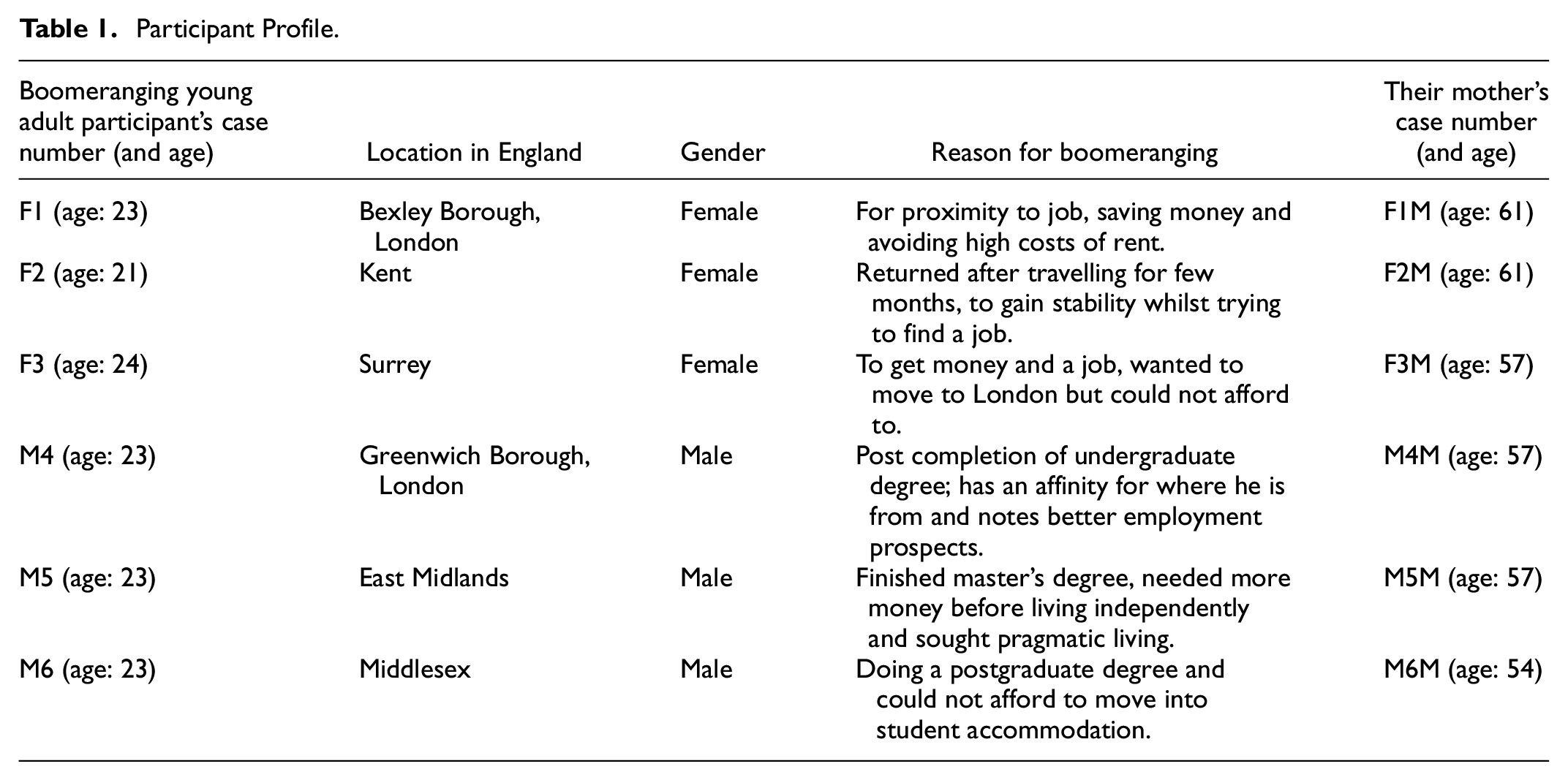
Participant eligibility had to match the criteria: (i) location in England; (ii) gender of the BYA; (iii) reason for “boomeranging.” The definition of a boomerang complied with the work of Mitchell (2006), and where BYA participants were aged 20 to 34 years, as linked to the parameters given by the Office for National Statistics. For participants to be included, they had to provide their consent and interest participation, along with their consenting mother. To recruit study participants, the researcher (KM) used their existing network and social media contacts. Those who expressed interest, completed a “SurveyMonkey” form to determine their eligibility to participate. A sample size of 12 was rendered suitable in line with study recommendations (cf. Shaheen & Pradhan, 2019). Table 1 delineates the profile of the participants—the boomerangs and their mothers.
Participant Profile.
A pilot was conducted prior to the main study, which involved a three-day trial in which three dyads (i.e., two female BYAs and one male BYAs and their mothers) completed a daily diary entry based on a draft explanation sheet. Participant feedback during the pilot phase, as well as the researcher’s evaluation of their trial diary entries, was used to formulate assessment.
Research Questions
The research questions were inspired by White’s (1994) work, and addressed through the use of computerized diary methods. Both BYAs and their mothers provided daily insights for a period of 21 days, to answer the study’s research questions. Include questions such as: “What are the contemporary perceptions and experiences of co-residence among BYAs and their mothers in England?”
(a) How are roles and identities formed and negotiated within their relationship, in context of their co-residence?
(b) What characterizes their dynamic relations and sense of “independence” regarding this type of living arrangement?
(c) What are the possible implications and recommendations for policy?
The procedure for thematic analysis, as outlined by Braun and Clarke (2006), was adhered to in six phases and is described in full elsewhere (Messiha, 2019).
Results
Two separate thematic maps were produced based on an independent analysis of the boomerang data and the mother data to identify and characterize unique themes within each dataset. Subsequently, the overlapping themes between the two datasets were identified and combined to produce an overarching map that integrated shared themes. This approach enabled a comprehensive examination of the converging and diverging patterns within the data, thereby providing a more nuanced understanding of the phenomena under investigation—this is illustrated in Figure 3. The thematic map for the BYA group is displayed in Figure 4, while Figure 5 shows the thematic map for the mother group.

Backbone structure of the thematic maps for both participant groups

Thematic map for the BYAs group.

Thematic map for the mother group.
The thematic analysis maps were presented with themes ordered in a way that reflected both the specific research questions and the nature of the data being analyzed. The themes were arranged to reflect the relationships and hierarchy between them. In particular, the themes were organized based on their level of abstraction or generality, with broader, overarching themes presented first, followed by more specific sub-themes. The themes were designed to carefully articles the content and meaning of the diary method data. To provide support for each theme and illustrate how they were grounded in the data, direct and varied quotations were included.
The thematic map for the BYAs, as illustrated in Figure 4, revealed the emergence of six primary themes, namely “prime concerns shaping living arrangements,” “framing of boomerang role,” “conceptualization of boomerang identity,” “nature of family relations,” “depiction of independence” and “perceived situational input of Government.” These main themes were found to give rise to several sub-themes, ranging from practical implications to proposed solutions. Further themes were also identified from these sub-themes, encompassing topics such as “restricted domestic space” and “mutual respect and exchanges of support.”
Theme 1: Prime Concerns Shaping Living Arrangements
Sub-Theme 1: Practical Implications
Restricted Domestic Space
Among BYA participants, the domestic space was used for various purposes. For instance, the bedroom was utilized for video calls with friends. However, five out of six BYAs reported experiencing limitations in the domestic space available to them while living with their parents. M6, for example, mentioned having to share a table with his mother for work due to the lack of space: My mum’s flat is small and doesn’t have many rooms, so I normally spend my day in the living room working on the dining room table (I don’t have a desk in my room). Normally my mum and I work on either ends of the table but because she’s ill and spends most of her day in her room resting, I have it to myself.
M5, another BYA, remarked that due to the constrained workspace, others were typically unable to utilize the room for other activities: As both [my brother] and I are working on phones, it generally means that the others cannot use the living room for watching television or other past times.
Establishment of Physical Boundaries
Some BYAs appeared to establish physical boundaries to gain privacy whilst living at home with their parents. For illustration, F1 reinforced this boundary through physical intervention: I needed to have a few phone calls with sales people in the UK, US and Canada, so I shut the door to my sister’s room where I work for a while in the morning just so that my parents didn’t wander in and ask if I wanted a drink.
To establish a physical boundary, M6 developed a creative solution with his mother by negotiating for an individualized workstation at home: For once I didn’t sit in the living room at the dining table and instead sat at a new desk created by my mum out of our family’s old storage cabinet. The cabinet is a family heirloom and one of its side’s folds out to make a flat surface, which was what I used as a desk.
Perceived Impact of the Pandemic
The impact of the COVID-19 pandemic was entangled as all the BYAs considered that this externality significantly affected their living situation, but it was not always experienced negatively. For instance, F2 noted improved family relations as a result: It’s strange though because I think we’re probably getting on better during the lockdown. Before the lockdown we barely spoke and stayed out of each other’s ways, which made us meaner to each other when we did speak, but now we do everything we can to be nice and thoughtful because we can’t exactly escape each other.
However, F3 stated that the pandemic exacerbated her home situation: […] I think the only issue I sometimes have is that [my parents] think I am being anti-social. This has been heightened since the Covid-19 lockdown as we are stuck with each other.
Sub-Theme 2: Emotional Considerations About Co-residence
Of the six BYAs, two acknowledged having mixed feelings about living together, while the remaining four felt positively about it.
Mixed Response
F2 experienced a combination of positive and negative emotions regarding co-residence and described experiencing improvements over time: At first, I felt disorientated and confused because I had gone from complete independence, to what felt like time travelling back to teenage-hood. […] As time went on, we both adjusted better, and dad has become more relaxed, which I think he had to really swallow a lot of disdain about, but it made both our lives easier. So overall I would say it started off far more negative, but naturally became more positive as time went on.
Positive Response
M4 reported a positive experience overall, which stemmed from their general enjoyment of the situation: My overall impression of co-residence since returning from university in the summer of 2018 has been positive. Despite some annoyances like my Mum getting worried and calling me if I’m out late, being asked to clean and tidy my room each weekend and the occasional arguments with family members in the household, I have enjoyed living with my parents and brother again.
Theme 2: Framing of Boomeranging Role
Sub-Theme 1: Perceived Low Contributory Role
Five out of six BYAs mentioned their limited involvement in contributing to the housing arrangement. For example, F3 stated: I’m very lucky that I don’t have to contribute much at home. I pay £200 a month to cover food and the car but other than that I don’t do much. I look after my own room and laundry but don’t contribute much around the house other than cooking sometimes.
Several BYAs expressed feelings of guilt about their limited contributions. For example, M6 mentioned feeling guilty about being unable to increase his contributions: Since starting my masters and coming back to live at home for the year Mum has paid for all my food, and I feel bad for not contributing. I work part time but living in London means what I make just pays for my train ticket and my phone bill, so I can’t contribute, even though I want to.
Sub-Theme 2: Beyond a Singular and Fixed Role
Four of the six BYAs appeared to resist the idea of having a specific “role.” For example, M5 stated that the roles he took on were less structured and more adaptable: I think that the roles that I and my family members have played have been less structured and more fluid since coming back from uni as my parents view us more as adults and lets [sic] us make our own mistakes.
Theme 3: Conceptualization of Boomeranging Identity
Sub-Theme 1: Duality of Child and Adult Identities
Five of the six BYAs described the complexity of identifying themselves as both a child and an adult, which made it difficult for them to establish a clear identity. M6 expressed this difficulty in balancing child-like and parent-like traits: It’s interesting because since being at home again I kind of feel both like an adult and a child. I know I’m an adult and my mum treats me like an adult, but because I’m studying and only work part time, I can’t contribute to the rent or the bills … etc., and when I go out for shops I always pay with my mum’s card and not my own. I’m really grateful that I have been able to live like this while doing my masters degree but the lack of independence and responsibility I have now compared to when I was living away from home almost makes me feel like a teenager again, in that you are your own person and you have your own identity, but you still rely on your parents to sustain you.
Sub-Theme 2: “Accommodated” Identity
Four out of six BYAs expressed that their parents played a role in shaping their identity, leading to their self-perception as lazy, comfortable, authentic, or relaxed. For instance, F1 noted that her parent(s) condoned her lazy identity: I think I am a bit lazy when I’m living at home, it’s easy to let my dad do the cooking when I’m back as it’s one less thing for me to worry about […].
Theme 4: Nature of Family Relations
Sub-Theme 1: Good Relations
All of the BYAs in this study reflected on their positive family relations. It is possible that these positive relations are linked to the wider benefits provided by their living arrangement. Additionally, it is possible that recruitment bias played a role, with those having a better experience being more likely to participate in the study. For instance, F2 commented on their good relations: My family relations are good overall. We all care about each other equally, and when we argue it’s usually because we care.
M4 expressed gratitude and appreciation for their family relations, which was a common sentiment among many of the BYAs: As I’m writing today’s diary I am strongly reminded that it is a blessing and joy to be able to continue living together with my family. The ability to continue sharing these significant family events into our adults [sic] lives is one of the highlights of returning home after university, particularly as travelling home for such events whilst living in [a city in the South of England] would have been draining both economically and mentally.
Sub-Theme 2: Interactivity
The data revealed both positive and negative aspects of interactivity, including the creation of quality time as well as emerging tensions and frustrations.
Building Quality Time
All of the BYAs participated in activities with their family to different degrees. As an For example, F2 remarked: We all spent time together today, even went for a bike ride/run although our younger brother tactfully escaped home after 10 minutes. Played a board game, which got very competitive, and watched a musical.
Emerging Tensions and Frustrations
Some tensions and frustrations were reported by all the BYAs throughout the duration of their diary writing, as shown by M6: Whenever my mum can’t figure out technology she has a bad habit of instantly shutting down, which takes the form of a bad mood and makes it even harder to help her. We managed to fix her problem after about 20 minutes but it was just very annoying to have to fix someone else’s problem when you’re tired and they are in a bad and disengaging mood.
Sub-Theme 3: Modes of Authority
Themes of relative freedom given by parents and mutual respect and support exchanges were prominent regarding modes of authority.
Relative Freedom Given by Parents
The concept of relative freedom granted by parents was recognized by some of the BYAs as an important theme. M4 exemplified this by stating: I also feel that living at home provides me with more and less freedom at the same time. I feel as though I gain a large amount of freedom not spending time cooking, washing, etc. in the evenings and at the weekends, freeing up my time to have fun with friends. But it can be limiting in other ways.
Mutual Respect and Exchanges of Support
Mutual respect expected between family members were relayed by some of the BYAs. For instance, F2 confirmed this in her diary: Generally I need to be kind and respectful to everyone in the house. Follow the unwritten rules of respecting the house […].
Furthermore, most of the BYAs both provided and received help from their family members. As an illustration, M4 assisted his mother with technology: In the evening I helped Mum get a Zoom call setup which I have also done for her work a number of times.
M4 also recognized his mother’s support in ensuring he wakes up on time: As is usual of me, I got out of bed very last minute (I have the Mum alarm clock to thank for many days I would otherwise be late for work!) […].
Theme 5: Depiction of Independence
Sub-Theme 1: Self-Recognition of Agency and Achievements
F1 expressed that they had a sense of agency in how they organized their day: Today was a bit easier in terms of being able to get on with what I chose and run by the schedule I wanted to as I was back at work today after the long Easter weekend. I mean I’m not too keen on my job but that’s a different story, at least I was able to run my day how I wanted to.
M5 mentioned his accomplishments in terms of saving money, among other BYAs who also talked about their achievements: […] I do get a sense of achievement by saving my money at the moment so I can defer that life that I would like as it means that I should be able to live somewhere which is nice and spacious.
Sub-Theme 2: Incomplete Sense of Independence
The majority of BYAs expressed a sense of restricted independence in their living arrangement. F3, for instance, felt less independent at home with her parents because her mother acts on her behalf: It’s why I think living at home makes me less independent as my Mum will do stuff for me. When I lived away from home I did everything myself and that didn’t bother me.
Theme 6: Perceived Situational Input of Government
Sub-Theme 1: Evaluation of Government’s Role
All of the BYAs held an opinion on the Government’s role in relation to the housing crisis, high house prices and rent, difficulties in the graduate job market, and financial debts. F1 provided insights on these matters: The Government does have some role in the current situation in terms of enabling house prices to become so steep, especially in cities including the London area (long-term). Rent adds up to a lot of a young person’s salary and can make it very difficult to simultaneously save for a house deposit and mortgage, leading young people to feel it can be a bit a waste of money. This means many young people with family within commuting distance of London (where the range of jobs is high) choose to stay at home in order to save money and avoid the high costs of renting.
Nonetheless, F1 expressed a common sentiment that the responsibility should not solely fall on the Government: Despite the government’s role in house pricing, I also believe young people and their families have their own responsibilities in achieving a pleasant family and co-habiting experience for all. I think good communication, understanding, empathy and a willingness to help out as a team are factors which help to achieve a positive environment with healthy relationships.
Sub-Theme 2: Proposed Solutions
The BYAs suggested solutions to address the phenomenon. M4 highlighted some ways to improve the Government’s role, for instance: I guess the government do have a role to play, schemes like “Help to Buy ISAs” are a start, but I definitely think that the government could do more to prevent the rising house prices, or a more effective way to enable young people to rent without this stopping them from ever being able to afford a house of their own.
F1 proposed the need for more programs aimed at increasing accessibility to property: […] Perhaps there could be a greater number of schemes to enable young individuals with steady jobs to start on the property ladder.
The thematic map for the mothers, as presented in Figure 5, unveiled the emergence of six primary themes, specifically “prime concerns shaping living arrangements,” “framing of mother role,” “conceptualization of mother identity,” “nature of family relations,” “depiction of independence,” and “perceived situational input of Government.” These themes were observed to give rise to several sub-themes, encompassing practical implications and modes of authority. Further themes were identified from these sub-themes, including “maximizing utility of domestic space” and “negative interactions.”
Theme 1: Prime Concerns Shaping Living Arrangements
Sub-Theme 1: Practical Implications
Maximizing Utility of Domestic Space
Five out of six mothers were reported to have made the most of domestic space consumption by creating workspace environments either for their child or personal use. For example, F1M allocated space for her daughter’s workspace station: […] today [F1] had to go back to work, we have made a small workspace for her in the back bedroom, which is actually our older daughter’s room, but she is currently in [city in the Midlands] studying for a PhD.
Perceived Impact of the Pandemic
All mothers acknowledged the impact of the pandemic on their living arrangement, with considerations from increased family time to generally less freedom. For instance, M4M remarked the former: Covid 19 has certainly had an effect – the 4 of us are doing more things together (family mealtimes – everyone is always in!, [sic] playing table tennis and family film nights).
Sub-Theme 2: Emotional Considerations About Co-residence
Two out of the six mothers admitted to a mixed response about co-residence, whereas the remaining four mothers felt positive.
Mixed Response
Two mothers expressed mixed feelings about co-residence, with both advantages and disadvantages, as exemplified by the following statement by M5M: Mixed. Love having the boys at home. Entertaining and fun. No conflict as long as I don’t open the bedroom doors. Only issue- when [lockdown] rules are “bent” and wanting a little more in the way of contributions from one.
Positive Response
The other four mothers had a generally positive response. For example, F1M expressed: Overall my impression of co-residence is positive, I love having [F1] home and she is a very easy person to live with. She is generally an incredibly happy person, willing to help and not prone to complaining.
Theme 2: Framing of Mother Role
Sub-Theme 1: Generalized Roles
The mothers acknowledged their roles in the living arrangement, which include caregiving, raising independent and healthy adults, and performing domestic tasks. F3M also highlighted this in her diary entry: My general role in this living arrangement is still one of being a mother to look after the family and provide both physically and emotionally for the rest of the family and as [F3] has returned from living away, I do not think the role has changed very much. I still do the majority of the cleaning, washing, cooking and house chores on a regular basis.
M4M similarly expressed her recognition: My general role is that of Mum, carer and counsellor as I have always been to my children.
Sub-Theme 2: Specific Roles
Some mothers specified their roles, which included providing security, but there was a strong focus on housework. Moreover, there seemed to be a prevalent argument for the parents to take on more housework duties rather than their boomeranging children. This is exemplified by F1M’s discussion of the housework responsibilities: Specifically, I do not do much of the cooking, generally my husband does that, I would cook when he was working, but since he has retired, he does the vast majority of the cooking. I do all of the laundry, generally I am also responsible for putting most of it away, although I only fold [F1’s] clothes, or put them on hangers.
Theme 3: Conceptualization of Mother Identity
Sub-Theme 1: Identity Tied with Mother Role
Most mothers seemed to heavily associate their sense of identity with their roles in the living arrangement. M6M, for instance, expressed that her identity is closely tied to her role: My identity with the current living arrangements is that I have a role as mother who provides a stable and comfortable home with food, emotional support and an opportunity for [M6] to do his master’s degree.
Sub-Theme 2: “Authentic” Identity
Several mothers perceived their identity as authentic, encompassing values such as optimism, not believing their children owe them, and standing for individualism and respect. An example of this is reflected in F2M’s diary entry where she describes her sense of identity: I feel I am myself overall and that person is a happy optimist generally, but there are times when I have struggled and fear has overwhelmed me.
Theme 4: Nature of Family Relations
Sub-Theme 1: Good Relations
All of the mothers expressed satisfaction with the good relations within their families, especially with their boomeranging offspring. This “satisfaction” was attributed to shared interests, comfortable living, and good companionship. For example, F3M discussed the positive relationships in her family: We have also always had healthy family relationships and our family norms have always focused on coming together for mealtimes, talking openly about issues or problems, and having a joke together, and sharing family time together particularly at Christmas, Easter and birthdays, and also in between.
Collaborative Dynamic with Husband
The majority of mothers reported that their husbands collaborated on household maintenance. This often involved both parties undertaking manual labor around the house, such as fixing and gardening. For example, F1M provided an illustration of this collaborative work: My husband and I went through all the cupboards in the kitchen to day [sic] to check exactly what we have in stock, based on that we then worked out a menu for the next two weeks and wrote a shopping list for my husband when he goes shopping tomorrow.
Attitudinal Dynamic with Boomerang Child
There were four dominant attitudes which were generally upheld by the mothers concerning their boomeranging child: gratitude, acceptance, sympathy, and pride about their progress and achievements. For example, M6M captures her gratitude towards her boomeranging son for his helpful behavior: [M6] is extremely helpful. He got a trolley while I stood in the que [sic] to get in. He gets what he wants and puts it in the trolley I get what I want. He packs everything in bags. It feels nice that he is thoughtful, and he said thank you for the shopping of food that he wanted. It makes me feel happy and appreciated that he says that.
F3M refers to her acceptance and complacency around her boomeranging daughter’s low cooking tendencies: [F3] occasionally cooks for us all and I cooked today. I don’t really mind cooking as I am a neater cook than [F3] and when she cooks it often looks like a bomb has hit the kitchen.
Some mothers expressed sympathy towards their boomeranging children, such as F1M who feels sorry for her daughter’s work situation: I do feel [F1] is being taken advantage of by her work so much, she works so hard, and is so underappreciated.
Many of the mothers expressed feelings of pride towards their boomeranging offspring. M5M, for instance, reflected on her children’s achievements with pride: I am very proud to hear the boys working and how well they do with their calls.
Sub-Theme 2: Interactivity
Positive Interactions
All mothers reported positive interactions with their family members, either individually or collectively. These interactions were often associated with enjoyable activities, such as leisure or physical activities. M6M, for example, shared her experience of spending leisure time with her boomeranging son: In the evening we watched the movie. It was so lovely to watch together, and I really enjoyed just relaxing in the sofa next to [M6].
Negative Interactions
Most of the mothers in the diaries made references to negative interactions. These were often associated with concerns and anxieties about their children, as well as feelings of irritation due to the actions of their boomeranging children or other family members. For example, F2M shared her concerns about her son’s unhealthy behavior: I am worried about my youngest son as he has taken to staying up very late and then sleep through the day.
Sub-Theme 3: Modes of Authority
Parental authority did not seem to emerge as a largely problematic or an undermining characteristic. Results showed that modes of authority articulated by the mothers generally seemed constructive towards their family—centered on support/reassurance, helpfulness and problem-solving. For example, F3M asserts her attempts to reassure her boomeranging daughter: In the middle of the morning, F3 was feeling quite low and brought up her concerns about the future […]. I tried to be as supportive as I could […].
Theme 5: Depiction of Independence
The majority of the mothers reported a clear and positive sense of independence related to taking responsibility in different aspects of their lives. For instance, F1M exemplified taking ownership: I do feel a sense of independence in this living arrangement, but that is because it is my home.
Also conveyed by M4M: I am independent in the co-residence. Having the 2 boys at home doesn’t stop me from doing the things I want to do.
Theme 6: Perceived Situational Input of Government
The Government’s role in boomeranging was critiqued by all the mothers, with mixed results; half of them showed either low expectations or ambiguity, while the other half had a stronger viewpoint. An example of the former is F3M’s lack of certainty about Government intervention: I am not sure whether the Government has a role to play in the current situation of the boomerang generation.
M4M attributed a lesser significance of government policy in influencing the phenomenon: The government policy could be said to have an influence on the rise of cohabiting parents and grown up children but all types of government have kept to the same policy on this – it is more a result of societal issues eg. Education to a higher level and lasting longer and parents [sic] willingness and financial ability to help adult children financially.
Other mothers had maintained criticisms, such as M6M: […] The government is not providing any options for the young generation to move out from home and start their lives independently as most young people want. […] It is the government’s responsibility to have a society where young people can work, pay rent, and buy food and pay for transport within the average national salary.
Discussion
How Are Roles and Identities Formed and Negotiated Within Their Relationship, in Context of Their Co-residence?
In this study, BYAs mainly defined their roles in terms of their limited contributions to the household, consistent with the findings of Lewis et al. (2016). Similar to the explanation provided by Warner et al. (2017), these young adults were aware of the need to contribute, but their level of contribution varied. They also experienced guilt over their lack of contribution. This is noteworthy because although expectations for co-residence regarding financial support and negotiations can be attributed to various influences such as unique circumstances and family or cultural norms (West et al., 2017), the comfort of the parental home may also elicit feelings of guilt (Wister et al., 1997).
In this study, BYAs expressed a sense of not having a singular and fixed role, which aligns with Casares and White’s (2018, p. 233) findings that young adults establish inconsistent roles in their daily lives, which are typically more fluid than static. Furthermore, the concept of a “role” seemed to be rejected by the BYAs in this study, possibly because the roles they had as children are no longer applicable (Burn & Szoeke, 2016).
The BYAs in this study experienced a duality in their sense of identity, balancing their child and adult roles. This dynamic interplay of identity may contribute to the challenge of defining “identity achievement” among young adults in Western societies (Kroger, 2007). The participants perceived their identity as “accommodated,” shaped by their parents’ treatment and the comfort of the parental home. This finding aligns with Lary’s (2015) research, which suggests that mothers often create a more accommodating environment at home for their boomeranging offspring compared to the outside world.
The mothers in this study were able to differentiate between their general and specific roles within the co-residential arrangement. Their general roles included caregiving, raising independent adults, and fulfilling domestic tasks. Consistent with Casares and White’s (2018) findings, the mothers expressed a desire to fill a parental role during the co-residential arrangement. When discussing the specifics of their roles, the mothers highlighted their responsibilities related to housework, possibly due to a desire to maintain their own standards or to prevent problems from arising, in order to preserve balance in the home (Warner et al., 2017).
The mothers in this study connected their identity to their roles, which is consistent with the idea that identities can be partially constructed based on specific roles (Fearon, 1999). Additionally, their identities were associated with authenticity, which included values such as optimism.
What Characterizes Their Dynamic Relations and Sense of “Independence” Regarding This Type of Living Arrangement?
BYAs in the study reported having good family relations, possibly attributed to the benefits of their living arrangement (Burn & Szoeke, 2016). They expressed gratitude and appreciation towards their family, similar to the findings of Lewis et al. (2016). The BYAs also mentioned bonding time with their family, consistent with Aquilino and Supple’s (1991) research. However, tensions and frustrations were also noted, primarily due to the actions and behaviors of other family members. Clemens and Axelson (1985) suggest that conflicts in this type of living arrangement may arise from daily maintenance, use of family resources, and lifestyle differences.
Regarding authority, BYAs acknowledged the relative freedom they were granted by their parents. The exchange relationships within this living arrangement are essential to understanding contentment patterns, which can be analyzed in terms of costs and benefits (Wister et al., 1997). Some of the BYAs emphasized their independence and achievements, but as Biesta and Tedder (2006) argue, individual agency is always influenced by structural factors. The BYAs also reported feeling an incomplete sense of independence.
The mother group also expressed positive family relations, similar to Aquilino and Supple’s (1991) findings. Additionally, the mothers reported collaborating with their husbands on household maintenance, which could contribute to their higher satisfaction with the living arrangement. Mothers expressed a range of attitudes towards their boomeranging offspring, including gratitude, acceptance, sympathy, and pride in their progress and achievements. However, they also experienced anxieties and worries about their children.
What Are the Possible Implications and Recommendations for Policy?
The findings of this study indicate that BYAs held a clear stance on the government’s role in their situation, attributing it to issues such as the housing crisis and debt. This aligns with the restructuring of social security systems in the late 20th century, which shifted responsibility onto families while reducing support and welfare payments (Berrington et al., 2012). However, some young adults in the group felt that the government should not shoulder all the responsibility. They suggested solutions ranging from preventing rising housing costs to introducing more programs aimed at improving property accessibility.
Mothers in the study had mixed opinions on the government’s role, perhaps due to their lack of exposure to the same challenges faced by their adult children (Furlong & Cartmel, 2006). While they did not make explicit recommendations, some mothers implied that more options for the younger generation and affordable housing are necessary for their children’s independence.
The impact of the COVID-19 pandemic on living arrangements revealed significant variability in experiences among young adults (BYAs) and their parents, linked to how living situations at home impacted upon individuals’ experiences and management of the pandemic (Langenkamp et al., 2022). We found that for many BYAs, the pandemic served as a double-edged sword. Indeed, some BYAs reported enhanced family relations, improved interactions and increased positivity. Whereas other BYAs experienced heightened tensions and exacerbated conflicts, often due to the extended time spent together in a constricted environment. Similarly, mothers experienced mixed effects upon their living arrangements. While the pandemic led to greater family cohesion through shared activities and increased time together, it also resulted in reduced personal freedom. This highlights the complex and varied implications of prolonged co-residence and changes in living arrangements, which were exacerbated during the COVID-19 pandemic and linked to increased stress (Evandrou et al., 2021).
The results of this study support Macmillan’s (2006) thesis that agency is a significant force in shaping the life course. Participants’ senses of agency were evident in various aspects of their lives, from their daily routines to their mothers’ perspectives on independence. However, as Macmillan noted, analyzing agency remains challenging, as societal conventions and expectations continually evolve and are impacted by structural factors, as highlighted in this study’s findings on the government’s role in rising housing costs and the graduate job market.
Despite the complexity of the relationship between structure and agency, the structure-agency nexus remains an important lens through which to view social phenomena, as Anaf et al.’s (2013) work demonstrates. While the significance of either force is often contested and intertwined, understanding the interplay between structural factors and individual agency highlights the diversity of pathways to adulthood, shaped by familial and regional opportunities. Agency emerges as a crucial finding in this study, highlighting how young adults navigate and shape their living arrangements despite structural constraints. Agency reflects young adults’ ability to make independent choices and manage household roles, even when economic and social pressures limit their options.
Both healthcare professionals and policymakers need a deeper understanding of the boomerang phenomenon as has been suggested by Otters and Hollander (2015). For instance, professionals will encounter numerous boomerang families seeking services, navigating situations where boomeranging can be seen as both a problem requiring resolution and a potential solution to previous challenges (Otters & Hollander, 2015). Therefore, policymakers need to consider the resources needed for this life stage and engage in developing social policies that address both the financial and resource challenges that might be faced by many families in the 21st century (Otters & Hollander, 2015). The diversity of cultural and traditional approaches to cohabitation should also be considered, as some traditional ethnic groups might have moral objections to cohabitation beyond childhood. Conversely, intergenerational family cohabitation might be considered usual practice within particular cultures, thereby influencing the increasing trend of delayed home leaving (Farris, 2020). Future research could explore the sociological concept of “role” in greater depth within this context, elaborating on its relation to cultural obligations, expectations and identity formation.
Strengths and Limitations
This study has several notable strengths and limitations. Among its strengths, the research provides a rich representation of the experiences of both young adults (BYAs) and their mothers, capturing diverse perspectives on co-residence and its impacts. Our findings align with existing literature, particularly regarding the fluidity of roles and identities among BYAs and the complex nature of pandemic-related experiences. Additionally, the research connects individual experiences to broader structural issues, such as housing and social security, offering valuable insights for policy development. The contextual analysis of the COVID-19 pandemic further adds depth to the understanding of how external stressors influence family dynamics.
However, we recognize that there are limitations within our study. For example, there is variability in experiences reported by BYAs and mothers. This highlights the complexity of co-residence and boomerang effect as a phenomenon and thus generalization across diverse cultures and contexts is challenging. While potential policy implications are identified, the recommendations might be constrained by the diverse views of participants and the evolving nature of structural factors like housing. Lastly, while the interplay between individual agency and structural constraints is acknowledged, the complexity of how these dynamics impacted participants’ experiences of co-residence and independence is difficult to fully capture.
Conclusion
This qualitative study aimed to explore the boomerang effect as a contemporary phenomenon of increasing cases of young adults in England living with their parents. The research provides new themes relevant to White’s (1994) recommendations on this phenomenon, and challenges the notion that the structure-agency nexus provides a clear understanding of how this phenomenon shapes individuals. The study was conducted during the COVID-19 pandemic, and it is crucial to consider the post-pandemic effects on residential living that are sensitive to the needs of young adults and their families. The diary method used in this study ensured that the insights from each participant group were compatible and reinforced the understanding of the phenomenon, which is consistent with the relevant literature. This study recommends that future research and policy in England address the potential concerns of BYAs and their families. Furthermore, investigating specific traits of BYAs, such as ethnicity or family structure, could be salient in considering this phenomenon. It is suggested future studies could benefit from a more inclusive research design and a co-creation approach should be considered, where appropriate.
Footnotes
Acknowledgements
Katrina Messiha’s University College London supervisor, Dr. Mary Sawtell, during her Social Policy and Social Research MSc.
Declaration of Conflicting Interests
The author(s) declared no potential conflicts of interest with respect to the research, authorship, and/or publication of this article.
Funding
The author(s) received no financial support for the research, authorship, and/or publication of this article.
Originality
This article is an original piece of work which has not been published before.

Data Availability Statement
Data sharing not applicable to this article as no datasets were generated or analyzed during the current study.