




Abstract
Since the onset of COVID-19, concerns have risen regarding the environmental impact of increased waste generation. Of particular concern is the surge in plastic usage, prompting a call for enhanced recycling practices. This study investigates the impact of the COVID-19 pandemic on recycling discourse in South Korea by analyzing news media coverage on recycling and reuse based on framing theory. Employing Python and R, a total of 24,928 news articles containing keywords (i.e., recycling and reuse) both pre- and during the COVID-19 pandemic were collected and analyzed. The results of computational analyses, such as topic modeling, semantic network analysis, and framing analysis, show that while an initial spike in COVID-19 cases correlated with heightened recycling-related coverage, this trend gradually waned as the pandemic persisted. The results also revealed shifts in keywords, frames, and framing functions over time. Notably, major frames expanded during the pandemic to incorporate COVID-19-related topics and concrete recycling efforts. Throughout, the primary framing function remained prognostic. This research provides valuable insights into the evolving environmental discourse amidst a global pandemic.
Plain language summary
Since the onset of COVID-19, concerns have arisen regarding the environmental impact of increased waste generation. Of particular concern is the surge in plastic usage, prompting a call for enhanced recycling practices. This research looked at how the COVID-19 pandemic changed the news media coverage of recycling and reuse in South Korea. Using computer programs, such as Python and R, this research analyzed nearly 25,000 news stories about recycling before and during the pandemic. The findings show that when COVID-19 cases first shot up, the news talked a lot more about recycling. But as time went on, even as the pandemic continued, they talked about it less. The words and themes in the news also changed over time. During the pandemic, the news started to include more about COVID-19 in stories about recycling and featured more concrete recycling efforts. Even with these changes, the primary focus stayed the same, which was solutions to the waste and recycling issue. This research provides valuable insights into how environmental conversations have changed during this global crisis.
Introduction
It has been 4 years since the world faced the COVID-19 (Sars-Cov-2) pandemic and people’s daily lives continue to be greatly affected as sporadic infections persist. One of the biggest changes the pandemic has brought is the rapidly increasing demand for personal protective equipment (PPE) to minimize contagion through direct contact. The use of more than 12.09 trillion masks and 6.5 trillion disposable gloves during the pandemic has resulted in severe environmental issues, predominantly related to waste (Prata et al., 2020). The pandemic has resulted in an astonishing amount of plastic medical waste, estimated at 12 to 24 million tons (Prata et al., 2020). In addition, dramatic increases of remote transactions and contactless delivery have led to the use of a massive amount of disposable products (Cheval et al., 2020). According to research conducted across 23 countries, 53% of respondents answered that the amount of plastic packaging has increased during the pandemic (Filho et al., 2021), indicating that waste disposal and recycling have become serious social issues.
Despite the explosive increase in waste due to the excessive use of recyclable materials, there has been limited research specifically addressing recycling and/or reuse issues during the pandemic. Although some recent scholarly works have explored environmental implications of the coronavirus, the focus has predominantly been on the pandemic’s (potential) positive consequences resulting from the restriction of personal activities and industrial practices, such as energy savings or reduced water and air pollution (Abu-Rayash & Dincer, 2020; Berman & Ebisu, 2020; Jiang et al., 2021; Muhammad et al., 2020; Venter et al., 2020). Some of these studies have speculated as to whether the crisis could catalyze sustainable practices by provoking individuals to reconsider their consumption behaviors (Bodenheimer & Leidenberger, 2020; Muhammad et al., 2020; Sarkis et al., 2020)
Nonetheless, a few studies on waste disposal or recycling have postulated that the pandemic has had a net negative impact on the environment, rather than being a positive sign for a better future, highlighting the urgent need for waste management strategies (Cheval et al., 2020; Prata et al., 2020). This disparity between previous studies prompts the crucial question: Does the COVID-19 pandemic raise profound environmental concerns or present an opportunity for sustainable living, particularly in the realm of recycling and reuse? To answer this question, it is necessary to understand the discourse surrounding recycling and reuse issues, both pre-pandemic and during the pandemic era. Past research on waste disposal and recycling during the period of pandemic has primarily relied on conceptual arguments (e.g., Prata et al., 2020) or policy suggestions lacking empirical evidence (e.g., Argentiero et al., 2022). Thus, it is important to conduct empirical research to examine how discourse about recycling and reuse issues have evolved amid the pandemic.
Media framing has emerged as a crucial framework for understanding public discourse on social issues, including environmental concerns. Past research has demonstrated that people’s perception of a social movement, including environmental problems, depends on how the news media frame it (Hutchins & Lester, 2015; Nisbet & Newman, 2015; Weathers & Kendall, 2016). News frames not only help people understand a specific issue but also set the boundaries of discourse (Entman, 1993; Scheufele, 1999). For social and environmental issues, in particular, there are three framing functions that can be used to understand their discourses: diagnostic (identification of a problem), prognostic (remedy or solution), and motivational (call to action; Snow & Benfold, 1988). This framework aids in comprehending which functions of frame are predominant and answering whether the pandemic serves as a turning point for fostering a more sustainable lifestyle, particularly concerning recycling and reuse practices. Building upon the significance of media framing in understanding environmental concerns (Atanasova, 2019; Boykoff, 2007; Hansen, 2018), the issue of recycling, particularly during the pandemic, needs to be analyzed by focusing on how the news media portray it. Despite the urgency of the issue, no scholarly works on media framing of recycling issues during COVID-19 have been conducted.
Therefore, this research aims to explore how discourse related to recycling and reuse has been changed before and after the outbreak of COVID-19 through analyzing news articles in South Korea. Specifically, this study examines primary frames of news articles and their functions concerning recycling and reuse before and during the COVID-19 pandemic using various computational analyses such as topic modeling, which aids researchers in identifying relevant and significant topics related to the issue, and semantic network analysis, a technique to understand discourse significance based on word centrality levels and connections. In addition, the current study investigates how the discourse of recycling changed as the crisis deepened by comparing keywords of four peak periods to understand whether the pandemic could be a catalytic event to influence recycling policies and/or individual pro-environmental behaviors.
Literature Review
Waste Disposal and Recycling Problems Before and After COVID-19
Environmental problems caused by changes in consumption patterns have periodically raised alarm even before COVID-19. According to Statista (2022), the e-commerce sector has been steadily growing since 2014 and online purchases reached $ 3.5 trillion USD in 2019. The number of online shopping users worldwide in 2019 exceeded 1.92 billion, a substantial increase from 2014 (Statista, 2021). The growth of food delivery applications—and the corresponding new consumption patterns—has resulted in accelerating global warming as well as the production of large amounts of waste (Liu et al., 2020). In the same vein, each person worldwide generates 0.74 kg of waste per day, and the global production of solid waste reaches 2.01 billion tonnes, of which a minimum of 33% is poorly managed in a manner that is not environmentally safe (Kaza et al., 2018). This finding underscores that waste disposal is a globally significant and pervasive problem.
The outbreak of COVID-19 has further accelerated these changes. According to the OECD (2020), since the beginning of the pandemic, the e-commerce industry has grown rapidly. In some countries, Google searches for “delivery” more than doubled during the first wave of COVID-19, as lockdowns were implemented (OECD, 2020). Previous research also pointed out that the COVID-19 crisis has led to increases in waste disposal and the use of disposable products (Cheval et al., 2020; Filho et al., 2021; Prata et al., 2020).
This has certainly held true in South Korea. According to the Korea Information Society Development Institute (Oh, 2020), online shopping transactions increased to 28.3% after the outbreak of the pandemic compared to 22% before the pandemic. Likewise, parcel delivery volume in February and March 2020, when the first pandemic wave began, increased by 31.7% and 28.8%, respectively, compared to the same period the previous year, according to the Korea Statistics (Lee, 2020). These trends continued as the coronavirus infection spread. According to Korea Statistics, recyclable waste increased by 10.2% and 9.1% in February–March 2020, compared to the same period of the previous year (Lee, 2020).
The negative impacts of the pandemic on the environment have been noted in the literature. For example, Cheval et al. (2020) pointed out that the pandemic has generated large volumes of nonrecyclable waste. Prata et al. (2020) also posited that the novel coronavirus has influenced individuals to increase their consumption of single-use plastics as a way of avoiding infection; in the face of this health crisis, people’s concern for their own personal safety trumped their concern for environmental impacts. In contrast, other researchers have argued that COVID-19 represents a watershed moment by providing an opportunity to reconsider the impact of individuals’ consumption habits on society and the environment, resulting in people significantly changing their behaviors to be more environmentally friendly post-pandemic (He & Harris, 2020; Muhammad et al., 2020; Sarkis et al., 2020). Bodenheimer and Leidenberger (2020) proposed the concept of a “window of opportunity for promoting sustainability transitions” (p. 61) to explain this phenomenon. However, those studies were limited to suggesting conceptual arguments or policy suggestions, rather than providing empirical evidence.
Although waste and recycling issues came to the fore immediately after the outbreak of COVID-19, no scholarly work has comprehensively and systematically explored what discourses were formed during the multiple waves of the pandemic. To determine whether the pandemic presents a turning point for recycling, it is important to understand what frames the news media have used to illustrate the issue of recycling and reuse by comparing before and after the coronavirus outbreak.
Framing of Environmental Issues and Framing Functions
A recent meta-analysis study found that as environmental concerns become severe, climate change-related research based on framing theory has increased in recent years (Guenther et al., 2023). Many of these studies have employed content analysis of news articles, indicating that framing theory is applicable to understand discourse related to environmental issues.
In communication studies, “(media) frame” refers to how the news media emphasize certain aspects of an issue, making them more salient to the audience (Chong & Druckman, 2007). A frame allows audience members to interpret and conceptualize the issue from their own perspective, using that framing process “to select some aspects of perceived reality and make them more salient in a communication context, in such a way as to promote a particular problem definition, causal interpretation, moral evaluation, and/or treatment recommendation” for a specific event (Entman, 1993, p. 52).
When a specific issue requires collective actions or social movements, framing involves requiring an audience or the public to collectively “locate, perceive, identify, and label” the issues faced as relevant (Goffman, 1974, p. 21). Snow and Benford (1988) explained this function of framing as a tool for engaging audiences and accomplishing eminent missions, which consists of three core framing tasks: diagnostic, prognostic, and motivational framing. Diagnostic framing mainly involves problem or threat identification and attribution of blame and responsibility. Prognostic framing suggests solutions to the identified problem as well as coping strategies for whom it affects. Motivational framing provides a “rationale for action” that urges active participation in corrective actions (Snow & Benford, 1988, p. 202).
Environmental issues usually spark social movements and require collective efforts, so previous research used those three frame functions to analyze how news media portray the issues, identify the dominant discourse and its arguments, and evaluate how media depict environmental issues and urge motivational and behavioral changes among the public (Hoffman, 2011; Polina et al., 2020; Yun et al., 2012). A recent study also investigated how legacy media coverage of climate change has changed during the COVID-19 pandemic based on the three frame tasks and found that the prognostic frame was the most prevalent, followed by a diagnostic frame (Stoddart et al., 2023). According to previous research (Ketelaars et al., 2014; Svensson & Wahlström, 2023; Wahlström et al., 2013), framing shifts to prioritize prognostic functions when there is an agreement on identifying the issue, while various stakeholders suggest different solutions. If the pandemic indeed serves as a turning point for recycling and reuse issues, there might be certain changes in frames and framing functions between before and after its outbreak. Therefore, this study proposes the first research question as follow:
Changes in Media Attention During the COVID-19 Pandemic
For environmental risks and events, media coverage plays a critical role in not only raising public concerns and the imminence of risks but also framing issues to be wider social problems that require public attention (Escobar & Demeritt, 2014). Moreover, media attention is found to promote behavioral changes and induce empathy for unfamiliar environmental issues (S. C. Kim & Cooke, 2021). Increased levels of attention from the news media and higher volumes of news coverage can amplify the public’s perceived susceptibility to risks (Kasperson et al., 1988) and attention to social issues, including environmental issues (e.g., Gamson & Modigliani, 1989; Schoenfeld et al., 1979; Stoddart et al., 2023). The level of media attention changes in response to key events throughout the development of the issue. For instance, media coverage of COVID-19 in the United States spiked and continued to increase immediately after the official declaration of COVID-19 as a pandemic, followed by several spikes correspond with the major developments in the pandemic and related social, economical, and political issues (Wirz et al., 2022). As trends in the volume of media coverage around the COVID-19 pandemic have shown in the previous study, this study assumes the outbreak of COVID-19 as a key event in the discussion of recycling and reuse issues in South Korea.
Within the realm of framing theory, the salience of an issue—reflected in its level of media attention—is crucial for shaping public perception about a certain issue (Entman, 1993), and thus, it is essential to investigate how media attention has evolved in response to the severity of the pandemic. This study suggests that the increase in confirmed cases serves as an indicator of the pandemic’s severity and its phase. Therefore, the following research question was proposed:
Changes in Framing During the COVID-19 Pandemic
As the level of media attention changes, frames also can be changed over the course of an event, because framing concerns about selecting and focusing on the salience of an issue (Entman, 1993). When a specific event occurs, news media usually situate it in different frames over time by highlighting various attributes of the event (Chyi & McCombs, 2004). Changes in media framing are inevitable, because different actions, needs, and concerns are required as the situation of an event changes (Chyi & McCombs, 2004; Muschert & Carr, 2006). Framing changes over time have been found to be pertinent to public attention in various situational contexts, such as natural disasters (Houston et al., 2012), wars (Dimitrova, 2006), international controversies (Pak, 2016), climate changes (Stoddart et al., 2023), and pandemics (Zhao & Wang, 2022). Frames in media coverage can provide generalized perceptions of the complex and dynamic aspects of an event or issue and examining its changes provides insights into how media coverage grasps the fundamental attributes of an event or issue over time (Chyi & McCombs, 2004; Houston et al., 2012). Because the public’s understanding of the issues and the perception of their seriousness can be influenced by the thematic approach that the news media use in their coverage, this study attempts to examine news frames and its changes in the context of environmental issues, particularly, the discussion of recycle and reuse during the course of COVID-19 pandemic.
Past research has also explored discourse related to environmental issues in the context of framing theory with a predominant focus on the climate change issue (e.g., Guenther et al., 2023; Han et al., 2017; Mercado-Sáez et al., 2022; Nisbet 2009, 2010; Schäfer & O’Neill, 2017). They found that various frames exist depending on nations and situations, which have changed over time. The COVID-19 pandemic is an event that influenced and changed perspectives of economic, social, and political aspects of human life—a health crisis that cascaded into a global environmental and economic crisis. Given the unique nature of the pandemic, which has generated a significant amount of waste and brought recycling and reuse issues to the forefront of environmental concerns, it is imperative to examine how discourses have changed as the pandemic has progressed, particularly in light of the surge in confirmed cases (i.e., first, second, third, and fourth waves). This study assumes that discourses surrounding the issue may undergo changes as the severity of the pandemic intensifies. In order to assess whether the pandemic presents an opportunity for fostering a more sustainable lifestyle through recycling and reuse practices, the current study proposes the following research question:
Method
News Article Collection
South Korean news articles about recycling and reuse were systematically collected both from all national and regional daily newspapers, spanning the period before and after the outbreak of COVID-19. The data was sourced from BigKinds, a prominent Korean online news database managed by the Korea Press Foundation. This repository encompasses full-text articles from 54 Korean major media outlets, including national dailies, economic dailies, local dailies, and TV news programs. Using BigKinds’ search function, new articles containing either “recycling” or “reuse” were searched, published between January 20, 2020 (the date of the first confirmed COVID-19 case reported in South Korea), and September 30, 2021. The initial search yielded a total of 37,513 news articles. Among these articles, articles that specifically referenced “COVID-19” were further extracted, using Python and web scraping libraries, such as Scrapy. This process resulted in a final dataset of 9,519 news articles, which were subjected to analysis to understand the pandemic’s impact on the discourse surrounding recycling.
To provide a comparative context, we also retrieved 15,409 news articles mentioning “recycling” or “reuse” and published during the year preceding the COVID-19 outbreak (i.e., between January 1, 2019, and January 19, 2020). The raw data includes diverse information related to the collected news articles, including date of publication, title, content, provider/news outlets, links of images, and category.
Data Preprocessing
First, to investigate the evolving themes within recycling related news articles during the COVID-19 pandemic, the first dataset (i.e., the collected news articles published after the COVID-19 outbreak) was segmented into four distinct periods, aligning with the peaks of reported COVID-19 cases, namely the first, second, third, and fourth waves. These temporal divisions were determined based on the data repository provided by the Johns Hopkins University Center for Systems Science and Engineering (JHU CSSE), a widely used source for globalCOVID-19 statistics, including those of South Korea (Figure 1 and Table 1).

The development of the COVID-19 pandemic.
Proposed Phase Based on the Progress of the COVID-19 Pandemic.

To get these datasets ready for the primary analyses, R and various packages such as tidytext, dplyr, SimplePOS, and KoLNP were employed for data preprocessing. This process involved identifying contents related to recycling and reuse from the collected news articles, tokenizing those sentences into appropriate linguistic units, and eliminating extraneous components. Since not all articles exclusively focused on recycling and reuse, with some delving into tangential topics like political candidates’ policy announcements, sentences containing either “recycling” or “reuse” were extracted to focus on the discourse surrounding these subjects. Then, these sentences were tokenized into meaningful language units, such as noun, verb, adjective, and/or adverbs, to conduct morphological analyses such as word frequency, semantic network analysis, and topic modeling. Following tokenization, irrelevant words were removed, designated as stopwords (e.g., reporter, anchor, because), along with unnecessary elements, such as conjunctions, auxiliary verbs, and transitive verbs.
Computational and Framing Analysis
This study involves several computational methods, including topic modeling and semantic network analysis to address research questions. Topic modeling is a text mining approach that uncovers patterns of keyword co-occurrence, allowing us to discern their underlying meanings. Employing Latent Dirichlet Allocation (LDA), an unsupervised machine learning method (Blei et al., 2003), keyword clusters are identified based on datasets. These clusters include prominent terms within topics, which help human researchers understand the nuanced meanings and add theoretical interpretation deductively. This method has been used as a popular robust method to discover underlying themes and topics of a discourse by analyzing a large text corpus (Brookes & McEnery 2019; Viola & Verheul, 2020).
Semantic network analysis is a method that identifies associations among core words in a textual data, discovers relationships and the importance of these words within the network (Doerfel, 1998; Van Atteveldt, 2008). This method reveals how each cord word intertwines with others, showing the network structure and enabling a more nuanced understanding of the contextual interpretation of those words. In addition, various centrality analyses provide insights into the importance of a word within the network. These metrics include the degree centrality, indicating how a word is connected to other words; the closeness centrality, showing the distance of a word from all other words; the betweenness centrality, highlighting how closely a word is positioned on the shortest path between other pairs of words; the eigenvector centrality, assessing the centrality of a word based on the number and quality of both incoming and outgoing links (Wasserman & Faust, 1994).
Results
RQ1: Changes in News Frames Before and After the Outbreak of COVID-19
To understand how the news frames and its functions regarding recycling and reuse have changed in response to the COVID-19 pandemic (RQ1), news articles from two-time frames—before the pandemic (from January 1, 2019, to January 19, 2020) and during the pandemic (from January 20, 2020, to September 30, 2021) were analyzed. Both topic modeling and semantic network analysis were used for the analysis, which are widely used methods for framing analysis (e.g., Walter & Ophir, 2019). First, using topic modeling, potential topics were inductively identified surrounding recycling and reuse. Each topic was labeled by researchers and deductively coded to identify frame functions of each frame.
Topic Modeling and Framing Analysis Results
Using hyperparameter tuning, the optimal number of topics was analyzed, which was nine; keywords under each potential topic were extracted through topic modeling analysis. Using those keywords from nine topics, three researchers reviewed 10% of the articles that included one of those keywords under each topic and identified frames. After we excluded irrelevant frames (e.g., movie or drama, a murder case wherein a body was found in a recycling bin, reuse of leftover dishes in restaurants), six frames were derived from the pre-pandemic dataset, and seven from the pandemic dataset (Table 2).
Topic Modeling Labels and Key Terms (Prior to the COVID-19 Pandemic).

Prior to the COVID-19 outbreak, the main frames related to recycling and reuse included (a) occurrences of severe air and water pollution; (b) popularity of eco-friendly products; (c) restrictions on the use of plastic packaging and disposable products; (d) renewable energy business for corporate innovation and competitiveness; (e) various programs in local fairs; and (f) local community development business. To understand how those frames differently function, four frame categories were used—diagnostic, prognostic, motivational, and others. One frame was coded as diagnostic framing (i.e., a), three as prognostic framing (i.e., b, c, and d), and two as others (i.e., e and f). No frame was coded as motivational framing. More specifically, frames that cover the extent to which environmental pollution needs attention was coded as diagnostic framing. Prognostic framing includes frames that introduce environmental efforts and strategies corporations adopted and will adopt to address pollution. Other framing includes frames that do not fit into any of the three framing functions, such as the introduction of local fairs and the initiatives of local communities and governments.
After the outbreak of COVID-19, seven topics were identified: (a) rapidly increasing waste resources and incorrect recycling practices; (b) global efforts to address COVID-19-related problems and climate change; (c) the growing industry of renewable and green energy; (d) fashion items made of recycled materials and eco-friendly packaging; (e) central and local governments’ economic and environmental policies; (f) support for vulnerable social groups and environmental issues; and (g) recommendations and arguments for the reuse of face masks.
Among them, one frame was coded as diagnostic framing (i.e., a), three as prognostic framing (i.e., b, c, and d), and three as others (i.e., e, f, and g). None were coded as motivational framing. Diagnostic framing includes frames that cover the dire environmental situations caused by the increased use of diverse materials and incorrect recycling practices during the COVID-19 pandemic. Prognostic framing included those that cover the environmental efforts of diverse entities, such as green businesses, and eco-friendly products and packaging. Frames that did not fit into another category, such as frames discussing governmental policies and controversy over the reuse of PPE, were coded as others (See Table 2).
Results of Semantic Network Analysis and Centralities
Semantic network and centrality analyses were performed to compare the co-occurrence of keywords and their influence in the periods both before and during the COVID-19 pandemic to understand more nuanced discussions around recycling and reuse before and after the COVID-19 outbreak, semantic network analyses and centrality analyses were conducted. The relevant sentences of the news articles were tokenized into various linguistic units (e.g., noun, verb, adverb). How these words were interconnected with varying degrees was examined (Figure 2 and Table 3). In the pre-pandemic era, many keywords were centered towards recycling and care for. In particular, many verbs were connected through recycling and other action verbs, indicating that efforts and plans around recycling were underway. The results of semantic networks also showed several environment-related words (i.e., environment, waste, trash, pro-environment), and also several words only included as top 30 terms in the pre-pandemic period (i.e., trash, interested parties, diverse, this year, operation, and problem).

Semantic network analysis: prior to (left) and during (right) the COVID-19 pandemic.
Keywords with Centrality Measures (Prior to and During the COVID-19 Pandemic).

Note. Terms in bold were only included in the lists of 30 terms with top high centralities. Centrality measures were calculated based on top 20% of co-occurrence pairs of terms (20% of pre-pandemic co-occurrence term pairs = 7,868,654; 20% of during the pandemic co-occurrence term pairs = n = 5,489,213).
After the outbreak of COVID-19, the results showed a little more complicated network with newly added words, such as reuse, plastic, mask, situation, caused by, and support. Compared to the pre-pandemic period, words such as mask, plastic, and reuse emerged as increasingly important, with high centrality measures indicating them as influential keywords in the discourses. Among the top 30 terms, the betweenness centrality values of reuse, mask, plastic, waste, and none were ranked higher compared to other terms, indicating that these terms serve as important terms that connect different groups of terms.
RQ2: Changes in the Volume of News Articles Correlated with the Number of Confirmed Cases
To answer RQ2, the volume of related news articles corresponded with the increase in the number of confirmed cases was analyzed, as these cases indicate the severity and phase of the pandemic. The pattern of increase in recycling and reuse news articles changed over time as the peak of COVID-19 cases progressed (see Figure 3). To understand the statistical relationship between confirmed cases and the volume of news articles, regression analysis was performed and the results showed that no significant relationship between the confirmed cases and the number of news articles existed during the overall period, β = .04, p = n.s. However, when considering the peak periods, it was found that the number of COVID-19 cases predicted the number of recycling and reuse news articles during the first peak of COVID-19 (the first wave of the pandemic), β = .57, p < .001. After the second peak, a slight rise of recycling and reuse news seemed to ensue in the following month, but no significant increase was revealed during the time, p = n.s. With the third and fourth surges of COVID-19 cases, there was also no significant increase in recycling and reuse news articles; notably, for the fourth peak—the largest surge to date for COVID-19 cases in South Korea—there was not even a minor increase in the amount of recycling news, and therefore, no significant results exist for both periods, p = n.s.

Comparison between the number of COVID-19 cases and news articles on recycling.
RQ3: Changes in Recycling Discourse During the COVID-19 Pandemic
Results of Word Frequency of Each Peak Period
First, to understand how discourses related to recycling and reuse have changed during the pandemic (RQ3), keywords in news articles were analyzed, particularly those from the peak periods when the number of confirmed cases rapidly increased. The results showed that different words appeared dominant in news articles related to recycling (see Table 4). When the number of COVID-19 cases surged for the first time (i.e., peak 1, the first wave of the COVID-19 pandemic), the word (face) mask was mentioned 4,038 times and use for 1,088; other frequently mentioned words, such as protective/for health, government, infection, and disposable were used fewer than 400 times. During peak 2, trash became the top frequently used word (496), followed by business, plastic, emission, mask, use, waste, resource, pickup, and support. The most frequently used words during peaks 3 and 4 were almost the same, with plastic, use, trash, emission, business, ice/ice pack, resource, environment, and pro-environmental in the top 10.
Term Frequency of Peak 1, Peak 2, Peak 3, and Peak 4.
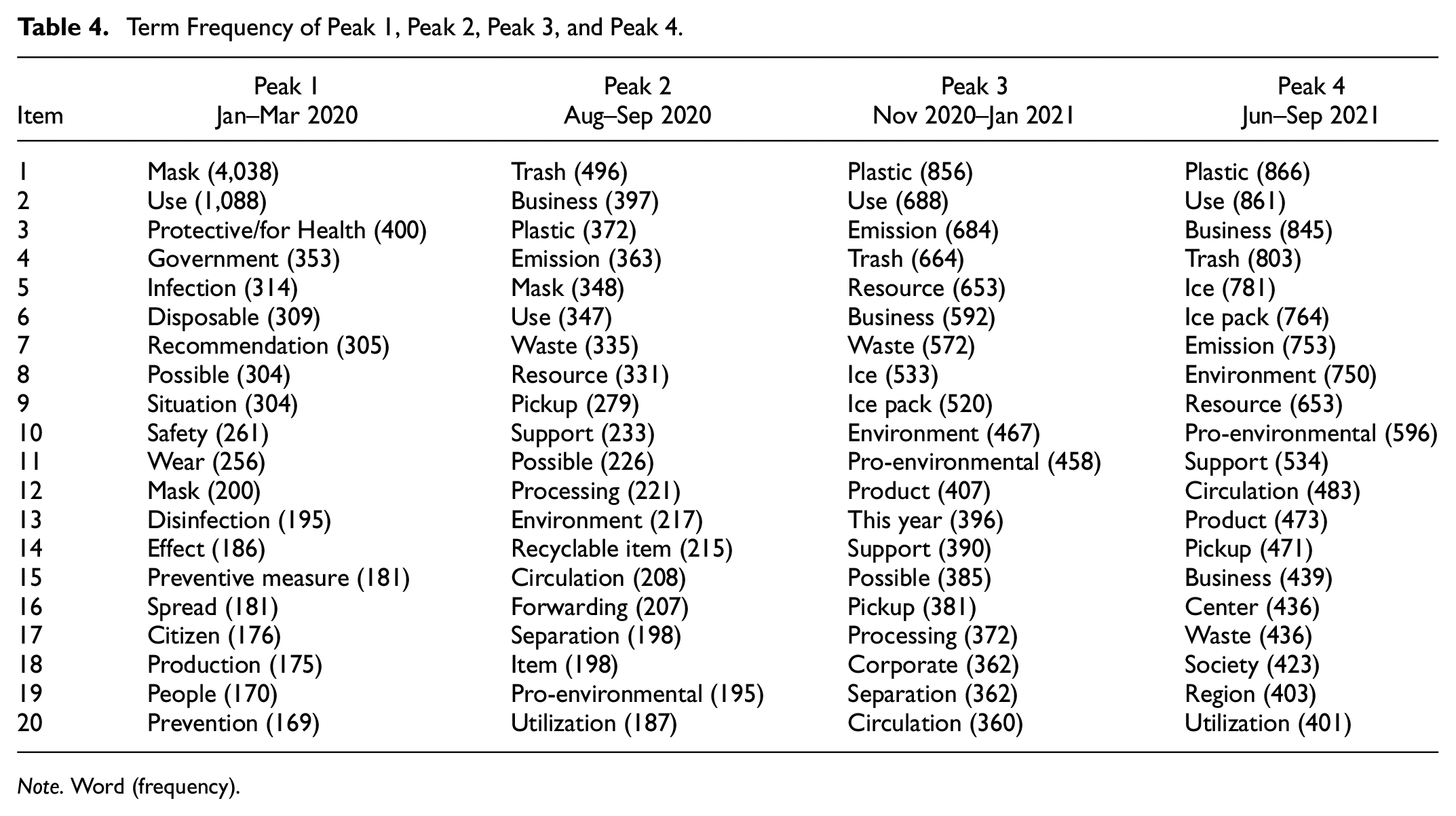
Note. Word (frequency).
Results of Semantic Network Analysis for Each Peak Period
Semantic network analysis for each peak period was performed to investigate how the discourse regarding recycling and reuse changed during each period of rapid increase in the number of confirmed cases. During peak 1, (face) mask and reuse showed the highest value for all centrality measures, identifying those as the most influential keywords directly and indirectly connected to and connecting the other keywords. During peak 1, the top 30 words with high centrality measures are more related to the virus, such as infection, spread, and new (variant), compared to other peak periods. In peak 2, recycling was identified as a keyword with high values of degree centrality, betweenness centrality, closeness centrality, and Eigen centrality. Recycling became the most influential keyword in the network, and words concerning the environment appeared in the networks, such as waste, plastic, care for, and become. These words became significant words in the discourse during peak 2. During peaks 3 and 4, recycling remained the main keyword connecting and mediating other words. The top 30 keywords during peaks 3 and 4 gave high centrality to environmental-related words, such as pro-environment, environment, waste, and product/goods. During peak 4 specifically, words like ice pack, business, and plan emerged in the semantic network. The word clouds of semantic networks for each peak illustrate the increasing role and influence of environment- and recycling-related words in the corpus. Figure 4 shows the network analysis for each period.

Semantic network analysis of peaks 1–4: peak 1, peak 2, peak 3, peak 4.
Discussion
The purpose of this study is to provide a framework for understanding media frames and discourses related to recycling and reuse, which have been influenced by the COVID-19 pandemic. More specifically, this study aims to determine whether the pandemic represents a significant turning point toward a more sustainable lifestyle in terms of recycling and reuse practices by providing empirical evidence. Therefore, the current study first examined frames and framing functions evident in recycling-related news coverage by comparing before and after the onset of the pandemic. The findings of this study revealed noteworthy consistencies and somewhat changes in frames and framing functions before and during the COVID-19 pandemic.
The results of deductive coding to identify framing functions of identified topics showed that the most prevalent framing was prognostic, followed by diagnostic, and no motivational framing existed in both periods. The dominance of a frame function may depend on the nature of an issue and the efficacy of the framing strategy. If providing solutions and corrective action would contribute to resolving the problem, prognostic frames would emerge as a dominant framing strategy (e.g., J. W. Kim et al., 2014). Particularly, within the climate movement, frames are undergoing a shift toward focusing on prognostic framing because there is a greater consensus on its diagnosis of the problem, yet divergent solutions are being proposed among relevant stakeholders (Ketelaars et al., 2014; Svensson & Wahlström, 2023; Wahlström et al., 2013). Aligning with these previous trends in environmental issues, this study also revealed prognostic frames as a primary framing function in news coverage of recycling and reuse issues before and after the COVID-19 outbreak, suggesting that there is a consensus on the significance of recycling issues regardless of the onset of the pandemic.
This study also identified the diagnostic frame as the second most prevalent framing both before and during the COVID-19 pandemic. Diagnostic frames remain predominant for long-discussed issues when it is crucial to enhance public awareness and disseminate information (Coulter & Coudrain, 2018; Vu et al., 2021). This indicates that even though recycle and reuse issues have been consistently discussed, they faced unforeseen circumstances due to the COVID-19 pandemic (e.g., mandatory use of disposable gloves or masks, not being able to provide reusable cups), which shed new light on the recycling and reuse discourse. On the contrary, no motivational frames were found in this study. Motivational frames are primarily used when the issue needs to garner collective attention and unity of the public, as well as encouraging individuals to engage with the issue (Hon, 2015; Johnston & Noakes, 2005). Such framing often relies on assertions or opinions rather than purely delivering information. Considering that news articles primarily deliver fact-based information instead of suggestions or promotional arguments, the presence of motivational framing in news articles might be difficult to identify. This could explain the absence of motivational framing found in the results.
Even though the functions of frames remain consistent both before and during the pandemic, there are both similarities and differences in specific frames. In diagnostic framing, there exists a difference between the period preceding the outbreak of the pandemic and the period following it. Before the pandemic, the frame described concerns regarding severe environmental and health hazards triggered by pollution, whereas after the onset of the pandemic, the frame highlighted issues directly related to waste management and recycling such as the increase in single-use plastic consumption, the surge in delivery services, and improper recycling practices resulting from the COVID-19. This distinction indicates that the pandemic has sparked more direct concerns about specific recycling issues generated from the COVID-19 outbreak. Within prognostic framing, on the other hand, frames such as renewable energy business practices in large corporations and the popularity of eco-friendly fashion products emerged both before and after the pandemic began. Nonetheless, differences were also found. Before the pandemic, the focus was on national-level efforts for environmental conservation such as strengthening regulations to minimize the use of plastic goods and disposable products. However, after the pandemic outbreak, there was a shift towards international efforts for environmental sustainability and addressing the challenges posed by COVID-19. This discrepancy suggests that the novel coronavirus has broadened discussions and initiatives regarding sustainability on an international scale.
Other changes in the focus of frames between the two periods were additionally found. While pre-pandemic news articles focused primarily on recycling programs implemented in business practices and local and federal government policies, news articles during the pandemic have included broader environmental concerns and efforts, such as the environmental impacts and consequences of COVID-19 and larger governmental and community efforts to promote recycling programs and campaigns. Increased attention to specific and practical environmental actions was another distinctive change in media coverage during the pandemic (e.g., the creation of jobs for sorting recyclables and the expansion of recycling facilities). Also, new and unique frames directly related to the pandemic have emerged during the pandemic, such as the reuse of face masks and assistance provided to disadvantaged groups and environmental causes.
Such changes in the focus of frames were also supported by the results of semantic network analysis in both the pre-pandemic period and during the pandemic period. Compared to the pre-pandemic period, keywords such as mask, plastic, and reuse emerged as important words with high centrality measures during the pandemic period, identifying them as influential keywords in the discourse. The results indicate that the discussions of recycling and reuse have expanded during the pandemic period to include new concerns surrounding recycling and reusing face masks and increased plastic consumption due to the use of packaging and protective equipment.
Furthermore, this study investigated how news articles about recycling and reuse have changed as the pandemic worsened. First, the relationship between the volume of news articles and the number of confirmed cases was examined, which showed a change in the pattern of related news articles as the confirmed cases increased. Specifically, after peak 1, articles related to recycling and reuse noticeably increased in the following month and a statistical significance supported this increase; by contrast, no significant relation existed between the progress of confirmed cases in peaks 2, 3, and 4 and the numbers of news articles. It is notable that during the fourth peak—the biggest explosion of COVID-19 cases in South Korea to date—not even a minor increase in the volume of news about recycling and reuse occurred. One plausible explanation is that from a journalistic perspective, other issues directly related to the explosion of confirmed cases (e.g., the severity of the pandemic or changes in the quarantine scheme) might have been perceived as more newsworthy than issues of recycling and reuse. This finding may be somewhat consistent with previous research demonstrating that the emergence of COVID-19 presents challenges to climate change issues, as the pandemic is regarded as a more severe social concern than climate change, resulting in reduced media coverage (Stoddart et al., 2023).
The results of semantic network analysis on the discourse during the four peaks showed the shift in recycling and reuse issue as the severity of the pandemic intensified. During peak 1, the word mask was prominent and largely associated with the term reuse, indicating that reuse of medical protective equipment was the major topic during this period. During peak 2, recycling appeared in the center of discourse, linked to waste, plastic, care for, and become; this result suggests that recycling became a primary issue in terms of waste management during this period. During peaks 3 and 4, the word recycling remained central, but more complicated networks emerged. Interestingly, the results for peak 3 and (to a lesser extent) peak 4 were very similar to the results for the pre-pandemic period. This finding implies that media coverage of reuse and recycling practices drastically increased when COVID-19 first occurred but slowly declined to pre-pandemic levels of discussion as the pandemic progressed and persisted. However, in peak 4, words such as ice pack, reuse, business, and plan emerged within the network. These findings suggest that as the pandemic escalates, media coverage shifts its focus from individual protection to recycling and environmental concerns. Additionally, words related to recycling practices are prominently featured in the network, particularly in peak 4, indicating that articles emphasizing practical environmental plans and actions become more noticeable as the pandemic worsens.
This study provides empirical evidence that supports existing research demonstrating both concerns and expectations about the environmental impacts of the pandemic. During the first COVID-19 peak, issues of recycling and reuse were associated with individual safety problems such as the reuse of face masks, while recycling problems were insignificant. This finding is consistent with the argument of Prata et al. (2020) who suggested that health and safety issues took precedence over environmental concerns during the pandemic. However, after the arrival of the second and third peaks, the severity of environmental problems emerged with the explosive increase of disposable products and the heightened use of delivery services. Since peak 3, discourses related to recycling and reuse expanded to include more practical and concrete action plans for sustainability beyond simply raising awareness of environmental issues. Moreover, these results empirically support previous studies asserting that a crisis may represent a turning point in the environmental crisis by making people rethink the impact of their consumption behaviors on the environment (Muhammad et al., 2020; Sarkis et al., 2020). The findings from topic modeling for comparison of topic-related keywords between before and after the outbreak of COVID-19 demonstrate this phenomenon more clearly because news frames after the outbreak of COVID-19 included more specific and action-oriented articles than those that existed in pre-pandemic. By conducting empirical research using various computational analytic techniques, this study supported and confirmed previous literature’s assertions regarding the relationship between the pandemic and environmental concerns.
Theoretical Implications
There are some theoretical implications. First, by incorporating inductive methods and deductive methods, this study contributes to existing knowledge about framing theory following previous research (Walter & Ophir, 2019). Framing theory has been used to investigate how the media portrays social movements such as environmental issues, but most of previous studies relied on a deductive strategy based on predetermined frames from prior research (Goh & Pang, 2016; Hon, 2015; J. W. Kim et al., 2014), which limits understanding of the whole picture of a specific context (Walter & Ophir, 2019). By incorporating the results from topic modeling and semantic network analysis, the current study revealed the overall changes in frames in the context of recycling after the outbreak of the pandemic. Second, the findings of this study underscores the importance of examining not only the explicit articulation of frames but also their underlying functions for a comprehensive understanding of discourses related to environmental concerns. In line with prior research focusing on the climate change issue (Stoddart et al., 2023; Svensson & Wahlström, 2023; Wahlström et al., 2013), this study revealed that prognostic function is the most prevalent, followed by diagnostic function, given the consensus on the diagnosis of the problem. This suggests that framing functions are applicable not only to macroscopic subjects such as climate change but also to micro-level issues such as recycling. Also, the current study found that the emergence of COVID-19 pandemic led to changes in frames and framing functions with media coverage shifting toward more practical approaches as the pandemic worsened, indicating a potential turning point. These findings align with previous literature on framing and social movements, suggesting that a critical event can serve as a watershed causing social change (Ramos, 2008) and the appearance of new frames (Stoddart et al., 2023). The current study extends this line of research by proposing that the outbreak of the novel coronavirus could be deemed a watershed moment for the pro-environmental movement.
Limitations and Future Research
This research has several limitations. First, this study analyzed a large volume of Korean news articles, covering a period from January 2019 through September 2021, but the pandemic has continued with other peaks and down with the emergence of the highly contagious variants since the end of 2021. Further analyses with a larger and up-to-dated data set that includes the most recent developments could bring new themes and topics not included in this analysis. Second, this research is limited to examining the overall discourse around these topics, because only news articles published in traditional newspapers were used. While this study identified certain changes in discourse related to recycling and reuse issues following the onset of the pandemic, it is still limited in determining whether the pandemic indeed provides an opportunity for the public to reconsider their consumption habits. To address this question, future research is needed to analyze the public’s actual conversation and discourse. Through online platforms such as social media, opinion leaders, influencers, and the general public can share editorial content and personal opinions alike about the topics. In excluding them from analysis, we did not capture the holistic discourse around recycling and may have excluded potentially novel conversations about recycling initiated by non-news media. Moreover, the nature of this study does not capture factors that cause framing changes of recycling and reuse issues during the pandemic. Nevertheless, there are various factors influencing trends in media coverage of an issue. For instance, news coverage of COVID-19 in the U.S. was found to be highly politicized (Hart et al., 2020; Wirz et al., 2022). Public opinion on climate change was directly influenced by media coverage, but at the same time, its media coverage was closely affected by political elites and economic factors (Brulle et al., 2012) and socially constructed (Chen et al., 2022). As framing changes are closely related to various factors, future research can expand its scope to investigate how changes in news framing interplay with changes in public opinion regarding recycling and reuse issues, as well as the cause and effect of such changes in the overall discourse on recycling and reuse issues.
The current study is a step toward understanding how the discourse surrounding environmental issues during the COVID-19 crisis has changed as a result of the pandemic. By using various computational data analysis techniques, this study contributes to the expansion of quantitative research in the field of environmental communication, suggesting that the global pandemic is a turning point for pro-environment and sustainability trends in the long-term.
Footnotes
Acknowledgements
We appreciate all efforts made by various entities to address many environmental problems worsened by the pandemic.
Declaration of Conflicting Interests
The author(s) declared no potential conflicts of interest with respect to the research, authorship, and/or publication of this article.
Funding
The author(s) received no financial support for the research, authorship, and/or publication of this article.
Ethical Approval
This is not applicable.
