




Abstract
As a major emerging economy, China government debt burden on local governments remains substantial, so enhance fiscal self-sufficiency and debt sustainability is so important. Utilizing panel data spanning from 2004 to 2020 across 29 provincial-level governments in China, this study employs the SYS-GMM approach to empirically validate the significant negative impact of digital infrastructure development on governments’ fiscal self-sufficiency rates. Furthermore, the research shows the significant positive mediating role of technological expenditure efficiency between digital infrastructure and fiscal self-sufficiency, implying that digital infrastructure can enhance fiscal self-sufficiency by augmenting technological innovation efficiency. Under the moderating effect mechanism, fiscal decentralization positively moderates the relationship between digital infrastructure and fiscal self-sufficiency. Heterogeneity analysis reveals that the impact of digital infrastructure on fiscal self-sufficiency is more pronounced in high-density regions. At the same time, its effect is less significant in low-density areas, indicating regional disparities in China’s digital infrastructure development. The contribution of this study is grounded in fiscal decentralization theory, policy recommendations advocate granting local governments greater autonomy over tax categories and broadening their fiscal revenue. Concurrent efforts should be directed towards deepening reforms in the fiscal and taxation systems, as well as budget management mechanisms.
Introduction
The global debt levels have been escalating alarmingly over the past few years, posing a significant threat to the world economy (Makin & Layton, 2021). According to the International Monetary Fund (IMF) (2021), the general government debt-to-GDP ratio for advanced economies is projected to surge from around 104% in 2019 to nearly 122% in 2021, with fiscal expenditures contributing over 13% to GDP growth. The COVID-19 pandemic has exacerbated this debt vulnerability, compelling governments worldwide to incur substantial debt to grapple with the crisis. This global debt crisis demands urgent attention and immediate resolution to prevent further economic instability (Brady & Magazzino, 2019).
As a major emerging economy, China has not been directly embroiled in the debt bubble afflicting developed nations. However, the debt burden on local governments remains substantial. Based on Figure 1, official data from the National Bureau of Statistics reveals that central government debt soared 6.4 times between 2005 and 2020, reaching a staggering 20.89 trillion yuan. The relentless escalation of debt has severely constrained local governments’ ability to fulfill their fundamental fiscal responsibilities and provide essential public services (Guo & Shi, 2021). However, the Chinese government’s heavy investment in digital infrastructure projects, such as information and communication facilities, data centers, and innovative city development (Chen et al., 2019), promises to enhance fiscal self-sufficiency and debt sustainability. This potential for positive change is a beacon of hope in the face of the current debt crisis (Li & Du, 2021).

The China’s centralized financial debt from 2005 to 2021,Vertical axis denotes the year, vertical axis the balance of China’s centralized financial debt.
Fiscal self-sufficiency also referred to as “fiscal comfort” by Jiao and Xu (2020) encapsulates the government’s ability to generate autonomous revenue and fulfill fundamental public responsibilities over the long term. In this study, fiscal self-sufficiency as the government’s capacity to apply generate fiscal autonomy in revenue generation and discharge essential public functions. Fiscal self-sufficiency is intricately linked to local governments’ fiscal allocations and administrative powers (Shi et al., 2023). It is regarded as a critical factor in promoting economic growth and enhancing the welfare of both the private and public sectors. Based on fiscal decentralization theory, devolving fiscal decision-making power to local governments aids in better catering to local preferences and needs, thereby improving allocative efficiency (Oates, 2004). Fiscal decentralization theory also recognizes the importance of maintaining fiscal self-sufficiency, as this fiscal autonomy partially enables local governments to utilize tax collection rights and rate determination powers, thus enhancing their fiscal self-sufficiency capacity (Hendrick & Crawford, 2014).
Existing literature indicates that to maintain fiscal self-sufficiency, central governments need to strengthen budget management by reclassifying budget revenues and expenditures (Chung, 2018). Regarding revenue, governments leverage taxes and tax rates as fiscal incentives and aid to promote economic development and improve fiscal self-sufficiency (Liou, 2011). Simultaneously, regarding expenditures, central governments are keen on increasing investments in the telecommunications and service industries to create employment demands, stimulate economic growth, and ultimately augment tax revenues, thereby enhancing fiscal self-sufficiency (Effiom, 2020). However, Effiom (2020) presents a contrasting viewpoint, arguing that increasing local government expenditures on essential public services may diminish fiscal self-sufficiency capabilities. Consequently, the relationship between digital infrastructure and fiscal self-sufficiency remains to be determined, necessitating further exploration. Therefore, this study poses the following research question: Can the development of digital infrastructure enhance fiscal self-sufficiency?
Within China’s unique fiscal decentralization framework, where fiscal power has been devolved to the provincial level, provincial governments possess the authority to invest in and support local infrastructure development (Guo & Shi, 2021). This study will employ a dynamic panel generalized method of moments (GMM) to evaluate the association between digital infrastructure and fiscal self-sufficiency. This study employs a mediation model to examine how technological expenditure efficiency mediates digital infrastructure and fiscal self-sufficiency, clarifying probable underlying mechanisms. Furthermore, this research will explore expenditure decentralization as a moderating variable on this subject and focus on China’s provincial panel data, aiming to provide an in-depth analysis of the country’s distinct causal relationship patterns.
This study makes significant contributions to the existing literature. First, it applies the concept of fiscal decentralization theory to elucidate the relationship between digital infrastructure development and fiscal self-sufficiency, thereby extending the applicability of this theory to the digital economy era and offering a perspectives on understanding fiscal decentralization.
Secondly, this research provides significant policy implications, serving as a crucial reminder to policymakers to prioritize fiscal capacity when promoting digital infrastructure development. It also aids governments in striking a balance between the two, underlining our findings’ practical relevance and importance.
Third, the study constructs a composite indicator to evaluate the technological expenditure efficiency, bolstering the government’s confidence in enhancing technological and providing crucial insights for fiscal institutions.
Fourth, the research accounts for the heterogeneity in population density across provinces, reflecting the disparities in population distribution.
Fifth, by investigating the moderating role of expenditure decentralization on the relationship between digital infrastructure and fiscal self-sufficiency, the study deepens our understanding of the interplay between these two factors.
The structure of this study is as follows: Section “Literature Review” reviews the relevant literature. The section “Empirical Research” outlines the methods and data employed. The sections “Empirical Results and Discussion” and “Mediating Effect Analysis” present the empirical findings and conduct robustness checks. Finally, Section “Conclusions and Policy Implications” provides the conclusions.
Literature Review
Fiscal Decentralization Theory
Fiscal decentralization theory contends that devolving fiscal powers to subnational governments enhances allocative efficiency by tailoring public goods provision to locality-specific preferences (Oates, 1993). Advocates of fiscal decentralization argue that the proximity of local governments to their constituents gives them a unique advantage in understanding localized needs and demand heterogeneities for public services (Oates, 1993). This approach, which avoids a one-size-fits-all strategy, can help prevent potential misallocation from centralized provision. However, it also requires effective fiscal self-sufficiency. The higher the fiscal self-sufficiency, the higher the government’s independent revenue; thus, more funds can be used for public expenditure (Martínez-Vázquez et al., 2017; Oates, 1993).
In digital infrastructure investments, a fiscal decentralization framework empowers subnational authorities to identify infrastructure gaps, prioritize projects, and allocate resources per local economic and social development goals (Oates, 1993). This approach, which brings decision-making closer to beneficiaries, is believed to boost the efficiency of public capital outlays and foster fiscal self-reliance at the local level. The link between fiscal decentralization and local fiscal self-sufficiency is significant and depends on the autonomy and accountability granted through the decentralization design (Martínez-Vázquez et al., 2017; Oates, 1993). When localities have increased fiscal decision rights and revenue-raising capacities, governments can tailor policies and finance critical infrastructure needs that align with their local comparative advantages. This flexibility and context-specificity in public investment can stimulate economic dynamism and create self-perpetuating revenue streams (Rodden, 2002). However, a balanced approach is imperative to preserve a unified economic union and spatial equity in public service standards. The precepts of fiscal decentralization necessitate a coherent assignment of responsibilities, prudential rules, and central oversight to align local incentives with nationwide stabilization and redistributive objectives (Musgrave, 1959).
Overview of the Digital Infrastructure
Digital infrastructure, grounded in information networks, encompasses software and hardware components such as internet penetration rates, optical cable lengths, broadband penetration rates, and other factors (Tang & Yang, 2023). In this study, digital infrastructure is defined as encompassing various hardware facilities that support the operation and dissemination of digital technologies, such as communication networks (the Internet, telecommunications networks, broadcasting, and television networks), data centers, cloud computing infrastructure, and Internet of Things (IoT) sensing facilities (Kumar et al., 2021). These hardware infrastructures provide the physical medium for storing, transmitting, and exchanging digital information (Tilson et al., 2010).
Digital infrastructure is typically employed as an independent variable to explain other phenomena (e.g., Rai et al., 2006; Schade & Schuhmacher, 2022; Tanriverdi et al., 2007). As an emerging research branch, Evangelista et al. (2014) constructed three indicators of digital technologies: digital infrastructure, digital usage, and digital empowerment. Utilizing a fixed effects panel, Alderete (2017) demonstrated that mobile broadband positively impacts entrepreneurship. These studies enrich the understanding of digital infrastructure significance. In a recent study spanning 2011 to 2019, Hu et al. (2023) investigated 282 county-level cities in China using threshold, quantile, and spatial model regressions, indicating that digital infrastructure development has spatial constraints in lowering carbon emissions and needs to be determined by the city. From a public policy perspective, Rozikin et al. (2023) advocate for government departments to coordinate governance and encourage infrastructure development through financial budgeting. The government should support digital transformation implementation, implying the need to increase investment in improving broadband services and cable networks (Samara et al., 2022). However, the digital infrastructure field is still evolving, with many compelling issues either unexplored or neglected, such as the correlation between digital infrastructure and fiscal self-sufficiency.
Overview of Digital Infrastructure on Fiscal Self-Sufficiency
Some scholars argue that digital infrastructure is crucial in enhancing fiscal self-sufficiency. Zhao et al. (2019) posit that digital infrastructure provides fundamental support for the operations of various industries, stimulating business and industrial development and thereby increasing economic activity. The economic activity often increases tax revenue, consequently improving fiscal self-sufficiency. Additionally, Egger et al. (2010) suggest that digital infrastructure positively impacts fiscal self-sufficiency, as developing digital infrastructure projects necessitates a substantial labor force, thereby creating employment opportunities and reducing unemployment. Elevated employment levels tend to augment household incomes and amplify tax contributions from individuals and enterprises. However, previous scholars contend that due to inadequate infrastructure endowments, infrastructure can only achieve a low-growth equilibrium, leading to protracted economic returns on government investments and, consequently, low fiscal self-sufficiency. Castelló-Climent and Hidalgo-Cabrillana (2012) shows the relationship between infrastructure, including digital infrastructure, and economic development reveals that in the short term, infrastructure investments increase government expenditure, thereby diminishing fiscal self-sufficiency. Only over the long term does the economic growth effect induced by infrastructure enhance fiscal self-sufficiency. Chudik et al. (2017) present that government debt transcends a critical tipping point, additional capital expenditures directed toward the expansion of digital infrastructure exhibit a detrimental impact on economic growth trajectories. Consequently, this negative impact on the country’s economic performance leads to a decrease in the government’s ability to generate sufficient money, indirectly affecting its fiscal self-sufficiency.
The exist of literature has yielded contradictory findings concerning the ramifications of digital infrastructure development on attaining fiscal self-sufficiency. This dichotomy in empirical evidence underscores the pressing need for continued scholarly inquiry to elucidate the intricate dynamics and causal mechanisms underlying the interplay between these two critical elements.
Studies on the Nexus Between the Digital Infrastructure and Technology Expenditure Efficiency
As scholars around the world have turned their attention to the budget of government and infrastructure, according to the general opinion, the country’s vigorous expansion and investment in infrastructure has worsened fiscal insufficiency, resulting in an increase in government debt, an imbalance in the fiscal budget, and an overall decrease in the fiscal self-sufficiency (Chung, 2018; Erlina & Muda, 2017; Vaslavskiy & Vaslavskaya, 2019). At a macro level, financial support from the government is required for economic development driven by digital infrastructure development. Long-term development requires investment in digital infrastructure to generate government income and sustain economic growth (Chen & Bartle, 2022, pp. 11–17). The government builds efficient digital infrastructure at a micro level, such as rapid electronic payment systems and modern technology-enabled cash registers. These demand the allocation of substantial government funding and the determination of financial budgets (Trachenko et al., 2020, pp. 112–116).
Global research points out that the core element for countries to develop creativity is the development of applied research technology expenditure (Florida & Goodnight, 2005). Scientific and technological investments are crucial to improving the government’s financial self-sufficiency in a new era of a rapidly developing digital infrastructure ecosystem. Innovation is mainly achieved through government funding of science and technology. Science and technology fiscal expenditures include local management, fundamental and applied research, R&D funds, employees, and technical services (Sun & Cao, 2014). Two opposing hypotheses stand out in the literature on government expenditure on innovative activities and government revenue: The first hypothesis predicts that expenditures on science and technology will decrease with the economy declines. Government revenue will also decrease (Bruckmann, 1983). The second hypothesis presents an opposing perspective: investment in technology increases government fiscal revenue, thereby positively impacting the efficiency of government fiscal budgets. There needs to be a clear consensus on which of these two assumptions will likely affect different countries and different types of budgets and technology spending (Durevall & Henrekson, 2011).
Some scholars point out that R&D spending moderates digitalization and CO2 emissions (Ma et al., 2022). Zhang et al. (2021) verify the mediating effect of technological progress on the digital economy and economic development. Lan and Zhu (2023) study technical innovation as a mediating variable between digital infrastructure construction (DIC) with low carbon; they found that technical innovation has an intermediary effect—technology expenditure efficiency prerequisites for the development of IT infrastructure (Shu et al., 2007). The relationship between digital infrastructure and technology needs to be more concerned. From the perspective of digital infrastructure, Yang et al. (2021) conduct based on the perspectives of the government, businesses, and the public, and it was determined that the sustainable development of digital infrastructure can be promoted through the implementation of technology. Empirical evidence suggests a strong correlation between research technology expenditure efficiency and digital infrastructure development. Nair et al. (2020) follow OECD countries, adopting a panel vector autoregressive (PVAR) model, finding that technology expenditure will positively affect digital infrastructure, and those two variables influence each other. However, the explored literature still does not consider two aspects: the internal mechanism of the digital infrastructure affecting fiscal self-sufficiency, and the other is that this study considers the complexity of technology expenditure efficiency construct input and output indicators that possess enhanced comprehensibility and measurability.
Moderating Effect of Expenditure Decentralization
The devolution of expenditure authority involves transferring spending decision-making responsibilities to local governments. Governments could cultivate heightened efficiency in the public sector through the decentralization of tax and spending powers, thereby contributing to an augmentation of fiscal self-sufficiency. Furthermore, expenditure decentralization repositions fiscal decision-making at the local level, endowing regional governments with the capacity to formulate and execute fiscal policies intricately. This autonomy empowers local governments to skillfully tailor fiscal expenditure and revenue strategies in response to their regions’ specific economic conditions and demands (Martínez et al., 2017). Consequently, this targeted and nuanced approach catalyzes a more effective enhancement of fiscal self-sufficiency.
This study’s rationale for focusing on fiscal expenditure decentralization is rooted in the diverse fiscal decentralization scenarios at the provincial level in China. Most public services in China are delivered by local governments, with 70% of public funds and over 55% of government expenditures below the provincial level. This implies that provincial governments are more responsible for expenditures, particularly in digital infrastructure development. Therefore, paying close attention to expenditure becomes particularly crucial considering the significant role played by provincial governments in undertaking the financial commitments associated with digital infrastructure construction. This study utilizes the metric of expenditure decentralization, calculated as the per capita fiscal expenditure in each region divided by the per capita fiscal expenditure at the central level (Wu & Wang, 2013).
Literature Gaps
As mentioned earlier, this study has made some progress and established a theoretical foundation, but the following three research gaps still exist: Firstly, a lack of empirical inquiries has been directed toward elucidating the potential ramifications of digital infrastructure on achieving fiscal self-sufficiency, particularly within provincial governance structures. Secondly, the prevailing literature on technological expenditure has predominantly been characterized by a single variable representation. Despite the importance of efficient technology spending, research lacks investigating whether digital infrastructure affects fiscal self-sufficiency by influencing this crucial mediating factor. In contrast, this study employs the TOPSIS entropy weighting method to construct a multidimensional indicator for gauging the efficiency of technological expenditure. Thirdly, this article explores the moderating effect of expenditure decentralization on the relationship between digital infrastructure and fiscal self-sufficiency, drawing upon the theoretical tenets of decentralization. Fourthly, given the disparities in population size across provinces in China, scrutinizing digital infrastructure’s diversified and unequal impacts is paramount for policymakers at various echelons of local governance to formulate concrete and effective strategies and guidelines that foster fiscal independence and reinforce fiscal self-sufficiency.
Empirical Research
Sample Selection
Measurement of Fiscal Self-Sufficiency
Rahman (2021) proposes fiscal self-sufficiency, which describes local governments’ capacity to accomplish targeted local revenues by utilizing financial data from regional revenue and expenditure budgets. Fiscal self-sufficiency is measured by realized local revenue/target acceptance*100%. Li and Du (2021) index to construct fiscal self-sufficiency from a proportion of transfer payments received by localities to measure it.
In this study, fiscal self-sufficiency measures the capacity of a local government to meet its government fiscal debt. This measure uses the ratio of general budgetary revenues to general budgetary expenditures. The higher the ratio, the stronger the local government’s fiscal self-sufficiency capability. To measure fiscal self-sufficiency, this study measured the government fiscal self-sufficiency ratio=100%* local regional revenue budget /local expenditure budget.
Fiscal comfort is used as a substitute variable for fiscal self-sufficiency to enhance the analysis’s robustness. The “fiscal comfort level” has also been used to measure local fiscal sufficiency, measured by the ratio of the local revenue demand index to the expenditure demand index. The expenditure demand Index (EDI) is the total national expenditure divided by the amount spent in each province. Local revenue demand index means dividing each state’s total income by the country’s total income (Tannenwald & Cowan, 1997).
Measuring Digital Infrastructure
There are many ways to measure the development level of the digital infrastructure. For example, Wang, Dong, Dong, et al., (2022) employs website quantity, the proportion of IPv4 addresses, and the average number of bytes per webpage to measure the development of digital infrastructure level. It is necessary to establish a unified standard definition for digital infrastructure.
According to the framework of digital infrastructure, three dimensions: access, usage, and empowerment construct the digital infrastructure (Evangelista et al., 2014). This study chooses the following secondary indicators that are connected to the four basic indicators. Table 1 shows a composite index of the digital infrastructure by dividing it into four sub-indicators: telecommunication infrastructure (Zahra et al., 2008), Internet penetration rate (Brandt & Thun, 2016) and Internet user proportion, optical cable construction level (Wang, Dong, Dong, et al., 2022).
Indicators of Digital Infrastructure.

The digital infrastructure index is represented by total fixed assets investment in information transmission computers, long-distance fiber optic cable tare length/national land area, the number of Internet users in each province/total resident population in each province, the number of Internet users/total number of people with Internet access (Bukht & Heeks, 2017). These composite indicators serve as proxies for a country’s level of digital infrastructure. This study utilizes the TOPSIS entropy weight method to standardize these four indicators, ultimately considering the digital infrastructure index as the key independent variable.
Measuring Control Variables
Based on previous research, following this study selected the following control variables from the perspective of macroeconomics and fiscal budget perspectives, this research chooses seven control variables: We use real GDP per capita (million yuan) to represent the regional economic development (RED) (Chen et al., 2019). Economic growth rate variable is measured by GDP index -1 (Borensztein & Mauro, 2004). Revenue elasticity variable is considered by tax revenue/GDP, and revenue elasticity demonstrates that stabilizing local tax revenue is a crucial approach to enhancing financial stability and sustainability. Besides, government revenue tax changes can directly cause changes in government budgets (Ishida, 2013). Urbanization represents the proportion of the urban population in total population. Generally, an interdependent and mutually supportive relationship exists between urbanization and digital infrastructure levels. Chinese government emphasizes advancing the establishment of digital infrastructure and new urbanization (Lu & Chen, 2023). Creativity is measured by number of patent applications granted, as Walker et al. (2002) state that patents represent inventiveness or creativity. FDI means foreign market uses the share of total GDP invested by foreign-invested enterprises as the degree of openness to the foreign market (Wang, He, & Niu, et al., 2022). Use the total retail sales of consumer goods to express the level of marketization (Liu et al., 2021).
Mediator Variables
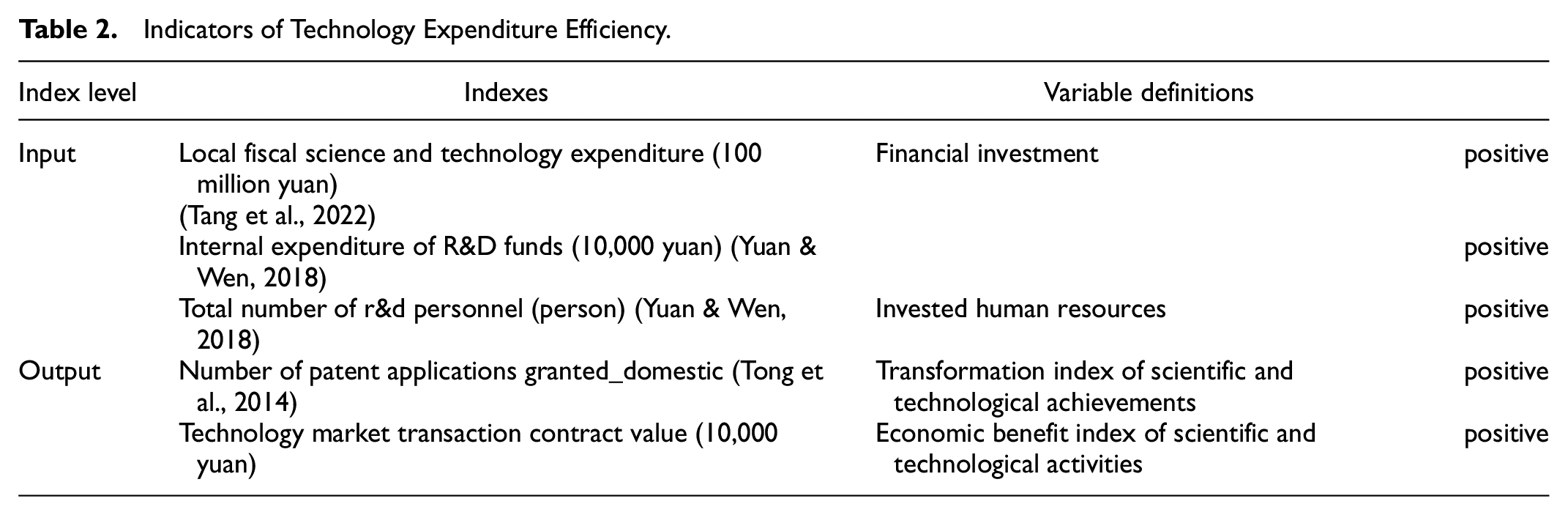
Firstly, this paper builds a complete set of index systems and analyzes the model construction by collecting data. Many factors exist in the performance evaluation design of science and technology expenses. Elberryn et al. (2022) select the input and output variables used in DEA, solving systems of linear equations to develop the technology efficiency value (Propheter, 2016). Based on the index system, scientific criteria, and data availability, this variable created the following indicator system, and the TOPSIS will standardize these five indicators (Yuan & Song, 2021). Entropy can determine the weight of indicators and improve the rationality and accuracy of the weights. In addition, TOPSIS can also reasonably sort the calculation results, helping to solve the problem of poor fuzzy comprehensive evaluation results. Based on this idea, this paper choose this method to evaluate each positive indicator to find its indicator weight to get the technology expenditure efficiency as shown in the Table 2:
Indicators of Technology Expenditure Efficiency.
Data Sources
Given the data availability and the change in the statistical caliber of the Chinese government, this paper uses the panel data of provinces. This study contains provincial panel data for 29 Chinese provincial administrative regions (except Tibet and Xinjiang, Hong Kong, Macao, and Taiwan) from 2004 to 2020. All data are obtained from China National Statistical Yearbook, In more detail, the data from the “Statistical Yearbook” by the government statistics bureaus of 29 provinces. And the data from China Internet Network Information Center. Table 3 defines the main variables involved in our empirical analysis, Table 4 shows the variable definitions:
Definition Variables.

Sources. China Statistical Yearbook.
Variable Definitions

Model Specification
According to the framework of Evangelista et al. (2014) and the above studies, digital infrastructure should be affected by three dimensions: access, usage, and empowerment. This study also uses the four sub-indicators of the digital infrastructure index, and the model is constructed as follows:

This study explores the relationship between digital infrastructure (DI) and fiscal self-sufficiency (FS), establishing a panel regression model in this section. This research includes a lagged one-period term of the explanatory variables into the panel model. The variable “digital Infrastructure it—1” is utilized to examine the digital Infrastructure on the development of FS. Berk et al. (2020) also consider the influence of the lag term for FS when examining the determinants of FS. To address potential issues related to heteroskedasticity and data fluctuations, this study apply natural logarithm processing for the variables.
Thus, Equation (1) can be written as:


Where α0 is the constant terms, α1…α 9 are the estimated coefficients, and ε it is the random disturbance terms. To investigate the impact of the DI on FS, where the subscript i represents the cross-section and t indicates the time series. Where i denotes the province, t denotes year. The dependent variable α1FS denotes fiscal Self-sufficiency, DI it denotes digital infrasrturement, the FS is not only affected by the DI but also disturbed by other factor. Hence, the model includes control variables, where FDI it refers to foreign direct investment, RED it represents regional economic development, MART it denotes marketization, RE it represents revenue elasticity, URBAN it represents urbanization, CRE it represents creativity, and ECO it denotes economic growth rate. α is the intercept term, β is the coefficient, and ε it is the random disturbance term.
If the regression model contains endogenous problems, such as the endogenous explanatory variable problem caused by the interaction between the DI and FS in this paper (Andrew et al., 2009). In other words, the DI may be endogenously determined by FS. Blundell and Bond (2000) investigate the system-generalized method of moments (SYS-GMM), which effectively solved the problems in the dynamic panel data and improved estimation efficiency. Therefore, this study uses the SYS-GMM and DIFF-GMM to estimate the results. The generalized moment estimation (GMM) method can control the time-fixed effect and individual effect on the one hand. Moreover, the consistency of the GMM estimator depends on two specification tests, namely Hansen and serial correlation (or autocorrelation) tests. On the other hand, it can solve the endogenous problem of explanatory variables by using the lagged items of explanatory variables as instrumental variables (Blundell & Bond, 2000). While conducting dynamic panel estimation, it is imperative to consider the Arellano-Bond and Hansen tests. The results of the SYS-GMM estimation show that the p-value of the first-order (AR (1)) and second-order (AR (2)) are less than .1 and higher than .1, respectively, which indicates that the estimation method of this study is reasonable. The p-value of the Hansen test are significantly less than 1, which proves that the IVs used in this research are effective.
Empirical Results and Discussion
Benchmark Estimates
The two dynamic model estimates reveal that AR (1) is significantly below 0.1, while AR (2) is significantly higher than 0.1. Furthermore, the results of the Hansen test show statistical significance below 1. This implies that the model estimation is valid, and the selection of instrumental variables is appropriate. FS lagging one period has a significant positive effect on the current period digital Infrastructure, which is significant at the 5% level, indicating that people past fiscal self-sufficiency affect the current period digital infrastructure on a national level. As for Table 5, it shows the regression results, the coefficient of the digital Infrastructure is negative in all methods; in other words, a 1% increase in the digital Infrastructure index can contribute to a decrease in FS of approximately −0.0914. The above previous ideas support the results that the digital infrastructure negative FS. (Ferreira & Araujo, 2006; Trachenko et al., 2020, pp. 117–118; Chen et al., 2020), this indicates that digital infrastructure will reduce fiscal self-sufficiency (FS). The possible reason is that substantial investment demands exacerbate fiscal deficits: The construction of digital infrastructure necessitates substantial one-time capital expenditures, and local government’s fiscal revenues are often insufficient to fully cover these outlays, resulting in an escalation of fiscal deficits and a concomitant diminution of fiscal self-sufficiency (Chudik et al., 2017). Under the framework of fiscal decentralization, imbalanced expenditure structures undermine long-term returns within the fiscal decentralization framework. An excessive concentration on digital infrastructure development may engender an imbalance in local governments’ expenditure structures, neglecting other crucial public service expenditures, thereby impeding long-term economic development and subsequently constraining the growth of fiscal revenues and the enhancement of fiscal self-sufficiency (Wang et al., 2023).
Results of the Digital Infrastructure on Fiscal Self-Sufficiency.
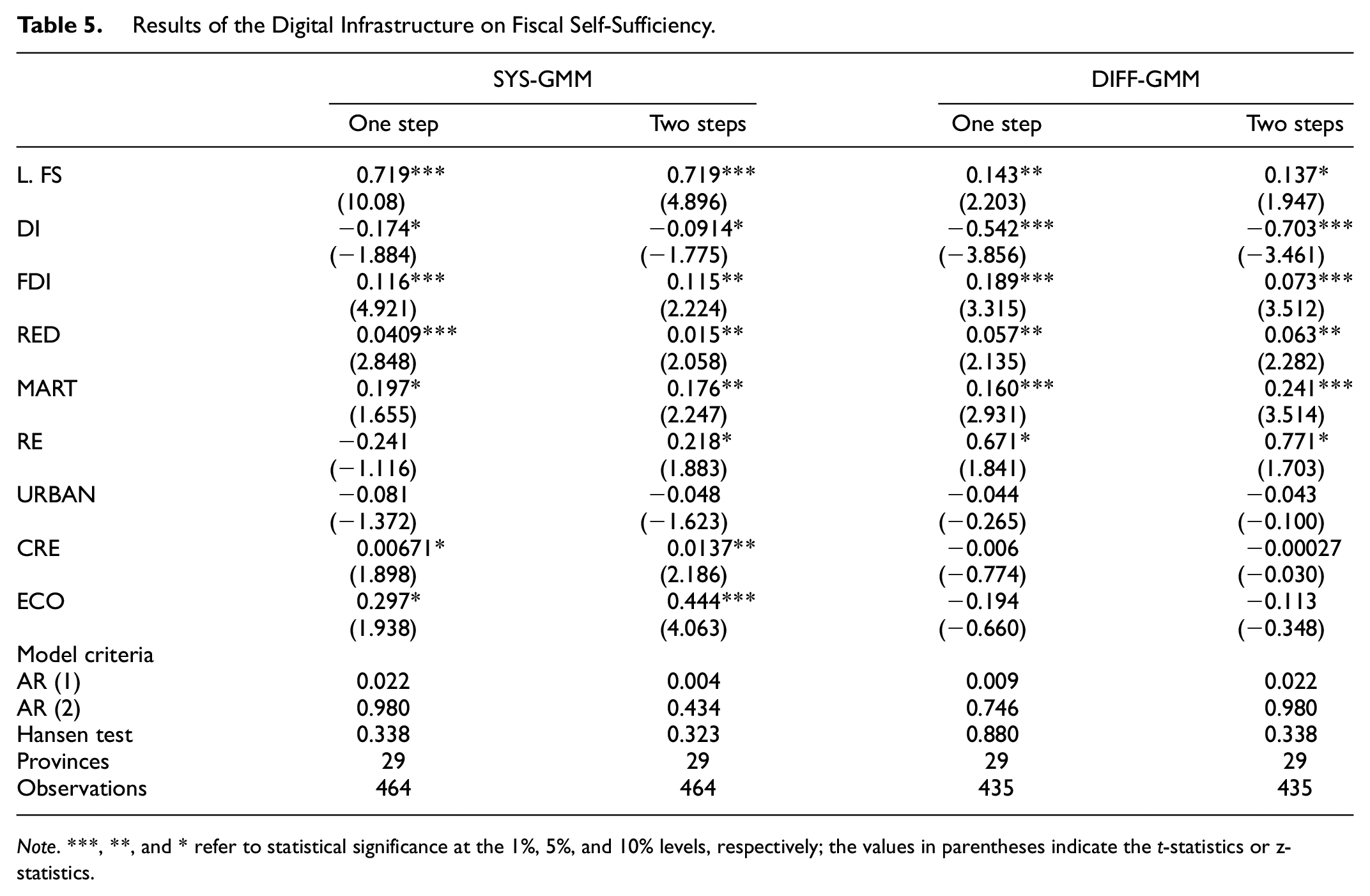
Note. ***, **, and * refer to statistical significance at the 1%, 5%, and 10% levels, respectively; the values in parentheses indicate the t-statistics or z-statistics.
Digital infrastructure became unprecedentedly important under the Internet Plus Policy (Hong, 2017). Subsequently, government fiscal expenditures include investment in digital infrastructure, and China’s infrastructure investment accounts for a large proportion of GDP (Dinlersoz & Fu, 2022). The government prioritizes “providing infrastructure” and “encouraging the use of infrastructure to create value” in fiscal allocation and policy implementation. Government may provide financial support for digital inclusion and infrastructure popularization to ensure that telecommunications infrastructure meets citizens’ needs (Tang & Yang, 2023). Based on China’s fiscal system, construction expenditures need to be financed by local governments, thus reducing fiscal self-sufficiency. Therefore, government spending on digital technology continues to grow yearly, long-term unilateral government spending can lead to increased pressure on government finances (Rozikin et al., 2023). On the other hand, the government increases budgetary spending to enhance digital infrastructure in rural and poor regions (Xia & Lu, 2008). This could raise government spending while slowing fiscal income growth, eventually leading to a decline in fiscal self-sufficiency.
For the control variables, the coefficient of FDI has a positive impact on government self-sufficiency. Provincial governments could obtain a more significant portion of the revenue generated through taxes on foreign direct investment (Zhang, 2001). The coefficient of the RED is 0.0151, and it is significant at a significance level of 5%. This shows that increased RGDP per capita income will increase the government’s fiscal self-sufficiency rate. Marketization is positive, which means that marketization has a positive and significant impact on government revenues. In addition, this study indicates that the coefficients of revenue elasticity are an essential driver in determining the increase of FS, which is 0.218. Tax revenue increases government fiscal self-sufficiency and eventually becomes the main source of government expenditure (Ashraf, 2018). In turn, governments could strategically allocate their budgets towards investments in public infrastructure. Urbanization coefficient is not significant, the reason may be that the impact of urbanization on government fiscal growth is contingent upon both infrastructure development and a conducive institutional environment (Turok & McGranahan, 2013). The estimated creativity coefficient is positive at a significance level of 10%. On the one hand, innovation helps reduce the expenses associated with government debt financing. On the other hand, creativity contributes to reducing government fiscal expenditures, thereby improving fiscal self-sufficiency (Chen et al., 2022). Economic growth rates are positive to local government fiscal self-sufficiency. An increase in economic growth results in higher tax revenue potential for the government, thereby advancing government budget fiscal self-sufficiency (Bartle et al., 2011).
Robustness Test
Fitrianto and Musakkal (2016) study that OLS is the most commonly used estimator in panel data sets. The method of OLS estimates was to minimize the sum of squared residuals. The estimated parameters were chosen simultaneously to make the sum of square residuals as small as possible. In the fixed effects model, it is desirable to assume differences in intercepts across cross-sectional or time series. RE models can be used to measure unobserved factors.
Fiscal comfort is used as a substitute variable for fiscal self-sufficiency to enhance the analysis’s robustness. The “fiscal comfort level” has also been used to measure local fiscal sufficiency, measured by the ratio of the local revenue demand index to the expenditure demand index. The expenditure demand Index (EDI) is the total national expenditure divided by the amount spent in each province. Local revenue demand index means dividing each state’s total income by the country’s total income (Tannenwald & Cowan, 1997).
This study also replaces the dependent variable with fiscal comfort to check robustness; Columns (1), (2), (3), and (4) of Table 6 are the results of estimating the effect of the digital infrastructure on fiscal self-sufficiency (FS) by using the fixed-effects panel model, random-effects model, the OLS model and SYS-GMM (Two Step), respectively. The significance of the estimated coefficients is consistent with the baseline regression, and the results are robust, further validating that digital infrastructure negatively affects fiscal self-sufficiency. Control variable results match baseline regression. Robustness test validates baseline regression results.
Robustness Test.

Note. t statistics in parentheses.
p < .1. **p < .05. ***p < .01.
Heterogeneity Analysis
This study divides the sample by regions into high population density and low population density (Zhuo et al., 2009), population density reflects the number of people in a province per square meter and presents the estimations in Table 7. The digital infrastructure positively affects fiscal self-sufficiency (FS) in high population density groups. The coefficient of the digital infrastructure on the efficiency of fiscal self-sufficiency (FS) is −0.072*, and it is significant at the 10% significance level. In areas with high population density, the government needs to increase financial expenditure in the development of digital infrastructure to meet the communication needs of the population, which will strain government revenues. Furthermore, the maintenance of digital infrastructure will be more costly, necessitating the government to assume a more significant portion of the construction and maintenance expenses, thereby reducing fiscal self-sufficiency. Additionally, regions with high population density face the limit of restricted land availability, which challenges the establishment of digital infrastructure as it necessitates the utilization of land resources. This phenomenon has the potential to result in limited availability of land and increased demand, thereby driving up land prices. Consequently, the government has higher construction expenses due to its investment in digital infrastructure. In densely populated regions, governments will prioritize enhancing infrastructure to facilitate urban expansion, particularly by constructing fiber optic communication networks and broadband infrastructure.
Heterogeneity Test.

Note. High populatoion density provicnes: Beijing, Tianjin, Hebei, Shanghai, Jiangsu, Zhejiang, Anhui, Shandong, Henan, Hubei, Hunan, Guangdong, Chongqing, Sichuan, Shaanxi, Jiangxi. low populatoion density provicnes: Shanxi, Inner Mongolia, Heilongjiang, Jilin, Liaoning, Fujian, Guangxi, Hainan, Yunnan, Guizhou, Gansu, Qinghai, Ningxia.
Moreover, the effect of the digital infrastructure on fiscal self-sufficiency (FS) in low population density is nonsignificant. A potential explanation is that areas with low population density may need more revenue to justify government expenditures for infrastructure development. A low population density may imply a smaller taxpayer base and reduced economic activity. In such circumstances, governments may encounter heightened fiscal challenges. Moreover, the construction of digital infrastructure typically demands substantial financial resources. In regions with low population density, achieving economies of scale might be challenging, resulting in comparatively diminished returns on investment. Furthermore, the correlation between regions with low population density and the development of digital infrastructure can be explained by substantial expenses, constrained profitability, the necessity for governmental intervention, and the complexities due to technological advancements. Therefore, the government’s willingness to invest is relatively reduced.
Mediating Effect Analysis
To verify the transmission mechanism of digital infrastructure affecting fiscal self-sufficiency (FS), this paper uses the intermediary effect model for empirical test. The empirical component of the article will include an examination of the indirect effects proposed in the mechanism of action segment. Furthermore, this study selects a hierarchical regression method to test the technology expenditure efficiency indexes as the mediating variable and investigate the mediating effect of DI in the nexus of the FS.



First, DI it is digital infrastructure in province i at year t, and MEDit is the level of technology expenditure efficiency in province i at time t. α0, β0, and P0 are constant items, ε it is the random perturbation term. In this regard, this study utilized Baron and Kenny’s Kenny’s (1986) method causal steps approach to test the indirect effect of technology expenditure efficiency (TEE) on the digital infrastructure. If α1 in equation (2) is significant, then the precondition of an indirect effect’s existence is considered significant, and further tests are conducted. If any step test coefficient is insignificant, then the next step cannot be tested. If β1 in equation (3) and ρ1, ρ2 in equation (4) are positive, then it indicates that there is an indirect effect. If ρ1 is significant, it will be a partial mediation effect. If ρ1 is insignificant, it will be a complete intermediary effect. Table 8 shows the causal steps approach.
Mechanism Verification. DI-TEE-FS as an Impact Pathway.

Note.***, **, and * refer to statistical significance at the 1%, 5%, and 10% levels, respectively; the values in parentheses indicate the t-statistics or z-statistics.
Furthermore, this paper selects technology expenditure efficiency (TEE) indexes as the mediating variable and investigates the mediating effect of TEE in the nexus of DI and FS. The results are represented in Table 8. Columns (1) to (3) show that digital infrastructure affects FS through TEE. TEE plays a partial intermediary effect.
When TEE is considered a mediating variable, the results indicate a mediating effect at the provincial level. The first column of Table 8 reports the estimation results of the basic model that the DI affects the FS. Column (2) of Table 8 shows that when TEE is the explanatory variable, The estimates show that for every 1% increase in digital infrastructure, TEE increases by 0.0389%. When TEE is the mediating variable, the coefficient of fiscal self-sufficiency is 0.598, that is, for every 1% rise in TEE, fiscal self-sufficiency will increase by 0.598 units. This result is consistent with the Zhou et al. (2020) and Nukpezah et al. (2022).
The robustness of the findings is checked using the Sobel mediation effect test (Sobel, 1982). The results indicate that the estimated coefficients of the TEE are significantly positive, confirming the robustness of the causal steps approach regression, which indicates the stability of the results. The p-value of Sobel is less than .1, which means that the TEE, as for the mediating variable, is able to produce a significant mediation effect. The proportion of mediation effect is 0.897, and Nair et al. (2020) also confirm the above conclusions.
Digital infrastructure can promote the development of TEE. The improvement of the government’s financial self-sufficiency is closely related to TEE. On the one hand, digital infrastructure plays a vital role in promoting the development of TEE. Researchers can swiftly access and share information through digital platforms, facilitating the rapid dissemination of research outcomes. Digital infrastructure offers broader collaborative opportunities, enabling the sharing of research findings and enhancing the capacity for collaborative research. Consequently, this more effectively propels technological expenditures efficiency (Bygstad & Øvrelid, 2020). On the other hand, TEE can improve the FS. Similar findings were reported in the study by Nukpezah et al. (2022), in which the authors pointed out that improving the TEE contributes to collecting revenue in local government and promoting government revenue performance. Technology expenditure efficiency improves government productivity and service performance. Efficiency and minimized waste help the government manage finances, minimize deficits, and promote fiscal self-sufficiency. This conf irms the previous theoretical analysis that the digital infrastructure further improves the FS by promoting TEE. At the same time, digital infrastructure provides high-speed internet connections and data storage capabilities, making it easier for researchers and innovators to share and access information, and its development is conducive to technological innovation, thereby increasing fiscal revenue (Li et al., 2021).
In brief, the digital infrastructure has increased the FS through TEE.
Further Discussion
A moderated effect is typically modeled statistically as an interaction between DI and the moderator variable, frequently quantified as the product of X and expenditure decentralization. Moderation can help us to understand how a process operates if the moderator places constraints on how or when that process can function (Hayes, 2009).
The purpose of this paper is to investigate the extensive adopt of expenditure decentralization as a moderator in the research area. Equation (5) incorporates the cross product term of the moderating variables and the digital infrastructure into the regression model. DI and FS by introducing expenditure decentralization as a moderating variable based on:

Table 9 shows the basic regression, the negative correlation between digital infrastructure and fiscal self-sufficiency may be attributed to the substantial investments required for high-level digital infrastructure projects. These investments are often facilitated through government fiscal expenditures, potentially diminishing fiscal self-sufficiency. In introducing the interaction term of expenditure decentralization and digital infrastructure as a moderating variable, a potential emergence of a positive relationship. Expenditure decentralization entails devolving more fiscal authority to local governments, empowering them to determine how funds are allocated and utilized autonomously. In this study, elevated levels of digital infrastructure development may be perceived as a strategic investment that enhances local fiscal self-sufficiency. Giving local governments greater autonomy through fiscal decentralization can effectively attract additional investment and stimulate economic growth through the development of digital infrastructure. Consequently, expenditure decentralization increased fiscal self-sufficiency as local governments efficiently allocate resources (Wegge et al., 2010), leveraging digital infrastructure development to influence fiscal autonomy positively.
Moderating Effect Test.

Note.***, **, and * refer to statistical significance at the 1%, 5%, and 10% levels, respectively; the values in parentheses indicate the t-statistics or z-statistics.
Conclusions and Policy Implications
To examine the impact of digital infrastructure on fiscal self-sufficiency and its internal impact mechanism, panel data from 29 Chinese provinces from 2004 to 2020 were utilized, estimate the results using the dynamic panel model (SYS-GMM), and discuss the mediating effect of technology expenditure efficiency. The main results are as follows:
From 2004 to 2020, a consistent rising trend was observed in the development of China’s digital infrastructure, indicating a gradual improvement over time. The findings from the baseline regression analysis indicate a negative relationship between digital infrastructure and fiscal self-sufficiency. Specifically, the results suggest that a 1% rise in the digital infrastructure index is associated with a 0.0914 increase in government fiscal expenditure. During the robustness test, the results match the baseline regression results, validating the results reliability. Furthermore, the heterogeneity analysis results show that population density significantly impacts digital infrastructure. Specifically, provinces with high population density require substantial financial investment from the government. Conversely, provinces with low population density will have less willingness of the government to invest in infrastructure. Furthermore, the findings from the impact analysis indicate that digital infrastructure plays a crucial role in increased fiscal self-sufficiency through promoting scientific and technological innovation. The introduction of fiscal decentralization has transformed the relationship between digital infrastructure and fiscal self-sufficiency from a negative correlation to a potential positive correlation within the fiscal context of China.
Policy Implications
China recognizes the significance of digital infrastructure in achieving economic growth, as evident in initiatives like “Broadband China” and “Optical Network City.” While these efforts have contributed to advancing new infrastructure, there remains for improvement in China’s current digital infrastructure landscape. Strengthening digital infrastructure should focus on the following key factors:
Based on the fiscal decentralization theory, the following policy recommendations are proposed to address the negative impact of digital infrastructure construction on fiscal self-sufficiency:
(1) Local governments are granted greater autonomy over tax categories and revenue sources. This would not only broaden their fiscal income channels but also empower them to make strategic decisions for their communities. Concurrently, fiscal and taxation system reforms should be advanced to optimize fiscal expenditure responsibilities, thereby freeing up more funds for local governments to invest in infrastructure development. This could lead to a more balanced and sustainable fiscal landscape. Furthermore, in the long run, the financial management capacities of governments at all levels will be significantly strengthened. Local governments should improve budget management, streamline expenditure structures, and allocate resources to priority areas. Meanwhile, the central government should focus on fostering local economies, broadening the tax base, and bolstering the financial capacity of local governments.
(2) In low-population-density regions, a more nuanced approach is warranted. Governments should purposefully align digital infrastructure investments with localized needs and growth prospects. Prudent resource allocation and policies that incentivize population influx can stimulate consumer demand and maximize the socioeconomic returns on digital infrastructure outlays. In addition, governments should implement focused migration initiatives and steps to boost the potential of rural areas, which measures may contribute to a self-sustaining fiscal context. Indeed, the quality of people’s lives is greatly enhanced in regions with adequate digital infrastructure.
(3) Catalyzing corporate digital transformation is pivotal to amplifying technological absorption and enhancing overall scientific and technological efficiency. Governments should formulate conducive policies and incentive structures to stimulate heightened private sector investment in digital upgrades and technological assimilation. Concurrently, it is essential for the government to foster robust collaboration between industry and academia and for the government and higher education institutions to collaborate with forces in promoting the integration of digital technology and education. This will help develop a skilled workforce that can perform well in the digital economy. The reason is that financial strength is indirectly strengthened by fully utilizing the technological spillover effect of digital infrastructure and enhancing the overall technological level.
Future research can be extended to China’s fiscal revenue or fiscal expenditure, and the relationship between digital infrastructure construction and fiscal self-sufficiency can be analyzed in detail through the fiscal decentralization theory.
Footnotes
Acknowledgements
We solemnly declare that all authors of this paper have both the rights and responsibilities to ensure the authenticity and accuracy of the research. We respect the contributions of each author during the research work and firmly believe that every author has made a significant contribution to the successful publication and knowledge contribution of this paper.
Declaration of Conflicting Interests
The author(s) declared no potential conflicts of interest with respect to the research, authorship, and/or publication of this article.
Funding
The author(s) disclosed receipt of the following financial support for the research, authorship, and/or publication of this article: Cunlin Li was supported in part by the Major Projects of North Minzu University (No. ZDZX201805), governance and social management research center of Northwest Ethnic regions and First-Class Disciplines Foundation of Ningxia (No.NXYLXK2017B09), the youth talent support program of Ningxia (2021), and the leading talents support program of North Minzu University.
Wenjun Mai was supported in part by the Center for Uzbekistan Studies of North Minzu University.
Ethics Statement
Not applicable

Data Availability Statement
Data sharing not applicable to this article as no datasets were generated or analyzed during the current study.