



Abstract
In the contemporary and perpetually changing environment, firms have transformed their business models by integrating advanced digital technologies in which their capabilities contribute crucially. This has evoked competition and challenges especially for small and medium-sized enterprises (SMEs). Therefore, the research aimed to analyze the mediating effect of information technology (IT) capability between digital business strategy and firms’ efficiency. The case of Chinese SMEs was considered specifically. The research was quantitative; therefore, the sample comprised 351 participants accumulated using a survey questionnaire. The mediating effect was tested using structural equation modeling (SEM) where partial mediation of the IT capability was found only in terms of IT proactive stance. Therefore, the research has certain managerial implications specifically in terms of proactive stance as the managers need to initiate the transformation within for efficient performance.
Keywords
Introduction
Globally, businesses are exploring ways to capture more share in the market and gain a competitive edge against their rivals (Anwar, 2018; Rehman & Anwar, 2019). This has been due to the advent of globalization which has increased the competition among the firms. In this concern, the alignment of information technology (IT) strategy has been a focus of companies in China where it was considered as a supplementary part of business strategy to help the businesses excel and perform efficiently (A. S. Bharadwaj et al., 2013). With time, the connections have been refreshed specifically with the concept of integration, given the abundance of information, complex supply chains maintained at global level, and the emergence of artificial intelligence, big data, and cloud computing (A. S. Bharadwaj et al., 2013; Kohli & Grover, 2008). Therefore, the businesses in the present period are integrating advanced digital technologies in their business models, strategies, and policies to guide them for comprehensive decisions (Chi et al., 2016). These strategies are deemed to be digital business strategies as they fuse technology and business models or strategies. This strategy influences the value of IT at business level especially in Chinese cities such as Qingdao, Linyi, Donging, Yantai, and Beijing as stated in Drnevich and Croson’s (2013) study. Here, the fusion of IT with the business strategy is transforming the conventional strategies used in businesses in terms of cross-functional strategy, enhancing their global process, and improving their distributed or modular systems (Kohli & Grover, 2008).
However, the research of Bataineh et al. (2015) stated that in enhancing the agility and efficiency of firms, for instance, IT capabilities, the IT infrastructure mediates effectively between the IT or business strategy and the agility in the market. A crucial gap, in this case, is determined as previously conducted research works have focused primarily on the association of digital business strategy (DBS) with firms’ performance, whereas the capability of the firm to excel in this regard have not been considered specifically in the context of businesses operating in China. Thereby, IT capability is one of the crucial factors affecting business performance and efficiency. Also, this research undertakes efficiency rather than performance, which entails that accomplishment of the tasks promptly is also a key consideration of this study rather than just profitability.
Considering the market competitiveness of Chinese firms operating in the digital industry, small and medium-sized enterprises (SMEs) strive to push the boundaries with their limited capability due to certain constraints, for instance, budget and resources (Brustbauer, 2016; Woschke et al., 2017). For instance, the study carried out by Parnell et al. (2015) claimed that Chinese SMEs attempt to follow a mainstream cost-based approach, especially for the domestic market. Nevertheless, the research also stated that it is not improbable that the Chinese SMEs adopt a differentiated strategy. The challenges for Chinese SMEs operating in Qingdao, Linyi, Donging, Yantai, and Beijing in terms of resources, capabilities, time, and costs have also been explored qualitatively by Gierlich et al. (2019). Precisely, this aspect of Chinese SMEs developed researcher’s interest to study of this domain with quantitative measures to evaluate whether DBS contributes significantly to efficiency and whether limited IT capabilities mediate relationship. Chi et al. (2016) also conducted a study on China in similar regard while considering e-commerce collaboration as the mediator, so the focus was more on supply chain elements. However, they considered manufacturing companies solely and declared it as their limitation. Hence, this study attempts to extend the analysis by considering a different mediator and considering the service sector as well in the analysis.
This study has been contributing to the existing theory as it identifies the mediating role of the firm’s IT capability among the relationship between DBS and firms’ efficiency. This aims to contribute to their existing relationship among DBS and firms’ efficiency, which has been discussed by various authors (Gregory et al., 2019; Na et al., 2017; Nadeem et al., 2018). Therefore, this study seeks to test the new model in the existing theory which depicts the relationship among DBS and efficiency of firms. The targeted population is based on managers and owners working in Chinese SMEs operating in Qingdao, Linyi, Donging, Yantai, and Beijing because of the significance of these cities in the context of SMEs.
Concerning all the above-mentioned aspects, this research has aimed to analyze the effect of DBS on the firms’ efficiency, whereas the mediating effect of IT capability has been tested further considering the case of Chinese SMEs. Also, for comprehensive attainment of the aim, the following objectives have been constructed:
To comprehend the latest concepts of DBS, IT capability, and firms’ efficiency;
To analyze the impact of DBS on the efficiency of Chinese SMEs;
To analyze the mediating effect of IT capability between the DBS of Chinese SMEs and their efficiency.
Concerning the aims and objectives, the core research question that this research has attempted to answer has been presented below:
Theoretical Background
DBS is manifested as one of the most prominent concepts in the business world, and it is referred to as the intersection of strategic management and IT (Holotiuk & Beimborn, 2017; Nadeem et al., 2018). The digital technologies that are commonly integrated into the systems in the present time-period include cloud computing, artificial intelligence, business intelligence, big data, and similar technologies aiding the businesses to excel and derive value (A. S. Bharadwaj et al., 2013; Iafrate, 2018; Kohli & Grover, 2008). Chi et al. (2016) argued that DBS is an organizational-level strategy rather than an IT strategy or functional strategy because the purpose of the inclusion of this strategy is generating value for the business through technology mediums. The integration of such technologies is supported by the study of Kahre et al. (2017) where the significance is highlighted by stating that DBS restructures the firms’ business model leading to transformation and is more concerned to produce prospective financial outcomes for the businesses. The research of Nadeem et al., (2018) has also asserted that DBS leads to digital transformation, yet the firms’ capabilities contributing to it are ambiguous. Bataineh et al. (2015) in this concern stressed on the IT capability of the firms in enhancing the efficiency of businesses irrespective of the industry it is operating in.
In the context of transformation, DBS reforms the infrastructure of the company along with improving the firms’ communication and coordination pattern (Westerman et al., 2014). The firms inclined toward digital transformation keep redefining their business strategies, for instance, IBM, Microsoft, Google, Oracle, and others, to push their digital capabilities for efficient performance in the market (Evans, 2018). Furthermore, the use of DBS extends the benefits of the organizations by outdoing conventional strategies in terms of providing superior customer experience, retention, operational performance, and efficiency (Chi et al., 2016; Setia et al., 2013). It has been further argued by Schryen (2013) that DBS helps in the identification of IT capability of the companies, which in turn aids the company to attain a competitive position in the market, which ultimately leads to value creation.
IT capability is defined by Bassellier et al. (2000) as firms that can obtain, expand, link, and reform the IT-based resources of the company, improving the operational efficiency and firms’ business strategy. Fundamentally, it presents a unified picture of organizations’ resources in terms of human resources, infrastructure, IT-based resources, and intangible assets of the companies, including IT skills, synergy, consumer orientation, and related knowledge (A. Bharadwaj, 2000). The research of Chae et al. (2014) and Lu and Ramamurthy (2011) demarcated the benefits of enhancing IT capability in terms of precise efficiency, cost reduction, growth in sales, and more market value. As different studies have deemed IT capability as having a significant role in refining the agility and efficiency of the businesses, the study of Bataineh et al. (2015) and Lu and Ramamurthy (2011) has asserted that it also can hold the company back, sanctioning its growth and further fragmented IT capability into infrastructure capability, business spanning, and proactive stance.
The infrastructure aspect of IT capability can be defined as the propensity of firms to align the solid stage of IT resources and architecture for managing data, their relative processes, and for the formation of interlinked channels (Mithas et al., 2005). IT business spanning, on the contrary, is referred to as the capability of the firm to visualize and apply the available IT resources optimally to produce value and support the objectives of the firm (Nwankpa & Roumani, 2016). Another dimension of IT capability is a proactive stance which can be defined as the active and opportunistic stance of the company toward indulging in innovation and producing novel ideas supporting the business using the IT resources available and exploring the new ones steadily (Lu & Ramamurthy, 2011).
As IT capability is based on certain resources, resource-based theory (RBV) is extensively used in the literature underpinning IT or systems. In terms of RBV, the success of the firms in the market is associated with the skills they possess and resources available to them that are rare, organization-specific, and hard to forge (Liang & You, 2009). In the context of SMEs, Ramon-Jeronimo et al. (2019) explained that resources available to them are limited due to financial and similar constraints, and this further limits the acquisition of resources to enhance the capabilities of the firms affecting their business performance. Therefore, the study of Nwankpa and Roumani (2016) inferred that IT capabilities of the firms are steady with RBV, and the IT capabilities that are rare, sustainable, and cannot be reproduced easily can benefit the organizations, specifically SMEs, in the long run by creating value, efficiency, and profitability.
Concerning the capability of IT firms, the technology acceptance model is widely discussed by the authors (Chen et al., 2017). This is due to the reason that the ability of the company to adopt and implement the technology is dependent on the acceptance of technology by the employees. It has been argued in the study by Acheampong et al., (2017) that the technology acceptance model is the theory of information systems which depicts how users accept the technology and use it effectively. In this manner, perceived usefulness is the degree to which it is believed by the person that with the use of a particular system, his or her job performance would enhance. This depicts the capability of the company in terms of adopting technology through the acceptance of employees in the company.
Conceptual Framework and Hypothesis Design
Conceptual Framework
The conceptual model of the study has been presented and discussed meticulously in Figure 1. The independent construct of the study is the DBS which has been computed with the indicators referring to use of artificial intelligence, cloud-based techniques, use of analytics, using technology in business models, and others. The variable is specifically supported by the study of Lu and Ramamurthy (2011). The mediator of the study of IT capability is measured through IT infrastructure, IT proactive stance, and business spanning as professed by the study of Bataineh et al. (2015). Given this, the dependent construct of the study is firms’ efficiency in which certain indicators have been considered, for instance, sales growth, enhancement in work productivity, customer satisfaction, reduced customer churn, and so on. These indicators are also considered by the study of Rehman and Anwar (2019) whereas the simialr methodologies has been adopted in the filed of enegry economics, environment and other academic fields.

Conceptual model.
Hypothesis Construction
DBS and firms’ efficiency
As explained earlier, DBS is a significant strategy that the businesses utilize to improve the viability and efficiency of firms (Setia et al., 2013) in terms of reducing cost, integrating digital technologies, and updating the business models. The research works that have considered DBS as a firm-level strategy and managed to examine its impact on the efficiency of firms are limited where most of past research works focused on IT alignment (Chi et al., 2016; Tallon & Pinsonneault, 2011). In this concern, the literature review has revealed that DBS’s integration helps the firms to excel exhibiting positive characteristics (A. S. Bharadwaj et al., 2013; Kohli & Grover, 2008). These aspects have led to the formulation of the following hypothesis that this research has tested considering the case of Chinese SMEs:
This relation has also been tested in the study by Murawski et al. (2018) in which the positive impact of digital business strategies on the efficiency of the black box was identified. Therefore, this study has aimed to identify the impact of digital business strategies on the efficiency of firms operating in China.
DBS and IT capability
It has been opined by the research of Nadeem et al. (2018) that DBS enables the companies to enhance their capabilities specifically, leading to digital transformation, yet the capabilities affecting them are vague. The research of Turulja and Bajgorić (2016) further stated that the digital strategies improving the capabilities of IT enable the firms to boost their value in the market. Therefore, it has led to the formation of the following hypothesis:
The study by Ukko et al. (2019) also tested a similar relation in which it was determined that the DBS has a positive effect on the IT capability of the companies. Therefore, this study has aimed to test the following hypothesis in the context of firms operating in China.
IT capability and firms’ efficiency
It has already been discussed previously following the study of Chae et al. (2014) that IT capability in terms of proactive stance, business spanning, and infrastructure can benefit the firms to attain efficiency in the market and can ultimately help them in finding competitive edge. Hence, based on the proposition, the following hypothesis has been constructed:
This hypothesis has also been tested in the study by Park et al. (2018) in which the positive effect of IT capability was determined in the efficiency of firms. In this manner, this study has involved the testing of this hypothesis in the context of Chinese firms where the effect of IT capabilities has been examined on the efficiency of firms.
Mediation of IT capability between DBS and firms’ efficiency
Under the research of Bataineh et al. (2015), a business strategy of the firms excels the IT capability, which in turn produces effective and efficient results in terms of productivity and profitability. In this case, the study by Lu and Ramamurthy (2011) bifurcated IT capability into infrastructure capability, business spanning, and proactive stance. Consequently, the following three hypotheses have been constructed considering the three discussed dimensions which have been tested in this study:
The mediation effect of IT infrastructure among the relationship between DBS and firms’ efficiency was also tested in the study by Ukko et al. (2019) in which the negative mediation of IT infrastructure was identified between DBS and firms’ efficiency. Therefore, a similar effect has been tested in the context of firms operating in the Chinese digital industry:
The mediation effect of business spanning on the relationship between DBS and firms’ efficiency was also tested by Nwankpa and Datta (2017) which depicted that there is no significant mediation of business spanning in the relationship among DBS and firms’ efficiency. This study has tested a similar effect on the firms operating in the digital industry in China.
The IT proactive stance has been tested as the dependent variable in the study by Nwankpa and Roumani (2016) where it has been determined that there is a positive effect of IT proactive stance on the performance of the firm. In this study, the researcher has tested the IT proactive stance as the mediating variable in which new findings will contribute to the contribution toward existing theory. The capabilities are being used in the application of energy economic and environment such.
Research Methodology
Sample and Data
The research has employed a quantitative research design where the data collection method is primary. The targeted population is based on the managers and owners working in Chinese SMEs; therefore, a sample size of 400 participants from 50 firms was targeted. This makes roughly 8 to 10 respondents from each firm. The underlying reason for omitting the junior employees is that they usually are less interested in the operations of the businesses and are more concerned toward the incentives and their pay. The managers and owners are well-informed personnel of the business who can provide authentic information substantiating the findings of the study. The study by Anwar (2018) asserted that the managers along with the owners are liable for the performance and efficiency of firms. Hence, the targeted sample is suitable for data collection. The data have been accumulated using close-ended survey questionnaire which has been administered physically and online as well. The cities of China that have been considered for data accumulation are Beijing, Qingdao, Linyi, Donging, and Yantai specifically as they are some of the largest cities having widespread businesses.
The researcher distributed the questionnaire among 400 participants. However, 352 were eligible to be used because some were returned unfilled and some were incomplete which could not be taken further. Hence, the response rate of this study is computed to be 88.0%. The research by Hashim (2010) has stated that when the population is 400, a sample of 250 can be deemed appropriate for analysis. Consequently, the sample size of this study is sufficiently large for any statistical analysis.
Measures
The survey instrument comprised two sections, where the first one dealt with demographic profile, whereas the next section was dedicated to the variables of the study measured on a scale ranging from 1 to 5 depicting “strongly disagree” to “strongly agree.”
It has been measured using a 5-point Likert-type scale as stated earlier in this section. The metrics are similar to the ones discussed in the conceptual model of the study. However, this variable has been adapted from the studies of Chi et al. (2016) and Nwankpa and Roumani (2016) comprising a total of six factors.
It has been measured separately for infrastructure, proactive stance, and business spanning. This variable has been adapted from the research by Nwankpa and Roumani (2013), and each of the three dimensions has been measured using four items.
Besides, the research has measured the dependent variable, which is firms’ efficiency, through questionnaire because integrating secondary data (financial ratios) with primary (survey questionnaire) might not produce satisfactory results. The factors discussed in the conceptual model have been undertaken, and this variable comprises 10 items which have been adapted from the studies of Nwankpa and Roumani (2013) and Rehman and Anwar (2019).
The research by Rehman and Anwar (2019) and Semrau et al. (2016) proclaimed that the age of the industry, its size, or nature can influence the results. Hence, they deduced that the inclusion of these control variables can limit the probability of spurious results. Therefore, the researcher of this study controlled the model for the industry’s nature, age, and its size using analysis of variance (ANOVA) on SPSS. The results implied insignificance, where the control variables age and size of SMEs affected the firms’ efficiency significantly in the context of Chinese SMEs, which were tested through structural equation modeling (SEM). Given this, the nature of the industry was a categorical variable; therefore, multigroup analysis (partial least squares–based multigroup analysis [PLS-MGA]) was conducted, where it was found that the results were similar to the overall results for Group 2 (service) and Group 3 (trading). However, for Group 1 (manufacturing), the results were similar in terms of effect and significance except for a proactive stance’s impact on firms’ efficiency. The variable of proactive stance was significant in other cases except for Group 1, showing that it does not directly affect the firms’ efficiency in case of manufacturing firms. Besides, when the effect using unstandardized residuals was compared among the three industrial groups, insignificant results were produced. Hence, it has been deduced that the effect does not vary across the groups, and this variable controls the association insignificantly. Consequently, in the final model, no control variable has been included specifically.
Analysis Technique
Besides, the data analysis techniques incorporate demographic profiling of the respondents and SEM model to answer the research question and test the constructed hypotheses. The technique is further supported by the studies of Rehman and Anwar (2019) and Chi et al. (2016) as they tested mediation. For SEM construction, SmartPLS has been employed, which uses PLS technique and does not assume normality of the data. The study by Lowry and Gaskin (2014) asserted that PLS has flexibility in terms of assumption of data distribution where skewed data can also be utilized, whereas for both exploratory and confirmatory studies, PLS can be employed. The distribution of the data of this study was found to be slightly skewed; therefore, the PLS technique has been preferred for SEM.
First, the researcher conducted pilot testing to examine the indicators used in the questionnaire for each variable. In this essence, some of the indicators were removed due to extremely low factor loadings which were not used in the final questionnaire. Initially, there were four factors of infrastructure and one was then removed, whereas firms’ efficiency comprised 10 factors, and after removal of two factors, eight were retained and used. Following the mentioned procedure, other pretesting techniques were employed in the final accumulated data. The description of pretesting has been provided as follows:
The researcher has controlled the nonresponse bias analysis by comparing the early responses with late responses. However, the researcher scheduled the dates accordingly to visit different SMEs and visited two each day. In this essence, the possibility of late responses was sanctioned. However, to limit the uncertainty of the online responses, the researcher recursively contacted the respondents to complete the questionnaire at the earliest. Therefore, the method helped to accumulate complete data in a designed time frame. Yet with the final accumulation of data, the researcher compared the results of late responses and early responses and deduced that the difference was insignificant. Hence, it implied that the data are free from nonresponse bias.
The first step to deal with data was incorporating data screening and aligning them for the analysis. In the case of missing values, the researcher replaced them with the average value of the series as proposed by the study by Molenberghs et al., (2014). Given this, in case of substantial missing of data, those rows were omitted so that they could not affect the analysis. However, due to adequate interaction with the respondents, the missing values were minimal in the entire data set.
The presence of outliers can be deemed as another crucial problem which can lead to spurious results. Hence, to deal with outliers, Mahalanobis distance was used, which has been suggested by the study by Aggarwal (2015). The data were then used for further analysis, specifically for SEM. In this case, one outlier case was removed, which reduced the sample from 352 to 351. Hence, the total sample size considered in this study is 351 participants.
The problem generally occurs when the dependent and independent variables are accumulated from the same respondents. To test whether condition-based maintenance (CMB) is an issue with the data of this study, Harman’s single factor has been employed on SPSS using principal component analysis (PCA) to examine whether the variance explained is above the threshold or below. The study by Tehseen et al. (2017) stated that the threshold for Harman’s test is considered to be 50%, and if the value is above 50%, then the problem of CMB occurs which is needed to be dealt with accordingly. It has been found from the PCA analysis and Harman’s test that the total variance explained is below 50%, implying that the hypothesized items are related to their factors concerning this study. Hence, the presence of CMB was not found because, concerning the data of this study, the computed total variance explained was 32.525% which is below the threshold of 50%.
Results and Discussion
Demographic Analysis of the Study
For comprehending the sample, demographic analysis has been tabulated in Tables 1 and 2. In Table 1, frequency analysis has been conducted for categorical variables whereas Table 2 illustrates descriptive statistics for scale variables. Following Table 1, the concentration of males in this study is found to be high, that is, 75.2%, whereas for females it is 24.8%. Also, most of the respondents were middle-aged, falling in the category of 26 to 40 years, forming 50.1% of the total sample. In the context of the position in SME, 70.9% were found to be managers and 29.1% were owners. Given this, 31.3% of the SMEs belonged to manufacturing sector, 47.9% belonged to the service industry, and 20.8% belonged to the trading industry. However, following Table 2, the average age of Chinese SMEs is computed to be 13 years, with an average size of 120 employees working in the respective companies.
Demographic Profiling.

Descriptive Statistics.

Note. SME = small and medium-sized enterprise.
Confirmatory Factor Analysis (CFA) and Path Analysis
CFA has been conducted to validate the use of factors in the model. However, first, the validity and reliability of the indicators have been evaluated using different measures: Cronbach’s alpha and composite for reliability, average variance extracted (AVE) for convergent validity, and heterotrait-monotrait (HTMT) ratio for the discriminant validity of the constructs. However, for analyzing factors’ relevancy, the metric of factor loadings has been used. The mentioned metrics have been proposed by the study by Civelek (2018), Vinzi, et al., (2010), and Wong (2013). The results of the model constructed in this study are presented in Table 3.
Reliability and Convergent Validity Testing.

Note. IT = information technology.
Significance at 1% (p values of factor loadings <.01).
In the context of factor loadings, the study by Hon et al. (2012) opined that the indicators below .4 should be omitted, which opines that factors loadings above .4 can be deemed as acceptable; however, the preferable minimum value is .6. Given the condition discussed, all of the factor loadings present in the final model fall in the acceptable range. Cronbach’s alpha is a measure used for examining the internal consistency of the constructs having a certain number of indicators. Therefore, concerning the research of Warner (2008), Leung (2001), and Ssempala (2009), the minimum value should be .6 to declare a variable statistical reliability. In this essence, the reliability is proven of each construct because all the values are above .6. Besides, composite reliability is also computed for reliability and its threshold is also .6 (Martínez, 2010; Vinzi et al., 2010). Concerning the constructs of the research, composite reliability is found because each value is above .6. Another significant aspect for CFA is the convergent validity which depicts the convergence between the constructs or their association in simpler terms (Bryman & Cramer, 2004). In this study, AVE has been undertaken for which the threshold is considered to be .5, yet .4 can be regarded as an acceptable value in case the composite reliability exceeds .6 (Huang et al., 2013). Consequently, all constructs can be declared as having valid convergence values.
On the contrary, SEM also requires discriminant validity of the constructs, which implies that each construct should be distinct from another (Mehmetoglu & Jakobsen, 2016; Tinsley & Brown, 2000; Warner, 2013). To evaluate the discriminant validity of this study’s constructs, HTMT ratio has been utilized. The studies of Gold et al. (2001), Teo et al. (2008), and Hair et al. (2016) asserted that the HTMT ratio should be lower than .9. In this concern, all the constructs are valid in a discriminant manner because all are computed to be below .9. The results can be viewed in Table 4.
Discriminant Validity Using HTMT Ratio.
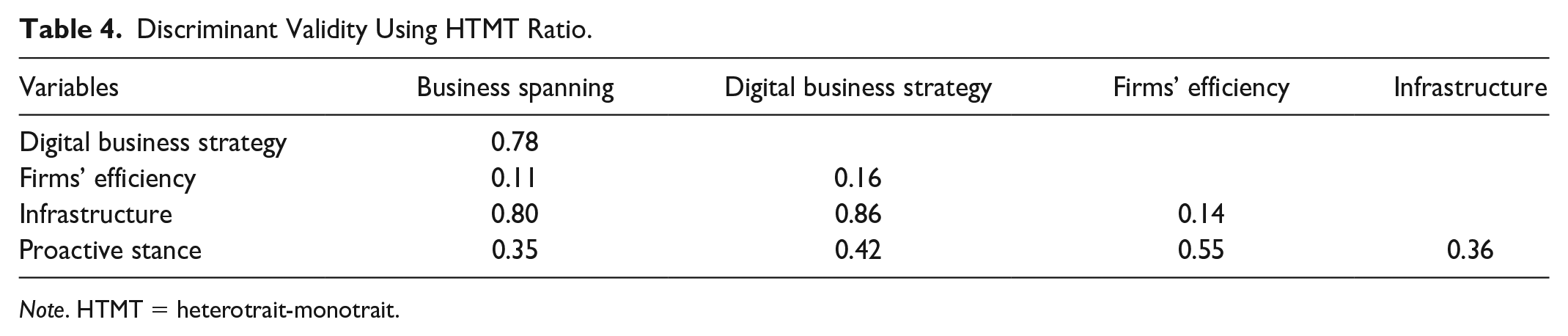
Note. HTMT = heterotrait-monotrait.
Following the verification of reliability, convergent validity, and discriminant validity, path analysis has been conducted and the results are posted in Tables 5 to 7. Following Table 5, the direct effects of each variable have been computed. The significance has been evaluated at 10%, 5%, and 1% level, which is supported by Wasserstein et al. (2019) and Kim (2015). Concerning direct effects’ assessment, DBS affects business spanning positively and significantly (p = .000 < .05) and the coefficient is positive as well. Besides, DBS also influences the IT infrastructure and IT proactive stance of Chinese SMEs significantly and positively (p < .05). Given this, the direct effect of IT proactive stance is also computed to be positively significant (p < .05) on the firms’ efficiency in the context of Chinese SMEs. The direct effect of DBS on firm efficiency is computed to be significant at 10% (p = .087 < .1) and is found to have negative effect, whereas all other effects are statistically insignificant.
Analyzing Direct Effect.

Significance at 1%. **Significance at 5%. *Significance at 10%.
Analyzing Specific Indirect Effects.

Significance at 5%.
Analyzing Total Indirect Effect.

Significance at 10%.
As the study includes the mediating variable, which is IT capability fragmented into three dimensions—proactive stance, business spanning, and IT infrastructure—the specific indirect influence has been further tested. The results presented in Table 6 are illustrating the indirect effect of DBS on Chinese SMEs’ efficiency through the three dimensions of IT capability. It has been explored that the indirect effect of DBS on firms’ efficiency is positively significant through IT proactive stance (p = .013 < .05). This implies that a proactive stance fully mediates the relationship between DBS and firms’ efficiency because the direct effect of DBS was not found. The implication has been presented based on the study conducted by Hayes (2017).
Based on the direct and indirect effects computed, total effects have been further incorporated to study the total influence of DBS on the firms’ efficiency, which is computed to be positive and significant as presented in Table 7. The assertion has been made because the p value is equal to .076, and according to the studies of Figueiredo-Filho et al. (2013) and Grabowski (2016), when the p value is found to be less than .1, then the association can be deemed as significant. Therefore, the total effect of DBS on Chinese SMEs’ efficiency is positive and significant, entailing to the inference that improvement in DBS of the firms through IT capability can improve the Chinese SMEs’ efficiency. It further entails that IT capability partially mediates the association between DBS and firms’ efficiency significantly and positively in terms of proactive stance.
The quality of the model and its predictive relevance have been further evaluated using R2, adjusted R2, and Q2 for predictive relevance. According to Table 8, the variance in DBS and IT capability is explaining 25.7% variance in the firms’ efficiency, which is reduced to 24.9% after the adjustment of errors. Table 8 further depicts that Q2 is computed to be .085. The study by Hair et al. (2016) asserted that to deem a model relevant for prediction, Q2 should be greater than 0. Therefore, predictive relevance on this model is found; however, it shows small predictive relevance. Considering this, the final model is illustrated in Figure 2.
Quality Assessment and Predictive Relevance.

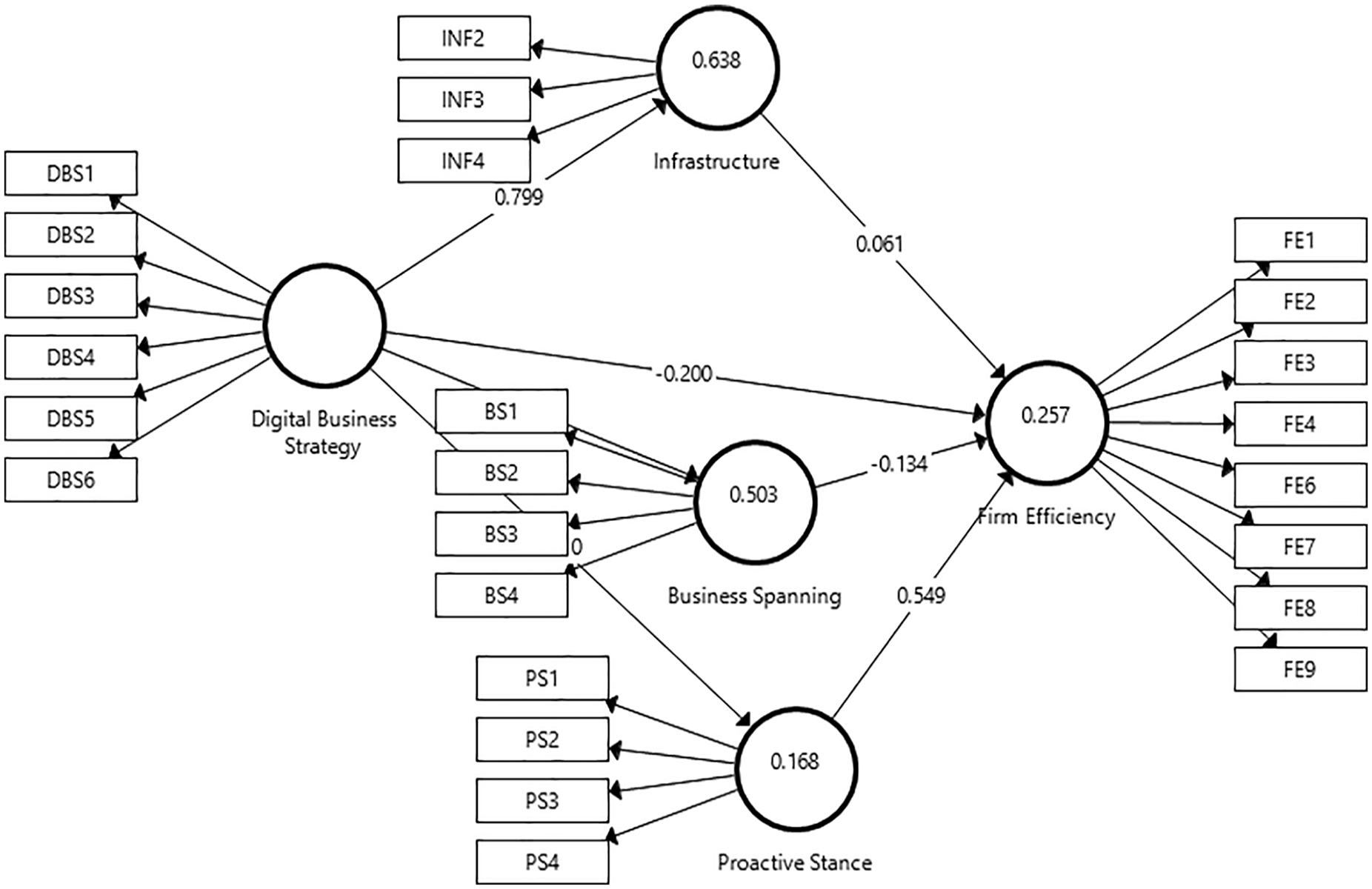
Measurement model.
To further evaluate the results, control variables were introduced, which are the age of SME and size of SME; the results are presented in Table 9. It depicts that none of the control variables is significant and neither of the evaluated paths is computed to be significant. Therefore, age and size do not control the mediation of IT capability between DBS and firms’ efficiency.
Path Analysis With Control Variables.

Significance at 1%. **Significance at 5%. *Significance at 10%.
Hypothesis Assessment Summary
In terms of the propositions made initially, the summarized response has been discussed in this section based on the results and findings. Concerning the results, two hypotheses are fully accepted, two are partially accepted, and two are rejected. However, the aim of the study is achieved because the mediation of IT capability is found between DBS and firms’ efficiency. The summary can be viewed as follows in Table 10.
Hypothesis Assessment Summary.
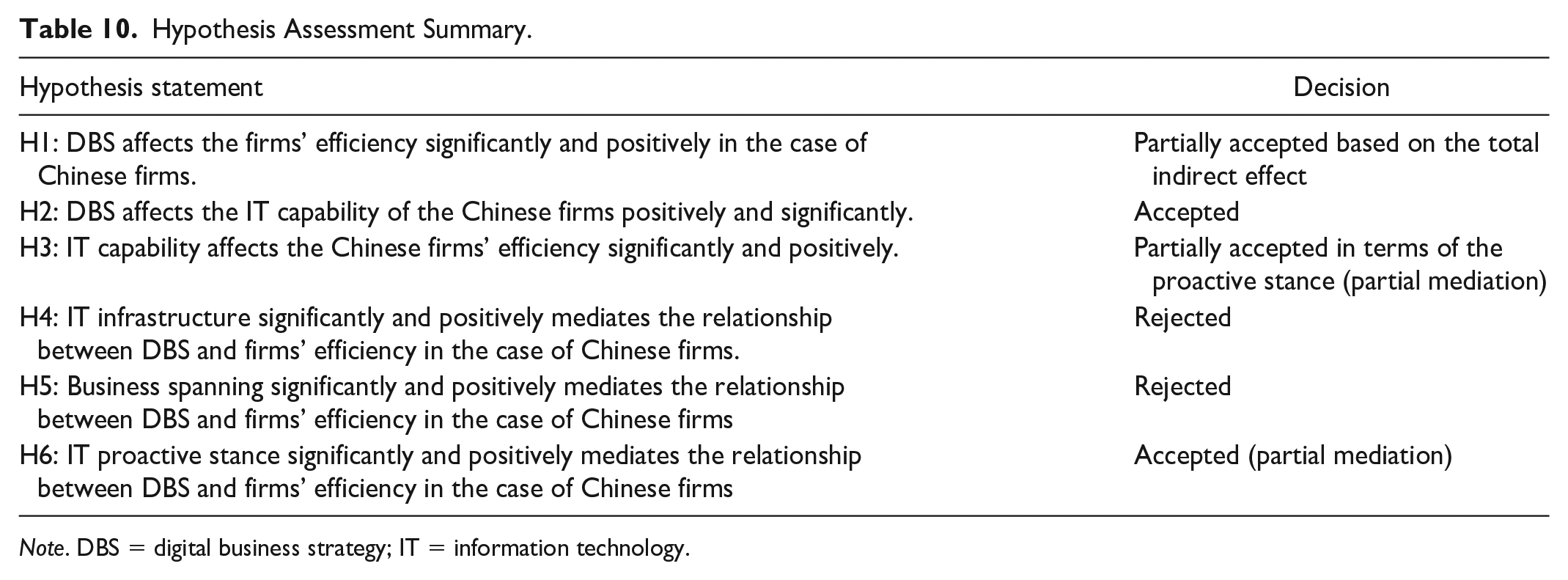
Note. DBS = digital business strategy; IT = information technology.
Discussion
This study extended the findings of the previously conducted research works on DBS and firms’ efficiency or performance by testing the mediation of IT capability. However, to obtain more specific results, the empirical assessment was conducted by accumulating the data from SMEs operating in China which can be deemed as an emerging market. With the help of these results, this study can make certain contributions as the IT capabilities as the mediator in the relationship between DBS and firms’ efficiency has never been tested before.
The findings of this study implicate that DBS individually does not affect the efficiency of firms, but through the mediation and inclusion of IT capabilities of the companies, the effect of DBS on firm efficiency is significant. This implied full mediation of IT capability. In the essence of previous studies, Setia et al. (2013) and Chi et al. (2016) argued that DBS improves firms’ viability and efficiency. However, the analysis of this study is argumentative because the direct effect of DBS was also significant. This implies that the support of cumulative IT capability in the context of the Chinese SMEs including IT infrastructure, business spanning, and specifically IT proactive stance is necessary to drive their efficiency positively. This contributes toward the findings of existing literature as the DBS remains ineffective in the mediation of IT capabilities. Therefore, using social media, cloud computing, artificial intelligence facilitated by IT architecture, robust IT planning, clear digital vision, and proactive action in terms of implementing DBS can result in efficient performance for Chinese SMEs.
Also, the findings imply that IT capability mediates the association of DBS with firms’ efficiency. The results, therefore, are coinciding with the study of Bataineh et al. (2015). However, this study specifically argues that the proactive stance for Chinese SMEs is more significant than IT-based infrastructure or business spanning. The study by Lu and Ramamurthy (2011) stressed that all three dimensions affect the performance, and it also coincides with the RBV theory as the IT capability reflects a unified picture of resources a company possesses. This also contributed to the findings of existing literature as the mediation of IT capabilities has been tested positive in the relationship between DBS and efficiency of firms. This will help the companies to determine that IT capabilities are significant to enhance the relationship of digital business strategies and efficiency of firms. Consequently, the businesses operating in China first need to have a stance that favors the induction of DBS in the firm to support profitability, productivity, and overall efficiency.
Conclusion
The research has provided a framework where the mediation between DBS and firms’ efficiency has been tested and proven. As businesses around the world are integrating digital technologies in their business strategies in the present period, this article recommends the strengthening of IT capability for improvement in the firms’ efficiency because the findings inferred full mediation. However, specifically, Chinese firms need to rebuild and substantiate their stance regarding the integration of DBS. The RBV theory also suggests that the sound resources enable the companies to perform effectively and efficiently, which correlates with the analysis of this study that focuses on resources in terms of IT capability. In this manner, this study has contributed to the existing theory as the mediation of IT capabilities among the relationship of DBS and firms’ performance. Therefore, it makes it necessary for the companies to focus on the capabilities of IT to make the digital business strategies effective in terms of increasing the performance of the firms operating in China.
Acknowledging that IT capability is a three-dimensional phenomenon, the performance can be driven to an optimal level when DBS is accompanied with it in the context of China and specifically the SMEs operating within. Besides, the findings can be generalized in other developing markets because China is an emerging market. Overall, this study fills the gap identified earlier in the context of DBS, which was previously considered as a functional strategy rather an as an organizational-level strategy, and the role of IT capability, which was not tested previously as a mediator in the context of Chinese SMEs.
Considering every aspect, this research can be improved by incorporating qualitative aspect because the focus of this research was on quantitative assessment. Besides, the mediation is tested in the context of China; however, in the future, mediation can be tested in other emerging countries like India and Pakistan. The sample can also be enhanced to further validate the findings of this study. Given this, the mediation or moderating role of risk in implementing DBS can also be tested in the future.
Policy Implications
This study has certain managerial/policy implications in light of the findings obtained from the quantitative assessment. First, the managers and specifically CEOs of the Chinese SMEs should formulate a DBS in case of its absence considering the IT capabilities of the firm. Second, they should widen their stance to envision the prospects of deploying any DBS. Third, the other dimensions of IT capability which are business spanning and IT infrastructure should not be neglected because the DBS can positively affect the capability of the firm and increase the probability of higher efficiency. Finally, the policies should be made in Chinese SMEs following the assessment of the resources the company owns and the ones it can acquire.
The researcher also encountered different limitations while executing this research, and some of the major ones have been outlined as follows:
The study is limited to the geographical bounds of China and Chinese firms having a maximum of 250 employees.
The sample size undertaken in the study was also limited to 351 participants due to limited accessibility to the participants, whereas the response rate was lower than 100%.
The factors considered for DBS are also limited, which can be increased in the future.
The research is also limited to testing only one mediator between DBS and firms’ efficiency, which is IT capability in terms of its three dimensions.
The study includes only SMEs of China, whereas large institutions are not targeted.
The accumulation of sample is also from large cities of China.
Footnotes
Appendix
Declaration of Conflicting Interests
The author(s) declared no potential conflicts of interest with respect to the research, authorship, and/or publication of this article.
Funding
The author(s) received no financial support for the research, authorship, and/or publication of this article.
