




Abstract
This study explores the determinants that contribute to the successful adoption of social commerce businesses among women, including entrepreneurial mindset, perceived value, social commerce literacy, and collaborative ecosystems. It also explores the potential impact of collaborative ecosystems and the successful adoption of social commerce businesses on women’s entrepreneurship. Targeting 223 women who are actively involved in social commerce businesses, data was analyzed using Smart PLS software. The results indicate that entrepreneurial mindset, perceived value, social commerce literacy, and collaborative ecosystems significantly impact the successful adoption of social commerce business among women. Furthermore, the study also found that the successful adoption of social commerce businesses and collaborative ecosystems has a significant impact on women’s entrepreneurship. This study contributes to the literature and theory of social commerce adoption, women entrepreneurship, and collaborative ecosystems in several ways. It makes a valuable contribution to social commerce theory by spotlighting the intricate interplay among diverse factors that collectively shape the successful adoption of social commerce ventures among women. The study’s findings also hold significant implications for a range of stakeholders, encompassing practical insights that can instigate positive transformations and enrich the realm of social commerce business and women’s entrepreneurship.
Keywords
Introduction
The accelerating complexity of the economic and social conditions of our time imposes many challenges, new roles, and heightened responsibilities on women across different aspects of their lives and within familial contexts, especially in finding new sources of income. The focus on empowering women has intensified, drawing attention from scholars, policymakers, and businesses worldwide. Recognizing that women’s economic empowerment not only enhances their socio-economic standing but also contributes to the overall development of societies, efforts to support women in entrepreneurship have gained significant momentum as a powerful driver of economic growth and social transformation. As the world moves toward a more open and equitable future, empowering women entrepreneurs emerges as a pivotal objective (Agarwal et al., 2023; Rajahonka & Villman, 2019).
The advancements in Information Technology (IT) have revolutionized women’s social, economic, and political spheres, empowering them to actively bridge numerous socio-economic disparities (Kamberidou, 2020; Yaseen et al., 2023). These technological developments have not only reshaped existing opportunities but have also generated new avenues for women’s growth and development, fostering their role in society. Social commerce, as an integration of e-commerce with social media platforms, has provided a unique approach to women’s online business (Andijani & Kang, 2022; Camacho & Barrios, 2022). It has created unprecedented opportunities for entrepreneurship for people with entrepreneurial orientation (S. V. Jin & Youn, 2022; Miao et al., 2022). This emerging e-commerce paradigm provided innovative platforms that enable individuals to harness their creativity and community involvement, providing new opportunities for self-employment and facilitating social development (Brahem & Boussema, 2023). As the popularity of social media continues to rise, social commerce has evolved into an active channel for businesses to engage and connect with their customers and drive sales, providing distinctive advantages for women (Camacho & Barrios, 2022). Social commerce not only facilitates business expansion but also empowers women to establish enduring connections, amplify their voices, and thrive in a global marketplace (Wang & Feng, 2022).
In today’s world, the need for collaborative environments and networks that effectively provide support to their members, including women, across all domains has become more imperative than ever. The rise of collaborative ecosystems has significantly contributed to business success in different domains. Collaborative ecosystems can create a supportive environment that encourages participants to collaborate, learn, and leverage shared resources (Quero & Mele, 2023; Roundy & Burke-Smalley, 2022). They have a crucial function in enabling the exchange of information, promoting partnerships, and increasing the exposure of businesses (Abreu & Calado, 2017). When women become part of these ecosystems, they enjoy access to a wider customer base, valuable market insights, and supportive networks (Neumeyer et al., 2019).
While social commerce is indeed gaining attention from scholars, the literature reveals a lack of studies on this new chapter of e-commerce from a business perspective. Little attention has been given to its role in the women’s business framework. There are still several unresolved issues, especially concerning the determinants that influence the adoption of these online enterprises among women. Much of the existing literature on social commerce adoption has primarily focused on general adoption patterns and behaviors, often overlooking the unique challenges and opportunities faced by women entrepreneurs specifically. Whereas some studies have explored gender differences in social commerce adoption and online shopping behavior among customers, there is a lack of comprehensive research specifically targeting women entrepreneurs in the context of SCB adoption. While entrepreneurial mindset is recognized as a crucial determinant of business success, there is a dearth of research specifically examining its role in the adoption of SCB among women. Existing studies often focus on generic measures of entrepreneurial orientation or intentions without considering the unique mindset characteristics that may influence women’s decisions to engage in social commerce ventures. Also, while perceived value is acknowledged as a key factor in the adoption decision of novel business models, there is limited research on how perceived value specifically affects women’s adoption of SCB. Understanding how business women perceive the value proposition offered by social commerce platforms and products can provide valuable insights into their adoption motivations and preferences. Furthermore, despite its importance in facilitating the successful adoption of e-business, there is a lack of research on how women’s social commerce literacy influences their adoption behaviors.
Although collaborative ecosystems are acknowledged as crucial facilitators of entrepreneurial achievement, there is insufficient research into how these ecosystems specifically impact women’s successful adoption of SCB. Investigating the role of collaborative networks, mentorship programs, and community support in facilitating women’s entry into social commerce can provide valuable insights for policymakers and practitioners. On the other hand, while some studies have explored the impact of social commerce adoption on business outcomes, there is limited research specifically examining how the successful adoption of SCB influences women’s entrepreneurship more broadly. Understanding the potential spillover effects of social commerce adoption on women’s entrepreneurial activities, such as empowerment, economic independence, and career advancement, is essential for promoting gender-inclusive economic development. Therefore, a comprehensive investigation is needed to explore how these interconnected factors interact and jointly contribute to the successful adoption of SCB among women and their entrepreneurship.
Addressing the aforementioned gap in the literature, this study aims to deeply answer the following questions: Q1: Do entrepreneurial mindset, perceived value, and social commerce literacy contribute to women’s adoption of SCB? Q2: Does the adoption of SCB significantly contribute to women’s entrepreneurship? Q3: Do collaborative ecosystems contribute to the women’s adoption of SCB and women’s entrepreneurship?
To address these research questions, this study incorporates different theories, including women’s economic empowerment theory, technology acceptance model, and entrepreneurial ecosystem theory.
Theoretical Framework
Advancement and empowerment of women have emerged as priority socioeconomic development trends. Women’s empowerment is one of the 17 sustainable development goals included in the United Nations 2030 Agenda for Sustainable Development. Women’s entrepreneurship has gained significant attention in recent years due to its potential for economic growth and empowerment. The literature has widely investigated how advancements in IT have a big impact on empowering women (Kamberidou, 2020; Ughetto et al., 2020). The literature has also revealed the role of digital transformation in providing new horizons for women’s entrepreneurship (Rajahonka & Villman, 2019; Steel, 2021). Recent studies emphasize that social commerce, or the use of social media platforms to support online shopping and selling transactions, has had a significant impact on various aspects of society (Brahem & Boussema, 2023; S. V. Jin & Youn, 2022). Many scholars have explored the effect of social commerce on a range of issues related to women (Andijani & Kang, 2022; Camacho & Barrios, 2022; Wang & Feng, 2022). While scholars have demonstrated an increasing fascination with examining various facets of women’s entrepreneurship within the context of digital transformation and social media capabilities, there remains a requirement for exploring many issues. These include the determinants of adopting SCB among women and its role in promoting women’s entrepreneurship, as well as the potential role of collaborative ecosystems in these interactions.
The escalating crises worldwide have challenged the sense of community and the social responsibilities of women business owners as well as their ability to go beyond the boundaries of conventional behavior in response to these crises, overcoming distinct gender-specific problems. Over the years, the gender gap in IT self-efficacy has decreased, with women increasingly inclined to perceive and utilize social computing as a platform for entrepreneurial business opportunities. With the popularity of social computing platforms, scholars have begun to investigate how social media contributes to women’s empowerment by concentrating on various social and gender issues (Cesaroni et al., 2017; Shata & Seelig, 2021). These platforms for social commerce have created an opportunity for gender equality that women have long sought in the business world. According to Camacho and Barrios (2022), women’s adoption of social commerce has been driven by their need for genuine involvement, equal opportunities in business and economic leadership, and gender equality. However, prior studies have placed more emphasis on the roles of gender in social commerce adoption (Molinillo et al., 2021; Mutambik et al., 2023).
Overall, social and collaborative entrepreneurship plays a vital role in enabling women’s entrepreneurship by providing a supportive ecosystem, resources, networks, and platforms that address the unique challenges and barriers faced by women entrepreneurs, while also creating opportunities for them to make a positive impact on society and the environment (Bastida et al., 2023; Kimbu & Ngoasong, 2016; Ratten, 2014). Collaborative entrepreneurship initiatives often offer access to resources such as funding, training, mentorship, and technical assistance, which are essential for starting and growing a business (Miles et al., 2006). Studies confirm that these resources can help women overcome financial barriers and gain the skills and knowledge needed to succeed in their entrepreneurial endeavors (Constantinidis, 2021; Schaltegger et al., 2018). Many social entrepreneurship ventures focus on addressing pressing social or environmental issues, such as gender inequality, poverty, healthcare, education, and environmental sustainability. According to scholars, by tackling these challenges, social entrepreneurs create opportunities for women to participate in meaningful and impactful ventures that align with their values and aspirations (Haugh & Talwar, 2016; Vázquez-Parra et al., 2021). Suseno and Abbott (2021) affirmed that social entrepreneurship endeavors typically prioritize diversity, equity, and inclusion, fostering environments where women can thrive as leaders and decision-makers. By promoting inclusive leadership practices and valuing diverse perspectives, social enterprises create opportunities for women to take on leadership roles and contribute to positive social change. Studies emphasized that engaging in social entrepreneurship can help women build confidence, develop leadership skills, and cultivate a sense of empowerment (Kimbu & Ngoasong, 2016; Vázquez-Parra et al., 2021).
In exploring the determinants contributing to the successful adoption of SCB among women, the theme of this study is grounded in several relevant theories, including Social Identity Theory, Gender Role Theory, and Self-Efficacy Theory. Social Identity Theory posits that individuals’ self-concept and social identities play a crucial role in shaping their behaviors and interactions within social groups (Ashforth & Mael, 1989; Brown, 2000; Zucker, 2004). When applied to women entrepreneurs in SCB, this theory can offer insights into how women’s gender identity and societal roles influence their perceptions of entrepreneurship and their engagement with business on social commerce platforms. Similarly, Gender Role Theory suggests that societal expectations and norms regarding gender roles have a significant impact on individuals’ behaviors and opportunities (Kray et al., 2017; Ochsenfeld, 2014). In the context of women entrepreneurs in SCB, this theory can help illuminate how traditional gender roles and expectations affect women’s access to resources, decision-making autonomy, and entrepreneurial activities in the digital economy. Additionally, Self-Efficacy Theory emphasizes the importance of individuals’ beliefs in their abilities to succeed in specific tasks or domains, which in turn influences their motivation and behavior (Betz & Hackett, 1997; Franzblau & Moore, 2001). When applied to women entrepreneurs in SCB, this theory can help explain how women’s confidence in their entrepreneurial skills, technological capabilities, and ability to navigate social commerce platforms contribute to their adoption and success in the online business environment.
This study seeks to answer its research questions by integrating Women’s Economic Empowerment Theory (WEET), and Technology Acceptance Model (TAM), and entrepreneurial ecosystem theory. WEET (Miller et al., 1989) suggests that improving women’s economic standing results in wider empowerment benefits. It underscores the importance of economic autonomy, resource accessibility, and decision-making authority in enhancing overall women’s entrepreneurship (Bobek et al., 2023; Orser, 2022). This theory can be employed as a guiding principle to investigate how the adoption of SCB and engagement in collaborative ecosystems impact women’s entrepreneurship. However, the literature confirms that women’s empowerment includes not just economic aspects but also how they can independently and collectively mobilize for social transformations within communities and society (Beninger et al., 2016; Irfan & Salam, 2020). At the same time, the literature confirms that social commerce plays a greater role than just establishing profitable commercial projects (Camacho & Barrios, 2022; Vongsraluang & Bhatiasevi, 2017; Wang & Feng, 2022). Its capacity to create positive social effects, empowerment, and inclusion of people, and advocate for social causes makes it a powerful force for positive societal transformations.
TAM concentrates on how user perception of emerging technologies’ usefulness and ease to use affect their attitudes and intentions toward adopting them (F. D. Davis et al., 1989; Venkatesh & Bala, 2008; Venkatesh & Davis, 2000). While social commerce literacy is consistent with self-efficacy, experience, and how users perceive they can use the technology, perceived value can be correlated to perceived value. This model can help to better understand how women’s readiness to adopt SCB is influenced by their entrepreneurial mindset, perceived value, and level of social commerce literacy. Furthermore, entrepreneurial ecosystem theory (Stam, 2015) can offer a comprehensive insight into the interconnected nature of various elements that foster entrepreneurship (Roundy & Burke-Smalley, 2022). When used to examine collaborative ecosystems, this theory aids in understanding how networks, resources, and support mechanisms collectively influence women entrepreneurs’ decisions about the adoption of SCB.
Social Commerce Business (SCB)
Social commerce is a novel digital business model that utilizes social media platforms and online communities to facilitate the buying and selling of products and services (Zhou et al., 2013). It amalgamates elements of e-commerce and social networking to offer consumers a more interactive and captivating shopping experience, employing platforms like Facebook, Instagram, Pinterest, Twitter, and others to showcase their products, engage with customers, and drive sales (Attar et al., 2021). Users can conveniently discover products within their social media feeds, enhancing the overall shopping experience. Scholars confirm that social commerce heavily relies on social proof, wherein positive reviews, testimonials, and user-generated content influence potential customers’ purchase decisions (S. V. Jin & Youn, 2022; Miao et al., 2022). However, the literature implies that scholars have focused on examining different issues of social commerce adoption from a consumer perspective, while largely neglecting the exploration of these novel online enterprises in terms of business opportunities. Furthermore, except for limited studies compared to its rapid spread and accelerating impact, the investigation into the impact of social commerce on the role of women in the realms of business, economy, and society has largely been ignored.
Entrepreneurial Mindset
The entrepreneurial mindset is a particular way of thinking and approaching prospects, challenges, and novel business opportunities (Naumann, 2017). It includes a range of attitudes, qualities, and behaviors conducive to exploring and exploiting opportunities, undertaking calculated risks, and accelerating innovation (Kuratko et al., 2021). Adopting an entrepreneurial mindset is critical for anyone considering or engaging in new business ventures (Ahimbisibwe et al., 2023). According to the research, those with a mindset of entrepreneurship dare to venture beyond what is familiar and make decisions that involve risk while mindfully considering the possible rewards (Abdelwahed & Alshaikhmubarak, 2023; Kuratko et al., 2021). Individuals with an entrepreneurial mindset typically demonstrate a readiness to embrace uncertainty, draw lessons from failures, and consistently explore novel avenues to generate value and drive positive transformation (Ashourizadeh et al., 2014). Scholars confirm that the entrepreneurial mindset among women adopting new business enterprises encompasses a combination of ambition, resilience, creativity, adaptability, and a genuine commitment to making a difference (Abdelwahed & Alshaikhmubarak, 2023; Ashourizadeh et al., 2014). However, reviewing the body of literature evident that little study has been done on the impact of entrepreneurial mindset on business overall. Research examining the potential role of entrepreneurial mindset in the context of social commerce is conspicuously lacking. Moreover, there has been no previous investigation into how the entrepreneurial mindset contributes to the success of women’s adoption of social commerce.
Perceived Value of SCB
The concept of perceived value when embracing novel business ventures relates to the subjective judgment held by potential entrepreneurs or established businesses regarding the merits, benefits, and potential outcomes associated with starting or integrating a new business venture (Gan & Wang, 2017; L. Y. Wu et al., 2014). According to Zietsman et al. (2020), it includes all of the perceived advantages, benefits, and gains that people think they will get as a result of business ventures. The literature confirms the role of perceived value as a major factor in the decisions to continue or start new businesses (Camacho & Barrios, 2022; Preedy et al., 2020). Preedy et al. (2020) assumed that the perceived value of a new business is often related to the belief that introducing a new product, service, or business model can provide a competitive advantage and market distinctiveness. The perceived value may include the ability to pursue one’s true interests, make a positive influence, and have more control over one’s professional life (Preedy et al., 2020; L. Wu & Li, 2011). Scholars confirm that the perceived value of adopting new commercial enterprises is comprised of the subjective benefits that women discern as they start their businesses (Agarwal et al., 2023; Camacho & Barrios, 2022). This perspective is shaped by an interaction of factors, including personal motivations, societal cues, economic possibilities, and the possible consequences for their own lives and their communities (Cho et al., 2021). Nevertheless, the literature reveals that the majority of prior studies have investigated the association between perceived value and social commerce adoption from consumers’ perspectives (Gan & Wang, 2017; Molinillo et al., 2021). It confirms a lack of studies on these relationships from a business standpoint. Furthermore, no prior research has examined the role of perceived value in the success of social commerce adoption among women.
Social Commerce Literacy
Digital literacy involves the skillful and responsible use of digital technologies, covering a range of skills that empower individuals to efficiently interact with and understand digital devices, tools, and platforms for various purposes (Reddy et al., 2020). It goes beyond mere technical proficiency, encompassing an understanding of the broader societal, communicative, informational, and personal implications of technology. According to Liao et al. (2023), it empowers individuals to actively participate in the digital world, make well-informed choices, and critically analyze digital content. Therefore, social commerce literacy can be described as the pool of knowledge, understanding, and skills that allows individuals to proficiently utilize social media platforms for e-commerce purposes. In the context of digital literacy literature (e.g., Irfan & Salam, 2020; Neumeyer et al., 2021), social commerce literacy encompasses a variety of proficiencies, from understanding the functionalities of diverse social media channels to strategically leveraging them for business-related endeavors like marketing, sales, and engaging customers. In the contemporary digital landscape, where social media wields considerable influence in both personal interactions and business pursuits, the outcome of social commerce literacy represents the ability to manage, understand, integrate, and harness the potential inherent in social media platforms to propel sales, cultivate brand recognition, and nurture customer relationships. Scholars confirm that grasping the features, algorithms, and trends of various social media platforms is essential for social commerce (Camacho & Barrios, 2022; Liao et al., 2023). However, the literature lacks empirical studies exploring the role of social commerce literacy in the adoption of these enterprises. More specifically, no previous studies have explored its potential impact on women’s successful adoption of SCB.
Collaborative Ecosystems
Collaborative ecosystems are dynamic networks of interconnected entities that work together toward common goals through knowledge sharing, resource exchange, and joint problem-solving (Keough & Blahna, 2006). In these ecosystems, a diverse range of actors, such as companies, startups, government agencies, research institutions, and non-profit organizations, come together to combine their expertise and capabilities toward common missions, benefiting from the trust and mutual collaboration among participants (Behnken et al., 2016). Collaborative ecosystems are advantageous not only to the participating entities but also to the broader industry and society. They serve as significant contributors to sustainable development by providing the foundations of innovation, and economic growth, and addressing societal needs (Quero & Mele, 2023). The literature confirms that participants in collaborative ecosystems share common objectives or missions, such as developing new products, addressing complex challenges, improving industry standards, or driving societal change (Abreu & Calado, 2017; Behnken et al., 2016). By aligning their goals, ecosystem members work together to achieve shared outcomes. This enhances efficiency, reduces duplication, and provides access to capabilities not available to individual entities. Nevertheless, existing literature indicates a lack of research exploring any potential association between collaborative ecosystems and social commerce. To be more precise, there has been no prior investigation into the potential impact of collaborative ecosystems on the successful adoption of SCB by women.
Women Entrepreneurship
Women’s entrepreneurship represents the act of women identifying and pursuing business opportunities, initiating and managing enterprises, and undertaking entrepreneurial roles (Orser, 2022). This includes women engaging in the creation, ownership, management, and expansion of businesses ranging from small startups to larger corporations across industries and sectors. Scholars demonstrated that women entrepreneurs provide novel ideas and solutions to the market, contributing to economic advancement and growth (Bobek et al., 2023; Orser, 2022). They typically launch new products, services, or business models that are needed for specific market niches (Ughetto et al., 2020). As an increasing number of women worldwide engage in entrepreneurial pursuits, there is a growing acknowledgment of the importance of providing support and empowerment to enable women entrepreneurs to excel and make meaningful contributions to their societies and economies. The impact of IT and e-business on women’s entrepreneurship has been transformative and profound, ushering in a new era of business opportunities. According to the literature, interest in how e-business and e-commerce contribute to women’s empowerment is growing. Although there is a rising trend of research on the importance of social commerce for women as a consumer, existing studies have largely ignored this association from a business perspective. The literature reveals a shortage of studies exploring the role of the successful adoption of SCB in the promotion of women’s entrepreneurship. Far less attention has been given to the potential role of collaborative ecosystems in the context of SCB.
Research Model and Hypotheses
To achieve its objectives and fill gaps in the literature, the research model of this study (See Figure 1) posts that entrepreneurial mindset, perceived value, social commerce literacy, and collaborative ecosystems significantly impact the successful adoption of SCB among women.

Research model.
This study also proposes that collaborative ecosystems and the successful adoption of SCB significantly impact women’s entrepreneurship. These proposed relationships and the accompanying hypotheses are explored in more detail in the following sections.
Entrepreneurial Mindset and Successful SCB Adoption Among Women
The entrepreneurial mindset empowers women, nurturing a sense of self-reliance and confidence (Ashourizadeh et al., 2014). It instills belief in their capabilities to establish and manage their businesses, liberating them from conventional gender roles and societal norms that restrict their autonomy within the realm of business (Abdelwahed & Alshaikhmubarak, 2023). Women with an entrepreneurial mindset are more likely to find opportunities in the field of social commerce. An entrepreneurial mindset can help them detect market gaps, discern emerging trends, and devise novel ways to harness social media platforms for business initiation or expansion (Ashourizadeh et al., 2014; Hossain et al., 2022). Successful SCBs rely on innovation and the ability to adapt to rapidly evolving digital landscapes (S. V. Jin & Youn, 2022). An entrepreneurial mindset enables women to think outside the box, develop novel marketing strategies, and create attractive content that resonates with their target audience (Abdelwahed & Alshaikhmubarak, 2023).
Entrepreneurs, including women in social commerce, usually build substantial networks to support their enterprises. Women who have an entrepreneurial mindset actively seek collaboration opportunities, partnerships, and mentorship, allowing them to gain access to collective knowledge and resources (Andijani & Kang, 2022; Camacho & Barrios, 2022). The landscape of social commerce undergoes constant evolution due to technological advancements and shifting consumer preferences. Women with a strong entrepreneurial mindset are more likely to prioritize making effective relationships with their target audience, providing deep experiences of its needs and expectations, and fostering brand loyalty. Furthermore, while gender biases and preconceptions still exist in the business world, women who adopt an entrepreneurial mindset frequently can confront these biases, demonstrating their abilities and aptitude in the area of social commerce and thereby inspiring other women to do the same (Brahem & Boussema, 2023; Wang & Feng, 2022). Therefore, it can suggest:
H1: Entrepreneurial mindset significantly impacts successful SCB adoption among women.
Perceived Value and Successful Social Commerce Adoption Among Women
The perceived value of initiating a social commerce venture can stem from the idea of taking control of the individual’s professional path, finances, and decision-making (Molinillo et al., 2021). The perceived financial gains of running SCB and generating income can drive women’s decision to initiate such enterprises (Agarwal et al., 2023; Brahem & Boussema, 2023). Furthermore, the perceived value of having the freedom to manage time and work from home or in different locations might be a strong motivator for women to start their businesses (Wannamakok & Chang, 2020). Social commerce enterprises usually provide flexible work arrangements, allowing women to balance business duties with personal and family obligations and responsibilities (Camacho & Barrios, 2022; Wannamakok & Chang, 2020). Numerous social commerce initiatives allow women to express their creativity, producing a sense of accomplishment and fulfillment that adds to the perceived value of launching and managing one’s own business (Beninger et al., 2016; Cesaroni et al., 2017).
Women entrepreneurs frequently prioritize effecting positive change within their communities or addressing particular societal concerns (Abdelwahed & Alshaikhmubarak, 2023; Bobek et al., 2023). The perceived value of developing a business aligned with personal values and contributing to social progress can be a strong motivator (Muzuva & Hlungwani, 2022). A line of studies confirms that the perceived value of connecting with customers, fellow entrepreneurs, and like-minded individuals may strengthen women’s sense of belonging and purpose, encouraging them to launch their businesses, including social commerce (Cesaroni et al., 2017; Steel, 2021). Women who realize that starting a social commerce enterprise will provide them with opportunities to improve their skills in marketing, branding, consumer involvement, and digital proficiency may be also more inclined to embark on this entrepreneurial journey (Camacho & Barrios, 2022). Furthermore, the perceived value of challenging traditional gender norms and advancing gender equality can be a powerful motivator for women to pursue SCB (Beninger et al., 2016; Brahem & Boussema, 2023). Hence, it can posit:
H2: Perceived value significantly impacts successful SCB adoption among women.
Social Commerce Literacy and the Successful Adoption of SCB Among Women
As social commerce continues to shape the entrepreneurial landscape, women who prioritize increasing their social commerce literacy will be in a position to flourish in this dynamic and ever-changing business. Social commerce literacy provides owners with the knowledge and proficiencies needed to establish and manage their businesses fostering their abilities in navigating aspects like online sales, marketing, customer engagement, and data analysis. Adequate knowledge and competencies in initiating and managing social commerce enterprises enable using these platforms effectively, potentially overcoming many conventional constraints and entry barriers (Andijani & Kang, 2022; Beninger et al., 2016). Leveraging social media platforms, they can effectively reach broader audiences, including international customers (Rajahonka & Villman, 2019; Steel, 2021). Scholars emphasize that digital literacy enables women to gain access to global marketplaces without the need for a physical store (Irfan & Salam, 2020; Omiunu, 2019). This proves especially advantageous for women entrepreneurs constrained by location, transportation, or cultural norms.
The cultivation and engagement of a community of customers and followers is critical to the success of social commerce. Socially literate women entrepreneurs adeptly connect and interact with their target audiences, fostering a devoted customer base (Agarwal et al., 2023; Brahem & Boussema, 2023). This skill is pivotal for sustaining a robust online presence and attracting repeat business. Platforms for social commerce usually include capabilities for customizing marketing and creating tailored customer experiences (Attar et al., 2021). Studies confirm that women who are digital business literate can create content and offers that are deeply relevant to their unique target demographics, increasing the likelihood of consumer engagement and acquisition (Neumeyer et al., 2021; Omiunu, 2019). The digital sector, which includes social networking and e-commerce continually evolves. Women entrepreneurs who understand how to manage social commerce platforms are better able to adapt to technical changing trends, algorithms, and new features and functions of social media (Camacho & Barrios, 2022; Liao et al., 2023). Consequently, this study proposes:
H3: Social commerce literacy significantly impacts successful SCB adoption among women.
Collaborative Ecosystems and Successful SCB Adoption Among Women
According to Agbaeze et al. (2018), being a member of ecosystems could provide significant insights and expertise in efficiently utilizing social media for business objectives. Access to this knowledge can enhance women’s abilities to initiate and maintain SCB. Women who are new to social commerce or just starting can benefit from mentors and experienced people who can provide valuable guidance and support (Camacho & Barrios, 2022; Cesaroni et al., 2017). This assistance can help overcome obstacles and gain confidence in pursuing social commerce as a business. Collaborative ecosystems often involve the sharing of resources, such as social media marketing and analytics technology, tools, and data (Gupta et al., 2020). Being a part of such ecosystems contributes to providing equal opportunities to compete in the social commerce arena for women entrepreneurs with limited resources or access to technology. By collaborating with other businesses and entities within the ecosystem, women entrepreneurs can tap into new markets, expand their customer base, and reach potential buyers interested in their products or services (Lawson, 2019; Neumeyer et al., 2019).
Collaborative efforts can result in combined marketing campaigns and promotional activities, increasing the visibility of their social commerce projects (Camacho & Barrios, 2022; Molinillo et al., 2021). Consumers frequently rely on recommendations and reviews from others before making purchasing decisions in social commerce, therefore trust is essential (Andijani & Kang, 2022;S. V. Jin & Youn, 2022). Being part of a collaborative ecosystem that promotes trust and mutual benefit can enhance the credibility of women-owned businesses, making potential customers more likely to engage in social commerce interactions with them. Within the ecosystem, women entrepreneurs can get vital market insights and determine customer preferences, allowing them to adjust their social commerce strategies to efficiently match the needs and expectations of their target audience. Furthermore, collaborative ecosystems often contribute to societal well-being and sustainable development (Quero & Mele, 2023; Yan et al., 2018). Women entrepreneurs who align their social commerce initiatives with such values and advocate for causes they care about can resonate with socially conscious consumers, building a loyal customer base. Therefore, it can propose:
H4: Collaborative ecosystems significantly impact successful SCB adoption among women.
Successful SCB Adoption and Women Entrepreneurship
SCB can wield a substantial influence across various aspects of entrepreneurship that occur within the context of advancing economic growth and facilitating positive societal transformation and progress. Social commerce enterprises initiated by women can contribute to pioneering innovation by introducing new products, services, and business models (Agarwal et al., 2023; Cesaroni et al., 2017). The literature confirms that these enterprises use online platforms and social media to reach a larger audience and quickly explore new ideas, fostering a culture of constant improvement and adaptation (Brahem & Boussema, 2023; Hossain et al., 2022). Also, women who work in social commerce can be proactive by actively seeking out opportunities, responding to market trends, and adjusting their businesses to changing circumstances (Camacho & Barrios, 2022; Cesaroni et al., 2017). Because social commerce is conducted online, women entrepreneurs can communicate with customers and other business partners in real-time, enabling them to quickly obtain feedback and fine-tune their services. This proactive approach can lead to more agile and customer-centric firms.
Social commerce may involve competing in a worldwide market in which businesses must differentiate themselves and stand out (Miao et al., 2022; Wang & Feng, 2022). According to Hossain et al.(2022), women entrepreneurs can gain a competitive advantage by focusing on differentiating value propositions, personalized consumer experiences, and the development of strong online communities. This competitive ambition can motivate women to excel and innovate, increasing the sector’s overall competitiveness. Studies revealed that women-led online businesses contribute to economic growth by generating new job opportunities, increasing spending on goods and services, and fostering local and international trade (Kamberidou, 2020; Steel, 2021). As these businesses grow, they can have a ripple effect, motivating other women to join the entrepreneurial ecosystem and contribute to the overall economic growth of their communities (Kamberidou, 2020). Women entrepreneurs involved in social commerce have the potential to challenge traditional gender roles and stereotypes by demonstrating their leadership talents and capabilities, entrepreneurial skills, and capacity to drive change (Camacho & Barrios, 2022; Rajahonka & Villman, 2019). Thus, it can suggest:
H5: Successful SCB adoption significantly impacts women’s entrepreneurship.
Collaborative Ecosystem and Women’s Entrepreneurship
Ecosystems provide entrepreneurs with access to a diverse range of viewpoints, opinions, knowledge, and resources (Agbaeze et al., 2018; Stam, 2015). According to Zhao et al. (2023), this variety promotes the development of creativity and the stimulation of innovative thought. Female entrepreneurs can collaborate to share ideas, learn from others’ experiences, and find solutions to challenges (Gupta et al., 2020; Lawson, 2019). This collaborative environment fosters the introduction of new products, services, and business models, hence pushing innovation and encouraging economic progress. The perceived risks associated with entrepreneurship can be minimized inside a collaborative ecosystem (Abreu & Calado, 2017; Brody et al., 2006). Female entrepreneurs who collaborate can divide risks, pool resources, and share knowledge, making the exploration of novel opportunities more manageable. A supporting ecosystem also provides access to mentors, advisors, and investors who may provide direction and boost confidence, encouraging women to take mindful risks and pursue ambitious initiatives (Lawson, 2019; Neumeyer et al., 2019).
A collaborative ecosystem fosters a proactive mindset by providing a platform for continuous learning and adaptation (Brody et al., 2006). Neumeyer et al. (2019) suggest that women entrepreneurs may participate in networking events, workshops, and knowledge-sharing sessions that will empower them to remain attuned to market trends and emerging technologies. Ecosystems boost the competitiveness of female-led businesses by encouraging healthy competition and peer learning. Engaging with other entrepreneurs enables women to analyze their development, learn from their successes and failures, and constantly improve their businesses. Furthermore, having access to shared resources such as co-working spaces, research facilities, and funding networks provides female entrepreneurs with the necessary to compete on a larger scale. Studies confirm that the collaborative ecosystem attracts investment, accelerates growth, and promotes an entrepreneurial culture that helps the economy as a whole (Agbaeze et al., 2018; Quero & Mele, 2023). According to studies, a collaborative environment empowers female entrepreneurs to overcome gender-based challenges and biases by providing a supportive environment (Abreu & Calado, 2017; Gupta et al., 2020). Thus, it can posit:
H6: Collaborative ecosystem significantly impacts women’s entrepreneurship.
Research Methodology
Development of Research Instrument
For the aims of this study, empirical data were collected through a questionnaire survey. The questionnaire and its measures were derived from previous studies (See Table 1) on social commerce adoption, entrepreneurial mindset, perceived value, digital literacy, collaborative ecosystem, and Women entrepreneurship.
Sources of Measurements.

Three experts with doctoral degrees or in leadership positions within e-business and entrepreneurship were recruited to verify the validity of the questionnaire, comprising 30 items, to assess the extent to which it measures the constructs of the research model clearly, logically, and accurately. The questionnaire (See Appendix A1) has been revised based on expert reviews and feedback before being distributed to the respondents. However, each item was rated by participants on a Likert scale, spanning from 1 (indicating strong disagreement) to 5 (representing strong agreement).
Sampling and Data Collection
The sampling method used in this study is known as purposive or judgmental sampling. This method involves selecting participants based on specific criteria. Targeting active women in SCB confirms that the respondents have firsthand experience and knowledge about the subject matter. Their answers are likely to be more informed and accurate, providing reliable data for the study on the determinants of successful adoption of social commerce among women. Focusing on women owners of social commerce enterprises who have practical experience with the topic supports the quality and relevance of the responses, leading to more meaningful findings and enhancing the practical value of the study’s outcomes. This leads to more practical and actionable recommendations for enhancing the adoption and success of social commerce among women.
One challenge encountered in the study was the absence of directories or online communities dedicated to SCB. To address this issue, the study conducted searches across different social networking platforms, with a particular focus on business pages on Facebook, particularly those initiated by women. This selection was driven by the widespread popularity of Facebook in Jordan, where the study was implemented. Additionally, to reach out to more potential participants, the author employed his social networks.
The process of data collection focused on women who utilized social media platforms to produce and/or sell goods, services, and content to generate income. It involved sending the questionnaire link to the targeted women through various communication channels, which they made public to communicate with customers. These channels include messenger applications, WhatsApp, email, and telephone. Participants were encouraged to utilize the snowball technique by sharing the survey link with other women who are SCB owners. This approach has enabled the collection of 223 valid responses (See Table 2), which were subsequently prepared for analysis over 35 days from 7 November to 12 December 2023.
The Profile of the Participants.

Data Analysis
Smart PLS application, version 4, was employed for conducting variance-based structural equation modeling (SEM) utilizing the partial least squares (PLS) path modeling technique. This software allows users to estimate research models and calculates standard evaluation criteria for assessing results.
The Measurement Model
The measurement model estimation aims to verify the reliability and validity of the scales used to measure the constructs of the research model (See Table 3). Following Hair et al. (2014) and Hair Jr et al. (2017), the results of Smart PLS analysis reveal that the factor loadings of most items exhibited values greater than the minimum threshold of 0.6, supporting the reliability of individual items of the measuring scales. However, Items with factor loadings below 0.6, including one item from the entrepreneurial mindset (EM3) and collaborative ecosystems (CE1) constructs, as well as two items from women entrepreneurship (WE4, WE8), were removed from further analysis. The assessment of construct reliability was conducted using both Cronbach’s alpha and composite reliability (CR) measures. For all constructs, both Cronbach’s alpha and CR values were greater than the threshold of .70, affirming an adequate level of internal consistency and reliability. Additionally, convergent validity was demonstrated as the Average Variance Extracted (AVE) coefficients for all constructs surpassed the threshold of 0.7.
The Results of Testing Validity and Reliability.

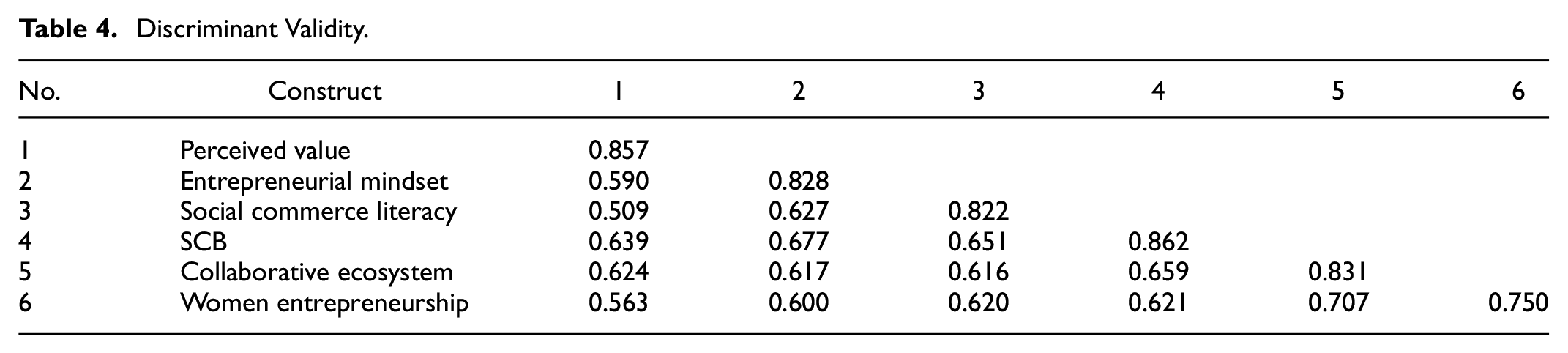
This study utilized Fornell and Larcker’s (1981) criterion to assess the discriminant validity of the measurement tool. The square root of each Average Variance Extracted (AVE) coefficient exceeds the correlations between the constructs (See Table 4), thus establishing discriminant validity for all latent constructs within the research model.
Discriminant Validity.
The Structural Model
The results of the PLS path analysis are shown in Figure 2, along with the coefficients for each relationship. The results show that 61.8% of the variations in the successful adoption of SCB are attributed to entrepreneurial mindset, perceived value, social commerce literacy, and collaborative ecosystems. Additionally, the analysis shows that the successful adoption of SCB and collaborative ecosystems are both responsible for 54.2% of the variation in women entrepreneurship.

The results of path analysis.
Under the methodology outlined by Hair Jr et al. (2017), a path coefficient exceeding 0.1 and t-values surpassing 1.96 with p-value less than 5% are considered statistically significant. Table 5 shows that the entrepreneurial mindset significantly impacts the successful adoption of SCB (H1). The path coefficient of the relationship was 0.262 (p = .000), with t-values >4. The results also indicate that perceived value significantly impacts the successful adoption of SCB (H2). The path coefficient of the relationship was 0.236 (p = .000), with t-values >4. Furthermore, social commerce literacy (H3) and collaborative ecosystems (H4) had a significant impact on the successful adoption of SCB. The path coefficients of relationships were 0.243 (p = .000) and 0.200 (p = .001), respectively, with t-values >3 for both relationships.
Hypotheses Testing.

Finally, the study revealed that the successful adoption of SCB (H5) and collaborative ecosystems (H6) significantly impact women’s entrepreneurship. The path coefficients of relationships were 0.275 (p = .000) and 0.526 (p = .000), respectively, with t-values >5 for both relationships.
Discussion
The results confirm that an entrepreneurial mindset significantly impacts the successful adoption of SCB among women. This finding aligns with the role of the entrepreneurial mindset in exploring market gaps, perceiving emerging trends, and formulating novel approaches to leverage social media platforms for initiating or expanding businesses in the dynamic environment (Ashourizadeh et al., 2014; Hossain et al., 2022). Prior research affirmed that women with an entrepreneurial mindset excel as decision-makers and problem solvers and tend to be more inclined to embrace potential risks, learn and derive lessons from losses, and persevere when confronted with challenges (Cho et al., 2021; Steel, 2021). Furthermore, these results agree with studies confirming the role of the entrepreneurial mindset in enabling women to perceive and react to shifting market conditions and customer demands, readily embracing novel tools, technologies, and strategies to stay relevant and competitive (Ashourizadeh et al., 2014; Muzuva & Hlungwani, 2022). These capabilities are critical to the successful adoption of SCB among women.
The outcome of this study reveals that perceived value significantly impacts the successful adoption of SCB among women. These findings accord with scholarly assertions that emphasize the significance of perceived financial advantages and income generation in motivating women (Agarwal et al., 2023; Brahem & Boussema, 2023). Studies confirmed that the perceived value of becoming self-employed and having the freedom to manage time and work from home or different locations, allowing women to balance business duties with personal and family obligations and responsibilities is a strong motivator for women to start their own online businesses (Camacho & Barrios, 2022; Wannamakok & Chang, 2020). This finding is also in line with the aspiration of women to contribute to positive change within their communities and the idea of challenging conventional gender norms and promoting gender equality, which inspires women to engage in SCB (Abdelwahed & Alshaikhmubarak, 2023; Bobek et al., 2023).
The results showed a significant contribution of social commerce literacy to the successful adoption of social commerce enterprises among women. These findings accord with scholars’ perspectives on the importance of knowledge and competencies in initiating and managing social commerce enterprises and overcoming conventional constraints and entry barriers (Andijani & Kang, 2022; Beninger et al., 2016). They also in line with studies confirming that women with digital business literacy can connect and interact with their target audiences and create content and offers that are deeply relevant to their needs and expectations, increasing the likelihood of consumer engagement and acquisition (Neumeyer et al., 2021; Omiunu, 2019). However, studies confirm that women who are proficient in managing social commerce platforms, utilizing analytics tools and performance metrics, and adapting to evolving technological trends and new social media features are better able to remain relevant and competitive in the dynamic and rapidly evolving SCB (Camacho & Barrios, 2022; Liao et al., 2023).
The results indicated a significant role of collaborative ecosystems in the successful adoption of SCB among women. This finding aligns with prior findings confirming the role of ecosystems in providing significant insights and expertise in effectively harnessing social media for business goals, as well as facilitating access to this knowledge to enhance women’s abilities to initiate and successfully manage their business ventures (Agbaeze et al., 2018; Keough & Blahna, 2006). Scholars confirmed that inexperienced women or those just starting in the realm of SCB can benefit from mentors and experienced people who can provide valuable guidance, advice, and assistance (Camacho & Barrios, 2022; Cesaroni et al., 2017). These findings also correspond to prior research highlighting the importance of collaborating with other businesses and consumers within the ecosystem in enabling women entrepreneurs to access new markets and broaden their customer base (Lawson, 2019; Neumeyer et al., 2019).
The results underscored the significant role played by the adoption of SCB in women’s entrepreneurship. These results align with prior findings that social commerce initiated by women can contribute to pioneering innovation by introducing new products, services, and business models, while also offering creative solutions to address market demands and challenges (Agarwal et al., 2023; Cesaroni et al., 2017). Studies emphasized the potential of social commerce in providing opportunities for women to obtain feedback quickly and proactively refine their businesses in responding to market trends and evolving conditions resulting in more agile and customer-centric business practices (Camacho & Barrios, 2022; Cesaroni et al., 2017). These findings also agree with studies confirming the contribution of women-led online businesses to economic growth by generating new job opportunities and fostering local and international trade, which demonstrate their leadership talents and capabilities to drive social and economic changes (Kamberidou, 2020; Steel, 2021).
The outcome of this study revealed that collaborative ecosystems significantly impact women’s entrepreneurship. This finding accords with studies emphasizing the role of ecosystems in providing entrepreneurs with diverse viewpoints, opinions, knowledge, and resources that promote the development of creativity and the stimulation of innovative thought (Agbaeze et al., 2018; Stam, 2015). Scholars confirmed the significance of a supportive ecosystem in granting access to and fostering collaboration with mentors, advisors, and investors who share knowledge, provide guidance, boost confidence, and encourage women to explore new opportunities, take calculated risks, and pursue ambitious initiatives (Lawson, 2019; Neumeyer et al., 2019). These results also align with previous studies that affirm the role of collaborative environments in empowering female entrepreneurs to overcome gender-related challenges and biases by providing a supportive environment for their entrepreneurial endeavors (Abreu & Calado, 2017; Gupta et al., 2020).
Implications and Future Research
Theoretical Implications
This study contributes to the literature and theory of social commerce adoption, women entrepreneurship, and collaborative ecosystems in several ways. It makes a valuable contribution to the field of social commerce theory by spotlighting the intricate interplay among diverse factors—namely, entrepreneurial mindset, perceived value, social commerce literacy, and collaborative ecosystems—that collectively shape the successful adoption of social commerce ventures among women. Concentrating on women entrepreneurs, this study enriches the discourse on gender and entrepreneurship within scholarly literature, deepening our existing knowledge of the unique experiences and strategies employed by women entrepreneurs. Furthermore, this study expands the scope of existing literature by underscoring the pivotal role of perceived value in the adoption of social commerce by women entrepreneurs. It sheds light on how women entrepreneurs’ perceptions of the value that social commerce imparts to their enterprises profoundly shape their decision-making and continuing adoption. This profound comprehension contributes meaningfully to broader discussions concerning the determinants of the successful adoption of SCB, as well as online businesses in general, among women.
The study extends scholarly comprehension of the importance of social commerce literacy in women’s success in adopting and excelling in social commerce ventures. This innovative viewpoint casts a spotlight on the critical importance of digital competency and literacy as pivotal determinants of success in social commerce environments. The study also enriches the literature on collaborative ecosystems by spotlighting how these interconnected networks can positively influence the success of women entrepreneurs in the realm of social commerce. By investigating how collaborative ecosystems provide support, resources, knowledge, and new business opportunities, this study contributes depth to conversations surrounding the role of ecosystems and related networks in online entrepreneurial achievement. Furthermore, Scholars can benefit from the empirical validation of the proposed conceptual framework of this study. The findings provide empirical evidence of the intricate connections between entrepreneurial mindset, perceived value, social commerce literacy, collaborative ecosystems, and the success of social commerce adoption among women entrepreneurs. They also provide meaningful insights to the role of social commerce adoption and collaborative ecosystems in advancing women’s entrepreneurship. This empirical validation fortifies the theoretical model, enhancing its robustness and credibility.
Implications for Practice
The findings of the study hold significant implications for a range of stakeholders, encompassing practical insights that can instigate positive transformations and enrich the realm of SCB and women’s entrepreneurship. The study’s implications underscore the importance of an entrepreneurial mindset, perceived value, social commerce literacy, and collaborative ecosystems in driving the successful adoption of social commerce among women entrepreneurs. Addressing these dimensions collectively enables stakeholders to contribute to a thriving landscape of women-led social commerce ventures and elevate women’s entrepreneurship.
Women entrepreneurs should recognize the influence of an entrepreneurial mindset on their journey to success in social commerce. Understanding the significance of perceived value empowers women to refine their products or services to align better with customer needs. Continually evaluating and enhancing value propositions enables women entrepreneurs to create a stronger market appeal. Women should proactively engage in enhancing their social commerce literacy. Embracing digital tools, staying updated on industry trends, and mastering effective online communication strategies enhance their competitiveness and adaptability. Furthermore, women entrepreneurs should actively seek out and contribute to collaborative ecosystems. Engaging with mentors, peers, and experts provides valuable insights, resources, and growth opportunities, contributing to a supportive and flourishing entrepreneurial journey.
To promote women’s entrepreneurial orientation, policymakers can introduce educational programs that instill entrepreneurial skills and mindsets among women from an early age. Such initiatives lay a strong foundation for women to excel in the realms of social commerce and entrepreneurship. This could include incorporating entrepreneurial skills development into school curricula, offering specialized training programs, and providing mentorship opportunities for aspiring female entrepreneurs. Policymakers should prioritize tailored digital literacy programs for women entrepreneurs. These programs bridge the digital divide and equip women with the essential skills to effectively leverage social commerce platforms. Government policies providing financial assistance, grants, and incentives for female entrepreneurs help to overcome initial hurdles and inspire them to explore opportunities in social commerce. Such policies can facilitate access to collaborative ecosystems by establishing and supporting collaborative networks, incubators, and accelerators specifically designed to help women entrepreneurs succeed in the social commerce space. It is very important to provide funding and resources to create supportive environments where women can network, share knowledge, and access mentorship and guidance from experienced professionals.
Developing policies that incentivize and support the growth of women-led SCB is crucial. This could include offering tax incentives, providing grants or loans specifically for female entrepreneurs, and implementing regulations that promote gender equality and fair competition in the digital marketplace. Policymakers can foster collaborations between government agencies, private sector organizations, and non-profit entities to create comprehensive support systems for women in social commerce. By leveraging the expertise and resources of various stakeholders, policymakers can enhance the effectiveness of initiatives aimed at empowering women entrepreneurs. They can encourage the development of gender-inclusive technologies and platforms that cater to the unique preferences and interests of women consumers and entrepreneurs. Furthermore, policymakers need to establish metrics and benchmarks to track the progress of initiatives aimed at supporting women in social commerce. Regularly evaluating the effectiveness of policies and programs, and adjusting strategies as needed to ensure meaningful impact and positive outcomes for women entrepreneurs can create an enabling environment that empowers them to successfully adopt SCB and thrive as entrepreneurs, ultimately contributing to economic growth and social development.
Limitations and Future Research
The study’s concentration on active female participants within the social commerce sector in Jordan might restrict the applicability of findings to diverse cultural or geographical contexts. Future research could engage in cross-cultural comparisons to ascertain the consistency of identified relationships across varying regions and nations. Employing a cross-sectional design limits the study’s ability to establish causality between variables. Furthermore, data derived from questionnaires may be susceptible to self-report bias, potentially influenced by participants’ desire for social approval or perception. Future studies could employ a mixed-methods approach, intertwining self-report data with observational or qualitative methodologies for a more comprehensive comprehension.
To avoid complicating its research model, the study did not include many gender-specific features and the extent of its impact on women’s success in SCB, such as the level of access to education, economic participation, decision-making power, legal rights and protections, and gender norms and stereotypes. Delving into mediating or moderating factors influencing the interplay between collaborative ecosystems, success in SCB, and women entrepreneurship could furnish a more comprehensive grasp of the underlying mechanisms. These factors may include cultural values, demographic characteristics, and types of SCB. Furthermore, future research needs to conduct a comprehensive analysis of the specific factors that contribute to the scalability of women-led social commerce enterprises. This includes exploring how aspects such as business models, access to capital, technological infrastructure, and market positioning influence the ability of these enterprises to expand their operations sustainably and analyze successful scaling strategies employed by women entrepreneurs in the social commerce sector.
Future longitudinal investigations could offer insights into the evolving dynamics and temporal changes in women’s adoption of SCB. Undertaking longitudinal studies to monitor the evolution and maturation of entrepreneurial mindset, perceived value, social commerce literacy, and collaborative ecosystems over time could reveal the dynamic influences shaping women’s successful adoption of SCB. Scholars and researchers can contribute to advancing knowledge on SCB adoption among women by exploring how they can innovate and adapt their business models, products, and services to respond to changing market dynamics and societal needs. This entails exploring how creativity, perseverance, and flexibility drive innovation within these enterprises, and assessing how such innovation influences their scalability and enduring viability. Another direction for future research is evaluating the effectiveness of policy interventions and institutional support mechanisms in fostering the growth and sustainability of women’s social commerce enterprises. This may include assessing the impact of initiatives such as gender-responsive procurement policies, entrepreneurship training programs, and access to mentorship and networking opportunities. By pinpointing areas where policies may fall short and advocating for necessary reforms, researchers can work toward establishing a conducive online environment for women entrepreneurs. By addressing these limitations and embarking on future research trajectories, the study’s findings can be enriched, thus contributing to a deeper comprehension of women’s successful integration of SCB and its implications for women’s entrepreneurship.
Conclusions
In today’s world, women face intricate challenges, wherein traditional gender roles are undergoing redefinition, and women are proactively engaged in a spectrum of roles and duties and managing financial aspects of their lives. While this signifies advancement and empowerment, it also ushers in distinctive challenges and responsibilities that women need to navigate. As women involve themselves in diverse domains such as career, family, education, and personal pursuits, they confront a blend of conventional and contemporary pressures. These pressures encompass financial accountabilities, caregiving roles, and societal presumptions, underscoring the intricate nature of their encounters. Social commerce has presented a dynamic innovative solution that empowered women to tackle their challenges and responsibilities. By creating opportunities for entrepreneurship and nurturing supportive networks, social commerce has provided women with novel horizons to manage their diverse roles and aspire for increased independence and achievement.
This study aimed to address gaps in the literature by providing compelling insights into the interconnected dynamics that drive the successful adoption of SCB by women entrepreneurs. The results underscore the pivotal role played by factors such as an entrepreneurial mindset, perceived value, social commerce literacy, and collaborative ecosystems in shaping women’s journey toward seamless integration into the realm of social commerce. Entrepreneurial mindset emerges as a critical determinant of women’s success in adopting SCB. Women who exhibit a proactive, innovative, and risk-taking mindset are more likely to recognize and seize opportunities in the digital marketplace. The study findings suggest that fostering an entrepreneurial mindset among women through education, training, and mentorship programs can enhance their readiness to engage in social commerce ventures and navigate the challenges of entrepreneurship.
Perceived value plays a central role in driving women’s adoption of SCB. Women entrepreneurs who perceive social commerce platforms as offering value-added benefits such as convenience, affordability, and access to a broader customer base are more inclined to adopt and invest in these platforms. The study highlights the importance of understanding women’s perceptions of value and tailoring social commerce offerings to meet their specific needs and preferences.
Social commerce literacy emerges as a crucial factor influencing women’s adoption and success in the digital marketplace. Women entrepreneurs who possess the necessary knowledge, skills, and competencies to effectively utilize social commerce platforms are better equipped to leverage these channels for business growth and expansion. The findings underscore the importance of providing women with training and support in digital marketing, e-commerce strategies, and social media management to enhance their social commerce literacy and competitiveness in the digital economy.
Collaborative ecosystems emerge as key enablers of women’s entrepreneurship and the successful adoption of SCB. Women entrepreneurs who are embedded within supportive networks, partnerships, and communities are more likely to access resources, opportunities, and mentorship that facilitate their business growth and sustainability. The study findings emphasize the need for fostering collaborative ecosystems that provide women entrepreneurs with access to capital, networks, and knowledge-sharing platforms to overcome barriers and enhance their competitiveness in the digital marketplace.
These elements collectively contribute to preparing women entrepreneurs with the necessary skills, perspectives, and resources required to navigate the intricacies of the digital marketplace effectively. Moreover, this study has shed light on the relationship existing between collaborative ecosystems and the successful adoption of SCB among women. The noteworthy impact observed underscores the profound influence exerted by supportive networks, shared knowledge, and mentorship on women’s capacity to flourish and excel within the social commerce landscape. This symbiotic correlation indicates that women entrepreneurs who adeptly embrace social commerce are more likely to make positive contributions to the broader domain of women’s entrepreneurship.
The findings of the study carry significant implications for practitioners and policymakers alike. They highlight the crucial importance of fostering an entrepreneurial mindset, enriching perceived value, nurturing social commerce literacy, and championing collaborative ecosystems to empower and fortify women entrepreneurs. As the realm of social commerce continues to reshape the contemporary business milieu, the insights gleaned from our study furnish a robust framework for well-informed decision-making, precisely targeted interventions, and strategies that propel women’s achievements in social commerce and entrepreneurship. Within a broader context, our study imparts valuable additions to the body of knowledge encompassing women’s engagement in digital commerce. It casts a revealing spotlight on the intricate interplay between personal attributes, contextual elements, and collaborative surroundings. Moving forward, these findings can act as a catalyst for further exploration, policy endeavors, and pragmatic actions aimed at fostering an all-encompassing, dynamic, and flourishing domain of women-led social commerce ventures and entrepreneurship.
Footnotes
Appendix
Questionnaire Items.

| Construct | Code | States |
|---|---|---|
| Perceived value | PV1 | Seeking out opportunities to establish new business ventures is a key aspect of my approach. |
| PV2 | I am constantly looking for ways to enhance and expand my entrepreneurial skills. | |
| PV3 | Exploring innovative solutions for my business is a significant motivator for me. | |
| PV4 | Failure and lessons learned are valuable experiences to enhance my entrepreneurial capabilities. | |
| Entrepreneurial mindset | EM1 | Social commerce business is a valuable avenue to enhance my financial well-being. |
| EM2 | Involvement in the social commerce business contributes significantly to my overall sense of accomplishment. | |
| EM3 | Customers believe that my business’s products and services improve their well-being and quality of life. | |
| EM4 | Social commerce business contributes to fulfilling my aspirations and objectives. | |
| Social commerce literacy | SCL1 | I am familiar with social media platforms that are relevant to my business. |
| SCL2 | I can effectively employ social media in marketing and engages with potential customers. | |
| SCL3 | I am knowledgeable in social commerce trends and best practices. | |
| SCL4 | I understand the importance of user-generated content in influencing purchasing decisions. | |
| Social commerce business adoption | SCB1 | I founded and presently operate a social commerce enterprise. |
| SCB2 | I utilize social media platforms to promote and sell products or services. | |
| SCB3 | I continuously adapt my business strategies to changing online market trends and consumer demands. | |
| SCB4 | I successfully manage challenges and setbacks to keep my commerce enterprise growing and profitable. | |
| Collaborative ecosystem | CE1 | I actively participate in networking events and cooperate with other social commerce firm players. |
| CE2 | I can reach mentors and advisors that provide guidance and support for my business. | |
| CE3 | I collaborate with social commerce entrepreneurs to share knowledge and ideas. | |
| CE4 | I am involved in communities that promote information sharing and peer learning. | |
| CE5 | Collaboration has led to joint ventures that enhance my social commerce business. | |
| Women entrepreneurship | WE1 | I am empowered to embark on entrepreneurial ventures and make contributions to the business realm. |
| WE2 | Throughout my entrepreneurial path, I have encountered and overcome gender-related challenges. | |
| WE3 | I believe that women contribute innovative ideas and abilities to the business arena. | |
| WE4 | The accomplishments of successful female entrepreneurs who serve as role models inspire me. | |
| WE5 | I am confident in my ability to balance professional and personal duties. | |
| WE6 | Women’s entrepreneurship is a driving force behind societal transformation and advancement. | |
| WE7 | Social commerce businesses run by women contribute significantly to economic progress. | |
| WE8 | I am inspired to challenge assumptions and pave the path for future female entrepreneurs. | |
| WE9 | Overall, the adoption of social commerce business promotes female entrepreneurship. |
Declaration of Conflicting Interests
The author declared no potential conflicts of interest with respect to the research, authorship, and/or publication of this article.
Funding
The author received no financial support for the research, authorship, and/or publication of this article.

Data Availability Statement
Data sharing not applicable to this article as no datasets were generated or analyzed during the current study.