




Abstract
E-commerce entrepreneurship is an important measure for enhancing agricultural efficiency, revitalizing rural areas, and increasing farmers’ income. However, many farmers fall into the dilemma of having the willingness to engage in e-commerce entrepreneurship but failing to take action. Based on empowerment theory, this study constructs an “empowerment–process–outcome” framework and employs survey data from 1,350 farmers in China to empirically analyze the relationship between digital literacy and the intention-behavior gap in farmers’ e-commerce entrepreneurship, along with its underlying mechanisms. The results show that digital literacy is significantly associated with a decreased likelihood of the intention-behavior gap in e-commerce entrepreneurship. Specifically, basic digital literacy is significantly related to behavioral transformation, whereas the practical effects of advanced digital literacy have not yet been fully realized. Furthermore, online social capital can partially mediate this relationship, and both instrumental support and institutional support play important moderating roles. Moreover, heterogeneity analysis reveals that farmers with a preference for cooperative entrepreneurship and those in areas with well-developed rural logistics are more influenced by digital literacy. In addition to enriching the application scenarios of empowerment theory, this study provides insights for optimizing digital literacy development mechanisms and improving the success rate of e-commerce entrepreneurial transformation.
Plain Language Summary
E-commerce entrepreneurship is crucial for boosting agricultural productivity, revitalizing rural regions, and raising farmers’ incomes. However, many farmers express a desire to start e-commerce businesses but fail to put their intentions into action. This study constructs an “empowerment-process-outcome” framework based on empowerment theory. It utilizes survey data from 1,350 Chinese farmers to investigate how digital literacy influences the gap between farmers’ intention to start e-commerce businesses and their actual actions, as well as the underlying reasons for this gap. The findings indicate that an enhancement in digital literacy is associated with a reduction in the gap between intention and action in e-commerce entrepreneurship. Basic digital literacy is strongly tied to the conversion of intentions into actions, while the full benefits of advanced digital literacy have not yet been fully realized. Online social capital can partly explain this connection. Both instrumental support and institutional support play important moderating roles. The analysis also reveals that farmers who prefer cooperative entrepreneurship and those located in areas with well-developed rural logistics are more significantly influenced by digital literacy.
Keywords
Introduction
E-commerce entrepreneurship is considered a promising way to generate income and employment for the poorer strata of society (Zhao et al., 2023). According to the World Bank’s Digital Progress and Trends Report 2023, improvements in digital infrastructure, including localized logistics systems, local currency payment options, and multilingual interface development, have significantly influenced consumer purchase intentions and participation, which in turn has promoted the development of e-commerce entrepreneurship (The World Bank, 2024). This phenomenon is particularly evident in the agricultural economy. In China, the rural e-commerce has shown significant growth. According to data from the Ministry of Commerce of China, in 2024, online retail sales in rural areas and for agricultural products increased year-on-year by 6.4% and 15.8% respectively, marking an acceleration in the digital transformation of China’s agricultural economy. Farmers are key actors at the upstream end of the rural e-commerce industry chain. If farmers can become genuine e-commerce entrepreneurs, it would not only help expand the marketing channels for agricultural products but also serve as an effective measure for achieving high-quality development of the agricultural economy (Haji, 2021). However, although market opportunities have stimulated farmers’ intentions to engage in e-commerce entrepreneurship, many of them find it difficult to turn their intentions into actual entrepreneurial actions.
Intention-Behavior Gap: The Dilemma Under Multiple Constraints
The dilemma of farmers having the “intention but no action” in e-commerce entrepreneurship arises mainly from both macro- and micro-level factors. At the macro level, systemic barriers stem from factor market failures, a low degree of organizational development, and lagging institutional support. At the micro level, endogenous constraints include path dependence on traditional farming practices, a lack of digital skills application, and weak social networks (Mei et al., 2020; Tang & Zhu, 2020). The essence of this dual dilemma lies in the institutional friction, capability gap, and organizational disconnection between traditional agricultural systems and the digital economy. Consequently, addressing these challenges necessitates cultivating farmers’ digital competencies, revitalizing social capital, and deploying context-sensitive entrepreneurship policies.
Digital Literacy: Empowerment Potential
Enhancing farmers’ digital literacy provides a breakthrough in narrowing the gap between their intentions to engage in e-commerce entrepreneurship and their actual behaviors. Scholars have begun to focus on the role of digital literacy, recognizing it as a necessary condition for farmers’ participation in digital rural development (F. Li et al., 2023; Prasandha & Susanti, 2022). In the context of e-commerce entrepreneurship in particular, a high level of digital and technological literacy has become a key factor in overcoming resource constraints (Chen et al., 2024; Fahmi et al., 2023). However, existing studies tend to examine the impact of digital literacy on either entrepreneurial intention or actual behavior in isolation, focusing on issues such as the mechanisms that stimulate farmers’ entrepreneurial intentions or the spatial spillover effects of entrepreneurial behavior. Although some scholars have mentioned the dilemma of the “intention–behavior” gap in farmers’ e-commerce entrepreneurship (Mei et al., 2020; Tang & Zhu, 2020), there remains a lack of in-depth analysis regarding the theoretical logic and empirical validation of the “intention without action” mismatch. This limits our understanding of how digital literacy empowers the transformation from intention to action in farmers’ e-commerce entrepreneurship and hinders the precision of policy interventions. Therefore, exploring how digital literacy influences the gap between farmers’ e-commerce entrepreneurial intentions and behaviors is an important topic of urgent theoretical and practical significance.
The Present Study: Delving Deeper
In view of this, our study incorporates digital literacy, online social capital, and organizational support into the theoretical framework based on empowerment theory, and empirically examines the relationship between digital literacy and the gap between Chinese farmers’ e-commerce entrepreneurial intention and behavior using micro-level survey data. This study aims to answer the following questions:
The potential contributions of our study are as follows: First, we break through the traditional dichotomy of “intention–behavior” in the field of rural entrepreneurship by constructing an explanatory framework for the intention–behavior gap in farmers’ e-commerce entrepreneurship, thereby expanding the research boundaries of this field. Second, we reveal the black-box mechanisms and contingent conditions underlying the impact of digital literacy on the intention–behavior mismatch. From the perspective of resource empowerment within empowerment theory, the study empirically tests the transmission effect of online social capital in the process of digital empowerment and identifies the differentiated moderating effects of various forms of organizational support. This provides a scientific basis for developing a targeted empowerment policy system that integrates “individual capabilities and organizational support.” Third, our findings offer important insights for optimizing strategies to improve farmers’ digital literacy, refining e-commerce entrepreneurship policies, and providing useful references for promoting high-quality agricultural development.
The rest of this paper is arranged as follows: Section 2 reviews the relevant literature and proposes hypotheses. Section 3 introduces the data sources, variable selection, and research methodology. Section 4 shows the research results, and Section 5 does the analysis and discussion. Section 6 provides the research conclusions, theoretical and practical implications, as well as directions for future research.
Literature Review and Hypotheses Development
Literature Review
The occurrence of farmers’ e-commerce entrepreneurial behavior is the result of the combined effects of individual choices and external environments. In terms of individual choices, existing research indicates that factors such as technological capabilities, family resource endowments, and social networks significantly impact farmers’ entrepreneurial decisions (Liu et al., 2021; Song et al., 2024). Regarding the external environment, policy initiatives have effectively facilitated the transition of traditional farmers into modern operators (Cui et al., 2017; Haji, 2021). Additionally, some scholars have analyzed the aggregation phenomena observed in certain typical Taobao Villages, Taobao Towns, and rural e-commerce industrial parks in China (Mei et al., 2020; Qi et al., 2019).
However, when farmers attempt to translate their entrepreneurial intentions into actual actions, they still face multiple constraints. In terms of business models, existing research indicates that most farmers currently rely on decentralized operations and have yet to establish effective cooperation and mutual assistance mechanisms (Tang & Zhu, 2020). Regarding market competition, homogeneous competition and industrial homogenization are relatively common. The simple replication of entrepreneurial models has created developmental bottlenecks and dampened farmers’ enthusiasm for entrepreneurship. Furthermore, with the iterative upgrading of digital technologies, technological barriers and insufficient capabilities have also severely hindered the transformation of farmers’ e-commerce entrepreneurial behavior (Mei et al., 2020; Xie et al., 2022).
Scholars have begun to focus on the positive impact of digital literacy on farmers’ production and operational behaviors, considering it a core element for farmers’ participation in digital rural practices. Digital literacy helps farmers better adapt to the demands of the digital era and provides new opportunities and pathways for entrepreneurship (F. Li et al., 2023; Prasandha & Susanti, 2022). In the field of e-commerce, a high level of digital literacy has become key to overcoming resource constraints, as it mitigates knowledge gaps and skill deficiencies, thereby promoting farmers’ participation in e-commerce or engagement in e-commerce entrepreneurship. Empirical studies based on survey data further indicate that digital literacy significantly enhances both farmers’ willingness to participate in e-commerce and their level of involvement (Chen et al., 2024; Fahmi et al., 2023).
In summary, existing research has laid a solid foundation for this study, yet the following aspects require further exploration: Firstly, current literature has paid insufficient attention to the phenomenon of “intention without action” in farmers’ e-commerce entrepreneurship and has not systematically elucidated the potential relationship between digital literacy and the intention-behavior gap in this context. Secondly, the relationship between digital literacy and the intention-behavior gap, along with the underlying mechanisms, remains inadequately investigated. Thirdly, the boundary conditions and specific contexts of this relationship need further clarification. This study focuses on the practical issue of the “intention-behavior gap in farmers’ e-commerce entrepreneurship.” Based on empowerment theory, it incorporates digital literacy, online social capital, and organizational support into an integrated analytical framework. A theoretical model is constructed to examine the relationship between digital literacy and the intention-behavior gap, and micro-level survey data is utilized to empirically analyze the associated effects and potential pathways.
Hypotheses Development
The Influence of Digital Literacy on the Intention-Behavior Gap in Farmers’ E-Commerce Entrepreneurship
Gilster (1997) defined “digital literacy” as an individual’s comprehensive ability to access, understand, and organize digital information. As research has progressed, the concept of digital literacy has continuously expanded to include not only the technical skills required to use digital tools, but also cognitive abilities and attitudes (Havrilova & Topolnik, 2017; C. Li et al., 2025). At the same time, major public organizations have proposed various digital literacy frameworks, among which UNESCO’s seven-dimension Global Framework of Digital Literacy is the most representative and widely recognized as a mature model. Therefore, digital literacy constitutes a comprehensive competency system. This study conceptualizes digital literacy as comprising media and operational literacy, information and data literacy, communication and collaboration literacy, content creation literacy, digital safety literacy, problem-solving literacy, and job-related literacy.
The theory of implementation intentions posits that forming implementation intentions is key to translating entrepreneurial intentions into actual behavior (Gollwitzer, 1999). The empowerment logic of digital literacy aligns well with the formation mechanism of implementation intentions. From the perspective of its specific empowering effects, digital literacy has a positive impact on the transformation of farmers’ e-commerce entrepreneurial intentions into actual behaviors, thereby effectively bridging the intention-behavior gap. According to empowerment theory (Zimmerman, 2000), digital literacy facilitates the transformation of farmers’ e-commerce entrepreneurial intentions into actual behaviors in stages through skill support, subjective self-drive, and co-growth mechanisms. First, skill support is the foundational component of digital literacy empowerment. By enabling the operation of digital tools and integration of information, it helps farmers overcome technical barriers during the entrepreneurial planning stage, transforming abstract intentions into actionable strategies. Second, the subjective self-drive mechanism triggers cognitive restructuring and motivational iteration through knowledge acquisition, enabling farmers to break free from traditional agricultural mindsets during the goal-setting stage, reassess entrepreneurial feasibility, and enhance the stability of the entrepreneurial process. Third, digital literacy empowers farmers to form an interactive cycle of technological mastery, cognitive iteration, and income growth. Technological mastery enhances the effectiveness of digital tool use; cognitive iteration promotes innovation in market strategies; and through engaging in e-commerce practices, farmers gradually realize economic returns. This interactive feedback loop further reinforces technological investment and cognitive upgrading, forming a virtuous cycle that strengthens entrepreneurial execution resilience (Hartmann et al., 2022).
In summary, the essence of the intention-behavior gap in farmers’ e-commerce entrepreneurship lies in a failure of transformation. According to empowerment theory, digital literacy directly enhances their entrepreneurial execution capacity through skill support, strengthens entrepreneurial identity and motivation through subjective self-driving force, and fosters sustained positive feedback through interactive cycles—collectively mitigating the intention-behavior gap. Based on the above theoretical reasoning, this study expects digital literacy to exert a significant negative influence on the intention-behavior gap. Therefore, we propose the following hypotheses:
The Influence of Digital Literacy on the Online Social Capital
Based on empowerment theory, online social capital represents a key manifestation of resource-based empowerment (Leong et al., 2015). Digital literacy has a clear effect on the accumulation of social capital. Empowerment theory emphasizes that enhancing individual capabilities promotes greater participation in social activities (Zimmerman, 2000). The improvement of farmers’ digital literacy transforms traditional social interaction patterns, facilitating the formation and accumulation of online social capital. In digital environments, online social capital can be categorized into bonding social capital and bridging social capital (Williams, 2006). Bonding social capital arises from “strong ties” characterized by similar identities and high levels of trust, whereas bridging social capital stems from “weak ties” marked by heterogeneity and loose connections.
Digital literacy contributes to online social capital through multiple mechanisms. First, it enables farmers to use digital tools to maintain frequent interaction within existing social networks, thereby reinforcing bonding social capital. At the same time, digital literacy helps transcend geographical boundaries and facilitates connections with more diverse groups, promoting the development of bridging social capital. Second, digital literacy fosters cross-domain collaboration. Through platforms such as social media and live-streaming e-commerce, farmers engage in broader social interactions. These interactions not only strengthen bonding social capital within strong-tie networks but also promote the construction of diverse bridging social capital through cross-regional and cross-sector partnerships (Park et al., 2013). Third, digital technologies enhance trust through mechanisms of security and transparency. By enabling traceable transaction histories and credit ratings, digital tools translate the moral constraints of traditional acquaintance-based societies into quantifiable and verifiable systems of trust. This ensures transactional integrity and promotes broader and safer cooperation. Therefore, we propose the following hypotheses:
The Influence of Online Social Capital on the Intention-Behavior Gap in Farmers’ E-commerce Entrepreneurship
Online social capital plays a significant role in narrowing the gap between farmers’ e-commerce entrepreneurial intentions and actual behaviors. It improves information flow and decision-making, especially in overcoming the market information blind spots caused by geographic isolation. The diverse information channels embedded in online social capital help transform entrepreneurial impulses into feasible decisions. Furthermore, online social capital enables resource integration and environmental adaptation. In particular, weak-tie networks within bridging social capital are instrumental in mobilizing resources such as logistics and customer bases. Digital tools allow for dynamic matching of these resources, increasing the operability of entrepreneurial plans. Finally, online social capital facilitates trust transmission and risk mitigation. Bonding social capital reduces the risk of early-stage collaboration through reputation-based constraints within homogeneous groups. Meanwhile, bridging social capital ensures transactional safety and transparency via platform-based credit systems and payment guarantees, thereby enhancing the reliability of entrepreneurial actions (Wang et al., 2025). Therefore, we propose the following hypotheses:
The Moderating Role of Organizational Support
Organizational support theory posits that organizations stimulate positive behaviors and foster mutually beneficial relationships by demonstrating care, recognition, and assistance toward their members (Eisenberger et al., 1990). Such support functions as both a motivational mechanism and a resource compensation strategy, helping individuals overcome challenges and increasing the likelihood of task success. Some scholars categorize organizational support into instrumental support and emotional support. Given that farmers’ e-commerce entrepreneurship is closely linked to the institutional environment (Liang et al., 2023), organizations also help address challenges such as weak bargaining power and limited sales channels through institutional means. This study divides organizational support into instrumental support, institutional support, and emotional support. Instrumental support refers to resources such as technical training and infrastructure. Institutional support ensures the sustainability of entrepreneurship through rules, contracts, and standardized operations. Emotional support is reflected in the trust, encouragement, and care provided by the organization, which enhances farmers’ sense of security and belonging.
First, we discuss the moderating role of instrumental support. The effect of digital literacy on the gap between farmers’ e-commerce entrepreneurial intentions and actual behaviors may vary depending on the level of instrumental support. When instrumental support is high, organizations provide essential production resources, technical training, and equipment (Rhoades & Eisenberger, 2002), which significantly enhance farmer s’ e-commerce capabilities and reduce technological barriers. In contrast, when instrumental support is low, farmers may have entrepreneurial intentions but struggle to act due to a lack of resources. Moreover, the ability of digital literacy to reduce the intention-behavior gap through online social capital also differs depending on instrumental support level. With high instrumental support, farmers are better able to leverage online social capital to build commercial networks (Cofré-Bravo et al., 2019), thereby strengthening the mediating role of online social capital. In this context, the effect of digital literacy on entrepreneurial behavior through online social capital becomes more pronounced. Conversely, under conditions of low instrumental support, limitations in resources and tools hinder farmers from fully utilizing online social capital, weakening their ability to integrate resources and constraining the mediating effect of online social capital. Therefore, we propose the following hypotheses:
Second, we discuss the moderating role of institutional support. The impact of digital literacy on the gap between farmers’ e-commerce entrepreneurial intentions and actual behaviors may vary depending on the level of institutional support. When institutional support is strong, contractual agreements and production standards help farmers stabilize their supply chains (Zhao et al., 2023), reducing market entry risks. In such cases, digital literacy and institutional support work synergistically to further facilitate the transformation of entrepreneurial intentions into actual behavior. In contrast, when institutional support is weak, the absence of clear rules and insufficient contractual protection leads to supply chain uncertainty, weakens market competitiveness, and hinders the realization of entrepreneurial behavior. Moreover, the effect of digital literacy in reducing the intention-behavior gap through online social capital also varies with the level of institutional support. When institutional support is strong, rules and contract enforcement enhance the trust foundation of online social capital, enabling farmers to effectively integrate resources and convert them into entrepreneurial actions (Mukul & Sheeri, 2024). Conversely, when institutional support is weak, problems such as information asymmetry, contract breaches, and weak brand influence constrain the effectiveness of online social capital, thereby weakening its mediating role. Therefore, we propose the following hypotheses:
Third, we discuss the moderating role of emotional support. The impact of digital literacy on the gap between farmers’ e-commerce entrepreneurial intentions and actual behaviors may be influenced by differences in emotional support. When emotional support is high, farmers receive sufficient trust and guidance (George et al., 2021), which reduces entrepreneurial uncertainty and enhances the role of digital literacy in promoting e-commerce entrepreneurial behavior. In contrast, when emotional support is low, a lack of trust and encouragement limits farmers’ entrepreneurial motivation, thereby weakening the effect of digital literacy. Additionally, the effectiveness of digital literacy in narrowing the intention–behavior gap through online social capital is also influenced by emotional support. Under high emotional support, trusted networks strengthen the resource integration function of online social capital, enhancing the impact of digital literacy on entrepreneurial behavior. However, when emotional support is low, trust networks are fragile (Lyon, 2000), making it difficult for online social capital to function effectively. Therefore, we propose the following hypotheses:
In summary, this study follows the research logic of “empowerment–process–outcome,” positioning digital literacy as the empowering driver of farmers’ e-commerce entrepreneurship, with online social capital and organizational support as key process variables. The gap between farmers’ e-commerce entrepreneurial intentions and behaviors is treated as the outcome, aiming to deeply examine how digital literacy influences the transformation of entrepreneurial intentions into actual behavior. Figure 1 illustrates the hypothesis model of this study.

Theoretical hypotheses framework.
Methodology
Research Design and Data Collection
This study collected data from farmers through a questionnaire survey. All participants were informed about the study’s purpose, the voluntary nature of their participation, and their right to withdraw. The research design effectively minimized risks through strict anonymity and the non-collection of personally sensitive information. The survey consisted of two stages: the first stage involved a pilot survey conducted in August 2024, during which 65 farmers were randomly interviewed, and the questionnaire design was refined based on their feedback. The second stage, the formal survey, took place from November to December 2024. In this stage, a combination of stratified sampling and random sampling was used. One province was selected from each of China’s eastern, central, western, and northeastern regions. Two cities were chosen from each province, and 2 to 3 counties were selected from each city. Then, 2 to 5 townships were randomly selected from these counties, and finally, 10 to 20 farmers were randomly chosen from each township to complete the questionnaire survey. A total of 1,453 questionnaires were distributed, with 1,350 valid responses collected, resulting in a valid response rate of 92.91%. The questionnaire covered five key areas: basic household information, digital literacy, online social capital, entrepreneurial intention and decision-making, and organizational support. The valid sample of farmers had the following characteristics: male household heads accounted for approximately 71.85% of the sample; most respondents were older, with 62.67% aged 50 or above; education levels were generally low, with 75.26% having a high school education or below, including vocational and technical schooling; and approximately 60.15% of the households had two members in the labor force.
Measures
Dependent Variable
The intention-behavior gap (IBG) in farmers’ e-commerce entrepreneurship refers to the discrepancy between entrepreneurial intention and actual behavior. This study focuses on the misalignment between farmers’ intention to engage in e-commerce entrepreneurship and their real-world entrepreneurial actions, aiming to explore the internal transformation mechanism from “having intention but no action” to “having both intention and action.” Accordingly, after excluding samples without e-commerce entrepreneurial intention, we coded farmers who had actually engaged in e-commerce entrepreneurship as 0, indicating no intention-behavior gap, and those who had not engaged as 1, indicating the presence of an intention-behavior gap. After removing the samples lacking entrepreneurial intention, a total of 952 farmers were identified as having the intention to engage in e-commerce entrepreneurship, accounting for 70.52% of the total sample. However, only 312 of them had actually carried out e-commerce entrepreneurial activities, while the remaining 640 farmers failed to convert their intention into action, accounting for 67.23% of the farmers with entrepreneurial intention. This further confirms the existence of the widespread “having intention but no action ” phenomenon in China.
Independent Variables
The key independent variable is Digital Literacy (DL). We referenced the Digital Literacy Global Framework released by UNESCO in 2018 (Law et al., 2018), which is applicable globally, and adapted it to the digital environment of Chinese farmers. Based on this, we set up 23 items across seven dimensions, which include media literacy, information and data literacy, social literacy, content creation literacy, digital security literacy, problem-solving literacy, and agriculture-related literacy. The respondents were asked to rate each item on a five-point Likert scale, ranging from 1 to 5, where 1 stands for “totally disagree” and 5 for “totally agree.” These have been discussed in Table 1.
The Evaluation Index System for Farmers’ Digital Literacy.

Mediating Variables
The mediating variable, online social capital (OSC), was measured based on the Online Social Capital Scale proposed by Williams (2006), and was assessed from two dimensions: bridging social capital and bonding social capital. Specifically, bridging social capital is measured using five items: “I often communicate with members I am not familiar with in WeChat groups,”“I am very interested in the opinions expressed by different people in WeChat groups,”“I often discuss planting techniques with unfamiliar members in WeChat groups,”“I can always meet new people through WeChat groups,” and “I am willing to exchange sales information with unfamiliar members in WeChat groups.” Bonding social capital is measured with five items: “When making important decisions, I can seek advice from family and friends through online social platforms and e-commerce platforms,”“My family and friends often share planting and sales information with me through online social platforms and e-commerce platforms,”“My family and friends frequently recommend distributors to me through online social platforms and e-commerce platforms,”“I can borrow money from family and friends through online social platforms,” and “I often share my personal life with family and friends on online social platforms.” The respondents were asked to rate each item on a five-point Likert scale, ranging from 1 to 5, where 1 stands for “totally disagree” and 5 for “totally agree.”
Moderate Variables
The moderate variable, Organizational Support (OS), is based on the Organizational Support Scale developed by Eisenberger et al. (1990), and adapted to the context of e-commerce entrepreneurship among Chinese farmers. It is measured using 13 items across three dimensions: Instrumental support (ITS), Institutional Support (INS), and Emotional Support (ES). Instrumental support is measured by items such as “The organization provides me with the necessary element services for agricultural production and product processing,”“The organization provides me with technical services, such as technical personnel and guidance,”“The organization provides me with financial services, such as cash support and low-interest loans,”“The organization provides me with informational services, such as policy interpretation and market outlook,” and “The organization provides me with training services, such as entrepreneurial training and organizational visits.” Institutional Support is represented by items like “The organization signs contracts or product orders with me,”“The organization sets standards for product production and processing,”“The organization provides me with brand-building services,” and “The organization provides me with product sales services.” Emotional Support is measured by items such as “The organization respects my decisions in agricultural production,”“The organization trusts me greatly,”“When encountering problems, the organization provides me with guidance and support,” and “ The organization cares about my well-being in agricultural production.” The respondents were asked to rate each item on a five-point Likert scale, ranging from 1 to 5, where 1 stands for “totally disagree” and 5 for “totally agree.”
Control Variables
We comprehensively considered both internal characteristics and external factors that influence farmers’ e-commerce entrepreneurship intentions and behaviors. Nine control variables were selected from three aspects. The first aspect is the individual characteristics of farmers, including gender, age, education level, health status, and entrepreneurial channel preference. The second aspect is family characteristics, such as the number of laborers and average annual family income. The third aspect is the external environment, which includes geographical location and logistics conditions.
Variables are described in Table 2.
Descriptive Statistics of Variables.

Data Estimation Techniques
Baseline Regression Model
The intention-behavior gap in farmers’ e-commerce entrepreneurship is a binary discrete variable. Therefore, a Probit regression model is constructed to empirically analyze the impact of digital literacy on this intention-behavior gap.
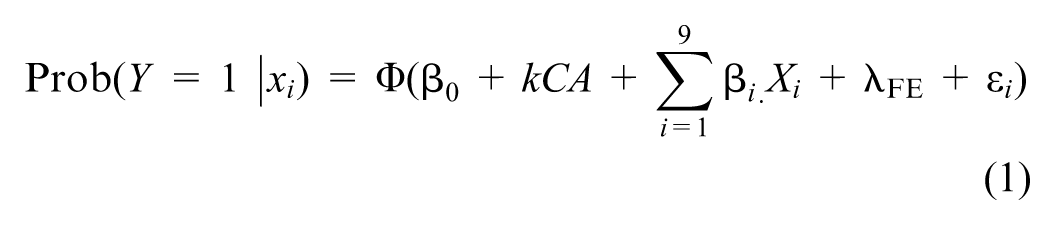
In Equation 1, Y represents the intention-behavior gap in farmers’ e-commerce entrepreneurship; CA represents digital literacy; X represents a series of control variables;
It is worth noting that though we’ve mitigated potential endogeneity from omitted variables by controlling for individual, household, and external environmental factors, the baseline regression results may still be biased due to unobserved factors and reverse causality. As farmers’ e-commerce entrepreneurial intentions and behaviors align more, their digital literacy may naturally improve with frequent exposure to digital environments, intensifying reverse causality. To address this, we employ an IV-Probit model. This approach uses instrumental variables to break the correlation between the endogenous regressor (digital literacy) and the error term, thereby enabling the identification of its causal effect on entrepreneurial intentions and behaviors and correcting for bias from reverse causality.
Bootstrap Approach
This study uses the Bootstrap method in the PROCESS macro to test the mediating effect of online social capital and the moderating effect of organizational support, mainly for the following reasons: (1) Bootstrap relaxes the normality assumption by constructing an empirical distribution through repeated resampling, replacing parametric assumptions. This significantly enhances the robustness of confidence interval estimation for non-normally distributed data or small samples. (2) It is applicable to analyzing mediation and moderation effects with binary dependent variables. (3) Compared with traditional mediation analysis methods, Bootstrap estimates the path coefficients of the full model and constructs bias-corrected confidence intervals, effectively reducing the risk of suppression effects and Type II errors. (4) By testing moderated mediation effects within a unified framework, Bootstrap can control for covariate interference across multiple paths and reduce omitted variable bias from stepwise modeling (Hayes, 2017).
Data Analysis and Results
Common Method Bias
We used Harman’s single factor test to examine common method bias (Podsakoff et al., 2003). The results showed that the variance explained by the first unrotated principal component was 25.16%, indicating that there was no serious common method bias in our measurement process.
Reliability and Validity Tests
Table 3 shows the reliability and validity test results. The Cronbach’s α coefficients and CR values for digital literacy, online social capital, and organizational support all exceed 0.9, surpassing the commonly accepted threshold of 0.7, indicating high internal consistency (Hair et al., 2009). The KMO values are above 0.7 and the p-values of Bartlett’s test of sphericity are less than 0.01, suggesting the data are suitable for factor analysis. Also, the cumulative variance explained by each variable is over 70%, well above the 40% benchmark, showing strong explanatory power of the measurement items. For validity, all standardized factor loadings are above 0.6, and the AVE values exceed 0.5, demonstrating high convergent validity. Moreover, the square roots of the AVEs for each construct are greater than the inter-construct correlation coefficients, indicating good discriminant validity (Fornell & Larcker, 1981). In short, the scale passes the reliability and validity tests.
Reliability and Validity Test of Variables.

Hypothesis Testing of the Main Effects
Baseline Regression
The baseline regression results are in Table 4. Column (1) shows digital literacy negatively impacts IBG without control variables. In Column (2), after adding control variables, the negative impact of digital literacy on IBG remains significant at the 1% level, supporting
Regression Results of the Influence of Farmers’ Digital Literacy on IBG.
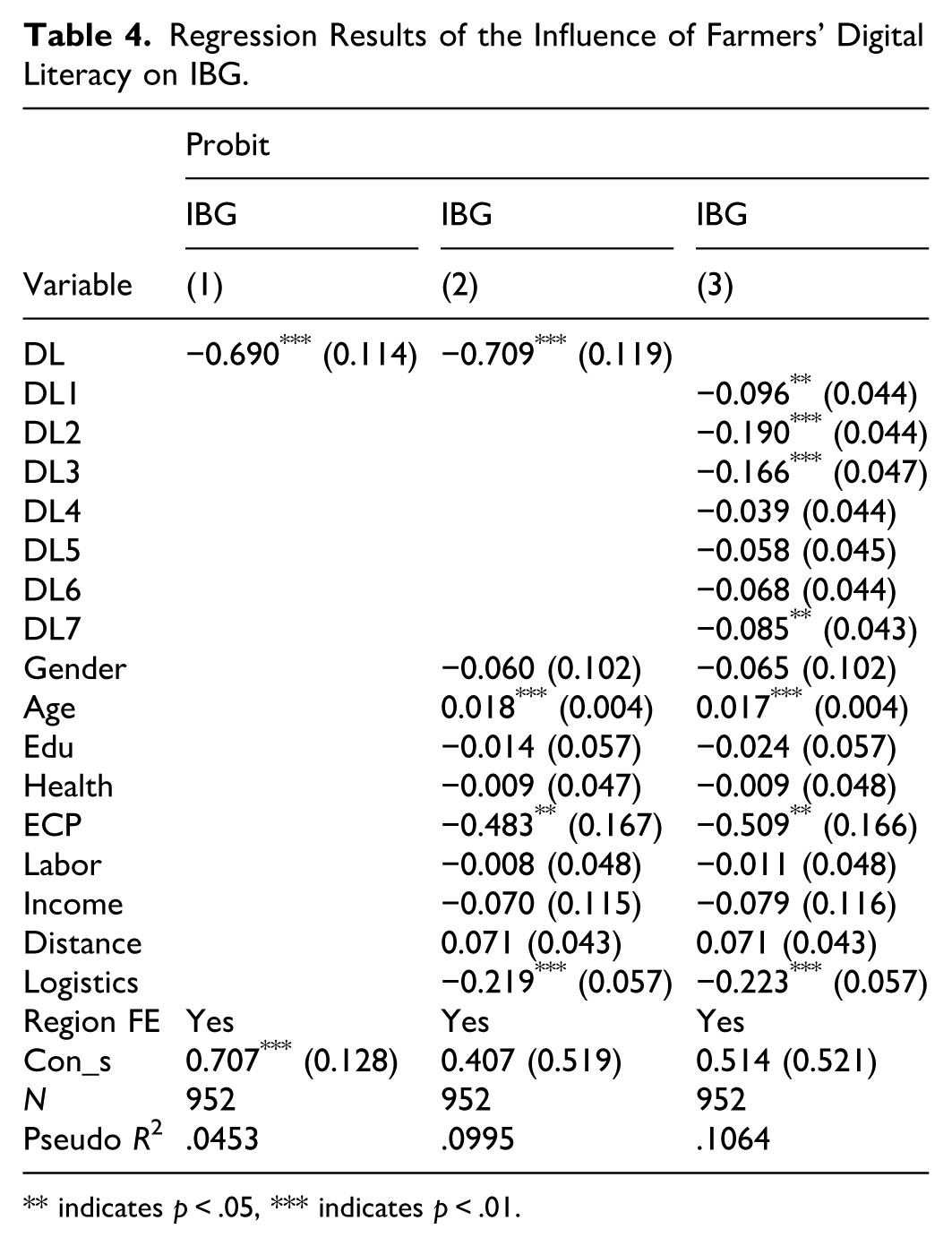
indicates p < .05, *** indicates p < .01.
Endogeneity Test
This study tackles endogeneity issues by employing the IV-Probit. We choose an aggregation-level instrumental variable, specifically using “the average digital literacy level of other farmers in the same township, excluding the surveyed household head” as the instrumental variable (IV-DL). The rationale behind this instrumental variable is grounded in two key aspects. Firstly, farmers within the same township are exposed to similar digital infrastructures, training resources, and policy environments. This makes an individual farmer’s digital literacy vulnerable to the influence of the overall digital atmosphere in the area, thereby fulfilling the correlation requirement between the instrumental variable and the endogenous variable. Secondly, the average digital literacy level of other farmers in the township is improbable to directly impact the e-commerce entrepreneurial decisions of a particular farmer, satisfying the exogeneity requirement.
From the IV-Probit model results presented in Table 5, we can observe that the corresponding p-value for the Wald test of exogeneity is .0307, which is significant at the 5% level. Consequently, we reject the null hypothesis that digital literacy is an exogenous variable, suggesting the existence of endogeneity issues. The F-value in the first stage of the IV-Probit model is 65.89, indicating that the selected instrumental variable does not have a weak-instrument problem. The second-stage regression results show that after accounting for endogeneity, farmers’ digital literacy still narrows the gap between their e-commerce entrepreneurial intentions and behaviors (
Endogeneity Test.

indicates p < .01.
Mediating Effect Test
We used the PROCESS macro to test the mediation effect. Based on the inclusion of all control variables, a bootstrap sampling procedure was conducted 5,000 times at a 95% confidence level. The results are shown in Table 6. The bootstrap test for mediation effects indicates that after incorporating online social capital, the direct effect of digital literacy on the inconsistency between farmers’ e-commerce entrepreneurial intention and behavior remains significant,
Mediating Effect Report.

Moderating Effect Test
We used the PROCESS macro to test the moderating effects of the three dimensions of organizational support. Results are shown in Tables 7 and 8. The interaction term between digital literacy and instrumental support negatively affects IBG,
Moderating Effect Report.

Index of Moderated Mediation.

Similarly, the interaction term between digital literacy and institutional support has a negative effect on IBG,
However, the interaction term between digital literacy and emotional support has no significant effect on IBG,
Robustness Test
First, we replace the Probit model with the Logit model to conduct a robustness test of the baseline regression. As shown in Column (1) and (2) of Table 9, after changing the econometric model, the negative effect of digital literacy on IBG remains significant at the 1% level. In terms of dimensions, media operation literacy, information and data literacy, social literacy, and job-related literacy all significantly negatively affect IBG, while the other dimensions do not show statistical significance. These results are consistent with the baseline regression results, indicating that the baseline model is robust. Next, considering the significant differences in physical function, cognitive ability, and knowledge level between farmers aged 70 and above and younger farmers, their digital literacy and online social capital may not significantly alleviate IBG. After excluding the sample of elderly farmers over 70 years old, we re-conducted the Probit regression analysis. As shown in Column (3) and (4) of Table 9, after restricting the sample, the effects of digital literacy and its dimensions on IBG are consistent with the conclusions from the full sample analysis, further verifying the robustness of the baseline model.
Robustness Test.

Indicates p < .10, **indicates p < .05, ***indicates p < .01.
Moreover, we constructed a Generalized Structural Equation Model (GSEM), and Figure 2 displays the results of the mediating effect pathways from the GSEM model. We will first interpret the regression model results for the first pathway (the upper pathway in Figure 2). The path coefficient for the first half, which originates from an OLS regression model, reveals a significant positive impact of digital literacy on online social capital (

Mediation effect paths based on GSEM.
We introduce the KHB model to calculate the mediating effect, with the results presented in Table 10. It is evident that online social capital plays a partial mediating role in the impact of digital literacy on IBG.
Total, Direct, and Indirect Effects of Digital Literacy on IBG.

Next, based on the model in Figure 2, we incorporate three moderating variables. As shown in Model (1) and (2) of Table 11, the interaction terms of digital literacy and instrumental support, as well as online social capital and instrumental support, both have a significant impact on IBG, indicating that the moderating effect of instrumental support is significant. From Model (3) and (4) of Table 11, the interaction terms of digital literacy and institutional support, as well as online social capital and institutional support, both have a significant impact on IBG, indicating that the moderating effect of institutional support is significant. Model (5) and (6) of Table 11 examine the moderating effect of emotional support. The results show that although the coefficients of the interaction terms of digital literacy and emotional support, as well as online social capital and emotional support, are negative, they are not significant, indicating that the moderating effect of emotional support is not significant. The above conclusions are consistent with the previous findings.
Moderating Effect Paths Based on GSEM.

Indicates p < .10, ** indicates p < .05, *** indicates p < .01.
Heterogeneity Analysis
Based on farmers’ preferences for e-commerce entrepreneurship channels, we divide farmers into cooperative entrepreneurship groups and independent entrepreneurship groups. The results in Table 12 show that the negative impact of digital literacy on IBG is mainly reflected in the group of farmers who prefer cooperative entrepreneurship. Cooperative entrepreneurship, relying on resource sharing, logistics support, and traffic diversion, can significantly enhance the effectiveness of digital literacy conversion. In contrast, farmers who prefer independent entrepreneurship can obtain technological and market information through digital literacy, but due to the lack of a stable cooperation mechanism, their entrepreneurial intentions are difficult to convert into actual behavior, limiting the positive role of digital literacy. In addition, based on whether there’s an express delivery station within 1 km of a farmer’s residence, we divide farmers into two groups: those with and without express delivery access. As shown in Table 12, the impact of digital literacy is mainly evident among farmers in areas with express delivery access. For farmers without nearby delivery services, logistical bottlenecks hinder timely and effective product delivery to consumers, reducing their entrepreneurial confidence. Consequently, digital literacy is less effective in bridging the gap between farmers’ e-commerce entrepreneurial intentions and actual behavior.
Heterogeneity Analysis.

indicates p < .01.
Discussion
This study aims to explore the relationship between digital literacy and IBG in farmers’ e-commerce entrepreneurship, as well as its underlying mechanisms.
Furthermore, we introduced instrumental support and institutional support as moderating variables. The results support
However, the moderating effect of emotional support did not receive empirical support, with both
In addition, our heterogeneity results show that digital literacy’s impact depends on conditions. Cooperative entrepreneurship and accessible logistics enable its full role. Zeng et al. (2024) and Keikhay Farzane et al. (2024) also confirmed the importance of cooperative entrepreneurship and logistics conditions. This means that rural e-commerce policies should go beyond individual skill training and focus on the construction of cooperation mechanisms and the improvement of logistics.
Conclusions and Implications
Conclusions
This study was based on empowerment theory to construct a theoretical framework for the gap between farmers’ e-commerce entrepreneurial intention and behavior. We investigated the relationship between digital literacy and the intention-behavior gap among Chinese farmers, using mediation and moderation analyses to identify correlating factors. Our findings indicate that: First, there is a significant negative relationship between digital literacy and the gap between farmers’ e-commerce entrepreneurial intention and behavior. Foundational digital literacies, such as media operation, information and data processing, social literacy, and agriculture-related application capabilities, demonstrate a strong effect in facilitating the conversion of intention into actual behavior. Meanwhile, although advanced digital literacy holds potential value in theory, its practical efficacy has not yet been fully realized. Second, online social capital partially mediates the relationship between digital literacy and the intention-behavior gap. Instrumental support and institutional support not only strengthened the negative relationship between digital literacy and the intention-behavior gap, but also reinforced the mediating path of online social capital. In contrast, the moderating effect of emotional support was not statistically significant. Third, the heterogeneity analysis reveals that the negative relationship between digital literacy and the intention-behavior gap is more pronounced among farmers who prefer cooperative entrepreneurial models. Meanwhile, in regions with relatively well-developed rural logistics infrastructure, this association is also more prominently manifested.
Implications
Implications of Theory
The study makes theoretical contributions in the following three aspects: First, it constructs a theoretical analytical framework for the relationship between digital literacy and the intention-behavior gap in farmers’ e-commerce entrepreneurship. Most existing literature still examines the impact of digital literacy on either farmers’ entrepreneurial intention or behavior in isolation (Chen et al., 2024; Fahmi et al., 2023), with insufficient attention to the “ having intention but no action” phenomenon observed in farmers’ e-commerce entrepreneurial practices. Notably, with the rapid development of rural e-commerce in China, farmers have generally recognized the value of e-commerce entrepreneurship. However, in reality, there is a paradox where farmers “want to start a business” but “dare not” or “do not know how to” start a business. This paper reveals the intrinsic relationship between farmers’ digital literacy and the transformation of e-commerce entrepreneurial behavior, enriching the theoretical understanding of the inconsistency between entrepreneurial intention and entrepreneurial action. Second, existing literature has lacked in-depth exploration of the relationship between digital literacy and the conversion of farmers’ e-commerce entrepreneurial intention into behavior. This study finds that online social capital plays a mediating role. Third, this paper reveals the moderating effect of organizational support. Compared to urban entrepreneurs, farmers’ e-commerce entrepreneurial behavior is more dependent on organizational support provided by cooperatives, agricultural enterprises, and village collectives. However, existing literature has not identified the boundary conditions of organizational support, making it difficult to explain the differences in farmers’ entrepreneurial behavior transformation at the same level of digital literacy. By introducing the organizational support variable, this study provides a contextualized theoretical explanation for research on farmers’ e-commerce entrepreneurship.
Implications of Practice
Our findings suggest the following practical implications. First, it is essential to establish differentiated pathways for enhancing digital literacy, with a particular focus on consolidating foundational digital capabilities. This study proves that foundational digital operations, information acquisition, and social literacy are significantly correlated with the conversion of farmers’ e-commerce entrepreneurial behaviors. However, the practical effectiveness of advanced digital literacy remains underutilized. Policy design should therefore distinguish between two tiers: foundational popularization, which involves expanding on-site village guidance, skills workshops, and distance education to strengthen practical operations and platform usage, and advanced empowerment, which entails cautiously promoting advanced digital technology training based on regional needs to prevent mismatches between resource allocation and actual outcomes.
Second, it is crucial to establish a resource integration and sharing platform centered on online social capital. This study proves that online social capital exerts a significant mediating effect between digital literacy and entrepreneurial behavior transformation. Governments, cooperatives, and enterprises should collaborate to develop digital platforms that integrate market intelligence, technical support, and production-marketing linkages. Additionally, they should actively utilize social media to foster collaborative networks among farmers, enabling experience-sharing and resource complementarity.
In addition, it is essential to strengthen organizational support and optimize the precise allocation of policy resources. This study demonstrates that both instrumental support and institutional support play significant moderating roles. We recommend strengthening logistics and digital infrastructure, promoting full coverage of village-level parcel delivery services, and emphasizing cooperative models such as “cooperative-farmer partnerships” and “enterprise-farmer collaborations.” These models should provide technical tools, risk-sharing mechanisms, and incubation services to reduce entrepreneurial risks and enhance the success rate of behavioral transformation.
Finally, attention should be directed toward group and regional heterogeneity, with the implementation of categorized guidance and precision interventions. This study proves that in regions characterized by strong cooperative entrepreneurial preferences and well-developed rural logistics infrastructure, farmers are more likely to facilitate entrepreneurial behavior transformation through enhanced digital literacy. Therefore, digital empowerment policies should be prioritized in regions with robust cooperative foundations and advanced logistics conditions. Conversely, in areas with weaker resource endowments and inadequate logistics, priority should be given to addressing infrastructure and logistical deficiencies while fostering a collaborative atmosphere and organized operational models.
Research Limitations and Future Directions
This study has certain limitations. The cross-sectional nature of the data limits the ability to accurately capture the long-term influence of digital literacy on the intention-behavior gap in farmers’ e-commerce entrepreneurship. Furthermore, key variables like digital literacy are based on self-reported measures, potentially introducing measurement errors and social desirability bias. The analysis is also constrained by its reliance on survey data from specific Chinese regions. Future studies would benefit from using longitudinal data, adopting more objective measurement tools and diverse data sources, and expanding the research to cross-regional or cross-cultural comparisons.
Footnotes

Ethical Considerations
This study was conducted in accordance with ethical standards. Informed consent was obtained from all participants, and the research utilized anonymized data that involved no identifiable private information or commercial interests.
Funding
The authors disclosed receipt of the following financial support for the research, authorship, and/or publication of this article: This work was supported by the National Social Science Foundation of China (No. 21BJY227; 23ZDA055) and the Social Science Planning Project of Shandong Province (No. 23CJJJ25).
Declaration of Conflicting Interests
The authors declared no potential conflicts of interest with respect to the research, authorship, and/or publication of this article.
Data Availability Statement
Data will be made available on request.