




Abstract
This research addresses the problem of misalignment between journalism education and entrepreneurial and market-ready careers. Using a sample of 300 journalism graduates with under 2 years of industry experience from multiple countries, the research employs a quantitative survey design to assess the impact of journalism education on their mindset, entrepreneurial skills, entrepreneurial knowledge, and their perceived connectedness with the journalism market needs. The primary objective is to assess how these educational outcomes impact market alignment, job satisfaction, and career status, and whether gender moderates these relationships. The findings indicate that while respondents rate themselves high on mindset, knowledge, and attitude, they perceived a lack of entrepreneurial skills. Moreover, a negative connection is found between entrepreneurial skills and market connectedness, while a positive connection is observed between mindset, knowledge, and connectedness. Perceiving connected to the journalism market needs did not translate into job satisfaction or result in entrepreneurial ventures. Gender moderates the relationship between connectedness and job satisfaction. The research underscores a gap between curriculum and market expectations, and recommends reforms in the form of more experiential, applied, and industry-aligned journalism education to prepare graduates for entrepreneurial and freelance careers.
Plain Language Summary
This study evaluates the impact of journalism education on graduates’ mindset, entrepreneurial skills, entrepreneurial knowledge, and their perceived connectedness with journalism market needs. It also assesses their current job status (independent journalist or salaried employee) and job satisfaction to explore the greater link between education and career outcomes.
Keywords
Introduction
Research Context
The transition to entrepreneurial journalism is a global phenomenon that has led to several studies exploring its impacts. In India, Dahiya (2024) highlights the rise of independent digital journalism platforms, while Holton (2021) discusses similar trends in the United States. The Reuters Institute (2024) notes that the future of journalism increasingly hinges on journalists’ ability to operate as independent business entities. These findings suggest that while entrepreneurial journalism offers new opportunities, it also requires significant adaptability and resilience from practitioners. Traditional journalism is transforming to keep up with the changing audiences’ preferences and behaviors, and is expanding from a centralized, government or corporate-owned and managed system to a more freelance and gig-based entrepreneurship (Fowler-Watt, 2023; Spilker et al., 2020). While this means that entrepreneurship opportunities are growing, it also means that traditional media employment opportunities are diminishing (Malter & Rindfleisch, 2019; Turow, 2019).
This shift requires a change in the set of skills and competencies that journalism graduates must acquire to meet the demands of an evolving landscape. Journalism graduates need to develop entrepreneurial skills and competencies of financial management, audience engagement, business acumen, and digital presence (Valencia-Forrester, 2020); yet journalism education has not adopted these skills as part of its curriculum in a substantial manner (Spilker et al., 2020). Many journalism programs continue to emphasize traditional technical skills or reporting craft, but may offer only limited exposure to entrepreneurial training (Josephi, 2019; Picard, 2020).
Research Gap and Problem Statement
Despite this global transition toward entrepreneurial journalism, there is a lack of studies that evaluate the gaps between the skills and knowledge imparted in journalism programs and the practical competencies required by the new age media market. This paper aims to fill this gap by exploring the current status of entrepreneur development in journalism education as it currently exists. This is done through the perspective of the students, by evaluating their perceptions of preparedness or perceived connectedness to the highly competitive freelance and entrepreneurship-driven media economy. This study focuses on recent graduates because they are uniquely positioned to assess how their journalism education translates into entrepreneurial readiness and early career outcomes. Their experiences provide direct insights into the applicability of educational inputs to market alignment, job satisfaction, and career status. The research expects to develop an understanding of the discrepancies between education and respondents’ perceptions about their preparedness, as well as assess their current career status and job satisfaction. Additionally, gender is considered a moderating variable in several entrepreneurship studies (Gomes et al., 2022; Margaça et al., 2021; Pelegrini et al., 2022), though there is a lack of focused research on this relationship in the context of journalism entrepreneurship. This research, therefore, aims to investigate the impact of gender on graduates’ perceptions of how their skills, mindset, and knowledge acquired through journalism education impact their perceptions of connectedness with the industry needs, and with their actual career outcomes and job satisfaction.
Research Aim and Objectives
The main aim of this research is to examine how current journalism education programs influence entrepreneurial readiness and its impact on graduates’ perceived market alignment and career outcomes.
The following objectives guide the research:
To assess the impact of entrepreneurial mindset, skills, and knowledge acquired in journalism education on graduates’ perceived connectedness with the journalism market (PCJM).
To evaluate the relationship between PCJM and job satisfaction, as well as the future career status of journalism graduates.
To analyze the moderating effect of gender on the relationships among entrepreneurial mindset, skills, knowledge, PCJM, and career outcomes.
The research expects to contribute to the academic discourse on journalism education. It also intends to provide actionable insights to educators for curriculum refinement to prepare graduates for the practical realities of a career in journalism.
Literature Review
Modern Journalism
Vos (2022) proposes that current journalists need to build their brand, engage with the audiences, and develop funding resources like crowdfunding, sponsorships, or subscriptions. The ability to generate revenue without governmental or corporate control is essential for entrepreneurial journalists’ independent reporting (Holton, 2021; Rafter, 2018). Also, creative and innovative skills are needed to enable journalists to continuously adapt to the changing market landscape (Adeoye & Jimoh, 2023). Business acumen and strategic thinking, along with digital media content production and management, are essential too (Berkey-Gerard and Maarleveld, 2020; Fulton, 2021; Hanitzsch et al., 2019). Similarly, skills related to podcasting, video production, interactive content generation, data visualization, and analytics are essential for modern journalists (Blasingame, 2022; Lim et al., 2020). Deuze and Witschge (2018) suggest that journalists be prepared in business entrepreneurship to develop their understanding of operational, financial, and marketing aspects of independent journalism. Most entrepreneurial skills are considered to be cognitive, and can be distilled in terms of skills that enable creativity, planning, managing resources and uncertainty, and having specific skills like financial literacy and operational knowledge (Salun et al., 2021). Knowledge also extends to the understanding of the dynamics of employee behavior, market dynamics, and ethics (Ruotsalainen et al., 2023). These cognitive and non-cognitive skills align with different stages of the entrepreneurial process, like exploration, evaluation, and exploitation (Van Laar et al., 2020).
Entrepreneurial Mindset Development in Journalism Education
Mindset is based on a variety of factors, including personality traits, attitudes, and behaviors that can encourage initiative and active engagement with future creation, leading to entrepreneurial success (Benedetti, 2020; Royle, 2023). Entrepreneurial mindset is linked with personality factors like openness, extraversion, conscientiousness, and agreeableness (López-Meri et al., 2021), and with traits like perseverance around challenging tasks (Caplan et al., 2020). Attitudes like independence, innovation, motivation, ambition, confidence, curiosity, and tolerance to failure have also been linked with entrepreneurial development, along with the ability to indulge in objective self-evaluation, clarity on goal setting, and resource allocations (O’Brien et al., 2024). Thus, journalism education should enable learners to understand the link between their academic assignments and real job requirements and create entrepreneurial intentions through engagement with practical, innovative, and creative project work (Liang, 2020; López-Meri et al., 2021).
Entrepreneurial Knowledge and Skill Development in Journalism Education
Journalism education has been predominantly focused on developing competencies like newsgathering, interviewing, writing and reporting, technical skills, digital skills, professionalism, and ethics in reporting, which are traditionally considered to be the core skills
Career Outcomes for Journalism Graduates
Several studies from across the world indicate that journalism graduates often struggle to find employment that is consistent with their qualifications, leading to underemployment (Somers et al., 2019; Tomlinson, 2021) Graduate Outcomes Survey from the UK recently reported that only 28% of journalism graduates found employment matching the journalism education in the 15 months post-graduation (HESA, 2023). Nevertheless, data from the National Council for the Training of Journalists (NCTJ) UK shows that 74% of NCTJ diploma holders and 88% who achieved the NCTJ’s “gold standard” qualification were employed in journalism-related roles (NCTJ, 2024). The NCTJ data is probably indicative of the fact that vocational-oriented diploma courses are more likely to be better tailored to suit the job market needs than graduate courses. A declining trend in the job market for journalists in the US is also expected as jobs may shrink by 10.1% between 2016 and 2026 (CareerExplorer, 2022). Entry-level journalism jobs are also on the decline in Germany, where the average age of journalists is around 45.3 years, suggesting limited potential for employment for younger graduates (Leibniz Institute for Media Research, 2023). In Australia, recent data reveal that only 26.1% of journalism graduates get a job in the media industry (Mumbrella, 2018). Similar data is obtained from Malaysia, where 31% to 35% of graduates get employed in unrelated fields (WageIndicator Foundation, 2024). In India, too, 29.4% of journalism graduates get employed in the marketing or public relations field, and 27.5% seek employment in art, design, or digital media (Edufever, 2024).
According to the U.S. Bureau of Labor Statistics (BLS), the median annual wage for news analysts, reporters, and journalists was $48,370, which is much lower than wages reported from other fields (Bureau of Labor Statistics, 2022). However, these journalism graduates’ earning expectations were higher (about $107,040 per year) than what they end up earning, which was 139% lower (Real Estate Witch, 2022). Entry-level journalist positions earn AUD 54,600 annually in Australia, which is again much lower than average salaries in the sector (SEEK, 2025). Similarly, entry-level journalists earn lower than average salaries in New Zealand at NZD 48,263 versus an average of NZD 55,575 (Talent.com, 2024). Similar low averages for journalists’ salaries are seen in Malaysia (RM 3000) (PayScale, 2025). In India, average annual salaries are INR 300,000 only (Edufever, 2024). The problems related to a mismatch in education and job market needs are evident from studies across the world, and highlight that journalism graduates are either underemployed or underpaid.
Theoretical and Conceptual Framework
Theoretical Underpinnings of the Research
This study draws on three theoretical perspectives: the Human Capital Theory (Becker, 1964), the Theory of Planned Behavior (Ajzen, 1991), and the Entrepreneurial Intention Theory (Krueger et al., 2000). Human Capital Theory posits that productivity and employability are linked to the skills, knowledge, and competencies that they acquire through their education. This supports the idea that journalism education should equip students with entrepreneurial skills, mindset, and knowledge. The theory of Planned Behavior suggests that individual behavior is driven by intention, which is shaped by self-efficacy, attitudes, and subjective norms. As such, journalism students high on autonomy, resilience, and self-efficacy are expected to be more likely to pursue entrepreneurial career paths. Finally, Entrepreneurial Intention Theory suggests that entrepreneurial intentions supported by knowledge, planning, and understanding of the feasibility and desirability of projects result in entrepreneurial behaviors. Together, these theories provide a conceptual framework and explain how mindset, skills, and knowledge influence graduates’ perceived alignment with industry needs and result in job satisfaction or career satisfaction. Additionally, gender is considered a moderating variable, supported by findings in entrepreneurship literature (Gomes et al., 2022; Margaça et al., 2021; Pelegrini et al., 2022). This is also theoretically grounded in the Theory of Planned Behavior and Entrepreneurial Intention Theory, which indicates that differences in self-efficacy, risk tolerance, and perceived behavioral control impact mindset, skills, knowledge, and market connectedness.
Conceptual Framework
As seen in the previous sections, literature suggests there is a need to align journalism education more closely with industry needs and equip journalists with resilience, adaptability, and specialized expertise (Yusof et al., 2018). Education that can enhance students’ self-efficacy and autonomy is also supported by the Theory of Planned Behavior (Ajzen, 1991), and can lead to developing students’ mindset (which is a mix of attitudes and self-perceptions) that empowers students to feel prepared (or gives them a sense of connectedness with the market) to take on the challenges of their future career.
Therefore, the following hypothesis is proposed:
Further, entrepreneurial skills, including financial literacy, business acumen, and creative production, are instrumental for navigating start-ups or freelance careers in journalism (Liu et al., 2021; Scott et al., 2016; Steel et al., 2018; Vasilendiuc & Sutu, 2021). According to Human Capital Theory, these skills directly enhance employability and capacity to meet evolving industry needs, and journalism education should be an investment that builds skills and competencies to enhance employability and productivity. As such, the following is hypothesized:
Furthermore, Entrepreneurial Intention Theory (Krueger et al., 2000) underscores the importance of perceived feasibility and desirability of entrepreneurship, which depends on knowledge of operational, marketing, and funding aspects. Education can shape this knowledge and lead to confidence, and enhance the practical viability of such endeavors. Hence, the following hypothesis is developed.
The perceived connectedness to journalism markets (PCJM) can impact job satisfaction and career status. Drawing on Human Capital Theory, better alignment between education and job expectations, or perceived connectedness to journalism markets (PCJM), enhances employability satisfaction and determines career status. Therefore, the following hypotheses are proposed:
Also, several entrepreneurial studies have found that gender impacted entrepreneurial education and mindset, skill, or knowledge acquisition (Çelik & Solmaz, 2023; Marques et al., 2021; Muskat & Reitsamer, 2020). This research aims to go further and assess whether gender moderates the impact of entrepreneurial education on journalism outcomes like career status and job satisfaction, and hence adds to the current knowledge on the subject. As such, the following research hypotheses are proposed.
These hypotheses are captured in the following Figure 1
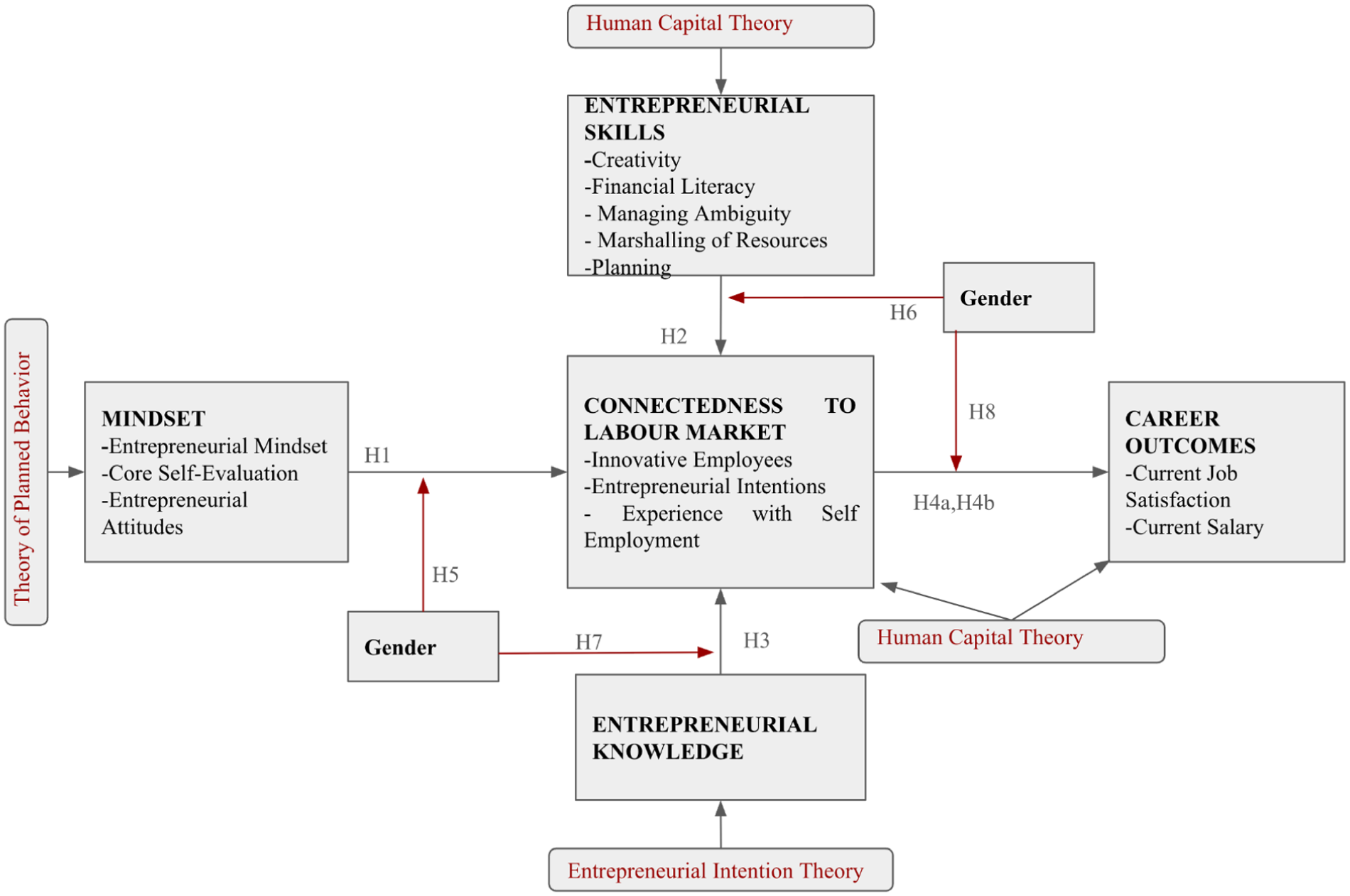
Conceptual framework.
Methodology
This research adopts a positivist paradigm and quantitative methodology to collect data from 300 respondents. Participants were included only if they had graduated from a journalism program in the last 2 years and if they had been employed in some form of work. The research focuses specifically on the experiences of graduates who were in their early careers, to capture perceptions of their entrepreneurial preparation and career alignment in the immediate post-graduation period. The insights from interviews of academic or industry experts were not considered, as while substantially useful for informing curriculum development, they fall beyond the scope of this research, which aims to explore the learner-centered outcomes and perceptions.
Also, 300 respondents may be a modest sample size for a global-level investigation; however, as research is aimed at identifying initial trends rather than claiming generalizability, this sample size is deemed appropriate for structural equation modeling (SEM) as supported by Hair et al. (2019). A purposive sampling method was used to recruit participants from academic networks, alumni LinkedIn groups, and journalism educational forums.
Purposive sampling was chosen as journalism graduates constitute a specific professional population that is not easily accessible through random sampling. By using these networking forums, alumni groups, and journalism forums, it was possible to reach relevant educational and professional experience respondents.
The first 300 eligible respondents who expressed interest and agreed to participate were selected, as the study aimed to develop an initial and exploratory understanding of journalism education and its impacts on the career outcomes of students. Respondents happened to be based in different countries due to the international nature of alumni and professional networks used for recruitment, rather than an intention to undertake cross-cultural comparison. As such, the sample includes respondents from India (31%), the UK (18%), Malaysia (15%), Australia (21%), and Nigeria (15%), representing a range of educational systems.
The research acknowledges that journalism education varies across cultural and institutional contexts, and this research does not presume uniformity in pedagogy across countries. However, an analysis of the cultural differences or contexts of the participants was deemed to be beyond the current scope of this research. The research limits its scope to noting overall patterns of journalism graduate experiences and common entrepreneurial outcomes for them. Future studies may undertake a comparative evaluation of cultural or pedagogical differences in journal education and their outcomes.
Data collection was done using a survey questionnaire based on the Assessment Tools and Indicators for Entrepreneurship Education (ASTEE; Moberg et al., 2009), which was developed using insights from Çelik and Solmaz (2023). Assessment tools like ASTEE review whether education is imparting entrepreneurial skills, mindset, entrepreneurial knowledge, and entrepreneurial intention, or feeling ready to meet the industry needs, and are aligned with the current research’s conceptual framework. The questionnaire was in English, which could have potentially led to the inclusion of only English-speaking participants, and hence may reflect their specific perspective only.
Supplemental Appendix A shows the full survey instrument, which is briefly described below.
The current study adapted the following measures from ASTEE as independent variables:
The items measuring mindset (11 items), entrepreneurial skills (19 items), and entrepreneurial knowledge (3 items) were assessed on a 7-point Likert Scale, while connectedness to the labor market items used a 7-point Likert style, and of yes/no responses.
The original ASTEE scale has been tested and validated across several countries (Austria, Belgium, Croatia, Denmark, Ireland, France, Italy, Germany, Portugal, Romania, Spain, Sweden, the United Kingdom) and is based on data collected by 4900 respondents. The adapted survey is reviewed by two independent experts in journalism education for face validity. Confirmatory Factor Analysis (CFA) is used to establish construct validity (Hox, 2021), and Cronbach’s Alpha and Spearman-Brown correlation are calculated to establish the reliability of the items (Izah et al., 2023). Structural Equation Modeling (SEM) is used to evaluate the measurement models to assess how well the observed variables represent the latent constructs, and to assess the structural model to evaluate the relationship between the constructs (Hair et al., 2019; Memon et al., 2021). Multi-Group Analysis (MGA) was done to further analyze the structural relationships using moderation. MGA allowed for understanding how gender may be impacting the relationships between different variables, and provides a deeper layer of understanding (Wang et al., 2019).
The research is conducted following all ethical considerations required for research with human participants. The survey link led the students to an informed consent form, and the participants were first required to read and accept the informed consent form before they could proceed to the actual survey (Hasan et al., 2021; Kaewkungwal & Adams, 2019). The informed consent page of the survey provided information regarding the purpose of the research and how the respondents’ responses would be used to attain the research objectives. It also apprised the respondents of their right to leave the survey at any point without any feelings of obligation (See Supplemental Appendix B).
The study ensured that no participants were harmed during it. The survey was set up online, and could be taken by respondents at their convenience, so the comfort, safety, and security of the respondents were not at risk. Also, any demographic and personal data collected was kept private and not shared by any third party, respecting the privacy and safety of the participants. The responses are also kept anonymous to ensure confidentiality and maintain participants’ safety from any repercussions due to their responses (Hasan et al., 2021). There is no potential harm to the participants due to the above-mentioned precautions taken. Moreover, the findings from this research reveal insights that can be used to guide educational curricula for journalism students, which is directly related to industry needs and can ensure their employability, suitability, and eligibility to participate in the media industry in the future. While the study brings no potential harm, it carries substantial benefits for ensuring a better future for journalism graduates.
Results and Discussion
Demographic Profile
There were 197 male and 103 female participants in the sample. It needs to be noted that the majority of the participants are male, which is reflective of the industry reality. In a study conducted by the Reuters Institute in 12 markets, only 40% of journalists were found to be female (Arguedas et al., 2024). Further, among males, 45 were independent journalists and 152 were salaried employees, while among females, 16 were independent journalists and 87 were salaried employees.
Descriptive Statistics
Descriptive statistics, including mean, standard deviation, skewness, and kurtosis, were calculated to assess data distribution and identify potential outliers. Appendix C shows the descriptive statistics, including mean (M) and standard deviation (SD) of the sample.
The descriptive analysis depicts participants’ perceptions of their mindset (M), entrepreneurial skills (ES), entrepreneurial knowledge (EK), and perceived connectedness to the journalism labor market (PCJM). Appendix C shows that mindset-related constructs have a high mean and low standard deviations (SD) for both male and female participants. For example, EM or entrepreneurial mindset (M = 5.08, SD = 0.54), EA or entrepreneurial attitudes (M = 5.05, SD = 0.5) and CSE or core self-evaluation (M = 4.93, SD = 0.52), all show a minimum difference across genders, which may suggest that journalism graduates in this sample have positive self-perceptions about themselves around being solution seekers, self-efficacy, and consider themselves as problem-solvers and initiative takers.
However, ES, particularly planning or P (M = 2.56, SD = 0.64), marshalling of resources or MR (M = 2.20, SD = 0.86), and financial literacy or FL (M = 1.77, SD = 0.77) show lower means compared to mindset. These respondents likely develop their minds, but there are gaps in skill acquisition during their education. Also, the SDs are relatively higher than for other factors, suggesting a higher differentiation between the perception of skills among the sample. This pattern may suggest an imbalance between thinking entrepreneurially and acting entrepreneurially, and can encourage more research exploring the gap between journalism education and practical entrepreneurial readiness.
EK (M = 4.97, SD = 0.58) also suggests that the respondents consider themselves informed about the purpose and context of entrepreneurship. However, moderate mean levels suggest that while respondents have conceptual awareness, it may be just average and may be difficult to translate into applied competence.
For PCJM, innovative employees or IE (M = 3.92, SD = 0.85) and entrepreneurial intentions or EI (M = 4.36, SD = 0.84) show moderate mean levels, suggesting that the respondents believe they can operate autonomously and that they are innovative to a certain degree. The gender difference in values for this variable is also noted to be higher than for others, especially for IE (female M = 4.08; male M = 3.84). Also, experience with self-employment or ESE is notably low (M = 1.56, SD = 0.27, on a 1–2 scale where 1 = yes, and 2 = no). This finding suggests a gap between intention and behavior, which may be further explored in future studies.
However, the low mean level and higher variability in responses from this sample suggest that their education may be only fostering an average level of market-connectedness, and practical entrepreneurial engagement stayed low, though the respondents had self-perceptions of readiness in the form of IE and EI.
Finally, job satisfaction or JS (M = 1.74, SD = 0.44) reveals a low mean, which may imply that that graduates may be in unstable jobs and grappling with unmet expectations. This finding suggests a possible misalignment between journalism education and early career outcomes, which is a central focus of this study and can be explored further in future research.
Next, to assess normality, measures of skewness and kurtosis were used (Bono et al., 2019; See Supplemental Appendix D). Several constructs exceeded the recommended thresholds of ±2 (skewness) and ±7 (kurtosis), suggesting either an overconfidence in replying due to the social desirability effect or a low self-perception. Some respondents may have either over-reported their entrepreneurial abilities to appear competent or under-reported due to self-doubt or lack of confidence. To meet the assumptions of Maximum Likelihood estimation, the item means were reversed and the data were log-transformed (Matore & Khairani, 2020), which is a standard practice. This is a widely accepted practice in quantitative research for correcting distributional non-normality and can be used to ensure reliable and unbiased parameter estimation. It preserves the original meaning of the constructs and does not impact any interpretation (Demir, 2022).
Reliability and Validity Analysis
Cronbach’s alpha was calculated to assess the internal consistency of the constructs, while the correlation matrix examined the inter-construct relationships. Subsequently, Confirmatory Factor Analysis (CFA) was conducted, including factor loadings, factor covariances, and model fit indices, to establish construct validity of the measurement model.
Cronbach’s Alpha
Table 1 shows the Cronbach’s alpha values for each construct, assessing the internal consistency of the items.
Cronbach’s Alpha.
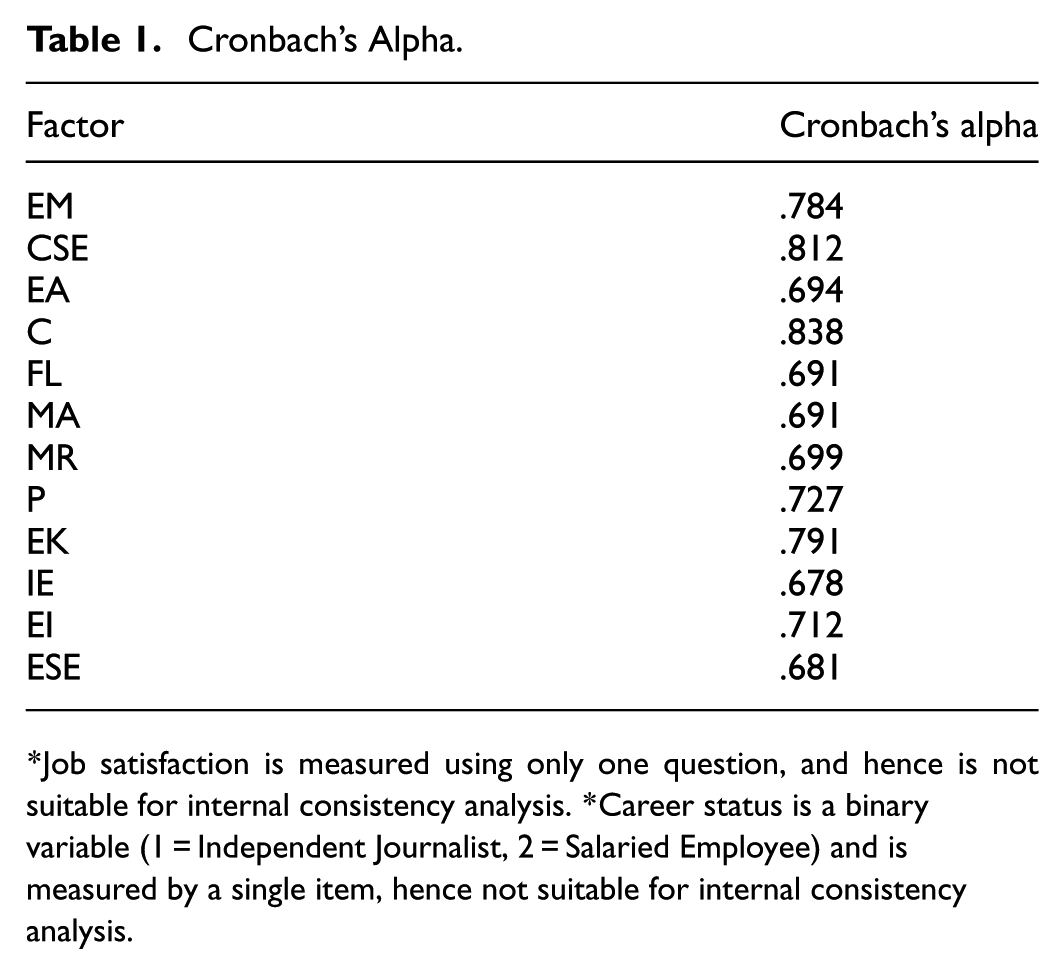
Job satisfaction is measured using only one question, and hence is not suitable for internal consistency analysis. *Career status is a binary variable (1 = Independent Journalist, 2 = Salaried Employee) and is measured by a single item, hence not suitable for internal consistency analysis.
The results show that all constructs demonstrate acceptable to excellent reliability (α > .70). For example, CSE (α = .812) and creativity (α = .838) suggest that these constructs consistently measure the underlying dimensions. However, some constructs like FL (=0.691) are slightly lower than the threshold. Some variables are excluded from Table 1 as mentioned in the notes under the table. Overall, the reliability analysis suggests that the scale can be used for further analysis, particularly SEM (Cheung et al., 2024).
Correlation Analysis
Also, strong intercorrelations between conceptually related topics suggest convergent validity of the instrument. Appendix E presents Pearson Correlation Coefficients for the constructs and is computed using the transformed (log-reversed) dataset (to account for significant skewness and kurtosis in the original scale distributions).
A moderate correlation between CSE and EA (r = .35) and EK (r = .32) suggests that people who evaluate themselves as high on potential success may also show higher confidence in starting their entrepreneurial endeavors or in their knowledge or understanding of entrepreneurship. This suggests an alignment between self-belief and perceived attitudes and knowledge, showing psychological readiness for entrepreneurship. Similarly, EA and EK (r = .48) suggest that people who believe they can be entrepreneurs are likely to also think they have the knowledge about entrepreneurship. Such findings mean that belief and knowledge reinforce each other but remain conceptually distinct.
FL, however, exhibits weak or negative correlations with several constructs. For example, it shows a negative correlation with EI (r = –.31) and IE orientation (r = –.28), which may be interpreted to mean that FL may deter people from entrepreneurial motivation in this context. It is possible that entrepreneurship motivations are driven more by passion or creativity than by structured financial literacy, and this may lead to a mismatch between practical knowledge and enthusiasm.
JS shows a relatively low correlation with other variables, and the highest with C (r = .13). This suggests that graduates who may perceive themselves as high on entrepreneurship skills or knowledge, or mindset, may still not be satisfied with their jobs. A possible explanation is that JS could be dependent on external market conditions and realities rather than self-perceived entrepreneurial readiness, however, more research is needed to explore this aspect in detail.
An explanation that can be considered for this result at this point is that most respondents reported being employed in a salaried job (See 5.1 Demographic Profile), and as suggested in the literature, journalism jobs have not only become scarce but increasingly non-rewarding and difficult to sustain. This finding reinforces the core research problem by highlighting the misalignment between educational preparation and the practical realities of journalism employment.
Confirmatory Factor Analysis
Confirmatory Factor Analysis (CFA) validated the measurement model and ensures that the observed variables measure the latent constructs reliably (Sürücü et al., 2022). CFA assesses the internal structure of the factors through factor loading, determines the overall model fit, and establishes if the proposed model is suitable for SEM (Tavakol & Wetzel, 2020). In this study, three variables were excluded from the CFA model for adequate reasons. Variables Experience with Self-Employment (ESE), Gender, and Career Status (CS) were excluded as these are based on binary or categorical variables, and CFA allows for an evaluation of only constructs using continuous or ordinal measurements (Zhang et al., 2019). It needs to be noted that by doing so, the study’s scope is not limited to these three variables, which are later included in the SEM analysis and MGA to test the research hypotheses.
Factor Loadings
The CFA yielded standardized and satisfactory loadings for the majority of items, with all items showing statistically significant loadings (Z > 3.29, p < .001). See Appendix F. The findings, therefore, indicate that observed variables contribute meaningfully to their latent factors, thus confirming that each construct is being measured reliably and captures the intended dimensions. Most estimates are within a consistent and acceptable range (between 0.70 and 0.80), indicating strong internal coherence construct validity. A fraction of items were near 0.50 or the lower threshold, but none were below 0.30 or negative, which suggests good convergent validity (Hox, 2021). This indicates that weaker items, too, contribute meaningfully and do not compromise the measurement model. The findings support the structural integrity of the measurement model and do not suggest removing any items.
Factor Covariances
Factor covariances analysis was undertaken to assess the interrelationships between the latent constructs (See Appendix G), and to establish discriminant validity showing that the model’s constructs are distinct and conceptually and empirically different from each other. This prevents any overlapping constructs from compromising the measurement model.
The factor covariance is analyzed using 12 latent factors identified in the CFA model, and it is seen that several pairs of factors show significant associations. For example, Factors 2 (CSE) and Factor 3 (EA) (Estimate = 0.64, p < .001) indicate potential conceptual overlap, likely due to self-evaluation and entrepreneurial attitudes being psychologically related; however, their correlation is within an acceptable range for discriminant validity.
In contrast, some factors exhibited negative estimates; for example, Factor 6 (FL) shows a negative estimate with several other factors. Respondents with higher financial literacy may not perceive themselves as creative or innovative, which is consistent with earlier findings. Factor 12 (JS) showed a weak or non-significant association with several other constructs, reflecting that job satisfaction is influenced by external labor market conditions rather than graduates’ entrepreneurial attributes, which underscores this research’s focus on the education-to-employment gap. Overall, the pattern of covariance supports that the factors capture distinct concepts and that the measurement model has discriminant validity for most factors (Rahlina et al., 2019).
Model Fit
Further, the adequacy of the measurement model is tested using model fit indices. A chi-square test was conducted to evaluate whether the proposed model reproduces the observed covariance matrix perfectly. The following Table 2 shows the results.
Chi-Square Test.

The chi-square statistic was significant (χ2 = 801, df = 675, p < .01), suggesting that the model does not perfectly reproduce the observed covariance matrix, but the discrepancy is modest. Given the large number of parameters and a large sample size, this is an acceptable indication of acceptable model fit (Nattino et al., 2020; Schober & Vetter, 2019; Semkow et al., 2019).
As a best practice, further analysis is done using indices like Comparative Fit Index (CFI), Tucker–Lewis Index (TLI), and Root Mean Square Error of Approximation (RMSEA).
Table 3 shows the CFI = 0.933 and TLI = 0.992, and it is observed that both are >0.90, confirming excellent model fit. RMSEA = 0.089 is also >0.08, for the 90% confidence interval (0.0819–0.090), and suggests borderline acceptability.
Model Fit Tests.
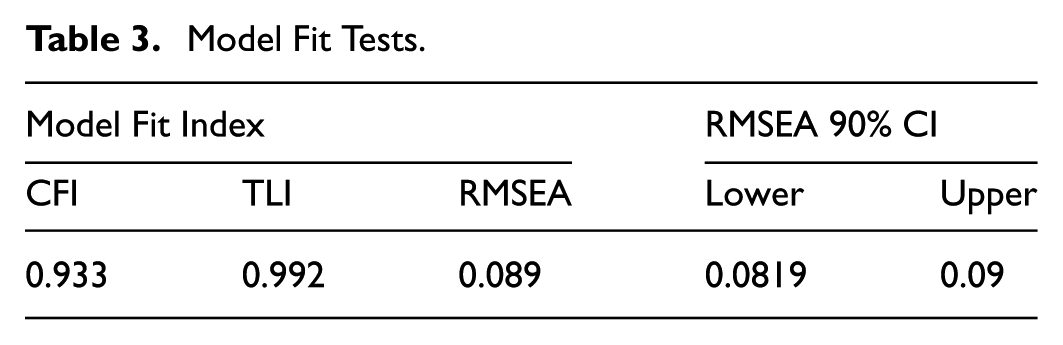
As the measurement model is found to be acceptable, no changes were applied before SEM.
Sequential Equation Modeling (SEM)
Mindset, Entrepreneurial Skills, Knowledge, and Perceived Connectedness to the Journalism Labor Market
The analysis revealed a statistically significant positive relationship between M (mindset) and PCJM (β = .205, p = .047; Table 4). Being high on mindset-related attributes (EA, CSE, and EM) is likely to also be perceived as being aligned with the labor market requirements. The results lead to the acceptance of H1: Journalism education that develops a mindset, impacts perceived connectedness with the journalism market’s needs (PCJM).
Mindset and PCJM.

Also, ES are negatively and significantly related to PCJM (β = –.39, p < .001), indicating that higher skills correspond with lower perceived market alignment. This appears counterintuitive, and plausible reasons are discussed in the Discussion section. The findings highlight a possible gap between skill acquisition and market relevance. Nevertheless, the findings reject H2: Journalism education that develops entrepreneurial skills impacts PCJM.
EK and PCJM were weakly but positively related (β = .143, p = .044). This suggests that higher EK slightly improves graduates’ perceived market alignment, and leads to the acceptance of H3: Journalism education that develops entrepreneurial knowledge affects PCJM.
Perceived Connectedness to the Labor Market and Career Outcomes
Career Outcome – Job Satisfaction (JS)
The analysis shows a very weak and insignificant impact of PCJM and JS (β = .04, p = .22) (Table 5), suggesting that respondents in this sample who felt market-aligned does not necessarily translate into higher job satisfaction for graduates. The findings, therefore, reject H4a: Journalism education that is PCJM impacts job satisfaction.
PCJM and JS.

Career Outcome – Career Status (CS)
Hypothesis H4b is based on categorical or binary outcomes (either independent journalists or salaried employees), and as it measures dichotomous and not continuous inputs, a binary logistic regression was more appropriate (Harris, 2021). This was conducted in SPSS, as SmartPLS does not allow binary outcome modeling. Table 6 presents the results.
PCJM and CS.

It is seen from Table 6 that PCJM and CS have a negative and insignificant relationship (β = –.08, p = .67), showing that perceived market alignment may not indicate early career advancement. Career outcomes may be shaped by external labor market factors rather than perceived readiness alone, as indicated in this sample, though more research is needed to understand this connection.
This leads to the rejection of H4b: Journalism education that is PCJM impacts future career status.
Multi-Group Analysis (MGA)
Impact of Gender on the Relationship between Mindset and PCJM
Table 7 shows that gender does not moderate the relationship between mindset and PCJM (β = .03, p = .88). This indicates that the positive influence of mindset on market alignment is consistent across genders. Also, as noted earlier, too, mindset has a positive impact on PCJM (β = .19, p = .23), but this relationship exists even when there is no gender difference for this sample. In conclusion, H5: Gender affects the relationship between mindset and PCJM is rejected.
Impact of Gender on the Relationship between Mindset and PCJM.

Note. The coefficient for mindset differs slightly between Hypothesis 1 (in Table 4) and Hypothesis 5 (Table 7) as Hypothesis 5 includes gender as a moderator, while H1 assesses the effect of mindset in the overall sample. In H5, the interaction term (mindset × gender) is used, which indicates that the impact of mindset on PCJM is assessed with the reference group, which is female respondents in this case. As such, the difference in values is reflective of the change in model structure and not of any analytical inconsistency.
Impact of Gender on the Relationship between Entrepreneurial Skills and PCJM
Hypothesis 6 tested whether gender moderates the relationship between ES and respondents’ PCJMt. Table 8 shows the interaction term as insignificant (β = .10, p = .62) and rejects any moderation effect of gender. This indicates that the negative ES–PCJM relationship stays for both male and female respondents. Also, as seen earlier, ES seems to hurt PCJM (β = –.47, p = .039), indicating that higher self-reported ES is associated with lower perceived alignment with industry needs. However, the respondents had rated themselves considerably lower on ES (See Supplemental Appendix C). The findings underscore a gap between the skills imparted in education and what graduates perceive as valued skills in the industry. It is likely that the respondents, irrespective of their gender, did not believe that the industry required the skills that they had been imparted. These findings may be further corroborated by future studies. Nevertheless, the findings reject H6: Gender impacts the relationship between entrepreneurial skills and PCJM.
Impact of Gender on the Relationship Between ES and PCJM.

Note. The coefficient for entrepreneurial skills differs slightly between Hypothesis 2 (in Table 4) and Hypothesis 6 (Table 8) as Hypothesis 6 includes gender as a moderator, while H2 assesses the effect of entrepreneurial skills in the overall sample. In H6, the interaction term (entrepreneurial skills × gender) is used, which indicates that the impact of EK on PCJM is assessed with the reference group, which is female respondents in this case. As such, the difference in values is reflective of the change in model structure and not of any analytical inconsistency.
Impact of Gender on the Relationship between Entrepreneurial Knowledge and PCJM
Table 9 shows that the interaction term was not statistically significant (β = −.06, p = .70), suggesting no moderation effect of gender on the relationship between EK and PCJM. As such, there are no gender-based influences on the relationship between knowledge and market alignment. Also, the effect of knowledge was positive but non-significant (β = .18, p = .20), suggesting EK may make respondents feel connected to the journalism labor market, but this may not be significant as perceived by the respondents in this study. This weak effect reinforces that knowledge may not be sufficient for strong perceived alignment. In conclusion, H7: Gender affects the relationship between entrepreneurial knowledge and PCJM, is rejected.
Impact of Gender on the Relationship Between EK and PCJM.

Note. The coefficient for EK differs slightly between Hypothesis 3 (in Table 4) and Hypothesis 7 (Table 9) as Hypothesis 7 includes gender as a moderator, while H3 assesses the effect of EK in the overall sample. In H7, the interaction term (entrepreneurial knowledge × gender) is used, which indicates that the impact of EK on PCJM is assessed with the reference group, which is female respondents in this case. As such, the difference in values is reflective of the change in model structure and not of any analytical inconsistency.
Impact of Gender on the Relationship Between PCJM and Job Satisfaction
Hypothesis 8 evaluated whether gender moderates the relationship between PCJM and JS. As observed in Table 10, the interaction term (Connectedness × Gender) is statistically significant (β = .17, p = .02), and hence confirms a moderation effect. This indicates that the effect of market connectedness on job satisfaction differs by gender in this sample. The findings suggest that females (who were used as the reference group) have an impact on the relationship between connectedness and job satisfaction in this sample. Also, it is seen that female respondents’ perceptions of connectedness to the labor market had a significant impact on job satisfaction (β = .17, p = .01), which may suggest that graduates who perceive themselves to be more aligned with market demands are more satisfied with their jobs. However, for males, the slope is reduced by the interaction term (β = .167–0.168 ≈–0.001), which suggests a lack of meaningful relationship between connectedness to market needs and job satisfaction. Thus, there is a gendered pattern where connectedness benefits females more than males. The findings, therefore, lead to the acceptance of H8: Gender impacts the relationship between PCJM and job satisfaction.
Impact of Gender on the Relationship Between PCJM and JS.
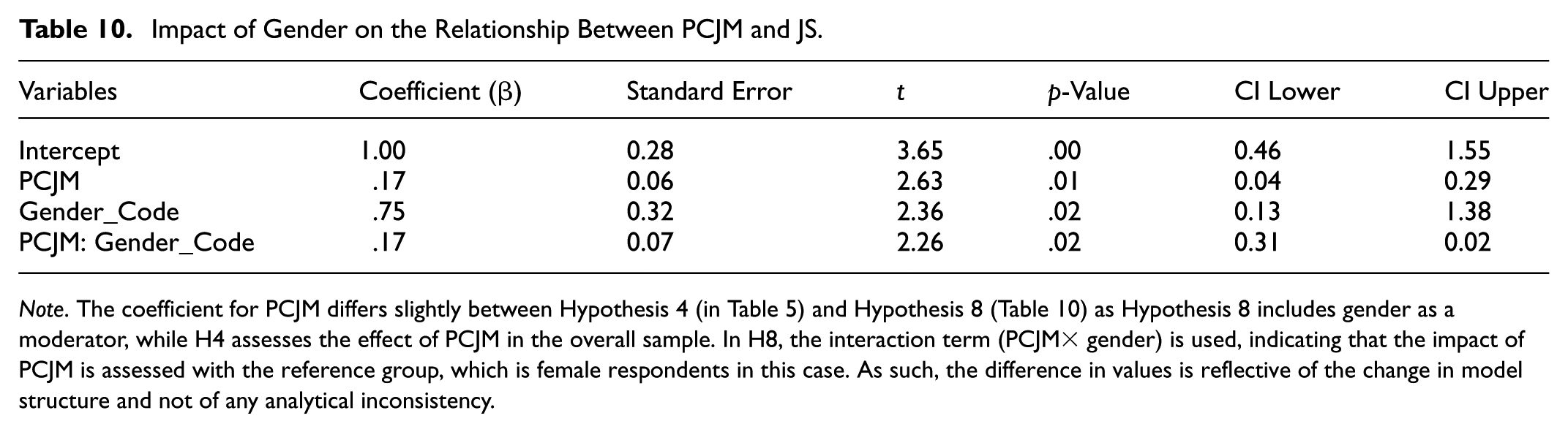
Note. The coefficient for PCJM differs slightly between Hypothesis 4 (in Table 5) and Hypothesis 8 (Table 10) as Hypothesis 8 includes gender as a moderator, while H4 assesses the effect of PCJM in the overall sample. In H8, the interaction term (PCJM× gender) is used, indicating that the impact of PCJM is assessed with the reference group, which is female respondents in this case. As such, the difference in values is reflective of the change in model structure and not of any analytical inconsistency.
Discussion
Mindset, Entrepreneurial Skills, Entrepreneurial Knowledge, PCJM, and Job Satisfaction
The literature has revealed that, in addition to digital skills for production, development, and broadcasting, entrepreneurial skills like financial management, creative, and innovative skills, business acumen, strategic thinking, and marketing skills were essential (Holton, 2021; Rafter, 2018; Vos, 2022). Journalism education, therefore, ideally needs to comprise these skills, mindset, and knowledge, and enable learners to feel connected with their future job market requirements (Benedetti, 2020; Caplan et al., 2020; López-Meri et al., 2021; O’Brien et al., 2024; Royle, 2023; Ruotsalainen et al., 2023; Salun et al., 2021; Van Laar et al., 2020), as envisaged in the conceptual framework. However, the findings highlighted several gaps, which further support the research problem that while journalism curricula may include conceptual understanding of entrepreneurial readiness, practical alignment with market needs is still lacking.
The findings highlight that respondents rated themselves high on mindset (entrepreneurial mindset, entrepreneurial attitude, and core-self evaluation), and on entrepreneurial knowledge, but not on entrepreneurial skills, which indicates that graduates within this sample may perceive having the mindset and knowledge for future entrepreneurial endeavors, but think they lack the skills. This pattern reflects the first three hypotheses, that mindset (H1) and knowledge (H3) are positively related to PCJM, but skills (H2) were not, and shows that there is a gap between thinking entrepreneurially and acting entrepreneurially for the current sample. These findings are also consistent with previous research that has underscored the lack of inclusion of entrepreneurial skills in a structured and formal format in journal education (Aceituno-Aceituno et al., 2018; Contreras, 2019; Frandsen, 2019; Spilsbury, 2020). However, future research can explore the same in diverse cultural contexts to provide a more in-depth understanding of the situation.
Similarly, the respondents did not rate themselves very high on labor market connectedness, especially for experience with self-employment. The fact that they rated themselves higher on entrepreneurial intention than on experience with self-employment suggests a gap between intention and behavior as perceived by the respondents in this sample. This aligns with the trends observed in past studies that have suggested a misalignment in education and industry requirements and the need to develop future journalists who can better adapt to the changed journalism industry (Deuze & Witschge, 2018; Örnebring, 2019). Journalism education may encourage entrepreneurship intention, but it does not prepare students with the skills needed by the market. Nevertheless, more cross-cultural and cross-educational settings research is needed to understand the impact fully.
The majority of the respondents rated their job satisfaction as low, which indicates that while they may have felt somewhat connected to the labor market requirements, their current jobs were not satisfactory for them. This directly relates to the H4a and H4b, which showed that PCJM did not meaningfully predict job satisfaction or career status, and indicates that perceived readiness or connectedness with the market alone does not translate into satisfaction with career path or status.
This dissatisfaction may also be reflective of the fact that the majority of participants in this research were salaried employees, and as the literature suggests, there is intense competition and changes in the job market for journalists. Several studies have documented the decline in jobs in the journalism market, and the problem of mismatch between skills and job requirements, or low wages (CareerExplorer, 2022; Edufever, 2024; Leibniz Institute for Media Research, 2023; Mumbrella, 2018; WageIndicator Foundation, 2024). Thus, the findings show that graduates may have confidence and conceptual understanding, but there are gaps in skills and alignment with structural aspects of the labor market.
Direct Relationships Between Variables
Structural Equation Modeling (SEM) tested the hypothesized relationships between the variables. The following section shows the results of the SEM analysis.
Mindset and PCJM
Hypothesis 1 was accepted, indicating that respondents who had the mindset for core self-evaluation and entrepreneurship attitudes were likely to think they were connected with the needs of the labor market. Previous studies have shown that mindsets that enable an internal locus of control, self-efficacy, and the ability to recognize opportunities lead to enhanced employability and adaptability (Aceituno-Aceituno et al., 2018; Contreras, 2019). Respondents were, therefore, likely to feel they have a psychological advantage in navigating the journalism job market. This also relates to the Theory of Planned Behavior, where self-efficacy and proactive attitudes are expected to lead to perceived employability. The findings also suggest that journalism education must encourage mindset development to prepare graduates for their futures.
Entrepreneurial Skills and PCJM
Hypothesis 2 was rejected, indicating the negative link between ES and PCJM. While these results appear counterintuitive, a likely explanation is that respondents did not think that these ES were relevant for the market or future jobs. This also aligns with the human capital theory, where skills are linked to increased employability, and as such, the finding highlights a critical gap between the skills emphasized in journalism education and the skills graduates perceive as needed in the journalism market. In the previous section, a direct positive connection between mindset and PCJM was observed, suggesting that respondents may consider their mindset to be more directly relevant to being connected with the needs of their future jobs, but think that the skills that their colleges had imparted to them were not relevant. Another possible explanation is, particularly in the context of the respondents rating themselves low on entrepreneurial skills, except on creativity (see Supplemental Appendix C), that they do not consider they acquired these skills properly or were unable to use them well in their salaried job roles that they currently have (See 5.1 Demographic Profile). Such dissonance has been reported in previous studies for graduates entering a digitally disrupted job market, where their skills are yet to be valued (Mumbrella, 2018; WageIndicator Foundation, 2024
Entrepreneurial Knowledge and PCJM
Hypothesis 3 connecting entrepreneurial knowledge and perceived connectedness to the labor market was accepted, which suggests that respondents who perceived that they understood entrepreneurship principles and roles of entrepreneurs during their college were likely to also perceive themselves connected to the labor market needs. Thus, knowledge may enhance their awareness and confidence and make them approach their future career with confidence. However, a small effect size suggests that knowledge may enhance intention as suggested by entrepreneurial intention theory, but it alone may not lead to market readiness, and its impact may be more psychological than practical. However, knowledge needs to be integrated with experiential learning or action-oriented learning to transform into actual employability. This finding also recommends ensuring that theoretical knowledge alone cannot lead to perfect labor market readiness, and experiential learning with applied skills and exposure to industry is essential for journalism education. Earlier studies (O’Brien & Wellbrock, 2024) have suggested that entrepreneurial knowledge needs to be complemented with activities like industry-collaborative projects, internships, or mentorships. Moreover, more research may be needed to explore the cross-cultural context of journalism education and its impact on students’ outcomes.
PCJM and Career Outcomes
Career Outcome – Job Satisfaction (JS)
Hypothesis 4a was rejected, underscoring that feeling prepared for the labor market does not necessarily translate into having job satisfaction. While the respondents had felt that they had the mindset and knowledge that made them adequate for journalist jobs, once they were in the market, they did not feel satisfied. This finding reinforces that perceived connectedness with industry may not be true for the respondents in this sample, and the job market conditions may differ from presumptions, thus lowering their satisfaction or ability to take up entrepreneurial endeavors. Since the majority of the graduates in this study had indicated that they were in salaried jobs (see 5.1 Demographic Profile), they were likely feeling restricted by the lack of autonomy, working conditions, or political aspects involved (Deuze & Witschge, 2018; Örnebring, 2019). Nevertheless, more in-depth exploration is required, including cross-cultural setting-based research to fully understand how the linkages between career outcomes and job satisfaction hold.
Career Outcome – Career Status
Hypothesis H4b was rejected, showing that perceived connectedness to the labor market did not impact career status. The findings indicate that respondents may feel their education connected them to the job market needs, but this does not impact what future career choices they made. This further underscores that career outcomes may not be linked to respondents’ perception of readiness or their mindset or knowledge, or even their intentions, but may be a factor of external factors like geography, limitations in opportunities (Örnebring, 2019). These results collectively highlight that journalism education, while valuable, needs to reflect the systematic and practical requirements of the journalism industry. The findings may be enriched by developing a more expansive study that compares journalism education and career outcomes across different regions or cultures.
Mediating Relationships Between Variables
Impact of Gender on the Relationship between Mindset and PCJM
The findings presented in Table 7 rejected Hypothesis 5 and suggested that gender does not moderate the relationship between entrepreneurial mindset and respondents’ perceived connectedness to the journalism labor market. However, the mindset’s impact on perceived connectedness to the journalism labor market is found to stay consistent irrespective of gender, suggesting that mindset development may act as a universal psychological benefit, as also implied by the theory of planned behavior, which posits that self-efficacy contributes to perceived readiness. The findings from this sample, therefore, reinforce the need for embedding mindset learning in journalism education, and that while there may be structural and institutional factors creating any gender issues in journalism careers later on, people equipped with an adequate mindset may be able to navigate those well. These results reinforce earlier studies’ findings that mindset may foster general readiness in both male and female graduates. Nevertheless, more studies, probably with larger sample sizes, are needed to explore this connection in depth.
Impact of Gender on the Relationship between Entrepreneurial Skills and PCJM
The results presented in Table 8 reject Hypothesis 6 and suggest that gender does not moderate the relationship between entrepreneurial skills and respondents’ perceived connectedness to the journalism labor market. However, the main effect of entrepreneurial skills was negative and statistically significant, which suggests that respondents who rated themselves high on entrepreneurial skills thought they were less aligned with the industry requirements. This finding is counterintuitive and may reflect a gap in skills-applications, indicating that current journalism curricula may not translate skill acquisition into practical value. As students, these graduates may have acquired the skills, but when they entered the job market, they realized that the journalism market did not reward or appreciate these skills. As most of them found employment in traditional media environments (See 5.1 Demographic Profile), likely did not find application of entrepreneurship skills in their jobs. However, it also needs to be noted that the majority of respondents did not rate themselves highly on any of the entrepreneurial skills, except for creativity; thus, the findings also underscore the fact that journalism education was not fully equipping them with these skills.
Nevertheless, from the gender perspective, no moderation effect implies that both genders perceive the misalignment similarly, suggesting the challenge to be systemic and not gender-driven, and hence requiring curriculum reform. The findings from this sample, therefore, reinforce that the challenges are not individual but likely structural and require changes in journalism education for better market alignment. Journalism education needs to bridge the market gaps and enable learning skills that can translate into meaningful employment. This can be attained by developing industry-integrated courses or co-creation of curricula with industry experts (Cossham & Irvine, 2021), as indicated by the current research.
Impact of Gender on the Relationship between Entrepreneurial Knowledge and PCJM
Table 9 shows no moderation impact of gender on the relationship between entrepreneurial knowledge and respondents’ perceived connectedness to the journalism labor market. It also shows that respondents who believed they had entrepreneurial knowledge may feel connected to the labor market needs, irrespective of their gender. Entrepreneurial knowledge, however, was found to have a weaker link with job market connectedness, suggesting that education needs to inculcate mentorship and internship programs to improve alignment with the job market. This finding again hints at structural or curricular factors, rather than individual factors, that may lead to any misalignment between entrepreneurial knowledge and labor market connectedness. Earlier studies have suggested that while knowledge provides the foundation, there is a need for action-oriented learning and embeddedness in the industry (Frandsen, 2019; Spilsbury, 2020). This finding further signals that the problem may lie in educational design rather than personal characteristics. Educational programs can benefit by delivering knowledge in a more relevant and applied format that is rooted in practice. However, more research is needed with larger sample sizes or cross-cultural comparisons to evaluate the impact of gender on entrepreneurial knowledge and PCJM.
Impact of Gender on the Relationship between PCJM and Job Satisfaction
The findings from Table 10 indicate that there is a gendered difference in job satisfaction, even when people feel they have the mindset and knowledge to connect them to the job market needs. This resonates with previous literature that women are likely to adjust their expectations and be satisfied in jobs than men, who require more status and autonomy to be satisfied (Çelik & Solmaz, 2023). For female respondents, women may likely drive satisfaction by adjusting themselves to the work environment, while for male respondents, it may be difficult to adjust to less income or recognition, or autonomy that their current salaried jobs entail (Muskat & Reitsamer, 2020). It is therefore likely that the expectations for male and female journalism graduates may vary, and this is reflected in their variation in job satisfaction. Nevertheless, as the findings reveal, overall, the majority of the respondents were not satisfied with their current jobs, irrespective of their gender. The findings therefore reiterate the need for better alignment of education with industry needs, and also focus on gender-sensitive career guidance and support. However, a cross-cultural comparison using a larger sample size to evaluate the impact of gender on PCJM and job satisfaction may reveal more intricate insights.
Conclusions
This study examined how entrepreneurial mindset, skills, and knowledge acquired through journalism education influence graduates’ perceived connectedness with journalism market needs (PCJM), and how this connectedness affects job satisfaction and early career outcomes, with gender as a potential moderator. It needs to be noted that the findings are based on a sample of 300 respondents from diverse national and cultural backgrounds, and hence provide an exploratory and preliminary level of insights. More detailed studies using cross-national comparisons or large data sets may be needed to corroborate the findings or expand on them. Nevertheless, the current study findings suggest that mindset and knowledge are positively associated with PCJM, but entrepreneurial skills have a negative association. This indicates that self-reported skills are not aligned with the market expectations. However, respondents exhibited feelings connected with the market, and yet reported low job satisfaction and limited engagement in entrepreneurial or self-employed roles. This further highlights a gap between educational preparation (which may make them feel equipped to meet the challenges) and early career outcomes (where they are unable to apply their education fully and succeed in the real world).
Gender was found to moderate only the relationship between PCJM and job satisfaction, with female graduates’ perceptions of market-alignment leading to their higher satisfaction. Overall, the findings underscore the need for journalism programs to improve in terms of developing curricula that deliver practical applications and market-relevant skills to support entrepreneurial and freelance career paths.
Implications
Academic Implications
The study adds to current knowledge on entrepreneurial journalism by exposing that self-perceived entrepreneurial mindset or knowledge, or even intention, may not be predictive of actual behavior. As such, it challenges existing models that explain entrepreneurial readiness and suggests rethinking journalism education to incorporate a greater alignment of mindset, knowledge, and skills with industry requirements. The action gaps between intention and behavior need to be further explored for journalism education, and refinements made in the curriculum. Further, a negative correlation between entrepreneurial skills and perceived connectedness to the market needs creates a paradox, implying a greater need for curricula to provide actionable, practical, and applicable skill sets. The research also adds to the understanding of the role played by gender, by showing the differences in job satisfaction and suggesting that experience may be conditioned by socio-cultural aspects. The findings underscore the need to integrate entrepreneurship with journalism education in a more organic and hands-on manner, rather than as a set of skills or attitudes, or knowledge.
Practical Implications
The research has practical implications for reforming the curriculum to embed experiential learning that includes formal entrepreneurship development with practical internships, incubators, industry mentorship, and project-based learning. It also recommends reducing the disconnect between skills being taught and market demands by curriculum co-creation with industry experts. By introducing periodic workshops with local media start-ups or independent journalists, students can get exposure to current market realities and learn practical strategies for monetization.
This can be attained by universities by introducing capstone projects, empowering students to launch small digital journalism ventures. By integrating financial literacy modules and short industry placements during such projects, the students can learn and apply their skills in real-world situations. Also, cross-disciplinary collaborations enabling journalism students to work with business or IT students on multimedia designs, digital campaigns can help simulate actual industry teamwork.
There is also a need for improving regulatory and accrediting interventions to ensure that graduates are future-ready. Another way to ensure alignment between journalism education and career outcomes is to include program evaluation metrics that track graduates’ freelance outcomes, entrepreneurial initiatives, or start-up participation, and use the feedback to refine curricula further. Finally, initiatives like alumni-led mentorship networks and industry practitioners as guest evaluators for student projects could strengthen the bridge between education and employability.
Supplemental Material
sj-docx-1-sgo-10.1177_21582440251398944 – Supplemental material for Entrepreneurial Education and Market Alignment in Journalism: Impacts on Graduate Career Outcomes and Job Satisfaction
Supplemental material, sj-docx-1-sgo-10.1177_21582440251398944 for Entrepreneurial Education and Market Alignment in Journalism: Impacts on Graduate Career Outcomes and Job Satisfaction by Yiming Ma in SAGE Open
Footnotes
Acknowledgements
The author would like to acknowledge the remarkable support and guidance received from his supervisor.

Ethical Considerations
Special Committee on Science and Technology Ethics of the Academic Committee of Taishan University approved our surveys (approval: Science and Technology Ethics Review Approval Letter #2025009) on May 13, 2025. Respondents submitted the consent button after reading the informed consent form, and before starting the survey.
Consent to Participate
The survey link led the participants to a page detailing the purpose of the survey, informing them of their rights. It provided them information that their participation was voluntary, their responses would be kept confidential, and that their responses would be kept anonymous. They were able to proceed to the survey only after they read and understood the informed consent, and submitted the form expressing their consent to participate in the survey.
Consent for Publication
Not applicable.
Funding
The author received no financial support for the research, authorship, and/or publication of this article.
Declaration of Conflicting Interests
The author declared no potential conflicts of interest with respect to the research, authorship, and/or publication of this article.
Data Availability Statement
The datasets generated during and/or analyzed during the current study are not publicly available due to privacy concerns, but are available from the corresponding author on reasonable request.
Supplemental Material
Supplemental material for this article is available online.
References
Supplementary Material
Please find the following supplemental material available below.
For Open Access articles published under a Creative Commons License, all supplemental material carries the same license as the article it is associated with.
For non-Open Access articles published, all supplemental material carries a non-exclusive license, and permission requests for re-use of supplemental material or any part of supplemental material shall be sent directly to the copyright owner as specified in the copyright notice associated with the article.
