




Abstract
It is easier to assume that educated older adults will find digital gadgets or the Internet as simple to use as the young generation does. However, it is not as simple as that. The generation that was not born into the digital world but has had to make an effort to learn to use digital technologies during their middle or late middle age is referred to as Digital Immigrants (DIs). Most of these individuals were forced to adapt to information technologies due to environmental pressure to survive and thrive at their workplace. The objective of this study is to investigate if the proposed “digital divide” that differentiates digital immigrants from digital natives (DNs) exists among e-commerce users in India, and if so, are digital immigrants less likely to adopt and use e-commerce services? Data was collected through a self-administered survey questionnaire from 432 Indian Internet users aged 19 to 65. Multigroup structural equation modeling analysis (M-SEM) of data revealed that DIs and DNs perceive e-commerce services differently. Though digital immigrants find e-commerce services challenging to use, their higher perception of its usefulness propels them to adopt and use e-commerce. This study contributes to the existing body of literature by extending our understanding of the technology adoption behavior of digital immigrants. The study’s implications and the scope for future research are discussed at the end of the article.
Plain language summary
Keywords
Introduction
Everyone is a product of the environment within which they were brought up, and the experiences they have gone through in life mold and guide them when approaching a new situation (Joshi et al., 2010). The term Digital Immigrants (DIs) and Digital Natives (DNs) was first introduced by Marc Prensky in 2001 to explain the generational gap in adopting and using new technology among people. He referred to the people born before 1980 and introduced to digital technologies during their middle age or late middle age as Digital Immigrants and people born after 1980 as Digital Natives (Prensky & Berry, 2001). Digital Natives were born and grew up amidst the Internet and digital technologies; hence it perfectly makes sense that these individuals are more adept with digital technologies, just like a sportsman or musician who has been practicing from young age tends to perform better than the one who was introduced to the same in the later stage of his/ her life. DNs are further categorized into two cohorts—Millennials and Generation Z based on their year of birth and the chronological events they experienced, and they are also known as “Net Gen” or Digital Generation (Arora & Dhole, 2019; L. Chen et al., 2021; Metallo & Agrifoglio, 2015; Turner, 2015). The assertion here is that young people have higher competency with ICT (Information and Communication Technologies) than their older counterparts.
Digital Immigrants did not grow up amidst ubiquitous technology; their educational experience was that of a traditional classroom setup where they had to rely on written materials (hard copy) and the instructor to get the information to learn (Creighton, 2018). Although many Digital Immigrants were able to master using digital technologies, they have a different attitude toward computer technologies from those of Digital Natives (Obal & Kunz, 2013). This attitudinal difference highlights the wide generational gap that prevails in society. This generational gap should be studied to ease some of the difficulties digital immigrants experience when they adopt and use new technologies (Kesharwani, 2020). In recent times, the differences in technology adoption behavior between young and older generations have become an important domain of inquiry for generational cohort and information systems (IS) scholars.
Further, while many criticized the concept of Digital Immigrants and Digital Natives as too simplistic and does not hold any base for generalization, there have been very few studies validating this concept outside the arena of schools and universities where the possible digital divide between students and teachers were explored (Joa & Magsamen-Conrad, 2022; Kesharwani, 2020). Moreover, generalization of the results obtained from studies conducted in developed economies like the U.S.A and Europe is of little to no value to a country like India, whose demography and social fabric are different (Hoffmann et al., 2014; Raman, 2019). Additionally, researchers across the globe have paid disproportional attention to the youngsters and left out the older generation (Metallo & Agrifoglio, 2015; Q. Wang et al., 2013). One must remember and acknowledge that digital immigrants are the inventors of technologies and systems that digital natives use today (Vodanovich et al., 2010). As societies age, the vulnerability of older people will increase if we fail to equip them to perform their routine activities by themselves (Guner & Acarturk, 2020). In this regard, “Information and Communication Technologies” (ICT) for older adults can improve their standard of life in society by enhancing their independence (e-shopping for groceries and medicine and video consultation with healthcare professionals); it also enables them to be in touch with their friends and relatives who live faraway, thus enhanced social inclusion in the society (Ahn & Jung, 2016). From this perspective, exploring the underlying factors that facilitate digital immigrants to adopt and use e-commerce services would be a significant value addition to the existing body of literature (Shafiq Obeidat & Young, 2017). Moreover, India being a developing nation, like any other developing nation, has been vocal about digitalizing every service it provides to its citizens. In addition to public institutions, private players have also been at the forefront of going digital lately. However, the needs and expectations of digital Immigrants regarding ICT acceptance and use are hardly ever looked up while designing and developing digital services (Guner & Acarturk, 2020; Vodanovich et al., 2010). This ignorance has propelled the authors to pursue this study.
E-shopping has become an indispensable part of people’s life in India and everywhere else. The Indian e-commerce industry has been projected to grow to 111.4 billion US Dollars by 2025 from 46.2 billion US $ as of 2020 (India Brand Equity Foundation [IBEF], 2021). The rise of e-commerce discount players such as Amazon, Flipkart (owned by Walmart), home-grown fashion-centric Myntra, the cheap mobile Internet, and the wide diffusion of Chinese-manufactured smartphones and laptops enabled the rapid adoption of online shopping in India. While some Digital Immigrants seem to be experts in online shopping, many appear to be experiencing greater anxiety and lack of trust when adapting to e-shopping (Hoffmann et al., 2014). This disparity presents a compelling opportunity to explore the e-commerce adoption behavior of Digital Immigrants in India. Based on the data collected from 432 individuals aged 19 to 65, we investigated the proposed model (Figure 1) using multigroup structural equation modeling (Amos-21.0). The findings from this research provide insights into the factors that influence Indian consumers to adopt and use e-commerce services and the digital divide that exists between Digital Immigrants and Digital Natives.
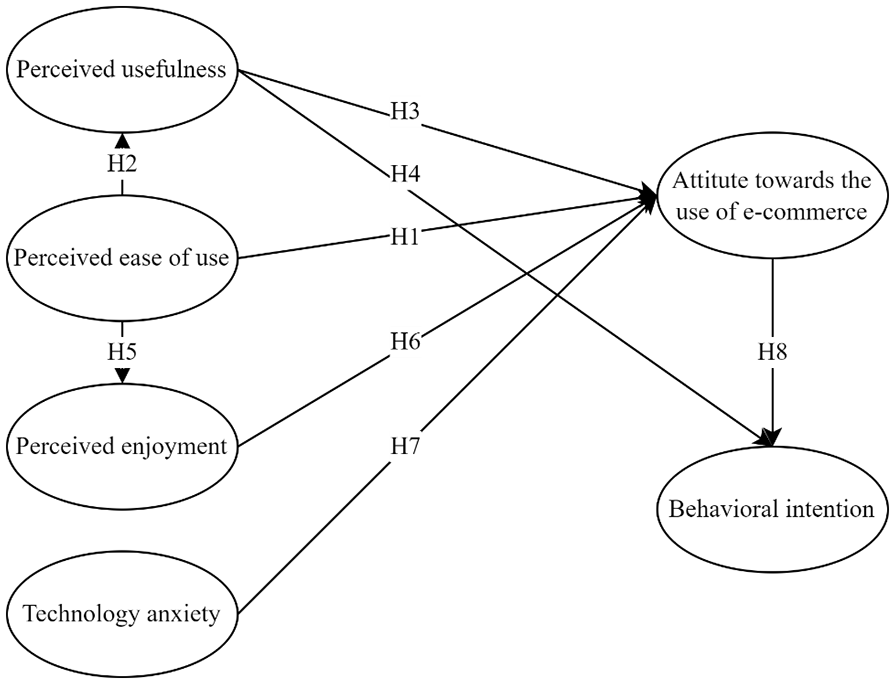
Conceptual model for determinants of e-commerce adoption and use among DIs and DNs.
The rest of the article is organized as follows; in section 2, a review of literature is made involving the determinants of e-commerce adoption and use, characterization of Digital Immigrants and Digital Natives, and a brief note on the e-commerce industry in India. Section 3 deals with the proposed research model and hypotheses formulation. Section 4 details the research methodology employed, and the data analysis carried out for the study. Then we go on to present the results and discussion in section 5. Section 6 presents the conclusion and implications of the study. Finally, section 7 provides the reference.
Review of Literature
Attitude formation has been a topic of importance for scholars in fields such as consumer behavior, sociology, psychology, information systems (IS), and many more. In the present study, we investigate how the attitude toward the use of e-shopping is formed between “Digital Immigrants and Digital Natives.” The literature review for the study revealed that four prominent theories based on which almost all the existing research on e-commerce adoption behavior has been conducted. They are the “Diffusion of Innovations Theory” (DIT; Rogers, 2003), “Theory of Reasoned Action” (TRA; Hill et al., 1977), “Technology Acceptance Model” (TAM; Davis, 1989), and “Theory of Planned Behavior” (TPB; Ajzen, 1991). Though TAM has been the widely used model to predict technology adoption behavior, scholars have advocated that it needs to be integrated with factors from other theories to improve its predictability power (Lee et al., 2011; Morosan & DeFranco, 2014). On this line, the TAM model has been expanded and modified in subsequent studies by scholars. The research that studied the e-commerce adoption behavior extending TAM (Çelik & Yilmaz, 2011; Kumar et al., 2021; Raman, 2019) included the factors— perceived trust, social influence, technology anxiety, perceived fun (hedonic motivation), perceived risk, personal innovativeness, and self-efficacy (Metallo & Agrifoglio, 2015; K. H. Wang et al., 2017; W. Y. Wu & Ke, 2015). Based on the above assertions, we extend the TAM model to study the difference in e-commerce adoption behavior between digital immigrants and digital natives.
Technology Acceptance Model in PredictingE-commerce Adoption Behaviour
Although TAM was initially introduced in the domain of information systems (IS), it has been extensively used in many other fields. It has its theoretical roots in the “Theory of Reasoned Action” (TRA), which furnished the theoretical base to understand the reason behind human behavior through unraveling the links between attitude formation, subjective norms (SN), and behavioral intention (Mortenson & Vidgen, 2016). The TAM model postulates that there are predominantly two factors that determine one’s attitude toward the adoption of new technology, they are “perceived usefulness (PU) and perceived ease of use (PEOU).” The attitude, in turn, affects the behavioral intention to use that technology (Davis, 1989). The model further states that the factor—“ease of use” affects “usefulness” positively. This assertion is straightforward, given that when a system is easy to use, it will also be perceived as more useful (Trivedi, 2016). There have been many studies investigating these two constructs and their interrelationship, and the results always supported their reliability and the basic relationships between them. However, these studies have also acknowledged that “perceived usefulness and perceived ease of use” are not the only factors determining technology acceptance, but they play an important role. As such, it is proven that though TAM constructs play a major role as antecedents of new technology acceptance, other factors also contribute significantly, if not equally (Sun et al., 2010). Hence, many researchers have modified and extended the TAM model by including other critical determinants of technology acceptance (Aslam et al., 2020; Chopdar et al., 2018; Qiu & Li, 2008; Raman, 2019). The notable contribution on this line includes the “Unified Theory of Acceptance and Use of Technology” (UTAUT) and, subsequently, UTAUT2 drawing elements from eight different behavioral prediction theories (Venkatesh et al., 2012). Based on this consideration, we, too, extended TAM by incorporating two additional factors to study the e-commerce adoption behavior between digital immigrants and digital natives: perceived enjoyment and technology anxiety.
Perceived Enjoyment
Perceived enjoyment (PE) is defined as “the extent to which using a specific technology is perceived to be enjoyable in its own right, aside from any performance consequences resulting from usage” (Rouibah et al., 2016). Two key factors to accept or reject a new technology, which are “intrinsic and extrinsic motivation” (X. Chen et al., 2019). The term intrinsic motivation refers to adopting a new system because it is fun and joyful (Alalwan et al., 2018). Extrinsic motivation refers to adopting a new system because it will result in favorable outcomes. As such, “perceived enjoyment” is the case of “intrinsic motivation,” whereas perceived usefulness is the case for extrinsic motivation to accept and use new technology. Based on this assertion, perceived enjoyment must be added to the TAM model at the same level as PU and PEOU. The terms perceived playfulness and perceived fun, or hedonic motivation, are often used interchangeably with perceived enjoyment, and all four are seen as the same factor.
Further, the study by Alalwan et al. (2018) found that frequent Internet use is significantly influenced by perceived enjoyment (PE). Along the same line, e-commerce too favored by many people because it is enjoyable to shop online (Saprikis et al., 2018). As “perceived ease of use” affects usefulness positively, it is very much rationale that it also influences perceived enjoyment positively. Because when a new technology is found to be easy to use, people will also perceive it to be enjoyable and use it whenever an opportunity arises. Based on the above consideration, perceived enjoyment is a crucial factor influencing e-commerce adoption and use; hence we have included it in our proposed model to examine the differences between “digital immigrants and digital natives.”
Technology Anxiety
Technology has become so pervasive and intrusive in everyone’s life that our dependence on technology will only grow and become an indispensable part of our life as time passes. Computer anxiety (CA) is delineated as “an irrational anticipation or fear evoked by the thought of using computers, the effects of which result in avoiding or minimizing computer usage” (Di Giacomo et al., 2019). Technology anxiety (TA) slightly varies from computer anxiety; TA is concerned about an individual’s general disposition toward technology, whereas CA is just focused on anxiety related to personal computer usage. TA is a key antecedent of not accepting new technology, and investigating its effect among digital immigrants is highly warranted (Maples-Keller et al., 2017). As people age, it is very likely that they will develop negative feelings toward new technology owing to their unfamiliarity and reduced cognitive ability (Dogruel et al., 2015). Considering that e-commerce consists of innovative technology-mediated services, the anxiety level of digital immigrants will be higher when they intend to use it as they have low exposure to technology compared to their young counterparts.
Moreover, as studies indicate that older people are more sensitive about wire money transactions than younger ones, the financial risks involved in e-shopping further hinder its adoption among older adults (Yang & Forney, 2013). The study by Cimperman et al. (2016) stated that older adults experience higher levels of computer anxiety than the younger generation; this notion is true not only for computers but also with new technology in general. Thus, we have included technology anxiety in our proposed model as a differentiating factor between digital immigrants and digital natives (Figure 1).
Digital Immigrants versus Digital Natives
Digital natives (DNs) are adolescents (Gen Z) and adults (Millennials) who were born and grew up amidst technology and digital gadgets. Whereas their parents— Gen X (Digital immigrants), have had to learn to use such digital technologies during their middle or late middle age (Agárdi & Alt, 2022; Hakkarainen et al., 2015). Since the young generation has grown up in an environment that is vastly different from the one where older adults were brought up, there is a significant difference in how both generations perceive and adopt digital services such as e-commerce, social networking sites, or any other technology-mediated products and services (Evans & Robertson, 2020). This generational gap should be investigated to frame strategies to mitigate the challenges the older generation face when adapting to technologies (Kesharwani, 2020). Digital immigrants are assumed to resist or at least have some difficulty accepting new technologies and systems. They prefer to speak face-to-face or over the phone as opposed to texting and have different adaptation behavior compared to digital natives (Milutinović, 2022). It reveals that DIs give importance to in-person human connection as opposed to connecting electronically (Riegel & Mete, 2017). Further, digital immigrants focus on one task at a time and prefer getting information from print or traditional media (Ahn & Jung, 2016; Sadiku et al., 2020). Whereas digital natives grew up amidst digital technologies and are accustomed to getting information in a jiffy, they prefer online chats to emails and instant messaging to phone calls (Shafiq Obeidat & Young, 2017). DNs typically have a short attention span and demand immediate feedback; they are connected online around the clock and access more information than any other generation (Jarrahi & Eshraghi, 2019; Manor & Kampf, 2022). The consistent use of electronic devices and early exposure to digital technologies made DNs comfortable with the quick transfer of information and multitasking with ease. While young individuals (DNs) prefer social networking and microblogging platforms, older adults (DIs) are more likely to use linear means of communication, such as email (Kirk et al., 2015).
Literature review suggests that there are two yardsticks predominantly used to divide Digital Immigrants from Digital Natives, that is, 1. Age, 2. Access to technology (Agárdi & Alt, 2022; Q. Wang et al., 2013). In this study, we have used age as the criterion for two major reasons. First, it was only in 1995 that India first got Internet access through Videsh Sanchar Nigam Limited (now known as Tata Communications) (News 18, 2020; The Economic Times, 2020). Second, personal computers too entered the Indian market only in the mid-90s (Sivakumaran, 2000). Further, until 2005 the computer and Internet were not for everyone, and their penetration was minuscule; it was enjoyed only by a few elites and bureaucrats (Haseloff, 2005; Rao, 2005). Hence, it is a clear indication that the people born before 1980 in India were at least 25 years old or higher when they were first introduced to the Internet and computers. Since most of them did not have extensive exposure to the Internet and computers till their early middle age or middle age, they are to be regarded as Digital Immigrants. They were not born in the digital era but gradually began adapting to digital technologies later in life. Thus, in this study, the participants above 45 years old are considered Digital Immigrants, and individuals aged between 19 and 39 are treated as Digital Natives.
E-commerce Industry in India
The ongoing tussle between organized retail distributors and big FMCG companies like HUL, P&G, ITC, Dabur, and Nestle is a testament to the kind of disruption e-commerce made in the retail industry in India (Mint, 2022). Seeing the growth potential e-commerce players have, the FMCG companies favored them, offering higher margins which angered the traditional distributors whose survival has been threatened by e-retailers like Jiomart (Mint, 2022; Sen, 2021). Given the burgeoning Internet user base and growing economy, India offers a tremendous opportunity for e-commerce firms (Nigam et al., 2020). The market valuation of the Indian e-commerce industry was at U.S. $ 22 billion in 2018, and now it is projected to hit a whopping $ 27 billion in 2027 (Statista, 2022). Industry players continue to make inroads in semi-urban and rural areas; about half of Amazon’s revenue for the year 2020 was from tier II and tier III cities (The Hindu, 2022). About 28% of India’s population (370 million) is below 15 years old; these individuals would be much more agile in adopting new technology and expected to drive the digital economy again in an upward trajectory (Thangavel et al., 2021). A consumer survey by Kearney (2021) states that about three-fourths of Indian households earn less than INR 5 lacks per annum, roughly $6,730, and this group has always been value-conscious. E-commerce companies can only quench the appetite of this segment as brick-and-mortar retailing involves higher costs (Jain et al., 2021). Considering the above facts, we believe investigating the e-commerce adoption behavior between young and older adult consumers would bring valuable insights to the industry and society. Further, while there are concerns surrounding online shopping, which range from financial fraud, divulging personal information, and the possibility of receiving broken or substandard products from sellers to delayed delivery, these insecurities and concerns have been largely overcome in the last few years through the measures taken by the e-commerce industry to win the customers’ trust (Ullal et al., 2021; J. Wang et al., 2022).
Theoretical Model and Hypothesis Formulation
This section conceptualizes a research model integrating TAM constructs with perceived enjoyment (PE) and technology anxiety (TA). A detailed discussion is made on these constructs above in the literature review (sections 2.1–2.4). Here, the rationale for the hypotheses is briefly argued. These constructs have been investigated previously in e-commerce adoption behavior but have not been employed to unearth the differences between “digital immigrants and digital natives.” The conceptualized model does not include the construct “actual use” (Figure 1). Instead, behavioral intention (BI) to adopt e-commerce services is incorporated as it is empirically confirmed as the predictor of actual use (Niemelä-Nyrhinen, 2009; Sheppard et al., 1988). According to the TAM model, two primary factors affect whether an individual accepts or rejects a new technology. They are- “perceived usefulness and perceived ease of use.” Perceived usefulness is defined as “the degree to which a person believes that using a particular technology would enhance his or her job performance,” and perceived ease of use is delineated as “the degree to which a user expects the technology to be free from effort” (Davis, 1989, p. 320). “Perceived ease of use affects perceived usefulness” positively because if a new technology is perceived as challenging to use, users may resist adopting it (Gefen & Straub, 2000).
Since Indian Millennials and Gen Z (Digital Natives) were introduced to computer technologies at a young age and are frequent users of the Internet, they tend to regard e-commerce services as easy to use (Thangavel et al., 2021). On the contrary, Indian Gen Xers (born before 1980) began to use technology and the Internet only in the later part of their life; as such, they have limited experience with computer technologies. This limited exposure lowers their confidence in technology use and increases their perceived difficulty in using e-commerce or other technology-mediated products and services (Singh & Sharma, 2023). Also, this lower exposure increases their anxiety level when learning to use them. Thus, perceived ease of use is a stronger determinant of e-commerce adoption and patronage for Indian Millennials and Gen Z (Digital Natives) than for Gen Xers (Digital Immigrants). Based on the above argument, the following hypotheses are examined,
E-commerce enables consumers to buy products and services at the click of a button from the comfort of their homes at a competitive price (Thangavel et al., 2022). It provides customers with product information and enables them to compare competing products’ prices and features. Customers can also return the products without remorse under the liberal norms of e-commerce firms, that is, no questions asked return policy (Janakiraman et al., 2016). No consumer, especially the Indian consumers who are largely value-driven, would say that the value and benefits brought by e-commerce as less useful. Hence both Digital Natives and Digital Immigrants value the convenience and best deals brought by e-commerce services equally. Further, the measures taken by the e-commerce industry in the last few years have assuaged the risks and fear associated with e-shopping to a large extent (Jain et al., 2021). Therefore, we can assert that both cohorts find e-commerce equally useful; hence there is no difference to exist between “digital immigrants and digital natives” in terms of perceived usefulness. Based on this argument, the following hypotheses are examined,
Perceived enjoyment (Hedonic motivation) has often been cited as an important determinant in consumers’ adoption and use of technology (X. Chen et al., 2019). When an individual perceives that using a particular system is fun, his/her attitude toward using it will be positive and favorable. Moreover, it has been found that the entertainment aspects of e-commerce services brought in the most interest to adopt and use it (Dabholkar & Bagozzi, 2002). Hence perceived enjoyment is a critical factor in determining the adoption and use of e-shopping. Additionally, when users feel the new system is easy to use, they will be overjoyed and engage with it whenever an opportunity arises (Çelik & Yilmaz, 2011). Therefore, increased “perceived ease of use” will result in greater perceived fun. Since Millennials and Gen Z (Digital Natives) perceive it as easier to use than Gen Xers, perceived enjoyment will be a stronger determinant of e-commerce adoption and use for digital natives than for digital immigrants. Hence, the following hypotheses are tested,
While the benefits of digitalization and its application are abundant, their effect on older adults is less investigated (Riegel & Mete, 2017). Technology anxiety has been identified by many scholarly studies as an inhibitor of technology adoption (Cimperman et al., 2016; K. H. Wang et al., 2017). Wagner et al. (2010) stated in their study that technophobia is one of the major barriers to computer use among the older adult population. Anxiety about using technology may be caused by the individual’s fear of making mistakes or losing vital information due to his/ her wrong action (Guner & Acarturk, 2020). When it comes to digital immigrants, they are a novice to computer technologies (Ahn & Jung, 2016). E-commerce services involve online financial transactions and divulging one’s personal information; hence it is susceptible to risks such as account hacks or scams. Thus, digital immigrants tend to experience higher anxiety levels than digital natives when they intend to adopt and use e-commerce services. So, we propose and test the following hypothesis,
Attitude is the positive or negative feelings toward a behavior (Davis, 1989). It has been cited as the important antecedent of behavioral intention to adopt and use new technologies (Shaikh & Karjaluoto, 2015; Trivedi, 2016). People tend to perform a behavior that they believe will bring-in positive outcomes and refrain from behavior that will result in negative consequences. A person’s perceptions, opinions, and feelings strongly influence his or her behavioral intention (Alalwan et al., 2018). Further, well-established theories such as the “theory of reasoned action,”“theory of planned behavior,” and TAM and the studies that are based on these theories have consistently supported that attitude influences behavioral intention, which in turn affects the actual behavior. Though it is often argued that behavioral intention does not necessarily result in actual behavior, there is a strong correlation between “behavioral intention” and actual behavior (Naruetharadhol et al., 2022). Thus, the intention to shop online is a significant predictor of actual e-commerce use behavior. Therefore, we test the following hypothesis,
Conceptual Model
Considering the literature review and the formulated hypotheses, Figure 1 below demonstrates the conceptualized model of the study. The constructs—“perceived usefulness, perceived ease of use, perceived enjoyment, and technology anxiety” influence the attitude toward the use of e-commerce services which in turn determines the behavioral intention to adopt e-shopping.
Methodology and Data Analysis
Measurement Scale Development and Sample Selection
The collection of data was carried out with the help of a questionnaire (online and paper-pencil method). The questionnaire comprised three parts, namely the introduction, where the purpose of the research was stated; the second part dealt with acquiring the demographic data of the survey participants, which included gender, age, educational level, family income, and years of Internet use experience. This data was collected to get an overview of the socio-economic status of the survey participants. The last section of the questionnaire carried the questions for measuring the variables stated in the proposed model (Figure 1). All 21 questions in the third part were adapted from previous research (Appendix 1). All the scale items used a five-point Likert scale anchored from 1 as “strongly disagree” to 5 as “strongly agree.”
Prior to data collection, a pilot study was carried out in two stages. First, we consulted two academics who are experts in Information Systems and e-commerce research and revised the questions based on their suggestions. Next, we requested 20 older adults who are aged between 50 and 65 years to register their responses to the questionnaire, and we discussed the difficulties they faced in understanding and responding to the questions. Further, for the digital natives’ group, the instrument was tested with 30 students who were 19 to 35 years old. Based on the input obtained from both groups, we reframed or deleted a few questions that the pretest participants identified as ambiguous or repetitive. Further, the examination of pilot study data resulted in factor loading of >0.5 for all the items; thus, the validity and reliability of the measurement scale were ensured at the pretest level. The sample for the study consisted of Indian Internet users aged 19 to 65 years, who knows how to make an online purchase, have made one already, or are willing to make one in the future. While most of the younger population filled out the online questionnaire, data were obtained from older adults offline as their response was meager for email circulation (Google form). The survey received a total of 470 responses, and 38 had conflicting responses for the same construct or were incomplete; as such, they were not considered for further analysis. The gender distribution of the overall sample was 55.09% of men and 44.91% of women. The group distribution was 48.38% of “Digital Immigrants” and 51.62% of “Digital Natives.” Further, the sample’s mean age for digital immigrants and digital natives was 54 and 27, respectively, with a standard deviation of 0.756 and 1.046.
Reliability and Validity Assessment of Measurement Items
To examine the normal distribution of data, the “skewness and kurtosis” test was run using SPSS-23.0. While the Skewness test assesses the symmetry of the data distribution or the lack of symmetry in a given dataset, Kurtosis measures how heavily the tails of a distribution differ from the tails of a normal distribution. This test helps us to understand where the most information is lying and to detect the outliers in a dataset. The values between −2 and +2 for Skewness and Kurtosis are considered acceptable to prove univariate distribution (George, 2011). The values of the “skewness and kurtosis test” for this study ranged between the recommended threshold values for all the constructs, both for Digital Immigrants (DI) and Digital Natives (DN). Table 1 below presents the values of the “Skewness and Kurtosis” test with mean and standard deviation for all the study variables.
Mean, Standard Deviation and “Skewness and Kurtosis” Results for Determinants of E-commerce Adoption.

Source. Authors’ own.
Further, the data was also subject to “Kaiser-Meyer-Olkin” (KMO) measure for sampling adequacy and “Bartlett’s test of Sphericity.” KMO is a test conducted to determine the variables’ collinearity which means how strongly a single variable is correlated with other variables (Glen, 2016). The KMO value closer to one (1) is considered perfect, while the value less than 0.5 (<0.5) is considered undesirable (Kaiser, 1974). Scholars have also stated that a KMO value of 0.8 is good to begin the factor analysis (Cop et al., 2020). “Bartlett’s test of Sphericity” is employed to assess whether the correlation matrix is an identity matrix. An identity correlation matrix means that variables are unrelated; thus, the given dataset is unsuitable for factor analysis. If the statistical value for “Bartlett’s test of Sphericity” is <0.05, then the correlation matrix is not an identity matrix, and thus the alternative hypothesis is accepted. The analysis for this study yielded a meritorious KMO value and a high significance level for “Bartlett’s test of Sphericity,” indicating that the dataset is a good fit for factor analysis. Table 2 below provides the results of KMO and “Bartlett’s test of sphericity.”
“KMO and Bartlett’s Test” for Factors of E-commerce Adoption for the Generations—“Digital Immigrants and Digital Natives.”

Source. Authors’ own (Factor analysis-data reduction, SPSS-23.0).
The model fit indices of the measurement model are given in Table 3 below and indicate a good overall fit for both digital immigrants and digital natives. Further, this measurement model result was analyzed along with “Cronbach alpha,”“Average Variance Extracted” (AVE), “Composite reliability” (CR), and “discriminant validity” to validate reliability and validity. As suggested by Bagozzi and Yi (1988), Henseler et al. (2009), the Cronbach alpha, CR and AVE values are to be of or more than .7, .6, and .5, respectively. The obtained values for these criteria are well above the specified threshold value (Table 4). The CFA results, too, indicated that all standardized loadings are significant at p < .01 and above the threshold value, that is, .7 (Fornell & Larcker, 1981). Further, the result of discriminant validity is shown in Tables 5 and 6 below.
Result of Goodness of Model Fit-Measurement Model.

Source. The authors (Amos-21.0).
Measurement Model Results.

aAverage variance extracted.
Cronbach’s α.
Correlation Coefficient Matrix and Square Roots of the AVEs (Digital Immigrants).
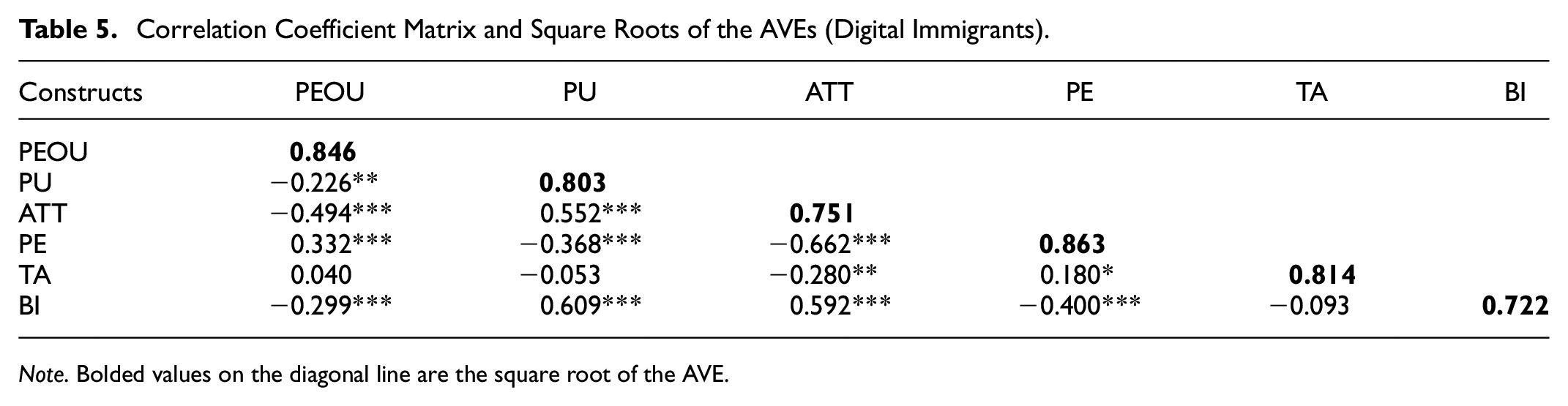
Note. Bolded values on the diagonal line are the square root of the AVE.
Correlation Coefficient Matrix and Square Roots of the AVEs (Digital Natives).

Note. Bolded values on the diagonal line are the square root of the AVE.
The square root of AVE for each construct was greater than their corresponding correlation coefficients with other constructs, indicating that the data has good discriminant validity (Hair et al., 2021). Thus, the analysis confirmed that all the constructs meet the validity and reliability criteria for both cohorts.
Multigroup Path Analysis
Two steps “Structural Equation Modeling” (SEM) was used to investigate the proposed hypotheses. This technique is popular in the domain of IS and consumer behavior research. This methodology investigates the relationship between independent and dependent variables for two or more distinct groups. After the preliminary investigation of measurement model fit statistics, the structural paths were drawn among the variables as per the conceptualized model. The first step was to make an independent baseline model for digital natives (DN) and digital immigrants (DI). The “goodness of fit measures of the structural model” presented in Table 7 below indicates a good fit as the estimates exceeded the cut-off value (Joseph et al., 2010). Since the baseline models fitted well for both groups, additional constraints were introduced to test the path coefficient equivalence. This technique simultaneously tests the items from both sample groups in one “confirmatory factor model.” The unconstrained model has given the value χ2= 405.376 with the degrees of freedom of 360, whereas the constrained model has resulted with χ2= 545.759 with the degrees of freedom of 383. The subsequent “Chi-square difference test” suggested a significant difference at the group level. Hence, we checked the path-by-path differences between digital immigrants and digital natives.
Result of Baseline Models for Digital Immigrants and Digital Natives—Structural Model.

Results and Discussion
To investigate the determinants of e-commerce adoption and use between “Digital immigrants and Digital natives,” the extended TAM model was utilized. The collected data from the research participants were analyzed using the statistical tool— Multigroup Structural Equation Modeling (M-SEM). In line with the existing literature, the study has hypothesized that digital immigrants (DIs) perceive technology-mediated services as challenging to use in comparison to digital natives as they were introduced to digital technologies only during their middle age or late middle age (Agárdi & Alt, 2022; Riegel & Mete, 2017). Further, DIs were trained to work and live in ways that are different from how things are done in the present digital era (Sadiku et al., 2020). Though digital immigrants value the usefulness aspect of technology, they have to undergo the challenge of learning to use it in the later stage of their life (Ahn & Jung, 2016). Biological researchers confirmed that a language learned later in life gets stored in different parts of the brain (Mårtensson et al., 2012). As such, any attempt to re-program the brain will yield only limited success.
The obtained results revealed that the more positive the attitude toward the use of e-commerce, the more intensive the behavioral intention to adopt and use e-commerce services among both digital natives and digital immigrants. Thus, hypothesis H8 has been accepted. Additionally, we found that attitude has a stronger relationship with the behavioral intention for DIs than DNs (Figures 2 and 3). Hence, we can assert that it is the attitude that older adults have toward technology use largely determines their technology adoption behavior. It concurs with the findings made in the study by J. Wu and Song (2021), which stated that attitude is the prime determinant of continuous use intention of e-shopping among U.S. older adults. Further, the study results revealed that “perceived usefulness” (PU) positively affects attitudes toward the use of e-commerce services for both generational cohorts. Thus, hypothesis H3 is supported. It has been expected because e-commerce enables customers to buy products and services at the click of a button from the comfort of their homes at a competitive price (Nigam et al., 2020). No consumer, especially the Indian consumers who are largely value-driven, would say that the convenience brought by e-commerce services is of less value. It is similar to the findings of the study by Agárdi and Alt (2022), which stated that perceived usefulness is a significant predictor of mobile payment use for both digital immigrants and digital natives. Further, the effect of “perceived usefulness” on “behavioral intention” to adopt e-commerce was also found to be positive for both groups; thus, hypothesis H4 has been accepted. However, its effect was stronger for digital natives compared to digital immigrants (Figure 2 and Figure 3). It could be due to DIs’ higher preference for checking the quality of products before purchase, and they seem to value the personalized customer support provided by the sales personnel in physical stores (Cimperman et al., 2016; K. H. Wang et al., 2017). Moreover, the risks associated with e-shopping- “credit card fraud, privacy infringement, unauthorized account access, misleading product information, and unclear dispute resolution mechanism” reduce the perceived usefulness of e-commerce services (Di Giacomo et al., 2019). Some older adults also perceive that it is not worth their time to change their conventional shopping habits to e-shopping (J. Wu & Song, 2021).

Structural model for Digital Immigrants.

Structural model for Digital Natives.
Further, while “perceived ease of use” (PEOU) was found to be positively influencing the variables— perceived usefulness, perceived enjoyment, and attitude toward the use of e-commerce for digital natives (Table 8), these relationships were found to be significantly negative for digital immigrants. The presence of the negative influence of PEOU on attitudes toward the use of e-commerce for DIs is a case for discussion. It means that DIs experience difficulties and do not perceive e-commerce services as easy to use. Therefore, this factor decreases their overall attitude toward the use of e-commerce services. It further reinforces the generally accepted understanding that older people perceive technology-mediated products and services as challenging to adopt and use in their day-to-day lives (Erjavec & Manfreda, 2022). Moreover, the study of online shopping drivers and barriers for older adults in Taiwan by Lian and Yen (2014) too reported a negative association between these variables. Additionally, the study of e-commerce adoption behavior of older adults in Turkey by Çelik and Yilmaz (2011) resulted in an insignificant relationship between perceived ease of use and e-commerce adoption intention. As such, we assert that though both generations find e-commerce services useful, digital immigrants perceive them to be challenging to use. It is largely in line with previous generational and IS studies, which posited that young individuals perceive new technologies as easier to use than older adults owing to their familiarity with digital technologies from a young age (Ahn & Jung, 2016; Metallo & Agrifoglio, 2015). The study has also found that perceived enjoyment (PE) positively influences the attitude toward the use of e-commerce services for DNs, whereas it negatively influences DIs. Therefore, Hypothesis H6 has been accepted. Since digital immigrants find e-commerce services challenging to use, they do not enjoy using them. This result contrasts with the findings of the study by Agárdi and Alt (2022), which stated that hedonic motivation strongly drives new technology adoption among digital immigrants. It is to be noted that this study is based in a different market (Europe), and the context (application) varies. Since our study was primarily conducted in India, which is a developing country and widespread penetration of computer technologies occurred during the late 2000s only, the older adults in India cannot be expected to be as sophisticated as their counterparts who are from developed economies such as U.S.A., U.K., or Europe. Further, the effect of technology anxiety on attitude toward the use of e-commerce services was found to be significantly negative for DIs, and its effect was found to be insignificant for DNs. Thus, Hypothesis H7 was not supported. The significant negative impact of technology anxiety for digital immigrants largely concurs with existing studies on older adults (Di Giacomo et al., 2019; K. H. Wang et al., 2017). As technology continues to evolve, it is challenging for older individuals to keep up with the latest developments. Further, they are concerned about technology’s potential risks, such as online scams or identity theft. These concerns lead to anxiety and hesitation when they intend to adopt e-commerce or other technology-mediated services (Peral-Peral et al., 2020). The presence of an insignificant relationship between technology anxiety and attitude toward the use of e-commerce services for DNs is unclear.
Results of Hypotheses Testing.

Note. **p < .05, ***p < .01.”
This study has revealed a higher level of perceived difficulty with e-commerce use among digital immigrants, leading to lowered attitude toward the use of e-shopping. Thus, it is concluded that “perceived difficulty” hinders adopting and using e-commerce services for digital immigrants. Though the young generation (Millennials and Gen Z) find e-commerce easy and simple to use, digital immigrants are hesitant to use e-commerce owing to higher perceived risk and low “ease of use” perception. Therefore, this lower ease of use perception could be the reason why most digital immigrants are late adopters or laggards when it comes to new technology adoption.
Nevertheless, the positive effect of “perceived usefulness” on attitude toward the use of e-commerce services was found to be greater for digital immigrants than for digital natives. Thus, digital immigrants perceive e-shopping as more useful than digital natives do. Therefore, though the lower “perceived ease of use” hinders digital immigrants from adopting and using e-commerce services, their higher perceived usefulness does push them to adopt online shopping. As older adults perceive e-commerce services as more valuable, they will overcome their reluctance toward technology and adopt them as time goes by. The e-commerce industry may organize educational and promotional campaigns targeted at older adults to encourage them to adopt e-shopping. Further, it has been hypothesized that digital natives find e-commerce services as easy to use as they have been exposed to digital technologies at a younger age, and the study has confirmed the same. The reasons behind the results of this study are due to generational differences.
Conclusion and Implications
This study was carried out to unearth the differences between digital natives and digital immigrants in e-commerce adoption and use. The significant takeaway for e-commerce practitioners is that both digital natives and digital immigrants differ in their approaches toward e-commerce adoption. Research on digital immigrants has been negligible or often ignored, citing that they will adapt to technology eventually seeing their younger counterparts (Manor & Kampf, 2022; Peral-Peral et al., 2020). As the study results suggest, though digital immigrants find e-commerce services challenging to use, the usefulness factor encourages them to adopt e-shopping. Information systems (IS) or information technology (IT) research largely validated that “perceived usefulness” is an important factor that plays a crucial role in technology adoption (Alalwan et al., 2018; Chang et al., 2016; Chopdar et al., 2018). Our results also support the same and add to the growing body of literature. Marketers may emphasize the efficiency of shopping online by highlighting the time and money (deals and discounts) one would save if e-commerce were used as a shopping medium to target older adult consumers.
Further, if the e-commerce firms could ease the perceived difficulty the digital immigrants have toward e-commerce use, their adoption rate will increase. Designing and developing websites that cater to older adults instead of using the same criteria by which they design their products and services for younger consumers will help in this aspect. Additionally, to ease the difficulties digital immigrants experience, e-commerce platforms can provide a “one-click” connector to speak to customer care executives. Firms should also introduce other user-friendly interfaces to assuage digital immigrants’ concerns with using e-commerce services. For industry practitioners, this study connotes the significance of customizing schemes and programs for empowering employees based on generational differences rather than one-size fits all strategy (Srinivasan, 2012).
Further, the hesitancy of digital immigrants to learn and adapt to new technologies may be linked to life-span perspectives. When great efforts are required to learn, older adults might consider them unworthy of their time. The other possible explanation for a lower adoption rate of e-commerce services among digital immigrants is that they are apprehensive about submitting their bank or debit card details on online shopping platforms as they are vulnerable to scams and identity thefts (Guner & Acarturk, 2020). Studies in the past revealed that there is a strong motivation to behave according to peer group’s expectations and opinions among older adults (Agárdi & Alt, 2022), encouraging older adult customers to share their positive online shopping experience on social media platforms (e-WoM) will nudge others to try and adopt e-commerce services. Additinally, it is true that though Internet and smartphone usage is increasing among digital immigrants, only a few shops online compared to digital natives. Whereas for digital natives, online mode of shopping is the first preference.
Further, although the young population (digital natives) is the lucrative and easy target for e-commerce services, it is important to direct marketing and promotional efforts toward older adults as they have more spending power than young adults. Moreover, the presence of digital immigrants in the virtual world is increasing as broadband connectivity increases; hence we can expect the same to seep over to e-commerce use as well. Digital immigrants also have more free time compared to young individuals. Therefore, marketers need to devise schemes and strategies to woo digital immigrants to adopt e-shopping. Additionally, e-commerce companies may establish authorized kiosks with trained personnel to assist older adult customers in placing orders online; they may also provide training to older adults who seek help. This exposure and training will make them competent and self-reliant over a period of time.
Although the present study contributes significantly to the literature on the technology adoption behavior of digital immigrants, it too can be viewed with some limitations. Future research can investigate other possible determinants of e-commerce adoption, such as personal innovativeness, perceived risk, perceived trust, self-efficacy, and subjective norms (SN), to unearth the differences between digital immigrants and digital natives. The authors could not incorporate these constructs in the research model because of time and resource constraints and to avoid lengthy questionnaires, leading to response fatigue among study participants. Further research is needed to explore the mediating and moderating variables that facilitate or hinder e-commerce adoption and use among digital immigrants. Since the study involves two generations—older adults and young population, the sample size should have been more to make a reliable generalization to the larger population.
Further, digital immigrants were unwilling to share their personal information, and convincing them to participate in the survey was hard for the authors. Future studies might also attempt to replicate our study to examine the adoption and use of Social Networking Sites (SNS) or mobile payment services between “digital natives and digital immigrants.” Studies in the past pointed out that the digital divide and generational cohorts cannot be defined merely based on the year of birth. It should be based on a complex mix of shared experiences, life events, and socioeconomic developments during individuals’ growing-up years (Ahn & Jung, 2016; Creighton, 2018). Further, some older adults or Generation X individuals are more technologically adept than young adults (Millennials or Gen Z; Q. Wang et al., 2013). Hence, rather than seeing the difference between “digital natives and digital immigrants” as a rigid dichotomy based on age, we should have used the “Technology Readiness Index (TRI)” scale developed by Parasuraman (2000) or Digital Natives Assessment Scale (DNAS) (Teo, 2013) to distinguish digital immigrants from digital natives. It is a serious limitation of this study. Therefore, research in the future can incorporate some of these measures when defining the cohorts. Further, future studies may also consider gender, educational level, and income as moderating variables to study the e-commerce adoption behavior among digital immigrants.
Footnotes
Appendix
Measurement Scale Information.

| Construct | Items | Source |
|---|---|---|
| Perceived usefulness (PU) | 1 Online shopping has more advantages than traditional brick-and-mortar stores because I can avail the service from the comfort of my home. 2 Online shopping is more efficient than offline shopping. 3 E-commerce sites have a larger product selection than traditional stores. 4 Overall, I find shopping online very useful. |
Davis (1989), Gefen and Straub (2000), Venkatesh and Davis (1996) |
| Perceived ease of use (PEOU) | 1 Online shopping has more advantages than traditional brick and mortar stores because I can avail the service from the comfort of my home. 2 Online shopping is more efficient than offline shopping. 3 E-commerce sites have a larger product selection than traditional stores. 4 I find e-commerce easy to use. |
Davis (1989), Gefen and Straub (2000), Venkatesh and Davis (1996) |
| Perceived enjoyment (PE) | 1 I feel good when I shop online. 2 Online shopping is enjoyable. 3 Online shopping gives me pleasure. |
Dabholkar and Bagozzi (2002) |
| Technology anxiety (TA) | 1 I feel apprehensive about shopping online. 2 I hesitate to shop online for fear of mistakes I can’t correct. 3 Shopping online is somewhat intimidating to me. |
Venkatesh et al. (2003) |
| Attitude toward E-commerce (ATT) | 1 I like the idea of shopping online. 2 My overall attitude toward online shopping is positive. 3 Online shopping is appealing. 4 Shopping online is a wise idea. |
Taylor and Todd (1995), Herrero Crespo and Rodríguez Del Bosque Rodríguez (2008), W. H. Wang and Liu (2009) |
| Behavioral intention (BI) | 1 I intend to shop online in the future. 2 I strongly recommend online shopping to others. 3 It is very much likely that I will shop online. |
Venkatesh et al. (2003), Herrero Crespo and Rodríguez Del Bosque Rodríguez (2008) |
Declaration of Conflicting Interests
The author(s) declared no potential conflicts of interest with respect to the research, authorship, and/or publication of this article.
Funding
The author(s) received no financial support for the research, authorship, and/or publication of this article.
Ethical Approval
Ethical approval was obtained from Department of Management Studies and Industrial Engineering (DMSIE), Indian Institute of Technology (ISM) Dhanbad and the study complied with ethical standards.
Informed Consent
Informed consent was obtained from participants prior to collecting their responses to survey questions. The research instrument (questionnaire) described the research’s purpose and briefly introduced the researchers and their organization. It also assured them that the survey is anonymous and thus it does not collect any personally identifiable information, and the obtained responses will only be used for academic research.

Data Availability Statement
Data is available with the corresponding author and will be provided upon request.