




Abstract
Consumer behavior and the way businesses conduct their operations have changed due to the widespread usage of internet purchasing worldwide. Bangladesh’s reliance on online shopping presents both opportunities and difficulties. The relatively large marketplace is driving up demand for online shopping. On the contrary, the need for greater technological proficiency that underpins online purchasing presents a significant challenge for entrepreneurs, managers, and consumers. This paper employed TAM (Technology Acceptance Model) to explore and predict Bangladeshi customers’ online purchasing intentions. The data were collected from 322 online consumers in Dhaka and analyzed with SEM utilizing SMART PLS 3. The data analysis demonstrates a significant association between consumers’ buying intention and Perceived Usefulness (PU), Perceived Ease of Use (PEU), Perceived Enjoyment (PE), and Subjective Norms (SN). On the contrary, the data portrayed Perceived Risk (PR) as insignificant. However, our findings suggest that the TAM can still be used to explain the change in behavior associated with using a marketplace, particularly when buying online products or services. In addition, to give a more profound knowledge, various user characteristics according to generation group still need to be studied. Findings further suggest that this study has academic and industry ramifications regarding anticipating consumers’ online purchasing choices in the digital marketing community. The study concludes with a discussion of its limitations and future research directions.
Introduction
The current research surveyed online buyers to ascertain the factors influencing their shopping decisions and future desire to shop online. This problem stemmed from the plethora of e-commerce standards, which included the demand for retailers and managers to understand why consumers buy online to design efficient online purchasing strategies for targeted online buyers (John, 2018; Rahman et al., 2018). Online shopping is a subset of e-commerce in which users can purchase products or services from merchants over the Internet (Singh & Sailo, 2013). It offers online buyers and suppliers a distinct policy and atmosphere for conducting business in a digital environment instead of a traditional one (Kariapper, 2021). The significance of online shopping is now unquestionable, owing to its conspicuous impact on the operations of online retail firms worldwide (Mandilas et al., 2013). Online shopping has expanded in popularity in recent years, with more than 85% of the world’s online population placing orders (Cheema et al., 2013; Zaineldeen et al., 2020). However, while people in developed countries are more accustomed to online shopping, those in developing or underdeveloped countries are yet to be familiar with online purchasing (Akhlaq & Ahmed, 2016; Kariapper, 2021).
Consequently, there is an undeniable need for additional research on online purchasing intention in underdeveloped countries such as Bangladesh. The government of Bangladesh has made significant steps to boost the country’s digital economy to keep pace with the rising global demand for digital marketing (Hussain, 2015). Promoting online marketing has been a colossal stride forward in recent years. Online buying in Bangladesh has been made easier by the government’s step by accepting online payment in 2009 (Chowdhury et al., 2021; Hussain, 2015). Globally, the e-commerce industry has been growing speedily (Vinerean et al., 2022). Due to the epidemic, the tendency has become more prevalent in Bangladesh in recent years (Hasnain, 2021). Regarding its thriving e-commerce sector and the participation of its citizens, the country has thus far had a very positive consequence. People are gradually becoming aware of the benefits of internet shopping and digital transactions. Companies must understand these developments and execute appropriate strategies utilizing digital means of conducting operations or rapidly adopting solutions.
By January 2021, there were 47.61 million internet users, up 19% from 2020 to 2021 (Simon, 2021). Bangladesh is an overpopulated country with 160 million people (UNFPA, 2021), so the demand for online shopping has increased over the years (Rahman et al., 2018; Sadia et al., 2019; Shawon et al., 2018; Uddin & Sultana, 2015). One of the reasons for the rising online buying need is the insufficiency of physical markets for these millions of individuals. Moreover, this demand has been accelerated due to the global pandemic caused by COVID-19 that prompted many governments, including Bangladesh, to lockdown for an undefined time (Chowdhury et al., 2021; Vinerean et al., 2022). Vinerean et al. (2022) noted that the pandemic has resulted in numerous changes in consumer behavior due to widespread lockdowns, social distancing, limited purchasing opportunities, and other precautions intended to prevent the spread of the virus. In this vein, Chowdhury et al. (2021) maintain that the government of Bangladesh declared a nearly 3-month quarantine to prevent the spread of the disease. After the lockdown, people avoided crowded locations unless it was an emergency. Individuals have gradually become accustomed to online platforms to fulfill their daily needs.
What motivates people to shop online? People shop online for various reasons, the most important of which is the convenience of not having to travel to a physical store to make a purchase, the option to compare prices across numerous websites at once, the chance to escape traffic, the opportunity to save time and fuel cost (Al-Dwairi & Kamala, 2009 ). Earlier research found evidence that people’s socioeconomic status significantly impacts online shopping (Kariapper, 2021; Nawi et al., 2019; Shawon et al., 2018; Uddin & Sultana, 2015). For instance, Uddin and Sultana (2015) noted that the more money and education people have, the more they make online purchasing. Some other considerations, such as age, geographic area, availability of internet sellers, and perceived risks, may influence an individual’s decision when buying online (Tong, 2010). On the contrary, insecure electronic payments, slow transmission lines, a lack of affordable merchandise demonstrations, and the technical inability to bring friends along on a shopping trip are all technology-based impediments to consumer acceptance (Jarvenpaa et al., 2000). However, the case of Bangladesh is intriguing because, while online shopping has grown in popularity over the years, the use of technology for digital marketing has become increasingly complicated (Hassan et al., 1970; Rahman et al., 2018). This research may unfold something exciting and novel to alleviate pressing issues and pave the way for a more convenient online shopping experience.
Literature Reviews and Hypothesis
Technology Acceptance Model (TAM)
The conceptual underpinnings of this research include the popular technology adoption model, which is renowned for its predictive ability, making it appropriate to a wide variety of circumstances (Christian & Agung, 2020; Venkatesh, 2000; Vinerean et al., 2022). The Technology Acceptance Model (TAM) has been commonly used to evaluate online purchasers’ acceptance of information technology (IT) systems or e-commerce environments (Davis, 1989; Zaineldeen et al., 2020). Because online shopping entails utilizing online applications to buy products or services, researchers studied it to implement information technology systems. Consequently, the theoretical structure was constructed using current research on e-commerce technology acceptance (Klopping & McKinney, 2004). Millions of visitors across several websites are curious about digital marketing because it creates new communication opportunities with customers and other valued stakeholders such as employers and suppliers (Ahamed et al., 2020; Akhlaq & Ahmed, 2016; Y. Chen & Barnes, 2007; Hassan et al., 1970). However, adapting to and accepting the technology required for digital marketing poses a big challenge. This study has covered consumers’ acceptance and perceptions of the system utilized in online purchases. Thus, this paper aims to assess the applicability of TAM in the Bangladeshi context and better understand the factors that influence Bangladeshi online buyers’ adoption or acceptance of online purchasing.
The Technology Adoption Model (TAM) was adapted from the Theory of Reasoned Action (TRA), derived initially from the field of social psychology (Rauniar et al., 2014). It is commonly used to forecast and explain new information technology adoption or acceptance (Davis, 1986; Fishbein & Ajzen, 1975). While TAM was believed to cover a wide range of end-user computing platforms and user populations (Davis et al., 1989), the “Theory of Reasoned Action” was hypothesized to represent human behavior most thoroughly (Fishbein & Ajzen, 1975). TAM implies a person’s central ideas about the system (perceived utility and ease of use) that determine their attitude toward utilizing it. The individual’s positive or negative feelings regarding conduct are referred to as attitude. According to Davis (1993), TAM distinguishes between belief and attitude and shows how internal input is causally related to beliefs, attitudes, and behavior. The most significant drivers of the actual system administration, based on TAM, are perceived ease of use (PEU) and perceived usefulness (PU) (Davis, 1993; Surendran, 2012). Shih (2004) used TAM to assess consumers’ acceptability of e-commerce and therefore revealed that perceived ease of use (PEU) and perceived usefulness (PU) both had a substantial effect on people’s attitudes toward e-business. He further noted that user approval was strongly associated with opinions about e-shopping.
The TAM is a concrete, simple, dominant, robust paradigm to explain human action, especially digital marketing. However, despite its admissible significance, the TAM’s universality is questioned by academics, especially in societies with low uncertainty avoidance, high power distance, and a high level of collectivism, like Bangladesh (Ahamed et al., 2020; McCoy et al., 2007). Venkatesh (2000) also finds the TAM’s parsimony as one of the significant flaws in this study. Based on this restriction and the TAM theory’s simplicity and robustness, researchers have aimed to incorporate variables from similar approaches to cover additional crucial determinants that might affect customers’ buying intention to use (Tong, 2010). For example, perceived risk, enjoyment, ease of use, and subjective norms are the most familiar among the constructs to be considered in the extended TAM (Brown et al., 2003; Davis et al., 1989; Gefen & Straub, 2004; Igbaria et al., 1996; Pavlou, 2003; Venkatesh, 2000).
The TAM is increasingly incorporating trust and perceived risk, according to Pavlou (2003). Incorporating trust and risk might be significant in Bangladesh, where online customers are primarily less used to technology, given that it is still a traditional country. However, the advancement of technology has been increasing considerably (Hussain, 2015). Hussain (2015) further noted that though Bangladesh has made enormous technological advancements in several fields, including telecommunication, internet connectivity and speed, digitization, and media, it still needs to catch up in too many other areas. But it is also true that individuals may perceive fewer hazards as they become more habituated to e-commerce, as noted by Islam and Saeed (2021). While perceived enjoyment significantly influences utilizing new technology (Igbaria et al., 1996), perceived ease of use measures the degree to of an individual believes that using a system would be straightforward (Davis et al., 1989). From subjective norms, individuals might feel community pressure to utilize or avoid a specific technology convenient to their environment and cultural values (Abdullah & Ward, 2016). Qiu and Li (2008) employed an extended TAM to study the adoption of online business, including three additional components: perceived enjoyment, trust, and social presence. Çelik and Yilmaz (2011) used extended TAM to understand the customer acceptability of online shopping. They added perceived enjoyment, perceived trust, perceived service, and system quality to the extended TAM. In subsequent years, many additional e-commerce studies have broadened TAM’s scope to include confidence, computer self-efficacy, personality, and perceived value (Daugherty et al., 2005; Gefen et al., 2003; Qiu et al., 2006; Wu & Chen, 2005). However, the following sub-sections detail the relationships among these constructs examined in the current investigation.
Perceived Usefulness (PU)
Perceived usefulness (PU) was stated by Davis (1989) as the amount through which a user’s performance will increase due to using specific information technology. A person’s assumption that deploying a new system will improve their work performance is sometimes referred to as perceived usefulness (Cheema et al., 2013). In another article, Davis et al. (1989) define the term perceived usefulness as the framework which is accepted and applied by individuals while purchasing products that may increase the work performance of an organization. TAM’s perceived utility used as a significant driver of researchers’ intention to explore the acceptability of technology for the uptake of online commerce has been demonstrated repeatedly (Davis et al., 1989; Rouibah, 2007; Savitskie et al., 2007). Customers are more interested in purchasing a product if it is perceived as valuable, according to Bhattacherjee (2001). The attributes of the commodities and how they are helpful to the users influence the utility of online shopping (Rose & Dhandayudham, 2014). The chance that a consumer may boost their efficacy by purchasing online, according to Zhou et al. (2007), has a favorable impact on the entire purchase process. When a customer believes that a product or service will benefit them, the product’s utility is realized, and their readiness to buy online increases (Bagdoniene & Zemblyte, 2009; Zaidi et al., 2015). However, according to two research, usefulness has essentially little bearing on the chance of utilizing the internet to make purchases (L. D. Chen et al., 2002; Vijayasarathy, 2004). Customers’ decisions to use technology such as the internet for online shopping are also dependent on their perception of getting better products than all other available options by using the internet (Al Zubaidi & Al-Alnsari, 2010). According to Vinerean et al. (2022), perceived usefulness affects significantly during the COVID-19 pandemic when consumers used online technology more frequently while purchasing to avoid contracting the virus. However, it is assessed that during COVID-19. Perceived usefulness has not affected the student’s attitude toward e-learning (Sukendro et al., 2020).
H1: Perceived Usefulness will be positively associated with consumers’ behavioral intention
Perceived Ease of Use (PEU)
Perceived ease of use (PEU) is one of the two critical elements affecting consumers’ online purchasing (Mandilas et al., 2013). It is defined by Davis et al. (1989) as “the degree to which an individual believes that adopting a specific system will be effortless in terms of both physical and mental effort.”Cheema et al. (2013) established that perceived ease of use in online purchases affects customers’ impressions of one-business platforms. In this similar vein, Venkatesh (2000) argued that numerous elements affect perceived ease of service in the technology adoption model, including internal control, for instance, computer self-efficacy and external power, namely favorable settings. PEU has both direct and indirect influence on consumers’ online buying intentions, according to Chau and Lai (2003). Davis et al. (1989) demonstrated that perceived ease of use influences perceived usefulness, whereby the more accessible technology is, the more beneficial it can be. L. D. Chen et al. (2002) suggest that PEU modulates behavioral intention indirectly through attitude. Many consumers are likely to acquire and employ technologies that are designed to be simple to use, as Amaro and Duarte (2015) suggested. Because online buying relies on information and communication technology (ICT), a user-friendly application and interface influence consumers to shop online (Al-Dwairi, 2013; Chiu et al., 2014). However, although PEU is one of the powerful constructs influencing online buyers’ behavioral intention, its findings are inconsistent across cultures. Several studies have concluded that PEU had little impact on consumers’ propensity to shop online (Koufaris, 2002; Lee et al., 2006; Savitskie et al., 2007). PEU does not impact when the internet is used for a purchase, according to Gefen and Straub (2000), but it does change the desire to use the internet to use the website for inquiry tasks (Lee et al., 2006). Rigopoulos and Askounis (2007) also noted that PEU does not alter the behavioral Intention to Use (BIU) for adopting online payment.
H2: Perceived Ease of Use will be positively associated with consumers’ behavioral intention
Perceived Enjoyment (PE)
Perceived enjoyment (PE) refers to the intrinsic desire to use new technologies (Igbaria et al., 1996). Davis (1989) stated that perceived enjoyment is the degree to which the act of using a computer is regarded as pleasurable. Lin et al. (2005) describe perceived enjoyment as a compelling reason to continue utilizing online services. Furthermore, perceived enjoyment is explained as the level of happiness that a buyer feels while shopping online on a specific website based on its ability to satisfy them, regardless of the website’s performance that user encounters (Ulaan et al., 2016). The level of enjoyment people feel when visiting a website has a significant impact on their likelihood of returning to it (Davis et al., 1992). The perception of enjoyment is positively associated with the attitude toward using a given source (Moon & Kim, 2001). Perceived enjoyment positively impacts women’s buying behavior when exploring and buying online products and services (Liu et al., 2005). However, the esthetic approach and comfort are predictors of online shopping decisions (Brown et al., 2003; Girard et al., 2006). Hart et al. (2008) noted that one of the prime purposes of using social networking sites is having fun. Customers are more inclined to buy online if they have a pleasant online buying experience on a specific webpage (Childers et al., 2001).
H3: Perceived Enjoyment will be positively associated with consumers’ behavioral intention
Perceived Risk (PR)
Customers and e-retailers are physically and temporally separated, and internet services are unpredictable, resulting in an inherent amount of uncertainty in online purchases (Al-Gahtani, 2011). Bauer (1960) defines perceived risk (PR) as the unpredictability and unfavorable outcomes associated with customers’ expectations. It represents the consumer’s perception of the risk of unanticipated consequences while researching and selecting products and services information before making a final purchasing choice (Cox, 1967). According to consumer perceived risk perception, people fear making mistakes and suffering the repercussions of their choices (J. W. Taylor, 1974). As a result, the increased perceived risk in technology adoption may engender feelings of fear and worry for online consumers (Abu-Shanab & Ghaleb, 2012; Featherman & Pavlou, 2003). Additionally, risk perceptions harm buyers’ intention to purchase online, and they usually prefer low-risk online purchasing (Jarvenpaa & Todd, 1996; Jarvenpaa et al., 2000; Tong, 2010). Moreover, Jarvenpaa et al. (2000) claimed that minimizing the risk of purchasing from various online firms would raise the likelihood of making an online transaction. Some earlier studies found a high association between perceived risk and behavioral intention to use.
H4: Perceived Risk will be negatively associated with consumers’ behavioral intention
Subjective Norms (SN)
It is common for consumers to adopt their system’s beliefs, attitudes, and behaviors either by admitting others into their community or relieving their uncertainty about adopting new technological solutions (A. R. D. Liang & Lim, 2011). In this vein, Andronie et al. (2021) noted that consumer satisfaction, buying propensity, perceived value, and confidence are essential in articulating behaviors, attitudes, and intentions to embrace mobile shopping. Ajzen and Fishbein (1980) argue that subjective norms explain people’s perception of the social pressure that affects executing the desired behavior as a predictor variable. To some extent, behavioral theories like the Theory of Reasoned Action (TRA) (Fishbein & Ajzen, 1975) and the Theory of Planned Behavior (TPB) (Ajzen, 1991) use the concept and construct of “subjective norm” to reflect this inter-subjective or collective impact, which might alter TAM. Subjective norm refers to what family, friends, professional firms, co-workers, and department heads assume about the activity’s outcome (normative belief), as well as how this norm influences conduct or the incentive to conform (Pedersen, 2005). According to Fishbein and Ajzen (1975), the subjective standard’s impact is necessary for attaining particular conduct. Mishra et al. (2014) argued that subjective norms significantly encourage people to do what they want. The findings of Massoro and Othman (2017) were agreed with S. Taylor and Todd’s (1995) IT usage analysis, which concluded that subjective norm is critical in describing performance expectancy. Shimp and Kavas (1984), Vallerand et al. (1992), Chang (1998), and Tarkiainen and Sundqvist (2005) all indicated a strong connection between subjective norms and consumers’ intention to use the technological system.
H5: Subjective Norms will be positively associated with consumers’ behavioral intention
Behavioral Intention to Use (BIU)
The desire of online customers to put in the effort required to carry out an activity can be determined by looking at their behavioral intentions (Ajzen, 1991). Given that the available evidence on the TAM model has supported the relationship between behavioral intention and use, most contemporary technology acceptance model research has focused on forecasting behavioral intention that will influence later use. Consumers are more likely to consult their social system to gain insight into and familiarity with novel technologies or gain social validation for adopting a novel system (Vinerean & Opreana, 2021). However, existing research on the effect of social influence on consumers’ plans to maintain online purchasing in their daily lives has yielded inconsistent results. Because this relationship is highly context-dependent and only occasionally has a significant impact (see Dakduk et al., 2020; Shaw & Sergueeva, 2019; Vinerean et al., 2021). According to the TAM, the linkages exist among all individual and environmental elements, and their usage is influenced by the behavioral intention, which is stated as the intensity of an individual’s desire to conduct any behavior (Davis et al., 1989; Fishbein & Ajzen, 1975; Venkatesh & Bala, 2008). Such behaviors are assumed to imprison an acceptance-like process (Venkatesh & Davis, 2000; Venkatesh et al., 2003). The intention to utilize a website and acquire a good or service, according to Pavlou (2003), is the final stage of an online purchase. Consequently, online buying intention is a prime factor in the behavior of online consumers.
Pavlou (2003) further noted that behavioral intention is identified as a customer’s willingness and desire to engage in an online purchase. Raza et al. (2014) indicated that behavioral intention refers to a situation between buyers and sellers where the buyers are ready to strike the transaction with the sellers. The firmness of the desire of customers to execute specific purchase behavior over the internet will get determined by the customers’ online buying intention in the digital world (Salisbury et al., 2001). Variables like considering and anticipating a brand while buying could be used to evaluate customer buying intention, as maintained by Laroche et al. (1996). Additionally, the theory of reasoned action proposed that customer experience may be anticipated from the intentions closely related to a customer’s behavior driven by their activity, purpose, and situation (Ajzen & Fishbein, 1980). Based on the research of Day (1969), purposeful measurements could be more successful than behavioral measures in capturing a customer’s attention since customers may purchase due to limitations rather than genuine desire when purchasing. The distinctive character of online settings impacts e-commerce acceptability and customer purchasing intentions (Pavlou, 2003). Furthermore, past purchasing experiences are favorably connected to e-commerce buying behavior (Shim et al., 2001).
Attitudinal Indicators
The following Table 1 is presented to indicate the attitudinal indicators by illustrating individual construct, items, wording and sources.
Attitudinal Indicators.

Research Methodology
The study’s primary objective is to examine Bangladeshi consumers’ attitudes toward online buying by reviewing the factors influencing their behavioral intentions, that is, online buying decisions. Quantitative approaches is employed to collect data from the targeted audience, independent of profession, civil status, economic level, or gender, but are over 18 years old and use various technologies, presuming that they currently shop online or intend to do so in the future. The survey questionnaire for this study was adjusted using prior literature taken for different constructs that stemmed from actual and extended TAM.
Research Design
This research was conducted in Dhaka, Bangladesh’s capital city, with roughly 21 million people (World Population Review, 2021). We chose Dhaka since it has the highest population density and represents a good cross-section of individuals from all over the country. The non-probability sampling approach, also known as purposive sampling, was employed because it facilitates sample selection and data collection while relatively inexpensive (Battaglia, 2008; Hair et al., 2017; Saunders et al., 2019). One of the major benefits of a nonprobability sample is avoiding the high nonresponse rate, which is high in probability sampling (Brick et al., 2022). Baker et al. (2013) note that nonprobability samples expand the opportunity to reach only targeted participants to achieve research objectives. In fact, the distinction between sample collection and the objective of generalization to a large population is of the utmost importance for the researchers, as it can lead to a mismatch between who or what is being sampled and the scope of any generalizations derived from subsequent data analysis (Rafail, 2018).
Furthermore, to ensure reliable data, we focused on respondents with a broader range of traits representing the community (income group, profession, age, education etc.). The questionnaire is divided into two sections: one for the respondent’s background and the other for measuring the items in question. We adopted latent variables and observed objects from the existing and validated literature (Table 1). All constructs were rated on a five-point Likert scale: 1 represents strongly agree, and 5 expresses strongly disagree. The items are included in Table 1, along with their sources. The conceptual model is made up of five latent variables, each of which is quantified by many observed items, as shown in Figure 1. The only dependent variable, the consumer’s behavioral intention to use (BIU), is linked to all independent factors.

The conceptual model.
A pilot study helps improve the quality of market research (Babbie & Mouton, 2010; Malhotra & Peterson, 2006). Prior to gathering the final data, a pilot study with a sample size of 20 participants was carried out, considering the standard practice in market research (Hsieh & Shannon, 2005). The pilot study includes diverse samples of age, income level, and educational attainment to ensure the accurate representation of the intended samples. After conducting the pilot study, we found that some observed items were inappropriate and needed to be clearly understood. As a result, we made a few minor adjustments to increase the instrument’s validity, reliability, and clarity (dropping items and rewriting some items without changing their meaning). Finally, the main study has conducted with the revised instrument.
Data Collection
Data collection occurred in two phases. The first phase of data were collected using a Google Form for 2 months (June and July 2021) when the lockdown was in force because of Covid-19 in Bangladesh. The second round of data was gathered following the article’s initial review in January 2023. The second round of data collection increased the sample size from 212 to 322 to improve data reliability and research validity. Though the study was conducted in a large city, Kline (2010) states that the minimum sample size for SEM is 200, so a sample size of 322 meets the requirement significantly. In fact, a sample size that is too small does not accurately represent the population, whereas a large sample size involves putting more individuals at risk (Michaelides, 2021). As a result, an optimal sample size we adopted to ensure statistically significant differences and scientifically valid results (see Gumpili & Das, 2022).
To connect with the participants, we mainly used social media platforms like Messenger and WhatsApp and sent the survey queries to them. Participants who lacked online shopping experience were excluded from the study. A total of 450 surveys were given out, and 322 (71.6%) of them were returned. Respondents ranged in age from 18 to 65 and were 43% female and 57% male. Almost 50% of the respondents are unemployed; the rest are full-time, part-time and self-employed. Regarding education, most participants (68%) completed their bachelor’s degree. The majority of the participants are also low earners (below or slightly above 200 USD). Table 2 shows the demographic information of each respondent in detail.
Respondents’ Demographic Characteristics.

Data Analysis
Structural Equation Modeling (SEM) was used to analyze the data. SEM evaluates a set of predictors, explanatory models, or equations simultaneously (Chin, 1998; Cohen et al., 2018; Wang et al., 2019). The maximum explained differences between independent and dependent variables are predicted and quantified using the PLS-SEM approach (Wang et al., 2019). Additionally, PLS-SEM can forecast the amount a dependent variable will change due to independent variables (Arefin et al., 2015). Using Smart PLS 3.0 software, the current study examined confirmatory factor analysis and structural relationships among the set of variables in the proposed model (Hair et al., 2017).
Results and Discussion
Measurement Model
To analyze the SEM, a sound and operative measuring model is required. We used multiple reliability tools to assess the measurement model’s internal consistency (i.e., roh_A, composite reliability, and Cronbach Alpha), convergent validity (i.e., AVE, Cross-loading, and item significance), and discriminant validity (i.e., FL criteria and HTMT ratio) following Hair et al. (2017) guidelines.
Reliability and Validity
Construct Reliability
The cut-off value of the observed items’ factors loading in smart PLS is 0.7 (Hair et al., 2011). And the specific cut-off value for factor loading should be determined based on the context of the research to optimize the model’s quality in terms of validity and reliability (Yoo & Donthu, 2001). Past studies noted that factor loading of items below 0.700 is inconsistent with the underlying theoretical construct (Ramaseshan & Stein, 2014). Moreover, they do not contribute to measuring the intended construct (Alalwan et al., 2017) and are weakly related to the intended construct (Cavazos-Arroyo & Máynez-Guaderrama, 2022). As a result, we excluded a few items (PR 2, PR 3, PR 6, SN 1; PU 3, PEU 4) from the measurement model due to their low factor loadings (0.600) to improve the model’s reliability and validity. However, PEU 3 and SN 2 were retained since they are almost close to the cut-off value (0.70). In some cases, items can be retained with factor loading slightly below the recommended cut-off value, which is an acceptable level of measurement reliability (Aboelmaged & Gebba, 2013; S. J. Cheng et al., 2023).
Hair et al. (2017) and Saunders et al. (2019) recommend that the Composite Reliability (CR) be more significant than 0.70 (CR > 0.7), indicating that each item in the measurement model measures the same concept. Cronbach’s alpha (Hair et al., 2017; Wasko & Faraj, 2005) and Roh A (Hair et al., 2017) values should be between 0 and 1, indicating that the proposed research model’s variables are internally consistent. The closer the value is to 1, the greater the internal consistency of the latent variables. All the variable prerequisites (Cronbach Alpha, roh_A, and CR) are met (Table 3). When the theoretical model is compared to the empirical model, the corresponding items for several constructs are discarded due to their low loading values to achieve a decent model fit. As a result, the structures are regarded to be sufficiently reliable.
Loading, Construct Reliability and Convergent Validity.

Note. Significance of each item, that is, observed variable’s p-values are: .000.
Convergent Validity
Hair et al. (2017) instruct that the Average Variance Extracted (AVE) value must exceed 0.5 (AVE > 0.5). Table 3 shows the factor loadings between constructs and AVE that satisfy the model’s reliability decision threshold. Additionally, the significance of each item, that is, the observed variable’s p-values, is .000, indicating the items’ convergent validity.
Discriminant Validity: HTMT and Fornell- Lacker (FL) Criteria
Discriminant validity approaches such as the HTMT and Fornell–Lacker (FL) criteria validate the measuring model. Table 4 shows the Heterotrait-Monotrait correlation ratio (HTMT), which must be less than .85 (HTMT .85) to be considered valid (Hair et al., 2017; Henseler et al., 2016).
Heterotrait-Monotrait Ratio (HTMT Test).

Additionally, the Fornell–Lacker (FL) criterion suggests that the construct’s square root of the AVE was greater than the inner correlations. Table 5’s off-diagonal entries represent the correlations between the variables. Table 5 demonstrates the Fornell–Lacker criteria, in which all diagonal values (Square root of AVE) are more significant than values in off-diagonal cells. Hence, the model conforms to all the prerequisites for HTMT and Fornell–Lacker (FL) discriminant validity.
Fornell–Lacker Criterion (FL Test).

Note. Values in bold represent square-root of AVE.
Structural Model
The structural model shows the possible paths in the research framework. For evaluating the structural model, the R2, Q2, and importance of paths are used to figure out how good or bad it is. According to Hair et al. (2017), these three things prove that their structural model is valid and factual. They say that R2, f2, and the significant level of the path coefficient all show how well the structure works. We looked at the five hypotheses in a bootstrap process with a sample size of 5,000 and used t-statistics to determine the path coefficient consistent with the method (Henseler et al., 2016).
Coefficient of Determinants (R2)
The squared multiple correlation coefficients (R2) are listed in Figure 2. The model’s strength is determined by the intensity of each structural path as determined by the R2 value for the endogenous construct (Peñalver et al., 2018); R2 must be larger than or equal to .1. (Falk & Miller, 1992). The results suggest the presence of an R2 value greater than .1. As a result, the capability for prediction is addressed. The coefficient of determination (R2) for Behavioral Intention to Use (BIU) is .531, suggesting that it varies by 53.1% due to all latent factors, including subjective norms, perceived ease of use, perceived enjoyment, perceived usefulness, and perceived risk. It displays the high representation of the independent variable in predicting it (Table 6).

The structural model of the study.
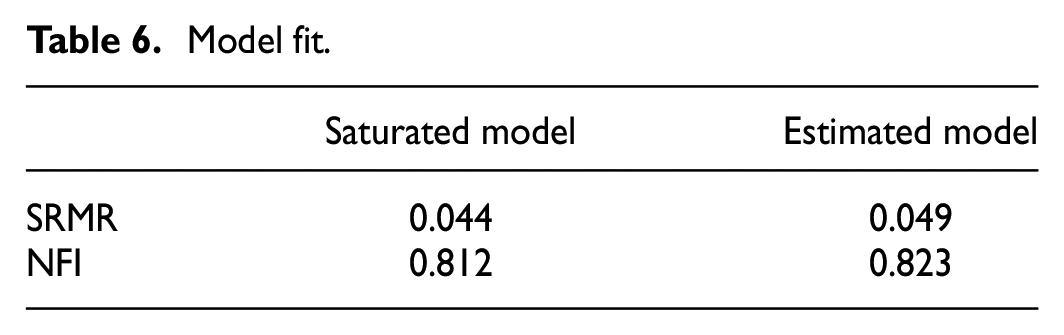
Model fit.
Strength of Effect (f2) and Blindfolding Based Cross-Validated Redundancy (Q2)
Henseler et al. (2015) and Chin (1998) defined an effect size of 0.02 as small, 0.15 as a medium, and 0.35 as large. The strength of effect sizes (f2) is utilized to quantify the model’s representational influence on various factors (Henseler et al., 2015). We assessed the strength of each construct’s influence in Table 7, which ranges between 0.019 and 0.622.
Strength of Effect (f2) and Blindfolding-Based Cross-Validated Redundancy (Q2).

Note. Blindfolding based cross-validated redundancy (Q2): BIU = 0.412.
Through blinded cross-validation, the current study established the parameter’s predictive ability (Q2). When Q2 exceeds zero (0) for any dependent variable, the result is deemed acceptable because it demonstrates the route model’s predictive relevance (Hair et al., 2017). 0.412 is more than or equal to 0.35, indicating that our model is highly predictive. Table 7 reaffirms the criterion.
Model Fit
The Standardized Root Mean Square Residual (SRMR) and the Normed Fit Index (NFI) are used to evaluate the model’s fit quality. SRMR was 0.049, which is less than the desired value of 10, indicating that the model fit was sufficient (Hair et al., 2017). Figure 2 illustrates the structural model used in this study. The NFI value is 0.82, which is more than the cut-off value for model fit. NFI values range from 0 to 1; the closer the value is to 1, the more reliable the fit. NFI values greater than 0.9 often indicate a solid fit for the model (Lohmoller, 1988).
Hypotheses’ Testing
The iteration number in the bootstrapping procedure can vary depending on the sample size and nature of the model. However, a minimum of 2,000 to 5,000 iterations number is recommended by previous studies to obtain reliable and stable estimates (Hair et al., 2017; Kock, 2015). Therefore, the five proposed hypotheses were tested with 5,000 subsamples using standard bootstrapping, and the proposed research model was validated using the path coefficient, t-value, and p-value. Typically, the chosen significance level for testing the path coefficients in the Structural Equation Model is set to .05, which states a 5% chance of making a type I error (rejecting a true null hypothesis). Therefore, the p-value generated from bootstrapping is used to test the significance of the path coefficients, with p < .05 (Hair et al., 2017). According to Table 8, the buyer’s intention to use (BIU) is significantly associated with PE-perceived enjoyment (β = .223, t-value = 3.402, p < .000). Similarly, PEU-perceived ease of use (β = .230, t-value = 3.748, p < .000), PU-perceived usefulness (β = .205, t-value = 3.167, p < .001), and SN-subjective norms (β = .248, t-value = 4.997, p < .000) significantly influence buyer intends to use (BIU). As a result, all the hypotheses are supported as hypothesized, and all are highly significant except PR. That particular hypothesis has been rejected.
Path Co-efficient and Hypotheses’ Testing Results.

Note. Coefficient of determinations (R2): .531.
p < .10. *p < .05. **p < .01. ***p < .001.
Before verifying the structural model, we confirmed the Variance Inflation Factor (VIF) utilized to investigate the lateral collinearity effect. We revealed that the VIF values in Table 8 ranged from 1.906 to 1.066, which fulfilled the Hair et al. (2017) requirements.
Discussion
Online shopping is conceptualized as a process that finally results in a consumer deciding whether or not to purchase based on a specific behavior. In fact, this behavior can be researched from a variety of perspectives. As such, a variety of circumstances might lead to the development of either a positive or negative attitude regarding the use of this new technology. The purpose of this study was to build a novel integrative model to account for Bangladeshi online buyers’ behavioral intention to use technological systems independently when making an online purchase. Based on the TAM, a conceptual model was developed to augment this properly proven framework by including five additional predictor factors (i.e., perceived usefulness, perceived ease of use, perceived enjoyment, persisted risk, and subjective norms). Data was gathered from 322 participants who had prior experience with online shopping. The results demonstrated that the model had a high internal consistency and reliability level, indicating significant explanatory power.
The result indicates that consumers select online purchasing by considering many factors. Two fundamental components of the Technology Acceptance Model (TAM) are perceived utility and ease of use (Davis et al., 1989). The current study also reveals that perceived usefulness and ease of use are two of the most important predictors of user acceptance and utilization of technology in the Bangladeshi context. This finding corroborates some recent cross-cultural studies that have demonstrated that perceived efficacy significantly predicts purchasing intent. For example, Yang et al. (2011) noted that perceived usefulness positively affects online purchasing intention. Some other studies (see more Alalwan et al., 2017; B. Cheng & Chen, 2019; Miao et al., 2020) also found that perceived efficacy significantly predicts online buying intention. Our study also found evidence that perceived enjoyment and subjective norms significantly affect the intention to use. These findings also are consistent with some past studies. Studies conducted by J. Chen et al. (2016), X. Liang et al. (2019), and Lu et al. (2019) demonstrated that perceived enjoyment has a positive effect on purchasing intent. The positive association of subjective norms influencing buying intention is another remarkable finding of our study. Our findings demonstrate that subjective norms derive from the beliefs and attitudes motivated by others (e.g., family members, friends, co-workers, etc.). Some previous studies also recorded similar findings (see more Fathema et al., 2021; Ngai et al., 2007; S. Y. Park et al., 2012).
In contrast, the hypothesis regarding perceived risks was found insignificant (=0.075, t-value = 1.548, p > .061) in the Bangladeshi context, despite having a significant impact on internet buyers in other countries, as indicated by our literature reviews (see Ahamed et al., 2020; Chiu et al., 2014; Jarvenpaa et al., 2000; Tong, 2010). Identical evidence was also revealed in Bangladesh. According to Fidai (2022), several online shopping platforms have recently perpetrated many financial frauds in Bangladesh. She further noted that as the online market experiences unprecedented growth, the number and strength of shrewd sellers behind keyboards have also increased, rendering this relationship unstable and dubious. Another study (see Shawon et al., 2018) on Bangladeshi online shoppers found evidence that perceived risk significantly impacts consumers’ intentions to purchase.
However, one of the reasons behind the insignificant findings regarding perceived risk is that we did not control our participants regarding their demographic profiles. According to the participants’ demographic profile (Table 2), 87% of respondents are young. Previous studies indicate that because the younger population is more accustomed to and comfortable with technology, they perceive online shopping as less risky (see Andronie et al., 2021; Dang et al., 2020; Škerháková et al., 2022). Dang et al. (2020) reveal that younger consumers are more likely to make impulse purchases online because they feel that the anonymity of the internet makes it less risky. Younger consumers were more likely to make purchases through social media because they trusted the recommendations of their friends and felt that it was a more personal and less risky way to shop (Ayalew & Zewdie, 2022). Moreover, financial scams in online buying mainly happen to other customer clientele dealing, especially with B2B transactions in Bangladesh, as Murtaza (2021) noted. The product or services with low prices are not scammers’ targets, so there might have little chance of being affected in the Bangladeshi context, affirming the insignificant outcome of the perceived risk factor in our study.
Additionally, our data analysis reveals that about 50% of respondents (primarily dependent families) had no income. Most participants are low earners (below or slightly above $200) who typically purchase goods and services with modest budgets and daily necessities that are less risky. These results support earlier research (see Nawi et al., 2019; Rahman et al., 2018), which noted that people with low incomes and those without jobs might view online purchasing as less risky due to its convenience and accessibility. Nawi et al. (2019) found that consumers prefer online buying as they can compare prices across various online stores from their homes or offices. Rahman et al. (2018) observed that people with low incomes were more likely to make online purchases because they viewed the internet as a means to access products and services they could not otherwise afford.
Implications of the Research
Our research has academic and industry implications in light of the importance of anticipating online consumers’ purchasing intentions in the digital marketing community. We have adopted TAM to help online retailers build new technology tools for their online consumers. They can look into how perceived usefulness, enjoyment, ease of use, risk, and societal standards influence the purchasing decisions of online consumers. These findings might fill the gaps in the earlier literature to extend TAM to predict online consumers’ behavioral intentions. On the other hand, according to the findings, e-commerce operators can use this information to help them develop various tactics to increase the likelihood that customers will purchase online. Thus, the results of this research also have critical applications in the real business world. Marketing can use early online identification of buyers with high purchase intent to adopt numerous online techniques for consumer intention, personalized suggestions, sales boosting, and targeted offers. Personalized recommendations, targeted promotions, and discounts can benefit from our research on cross-cultural contributions to the digital marketing community. If they want to further their marketing strategies, this might help entrepreneurs discover their most profitable online business for both products and services.
Limitations and Future Research Direction
Despite the careful attention paid to research methodology, the current study may have significant limitations. For instance, there may have a risk of research bias due to the convenience sample approach, which may only generalize some of the population. Because our study was done in Dhaka and focused on online consumers with a small sample size (322), a significant portion of the sample was young (87%, age group 18–34 years), limiting the study’s generalizability. Future research should expand the number of respondents in the nationwide study and mix different age groups with a specified threshold number for each group. The current study used only the survey method for data collection, which needs to be more comprehensive to examine the effects of various constructs on consumers’ online buying intention. As a result, more research is needed following a combination of other data collection methods, such as in-depth interviews with some survey participants, to understand better which factors influence their perceptions of online purchasing in Bangladesh. Self-selection bias may have influenced our results because our sample included solely active internet consumers. There may be varying perceptions of the influence of practical utility, subjective norms, hedonic value, and perceived risk on individuals who have already ceased purchasing products and services from online platforms.
The findings of the current study established its value. Examining attitudes, intentions, and actual shopping behavior in Bangladeshi culture and place is crucial. Appropriate design recommendations require a detailed grasp of how various factors affect behavioral choices when consumers shop online. Because those factors may change over time as the market evolves and customers gain more knowledge and information, longitudinal research on online shopping behavior is required. As this study established the feasibility of TAM use in Bangladesh, future research may be conducted in detail to ascertain the elements influencing Bangladeshi online consumers’ behavioral intention to online purchasing. An additional study can be conducted to improve understanding of the aspects that affect perceived risk, which is essential for Bangladeshi online buyers. More studies also can focus on the utility and comfort of usages, such as price, web usability, and online payment options. Additional research on more individual qualities that may aid in identifying potential clients is possible, particularly given the absence of information on online shopping adoption in Bangladesh. We also have not revealed the demographic variations that influence behavioral intention to use, which have been researched and proven significant in previous studies in cross-sectional studies globally. Indeed, internet shopping is a relatively new phenomenon in emerging economies such as Bangladesh and should be investigated in conjunction with other demographic characteristics such as level of education, gender identity, area, and income that may influence behavioral intention to use. To sum up, the findings of this work provide an ideal starting point for further discussion on future research endeavors in this area in Bangladesh.
Conclusion
Bangladesh’s reliance on online shopping presents both opportunities and difficulties. The relatively large marketplace in terms of population size is driving up demand for online shopping. On the contrary, the need for greater technological proficiency that underpins online purchasing presents a significant challenge for entrepreneurs, managers, and online consumers. Our research supports Davis’s (1989) theory that TAM significantly influences people’s intentions to purchase online. The current study aimed to present the development of TAM, highlight the limitations of the earlier iteration of this theory and examine technology acceptance and adoption in online purchasing better to understand individual behavior in a developing country like Bangladesh. According to our findings, the Technology Acceptance Model (TAM) model can still be used to explain the change in behavior associated with using a marketplace, particularly when buying online products. To give a more profound knowledge, various user characteristics according to generation group still need to be studied. This is helpful for businesses to identify and address any early-stage phenomena relating to customer satisfaction, effectiveness, and loyalty in using a marketplace for online purchasing.
Footnotes
Acknowledgements
The authors acknowledge and appreciate the spontaneous responses of the participants in this research.
Authors’ Contribution
The lead investigator, Shafiqul Islam, oversaw the study’s concept and design, methods, questionnaire design, evaluating, editing, and finalizing the first edition. The second author, Fakhrul Islam, prepared questionnaire, methodological design, data curation, and analysis. As the third author, Noor-E-Zannat assisted with the production of literature evaluations, revisions, and reference corrections. The final manuscript has been read and approved by all writers.
Declaration of Conflicting Interests
The author(s) declared no potential conflicts of interest with respect to the research, authorship, and/or publication of this article.
Funding
The author(s) received no financial support for the research, authorship, and/or publication of this article.
Ethics Statement
All procedures used in studies involving human subjects followed applicable ethical standards.

Data Availability
Data is available on request.