




Abstract
The Comprehensive Scheme on Reducing Social Insurance Contribution Rates (RSICR scheme) issued in 2019 had an important impact on the financial backing risk of the Chinese Public Pension for Enterprise Employees. We developed actuarial models for contribution revenues, benefit expenditures, and the balance of the public pension to analyze the impact of the RSICR scheme on the financial status of the Chinese Public Pension and the financial backing risk early warning after its implementation. This was done according to the State Council Documents and considering the interruption of participants’ contributions and the contribution salary being lower than the statistical salary. We found that (1) the RSICR scheme will worsen financial status in earlier years; however, it effectively slows down the trend of financial deterioration in most years of the forecasted period. (2) After implementing the RSICR scheme, four early warning indicators were selected and calculated. Since 2022, the financial backing risk of the Chinese Public Pension has increased rapidly, and four warning levels–blue, yellow, orange, and red–and their corresponding warning-year intervals were obtained. (3) According to sensitivity analyses, the key reverse early warning indicators’ influencing factors ranged from strong to weak: retirement age, firm contribution rate, and total fertility rate. In the same direction, from strong to weak, are the benefit growth rate, the bookkeeping interest rate, and the transitional coefficient. Finally, we propose policy suggestions to alleviate the financial backing risk.
Plain language summary
Purpose. The Comprehensive Scheme on Reducing Social Insurance Contribution Rates (abbreviated as RSICR scheme) stipulated that contribution rate of firms in Chinese public pension can be reduced to 16% and the average salary calculation standard is correspondingly adjusted. This paper aims to explore the impact of the RSICR scheme on the finance of the public pension, and to early warn the financial backing risk of the public pension after the implementation of the scheme. Methodology. We develop actuarial models for contribution revenues, benefit expenditures and balance of Chinese public pension. The parameters involved in the actuarial models are estimated, and the impact of the RSICR scheme on Chinese public pension finance is numerically simulated by using MATLAB software, as well as the financial backing risk of Chinese public pension under the implementation of the scheme. Conclusions. By comparing the impacts of three scenarios on the financial status of the public pension, we find the RSICR scheme will worsen the financial status in early several years, nevertheless, effectively slow down the trend of financial deterioration in most years of the forecast period. After the implementation of the RSICR scheme, we calculate the benefit payment gap and its proportion in national financial revenues and find that financial backing risk rises rapidly since 2022. Implications. This paper provide a useful reference for improving the sustainable operation ability of Chinese public pension system.
Introduction
Population aging has attracted the attention of Researchers and governments to the financial pressure on public pensions (Cho & Lee, 2022; Hoang, 2023; Vanella et al., 2022). The same applies to China. The number of provinces in China where public pensions for urban employees cannot be paid in the same year has increased annually in recent years, resulting in an increase in financial subsidies. Figure 1 shows the financial subsidies for public pensions from 2010 to 2017, based on the Statistical Bulletin on the Ministry of Human Resources and Social Security Undertakings. Between 2018 and 2021, no specific subsidy data were published in the government’s statistical bulletin. On August 25, 2022, the Chinese Ministry of Human Resources and Social Security elucidated on its official website the advancements and accomplishments in employment and social security over the preceding decade. As of August, the data revealed that the central government’s fiscal contributions to the public pension scheme for enterprise employees in China amounted to an estimated 650 billion yuan. If the subsidy for the next 4 months was approximately half of that for the first 8 months, and the local financial subsidy was estimated to be 1/5 that of the central government, then the national financial subsidy for the whole year would be approximately 1170 billion yuan. Due to the sluggish growth of the world economy and increasing downward pressure on the country’s economy, China has adopted a positive financial policy. Regardless of whether the national financial deficit rate increased to 3% or exceeded 2 trillion yuan in 2016, financial subsidies for urban employees’ public pensions continue to increase annually, thereby increasing the financial backing risk. Therefore, immediate control of the financial backing risk of public pensions and the establishment of corresponding early warning indicators of risk is necessary.

Financial subsidies for public pension for urban employees.
China’s current public pension system includes public pensions for urban employees as well as rural and urban residents. The Public Pension for Urban Employees includes the Public Pension for Enterprise Employees, which covers enterprise employees, self-employed individuals, and urban flexible employees, and the Public Pension for State Organs and Institutions, which covers the staff of state organs and institutions. In contrast, the Public Pension for Rural and Urban Residents covers farmers, migrant workers in urban areas, not covered by the Public Pension for Enterprise Employees, and urban residents ineligible for the Public Pension for Enterprise Employees.
The General Office of the State Council issued a Comprehensive Scheme for Reducing Social Insurance Contribution Rates (RSICR scheme) in April 2019. The RSICR scheme proposed that, from May 1, 2019, the firm contribution rate for Public Pensions for Urban Employees should be reduced to 16%. Furthermore, the calculation standard for the average salary should be adjusted to the weighted average salary of non-private and private sector employees in urban areas. On the one hand, lowering the contribution rate reduces contribution revenue, which is not conducive to the pension’s long-term financial status. On the other hand, adjusting the calculation standard of the average salary will reduce the average salary and the calculated basic and transitional pension benefits. This phenomenon is conducive to the pension’s long-term financial status. The scale of the Public Pension for Enterprise Employees is greater than that of the Public Pension for State Organs and Institutions. Thus, what is the effect of the RSICR scheme on the long-term financial status of the Public Pension for Enterprise Employees and how will the pension’s financial backing risk change?
Given the current fragility of the financial sustainability of the Chinese Public Pension and the significant impact of the RSICR scheme, further research is urgently required in this area. Consequently, we propose the following research topics. Objective 1: To explore the impact of the RSICR scheme on the financial status of the Chinese Public Pension for Enterprise Employees. Objective 2: Early warning of this Chinese Public Pension’s financial backing risk over the next 75 years in the context of the RSICR scheme. Although there are relevant studies on research objective 1, such as Zeng and Li (2019), Yao (2021), and Zeng and Yao (2022), these studies failed to consider the adjustment of the other aspects of the RSICR scheme (i.e., the adjustment of the calculation standard of the average salary) and did not fully clarify the in-depth impact of the RSICR scheme on the Chinese public pension system.
To achieve the two research objectives, we first establish actuarial models of annual contribution revenues, benefit expenditures, and the balance of the Public Pension for Enterprise Employees in accordance with the State Council Decision on Establishing Unified Public Pension System for Enterprise Employees (State Council Document 26 of 1997) and the State Council Decision on Improving the Public Pension System for Enterprise Employees (State Council Document 38 of 2005). Second, based on these actuarial models, the relevant parameters are calibrated or estimated according to historical data from the Chinese Statistical Yearbook. Furthermore, the possible impact of the RSICR scheme on the financial status of the Public Pension for Enterprise Employees is simulated using MATLAB software. Third, based on the impact results of the RSICR scheme, we select the early warning indicators of the financial backing risk, set the early warning level, and accurately evaluate the annual interval of each early warning level of the public pension for the next 75 years. Fourth, by examining the effects of postponing retirement, fertility policy, and contribution rate on the early warning indicators, we further analyze the sensitivity to test the reliability of the early warning results. We propose policy recommendations to improve the Public Pensions for Enterprise Employees based on the results of our calculations.
The section is a literature review. The third section constructs models of annual contribution revenues, benefit expenditures, and the balance of the Public Pension for Enterprise Employees. The fourth section calibrates the relevant parameters involved in the actuarial models using historical data from various statistical yearbooks in China. The fifth section reports and discusses the results. The sixth section verifies robustness. In the final section, we present our concluding remarks.
Literature Review
Factors Affecting the Financial Status of Public Pension Funds and Actuarial Analysis of Its Financial Status
Internationally, there are three hotspots of research on public pension systems. The first examines the impact of factors such as fertility, delayed retirement, education, and inflation on pension funds (Breyer & Hupfeld, 2010; Chen et al., 2020; Galasso, 2008; Han & Meng, 2021; Hu & Yang, 2021; Miyazaki, 2014; Shen & Yang, 2021). The second explores the future financial status or solvency of pension funds (Billig & Ménard, 2013; Grech, 2013; X. Ren et al., 2019; Zhao et al., 2018), and the prediction of pension finance in uncertain environments (Alonso-García et al., 2018; Slipsager, 2018). The third investigates the optimal investment strategies for pension funds (Bernard & Kwak, 2016; Kryger, 2010; Liang & Ma, 2015; Romaniuk, 2007).
A literature review on the financial status of the Chinese Public Pension for Enterprise Employees using actuarial methods can be classified into three categories: implicit debts (Dong et al., 2005; Jia et al., 2007; Sin & Yu, 2005; Y. Zhang et al., 2013; B. Zheng, 2014), balance of revenues and expenditures or payment gap of the pension (Gao & Ding, 2006; Liu, 2014; X. Wang & Mi, 2013), and financial sustainability and financial burden of the pension (Ai et al., 2012; X. Wang & Jiang, 2016; Z. Yang & Shi, 2016; Yu & Zhong, 2009; S. Zheng & Liao, 2017).
Although the actuarial methods used in these studies are worth referencing, they have the following limitations. First, they did not examine the effect of the RSICR scheme on pensions because they were published in 2019. Second, the annual financial backing risk of the Public Pension for Enterprise Employees was not analyzed in these studies. Third, even if the financial burden is measured, it is a discounted value at a certain point in time rather than each year in the long term. In particular, it calculates the difference between the present value of deserved benefits and that of future contributions for all participants at a given time, as opposed to the difference between the contribution revenues and benefit expenditures in each of the future years (Z. Yang & Shi, 2016). Finally, most of the literature (except Liu, 2014; S. Zheng & Liao, 2017) does not consider certain real situations, such as changes in population policy, different retirement ages for female workers and cadres, participants’ intermittent contributions, and contribution salaries below the statistical salary. X. Zhang et al. (2018) evaluated the financial backing risk of the Public Pension for Urban Employees. However, the RSICR scheme’s effects have not yet been examined. The other lacunae in their study included the following: The assumption that individual accounts are not managed separately is inappropriate. The contribution revenues model includes retired “old people” and “old middle-aged people.” The assumption that individual account pension benefits increase annually is also inconsistent with the provisions of State Council Document 38 of 2005. These lacunae significantly affected the calculation results.
Early Warning Research on Payment Pressure of Public Pension
Xiong (2001) analyzed the main factors influencing the payment ability of pension funds and constructed an early warning model to assess the payment ability of Zhejiang Province. He et al. (2002) designed early warning indicators for pensions, introduced the calculation of the indicators and explained the corresponding early warning analysis and policy simulation methods. Furthermore, H. Li et al. (2003) used the Delphi method to estimate the warning indicators and limits for pension revenues and expenditures. Z. Wang and Fang (2014) discussed the technical problems in monitoring and providing early warnings of the revenues and expenditures of pension funds. Chang and Chen (2011) selected early warning indicators for public pension funds, established an early warning model based on a BP neural network, trained the model using Shanghai data, and set five alarm degrees based on experience. X. Yang et al. (2016) proposed numerous pension fund risks, such as system, revenue, expenditure, and investment risks, and constructed a neural network-based nonlinear relationship structure among warning indicators.
However, these studies do not focus on financial backing risk; thus, they fail to address the key question of how much financial backing risk is caused by public pensions. All these involve establishing an early warning index system. The indices involved are comprehensive and broad but not in-depth, and there is no specific prediction for financial backing risk. The established calculation model also presents difficulties in keeping up with the pace of State Council Document 38 of 2005.
Developed countries use actuarial techniques to assess their long-term social security. To provide an early warning of potential long-term financial problems, the trustees of the Federal Old-Age and Survivors Insurance and Federal Disability Insurance Trust Funds (OASDI) report annually to the United States (US) Congress on the financial status of funds. Solvency, sustainability, actuarial balance, sustainable solvency, and open-group unfunded obligations are among the estimates used to evaluate financial status (Goss, 2010). The OASDI Board of Trustees (2022) emphasized that trustees should evaluate the actuarial status of the OASDI program over the next 75 years using the following three types of measures: (1) annual cash flow measures, including income rates, cost rates, and balances; (2) trust fund ratios; and (3) summary measures, such as actuarial balances and open group unfunded obligations. The Government Actuary’s Department of England (GAD) states that the 1948-established National Insurance Fund must hold contributions regarding contributory social security benefits and provide working capital to ensure payment of these benefits. The fund’s long-term financial position is based on the anticipated relative growth of National Insurance contribution receipts relative to benefit expenditures. “To ensure a reasonable working balance in the fund, the convention is to consider the payment of a Treasury Grant if the Fund balance is projected to fall below 1/6th of the annual benefit expenditure (approximately 2 months of benefit expenditure). Treasury Grants are limited to a maximum of 17% of the estimated benefit expenditure in the relevant year.” (Government Actuary’s Department of England, 2022).
However, the US and UK consider preventing social security financial risks over financial backing risks. Therefore, the indicators used by these two countries do not apply to China. To reflect financial backing risk associated with Chinese Public Pension for Enterprise Employees, it is necessary to establish early warning indicators based on China’s realistic situation.
Reduction of Pension Contribution Rates and the Financial Status of Public Pension Funds
The RSICR scheme was scheduled to be formally implemented in 2019, and its predecessor, generally known as the social insurance rate reduction, started in some Chinese provinces before 2019 as a pilot scheme to reduce the contribution rate of pensions, which has been studied by the academic community. These studies focus on the effects of social insurance contribution rate reductions on corporate behavior in terms of corporate contribution burden, corporate investment, corporate innovation, corporate hiring, and corporate contribution compliance (L. Guo & Hu, 2020; S. Li & Tian, 2022; C. Ren, 2021; Ying et al., 2021, etc.). However, they do not focus on the financial impact of the RSICR scheme on the Chinese public pension system. Some studies have addressed the impact of these aspects. Zeng and Li (2019) used actuarial models to analyze the impact of a reduction in the contribution rate on the long-term viability of social insurance funds using the Chinese Public Pension for Urban Employees as an example. Yao (2021) built an actuarial model to simulate numerically the impact of reducing the pension contribution rate on the sustainability of funds under different policy combinations. Based on the provincial panel data of China from 2002 to 2019, Zeng and Yao (2022) used econometric and actuarial models to explore the impact of reducing the pension contribution rate on enterprises’ contribution compliance and the sustainability of pension funds. To investigate the impact of the RSICR scheme, these studies mainly used numerical simulations by constructing actuarial models. However, they also had the following shortcomings: First, the adjustment of the average salary calculation standard regulated by the RSICR scheme was not considered in-depth, resulting in their conclusion of the impact of the RSICR scheme is not comprehensive. Second, none of the above studies provides early warnings about the financial sustainability of the Chinese Public Pension after the implementation of the RSICR scheme.
The innovative points of this study are revealed by summarizing the deficiencies in the above literature. (1) This study constructs actuarial models suitable for the actual situation of the Chinese Public Pension that are closer to the provisions of national documents than most previous studies. (2) Less literature considers the adjustment of the average salary calculation standard without fully clarifying the impact of the RSICR scheme. This study considers both the reduction in the pension contribution rate from 20% to 16% and the adjustment of the average salary calculation standard to the weighted average salary of non-private and private sector employees in urban areas in the RSICR scheme as well as thoroughly analyzes the impact of the RSICR scheme on pension funds. (3) Previous scholars have rarely studied the early warnings of Chinese public pension finance, especially after the RSICR scheme implementation. This study selects appropriate early warning indicators for the future financial status of the Chinese public pension system after the RSICR scheme implementation.
Models and Methods
Hypothesis Development
No mature theoretical framework can explain research objective 1, the financial status of the Chinese Public Pension for Enterprise Employees in relation to the RSICR scheme. This study proposes a corresponding research hypothesis and analyzes it using actuarial models and numerical simulations. Based on the analysis results of Research Objective 1, early warning indicators are designed to monitor the early warning of the financial backing risk of the Chinese Public Pension 75 years after the implementation of the RSICR scheme, and the early warning results of Research Objective 2 can be obtained.
We propose the research hypothesis for research objective 1. The RSICR scheme includes two main reforms: The first is to reduce the firm’s pension contribution rate from 20% to 16%. The second is the average salary calculation standard, which is adjusted from the former average salary of urban on-the-job workers to the weighted average salary of non-private and private-sector employees in urban areas. Some studies (Y. Guo & Zhang, 2019; Mao, 2020, etc.) believe that reducing the pension contribution rate can reduce contribution revenues and weaken the finances of public pension funds. Thus, we propose the following hypotheses:
Hypothesis 1: Considering only a reduction in the pension contribution rate of the RSICR scheme will adversely impact the financial status of the Chinese Public Pension and worsen its financial sustainability.
However, none of these studies consider adjusting the average salary calculation standard, which, in theory, would reduce the average salary, basic pension benefits, and transitional pension benefits. Thus, this modification will reduce benefit expenditure, which is beneficial to the financial status of public pension funds. Regarding the long-term impact of implementing the RSICR scheme, it is likely that the scheme will have a negative impact on Chinese public pension funds in the early stages and a beneficial impact in the later stages (Z. Yang & Chen, 2021). Thus, the following research hypothesis was proposed:
Hypothesis 2: Considering both changes in the RSICR scheme, the scheme will initially negatively impact the financial status of Chinese Public Pensions for Enterprise Employees and have a positive impact in the later stage of the prediction period.
This study adopts a scientific research method that combines actuarial modeling and numerical simulation (Ai et al., 2012; Board of Trustees, 2022; X. Wang & Mi, 2013; Z. Yang & Chen, 2021; Zeng & Li, 2019). A review of the above literature reveals that actuarial methods are generally used to study the impact of a social insurance contribution rate reduction on the Chinese public pension system. What’s more, some developed countries have advocated the use of actuarial methods to regularly assess and report the financial status of pension funds at the national legislative level, which demonstrates the advantages of actuarial methods in assessing the long-term financial status of pension funds. The U.S. Social Security Act, for instance, requires the Board of Trustees of the Trust Fund to report annually to Congress on the actuarial status of OASDI finances over the next 75 years. Section 166 of the Social Security Administration Act of 1992 in the United Kingdom requires the Department of Actuaries to submit an actuarial report every 5 years evaluating the financial status of the National Insurance Fund over the next 65 years. Considering the benefits of the actuarial method, we also adopted it for the empirical analysis. The next section constructs actuarial models based on the actual development of the Chinese public pension system for subsequent analysis of the RSICR scheme’s impact and its early warning after implementation.
Actuarial Models for the Public Pension
The Chinese Public Pension for Enterprise Employees was formally established through the State Council Document 26 of 1997 and matured through the State Council Document 38 of 2005. According to these two key documents, the Public Pension for Enterprise Employees has two accounts: an individual account for each participant and a pooling account for the country. To calculate contribution revenues and benefit expenditures, participants are categorized into three: “old person,”“middle person,” and “new person.”“Old person” refers to participants who retired before the implementation of the State Council Document 26 of 1997; “middle person” refers to participants who joined before the implementation of the document and retired after the implementation; and “new person” refers to participants who joined after the implementation of the document. To investigate annual contribution revenues and benefit expenditures, it is necessary to establish actuarial models for individual and pooling accounts.
The following variables are used: Assume that the age of persons who become firm employees and participate in the pension, e, is 20 years; the retirement age, r, is 50, 55, and 60 for female workers, female cadres, and male employees, respectively; and the ultimate age, ω, is 100 years. The firm contribution rates for the pension and individual contribution rates are q and c, respectively. The number of participants aged x in year t was denoted as Lt,x. The contributing persistence ratio of participants is a. St,x denotes the salary of a participant at age x in year t, and
According to State Council Document 26 of 1997 and State Council Document 38 of 2005, we calculate the revenues and expenditures of the pooling and individual accounts. Pooling account revenues (
Contribution Revenues in Each Year
The formulas for annual contribution revenues are the same because the participants’ ages all range from e to r− 1. The pooling account revenues in year t are equal to the working participants’ firm contributions. The contribution salary is lower than the statistical salary because some salary items are included in the statistical salary, but not in the contribution salary. The contribution salary is the product of the working participant’s salary in the previous year and the proportion of the contribution salary to the statistical salary, d. Thus, the contribution revenues can be expressed as

In year t, individual account revenue equals individual contributions. The contributions are deposited into individual accounts but are managed by a competent authority together with pooling account revenues. The formula for individual account revenue is

The retirement ages of female workers, female cadres, and male employees vary, and thus the formulas for calculating annual benefit expenditures vary. Furthermore, the years in which old person, middle person, and new person begin appearing and completely disappearing among retirees vary. For the purpose of developing an actuarial model for benefit expenditures, we will use female employees as an example below. Modeling ideas and methods for female cadres and male employees were the same.
Benefit Expenditures in Year t ∈[2022, z + r − e]
To coincide with the years when old, middle, and new persons begin appearing and completely disappearing among retirees, it is necessary to divide the prediction period into different intervals for modeling. During [2022, z + r − e], only old and retired middle-aged persons were among the retirees (retired new persons had not yet started to retire during this period, so they did not during this time).
The age range of old person is [r + t − z, ω]. The authority shall pay basic benefits to the elderly, according to the original regulations of State Council Document 26 of 1997. Let

where
The age range of retired middle person is [r, r + t − z − 1] and the expenditures for their basic and transitional benefits are calculated as follows:

According to the State Council Document 38 of 2005, the basic benefits standard in the year of retirement is based on the average value of the working employees’ average salary in the previous year and the participants’ indexed average contribution salary. Any retiree with at least 15 years of contributions should receive 1% of their pension benefits for each full year of contributions. Transitional benefits are equal to the product of the transitional coefficient, participant’s deemed contribution years, and indexed average contribution salary. Thus, the basic and transitional benefits for a retired middle-aged person at age x in year t are calculated as follows.
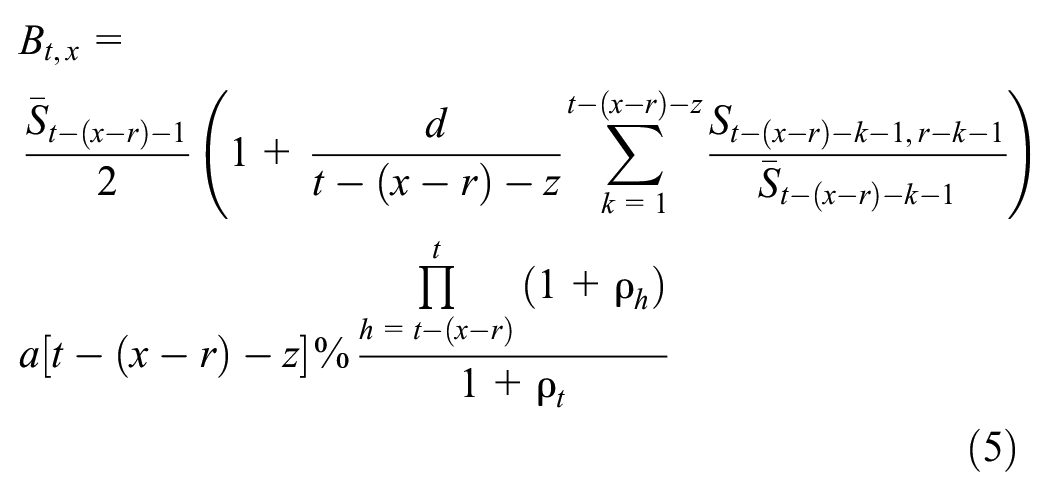

According to the State Council Document 38 of 2005, the stipulated payment months for individual account benefits correspond to retirement ages 50, 55, and 60 are 195, 170, and 139, respectively. Let m be the stipulated payment month and [m/12] be the largest integer not greater than m/12. Individual account benefits received by retirees within and beyond the stipulated payment months should be paid from their individual and pooling accounts, respectively. In this model, we did not account for funeral expenses paid for deceased retirees from the pooling account. For financial safety, and to simplify the calculation, we assume that the individual account benefits for the remaining months of the entire year within the stipulated payment months are paid from the pooling account. Thus, the individual account benefits of retired middle persons who are r∼r+ [m/12] − 1 years old and r + [m/12] years and over are paid from their individual accounts and pooling accounts, respectively. Thus, the individual account benefit expenditures for retired middle persons paid from the pooling and individual accounts are calculated as follows:


where the annual individual account benefits of the retired middle person are equal to the accumulated amount of the individual accounts divided by the stipulated payment years:

Benefit Expenditures in Year t ∈ [z + r − e + 1, z + ω − r]
During this period, the old persons, retired middle persons, and retired new persons were covered. The age range of old person is still [r + t − z, ω], and the formula for their benefit expenditures is the same as in Equation 3. The age range of the retired middle person is [e + t−z, r + t − z − 1]. The expenditure formula for basic and transitional benefits for retired middle person is the same as that in Equation 4. The formulas for individual account benefit expenditures for retired middle person paid from the pooling and individual accounts are the same as in Equations 7 and 8, respectively. The age range of retired new person is [r, e + t − z − 1]. A retired new person only receives basic benefits. The expenditures on basic benefits for retired new persons are

where the basic benefits for a newly retired person of age x in year t are calculated as follows:

The expenditures of individual account benefits of retired new persons paid from pooling and individual accounts can be expressed separately as


where the individual accounts for the benefits of newly retired persons at age x in year t and are calculated as follows:

Analogously, benefit expenditure models for each future year can be constructed in the same manner.
Refund of Individual Account Balance in Each Year
Individual account balances are refunded to the legal heirs of participants who pass away during their contribution (working) period or during the specified payment months. It can be stated as

where, Dt,x represents the number of participants who passed away at age x in year t. It was assumed that the individual account for the Public Pension for Enterprise Employees was established in 1997; thus, t – n + 1 ≥ 1997.
Balance of Contribution Revenues and Benefit Expenditures
In accordance with State Council Document 26 of 1997 and State Council Document 38 of 2005, the current year’s balance is the pooling account balance and the individual account balance of the current year. The current year’s pooling account balance equals the contribution revenues of the pooling accounts (
In general, the cumulative balance is understood as follows: If the previous year’s cumulative balance is positive, then the current year’s cumulative balance equals the last year’s cumulative balance × (1 + ROI rate) + the current year’s balance. If last year’s cumulative balance is negative, then the current year’s cumulative balance = last year’s cumulative balance + the current year’s balance.
Data and Calibration of the Model Parameters
The actuarial models’ parameters were calibrated or estimated using historical data from China’s statistical yearbooks to obtain their values during the evaluation period.
Annual Urban Population Composition
To predict the urban population composition using the cohort component method, the following parameters must be determined: initial population composition, annual total fertility rate during the forecast period, fertility rate of childbearing women based on age, birth sex ratio of the population, life table, China’s urban population, and proportion of the population migrating based on age and sex.
First, we determine the initial population composition. According to China Population and Employment Statistics Yearbook 2021, the population sampled by age and sex in 2020 are obtained, and divided by the corresponding population sampling ratio to obtain the actual urban population by age and sex in 2020, which is the initial population composition.
Second, we estimated the total fertility rate and the fertility rate of childbearing women based on their age. The average fertility rate of childbearing urban women based on age during 2000 to 2020 was obtained from China Population and Employment Statistics Yearbook 2001-2021. Let
Third, the annual birth sex ratio and life table during the prediction period are also obtained from PADIS-INT. The Far Eastern model life table is more consistent with China’s population situation (W. Zheng et al., 2014). Thus, we also chose it from 2021 to 2096.
Fourth, the national urban population is equal to the product of the total population and the proportion of urban population. Using PADIS-INT with the default parameters for the “China” region yields the total annual population during the forecast period. ARIMA (1, 2, 0) was used to predict the proportion in each year based on a sample of the proportion of the urban population during 1980 to 2020 published in China Statistical Yearbook 2021. J. Wang and Ge (2016) assume that the upper limit of China’s urbanization rate is 80%. Thus, in years where the rate exceeded 80% in the forecast results, 80% was considered the urban population proportion.
Fifth, we estimate the proportion of migrants according to age and sex. We refer to the method used by Meng and Jiang (2018) to calculate the number of rural-urban transferred populations by age and sex from 2000 to 2010. We calculated the urban population by age and sex under natural growth without migration and subtracted it from the actual urban population by age and sex, as reported by the China Statistical Yearbook. To obtain the number of rural-urban transferred population transfers by age and sex, we used this method to estimate the urban population by age and sex in 2020, which was also used to estimate the urban population by age and sex from 2005 to 2019. The urban population by age and sex in 2006 to 2020 minus the urban population by age and sex under natural growth was estimated separately by taking the urban population by age and sex during 2005 to 2019 as the starting population, resulting in the number of rural-urban transferred population by age and sex during 2006 to 2020. We considered the average migration proportion of each age and sex during 2006 to 2020 as the migration proportion of the corresponding age and sex in the prediction period. We used the cohort component method to estimate future urban populations by age and sex based on these parameters.
Annual Number of Participants
The ratio of female workers to female cadres in the enterprise was set to four. The urban population by age and sex for 2000 to 2020 was obtained using the calculation method for the urban population by age and sex for 2006 to 2020. We can calculate the number of urban people in the working age range and retirement age range from 2000 to 2020, respectively. China Human Resources and Social Security Yearbook 2021 revealed the number of employees and retirees covered by Public Pension for Urban Employees, and Enterprise Employees from 2000 to 2020. The ratio of urban employee participants to urban people in the working-age range (rw) from 2000 to 2020 is calculated by dividing the number of employees covered by the Public Pension for Urban Employees by the corresponding year’s number of urban people in the working-age range.
According to China Population and Employment Statistics Yearbook 2021, the average registered urban unemployment rate from 2000 to 2020 was 3.99%. Thus, the upper limit of rw was 96.01%. Historical data of rw from 2000 to 2020 were taken as a sample, and ARIMA (0, 1, 0) was used to predict future ratios. If the prediction result exceeded the upper limit, then the upper limit was taken as the value of rw in the current year.
Dividing the number of enterprise employee participants by the number of urban employee participants in the corresponding year provided the ratio of the number of enterprise employee participants to the number of urban employee participants (ri) from 2000 to 2020. Take the average value of 21 years and 90.89% as ri in each year during the forecast period.
From the above prediction of China’s urban population composition, we determined the annual number of working-age urban residents during the forecast period. Multiplying this number by the ratios rw and ri yields the annual number of enterprise employee participants during the forecast period. Similarly, we estimated the annual number of enterprise retiree participants during the forecast period. Thus, we obtain the annual number of participants in an enterprise by age and sex for each year during the forecast period. The number of deceased participants (Dt,x) was obtained by multiplying the annual number of participants by age and sex by the mortality rate in the Far Eastern model life table for the corresponding year.
Bookkeeping Interest Rate and ROI
Based on the benchmark interest rate of RMB one- year deposits issued by the People’s Bank of China, the compound annual interest rate was calculated to be approximately 3.27% from the end of 1995 to the end of 2015. The average bookkeeping interest rate of individual accounts of the Public Pension for Urban Employees for 2016 to 2021 published by the General Office of the Ministry of Human Resources and Social Security and the General Office of the Ministry of Finance, was 7.47%. Thus, the bookkeeping interest rate in 2015 and before, and in 2016 and after can be set at 3.27% and 7.47%, respectively. The National Council of Social Security Funds issued the 2020 annual report on the entrusted operation of the Basic Pension Insurance Fund in September 2021, indicating that the fund’s average annual return on investment since the entrusted investment was 6.89%, which was the initial ROI.
Other Parameters
Based on the State Council Document 38 of 2005, the individual contribution rate (c) was 8%. The transitional coefficient (ε) is controlled between 1% and 1.4%; thus, we take the intermediate value of 1.2%. The average pension benefits in 2016 to 2020 and the average salaries of enterprise employees in 2015 to 2019 were published in China’s Human Resources and Social Security Yearbook 2021. The replacement rate for 2016 to 2020 can be calculated by dividing enterprise retirees’ average pension benefits in 2016 to 2020 by enterprise employees’ average salary in 2015 to 2019. Their average value was 46.50%, which was used as the replacement rate (R) for the forecast period. China Social Insurance Development Annual Report 2015 announced an official replacement rate of 67.50%. Dividing the replacement rate in 2016 to 2020 respectively by the official replacement rate provides the proportion of the contribution salary to the statistical salary in 2016 to 2020. Their average value of 68.89% was taken as the proportion of the contribution salary to the statistical salary in the forecast period (d).
Historically, the benefit growth rate (ρt) is usually set at 40% to 80% of the salary growth rate. We considered a salary growth rate of 60% as the annual benefit growth rate. Every year, some participants break contributions, considering their experience value of Beijing. Therefore, we set the contributing persistence ratio (a) to 85%. According to the 2020 Employment Report for Chinese College Students issued by the third-party professional organization Mycos, the average monthly starting salaries of undergraduate and junior college students are 5,440 yuan and 4,295 yuan respectively, while the average monthly salary of new entrants is 4,867.5 yuan.
We estimate the growth rate of seniority-based salary (s) and the growth rate of adjacent-age retirees’ benefits in the same year (b) as 1.58% and 1.03%, respectively using the methods of Z. Yang and Shi (2016). And the salary growth rate (gt) in 2020 and earlier is consistent with the average salary index of urban employees in the corresponding year in the China Labor Statistics Yearbook. The salary growth rate is set at 6.6%, 5.7%, and 4.8% during 2021 to 2025, 2026 to 2030, and future years, respectively.
Research Results and Discussion
To verify these research hypotheses, we designed the following three scenarios: In Scenario 1, the scenario before the implementation of the RSICR scheme, where the firm contribution rate of pension is 20% and the average salary standard remains unchanged (i.e., working employees’ average salary in the enterprise), serves as the benchmark control group. Scenario 2 considers a reduction in the firm contribution rate for the RSICR scheme; that is, the firm contribution rate is reduced from 20% to 16%, and the average salary standard remains unchanged. In Scenario 3, considering both reforms of the RSICR scheme, that is, the firm contribution rate drops to 16%, and the average salary standard becomes the weighted average salary of non-private and private sector employees in urban areas.
Effect of the RSICR Scheme on the Long-Term Financial Status
The current year’s balance and cumulative balance can be used to determine the long-term financial status of public pensions. According to China’s Labor Statistics Yearbook 2021, the cumulative balance of the basic old-age insurance fund for enterprise employees in 2020 was 44401.7 trillion yuan, which was the initial cumulative balance. Based on the established actuarial models for pension contribution revenues and benefit expenditures, we used MATLAB for programing. Figure 2 shows the financial status results when the parameter values under the three scenarios discussed above were included in the computation program.

Long-term financial status of the public pension under the three scenarios.
The long-term financial status of Public Pensions for Enterprise Employees is unfavorable. The starting year, when the current year’s balance becomes negative, is 2023 under scenario 1, 2021, and 2022 under scenarios 2 and 3. In all three scenarios, the balance of the current year decreases rapidly every year. The decline in Scenario 2 was greater than that in Scenario 1, and the decline in Scenario 3 was initially greater but then smaller than that in Scenario 1. The starting years for the cumulative balance to become negative under scenarios 1 to 3 are 2029, 2026, and 2028, respectively. The subsequent change in the trend of the cumulative balance is almost the same as that in the current year’s balance.
To show the impact of scenario 2, in which only the firm contribution rate is lowered, and scenario 3, in which the RSICR scheme is implemented more clearly, we introduce the concept of the change rate of balance = [balance after change (the current year’s balance or cumulative balance) − balance before change (i.e., scenario 1)]/(absolute value of balance before change). Figure 3 shows a comparison of scenarios 2 and 3 with scenario 1 in terms of the change rates of the current year’s balance and cumulative balance.

Change rates of balance in scenarios 2 and 3 compared with scenario 1.
The change rates of the current year’s balance and cumulative balance in Scenario 2 compared with Scenario 1 were always below zero. This finding indicates that a reduction in the contribution rate worsens the long-term financial status of Public Pensions for Enterprise Employees. This result is consistent with the conclusions of Y. Guo and Zhang (2019) and Mao (2020). Thus, Hypothesis 1 is confirmed. Although scenario 3 will worsen the financial status in a few years in the early forecast period, the change rates of the current year’s balance and cumulative balance will rise above zero in the 5th and 11th years after 2021, respectively. This observation indicates that the financial status under Scenario 3 in most years of the forecast period is better than that under Scenarios 1 and 2. Comparing Scenarios 1 and 2, it is evident that although the financial status of the public pension will continue to deteriorate if the RSICR scheme is implemented, the trend of financial status deterioration will be restrained to a certain extent. Therefore, the implementation of the RSICR scheme is reasonable. This result is consistent with the conclusions of Yao (2021), and Zeng and Yao (2022). They also believe that the implementation of the RSICR scheme was scientific and beneficial to the financial sustainability of Chinese public pensions. Thus, Hypothesis 2 is confirmed.
The RSICR scheme includes two pension measures: a reduction in the contribution rate and an adjustment to the calculation standard for the average salary, which will result in a decline in financial status within a few years at the outset and a halt to the deterioration trend over the majority of the prediction period. A reduction in the contribution rate reduces the revenue contribution from public pensions. On the contrary, adjusting the calculation standard of the average salary will decrease newly joined retirees’ (including retired middle persons and retired new persons) benefits compared with those calculated under the original average salary standard. Furthermore, the increase in retirees’ benefits in each year’s adjustment will also decrease compared with the benefits calculated under the original average salary standard. Thus, benefit expenditures are reduced. If the decrease in contribution revenue is greater than the benefit expenditure savings, the public pension’s financial status will deteriorate; otherwise, the deterioration will be restrained. During the initial few years of the forecast, the number of employee participants was higher than that of retiree participants. This situation results in a greater reduction in contribution revenue than in benefit expenditure savings. In the following years, retiree participants will gradually increase in number compared with employee participants because of population aging. Thus, benefit expenditure savings are greater than the reductions in contribution revenues.
Financial Backing Risk and Its Early Warning Under the RSICR Scheme
As mentioned above, even after the implementation of the RSICR scheme, the current year’s balance and cumulative balance of public pensions for enterprise employees will become negative in 2022 and 2028, respectively. This condition inevitably induces a financial backing risk. The following indicators can be used to measure financial backing risk: (1) the current year’s payment gap, (2) the cumulative payment gap, (3) the proportion of the current year’s payment gap to financial revenue, and (4) the proportion of the cumulative payment gap to financial revenue. The current year’s payment gap is the difference between the current year’s benefit expenditure and contribution revenue, which is negative for the balance of the current year. The cumulative payment gap is the total payment gap within certain years, which is negative for the cumulative balance. The proportion of the current year’s payment gap to financial revenue is the ratio of the current year’s payment gap to the previous year’s financial revenue. The proportion of the cumulative payment gap in financial revenue is the ratio of the cumulative payment gap to the total financial revenue within the corresponding years.
The general public budget revenue during 2000 to 2020 published in China Statistical Yearbook 2021, was used as the sample. Thus, the general public budget revenue during 2021 to 2096 was obtained through trend extrapolation as financial revenue in the corresponding year. Four indicators were calculated to measure the financial backing risk, and the results are shown in Figure 4. The current year’s payment gap and the proportion of the gap in financial revenues will increase at a more rapid rate from 2022 to 67.33 trillion yuan and 68.39% in 2096, respectively. The cumulative payment gap will continue to rise rapidly, and its proportion of financial revenues will rise rapidly first and then increase gradually, increasing to 2,099.06 trillion yuan and 48.10% in 2096, respectively.

Annual change in financial backing risk of the public pension.
Since 2022, despite the implementation of the RSICR scheme, the financial backing risk of the Public Pension for Enterprise Employees has risen rapidly. Thus, the urgent establishment of an early warning system for risk is required. The above four indicators, as well as the starting year of the current year’s payment gap and cumulative payment gap, the maximum of the current year’s payment gap, and the maximum of the cumulative payment gap in the forecast period, can reflect financial back risk and be used as early warning indicators. However, after comparison, we find that the proportion of the current year’s payment gap in financial revenues (w) is the most direct reflection of how much of the current year’s financial revenues must be used to fill the current year’s pension gap. This approach can directly achieve the goal and plays a more direct, concise, and immediate warning role than other indicators. Therefore, it can be used as a key early warning indicator of financial risk.
Setting an early warning index value should consider the three parts of Chinese Public Pension, namely, the Public Pension for Enterprise Employees, Public Pension for State Organs and Institutions, and Public Pension for Rural and Urban Residents, in which the first one is the largest. Regarding the financial burden on each part, it is more appropriate to set w of the Public Pension for Enterprise Employees to be slightly larger than one-third of the index under the full benchmark. Therefore, the interval of 0 < w ≤ 1.5% can be set as blue early warning (level IV), and the corresponding year is 2022–2022. The interval of 1.5% < w ≤ 3.5% is a yellow early warning (level III), and its corresponding year is 2023 to 2024. The interval of 3.5% < w ≤ 7% is an orange early warning (level II), and its corresponding year is 2025 to 2027. An interval of w > 7% is a red early warning (Level I), and its corresponding year is 2028 to 2096.
The above early warning analysis of the financial backing risk of public pensions in the context of the RSICR Scheme implementation reflects the actual risk faced by the Chinese public pension system. On the one hand, referring to the previous research experience of X. Wang and Mi (2013) and Z. Yang and Chen (2021), we selected classic and rich early warning indicators that can effectively reflect the financial payment pressure encountered in the Chinese public pension system practice. On the other hand, based on data from the China Statistical Yearbook 2022, Chinese public pension payment pressure is high, and most provinces have experienced the dilemma that contribution revenues do not cover benefit expenditures. Applying the early warning levels of the financial backing risk of the public pension system and their year intervals derived from this study, these provinces have entered the blue warning level, which can be a good early warning signal to relevant governments and has significant practical value.
Sensitivity of the Key Early Warning Indicator
The sensitivity of the key early warning indicator was examined using the arc elasticity of the proportion of the current year’s payment gap in financial revenue (w) to each major factor. Taking Scenario 3 as the baseline, we increased the retirement age of female workers from 50 to 55 without changing that of female cadres and male employees. The current year’s payment gap appears in 2025, which is 3 years later than the baseline scenario. Based on the baseline scenario, we raise the total fertility rate, firm contribution rate, transitional coefficient, bookkeeping interest rate, and benefit growth rate by 1%. Figure 5 shows the arc elasticity of w with respect to these factors.

Arc elasticity of w to each factor.
The effects of these factors on the proportion of the current year’s payment gap in financial revenue can be classified into two categories: factors that enable w to change in the opposite direction and those that enable w to change in the same direction. First, increasing retirement age, firm contribution rate, and total fertility rate will reduce w. The influence of retirement age and firm contribution rate will weaken annually, whereas the total fertility rate will impact w in 2037, which is relatively small and gentle.
Second, an increase in the transitional coefficient, the benefit growth rate, and bookkeeping interest rate will increase w and the impact of the transitional coefficient and replacement rate will weaken annually, whereas that of the bookkeeping interest rate remains relatively flat throughout the forecast period. Retirement age, firm contribution rate, benefit growth rate, bookkeeping interest rate, total fertility rate, and the transitional coefficient have an average degree of influence on the proportion of the current year’s payment gap in financial revenue (w) ranging from strong to weak.
Based on the change in the proportion of the current year’s payment gap in financial revenues caused by these major factors, we can determine the impact of these factors on the yearly interval of early warnings at each level. For example, raising the retirement age of female workers by 5 years will delay the starting years of blue, yellow, and orange by 3 years and the red warning by 5 years. When the remaining factors increased by 1% under the baseline scenario, they had little impact on the yearly interval of early warnings at all levels. Only the firm’s contribution rate delays the starting year of the red warning by 1 year and the bookkeeping interest rate advances it by 1 year.
Conclusions and Policy Implications
We established actuarial models for contribution revenues, benefit expenditures, and the balance of the Public Pension for Enterprise Employees to predict their annual financial status over the next 75 years. These models were developed based on State Council Document 26 of 1997 and Document 38 of 2005 and considered actual situations, such as the RSICR scheme, changes in population policy, different retirement ages of female workers and cadres, discontinuous contributions by participants, and lower contribution salary than the statistical salary. By comparing and analyzing the long-term financial status of public pensions in the three scenarios, we find that the RSICR scheme is more reasonable than a single policy of either maintaining the original policy or reducing the firm contribution rate.
Although the RSICR scheme will worsen the financial status in a few early years of the forecast period, it can slow the deterioration of the financial status in most years of the forecast period. In the case of implementing the RSICR scheme, the current year’s payment gap for public pensions will appear from 2022, and the annual financial backing risk will increase. Therefore, an early warning system for a financial backing risk is urgently required. The proportion of the current year’s payment gap in financial revenues best reflects the financial backing risk among the numerous early warning indicators. Accordingly, we established four early warning levels and examined the effects of postponing retirement, birth policy, and contribution rate on the key early warning indicator.
Sensitivity analyses revealed the direction and extent of the major factors affecting the proportion of the current year’s payment gap in financial revenues. The order of the reverse influencing factors from strong to weak is retirement age, firm contribution rate, and the total fertility rate. The order of influence factors in the same direction from strong to weak is benefit growth rate, bookkeeping interest rate, and transitional coefficient. To further alleviate the financial backing risk caused by the Public Pensions for Enterprise Employees, the above results have the following policy implications:
First, the postponing retirement policy for female workers should be introduced. The sensitivity analysis shows that the postponing retirement policy for female workers can reduce the proportion of the current year’s payment gap in financial revenues and delay the starting year of the early warning system at all levels. From an international perspective, the postponement of retirement is a common trend. Based on the actual situation in China, adopting a gradual postponement of retirement policies is more appropriate. The current retirement age for female workers is low. Therefore, postponing retirement for female workers is more appropriate.
Second, increasing the firm contribution rate can reduce the proportion of the current year’s payment gap in the financial year but can also increase enterprises’ contribution burden. This condition is not conducive to unloading enterprises’ burden and moving forward lightly because it is not in line with the current policy of reducing the contribution rate of public pensions. To decrease the proportion of the current year’s payment gap in financial revenue and avoid an increase in the contribution rate, it is necessary to increase the collection objects for public pensions. For example, in addition to the levy on salary income, contributions can also be levied on the consumption of luxury goods.
Third, it is necessary to organize sociologists, economists, resource environmentalists, and other experts to jointly tackle key problems and immediately study China’s population policy. Currently, experts have two opposing views: taking active measures can increase fertility rates. The results show that increasing the total fertility rate reduces the proportion of the current year’s payment gap in financial revenue. Second, increasing the fertility rate conflicts with the carrying capacity of resources and the environment. Difficulties in enrollment, schooling, employment, medical treatment, and traffic reflect the contradiction between the population, resources, and environment. Labor force shortages must be addressed by science and technology, such as production automation, robotics, and intelligent equipment. Therefore, immediately organizing scholars in sociology, economics, resources, and environmental sciences is crucial for jointly studying population policies.
Fourth, the booking interest rate is not that the higher the better. In previous studies, the policy implications of the bookkeeping interest rate differed because of different economic goals, such as maximizing social welfare and reducing the expected present value of the pension’s future financial burden. This study aims to control for the proportion of the current year’s payment gap in financial revenues, which changes in the same direction as the interest rate and is significantly affected by it. Thus, the booking interest rate is not the higher the better.
Finally, appropriate control of the transitional coefficient is necessary because the proportion of the current year’s payment gap in financial revenue changes in the same direction as the transitional coefficient. Thus, controlling for the transitional coefficient controls this proportion effectively. In recent years, the benefit growth rate has gradually decreased. Therefore, the transitional coefficient should be similarly adjusted.
This study has the following limitations. First, instead of adopting the overlapping generation model, we refer to the research method of combining actuarial modeling and numerical simulation that has been utilized by previous researchers for empirical analysis and early warning analysis. In addition, the actuarial model constructed in this study is the cash flow model, in which both contribution revenues (Ct) and benefit expenditures (Pt) can be multiplied by the inflation rate, in which both sides can also be dropped by the inflation rate simultaneously. Thus, it is difficult to explore the economic effects of implementing the RSICR Scheme and the impact of economic inflation on the indicators of financial backing risk. Future research should use the OLG model for further discussion. Second, the actuarial model built in this study is difficult to apply to datasets from other countries, and it is inconvenient to directly compare with the research conclusions of other countries. We built actuarial models applicable to the Chinese public pension system based on the reality of China, which is not applicable to the datasets of other countries. Future empirical analyses of the impact of the RSICR Scheme, such as econometric regression methods and comparisons with datasets from other countries, could be performed to enrich the findings of this study.
Footnotes
Acknowledgements
The authors are grateful to the editors and the anonymous referees for their constructive comments and valuable suggestions.
Declaration of Conflicting Interests
The author(s) declared no potential conflicts of interest with respect to the research, authorship, and/or publication of this article.
Funding
The author(s) disclosed receipt of the following financial support for the research, authorship, and/or publication of this article: This research was supported by Jiangxi Provincial Social Science Foundation Project (23SH22D), Humanities and Social Sciences Youth Fund Project of China Ministry of Education (24YJC840006), Humanities and Social Sciences Planning Fund Project of China Ministry of Education (23YJA630119), Major Program of the Key Research Institute on Humanities and Social Science of China Ministry of Education (22JJD790091), Jiangxi Province University Humanities and Social Sciences Research Project (SH22206), and the 111 Project (B17050).

Data Availability Statement
The data used in this paper mainly comes from various statistical yearbooks in China. Detailed data available on request.