




Abstract
Incorporating more informal workers into the employee public pension scheme (EPPS) is a crucial component of building a high-quality employment security system in China. This study, based on data from the China Family Panel Studies (CFPS) for the years 2014, 2016, and 2018, empirically analyzes the impact of Internet usage on the participation of informal workers in the EPPS. The research finds that informal workers significantly increase the possibility of participation in the EPPS through the Internet usage. This positive effect remains significant even after a series of robustness tests. Heterogeneity analyses argue that informal workers with higher educational level are more likely to participate in employee public pension scheme through the Internet Usage than informal workers with lower educational level. Mechanism analysis suggests that informal workers significantly raise their government trust through the Internet usage, thereby promoting their participation in the EPPS. Based on the empirical results, the following policy recommendations are proposed: government should further utilize the Internet to streamline online enrollment procedures, reducing the time costs for informal workers to participate in the EPPS. Additionally, the government should actively engage with the public through the Internet to enhance its image and deepen the level of government trust of informal workers, thereby increasing their motivation to participate in the EPPS.
Keywords
Introduction
Research Background
In the era of rapid development of the Internet technology, the booming digital economy has been rapidly growing in China, bringing new opportunities to the job market. Under the background of rapid development of digital economy, a large number of informal workers have emerged in the employment market. These informal workers often include individual entrepreneurs, temporary employees, freelancers, and various other groups. They typically engage in non-fixed occupations, characterized by a lack of stable employment relationships, and passively access to the public pension scheme, which poses risks not only to the future retirement security of informal workers but also presents challenges to the sustainable development of China’s public pension scheme.
The participation of informal workers in the public pension scheme not only contributes to the improvement of the coverage of China’s social security system but also helps in establishing a fair and inclusive social security framework. Individuals engaged in any form of employment should be entitled to equal security benefits, which is a fundamental principle in the current goals of the Chinese government toward achieving shared prosperity. The participation of informal workers in the public pension scheme contribute to the equity of social security, reducing disparities in benefits among different forms of employment, and thus fostering greater inclusivity and social equity.
As a long-term social security system, the public pension scheme can significantly obtain benefits from an increased number of participants. By expanding the pool of contributors, it becomes possible to increase the size of the public pension funds, thereby reducing the risk associated with public pension expenditures. This is of paramount importance for ensuring the sustainability of the public pension scheme and the long-term stability of benefits payment of public pension scheme.
According to statistics from the “China Financial Yearbook 2018-2021,” the government’s subsidies to the public pension scheme amounted to 744.866 billion RMB in 2017. Subsequently, these subsidies have increased each year, with the government providing 940.597 billion RMB to the fund in 2020. Calculated from the base year of 2017 (the statistical category for this item was “Government Subsidies to Social Security Funds” before 2017, and the statistical criteria were inconsistent before and after that. Therefore, to maintain consistency, this study only uses data from 2017 onwards), the average annual growth rate of government subsidies to the public pension scheme is approximately 8.76%. This growth rate even surpasses the concurrent growth rate of China’s GDP (according to data from the “China Statistical Yearbook 2018-2021,” the average GDP growth rate in China from 2017 to 2020 was 5.45%).
Therefore, encouraging more informal worker groups to participate in the public pension scheme is a crucial measure for achieving comprehensive development of the social security system.
Literature Review
Definition of Informal Workers
Existing studies have defined China’s informal employment sector from various perspectives. A. G. Hu and Zhao’s (2006) research categorizes urban private enterprise personnel and self-employed individuals as informal workers. Wu and Cai (2006) define self-employed laborers and employed individuals without labor contracts as informal workers based on the International Labour Organization’s standard definition. G. H. Wang et al. (2011) classifies low-income and economically disadvantaged workers as informal workers based on income groups. W. J. Lu and Zhang (2018) use the criterion of whether workers are included in the national tax supervision system to distinguish informal workers.
Previous research has primarily categorized informal workers based on the nature of their work and income status. Considering the classification criteria of existing research and the official implementation of the “Social Insurance Law” by the Chinese government on July 1, 2011, the author, in line with the needs of this study, will categorize formal and informal workers based on whether workers have signed labor contracts with their employers. This is because for formal workers, that is, formal workers, the decision to participate in the Employee Public Pension Scheme (EPPS) is not subject to personal discretion. According to Article 58 of the “Social Insurance Law,”“Employers shall apply for social insurance registration for their employees with the social insurance agency within 30 days from the date of employment,” and “Individual industrial and commercial households voluntarily participating in social insurance, non-full-time employees not covered by social insurance in their employing units, and other flexible employees shall apply for social insurance registration with the social insurance agency.” It can be observed that formal employees and informal workers differ in their initiative to participate in EPPS. Formal workers are compelled to participate, as the employer must contribute to their EPPS, whereas informal workers have the choice to decide whether to contribute to EPPS. Therefore, for the purpose of this study, workers who have not signed labor contracts with their employers are classified as informal workers. According to the characteristics of the survey data, the occupations of informal workers in this study include individuals working in enterprises without labor contracts, self-employed individuals, family agricultural producers, business owners, migrant workers, and manual laborers.
The Existing Research Analysis
China’s public pension scheme emerged alongside the transformation of its economic system, aiming to promote the development of various ownership enterprises. The coverage of this system has gradually expanded from initially covering state-owned enterprise employees to encompassing employees of all types of enterprises. As the comprehensive public pension scheme is gradually established, China’s existing public pension scheme is no longer limited to formal workers’ benefits. Instead, it has become a risk-sharing mechanism that all urban and rural residents, including informal workers, can participate in. For informal workers, the entry barriers to the public pension scheme have been continuously lowered. Currently, they can voluntarily participate in public pension scheme. In theory, they should be able to enjoy the same pension benefits as formal workers. However, in practice, the public pension scheme benefits for informal workers are still not as favorable as those for formal workers.
China’s current public pension scheme consists of two major categories: employee public pension scheme (EPPS) and urban-rural resident public pension scheme (URPPS). Studies by Chen and Zeng (2013), Cheng et al. (2013), and C. C. Zhang et al. (2014) have examined the crowding-out effect of urban-rural public pension scheme (URPPS) as a public transfer payment policy on individual payments. They found that URPPS has a significant positive impact on various indicators such as personal income, consumption, poverty incidence, labor supply, health, and life satisfaction. Moreover, it plays a significant role in changing the elderly’s pension patterns. URPPS can also reduce medical burdens by improving the health conditions of beneficiaries (Ma et al., 2021).
The participation of informal workers in public pension scheme not only contributes to expanding the coverage of China’s social security system but also helps establish a fair and inclusive social security system. Individuals engaged in any form of employment should be entitled to deserve security benefits. This is crucial in the context of the Chinese government’s commitment to achieving common prosperity. As an integral part of the labor market, the involvement of informal workers in public pension scheme promotes fairness in social security, reduces disparities in treatment between different forms of employment, and enhances social inclusiveness and equity.
However, due to institutional design, there is a significant disparity in the benefits provided by the two major categories within the public pension scheme—employee public pension scheme (EPPS) and urban-rural resident public pension scheme (URPPS)—after workers retire. There is a noticeable gap in the benefits that EPPS and URPPS can provide to workers after retirement. According to data from the “China Statistical Yearbook (2022),” recipients of EPPS can receive an average monthly benefit of 3,577 yuan, while recipients of URPPS can only receive an average of 191 yuan per month. The former is 18.74 times higher than the latter. Additionally, in terms of fiscal subsidies, data from the “2021 National Social Insurance Fund Income Settlement Sheet” shows that in 2021, 79.4% of fiscal subsidies for public pension went to EPPS, with only 20.6% directed toward URPPS.
Currently, academia generally agrees on the low participation rate of informal workers in EPPS. Studies have explored optimization pathways for participation in EPPS, considering aspects such as policy promotion (Zhao & Zhou, 2020), improving transfer policies (J. F. Lu & Wang, 2019; L. Zhang & Fan, 2015), and streamlining public pension processing procedures (Tang, 2021). Understanding policy information related to public pension scheme, such as participation conditions, procedures, and payment thresholds, can reduce cognitive biases among informal workers. Positive policy promotion can increase their participation rate in public pension scheme (Zhao & Zhou, 2020). Simplifying participation procedures can also effectively increase the participation rate of informal workers in EPPS. The handling and payment procedures for China’s public pension scheme have become more streamlined from the initial establishment of the system, allowing informal workers to directly handle enrollment procedures and pay related fees at their local social insurance bureau without returning to their registered residence. Simplifying the processing procedures can effectively increase the participation rate of informal workers in EPPS (J. F. Lu & Wang, 2019; L. Zhang & Fan, 2015).
The existing studies predominantly adopt a theoretical “problem-solution” approach, mainly conducting theoretical analysis from a policy perspective. There is a limited amount of empirical research on the participation of informal workers in EPPS, and there is a lack of studies exploring how the Internet usage behavior of informal workers affects their involvement in the EPPS and the underlying mechanisms. Some studies suggest that in the digital age, Internet usage has a significant impact on individuals’ decision-making in purchasing business insurance (Wei et al., 2019; Yang et al., 2019). However, there is currently scarce research addressing how the Internet usage behavior of informal workers specifically influences their participation in EPPS and analyzing the associated mechanism.
Considering both the achievements and shortcomings of existing research, this study is believed to make marginal contributions in the following aspects: (1) Through empirical and quantitative analysis, the study aims to understand the impact of internet usage on the participation of informal workers in EPPS; (2) In addition to considering the role of digital technology in simplifying the participation processes of EPPS, the study incorporates an analysis of how the Internet, in the digital information age, influences people’s trust toward the government. As EPPS is a social public policy introduced by the government, individuals’ trust toward the government may influence their willingness to participate. In the digital information society, any negative government behavior could be magnified through the Internet, yet the internet also provides an effective channel for improving government-public communication. Therefore, in today’s digitalized information age, it is essential to include people’s trust toward the government in the analysis framework, examining the mediating role of government trust in the relationship between informal workers’ Internet usage and participation in EPPS.
The organization of the subsequent sections of this paper is outlined as follows: Firstly, introduction to China’s public pension scheme: In this section, a comprehensive introduction will be provided on China’s existing social pension insurance system. The focus will be on a detailed analysis of the welfare levels that informal workers can attain through their participation in the EPPS. Secondly, theoretical analysis of Internet usage, government trust, and informal workers’ participation in public policy: The second part will involve theoretical analysis on the topic of Internet usage, government trust, and the participation of informal workers in EPPS. Additionally, the section will put forth research hypotheses based on the theoretical framework. Thirdly, variable explanation, definition, and descriptive statistics: The third part will elucidate and define the variables used in this study. It will also provide descriptive statistics for each variable, and this section will also establish baseline regression models and mediation effect models. Fourthly, regression analysis: Utilizing the data and regression models from the third part, the fourth section will conduct regression analysis. This will encompass baseline regression analysis, robustness tests, heterogeneity regression analysis, and mediation regression analysis. Finally, the final part will draw conclusions based on the empirical regression results obtained in the fourth part. It will offer relevant policy suggestions and summarize both the shortcomings of this study and potential avenues for future research.
The Introduction of Public Pension Scheme in China
China’s current public pension scheme includes the Employee Public Pension Scheme (EPPS) and the Urban-Rural Public Pension Scheme (URPPS). However, there exists a significant disparity in contributions and benefits payment between these two kinds of schemes. Informal workers have the option to participate in either of the two kinds of public pension schemes or choose not to participate at all. The contributions made during employment and the standards of benefits payment after retirement differ significantly between the EPPS and URPPS.
The contribution to the employee public pension scheme is calculated based on 20% of the local average monthly wage in the last year (considering that there exists a difference in economic abilities of informal workers, the contribution policy allows informal workers to voluntarily choose an appropriate contribution wage base within the range of 60% to 300% of the local monthly average wage when informal workers participate in the EPPS). Within this 20% contribution rate, 8% is allocated to the individual pension account, and 12% is allocated to the social pooled pension account, which is managed and operated by the government. Contributions to the EPPS are made on a monthly basis, and workers are required to accumulate at least 15 years (180 months) of contributions. In the event of early withdrawal, only the accumulated amount in the individual pension account could be refunded. Figure 1 illustrates the contributions process for the informal workers to participate in the EPPS.

The contribution of employee public pension scheme.
The employee public pension scheme is paid monthly, and the specific benefits payment is as shown in Figure 2. The benefits payment is derived from both the individual pension account and the social pooled pension account. The benefits payment from the individual pension account is calculated by dividing the balance in the individual pension account by 139 (the number 139 represents the number of months for pension calculations when retiring at the age of 60. The calculation of the number of months is determined by the document titled “Decision of the State Council on Improving the Basic Pension Scheme for Enterprise Employees.” For example, when someone retires at the age of 60, the number of calculation months is 139. If a worker retires early due to work-related injuries or health reasons, the number of calculation months is increased accordingly).

The benefits payment of employee public pension scheme.
The benefits payment from the social pooled pension account is linked to the local average monthly wage in the last year, “a,” and the contribution period, as specified in the calculation formula in Figure 2. The local average monthly wage in the last year is published by local governments, and the “a” in the Figure 2 is the ratio of the individual’s contribution wage base to the local average monthly wage. For an example, if an informal worker chooses a monthly contribution wage base of 1,500 RMB, and the corresponding local monthly average wage is 2,500 RMB per month, then the “a” in the Figure 2 would be 60%. The contribution period refers to the actual number of years an individual has contributed to the EPPS, with a minimum requirement of 15 years.
Taking the example of an informal worker who chooses to contribute at 60% of the local average monthly wage for 40 years, then the “a” in the Figure 2 would be 60% and contribution period would be 40. Based on the calculation formula shown in Figure 2, the benefits payment from the social pooled pension account for this informal worker upon retirement would be 32% of the local average monthly wage in the last year (32% = (1 + 60%) × 40%/2).
The total benefits payment of the EPPS is the sum of the individual pension account and the social pooled pension account. Once the balance in the individual pension account is exhausted, the social pooled pension account would continue to cover the remaining benefits payment from the individual pension account. From the calculation formula in the Figure 2, it is obvious that the EPPS follows a policy of “more contribution leads to higher benefits payment” and “longer contribution period leads to higher benefits payment.” Choosing a higher contribution wage base (which means a higher “a” in the Figure 2) and contribution for longer period would receive a higher monthly benefits payment after retirement.
The contribution to the URPPS is a combination of individual contribution and government subsidies, with both individual contribution and government subsidies being allocated to the individual pension account. Similar to the EPPS, the URPPS also has different contribution standards. However, the key difference is that the contribution standards of the URPPS are determined by the government based on the local annual price levels rather than the local average monthly wage.
Taking Guangzhou City as an example, in 2021, the contribution standards of the URPPS in Guangzhou are divided into seven tiers, with contribution standards ranging from a minimum of 360 RMB to a maximum of 4,800 RMB. Correspondingly, government subsidies range from a minimum of 420 RMB to a maximum of 960 RMB (calculate from https://www.gz.gov.cn/gfxwj/szfgfxwj/gzsrmzfbgt/content/post_7304595.html.). Contribution to the URPPS is made on an annual basis and also requires a minimum of 15 years of contribution period.
Figure 3 illustrates the contribution of the URPPS. Unlike the EPPS, the URPPS does not involve a social pooled pension account in the contribution process. Both individual contribution and government subsidies are allocated to the individual pension account. However, when the URPPS pays for the benefits, the benefits payment includes not only from the individual pension account but also there is part of benefits payment from the social pooled pension account. The benefits payment from the social pooled pension account are determined by the central government at a minimum standard, and local governments can adjust it according to the local public finance situations.

The contribution of urban-rural public pension scheme.
Figure 4 illustrates the benefits payment of the URPPS. The benefits payment of URPPS is paid on a monthly basis. Similar to the EPPS, when the balance in the individual pension account is exhausted, the remaining benefits payment of the individual pension account that would be covered by the social pooled pension account.

The benefits payment of urban-rural resident public pension scheme.
The EPPS and URPPS both adhere to the principle of “the more contribution the higher benefits payment” and require a minimum of 15 years of contribution period. However, the key difference lies in the contribution and benefits payment standards, with the EPPS having higher standards than the URPPS.
Taking Guangzhou City in 2021 as an example, the minimum monthly contribution base for the EPPS was 4,588 RMB, and the maximum was 22,941 RMB (calculate from http://rsj.gz.gov.cn/ywzt/ztbd/zszhlwgzqmlslbrw/ylbx/content/post_7788328.html). Even if we calculate based on the minimum contribution base (4,588 RMB), informal workers in Guangzhou city who participate in the EPPS would contribute 11,011.2 RMB (4,588 × 20% × 12) annually. This amount is 2.294 (11,011.2/4,800) times the highest contribution standard of the URPPS in the same year.
After retirement, for the informal workers, the benefits payment from the EPPS can be adjusted based on the last year’s local average monthly wage. The adjustment is relatively fast and can be linked to economic trends. In contrast, the benefits payment from the URPPS is lower, and the adjustment is relatively nominal.
Compared to the URPPS, the EPPS could provide a better retirement life and higher welfare levels for informal workers. However, most informal workers are not participated in the EPPS (Chu & Qin, 2023). Increasing the participation rate of informal workers in the EPPS is crucial to meet their retirement security needs, optimize the pension benefit distribution pattern, and achieve shared prosperity.
Theoretical Analysis and Research Hypothesis
Internet Usage and Participation of Informal Workers in Employee Public Pension Scheme
With the deepening development of Internet technology, government departments are increasingly using Internet to disseminate policy information about EPPS and provide online channels for enrollment. Informal workers could conveniently access the EPPS policy information and enrollment procedures through the internet. This interaction occurs as government departments use the Internet to disseminate policy information about EPPS and informal workers get to know about the EPPS by the use of Internet. The more relevant information that informal workers to know about, the more informal workers are likely to participate in the EPPS. Additionally, government departments providing online enrollment channels could reduce the time costs associated with informal workers joining in the EPPS, further promoting their willingness to participate.
Through the use of Internet, the relative government departments could improve the fulfillment efficiency of enrollment procedures for informal workers. Informal workers can submit applications online, provide necessary personal information, and upload relative documents to relative government departments, all of which save time compared to traditional offline procedures. This enhanced convenience reduces the time cost of informal workers and encourages them to participate in the EPPS. Moreover, by using dedicated APP, informal workers can check their enrollment status and contribution records at any time. This empowers them with better information about their contribution history and duration, helping them to understand their entitlements and avoiding inconveniences and misunderstandings resulting from opaque information.
Based on the above analysis, the author believes that the use of Internet of informal workers has a significantly positive impact on their participation in the EPPS. The Internet serves as a platform for information exchange between informal workers and government. Government uses the Internet to disseminate relevant policy information about EPPS and creates online enrollment channels for informal workers. In turn, informal workers can access the EPPS policy information online, and reduce their time costs by online enrollment channels, all of which could increase the possibility of informal workers to participate in the EPPS. Therefore, this paper proposes the first research hypothesis, H1:
Hypothesis 1: Informal workers increase the possibility of participating in the employee public pension scheme by using the Internet.
Internet Usage and Government Trust
Government trust refers to the expectations of people regarding whether the government and its administration system operates in a manner consistent with people’s anticipated outcomes (Hetherington, 1998). Government trust directly affects the efficiency of public policies in society. Putnam’s (1993) research indicates that when people distrust the government, they tend to reject various public policies implemented by the government, leading to a significant reduction in the effectiveness of public policy. R. Hu et al. (2011) argue that when people distrust the government, they are likely to refuse to participate in various public policies and activities initiated by the government, which can seriously impact the government’s governance performance. Social capital theory posits that effective government information dissemination can enhance people’s trust in the government. Interaction and communication between people and government have a positive impact on government trust (Putnam, 1993), and the process of repeated interaction and communication between people and government can enhance the government trust of people.
In the digital age, the Internet, as an emerging medium for social interaction, influences how people access information and form trust (Guo & Liang, 2014). Existing research confirms that people’s government trust can be influenced by the social media platforms on the Internet, as a result of Internet providing people with more opportunities and channels to communicate with government (Ceron, 2015; Guriev et al., 2021; Kim & Lee, 2012). Through the use of Internet, people can obtain information related to the performance of the government, which can adjust their attitudes toward the government (Ceron, 2015). Government-run Internet-based social media enable the timely release of authoritative information, interaction with people, and response to people’s concerns, which fosters a positive interaction and communication between people and government, ultimately leading to a higher level of government trust of people (Ni et al., 2022; Q. Wang & Guan, 2023; Zhuravskaya et al. 2020).
The immediacy and interactivity inherent in Internet-based social media expand the space for interaction and communication between the people and government (Klein & Robison, 2020). Through government-run Internet-based social media, the government could play an active role in areas such as government information disclosure, guiding public opinion, soliciting public input, and building up the government’s image. Research by Qin et al. (2017) found that local governments in China listen to people’s opinions and make policy adjustments through government microblogs and message boards on government websites, which contributes to an increase of the level of government trust of people.
Based on the above analysis, this paper proposes the second research hypothesis H2:
Hypothesis 2: Through the use of the Internet, informal workers can increase their levels of government trust.
Internet Usage, Government Trust, and Participation of Informal Workers in the EPPS
Citizen political participation is an essential component of the political system. The successful implementation of public policies by the government relies on active citizen involvement. Without such participation, there may be adverse reactions, including increased administrative costs and ineffective policy measures. Trust, as a prerequisite for cooperative behavior, is a key factor influencing citizen political participation. When citizens harbor distrust toward the government, it can adversely affect their enthusiasm for political engagement, leading to increased administrative costs for the government. Conversely, when citizens trust the government, they are more likely to express their preferences actively, engage in widespread discussions on public policies, and contribute to the implementation of scientifically sound and beneficial public policies. This dynamic interaction fosters a positive relationship between citizens and the government by enhancing citizens’ willingness to participate in politics.
C. C. Zhang and Hu (2016) conducted empirical analyses using grassroots election voting and public health scheme as examples of public policies. They found that individuals with higher levels of trust in the government are more likely to participate in public policies. Fan and Jin (2016) discovered that higher government satisfaction significantly increases villagers’ willingness to participate in elections. W. Liu et al. (2021) indicated that higher levels of government trust among citizens promote institutionalized political participation. G. Z. Liu and Wang (2023) argued that when the government promptly responds to citizens’ demands, citizens are more willing to cooperate with the government. Government trust is a cornerstone for social stability and development, particularly in the realm of social security.
Principal-agent theory aims to explain the agency relationship between principals and agents. It posits that information asymmetry in the principal-agent relationship may lead to suspicion and distrust of the agent by the principal. Moreover, there is the possibility of the agent abusing power, pursuing self-interest, or inadequately executing the delegated tasks. The advent of the Internet can mitigate this information gap. Serving as a platform for information dissemination and interaction, the Internet facilitates contact and interaction between the government and informal workers. This enables informal workers to have a more comprehensive understanding of policies, eliminating doubts arising from information asymmetry.
Through interactive information sharing on online platforms, the government can present a more transparent, approachable, and people-oriented image, enhancing trust among informal workers. The widespread use of the Internet provides a new platform for information transmission, interaction, and trust-building between the government and informal workers. Informal workers, through the use of the Internet, can promote the formation of government trust, thereby increasing the likelihood of their participation in the EPPS.
Hypothesis 3: Informal workers, through the use of the Internet, increase their level of government trust, thereby increasing the possibility of participation in the employee public pension scheme.
According to the above hypotheses H1, H2, H3, the author has constructed an impact mechanism diagram, as illustrated in Figure 5. Through the Internet, the government can disseminate pertinent policy information to the informal workers. Informal workers, by using the Internet, can bolster their understanding of the policy associated with the EPPS. Furthermore, Internet enables informal workers to reduce the time costs associated with enrollment procedures of the EPPS, thus enhancing the convenience of participation in EPPS. Therefore, informal workers can directly increase the possibility of participation in EPPS by using the Internet. Additionally, the Internet provides a way to facilitate communication and interaction between the government and informal workers. This fosters a friendly environment where government trust among informal workers is augmented, indirectly leading to an increased possibility for informal workers to participate in the EPPS.

The impact path of Internet usage on participation in EPPS.
Data and Model Setting
Data Source and Descriptive Statistics
The data used for this study is derived from the China Family Panel Studies (CFPS). This dataset initiated baseline tracking surveys in 2010 and has since released data from six survey rounds, covering the years 2010, 2012, 2014, 2016, 2018, and 2020. These surveys encompass household data from 26 provinces in China (excluding Hong Kong, Macau, Xinjiang, Tibet, Qinghai, Inner Mongolia, and Hainan) and possess strong representational characteristics.
For this study, data from the CFPS for the years 2014, 2016, and 2018 were selected. This choice is informed by the policy change that allowed informal workers to participate in the EPPS starting from July 1, 2011. Taking into account the implementation lag in policy changes, data from 2010 and 2012 were excluded. Additionally, data from 2020 were omitted due to the absence of publicly available household-level survey data.
In accordance with the retirement rule in China, which stipulates that males retire at the age of 60 and females retire at the age of 55, this study excluded research samples of males aged 60 above and females aged 55 above. Additionally, samples of individuals aged below 16 and those currently attending school were also excluded.
Using the statistical items available in the CFPS dataset, this study categorizes informal workers based on whether they have signed fixed-term labor contracts as the criterion.
The dependent variable in this study is whether informal workers participate in employee public pension scheme, which is a dummy variable. According to the policy requirement, employers are obligated to contribute to the employee public pension scheme for their employees, which means formal workers are mandatorily enrolled in the EPPS. However, informal workers have the choice to participate or not. Furthermore, when choosing the type of public pension scheme, informal workers can opt for the lower-cost urban-rural public pension scheme, as mentioned earlier.
The contribution standards and benefits payment of EPPS are higher than URPPS. From a national perspective, increasing the participation rate in EPPS is advantageous for ensuring the long-term stability of public pension scheme. From the perspective of individual informal workers, participation in the EPPS is more likely to secure their quality of retirement life. If an informal worker participates in the EPPS, it is recorded as 1; if they do not participate in the EPPS, it is recorded as 0.
The core explanatory variable in this study is whether informal workers use the Internet. In the 2014 CFPS data, this corresponds to the question “Do you use the Internet?” In the 2016 and 2018 CFPS data, there are two questions related to whether the respondent uses the Internet: one is “Do you use mobile Internet?” and the other is “Do you use computer Internet?” If the respondent answers “YES” to at least one of these two questions, it is recorded as 1, indicating that they use the Internet. If they answer “NO” to both questions, it is recorded as 0, indicating that they do not use the Internet.
The mechanism variable in this study is the level of government trust among informal workers. However, there is no direct survey question about the level of government trust in the CFPS. Thus, we use the similar survey question in the CFPS to substitute, and the corresponding similar survey question in the CFPS is: “The performance assessment of the local government.” There are five response options to this question: “Worse than before,”“No achievement,”“Not much achievement,”“Some achievements,”“Significant achievements.” The authors suggest that the higher assessment of the local government, the correspondingly the higher level of government trust of people. The responses to this question are scored based on the assessment of the local government, with specific score values as shown in Table 1.
Definition of Variables.

In addition, this study includes individual and household control variables to minimize bias in the estimated coefficients of the core explanatory variable. Individual control variables include gender, marital status, age, education level of each informal worker, living areas, and nature of household registration. Household control variables include their household size and household income level.
Table 2 shows the basic descriptive statistics for the variables in Table 1. During the research period, only 5% of informal workers participated in the EPPS, indicating a relatively low participation rate.
Descriptive Statistics of Data for Each Variable.

Based on the time trend, the participation rate of informal workers in the EPPS has been increasing slowly. In 2014, 4.6% of informal workers participated in the EPPS, while in 2016, it was 4.7%, and in 2018, it reached 5.8%.
On the other hand, the proportion of the Internet usage of informal workers has been rapidly increasing during the research period. In 2014, 31.5% of informal workers used the Internet, and this percentage increased to 47.6% in 2016 and 55.2% in 2018. There is a positive correlation between Internet usage and participation in the EPPS, as both have shown synchronous growth.
Model Setting
The basic model is set as shown in Equation 1:
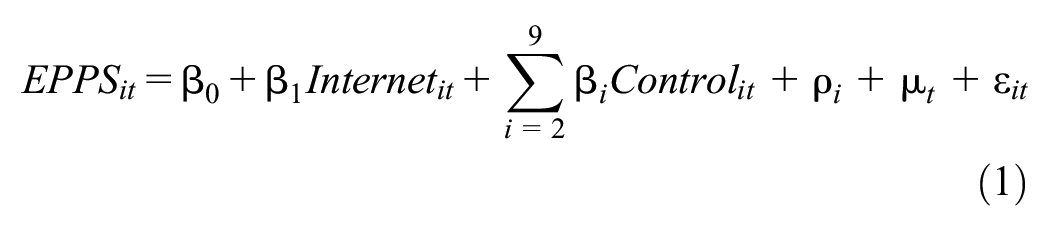
The dependent variable,
To examine whether the research hypothesis H3 is valid, that is, whether informal workers can enhance government trust and increase their participation in EPPS through the use of the Internet, and to explore the existence of the mediating mechanism path “Internet Usage—Government Trust—Participation in EPPS,” this study draws on the methodology presented by Wen and Ye (2014). The study employs a stepwise mediation approach and constructs a mediation model based on Equation 1. The model is presented as follows:


The testing process of the mediating effect model involves the following steps: First, based on the baseline regression results of Equation 1, examine whether
Empirical Results
Basic Regression Results
Table 3 presents the basic regression results of this study. In Table 3,
Regression Results of the Impact of Internet Usage on the Participation in EPPS.

Note. ***, and ** indicate statistical significance levels of 1%, and 5%; and robust standard errors are given in parentheses.
The regression results in Table 3 indicate that from Model (1) to Model (4), as fixed effects and control variables are added, the estimated coefficient of the core explanatory variable consistently remains positive at a statistically significant level of 1%. This suggests that informal workers significantly increase the possibility of participating in EPPS by using the Internet. According to the estimated results of Model (4), informal workers increase the possibility of participating in EPPS by 3.7% through the Internet usage, thus, H1 is validated.
Among the control variables, gender, nature of job, education level, age, and household variables have a significant impact on the dependent variable. The age of informal workers exhibits a significant inverted “U”-shaped relationship with participation in the EPPS. When informal workers are engaged in non-agricultural work, have a higher level of education, and have lighter family burdens, the possibility of participation in EPPS also increases correspondingly.
Robustness Tests
Probit and Tobit Model Estimation
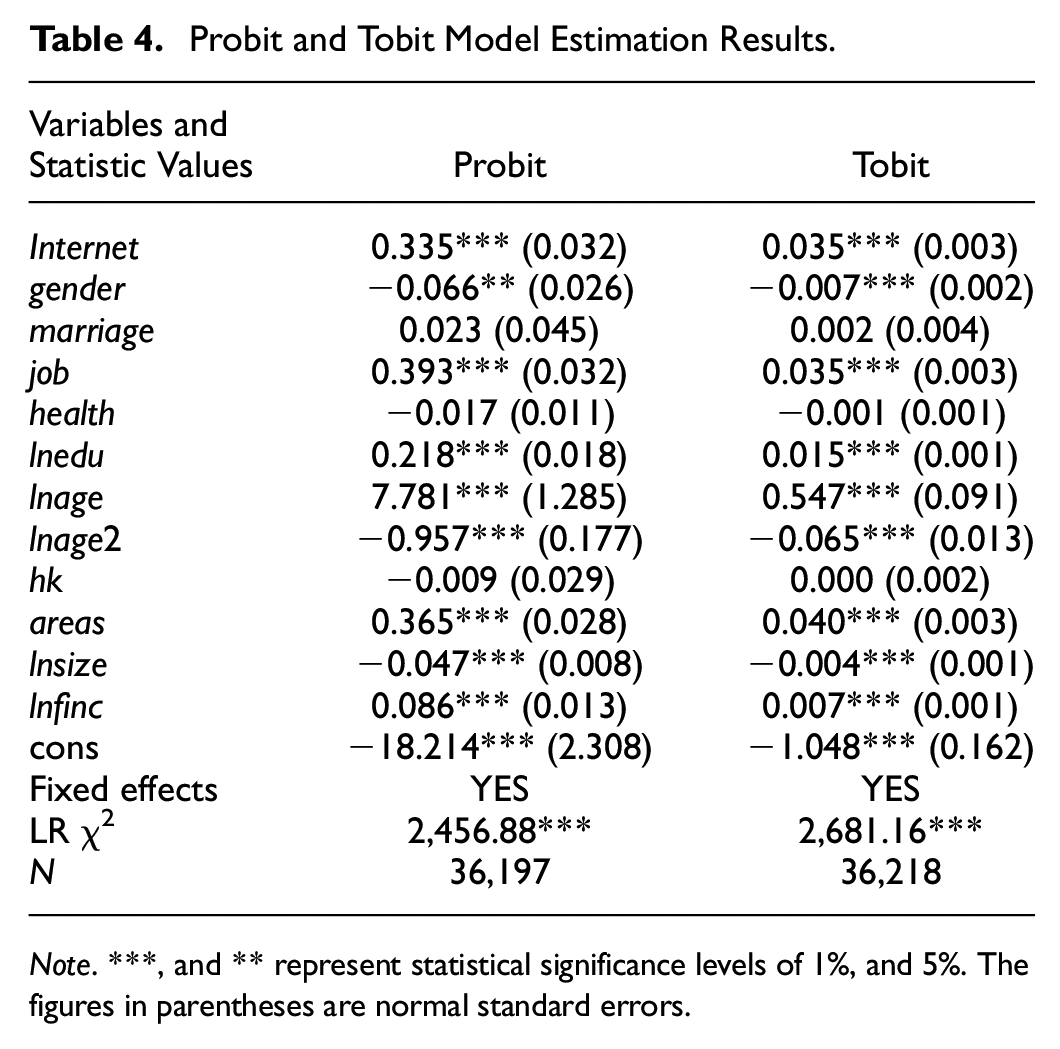
As the dependent variable is a dummy variable, Probit and Tobit model are used for re-estimation. However, as the Probit and Tobit estimation are random-effects models, they cannot accommodate individual fixed effect at the same level as the microdata. Therefore, we substituted individual fixed effect with provincial fixed effect.
As shown in Table 4, after estimation with Probit and Tobit models, the impact of the core explanatory variable, Internet use, on whether informal workers participate in EPPS remains significantly positive. The marginal effects, calculated by Probit and Tobit, are 0.029 and 0.035, respectively, and both are statistically significant at the 1% level. According to the estimation results of the Probit and Tobit models, the likelihood of informal workers participation in EPPS increases by 2.9% to 3.5% through the use of the Internet. The estimation results in Table 4 is consistent with the estimation results in the baseline regression in Table 3. Therefore, this paper concludes that the behavior of informal workers using the Internet increases their likelihood of participating in EPPS by 2.9% to 3.7%.
Probit and Tobit Model Estimation Results.
Note. ***, and ** represent statistical significance levels of 1%, and 5%. The figures in parentheses are normal standard errors.
Endogeneity
In the basic regression of Table 3, there might be endogeneity that could bias the estimation results. Despite controlling for fixed effects and control variables in the basic regression, there could still be omitted variables affecting the estimation results. Additionally, there might be a reverse causality issue between participation in the EPPS and Internet usage by informal workers. Informal workers who intentionally participate in the EPPS might need to use the Internet to gather relevant information.
To address endogeneity, 2SLS (Two-Stage Least Squares) method is used. In this study, the density of Internet port access in different regions is used as the instrumental variable (the density of Internet port access = The amount of Internet port access in different regions/The amount of permanent resident in different regions, the relevant data comes from “China Statistical Yearbook”). This choice is based on the idea that the density of Internet port access in different regions can measure the development of local Internet infrastructure. When the Internet port access density is higher in a region, it indicates that the development of Internet infrastructure in this region is more advanced. For individuals, living in a region with more advanced Internet infrastructure lowers the threshold for the Internet access. Importantly, the density of Internet port access in a region does not directly influence informal workers whether to participate in the EPPS. Therefore, theoretically, this instrumental variable meets the exogeneity assumption that instrumental variable can only affect the dependent variable through the core explanatory variable.
Table 5 reports the regression results of 2SLS. As shown in the first-stage regression results in Table 5, the instrumental variable’s impact on the core explanatory variable is statistically significant at the 1% level. With an increase in the density of Internet port access in a region, the possibility of Internet usage of informal workers in that region also increases.
Regression Results of 2SLS (IV-OLS).

Note. ***, and ** represent statistical significance levels of 1%, and 5%. Robust standard errors are shown in parentheses, and the critical value of Stock Yogo weak identification test at 10% level is shown in [].
The second-stage regression results demonstrate that the impact of Internet usage for informal workers participation in the EPPS remains statistically significant and positive, consistent with the sign observed in the basic regression in Table 3. Furthermore, tests on the instrumental variable reject the null hypotheses of weak instrument and instrument irrelevance. Therefore, it can be concluded that the basic results in Table 3 are valid.
Tables 6 and 7 present the regression results corresponding to Table 4 using instrumental variables. The instrumental variables used in Tables 6 and 7 are consistent with those in Table 5. Probit and Tobit estimations are employed for the respective models. The results in Tables 6 and 7 indicate that the impact of instrumental variables on whether informal workers use the Internet remains significantly positive. The regression results for the second stage reveal that informal workers significantly increase the probability of their participation in EPPS by using the Internet.
Regression Results of IV-Probit.

Note. *** represents the statistical significance levels of 1%. Normal standard errors are shown in parentheses.
Regression Results of IV-Tobit.

Note. ***represents the statistical significance levels of 1%. Normal standard errors are shown in parentheses.
The first-stage F-statistics in Tables 6 and 7 are 1,388.01 and 1,204.79, respectively, suggesting that the instrumental variables are strong instruments. Additionally, the Wald test values for endogeneity in both tables are 36.65 and 17.33, respectively, significantly rejecting the null hypothesis that Internet use is exogenous. Therefore, employing instrumental variables in the regression is deemed necessary, and it proves that the basic regression in Table 3 is robust.
Heterogeneity Analysis
In the baseline regression presented in Table 3, the educational level of informal workers as a control variable is significantly positive at the 1% level, indicating that the higher the educational level of informal workers, the greater the likelihood of participation in EPPS. Besides directly influencing informal workers’ participation in EPPS, the author believes that the educational level also plays a role in determining whether informal workers use the Internet. Generally, informal workers with higher educational levels are more proficient in using the Internet and can obtain relatively more useful information from it. As a result, their understanding of the EPPS program is more comprehensive. Consequently, the likelihood of their participation in EPPS through Internet usage is higher than that of informal workers with relatively lower educational levels.
Table 8 presents grouped regressions based on the educational level of informal workers. After calculating the median of the educational level for informal workers (which is 9.32 years), rounding it down, and dividing informal workers into two groups: those with an educational level at or below junior high school and those with an educational level above junior high school. As shown in Table 8, Model (1) represents the regression results for the group with an educational level at or below junior high school, and Model (2) represents the results for the group with an educational level above junior high school.
Heterogeneity Analysis on Educational Level of Informal Workers.

Note. ***, **, and * represent the statistical significance levels of 1%, 5%, and 10% respectively. Robust standard errors are shown in parentheses.
The estimated coefficients for the core explanatory variable in both groups are significantly positive at the 1% level. However, the estimated coefficient for Model (2) is 0.037, higher than the 0.013 for Model (1). This indicates that informal workers with an educational level at or below junior high school increase their likelihood of participating in EPPS by 1.3% through the use of the Internet. In contrast, informal workers with an educational level above junior high school increase their likelihood of participating in EPPS by 3.7% through the use of the Internet.
Although the estimated coefficient for the core explanatory variable in Model (2) is greater than that in Model (1), it is essential to note that these coefficients are estimated rather than true values. Therefore, comparing and judging solely based on the magnitude of the estimated coefficients is insufficient. A group-wise coefficient difference test is also required after conducting grouped regressions.
Through 1,000 bootstrap resamples, the intergroup difference coefficient between Model (1) and Model (2) is −0.024. Furthermore, this difference coefficient is significant at the 1% level based on empirical p-values. Consequently, it can be inferred that informal workers with higher educational levels have a greater likelihood of participating in EPPS through the use of the Internet compared to those with lower educational levels.
Regression on the Influence Mechanism
Table 9 shows the regression results of the influence mechanism. As mentioned before, the author believes that the Internet enables informal workers to access relevant policy information about EPPS and simplifies the enrollment procedures of EPPS, which can directly increase the possibility of informal workers for participation in EPPS. Additionally, from the above theoretical analysis and research hypothesis, the authors argue that informal workers can enhance their government trust by using the Internet, which, in turn, could indirectly increase the possibility of informal workers for participation in the EPPS. In other words, the author believes that there may be a partial mediating effect between Internet usage, government trust, and EPPS. To investigate this, a mediation effect model test is conducted, following the steps outlined in Equations 2 and 3.
Regression Results of Influence Mechanism.

Note. *** indicates statistical significance levels of 1%, and robust errors are given in parentheses.
In Table 9, Model (1), shows the regression results of the impact of Internet usage on government trust. The regression results indicate that informal workers significantly increase the level of government trust through the use of Internet. H2 is validated.
Additionally, as the estimated coefficient for Internet in Model (1) is significantly different from zero, that is,
The regression results for Model (2) in Table 9 show that the estimated coefficients for both Internet and Government Trust are significantly positive. In other words,
Conclusion
Informal workers’ participation in EPPS can provide them with a more robust retirement security. However, in reality, there is still a high proportion of informal workers who have not enrolled in EPPS. Apart from the higher contribution of EPPS, this is also related to the complexity of EPPS system design, which informal workers find challenging to comprehend. Based on data from CFPS (2014, 2016, 2018), this paper empirically analyzes the role of the Internet usage in the participation of informal workers in EPPS. The study finds that informal workers significantly increase their likelihood of participation in EPPS through the use of the Internet. The Internet facilitates informal workers in understanding relevant information about EPPS and simplifies the procedures for participation in EPPS. This promoting effect is heterogeneous concerning educational levels, with higher-educated informal workers having a greater likelihood of participation in EPPS through Internet usage. Through the analysis of a stepwise mediation effect model, government trust plays a partially mediating role between the Internet usage and EPPS. Based on these empirical results, the paper proposes the following policy recommendations:
1.The widespread availability of the Internet has fundamentally changed how people access information and services. In order to increase the participation rate of the EPPS, government can leverage online platforms to provide more convenient and efficient enrollment procedures for informal workers. Here are some specific policy recommendations:
(i)Transparent Policy Interpretation: The government should use the Internet to disseminate policy interpretations. This should include explanations of the objectives of employee public pension scheme, details about benefits payment, and contribution standards. The government can establish dedicated online platforms that offer easily understandable policy explanations, enabling informal workers to have a clearer understanding of their rights and responsibilities once they participate in the EPPS.
(ii)Provide Detailed Enrollment Procedures Guidelines Online: The government can offer comprehensive enrollment procedures guidelines for informal workers on Internet platforms, explaining to them how to apply for enrollment, fill out necessary forms, and provide required documents. This can help reduce uncertainty and confusion among informal workers during the enrollment procedures.
These policy recommendations aim to harness the power of the Internet to improve access to information, simplify enrollment procedures, and raise awareness among informal workers about the benefits of participation in the EPPS.
2.Establishing a positive image of the government is crucial to build up government trust, which is a core element in ensuring informal workers’ participation in the EPPS. To achieve this, the government can take several measures to build up government trust:
(i)Real-Time Communication and Response: The timely interaction and communication between the people and government is important, so the government should establish more Internet channels to interact and communicate with public and listen to their advice.
(ii)Providing High Quality Public Service: The quality of public service reflects on the actual attitude that government toward its people, because the people-oriented government understands the needs that its people really want. The high quality of public service that provided by government could meet the practical needs of people and enhance the level of government trust of people.
(iii)Transparency in Public Financial Matters: Enhance the government’s public financial transparency, especially concerning the operation and management of public pension scheme funds. The government can publicly disclose information about the operation of public pension scheme funds to ensure the fairness and legality of fund utilization, thereby building government trust among informal workers regarding the security of the funds.
Through these measures, the government can strengthen its image, further encouraging informal workers to actively participate in the EPPS. This policy direction is expected to have a positive impact on advancing social equity and improving the quality of life for informal workers, contributing to the enhancement of the social security system and overall societal stability.
Limitations and Direct of Future Research
This study empirically examines the likelihood of informal workers participating in EPPS by using micro survey data from CFPS, with government trust playing a partial mediating role between Internet use and EPPS participation. Despite the contributions of this research, the author acknowledges certain limitations and identifies areas for potential innovation in future studies.
Limitation
Due to the unique design of China’s public pension scheme, informal workers, when participating in public pension scheme, can choose either the “expensive” and higher-coverage EPPS or the “inexpensive” but relatively lower-coverage URPPS. Therefore, the most immediate considerations for informal workers when choosing to participate in public pension scheme are income levels and contribution burdens. Informal workers may opt for the “inexpensive” URPPS or choose not to participate in any public pension scheme due to the heavier contribution burden of EPPS. Although the study controls for variables such as “income levels,” the author did not extensively analyze and test income levels as a core explanatory variable. Currently, ongoing research is exploring the impact of income levels and contribution burdens on informal workers’ participation in EPPS.
Direction for Further Research
Public pension scheme is designed to adjust and intervene in imbalances within society. However, due to the inherent flaws in social security system design, the system itself may exacerbate societal inequalities. In future research, the author plans to explore the design of China’s public pension scheme, investigating factors influencing informal workers’ decisions to participate in EPPS. Additionally, the study aims to examine whether there is a substitution effect between public pension scheme and public medical insurance. For instance, when income levels are limited, informal workers may rationally choose to forego long-term investment in future security and seek immediate life assurance instead.
Abbreviations
Employee public pension scheme (EPPS); Urban-rural public pension scheme (URPPS); China Family Panel Studies (CFPS)
Footnotes
Acknowledgements
We appreciate the editors and anonymous reviewers for their efforts and valuable comments on this paper.
Declaration of Conflicting Interests
The author(s) declared no potential conflicts of interest with respect to the research, authorship, and/or publication of this article.
Funding
The author(s) disclosed receipt of the following financial support for the research, authorship, and/or publication of this article: This research was funded by the Philosophy and Social Science Planning Program of Henan Province “Research on the Mechanism and Countermeasures of Digital Economy Driving the Green Development of Henan Manufacturing industry” (Grant No: 2023BJJ009); Postgraduate Cultivating Innovation and Quality Improvement Action Plan of Henan University (Grant No. SYLYC2022209); Philosophy and Social Science Planning Program of Henan Province “Research on the Coupled and Coordinated Development of Digital Economy and Employment Quality” (Grant No: 2023CJJ163).

Data Availability Statement
Data will be made available on request.