




Abstract
Based on social exchange theory, this research developed a theoretical model on the impact of the internal corporate social responsibility (ICSR) of platform enterprises on employee innovation performance. Based on 414 employee data from 56 platform enterprises, hierarchical linear modeling was employed to test the model at two time points. The results revealed that the ICSR of platform enterprises has a significant positive effect on employee innovation performance, and employee intrapreneurship mediates the relationship; that is, the ICSR of platform enterprises promotes employees’ innovation performance by stimulating their intrapreneurship. Employees’ moral identity can also positively moderate the relationship between the ICSR of platform enterprises and employee intrapreneurship; the stronger the employees’ moral identity is, the stronger the positive impact of the platform’s ICSR is on the employees’ intrapreneurship. The relationship between the ICSR and employee innovation performance was clarified under platform economics. The current conclusions can guide platform enterprises’ innovation and sustainable development efforts.
Keywords
Introduction
Background
Platform enterprises, which represent an increasingly crucial business model, have received widespread attention in academia (Su et al., 2018; Wan et al., 2020). This article focuses on internal platform–based enterprises that eliminate midlevel managers and transform each functional department into a platform where small and microenterprises and entrepreneurial teams are hatched and external construction creates a shared community ecosystem (Wan et al., 2020). Employees are authorized to form an inverted triangle organizational structure, with internal employees as the leading force and external users as the driving force of platform enterprises. Employees are regarded as the backbone of internal platform organizations. The performance generated by employee innovation input has become a major indicator of the innovation and sustainable development ability of enterprises in a changing and competitive business environment (Van Wingerden et al., 2015). Particularly, in internal platform–based enterprises with employees in the main roles, employee innovation performance is a critical factor that influences both the internal team’s and the enterprise’s performance. Therefore, methods for improving employee innovation performance should be investigated by internal platform–based enterprises and academia.
Research Gap
For platform enterprises, corporate social responsibility (CSR) should not be neglected. Although platform enterprises have achieved some success despite the relatively saturated market and fierce competition, the application of CSR must still be considered in the context of the sharing economy. Some macro-level research has indicated that CSR is fundamental in improving operational efficiency (Brammer & Millington, 2005) and technological innovation (Bernal-Conesa et al., 2017). Scholars of resources and strategy have revealed that CSR promotion helps enterprises to integrate resources (Halkos & Skouloudis, 2018) and improve internationalization performance (B.-S. Han & Park, 2017). Researchers have also discussed the impact of CSR on enterprise employees at the micro level. In terms of the effect of CSR on employees’ attitudes, studies have found that CSR can improve employees’ engagement (Besieux et al., 2018), job satisfaction (Barakat et al., 2016), happiness (Li et al., 2020), and organizational commitment (Fu et al., 2014), and that it is instrumental in promoting employees’ overall professional life quality (H. L. Kim et al., 2017). Studies have also revealed the effects of CSR on employees’ behaviors; for example, enterprises’ CSR activities can promote employees’ in-role behaviors (Rupp et al., 2018), organizational citizenship behaviors (H. L. Kim et al., 2017), and philanthropic behaviors (Rodell et al., 2017), and reduce employee turnover rate (Carnahan et al., 2017). In addition, Hur et al. (2016) reported that CSR can improve employees’ creativity.
Recently, some literature has linked CSR and employee performance, and explored the relationship between CSR and employee performance from different perspectives and mechanisms (Korschun et al., 2014). Shin et al. (2016) found that perceived CSR was indirectly and positively associated with job performance sequentially mediated first through organizational identification and then job satisfaction. Zeb and Yasmin (2016) also found that CSR can promote employees’ job performance by improving employee satisfaction. Story and Castanheira (2019) studied whether this relationship was mediated by employees’ job satisfaction and affective commitment, and they found that job satisfaction partially mediates this relationship but affective commitment did not act as a mediator for the CSR–performance relationship. Obeidat (2016) provided a new perspective through case studies, and he believed that CSR could affect performance by improving employees’ work engagement. Thereafter, M. Kim and J. Kim (2020) found that CSR can improve employees’ work engagement and well-being, which play an important role in promoting their performance. Although the positive relationship between CSR and job performance has been affirmed by most scholars, some scholars think that this relationship is vague. For example, Newman et al. (2015) pointed out that employee perceptions of CSR toward employees, customers, and government can neither influence their job performance nor organizational citizenship behavior.
It can be found that, although rich research results have been obtained, there are still many differences on the impact of CSR on employee performance, and a unified conclusion has not yet been formed (Carroll & Shabana, 2010). The differences among scholars are mainly as follows: First, the “black box” of the mechanism of CSR affecting employee performance is complex and needs further exploration; and second, the framework system of CSR is rich, including multiple dimensions and levels, and the impact of different dimensions and levels of CSR on employee performance may also have significant differences (Lee, 2008). A literature review revealed that, although some scholars have discussed the mechanism of CSR’s influence on the behavior and attitude of employees from the micro level, few studies have investigated how CSR affects the innovation performance of employees (Aguinis & Glavas, 2012). Therefore, we think it is necessary to explore a new influence mechanism to explain the specific relationship between CSR and employee performance. Furthermore, many micro-level studies have not strictly distinguished between internal and external social responsibilities. Therefore, the author believes that the internal CSR (ICSR) of enterprises should be considered in micro-level studies of the impact of CSR on employees. Clarifying how ICSR affects employee innovation performance might yield valuable insights. Therefore, to investigate how internal social responsibility of platform enterprises affects employees’ innovation performance through social exchange theory is the main purpose of this article and has its significance.
Employee intrapreneurship, which is regarded as a reengineering of organizational risk and restructuring of strategy, is driven by employees who can provide the sustainable development of their enterprises with a competitive advantage (Ireland et al., 2009). Research on employee intrapreneurship has focused more on the influence of individual employee-related factors on the success of employee intrapreneurship (Floyd & Lane, 2000), and research on why and how employee intrapreneurship occurs remains relatively scattered and vague. Employee intrapreneurship has a series of influences on enterprises and organizations (Kearney & Meynhardt, 2016); however, whether it also affects individuals remains unclear.
Moral identity (MI), which refers to the moral evaluation standard of individual behaviors and attitudes, is used by individuals to compare the behaviors and attitudes of enterprises and those around them with their own moral judgments; individuals then adjust their psychological reactions and behavioral attitudes according to the evaluation results (Aquino et al., 2011). Therefore, this research employed social cognition theory and used MI as a moderating variable to investigate whether the relationship between ICSR and employee intrapreneurship is affected by the level of employees’ MI.
Research Objective and Significance
Based on the existing literature, we find that the relationship between CSR and employee innovation performance is vague, which needs to be clarified to better understand CSR. The purpose of our research is to clarify the influence of internal social responsibility of platform enterprises on employees’ innovation performance through social exchange theory. In the direct effect, we mainly discuss the relationship between internal social responsibility and employees’ internal entrepreneurship, and the relationship between employees’ internal entrepreneurship and innovation performance. In addition, we regard employee’s internal entrepreneurship as an important intermediary role and use an intermediary model to clarify the specific impact mechanism of platform enterprise’s internal social responsibility on employee’s innovation performance. Finally, we need to consider the boundary conditions of this influence effect. Therefore, we use MI as a regulating variable to discuss the boundary effect of internal social responsibility of platform enterprises on employees’ internal entrepreneurship. Our research can provide a brand-new perspective to explain how CSR affects employees’ innovation performance on the basis of existing literature, which is a new starting point and a bold attempt. In addition, our research can provide ideas for platform-based enterprises to fulfill their social responsibilities, stimulate internal entrepreneurial vitality, and achieve sustainable development.
Based on this discussion, we put forward the following research questions:
This study mainly includes the following parts. “Introduction,” as described above, introduces the research background and raises research questions; the “Theory and Hypotheses” section puts forward the research hypothesis and theoretical model; the “Research Design” section introduces data collection methods and measurement tools; the “Data Analysis and Results” section is to test the research hypothesis proposed in this article through data analysis; and the “Discussion and Conclusion” section discusses the research results of this article, including theoretical and practical significance, and puts forward the future research direction.
Theory and Hypotheses
Platform Enterprise Internal Social Responsibility and Employee Innovation Performance
Sheldon (1924) proposed the concept of CSR, and Carroll (1979), who defined CSR as a series of obligations that enterprises fulfill based on social development and hope, used the initial concept to propose the pyramid structure of CSR. Although its definition is not uniform, CSR is typically regarded as the corresponding obligations of corporations to stakeholders according to social ethics. Werther and Chandler (2010) divided CSR into internal and external social responsibility on the basis of previous research limitations and stakeholder theory; they stated that ICSR mainly focuses on management activities related to employees, such as incentives, career development, and training, whereas external CSR mainly concerns the environment, society, and consumers.
From a broader perspective, stakeholder orientation must be viewed as part of sustainability because sustainable success in an uncertain environment depends not only on the external environment but also on other stakeholders (employees) inside enterprises (Zink, 2005). Social exchange theory holds that individual activities cannot be separated from the exchange relationship according to the principle of reciprocity; that is, individuals exchange their behavior or output results for an award or remuneration provided by the other party (Blau, 1964). As stated before, ICSR mainly concerns the management practices related to employees. Enterprises attach great importance to employee welfare, the fostering of occupational commitment before recruitment, and individual health management. Therefore, enterprises fulfilling ICSR allocate more resources to employees; sensing that the enterprise cares for them, employees’ work enthusiasm and investment in innovation are then stimulated (Opoku-Dakwa et al., 2018), which improves their innovation performance as a reward. Second, fulfilling ICSR is one method of enhancing corporate MI and employees’ recognition of the enterprise. This recognition is regarded as a critical prerequisite for innovation input. Furthermore, relevant studies have indicated that ICSR can improve employees’ job satisfaction (Paluri & Mehra, 2018) and organizational citizenship behavior (Farid et al., 2019), and these factors can promote individuals’ innovation performance. Therefore, the following hypothesis is proposed:
Mediating Role of Employee Intrapreneurship
Employee intrapreneurship refers to the risk taking and strategic renewal activities of employees within the enterprise, which is the result of effective human resource management and is manifested in the behavior of individual intrapreneurs (Blanka, 2018). For both management and nonmanagement employees, organizational risk creation and strategic restructuring are the core elements of employee intrapreneurship (Belousova & Gailly, 2013). Platform enterprises typically provide employees with more entrepreneurial resources and welfare benefits, fulfill their occupational commitment, and offer a pleasant working environment. The fulfillment of these internal social responsibilities can improve employees’ self-esteem, organizational pride (Törnquist Agosti et al., 2017), and enhance employees’ sense of ownership. Farooq et al. (2017), in their research on internal and external CSR, found that ICSR can enhance employees’ sense of respect and thus enhance their identification with the organization. Employees who regard themselves as insiders and have strong organizational identity are more willing to innovate and reshape internal strategies. Platform enterprises not only decentralize power to employees but also form an independent entrepreneurial team inside the enterprise; this enables each employee to participate in the enterprise’s operation and management process (Wan et al., 2020) and simultaneously achieves the enterprise’s ICSR goals. Thus, according to social exchange theory (Blau, 1964), as the cornerstone of platform enterprises, employees can stimulate their own entrepreneurial spirit and promote the development of their team and even the enterprise through continual management innovation.
Human resources, composed of employees, are the source of enterprise innovation and the foundation of the core competence of the enterprise. Although employee intrapreneurship is not always related to innovation behavior (i.e., it is not a pure enterprise innovation practice), it has a certain internal relationship with the innovation output of employees (Valsania, 2016). Employee intrapreneurship is not only a manifestation of individual self-efficacy and internal role recognition (Blanka, 2018) but also a collection of innovation input and active reform behaviors displayed by employees according to the standpoint of the enterprise where employees can correspondingly improve their innovation output. As already stated, the flattening of the organizational structure of the platform and the devolution of authority provides employees with full autonomy; these employees then have unique institutional advantages in the utilization of resources and identification of business opportunities (Wan et al., 2020). Therefore, employees with a strong sense of entrepreneurship take full advantage of platform resources and opportunities to improve their innovation performance. Finally, behavior-based employee intrapreneurship belongs to a broader category of active strategic behaviors and plays a vital role in employee performance incentives, welfare benefits, and happiness at work (Gawke et al., 2018). At the same time, research has indicated that improving employee performance incentives (Manso, 2011) and happiness at work (Magnier-Watanabe et al., 2017) can promote individual innovation performance. On the basis of this logic, the following hypothesis is proposed:
Moderating Role of MI
In enterprise organizations, employees’ MI refers to the recognition and acceptance of individual behaviors according to a social moral system and personal moral values. Aquino et al. (2011) defined MI as a relatively stable self-concept composed of a complete set of moral characteristics. In this study, it was argued that the MI of employees can be a critical moderator between the ICSR of platform enterprises and employee intrapreneurship. First, as the moral criterion for individual behaviors and attitudes, moral identification involves individuals comparing the behaviors and attitudes of others with their own moral judgments, and then adjusting their behaviors and attitudes according to the evaluation results (Aquino et al., 2011). The fulfillment of ICSR goals of platform enterprises involves a series of management activities related to the positive development of employees. In the process of fulfilling these responsibilities, platform enterprises can create a highly responsible enterprise atmosphere and working environment for employees. And this process can bring stronger psychological impact on employees who are with high MI. Therefore, employees with a strong MI more easily form a sense of corporate identity at the psychological level when the enterprise complies with its responsibilities; such contexts strengthen the psychological contract bond established with the enterprise, which is reflected in individual behaviors and attitudes. Social cognition theory (Bandura, 1986) holds that individuals in a given environment can adjust their behaviors and attitudes to conform to their own moral standards by collecting information around them. Moreover, employees with strong MI pay more attention to the MI of the enterprise and tend to actively capture the moral information of the enterprise (Eisenbeiss & Van Knippenberg, 2015). Therefore, it is easier for platform enterprises to implement internal responsibilities to stimulate employees with a strong MI from the information-receiving level, and such employees are likely to perform the equivalent or even more intrapreneurial behaviors according to this information on morality. However, employees with low MI are not sensitive to the moral environment and tend to ignore the moral information around them. Finally, according to social cognition theory (Bandura, 1986), employees’ MI is a psychological mechanism that converts moral information into corresponding ethical and moral behaviors on the basis of moral cognition (Leavitt et al., 2016). Therefore, platform enterprises’ internal responsibility can stimulate to a greater extent the positive attitude and intrapreneurial behavior of employees with strong MI. Accordingly, the following hypothesis is proposed:
This study’s theoretical model is illustrated in Figure 1.

Theoretical model.
Research Design
Sample and Data Collection
Data collection mainly had the following difficulties. The research content of this article was platform enterprises, and we need to consider how to judge whether it was a platform enterprise. To make the research object more suitable for the research topic, the investigated enterprises need to meet two major requirements. That was, they belonged to internal platform enterprises (platform enterprises with the characteristics of internet, multilateral market and network effects, and empowerment through internal platform organizational changes) and had entrepreneurial derivative mechanism. Therefore, college teachers, MBA students, and some business people have built a bridge for data survey. The field research conducted on most samples in this study was solid. Therefore, before the investigation, we communicated with the senior management of the companies and have been given approval. Thereafter, we sent the questionnaire to the investigation objects through email and informed them about the matters requiring attention. Finally, the participants returned the completed questionnaire through email. To avoid high autocorrelation and common method bias and improve the reliability of the data and results, all the data were collected in two stages in this study, lasting 2.5 months. Also, to facilitate data matching, we required each participant to leave the last four digits of their mobile phone number in the two-stage survey. The participants of this study were knowledge employees at internal platform enterprises in Fujian, Guangdong, Jiangsu, and Shanghai, who were mainly involved in the fields of science and technology, culture, and services. The selected employees were mainly from the research and development and design departments, including some team leaders. In this study, data were collected twice (with a 1-month interval) by means of online and paper self-administered questionnaires. In the first survey, the employees provided feedback on the ICSR scale of the enterprise. In total, 543 questionnaires were issued and 537 were returned. In the second survey, employees completed questionnaires on MI, employee intrapreneurship, and innovation performance. Of the 537 questionnaires issued, 526 were returned. After the researcher rejected unqualified questionnaires, 414 valid questionnaires were obtained (response rate = 78.7%) involving 56 enterprises (5–9 individuals per enterprise). Male respondents accounted for 50.5% and those aged below 40 years, with a bachelor’s degree or above, or with more than 5 years of experience accounted for 60.6%, 75.8%, and 45.9%, respectively.
Measures
Widely used domestic and foreign measurement instruments were consulted to inform the development of the current scales; a 5-point Likert-type scale, ranging from 1 (strongly disagree) to 5 (strongly agree), was employed. Before formulating the scale, English teachers and management teachers back-translated the scale; subsequently, the original foreign scale and translated version were discussed and revised by two other management teachers to obtain the final formal Chinese scale.
ICSR
The ICSR scale was formulated after the scales of Farooq et al. (2017). Specific content related to platform enterprises’ internal responsibility was generated through enterprise interviews, and the questions were scored using an expert consultation method. Finally, the platform enterprise ICSR scale, containing seven items, was finalized. The following is a sample statement on the scale: “My enterprise provides me with necessary entrepreneurial resources.” The Cronbach’s alpha for MI was .910, average variance extracted (AVE) was 0.586, and composite reliability (CR) was .908, and the factor loading of the seven items were higher than 0.53, indicating a greater level of both convergent validity and internal reliability for the scale (Table 1).
Reliability and Validity Test of the Scales.

Note. CA = Cronbach’s alpha; CR = composite reliability; AVE = average variance extracted; df = degrees of freedom; CFI = comparative fit index; TLI = Tucker–Lewis index; RMSEA = root mean square error of approximation.
MI
The MI scale was developed by Aquino and Reed (2002) and contains 10 items, such as “It makes me feel good to be someone with these qualities.” Before completing the questionnaire, some descriptive words related to ethical and moral characteristics were listed, such as kindness, honesty, and justice, and then respondents rated these descriptions according to their level of each characteristic. The Cronbach’s alpha for MI was .910, AVE was 0.552, and CR was .925, and the factor loading of the seven items were higher than 0.53, indicating a greater level of both convergent validity and internal reliability for the scale.
Employee intrapreneurship (EI)
The employee intrapreneurship scale was developed by Gawke et al. (2018) and contains eight items, such as “I will provide input on the strategic update of the enterprise.” The Cronbach’s alpha for the MI scale was .898, AVE was 0.583, and CR was .918, and the factor loading of the seven items were higher than 0.53, indicating a greater level of both convergent validity and internal reliability for the scale.
Innovation performance (IP)
The innovation performance scale was developed by Y. Han et al. (2007) and contains eight items, such as “I will offer new ideas to improve the present situation.” Cronbach’s alpha for the IP scale was .871, AVE was 0.530, and CR was .900, and the factor loading of the seven items were higher than 0.53, indicating a greater level of both convergent validity and internal reliability for the scale. The reliability and validity of the scales are shown in Table 1.
Because employees’ intrapreneurship and innovation performance may be affected by their sex, age, education, length of service, and the size of the enterprise (Wan et al., 2020; Liu et al., 2020), these factors were regarded as control variables to maximize the reliability of the results.
Data Analysis and Results
Polymerization Analysis
The ICSR scale was completed by enterprise employees; however, ICSR may vary at the enterprise level, therefore it had to be aggregated at the enterprise level. Because calculations indicated that rwg = .81, intraclass correlation coefficient (ICC; 1) = 0.38, and ICC(2) = 0.82, the measurement data of social responsibility within the platform enterprise met the requirements of aggregation to the enterprise level.
Reliability and Validity Testing
Harman’s single-factor test was used for factor analysis. Four factors were extracted using a principal component analysis: The first principal component obtained without rotation accounted for 25.56%, which did not exceed the critical value of 40%. Therefore, the homologous error was not obvious in this research. The discriminant validity among variables was investigated, and the goodness of fit of the four-factor model was examined using confirmatory factor analysis with Mplus software (Table 2). The following results were obtained: χ2/df = 1.897, comparative fit index (CFI) = 0.932, incremental fit index (IFI) = 0.933, Tucker–Lewis index (TLI) = 0.927, root mean square residual (RMR) = 0.040, and root mean square error of approximation (RMSEA) = 0.046. The current model was clearly superior to related models, which indicates that the four factors in this study had good discriminant validity.
Confirmatory Factor Analysis Results.

Note. Four-factor model: ICSR, MI, EI, IP; Three-factor model: ICSR + MI, EI, IP; Two-factor model: ICSR + MI, EI + IP; Single-factor model: ICSR + MI + EI + IP. ICSR = internal corporate social responsibility; MI = moral identity; EI = employee intrapreneurship; IP = innovation performance; df = degrees of freedom; CFI = comparative fit index; IFI = incremental fit index; TLI = Tucker–Lewis index; RMR = root mean square residual; RMSEA = root mean square error of approximation.
Descriptive Statistics and Correlation Analysis
Table 3 presents the mean value, standard deviation, and correlation coefficient of the variables involved in this study. At the individual level, employee intrapreneurship was significantly positively correlated with employee innovation performance (r = .587, p < .001).
Mean Value, Standard Deviation, and Correlation Coefficient of Variables in This Study.
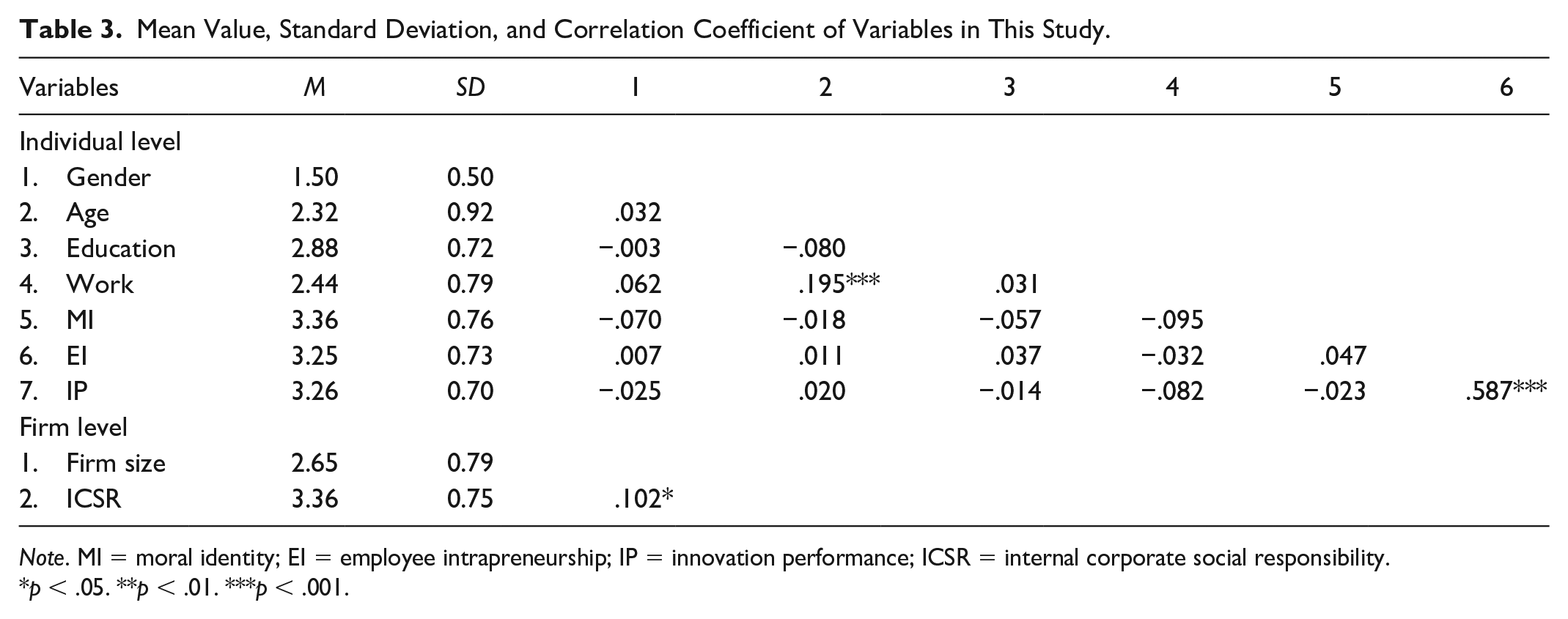
Note. MI = moral identity; EI = employee intrapreneurship; IP = innovation performance; ICSR = internal corporate social responsibility.
p < .05. **p < .01. ***p < .001.
Hypothesis Testing
Because the theoretical model in this research included variables at both the enterprise and individual level, hierarchical linear modeling (HLM) was employed to test the hypotheses. First, the ICC values of individual variables were investigated before hypotheses testing to confirm that they were suitable for HLM. In this study, the outcome variables at the individual level included employee intrapreneurship and innovation performance; therefore, zero models were constructed accordingly. Testing revealed that the ICC of employee intrapreneurship and innovation performance was 0.35 and 0.23, respectively, indicating that 35% and 23% of the variation in employee intrapreneurship and innovation performance were explained by between-enterprise variables; therefore, cross-layer analysis could be performed.
To control the relevant variables at the individual and enterprise levels, this researcher employed HLM to conduct hypothesis testing. First, in the cross-layer analysis of employee innovation performance (Table 4; M2), ICSR had a significant positive impact on employee innovation performance (β = .550, p < .001), indicating that improving ICSR can promote the innovation performance of employees. H1 was therefore verified.
Multilayer Linear Regression Analysis Results.

Note. R2total = R2intraclass × 1-ICC(1) + R2interclass × ICC(1). EI = employee intrapreneurship; ICSR = internal corporate social responsibility; MI = moral identity.
p < .05. **p < .01. ***p < .001.
Second, in the same-level analysis of employee intrapreneurship and employee innovation performance, the results revealed that (M3) employee intrapreneurship had a significant positive impact on employee innovation performance (β = .556, p < .001). In the cross-layer analysis of ICSR on employee intrapreneurship (M6), the results indicated that ICSR had a significant positive effect on employee intrapreneurship (β = .719, p < .001). When employee innovation performance was input as the outcome variable and employee intrapreneurship and ICSR as the first and second variables, respectively, cross-layer analysis revealed that (M4) ICSR had a significant positive impact on employee innovation performance (β = .191, p < .01), indicating that employee intrapreneurship partially mediates ICSR and employee innovation performance; therefore, H2 was verified. To test the mediating effect more accurately, the Sobel test and bootstrap method were used. The test results are listed in Table 5. The estimated mediating effect value was 0.229 (SE = 0.025, 95% confidence interval [CI] = [0.184, 0.282]) and the absolute value of Sobel Z was greater than 1.96, indicating that the mediating effect of employee intrapreneurship was obvious, which verified H2 again.
Mediating Effect Test Results of the Sobel Test and Bootstrap Method.

Note. If the upper and lower limits of the interval do not include 0, the effect is significant; otherwise, it is insignificant. CI = confidence interval; ICSR = Internal corporate social responsibility; EI = employee intrapreneurship; IP = innovation performance.
ais the regression coefficient of the first stage, bis the regression coefficient of the second stage, SE is the standard error.
p < .05. **p < .01. ***p < .001.
Finally, the moderating effect of MI was tested. This is a test of cross-level moderating effect. We regarded CSR as an organizational factor, whereas employees’ internal entrepreneurship and MI were individual factors. Therefore, we used HLM software to test the cross-layer regulatory effect. The interaction between ICSR and MI had a significant positive effect on employee intrapreneurship (β = .398, p < .01), indicating that MI can play a positive moderating role between ICSR and employee intrapreneurship (Table 4, M7). Therefore, H3 was verified. The simple moderating effect is illustrated in Figure 2.
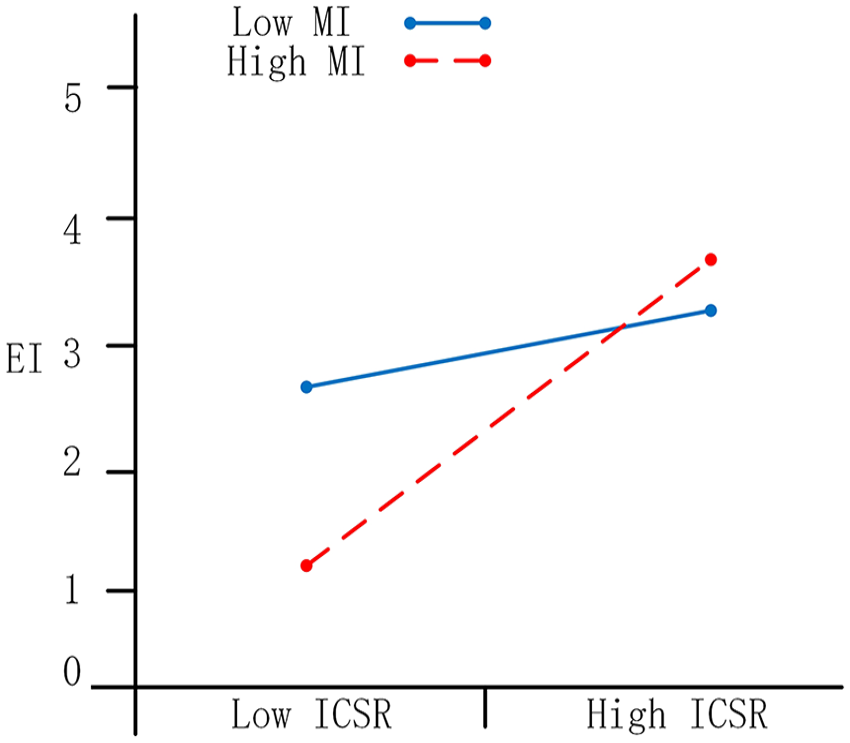
The simple moderating effect of MI.
After the preliminary moderating effect test, we used the PROCESS program in SPSS22.0 to test the moderating effect with the bootstrap method. The bootstrap sampling number was set to 5,000 times, and the confidence level of the CI was set to 95%. Through the test, it was found that MI played a moderating role between main effects (Table 6), so H3 was supported.
Moderating Effect Test of the Bootstrap Method in PROCESS Program.
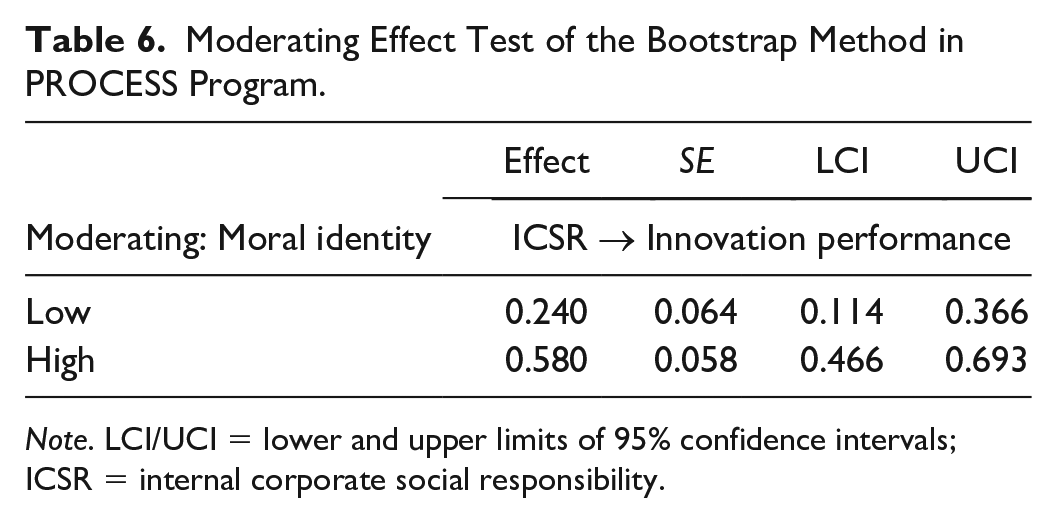
Note. LCI/UCI = lower and upper limits of 95% confidence intervals; ICSR = internal corporate social responsibility.
Discussion and Conclusion
Conclusion and Theoretical Implications
With the theory of social exchange as its foundation, this study investigated the mechanism by which the ICSR of platform enterprises influences the innovation performance of employees through their employee intrapreneurship. Moreover, the moderating effect of employees’ MI on ICSR and employee intrapreneurship was examined by employing social cognition theory. The principal research results are discussed next.
First, platform enterprises’ ICSR has a significant positive effect on employee innovation performance. Gupta et al. (2017) constructed a conceptual model of ICSR and employee innovation performance on the basis of stakeholder theory. This study empirically verified the relationship between ICSR and employee innovation performance and obtained results consistent with the conceptual model. Second, in consideration of the platform economy, this research formulated the ICSR scale of platform enterprises based on previous studies (Farooq et al., 2017) and verified its relationship with employee innovation performance. Therefore, this research revealed the relationship between the ICSR of platform enterprises and employee innovation performance, and edited the scale of ICSR of platform enterprises, which broadens the research perspective of CSR.
Second, employee intrapreneurship can play a mediating role between the ICSR of platform enterprises and the innovation performance of employees. In the context of innovation and entrepreneurship, discussing how to promote employee intrapreneurship and what impact this spirit has on enterprises, organizations, and employees is imperative (Belousova & Gailly, 2013). However, studies on the propositional and outcome variables of employee intrapreneurship remain scattered and vague (Blanka, 2018). This study found that the ICSR of platform enterprises can promote employee intrapreneurship, which in turn can promote improvements in employees’ innovation performance. This conclusion not only reveals the specific influence mechanism of platform enterprise ICSR on employee innovation performance but also expands theoretical knowledge on employee intrapreneurship.
Third, the MI of employees can positively moderate the positive relationship between the ICSR of the platform enterprise and employee intrapreneurship. That is, the higher the degree of MI of employees, the more the internal responsibility of the platform enterprise can improve the employees’ intrapreneurship. Related studies have focused more on the causal relationship between CSR and MI, and the mediating role of MI between CSR and employee behavior and attitude (Farid et al., 2019). This research used MI as a situational variable to investigate its moderating role, and the conclusion regarding the MI of employees has broadened the extent of the effect of CSR on the behavior and attitude of employees and has contributed to theoretical research on MI.
Practical Implications
The main purpose of management research is to provide guidance for the daily management practice of enterprises according to the latest findings. The conclusions of this study may enhance the sustainable and healthy development of platform enterprises. Some suggested practices are provided next.
First, fulfill social responsibilities actively. In the platform economy, the social responsibility of platform enterprises is crucial for promoting the development of enterprises and maintaining their social reputation. This research revealed that platform enterprises’ fulfillment of ICSR can improve employees’ innovation performance. Therefore, platform enterprises should prioritize the fulfillment of internal social responsibilities (Malik et al., 2020), actively realize the promises made to employees before and after recruitment, and nurture the relationship with employees. The internal platformization of enterprises involves the formation of employee intrapreneurship mechanisms. Therefore, platform enterprises should consider the ICSR of general enterprises and maximize entrepreneurial opportunities and resources to the strategic height of ICSR and maintain an environment that is conducive to internal employees starting businesses (Zhao et al., 2020). Of course, platform enterprises should also consider external social responsibility. The sustainable development of the platform economy cannot be separated from its multiple stakeholders; therefore, it is necessary to consider social environment, social morality, and consumers within the scope of social responsibility and establish a sound internal and external social responsibility system.
Second, pay attention to the cultivation of an entrepreneurial spirit in employees. Employee intrapreneurship is reflected in organizational innovation and the strategic remodeling behavior of internal employees, which are vital for improving corporate performance (Kearney & Meynhardt, 2016) and the sustainable development of the organization (Floyd & Lane, 2000). This research found that employees’ intrapreneurship leads to an improvement in their innovation performance. Therefore, in the current innovation and entrepreneurship environment, platform enterprises should not only emphasize the entrepreneurship of leaders and entrepreneurs but also value the entrepreneurship of ordinary employees. The current findings suggest platform enterprises should treat each employee as an insider, provide superior entrepreneurial opportunities and resources for each intrapreneurial team and to teams and employees with entrepreneurial intention, and enhance the organizational identity and pride of employees (Liu et al., 2020). In this manner, employees with full autonomy, and who are driven by internal motivation, can engage in innovation-related practices. Platform enterprises should also enrich the theoretical knowledge of internal employees through a series of activities such as entrepreneurship training, after recruitment, which not only encourage employees to innovate but also cultivate the characteristics and spirit that employees should have as intrapreneurs.
Third, guide employees’ moral orientation and values appropriately. This study revealed that employee MI positively regulates the positive relationship of ICSR and employee intrapreneurship; therefore platform enterprises must actively fulfill their CSR and enhance their corporate image. Platform enterprises should also cultivate personal ethical quality and actively guide their staff’s moral orientation and values to correspond to those of the enterprise; these values help staff to meet the demands of the enterprise and foster innovation.
Limitations and Future Research Directions
Although some useful results have been obtained, the limitations of this study should be acknowledged. First of all, this study’s respondents are mainly concentrated in Fujian, Guangdong, Jiangsu, and Shanghai. Therefore, the research results may not necessarily represent platform enterprises in other regions. Future studies could expand the research scope and add platform enterprises from different business sectors. Second, although this study revealed the influence of ICSR on employee intrapreneurship, the internal influence mechanism was not clarified. Therefore, future studies could investigate the mechanisms mediating employee psychological characteristic variables and organizational variables. In addition, whether the influence of CSR within a platform enterprise on employee intrapreneurship is affected by other situational variables remains unclear; thus, future studies could investigate the moderating effect of organization-level variables. Finally, two questions remain for future research. In addition to employee innovation performance, does ICSR of platform enterprises have an impact on other behaviors and attitudes of employees? For example, in the process of fulfilling internal responsibilities to employees, do enterprises induce employees’ unethical pro-organizational behavior?
Footnotes
Acknowledgements
The authors thank the editors and reviewers for their valuable contributions to the improvement of the article. Meanwhile the translation agency, Wallace Academic Editing, has made an important contribution to the readability of this article.
Declaration of Conflicting Interests
The author(s) declared no potential conflicts of interest with respect to the research, authorship, and/or publication of this article.
Ethics Statement
This research was carried out in accordance with the recommendations of moral rule for empirical research and approved by the Academic Committee of Business School of Huaqiao University; all participants were assured that their participation was voluntary and that their anonymous responses would be kept strictly confidential. In the cover-page of the questionnaire, it was clearly stated that “all your responses in this survey will be collected anonymously and be kept confidentially, and only be used for research.”
Funding
The author(s) disclosed receipt of the following financial support for the research and/or authorship of this article: This research project was supported by China Postdoctoral Science Foundation (grant no. 2018M632573).
