




Abstract
Due to organizations’ unsatisfactory and ineffective environmental performance, scholars focused on employee behavioral improvements rather than relying primarily on technological advancements. This study intended the role of strategic HR practices toward talent retention through job satisfaction and employee work engagement in Pakistan’s education sectors. Additionally, this study examined the moderating impact of psychological empowerment on job satisfaction and work engagement toward talent retention and how they affect universities’ environmental performance. Past empirical research projects and related theories have helped in the creation of the conceptual model. The relevant associations were investigated in this study using a sample of 332 employees from the education sector of Pakistan. The partial least squares structural equation modeling (PLS-SEM) method is used to evaluate these elements in the current research investigation. The analysis showed that strategic HR practices positively influence talent retention in the education sector. Work engagement and job satisfaction positively mediate the relationship between strategic HR practices and talent retention. Furthermore, psychological empowerment positively moderates the relationship between job satisfaction and work engagement toward talent retention. Executives and policy-makers of education sectors get benefit from strategic HR practices in an environmentally friendly setting by learning how to foster a culture to improve sustainability and talent retention that sets organizational environmental values.
Plain language summary
Despite the previous research and basis of AMO theory, this investigation aims to conclude how strategic HR practices are pivotal in talent retention, especially in Pakistan. Further, this study determines the mediating mechanisms of employee results (work engagement, job satisfaction) and psychological empowerment moderating role. More precisely, three research questions are addressed in this study: First, do strategic HR practices impact talent retention? Second, do work engagement and employee’s job satisfaction mediate the relationship between strategic HR practices and talent retention? Finally, does psychological empowerment moderate the relation of strategic HR practices with talent retention? The remaining parts of the study are as laid out: Section 2 discusses an outline of prior literature. Section 3 deals with materials and methods. Section 4 reports data analysis and study results. Section 5 deliberates the findings of the study. Finally, section 6 concludes the study and provides policy recommendations.
Keywords
Introduction
In the most highly competitive digital era, human capital is a crucial part of where organizations must take good care of their employees. Talent management includes high-quality human resources, developing their skills and expertise, and consistently inspiring them to enhance their performance (Hassan, 2022). Organizations are presently confronted with numerous challenges and threats from internal and external surroundings. HR specialists confront a significant challenge in recruiting and selecting the ideal employee. So, there is a vital need to build employee retention strategies (Chapano et al., 2023). Internal and external forces have impacted HRM functions, such as recruitment, selection, training, and rewards (Khan et al., 2019). According to previous research, several organizations have increased their focus on monetary and non-monetary rewards to oversee employees’ lifestyles, well-being, and involvement (Kushwaha et al., 2022). Therefore, firms need to consider the political, social, legal, economic, and employment aspects in their incentive plans and the job market environment in business. It is considered that more innovation and new strategic HRM practices are required to improve employee performance, satisfaction, and motivation (Infante & Darmawan, 2022). Surrounding factors typically impact all strategic HRM activities, but they impact the reward system components, such as monetary and non-monetary benefits.
A comprehensive reward system encompasses several elements: total pay, variable pay, benefits, and recognition. These elements directly affect the performance of sustainable talent (Chantal et al., 2022). HRM has long used the idea of an entire reward system as an effective talent management tool. Companies should use monetary and non-monetary rewards to attract new talent and engage existing staff (Škerháková et al., 2022). Additionally, corporations should provide a reward policy that would be appropriate to the real needs of employees (Tabiu & Nura, 2018). Strategic HRM develops an efficient reward system to engage, motivate, and retain the best staff, as the best employees directly influence sustainable organizational effectiveness (Tabasum & Rehman Shaikh, 2022). By formulating and striving to achieve efficient strategic HRM strategies, specifically reward strategies, companies may draw in and keep talented employees who positively contribute to their missions. This may retain, empower, enthusiastic, and productive talent (Tabiu & Nura, 2018).
According to previous research, employee turnover can decrease the performance of companies and is costly to encompass replacement costs, and HR professionals prioritize retaining talented employees (Redondo et al., 2021). Academic staff turnover in Ethiopian universities has increased, but the impact of employee turnover denotes an additional burden for current staff. Employee absenteeism rises due to increased workload, which lowers employee morale and increases stress levels (Singh, 2018). Furthermore, job satisfaction, employability, chances for promotion, training opportunities, and relationships with peers and managers were important determinants influencing employee turnover intention (Kebede & Fikire, 2022). Instructors’ job satisfaction is preeminently anticipated by job security. It is preferred that mentors be encouraged and interested in enhancing their performance in the educational process by providing better career growth, stable jobs, and appropriate work conditions (Afaq et al., 2022). According to the past researcher, academic staff job satisfaction is meaningfully related to reimbursement, job safety, and working conditions. Employees favor staying in a group that permits them to advance and grow on a pathway to success, and compensation strategies are quite effective in attraction and retention valuable resources (Kumar, 2022).
Despite the previous research and basis of AMO theory, this investigation aims to conclude how strategic HR practices are pivotal in talent retention, especially in Pakistan. Further, this study determines the mediating mechanisms of employee results (work engagement, job satisfaction) and psychological empowerment moderating role. More precisely, three research questions are addressed in this study: First, do strategic HR practices impact talent retention? Second, do work engagement and employee’s job satisfaction mediate the relationship between strategic HR practices and talent retention? Finally, does psychological empowerment moderate the relation of strategic HR practices with talent retention? The remaining parts of the study are as laid out: Section 2 discusses an outline of prior literature. Section 3 deals with materials and methods. Section 4 reports data analysis and study results. Section 5 deliberates the findings of the study. Finally, section 6 concludes the study and provides policy recommendations.
Review of Literature and Hypothesis Development
Strategic HR Practices
Globalization has taken over the world. Technological developments have developed rapidly, and companies are undergoing transformational change to be competitive in the worldwide job marketplace. Therefore, the importance of HRM has increased. The past study (Ore & Sposato, 2022) highlighted a crucial factor in recruiting new hires with the required knowledge and capabilities to support the achievement of corporate goals. Using the Internet, the first step toward practicing recruitment occurred in the mid-1990s. The public media dubbed it the recruitment revolution due to its success, significantly benefiting organizations and HRM (Jayaram et al., 2017). The researcher (Dam et al., 2023) concluded that intelligent automated systems comprise a new approach to staff management and improving productivity. The influence of innovation has been revealed by focusing on HRM strategies and HRM practices such as recruiting, training, and job performance (Vrontis et al., 2022). By following the selection of staff, who are qualified and appropriate for the position in HRM, training is held for these employees to help them get familiar with their positions and acquire knowledge about their jobs. The basic concept of instructional design can be restructured (AlHamad et al., 2022). These teachers can gauge how quickly each student can grasp new concepts. When a concept is unclear, the instructors can provide a detailed explanation. Additionally, the training’s pace can be changed in response to employee feedback (Kambur & Akar, 2022).
The author (Sánchez et al., 2015) concluded that compensation is the most vital component of a position that influences employee inspiration and behavior. A competitive salary and incentive structure are required to invite talent, and monetary recompenses are broadly used to retain staff (Kumar, 2022). Furthermore, a staff’s skills and attributes influence organizational path planning and increase performance value, creating a company’s success in HR responsibilities. Encourage innovativeness by utilizing E-HRM technology to improve quite flexible human resource practices, expedite tasks, and redefine work and personal interaction and behavioral patterns (Kutieshat & Farmanesh, 2022). A prior study (Tabasum & Rehman Shaikh, 2022) highlighted that compensation and rewards positively impact employee retention rates. According to previous findings, internal and external rewards have encouraged to improve employee job performance (Chantal et al., 2022). Staff members are pleased with the institutions through compensation and reward system. However, this level of satisfaction must be monitored regularly to ensure that employees, the institution’s most valuable asset, faithfully carry out their allotted tasks and perform constructively (Marasigan et al., 2019).
Talent Retention and Strategic HR Practices
Talent retention and strategic HR practices are critical in an existing competitive business environment, where organizations must retain their top-performing employees to remain competitive (Mbugua et al., 2014). The process of retaining skilled and talented resources within a company for a long time is known as talent retention (Imna & Hassan, 2015). Strategic HR practices refer to human resource management activities designed to align HR guidelines and practices with the administration’s strategic resolutions (Chiboiwa et al., 2010). The effective implementation of strategic HR practices can help organizations retain their talented employees by generating a positive work atmosphere, providing prospects for career growth and development, and contributing modest compensation and reimbursement packages. These practices can include employee engagement initiatives, mentoring and training programs, flexible work provisions, and succession planning (Al-Hajri, 2020).
In a past study, researchers (Chen & Huang, 2009) focused on a main component of talent retention in terms of employee talent development. Talent retention and development are related, and employee retention follows. A high retention rate reflected employee satisfaction and business performance (Siripipatthanakul et al., 2022). The previous study defined talent management as an organizational HRM process used to recruit, train, inspire, and keep engaged and productive employees (Škerháková et al., 2022). Past research highlighted a substantial relationship between teachers’ perceptions of talent management strategies and the level of positive enthusiasm for work (Rumawas, 2021). Past studies (Dam et al., 2023) concluded that psychological contracts are crucial for young talent commitment in Vietnam and the more competitive environment. There is a significant implication for understanding how generational differences and cultural influence enable companies to retain their talented staff.
There are several strategies for putting talent management plans into action. Still, success generally depends on applying a mixed strategy, in which other management divisions support the HR functions to get the most out of the investment made in talent management (Hoa et al., 2022). According to previous research findings, talent management methods are essential to overall HR strategies (Akunda et al., 2018). Another study (Muhammad & Shao, 2017) highlighted that HR practices, especially recruitment, and selection, have extreme importance in organizational success. The author (Elrehail et al., 2020) indicated that talent management significantly impacts perceived organizational backing and employee retention. These arguments supported our study to retain people based on their talent and give value to the organization. Another study also supported the talent retention factor through HR practices (Wehelmina Rumawas, 2021). From the above discussion, we hypothesized,
Mediating Role of Job Satisfaction
Strategic HRM is aligning HR practices with the overall strategic goals of an organization (Khandelwal & Shekhawat, 2018). One important outcome of strategic HRM is talent retention, which refers to an organization’s ability to retain talented employees. Job satisfaction is an important factor influencing talent retention (Kiragu & Marwa, 2022). Job satisfaction is crucial in the association between strategic HRM and work engagement, influencing employee retention. Strategic HRM practices promote job-enhancing employee satisfaction by allowing them to grow their skills, offering competitive compensation packages, rewarding employee performance, and promoting a positive work-life balance (Chiboiwa et al., 2010). Job satisfaction increases a worker’s likelihood of staying with the company, which helps retain talent (Sikora & Ferris, 2014). Additionally, job satisfaction can lead to increased productivity, better job performance, and reduced absenteeism and turnover. Organizations that implement effective strategic HRM practices and focus on improving job satisfaction are more likely to retain their talented employees (Izvercian et al., 2016).
Acquisition of new talent is linked to staff retention through talent development. A high retention rate indicated staff satisfaction and proved more effective (Siripipatthanakul et al., 2022). Additionally, benefits and competitive salaries are essential to retaining staff at the organization. Competitive market salaries and benefits attract and retain high-quality talent. These factors directly impact staff retention (Iqbal et al., 2017). The past researchers highlighted a substantial influence of talent development on the intention to stay (Damayanti Aprilia et al., 2022). Employee satisfaction is associated with firm rewards in the corporation. Compensation, institute reputation, and workplace culture are the main factors of job satisfaction that influence talent retention (Jain, 2015). In contrast to prior research, this research found that the acquisition of talent effect employee job satisfaction (Almomani et al., 2022). The significant association between talent retention and job satisfaction was that high job satisfaction increases a greater likelihood of employee retention in firms (Andoh et al., 2021). As a result, HR practices substantially influence employee job satisfaction toward talent retention. Therefore, we hypothesized,
Mediating Role of Work Engagement
Work engagement represents a worker’s level of involvement, zeal, and commitment toward job and employer. Strategic HRM is the deliberate and planned use of human resources to achieve organizational objectives (Elrehail et al., 2020). An organization’s capacity to keep valuable and effective people is referred to as talent retention. When employees are involved in their work, they are more prone to be dedicated to their organization and to stay with it longer (Jain, 2015). Engaged employees are also more productive, which contributes to achieving organizational objectives. Effective strategic HRM practices can contribute to work engagement by offering possibilities for development and advancement to workers, clear expectations and goals, and supportive supervision (Memon et al., 2021). Workers are more likely to be engaged in their work by providing these opportunities, contributing to talent retention (Janjua & Gulzar, 2014). On the other hand, work engagement can also facilitate the implementation of effective strategic HRM practices (Khandelwal & Shekhawat, 2018). Employee engagement increases involvement in training and development initiatives, provides feedback, and contributes to developing strategic HRM practices (Mbugua et al., 2014). Engaged employees are more likely to be dedicated to their company, more productive, and more inclined to work there for an extended time. Strategic HRM practices that promote work engagement can contribute to talent retention (Al-Hajri, 2020).
The past researcher identified training and performance evaluations as the two main factors that affected employee commitment at the workplace (Visser et al., 2021). Engaged employees can facilitate the implementation of effective strategic HRM practices. Moreover, work engagement mediates toward employees’ achievement with HRM practices, leading to minimal turnover intention (Memon et al., 2021). Past studies observed that organizational obligation and employee job satisfaction were positively correlated (Khandelwal & Shekhawat, 2018; Van Dyne et al., 2003). Engagement significantly impacts individual contributions to anticipate organizational commitment (Cherif, 2020). According to a past study, in higher education, HRM practices contributed to employee organizational obligation. Furthermore, work engagement mediated the positive association between performance appraisal and organizational commitment related to a previous study (Aboramadan et al., 2020). The previous study’s findings supported our study that works engagement positively mediates between talent administration and talent retention (Shaaban, 2018). HRM, change management, and work engagement in the information technology sector execute specific talent retention practices to keep employees engaged with their work and their organization (Akunda et al., 2018). The outcomes of past research revealed that there is a moderate-to-strong positive affiliation between the rewards that can predict trust and work engagement (Victor & Hoole, 2017). Based on above discussion it hypothesized,
Moderating Role of Psychological Empowerment
Psychological empowerment mentions employees’ perception that they have control over their work and can make meaningful contributions to the organization (Li, 2016). It is important to link strategic HR practices and talent retention. Strategic HR practices, such as training and development, performance management, and career advancement opportunities, can enhance employees’ perceptions of their psychological empowerment (Barton & Barton, 2011). When employees feel empowered, they are more likely to be content with their work, dedicated to the company, and prepared to stick with it for a long time. In turn, talent retention can be improved through strategic HR practices that promote psychological empowerment (Siegall & Gardner, 2000). When employees feel empowered, they are more prone to be involved and motivated to perform well, leading to increased productivity and better job performance (Carless, 2004). Additionally, employees are more inclined to go through a sense of loyalty toward the company and a desire to work there for an extended time. Therefore, psychological empowerment can be a key mechanism through which strategic HR practices can impact talent retention (Shi et al., 2012). Organizations can produce a more engaged and committed workforce by promoting employee empowerment, which is essential for retaining top talent (Visser et al., 2021).
By contributing to the literature, HRM content and practices are key aspects that provide an HRM system’s constructive workplace. The researcher’s findings (Mathew & Nair, 2022) demonstrated the positive mediating role of psychological empowerment and the moderating role of attitudes of the HRM system. The relationship’s courage fluctuates due to specific intervening variables like culture, age, and experience (Mathew & Nair, 2022). HR practices are gaining popularity, particularly in the area of organizational economics, strategic management, and HRM (Easa & Orra, 2021). There are sub-variables in psychological empowerment: impact, competence, and autonomy (Bhatnagar, 2016). The author (Malik et al., 2021) stated that performance management strategies focus on supporting the three psychological demands of competence, autonomy, and relatedness. They may successfully boost employees’ perceived work significance. Consequently, based on findings from past studies looking at trends in performance management, performance assessment, and independence theory (Barton & Barton, 2011). By contributing to positive work outcomes like well-being and performance, this study offered a new perspective on how to apply ideas from positive psychology to techniques used in performance management (Kubiak, 2022). The outcomes of the previous study highlighted that the role of psychological empowerment knowledge and skills enhance the power of employees to take decisions very effectively (Zubair Alam, 2019). This study established the direct association between psychological empowerment and people’s job satisfaction toward talent retention. Therefore, we hypothesized,
Model of Proposed Research Study
This research has engrossed in assessing the effect of strategic HR practices on talent retention through job satisfaction and work engagement among different university employees in Pakistan. Furthermore, this study determines the moderating effect of psychological empowerment among job satisfaction and work engagement toward talent retention. Figure 1 represents a research framework in-depth, as in the literature review introduced above, to elaborate the model shown below.

Conceptual framework.
Material and Methods
This study concentrates on the key elements of strategic human resources practices influencing talent retention through job satisfaction and employee work engagement in the education sector. Furthermore, psychological empowerment has become vital for firms to find a competitive benefit in the quickly evolving market atmosphere. The size of the sample denotes to the number of participants in a study who provide data that is used for analysis. The sample size is an important consideration in research because it can affect the generalizability of the findings. The common approach is using established guidelines, rules of thumb, or Cochran’s calculation. According to the thumb rule, the sample size for this study will be 332. It is obtained by multiplying the number of questions which is 32 by 10 (Bonilla et al., 2005). Employees of universities in Pakistan’s Punjab province, both public and private, are indeed the study’s target group. Pakistani universities share a common structure, set of rules, and culture. Therefore, it is reasonable to assume that figures from the Punjab province represent the overall population. There are both teaching and non-teaching authorities within the university staff. To get the appropriate results, a convenient sampling technique was used in this study as an effective medium (Stratton, 2021) as the population size is large, so it isn’t easy to approach each participant (Zhou et al., 2023). Participants are chosen for convenience sampling depending on their availability and desire to participate. Convenience sampling is often used in online surveys, where participants can be easily reached through email, social media, or other online platforms (Correia et al., 2024; Shahzad, Xu, & Zahid, 2024).
A designed questionnaire was used to gather the primary data. Questionnaires are a commonly used research tool that allows researchers to gather data from participants on a wide range of topics. The questions can be structured or unstructured, asking participants about their attitudes, beliefs, behaviors, experiences, or demographics. We also used common method bias, which refers to the tendency for participants to reply consistently to questions, regardless of the content of the questions. Participants have the option to choose the neutral for every question. To minimize the risk of common method bias, researchers have access to a variety of tools, including randomizing the order of questions using different response scales and including reverse-coded items. For this study, we used a structured questionnaire with a Likert scale, which asks participants to rate their level of agreement or disagreement with a statement on a scale from 1 to 5 (1 being strongly disagreed and 5 being strongly agreed).
The higher education commission (HEC) of Pakistan’s website was used for data collection to pick the top six public and private universities. These universities were located in Lahore, the capital of Punjab in Pakistan. The data-gathering process was started in the first quarter of 2023. The researchers sent questionnaires to university staff members using Google Forms, emails, messenger, and other social media networks. Initially, 414 participants responded to questions. There were 34 missing values in the responses, and 48 questionnaires had incorrect answers. Overall, 332 replies in total were used for the analysis. The response rate was 80%. However, the sample data consist of 201 males (61%) and 131 females (39%) respondents. Table 1 demonstrates the study’s demographic characteristics of respondents. The maximum of 146 respondents (44%) age group was 29 to 36, 116 respondents (35%) were lying in the age group 20 to 28, and 70 respondents (21%) were 37 to 44 years of age. Moreover, the educational background of respondents consists of the following distribution: 88 respondents (27%) were undergraduates, 140 respondents (42%) belonged to master’s degrees, and 104 respondents (31%) belonged to Ph.D. degrees. The sample’s composition with a designating reference. Professional experience of respondents, where a significant portion of respondents’ work experience is 31% in the range of (1–5 years), 40% of respondents in the range of (6–10 years), and 29% of respondents in the range of (11–15 years). For more demographic details, see Table 1.
Demographics Profiles.

Measurement and Scales
Most of the variables taken into account in this examination were altered from earlier research investigations to meet the needs of the information-sharing literature. Every variable was evaluated on a five-point Likert scale, with 1 being disagreement (strongest disagree) and 5 being agreement (strongly agree). This study focuses on three SHR practices (recruitment & selection, training & development, and compensation & reward) determined by the nine-item scale for each dimension with three questions designed (Adnan & Izzat, 2012). Talent retention is measured by utilizing the 5-item scale of Jindal et al. (2017). Job satisfaction evaluated through a 5-item scale developed by Dziuba et al. (2020) is adopted. The 5-item scale measures work engagement taken from Adeel et al. (2022). Psychological empowerment is determined using a 5-item scale by Islam et al. (2022). The personal details of the participants, such as their age, formal education, and work experience, are utilized as control variables because it is possible that these factors may also affect their counterproductive conduct, sense of fairness, and personality features.
Analysis and Results
A widely used statistical technique called partial least square structural equation modeling (PLS-SEM) enables researchers to explore the complex relationship between latent and observable variables of any framework (Gye-Soo, 2016). It is a regression model technique that combines confirmed factor analysis (CFA) with linear regression, permitting the simultaneous use of structural and measurement models (Sarstedt et al., 2022). In order to look into the suggested theoretical manner of academic achievement, we used Smart PLS 3.0 statistical software in this study. We chose PLS-SEM, which has been recommended by multiple academics as the most suitable tool for the subsequent research project, considering the comprehensive structure of moderation and mediation (M. F. Shahzad et al., 2021). All of the values have suggested a high level, according to the study analysis. The results derived from factor analysis, validity, reliability, and collinearity statistics are shown in Table 2.
Contracts Reliability and Validity.

Measurement Model
Previous researchers (Voorhees et al., 2016) suggested that PLS-SEM combines a two-step modeling approach where the structure and measurement models are used and conducted simultaneously. In the measurement model, we performed different tests such as internal consistency, validity, reliability, and fitness of the model (Hamdollah & Baghaei, 2016). To display the measured reliability of a study on strategic HR practices, researchers can use several statistical techniques, such as Cronbach’s alpha, test-retest, and inter-rater reliability. These techniques can help ensure the study’s consistent procedures and intended measures. This test shows how closely the components of each build are related to one another (F. Shahzad et al., 2022) for values of and composite reliability, as well as Cronbach’s alpha and AVE are used to evaluate internal consistency (Hair et al., 2017). The threshold value for internal consistency is 0.4 or a maximum level of 0.7 from F. Shahzad et al. (2022); as shown in Table 2, all values are placed in an acceptable range. For evidence, Cronbach’s alpha (α) values showed in Table 2 as job satisfaction = .838, psychological empowerment = .984, strategic HR practices = .957, talent retention = .837, and work engagement = .914. For evidence, composite reliability values showed in Table 2 as job satisfaction = 0.885, psychological empowerment = 0.987, strategic HR practices = 0.963, talent retention = 0.882, and work engagement = 0.957. For evidence, AVE values showed in Table 2 as job satisfaction = 0.607, psychological empowerment = 0.939, strategic HR practices = 0.745, talent retention = 0.601, and work engagement = 0.818. Convergent validity is measured using the Average variance extracted (AVE) from each construct and the average of the item’s outer loading of each variable (Fassott, 2010). The PLS model is considered to have satisfied outer loading if the value of each variable is higher than 0.7 for each item (M. F. Shahzad et al., 2021). Table 2 shows values for factor loading placed in the range. By examining the acceptance of factor loading, we investigated the likelihood of variance inflation factor (VIF). The measurements are believed to be accurate because of the low threshold number. VIF must have a threshold value of less than 5 (Sarstedt et al., 2022). Table 2 of VIF reveals that the multicollinearity of the dataset was significant.
Discriminant Validity
This analysis used bootstrapping to check the estimation’s standard errors (Voorhees et al., 2016). Additionally, consider the following advice of this study (Henseler et al., 2016) used convergent reliability and discriminant validity. The point or degree where one construct somehow doesn’t correlate with another is characterized as discriminant validity. The procedure which is the most conformist to assess the discriminant validity. The outcomes of discriminant validity, utilizing the square roots of the component values (Fornell & Bookstein, 1982), are shown in Table 3. The highlighted square root of AVE exceeds the construct’s highest association with other constructs (Gye-Soo, 2016). For evidence, the values shown in Table 2 as job satisfaction = 0.779, psychological empowerment = 0.969, strategic HR practices = 0.863, talent retention = 0.775, and work engagement = 0.904.
Discriminant Validity.

Note. Square root of AVE is displayed on the diagonal in bold values.
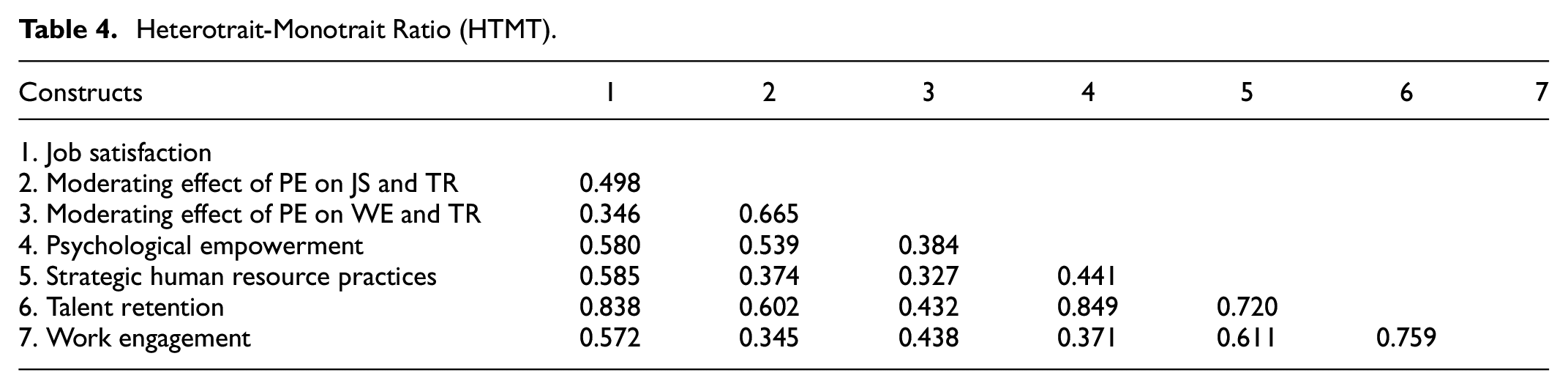
The discriminant validity of the data was evaluated using the Heterotrait-Monotrait (HTMT) ratio. All values must fall within the range of -1 and 1, in order to demonstrate discriminant validity between all of the HTMT components (Henseler et al., 2016). The current study established the discriminant validity of each study variable utilizing HTMT and lying-in range in Table 4.
Heterotrait-Monotrait Ratio (HTMT).
Structure Model
The structural model was assessed and examined at this phase in light of the measurement model’s green signal ensuring validity and reliability (Furrer et al., 2016). R-Square analysis, in turn, calculates the coefficient of determination using the total variance and the variation ratio on independent constructs of the dependent variable. Values of R square describe how well the IVs explain the DVs (Hamdollah & Baghaei, 2016). The R-square value of this model is talent retention = 0.90%, job satisfaction = 0.28%, and family binding = 0.34%. The structural model is created using SmartPLS, and model fitness is also evaluated. The model is generally well-fitting, according to the results of the fitness indices (F. Shahzad et al., 2022). For instance, NFI = 0.811, SRMR = 0.068, and Chi-Square = 2678.235. See Figure 2, which explains the model’s estimation.

Valid estimation model (PLS diagram).
Hypothesis Testing
The bootstrapping process is used with 5,000 resamples to generate the mean and standard deviation as well as the β-values, t-values, and p-values to validate the statistical significance and hypothesis evaluation (Fassott, 2010). This study contains different variables such as independent, dependent, mediators and moderator variables. It reveals if the impact of that particular variable has a positive or negative impact on other variables (Shahzad, Liu, & Zahid, 2024; Shahzad, Xu, & Baheer, 2024). Positive impact showed a strong association of the independent variable with the dependent variable. Similarly, the negative impact showed independent variable increases, the dependent variable decreases. It demonstrated the strong direct and indirect effects that some independent factors on the dependent variable have on one another (Sarstedt et al., 2022). The mediator explains why or how the relationship between two variables exists, whereas a moderator identifies when or for whom the relationship is strongest or weakest. Mediators and moderators are important concepts in this research as they help researchers understand the underlying concept that strategic HR practices positively impact talent retention. The significance of the variables was determined using the p-value criterion (p < .05). The result revealed that strategic HR practices positively correlate with talent retention in the education sector, as indicated in Table 5 (β = .108, t = 4.828, and p < .05). Strategic HR practices positively impact job satisfaction with values (β = .533, t = 10.110, and p < .05). Strategic HR practices positively impact work engagement with values (β = .579, t = 12.072, and p < .05). Job satisfaction positively impacts talent retention with values (β = .190, t = 5.843, and p < .05). Work engagement positive impact on talent retention with values (β = .272, t = 7.345, and p < .05). Psychological empowerment positive impact on talent retention with values (β = .601, t = 15.316, and p < .05). Job satisfaction positively mediates the relationship between strategic HR practices and talent retention with values (β = .101, t = 4.376, and p < .05). Work engagement positively mediates the relationship between strategic HR practices and talent retention with values (β = .158, t = 5.642, and p < .05). PE positively moderates the relationship between job satisfaction and talent retention with values (β = −.063, t = 2.288 and p < .05). PE positively moderates the relationship between work engagement and talent retention with values (β = .067, t = 3.071, and p < .05). All hypotheses were validated, as shown in Table 5 and Figure 2.
Hypothesis testing.
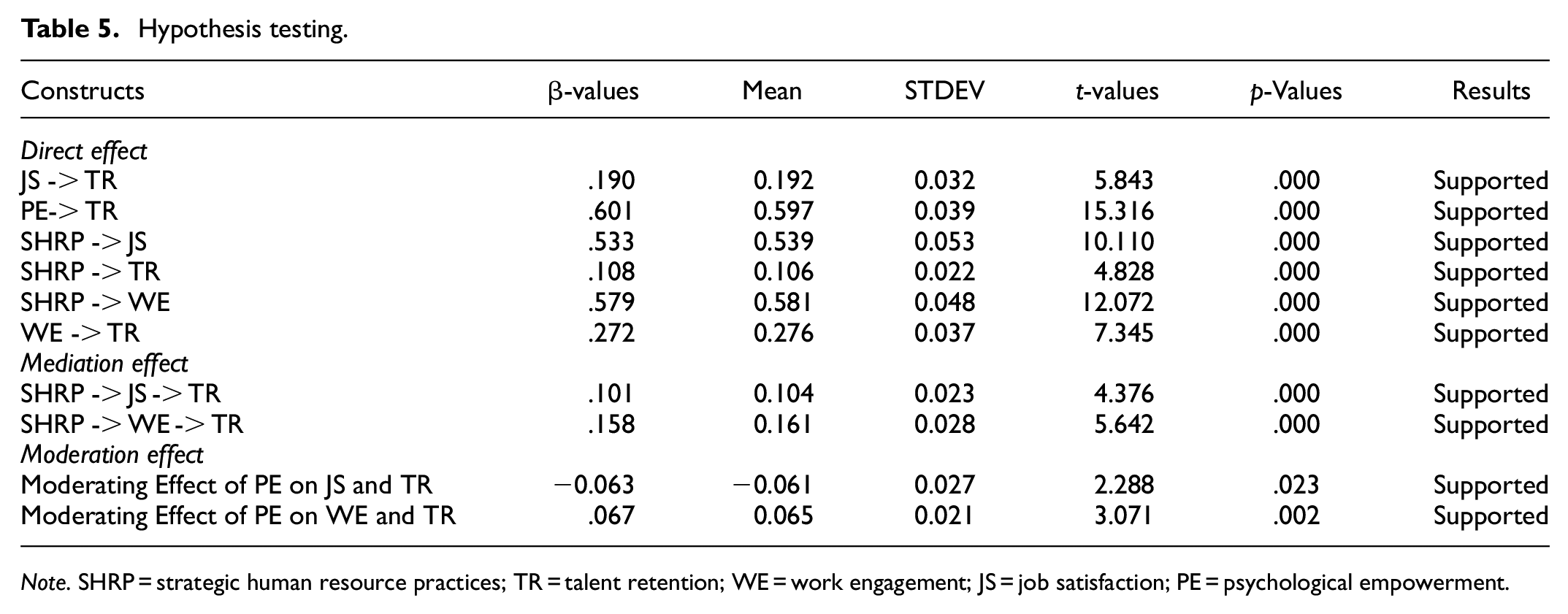
Note. SHRP = strategic human resource practices; TR = talent retention; WE = work engagement; JS = job satisfaction; PE = psychological empowerment.
A product indicator is used to examine the influence of moderators between independent and dependent variables in order to test the moderating impact. Results, however, indicate that psychological empowerment has a beneficial moderation impact with values (β = −.063, 0.067, t = 2.288, 3.071, and p < .05) to predict psychological empowerment, ultimately indicating employee talent retention. Figure 3 comprehensively shows the graphical representation of the moderation effect of psychological empowerment among job satisfaction and talent retention at three different levels. Figure 4 comprehensively shows the graphical representation of the moderation effect of psychological empowerment among work engagement and talent retention at three different levels. However, the red line indicates that the slope would be extremely steep. When psychological empowerment is weak, indicating the extravagant level of job satisfaction and work engagement toward talent retention. Further, when psychological empowerment is considered strong at the green line, the slope represents increased job satisfaction, work engagement and talent retention. More specifically, Figures 3 and 4 and Table 5 explain the moderation effect of psychological empowerment in predicting job satisfaction and work engagement toward talent retention.

Moderating effect of PE on JS and TR.

Moderating effect of PE on WE and TR.
Discussions
This research inspected the relationship between strategic HR practices and talent retention with the mediating role of job satisfaction and work engagement in the education sector. Furthermore, this study scrutinized the moderating role of psychological empowerment in job satisfaction and employee work engagement toward talent retention. Data were assembled from a staff of universities of Punjab, Pakistan. 414 questionnaires were handed out to participants, and 332 were returned. PLS-SEM software 3.3 was utilized for the analysis. The primary inspiration for this research was to address the shortcomings of the education sectors in Pakistan. The outcome of this study is that strategic HR practices positively influence talent retention in the education sector. Job satisfaction and employees work engagement positively mediate the relationship between strategic HR practices and talent retention. Furthermore, individual psychological empowerment positively moderates the relationship between job satisfaction and work engagement toward talent retention. The tools’ characteristics also reveal the importance and quality of the analysis or evaluation conducted.
First, we assessed how strategic HR practices affected talent retention. Results indicate that strategic HR practices significantly impact how well employees function regarding their talent. A past study (Islam et al., 2022) highlighted administration’s HR department is exceptionally important for employee retention. Staff retention strategies may include training courses, internal promotion chances, awarding incentives, and enhancing workplace policies and procedures. The previous study’s findings also described the capacity of an enterprise to keep its employees, also known as talent retention (Chen & Huang, 2009). When individuals choose to stay with their existing employer rather than look for employment elsewhere. Working along connections among coworkers improves business outcomes and increases employee happiness and engagement, underscoring the significance of employee retention. A positive work atmosphere frequently increases productivity and promotes more fulfilling encounters with consumers, which can enhance client loyalty (Sánchez et al., 2015). These results are consistent with recent findings (Akunda et al., 2018; Narayanan, 2016; Sepahvand & Khodashahri, 2021).
Second, this study assessed the mediation role of job satisfaction and employee work engagement. The findings revealed that job satisfaction positively mediated the relationship between strategic HR practices and talent retention. Results also showed strategic HR practices positively impact job satisfaction. Further job satisfaction showed a positive impact on talent retention. Organizations that increase the engagement and satisfaction of their employees through clearly defined strategic HR policies (Iqbal et al., 2017). They will be inspired to put up greater efforts on their organizations’ behalf, strengthening their desire to stay. Previous researchers (Shmailan, 2016) argued strategic HR practices included the specialty of talent management. The aim of strategic HR practices is the best applicants should be chosen, and those applicants should be managed effectively utilizing smart policies and processes. Strategic HR practices aim to support employees’ development by outlining professional options and training schedules. Strategic HR procedures can boost the organization’s effectiveness by ensuring that workers have lucrative working relationships that lead to employee retention (Hafez et al., 2017). These results are consistent with recent findings (Muathe et al., 2013; Terera & Ngirande, 2014).
Further, the results showed that work engagement positively mediated the relationship between strategic HR practices and talent retention. Results also showed strategic HR practices positively impact work engagement. Further work engagement showed a positive impact on talent retention. A previous study (Sepahvand & Khodashahri, 2021) explained work engagement is a degree of how involved and passionate people are concerned about their employment and how much extra effort they are willing to make. The most skilled employees go over and above the call of duty; as a result, projects are more effective, and employee productivity increases. The past study expressed that making a culture and environment that draws and retains excellent talent is the best approach (Pandita & Ray, 2018). In the logic that individuals have positive insights of your corporation and its principles. According to research by Galal et al. (2016), businesses with happier staff generated 21% more than organizations with disgruntled employees. Work engagement estimates how devoted your employees are to your business and to each other. The achievement of their employees’ goals and work is essential to them (Jindal et al., 2017). These results are consistent with recent findings (Al-Hajri, 2020; Fernando & Nishanthi, 2021).
Third, this study assessed the moderation part of psychological empowerment. The results revealed that psychological empowerment positively moderated the relationship between job satisfaction and talent retention. Psychological empowerment is crucial to successful work achievements such as job satisfaction. Psychologically stronger followers obtain greater intrinsic need satisfaction from their work and consequently enjoy greater job satisfaction (Dewettinck & van Ameijde, 2011). A past study (Rafiq et al., 2020) also expressed that workers perform better, are happier in their employment, and are more devoted when they feel in control at work to the company and also retained. These results are consistent with recent findings (Jha, 2019; Panda & Sahoo, 2021). Further, the results also discovered that psychological empowerment positively moderated the relationship between work engagement and talent retention. PE workers are more dedicated to their tasks and organizations, are more involved at work, and have lower interest rates of quitting intentions (Baek-Kyoo et al., 2019). According to research (Sulphey, 2021), psychological empowerment is favorably associated with workers’ performance on responsibilities, job environments, and innovation. Employee engagement is a constant theme in the optimization of employee retention. The deeper involvement of employees can be facilitated by higher retention, which can lead to higher levels of engagement (Sharma & Garg, 2017). These results are consistent with recent findings (Greco et al., 2006; Islam et al., 2022).
Conclusions and Policy Recommendations
The current study illuminates the link among strategic human resource practices, talent retention, work engagement, job satisfaction, and psychological empowerment. The research study has a three-fold contribution; First, strategic HR practices positively impact talent retention in education sectors in Pakistan. Second, job satisfaction and work engagement positively mediate between strategic HR practices and talent retention. Third, psychological empowerment has a positive moderating effect on job satisfaction and work engagement toward talent retention. Generally speaking, this study tried to determine a connection between SHR practices and institutions’ environmental performance to use their valuable talents. Universities are renowned for being pioneers in the discovery of new information. A recent study focused on strategic HR practices as improving motivation and the capacity to create opportunities to offer practices that may impact work engagement of employees and job satisfaction. The findings offer useful information for regulators to deliberate for employees to exhibit presentations that improve environmental performance: work engagement, better performers, and talent retention. This research also provides endorsements for putting up SHR policies to make their human capital environmentally responsible at the organizational level to enhance employee awareness of the requirement to protect their organizations overall.
Theoretical and Practical Implications
This study has important theoretical implications for the field of strategic HRM. First, this study enlarges the literature on HRM and grounds significant implications for management in the education sector in Pakistan. According to researchers, strategic HR practices can aid the organization in achieving its talent retention targets. A slight focus has been added to determining how HRP and talent retention are coordinated. Second, this study presents empirical suggestions because of the theoretical view of AMO as to the association between strategic HR practices and talent retention, which could be significant for HR professionals in the education sector. Third, this study donates to the growing literature on strategic HR practices, job satisfaction, work engagement, and talent retention. The study recommends that strategic HR practices can positively impact talent retention by increasing job satisfaction and work engagement. Additionally, the study provides evidence for the moderating role of psychological empowerment in this relationship. The findings suggest that psychological empowerment can enhance the effects of strategic HR practices on job satisfaction, work engagement, and talent retention. Psychological empowerment findings emphasize the importance of considering individual differences in HR practices. Lastly, the finding of this study emphasizes the importance of ensuring that employees are pleased with their jobs and are engaged in their work to retain them.
This study has practical implications for organizations looking to hold their talented employees. First, this research is useful for professionals and upper management to sustain their talent by providing satisfaction and task engagement to their staff. HR managers may integrate this study into the enrollment and selection procedure for new staff hiring. Authorities emphasize the importance of selecting and recruiting vigilant and young talent. Second, this study suggests the input of different strategic HR practices to work commitment and job fulfillment may be assessed and conveyed to university partners or decision-makers. The results of this research will assist university officials in designing HR practices that encourage employees to stay a long time. A university’s talent attitude strength to promote through strategic recruitment practices to interest vigilant aspirants with an innovative spirit. Third, organizations should pay attention to practices such as career growth, flexible work arrangements, and appreciation and rewards to ensure employees are satisfied and engaged. Lastly, this study advocates that organizations should focus on empowering their employees to enhance the positive effects of HR practices on talent retention. This can be achieved through practices such as providing autonomy, involving employees in decision-making, and offering opportunities for personal and professional growth. They can do so by providing opportunities for employees to learn and grow, encouraging a positive work environment, and rewarding good performance. This study’s theoretical and practical implications guide organizations to develop effective HR practices and retain talented employees.
Limitations and Future Research
In addition to significant contributions, this study has convinced limitations. Firstly, the data is obtained from the employees of the universities. In the future, other industries may also be chosen.
Secondly, the study is cross-sectional, so causality cannot be inferred. Future research could utilize longitudinal or experimental designs to establish causal relationships. Thirdly, the study’s sample size was limited due to the selection of the top six universities in Lahore, which may affect the generalizability of the findings. Future research can expand the sample size to include multiple universities at the Punjab or Pakistan level. Future research is also suggested to incorporate individuals from various educational backgrounds and nations. Fourthly, this study includes only three SHRPs (recruitment and selection, training and development, compensation and reward), while future research can use other strategic HR practices such as career planning, green involvement, and performance management. Fifthly, this research determined the mediating effect of work engagement and employee’s job satisfaction to explore the relationship between SHRP and talent retention. Future studies may be assessed on other mediating mechanisms such as employee motivation, sustainable environment, and performance management. Finally, this study evaluated the moderating effect of psychological empowerment among strategic HR practices and talent retention. Future studies may use other moderating mechanisms like experience, organizational ethics, supervisor support, and employee motivation.
Footnotes
Declaration of Conflicting Interests
The author(s) declared no potential conflicts of interest with respect to the research, authorship, and/or publication of this article.
Funding
The author(s) received no financial support for the research, authorship, and/or publication of this article.
Ethics Statements
Studies involving animal subjects
Generated Statement: No animal studies are presented in this manuscript.
Institutional Review Board Statement
Generated Statement: This study does not need the approval of ethical permission from the university. We received consent to participate in the study from the respondents in verbal and written form.
Inclusion of Identifiable Human Data
Generated Statement: No potentially identifiable human images or data is presented in this study.
Informed Consent Statement
Informed consent was obtained from all subjects involved in the study.

Data Availability Statement
Data can be obtained upon reasonable request.