




Abstract
This study investigated the effect of work engagement (WE) on teachers’ workplace well-being (WWB) and the role of perceived organizational support (POS) and psychological empowerment (PE) in the underlying internal mechanisms. The participants were 2,090 Chinese teachers (valid response rate: 90.32%), with an average age of 39.42 years (SD = 8.73). To test the mediating role of POS and PE on the relationship between WE and WWB (parallel and serial), participants were asked to complete the subscales of employee well-being, the Utrecht Work Engagement Scale, the Psychological Empowerment Scale, and the Perceived Organizational Support Scale. The results revealed that (1) WE can positively predict WWB, (2) POS and PE mediated the relationship between WE and WWB, and (3) there were numerous indirect routes (i.e., WE→POS→PE→WWB). The results of this study help us understand the relationship between WE and WWB and have implications for improving teachers’ WWB.
Plain language summary
Purpose: This study investigated the effect of work engagement (WE) on teachers’ workplace well-being (WWB) and the role of perceived organizational support (POS) and psychological empowerment (PE) in the underlying internal mechanisms. Methods: The participants were 2090 Chinese teachers (valid response rate: 90.32%), with an average age of 39.42 years (SD = 8.73). To test the mediating role of POS and PE on the relationship between WE and WWB (parallel and serial), participants were asked to complete the subscales of employee well-being, the Utrecht Work Engagement Scale, the Psychological Empowerment Scale, and the Perceived Organizational Support Scale. Results: The results revealed that (1) WE can positively predict WWB, (2) POS and PE mediated the relationship between WE and WWB, and (3) there were numerous indirect routes (i.e., WE→POS→PE→WWB). Conclusion: The results of this study help us understand the relationship between WE and WWB and have implications for improving teachers’ WWB. Implications: The results of this study have practical implications, particularly for educators, as they highlight the significant role of WE in influencing teachers’ WWB. Limitations: Teachers’ self-reports served as the source of the data. This approach can result in recollection bias. In addition, since we did not use an experimental approach but rather a cross-sectional one, we could not identify any causal links.
Keywords
Workplace well-being (WWB) has gained increasing importance during the COVID-19 pandemic (Gupta, 2023). According to Page (2005), WWB refers to the joy employees derive from their work and is influenced by their overall workplace perceptions and satisfaction with their employers. Addressing factors such as workload, work-life balance, job clarity, and support from colleagues and school management is crucial for ensuring teachers’ WWB. Prioritizing teachers’ WWB is essential as it directly impacts their performance (Aryanti et al., 2020), job satisfaction (Baluyos et al., 2019; Rahm & Heise, 2019), and students’ happiness and performance (Gray et al., 2017; Roffey, 2012). Moreover, improving teachers’ WWB can help reduce turnover rates (Chang et al., 2017). Despite its significance, few surveys have investigated teachers’ WWB and happiness compared to other factors (Kun & Gadanecz, 2022). While there have been studies investigating the relationship between work engagement (WE) and WWB, limited research has focused on teachers (e.g., Järvelä & MacNeil, 2021). This study investigated the predictive role of WE in WWB and identified mediating factors in this relationship.
This study holds theoretical significance as it explores the relationships between WE and WWB, considering the potential serial mediating role of perceived organizational support (POS) and psychological empowerment (PE). This examination contributes to the application of social exchange theory, expanding its scope and depth. The findings offer valuable insights for organizational managers and decision-makers, providing guidance to improve employees’ work experience and overall happiness. From a practical standpoint, this study provides recommendations for implementing measures that enhance WWB within organizations. By understanding the relationships between WE, POS, and PE, organizations can design and implement effective policies and strategies to promote employees’ WWB.
Work Engagement and Workplace Well-Being
Kahn (1990) introduced WE as a state where employees actively invest positive energy into their work roles, expressing themselves both physically and mentally. WE is “a positive, fulfilling, work-related state of mind characterized by vigor, dedication, and absorption” (Schaufeli et al., 2002, p. 74). The Job Demands-Resources (JD-R) model (Bakker & Demerouti, 2017; Demerouti et al., 2001) provides a theoretical framework for examining how teachers’ WE influences their well-being and is associated with workplace resources (Ouweneel et al., 2012).
Previous studies consistently show a positive association between WE and WWB (Abun et al., 2020; Hakanen & Schaufeli, 2012; Saks, 2006). Numerous investigations demonstrate that WE predicts WWB (Do Nascimento et al., 2021; Sahai & Mahapatra, 2020; Sosnowska & Griep, 2019), with WE identified as a key factor influencing WWB (Aronen et al., 2021) and job-related affective well-being (Andrulli & Gerards, 2023). Understanding and prioritizing the impact of WE on WWB is vital for fostering a positive work environment that benefits both employees and organizations. According to self-determination theory, individuals who are more engaged in their work tend to experience greater well-being (Ryan & Deci, 2000), as they have a sense of autonomy and self-determination. Flow theory (Csikszentmihalhi, 2020) suggests that deep engagement and immersion in an activity enhance satisfaction and WWB.
Given the significance of teachers’ WWB for job quality and the potential predictive role of WE, this study investigated whether and how WE positively predicts WWB. Thus, the first hypothesis (H1) is as follows: WE positively predicts WWB.
Perceived Organizational Support as a Mediator
POS refers to employees’ overall belief in the value and care that organizations place on their contributions and well-being (Amir & Mangundjaya, 2021; K. Y. Kim et al., 2016). Studies indicate a positive correlation between POS and WE (Aulia et al., 2019; Dwitasari et al., 2016; Inam, 2021; Junça Silva & Lopes, 2021; Ramdhani & Sawitri, 2017). For example, a study of police officers by Perwira et al. (2021) found a significant relationship between POS and WE. While some studies have explored the impact of WE on POS, this study investigated whether teachers who are fully committed to their work are more likely to attract organizational attention and recognition.
Organizational support theory and evidence from numerous studies demonstrate that POS affects employee well-being (Eisenberger & Stinglhamber, 2011). A healthy organization prioritizes employee productivity and well-being through fulfilling occupations and a positive social workplace environment (Wilson et al., 2004). Empirical evidence by D. Kim et al. (2018) confirms the positive influence of POS on employees’ subjective well-being. Moreover, Utari (2019) found a moderate correlation between POS and workplace well-being, indicating that POS impacts WWB. These findings suggest that POS may mediate the relationship between WE and WWB. Therefore, the second hypothesis (H2) is as follows: The relationship between WE and WWB is mediated by POS.
Psychological Empowerment as a Mediator
PE, as defined by Spreitzer (1995), encompasses four dimensions: impact, competence, self-determination, and meaning. In this study, PE is defined as the “personal belief that employees have about their roles concerning the organization” (Spreitzer, 2006, p. 203). Previous studies have consistently shown a positive relationship between PE and WE in various countries (Bhatnagar, 2012; Sharma & Garg, 2017; Sharma & Singh, 2018; Ugwu et al., 2014; S. Wang & Liu, 2015). While most research focuses on the effects of PE on WE, there is evidence that WE can predict PE. For instance, Musavi (2016) found that engagement dimensions (vigor, dedication, and absorption) significantly influenced PE.
The four dimensions of PE are significantly associated with individuals’ psychological well-being (Taştan, 2013), and researchers suggest that PE impacts employee well-being (Wardani & Amaliah, 2020). In a study involving Chinese kindergarten teachers, PE was found to predict greater professional well-being (Y. Liu et al., 2022). Zhao and Wang (2022) proposed that PE mediates the relationship between social support, school management activities, and young university teachers’ work well-being. While no studies have specifically examined the mediating mechanism between WE and WWB, previous research suggests that PE may play a crucial mediating role. Thus, the third hypothesis (H3) is as follows: PE mediates the relationship between WE and WWB.
Perceived Organizational Support and Psychological Empowerment as Mediators
There are empirical gaps in understanding the relationships between WE, POS, PE, and WWB. One gap pertains to the direction of these relationships, while another gap relates to the limited examination of interconnections among these variables. Caesens et al. (2020) explored the mediating role of PE in the positive relationship between POS and mental health, and Yakut and Ergün (2022) found that improving organizational commitment and POS enhanced employee well-being. However, there is a lack of extensive research investigating the specific connections and underlying linkages between these variables and WWB. Thus, further research is needed to understand how WE, POS, and PE collectively contribute to WWB, providing insights for organizational strategies and interventions.
The potential double-mediating role of POS and PE in the link between WE and WWB should also be considered. Studies have demonstrated a strong association between POS and PE (Caesens et al., 2020; Iqbal & Hashmi, 2015; Maan et al., 2020). Employees’ perception of organizational support plays a crucial role in their psychological empowerment at work (Ali et al., 2010). Afzali et al. (2014) also emphasized the significant contributions of POS to the development of PE. Similarly, Shi et al. (2022) identified POS as a significant and positive predictor of PE.
Scholars have started investigating the interrelationships among key factors influencing organizational performance (such as WE, POS, and PE) and their effects on employee well-being (Hakanen et al., 2018; Jose & Mampilly, 2015; Zulfikar & Putra, 2020). Multiple regression analyses consistently show that predictor variables (including WE, POS, and PE) statistically predict psychological well-being (Posa, 2019). Surprisingly, no study has examined the correlations between these four variables (WE, POS, PE, and WWB), including the possible serial mediating role of POS and PE. Consequently, this study addressed this research gap. The fourth hypothesis (H4) is as follows: The relationship between WE and WWB is serially mediated by POS and PE.
Theoretical Foundation
According to self-determination theory (Ryan & Deci, 2000), individuals who are more engaged in their work tend to experience greater well-being. When employees have a sense of autonomy and self-determination at work, they are more likely to invest themselves and have higher levels of well-being.
Social exchange theory (Blau, 1986) suggests that individuals engage in reciprocal relationships based on their expectations of receiving rewards. In the context of work, when employees demonstrate high levels of WE, they actively collaborate and interact with the organization. They identify strongly with the organization’s goals and values, and are willing to contribute to its success. This positive engagement often attracts attention and support from the organization, which recognizes the value of these employees and provides them with more support and resources. This positive feedback reinforces employees’ POS. Thus, it is hypothesized that WE positively predicts POS.
POS, in turn, is considered a prerequisite for PE, as it represents the organization’s support in granting employees autonomy and decision-making freedom (Kang et al., 2020). Consequently, POS may positively predict PE. Maan et al. (2020) suggested that PE can mediate the relationship between POS and job satisfaction. Given the strong relationship between job satisfaction and WWB (Baquero, 2023), PE may also serve as a mediating variable linking POS and WWB.
Aims
This study clarified the relationships between WE, POS, PE, and WWB, examined whether POS and PE mediate the relationship between WE and WWB, and identified ways to enhance teachers’ WWB. Figure 1 illustrates the proposed connections between these variables.

A conceptual framework comprising numerous mediators in which perceived organizational support and psychological empowerment mediate the relationship between work engagement and workplace well-being.
Method
Participants
The final sample consisted of 2,090 teachers (valid response rate: 90.32%) with an average age of 39.42 years (SD = 8.73) and an average teaching time of 17.97 years (SD = 9.97). The sample included 1,489 female teachers (71.20%) and 601 male teachers (28.80%). A total of 1,745 instructors (83.49%) majored in the teaching program, 305 (14.59%) majored in the non-teaching program, and 40 (1.91%) of the teachers’ major information was missing. More information on the participants is presented in Table 1.
Descriptive Statistics (n = 2,090).
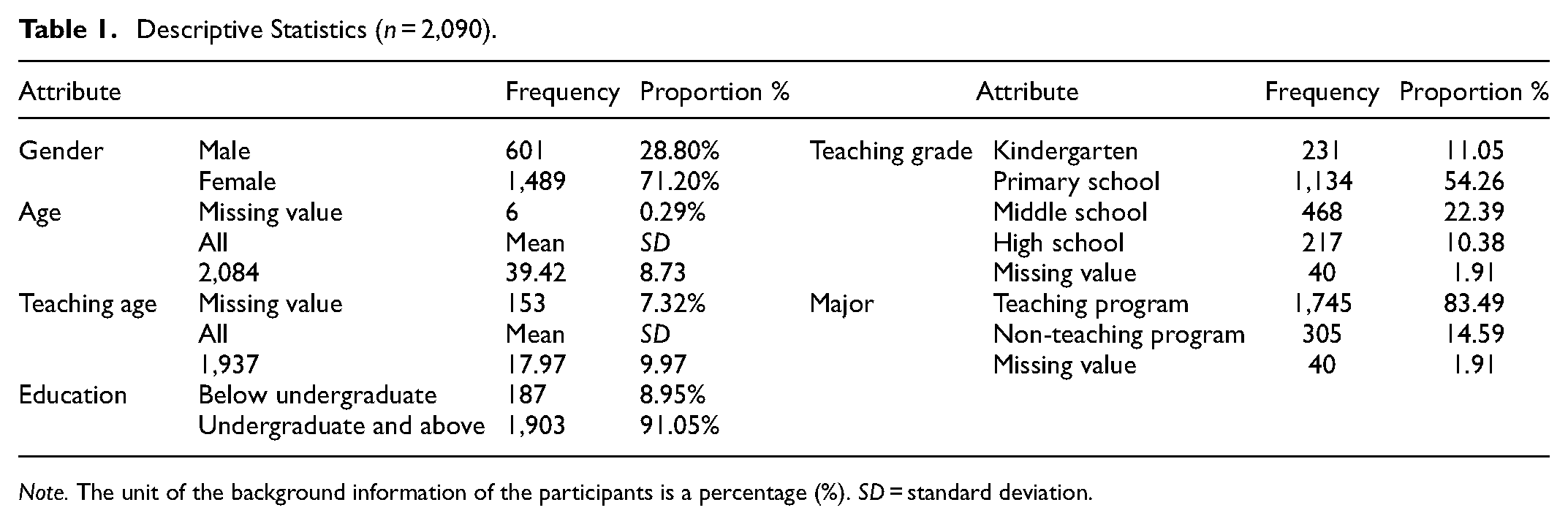
Note. The unit of the background information of the participants is a percentage (%). SD = standard deviation.
Measurement Tools
Workplace Well-Being
Teachers’ WWB was assessed using the employee well-being subscale developed by Zheng (2015) using a Chinese sample. The scale consists of six items designed to capture various aspects of WWB (e.g., “I am satisfied with my work responsibilities”). Participants responded to each item using a 7-point Likert scale ranging from 1 (strongly disagree) to 7 (strongly agree). Higher scores indicate a stronger sense of WWB. It is important to note that the scale was specifically developed within the Chinese context and has demonstrated excellent reliability and validity in previous research (Jie et al., 2021). In the present study, the internal consistency of the scale as measured by Cronbach’s alpha was .95, indicating a high level of internal reliability.
Work Engagement
The 9-item Utrecht Work Engagement Scale (UWES; Schaufeli et al., 2006) was used to evaluate the general level of WE. The UWES comprises three subscales: vigor, dedication, and absorption. Each subscale captures a distinct aspect of WE. For instance, vigor items assess feelings of energy and enthusiasm at work (e.g., “I feel energetic at work”), dedication items evaluate the sense of being passionate about one’s work (e.g., “I am passionate about my work”), and absorption items measure the extent to which individuals are fully engrossed in their job (e.g., “I am immersed in my job”). Participants responded to the UWES items using a 7-point Likert scale ranging from 0 (never) to 6 (always). This scale has been widely used and has demonstrated good reliability and validity in previous studies (Lu et al., 2018). A composite score was calculated by summing the responses from the three subscales. In the current study, the reliability of this composite score, as assessed by Cronbach’s alpha, was .93, indicating high internal consistency.
Psychological Empowerment
Teachers’ PE was assessed using a 5-point Likert scale named the Psychological Empowerment Scale (PES), compiled by Spreitzer (1995) and adapted for the Chinese context by Li et al. (2006). The items on this scale range from 1 (strongly disagree) to 5 (strongly agree). This study uses the Chinese version. The scale consists of 12 items across four dimensions, meaning (e.g., “My life value is commensurate with the teaching activity I do in this school”), self-efficacy or competence (“I am proficient in the subjects I teach”), self-determination (“I provide primary inputs in selecting content, topics, and skills to teach students”), and impact (e.g., “I have a great influence on student learning”). The PES has consistently demonstrated robust reliability and validity across numerous studies, particularly when implemented using Chinese samples (Ye et al., 2020). In the current study, the internal consistency of the scale, as measured by Cronbach’s α, was .91, indicating high reliability.
Perceived Organizational Support
The Perceived Organizational Support Scale developed by Eisenberger et al. (1986) was selected to assess the responders’ POS. The Chinese version of the POS, compiled by Ling et al. (2006), was specifically chosen for this study. The scale comprises 36 items, of which eight were selected as representative items for teachers to respond to. For instance, one item included in the scale was “My organization cares about my opinions” (Oubibi et al., 2022). A 5-point Likert scale ranging from 1 (strongly disagree) to 5 (strongly agree) was used to measure teachers’ POS. Teachers’ POS increases with an increasing score. This scale has consistently demonstrated strong reliability and validity across investigations, particularly when applied to Chinese samples (Chen & Lin, 2017). In this study, the internal consistency of the scale, assessed using Cronbach’s α coefficient, was found to be .91, indicating high reliability.
Procedure
The participants took part in an online survey via a reliable Chinese data collection platform similar to the Qualtrics Online Sample (www.credamo.com). Before they responded, all participants were assured of the anonymity and confidentiality of their responses and that the data collected would be used for academic research. The participants completed all questions in approximately 20 min. No incentives were provided to the participants. The study was authorized by the Ethics Committee of the local university and was conducted according to the Declaration of Helsinki (Protocol code: 20210069, approved April 1, 2021).
Common Method Bias
Common method bias refers to a potential bias that can arise when data are collected from the same source using the same method, resulting in an inflated correlation between variables. This study therefore implemented several procedural remedies to minimize the potential impact of common method bias. These remedies ensured the anonymity and confidentiality of the participants, which helped to reduce the likelihood of common method bias. Furthermore, to gain a deeper understanding of the extent of the common method bias, a series of confirmatory factor analyses (CFAs) were conducted, using a comprehensive measurement model. As recommended by Podsakoff et al. (2003), this model incorporated both method-specific and substantive latent factors. By comparing the fit indices of the measurement model with and without the inclusion of method-specific factors, it was possible to assess the presence of common method bias.
Statistical Analysis Strategy
This study employed SPSS (version 26.0) to conduct descriptive statistics, while Mplus 8.3 was utilized to analyze the structural equation model (SEM) involving latent variables. Item parceling was used to indicate the relationships between the latent variables, following a factorial algorithm known as item-to-construct balance, as suggested by Little et al. (2002). Item parcels were created for the latent variables of WE, WWB, and POS. For PE, the original structural factors were used as the observed factors. The hypothesized model consisted of 4 latent variables and 11 observed variables.
Several criteria were used to evaluate the adequacy of the SEM and CFA models. These included a chi-square to degrees of freedom ratio (χ2/df) of less than 3, a root-mean-square error of approximation (RMSEA) value below 0.08, a standardized root-mean-square residual (SRMR) below 0.05, and comparative fit index (CFI) and Tucker–Lewis index (TLI) values exceeding 0.90, as recommended by Marsh et al. (2004). To examine the mediating effects, a bias-corrected bootstrap was employed with 5,000 random replicate samples, using maximum likelihood estimation. This approach allows for the estimation of indirect effects and provides inferences that are more accurate regarding the significance of mediation that are more accurate (Kline, 2023).
Results
Preliminary Analyses
Common Method Variance Control and Inspection
It is crucial to note that the findings did not indicate a significant common method bias. The results obtained from the bifactor model analysis revealed ΔCFI = 0.09 and ΔTLI = 0.08 (both p < .10) and ΔRMSEA = 0.02 and ΔSRMR = 0.03 (both p < .05). These results suggest that the inclusion of method-specific factors did not significantly improve the fit of the model, providing evidence against the presence of common method bias.
This study implemented procedural safeguards to mitigate potential common method bias. In addition, rigorous analyses were conducted to assess the extent of common method bias, including the use of a bifactor model. The results consistently indicated the absence of significant common method bias, further supporting the validity and reliability of the findings.
Correlational Analysis Among the Main Variables
The Pearson correlation analysis showed a positive association between WE and PE, POS, and WWB. PE was positively correlated with POS, WE, and WWB. POS was positively associated with WE, PE, and WWB. The description indices (M and SD) and correlation findings for the key variables are presented in Table 2. Gender and age were demographic factors, but they had no bearing on the outcome variable (WWB); therefore, they were excluded from the subsequent analysis.
Correlations and Descriptive Statistics Between Main Variables (N = 2,090).

Note. Gender was dummy coded with 1 for male participants and 2 for female participants. The results indicated no significant skewness or kurtosis issues for the four main variables. M = mean; SD = standard deviation; TA = teaching age; WE = work engagement; PE = psychological empowerment; POS = perceived organizational support; WWB = workplace well-being.
p < .05. **p < .01.
Testing of the Multiple-Mediation Model
The current study used an SEM to examine the multiple-mediation model. The correlation analysis presented in Table 2 shows significant associations between gender, age, and teaching age with WE, and gender is also significantly related to WWB. Consequently, these variables were controlled for in the testing of the multiple-mediation model.
When applying the SEM with latent variables, the hypothesized model exhibited an excellent fit to the data, even after accounting for the controlled variables. The model’s goodness of fit was assessed using various indices: the chi-square test of model fit yielded a value of 12.99 (χ2 = 870.61, df = 67, p < .001). In addition, the CFI was 0.96, the –TLI was 0.95, the RMSEA was 0.07 (with a 90% confidence interval ranging from 0.07 to 0.08), and the SRMR was 0.04.
As presented in Figure 2 and detailed in Table 3, WWB was significantly predicted by WE (β = .25, SE = 0.04, p < .001, 95% CI [0.181, 0.317]). The direct effect of WE on WWB accounted for 31.76% of the total effect, indicating a significant relationship. Notably, the total indirect effect (0.53) constituted a substantial proportion, contributing 68.11% of the total effect of WE on WWB. Furthermore, the specific indirect effects of the three mediation paths accounted for 12.30%, 30.50%, and 10.60% of the variance, respectively. These results provide robust support for a multiple-mediation model involving POS and PE in the relationship between WE and WWB.

A serial mediation model from work engagement to workplace well-being. Part of the items was parceled. Standardized path coefficients are expressed numerically. Gender, age, and teaching age have been used as control variables.
Testing the PE and POS (Multiple) Mediation Model Pathways With Bootstrap (N = 2,090).
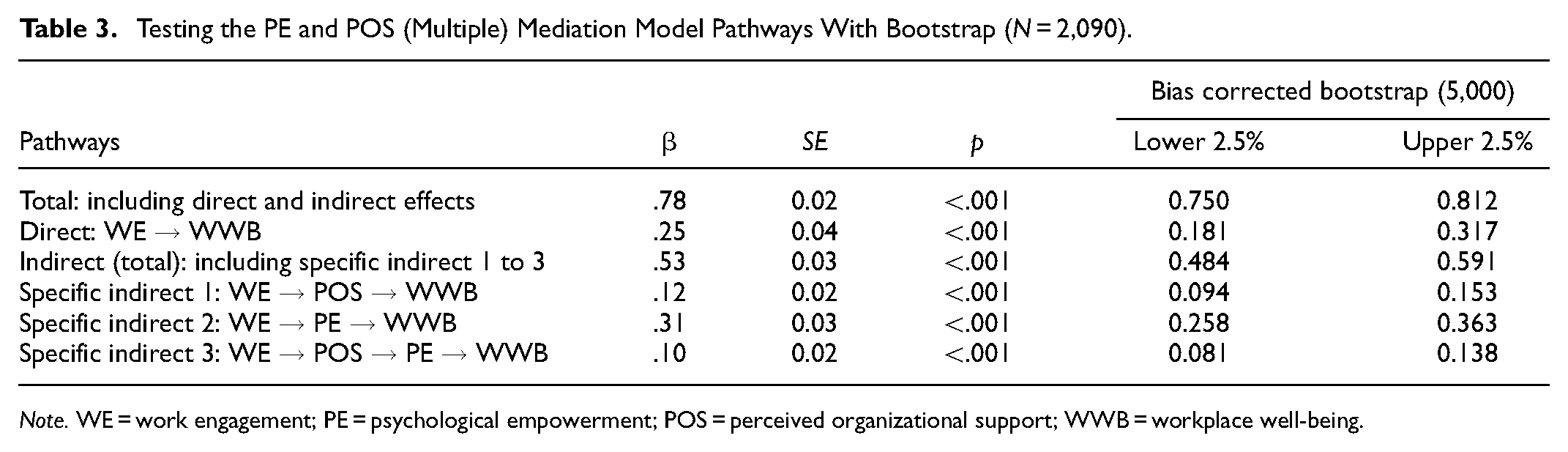
Note. WE = work engagement; PE = psychological empowerment; POS = perceived organizational support; WWB = workplace well-being.
Discussion
The study’s primary objective was to gain a deeper understanding of the underlying mechanisms between WE and WWB. With a focus on investigating the parallel and serial mediating roles of POS and PE in the relationship between WE and WWB, 2,090 teachers were recruited. The findings provide substantial support for the hypotheses regarding the mediation processes. Specifically, the results underscore the critical significance of POS and PE in linking WE to WWB, highlighting their pivotal roles as key pathways between these constructs.
The present study aligns with past research conducted by Yang et al. (2019), confirming the positive relationship between WE and WWB. The findings substantiate H1, confirming that WE positively predicts WWB. Teachers who exhibit high levels of WE are more likely to receive recognition, praise, and appropriate rewards, leading to elevated WWB.
Perceived Organizational Support as a Mediator
The findings support the validity of H2, indicating that POS acts as a mediator between WE and WWB. This aligns with prior studies, including Colakoglu et al. (2010), who characterized POS as an organization’s recognition of employee contributions and concern for its workers. The positive and significant relationship observed between WE and POS is consistent with the findings of Köse (2016). One possible explanation for this outcome is that WE plays a vital role in enhancing the baseline of POS (Demerouti et al., 2010). The significant association between WE and POS highlights the notion that greater levels of WE contribute to higher POS within an organization.
Sen and Khandelwal (2017) proposed that POS plays a significant role in influencing WWB. The observed significant relationship between POS and WWB implies that teachers who receive greater support and attention are more likely to have the confidence to achieve their goals and effectively cope with personal challenges, thereby enhancing their WWB. In this study, both WE and POS demonstrate positive relationships with WWB, emphasizing the vital links between WE, POS, and WWB.
Given the contextual and empirical perspectives, the findings underscore the importance of fostering a work environment that promotes WE and POS to enhance teachers’ WWB. These findings align with current research trends that emphasize the significance of organizational support and employee engagement in promoting well-being (Na & Chelliah, 2022; Wahab, 2022). By recognizing the role of WE and POS in improving WWB, educational institutions can implement strategies to enhance teacher engagement, cultivate a supportive organizational climate, and provide the necessary resources and support to promote teachers’ well-being (Fridayanti et al., 2022; Ilyas et al., 2022; L. Wang et al., 2022).
Psychological Empowerment as a Mediator
The results validate H3, indicating that PE can mediate the relationship between WE and WWB. This finding is consistent with the principles of employee involvement theory (Lodahl & Kejner, 1965), which proposes that employees should be engaged in decision-making processes that affect them, and they should be supported with necessary informational resources, appropriate rewards, and learning opportunities. Furthermore, this study suggests that elevated WE and work commitment contribute to enhanced PE. Previous studies, such as Bhatnagar (2012) and S. Wang and Liu (2015), have emphasized the positive relationship between PE and WE. However, few studies have explored how WE affects PE, and this study effectively fills this gap by demonstrating that WE positively predicts PE. Hence, this study provides evidence that increased WE promotes PE.
Moreover, PE is positively associated with WWB (e.g., Li & Lin, 2020). The work of García-Juan et al. (2020) supports the notion that employee well-being improves when employees feel psychologically empowered. Moreover, teachers can derive benefits from happiness at work because PE is often accompanied by positive emotions, which are crucial components of well-being. The findings of this study suggest that PE can predict WWB. Therefore, PE can serve as a moderating mechanism through which WE impacts WWB. Increasing WE not only enhances PE but also subsequently increases WWB.
Regarding the contextual and empirical perspectives, the findings highlight the significance of PE as a mediator in the relationship between WE and WWB. These findings align with current research trends emphasizing the role of employee empowerment in fostering well-being and positive work outcomes (Joo et al., 2023; Sun et al., 2022). By recognizing the importance of PE, educational institutions can implement strategies to empower teachers, provide them with autonomy and decision-making opportunities, and foster a supportive work environment, ultimately promoting their well-being.
Perceived Organizational Support and Psychological Empowerment as Mediators
The results of this study support H4, demonstrating that the sequential mediation of POS and PE can influence WWB through WE. This finding is consistent with past research, including Iqbal and Hashmi (2015), who found a positive relationship between POS and teachers’ PE. According to organizational support theory (Rhoades & Eisenberger, 2002), when teachers perceive their contributions as valued and rewarded by an organization, they develop a more positive perception of their work and gain confidence in their abilities and skills. This conclusion is based on an analysis of over 70 studies that examined employees’ perceptions of their employers’ recognition of their contributions to, and concern for, their well-being. Furthermore, the findings indicate that employees experience greater PE when they receive organizational support in the workplace.
This study provides a detailed explanation of the specific internal psychological mechanisms through which WE affects WWB. High levels of WE reflect teachers’ strong identification with their profession (Britt, 2003). Having a high degree of engagement with the teaching process signifies teachers’ recognition of the value of their work and increases their WWB when they achieve significant teaching outcomes, receive organizational support from their school, and experience salary increments. Overall, increased WE, coupled with external recognition, fosters positive POS, and higher POS contributes to increased PE, thereby enhancing teachers’ WWB. This finding emphasizes the close link between WE and WWB.
The discussion of the results sheds light on the underlying mechanisms and implications of WE, POS, and PE in fostering WWB. These findings align with current research trends that emphasize the importance of recognizing and supporting employee contributions and well-being (L. Liu et al., 2024; Nabawanuka & Ekmekcioglu, 2022; Qin & Men, 2022). This study contributes to the literature by providing insights into the sequential mediation process and the significant impact of WE on WWB.
Implications for Practice
The results of this study have practical implications, particularly for educators, as they highlight the significant role of WE in influencing teachers’ WWB. Teachers play a pivotal role in supporting students’ progress and achievement (Stronge et al., 2004), indicating the importance of promoting teachers’ well-being in the field of education (Ross et al., 2012). Accordingly, understanding how WE positively predicts teachers’ WWB is invaluable.
To enhance WE among teachers, attention should be paid to fostering a conducive campus culture. Previous studies have shown a positive association between perceived school climate and instructors’ WE (Fu et al., 2022). Therefore, creating a supportive school climate can help boost teachers’ WE. Moreover, POS emerges as another crucial factor in explaining the relationship between WE and WWB. Schools and broader educational communities should prioritize the provision of adequate organizational support for teachers. Strengthening organizational support enhances teachers’ PE by fostering a sense of warmth and appreciation from the organization. It also creates an environment in which teachers feel encouraged to experiment with various teaching approaches that benefit both students and their own professional growth. The findings underline the significance of POS and PE as key proximal processes in the association between WE and WWB. With this understanding, practitioners can explore effective strategies for enhancing teachers’ WWB. By prioritizing the improvement of WE and promoting a supportive organizational culture, educators can take meaningful steps toward creating an environment that nurtures teachers’ WWB.
It is noteworthy that although increased WE can enhance the likelihood of POS, it does not guarantee that all highly engaged employees will receive organizational support. Organizational support is a comprehensive concept that encompasses various aspects, such as organizational culture, leadership style, policies, and procedures. To improve the experience of organizational support, employees also need to establish positive working relationships within the organization, and foster good communication and cooperation with leaders and colleagues.
In sum, this study offers valuable insights for practitioners, particularly in the field of education, by emphasizing the importance of WE in influencing teachers’ WWB. This underscores the need to cultivate a positive school climate, strengthen organizational support, and recognize the critical roles of POS and PE as proximal processes in fostering teachers’ well-being. These findings can guide practitioners in identifying effective approaches for enhancing teachers’ WWB.
Limitations and Future Directions
This study offers recommendations for implementing measures to enhance WWB. Organizations can better design and implement relevant policies and strategies to boost employees’ WWB by understanding the relationships between WE, POS, and PE. For instance, organizations can focus on creating supportive work environments, encouraging employee involvement, fostering positive work relationships and communication channels, and providing autonomy and decision-making freedom to enhance employees’ PE. The study’s findings that WE, POS, and PE all positively predict WWB is a reminder that organizations can improve teachers’ well-being at the material level by increasing their benefits and pay while also providing more support for their mental health. By improving teachers’ POS and empowering them psychologically, it is possible to enhance their sense of WWB.
This study has several limitations. First, there may have been recall bias because teachers self-reported all the data that were gathered. Even if there was no common method bias, it will be necessary to gather data to replicate the results from other sources in subsequent research. The second limitation pertains to the study’s cross-sectional design. Additional analyses were performed to account for confounders and enhance explanatory power, but because the current study was non-experimental, no conclusions about causality can be drawn. That said, this study offers a crucial foundation for investigating long-term correlations and identifying additional mechanisms that account for the association between WE and WWB. Future studies using an experimental design should further validate the existing findings. Third, the data were only collected from teachers in China and therefore need to be validated in the future for samples in different settings. However, the issues identified in this study warrant further investigation.
Conclusion
This study examined the mediating effects of POS and PE on the relationship between WE and teachers’ WWB, considering both parallel and serial impacts. Through the analysis of data collected from 2,090 Chinese instructors, the findings offer valuable insights into the factors contributing to the significant and profound influence of WE on WWB. The results support the presence of parallel or serial multiple mediator models involving POS and/or PE, revealing the complex interplay between these variables in shaping the relationship between WE and WWB. By investigating these mediating pathways, this study contributes to a deeper understanding of the internal dynamics and interactions involved in fostering teachers’ well-being, offering practical implications to enhance it.
Footnotes
Acknowledgements
Thanks to the participants who participated in this study. We are very grateful to the editor and reviewers for their work and suggestions for this paper. We thank our colleagues at ZJNU, HZU, and JHAI.
Author Contributions
Danni Xue, Xue Lin, Xiajun Yu, and Hui Zhou: Conceptualization, Writing-Original draft preparation. Xiajun Yu and Xue Lin: Methodology, Resources, Data Collection. Xiajun Yu, Xue Lin, Danni Xue, & Hui Zhou: Writing-Reviewing and Editing.
Declaration of Conflicting Interests
The author(s) declared no potential conflicts of interest with respect to the research, authorship, and/or publication of this article.
Funding
The author(s) disclosed receipt of the following financial support for the research, authorship, and/or publication of this article: This study was supported by Zhejiang Province Education Science Planning 2024 General Planning Project ‘Research on Strategies for Improving Science Teachers’ Interdisciplinary Teaching Practical Ability’ (Project No.: 2024SCG043); 2023 Huzhou Normal College “Four New” Education and Teaching Reforms Research Project ‘Construction of Teaching Case Bank Based on the Cultivation of Interdisciplinary Literacy of Teacher Trainees’ (Project No. JG202339); Jinhua Educational Science Planning Project of 2024 (Project No. JB2024063).
Ethical Approval
This study was authorized by the Ethics Committee of the Zhejiang Normal University, which was conducted per the Declaration of Helsinki. This study was also approved by school authorities and principals. The participants were informed that their responses to questionnaires would be anonymous and confidential, and the data collected would be used for academic research only.

Data Availability Statement
The author has specified no data sets for the following reason: The data that has been used is confidential. Due to the sensitive nature of the questions asked in this study, survey respondents were assured raw data would remain confidential and would not be shared.