




Abstract
Employee voice behavior has attained significant attention in contemporary research due to its positive consequences for both workers and employers. Drawing on the social exchange theory, this study examined the mediating role of job satisfaction and psychological empowerment on the relationship between transformational leadership and employee’s voice behavior. Data were collected through survey questionnaires by utilizing a three-wave time-lagged study design from employees from diverse private and public sector organizations in Pakistan. The parallel multiple mediation is tested through Hayes’s process macro. The results indicate that job satisfaction and psychological empowerment partially mediate the relationship between transformational leadership and employee’s voice behavior. Further analysis depicts that both job satisfaction and psychological empowerment leveraged under transformational leadership act as parallel mediators and have no statistical significant difference between them. The theoretical and managerial implications are discussed.
Keywords
Introduction
The traditional autocratic style of leadership has been replaced by a democratic style of leading in recent times (Watts et al., 2020). While organizations and research scholars have traditionally conceptualized employees as their valuable assets, there is a growing recognition that organizational leaders need to develop more collaborative and motivating relationships with employees (Ciobanu et al., 2019). The preferences of leaders have evolved wherein they opt to share their decision making, authority, and responsibility with their followers (Khan et al., 2020). The comparison of different leadership styles reveals a higher efficiency for transformational style of leading (Bose et al., 2020). Leadership style has the capacity to influence employees’ attitudes, behaviors, and assumptions to develop a mindset that facilitates the organization to achieve its goals and objectives (Walsh & Arnold, 2020). The transformational leader has a clear vision and his team has a say in the achievement of this vision (Robbins & Davidhizar, 2020). This is based on the premise that the employee’s voice in the decision-making process adds to organizational performance (Mowbray et al., 2020).
Due to the likely benefits of voice, a growing body of literature is focusing to promote employees’ voice behavior to challenge the status quo (e.g., Chen et al., 2018; Lu & Lu, 2020; Ng & Feldman, 2012; Tan et al., 2019). Despite the fact that transformational leadership has been recognized in recent years to play a vital role in determining employees’ voice behavior (Bose et al., 2020; Chen et al., 2018; Duan et al., 2017; Svendsen et al., 2018; Wang et al., 2019; Zhang, Hu, & Wang, 2020), the indirect influence of transformational leadership on voice behaviors by using parallel mediators has been scarcely analyzed (Detert & Burris, 2007; T. L. Liang et al., 2017). This study contributed toward better understanding of the complete influential process of transformational leaders toward employee voice behavior by including more proximal and malleable motivating mechanisms that would work best in high power distance and collectivist South Asian cultures (Hofstede, 2001). Thus, the primary focus of this article is to develop and empirically test a more comprehensive voice behavior framework that would enable employees challenge the status quo and indulge in the courageous behavior to raise their voices in hierarchy driven workplace.
Although research in leadership studies focused on leader-centered perspective, with the passage of time, follower-centered perspective is also gaining attention (Gardner & Avolio, 1998; Gumusluoglu & Ilsev, 2009). According to Aydogmus et al. (2018), besides depending on leader’s actual behavior, the effectiveness of leadership also depends upon followers’ perception which is deemed to be follower-centered perspective toward leadership. Follower-centered perspective toward transformational leadership hence entails that transformational leader inspires followers to accomplish the shared vision of organizations by creating a trustworthy relationship with employees. According to Van Dyne and LePine (1998), one of the manners through which a healthier relationship is created with employees is to strengthen their upward communication about work-related problems exhibited through voice behavior. According to Parker and Collins (2010), such proactive behavior is aimed at improving the status quo. Morrison (2014) proposed that certain internal reasons evoke voice behavior among employees and that such internal reasons should be given attention. Current study advances the understanding on the underlying processes and mechanism of how employees’ perceptions of transformational leadership influence their promotive voice behavior in number of ways. First, our study contributes to the individual micro-level analysis of transformational leadership as identified by W. Liu et al. (2010), by considering its impact on voice behavior of employees. Second, present study adds to the sparse literature on the underlying mechanism between transformational leadership and voice behavior relationship (T. L. Liang et al., 2017). Finally, our study integrates both job satisfaction and psychological empowerment literature to explain the effects of transformational leadership and voice behavior in light of social exchange theory. Hence, as suggested by Bass and Avolio (1993), inspirational motivation instilled by transformational leadership among their followers creates a social exchange leader–follower relationship, due to which followers try to perform beyond expectations by indulging in proactive behaviors (Ashfaq et al., 2019) and raising the voice for organizational concerns is one of the way of social exchange exhibited by employees (Yousaf et al., 2019). Current study, therefore, is aimed at investigating the contextual factors and mediating mechanism as to how voice behavior is influenced specifically in South Asian context (i.e., Pakistan) for two main reasons. First, as pointed by Mangi et al. (2012), Pakistan is a collectivist society having national culture of high power distance. Hofstede’s (2001) study of cultural context of Pakistan also suggested that there is prevalence of high uncertainty avoidance in the organizations, which in turn hinders the employees’ creativity, autonomy, and risk bearing behaviors. As a result of which employees have less likely to maintain a good-quality relationship with their leaders to pinpoint the problems in workplace by raising voice that lead to high-quality work environment. Second, the challenging global scenario is affecting the world economy and Pakistan is not an exception. Current study offers an insight into how to bring closer two important players of organization that is, leaders and employees by revoking voice behavior among employees by inculcating the culture of transformational leadership in Pakistani organizational context.
Theoretical Background and Hypotheses Development
Drawing on the social exchange theory this section presents the existing literature on transformational leadership, voice behavior, job satisfaction, and psychological empowerment that has helped in development of hypotheses.
Social Exchange Theory and Transformational Leadership
Social exchange theory suggests that individuals, who perceive to have valuable interaction with their organizations, reciprocate positive behaviors in exchange (Blau, 1964). As identified by Duan et al. (2017), when employees are treated by their leaders in a motivational manner by intellectually challenging them and expecting high performance from them, this in turn creates social exchange relationship with their leaders. Social exchange theory draws on the attention of researchers toward new area of investigation to study the effects of transformational leadership in enterprises (Pillai et al., 1999; Zeinabadi, 2013).
Transformational leaders influence their followers’ values and beliefs by their charismatic role, taking challenging risks by incorporating followers’ ideas, recognizing followers’ needs, and providing them with motivational inspiration (Podsakoff et al., 1990). According to the social exchange theory (Blau, 1964) due to such relationship, a sense of obligation arises as a result of which one person delivers his services in exchange to other. To reciprocate, employees exhibit positive behaviors like engaging in constructive voice behavior (Walumbwa & Schaubroeck, 2009).
Transformational Leadership and Employees’ Voice Behavior
Leadership style fosters employees’ willingness to raise their voice (Jada & Mukhopadhyay, 2019; S. Kim & Ishikawa, 2021; Morrison, 2014). According to H. Kim (2014), leaders carry the potential of transformation for organizations through contribution and empowerment of employees. Particularly transformation style of leading is recognized for creating a connection between leader and followers’ behaviors (Avolio & Mhatre, 2012). The inspiration given by transformational leadership brings self-actualization in followers and motivates them to put their efforts beyond rewards (Arthur et al., 2011; Dvir et al., 2002). As identified by Bass (1985), transformational leadership comprised four interrelated behavioral components: idealized influence, inspirational motivation, intellectual stimulation, and individualized consideration. Idealized influence refers to the exemplary role model exhibited by transformational leaders which the followers want to mime. Inspirational motivation refers to the visionary and emotional appeal portrayed by transformational leaders that provide the followers with clear vision. With this dimension, transformational leaders reveal onerous and challenging future to the employees, which enable them to perceive of their work as meaningful. Such charismatic leadership makes employees more committed and motivated in their behaviors (Shamir et al., 1993). Through intellectual stimulation dimension, transformational leaders promote creative ways of thinking and doing things among followers, for example, by enabling the employees to rethink of doing work and to question the status quo (Strauss et al., 2009). Individualized consideration dimension of transformational leadership enables the leaders to individually respond to the needs of followers and entrust them with job duties that provide opportunities for learning. Due to these behavioral components and by empowering them, transformational leaders can influence the proactive behavior of employees (Den Hartog & Belschak, 2012) which encompasses all the change-oriented behaviors of employees at work (Bateman & Crant, 1993).
Moreover, transformational leaders through their positive approach toward employees have the skill to lessen the negative consequences of speaking up and letting their followers engage in promotive voice behavior (J. Liang et al., 2012). Detert and Burris (2007) claimed that transformational leadership is considered to provide employees with psychological safety that makes them comfortable with their behaviors’ disposals without any fear of negative consequences of self-image (Kahn, 1990, p. 708). Due to such environment of psychological safety, followers of transformational leaders can express themselves (Carmeli et al., 2014). Furthermore, transformational leaders are more plausible in inducing the personal identification of employees with their leaders (Walumbwa et al., 2008). According to Kark et al. (2003), personal identification is the self-identification of leaders with employees’ personal beliefs. Such a strong association with the leaders motivates the followers to speak up (Duan et al., 2017) by exhibiting voice behavior. Employee voice is defined by Van Dyne and LePine (1998) to be a promotive behavior of employees whereby instead of merely criticizing upon the factors of dissatisfaction, their emphasis is upon improving the status quo. Employees’ voice behavior is said to be a constituent of extra-role behavior which comprises discretionary and positive behaviors which are not formally required by organizations but such behaviors are important in effective functioning of organizations treated as organizational citizenship behavior (Erum et al., 2020; Organ et al., 2006). Leaders value such helping behaviors of employees like constructive voice behavior because in this way, problems in the work units are revealed along with their respective solution which in turn improves the functioning of work unit (Van Dyne & LePine, 1998).
Leaders’ style plays a vital role in the establishment of voice processes as they decide how to respond to employees’ suggestions or new ideas (King et al., 2019). It is their discretion whether to take employee’s suggestions seriously or to discourage them. They decide the extent to which they will listen to their employee’s suggestions and incorporate those ideas into implementation (King et al., 2019). It is contended that benefits of voice are dependent on the leaders’ reaction to the suggestions of their employees (Edmonson, 1999; Stamper & Van Dyne, 2001). Leaders taking actions on employees’ suggestions are like a form of reciprocity of social exchange. Furthermore, it creates positive vibes for employees to have a sense of control while considering their contributions as meaningful (Landau, 2009). As, followers’ values, beliefs, and aims are subject to influence under transformational leadership (Rafferty & Griffin, 2004), it is probable that they enhance the employees’ internal commitment to contribute toward change in their work environment (Parker & Wu, 2014), and making constructive suggestions in this regard by exhibiting promotive voice behavior.
Transformational leaders attempt to satisfy their followers’ needs and motivate them and make sure that they are duly active in their tasks (Bass, 1985). Followers of transformational leaders feel esteemed, trusted, and respected. Detert and Burris (2007) suggested that the presence of transformational leadership provides employees with the motivation that instead of maintaining the status quo, their leaders are oriented toward the future. Therefore, due to the supportive leadership backed by the transformational leaders underpins the perception that employees’ suggestions are welcomed and it is safe to speak up (King et al., 2019). As a corollary, employees got the liberty of engaging in voice behavior. Thus, the following hypothesis is formulated:
Job Satisfaction as a Mediator
Prevailing descriptive and evaluative approaches to the satisfaction of employees encompass employees’ emotional state toward features of job as a whole. Employees’ general job satisfaction is referred to as the employees’ mental state about the evaluation of their job (Poon, 2003). There are various elements like salary, success, recognition, mentoring, and coaching that enhance employees’ satisfaction with their job (Omar & Hussin, 2013). Job satisfaction is defined as the emotional and evaluative employee’s response toward his or her job and is the key to employees and organizations’ strong bond (Yıldız & Şimşek, 2016). As leaders have direct involvement in socialization, communication, and coordination with employees, they tend to influence job satisfaction of their followers (Sulieman et al., 2011). Kennerly (1989) argued that leadership style and job satisfaction are the key to organizational performance. Past research also demonstrated that there is strong association in transformational leadership and job satisfaction (Bryman, 1992; Podsakoff et al., 1990). Furthermore, Yıldız and Şimşek (2016) opined that workers are said to be more satisfied with their job when they perceive their leaders as transformational. Transformational leaders have a positive impact on workplace, which provides followers with greater satisfaction related to their job that is beneficial for the organizations (Braun et al., 2013; Kammerhoff et al., 2019).
Social exchange theory (Blau, 1964) holds that individuals establish transactional or trusting relations with others based on their experiences. One of key tenets of social exchange theory is that the proximal cause of behavior is dependent on the quality of relationship between two parties. Transformational leaders influence subordinates’ thoughts and encourage them to explore innovative solutions through intellectual stimulation (problem-solving thinking of transformational leaders). These leaders foster learning environment whereby employees do not hesitate in challenging their leaders and propose new approach to work. Transformational leaders emphasize development of employees and their learning. Employees tend to reciprocate in variety of ways, and one such manner is to engage in voice behavior that is constructive in nature. This also suggests that employees who are highly satisfied with their job due to their leaders’ interaction with them and the quality relationship with their leaders have less perception of the risk associated with their exhibiting voice behavior. Another theoretical underpinning is that job satisfaction is extensively studied antecedent of voice behavior (Lin et al., 2020) and extant of voice research examined that satisfied employees deem themselves as completely fulfilled and have the spirit to contribute toward more organization wide suggestions and ideas (e.g., Ilkhanizadeh & Karatepe, 2017; LePine & Van Dyne, 1998; Lin et al., 2020; X. Zhang et al., 2014). Current study thus proposes that linkage of transformational leadership with job satisfaction creates the underlying mechanism between transformational leadership and voice behavior. These arguments set forth the rationale to formulate the following hypothesis:
Psychological Empowerment as Mediator
In the organizations, challenging of the status quo is an attribute of voice behavior that carries with it the risks and costs of personal nature. Hence, a stimulus is required to embolden this behavior of extra-role nature (Zhang, Bowers, & Mao, 2020). According to Morrison (2011), the decision of opting an extra-role behavior depends on three motivational factors; the motive to create advantage for the organization, perception regarding voice safety; and perception of voice efficacy. In this vein, employees who have psychological empowerment have a feeling of control to manage their work and are more likely to get engaged in extra-role behaviors like voice (Spreitzer, 1995). According to Nisar et al. (2020), such vital behaviors like raising voice work not only for the betterment of organizations but also for employees as well.
There has been prevailing emphasis on of transformational leaders’ empowering effect toward their subordinates. For instance, Burns (1978) claimed that transformational leaders’ role is not just to activate their followers but also to engage them. Employees feel empowered when they are involved in decision-making process (Kim & Fernandez, 2017). Transformational leaders engage their followers by communicating about the significance of the group mission and that how an individual’s contribution meant a lot for the work unit’s success (Shamir et al., 1993). Thereby, transformational leaders inspire their subordinates to internalize the goals of their organizations and thus providing them a state of internal motivation that their contribution toward the organizations meant a lot for their work settings. As followers exert their efforts to achieve organizational vision, they feel deepened sense of self-fulfillment through the success of their organizations (Dvir et al., 2002). This suggests that transformational leaders empower and engage their subordinates through promoting employees’ identification with organizational goals, members, and values (Kark et al., 2012) and through triggering intrinsic states of employees like fulfillment and personal growth (Conchie, 2013). Hence, behavior of transformational leaders modifies the followers’ perceptions by fostering their motivation and proactivity to work toward organizational goals.
Existence of a positive association between transformational leadership and followers’ outcomes is endorsed by social exchange theory (Molines et al., 2020). The motivation provided by transformational leaders motivates employees to analyze the situation leading them to better problem-solving techniques (Farahnak et al., 2020). Because of proper mentoring and coaching of transformational leaders, followers accept greater responsibility that positively influences the work environment (Robbins & Davidhizar, 2020).
Transformational leaders provide positive cognitions to their followers about themselves, thereby enhancing their active orientation toward work role. Such active rather than passive orientation which an individual builds is translated into his or her psychological empowerment. Furthermore, by spending quality time with their followers, coaching them, developing their key strengths, and supporting them, transformational leaders enable employees to be aware of their talents.
According to Spreitzer (1995), psychological empowerment is defined as a motivational construct comprising four types of cognitions (i.e., meaning, impact, confidence, and self-determination). Due to the collective effect of these cognitions manifested through psychological empowerment, employees perform active role instead of being passive. Besides, with the transformational leadership, employees feel their work as meaningful and are motivated enough to work proactively. Such motivational state is identified by Spreitzer (1995) as psychological empowerment that is referred to as a motivational process that provides the employees with intrinsic motivation. The individuals who are psychologically empowered feel their work as meaningful and are competent in their task-related abilities (Conger & Kanungo, 1988). Lee and Nie (2017) also suggested that the empowerment entailed by leaders among their followers enhances their work meaningfulness. Transformational leaders hence focus on developing the psychological empowerment of employees. Employees exhibit self-determination and associate meaningfulness in their work through compelling vision, individualized coaching of their transformational leaders. Thus, due to psychological empowerment being built in employees through the transformational role of their leaders encourage employees to engage in promotive voice behavior. Hence, based on above arguments, following hypothesis is formulated:
Job Satisfaction and Psychological Empowerment as Parallel Mediators
Job satisfaction is considered to be employees’ general emotional state related to overall features of his or her job (Fried & Ferris, 1987) and is also affected by the behavior of leaders (Yukl et al., 2013). When the leaders are transformational, employees feel satisfied with their job (Podsakoff et al., 1990; Yıldız & Şimşek, 2016). Employees reciprocate in variety of ways, and one such manner is to engage in voice behavior that is constructive in nature (Ng & Feldman, 2012). This also suggests that employees who are highly satisfied with their job due to their leaders’ interaction with them and the quality relationship with their leaders have less perception of the risk associated with their exhibiting voice behavior. Analogous to this, psychological empowerment is a motivational state and according to transformational leadership theory, employees feel psychologically empowered, when supervisors foster learning environment for their followers. Avolio and Bass (1988) argued that transformational leaders are enthusiastic toward future goals of organizations and are assertive in expressing to their followers about the end itself. This in turn uplifts the employees to deem the vision of organizations as meaningful and momentous and to comprehend their work in terms of contribution toward achieving the goals of organization. Therefore, as it is assumed that not a single mediator influences another mediator causally, it is proposed in this study that two mechanisms, that is, psychological empowerment and job satisfaction, will mediate the relationship between transformational leadership and voice behavior. Hence, the following hypothesis is formulated:
Method
Sample and Procedure
The sample of study consisted of employees serving in different public and private sector institutions belonged from service sector in two out of four districts of city division. By using personal and professional contacts, we accessed the supervisors from these institutes soliciting their consent to let their employees participate in our study. Upon getting the approvals from some of the supervisors, we approached employees who had no managerial authority in their respective organizations as suggested by Zhu et al. (2015). Furthermore, we briefed them about the purpose of study and sought their consent to participate in present research by ensuring them about the anonymity of their responses.
The data were collected using three-wave time-lagged design, to reduce the common method biases. As discussed by Podsakoff et al. (2003), if the predictor and criterion variables are measured in same time, there is tendency of common source variation. As a remedy, Podsakoff et al. (2003) suggested to introduce temporal separation between predictor and response variables by making the previous response less salient. Our study hence uses time lags at three points to reduce the consistency motifs to ensure the validity of data. Data for our study variables were gathered with temporal gap of approximately 10 days to correspond to the underlying mechanism and process of transformational leadership perceived effect on the behavior of employees to be studied and to reduce the attrition of responses as well. We distributed 400 questionnaires at Time 1 (T1) and after discarding the questionnaires with missing information we finalized 297 questionnaires. At Time 2 (T2), we received 272 questionnaires. After disposing unusable questionnaires, we distributed 247 questionnaires at Time 3 (T3) and received 211 questionnaires with complete information, rendering the response rate to be 86.8% at Time 3 (T3). Thus, 211 questionnaires were used for the study.
Dormann and Griffin (2015) noted that depending upon the stabilities of study variables, a temporal gap of days like 2 days, 1 week, or 100 hr is suitable to cope with assorted working hours. Literature in the domain of organizational behavior and human resource management suggested that significance and frequency of workplace events have an effect on job satisfaction (Fuller et al., 2003) and on psychological empowerment (Drury & Reicher, 2009) as well as on voice behavior (Q. Wang et al., 2014). Hence, we used 10-day interval between data collection waves in our study to ensure high stability of respondents’ behaviors. In addition, collecting data in such time horizon minimized the influence of other events like employee turnover.
The respondents consisted of 53% females and 47% males, with 48.6% were of 20 to 30 years of age, 34.9% with an age range of 31 to 40 years, and 16.5% were with age range of 41 to 56 years. In addition, all respondents were highly educated (i.e., 75.5% = completed university).
Measures
Transformational leadership
Transformational leadership was measured using a 22-items scale developed by Podsakoff et al. (1990). A sample item is “My leader is always seeking new opportunities for the unit/department/organization.” Five-point Likert-type scale was used which ranged from 1 = strongly disagree to 5 = strongly agree (Cronbach’s α = 0.94).
Job satisfaction
Job satisfaction was measured using eight-item scale developed by Macdonald and MacIntyre (1997). A sample item is “I am satisfied with my colleagues.” Five-point Likert-type scale was used to score the scale, which ranged from 1 = almost never to 5 = very often (Cronbach’s α = 0.92).
Psychological Empowerment
Psychological empowerment scale was adapted from Spreitzer’s (1995) 12-item scale on psychological empowerment. A sample item of the scale is “The work I do is very important to me.” Five-point Likert-type scale was used to score the scale, which ranged from 1 = not at all to 5 = exceptional degree (Cronbach’s α = 0.90.)
Voice behavior
Voice behavior was adapted from Van Dyne and LePine’s (1998) six-item scale on voice behavior. One of the sample item was “I develop and make recommendations concerning issues that affect my work.” The scale was scored on 5 point Likert-type scale ranging from 1 = almost never to 5 = very often (Cronbach’s α = 0.92).
Control variables
To control for potential effects on voice behavior, the study included demographic variables, that is, age (in years), tenure (in years), and gender (coded 1 = male, 2 = female) and workplace social courage as control variables at Time 1 (T1). The demographic variables have been included as control variables because they are widely used in voice behavior studies (e.g., Botero & Van, 2009; Detert & Burris, 2007; LePine & Van Dyne, 1998; Li & Tian, 2016; Morrison, 2011; Tangirala & Ramanujam, 2008). Furthermore, we have also controlled workplace social courage which is defined as the courage which enables the member of organization to take their esteem at risk (Howard et al., 2017, p. 3). Howard and Holmes (2019) proposed that social courage has a positive and direct relationship with voice behavior, so we control its confounding effects on the study outcome variable.
Analytic Strategy
We performed descriptive analysis on demographic variables and inter correlation matrix of our study variables by using SPSS 21.0 ver. Furthermore, to check the validity of study measures, we conducted confirmatory factor analysis on all the items of our questionnaire by using AMOS 21.0 ver. In addition, for testing the four hypotheses of current study, we executed PROCESS macro (Model 4) developed by Hayes (2017). The model was tested by using bootstrapping technique, which covers the sample size constraint by using 10,000 re-sample bias-corrected bootstrapping to overcome the possible limitation of small sample size, hence bolstering the confidence of inference based on sample size. Furthermore, as present study adapted the constructs developed outside the context of our research, face validity of items was ascertained by performing a priori analysis and taking expert opinion from an expert faculty member and two doctoral students.
Results
Descriptive Statistics
Descriptive statistics and correlations among the study variables are shown in Table 1. The statistics reveal positive correlation of study variables, that is, transformational leadership (M = 3.61, SD = 0.45), job satisfaction (M = 3.66, SD = 0.59), psychological empowerment (M = 3.71, SD = 0.57), voice behavior (M = 3.43, SD = 0.56). Moreover, results in Table 1 depicted that there exists significant and positive correlation between transformational leadership, job satisfaction, psychological empowerment, and voice behavior, hence setting the initial statistical ground for our hypotheses testing by using PROCESS macro (Hayes).
Means, Standard Deviations, and Correlations.

Note. n = 211.
p < .05 (two-tailed). **p < .01 (two-tailed).
Confirmatory Factor Analysis
To test the factorial validity of measures, confirmatory factor analysis (CFA) was conducted. The hypothesized four-factor model (χ2/df = 1.779, goodness of fit index [GFI] = 0.941, comparative fit index [CFI] = 0.938, Tucker–Lewis index [TLI] = 0.912, root mean square error of approximation [RMSEA] = 0.061) fits the data well as indicated by the model fit indices (see Table 2). An alternative three-factor model (χ2/df = 3.113, GFI = 0.534, CFI = 0.416, TLI = 0.392, RMSEA = 0.100) was run by combining transformational leadership and psychological empowerment, which fits the data worse than four-factor model. Furthermore, a two-factor model (χ2/df = 1.779, GFI = 0.941, CFI = 0.938, TLI = 0.912, RMSEA = 0.061) was also tested by combining all T1 and T2 variables (i.e., transformational leadership, job satisfaction and psychological empowerment), which revealed a poorer fit. Besides, we tested one-factor (χ2/df = 3.428, GFI = 0.499, CFI = 0.328, TLI = 0.301, RMSEA = 0.108) by loading all variables of study onto one latent factor. Hence, the results support the discriminant validity of study measures.
Results of Confirmatory Factor Analysis.

Note. GFI = goodness of fit index; CFI = comparative fit index; TLI = Tucker–Lewis index; RMSEA = root mean square error of approximation.
Three-factor model: transformational leadership and psychological empowerment were combined. bTwo-factor model: transformational leadership and psychological empowerment and job satisfaction were combined.
The standardized factor loading of the items ranges exceed 0.6, which suggest a minimum threshold point for model fit (Hair et al., 2006; Truong & McColl, 2011). Furthermore, the convergent and discriminant validity was assessed to check the construct validity. The results reported in Table 3 demonstrated that the construct of current study fulfill the criteria of discriminant and convergent validity laid down by Fornell and Larcker (1981), that is, composite reliability (CR) > 0.6 and average variance extracted (AVE) > 0.5.
Convergent and Discriminant Validity.

Note. The bold-faced values in the diagonal are the square root of AVE which show the relation of variance captured by the construct and the variance due to measurement error. PE = psychological empowerment; TFL = transformational leadership; JS = job satisfaction; VB = voice behavior; MSV = maximum shared variance; ASV = average shared variance.
Hypotheses Testing
The results indicated that the integrated model proposed in the study had an adequate overall fit (χ2/df = 1.779, GFI = 0.941, CFI = 0.938, TLI = 0.912, RMSEA = 0.061). Transformational leadership was found to have significant positive relationship with employee voice behavior (β = 0.229, p < .001) as depicted in Table 4. The total and direct effects shown in Table 5 also reveal that transformational leadership has significant effect on voice behavior (direct effect 0.229, p < .001, 95% CI = 0.107, 0.352). Hence, Hypothesis 1 was supported.
Model Estimation Results.

Note. n = 211. LL = lower limit; CI = confidence interval; UL = upper limit; TFL = transformational leadership; VB = voice behavior and bootstrap sample =10,000; JS = job satisfaction; PE = psychological empowerment.
Total Effect and Direct Effect of transformational Leadership on Employee Voice Behavior.

Note. LL = lower limit; CI = confidence interval; UL = upper limit.
To test the multiple mediation model and for evaluating the significance of conditional indirect effects, a 95% bias-corrected bootstrapped confidence intervals (10,000 bootstrap samples) was generated following Shoss et al. (2013). For hypotheses testing, Hayes’s (2012) Process macro (Model 4) was employed. To examine the indirect effects specifically, the results of bias-corrected bootstrapping confidence intervals (CI) were above zero as depicted in Table 6. The results of analysis demonstrated that there exists partial mediation of job satisfaction between transformational leadership and voice behavior (a1b1 = 0.088; CI = 0.025 and 0.171). Hence, Hypothesis 2 was supported.
Indirect Effect of Transformational Leadership on Employee Voice Behavior.

Note. LL = lower limit; CI = confidence interval; UL = upper limit.
Similarly, there exists partial mediation of psychological empowerment between transformational leadership and voice behavior (a2b2 = 0.035; CI = 0.003 and 0.077). Therefore, Hypothesis 3 was also supported.
Multiple Mediation
Analysis of Hypothesis 2 and 3 provides support for examining parallel mediation testing in Hypothesis 4. To test the parallel multiple mediator integrated model of the study, results of point estimate of differences of specific indirect effects of two mediators are referred (see Table 6). The 95% confidence interval (CI) contains zero point [−0.022, 0.137] showing that indirect effects of the two parallel mediators, that is, job satisfaction and psychological empowerment, were not statistically different. This shows that transformational leadership has indirect effect on voice behavior through both job satisfaction and psychological empowerment. Job satisfaction and psychological empowerment are said to be parallel mediators of the relationship between transformational leadership and voice behavior. Hence, Hypothesis 4 was supported. Furthermore, point estimate of the differences between the two mediators (see Table 6) revealed similar findings, that is, both job satisfaction and psychological empowerment are no different than each other and have parallel mediating roles in bringing employees’ voice behavior (0.052, 95% CI = −0.022, 0.137).
Discussion
Drawing from transformational leadership theory and voice behavior (Avolio & Bass, 1988; LePine & Van Dyne, 1998), we investigated the influence of transformational leadership on contextual variables like job satisfaction and psychological empowerment that enable employees speak up (Janssen et al., 1998) as hypothesized in Figure 1. In particular, we found that role of management is consistently related to voice behavior in the South Asian context. We also found psychological empowerment and job satisfaction as parallel mediators between transformational leadership and voice behavior relationship.

Hypothesized model.
Based on multiwave data following Ilyas et al. (2020), our analytic design draws findings which are parallel to the literature that employees’ positive work behavior is dealt as a consequence of transformational leadership (e.g., Aryee et al., 2012; Avolio & Bass, 1988; Boamah et al., 2018; H. Wang et al., 2005). Consistent with recent findings of Duan et al. (2017), our study results portray that transformational leaders exhibit positive signals for employees that their promotive voice behavior will be responded positively. Moreover, our study findings are consistent with extant of leadership literature which noted that transformational leadership directly affects job satisfaction (e.g., Manning, 2002; Podsakoff et al., 1990; Yıldız & Şimşek, 2016) and psychological empowerment (e.g., Kark et al., 2012; Shamir et al., 1993).
In addition, the results of present study demonstrate that the linkage between transformational leadership and voice behavior is found to be partially mediated by job satisfaction and psychological empowerment. Past studies indicate that partial mediator model demonstrate direct as well as an indirect impact of leader behavior through the mediator (Howell et al., 1986; James & Brett, 1984). This partial mediation implies that transformational leadership could impact voice behavior directly or by other plausible means (i.e., job satisfaction, psychological empowerment). However, entire effect of transformational leadership cannot be simply attributed to job satisfaction and psychological empowerment as there might be instances where transformational leadership can still influence voice behavior of employees.
The most significant findings of current study is the contextual role of dual psychological and emotional states, that is, psychological empowerment and job satisfaction toward enabling employees in challenging the status quo under transformational leadership. In addition, the further mediation analysis between the two mechanisms reveals that job satisfaction and psychological empowerment leveraged by transformational leadership both have a stronger role in enhancing the promotive voice behavior of employees. Collectively our findings indicate that group of motivators work as effective mechanisms between the transformational leadership and voice behavior link. More specifically, employees’ perception of transformational leadership was linked to the motivating states of job satisfaction and psychological empowerment which in turn give employees enough confidence and courage to speak up (Hypothesis 4). Parallel mediation of our findings strengthens the idea that both motivating states enable the transformational leaders to create positive vibes for employees to challenge the status quo. This, in turn, promotes the contextual antecedents to foster promotive voice behavior (Chen et al., 2018). Subsequently, due to psychological empowerment motivating state materialized in employees, a sense of self-determination, competence, meaning, and impact is established (Spreitzer, 1995), which supports employees in their problem-solving aspects (Maan et al., 2020) and encourages employees to raise their voice for the improvement of organizational processes. Furthermore, when employees are satisfied, they experience positive emotional state and according to social exchange theory (Blau, 1964), they reciprocate the organizations in terms of challenging the status quo for improvement purpose (LePine & Van Dyne, 1998; X. Zhang et al., 2014). These motivating mediating mechanisms establish a strong bond among employees and the organizations and thus afford the transformational leaders to foster promotive voice behavior of their followers (see Figure 2).
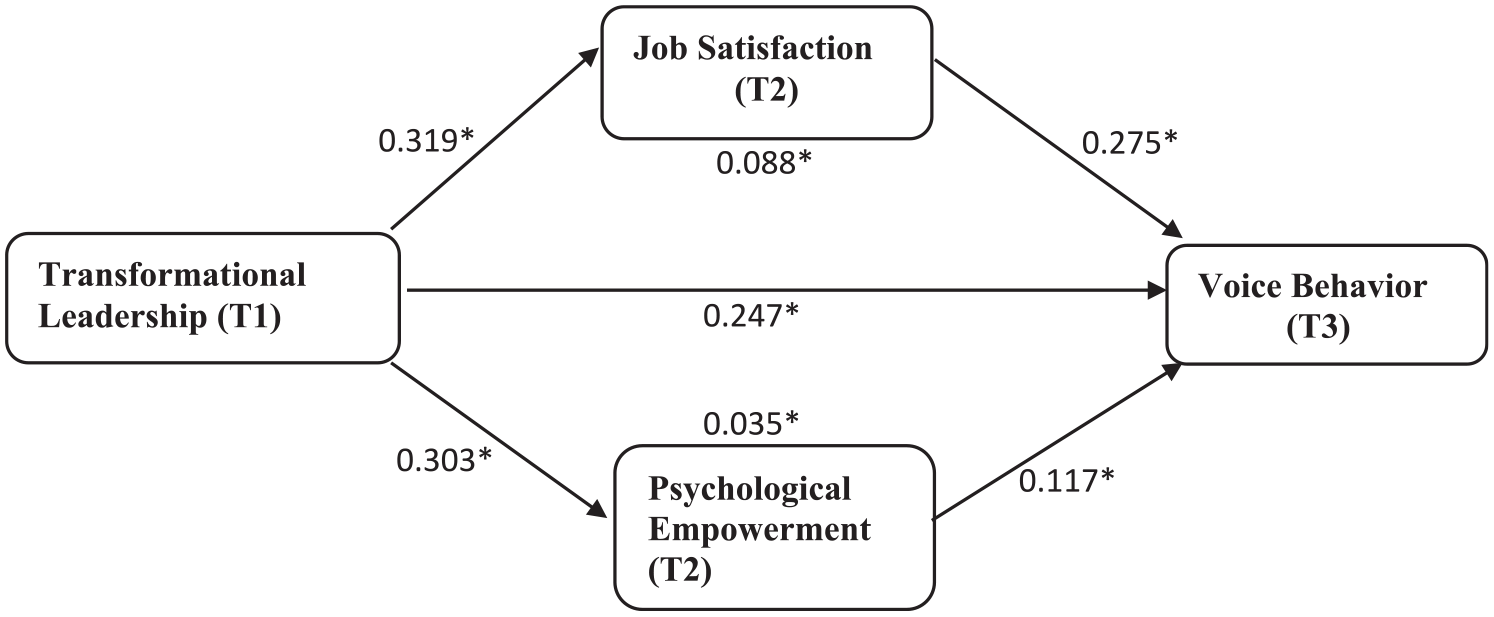
Significant paths in multiple mediation model.
Theoretical and Practical Implications
Three significant contributions are being offered by this research theoretically. First of all, as pointed by King et al. (2019), future studies need to explore leadership style with voice behavior. Findings of current study contributed toward the transformational leadership body of literature toward facilitating the employee voice behavior. This study highlights the importance of voice behavior which is boosted under transformational leadership both through direct (i.e., under transformational leadership) and indirect ways (i.e., through job satisfaction and psychological empowerment). Second, by extending the research on transformational leadership theory, this study has revealed interesting mechanism through which transformational leadership may encourage voice behavior; it considers job satisfaction and psychological empowerment as parallel mediators. Both parallel mediators illustrate the emotional (satisfaction factor) and psychological (psychological empowerment factor) motivating factors. Both motivation-based mediators give employees the confidence that by raising voice and challenging the status quo, they would be heard under the supervision of transformational leadership. Finally, current study responded to the research call by Lam et al. (2012) in which need to conduct more studies in Asian context is also addressed. The data collected from Pakistani organizations contribute toward the body of knowledge on transformational leadership–voice behavior in the South Asian context more specifically.
In addition to theoretical contribution, present study provides some important managerial implications. Transformational leaders through their charismatic style (idealized influence) have the ability to encourage employees to outperform than expected (Bass, 1985). Specifically, leaders should opt transformational leadership style to encourage employees to raise their voice for unveiling the hidden problems and their suggested solutions as well. Drawing on Blau’s (1964) social exchange theory, individuals reciprocate more positive behavior in return for the perceived values from the organizations. Hence, as suggested by Bass and Avolio (1993), inspirational motivation instilled by transformational leadership among their followers create a social exchange leader–follower relationship, due to which followers try to perform beyond expectations. Furthermore, as suggested by Hechanova et al. (2006), empowerment that is instilled among followers should be seen as “less to more” continuum rather than as “either-or” proposition. Consistent to this findings, our study suggests that a transformational leader can enhance the motivation of employees through improving (i.e., “less to more” continuum) psychological empowerment level of followers. In the same manner, job satisfaction being the internal motivating factor is established under transformational leadership. In turn, due to the trust of being heard by the leadership, they exhibit promotive voice behavior.
Limitations and Future Directions
Although current study has taken steps to enhance its validity by employing three-wave time-lagged study design and provides important insights about the dynamic understanding of the relationship between transformational leadership and voice behavior in South Asian context, it is not free from certain limitations. First, the data were gathered from Pakistani employees, which might limit the external validity. For instance, the results cannot be generalized to other population like Western-based sample. Therefore, we suggest future research to test the theoretical model of our study by taking broader sample and other cultural contexts as well to acquire generalizability. Second, instead of using multisource for data collection, the data were collected from employees only, which might artificially inflate the relationships between constructs due to common source variation Podsakoff et al. (2003). Although the CFA evidence revealed low influence of common source variation, we acknowledge our limitation of study and recommend future studies to utilize multisource data such that employee voice behavior would be assessed from leaders and the transformational leadership style would be assessed from respective team of followers, and job satisfaction and psychological empowerment be self-reported from employees. Third, consequences of voice behavior were not included in this study as these were beyond the scope of the study. Future studies might include the consequences of voice behavior by extending the model of this study (i.e., individual, group and organization level outcomes). Fourth, integrated model of current study represents only a part of complex nomological network of leader–employee relationship with respect to different mechanisms. We, thus, recommend future studies to incorporate other mediating mechanisms such as diversity climate, organizational embeddedness, emotional exhaustion, and prototypicality. Fifth, present study was cross-sectional in nature and to fortify the association between transformational leadership and voice behavior, future research can entangle other mediators/moderators by collecting data longitudinally.
Conclusion
Current study empirically attests the underlying mechanism roles of both psychological empowerment and job satisfaction that contribute to the literature of transformational leadership and voice linkage research. Furthermore, Findings of this study suggest that transformational leaders foster a learning work environment with appropriate norms while encouraging employees to engage in constructive voice behavior. Transformational leadership style adopted by organizations has beneficial effects in providing employees with motivating states related to their jobs as well. Thus, our study provides a thorough understanding of translating transformational leadership behavior into followers’ voice behavior specifically in South Asian context.
Footnotes
Compliance With Ethical Standards
All procedures performed in the completion of this study involving human participation follow the ethical standards and guidelines by taking consent from organizations first and then the participants who were first briefly explained about the study.
Authors’ Note
Sehrish Ilyas now affiliated to Management Sciences Department, Lahore College for Women University, Lahore, Pakistan.
Declaration of Conflicting Interests
The author(s) declared no potential conflicts of interest with respect to the research, authorship, and/or publication of this article.
Funding
The author(s) received no financial support for the research, authorship, and/or publication of this article.
