




Abstract
This study aims at investigating the effectiveness of therapeutic storytelling in reducing body dysmorphic disorder symptoms among a sample of female adolescents in Irbid, Jordan. The study sample comprises 28 female adolescents who are randomly distributed into two equal groups, namely the experimental group and the control group. The experimental group (N = 14) participated in the therapeutic storytelling program while the control group (N = 14) did not participate in any intervention program. However, to achieve the objectives of the study, a scale of body dysmorphic disorder is used to collect the study data in the pre- and post-tests of the two groups while the follow-up test is applied to the experimental group only. After analyzing the collected data, the results of one-way analysis of variance and t-test showed statistically significant differences between the experimental and control groups. The scores average of the post-test on the body dysmorphic disorder scale was in favor of the experimental group, which indicates the value of the therapeutic storytelling program used. The results of post- and follow-up comparisons among the experimental group members indicate the absence of statistically significant differences between the post- and follow-up averages on the body dysmorphic disorder scale, which reflects the reliability of the program’s impact.
Plain language summary
This study investigates the usefulness of storytelling in reducing body dysmorphic disorder symptoms among female adolescents represented by a sample of 28 females from Irbid, Jordan. Using statistical analysis, the study concludes that the absence of statistically significant differences between the post- and follow-up averages on the body dysmorphic disorder scale reflects the reliability of the program’s impact.
Introduction
Some adolescents live in a psychological climate full of tensions and pressures that increase the incidence of mental disorders. Social media is one of the most important factors that may cause adolescents’ negative self-perception, for example. Some applications allow adolescents to take photos, edit them, and filter them to change their appearances (Brucculieri, 2018). While this may seem innocent, it points to the belief that the main motivation for the cosmetic- surgery is dissatisfaction with the body (Chen et al., 2019). Interestingly, dissatisfaction with the body image is associated with an individual’s negative perception of themselves as well as what is called body dysmorphic disorder, which is a form of mental disorder in which dissatisfaction with physical appearance is the defining feature (Longley et al., 2019). The American Psychiatric Association (APA) defines body dysmorphic disorder as an individual’s preoccupation with one or more imagined physical appearance imperfection, not being observed by others (2013). It is caused by the interference and interaction of a range of external (physical and social) conditions with internal (psychological and physical) conditions, which cause the individual to perform several non-adaptive behaviors internally and externally (Afriliya Fila, 2018). In fact, about 7% to 15% of those who suffer from such disorder are estimated to be seeking plastic surgery (Walker et al., 2021).
Body dysmorphic disorder is classified, based on the Diagnostic and Statistical Manual of Mental Disorders Version V (DSM-5), in the category of obsessive-compulsive disorders (Phillips, 2017). Individuals with body dysmorphic disorder suffer from being obsessed with one or more perceived imperfections that do not exist or may, at least, be minor to their physical appearance. However, individuals with body dysmorphic disorder spend many hours focusing on single or more perceived imperfections in their bodies, although it does not seem to be defective at all. Some of them may look a little bit unattractive, but they become more occupied with their body image and focus more on that perceived defect, which negatively impacts their performance at the social and professional levels (American Psychiatric Association [APA], 2013). For instance, they may get engaged with repetitive behaviors due to fears arising from their appearance, doing their best to hide the incompatibility they imagine. In addition, they may generate involuntary habits such as constantly examining their appearances in the mirror, and they may seek reassurance from others concerning their clothes and appearance (Ramphul & Mejias, 2018).
This phenomenon has been tackled by several studies; nevertheless, adolescents usually resist sharing their concerns and problems with other people, which constitutes an obstacle to counselors (Noller & Atkin, 2014). Therefore, it is necessary to establish certain counseling methods that are more compatible with the adolescents’ traits (Slivinske & Slivinske, 2014). Among such methods outstands therapeutic storytelling, which is a way to deal with adolescents without blame or confrontation (Morgan, 2000; Perrow, 2003). This method deals with problems in a symbolic way through the analysis of stories, thus reducing adolescents’ resistance, as it seems less threatening to them (R. Gardner, 1986). R. Gardner (1986) introduced therapeutic storytelling as a substitution of the analytical principle used to bring the subconscious into the realm of consciousness to achieve therapy. He assumed that individuals are effective in their lives, being aware of other points of view and the many possibilities of situations. He also assumed that people enjoy not only listening to stories but also telling them. Thus, therapeutic storytelling is used as a diagnostic instrument and therapy method that depends on exchanging stories between the counselee and disordered individuals at the individual or group levels (Erford, 2014; Slivinske & Slivinske, 2014).
Erford (2014) found that therapeutic storytelling is suitable for adolescents, especially those who are resistant to talk therapy, which “known as psychotherapy, is based on the core idea that talking about the things that are bothering you can help with emotional distress” (Fritscher, 2020). Slivinske and Slivinske (2014) explained that through this method, adolescents can solve their problems relying on the behaviors of the characters in the story. This suggests that therapeutic storytelling needs the lowest level of trust between the counselor and the counselee, since the counselor does not demand explicit self-disclosure. The stories deployed in the therapy are analyzed symbolically, with the counselor giving full consideration of the nature of the counselee’s cultural and family background (Hammel, 2019). The storytelling process in story therapy is characterized by giving the individuals a future view of the consequences of their decisions, through which values and beliefs can be clarified. This process is to reach people who have difficulties speaking for themselves and have expressed feelings (Erford, 2014). However, some views must be taken into consideration when applying Therapeutic Storytelling. R. Gardner (1971) assumed that personal stories are not always accurate. They are affected by the current period of the narrative in terms of the difference in the extent of the individual’s perceptions of events. Also, they are affected by variations at the levels of development and subjective opinions among individuals. Besides, they may be influenced by the traits of the counselee addressed in the story. Therefore, the counselor should always look at the story within the cultural framework of the counselee, and the contextual position of the story. Moreover, the story should not be treated in isolation from the information provided by the counselee about them.
Several studies have been conducted about the effectiveness of therapeutic storytelling on mental health indicators in different samples. R. A. Gardner (1968) conducted a study to test the effectiveness of therapeutic storytelling in alleviating the problems of the Oedipus complex in the case of 5-year-old Larry. The results indicated that the method is useful in decreasing the severity of Oedipus problems in children. R. A. Gardner (1970) conducted another study to test the effectiveness of Therapeutic Storytelling in alleviating the severity of PTSD symptoms among five children from New York City in the USA. Their ages ranged from 5 to 9 years. The results of the study indicated the effectiveness of Therapeutic Storytelling in alleviating the symptoms of PTSD in children. Parker and Wampler (2006) conducted a study to identify the effectiveness of the therapeutic storytelling method and an educational method by providing direct psychological information. They compared the previous methods for reducing negative feelings and increasing positive feelings about relationships. The study sample comprised (42) female students whose ages ranged between 18 and 42 years with an average age of 30 years. The study results revealed that there were statistically significant differences between the pre and post measurements of the two groups. This indicated the effectiveness of both methods in reducing negative feelings and increasing positive feelings. The results also revealed that the therapeutic storytelling method was more effective than the educational method.
Shafieyan et al. (2017) conducted a study to test the effectiveness of a therapeutic storytelling program in improving students’ levels of optimism in Isfahan-Iran. The study sample comprised 34 male students whose ages ranged from 11 to 8 years. The data was collected by the standard Kazdin hopefulness tool. To extract the results, t-test and one-way analysis of variance were applied. The study results revealed that there were statistically significant differences between the pre and post measurements and between the experimental and control groups. This indicated the effectiveness of the therapy program in improving the level of optimism. Besides, the results indicated that there were no statistically significant differences between the post and sequential measurements, indicating the reliability of the impact of the program. Mannell et al. (2018) conducted a study to test the effectiveness of the program based on therapeutic storytelling in relieving women’s suffering and supporting their psychological health after exposure to men’s violence in Afghanistan. The study sample comprised 20 Afghani women. To collect the study data semi-structured interviews were used. The study results revealed statistically significant differences between the pre and post measurement and between the experimental and control groups. These results indicate the effectiveness of the used therapy program.
Al-Sharifin and Albahr (2020) conducted a study to examine the effectiveness of Therapeutic Storytelling in reducing bulimia nervosa and impulsivity disorders among a sample of female adolescents in Jordan. The study sample comprised 30 female students who were randomly assigned to two equal groups, the experimental group (N = 15) and the control group (N = 15). Two scales were applied to collect the study data; the Binge Eating Disorder scale and the Impulsivity scale. To get the result extracted, one-way analysis of variance was applied. The study results showed that there were statistically significant differences between the experimental and control groups. These differences were regarding the mean scores on the bulimia nervosa scale in the post-test in favor of the experimental group. Also, the results of the post and sequential comparisons indicated that there were no statistically significant differences among the members of the experimental group. These differences were between the averages of the post and sequential measurements on the bulimia nervosa scale and the dimensions of the impulsivity scale. These results reflect the reliability of the program’s effect.
By exploring the previous experimental research studies, it is obvious that they do not address body dysmorphic disorder within the limits of the researchers’ knowledge. Besides, these studies focus on different age stages with only one of them, Slivinske and Slivinske (2014), focusing on adolescence. Thus, this study is to provide specialists with a program that may help them face these problems and disorders.
Study Questions and Objectives
Some of the characteristics of the adolescence period highlight the urgent need for intervention by specialists; adolescents avoid sharing their problems with others because they believe that disclosing them threatens their self-image in front of others (Noller & Atkin, 2014). This makes it more difficult to reach their problems and solve them. In body dysmorphic disorder, the need for intervention becomes more urgent because of the negative effects of the disorder that adolescents may face in the coming stages. The motivation for the study came from the importance of early detection and intervention to treat body dysmorphic disorders in female adolescents. There was a search for more effective methods and appropriate ways to deal with these problems among adolescents. It is because the best therapy options are not yet clear (Hebebrand & Herpertz-Dahlmann, 2019). The researchers adopted a therapeutic storytelling method. The effectiveness of this method can be expected through its characteristics in the ability to reach adolescents and deal with their problems. What has increased the interest in this method is the scarcity of studies in this aspect. More specifically, the study attempts to achieve the objective of whether there are statistically significant differences (α = .05) between the average scores of female adolescents in the experimental group and the average scores of their peers in the control group.
Idiomatic and Procedural Definitions
Body Dysmorphic Disorder: It is an individual’s preoccupation with one or more imagined imperfections in physical appearance that are not noticeable to others. Or it appears to them only slightly, and during this time the individual engages in repetitive behaviors such as picking at their skin or excessive self-care. They may have mental actions such as comparing their appearance to others in response to appearance anxiety. This appearance anxiety causes disruption in the individual’s social and professional life and other important areas of performance (APA, 2013). It is defined procedurally depending on the degree obtained by the respondent on the used body dysmorphic disorder scale in the current study.
Therapeutic Storytelling: It is the use of storytelling as a diagnostic instrument and therapy method through several stages. The counselor begins with the counselee’s narration of a personal story from their imagination, using games, drawing, singing, writing poetry, and other means to express the story. Then, the counselor analyzes that story and the counselee’s projections within it, developing therapeutic stories that provide a context for the personal story told by the counselee. The counselee tells the counselor through sessions. And at the end of the sessions, the counselee retells the personal stories, with some modifications, expressing an exchange of personal narratives with therapeutic characteristics. Thus, therapy is achieved (R. Gardner, 1986). The therapeutic storytelling program in the current study is defined as a group counseling program based on the therapeutic storytelling method and being prepared by the two researchers.
The Stage of Adolescence: It is the link between childhood and adulthood and includes the ages of 10 to 19 years. This stage includes several sub-stages arranged in chronological order: the early adolescence stage, which is between 11 and 13 years. Middle adolescence is between 14 and 16 years, and late adolescence is between 17 and 19 years (Hagan et al., 2015).
Method and Procedure
Study Members
Several dermatology clinics were selected using the convenience sampling method. The body dysmorphic disorder scale was applied to all 124 female adolescents who attended dermatology clinics. In light of the scores obtained by female adolescents on the body dysmorphic disorder scale, 37 females who obtained high scores on the body dysmorphic disorder scale were enumerated. After meeting with the female adolescents and clarifying the purpose of the study, 28 female adolescents obtained the consent of their parents to participate in the counseling program. The sample was randomly divided into two groups: an experimental group comprising 14 female adolescents and a control group comprising 14 of them.
Study Instruments
Body Disorder Scale Constancy
To estimate the reliability of the internal reliability of the body dysmorphic disorder scale and its triggers; Cronbach’s Alpha equation was used. The internal reliability for the scale as a whole was (0.910). The values of the reliability of the internal consistency of its dimensions ranged between (0.902 −0.876). To verify the reliability of the repetition of the scale and its dimensions, the scale was re-applied to the previous exploratory sample, using the test-retest method. The repetition reliability of the scale was (0.923) and the repetition reliability values of its dimensions ranged from (0.914) to (0.879).
The rationale for its validity has been verified by presenting it to a group of 5 competent referees, who were Professors of Psychology. These referees were to determine the appropriateness of the objectives for which it was designed. The referees considered the program appropriate with some modifications, and in the light of the proposals, the amendments were made, and the program was subsequently applied.
Study Procedures
The study was carried out by implementing the followings: First, medical clinics were identified, in which the survey was to be applied in preparation for the study sample. Then, researchers prepared the study instruments according to the scientific steps followed in experimental studies and ensured their validity, reliability, and applicability. After that, they met some dermatologists to ensure cooperation and accuracy in the conduct of the study. Then, the instrument was developed, and validity and reliability indicators were extracted; the instruments then were applied to the group of female adolescents in the clinics. The study sample was 28 female adolescents. The researchers updated the identification procedures of the study sample through the collection of preliminary demographic data on the sample and oral parental consent was obtained. Then, the study sample (n = 28) was equally distributed into experimental and control groups. Thenceforth, the post-test was applied, and data were collected and analyzed to compare the performance of the experimental group with that of the control group. And then, the follow-up measurement was applied 1 month after the end of the program, after which the results were analyzed and presented. These results were discussed, and some recommendations were presented to comply with the results reached and finalize the research.
Study Design
This study is a semi-empirical study, expressed in symbols:

(G1) stands for Experimental Group; (G2) stands for Control Group; (R) stands for Random Distribution; (O1) stands for Tribal Measurement with Study Scales; (O2) stands for Post- Measurement with Study Scales; and (O3) stands for Sequential Measurement with Study Scales.
Study Variables
Statistical Processing
To test the hypotheses of the study, the arithmetic means and standard deviations of the sample respondents’ responses to pre, post, and sequential measurements were calculated. The researchers are using the ANCOVA method to test the first hypothesis and the T-test for two independent samples to test the second hypothesis.
Study Results
Arithmetic Means and Standard Deviations of the Respondents’ Responses of the Two Experimental Groups on the Scale of Symptoms of Body Dysmorphic Disorder in the Pre and Post Test; Following the Group Variable.

Table 1 shows apparent differences between the arithmetic means of the scores of the members of the two experimental and control groups of the body dysmorphic disorder scale. To verify the substance of the phenotypic differences, one-way ANCOVA analysis was used. This is done after taking into account the pre measurements of the body dysmorphic disorder scale, for both groups, as an associated variable, as shown in Table 2.
One-Way Analysis of Variance Associated With the Body Dysmorphic Disorder Scale in the Post-Test Following the Group Variable.
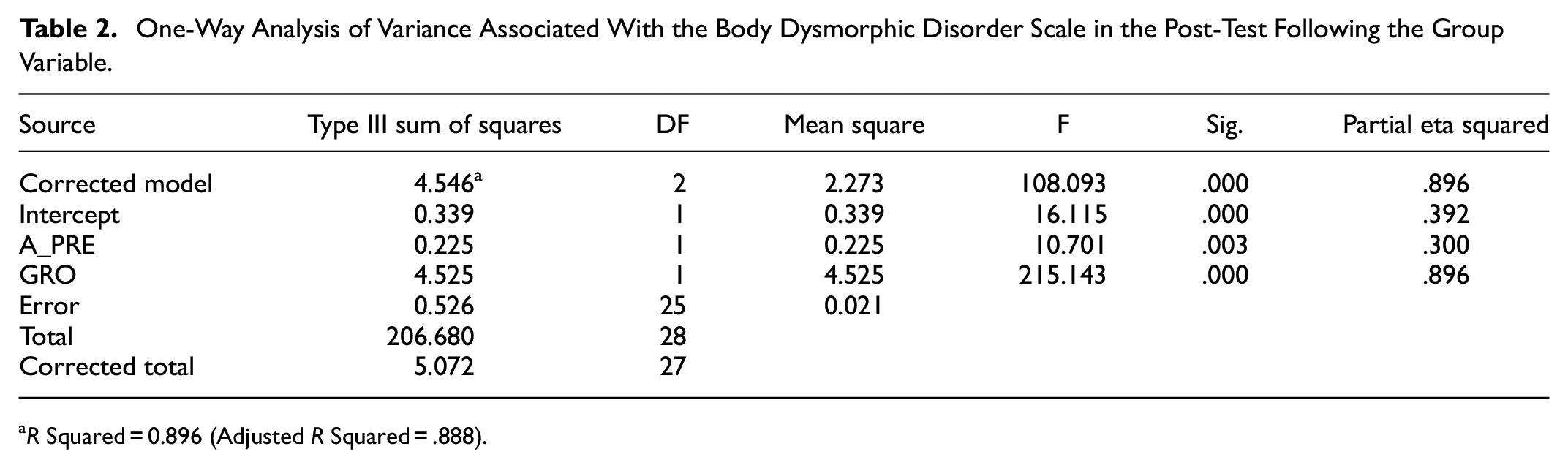
R Squared = 0.896 (Adjusted R Squared = .888).
Table 2 shows that there is a statistically significant difference at the significance level (α = .05). This difference is between the two-arithmetic means for the post-measurement of female adolescents’ responses on the body dysmorphic disorder scale according to the group (experimental, control). The researchers calculated the adjusted arithmetic means and standard errors of the post-measurement of body dysmorphic disorder in female adolescents. They did so to determine in favor of which of the two study groups (experimental, control) the apparent differences were, following the group, as shown in Table 3.
The Adjusted Arithmetic Means and Standard Errors of the Body Dysmorphic Disorder Scale in Female Adolescents Following the Group Variable.

Table 3 shows some apparent differences in favor of the female adolescents in the experimental group receiving training on the counseling program; compared to those in the control group who did not receive any training. Thus, these differences lead to the acceptance of the statistical hypothesis, realizing that the effect size of the program has reached (89.6%). This is to indicate a strong and practical effect of the therapeutic storytelling program in reducing the level of body dysmorphic disorder.
Table 4 shows that there are no statistically significant differences for the T-Test of the correlated samples of the body dysmorphic disorder scale. They indicate that there is a continuity to the program’s impact after the program ended. This indicates acceptance of the null hypothesis.
Results of the Paired Samples T-Test Show Differences in the Post- and Sequential Measurements of the Body Dysmorphic Disorder Scale.

Results Discussion
The current study sought to examine the effectiveness of therapeutic storytelling in reducing body dysmorphic disorder in a sample of female adolescents. The results of the examination of the first and second hypotheses indicated their acceptance. There were statistically significant differences (α = .05) among members of the experimental group and the control group, in favor of the experimental group. The level of body dysmorphic disorder decreased in the experimental group compared to the female adolescents in the control group.
This positive result of the current study complies with the findings of some Arab and Western studies that used the therapeutic storytelling method such as Al-Sharifin and Albahr’s (2020) study. The positive results of the program can be explained by starting with R. Gardner’s (1971) study: Gardner indicated the effectiveness of therapeutic storytelling in helping individuals talk about their problems and discuss them with others without threatening themselves. This was confirmed by Al-Sharifin and Albahr’s (2020) study. Besides, this was demonstrated in the current study by some of the female participants, who indicated that the program helped them talk about their problems without hesitation.
The positive result can be explained considering the flexibility of the therapeutic storytelling method. It was possible to employ various methods and different activities that may have helped in achieving the goals that the program was designed to achieve. Also, this helps effectively employ the time allocated for the sessions. The style is also flexible, according to some researchers, as it responds to the different cultures of female adolescents. It is based on storytelling that transcends culture and moves to the core of the human experience (Gladding & Drake Wallace, 2010).
The results can also be interpreted considering the therapeutic storytelling method that creates the conditions for making decisions. This complies with the nature of the age stage, which is characterized by the adolescent’s quest for independence from others (Noller & Atkin, 2014). Also, the presence of many female adolescents in the experimental group may have a positive impact on developing positive feelings among female adolescents, in general. The feeling that some share problems with them may be considered a mitigating factor for negative feelings.
The results may be attributed to the effectiveness of the therapeutic storytelling method. This could be the case as most participating female adolescents indicated that their ability to express themselves during storytelling was improved. Additionally, listening to the stories of other female adolescents may have an impact on their ability to better identify and explore themselves. The effectiveness of the method can be inferred from the effective questions that the female adolescents were asking during the application of the different stages of the method; this may reflect a sound understanding of the nature of the method used. This effectiveness is confirmed by Gardner’s assumption (R. Gardner, 1986) which sees that therapeutic storytelling is attractive to individuals; and that individuals not only enjoy listening to stories but also telling them. Besides, it is confirmed by Erford (2014) who believes that therapeutic storytelling is suitable for many cases, including those who find it difficult to express their feelings.
The researchers assumed the effectiveness of the stage of therapeutic stories and questions from their effectiveness in recording and analyzing data. The researchers found common therapeutic dimensions among the female counselees’ problems, for which the therapeutic stories were built to serve them. And this effectiveness became clear during the telling of therapeutic stories from the female students’ gestures and body language, which reflect their harmony with the events of the story. Those female students told their stories without fidgeting or straying in their minds, along with a noticeable change in their emotional state during the storytelling. Moreover, effective questions were posed by the female guides to the characters and events in the story. As for the effectiveness of the therapeutic questions, it was represented by the researchers’ commitment to submitting the levels of questions gradually. They covered aspects of the problem to increase the female counselees’ awareness of it, providing them with the largest possible number of treatment options and alternatives to the problem. They created hope for improvement, and this is what Slivinske and Slivinske (2014) emphasized.
Also, listening to the visual recordings may have had an effective impact in achieving these results. R. Gardner (1986) saw that listening repeatedly to video recordings of progressive stories, therapeutic stories, and alternative stories works to raise the counselees’ level of awareness; as the counselor can play a role in achieving positive results during the application. Adherence to the specific procedures of the therapeutic storytelling may have the greatest impact in urging female adolescents to use therapeutic storytelling and increase the effectiveness of the application.
The reliability of the program’s contribution reduced the symptoms of body dysmorphic disorder. This can also be explained by the fact that the program, with its guiding and practical components, helped female adolescents increase their self-awareness. This awareness increased the dimensions of thinking and behaviors. The program may have a role in realistic thinking skills by providing female adolescents with the storytelling skills to create consistency among female counselees regarding past and current events. Therefore, it was noticeable that female adolescent counselees tended to tell real stories. This supports what Erford (2014) indicated that adolescents are more inclined to think realistically because those skills, that comply with the female adolescents’ needs, gain stability.
The female adolescents’ stability can be explained considering what Slivinske and Slivinske (2014) indicated that therapeutic storytelling improves the self-concept of the female counselees’ perception of themselves. Besides, it helped in their understanding of their identities by the individual’s focus on the problem itself that needs to be solved and the individual is not the problem. This may have contributed to creating hope for improvement among female counselees.
Study Significance
First: The Theoretical Scientific Significance
This study sought to contribute to addressing the therapeutic storytelling method by revealing its effectiveness in Arab studies. This study attempts to test its effectiveness in reducing the symptoms of body dysmorphic disorder among a sample of female adolescents. The study and the therapy method that it tackles are the first at the Arab level within the limits of the researchers’ knowledge. Thus, it can be relied on as a point of reference and an introduction to future research and studies to deal with adolescents’ other problems that appeal to specialists.
Second: The Practical Significance
The practical importance of this study is its provision of a counseling program that can be used in dealing with adolescent problems. Also, it is considered an early solution to treat those problems considered precursors to other problems. The study is considered important as it contains theoretical literature that can be used to form a knowledge base about therapeutic storytelling and body dysmorphic.
Study Limitations
The possibility of generalizing the results of the current study is determined by several conditions: Demographic characteristics of the study sample of female adolescents whose ages ranged from 14 to 17 years, in Irbid Governorate, Jordan. It is also determined by several factors: the quasi-experimental study design with experimental and control groups, random distribution with pre, post, and follow-up measures, and the psychometric properties of the instruments used in the study. Besides, the components of the counseling program and the nature of the temporal conditions, must be considered, as they were subjected to the Corona pandemic.
Conclusion and Recommendations
Through this research, it is clear that story therapy is considered the most useful, creative, and appropriate method for the counselor, through which games, drawing, writing, singing, poetry, and others can be used to express stories that help the clients to express as effectively as possible. By using story therapy as a diagnostic tool and treatment method, the counselor is able to analyze the projections presented by the counselor through the story. After the personal stories are exchanged between the counselor and the counselee, the therapeutic treatment is achieved. However, what distinguishes narrative therapy is that it needs the lowest level of trust between the counselor and counselee, as the problem is presented in a symbolic way, in which the counselor does not demand explicit self-disclosure. Also, the stories are analyzed in a symbolic manner, which reduces resistance, but the counselor must understand, as much as possible, the nature of the cultural and family background. Accordingly, the researchers recommend the following:
❖ Adopting this study program within the collective counseling in schools for its effectiveness in reducing the level of body dysmorphic among female adolescents would be a good start.
❖ Training the educational counselors on the program used in this study based on therapeutic storytelling.
❖ Incorporating the therapeutic storytelling program into the study plans of university counseling and mental health students, as well as training them in it.
Footnotes
Declaration of Conflicting Interests
The author(s) declared no potential conflicts of interest with respect to the research, authorship, and/or publication of this article.
Funding
The author(s) received no financial support for the research, authorship, and/or publication of this article.

Data Availability Statement
The datasets generated during and/or analyzed during the current study are available from the corresponding author on reasonable request.