




Abstract
Adolescent females are at risk for increased rates of poor mental health, with low self-esteem being of particular concern. Approaches incorporating mentorship, emotional intelligence training, and physical activity directed toward improving self-esteem in youth may be effective. The objectives of this study were to evaluate a program, titled BIO Girls, for measures of self-esteem, paying particular attention to potential differential effects based on physical activity type. Self-esteem, body esteem, and physical activity enjoyment were assessed in BIO Girls participants, serving as study participants, preseason and postseason. Paired samples t-tests revealed significant increases in self-esteem (t(84) = −1.62, p = .004) from pre-test to post-test. Significant increases from pre-test to post-test were found for body esteem in certain groups, cross-training (t(84) = 2.10, p = .04) and yoga t(84) = 15.00, p = .01) and on specific body esteem subscales, the appearance esteem subscale t(84) = −2.11, p = .02). Repeated measures ANOVA revealed no significant differences between program type, (F(3,81) = .33, p = .90), grade (second–sixth), (F(4,80) = .41, p = .80), or program location F(1,83) = .003, p = .96 for self-esteem. No significant differences were found between program type (F(3,81) = .23, p = .95), or grade (F(4, 80) = .61, p = .52) for body esteem. No significant differences were found between program type F(3,81) = .64, p = .46., or grade F(4,81) = .85, p = .46 for enjoyment of PA. BIO Girls program was effective in enhancing self-esteem regardless of the type of physical activity, age of the participants, and program location. BIO Girls was also effective in improving components of body esteem in its participants, regardless of the type of physical activity and age of the participants.
Plain Language Summary
Why was the study done? BIO Girls is a self-esteem-building program serving young girls. It involves twelve weekly sessions that combines life-skills lessons, Christian non-denominational devotions, small-group mentoring, and non-competitive physical activity. The primary goal of BIO Girls is to improve girls’ self-esteem. Improving self-esteem is important because having low self-esteem, or being regularly unhappy or unsatisfied with yourself, is a strong predictor of behavioral and emotional problems including depression, anxiety, eating disorders, suicide, risky sexual behaviors, and substance abuse. What did the researchers do? Researchers asked the participants of BIO Girls to complete a survey on self-esteem, body esteem, and enjoyment of physical activity at the beginning and completion of the program. Preseason and postseason scores on each survey were compared to determine whether girls experienced changes in self-esteem, body esteem, and enjoyment of physical activity as a result of participating in BIO Girls. What did the researchers find? Results from these analyses showed that, by the end of the BIO Girls program, girls scored higher on self-esteem, body esteem, and enjoyment of physical activity. The results were similar across all age groups, site locations, and type of physical activity incorporated. What do the findings mean? Findings from this study support the concept of providing programs intentionally designed to enhance self-esteem in young females. The evaluation of desired outcomes of such progams assissts organizations in obtaining funding for continued program implementation and expansion.
Introduction
Issues regarding the emotional well-being of youth are becoming increasingly problematic. With depression and anxiety on the rise in our youth (Centers for Disease Control, 2022), exploring ways to combat the problem is essential. There appears to be a more recent cause for concern regarding mental health due to the COVID-19 pandemic (Chen et al., 2020; Panchal et al., 2023). Adolescent females are especially at risk for increased rates of poor mental health, as being female was identified as a significant risk factor for increasing symptoms of anxiety during the pandemic (Chen et al., 2020l; Panchal et al., 2023).
Due to the correlation between mental health and self-esteem, this aspect of psychological well-being is of particular interest. Adolescents are particularly vulnerable to having low levels of self-esteem (Dove, 2017; Sebire et al., 2014). Many adolescent girls are at risk for having negative beliefs about themselves due, in part, to physical self-concept pressures and disturbances (Beasley & Garn, 2013; Dove, 2017), resulting in low body esteem. Body esteem refers to an individual’s overall evaluation and feelings about their own body. Body esteem has been shown to have a significant and measurable impact on girls’ confidence and life satisfaction (Dove, 2017) and is a substantial predictor of self-esteem (Goldschmidt et al., 2016). Low body esteem is a risk factor for several other concerns in children and adolescents, such as disordered eating, unhealthy behaviors (e.g., smoking) (Paxton & Damiano, 2017), and low self-esteem (Goldschmidt et al., 2016).
Many behavioral, social, mental, and physical health issues are associated with low self-esteem. Adolescents with low levels of self-esteem have revealed more social and emotional issues such as being antisocial (Choo et al., 2017; Dove, 2017;) and having depression and anxiety (Choo et al., 2017; Orth, & Robins, 2013; Sowislo et al., 2013; Taylor, 2014; Troshikhina & Manukyan, 2016). Low self-esteem individuals also tend to engage in negative behaviors such as engaging in substance abuse (Taylor, 2014; Troshikhina & Manukyan, 2016), having higher rates of screen time and computer use (Carson et al., 2016), engaging in addictive social media use (Andreassen et al., 2017), and having a higher risk of suicide (Choo et al., 2017). Conversely, higher levels of self-esteem predict more success in many wellness dimensions, such as better occupational success, healthy relationships, and overall well-being (Orth & Robins, 2014). Additionally, those with higher levels of self-esteem are less likely to engage in risky health behaviors (Keane & Loades, 2017; Langdon-Daly & Serpell, 2017; Sánchez-SanSegundo et al., 2022). Factors contributing to higher self-esteem include a stable home environment and good communication and relationships with parents (Diedrichs et al., 2016; Nguyen et al., 2019), having a healthy weight (Carson et al., 2016), physical activity and sports participation (Dale et al., 2019; Galeotti, 2015; Liu et al., 2015), and being involved in programs that promote adolescent empowerment (Galeotti, 2015; Iachini, et al., 2017).
Many of these factors are related to physical activity (PA) and are strong correlates of higher self-esteem. Furthermore, physical activity appears to have a protective effect on developing anxiety or depression (Chen et al., 2020; Panchal et al., 2023) by helping to improve self-esteem (Ranøyen et al., 2015)and a positive physical self-concept, thus creating better body esteem. (Fernández-Bustos et al., 2019; Liu et al., 2015). Recent reviews of PA in children and adolescents have revealed strong links between physical activity and various aspects of mental health such as depression, anxiety, self-esteem, and cognitive functioning (Biddle et al., 2019; Dale et al., 2019). Although causal effects remain ambivalent, physical activity has been shown to reduce and/or improve symptoms of depression and anxiety, increase self-esteem (Galeotti, 2015; Tirlea et al., 2016)., and improve physical self-concept, thus body esteem (Fernández-Bustos et al., 2019; Liu et al., 2015).
Interventions
Given the potential long-term negative consequences of low self-esteem and positive outcomes of high self-esteem, it is imperative analyses and interventions to improve self-esteem in adolescents be implemented. Several approaches have been implemented to determine how best to assist society’s youth in improving self-esteem. Such approaches often incorporate mentorship, emotional intelligence training, and physical activity. Curriculum-based wellness programs have been found to significantly improve self-esteem, self-efficacy, and health behaviors in young females (Marino, et al., 2020; Ranøyen et al., 2015). Mentoring programs involving relationship building, self-esteem enhancement, and goal setting, designed specifically to enhance self-esteem, have been effective in doing so (Galeotti, 2015; Weiss et al., 2019). In addition to mentorship programs, interventions designed to improve emotional intelligence (EI) can also have a positive effect on self-esteem (Joshi & Sokhe, 2021).Emotional intelligence has been defined as the ability to monitor one’s own and other’s feelings, differentiate amongst feelings, and use this information to guide one’s behavior. It is a set of skills that lays the foundation for building self-esteem (Joshi & Sokhe, 2021). Upon completion of emotional intelligence intervention training that consisted of lessons involving recognizing and understanding emotions, labeling, and expressing emotions, and understanding and recognizing (high and low) self-esteem, self-esteem was significantly enhanced (Joshi & Sokhe, 2021).
Programs and interventions designed specifically to increase physical activity have also been shown to improve self-esteem (Biddle et al., 2019; Ranøyen et al., 2015) and physical self-concept (a component of global self-concept similar to self-esteem) (Biddle et al., 2019; Erdvik et al., 2020; Joshi & Sokhey, 2021). Most of the studies reviewed revealed evidence to support the effectiveness of PA in improving the physical self-concept domain of self-esteem, with the strongest evidence for improvements in physical self-perceptions that accompanied enhanced self-esteem in the majority of the studies measuring these outcomes (Biddle et al., 2019). In a meta-analysis of 38 studies that used a variety of participants ranging from ages 4 to 20, researchers reiterated the association between physical activity, self-concept, and self-esteem, and concluded that PA interventions alone play a significant role in improving self-worth and self-concept, particularly physical self-concept, in children and adolescents (Liu et al., 2015). While self-esteem and physical self-concept may be meditating factors, a strong predictor of physical activity is enjoyment. Interventions designed specifically to increase the enjoyment of PA have been shown to increase PA levels. (Dishman et al., 2005). Enjoyment of an activity has a significant influence on behavior, providing an immediate reward for being physically active. Enjoyment might also have an indirect influence on physical activity by influencing self-efficacy. Certain domains regarding attitudes toward physical activity were found to be predictors of fitness levels among youth (Ruiz & Sherman, 2006).In other words, participants with “better” attitudes toward physical activity had higher levels of aerobic capacity, indicative of higher levels of PA. Therefore, finding a type of PA that children and adolescents enjoy will contribute to a healthy level of PA.
Combining the components of effective interventions to improve self-esteem, a program titled BIO (Beautiful Inside and Out) Girls was created in 2013. The program was inspired and developed based on concepts from the Dove Self-Esteem Project, which was created to empower young females to form a healthy body image and help to improve their body confidence and thus self-esteem (The Dove Self-Esteem Project, Dove, 2022). The premise of the program was to do so through life-skill lessons, mentorship, and non-competitive physical activity. Initial analyses of BIO Girls programming effects indicated significant improvements in self-reported overall quality of life, physical well-being, emotional well-being, family life, and school life. Parents of the participants also reported significant improvements in total well-being, physical well-being, emotional well-being, self-esteem, family life, and school life (Gust, 2020). The primary type of physical activity incorporated into the program for these analyses was running; however, since the initial formal analysis, BIO Girls has expanded to incorporate additional types of PA, such as cross-training, yoga, and self-defense, to explore other types of PA young girls may enjoy. Other physical activity intervention programs have incorporated various types of exercise, including aerobic exercise, martial arts, flexibility, yoga, and strength training. Efforts to identify differential effects of physical activity on self-esteem based on PA type have only been conducted with adults, with no recent comparisons. Although various types of PA, sport, and exercise have been used as an intervention, to our knowledge, no studies have investigated the potential comparison effects of different PA types on self-esteem in youth.
Because BIO Girls’ mission is “to improve the self-esteem in adolescent girls,” evaluating its effectiveness is imperative for continuous development and improvement. The BIO Girls curriculum includes lessons that are intentionally and purposefully focused on body esteem and self-esteem. Therefore, measuring these variables may indicate the program’s worth. The physical activity portion of the program steadily increases the amount of weekly PA, therefore, measuring the amount of PA would be counterproductive. Given the correlation between attitudes toward PA and long-term PA, this variable was deemed worthy of study. Individuals who experience higher enjoyment of physical activity are more likely to engage in regular physical activity, which in turn, is associated with increased levels of self-esteem
Therefore, the purpose of this study was to evaluate the effects of the BIO Girls program on self-esteem, body esteem, and enjoyment of physical activity, paying particular attention to potential differential effects of PA type.
Methods
BIO Girls is a 12-week community-based program that includes mentorship, life-skills lessons, Christian non-denominational devotions, and non-competitive physical activity. Each week, program participants and mentors meet and engage in educational activities that strive to combat societal pressures, recognize their values, handle stress, and choose kindness (BIO Girls, 2022). Additionally, BIO Girls focuses on physical fitness as a part of a holistic approach to health and well-being. Mentors are community volunteers who are dedicated to the BIO Girls mission. Each week, mentors led their small group (5–6 girls) through the curriculum, engaged in discussions, and participated in each session’s physical activity. Weekly sessions were 90 min in length. The mission of BIO Girls is to improve self-esteem and build self-confidence and life skills through non-competitive physical activity, small group mentorship, and faith-based lessons.
This study was conducted using a quasi-experimental design in which adolescent females (age 7–12) participating in a BIO Girls program, were surveyed on day one of the program (pre-test) and the last day of the 12-week program, (post-test). The survey was administered electronically on tablets using Qualtrics offline application. All program participants, and their parent(s), received an assent form via email prior to the initial program meeting. Those who chose to opt out were not included in the study. This study was approved by the University of Minnesota's Institutional Review Board.
Participants
Of the total 1,403 girls participating in BIO Girls in 2021, a convenience sample of 368, involving 14 communities, were enrolled in this study. Each site consisted of a range of 20 to 40 participants. Of this group, a small subsample of 85 (23%) completed both preseason and postseason surveys. Participants ranged in age from 9 to 12 years old (M = 10.83, SD = 1.31). Ninety-one percent of participants were White or Caucasian, 1.78% Hispanic or Latino, 1.35% American Indian or Alaska Native, 1.21% Black or African American, and 0.71% Asian. Sixty-one percent came from a rural community, while 39% lived in an urban or suburban setting. Just under 1% of the participants were considered low socioeconomic status based on their enrollment in free or reduced lunch. Participant distribution in the four program types was as follows: 78.8% running, 10.6% cross training, 7.1% self-defense, and 3.5% yoga.
Measures
Both pre- and post-surveys consisted of the same measures of self-esteem, body esteem, and enjoyment of physical activity. The instruments used to measure these constructs were widely used, well-established tools that have shown evidence of reliability and validity in past research studies. First, the 10-item Self Esteem subscale of the Behavior Assessment System for Children (BASC), child form (Reynolds & Kamphaus, 2004) was used to measure girls’ self-esteem, with a four-point Likert scale from 0 (never) to 3 (almost always) and a response rating of false (0) to true (2). To create total scores, item raw scores were first summed and then converted into standardized t-scores, such that overall lower scores indicated less self-esteem. Sample items included, “I like the way I look” (never-always) and “I feel good about myself” (false-true). This instrument is a valid and reliable tool for assessing several behavioral and emotional constructs and measures of self-perception, including self-esteem. (DiStefano and Kamphaus, 2007; Kamphaus and Reynolds, 2007; Weis and Smenner, 2007).
Second, the 20-item Body Esteem Scale (BES) (Mendelson & White, 1993), which includes three subscales for appearance, weight, and attributions, was used to measure body esteem, with a three-point Likert including 0 (no), 1 (sometimes), and 2 (yes). Negatively worded items were reversed coded then a total score was determined by adding the scores for each item, thus, higher scores indicated a higher level of body esteem. The Body-Esteem Scale (BES) is a commonly used measure of self-evaluation of body image in youth and is a valid and reliable measure of body esteem for this population (Cecil and Stanley, 1997, Perez et al., 2023).
Lastly, the 16-item Physical Activity Enjoyment Scale (PACES) was used to measure girls’ enjoyment of physical activity, with a five-point Likert scale from 1 (disagree a lot) to 5 (agree a lot). A score was computed by calculating the average of the 16 items. PACES has been shown to have high internal consistency and be a valid and reliable instrument (Kendzierski & DeCarlo, 1991, Moore et al., 2009; Motl et al., 2001).
Analysis
Pre- and post-surveys were matched to participants using an assigned ID number that was included in each survey. Paired samples t-tests were used to determine the difference in self-esteem, body esteem, and physical activity enjoyment from pre- to post-test. Analyses of individual items on each subscale of the BASC, as well as each of the individual items on the BES and the PACES were also conducted, using t-tests and chi-square tests. Repeated measures ANOVA was used to evaluate the effects of program type (running, cross-training, yoga, and self-defense), grade level (grades 2 through 6), and program location (rural vs. urban), on changes in self-esteem, body esteem, and enjoyment of PA. Data were analyzed using IBM SPSS statistics software, version 28.
Results
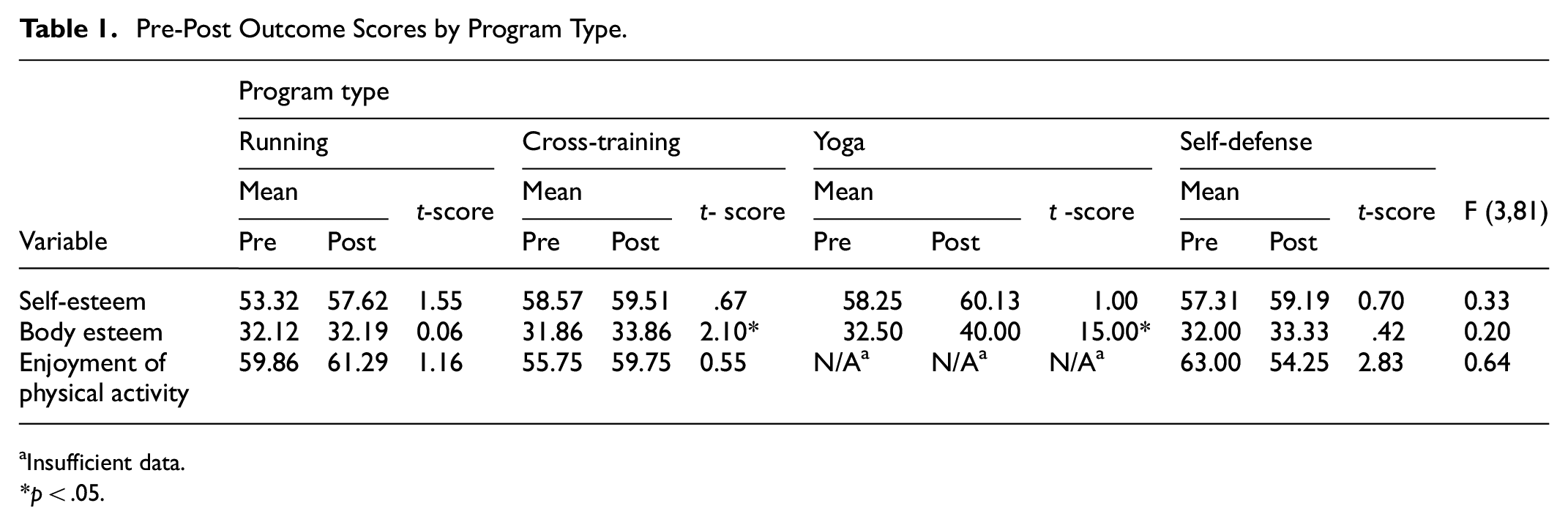
Pre and post-test results are displayed in Figure 1 and Table 1. Participants experienced an overall significant increase in self-esteem (M = 40.29 ± 4.25 vs. 41.21 ± 4.90, t = −1.62, p = .004) from pre-season to post-season. Overall body esteem also increased (M = 31.30 ± 2.46 vs. 33.30 ± 3.01, t = −1.92, p = .08) from pre-season to post-season, yet not statistically significant. However, significant increases in body esteem did increase significantly for participants in the cross-training (M = 31.86 ± 2.33 vs. 33.86 ± 2.79, t = 2.10, p = .04) and yoga groups (M = 32.50 ± 2.59 vs. 40.00 ± 4.01, t = 15.00, p = .01) Additionally, girls scored significantly higher on the appearance esteem subscale of the BES at post-test (M = 22.12 ± 2.04) than at pre-test (M = 20.66 ± 1.78; t = −2.11, p = .02).

Outcome scores from pre to post program.
Pre-Post Outcome Scores by Program Type.
Insufficient data.
p < .05.
Item analysis on self-esteem found that significantly fewer girls reported wishing they were different (χ2 = 4.32 p = .04 and girls scored significantly higher on liking their looks (t = −1.31, p = .01). Statistically significant findings were also found for items of body-esteem: (1) Girls scored significantly higher on their weight making them happy (t = −1.67, p = .01), (2) Girls scored significantly higher on liking what they saw in the mirror (t = −2.13, p = .01), (3) Girls scored significantly higher on being proud of their bodies (t = −2.68, p = .004), (4) Girls scored significantly higher on thinking they have a good body (t = −1.15, p = .03), (5) Girls scored significantly lower on wanting to change their looks (t = 1.42, p = .004), and (6) Girls scored significantly lower on feeling ashamed of their looks (t = 1.26, p = .01). Lastly, regarding enjoyment of physical activity girls were less likely to report feeling bored with physical activity (t = 2.54, p = .01).
The estimated means of self-esteem, body esteem, and enjoyment of PA are presented by program type in Table 1. No significant differences were found between program type for self-esteem F(3,81) = .33, p = .90, body esteem F(3,81) = .23, p = .95, or enjoyment of PA F(3,81) = .64, p = .46. Additionally, no significant differences were found between each grade for self-esteem, F(4,80) = .60, p = .51, body esteem F(4, 80) = .61, p = .52, or enjoyment of PA F(4,81) = .85, p = .46, and no significant differences were found between each site location (rural vs. urban) for self-esteem F(1,83) = .003, p = .96.
Discussion
The findings of this study indicate that the BIO Girls program was effective in enhancing self-esteem in its participants, regardless of the type of physical activity participants engaged in, and age of the participants, or if the program was in a rural or urban setting. It was also effective for enhancing body esteem, independent of PA type or age. Since the BIO Girls program is intentionally designed to improve self-esteem in young girls, this finding is encouraging. This finding contrasts with a previous study evaluating BIO Girls, in which no significant improvements were found from the girls’ surveys, in self-esteem from pre- to post-program (Gust, 2020). A plausible explanation for the difference in outcomes is that the 2020 study used a different tool to assess self-esteem, the KINDL-R, which translated to English means Revised questionnaire to assess Health-Related Quality of Life in children and adolescents. However, when evaluating the parents’ surveys in the 2020 study, significant improvements were found in self-esteem. Utilizing the parent version of the BASC may be valuable to include in future studies.
The BIO Girls curriculum centers around mental wellness, healthy relationships, leadership and kindness. Many of the lessons under the mental wellness module involve learning how to control one’s emotions, interpret and express feelings, and self-perception, all characteristics of emotional intelligence. Certain aspects of emotional intelligence, such as attention to feelings, correlate with higher self-esteem levels, particularly in young females (Calero et al., 2018). Improvement in self-esteem after participation in programs designed to improve self-esteem with an emotional intelligence component has been effective (Joshi and Sokhey, 2021), similar to the present study.
The present study also demonstrated improvements in body esteem. An individual’s body esteem, or the feelings and evaluations they hold about their body, plays a significant role in shaping their physical self-concept, which is how they perceive and understand their physical abilities and appearance. This physical self-concept can deeply influence their overall self-esteem, as positive perceptions of one’s body and physical abilities tend to foster a stronger sense of self-worth and confidence. Because body esteem and self-worth are included in the lessons within the BIO Girls curriculum, it is reassuring to discover improvements in these factors. The physical activity pillar of BIO Girls programs should not be disregarded as a contributor toward improved body esteem since physical self-concept can be improved through PA, as demonstrated through previous studies (Fernández-Bustos et al., 2019; Liu et al., 2015).
Because physical activity is a significant component of the BIO Girls program, it is encouraging that the increase in participants’ self-esteem and body esteem occurred regardless of the type of physical activity (e.g., running, yoga, self-defense, or cross-training). This is consistent with studies using a variety of physical activity as the focus of the study. Several studies were reviewed using recreational dance as the type of PA among children and adolescents, and it was concluded that involvement in dance had a positive effect on self-concept (Burkhardt & Brennan, 2012).
In several programs like BIO Girls, the mode of PA is running. Studies evaluating those programs have had similar results to the present study showing improvements in self-esteem as a result of participation (Erdvik et al., 2020; Iachini et al., 2017; Joshi & Sokhey, 2021; Ranøyen et al., 2015; Troshikhina & Manukyan, 2016). Improving components of physical fitness have been positively associated with physical self-perceptions, particularly perceived physical appearance, and perceived competence, as well as overall physical self-worth and global self-esteem (Smith et al., 2014). Meta-analysis and reviews of interventions examining the benefits of muscular fitness found muscle fitness to be positively associated with physical self-perceptions, particularly perceived physical appearance and perceived competence, as well as overall physical self-worth and global self-esteem (Smith et al., 2014).
In contrast, upon reviewing several studies using yoga as the intervention, no significant effects on global self-worth were found (Ferreira-Vorkapic et al., 2015). The authors offered several explanations for the results. For example, yoga can be difficult to learn and master, therefore supporting the skill development theory; in this case, the opposite. If participants felt they did not develop the skills used in yoga practice, an improvement in self-concept was not achieved, thus lacking an improvement in global self-esteem/self-concept. In the present study, the girls who participated in yoga did display slight increases (although not statistically significant) in self-esteem.
Since BIO Girls involves components other than PA, such as a mentor-led curriculum and service to others, it is difficult to determine which component can be credited toward the self-esteem increase. Previous studies using PA as the only intervention demonstrated significant increases in self-concept, but no significant effect sizes were found for self-esteem (Liu et al., 2015). Analysis of studies using PA combined with other strategies, such as curricular elements around self-management and self-regulatory skills, there was significant variability between the studies (Annesi, 2006). The one conclusion drawn from the analysis was that for children and adolescents, PA alone plays a role in improving self-worth and self-concept (Annesi, 2006), close relatives of self-esteem. However, curriculum-based self-esteem programs and mentorship programs have also been effective (Biddle et al., 2019; Iachini et al., 2017; Marino, et al., 2020). Therefore, since all aspects of the BIO Girls program have been shown to improve self-esteem, PA in conjunction with an empowerment curriculum and mentorship, would not be counterproductive.
Lastly, regarding enjoyment of physical activity, although not statistically significant, enjoyment of PA did increase across all types of activity and grade levels. An assumption can be made that girls chose an activity they were interested in, thus already having a positive attitude toward it, leaving less room for significant improvements. Thus, providing more opportunities for children to engage in activities they find enjoyable, may help to form positive attitudes toward PA, health and fitness, and social subdomains of PA. Enjoyment of an activity leads to better intrinsic motivation, increased participation in the activity, and improved physical self-competence (Murrock et al., 2016). Thus, programs that provide physical activity in a fun and non-competitive atmosphere may lead to an improvement in long-term PA as well as self-esteem.
Limitations
The main challenge faced with this study centered on data collection. Much of the data collected was unusable, due to either the surveys being incomplete (resulting from a glitch in the Qualtrics application) or the participants missing the pre- or post-data collection session. This resulted in a small sample size, a significant limitation of this study. Another limitation was an uneven distribution of participants in the program type (e.g., running, yoga, cross-training, or self-defense). Since BIO Girls program participants
Conclusions and Further Directions
BIO Girls program was effective in enhancing self-esteem, and components of body-esteem, in its participants, regardless of the type of physical activity, age of the participants, and rural versus urban setting. The findings of this research have been shared with the communities through the BIO Girls annual report, which aids the organization in securing funding to support, promote, and expand its programming. Findings from this study support the concept of providing programs intentionally designed to enhance self-esteem in young females, whether they utilize curricular components, physical activity, or a combination.
Future research should incorporate a dependent measure of physical self-concept to assess the psychological outcomes of the program more fully, as well as utilize a dismantling design to better understand which curricular components are most important in effecting positive change. This would help BIO Girls best and most efficiently meet the needs of young girls. Retroactive studies using a control group would also be beneficial as would long-term follow-up studies to determine lasting effects of the BIO Girls program.
The results of this study are of interest to any community program in which the focus is improving self-esteem in adolescent females. The findings are of particular interest to the BIO Girls executive team and its stakeholders, as they indicate the program is effective in achieving the program’s desired outcomes. Additionally, parents of adolescent females may be interested and care about these findings. Since this report supports community programs in its efforts to improve self-esteem through mentorship, PA, and the development of life skills, Lastly, any health and physical educators should especially care about the increased enjoyment of physical activity finding. To achieve and maintain adequate regular physical activity, it is imperative they find enjoyment in their chosen activity. By assisting youth in finding physical activities they enjoy, hopefully, they will continue to participate in such activities and establish a healthy mind and body.
Footnotes
Author Note
All program participants, and their parent(s), received an assent form via email prior to the initial program meeting. Parents and/or program participants were able to opt out of research particicipation.

Ethical Considerations
This study was approved by the University of Minnesota’s Institutional Review Board, Study# STUDY00011068
Funding
The author(s) disclosed receipt of the following financial support for the research, authorship, and/or publication of this article: Funding was provided by the institution’s “Faculty Research and Engagement Funds.” No external funding was provided.
Declaration of Conflicting Interests
The author(s) declared no potential conflicts of interest with respect to the research, authorship, and/or publication of this article.
Data Availability Statement
The data that support the findings of this study are available from the corresponding author upon reasonable request.