




Abstract
This mixed-methods study draws on quantitative and qualitative data on interpersonal communication measures and experiences of Canadian transgender people under the framework of Meyer’s minority stress model. Based on administration of three surveys (Willingness to Communicate; Personal Report of Communication Apprehension; and University of California, Los Angeles [UCLA] Loneliness scales), the participants in this study rated higher on communication apprehension and loneliness and were less willing to communicate than broader population means. The 44 participants identified key communication stressors in interactions with cisgender individuals and generated recommendations to facilitate less stressful communication climates. Communication climate, social isolation, and cisnormativity emerged as fundamental themes affecting interpersonal communication dynamics.
Keywords
Communicating While Transgender
Transgender communication is emerging as a field of inquiry in its own right (Spencer & Capuzza, 2015), and interpersonal communication studies involving transgender studies is emerging as a field within this larger trend (e.g., Kosenko, Rintamaki, & Maness, 2015; Norwood & Lannutti, 2015). Social scientific scholarship on interpersonal communication involving transgender people is, as typical of emerging fields of study, still marked by somewhat incidental publications and research projects. This particular project seeks to advance this area of inquiry by pursuing five objectives: (a) extending previous work on transgender communication dynamics, (b) contributing to the growth of interpersonal communication studies and transgender studies in a Canadian context, (c) extending traditional applications of communication scholarship to include transgender individuals, (d) generating recommendations to help address communication needs and expectations identified by needs assessments, and (e) demystifying cisgender–transgender communication (Dixon, 2015). To these ends, this study offers quantitative data on loneliness, willingness to communicate, and communication apprehension in a Canadian transgender sample and qualitative data on communication dynamics experienced by Canadian transgender people. The immediate goal of the study was to explore communication experiences and descriptors of Canadian transgender people, with a particular emphasis on loneliness, willingness to communicate, and communication apprehension. In this way, this study builds on previous work exploring communication needs of transgender Canadians (heinz, 2015; heinz & MacFarlane, 2013).
Nomenclature
Scholarly, professional, cultural, personal, and political preferences and conventions differ greatly when it comes to describing individuals who are not cisgender. Language use in this area is also changing rapidly, and differs in national contexts even when English is used as a common language. In this study, participants answered “yes” to the screening question of whether they “identify as transgender,” so this study uses both identity language and the referent “transgender” throughout as affirmed language. When other literature is cited, the language used in that particular work is maintained.
Interpersonal Transgender Communication
Spencer (2015) provided a succinct and first overview of the emergence of transgender studies in communication. Spencer demonstrated the emergence of a field of study, notably driven by publications since 2010, and noted the paucity of studies in the areas of human communication (e.g., health, interpersonal, family, intercultural) that focus exclusively on transgender people. Such studies include examinations of coming out processes (Meyer, 2003), relational management (Aramburu-Alegría & Ballard-Reisch, 2011; Nuru, 2014), family communication dynamics (Norwood, 2012; Norwood & Lannutti, 2015), health communication (Kosenko, 2010, 2011; Kosenko et al., 2015), instructional communication (Spencer & Capuzza, 2016), intercultural communication (Johnson, 2013; Yep, Russo, & Allen, 2015), and workplace communication (Dixon, 2015). To date, little is known about the communication experiences of transgender people—despite consistent indications arising from studies that communication is key to the life quality of transgender people and their families. Communication dynamics are still implicitly rather than explicitly studied in much research involving transgender people, likely due to the preponderance of clinical health research in this area.
More than 27,000 respondents participated in the 2015 U.S. Transgender Survey conducted by the National Center for Transgender Equality. The survey, which is the largest survey of transgender people in the United States to date, demonstrated several themes, such as pervasive mistreatment and violence, severe economic hardship and instability, harmful effects on physical and mental health, and the compounding effect of other forms of discrimination (James et al., 2016). The survey also demonstrated several positive trends, such as increased visibility and acceptance of transgender and nonbinary people, and growing acceptance by families and friends, colleagues, and classmates. The 2009 Canadian TransPULSE research project, which attracted 433 participants from Ontario, found that 43% of trans Ontarians had attempted suicide at some point in their lives and that 75% of trans Ontarians had ever seriously considered suicide (Scanlon, Travers, Coleman, Bauer, & Boyce, 2010). With regard to male-to-female (MTF) individuals, the Ontario survey findings indicated that 75% of MTF participants had symptoms consistent with clinical depression (Rotondi et al., 2011). In addition, the survey found that disproportionately high numbers of trans Ontarians had avoided public spaces because of fear of harassment or being outed (Scheim, Bauer, & Pyne, 2014). In a large-scale study of the experiences of trans people in the United Kingdom, Ellis, Bailey, and McNeil (2016) found that social hostility, defined as “being made fun of or called names; silent harassment” was the most frequent reported form of victimization (p. 9). Turner, Whittle, and Combs (2009) found verbal abuse to be the most common form of victimization of transgender people in a European Union context. A comparative analysis of European Union lesbian, gay, bisexual, and transgender (LGBT) survey data by the European Union Agency for Fundamental Rights (2014) found that trans respondents reported frequent discrimination, victimization, disrespect, and maltreatment, leading many to avoid public spaces or hide their gender identity. Herman (2013) surveyed transgender and gender-nonconforming people about gendered public restroom use in Washington, D.C., and found that 68% of participants reported at least once instance of verbal harassment.
Communication appears to be an implied but critical concept in these and similar needs assessments, whether the reported behavior involves verbal harassment, negative experiences with health care providers, mismatching identity documents, avoidance of social contact, or nonverbal gender identity expressions. For example, Holman and Goldberg (2008) generated recommendations on social and medical transgender case advocacy and argued that often, “it is necessary to actively advocate as part of making a referral, to educate agency staff about transgender sensitivity protocols and trans-specific accommodations” (p. 199). Fraser (2012), past president of the World Professional Association for Transgender Health (WPATH), who advocated for the inclusion of etherapy in Version 7 of WPATH’s Standards of Care for the Health of Transsexual, Transgender, and Gender-Nonconforming People, suggested that many transgender people worldwide could “benefit from the services of a knowledgeable, competent, and compassionate etherapist” (p. 258). Bauer et al. (2009) argued that cisnormative erasure affects health care for transgender people, including “informational erasure” (p. 352) and “institutional erasure” (p. 354) such as exclusion on forms, texts, and applications. Version 7 of the WPATH’s Standards of Care (Coleman et al., 2012) contained concrete recommendations for voice and communication therapy “to help clients adapt their voice and communication in a way that is both safe and authentic, resulting in communication patterns that clients feel are congruent with their gender identity and that reflect their sense of self” (p. 198). Each of these scholarly contributions emphasizes, indirectly, the role of verbal and nonverbal communication.
Intentional investigations that foreground communication concepts are now appearing, beginning to address a significant gap in the literatures of communication studies on one hand and transgender studies on the other. In their study on families’ experiences with transgender identity and transition, Norwood and Lannutti (2015) encouraged interpersonal communication researchers to identify the communication dynamics within resilient families to “develop specific communication strategies for easing the negative and increasing the positive effects of this family stressor” (p. 68). Communication research has the potential to generate applied recommendations that can be put to use by transgender, nonbinary, and cisgender people alike. Repeatedly, recent research has demonstrated transgender people’s positive accounts of interactions, such as Kosenko et al.’s (2015) online needs assessment of 152 individuals’ perceptions of positive interactions with health care providers. These scholars identified seven trans-positive recommended behaviors for health providers: “communicating sensitivity to gender issues, admitting ignorance, having a good bedside manner, curing the disease (and not the patient), protecting patient privacy, advocating for transgender health, and treating all patients equally” (p. 9). They suggested that their findings “underscore the importance of communication skills and cultural sensitivity training for health care providers” (p. 13). Earlier work designed to assess needs of transgender people on Vancouver Island in British Columbia, Canada, found that the community and social belonging needs of the participants were not met and that social needs ranked even with health needs for these individuals (heinz & MacFarlane, 2013).
Loneliness
One area that appears particularly understudied in the realm of interpersonal communication involving transgender people is the phenomenon of loneliness. Feelings of being alone and socially isolated are frequently surfaced in studies of and reflections on transgender experiences (e.g., Beemyn & Rankin, 2011; Bhanji, 2012; Brill & Pepper, 2008; Garofalo, Deleon, Osmer, Doll, & Harper, 2006; Girshick, 2008; Hines, 2006; Lev, 2013; Rubin, 2003; Warland, 2016; Witten, 2002), even for transgender people who positively embrace their gender identities and/or feel affirmed and supported in their gender identities (e.g., Greatheart, 2010; Waszkiewicz, 2006). Transgender needs assessments, traditionally conducted from a public health perspective, tend to point to common experiences or perceptions of social isolation, loneliness, and the perception and/or experience of social exclusion as a result of stigma and discrimination, particularly among transgender populations disproportionately affected by intersecting factors such as poverty, HIV status, race, class, culture, migration status, or ability status (e.g., Bauer, Travers, Scanlon, & Coleman, 2012; Hendricks & Testa, 2012; Holman & Goldberg, 2008; Kenagy, 2008; Xavier, Bobbin, Singer, & Budd, 2005). Small-scale qualitative studies (e.g., Koken, Bimbi, & Parsons, 2009) often reflect a similar pattern. Logie, Lacombe-Duncan, Lee-Foon, Ryan, and Ramsay (2016) conducted focus groups with LGBT African and Caribbean newcomers and refugees to Canada and identified the benefits of targeted social support groups to decrease social exclusion and increase community resilience. Social support, Logie et al. argued, can reduce isolation and the impact of stigma, a position taken earlier by Bockting, Benner, and Coleman (2009). Small-scale qualitative studies involving transgender people often rely on themes and patterns emerging from the data; although these themes frequently encompass what individuals describe as isolation or loneliness, these are usually not a priori defined or conceptualized. Scholars in a range of disciplines not only have established links between social isolation and loneliness (Bernard, 2013; Hendricks & Testa, 2012; Shankar, Hamer, McMunn, & Steptoe, 2013; Victor, Scambler, & Bond, 2009) but also pointed out the need to not use loneliness as an interchangeable concept with social isolation, aloneness, or solitude (Bernard, 2013; Tzouvara, Papadopoulos, & Randhawa, 2015). In a narrative literature review on the theoretical foundations of loneliness, Tzouvara et al. (2015) pointed to the negative health outcomes associated with loneliness, particularly when it affects humans long term and reinforces negative thoughts over time.
Communication and loneliness
Communication scholars continue to study loneliness. Communication-centered approaches to the study of loneliness focus on the effects of communication skills deficiencies; attribution-based approaches focus on loneliness as a result of stable and internal factors (Park, 2015). From a communication perspective, Segrin (1996) pointed out that loneliness has suffered from “conceptual confusion” and defined it as the “discrepancy between desired and achieved levels of social contact and interaction” (p. 226). Segrin reviewed that loneliness has been consistently found to not be related to social network size, to be highly correlated with depression, and to consistently emerge as the perception of being socially undesirable, not having a close friend, and not wanting to be a burden to others. Scholars have demonstrated that loneliness can be reduced by mediated communication in the form of parasocial interaction (Wang, Fink, & Cai, 2008); they have demonstrated links between loneliness and willingness to communicate (Kirtley, 1999) and an individual’s level of communication apprehension and loneliness (Downs, Manoochehr, & Nussbaum, 2009; Zakahi & Duran, 1985). In a reciprocal relationship, depression and loneliness can create or deepen interpersonal communication problems (Segrin, 1996).
Meyer’s Minority Stress Model
Meyer’s minority stress model (Meyer, 1995, 2003, 2007; Meyer, Schwartz, & Frost, 2008) has been widely used to examine stigma, intersecting oppressions, and minority stressors in sexual minority populations (e.g., Marcellin, Scheim, Bauer, & Redman, 2013; Otis, Rostosky, Riggle, & Hamrin, 2006; Sandil, Robinson, Brewster, Wong, & Geiger, 2015). In essence, the model suggests that objective and subjective stressors unique to a particular minority group (e.g., homophobia for gay, bisexual, and lesbian individuals) can be identified within social structures; such stressors affect one’s physical and psychological health (Meyer, 2003). The model has been predominantly applied to gay, lesbian, and bisexual populations (e.g., Gamarel, Reisner, Laurenceau, Nemoto, & Operario, 2014; Kelleher, 2009), with fewer applications to transgender or nonbinary individuals (e.g., Bockting, Miner, Swinburne Romine, Hamilton, & Coleman, 2013; Hendricks & Testa, 2012; Levitt & Ippolito, 2014b; Seelman, 2016). Meyer (2003) suggested that the “stress model can point to both distal and proximal causes of distress and to directing relevant interventions at both the individual and structural levels” (p. 692). Distal causes of distress are external events such as an act of violence; proximal causes of distress are internal conditions such as an expectation of rejection. Meyer conceptualized minority stress as an extension of social stress theory:
In developing the concept of minority stress, researchers’ underlying assumptions have been that minority stress is (a) unique—that is, minority stress is additive to general stressors that are experienced by all people, and therefore, stigmatized people are required an adaptation effort above that required of similar others who are not stigmatized; (b) chronic—that is, minority stress is related to relatively stable underlying social and cultural structures; and (c) socially based—that is, it stems from social processes, institutions, and structures beyond the individual rather than individual events or conditions that characterize general stressors or biological, genetic, or other nonsocial characteristics of the person or the group. (p. 676)
Ellis et al. (2016) argued that feelings of vulnerability resulting from transphobic victimizations enhance minority stress and are linked to negative health outcomes such as internalized transphobia, anxiety, and low self-esteem. Levitt and Ippolito (2014b) demonstrated “unexpected stressful issues arising both before after adopting” a gender identity (p. 61). Hendricks and Testa (2012) introduced an adaptation of Meyer’s minority stress model by offering a conceptual framework for clinical work with transgender and gender-nonconforming clients. This adaptation is of particular significance here because it offers an explanation of how trans individuals’ experiences of victimization and discrimination come to “have serious effects on the mental health of trans people” (Hendricks & Testa, 2012) in the context of Meyer’s model. Their work is particularly relevant because it focuses on the experiences of social isolation, loneliness, and social disconnectedness and their role as predictors of suicide risk (Joiner, 2011; Van Orden et al., 2010). Herman (2013) also argued that minority stress models are relevant to the life experiences of transgender people. Meyer’s model does not isolate interpersonal communication as a phenomenon of immediate relevance to the creation and experience of stressors, but many of the stressors and stress mitigators Meyer (2003) provided as illustrations (e.g., concealing one’s identity, support groups, self-disclosure, talking to family, prevention programs) consist of interpersonal communication processes.
This study was, therefore, designed to explore communication experiences and descriptors of Canadian transgender people, with a particular emphasis on loneliness, willingness to communicate, and communication apprehension, three measures that have been widely tested in other populations.
University of California, Los Angeles (UCLA) Loneliness Scale
The UCLA Loneliness Scale (Version 3; Russell, 1996) was chosen to assess transgender participants’ sense of loneliness. The instrument, first introduced in 1978 (Russell, Peplau, & Cutrona, 1980; Russell, Peplau, & Ferguson, 1978), has emerged as a highly reliable and valid measure, and the second and subsequent third versions have further refined the scale. Russell (1996) encouraged researchers to use the scale to enable future updates and modifications.
Willingness to Communicate
Willingness to communicate (WTC), defined as a “person’s willingness to initiate communication” (Morreale, 2007, p. 8), has been studied since the late 1970s. It is understood to be a stable personality trait. The WTC Scale first developed by McCroskey and colleagues in 1985 consists of a 20-item questionnaire measuring WTC in public speaking meetings, dyads, and small groups with strangers, acquaintances, or friends. Face validity and alpha reliability of the instrument are strong (Morreale, 2007). WTC is related to communication apprehension (Donavan & MacIntyre, 2004; MacIntyre, 1994). For this study, the most recent version of the WTC instrument was used (McCroskey & Richmond, 2013).
Communication Apprehension
Communication apprehension is defined as “the fear or anxiety an individual experiences as a result of either real or anticipated communication with another person or persons” (McCroskey & Beatty, 1984, p. 79). Most frequently, the Personal Report of Communication Apprehension (PRCA-24), developed by McCroskey (2005), is used to assess the construct given its high reliability and high predictive validity (Morreale, 2007).
Emerging from the literature review and applied research findings, the research questions guiding this study were as follows:
Method
Data Collection
Six individuals assisted with gathering data in five Canadian provinces in 2015 and 2016; in addition, the author collected data at the Canadian Professional Health Association for Transgender Health Conference in Halifax in October 2015. Participants completed three long-established social science instruments (UCLA Loneliness Scale Version 3, PRCA, and Willingness to Communicate) in paper-based format and provided answers to five field-tested open-ended questions. Basic demographic data were collected at the same time via nine questions about age, sex assignment at birth, gender identity, ethnic identity, geographic location, size of population center, and time from social and/or physical transition. The question about transition simply inquired how much time had passed since “physical and/or social” transition because transition itself was not a focus of this study, and the purpose of including this question was limited to determining whether the length of public identification was relevant. For many transgender people, these processes are intertwined, contextual, and dynamic as their responses in this study further illustrate. The surveys were submitted in anonymous format; identification of the province in which the data were gathered was the only item tying data to their origin. Participants and the community members facilitating data collection received gift cards in recognition of their time. Participants were recruited via snowball sampling, an appropriate nonprobability sampling technique for studies surveying members of a rare population (Lavrakas, 2008). The Research Ethics Board of Royal Roads University reviewed and approved the study, which was supported by an internal research grant of Royal Roads University.
Participants
Descriptive statistics of the participants are provided in Table 1. A total of 44 participants between the ages of 19 and 65 years (M = 33.27 years) provided survey and questionnaire responses for this study. Of these participants, 12 had been assigned to the male sex at birth, and 32 had been assigned to the female sex. Seven participants identified as visible minorities, a demographic category defined by Statistics Canada as “persons who are non-Caucasian in race or non-white in colour and who do not report being Aboriginal” (Statistics Canada, 2017). Six participants identified as Aboriginal, defined by Statistics Canada as First Nations, Métis, or Inuit. The majority of participants (31) lived in large population centers, defined as communities with more than 100,000 people by Statistics Canada. Participants resided in the Canadian provinces of British Columbia (14), Newfoundland (seven), Nova Scotia (11), Ontario (10), and Quebec (2). For 38 participants, the time range from social and/or physical transition to the date of the data collection extended from 4 months to 20 years. Six participants did not answer the question on length of time from social and/or physical transition. Most participants (18) were out to “most” people, 13 were out to “close” family and friends, 12 were out to all, and one participant was not out to anyone. The sample was limited by two considerations common to research involving transgender people: (a) the participants identified based on self-report and (b) the sample was based on a convenience sample (cf. Rosser, Oakes, Bockting, & Miner, 2007) as well as one limitation arising from the sample: the majority of participants had been assigned to the female sex at birth.
Descriptive Statistics.

Age categories based on Grant et al. (2011).
Instruments
The UCLA Loneliness Scale Version 3 (Russell, 1996) is designed to measure subjective feelings of loneliness as well as of social isolation. The 20-item scale includes items such as “How often do you feel alone?” and asks participants to rate each item on a scale from 1 (never) to 2 (rarely) to 3 (sometimes) to 4 (always). Nine of the items are reverse scored. First published in 1978, the scale has been revised twice. The UCLA Loneliness Scale Version 3 was published in 1996, and, as the most recent measure, was used in this study. The instrument is considered internally consistent (coefficient α ranging from .89 to .94) and highly reliable (Russell, 1996). Total scores can range from 20 to 80, with higher scores reflecting greater loneliness.
The Willingness to Communicate (WTC) Scale contains 20 items, of which 12 are designed to measure an individual’s inclination to initiate communication and the remaining eight to distract attention from the scored items. Alpha reliability estimates generally range from .85 to above .90 (McCroskey & Richmond, 2013). Items such as “Talk with a friend while standing in line” ask respondents to indicate the percentage of times they would choose to communicate in each of the 20 situations, with 0 representing never and 100 always. In addition to the total WTC score, the instrument allows the generation of four context-type and three receiver-type scores. The context-type subscores pertain to group discussion, meetings, interpersonal, and public speaking settings. The receiver-type subscores pertain to stranger, acquaintance, and friend. These subscores, however, are not quite as reliable as the total score. All subscores and the total score will fall in the range of 0 to 100. To arrive at the total WTC score, the receiver-type subscores are added and divided by 3. The norms for the total WTC are high if >82 and low if <52. For context scores, scores are considered high if >89 for group discussion, >80 for meetings, >94 for interpersonal conversations, and >78 for public speaking. Context scores are considered low if <57 for group discussion, <39 for meetings, <64 for interpersonal conversations, and <33 for public speaking. For receiver types, scores are considered high if >63 for stranger, >92 for acquaintance, and >99 for friend. Scores are considered low if <18 for stranger, <57 for acquaintance, and <71 for friend.
The PRCA-24, developed by McCroskey (2005), consists of 24 items. It is highly reliable (α reliability typically between .93 and .95) and has high predictive validity. Items are presented in the form of short “I” statements, for example, Item 1 reads “I dislike participating in group discussions.” Participants select the degree to which each item applies to them (ranging from 1 (strongly disagree) to 5 (strongly agree). The total PRCA score is the sum of the addition of all scores, which can range from 24 to 120. Scores below 51 indicate very low communication apprehension; scores between 51 and 80 indicate average communication apprehension; and scores above 80 indicate high communication apprehension. The instrument also allows for the subscoring of group discussion, meetings, interpersonal, and public speaking settings. These subscores, however, are not quite as reliable as the total score.
Data Analysis
Quantitative analysis of the data resulting from the three survey instruments involved descriptive statistics to provide a snapshot of various statistics, most notably frequency, mean, and standard deviation. Correlation coefficients were run to examine the correlation of the scales to demographics.
The qualitative data resulting from the answers to open-ended questions were analyzed via two methods. First, a question-by-question analysis of the content provided by the participants’ responses followed standard procedures recommended in the coding of open-ended survey responses (Fink, 2015). The author and a research assistant grouped the responses by question and read the responses to each question multiple times. Both marked key words and phrases used by the respondents to arrive at coding categories for each question. Using a spreadsheet, all responses were assigned to one or several coding categories for each question, and frequencies of appearance were tabulated; categories represented by three or more responses were reported. Labels for coding categories were derived from language used by the participants. In the descriptive analysis of the individual open-ended responses, these coding categories were drawn upon to arrive at themes representative of the responses to each individual question.
Second, a qualitative analysis of the overall data (i.e., the text of the answers to all the questions) employed a traditional thematic analysis following the models articulated by Braun and Clarke (2006) and applied by Fielden, Sillence, and Little (2011) and Olivari, Cuccì, and Confalonieri (2016). This analysis consisted of multiple readings of the text, identifying clusters of meaning, extracting themes and subthemes, and selecting representative participant quotes. To enhance representativeness of the data collected, participant quotations were checked to ensure that each participant was represented at least once, whether in direct or indirect quotations, in either the content or the thematic analysis.
Results
Quantitative Survey Analysis
Descriptive results
UCLA Loneliness Scale Version 3
Participant (n = 44) scores ranged from 27 to 72 (M = 48.29, SD = 10.74).
PRCA-24
Participant scores (n = 44) for the PRCA Group Discussion composite ranged from 6 to 30 (M = 18.38, SD = 5.79; Table 2). Participant scores (n = 44) for the PRCA Meetings composite ranged from 6 to 30 (M = 19.18, SD = 6.19). Participant scores (n = 44) for the PRCA Interpersonal composite ranged from 7 to 30 (M = 18.27, SD = 5.18). Participant scores (n = 44) for the PRCA Public Speaking composite ranged from 6 to 30 (M = 20.63, SD = 6.01). Participant scores (n = 44) for the overall PRCA composite ranged from 47 to 76 (M = 69.06, SD = 5.15).
WTC, PRCA-24, and UCLA-Loneliness Scale Scores (n = 44).

Note. WTC = Willingness to Communicate; PRCA = Personal Report of Communication Apprehension; UCLA = University of California, Los Angeles.
Willingness to Communicate (WTC)
Participant scores (n = 44) for the WTC group discussion composite ranged from 6.67 to 100 (M = 63.40, SD = 24.29). Participant scores (n = 44) for the WTC meetings composite ranged from 0 to 100 (M = 50.93, SD = 28.83). Participant scores (n = 44) for the WTC interpersonal composite ranged from 0 to 100 (M = 61.04, SD = 25.52). Participant scores (n = 44) for the WTC public speaking composite ranged from 0 to 100 (M = 57.47, SD = 28.80). Participant scores (n = 44) for the WTC stranger composite ranged from 0 to 100 (M = 39.52, SD = 27.47). Participant scores (n = 44) for the WTC acquaintance composite ranged from 0 to 100 (M = 60.98, SD = 28.76). Participant scores (n = 44) for the WTC friend composite ranged from 15 to 100 (M = 74.13, SD = 24.47). Participant scores (n = 44) for the WTC overall composite ranged from 8.33 to 100 (M = 58.21, SD = 24.86).
Mean comparisons with population standard
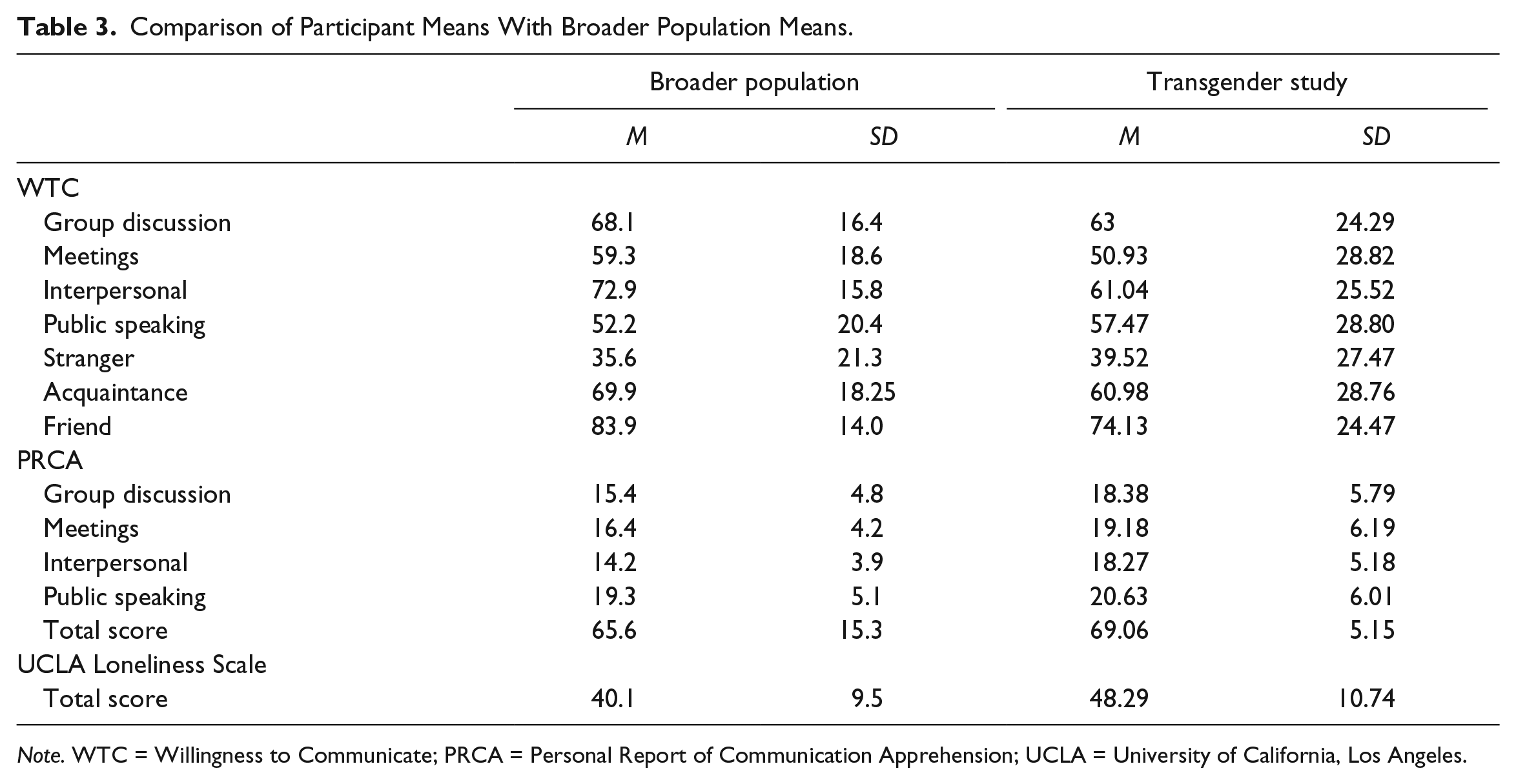
The first objective of the quantitative analysis was to compare the means of the transgender community with the broader population norms. A population mean did not seem available for the WTC; therefore, the broader population mean used in Table 3 is based on a study of student groups in the United States (Barraclough, Christophel, & McCroskey, 1988). The population mean for the PRCA is based on two separate samples: one of more than 40,000 college students and another of more than 3,000 nonstudent adults with virtually the same results. A population mean did not seem available for the UCLA Loneliness Scale; therefore, the broader population mean used in Table 3 is based on a sample of students (N = 487) used in a study testing the reliability, validity, and factor structure of the UCLA (Russell, 1996). It is important to note that researchers have not established Canadian population norms for these scales. The results demonstrate that, in comparison with a broader population of students, the participants in this study were less willing to communicate in group discussions, meetings, and interpersonal conversations as well as with acquaintances, and with friends. However, they were more willing to communicate in public speaking and with strangers. This sample was also more apprehensive to communicate across all subgroups and reported more loneliness that the broader population norms.
Comparison of Participant Means With Broader Population Means.
Note. WTC = Willingness to Communicate; PRCA = Personal Report of Communication Apprehension; UCLA = University of California, Los Angeles.
Correlations
Correlations were run to assess relationships between the scales and the demographic variables (Table 4). Because this data set has variables with data that are not normally distributed, Spearman’s correlation coefficient (Spearman’s rho) was used rather than the Pearson correlation coefficient (Pearson’s r). No scales were related to sex assigned at birth, the size of the participant’s population center, or the time from social and/or physical transition. The overall PRCA composite was negatively correlated with age, meaning that as participants’ ages increased, their scores on the PRCA overall composite decreased. The correlation coefficient (–.335) demonstrated a moderate effect. WTC–public speaking and WTC–friend scores were positively correlated to the degree that a participant reported being out as transgender. This means that the more out participants reported being, the higher their scores on WTC–public speaking and WTC–friend. The correlation coefficients of .329 and .316, respectively, demonstrated a moderate effect. PRCA–meetings scores were negatively correlated to the degree that participants reported being out, meaning that the more out participants reported being, the lower their PRCA–meeting score was. The correlation coefficient of –.305 demonstrated a moderate effect.
Correlation Between Demographics and Scales.

Note. WTC = Willingness to Communicate; PRCA = Personal Report of Communication Apprehension; UCLA = University of California, Los Angeles.
Qualitative Analysis of Open-Ended Questions
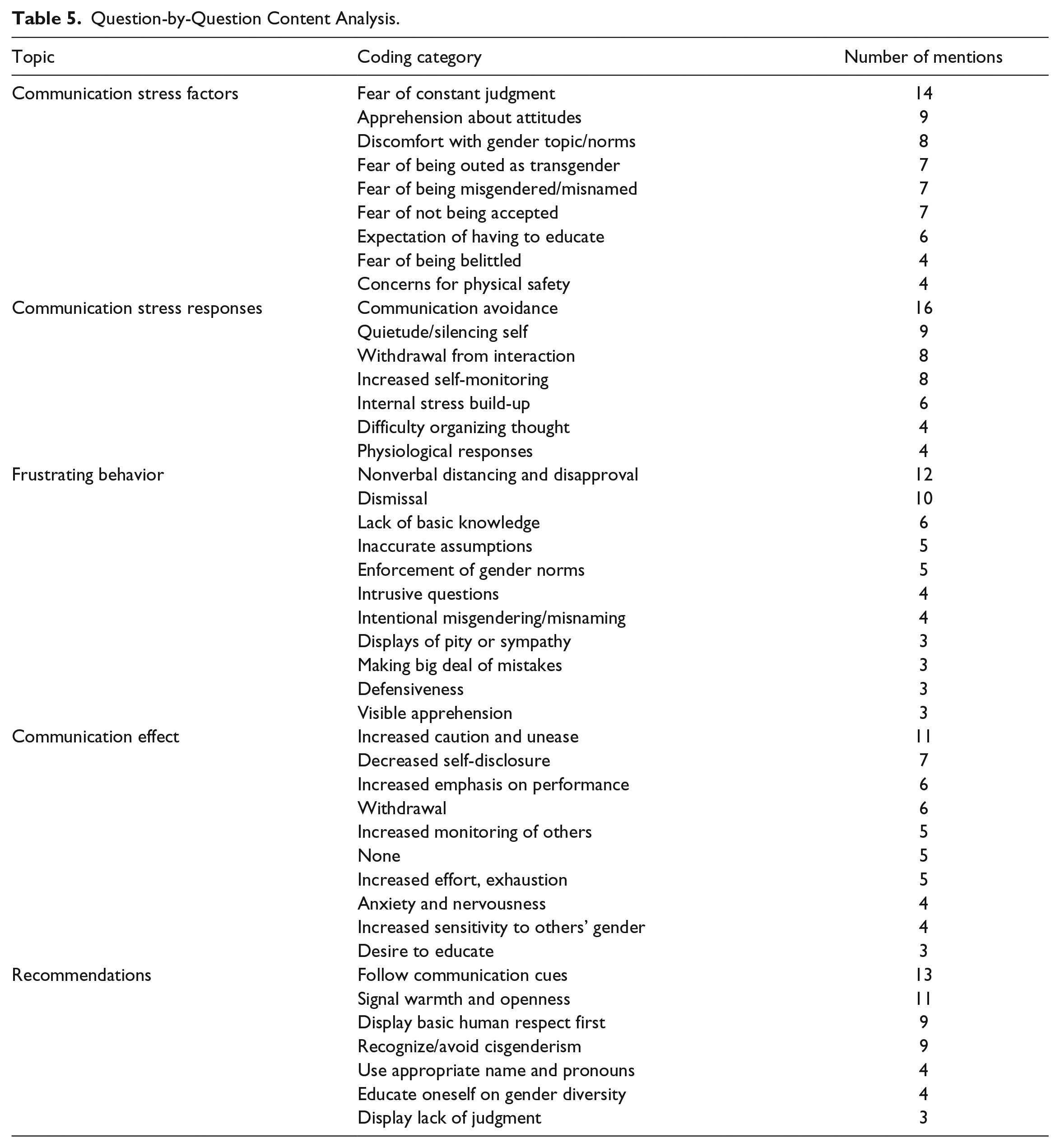
Five questions asked participants to (a) identify factors that might make face-to-face interactions with cisgender people stressful to them, (b) describe how such stress affects their these interactions, (c) identify cisgender communication behavior most frustrating to them, (d) reflect on whether being transgender affects the ways in which they communicate with other people, and (e) suggest recommendations to cisgender people who would like to make such interactions less stressful. These questions were exploratory, given the apparent scarcity of previous work on transgender communication from a minority stress perspective. The responses were first analyzed question by question using standard content analysis coding practice (Fink, 2015), then as one overall data set using thematic analysis (Braun & Clarke, 2006). Although linking demographic data such as age or time from transition would provide a richer context for quotations from participants, the research ethics protocol had intentionally assured participants that demographic data would only be provided in aggregate form and not linked to individual open-ended survey responses. This addressed concerns about confidentiality and privacy expressed by some prospective participants. Results of the question-by-question analysis are summarized in Table 5; results of the overall analysis are summarized in Table 6 in a format modeled after that employed by Olivari et al. (2016).
Question-by-Question Content Analysis.
Overall Thematic Analysis.

Question 1: Communication stress factors
Participants differentiated between communication with strangers and communication with individuals they know, between communication with cisgender men and cisgender women, and between communication with individuals who know that the participant identifies as transgender and communication with those who do not. They stated that stress in interactions with cisgender strangers, particularly cisgender men, primarily arises from the fear of constant judgment, being belittled or not accepted; apprehension about attitudes; fear of being misgendered, misnamed, and/or outed as transgender; the expectation of having to educate others; and concerns about physical safety. They also reported a general lack of comfort with conversations reflecting gender norms.
I don’t know how they will react once they find out I’m trans. It feels unsafe. At the same time, I don’t want to always have to “out” myself. But then there’s the fear that they will find out some other way. If I do “out” myself, I worry that I’ll be expected to educate them; I worry they won’t see me for who I am but just get caught up in me being trans. (Participant 3)
Participant 7 said that “feelings of being judged, not being listened to,” and “belittled, talked to as if I were a child” cause stress in communication with cisgender people. Some noted that interpersonal communication stress can affect all interactions, not just those with cisgender strangers: “It creates more distance between me and almost everyone else” (Participant 44). Conversation about gender-related topics increases stress, participants observed, such as conversational partners’ “assumptions about my ‘stance’ on women” (Participant 26). Participant 25 responded with the observation that face-to-face interactions with cisgender people are not stressful: “If anything, I find it less stressful than interactions with trans people because I care more what trans people think of me.”
Question 2: Communication stress responses
All but six participants said that stress occurring in interpersonal communication encounters with cisgender people affects their communication behavior. Participants identified communication avoidance, withdrawal from interactions, silencing, and increased self-monitoring as direct responses to interactions. Some participants noted physiological responses such as a nervousness, stomach pain, muscle tension, conscious efforts to control one’s voice, stuttering, and facial flushing. Others reported that stress made it difficult to organize their thoughts and spoke of an internal sense of stress building up. The most common behavioral responses participants identified were withdrawal and avoidance, whether in the form of physical avoidance of public spaces or internal withdrawal.
Generally, my body becomes tense, I may have a hard time reasoning because I am so distracted by my stress. I may choose to not respond or end a conversation prematurely to end the interaction entirely. In the past I often held onto these situations/interactions and my stress sat in my body and manifested in tight muscles and soreness. (Participant 27)
Avoidance patterns the participants spoke of included not speaking, or speaking less, keeping answers short, shutting down, withdrawing from discussions, keeping people at arms’ length, and keeping conversational topics at superficial levels.
I try to accommodate the other person. Causes internal anxiety. May talk less, avoid people, leave social situations sooner, go outside. Stick to more formal topics, do not discuss personal opinions or express my true feelings. (Participant 16) I find that I become anxious and stressed in some interactions. While I want to stand up for transfolk I lose confidence and struggle to communicate because my emotions get too involved. (Participant 9)
One participant noted that although they experience stress, that stress does not manifest externally: “The stress becomes and stays internal,” Participant 1 wrote. For others, though, stress does manifest externally. “It can make me avoid ‘straight’ ‘cis’ spaces. It can make me defensive or enraged, or embarrassed,” Participant 32 said. “It greatly affects my communication because I will think it over before I can talk (i.e., make sure my voice is higher, etc.)” (Participant 34).
Several participants who physically transitioned noted that transition stage made a difference: “As I’ve been passing as cis more frequently it is less stressful” (Participant 28). Many participants observed effects on speech production as a function of stress that communication encounters produce. “Alternately I ramble or end up mute and just don’t engage,” Participant 14 noted. “Particularly with cisgender males I feel I have to perform masculinity. The pressure of performance causes me to second guess a lot of what I say/do,” Participant 31 wrote. Participant 37 spoke of a vicious cycle: “Stress can lead me to overanalyze/overthink and therefore induce more stress.”
Question 3: Frustrating cisgender communication behaviors
Verbal and nonverbal communication behaviors that reflect transphobia, ignorance, or arrogance create frustration for these transgender individuals. Such behaviors most notably include nonverbal distancing and expressions of disapproval and dismissal of the transgender individuals overall or of their attitudes, beliefs, and experiences. Some participants identified staring, eye rolling, frowning, physical distancing, bathroom usage glances, and loud and abrasive speech as the most frustrating nonverbal communication behaviors they experience. Participants articulated disappointment with the experience of not being seen, listened to, or heard during interpersonal interactions. “People who seem content to ignore your existence, even when they know you as an acquaintance,” Participant 16 wrote. It is frustrating when others “won’t listen/correct me on my experiences,” Participant 23 offered. Other cisgender communication behaviors creating interactional distance and conflict include displays of lack of basic knowledge about gender diversity, inaccurate assumptions, and enforcement of gender norms. Participants also identified being asked intrusive questions, intentionally using incorrect pronouns or names, displaying pity or sympathy, making a big deal about mistakes, defensiveness, and visible apprehension as obstacles.
Inappropriate displays of sympathy or pity are frustrating, several participants noted, such as Participant 21, who wrote, “Relax! And don’t use me as a way to prove you are an ally,” or Participant 5, who provided the example “I can’t imagine how hard it must be.” In a similar vein, overaccommodation was noted as being a hindrance to positive communication encounters. “Frustrating? Stumbling over pronouns with profuse apologies. When they treat me like I’m dangerous,” Participant 21 wrote. “Making a huge deal out of ‘screwing up’ my gender,” Participant 13 said. Participant 33 said it is frustrating “when ‘allies’ try way too hard to look understanding and it comes across as pity.”
For some participants, normative assumptions about gender-related preferences constitute the biggest challenge in interactions with cisgender people. Such communication behaviors include the assumption that transgender people want to live up to normative ideals. “I dislike being complimented only when I perform to the standards of any assigned gender,” Participant 22 said. Participant 30 referred to “Just assuming that I need to present as cis to be accepted fully as female.”
Question 4: Transgender identity and communication
Five participants said that being transgender does not affect the ways in which they communicate with other people. For the majority of participants, however, there is a noticeable effect. Caution, unease, anxiety, and nervousness were reported as common effects. Participants noted that they are more cautious and not at ease during interactions, such as Participant 3 who said, “I tend to be cautious when meeting new people. I am ever vigilant, even with people I know, as I never entirely feel safe.” Participant 13 wrote “I find I’m more on edge and alert in social situations due to a general sense of danger.” Withdrawal from communication and decreased self-disclosure were reported by participants who contributed statements such as “I don’t talk about my private life much at all anymore” (Participant 5), “I share less personal information” (Participant 16), and “I also have a harder time expressing my feelings/thoughts to even close friends” (Participant 19). “I have trouble trusting people,” Participant 15 wrote. This appeared especially common when conversations turn to gender-specific topics.
I often find myself hyper-aware of conversation topics (especially with cisgender or hetero people) and mentally plan ways to end or leave a conversation if it becomes unbearable/inappropriate. (Participant 27) So many things in life are so cis-centred that I don’t feel like talking about my experiences at all because it will require me to teach them, answer questions and deal with their own ignorance. (Participant 35)
Some participants noted that they increase emphasis on gender performance to accommodate others, along with increased monitoring of others’ communication responses. “I am nervous my voice will give me away. I’m nervous people won’t get it,” Participant 29 wrote. Participants also commented on the increased effort and resulting exhaustion they experience as a result. Participant 41 said being transgender has no effect on communication. “I try to act myself 99 percent of the time and if people don’t like me for me I don’t surround myself with them unless I have to.”
Three participants said that being transgender has positively affected their communication behavior, in that, it makes them more sensitive to the gender identities of others and has given them a greater appreciation for gender dynamics.
On one hand, it allowed space to be vulnerable and share my experiences for education and advocacy work. On the other hand I feel like I always have to be “on” and as if I can’t communicate that I may need something different in the moment. (Participant 19)
Three responses also reflected that participants felt empowered to be more outgoing and to take the initiative to educate others.
Question 5: Recommendations
The most common response suggested that cisgender people need to follow the nonverbal and verbal communication cues provided by transgender people, to follow their lead, and to be sensitive to their communication needs by signaling warmth and openness. Many participants noted that nonverbal communication behavior contributes greatly to feelings of comfort and safety during a communication interaction. Signaling warmth, openness, and lack of judgment is essential, they suggested. Such communication behavior, they suggested, does not require special inventories of communication skills but a general genuine desire to acknowledge another’s humanity, to display basic human respect for an individual, and to have a basic understanding of gender diversity.
I would recommend that they make the effort to educate themselves about trans issues and that they don’t just assume that other people are cisgender. Also, I would appreciate it if they saw me as a human first and followed my lead on what I’m comfortable disclosing. (Participant 3)
Participant 20 recommended “open and welcome body language. No questions about my body or gender that aren’t relevant to conversation.” Focusing on an individual’s apparent gender variance creates an interpersonal distance that creates stress in interactions, several participants noted. “Just treat me like you would any other person and don’t bring up me being trans unless I do first,” Participant 33 wrote. Participant 28 recommended to “not treat trans people any different than cis people.” Participant 6 observed that “as long as people are warm and respectful, then I’m not stressed.”
Not surprisingly, participants remarked on the frustration, stress, and anxiety they experience when others use incorrect pronouns, assume pronouns, or argue when a pronoun is corrected. They recommended, for their own practice as well as that of others, to use gender neutral language where possible, until they have been given the opportunity to introduce themselves. “Let go of the judgment, don’t assume, don’t Sir? Ma’am? Sir?” Participant 10 wrote. Participant 24 suggested to “not argue with a suggestion or request” because “it tends to invalidate the transperson’s voice.” People should not try to guess pronouns if they are not sure about the appropriate pronoun, Participant 12 wrote.
Other participants recommended that cisgender individuals become sufficiently educated with gender diversity to understand “how exhausting it can be to be constantly misunderstood” (Participant 38), to “be patient in conversation” (Participant 40), and to “stop dismissing my observations as if they’re not valid just because I’m transgender” (Participant 44). This includes being sensitive to the level of stress conversations about gendered behaviors can bring about for transgender people. “Learn about 2 spirit ones who do not fit in gender roles. Do not assume males to do male roles and females female roles,” Participant 2 wrote. “Make a habit of using sex-neutral terms when interacting with people,” Participant 8 contributed. Such responses were related to comments about the need to recognize and avoid cisgender assumptions.
Two participants noted that they had no recommendations because they did not find interactions with cisgender people stressful. A few other individuals said they had no recommendations because they were not sure how interactions could be improved or because they attributed stress to internalized anxiety.
Thematic Analysis of Overall Response Data
The open-ended questions were interrelated, and respondents at times further articulated or elaborated on responses to preceding questions. To complement the question-by-question analysis, an overall thematic analysis was conducted, based on the data set consisting of all open-ended responses. This analysis yielded three overarching themes with four corresponding subthemes: communication climate (boundaries, safety, self-disclosure, self-monitoring), social isolation (isolation, loneliness, social anxiety, unwilllingness to communicate), and cisnormativity (binary understandings, expectation violation, gender norms, uncertainty reduction; see Table 6). In contrast to the content analysis of the open-ended questions, which drew directly from responses to arrive at coding category labels, this overall analysis established conceptual themes and drew from interpersonal communication literature for appropriate labels.
Communication climate
The dominant overall theme reflected the significance of the interpersonal communication climate. Participants said interactions in which mutual trust, respect, and safety are established early on tend to be positive and enriching; interactions in which boundaries are violated, identity is reduced to being transgender, and judgment and dismissal are evident reinforce the need to avoid and withdraw from communication. Several participants noted anticipating potential threats to their physical safety. The constant need to self-monitor one’s communication behavior increases stress, reduces confidence, and requires a taxing amount of energy, all but four respondents indicated. Participant 44 said, “I enjoyed communicating with others before transition, now I dread it.” Participant 43 noted, “I self-censor a lot!” Most participants raised the need to adjust and monitor self-disclosures depending on context, conversational partner, and communication climate.
Isolation
Nineteen participants made references to feeling alone, lonely, or socially isolated in their responses. In some instances, participants reported social anxiety exacerbating isolation; such an anxiety was attributed to negative experiences or expectations of negative encounters. Participants described being isolated or isolating themselves by avoiding communication encounters, deflecting personal questions, restricting open communication to close or known others, and opting for silence. Participant 3 wrote, “I keep people at arm’s length.”
Cisnormativity
Regardless of interpersonal intent of conversational partners, cisnormative expectations and norms pose obstacles to open conversational exchanges, these participants noted. Those who have physically transitioned, and/or are recognized in their self-identified gender, and comfortable with gender norms, reported greater ease in interactions because of uncertainty reduction in interactions. However, for those who are not recognized in their self-identified gender and/or those who are not comfortable with binary gender norms, casual participation in everyday conversations appears marked by difficulty and safety concerns. Ten participants expressed disappointment that cisgender individuals tend to expect gender conformity, whether in regard to one’s sex assigned at birth or one’s self-identified gender. “Most of the past year I’ve been presenting as male. It’s easier to get by, and people find it easier to classify me and thus communicate with me. I kind of hate myself then, however,” Participant 4 observed. Three participants spoke of their commitment to educating cisgender individuals about the range of gender identities, with a particular emphasis on nonbinary identities.
Conversations that normalize cisgender assumptions may open up transgender participants to levels of disclosure not anticipated, lead to awkward withdrawals from communication, or expose them to boundary violations. At the same time, expectancy violation creates challenges for cisgender participants. Lack of knowledge or comfort with cisgender communication norms appears to contribute to feelings of isolation:
Being raised female and being introspective and valuing talking about feelings makes me an atypical man. This can make my interactions with cis men strained (especially with strangers). (Participant 31)
Summary
The first research question inquired about the interpersonal communication experiences of transgender people. In sum, participants emphasized the need for positive communication climates that are sensitive to the experiences of loneliness and the effects of cisnormativity. Participants identified specific communication stress factors common to face-to-face interactions with cisgender people, reported on their own responses to such stress, identified specific cisgender communication behaviors that increase stress, and generated recommendations for cisgender people.
The second research question sought to establish how transgender people in this sample rate on measures of communication apprehension, loneliness, and willingness to communicate. In comparison with broader student population norms (keeping in mind that this study used a nonrandom sample), this sample was less willing to communicate in all settings other than with strangers or in the form of public speaking, reported higher loneliness, and reported higher levels of communication apprehension. The degree to which participants were out appeared to have the greatest impact on their willingness to communicate and their loneliness scores.
The third research question asked participants to offer recommendations to cisgender people. In sum, these recommendations suggest cisgender people should follow the verbal and nonverbal communication cues provided by transgender people; signal warmth, openness, lack of judgment, and basic human respect; and acquire a basic understanding of gender diversity.
Discussion
Meyer’s (2003) minority stress model and applications of that model to transgender populations (Hendricks & Testa, 2012; Kelleher, 2009) suggest that cisnormativity, cisgenderism, and transphobia contribute to chronic stress and negative health outcomes for transgender people. This study sought to isolate and identify specific interpersonal communication behaviors and experiences in which these stressors manifest. Such work is relevant to public policy and mental health service delivery (Alessi, 2014), educators (E. R. Green & Maurer, 2015), family members, friends and allies of transgender people (Norwood, 2012), and the public at large.
Three instruments were administered to gather initial data on communication apprehension, loneliness, and willingness to communicate among Canadian transgender people. The results demonstrate relatively high degrees of communication apprehension and loneliness and relatively low degrees of willingness to communicate. The qualitative analysis of the results suggested significant communication stress factors influencing individuals’ ability and willingness to engage in communication, a keen awareness of potential or perceived threats resulting from communication, a desire to communicate in a welcoming communication climate, and a phenomenon of social isolation and loneliness. Participants generated specific recommendations for cisgender individuals wishing to contribute to a more welcoming communication climate.
These results offer a glimpse into the ways in which a sense of real or perceived social isolation and loneliness might interact with communication behaviors and dispositions and vice versa. It is noteworthy that individuals who consider themselves to be more visible (out) score lower on loneliness and communication apprehension and higher on willingness to communicate. At the same time, the qualitative data illustrate the stressful aspects of being visible. Cacioppo and Cacioppo (2014) argued that, generally speaking, individuals who feel lonely experience a higher degree of sensitivity to social threats, a dynamic they titled “toxic effects of perceived social isolation” (p. 58). Such work builds on earlier work in interpersonal communication, such as that of Segrin (1996), who observed that lonely people typically desire more intimate and meaningful relationships but hold negative views of others and expect others to hold negative views of them. In conversation, Segrin noted, lonely people “behave in such a way, perhaps as a result of deficient social skills, to virtually ensure a negative outcome” (p. 231). The results, therefore, stress the need for family members, friends, allies, educators, and therapists (Levitt & Ippolito, 2014a) to foster strong conversational skills among transgender people. That, however, cannot happen unless the communication climate is conducive to safe and welcoming conversations. Importantly, these are not necessarily conversations about one’s gender identity or gender-related issues; they are conversations at large, which often contain cisgender and cisnormative, and sometimes transphobic, elements that make it stressful for transgender people to participate or further the conversation.
It is important to keep in mind that “not everyone who experiences discontinuity between his or her sex and gender will experience distress about gender identity” as the WPATH Consensus Project Human Rights Work Group pointed out in 2011 (J. Green, McGowan, Levi, Wallbank, & Whittle, 2011, p. 4). Some participants in this study noted that they do not find conversations with cisgender individuals stressful; some noted that they enjoy the opportunity to help educate others on gender-related issues. These are indicators of resilience, also backed by the relationship of outness to lower apprehension and isolation, which warrant further study. The recommendations the participants generated for cisgender individuals are valuable in their relative simplicity. Participants in this study emphasized the need for cisgender supportive individuals to first and foremost interact with others, regardless of their gender presentation, as humans. Demonstrating basic human respect for another individual in a communication setting is essential, they suggested, as are nonverbal communication behaviors that signal safety and lack of judgment. However, they noted, it is crucial to follow the conversational interactant’s lead, rather than seeking to demonstrate one’s gender knowledge, establish oneself as an “ally,” enact a minority dynamic by displaying sympathy or pity, or making assumptions. Learning how to implement these principles in casual conversation, at family gatherings, social events, or at work remains a challenge in the face of cisgender assumptions deeply embedded in our language and thought. However, the deleterious effects of a cycle anchored between real or perceived social isolation and loneliness on one pole and withdrawal from communication on the other have been well established (Kelleher, 2009) and warrant collective work on generating concrete communication recommendations. Such work could contribute to emerging communication research on the ways in which individuals regulate communication anxiety (White et al., 2015).
Footnotes
Acknowledgements
The author expresses sincere gratitude to Jayce Palmer, Stefan de Villiers, Charles Paul Murphy, Zack Marshall, Stevie Gregg, and Kinnon MacKinnon for assistance with the data collection. The author gratefully acknowledges the assistance of research assistants Tina Quade and Marie Claire Joseph in the data analysis process. The feedback of two blind peer reviewers was most helpful in the final revision of the article, as was the careful review by Dr. Runa Das, assistant professor at Royal Roads University. Most of all, the author expresses gratitude for the participation of the transgender individuals who made this study possible by thoughtfully sharing their time and perspectives with all of us.
Declaration of Conflicting Interests
The author(s) declared no potential conflicts of interest with respect to the research, authorship, and/or publication of this article.
Funding
The author(s) received financial support in the form of an internal research grant from Royal Roads University for the research and/or authorship of this article.