




Abstract
This research breaks away from the existing literature that focuses only on the relationship between environmental regulations and employment size and employment structure, and focuses on the employment creation effect, destruction effect and the net effect of environmental regulations on employment. Accordingly, employing a two-tier stochastic frontier model, this research will answer whether the bilateral effects of environmental regulation on employment exist, which is larger or smaller, the net effect using provincial panel data in China from 2011 to 2020. Research results show that the creation effect makes employment higher than the frontier level by 3.18%, while the destruction effect makes employment lower than the frontier level by 4.58%, and finally the destruction effect dominates with the two-tier effects making employment lower than the frontier level by 1.40%. Furthermore, it was found that the lower the level of environmental regulation implementation, the greater its destruction effect. Moreover, from different human capital perspectives, environmental regulations have the least damaging effect on the low-skilled group, followed by the high-skilled group, and the most significant effect on the medium-skilled group. The destruction effect exhibits regional heterogeneity, sequentially weakening from the east to the central and western regions. The findings of this study hold particular significance for governmental entities in determining the stringency of environmental regulatory measures. It effectively promotes the government’s enforcement of environmental regulation policies, and has significant implications for achieving the dual advantages of “environmental protection” and “full employment” in society.
Keywords
Introduction
In the 40 years of China’s reform and opening up, the gross domestic product has achieved a mean annual growth rate of 9.5%. However, in stark contrast to the rapid economic growth is the deteriorating environmental problem. During China’s 13th Five-Year Plan (2016–2020), China imposed 833,000 environmental administrative penalties, with a fine of 53.61 billion yuan, an increase of 1.4 times and 3.1 times, respectively, compared to the 12th Five-Year Plan (2011–2015) period. In the 14th Five-Year Plan period (2021–2025), the Chinese government will continue strengthening its environmental protection efforts regarding environmental protection laws and policies. At the 20th National Congress of the Communist Party of China (CPC), China government advocated to protect the ecology with the strictest system and create a beautiful China with “lucid waters and lush mountains are invaluable assets,” with the dual objectives of environmental enhancement and economic advancement as the aspirations of future sustainable economic development. This trend will inevitably put higher demands on the existing environmental regulations.
It should not be overlooked that while continuous high-intensity environmental regulations have markedly enhanced the environmental quality in China, they have also raised the operating costs of enterprises, resulting in a weakening of their competitive advantage and a contraction of production scale, which in turn has led to unemployment (Berman & Bui, 2001; Raff & Earnhart, 2020). Studies have found that while promoting economic development, the government will focus more on environmental protection, but will still ignore people’s livelihood issues (W. Guo et al., 2020). As a populous country, China has always advocated that “employment is crucial to the people’s wellbeing.” The increased uncertainty in the external environment and the economic downturn caused by the 2019 novel coronavirus have caused production costs for enterprises to continue to rise, especially the pressure on labor costs. Furthermore environmental regulations may further reduce corporate profits and have a more extensive influence on labor market demand. Within the framework of the new normal, achieving the dual benefit of environmental preservation and comprehensive employment creation emerges as the central focus and formidable challenge in China’s economic progress.
The existing literature has explored the relationship between environmental regulation and employment from several distinct perspectives. First, based on the Porter’s (1991) view, environmental regulations can stimulate technological innovation, expand enterprise capital and production scale, and thus increase the demand for labor. This phenomenon is known as the innovation compensation hypothesis (Bezdek et al., 2008; Hussain et al., 2023; Morgenstern et al., 2002). Second, environmental regulation increases the operational expenses of enterprises, which can weaken their contestable advantage and lead to a contraction of production scale, ultimately reducing employment rates for both enterprises and residents (Berman & Bui, 2001; Greenstone, 2002). Third, some studies have suggested that the relationship between environmental regulation and employment follows a non-linear. The complex U-shaped or inverted U-shaped structure provides a more precise depiction of the internal correlation between regulation and employment (Cole et al., 2008).
Despite the extensive of literature investigating the influence of environmental regulation on employment, there are still two domains that require further discussion. Firstly, existing studies provide a more in-depth analysis of how environmental regulation impacts employment, but most empirical studies in the literature tend to yield positive or negative findings (W. Guo et al., 2020; Raff & Earnhart, 2020), thereby fragmenting the combined effect of the two on employment and failing to provide quantitative estimates of the net effect of both. If this point is ignored, it will be impossible to fully and deeply understand the comprehensive effect of environmental regulation on employment. It will also be impossible to understand why in some areas where environmental regulation is different, there will be two opposite effects on employment creation or destruction.
In addition, it is noteworthy that a research gap exists in quantifying the magnitude of employment deviations resulting from environmental regulations in China. Most research concerning the effects of environmental regulation on employment has been conducted in developed countries (Belova et al., 2015; Walker, 2011; Yamazaki, 2017), with little research in developing countries. In developed countries, enterprises subject to environmental regulation tend to be capital-intensive rather than labor-intensive, resulting in a small net effect on social employment (Belova et al., 2015; Bezdek et al., 2008). With China’s productive labor force and economic development relying on high-carbon industries (Qejvanaj, 2021), the employment effects of environmental regulations will likely be amplified. More importantly, the Chinese government has permanently assigned significant importance to environmental development and has incorporated environmental regulation into its national development plan (Wu et al., 2019). Meanwhile, China has recently emerge as the second-largest global economy (Hussain, Tian, Ayaz, & Zhang, 2022) and one of the largest job markets (Ali et al., 2023). This further underscores the imperative of leveraging Chinese data to consolidate the developmental trajectories observed in China and offer greater guidance for other developing nations in formulating environmental regulations.
This study makes the following contributions to the existing literature. Firstly of all, theoretically, this research integrates the “create effect” and “destroy effect” of environmental regulation on employment into a unified research framework and advocates that environmental regulations exert a “bidirectional” influence on employment, and profoundly analyzes the mechanism of the crowding-out and crowding-in effects of environmental regulations on employment. In addition, from an economic theoretical perspective, this paper incorporates the pollution factor as a production factor into the Cobb–Douglas production function. It uses mathematical analysis to analyze the underlying mechanism of how environmental regulation affects employment. Secondly, in terms of methodology, our study employs a bilateral stochastic frontier model to measure the crowding-out and crediting-in effects of environmental regulation, and to further measure the net effect of their interaction. This model effectively corrects the measurement bias inherent in existing studies and facilitates the examination of the spatial and temporal patterns and variation patterns of the bilateral effects of environmental regulations on employment. As such, it fills the gap in the existing literature and enriches the corresponding literature on the employment effects of environmental regulations on research methods. Finally, this study expands the research scenarios by examining whether the net effect of environmental regulation on employment is stable under more heterogeneous scenarios, such as time, space, intensity, and human capital. Investigating the heterogeneous changes in the net effect of environmental regulation on employment facilitates a comprehensive understanding of the general pattern of how environmental regulation impacts employment and offers valuable policy insights into effectively balancing the inherent conflict between environmental protection and labor and employment.
The remainder of the study is organized as follows: In section “Theoretical Model and Mechanism Analysis,” we provide the analytical framework for the creation and destruction effects of environmental regulation on employment based on the Cobb–Douglas production function. In section “Materials and Methods,” we transform this framework into a two-tier stochastic frontier model, including the variable selection and data sources. In section “Result,” we present the empirical analysis and analyze the effect of heterogeneous environmental regulation on employment. Section “Discussion” provide the discussion. Finally, in section “Conclusion and Policy Suggestions,” we present the conclusions and policy recommendations.
Theoretical Model and Mechanism Analysis
Theoretical Model
The influence of environmental regulation on employment ultimately contingent upon the production decisions of enterprise under conditions of environmental regulation. The Cobb–Douglas production function argues that the input factors of a firm contain labor and capital. In reference to Cole et al. (2008), this research considers the pollution emission of a firm as a production factor, and environmental regulation can represent the price of pollution input of a firm, and takes this as an entry point to analyze the adjustment of production behavior and the impact on labor demand caused by the increase of the price of pollution factor of a firm due to environmental regulation (Fullerton & Heutel, 2010). Then, the production function of the firm considering environmental pollution inputs is:

where Y represents the total production level of the enterprise; E, L, K, and
Thus, the equation for the firm’s profit function can be formulated as:

where π denotes the firm’s profit; p denotes the firm’s product price; and e, l, k, and c denote the prices corresponding to each input factor of the firm, respectively. The e represents the environmental pollution price, which serves as a measure of the stringency of environmental regulation.
Assuming that enterprises allocate their factor input levels according to the profit maximization principle, the association between labor factor input and environmental pollution input is expressed as:

The intensity of environmental regulation can be expressed in terms of the price of environmental pollution

Assuming that δE→e is used to express the price elasticity of environmental pollution inputs:

The stronger the environmental regulation, the smaller the environmental pollution input of enterprises. Therefore, (

Where
Mechanism Analysis
This section primarily focuses on the direct and indirect impacts of environmental regulation on employment, as illustrated in Figure 1.

The theoretical framework of the bilateral effects of environmental regulation on employment.
Create Effect
First, according to Porter’s innovation compensation hypothesis, it is argued that environmental regulation can induce firms to internalize the external costs of environmental regulation, which motivates them to innovate technologically and improve their input and output levels. This can offset the rising costs of environmental regulation (Porter, 1991). As the stringency of pollution control measures increases as part of environmental regulation, firms may increase their research and development (R&D) and investment in clean technology to achieve environmental regulation standards (H. L. Li et al., 2019; Qin et al., 2023). In the process of pollution control and emission reduction, enterprises may also employ more profoundly skilled personnel to engage in technology research and development, technology implementation, and technology maintenance (Berman & Bui, 2001; Dai et al., 2021), which may increase new jobs and boost social employment (Y. Song et al., 2019). Additionally, implementing clean technologies in the production process is often a key component of enterprises’ pollution control and emission reduction measures (Shao et al., 2020). The requirement for clean industry development goals can promote the demand for highly qualified labor in enterprises, which may be a proactive way for firms to respond to the increasing intensity of regulations by improving the quality of labor and promoting technological innovation (Ali, Ali, et al., 2022). This, as a result, will eventually strengthen the demand for highly qualified personnel to develop or upgrade green production technology.
Second, Environmental regulation increases the demand for labor by raising the cost of resource factors in the factor market, which is called the “substitution effect of production factors.” Under the constraints of environmental regulations, in order to realize the aim of maximizing profits, enterprises will modify the ratio of variable production factors, decrease resource production factor investment, and enhance labor and other production factor investment (Liu & Wang, 2020; Walker, 2011). This process of factor adjustment and structural reorganization may allow enterprises to reach a new optimal equilibrium through the innovation of clean technology and the improvement of production processes, leading to an expansion of their production scale driven by profits. In other words, the expansion of the production scale of enterprises means an increase in the demand for employment (M. Li & Du, 2022).
Destruction Effect
On the one hand, in accordance with the compliance cost hypothesis, increased environmental regulation is likely to lead to higher costs for firms in terms of pollution control and environmental compliance, thereby crowding out firms’ production investment, innovative behavior, and other organizational management activities. This would, to some extent, limit firm expansion and discourage employment (Kneller & Manderson, 2012; M. Song et al., 2021). Walker (2011) and Raff and Earnhart (2020) mentioned that environmental regulation would result in an escalation of production expenses for enterprises, and those workers with high mobility and low skills are more likely to lose their jobs in the short term. Additionally, enterprise in high-polluting industries may face more tremendous environmental regulatory pressures and may try to reduce production costs by growing dismissal rates, resulting in a reduction in the number of employees employed by firms and social employment rates (Dissou & Sun, 2013; Kahn & Mansur, 2013).
On the other hand, environmental regulation can lead to the “pollution haven hypothesis” which reduces employment. Due to the higher cost of pollution reduction in areas with more stricter environmental regulations, firms that aim to maximize profits may transfer their plants to areas with weaker environmental regulations, negatively impacting labor employment in areas with stronger environmental regulations (C. Sun et al., 2017). Specifically, Q. L. Liu et al. (2012) and Wu et al. (2019) provided evidence that as the intensity of environmental regulation increased in China’s developed regions, polluting industries significantly relocated to the mid-west area in China, resulting in a downward trend in employment in polluting industries in the eastern region.
Our research argues that environmental regulation makes a “two-tier effect” of crowding out and crowding in social employment, Following, we will examine the positive and negative effects of environmental regulation on employment, as well as the net effect, by constructing a two-tier stochastic frontier model.
Materials and Methods
Model Setting
Considering that environmental regulation has two opposite influence on employment, positive and negative. Considering the problem that traditional estimation methods cannot identify and capture the specific magnitude of creation and substitution effects, this study draws on Kumbhakar and Parmeter (2009) to propose that a two-tier stochastic frontier models can better estimate bilateral effects and are suitable for measuring bilateral effects (Y. Liu et al., 2019). This study utilizes the findings of Kumbhakar and Parmeter (2009) as a reference and establishes a two-tier stochastic frontier model in the following.

Based on equation (7), it is understood that actual employment is eventually the result of a bilateral combination of both positive and negative effects of environmental regulation. The creation effect of environmental regulation on employment raises employment above frontier employment, while the destruction effect brings employment below frontier employment. The deviation of actual employment can be measured by calculating the net effect of the two combined effects. In addition, considering that the OLS estimation results are biased, this study uses the MLE to obtain effective estimation results. Further, the following assumptions are made on the residual distribution of the model:
Drawn from the above assumed distribution, the probability density function of

Where

Based on the parameter estimation of equation (9), the expression of the maximum likelihood function (MLE) is constructed as shown below:

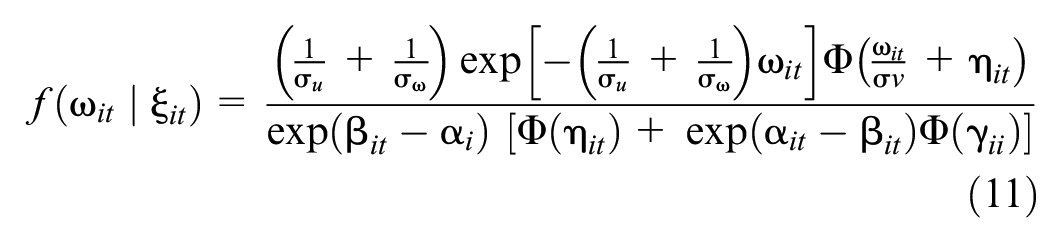

On this basis, the conditional expectations of


With equations (13) and (14), it is possible to estimate the extent to which the creation and destruction effects cause employment to deviate from frontier employment. In order to facilitate comparison, it is essential to convert further the absolute value of the deviation degree of environmental regulations affecting employment into a ratio higher or lower than the frontier level. The specific conversion formula is as follows:


Further derive the net effect of environmental regulation on employment. The specific form is as shown below:

NE represents the difference between the employment creation effect and the destruction effect. If NE > 0, the employment creation effect is stronger than the destruction effect, that is, the employment creation effect has a primary influence. If NE < 0, it indicates that the employment destruction effect is stronger than the creation effect, and the employment destruction effect exerts a prominent influence.
Variable Description
Data Sources
Our research construct a panel dataset to illustrate environmental regulation of provincial employment across 30 provinces over the period of 2011–2020. Considering the missing data for Tibet and Hong Kong, Taiwan and Xizang, we therefore exclude this region from the sample. The data sources for this study include the China Statistical Yearbook, China Science and Technology Statistics Yearbook, and China Environment Statistical Yearbook, published by the National Bureau of Statistics of China and the ESP Global Database.
Variable Definition
Independent Variable
Environmental regulation. Environmental regulation means that the regulation of various actions that pollute the public environment to protect the environment (Walker, 2011). This study follow the example of the practices of M. Song et al. (2021), Feng et al. (2021), and Cole and Elliott (2003), and chooses the three pollutant indicators of industrial wastewater discharge, sulfur dioxide discharge, and soot discharge. The standardization process is carried out and converted to values from 0 to 100, the arithmetic mean of the regional pollutant discharge indicators are calculated. Finally, getting the synthetic index EG represents the strength of environmental regulation.
Dependent Variable
Employment. Referring to W. Q. Zhou and Tao (2020), select the quantity of employed people in the secondary and tertiary industries as the regional employment, and take the logarithm of it.
Control Variable
Foreign investment: Foreign investment can directly lead to a certain number of employment opportunities, especially in production and manufacturing, which require a significant number of workers. Referring to Dai et al. (2021) study, this paper measures the impact of foreign investment on employment by the total of actual foreign investment utilized; Urbanization: Urbanization leads to the upgrading of industrial structure, which may lead to more employment opportunities (Sato & Zenou, 2015). We refer to H. L. Li et al. (2019), which employs the proportion of the non-agricultural population to the total population as a measure of the extent of regional urbanization; Innovation level: Use of regional patent applications granted to express the level of innovation; R&D Level: The use of industrial enterprises on the scale of R&D expenditure measurement. Technology employment replacement rate refers to the impact of technological development on employment. This variable is measured using the technology market turnover of technology; Government intervention: As an instrument of macroeconomic regulation (Yu, 1997), the government can not only directly increase fiscal spending to increase the supply of public services, such as education, health care, and infrastructure, thus creating more jobs, but also indirectly stimulate firms to increase investment and hire more employees through measures such as tax breaks or subsidies to firms (Allsopp, 1995). Therefore, government fiscal intervention is an essential factor that affects market employment. Referring to Shelton’s (2007) study, the amount of government fiscal spending represents the level of government intervention in market employment; Openness: The heightened degree of openness within a region may foster interregional and international trade, fueling the region’s economic expansion. This phenomenon may augment local job prospects and bolster the local employment rate (Asaleye et al., 2017). To evaluate the effect of regional openness on employment, this study employs regional import and export volumes as proxies; Human capital: Human capital encompasses a variety of human resources, such as education, training, skills, health, knowledge, and experience (Wößmann, 2003). Referring to Folloni and Vittadini (2010), the average years of schooling was used to calculate the level of regional human capital; Economic development level: The level of regional economic development is positively correlated with the amount of employment (Bezdek et al., 2008). The more economically developed a region is, the more employment it can provide. The GDP per capita indicates regional economic development (Cole et al., 2008).
This paper also introduces several control variables that influence the linkage between environmental regulation and employment. Table 1 displays the descriptive statistics for the variables used in this research.
Summary Statistics.

Result
Two-Tier Stochastic Frontier Model
Baseline Regression Model
We start from the MLE by including all covariates in Table 2. Model (1) is the result of OLS estimation without bias effects. Model (2) does not control for time fixed effects and area fixed effects; models (3) and (4) control for area and time fixed effects only, respectively; and model (5) controls for both area and time fixed effects. Model (6) only considers the unilateral estimation result of the destruction effect of environmental regulation on employment, that is, the model residual item
Basic Estimation Results of Two-Tier Stochastic Frontier Model of Environmental Regulation on Employment.

Note. t statistics in parentheses.
p < .1. **p < .05. ***p < .01.
According to the model likelihood ratio test (LR), after considering the deviation effect, model (8) is more rational than the OLS estimation and the remaining model, so this paper chooses model (8) as the basis to analyze the bilateral effects of environmental regulation.
As shown in Table 2, according to the estimated results of model (8), the estimated coefficient of the employment creation effect of environmental regulation is significantly positive (r = .139, p < .01), which mean there is the employment creation effect of environmental regulation increases employment. The estimated coefficient of the destruction effect is significantly negative (r = −.568, p < .01), implying that the destruction effect of environmental regulation reduced employment. Therefore, this paper proposes that the two effects of environmental regulation on employment creation and destruction are initially verified in the estimation results of model (8).
Variance Decomposition: Measuring the Bilateral Effects of Environmental Regulation on Employment
Based on model (8) in Table 3, to deeply analyze the dominant effect of environmental regulation on employment, it is essential to decompose the effect of environmental regulation on employment creation and destruction. The decomposition results are displayed in Table 3. The degree of creation and destruction of employment by environmental regulation is 0.0329 and 0.0491 respectively, which makes the net effect of environmental regulation on employment E
Variance Decomposition: Effects of Environmental Regulation on Employment Creation and Destruction.

In order to precisely measure the actual impact of environmental regulation on employment, the proportion of the creation and destruction effects can be further decomposed. Interestingly, the destructive effect accounts for 68.98%, and the creative effect accounts for 31.02%. This result shows that the employment destruction effect is significantly greater than the employment creation effect, indicating that the destruction effect dominates, thus again proving the correctness of the above estimation result that environmental regulation inhibits employment growth through the employment destruction effect.
The Influence Degree of Creation Effect and Destruction Effect on Employment
According to formulas (14) to (16), this study further estimates the deviation degree of regional employment compared with the optimal employment level. Table 4 displays the percentage of creation effect and destruction effect, and their net impact, to ultimately determine the real effect of environmental regulation on employment. On average, the creation effect increases the employee by 3.18%, while the destruction effect lowers the employee by 4.58%. Therefore, the net effect of environmental regulation on employment leads to a lower frontier level of employees by 1.40%. This indicates that the asymmetry of the bilateral effect of environmental regulation is distinguished by a detrimental effect on employment levels overall.
Estimated Net Effect of Environmental Regulation on Employment.

Note. Net impact = creation effect − destruction effect.
Figure 2 provides the frequency distribution of the employment creation effect, destruction effect, and net effect of environmental regulation on employment, respectively. The destruction effect shows a right-skewed distribution, with about 40% of provinces experiencing a significant destruction effect. The creation effect has a lower frequency, ending at around 15%, significantly lower than the destruction effect. The distribution of the net effect present that most provinces are influenced by the destruction effect, with fewer provinces experiencing a positive creation effect. This may be because, at this stage, environmental regulation in China has not yet acted as an incentive for innovation, and instead mainly increases firms’ pollution control costs or investment in environmental technology, which can crowd out investment in production and lead to a decline in labor demand.

Distribution of the creation effect, destruction effect, and net effect of environmental regulation.
Regional Characteristics of Environmental Regulations on Employment
Table 5 offers detailed insights into the geographical distribution of the net effect of environmental regulation on employment. Overall, the mean net effect of environmental regulation on employment is negative in eastern, middle and western, with values of −2.76%, −0.80%, and −0.48%, respectively, and the distribution effect was highest in the east, followed by the middle and lowest in the west. On the one hand, most of China’s manufacturing industries are located at both ends of the “smiling curve,” and these industries are primarily gathered in the eastern region, which also leads to a higher degree of pollution in the eastern region than in the central and western regions. On the other hand, the scale of enterprises in the eastern region is prominent. Under the influence of cost effects, the operating costs of enterprises increase, the scale of production is reduced, and the demand for labor is reduced. Consequently, the employment destruction effect is more pronounced in the more industrially developed eastern provinces.
Characteristics of the Regional Distribution of the Net Effect of Environmental Regulation on Employment.

Year Characteristics of Environmental Regulation on Employment
In the past 10 years, the net impact of environmental regulation on employment has been dominated by the destruction effect, ranging from −0.23% to −2.57%. The net effect of environmental regulation on employment is consistently negative as the time trend changes. It may be linked to the overall weakness of environmental regulation in China at present, leading the incentive effect of innovation cannot make up for the employment destruction effect caused by the increase in cost. Consequently, the net effect of environmental regulation on employment is characterized by an inverted “U” shape over the 10-year sample period (Figure 3).
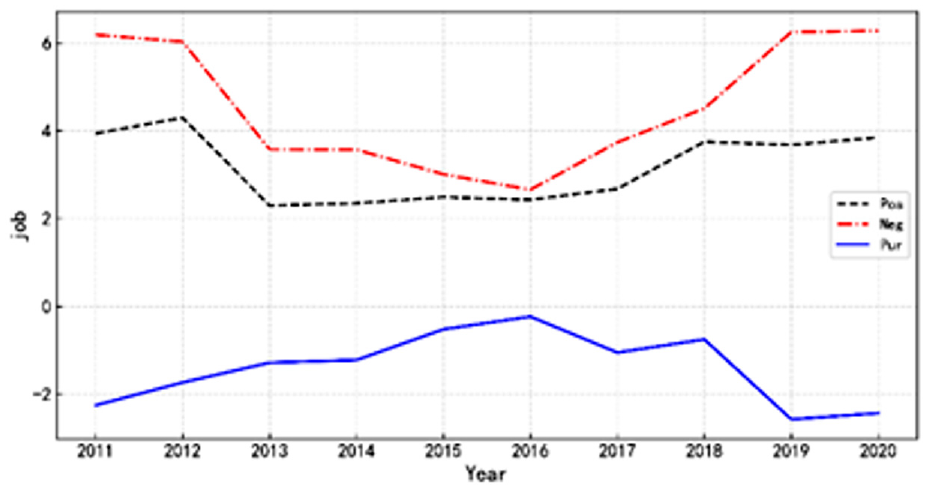
Year characteristics of environmental regulation on employment.
Environmental Regulation of Varying Intensity Affects Employment
Next, environmental regulation is divided into three groups according to the one-third quantile: low, middle, and high, and the distribution of bilateral effects is analyzed under different levels of environmental regulation. The results are shown in Table 6. Overall, there is significant heterogeneity in the effects of environmental regulations on employment at varying levels of environmental regulations. Regarding destruction effects, the maximum is at low levels (6.25%), and the minimum is at high levels (3.72%). The reason may be that when the environmental regulation is low, the cost-effectiveness is greater than the “element complementarity” effect and the “innovation compensation effect,” and the destructive effect is stronger. As the intensity of environmental regulation enhances, enterprises will benefit more from compensating for “compliance costs” through product or process innovation, which can reduce marginal costs and reduce destruction effects. It should be highlighted that the current level of environmental regulation in China still needs to be strengthened and improved, the “cost of compliance” effect is still more significant than the “innovation compensation effect,” and ultimately, environmental regulation is still manifested as a destruction effect.
Environmental Regulation of Varying Intensity Affects Employment.

The Impact of Environmental Regulation on Employment Under Different Human Capital
In order to test the influence of human capital heterogeneity, this research divides them into three groups of high school and low school according to the average education years of 9 years and 16 years as the cut-off points. When human capital ≤9 years, is a low-work skilled group; 6 < human capital ≤ 16, is a medium-work skilled group; human capital > 16 is a high-work skilled group. The results are presented in Table 7. Overall, the creation effect of environmental regulation is consistently lower than the destruction effect at all skill levels. Interestingly, the low-work skill group had the weakest destruction effect. This may be because low-skilled labor is cheaper in the labor market and firms under environmental regulation preferentially use cheap, low-skilled labor as a substitute for rising prices of polluting factors such as energy, thus mitigating to some extent the destruction effects of environmental regulation.
The Impact of Environmental Regulation on Employment Under Different Human Capital.

Note. Years of education per capita = elementary school literacy × 6 + junior high school literacy × 9 + high school literacy × 12 + college and above literacy × 16.
Robustness Tests
To verify the validity of the research’s conclusions, we refer to W. Y. Sun and Zhou’s (2020) and choose the percentage of government investment in environmental pollution control to GDP to measure the intensity of environmental regulation in each province for robustness testing. Table 8 displays the results of a robustness test. The results indicated that the creation effect is 0.0478, and the destruction effect is 0.0835, consistent with the previous results. Regarding the net effect, the creation effect accounts for 24.7%, and the destruction effect accounts for 75.3%, indicating that the destruction effect has a significant influence, leading to deviation from the frontier level of employment. Consequently, the robustness of the results can be further verified.
Robustness Tests (2).

The net effect of the destruction, the creation effect, and the interaction between the two are further estimated. The results are shown in Table 9. The results displays that as the level of environmental regulation development increases, its promotion effect raises regional employment by 1.24%. In comparison, the destruction effect is a 6.28% decrease in regional employment. The net effect makes the actual regional employment relatively lower than the frontier level by 5.04%, which is approximately the same as the previous estimation.
Robustness Tests (2).

Discussion
Discussion of the Total Effects
This study breaks away from the original literature that focused only on the relationship between environmental regulation, employment size (W. Guo et al., 2020) and employment structure (M. Li & Du, 2022; Zheng et al., 2022), and centers on the net effect of environmental regulation on employment. Based on a two-tier stochastic frontier model, our research measures the crowding-out effect, crowding-in effect, and net effect of environmental regulation on employment. The empirical results indicate that the destruction effect dominates the effect of environmental regulation on employment. In comparison to the findings of Y. Song et al. (2019), Shao et al. (2020), and Cao et al. (2020) that suggest environmental regulation is conducive to employment increase, our study finds that the demand for employment decreases as the intensity of environmental regulation increases. This is due to the fact that in China, a country with a predominance of labor-intensive industries, the “pollution control or emission reduction expenditure” induced by environmental regulation is more sensitive (M. Song et al., 2021), causing a significant rise in factor costs for enterprises (Ding et al., 2022), and thus resulting in a substantial reduction in employment. Simultaneously, this phenomenon underscores the pressing need to enhance the development of clean, renewable energy, and environmental protection industries in China (Dai et al., 2021), which presently offer limited labor opportunities due to their underdevelopment.
Discussion of the Heterogeneity
Environmental regulation exhibits spatial heterogeneity in its impact on employment, with the most destructive effect in the eastern region, followed by the central region, and the slightest effect in the western region. This phenomenon also aligns with the current development patterns of the Chinese economy (N. Zhou et al., 2021). On the one hand, as the most developed industrial region in China, the implementation of environmental regulation in the eastern region leads to more industrial enterprises purchasing pollution control equipment and increasing environmental protection facilities, lead to the continuous increase of production costs and affecting the profitability and employment demand of enterprises (Fu et al., 2021). On the other hand, China is undergoing a new round of industrial upgrading, and labor-intensive industries in the eastern region are gradually shifting to the central and western regions (Q. Guo & He, 2017), which may contribute to the loss of employment opportunities in the original region.
In terms of the level of intensity of the implementation of environmental regulations, the lower the intensity of the implementation of environmental regulations, the more pronounced the destructive effect. This is attributed to the fact that relatively low environmental regulations may prompt firms to underinvest in technology and product innovation, leading to impaired competitiveness, poor market performance, and ultimately, a contraction in production scale and job opportunities (Cohen & Santhakumar, 2007). On the contrary, more stringent environmental regulations can stimulate firms to adopt innovative and eco-friendly production methods and products (Hille et al., 2020), enhancing their competitiveness and sales performance, and creating more employment opportunities.
The wage level of employees in the labor market is closely related to their skill level, with low-skilled employees typically receiving lower wages (Sgobbi, 2015). Environmental regulation may lead to job growth in sectors such as clean energy and sustainability (Wang & Lee, 2022), which often require employees for installation, maintenance, and cleaning. Firms may prioritize hiring lower-skilled employees with lower wages, resulting in a significant job creation effect for this group and minimal disruptive effects. Conversely, middle and high-skilled employees may require higher wages in a competitive labor market, while firms’ production costs increase due to environmental regulations. Therefore, firms may be more inclined to reduce the expansion of middle and high-skilled jobs to cope with the cost impact of environmental regulation.
Discussion of the Model
Unlike previous studies that used linear regression models (Zhong et al., 2021), threshold regression models (W. Q. Zhou & Tao, 2020), Differences-in-Differences (DID) models (Walker, 2011), and Computable General Equilibrium models (CGE) (Xie & Saltzman, 2000) to investigate the mechanisms through which environmental regulation influences employment, this research employs a two-tier stochastic frontier model to thoroughly examine the net effect of environmental regulation on employment. The use of this model effectively addresses the previous research that focused too much on the one-sided effects of environmental regulation on employment, such as positive effects (Belova et al., 2015; Yamazaki, 2017) or negative effects (Greenstone, 2002; Kahn & Mansur, 2013), while neglecting the net effects. Moreover, the two-tier stochastic frontier model can not only measure the specific sizes of the positive and negative effects of environmental regulation on employment, making the conclusions more observable (H. Liu, 2021; Papadopoulos, 2021), but also measure its crowding-out and crowding-in effects more intuitively, making the research more policy-oriented.
Conclusion and Policy Suggestions
Conclusion
In the context of China’s economy entering a new normal stage and the escalating environmental pollution issue, this study endeavors to examine the intricate nexus between environmental regulation and employment. Its objective is to establish a robust theoretical foundation for comprehensively evaluating the efficacy of environmental regulation while addressing the research gap pertaining to social employment. By doing so, it aspires to identify a mutually beneficial pathway that harmonizes economic development and environmental conservation.
Hence, based on panel data from 30 provinces in China from 2011 to 2020, this research constructs a two-tier stochastic frontier model to empirically test the bilateral effects of environmental regulations on employment. The main conclusions of this research are as follows: (1) The creation effect of environmental regulation makes employment higher than the frontier level by 3.18%, while the destruction effect makes employment lower than the frontier level by 4.58%, and finally the destruction effect dominates with the two effects making employment lower than the frontier level by 1.40%. (2) Throughout the observed time frame, the net effect of environmental regulation on employment displays an “inverted U-shaped” trend. (3) From the regional distribution characteristics, the destruction effect exhibits regional heterogeneity, with a sequential weakening from the east to the central and western regions. (4) From the perspective of different intensities of environmental regulation implementation, the lower the level of environmental regulation, the greater the destruction effect on employment; (5) Considering varying levels of human capital, environmental regulation has the most significant destruction effect on the medium skill group, followed by the high skill group, and the lowest effect on the low skill group.
Policy Suggestions
The ultimate goal of policymakers is to achieve a win-win situation between economic development and ecological protection (Ali, Jiang, et al., 2022; Hussain, Tian, Ayaz, & Ashraf, 2022). Unless the influence of environmental regulations on employment is taken into consideration, the Chinese government cannot achieve its policy objectives of sustainable development. Therefore, to better unleash the creation effect of environmental regulations and mitigate the destruction effect, this research proposes the following policy recommendations:
First, even though the destructive effect of environmental regulation is dominant, there is no contradiction between strengthening environmental regulation and promoting employment. The government should take measures to stimulate the job creating effect of environmental regulations. For example, the government can implement a “green economy” plan that provides a series of incentives such as R&D subsidies, tax breaks, funding, and policy support for environmentally friendly industries, including new energy, to stimulate the growth of green industries and increase employment opportunities.
Second, the regional heterogeneity in implementing environmental regulations suggests that the government needs to formulate environmental regulations tailored to local conditions to avoid the potential employment risks associated with a “one-size-fits-all” approach to environmental regulation. Moreover, in the highly developed eastern region, the government should provide compensation for the employment losses resulting from the reduction of polluting industries due to environmental regulations, utilizing the employment creation effect generated by technological innovation and industrial upgrading, driven by these same regulations. As for the governments of the central and western regions, they can stimulate local industrial upgrading and labor force employment by actively undertaking industrial transfers from coastal regions, and promoting the development of clean energy industries based on their respective regional resource endowments, by reducing or waiving taxes and providing financial subsidies, in order to create more employment opportunities.
Government is necessary to improve workers’ job skills through vocational education and vocational skills training to decrease the negative impact of the destructive effect on low-skilled workers. At the same time, the government should focus on developing new energy, clean energy industry, energy-saving, and environmental protection industry to better use of the creative effect for medium and high-skilled workers.
Future Directions
There are several aspects of this paper can be further explored. On the one hand, the majority of the extant literature focus on macro-level environmental regulations, but have not yet centered on the impact of micro-level environmental regulations on employment, such as the impact of emissions trading systems, taxation systems for polluting enterprises on regional employment; On the other hand, due to the limited availability of data, our study does not examine the influence of environmental regulations on the gender, age, and industry of employed persons. Future research could explore more on the above aspects.
Footnotes
Acknowledgements
All authors have read and agreed to the published version of the manuscript. Thanks to all the editors for their review work.
Authors’ Note
This research was conducted while [Chenhui Ding] was at [Hohai University]. They are now at [Dongguan University of Technology] and may be contacted at [
Author Contributions
Lu Tang: Conceptualization, Formal analysis, writing—original draft, Writing—review and editing; Chao Liu: Methodology, Funding acquisition; Chenhui Ding (Corresponding author): Software, Data curation, Methodology; Othman Mohamed: Validation; All authors have read and agreed to the published version of the manuscript. All authors have read and agreed to the published version of the manuscript. Thanks to all the editors for their review work.
Declaration of Conflicting Interests
The author(s) declared no potential conflicts of interest with respect to the research, authorship, and/or publication of this article.
Funding
The author(s) disclosed receipt of the following financial support for the research, authorship, and/or publication of this article: This work was supported by the 2022 Jiangsu Provincial Social Science Applied Research Excellence Project, the project name is “The Effect of Digital Economy to Promote Innovation Efficiency in Jiangsu and Policy Support,” the Grant Number is 22SYB-121. Jiangsu Province Postgraduate Research and Practice Innovation Program Project (Grant Number KYCX22_0691).
Ethical Approval
Not applicable, this study does not involve the medical, human or animal fields.

Data Availability Statement
Contact the corresponding author to obtain the data of this paper.