




Abstract
Grounded in the expectation-confirmation theory and the D&M Information Success Model, this study investigates the factors influencing college students’ continuance intention to use mobile learning from three perspectives: educational institutions, instructors, and learners. About 421 college students were randomly selected to participate in a survey measuring their feedback on eight factors (information quality, system quality, service quality, perceived usefulness, confirmation, satisfaction, continuance intention and instructor support). The Smart-PLS method was employed for data analysis. Results indicate that CON and SEQ significantly and positively influenced PU, CON, and TES significantly and positively influenced SAT. Meanwhile, PU and SAT were significant predictors of CI, SYQ and TES significantly and positively predicted CON. The proposed model explained 83.1% of the variance in the continuance intention of mobile learning. Notably, teacher support was proven to significantly and positively impact students’ confirmation and satisfaction. Gender did not significantly moderate the relationship between perceived usefulness, satisfaction, and continuance intention. This research fills a gap in the current mobile learning literature and provides theoretical and practical implications for college students’ continuance intention toward mobile learning.
Plain Language Summary
The study aims to understand what influences college students to continue using mobile learning. It examines the impact of system quality, information quality, service quality, and teacher support on students’ willingness to keep using mobile learning. Mobile learning, which uses devices like smartphones and tablets for education, has become more popular, especially during the COVID-19 pandemic. It offers flexibility, allowing students to learn anytime and anywhere. However, its effectiveness depends on several factors. While previous studies have explored these factors, few have examined the combined impact of system quality, information quality, service quality, and teacher support. This study aims to fill that gap. The study surveyed 421 college students from three universities in China. Students were asked about their experiences with mobile learning, focusing on eight key factors: information quality, system quality, service quality, perceived usefulness, confirmation, satisfaction, continuance intention, and teacher support. The data were analyzed to identify the relationships between these factors. Information and system quality did not significantly impact perceived usefulness, possibly due to technical issues or information overload. Service quality had a significant positive impact on perceived usefulness. Information quality did not significantly affect confirmation. Good system quality significantly improved overall experience and confirmed expectations. Service quality did not significantly influence confirmation. Meeting students’ expectations significantly improved perceived usefulness and satisfaction. Students were more satisfied when mobile learning met their expectations and provided practical benefits.
Introduction
With the rapid advancement of internet technologies and the widespread adoption of mobile devices, educational researchers are increasingly focusing on mobile learning (M. Almaiah et al., 2022). Mobile learning is characterized as a novel pedagogical approach that employs mobile devices such as smartphones and tablets for electronic learning (M. A. Almaiah et al., 2019; Al-Rahmi et al., 2022). Mobile learning offers flexibility and portability, granting students opportunities to learn anytime and anywhere (Bayu Seta et al., 2022; Bernacki et al., 2020). Compared to traditional educational methods, mobile learning promotes personalized learning experiences, thus stimulating student interest and engagement (Al-Emran et al., 2020; Q. Ye et al., 2019). Mobile learning encompasses both synchronous learning, such as live video conferencing, online chat, and real-time feedback, as well as asynchronous learning, where students can access course materials at their own pace, participate in forum discussions, and complete assignments (Y. Gupta et al., 2021). Unlike traditional LMS, mobile learning emphasizes the convenience and flexibility of ubiquitous learning, supporting personalized learning experiences and content interaction (Gumbheer et al., 2022). This learning method leverages mobile-specific features like push notifications and location services to enable dynamic interaction with learning content and adapt to the learner’s progress and personalized learning path (Afful & Boateng, 2023). Mobile learning is transforming traditional, centralized LMS into a more decentralized, learner-centered approach, enhancing learner autonomy and making education more personalized and seamlessly integrated into daily life (Al-Rahmi et al., 2021; Dolawattha et al., 2022; Togaibayeva et al., 2022). Particularly during the pandemic, mobile learning has become an indispensable learning method for university students and holds immense potential for higher education (Alioon & Delialioğlu, 2019; Tseng & Hill, 2020). Scholars emphasize that educators should focus on students’ continuance intention (CI) in mobile learning rather than passive acceptance (Bayu Seta et al., 2022; Rysbayeva et al., 2022). Furthermore, existing research indicates that the CI of university students is a crucial factor in adopting mobile learning (He & Li, 2023; Kashive & Phanshikar, 2023; Rui-Ting Huang et al., 2017). Therefore, it’s pivotal to explore the CI of university students toward mobile learning.
Previous studies have explored the factors affecting the CI of mobile learning based on theories like Expectation Confirmation Theory (ECT) (Meng & Li, 2024; J.-H. Ye et al., 2022), Theory of Planned Behavior (TPB) (L. Li et al., 2022; Rajeh et al., 2021; Wu & Tian, 2021), D&M (Shim & Jo, 2020; H. Yang et al., 2023), Technology Acceptance Model (TAM) (M. Almaiah et al., 2021; Moca & Badulescu, 2023), and The Unified Theory of Acceptance and Use of Technology (UTAUT) (Voicu & Muntean, 2023). For instance, Voicu and Muntean (2023) used TAM, UTAUT, flow theory, and SCT as their theoretical framework and examined a cohort of 509 participants ranging from undergraduate students to working professionals aged 18 to 51. Their model explained 85% of the variance in CI in mobile learning. Meng and Li (2024) adopted ECM as their theoretical framework and conducted an empirical study involving 231 part-time teachers to examine CI in informal learning. Their model accounted for 87% of the variance in CI among part-time teachers in mobile learning. These results demonstrate that models such as ECM, TPB, D&M IS, TAM, and UTAUT are highly suitable for explaining and predicting the CI of university students in mobile learning.
However, up to this point, few studies in mobile learning have concurrently considered teacher, institution, and student factors (Y. Shen et al., 2022). M. Almaiah et al. (2021) argued that relying solely on theories like TAM, ECM, TPB, and the D&M might be insufficient for predicting CI, emphasizing the significance of teacher factors. Altalbe (2021), Chiu (2021), J. Wang et al. (2017) pointed out that teachers can offer emotional, behavioral, and academic support, significantly affecting students’ self-efficacy (SE), academic engagement, and performance, further influencing their CI. Hence, this study aims to bridge this gap by introducing a comprehensive model encompassing teacher factors: teacher support (TES), institutional factors: information quality (INQ), service quality (SEQ), and system quality (SYQ), and student factors: perceived usefulness (PU), confirmation (CON), satisfaction (SAT), and CI. This study conducted an empirical investigation on undergraduate students’ CI to use mobile learning, utilizing the Smart-PLS method to analyze our data. The research questions for this study are:
Which factors significantly influence university students’ CI toward mobile learning?
To what extent can these factors explain the variance in university students’ CI for mobile learning?
Is there a significant gender difference in the CI for mobile learning among university students?
The remainder of this paper unfolds as follows: In the Second section, we introduce our research model and put forth hypotheses grounded in prevailing literature. The Third section delves into our data collection processes and the experimental methodology employed. The Fourth section sheds light on our research findings. In the Fifth section, we engage in a comprehensive discussion, touching on interpretations of our results, the dual impact of our research (theoretical and practical), its inherent limitations, and prospects for future exploration. The last part is the conclusion of this study.
Literature Review
ECM
The ECM evolved based on the foundational principles of the Expectation Confirmation Theory and the Technology Acceptance Model (Bhattacherjee, 2001). This model accentuates the facets of user SAT and the CI to utilize information systems. It encompasses four dimensions: PU, SAT, CON, and CI (Bhattacherjee, 2001). Specifically, PU denotes the user’s perception of the product’s utility. CON relates to the users’ endorsement of the product. The level of this CON determines their overall SAT with the product. Meanwhile, CI reflects the users’ desire to use the product again.
In recent years, many researchers have employed the ECM to investigate the success of various information systems. This includes e-learning systems (X. Li et al., 2022; J.-H. Ye et al., 2022), Learning Management Systems (Ashrafi et al., 2022), MOOCs (Massive-Open-Online-Course) (Dai et al., 2020; Lu, 2019), and blended learning (W.-T. Wang et al., 2019), among others. For example, X. Li et al. (2022) utilized the ECM to investigate the factors influencing vocational students’ CI toward online learning systems, explaining 76.6% of the variance in CI. Within these studies, apart from the constructs of SAT, PU, CON, and CI, researchers also incorporated constructs such as expectancy beliefs (Fu et al., 2022; Niu et al., 2022; J.-H. Ye et al., 2022), perceived enjoyment (Ashrafi et al., 2022), perceived behavioral control (Rajeh et al., 2021), cognition (C.-H. Huang, 2021), intrinsic motivation (H. Yang et al., 2023), and SE (L. Y. Wang et al., 2019). For example, Ashrafi et al. (2022) developed a comprehensive model integrating ECM and TAM constructs along with subjective norms and perceived enjoyment, examining the factors affecting university students’ CI toward learning management systems. They discovered that perceived enjoyment significantly positively influences their CI. These constructs further enhance the predictive and explanatory power of the ECM from multiple dimensions.
Moreover, researchers have also considered integrating the ECM with models like TAM (Ashrafi et al., 2022), TPB (Dai et al., 2020), ISSM (H. Yang et al., 2023), TTF (T. Wang et al., 2021), and SCT (C.-H. Huang, 2021) to form new theoretical framework. For example, T. Wang et al. (2021) based their study on ECM and the TTF model, examining the factors influencing university students’ CI in online learning. This integrated model accounted for 66.7% of the variance in CI. These combinations unearth factors influencing university students’ CI toward online learning. In summary, the ECM serves as a tool to explore which factors influence the SAT and CI of university students using online learning systems.
D&M Model
DeLone and McLean (1992) initially proposed the D&M Information Systems Success Model, laying the groundwork for evaluating the effectiveness and success of IS. The original model consisted of six core dimensions: SYQ, INQ, use, user satisfaction (SAT), individual, and organizational impact. To enhance the accuracy of predicting CI, McLean (2003) revised the model, adding a SEQ dimension and replacing the original “net benefits” with the concept of “intention to use.”
In recent years, to gain a deeper understanding of the success of information systems, including e-learning systems, researchers have focused on three primary areas: Firstly, research context of the D&M model: This includes e-learning (Al-Fraihat et al., 2020; Alsabawy et al., 2016), MOOCs (Albelbisi et al., 2021), online distance learning (Jung & Shin, 2021), and virtual classrooms (X. Huang & Zhi, 2023). For example, Al-Fraihat et al. (2020) explored the impact of e-learning technology quality (including INQ, SYQ, and SEQ) on university students’ CI. These constructs collectively explained 71.4% of the variance in SAT. Secondly, constructs related to the D&M model: Beyond the aspects of INQ, SEQ, and SYQ, researchers have incorporated constructs such as teacher quality (Aldholay et al., 2018; X. Huang & Zhi, 2023; Raphael, 2018), flow experience (Jung & Shin, 2021), system usage (Efiloğlu Kurt, 2019), and perceived usefulness (Bessadok, 2022). These constructs provide a multi-dimensional perspective on factors influencing the success of e-learning. For example, X. Huang and Zhi (2023) explored the impact of teacher quality on university students’ CI in virtual classrooms based on the D&M model and ECM constructs, finding that teacher quality significantly positively affects students’ PU and CON. Thirdly, theoretical models integrated with the D&M model: These primarily include the ECM (Gu et al., 2021; X. Huang & Zhi, 2023; Suzianti & Paramadini, 2021), UTAUT (Bessadok, 2022; Lee et al., 2020), TTF (Isaac et al., 2019), and TAM (Bessadok, 2022) models. For example, Gu et al. (2021) integrated D&M ISSM and ECM to study the factors affecting users’ CI to use MOOCs, revealing that platform quality is a key factor influencing users’ CI. By constructing new models, researchers aim to investigate the impact of e-learning system quality on students’ CI.
Tes
TES is an indispensable component in the student learning, serving as the supportive actions students receive during their academic journey (Roorda et al., 2011). Viewed from the perspective of student perceptions, TES is characterized by the genuine care, friendly demeanor, sincere understanding, and selfless commitment demonstrated by teachers toward their students (Ryan & Patrick, 2001). Additionally, the substance of TES manifests in the assistance offered to students. Teachers prioritize fostering individual relationships with students, promptly assisting and advising those in need (X.-X. Liu et al., 2021), and encouraging greater engagement and commitment to academic excellence (L. Ma et al., 2021). As such, TES is a multifaceted concept that can be defined and described from various angles.
The manifestation of TES encompasses several aspects, and it has been categorized differently based on distinct perspectives. From the viewpoint of self-determination, TES includes three dimensions: autonomy support from the teacher (J. Wang et al., 2017), cognitive evaluation (R.-D. Liu et al., 2018), and structure (Lei et al., 2017). When analyzed based on the nature of support, teachers offer informational support (Altalbe, 2021), tools (Sadoughi & Hejazi, 2021), emotional support (Ekatushabe et al., 2021; Sadoughi & Hejazi, 2021; H. Yang et al., 2023), and evaluative feedback (Hilliger et al., 2020).
As a critical stakeholder in the student learning process, TES is a valuable resource for students to enhance their academic performance, participate actively in learning, and cultivate positive emotions. Such support can amplify students’ motivation to learn (Chiu, 2021), their academic engagement, performance (Altalbe, 2021; Hilliger et al., 2020), and their sense of SE (Descals-Tomás et al., 2021). Beyond mainstream education, the significance of TES has also been recognized in foreign language learning. When students are encouraged and supported by teachers in foreign language classrooms, they exhibit heightened self-efficacy and engagement (G. Yang et al., 2022). In conclusion, TES plays a pivotal role in students’ academic journey, warranting further exploration regarding its impact on students’ CI in online learning.
Research Hypotheses
Quality Factors and PU
In the D&M model, “PU” refers to the user’s perception and degree of system use when executing tasks (DeLone & McLean, 1992; Petter & McLean, 2009). The D&M model identifies three critical metrics: INQ, SYQ, and SEQ. INQ indicates the quality of the information output by the system. SYQ refers to the system’s reliability, intuitiveness, complexity, flexibility, and response time. SEQ represents the quality of the system’s responsiveness to user needs, directly affecting users’ PU and expectations (Garfield, 2016; Lwoga, 2014).The significant influence of INQ, SYQ, and SEQ on PU has been validated in various research domains. For instance, these domains include e-learning (Al-Fraihat et al., 2020; X. Li & Zhu, 2022; Suzianti & Paramadini, 2021), MOOCs (Albelbisi et al., 2021; Gu et al., 2021), online health websites (Shim & Jo, 2020), e-government (Hidayat Ur Rehman et al., 2023; W. Li & Xue, 2021), online banking (Almazroi et al., 2022; Naruetharadhol et al., 2021), medical service systems (Almazroi et al., 2022; Song et al., 2021), and virtual classrooms (Du et al., 2022; X. Huang & Zhi, 2023; X. Shen & Liu, 2022). For example, in the context of e-learning systems, Al-Fraihat et al. (2020) suggested that offering students a concise, clear, and needs-matching system, information, and service significantly amplifies their PU and SAT with the e-learning system. Correspondingly, X. Li and Zhu (2022) explicitly state that the quality of e-learning systems directly affects user adoption and PU. Du et al. (2022) indicated that the quality of virtual classrooms significantly affects teachers’ PU, with the quality provided by the virtual classroom system determining the teacher’s user experience. Collectively, these studies suggest that when students perceive the quality of mobile learning as aligning with their expectations, they will view it as useful and react positively.
Thus, we propose the following hypotheses:
H1: INQ has a significant positive influence on PU.
H2: SYQ has a significant positive influence on PU.
H3: SEQ has a significant positive influence on PU.
Quality Factors and CON
The ECM integrates the Expectation Confirmation Theory with the Technology Acceptance Model. Within this model, “CON” describes a user’s perception of whether the information system meets their initial expectations (Bhattacherjee, 2001). This concept is closely related to the alignment between a user’s initial expectations and experience after using the information system. Specifically, the degree of CON is relatively high when the system’s actual functions, performance, or user experience closely match the user’s original expectations (Patterson & Potter, 2004; Petter & McLean, 2009).In recent years, quality factors within the D&M model, as prerequisites for validating information system success, have been extensively validated in information systems research. There is a widespread consensus among researchers that when the quality of an information system meets or exceeds user expectations, user acceptance of the system is higher (B. Cheng et al., 2014; Cidral et al., 2020). This research conclusion has been fully corroborated across various studies on different information systems (Gu et al., 2021; X. Huang & Zhi, 2023; X. Li & Zhu, 2022; X. Shen & Liu, 2022). Taking e-learning systems as an example, P. Gupta et al. (2021), X. Huang and Zhi (2023) emphasize that a system of superior quality may further elevate user expectations for the information system, leading to more significant endorsement and affirmation of the system. Moreover, Gu et al. (2021) also discovered a significant correlation between SEQ and CON. M. A. Almaiah et al. (2016) noted in their research that the quality of mobile learning systems is considered a central factor affecting CI, with quality directly determining whether users affirm the mobile learning system. In light of the above, we propose the following hypotheses:
H4: INQ has a significant positive influence on CON.
H5: SYQ has a significant positive influence on CON.
H6: SEQ has a significant positive influence on CON.
ECM Constructs
In the ECM model, CON, PU, SAT, and CI are the main constructs. The relationships between these constructs have been well-documented in various studies. Firstly, CON significantly positively influences PU and SAT (Al Amin et al., 2024; Sreelakshmi & Prathap, 2020; Y.-M. Cheng, 2020; M. Cheng & Yuen, 2022; Lim et al., 2019; Nie et al., 2023; Persada et al., 2022; Pozón-López et al., 2020; Rekha et al., 2023; Song et al., 2021; Zhang et al., 2023). For instance, Rekha et al. (2023) found that CON positively influences PU and SAT when studying factors impacting university students’ CI for MOOCs. Their research also confirmed that PU and SAT play a vital role in CI. Moreover, higher CON levels significantly positively affect SAT, which subsequently influences CI (P. Cheng et al., 2019; Mellikeche et al., 2020). For instance, A. Li et al. (2021) emphasized that CON of students using online platforms significantly influences SAT, demonstrating CON as a key determinant of CI. PU also significantly positively influences SAT and CI. Multiple studies confirm that when users believe an information system is useful, they are more likely to continue using it (Y.-M. Cheng, 2020; M. Cheng & Yuen, 2022; Rekha et al., 2023; Zhang et al., 2023).For instance, Zhang et al. (2023) constructed a comprehensive model based on the ECM and ISSM frameworks, exploring factors impacting students’ CI for online learning systems, and found that is crucial for SAT with information systems. Lu (2019) studied factors affecting undergraduates’ CI for MOOCs based on the ECM and validated the relationships between the ECM variables. The results showed that CON positively influences PU and SAT, thus enhancing CI. In summary, the ECM model emphasizes the relationships among CON, PU, SAT, and CI. The interactions between these variables explain users’ acceptance and SAT levels with information systems and effectively predict their CI. Therefore, this study proposes the following hypotheses:
H7: CON has a significant positive influence on PU.
H8: CON has a significant positive influence on SAT.
H9: PU has a significant positive influence on SAT.
H10: PU has a significant positive influence on CI.
H11: SAT has a significant positive influence on CI.
TES, CON, SAT, CI
In the modern educational environment, especially in online learning, TES is a paramount factor in ensuring the sustainability of student learning (Giray, 2021). Abdullah et al. (2022) indicated that TES has lasting implications on student learning and enhances students’ self-efficacy, thereby aligning their learning expectations with the actual performance of online courses. Moreover, Sadoughi and Hejazi (2021) demonstrated that compared to home schooling, TES plays an irreplaceable role in stimulating students’ online learning intention and participation, aiding students in confirming their online learning experiences. In traditional education, TES significantly affects student engagement and SAT (L. Ma et al., 2018) . Recently, in online learning studies, TES has been evidenced to influence student SAT (Bolliger & Halupa, 2018; Martin & Bolliger, 2018; Lockman & Schirmer, 2020). For instance, She et al. (2021) indicated students’ self-efficacy and their perception of TES are pivotal influencing factors for online learning SAT. Abdullah et al. (2022) pinpointed students’ motivation and TES as a vital influencing factor for online learning SAT. TES influences students’ learning motivation, academic commitment, and academic self-efficacy, subsequently affecting their CI toward e-learning (Pan, 2022). Studies by Clary et al. (2022) emphasize that beyond students’ intrinsic motivation, external factors, especially TES, significantly impact students’ CI. Han et al. (2021) further elaborated on student engagement, SAT, and self-efficacy in online learning, stressing the central role of TES in these dimensions and its positive correlation with students’ CI.
Based on these studies, the following hypotheses are proposed:
H12: TES has a significant positive influence on CON.
H13: TES has a significant positive influence on SAT.
H14: TES has a significant positive influence on CI.
The Moderating Role of Gender
According to previous research, there is a prevailing belief that significant gender disparities exist in the utilization of information technology (Mariya Brussevich et al., 2018; Morris, 2000). Numerous studies suggest that females are more concerned with academic performance and achievement. They often demonstrate a strong sense of responsibility and autonomy in the classroom and express greater approval and satisfaction with online learning experiences (Albelali & Alaulamie, 2019; Malik et al., 2020). However, based on current research, in areas of information technology such as online learning, mobile healthcare, and e-governance, males tend to be more focused on whether the actual outcomes after usage meet their expectations (Lakhal et al., 2021; Le et al., 2020; X. Li et al., 2022; Niu & Wu, 2022; Wu & Wang, 2020). X. Li et al. (2022) explored the relationship between PU and CI in e-learning systems across genders. They found a stronger impact between PU and CI for males than females, suggesting that gender significantly moderates the relationship between PU and CI. Moreover, they found that male’s SAT significantly influences CI. This is likely because individuals’ proficiency with online learning technologies can influence their learning outcomes and results, subsequently affecting their satisfaction with online learning (Alghamdi et al., 2020; Dubois et al., 2020; Niu & Wu, 2022). In the present study, students’ proficiency with mobile learning technologies will likely influence both their PU and SAT, in turn affecting their CI. We hypothesize that, compared to females, the CI of males is more significantly influenced by both PU and SAT. Based on the aforementioned studies, we propose the following hypotheses:
H15: Gender significantly positively moderates the relationship between PU and CI.
H16: Gender significantly positively moderates the relationship between SAT and CI.
Based on the aforementioned research hypotheses, we propose a conceptual model for this study, as illustrated in Figure 1. This research employs gender as a moderate variable to conduct a multi-group analysis of the gender differences in university students’ CI to use mobile learning.

Research model.
Methodology
Participants
Data were collected from students attending three universities in China: Henan University of Technology, Zhengzhou University, Henan University of Science and Technology, using Wenjuan Star (https://www.wjx.cn/). In this study, we employed a random sampling method for the distribution and collection of questionnaires. Initially, the research team coordinated with teachers from various classes, who then introduced the purpose and significance of the questionnaire to students during class. Subsequently, teachers randomly selected students within their classes to participate in the survey, ensuring the randomness and representativeness of the sample. After this process, teachers shared the questionnaire link in the class group chat, allowing students to voluntarily decide whether to participate in the survey. Only participants who had engaged with mobile learning for at least one semester were considered. The courses offered in mobile learning at these three universities span across various disciplines including Humanities (e.g., Spoken and Listening English for Everyday Life, Literature Management and Information Analysis), Social Sciences (e.g., Lectures on Academic and Professional Integrity), and Natural Sciences (e.g., Engineering Ethics). Taking Zhengzhou University as an example of mobile learning adoption, by March 2020, Zhengzhou University had launched 317 online courses, engaging 21,000 instances of graduate students participating in online learning, covering 4,473 teachers and students (http://www.zzu.edu.cn/). We employed a random sampling approach for participant selection. Ultimately, 421 responses were gathered from an online survey questionnaire. To assess the representativeness of our sample, Chi-square tests were conducted for gender distribution (males = 42.18%, females = 53.21%; p = .525). The results displayed no statistically significant difference between the sample and the population, indicating a highly representative sample. Data gathering took place from February 2023 to June 2023. The specific demographic data are presented in Table 1.
Demographic Characteristics of the Sample.

Measurements
The survey was bifurcated into two sections. The preliminary section collated demographic details of the respondents, including gender, age, academic major, and academic level. The subsequent section aimed to assess eight constructs derived from the theoretical framework. Specifically, Part 2 comprised 26 indicators, as detailed in Table 2. A 7-point Likert scale was utilized from 1 (strongly disagree) to 7 (strongly agree). All survey items were sourced directly from established academic literature. For accuracy, the original scale information is included in Appendix A. The revised content is as follows:
Construct Measurement and Source.

Statistical Analysis
Data was analyzed using Smart Partial Least Square 4.0 (Smart PLS). Smart PLS has many advantages in data analysis, such as non-normal data analysis, small sample size, maximum explanatory power of variance of endogenous latent variables, and complex models (Hair et al., 2021). This study aims to investigate the maximum explanatory power of CI variance by INQ, SYQ, SEQ, TES, PU, CON, and SAT. The sample size is only 421 and includes eight constructs belonging to a complex model. Therefore, Smart PLS is suitable for data analysis in this study.
Data analysis includes three aspects. First, the measurement model test, namely, construct reliability and validity. The reliability includes item reliability, composite reliability and Cronbach’s alpha (α). The validity includes convergent validity and discriminant validity. To validate the discriminant validity of the construct, the Fornell-Larcker and cross-loadings criterion were tested. Second, the structural model, including the collinearity test, significance test of structural model relations, model’s explanatory power (R2), model’s predictive power (Q2), and common method variance (CMV). Finally, gender differences in PU and SAT on CI relationships were examined.
Results
Measurement Model
Following the guidelines by Hair et al. (2021), we assessed the reliability and validity of the scales through a measurement model. Initially, we evaluated the reliability of all constructs by examining the indicator loadings and composite reliability (CR). As per the guidelines, the indicator loadings should be greater than 0.708 to achieve acceptable item reliability (Hair et al., 2021). Concurrently, the internal consistency reliability of the scales was assessed using Cronbach’s alpha coefficient, which must exceed .7. Based on the results presented in Table 3, the indicator loadings, composite reliability, and Cronbach’s alpha coefficients are all above .7, indicating satisfactory reliability for all scales.
Reliability and Validity.

Subsequently, the convergent validity and discriminant validity of the scales were assessed. Convergent validity was gaged through the average variance extracted (AVE), which should surpass 0.5. Discriminant validity was evaluated using the traditional Fornell-Larcker (Fornell & Larcker, 1981) and the cross-loading criterion. According to the cross-loading criterion, an indicator’s outer loading on the associated construct should exceed any cross-loadings (i.e., its correlation) with other constructs (Table 4). Additionally, the correlations between constructs should be less than the square root of the AVE (Table 5). These results suggest that each construct possesses good discriminant validity.
Discriminant Validity (Cross-Loadings Criteria).

Discriminant Validity (Fornell-Larcker Criteria).

Note. The bold numbers on the diagonal are the square roots of the AVE.
Common Method Variance
Common method variance (CMV) was assessed using two approaches. First, the Harman single-factor test indicated that no single factor accounted for the majority of the variance (Podsakoff et al., 2003). The test yielded the largest single factor explaining 31.018% of the variance, which is well below the 50% threshold (Podsakoff et al., 2003). Secondly, the marker variable technique was applied, which involves introducing a theoretically unrelated marker variable into the research model to test for common method variance (Lindell & Whitney, 2001). The highest shared variance with other factors was estimated at 0.0217 (2.17%), which is quite low (Johnson et al., 2011). Thus, based on the results from these two tests, it can be inferred that no significant common method variance is present.
Structural Model Assessment
Collinearity
To assess collinearity, the VIF values in the predictor constructs were adopted. According to Hair et al. (2021), the VIF values should be below 5 and ideally below a value of 3 to ensure that collinearity has no substantial effect on the structural model estimates. Table 6 indicated that all VIF values between 2.319 and 4.849 and thus met the recommended level.
VIF Values of Predictor Constructs.

Significance of the Structural Model Relationship
The significance of the structural model relationship was assessed using the bootstrapping algorithm in Smart PLS. According to Hair et al. (2021), t-statistics (t > 1.96), p-values (p < .05), and confidence interval (excluding zero) were used to test the significance of the relationship. Table 7 indicates the path coefficient, confidence interval, T-statistics, and p-values.
Result of the Significance of the Structural Model Relationship.
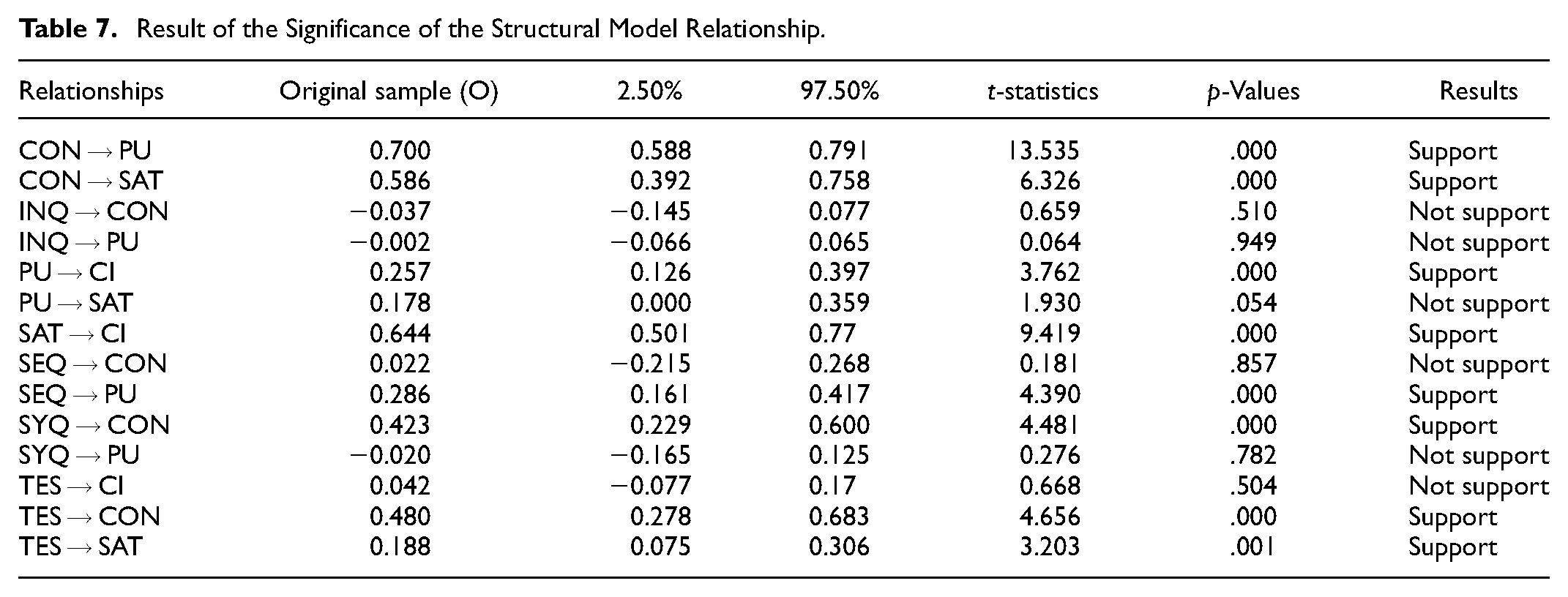
Specifically, the relationship between CON (β = .700, t = 13.535, p = .000), SEQ (β = .286, t = 4.390, p = .000), and PU was positive. Likewise, CON (β = .586, t = 6.326, p = .000), and TES (β = .188, t = 3.203, p = .001) was positively related to SAT. The relationship between SYQ (β = .423, t = 4.481, p = .000), TES (β = .480, t = 4.656, p = .000), and CON was positive. Meanwhile, PU (β = .257, t = 3.762, p = .000) and SAT (β = .644, t = 9.419, p = .000) was positively related to CI. Finally, The non-significant relationships were as follows: INQ with CON (β = −.037, t = 0.659, p = .510), INQ with PU (β = −.002, t = 0.064, p = .949), PU with SAT (β = .178, t = 1.930, p = .054), SEQ with CON (β = .022, t = 0.181, p = .857), SYQ with PU (β = −.020, t = 0.276, p = .782), and TES with CI (β = .042, t = 0.668, p = .504).
Explanatory Power and Predictive Relevance
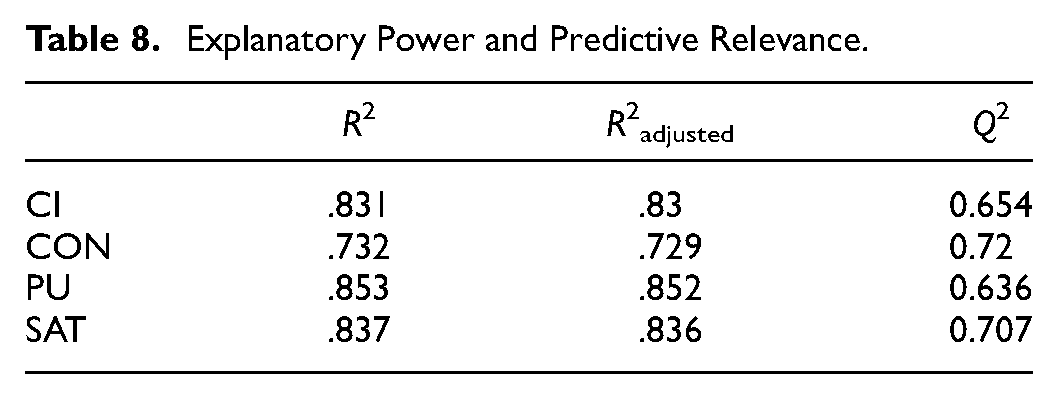
The R2 values for the endogenous constructs and Stone-Geisser’s Q2 values explain the model’s explanatory power and predictive relevance (Hair et al., 2021). The R2 values (see Table 8) indicate the model’s satisfactory explanatory power. The R2 value for CI suggests that all the factors account for approximately 83.1% of the variance in CI. Similarly, the R2 value for SAT indicates that its predictive factors explain about 83.7% of the variance. Furthermore, all Q2 values are greater than zero (see Table 9), implying that the empirical model exhibits high predictive relevance (Hair et al., 2021).
Explanatory Power and Predictive Relevance.
MICOM Step 2_Compositional Invariance: Across Males Versus Females.

Multigroup Analysis
Measurement Invariance Analysis
This study employs a multigroup PLS analysis to compare and analyze the differences in path coefficients among different genders. This method has been widely used in prior literature (Zhou et al., 2014). Before examining moderation effects, we assess potential measurement invariance issues based on the Multiple Indicator Composite Model (MICOM) procedure (Henseler et al., 2016).
As suggested by Hair et al. (2021), conducting multigroup analysis requires establishing both structural invariance (i.e., the same parameters and estimation methods) and composite invariance (i.e., the same indicator weights). In Smart PLS 4.0, structural invariance is automatically set, while composite invariance is assessed through a permutation algorithm (Hair et al., 2021). It is necessary to establish structural invariance that the path models and data processing used in different gender groups in this study are identical (Henseler et al., 2016). Furthermore, structural invariance is confirmed since both groups’ model estimations are carried out using the same algorithmic settings (Henseler et al., 2016). Composite invariance is established if the computed score correlations are greater than the 5% of the empirical distribution, as shown in Table 9, providing strong support for its validity (Hair et al., 2021). Overall, measurement invariance between these two groups is confirmed.
Multi-Group Analysis
After validating measurement invariance, a multi-group analysis was carried out. Concerning gender, a dummy variable was used to distinguish between males and females (Venkatesh & Morris, 2000). This study conducted a multi-group analysis by comparing the paths across different groups (Zhou et al., 2014). The results of path coefficient analysis between gender subgroups are shown in Table 10. The results indicate that there are no significant gender differences in the impact of PU (β_males = 0.194, β_females = 0.304, p = .550) and SAT (β_males = 0.798, β_females = 0.592, p = .279) on CI. Therefore, the above hypotheses are not supported.
Comparison of Path Coefficients (Males and Females).

Discussion
This study explores the factors influencing university students’ CI to engage in mobile learning. A comprehensive review of existing literature posited that factor such as INQ, SYQ, SEQ, CON, PU, and SAT play pivotal roles in determining students’ CI toward mobile learning. The validity of the proposed research model was evaluated using Smart PLS. A significant proportion of the hypotheses were confirmed, accounting for 83.1% of the total variance in students’ CI for mobile learning. In subsequent sections, a detailed discussion of the findings related to the initially posed research questions will be provided.
Quality Factors and PU
The INQ of mobile learning does not have a significant positive correlation with PU, which contradicts Zaineldeen (2021) research. In examining university students’ CI regarding information systems, Zaineldeen (2021) found that the INQ of systems significantly positively influenced their PU and SAT. When the quality of information systems improves, students’ PU and SAT increase substantially. There may be two reasons for these inconsistencies: first, in mobile learning, technical issues such as app crashes or unstable internet connections affect students’ perception and use of INQ (Nie et al., 2023), reducing their evaluation of the information’s practicality. Second, information overload makes it difficult for students to filter out critical content, reducing practical learning help and weakening their perception of the information’s usefulness (Chavoshi & Hamidi, 2019). Furthermore, SYQ does not have a significant positive impact on PU, which is inconsistent with (Vanitha & Alathur, 2021), who argued that SYQ in e-learning significantly influences students’ PU. This difference may stem from insufficient functionality in mobile learning systems, which cannot meet students’ academic needs (Klimova, 2019). Additionally, unstable internet connections or device compatibility issues may affect system performance and reduce students’ assessment of SYQ (T. Wang et al., 2021). However, SEQ has a significant positive impact on PU. This finding aligns with X. Huang and Zhi (2023) study, which found that improving SEQ directly enhanced students’ PU when examining factors influencing their CI with virtual classrooms. In this study, high-quality mobile learning services met university students’ needs for convenience and support while increasing their recognition of the higher practicality of learning content.
Quality Factors and CON
The INQ of mobile learning does not have a significant positive impact on students’ CON, which contradicts Gu et al. (2021), who found that INQ effectively promoted university students’ initial expectations of MOOC platforms. This inconsistency may result from the following factors: First, mobile learning platforms may fail to meet students’ individualized needs for specialized in-depth learning. Generalized or shallow learning content may cause dissatisfaction with the content’s professionalism and practicality (M. Almaiah et al., 2021). Second, technical issues such as poor user interface design or complicated operation may hinder students from effectively accessing and using information (Kumar & Bervell, 2019). The SYQ of mobile learning significantly positively impacts CON, consistent with Q. Yang and Lee (2021) finding that SYQ is a key factor influencing quality CON on MOOC platforms. In this study, the SYQ of mobile learning not only improved students’ overall experience with the platform but also enhanced their trust and reliance on the system, further strengthening their CON degree in using mobile learning. However, SEQ does not significantly influence students’ CON, which contradicts Q. Yang and Lee (2021) finding that SEQ is a key factor influencing students’ CON. Possible reasons include: the informal and intermittent nature of mobile learning makes students susceptible to external interference(Fan et al., 2023), so even if SEQ improves, it may not significantly enhance students’ overall learning experience. Furthermore, mobile learning emphasizes personalization and autonomy, and if the service fails to meet students’ specific needs, such as providing materials and pathways suited to their learning styles, improving general SEQ alone may not satisfy students (Uppal et al., 2018).
Constructs of the ECM
CON in mobile learning significantly positively affects PU and SAT. This is consistent with T. Wang et al. (2021), which showed that when students’ expectations were confirmed, it significantly improved their PU of mobile learning. Furthermore, Niu and Wu (2022) found that CON has an even stronger impact on SAT. When mobile learning meets or exceeds students’ expectations, they find it useful and are more satisfied with it, strengthening their CI. In this study, university students’ PU and SAT improved when they highly recognized the actual effectiveness of the mobile learning system. PU significantly positively impacts students’ SAT and CI, consistent with Zhang et al. (2023). M. Cheng and Yuen (2022) study further showed that PU significantly enhances adolescents’ SAT and CI with e-learning systems. In this study, university students were more satisfied and willing to continue using mobile learning only if they believed it was highly practical and useful. The study also emphasized that in mobile learning, SAT significantly positively affects CI, aligning with Bøe et al. (2021). From the perspectives of users and managers, Bøe et al. (2021) explored educators’ CI toward e-learning and found that SAT significantly positively impacts CI. This shows that when university students are satisfied with mobile learning and recognize its value, they are more likely to continue using it. In this study, the higher students’ SAT with mobile learning, the stronger their willingness to continue using it. They will proactively use this tool to enhance their learning effectiveness and seek more value from mobile learning.
TES, CON, SAT, CI
TES significantly positively influences students’ CON and SAT. Specifically, when students receive more TES in mobile learning, they can better understand the benefits of learning, improving their CON degree. This finding aligns with Abdullah et al. (2022), who found that students’ perceived support enhanced their self-efficacy and met their expectations for mobile learning. In this study, teachers provide technical, emotional, and academic support in mobile learning, helping students better understand, adapt to, and use mobile learning tools, thus enhancing their CON degree (X. Ma et al., 2023). Similarly, TES also significantly improves students’ SAT. Research shows that when students feel more support from teachers, their SAT with mobile learning also increases. This conclusion is supported by She et al. (2021), Sun and Shi (2022). In this study, on one hand, TES helps students understand and use relevant technology, strengthening their recognition of mobile learning and increasing their SAT. On the other hand, teachers’ assistance in technical and academic matters resolves challenges that students encounter in mobile learning (X. Ma et al., 2023).
However, TES does not significantly impact university students’ CI with mobile learning, which differs from Descals-Tomás et al. (2021), who argued that TES is the most important factor influencing students’ CI in mobile learning. The inconsistency may stem from multiple factors. First, because of mobile learning’s flexibility and fragmented nature, students with strong self-regulation skills may prefer to learn at a time and place they deem suitable, reducing dependence on teachers (X. Ma et al., 2023). Second, some teachers may lack the necessary skills and knowledge in mobile learning, making their support ineffective. Additionally, TES may not precisely align with students’ specific needs, especially regarding technical and academic challenges (Feng et al., 2023).
The Moderating Role of Gender
Research finds that gender does not have a significant positive moderating effect on the relationship between PU and CI, differing from X. Li et al. (2022) conclusions. They found that gender differences significantly moderated the relationship between PU and CI in online learning. This inconsistency may arise from the following factors: On one hand, the abundance of readily accessible learning resources in the mobile learning environment makes male and female students perceive usefulness similarly (Al-Emran & Teo, 2020), reducing the moderating effect of gender on the relationship between PU and CI. On the other hand, as mobile devices and apps become increasingly common, mobile learning has become a part of everyday life, and the gender differences in using these technologies are narrowing (Fagan, 2019), further reducing the moderating effect of gender.
Studies indicate that gender doesn’t play a notable positive moderating role in the relationship between SAT and CI, which contrasts with the findings of Alghamdi et al. (2020). They found that males’ proficiency with technology augmented their SAT and CI toward online learning. This inconsistency may arise from: On one hand, current mobile learning platforms and tools are designed to provide the best learning experience for all users, regardless of gender (Hamidi & Jahanshaheefard, 2019), which may weaken the moderating effect of gender on the relationship between SAT and CI. On the other hand, in modern educational and technological environments, males and females have equal opportunities for education and technology use, reducing gender differences in SAT and CI (Crues et al., 2018).
Implications
In the context of mobile learning, this study has developed an integrated model that explores factors influencing college students’ CI to use mobile learning from the dimensions of institution, teacher, and student. This model explains 83.1% of the total variance in college students’ CI to use mobile learning. Thus, the research model and its results presented here are compelling, and the conclusions drawn have both theoretical and practical implications.
Theoretical Implications
The first contribution of this study is creating a predictive model for college students’ CI to use mobile learning, building on the foundations of both the ECM and D&M models. The D&M model includes INQ, SYQ, and SEQ; the ECM model integrates PU, CON, SAT, and CI. The educator dimension adds a facet related to teacher support. This comprehensive model considers the factors affecting college students’ CI to use mobile learning from three dimensions: educational institutions, teachers, and students. This addresses the previous research gap, which mainly focused on platform quality and learner-centric factors.
Secondly, the performance of the developed model is commendable. The model demonstrates a strong explanatory power regarding PU, SAT, and CI. It moderately explains the confirmation factor. Specifically, the model explains a significant 85.3% of PU, 83.7% of SAT, and 83.1% of CI and moderately accounts for 73.2% of CON. Compared with previous research models, these results have high performance.
Lastly, this study addresses group differences. Gender was considered a moderating factor between PU, SAT, and CI. It was found that the impact of PU and SAT on CI does not show significant gender differences. The reasons leading to this conclusion were extensively discussed. This fills the gap that previous studies overlooked gender differences in the CI for online learning .
Practical Implications
This research aims to explore factors influencing college students’ CI to use mobile learning. Based on the study’s findings, the following practical implications can be drawn:
For educators, university students’ CON of mobile learning significantly positively influences their PU and SAT. Therefore, teachers should focus on enhancing students’ CON of mobile learning. To achieve this, they should regularly update course content to align with industry standards and market demands, incorporating the latest industry reports, case studies, and technological advancements. By keeping the courses up-to-date and providing real-world application scenarios, students will more easily recognize the value of mobile learning. Additionally, teachers should introduce emerging technologies like artificial intelligence and big data analytics to demonstrate their practical applications in the industry. This will help students increase their PU and spark interest in new technologies. Lastly, teachers should provide positive feedback, regularly check students’ progress, set reasonable short-term goals, and organize feedback meetings to ensure teaching strategies meet students’ needs. These methods can enhance students’ CON and SAT with mobile learning and ultimately improve their CI.
For university students, to strengthen their CON and SAT with mobile learning, students should actively participate in discussions and Q&A sessions on mobile learning platforms, share insights, and learn from each other to deepen their understanding of course content. Since the quality of mobile learning services and systems directly affects students’ CON and CI, students need to clearly set short-term and long-term learning goals, gradually achieving these goals to boost learning confidence and a positive attitude while recognizing the practical value of mobile learning courses. Additionally, students should use platform resources for self-directed learning, choosing courses that align with career goals and expanding their knowledge through practical case studies. Providing feedback on learning experiences and needs is also crucial, as it helps teachers improve course content to meet practical demands, ultimately enhancing CI.
For educational institutions, they should provide comprehensive training and support to enable teachers to better utilize mobile learning platforms in their teaching. Since TES plays a significant role in students’ CON and SAT with mobile learning, training should include how to enhance students’ learning experiences through positive feedback and interaction and how to align courses with the latest industry standards. Institutions should also strengthen the technical infrastructure of mobile learning, optimizing SEQ to ensure the system remains stable and accessible, providing students with a positive learning experience and increasing their CON. Finally, recognizing outstanding teachers, hosting seminars and lectures with industry experts, and other activities will ensure course content aligns with industry demands, motivating teachers to participate in course development and inspiring student interest.
Limitations and Future Research Directions
Despite the findings presented, this study has several limitations. First, the sample was predominantly female, which did not account for the differences in gender results when using mobile learning. Future research should address this to comprehensively understand the impact of gender on mobile learning. Secondly, this study employed a quantitative survey approach, which effectively gathered a broad range of statistical data but limited the depth of insight into the factors influencing college students’ CI to use mobile learning. To achieve a deeper understanding, future research could benefit from integrating qualitative methods, such as interviews or focus groups. These qualitative approaches would complement the quantitative data and provide richer insights into the dynamics at play. Finally, the study was a cross-sectional survey that couldn’t fully capture the long-term changes in students’ CI toward mobile learning over time. Future studies should consider conducting longitudinal research to better understand how students’ SAT and CI with mobile learning evolve over time and their long-term impacts.
Conclusion
This study aims to explore the factors that affect college students’ CI in mobile learning. Building on the ECM and D&M Information Success Model, this research incorporated TES to devise a predictive model for CI toward mobile learning among college students. It was found that SEQ significantly positively influences students’ PU of mobile learning. Students’ CON of mobile learning significantly impacts their SAT, which affects their CI. TES was found to significantly positively influence students’ SAT and CON. Moreover, the study discovered that gender differences do not significantly moderate the relationship between PU, SAT, and CI. In addition, practical suggestions were made to mobile learning developers, learners, and teachers. By improving the functionalities of mobile learning platforms, increasing teachers’ level of support to students, and enhancing students’ efficiency in leveraging mobile learning, it is hoped to boost students’ SAT and CI toward mobile learning.
Footnotes
Appendix

| Construct | Item | Measurement | Source |
|---|---|---|---|
| INQ | INQ1 | Remote lecture providers provide information related to my learning. | Jung and Shin (2021) |
| INQ2 | Remote learning providers provide very easy-to-understand educational content. | ||
| INQ3 | The remote lecture provider provides the latest information for my purpose. | ||
| SYQ | SYQ1 | The remote lecture system has clear and reliable quality characteristics. | |
| SYQ2 | The remote lecture system always responds quickly. | ||
| SYQ3 | The remote lecture system delivers information in a clear and concise manner to both men and women of all ages. | ||
| SEQ | SEQ1 | The instructor has enough knowledge to meet the needs of the learner. | |
| SEQ2 | Instructors and operators respond kindly to the needs of learners. | ||
| SEQ3 | Instructors and operators give individual attention to learners. | ||
| TES | TES1 | I have established a friendly and harmonious relationship with my teachers in online English learning. | G. Yang et al. (2022) |
| TES2 | The teacher actively participates in my English online learning activities. | ||
| TES3 | The teacher creates a good English online learning atmosphere for me. | ||
| TES4 | The teacher will adjust the teaching content according to my English online learning. | ||
| PU | PU1 | Using Web-based learning would improve my productivity in learning. | L. Li et al. (2022) |
| PU2 | Using Web-based learning would improve my academic performance. | ||
| PU3 | I find the Web-based learning is useful for me. | ||
| CON | CON1 | My experience using the e-learning system was better than I expected. | Rajeh et al. (2021) |
| CON2 | The service level provided by the e-learning system was better than I expected. | ||
| CON3 | The e-learning systems can meet demands in excess of what I required for the service. | ||
| SAT | SAT1 | I am satisfied with the e-learning services. | Sumi and Kabir (2021) |
| SAT2 | I will recommend e-learning services to others. | ||
| SAT3 | My enrollment decision is right. | ||
| CI | CI1 | I intend to continue using WANKE mobile learning app in the following semester, rather than discontinue its use | S. Yang et al. (2019) |
| CI2 | If I could, I would like to continue my use of WANKE mobile learning app in the following semester | ||
| CI3 | My intentions are to extend my use of WANKE mobile learning app in the following semester |
Declaration of Conflicting Interests
The author declared no potential conflicts of interest with respect to the research, authorship, and/or publication of this article.
Funding
The author(s) disclosed receipt of the following financial support for the research, authorship, and/or publication of this article: Henan Philosophy and social Science work affairs Center (No: 2022BJY020, 2020BZZ006); Science and Technology Department of Henan Province (No: 212400410051); Ministry of Justice of the People’s Republic of China (No: 17SFB3009).
Informed Consent Statement
Informed consent was obtained from all subjects involved in the study.

Data Availability Statement
The data that support the findings of this study are available on request from the corresponding author.