



Abstract
Learning Management Systems (LMS) are crucial in modern educational technology, enhancing education through personalized support, efficient resource management, and data-driven decision-making. LMS holds a pivotal position in contemporary higher education. This research explores undergraduate students’ continued learning intentions, grounded in the Expectation-Confirmation Model and Flow Theory, while assessing the moderating effect of intrinsic motivation within this context. From January to August 2023, an online survey gathered self-reported data on satisfaction, confirmation, perceived value, continued intention, flow experience, and intrinsic motivation from 232 undergraduate students across three universities in Henan Province using the Questionnaire Star platform. Analysis using Partial Least Squares Structural Equation Modeling (PLS-SEM) confirmed all research hypotheses except for the insignificant impact of flow on satisfaction and continued intention, demonstrating the model’s significant explanatory power for continued intention, explaining 90.8% of the variance. The adjusted R2 was 90.6%, and the Q2 value reached 78.5%. Intrinsic motivation was found to moderate the relationship between satisfaction and continued intention positively, but it did not affect the relationship between perceived value and continued intention. The findings underscore the importance of LMS in educational settings and provide insights into enhancing user experience, student engagement, and satisfaction. Recommendations include the need for developers to improve the LMS interface and functionalities, for educators to enrich learning resources, and for students to recognize the value of LMS and set clear goals to foster their intrinsic motivation.
Plain language summary
Learning Management Systems (LMS) are crucial in modern educational technology, enhancing education through personalized support, efficient resource management, and data-driven decision-making. LMS holds a pivotal position in contemporary higher education. This research explores undergraduate students’ continued learning intentions, grounded in the Expectation-Confirmation Model and Flow Theory, while assessing the moderating effect of intrinsic motivation. The analysis was conducted using Smart PLS. Smart PLS offers a myriad of benefits for data analysis, including handling non-normal data, accommodating small sample sizes, maximizing explanatory power for the variance of endogenous latent variables, and the capacity to process complex models. The objective of this study is to discern the maximum explanatory power of CI variance influenced by FLOW, CON, PV, SAT, and SAT. With a sample size of just 232 and encompassing six constructs, the study adopts a complex model framework. Given these conditions, Smart PLS is an apt choice for data analysis in this context. The primary contribution of this research is developing a multi-dimensional and comprehensive model for assessing college students’ CI to use LMS. Moreover, our findings suggest that the flow experience does not significantly affect CI use and satisfaction, differing from previous studies where FLOW significantly impacted university students’ CI to use e-learning.
Keywords
Introduction
With the rapid advancement of information technology and the impact of the COVID-19 pandemic, the number of users engaging in online learning has been increasing daily. Online learning has emerged as one of the most significant advancements in information and communication technology and higher education (Dang et al., 2016). LMS, one of the most comprehensive and essential technologies within online learning, has attracted extensive research and attention. LMS are information systems designed to facilitate e-learning by processing, storing, and disseminating educational materials (McGill & Klobas, 2009). They play a pivotal role in modern education by offering opportunities for efficient management of educational resources, support for personalized learning, data-driven decision-making, and the provision of a globalized educational approach. They help enhance the quality and accessibility of education, providing a more flexible, sustainable, and personalized learning experience for both students and educators. Early research on LMS primarily focused on adoption (Kim et al., 2021; Navarro et al., 2021; Raza et al., 2021; Ustun et al., 2021). However, studies by Ashrafi et al. (2020) have found that the continuance intention (CI) to use LMS reflects their success more than the initial willingness to adopt. Hence, university students’ uniqueness in learning needs and new technology acceptance makes them ideal subjects for evaluating LMS effects and optimizing educational resources (Martín-García et al., 2019). Despite early studies concentrating on LMS adoption issues, recent research indicates that users’ CI to use LMS systems better reflects their success (Ashrafi et al., 2020). Therefore, this study aims to delve into university students’ CI to use LMS and explore this specific group’s characteristics and personalized needs.
Researchers have explored the factors and mechanisms influencing the CI using multiple theoretical frameworks, including the ECM (Li, Wang, Wei, 2022), TAM (Ashrafi et al., 2020), TTF (Navarro et al., 2021), Flow (Goh & Yang, 2021a), D&M ISSM (Alyoussef, 2023; Gu et al., 2021) and SDT (Su & Chen, 2020). By integrating two or more models or incorporating different constructs, researchers have extended the model frameworks or enhanced the predictive capability of the models (Y. M. Cheng, 2021; Dai, Teo, Rappa, 2020). However, despite the TTF, TAM, and ISSM models examining the use of information systems from different angles, including task-technology fit, users’ attitudes (ATT) toward technology, and the impact of system quality, these models have limitations. For instance, the TAM model lacks consideration for user differences, and the TTF model focuses on the match between tasks and technology. The ECM model emphasizes users’ experience, including satisfaction (SAT) and confirmation (CON), while Flow Theory explores the depth of users’ experiences with products. This study primarily relies on ECM and Flow Theory to explore how individuals form CI to use LMS based on their experiences. For example, Ashrafi et al. (2020), based on TAM and ECM, surveyed 153 university students on factors affecting the CI to use LMS. The results showed that this integrated model could explain 75.9% of the variance in CI within LMS. Furthermore, existing research has identified multiple factors influencing LMS’s CI, such as SAT (Alzahrani & Seth, 2021; X. Wu & Wang, 2020), engagement (Goh & Yang, 2021), performance expectation, social influence (Sirayos & Siriluck, 2021), perceived usefulness (PU) (Alturki & Aldraiweesh, 2021), perceived ease of use (PEOU) (M. Cheng & Yuen, 2018; Gu et al., 2021), perceived value (PV) (Y. Li et al., 2021), and ATT toward LMS content quality (Ashrafi et al., 2020; Niu & Wu, 2022), laying the foundation for our research on the factors influencing university students’ CI to use LMS and the moderating effect of intrinsic motivation (IM).
Despite the recent surge in interest in the continued use of learning management systems (LMS), noticeable gaps still exist in the literature. Firstly, from a theoretical standpoint, prior research on the CI to use LMS has primarily been based on single models such as the ECM and the TAM. However, these models alone are not sufficient to fully explain the CI of university students to use LMS. Specifically, studies are scarce integrating ECM with TAM to explore the CI of using LMS. Integrating ECM and TAM could provide a more comprehensive and in-depth understanding of the factors affecting students’ CI of LMS. Secondly, the role of students’ IM as a moderating factor in the CI to use LMS has been overlooked. IM regulates students’ learning performance, strategies, and outcomes (Rodríguez-Ardura & Meseguer-Artola, 2019). Students with high IM are typically more driven to pursue knowledge and skills, show greater interest in learning tasks, and achieve higher learning outcomes (Çebi, 2022).
Moreover, IM can help maintain long-term learning motivation, making students more likely to exhibit a higher CI when learning is driven by interest and autonomy (Shahri et al., 2019). By understanding how IM affects learning intentions, educators and developers can better design learning environments and resources that stimulate students’ inner drive, promoting deeper engagement and effectiveness in learning. Understanding the impact of IM on CI allows educators and developers to create learning environments and resources that motivate students intrinsically, encouraging the sustained use of LMS.
Compared to existing research, this study contributes in three primary ways: Firstly, it reveals the moderating effect of IM on the CI of undergraduate students to use LMS, an aspect previously overlooked in the literature. Secondly, by integrating the ECM and Flow theory, this research provides empirical evidence for predicting factors of CI for undergraduates using the LMS. Lastly, the results of this study can guide system developers and educators in formulating effective improvement strategies to enhance students’ SAT and CI.
This study aims to delve deeply into the factors affecting the CI of undergraduate students to use LMS and the moderating role of IM. Our research surveyed the CI of 232 undergraduate students from Chinese universities to use LMS. Additionally, we analyzed the collected data using Smart Partial Least Square 4.0 (Smart-PLS). Based on this, the research questions of this study are:
(1) What factors influence the CI of undergraduate students to use LMS?
(2) To what extent do these factors explain the variance of CI of university students to use LMS?
(3) Does IM have a moderating effect on the impact of SAT and PV on CI?
The following offers a brief overview of the structure of the remaining sections of this study. Literature concerning ECM, Flow, and IM will be discussed in the subsequent section. Based on the literature review in the second section, we present our research hypotheses in the third section. The fourth section provides a detailed account of the methods employed in this study for data collection and model testing. The fifth section analyzes the empirical test results. In the sixth section, we discuss the statistical findings. Finally, we elaborate on the theoretical implications, practical implications, limitations of the study, and directions for future research.
Literature Review
ECM
Based on the Expectation Confirmation Theory (ECT) and the TAM, Bhattacherjee (2001) introduced the ECM in 2001. The ECM primarily focuses on the investigation of CI within the framework of information systems. It is widely used to assess user SAT and post-purchase behavior (Ashrafi et al., 2020; Chiu et al., 2020; Dai, Teo, & Rappa, Huang, 2020; H. S. Lee & Cho, 2021). The model comprises four constructs: PU, Confirmation (CON), SAT, and CI, as illustrated in Figure 1. According to Bhattacherjee (2001), PU pertains to users’ judgment of the system’s utility, serving as a primary reason for individuals to adopt certain technologies at a given time. CON refers to users’ perception of the consistency between their expectations and the actual performance of the information system. SAT represents the users’ subjective evaluation and feelings about their overall experience and the performance of a product or service after use. CI indicates the inclination to keep using the system.

ECM model.
Previous research has widely applied the ECM to study users’ CI, not limited to e-learning systems (Y. M. Cheng, 2020; Xu et al., 2022), e-governance (Hidayat-ur-Rehman et al., 2020), and mobile applications (Tam et al., 2018). It also encompasses various aspects of online education, such as online learning systems (Li, Wang, Wei, 2022), LMS (Ashrafi et al., 2020), e-learning (Alam et al., 2022; Y. M. Cheng, 2021), and MOOCs (Dai, Teo, Rappa, 2020; Gu et al., 2021). These studies highlight CON, PU, and SAT as critical factors influencing students’ intentions to continue using these platforms. Furthermore, to enhance the predictive power of ECM, researchers have incorporated various constructs into the ECM model, such as computer anxiety, computer self-efficacy (Li, Wang, Wei, 2022), task skill, task enjoyment (Alam et al., 2022), curiosity, and ATT (Dai, Teo, Rappa, 2020). Additionally, ECM has been integrated with other theoretical models like SDT (Meng & Li, 2023), TPB (Li, Wang, Wei, 2022), TAM (Ashrafi et al., 2020), Flow and HOT-fit (Y. M. Cheng, 2021) and ISSM (Gu et al., 2021), forming comprehensive theoretical frameworks to explain students’ CI to use online learning technologies. Table 1 summarizes recent applications of ECM in the field of online education. Based on these research backgrounds, this study adopts ECM as the foundation, combined with the constructs above and theoretical models, to predict students’ CI to use LMS, thereby providing deep insights into online education’s practice and theoretical development.
Research on the Application of ECM in the Educational Domain.

Flow
Csikszentmihalyi (2000) introduced the Flow theory to describe the optimal mental state in human experiences. Flow theory denotes that when a person engages in an activity, if their skills align with the challenges, they become deeply absorbed and immersed in the activity, often referred to as “Flow.” Flow is a mental state that can provoke internal impulses, resulting in heightened concentration and involvement.
The Flow theory has been extensively adopted in various fields, such as education (Gao, 2023; X. B. Wang et al., 2022), marketing (Alan et al., 2022; Kang et al., 2018), psychology (Z. W. Zhang, 2021), and sports (Han & Park, 2020; H. S. Lee & Lee, 2021). It describes customers’ and users’ adoption intentions and has been validated across diverse activities. Gao (2023) amalgamated the concepts of sensory stimulation, the extended Unified Theory of Acceptance and Use of Technology (UTAUT), and Flow theory to discern the CI of users toward innovative education amidst delayed rewards. The findings indicated that the users’ Flow state significantly contributes to enhancing CI and materializing the deferred advantages of intelligent education. Based on the Expectancy-Value Theory (EVT) of achievement motivation and Flow theory, Rachmatullah et al. (2021) examined students’ genetics learning in a learning environment. The research findings revealed that the Flow experience significantly influenced students’ examination results. J. Wu et al. (2021) employed the Flow experience as a crucial predictor to gauge the subjective well-being of undergraduates during COVID-19. The results revealed a significant positive correlation between Flow and subjective well-being. Additionally, academic self-efficacy played a role in bolstering the positive relationship between Flow and subjective well-being. The more students experience Flow, the stronger their sense of academic self-efficacy, leading to greater subjective well-being.
Csikszentmihalyi (2000) proposed that educational institutions are ideal places for applying flow theory, where the flow experience can make individuals feel efficient, enthusiastic, and happy—excellent psychological states highly desired in academic environments. Research shows that flow significantly impacts education, especially enhancing learners’ SAT and maintaining their learning intentions (Jung & Shin, 2021; Yu-Ping Chiu, 2023). To further refine, we categorized the research results on the impact of flow into the following categories: Firstly, regarding the SAT with the learning process and the CI of learning, studies have shown that when the presentation of learning content or materials matches the needs of learners, they can achieve learning objectives with less effort. This match enhances learners’ sense of control, increases SAT with the learning process, and strengthens the CI of learning (Al-Okaily et al., 2021; Koc et al., 2022). Secondly, in terms of the adaptability of the learning environment, research points out that the challenging nature of the learning environment (e.g., gamified learning environments) should match learners’ capabilities. This adaptability supports learners’ continued learning in specific environments (Hamari & Koivisto, 2015). Thirdly, regarding classroom performance and learning outcomes, research based on the information system success model and flow theory found that flow experiences positively affect students’ classroom performance, learning outcomes, and willingness to attend classes Li, Wang, Lu, et al. (2022). Lastly, concerning student engagement in online learning platforms, research using a combined theoretical framework of flow theory and expectation-confirmation model shows a significant positive relationship between flow and students’ CI on online English teaching platforms (L. Zhao et al., 2021).
IM
Motivation is the “internal or external force that stimulates enthusiasm and perseverance to pursue a course of action” (Deci & Ryan, 1975). Motivation includes IM and EM, and human behavior is influenced by both IM and EM. IM refers to a type of motivation where individual actions are driven by PV and the benefits of the behavior (Meng & Li, 2023) rather than arising from external pressures or rewards. It plays a pivotal role in a person’s job SAT, curiosity, and sense of participation (C.-J. Wang, 2021). As IM is linked to high-quality academic outcomes, it has been widely studied in fields like online learning (Khan et al., 2018; Meng & Li, 2023; L. Wang, 2022), e-learning (Liu et al., 2022; Sahin et al., 2022), MOOCs (Dong et al., 2023; Romero-Frias et al., 2023), and hybrid learning (Al-Osaimi & Fawaz, 2022; Yang et al., 2023). Learners’ IM was found to be positively related to their academic achievements. IM influences students’ autonomy in learning and leads to more positive outcomes (Alghonaim, 2021).
The current study divides the role of IM into two main directions: Firstly, as a critical predictive variable, IM has a positive effect on students’ academic performance and their CI to learn. For instance, when C. Li, He, and Wong (2021) considered perceived enjoyment as an aspect of IM, it played a decisive role in university students’ CI to engage in English e-learning. Meng and Li’s (2023) research also confirmed the direct positive effect of IM on teachers’ informal online learning and students’ CI to engage in MOOC learning. Secondly, as a variable to be predicted, IM is influenced by various factors such as emotional intelligence, peer support, age, gender, etc. Mercader-Rubio et al. (2023) discovered that emotional intelligence could directly and positively predict university students’ IM, while Hsu et al. (2023) study revealed the impact of a peer assessment-based mobile learning method on IM. Furthermore, Fernández-Martín et al. (2020), through a meta-analysis, evaluated the effect of cooperative learning interventions on the IM of physical education students. These studies highlight the importance of IM in enhancing learning outcomes and identify complex factors that affect IM, providing valuable insights for improving the effectiveness of educational practices.
Hypothesis Development
SAT and CI
According to the ECM, SAT refers to the user’s subjective evaluation and feelings about a product or service’s overall experience and performance after its use (Bhattacherjee, 2001). Moreover, the SAT is the most potent predictor of a user’s CI. Existing research has explored the impact of SAT on CI from various domains (Hussein et al., 2022; Jo, 2022; T. Wang et al., 2021; J. Zhang et al., 2023). Specifically, T. Wang et al. (2021) took ECT and TTF frameworks and developed a research model to study the CI of university students toward online learning during COVID-19. The findings revealed that students’ SAT significantly influenced their CI toward online education. Jo (2022), using an extended ECM, investigated the critical driving factors for university students’ CI to use e-learning. The research found that SAT positively affected students’ CI in e-learning during COVID-19. Hussein et al. (2022), drawing from a combined model of TAM, ISSM, Cognitive Load Theory (CLT), and individual characteristics, researched students’ CI of using Google Classroom within the LMS. The study indicated that SAT significantly and positively impacted students’ CI of using Google Classroom. However, the Ashrafi et al. (2020) survey suggests that students’ SAT with LMS does not significantly affect their CI to use. This research hypothesizes that, when learners felt SAT with the LMS, they demonstrated a higher CI to use it. As a result, this research hypothesizes:
CON and SAT
CON refers to a user’s perception of the consistency between an information system’s expected performance and actual performance (Bhattacherjee, 2001). When users find that the outcomes they perceive from using online education platforms meet or exceed their expected levels, they subsequently experience expectation CON or negative disconfirmation, leading to higher levels of SAT (Bhattacherjee, 2001). In the field of online learning technology, a plethora of studies have elucidated the relationship between CON and SAT from various perspectives (C. Y. Li & Phongsatha, 2022; Rajeh et al., 2021; Yang et al., 2023; J. Zhang et al., 2023). Specifically, Yang et al. (2023) employed the ECM of Information System Continuance to explore the CI of blended learning. The study indicates that CON positively impacts SAT, influencing students’ CI toward blended learning. J. Zhang et al. (2023) ground their work in the ECT and the ISSM, investigating the critical predictors of the CI toward online learning systems. Their research revealed that students’ CON of the system significantly positively affects SAT. Rajeh et al. (2021) integrated the ECT and the TPB to predict students’ SAT and CI for e-learning. The results found that students’ CON significantly and positively influenced their SAT. Nevertheless, in the study on the continued intention of vocational college students to engage in online learning by Li, Wang and Wei (2022), it was found that confirmation has a significant negative impact on satisfaction, attributing this phenomenon to the insufficient online learning experience of vocational college students. This research hypothesizes that learners tend to be SAT with the LMS when they find that the LMS meets their expectations. As a result, this research hypothesizes:
PV, CON, SAT, and CI
PV was initially introduced as an economic concept, referring to an individual’s overall perception and evaluation of a product or service (Ma et al., 2019). It is also considered a crucial competitive strategy (Ma et al., 2019). PV plays a pivotal role in the SAT and CI toward online education. Y. Li, Nishimura, Yagami, et al. (2021) posited that a learner’s commitment to completing in-school assignments is closely related to their PV of online learning. The findings indicated that PV significantly and positively impacts the CI. Shanshan and Wenfei (2022) studied ECM, TTF, and flow theory, exploring factors influencing the CI toward using MOOCs. Their research found that PV notably and positively affects the user’s SAT and CI when using MOOCs. Azhar et al. (2021), integrating the UTAUT framework with PV, investigated factors affecting urban underprivileged populations’ acceptance of online learning. The results indicated that PV significantly impacts these populations’ acceptance and CI toward online education.
PV can be predicted through user CON. This CON can enhance their perceived benefits, thereby increasing the PV of online learning (Panigrahi et al., 2018). As demonstrated by Shanshan and Wenfei (2022), who employed a combined theoretical framework of TTF and ECT, a study on university students’ CI toward MOOCs revealed that CON positively influences their PV in using MOOCs. Jia et al. (2023) proposed a Value-Based Continuance Intention Model (V-ECM), with results indicating that PV directly and positively influences the CI. In this study, the higher the students’ PV, the greater their SAT with the LMS and CI. Furthermore, students’ CON of expectations toward the LMS can elevate their PV. As a result, this research hypothesizes:
CON and Flow
Flow is described as a state in which an individual, when engaged in an activity and their skills match the challenge, becomes wholly focused, deeply involved, and immersed in the task, losing a sense of self-awareness (Csikszentmihalyi, 2000). CON has a significant impact on users’ Flow experience. When learners have a positive CON of an online learning platform, they are more likely to be in a state of Flow because such platforms can fully engage them in learning activities (M.-C. Lee, 2010). To date, many studies in the educational field have affirmed the relationship between CON and Flow experience (Lu et al., 2019; Shanshan & Wenfei, 2022; Y.-T. Wang & Lin, 2021; H. Zhao & Khan, 2021). Lu et al. (2019) researched the SAT and CI of using MOOCs by leveraging the ECT and user experience. They found that user CON had a significant positive influence on their Flow experience. Y.-T. Wang and Lin (2021) utilized an integrated research model comprising ECT, Flow theory, and habit to explore the CI in using mobile learning applications. A core finding from their study suggested that CON exerted a pronounced positive effect on the Flow experience. Using the ISSM and Flow Theory, Tseng et al. (2022) examined business students’ acceptance and CI to use learning technology. Their results indicated that CON positively influenced students’ Flow experience. In this study, when learners feel a CON of their expected performance within the LMS, they experience a positive state of Flow. As a result, this research hypothesizes:
Flow and SAT
When learners associate their engagement in online platform-related activities with the Flow experience, it can further enhance their level of SAT, leading to a heightened sense of fulfillment (Ali, 2016). Current research has already established a relationship between Flow and SAT (Y. M. Cheng, 2021; Jung & Shin, 2021; M.-C. Lee, 2010; H. Zhao & Khan, 2021). For instance, H. Zhao and Khan (2021) used the Flow Theory and ECM as a theoretical framework to investigate the CI of using online English platforms. Their findings indicate a significant positive correlation between learners’ Flow experience and SAT with learning. In the e-learning system, Y. M. Cheng (2020) discovered that the Flow experience significantly positively impacts users’ SAT. During COVID-19, Jung and Shin (2021) examined the factors influencing Korean university students’ SAT with remote online learning. Their results revealed that Flow significantly enhances learners’ SAT with distant online education. In this study, students with a higher Flow experience exhibit more excellent SAT with the LMS. As a result, this research hypothesizes:
Flow and CI
CI refers to the inclination to use a system (Bhattacherjee, 2001). Within educational research, the Flow experience can help learners reduce feelings of loneliness during the learning process, providing a sense of joy and fulfillment that might not be attainable in daily life (Deng et al., 2010). This, in turn, promotes the learners’ CI (Kawabata, 2018). Current research has elucidated the relationship between Flow theory and CI from various perspectives, such as online learning (Hewei & Youngsook, 2022; Li, Wang, Lu, et al., 2022), MOOCs (Arquero et al., 2021; Y. M. Cheng, 2023; Y. Zhao et al., 2020), and blended learning (Goh & Yag, 2021), among others. For instance, Y. Zhao et al. (2020) use a combined framework of Flow Theory and Stimuli-Organism-Response (S-O-R) to explore learners’ CI toward MOOCs. The study found that the higher the level of Flow, the greater the learners’ CI toward the platform. Goh and Yang (2021) investigated the nature of the Flow experience in driving learners’ CI of using an LMS in a blended learning environment. Their findings verified that Flow has a positive impact on CI. Gao (2023), under the backdrop of delayed benefits, studied the CI toward smart education. But Jin (2020) discovered that the flow experience could lead to student dissatisfaction with virtual classrooms, thereby reducing their CI to use virtual classrooms. This research hypothesizes that, students with a higher Flow experience demonstrate a greater CI toward the LMS. As a result, this research hypothesizes:
The Moderating Effect of IM
IM refers to the internal drive within an individual, aiming to fulfill inherent interests, curiosity, and personal values rather than being influenced by external rewards or punishments (Deci & Ryan, 1975). It is one of the crucial factors impacting students’ engagement and decisions related to continuous learning (Bailey et al., 2020). Specifically, under the influence of IM, students typically exhibit strong interest, enthusiasm, and confidence in daily learning activities (Henderlong & Lepper, 2002). Researchers tend to consider IM as a prerequisite for influencing the use of educational technology. For instance, Roca and Gagné (2008) examined the effects of learners’ CI on an English mobile learning system. The results suggested that IM positively predicts CI. Previous studies have found that both SAT and PV positively influence students’ CI toward online learning (Goh & Yang, 2021; Jia et al., 2023; Jo, 2022). Furthermore, the impact of IM on CI is also deemed essential (Li, He, and Wong, 2021; Meng & Li, 2023). Hence, SAT, PV, and IM are all expected to influence CI positively, and potential interactions might occur among these constructs. For example, C.-J. Wang (2021), based on empirical research, found that a positive relationship between students’ career decision-making self-efficacy, SAT, and vocational commitment relates to higher levels of IM. Moreover, higher levels of IM influence the positive relationship between SAT, commitment, and exploration. Vogt et al. (2021) studied the moderating role of IM on annotations and overall learning outcomes in Virtual Learning Environments (VRLE). The study discovered that IM significantly moderated the relationship between annotations and learning outcomes in VRLE. This research suggests that the magnitude of the impact of SAT and PV on CI differs at varying levels of IM. Therefore, exploring the interactions between IM, SAT, and PV in predicting CI for LMS is essential. As a result, this research hypothesizes:
Based on the above hypothesis, the hypothesized model of this study is proposed (Figure 2).

Research model.
Methods
Participants
This study distributed surveys and collected data via the online questionnaire platform (https://www.wjx.cn/). We initially provided teachers at participating universities with detailed information about the research objectives, data collection methods, and consent forms, who then forwarded the survey materials to the students. The samples were from three universities (Zhengzhou University, Henan Normal University, and Henan University of Science and Technology) in China. Participants had utilized an LMS for a minimum of one semester. A random sampling approach was employed to select participants. This method gathered data from 232 respondents via an online questionnaire. To evaluate the representativeness of our sample, we conducted Chi-square tests on gender distribution (male = 43.27%, female = 51.57%; p = .500). The results revealed no statistically significant difference between the sample and the population, underscoring the representativeness of our sample. Data collection spanned from January 2023 to August 2023.
According to Barclay et al. (1995), when conducting research using PLS-SEM, the minimum sample size should be ten times the number of arrows pointing at latent variables in the PLS path model. In this study, the maximum number of arrows pointing at a latent variable was 3. This means that this study’s minimum required sample size was 30, while the actual sample size was 232. Therefore, the sample size of this study meets the research requirements.
Measurements
The measurement comprised two sections. The first section gathered demographic data of the participants, encompassing gender, age, origin, and subject. Six constructs derived from the theoretical framework were assessed in the second section. Specifically, 19 indicators were evaluated in this section (Table 2). A 7-point Likert scale, ranging from 1 (strongly disagree) to 7 (strongly agree), was used, and all items were adapted directly from pertinent literature.
Constructs Measurement and Source.

Statistical Analysis
The analysis was conducted using Smart PLS. Smart PLS offers a myriad of benefits for data analysis, including handling non-normal data, accommodating small sample sizes, maximizing explanatory power for the variance of endogenous latent variables, and the capacity to process complex models (Hair, 2021). The objective of this study is to discern the maximum explanatory power of CI variance influenced by FLOW, CON, PV, SAT, and SAT. With a sample size of just 232 and encompassing six constructs, the study adopts a complex model framework. Given these conditions, Smart PLS is an apt choice for data analysis in this context.
The data analysis encompassed three distinct dimensions. The first focused on the outer model test, specifically assessing construct reliability and validity. Reliability measurements incorporated item reliability, composite reliability, and Cronbach’s alpha (α). Validity evaluations covered both convergent validity and discriminant validity. To ascertain the discriminant validity of the construct, both the Fornell-Larcker criterion and cross-loadings were scrutinized. The second dimension pertained to the inner model, encompassing the collinearity test, significance assessment of model relations, the model’s explanatory power (R2), predictive power (Q2), and the common method variance (CMV). The final aspect investigated the moderating influence of IM on the relationship among SAT, PV, and CI.
Results
Measurement Model
Guided by Hair (2021), the reliability and validity of the scales were ascertained using a measurement model. We commenced by evaluating the reliability of all constructs via indicator loadings and composite reliability (CR). Hair (2021) states that indicator loadings should exceed 0.708 for acceptable item reliability. Additionally, to gauge the internal consistency reliability of the scale, Cronbach’s alpha coefficient was utilized, with the expectation of a value surpassing .7. As delineated in Table 3, the indicator loadings, composite reliability, and Cronbach’s alpha all meet the stipulated .7 threshold, affirming the satisfactory reliability of all scales. The ensuing step involved examining the scales’ convergent and discriminant validity. The Average Variance Extracted (AVE) was employed to assess convergent validity, with a benchmark value of more than 0.5. Discriminant validity was scrutinized using the Fornell-Larcker criterion (Fornell & Larcker, 1981) and the cross-loading approach. According to the latter, an indicator’s outer loading on its designated construct should eclipse its cross-loadings (i.e., its correlation) with other constructs, as detailed in Table 4. Furthermore, inter-construct correlations ought to be lesser than the square root of the AVE, as reflected in Table 5. Collectively, these results indicate robust discriminant validity across all constructs.
Construct Reliability and Validity.

Discriminant Validity (Cross-Loadings Criterion).

Discriminant Validity (Fornell-Larcker Criterion).

Note. The diagonal values in bold are the square roots of AVE.
Common Method Biases
Common Method Bias (CMB) was assessed through dual methodologies. Initially, Harman’s single-factor test suggested that no singular factor was responsible for the majority of the variance, with the most dominant factor explaining just 30.128% of the variance (Podsakoff et al., 2003), substantially below the 50% threshold as recommended by Podsakoff et al. (2003). Subsequently, the marker variable technique was employed, which introduces a theoretically unrelated marker variable to the research model for CMB assessment (Lindell & Whitney, 2001). The highest shared variance with other constructs was found to be 0.0127 (1.27%), considered significantly minimal according to Johnson et al. (2011). Consequently, the findings from these evaluations strongly suggest an insignificant prevalence of common method bias.
Structural Model
Collinearity
Collinearity was evaluated using the predictor constructs’ Variance Inflation Factor (VIF) values. Hair (2021) suggests that VIF values should ideally be below three and must not exceed 5 to confirm the absence of significant collinearity effects on the structural model estimates. As presented in Table 6, all VIF values range between 1.961 and 4.154, aligning with the recommended criteria.
VIF Values of Predictor Constructs.

Significance of the Structural Model Relationship
The significance of the structural model relationships was determined through the bootstrapping algorithm in Smart-PLS. Hair (2021) recommends utilizing t statistics (t > 1.96), p-values (p < .05), and a confidence interval that excludes zero to evaluate the significance of these relationships. Table 7 presents the path coefficient, confidence interval, T statistics, and p-values.
Result of the Significance of the Structural Model Relationship.

Note. Significance level: p < .05, p < .01, p < .001. Non-significance: p > .05.
Specifically, the relationship between PV (β = .202, t = 2.323, p = .020), SAT (β = 0.259, t = 2.089, p = 0.037), and CI was positive. Likewise, CON (β = .312, t = 2.556, p = 0.011) and PV (β = .507, t = 3.98, p = .000) were positively related to SAT. The relationship between CON (β = .892, t = 43.272, p = .000) and FLOW was positive. Meanwhile, CON (β = .916, t = 51.519, p = .000) was positively related to PV. Finally, the non-significant relationships were FLOW with CI (β = .064, t = .952, p = .341) and FLOW with SAT (β = .144, t = 1.602, p = .109).
Explanatory Power and Predictive Relevance
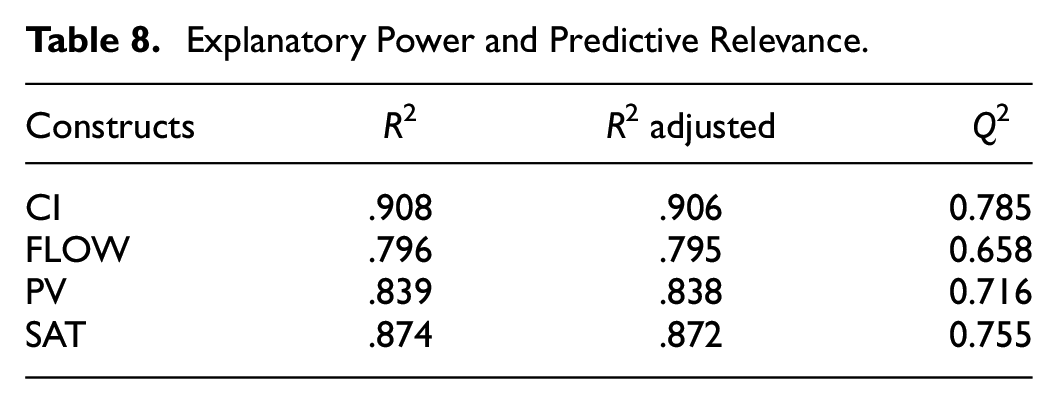
The model’s explanatory power and predictive relevance can be discerned through the R 2 values of endogenous constructs and Stone-Geisser’s Q 2 values, respectively (Hair, 2021). As depicted in Table 8, the R 2 values indicate the commendable explanatory strength of the model. Specifically, the R 2 value for CI reveals that 90.8% of its variance can be attributed to the predictive variables. Concurrently, the predictors for SAT account for about 87.4% of its variance, as indicated by its R 2 value. Furthermore, all the Q 2 values exceeding zero, as shown in Table 8, underscore the significant predictive relevance of the empirical model (Hair, 2021).
Explanatory Power and Predictive Relevance.
Moderation Effect Analysis
Moderating effects arise when the association between two variables fluctuates based on the value of a third variable, termed the moderator. Such a moderator can modify the strength or orientation of the relationship between the primary variables (Hair, 2021). To assess the moderating effect of IM on the association between SAT, PV, and CI, this research utilized the two-stage approach of Smart PLS (Becker et al., 2018). Table 9 showcases that when considering university students utilizing LMS, IM notably augments the positive correlation between SAT and students’ CI to engage with the LMS (β = .336, t = 2.556, p = .011). This finding supports H9a. Conversely, IM does not exert a discernible moderating influence on the bond between PV and CI (β = −.084, t = .954, p = .34). As a result, H9b is refuted.
The Regulatory Effects of IM.

Note. Significance level: p < .05, p < .01, p < .001. Non-significance: p > .05.
Discussion
This study explored the factors influencing university students’ continued intention to use LMS, emphasizing the moderating role of intrinsic motivation. The description of the results starts with a comprehensive review of the existing literature, hypothesizing that Flow, CON, PV, and SAT play significant roles in predicting students’ CI to use. The validity assessment conducted with Smart PLS software indicated that the proposed research model could explain 90.8% of the total variance in students’ CI to use the learning management system, supporting the vast majority of the research hypotheses. Our findings revealed that PV is the most significant predictor, followed by SAT, while the flow experience did not significantly affect CI. Furthermore, this study delved deeper into the factors affecting satisfaction, finding that PV had the most significant effect on SAT, followed by CON, with flow experience having no significant effect on SAT. Lastly, confirmation significantly impacted both PV and flow experience, deepening the understanding of the interactions among these variables. IM played a significant role in the effect of SAT on CI to use, while its moderating effect between PV and CI to use was insignificant. The discussion then contrasts with existing research findings, exploring how these factors influence university students’ CI to use LMS.
This study indicates that when university students use the LMS, PV significantly influences their CI to use it. This finding is consistent with the research of Azhar et al. (2021), which indicates that the higher the students’ PV, the more direct and positive impact it has on their CI toward online learning. One possible explanation for this result is that PV reflects students’ approval of the LMS. Students who perceive that the LMS can meet their learning needs are more likely to use the system to achieve their educational objectives. Another rationale is that the LMS offers students a range of convenient learning tools and resources, catering to their functional requirements during the learning process. This perceived functional value amplifies students’ CI to use the LMS.
The research reveals that among university students, the SAT has a significant positive influence on the CI’s use of the LMS. This finding is consistent with J. Zhang et al. (2023), who indicated that the higher the students’ SAT with online learning, the greater their CI. There are two possible explanations for this finding. On the one hand, the LMS offers a variety of features and a user-friendly interface, allowing students to manage and organize learning resources conveniently. This enhances their SAT during the system’s use, promoting the CI. On the other hand, when students gain knowledge and experience from the system, fulfilling their periodic self-worth realization, it can significantly promote their SAT, enhancing their CI of using the LSM.
Interestingly, this study did not find a significant correlation between students’ Flow and CI. This result contrasts with the findings of Goh and Yang (2021) observed that Flow significantly influences students’ CI toward LMS. This inconsistency may be due to the following reasons. On the one hand, if students utilize the LMS primarily to achieve specific academic goals rather than to experience the system itself, and if the LMS fails to help them effectively achieve those goals, their CI to use the platform might be adversely impacted. On the other hand, over prolonged use, students might experience fatigue or find the LMS tedious. Alternatively, they might discover other superior learning tools or resources, leading to a diminished CI with the current LMS. Moreover, the study by Goh and Yang (2021), which conducted a reflective flow structure analysis on 92 students using the PLS method, contrasts with our study using the PLS-SEM analysis method based on a larger sample of 232 university students. This larger sample size might cover a broader student population and more diverse usage scenarios, suggesting that the direct impact of the flow experience on continued intention to use was not as significant in our findings.
The investigation carried out in this study has revealed that university students’ PV has a significant positive influence on their SAT while using the LMS. This result aligns with the findings of Shanshan and Wenfei (2022), which suggest that the higher the students’ PV, the greater their SAT levels when using MOOCs. A possible explanation might be that students tend to be more SAT when they perceive tangible learning benefits from the LMS. Another possible reason is that PV may relate to students’ assessments of the LMS’ quality and diversity of learning resources. When students feel the LMS offers high-quality and diverse learning materials, they are likelier to be SAT with it.
The study found that during the process of university students using the LMS, CON significantly influences SAT. These results reflect those of L. Li, Wang, Li (2022) also found that CON in online learning notably correlates with SAT. This effect can be attributed to students forming subjective perceptions about the LMS as they use it and then comparing the system’s outcomes to their prior expectations. If the post-use performance or results of the LMS exceed the students’ initial expectations, they tend to feel SAT with the content provided by the system.
Contrary to expectations, this study did not find a significant positive impact between university students’ Flow and SAT. This outcome is contrary to that of H. Zhao and Khan (2021), who found that Flow effectively enhances student SAT scores when students use online English platforms. This inconsistency may be due to the following two factors. Firstly, the learning content and tasks provided by the LMS might not align with the student’s educational needs. If it fails to improve students’ academic performance effectively, students may struggle to gain a sense of achievement, which consequently doesn’t foster an increase in SAT. Secondly, the LMS might lack personalized customization features, rendering it incapable of catering to diverse student groups’ individual needs and preferences. Such a shortfall might cause students to feel that their experience with the LMS platform is less than seamless. This can adversely affect their flow experience and reduce their overall SAT score with the LMS. Additionally, compared to H. Zhao and Khan (2022), who collected 500 sample data through a closed questionnaire survey conducted by a marketing research institution, our study was based on a broader sample size. In a larger sample, the impact of individual differences may be diluted, making the positive effect of flow experience on satisfaction less significant. This methodological difference might be another critical factor leading to the inconsistency in the results of the two studies.
This study demonstrates that during the process of university students using the LMS, CON significantly influences PV. This outcome aligns with the findings of (Panigrahi et al., 2018). Their research revealed that user SAT can enhance students’ perceived benefits in online learning, thereby increasing the PV of online learning. The observed correlation between CON and PV can be explained in two ways. First, when students engage with the LMS, if the content provided by the system meets their usage requirements and aligns with their expectations, they will have a heightened sense of CON toward the LMS. This, in turn, results in a higher PV for the students. Secondly, the LMS supports students’ learning by offering resources, course schedules, and assignment requirements. When students are SAT with this information and can rely on the accuracy and reliability of the information provided by the LMS, they are more likely to confirm the system’s value.
This research reveals that when university students use the LMS, CON significantly influences their Flow. This result is consistent with the findings of Wang and Lin (2021), who found that CON has a notable positive effect on the Flow experience in mobile learning applications. There are several possible explanations for this result. Firstly, when students clearly understand the LMS’s features and objectives, receive timely feedback, and find that most of their expectations regarding the LMS are confirmed, they are more likely to focus intently, leading to a state of flow. Secondly, the LMS can provide students with automated evaluations and feedback, promptly informing them about their academic performance and progress. Such timely feedback helps students better gauge their learning pace, enhances their sense of CON with the LMS, and consequently promotes the emergence of the Flow experience.
The results of this study show that during the process of using the LMS, university students’ IM significantly and positively moderates the relationship between SAT and CI. This finding aligns with the research of C.-J. Wang (2021), who surveyed 782 students and determined that IM notably positively moderates the relationship between SAT and CI. Two possible explanations account for this observation. Firstly, students with a high level of IM resonate more with the value and purpose of learning. This implies that they place greater importance on the support provided by the LMS. Consequently, they are more likely to derive SAT from the LMS, encouraging their CI to use the system. Secondly, when students feel SAT with the LMS, their IM may be further boosted. Conversely, high IM can also predispose students to derive SAT from the LMS more easily. This positive feedback loop ensures that IM is a robust positive moderator in the relationship between SAT and CI.
Contrary to previous research findings, this study discovered that university students’ IM does not significantly moderate the relationship between PV and CI when using the LMS. IM represents an individual’s inner driving force, influencing students’ motivation and persistence in learning. It could significantly impact how students assess learning tools’ value and CI use. This finding contrasts with the study of Hulleman and Harackiewicz (2009), who explored the factors influencing high school students’ continued participation in science classes. Their research discovered that IM played a significant moderating role between PV and CI. This discrepancy could be attributed to the following two aspects. On the one hand, PV refers to students’ subjective feelings about the utility and efficacy of using the LMS. Suppose students’ PV of the LMS platform primarily depends on external factors like ease of use or aesthetic interface rather than an IM for learning. In that case, the moderating effect of IM between PV and CI might be weak or non-existent. On the other hand, university students might use the LMS primarily to meet fundamental academic and course requirements. Such utilitarian needs could lead to students’ CI mainly being based on the actual functionalities provided by the LMS rather than being influenced by their IM.
Implications
This study integrates the ECM and Flow theory to explore the factors influencing college students’ CI toward LMS and the moderating role of IM. The proposed model accounts for 90.8% of the total variance in students’ CI with LMS. Consequently, this study’s research model and findings hold theoretical and practical implications.
Theoretical Implications
The primary contribution of this research is developing a multi-dimensional and comprehensive model for assessing college students’ CI to use LMS. This model was designed based on a systematic review and in-depth analysis of existing literature on ECM and Flow. This new model is comprehensive because it thoroughly incorporates various perspectives regarding the LMS, including learners’ CON, PV, SAT, CI, FLOW, and IM. These elements encapsulate the principal components of existing methodologies.
Moreover, our findings suggest that the flow experience does not significantly affect CI use and satisfaction, differing from previous studies where FLOW significantly impacted university students’ CI to use e-learning. This provides a new perspective for research in this field and expands the application scope of the ECM and FLOW, enhancing our understanding of university students’ continued intention to use LMS.
The current study also investigates the moderating role of IM on CI. Previous research has predominantly focused solely on the direct impact of IM on CI (Li, He, L., & Wong, 2021; L. Wang, 2022; Yang et al., 2023). To the best of our knowledge, this is the first study to comprehensively identify the influencing factors of CI when using LMS and empirically test the moderating role of IM within a single model. This represents the second theoretical contribution of our research.
The third contribution concerns the performance of the developed model. This model exhibited strong predictive capability for CI, significantly accounting for 90.8% of the variance in the CI to use LMS. Compared to previous models, it boasts higher predictive relevance and explanatory power.
Practical Implications
This study aims to explore the factors predicting undergraduates’ CI toward LMS. Based on the findings, we propose the following practical implications.
Firstly, regarding the impact on LMS developers. On the one hand, system developers should prioritize the user interface design of the LMS to ensure its usability, navigability, and visual appeal. Additionally, they could offer personalized customization options, allowing students to adjust the interface notification settings based on their preferences and needs, enhancing their SAT. On the other hand, developers can integrate engaging and interactive features into the LMS, such as online quizzes and virtual experiments, enabling students to assess their learning outcomes promptly. This piques students’ interest and motivation to continue learning and stimulates their IM.
Secondly, concerning the practical implications for educators, on one side, teachers can utilize the LMS to offer students a diversified range of learning resources, such as text, videos, and presentations, catering to different learning styles and needs (X. Wu & Wang, 2018). Moreover, educators can design collaborative projects within the LMS to enhance student engagement, increasing their PV and SAT with the system. On the other side, it’s imperative for teachers to foster students’ curiosity, desire to explore, and innovative thinking, creating a positive learning atmosphere. Encouraging self-directed learning can kindle their IM.
Lastly, regarding the practical implications for students, they should recognize the significance of the LMS in their learning journey. Students should learn to harness the LMS to enhance their study efficiency and apply acquired knowledge, elevating their PV and SAT. On the other hand, during LMS usage, students should set clear learning objectives for themselves, which can ignite their IM, making them more enthusiastic about using the LMS. Concurrently, it’s beneficial for them to cultivate the habit of using the LMS regularly, gradually fostering a sense of self-discipline in their studies, thereby amplifying their CI.
Limitations
While our research offers both practical and theoretical value in this study, there are also certain limitations. Firstly, the sample is confined to 232 undergraduate students from three general higher education institutions in the Henan province of China, leading to results that may not be universally representative. Hence, future research could broaden the sample to encompass students from vocational colleges, general higher education universities, and postgraduate students to determine whether the relationships between these variables vary among student demographics. Secondly, due to the cross-sectional nature of this research, it doesn’t shed light on the dynamic changes of the study subjects over time, nor does it ascertain causality of specific features or behaviors. Future studies could adopt a longitudinal perspective to understand the temporal dynamics of the constructs better. Thirdly, our study only discusses the moderating role of IM, leaving out the potential moderating role of extrinsic motivation. Hence, subsequent research can probe into the modulatory effects of extrinsic motivation or factors influencing IM when examining the CI to use LMS. Lastly, our conclusions are purely based on statistical data, which might not offer a deep understanding of the future continuous intention to use LMS. Including qualitative methods in future studies might help identify critical predictors of continuous intention, potentially addressing the gaps in quantitative research.
Conclusion
This study aimed to predict the factors influencing university students’ CI to use LMS. Employing a theoretical model based on the ECM, FLOW, and IM, the study put forth nine hypotheses and conducted empirical research on a sample of 232 university students. The findings revealed significant positive correlations among certain facets of the model. Notably, IM demonstrated a significant positive moderating effect. More specifically, CON had a pronounced positive impact on Flow experience, PV, and SAT. The PV was closely related to SAT, and both emerged as critical predictors of the CI. IM manifested a significant positive moderating role between SAT and the CI. The findings of this study underscore the importance of enhancing students’ CON, PV, and SAT through optimizing user experience in the design and implementation of LMS. Developers and educators should integrate personalized and interactive features to meet students’ learning needs and promote their continued engagement. This deepens our understanding of students’ motivations for using LMS and provides practical guidance for integrating educational technology more effectively into students’ needs and motivations, which can help improve the efficiency of LMS usage and teaching outcomes.
Footnotes
Authors’ contribution
Conceptualization, Renjie Song; Data curation, Yaru Zheng and Renjie Song; Writing original draft, Renjie Song; Writing - review & editing, Renjie Song and Yaru Zheng. All the authors have read and agreed to the published version of the manuscript.
Declaration of Conflicting Interests
The author(s) declared no potential conflicts of interest with respect to the research, authorship, and/or publication of this article.
Funding
The author(s) received no financial support for the research, authorship, and/or publication of this article.
Ethical Approval
The researchers confirms that all research was performed in accordance with relevant guidelines/regulations applicable when human participants are involved (e.g., Declaration of Helsinki or similar). This study was approved by the Ethics Committee of Henan Polytechnic University, with the approval number: HPU-
Informed Consent Statement
Informed consent was obtained from all subjects involved in the study.

Data Availability Statement
The data that support the findings of this study are available on request from the corresponding author.