




Abstract
This research aims to study the relationship between energy use and economic growth between 1990 and 2021 in Colombia. Energy is a key element for economic growth and to improve people’s living standards, especially in developing economies like Colombia. To estimate both the short-run and long-run relationship between economic growth and energy use and economic growth, we used data from 1990 to 2021 and we estimated an error correction model along with a regression using the FMOLS/DOLS estimators. We found that economic growth and energy use are related in the short run in Colombia, according to the Toda–Yamamoto causality test, GDP granger causes energy use and there’s not enough evidence to claim that energy use and GDP are related in the long run.
Plain language summary
This research aims to study the relationship between energy use and economic growth between 1990 and 2021 in Colombia. Energy is a key element for economic growth and to improve people’s living standards, especially in developing economies like Colombia. To estimate both the short-run and long-run relationship between economic growth and energy use and economic growth, we used data from 1990 to 2021 and we estimated two econometric models to capture both the short run and long run dynamics between energy use and economic growth. We found that economic growth and energy use are related in the short run in Colombia and the direction of the relationship goes from GDP to energy use and there’s not enough evidence to claim that energy use and GDP are related in the long run in Colombia.
Introduction
Energy plays a pivotal role in transforming inputs and improving people’s standards of living, primarily in developing countries. The relationship between energy use and economic growth has been studied in several locations around the world, nonetheless, there is no clear consensus on the nexus between energy use and economic growth as can be observed in the meta-analysis by Mutumba et al. (2021).
These results have serious policy implications for policymaking regarding the adoption of policies to reduce energy consumption. If there is a relationship running from GDP to energy consumption, the effect of the energy reduction policy will have little impact on GDP, given the current economic structure of the country, whereas if the relationship is bidirectional or runs from energy to GDP, the policy to reduce energy consumption may harm economic growth (Belke et al., 2010; Gözgör et al., 2018).
The research of Kraft and Kraft (1978), who used empirical data from the United States as the main finding, shows a positive and bidirectional relationship between energy consumption and economic growth. Under this position, later research reaches the same conclusion (Apergis & Payne, 2010; Chontanawat et al., 2008; Ozturk et al., 2010; Tiba & Omri, 2017).
The energy sector constitutes a major factor in the economic development of countries as determined by the International Energy Agency (IEA), Stern (1993) and Török (2023) However, in developing countries, the results are not always positive according to Ouédraogo (2013), one factor for this result is the lack of investment in energy infrastructure, a weak regulatory framework, or the structure of the economy (Shahbaz et al., 2018).
Our analysis focuses on Colombia, a developing country, using data from 1990 to 2021 and implements an econometric approach using two time series models; ECM and FMOLS/DOLS, to study the dynamics between energy use and economic growth. There are two previous studies about energy use and economic growth in Colombia, the first is that of Castillo (1999) who found that there was enough evidence to claim that energy use and economic growth are related, and the second one by Poveda and Martínez (2011), who found that energy use and economic growth were positively associated.
Nonetheless, the latter study had an issue of multicollinearity in the econometric estimation if we take into account that the variable of energy intensity is a linear combination of energy supply, this fact makes the hypothesis tests unreliable and reduces the robustness of the results (Studenmund, 2017), thus it’s required to use a different approach to have a better understanding about the relationship between energy use and economic growth in Colombia.
This paper aims to contribute to the existing literature on the nexus of energy and economic growth both in the world and in Colombia, in addition to that, we also seek to provide an additional explanation of the discordances in the results in the literature about the nexus between energy use and economic growth using the Colombian experience.
Finally, the structure of this article is as follows: the first section deals with the literature review of the relationship between economic growth and energy use in the world and Colombia; the second section is concerned with the methodology and data; the fourth, fifth and sixth, seventh, sections present results, discussion of the results and the conclusions, policy recommendations and limitations of the study.
Literature Review
The relationship between economic growth, poverty, and energy use, as well as its implications, has been widely discussed and debated by several scholars in different locations around the world. Ogbeide-Osaretin (2020) found that, in Nigeria, energy use can reduce poverty, because it makes people more productive and can raise their life quality standards. Besides, energy consumption can increase access to better and more efficient fuel types, such as electricity or natural gas, while non-efficient sources like biomass are positively related to poverty and environmental degradation (Usman et al., 2020).
The process of collecting wood makes people less productive, as they could have used that time in more profitable activities. In the same way, Usman et al. (2020) found, using panel data evidence from South Asian countries, that energy consumption has a negative relationship with poverty, and it has both a direct and indirect effect on poverty. They also found that energy use has a positive effect on economic growth and unemployment, as energy is an important input for the main sectors of the economy, such as industry or services. Therefore, Usman et al. (2020) agreed with the results shown by Li and Leung (2021): they found that energy use has a positive impact on economic growth depending on the source of energy used.
Moreover, for developed countries such as the G7 countries, the relationship is not quite consistent. Balcilar et al. (2010) found no consistent relationship between energy use and economic growth in their research for G7 countries. In contrast, in a study conducted by Shahbaz et al. (2018) regarding the Organization for Economic Cooperation and Development (OECD) countries, the authors concluded that there is a significant relationship between energy consumption and economic growth. However, Topolewski (2021) found that increases in energy consumption do not cause changes in the rate of economic growth of European countries.
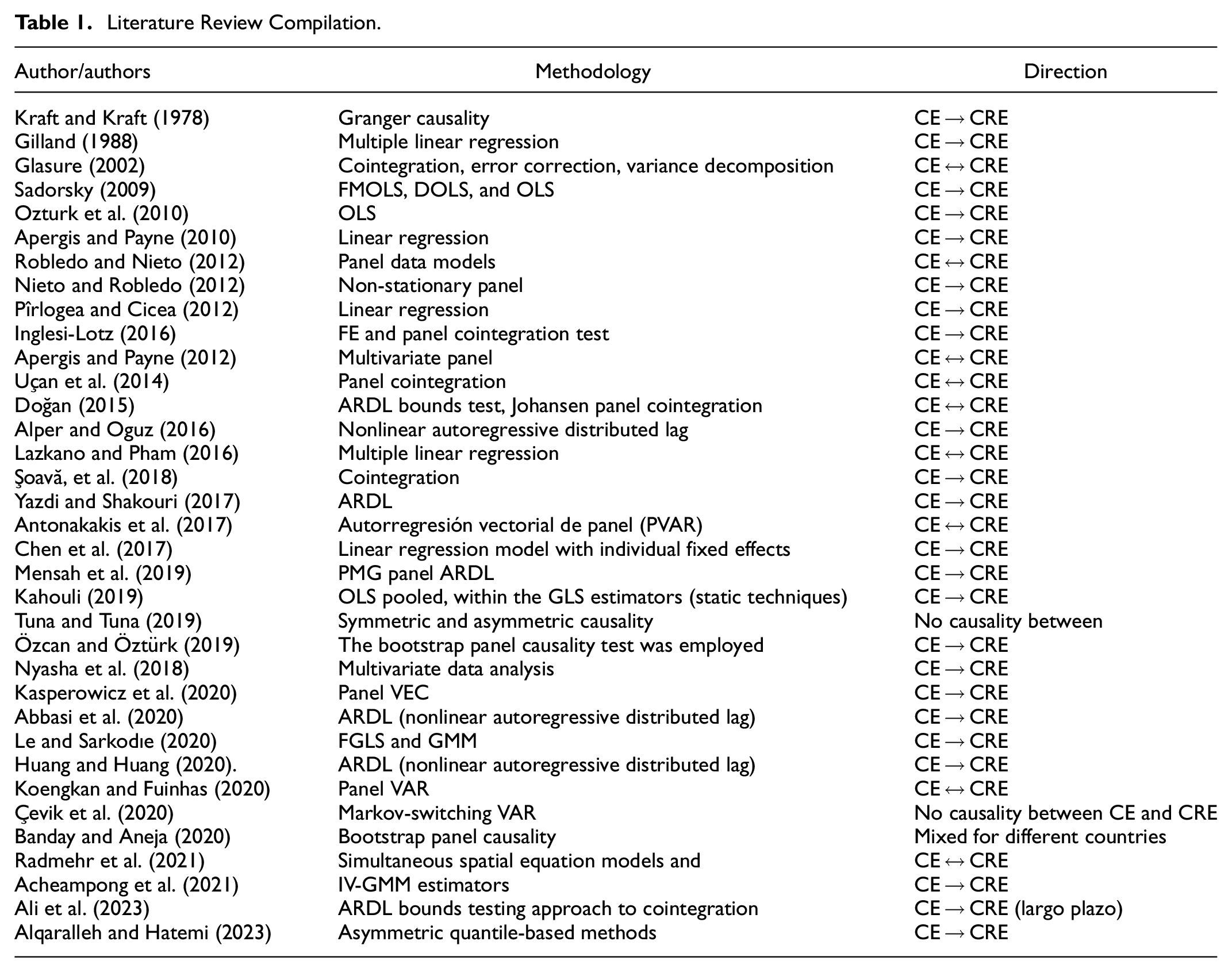
Thus, Table 1 provides an overview of the studies published from 1978 to 2024 on the relationship between energy consumption and economic growth using different models. The evidence shows that the relationship between these two variables is positive in most cases.
Literature Review Compilation.
Methodology
Model Specification
The relationship between energy use and economic growth can be studied using a Cobb–Douglas production function and it’s represented in equation (1), in which output depends upon capital;
Cobb–Douglas Production Function

Based on the data and several studies like that of Kümmel et al. (1989), Stern (1993), Ntanos et al. (2018), Saad and Taleb (2018), and Li and Leung (2021), the relationship between GDP and energy use along with the other control variables can be modeled as it’s depicted in equation (2).
Theoretical Production Function of Energy Use and GDP

Now, take the logs to obtain the corresponding elasticities.
Loof the Production Function

Therefore, the proposed output energy model can be defined in equation (4):
Proposed Model

Where
Energy plays a crucial role in economic growth and should be considered an input along with capital and labor (Stern, 1993), thus, the variable used to measure energy use is final energy consumption, because the energy consumed was used to perform economic activities and it has been widely in literature as can be seen in Kraft and Kraft (1978), Stern (1993), Fatai et al (2002), Dagher and Yacoubian (2012), and Topolewski (2021).
Labor and capital are the main drivers of economic growth according to Coral and Montoya (2014) and Gutierrez and Murillo (2021). They used the Solow model, following the neoclassical approach to explain the economic growth in Colombia and chose the gross capital formation and the labor workforce as proxies to measure capital and labor, which goes in line with the literature on economic growth and energy (Li & Leung, 2021; Ntanos et al., 2018; Shahbaz et al., 2018).
Zahonogo (2017), Sunde (2017), and Huchet-Bourdon et al. (2017) showed that trade openness has a positive association with economic growth, particularly, Hye et al. (2016) as well as Raghutla (2020) found that trade openness is positively associated in the long run with economic growth in emerging economies, therefore is required to control for the potential confounding effect that trade openness might have on the results.
Estimation
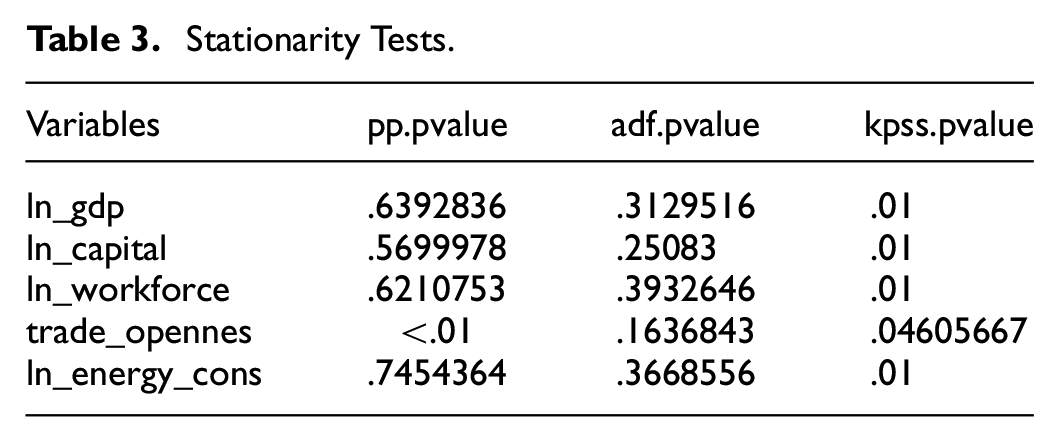
Before estimating the models to analyze both the short and long-run dynamics in the data, it’s required to test for stationarity as you can see in Table 3, given that the ADF test has some issues with its statistical power, it’s advisable to run the ADF test along with the PP test and the KPSS test as suggested by Levendis (2019).
On the other hand, we tested for cointegration using Johansen’s procedure, and then an ECM model, specified in equation (5), was run along with FMOLS and DOLS to capture the short-run and long-run dynamics between economic growth and energy use, to identify the relationship among the variables the Toda and Yamamoto’s (1995) modified version of the granger causality test was applied since the assumption of stationarity assumption isn’t always met.
ECM Model

The ECM was chosen to analyze the short-term dynamics in the data, due to the small sample size and its parsimony and robustness as stated by He (2008), in addition to this, other approaches like the VECM need at least 50 data points to achieve asymptotic level of competency (Salthouse et al., 2006) and it also has been used widely in the literature for analyzing short-run dynamics as can be seen in Scheiblecker (2013), Syahnur et al. (2014), Bernard and Kichian (2019), and Anser et al. (2020).
The long-run dynamics were modeled using the fully modified ordinary least squares (FMOLS) and dynamic ordinary least squares (DOLS) framework because these estimators are efficient for small sample sizes and eliminate the problem of autocorrelation and endogeneity, nonetheless, FMOLS requires that the variables have the same order of integration and it’s most of the time outperformed by the DOLS method (Kao & Chiang, 2004). This approach has been used to model long-run dynamics in energy economics either using time series or panel data, some examples of the use of the use of the FMOLS/DOLS framework can be found in Štreimikienė and Kasperowicz (2016), Khan et al. (2019), Merlin and Chen (2021), and Rahman et al. (2021).
Johansen Co-integration Test
Johansen test determines whether three or more time series are co-integrated; that is if they are related in the long run. It evaluates the validity of a co-integrating relationship by employing a maximum likelihood estimates (MLE) approach, and it is also used to estimate the number of relationships and to find the number of relationships (Poh & Tan, 1997). In the following equation,

Otherwise, the variables are co-integrated, as the linear combination of non-stationary variables can be stationary (Studenmund, 2017).
Toda–Yamamoto Causality Test
Granger causality is a test used to find out the direction of a relationship between two or more variables, that is, it evaluates the precedence of
Their approach involves formulating a VAR model in the levels of the data and testing causality among variables regardless of their degree of stationarity or cointegration, this approach is implemented following these steps, according to Toda and Yamamoto (1995):
Choose the optimal lag k.
Determine the maximum order of integration
Estimate
Use the block exogeneity Wald test to find the direction of the causality.
To apply the Toda–Yamamoto test is required to transform equation (3) into a VAR system:


In which M =
The Toda–Yamamoto procedure tests the linear or nonlinear restrictions on the first k coefficient matrices by using asymptotic theory (Paul, 2020).
Data
The model was estimated using time series data for the 1990 to 2021 period, due to issues with the availability of the data for the country. In Table 2 you can see the details of the data and variables used as well as their corresponding sources.
Data Specification.

Stationarity Tests.
Results
In the first place, before model estimation, it’s required to test for stationarity in the data. The stationarity test results in Table 3 show that the variables are not stationary using ADF, PP developed by Phillips and Perron (1988) and the KPSS test proposed by Kwiatkowski et al. (1992) to minimize the risks of both type I and type II errors, given the different nature of the tests, mainly the difference specifying the null hypothesis of the existence of a unit root.
In light of the non-stationarity, the test of cointegration of Johannsen was performed to find potential long-run relationships among the variables as can be observed in Table 4. Therefore, we find evidence for at least one cointegrated variable, which enforces the need for estimating both the short-run and long-run coefficients of energy use and the rest of the variables using the ECM and the FMOLS/DOLS framework.
Johannsen Cointegration Test Results.

Table 5 reports the coefficients of the error correction model. There’s not enough evidence to say that there exists a long-run relationship between energy use and economic growth, nonetheless, we found that the relationship exists in the short run as denoted by the delta coefficients. An increase of 1% in energy consumption is associated with an average increase of 0.31% in economic growth in the short run when controlling for other factors like capital, labor, and trade openness.
Error Correction Model Estimation.

p < .1. **p < .05. ***p < .01.
It’s not enough knowing the existence of the relationship, but the direction of the latter. A Toda–Yamamoto test was run to find the direction of the relationship between energy use and economic growth in Table 6. GDP granger causes energy consumption, that is, the relationship goes from GDP to energy consumption in the short run.
Toda–Yamoto Test Results.

On the other hand, the FMOLS/DOLS method agreed with the results of Table 5 for the long-run relationship between energy use and economic growth. The long-run coefficients estimated using FMOLS and DOLS can be observed in Table 7. The long-run relationship between capital and labor and GDP is positive and statistically significant according to the neoclassical theory of growth posed by Solow (1956), however, there’s not enough evidence to say that energy use and economic growth are related in the long run in Colombia.
FMOLS/DOLS Estimation.

p < .1. **p < .05. ***p < .01.
Discussion
The results shown in the previous section showed that energy use and economic growth have a positive relationship at least in the short run, this results back the conservation hypothesis, which says that the relationship between energy and economic growth goes from economic growth to energy (Kassim & Işık, 2020). According to the latest literature review by Mutumba et al. (2021), 43.8% of the results find that the growth hypothesis; the relationship goes from energy use to economic growth, whereas 27.2% of studies assure the conservation hypothesis, the results of this study correspond to the conservation hypothesis and go in line with what was found by Stern (1993), Ozturk et al. (2010), Shahbaz et al. (2018), Apergis and Payne (2010), Usman et al. (2020), and Zou (2022).
The results in the previous section can be explained by the economic structure of Colombia because the economy of Colombia isn’t very energy-driven as shown in Figure 1. Industry consumes around 25% of the total energy, and services account for more than 40% if you add transport and commercial services based on the data provided by the IEA.

Energy use in Colombia by sector in 2021.
In addition to that, industry accounted for around 24.86% of the GDP in 2021, whereas services accounted for almost 58% of the activity along with the fact that just 11.2% of the employment is provided by the industry, whereas more than 60% of the employment is focused on services according to the DANE.
Therefore, the extent of the importance of energy in the economy will be determined by the relevance of energy or technological development in the economy (Shahbaz et al., 2018). In the case of Colombia, the role of technology isn’t too big, as the labor has a very low technological component as stated by Castillo (1999); productivity in Colombia has stagnated in the last 20 years as shown by Feenstra et al. (2015), and the economic structure of the economy favors a model of exporting raw materials and low-value-added products (International Monetary Fund, 2023) that aren’t very energy intensive.
On the other hand, another factor that can explain the results is the energy efficiency of the corresponding country, in Colombia less and less energy is required to produce an additional unit of GDP as you can observe in Figure 2. Therefore, to produce one additional unit of GDP, the process requires 1.7 times less energy than 30 years ago, as well as 1.3 times less energy than 20 years ago.

Energy intensity in Colombia from 1990 to 2021.
These results have powerful implications for the energy formulating policy to reduce emissions and the energy transition, as reducing energy consumption wouldn’t harm economic growth as stated by those with similar results like Ozturk et al. (2010), Gözgör et al. (2018), Mutumba et al. (2021), and Zou (2022). However, this interpretation of the conservation hypothesis ignores the fact that those results imply that the economic structure of those countries would remain the same, that is, having economies that are not very energy-intensive, which means that in the face of structural change in the economy as a result of industrial policy that some governments could implement, drastic energy reduction policies could harm the prospects of economic growth for those countries.
According to Mutumba et al. (2021), the discordances in the literature on energy and economic growth can be explained by different periods, possible omitted variable bias, different applied methodologies or the heterogeneity of the economic structure of the countries (Shahbaz et al., 2018), however, an additional explanation to the discordance in the literature of economic growth and energy nexus can be provided based on the Colombian experience could be the returns to the scale of energy.
When energy was scarce, it imposed a constraint on economic growth, as the economy was not energy-intensive (Stern, 1993), since the industry was not fully developed. Nevertheless, when economies became more industrialized and more energy-intensive, and new energy sources such as oil, coal, or electricity were used for manufacturing, services, and transportation, the returns to scale of an additional energy unit played a smaller role in economic growth in the Figure 3 the evolution of manufacturing in Colombia between 1965 and 1991 as a share of GDP is shown. Manufacturing became less important over time for the Colombian economy given that its share of the GDP shrank about a half between 1990 and 2021.

Value added of manufacturing as a share of GDP between 1965 and 2021.
In that way, energy and economic growth were closely related; but, as the economies migrated to a more service-based economy, the role of energy in GDP growth is more limited. Besides, access to more efficient energy sources and the efficiency driven by technological change or regulations leads to the reduction in the ratio between GDP and energy use; that is, using less energy to produce an additional unit of output.
In that way, energy and economic growth were closely related; but, as the economies migrated to a more service-based economy, the role of energy in GDP growth is more limited. Besides, access to more efficient energy sources and the efficiency driven by technological change or regulations leads to the reduction in the ratio between GDP and energy use; that is, using less energy to produce an additional unit of output.
Conclusion
There is a relationship between energy and economic growth in the short run. An increase of 1% in energy consumption is associated with an average increase of 0.31% in economic growth in the short run, however, there is not enough evidence to say that energy use and economic growth are related in the long run for the case of Colombia. According to the Toda–Yamamoto test, the relationship between energy use and economic growth goes from energy use to economic growth, which means that these results favor the conservation hypothesis.
This fact can be explained by the dynamics and the structure of the Colombian economy given that the economy is a low energy-based economy, service-based economy, and its export sector is based on raw material and low value-added products that are not very energy intensive according to the data of the DANE.
On the other hand, to explain the discordances in the literature on economic growth and energy use, we argue that the Colombian case can be explained by the return to scale of energy. The participation of the industry in GDP has been decreasing over time and services are playing an increasingly important role in the economy of Colombia, besides the energy intensity of the country has been decreasing over time; today it requires 1.7 times less energy to produce an additional unit of output compared to 30 years ago, and 1.2 times less than 20 years ago time as a result of technological change and government regulations.
These results have meaningful policy implications for devising policies to reduce emissions, energy transition, and industrialization. Policies for reducing energy consumption won’t hamper economic growth both in the long run and in the short run, nonetheless, it’s required to take into account the structure of the economy, because if the government plans to develop plans of industrialization the prospect of economic growth could reduce. That’s why in the following section we recommend that the energy transition to cleaner energy sources be gradual and based on incentives and efficiency.
Policy Recommendations
The Government must promote the use of efficient and cleaner energy sources in order to improve people’s living standards and transition to more sustainable and efficient energy sources. To do this, the government should develop tax incentives for those enterprises that use cleaner energy sources and reduce their emissions as well as promote technological cooperation with the countries of the OECD to bring capital to finance green energy projects.
In addition to that, faster and more impactful policies should be promoted to provide natural gas and electricity to a greater extent to the communities affected by energy poverty and enhance the energy security of the country by using more efficient and sustainable sources.
Limitations of the Investigation
These results applied just to the case of Colombia and therefore care should be taken when generalizing these results to other countries, primarily due to the sample size in this research paper (n = 32). On the other hand, the findings of this study may change if different methodologies are applied, therefore, we encourage the replication of this study to provide more robust evidence for the link between energy and economic growth
Supplemental Material
sj-xlsx-1-sgo-10.1177_21582440241279682 – Supplemental material for Energy Use and Economic Growth: An Empirical Study of Short-Run and Long-Run Dynamics for Colombia Between 1990 and 2021
Supplemental material, sj-xlsx-1-sgo-10.1177_21582440241279682 for Energy Use and Economic Growth: An Empirical Study of Short-Run and Long-Run Dynamics for Colombia Between 1990 and 2021 by Alejandro Dinas-Morales and Edy Lorena Burbano-Vallejo in SAGE Open
Footnotes
Declaration of Conflicting Interests
The author(s) declared no potential conflicts of interest with respect to the research, authorship, and/or publication of this article.
Funding
The author(s) received no financial support for the research, authorship, and/or publication of this article.
Data Availability Statement
I deeply encourage replication when it comes to research, so in table 2 all variables are listed along with its corresponding data source. Most of this data is available in the world data bank data open data repository. You can access it direclty from the following link: https://data.worldbank.org/. The variable of energy intensity was computed using data from the Global energy balance of the IEA, you can download it here:  .
.
Supplemental Material
Supplemental material for this article is available online.
References
Supplementary Material
Please find the following supplemental material available below.
For Open Access articles published under a Creative Commons License, all supplemental material carries the same license as the article it is associated with.
For non-Open Access articles published, all supplemental material carries a non-exclusive license, and permission requests for re-use of supplemental material or any part of supplemental material shall be sent directly to the copyright owner as specified in the copyright notice associated with the article.
