



Abstract
Smart meter technology installation as a potent means of energy management is a nascent and evolving phenomenon in most developing countries in Sub-Saharan Africa. The ascendency is exponentially provoking migration from hugely unmetered electricity consumers in favour of smart meter technology. For policymakers to formulate actionable and effective energy policies, a deeper understanding of factors that culture users’ interest in smart meter technology is necessary. Despite the imperativeness of consumers’ viewpoints in policy-design, little contemporary insights still exit regarding those antecedents that propel electricity consumers to switch to smart meter. Accordingly, this study examines determinants of smart meter and their potential influence on sustainable energy consumption behavior among residents in under-reported sub-urban areas in Nigeria. The drivers were employed to extend the Theory of Planned Behavior. One hundred and fifty copies of self-administered questionnaire serve as data collection instrument from participants. Structural equation modeling technique with the assistance of SmartPLS software was utilized in data analysis relating to the hypothesized paths in the research framework. Findings show that bill estimation anxiety and perceived behavioral control were the critical factors that determine smart meter purchase intentions and indirectly influence sustainable energy consumption behavior. Other lesser yet significant constructs were environmental concern, attitude, and subjective norm. Theoretical and potential energy policy/marketing implications of the findings were highlighted.
Introduction
The mitigation of global sustainability problems largely depends on increasing the number of pro-planet individuals and stimulating awareness level through informed research (Mohiuddin et al., 2018; Ukenna & Nkamnebe, 2017). Care for resource reservoir of nations and quality status of global biosphere appears to be urging unprecedented interest in sustainable consumption behavior (Bilgen & Sarıkaya, 2018). Earlier, sustainability issues were largely restricted to producers, side-lining or under-estimating consumers’ contributions in sustainability question. Interestingly, Geiger et al. (2018) report crisply connect individual consumption behavior to present rising unsustainable development. Perhaps, the unfolding reality about climate change is increasingly creating a “cohort of consumers showing itself more and more, speaking out loud about the negative effects that unsustainable consumption patterns have on our environment” (Piligrimiene et al., 2020). Caring for the needs of the present without undermining interests of future generations is quietly being webbed into marketing strategy formulation and public policies by government at diverse levels and geography. As part of the broader concept of sustainability, supply and use of electricity and other energy resources constitute an invaluable component of sustainable consumption agenda. This understanding perhaps informs inclusion of sustainable and modern energy services for all in developing economies as Sustainable Development Goal number 7 (United Nations Summit, 2015).
Within electricity sector in Nigeria, Oseni (2015) posits that electricity consumers can be broadly classified into two: Those without meters and those that have meters. The metered consumers are equally in two categories: postpaid and prepaid meter users. Therefore, three categories of energy users in Nigeria exist: unmetered, prepaid, and postpaid. Several efforts have been made to transform all electricity users to prepaid meter users. Nigerian Electricity Regulatory Commission (NERC) introduced the prepaid metering system to electricity consumers in 2005; however, only few electricity consumers got the prepaid meter. Also, after unbundling of the Power Holding Company of Nigeria (PHCN), the eleven (11) succeeding private distribution companies have been trying to ensure that all electricity consumers are provided with prepaid meters. Despite these efforts, the unmetered electricity consumers in Nigeria are about half of the registered electricity users in 2014 (p. 154).
Non-meter-users of electricity are billed based on estimated energy consumed monthly. Expectedly, unmetered and to a great extent postpaid meter consumers tend to be less sensitive to sustainable energy consumption. For instance, electricity bulbs are left on even in the day time leading to some energy wastage (Etiosa, 2008). Recently, there is a growing transition from the unmetered group of electricity users to smart meter (SM)/prepaid meter consumers; this shift in energy consumption approach, doubtless, is gaining appreciable popularity across nations including Nigeria, where the phenomenon is still emerging (Rausser et al., 2018). The European Parliament, in the 2012/27/EU directive, defined a Smart Metering or intelligent metering system as “an electronic system that can measure energy consumption, provide more information than a conventional meter, and can transmit and receive data using a form of electronic communication” (The European Parliament, 2012). Worldwide, SM deployment is rising. For instance, 1 billion SMs are projected to be installed globally by 2022 (Strother & Lockhart, 2014). Also, in Europe alone, European Commission indicates that member states have agreed to deploy 200 million SMs by 2020 (Electric Directive 2009/72/EC). The forecast suggests that nearly three-quarters (70%) of final-users will be served with SM technology (Commission Staff Working Document, 2014). Similarly, in America, the Institute for Electric Innovation reports a total of 50.1 million SMs installed in 2014, which represents an in-road rate of 36.3% (Federal Energy Regulatory Commission, 2015). In Nigeria, SM installation is gradually but steadily rising; 3.5 million consumers are connected and 4.4 million registered SMs are being processed for installation in homes (National Electricity Regulatory Commission [NERC], 2018). Globally, advanced metering industry is projected to grow from roughly US$8.8 billion in 2016 to above US$10.7 billion in 2025 (Smart Energy International, 2019). In Nigeria, there is an unprecedented growing engagement in SM demand among real estate (e.g., hotels, private residential houses, housing estates) owners, political elites, and interestingly among approximately 46 million Nigerian middle class (PwC, 2016) across Nigerian cities.
Electricity-sector-based research majorly revolves around energy and growth (Osigwe & Arawomo, 2015), energy efficiency and cars (Arawomo & Osigwe, 2016), few adoptions and willingness to accept prepayment billing in Africa (Oseni, 2015), and electricity-billing system and household consumption (Xu et al., 2015). Pointedly, studies on smart metering and sustainable energy consumption behavior are scanty as “little is known about which factors motivate consumers to actually engage in SM systems” (Bayram & Ustun, 2017; Oseni, 2015) despite the surging interest in SM technology. Similarly, Solaimani et al. (2015) and Wilson et al. (2015) argue that SM research focus predominantly on technicalities of the system neglecting considerably consumer-centric issues relating to acceptance, attraction, and motivations. This inquiry, therefore, departs from earlier studies as it focuses on the determinants of smart metering usage on sustainable consumption among relatively under-studied semi-urban electricity consumers that are largely unmetered in Nigeria. Horis et al. (2013) opine that factors that shape behavior of energy consumers may most likely lack uniformity across countries, regions, and cities. Mohiuddin et al. (2018) opine that “differences in the pace of economic development, public policy, educational level, culture and awareness of environmental issues create different contexts and develop different approaches of green product consumption in respective developed and emerging countries” (p. 2). Unlike in many developed countries where consumers/customers with high credit-risk (Howat & McLaughlin, 2012) may be provided with SM by energy-supplying-company, deployment of SM in Nigeria rests majorly on consumers’ volition and preparedness to pay for its price and associated installation costs. In such setting, to facilitate SM usage across demographics, it is imperative for government and organizations to understand the antecedents of consumers’ interest in SM to guide policy formulation. More so, contradictions and unresolved debate trail earlier inquiry on SM motivations in the few existing literature (Enshassi et al., 2017; Serret & Brown, 2014). These controversies and contradictions, perhaps, give legitimacy to recognize context-specific research element(s) as borrowing theories and constructs wholly from industrialized nations have been proven to be limited in utility and generalization in view of wide differences in cultural, political, and socio-economic systems (Rosenbaum et al., 2018). Therefore, SM research grounded on Nigerian data, denoting arrowhead and the largest economy in Sub-Sahara Africa (SSA) (Ukenna et al., 2018) would contribute significantly to SM engagement discourse, including carbon emission minimization and wellbeing agenda (Buchanan et al., 2016).
In addition, Davoudi et al. (2014) maintain that sustainability-based-consumption investigations should be centered on behavioral formation and changes in terms of energy consumption behavior. Framing a sustainable development path (Biswas & Roy, 2015) requires effective behavioral changes in both the production and willingness to adjust to pro-environment-benign practices. Hence, it is crucial that the factors contributing to uptaking of smart metering system within the household are understood. This study employs electricity prepaid meter system (PMS) alternatively called smart meter—a tool for reading, monitoring energy consumption and efficiency as a proxy for examining sustainable electricity consumption behavior. This research is anchored on the theory of planned behavior (TPB). Primarily, this research aims to (1) understand those factors that trigger relatively under-studied energy consumers’ intention to acquire SM in a typical semi-urban setting in Enugu, Nigeria that are largely unmetered; (2) determine the effect of those SM determinants on sustainable energy consumption behavior based on TPB, and (3) determine the applicability of TPB in the context of determinants of SM deployment on sustainable consumption behavior of energy consumers. The rest of this article is structured as follows: brief review of related literature, methodology, analysis, managerial and theoretical implications of findings, and possible areas for future investigation.
Review of Related Literature
Overview of Nigerian Electricity Market
Electricity generation in Nigeria began in 1896; however, full operation started in 1929 with the construction of Kura hydro-electrical power station in Jos. Electricity Corporation of Nigeria (ECN) of 1951 metamorphosed into Nigerian Electricity Power Authority (NEPA) in 1988. To enhance sector efficiency and accessibility, Electric Power Sector Reform (EPSR) Act of 2005 was enacted paving way for private participation. Consequently, the sector was partially privatized and renamed the Power Holding Company of Nigeria (PHCN). Later, the sector was unbundled leading to six generation companies (GENCOS), eleven distribution companies (DisCos), and Transmission Company of Nigeria (TCN)—which is wholly owned by the federal government (World Bank, 2018). The EPSR Act also created the National Electricity Regulatory Commission (NERC) to monitor all operational and commercial performance of the Nigerian Electricity Supply Industry (NESI) and to protect consumers from exploitation (NERC, 2018).
NERC (2018) report shows that fuel sources account for 81.5% of electricity generation in the second quarter of 2018 while hydro-generated electricity contributes a meager 30,164 Mw h. Presently, four categories of customers exist in the market: residential, commercial, industrial, and public categories. Out of these categories, residential buildings account for more than 59% of electricity consumed (Businessamlive, 2018).
Theoretical Foundation—The Theory of Planned Behavior
The theory of planned behavior (TPB; Ajzen, 1991) is a derivative of the theory of reasoned action (TRA; Fishbein & Ajzen, 1975). Originally, TPB is a summation of four constructs: attitude, subjective norms, perceived behavioral control, and intention.
This study extends TPB by including two new constructs: “environmental concern” from Smart Residential Energy Culture Theory (Lazowski et al., 2018) and “bill estimation anxiety” taken from literature reviewed to test their relationships with SM acquisition intention using electricity consumers in semi-urban setting in Enugu, Nigeria. Adding more variables in TPB model aligns with scholarly submissions in the extant literature for supplementary construct(s) to enhance the predictive power of the model (Roy et al., 2017). To extend the basic TPB model, Sommer and Haug (2011) added new variables in their investigation. Also, Tong et al. (2011) included need for achievement and family business background in the study of factors that determine the entrepreneurial intentions among university students.
Models such as the econometric and simultaneous equation model have been employed in energy-based studies (Nugroho et al., 2017; Oseni, 2015), yet research evidence (Cooke et al., 2016; Sanne & Wiese, 2018) point to TPB as a preferred model because of its extensive use in varied contexts and robustness. Hence, Ajzen and Fishbein (1977) opine that the behavioral intentions can be adequately explained by the three predictors in TPB. TPB denotes a unified theoretical framework with general applicability; it permits investigators to understand intentions from both social and personal perception lens. Notwithstanding the exceedingly diverse application of TPB, none of the extant literature accessed explored specifically how the variables in the TPB influence SM acquisition intention and behavior from the perspective of energy consumers in semi-urban areas in a typical developing nation where individual/family homes are predominantly unmetered. This research aims at filling the gap by applying and extending TPB by including environmental concern and bill estimation anxiety in energy sector.
Conceptual Narration and Hypotheses Development
Attitude toward behavioral intention
Fishbein and Ajzen (1975) conceptualize attitude as a tripartite concept comprising cognitive, affective/emotional, and conative dimensions. Recently, Alcantara (2012) posits that emotional component is considerably dominating most consumer consideration as lesser attention tends to be given to cognitive or conative aspects thereby complicating the assessment of consumer attitude (Munoz-Leiva et al., 2017). Taken from this lens, Wicker (as cited in Tripathi & Sing, 2016) defines attitude as “evaluative feelings of pro or con, favorable or unfavorable with regard to particular objects; whereas the objects may be “concrete representations of things or actions, or abstract concept.” Theoretically, there is a presumption that an electricity consumer may most likely display approach behavior toward energy application device(s) such as smart meters by showing favorable feelings or disapproval via hostile expression. Also, a positive attitude lubricates transactions and potentially decreases impediments regarding the acceptance of innovation (Liebana-Cabanillas et al., 2014). The more favorable attitude a person has toward a behavior or object, the greater the propensity of such person’s intention to perform the behavior (Ajzen, 1991; Jalilvand & Samiei, 2012). Research suggests that the predictive power of attitude tends to increase when it is modeled at a specific set of objects (e.g., smart meter) or behavior (Ajzen & Fishbein, 1977; Heeren et al., 2016) than when attitude explores general behavior (Heeren et al., 2016). Paradoxically, vast studies that investigate attitude in diverse domain regarding various objects or phenomenon found empirical support between attitude and intention (Alsaggaf & Althonayan, 2018; Hsiao & Tang, 2014; Saghafi et al., 2017). Ek and Soderholm (2010) found that the attitude of residents toward the environment was an important factor shaping users’ intention to engage in energy-saving behavior such as procurement of SM. Based on this narration, this research hypothesizes that:
Subjective norm and intention
Ajzen and Fishbein (1980) define subjective norm in terms of perceived direct and indirect pressure to perform an action or behavior of interest by other individuals such as friends, wife, children, family, or peers. Basically, subjective norm is “the perceived social pressure to perform or not to perform a behavior” (Ajzen, 1991, p. 188). Subjective norm concerns a person’s perception that high-profile people think that he should or should not embark in a typical behavior. For instance, in largely unmetered yet growing sub-urban setting in Nigeria, hybrid of individuals such as “middle” and “struggling class” co-exist. Consequently, unintended competition for recognition tends to prevail among neighbors in terms of who owns what. Expectedly, actions and electricity consumption behavior of many residents and intending ones (e.g., new house owners) may most likely shape what is presently occurring within the neighborhood or family recommendations to attain a minimum threshold for social approval. In this sense, the intention to acquire SM may be a response to social pressure (Chawla et al., 2019; White et al., 2019) from neighbors and to avoid social discomfort associated with sudden power disconnection by service provider. Premised on this understanding, studies have found empirical support for pressures from society as a strong positive predictor of individual intention to undertake or not to undertake a certain activity (Alsaggaf & Althonayan, 2018; Hsiao & Tang, 2014). Also, Yadav and Pathak (2017) as well as Vermeir and Verbeke (2008) in a study of green consumption behavior and purchase of sustainable products show that subjective norm highly predicts intention to consume or purchase sustainable products. Within electricity sector, particularly in Nigeria, it remains somewhat unclear if subjective norm has a relationship with SM acquisition intention. On the basis of this discussion, this research hypothesizes that:
Bill estimation anxiety and SM acquisition intention
Billing in Nigerian electricity sector remains a controversy-generating-issue resulting primarily from widespread bill estimation (BE) regime. BE applies to unmetered and those customers whose postpaid meters have spoilt. Anyaehie et al. (2018) define BE as a “system of charging unmetered electricity consumers for electrical energy consumed based on their previous usage without considering the actual quantity of energy consumed” (p. 1). Consumers in this classification are made to pay beyond what they consumed per month. Arawomo (2017) opines that unmetered consumer experience arbitrary charges by energy providers. In sub-urban areas of Nigeria, where SM or prepaid meter are still limited, BE is common. Consequently, displeasure, tension, and pronounced anxiety usually trail electricity consumers monthly regarding likely “inflated bills” they may be forced to pay. Three kinds of arbitrary electricity billing comprising charging of electricity price over the rates approved by the regulator, billing over the meter record, and inconsistent BE (Amadi, 2013) are dominant. Anyaehie et al. (2018) note a correlation between consumers trapped in estimation-billing system and intention to migrate to a more pocket-friendly-billing device. Also, current electricity spending or energy prices (Reuter & Loock, 2017) was found to positively affect intention to adopt prepaid meter for reduction in energy consumption and actual amount customer would be willing to pay to obtain the device (Oseni, 2015). This finding clearly suggests that as an individual or household electricity bill rises, the intention to transit to SM increases correspondingly. Corroborating this finding, Boyd (2008) observes that consumers experiencing very high electricity expense or consumes high volume of electricity are more likely to express intention toward SM probably because of expected decrease in their electricity bills presumed to be associated with SM usage. Accordingly, this study hypothesizes that:
Environmental concern and SM acquisition intention
Environmental concern (EC) is a pivotal sustainability construct in green marketing realm; it is defined as “the consumers’ emotional involvement regarding different environmental matters” (Kaman, 2008), or the degree to which consumers believe their own behavior has negative environmental implications (Abrahamse & Steg, 2011). In consumer decision-making process, EC is silently becoming a compelling consideration across demographics in diverse economies (Diamantopoulos et al., 2003). Prior environmental-based investigations relating to sustainable energy brands (Hartmann & Apaolaza-Ibanez, 2012) and sustainable-purchasing behavior (Kaman, 2008) show that EC directly triggers EC-purchase-intention or behavior. For instance, in the United Kingdom, attaining the environmental threshold has emerged as a basic social value that must be satisfied regarding acceptable future energy system (Parkhill et al., 2013). Worldwide, energy consumption in homes contributes 30%–32% of total CO2 emissions (Shaikh et al., 2014). In the European Union, households’ energy usages represent 40% of total energy consumption (Osterbring et al., 2016) and contribute roughly 19%–36% of greenhouse gas emission (Grazinger et al., 2014). These energy consumptions and Co2 emission statistics silently though propel environmental consciousness; it also indicates that reducing energy consumption considerably in home particularly in developing economies that are beginning to understand inter-relatedness of human consumption and environmental health may most likely translate into Co2 reduction and curtailment of deterioration in climate change. Zografakis et al. (2010) concluded that people with access to more energy information and a stronger cognition of climate change would be more willing to buy energy-saving products (e.g., smart meter) and participate in energy-saving activities. Prior environmental-based investigations relating to sustainable energy brands (Gholami et al., 2020; Hartmann & Apaolaza-Ibanez, 2012) and sustainable-purchasing behavior (Kaman, 2008) show that EC directly triggers EC-purchase-intention or behavior. In addition, research links EC and intention to procure energy-saving products such as SM in the extant literature (Wang et al., 2014; Zhang et al., 2018). Despite the established correlation between EC and intention to install energy-saving products such as SM, a study conducted in Ontario, Canada by Lazowski et al (2018) concerning motivations for engagement in a smart grid surprisingly report that EC in terms of lowering carbon footprint (i.e., saving the planet) was an insignificant determiner for many respondents. The prevailing inconsistency in earlier findings suggests the need for further research regarding the nexus between EC and intention to acquire SM in Nigerian context where SM technology is still evolving. This article, therefore, hypothesizes that:
Perceived behavioral control and intention
Perceived behavioral control (PBC) relates to a person’s faith and confidence required in engaging in a behavior or hiccups that may undermine the prospects of undertaking a given behavior (Ajzen et al., 2011; Heeren et al., 2016; Vermeira & Verbeke, 2008). Therefore, PBC assesses the ease or difficulty of undertaking behavior (Ajzen, 1991). Constraints restrain consumers’ intention to perform a typical behavior (Vermeira & Verbeke, 2008). For example, in Nigeria, to obtain SMs consumers are made to pay official rate alongside huge undocumented expenses which may sometimes be more than the official rate. In that case, when electric consumers foresee potential constraint in terms of money required to obtain SM, they may most unlikely form strong intentions to perform the behavior. To some extent, cash-sensitive consumers webbed in such SM acquisition hurdles may display a correspondingly weaker intention. Ideally, the lesser the encumbrances or more resources are available, and perhaps prior experience, the greater their perceived control over behavior (Hsiao & Tang, 2014). The control beliefs considerably determine the degree of individual perceived power to perform the behavior (Chang & Watchravesringkan, 2018). The degree of control beliefs is significant for consumers unfamiliar with certain innovative technologies (Hsiao & Tang, 2014).
Interestingly, a plethora of studies has demonstrated clear and strong connection between PBC and behavioral intention (Ajzen et al., 2011; Chang & Watchravesringkan, 2018; Heeren et al., 2016; Hsiao & Tang, 2014). However, Zhang et al. (2018) in a study conducted in China did not find significant relationship between PBC and purchase intention. Nevertheless, PBC–intention relationship in SM uptake in developing context where SM is still evolving needs to be understood. Therefore, this research postulates that:
Perceived behavioral control and sustainable consumption behavior
Ajzen (1991) establishes that PBC directly influences actual consumer behavior in TPB model. When an individual possesses strong faith and confidence and understands that no external hindrances will prevent performance of behavior, s/he is more likely to execute behavior (Ajzen, 1991; Davis et al., 2009). Extant studies provide sufficient support regarding PBC–actual behavior relationship. For example, Chang and Watchravesringkan (2018) show that PBC directly influences actual sustainable apparel-buying behavior. Also, Heeren et al. (2016) found that PBC is the most important factor driving sustainable behavior. Within the water and energy management study in Gaza strip, Enshassi et al. (2017) report that PBC simultaneously contributes to households’ energy-savings behavior and creates a strong intention in residents to engage in energy conservative behavior. Therefore, consumers who exhibit strong control beliefs will engage in sustainable consumption behavior. This article hypothesizes that:
Smart meter acquisition intention and sustainable consumption behavior
Sesini et al. (2020) aver that “promoting sustainable consumption is a crucial aspect of sustainable development, which depends on achieving long-term economic growth that could ensure environmental and social needs for both present and future generations” (p. 1). From TPB perspective, behavioral intention is crucial determiner of behavior and represents the extent to which an individual intends to perform or not to perform actual behavior (Ajzen, 1991). Previous studies have proven empirically that behavioral intention is a strong determiner of actual behavior (Ajzen et al., 2011; Davis et al., 2009; Heeren et al., 2016). Promoting sustainable electricity consumption behavior strongly relies on growing intention to acquire energy-saving devices such as SM. Intention, though widely acknowledged as a major antecedent of action and/or behavior, there are situations where intention fails to translate into behavior/action. This uncommon gap is referred to as intention–behavior gap (Naidoo, 2010). Notwithstanding, this article hypothesizes as follows:
Research Methodology
Population of Interest and Sample Size
Semi-urban electricity consumers/households form the population of interest in this study. The semi-urban areas chosen comprise three local government areas (LGAs) from Enugu East (Enugu East, Enugu South, Isi-Uzo) and Enugu West (Nkanu East, Nkanu West, and Udi) Senatorial Zones. The potential respondents are electricity consumers who are currently using, have used or paid for smart meters, and are awaiting installation. The recruitment of individuals and/or household as respondents is partly based on referral and/or recommendations (Davoudi et al., 2014). Since the sampling frame of SM owners in Enugu semi-urban areas is still fluid and/or difficult to get from energy providers at the moment largely because SM installation is still at an infancy stage, a sample size of 150 electricity consumers was determined statistically as suggested by Omair (2014). To achieve representativeness, respondents drawn from the six LGAs were proportional to the population of each LGA as shown by Nigerian Population Commission (2006).
Questionnaire Construction
The questionnaire has two sections: Section A obtained data on respondents’ sociodemographics such as age, income, gender, and others whereas section B collected data relating to constructs shown in the research model. Close-ended questions were used in section A, while 5-point Likert-type-scale format was used in section B. Five-point Likert-type-scale where 1 means strongly disagree and 5 denotes strongly agree was employed because research evidence shows that scale format beyond 5-point (e.g., 7-point) is likely to produce poor data quality (Revilla et al., 2014; Simms et al., 2019). Furthermore, validated measurement scales from earlier studies (Ajzen, 2002; Han et al., 2010; Hartmann & Apaolaza-Ibanez, 2012; Kim & Han, 2010; Liu et al., 2018; Lobikiene et al., 2016; Maichum et al., 2016; Paswan et al., 2017; Paul et al., 2016; Roberts & Bacon, 1997; Yazdanpanah et al., 2015; Zimmer et al., 1994) were adapted after a slight alteration to fit study context. The adapted scales were pilot-tested on 20 SM energy consumers in Udi, Enugu because of the rephrasing of some items (Hair et al., 2010). The pilot-test produced a Cronbach alpha value of .762, which strongly indicates that the items are internally consistent. Comments accompanying the pilot study were incorporated in the final survey instrument administered to the participants. However, cohort consumers used in the pilot study were excluded from the respondents who took part in the final survey to erase bias. The constructs comprising attitude, subjective norm, perceived behavioral control, environmental concern, bill estimation anxiety, purchase intention, and sustainable consumption behavior were measured with four (4) items each. Overall, twenty-eight items (28) were utilized.
Administration of Questionnaire
Snowballing sampling technique was used to identify SM owners. Snowballing sampling approach was chosen partly because there is no available register of SM owners in the local government areas under study and partly because of the difficulty of accessing the customer group (Biernacki & Waldorf, 1981). Therefore, to qualify as a respondent and to ensure that appropriate data were collected, eligibility checks such as confirmation of the existence of functional SM or presentation of payment receipt for SM not yet installed were checked by the research team. On researchers’ request, accredited respondents suggest to the investigators individuals or household they know that have or paid for SM. This strategy aligns with Suri (2011) who asserts that sample recruitment begins with a list of initial contacts that subsequently assist to set up other referrals. Potential respondents who show willingness to participate in the survey were given copies of the questionnaire to complete; others who did not consent to the study were disallowed. Put differently, participation in the survey was purely voluntary. Participants were assured of the confidentiality of their responses. Copies of the questionnaire were administered personally to the participants by the research team in their home(s) with the aid of a trained research assistant. The data collection lasted from November 10, 2019, to December 8, 2019, which approximates to 5 weeks.
Analyses and Results
Participants’ Profile
Response rate of 129 (86%) usable responses which surpassed the minimum threshold in survey research as suggested by Baruch and Holtom (2008) was achieved. From the sample understudy, male:female ratio is 68%:32%. Participants within 46–55 age brackets constitute the majority (32%); 36–45 aged respondents’ make-up the second largest group (23%). Respondents aged ≤25 years and 56+ years represent 12% each; 33% of the participants are married, whereas the majority accounting for (40%) are single. Other classifications are as follows: widow (9%), widower (7%), separated (8%), and divorced (3%). In terms of highest educational qualification, 33% of the surveyed participants hold B.Sc./HND. The remainder are split into categories thus: First School Leaving Certificate (FSLC) 6%, WASC/SSC/GCE 17%, Master 16%, and PhD/Fellowship is 10%. Regarding occupation, most respondents representing 30% are private-sector employees; the self-employed accounts for 29%. Other participants comprise public-sector employees 20%, students/apprentice 9%, and unemployed 12%. Average monthly gross income statistics show that the majority of participants (30%) earn between N50,001.00 and N100,000.00 and minority of the respondents denoting (9%) generate ≤N50,000.00. Other respondents are clustered as follows: N100,001.00–N150,000.00 (24%), N150,001.00–N200,000.00 (21%), and N200,000.00+ (16%).
Constructs’ Measurement Items
The mean values revolve around 3.234–4.245, indicating that the participants in the survey evaluated the seven factors favorably. The mean of measurement items concerning each construct are as summarized in Table 1.
Descriptive Statistics.

Measurement Model Evaluation
In examining reflective measurement PLS-SEM model, Wong (2013) and Hair et al. (2010) maintain that analysis should be restricted to composite reliability (CR), outer model loadings, and average variance extracted (AVE)—for purpose of ascertaining the convergent validity and discriminant validity. Construct loadings were utilized to examine the convergent validity. As evident in Table 2, the loadings surpassed 0.6 benchmark recommended (Chin, 1998). The positivity of the indicators’ loadings is doubtless as they range from 0.707 to 0.947, which affirms the convergence of the measurement items on each variable. Furthermore, Peng and Lai (2012) posit that when AVE is ≥0.05 and CR is ≥0.7 for all variables in the measurement model, convergent validity exists. CRs regarding all the constructs are ≥0.70 (i.e., 0.806–0.945) and AVE are ≥0.5 (i.e., 0.627–0.851). Based on CR and AVE statistics, convergent validity existence is established for all the factors studied.
Measurement Model Evaluation.

Note. AVE = average variance extracted; CR = composite reliability.
Discriminant Validity Check
Hair et al. (2014) explain that in ascertaining discriminant validity, the square-root of the AVEs must be higher than its corresponding pair in the correlation matrix. From Table 3, the square-root of the AVEs (0.792–0.922) is higher than their corresponding pairs in the correlation matrix in Table 3 confirming the existence of discriminant validity (Agan et al., 2013). There is lack of 100% similarity between factors which indicates that the results were fairly high and acceptable (Hulland, 1999). The least square-root of AVE (0.792) surpasses the highest value in the correlation matrix (0.782). In addition, all the correlations regarding the variables were <0.8 suggesting non-existence of multi-collinearity problem (Fraering & Minor, 2006). This statistic further establishes the presence of discriminant validity.
Discriminant Validity Checks (Fornell–Larcker Criterion).
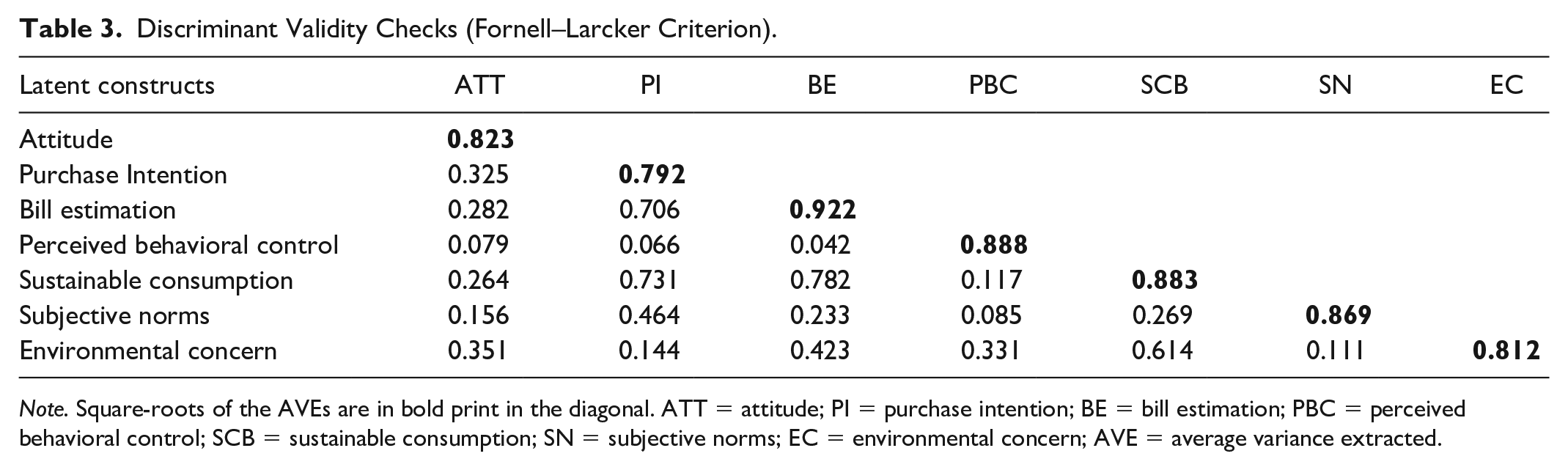
Note. Square-roots of the AVEs are in bold print in the diagonal. ATT = attitude; PI = purchase intention; BE = bill estimation; PBC = perceived behavioral control; SCB = sustainable consumption; SN = subjective norms; EC = environmental concern; AVE = average variance extracted.
Reliability was assessed through Cronbach α and composite reliability tests. For a measurement model to fulfill the criterion for Cronbach α, the identified constructs must attain .5 α score, while a .7 cut-off limit has been recommended for a composite measure (Babin et al., 2008; Hair et al., 2014). As shown in Table 1, the reliability test output provided acceptable indices of internal consistency with Cronbach α ranging from .548 to .912, while the composite reliability test scores ranged from .806 to .945. These scores are greater than their respective cut-off limits. Thus, we can conclude that the measurement indicators are internally consistent.
Structural Model and Path Analysis
The goodness-of-fit (GoF) is 0.647, which exceeds the cut-off point of ≤0.36 (Wetzels et al., 2009). The GoF of the research model exceeding the recommended threshold shows that the proposed theory aligns with reality. The coefficient of determination, R2, is .604 regarding PI. This implies that the latent constructs comprising ATT, SN, BE, EC, and PBC moderately explain 60% of the variance in the PI. Factors not included in the model account for 40% of the variation in PI. Also, PI explains 0.539 or 54% variation in SCB.
Structural Path Coefficient Sizes and Significance
From Figure 3, the extended TPB structural results, PBC exhibits the strongest effect on PI with a path coefficient of 0.645; the remainder are ATT: 0.358; SN: 0.305; BE: 0.602; and EC: 0.361. Evidently, BE is the second highest contributor to PI in terms of coefficient value/size. The coefficient size clearly X-rays the rank-ordered contribution of each independent variable to the PI of smart meter among the surveyed respondents. In terms of hypothesized paths, ATT > PI (0.358); SN > PI (0.305); BE > PI (0.602); EC > PI (0.361); and PBC > PI (0.645) show statistical significance as their standardized path coefficients are more than the .05 significance level employed in the study. Accordingly, this study accepts H1, H2, H3, H4, and H5 as direct determinants of PI of smart meter but indirect predictors of sustainable consumption behavior. Nevertheless, the proposed direct relationship between PBC > SCB (0.069) was insignificant given its low standardized path coefficient being less than .05 significance level used. Thus, this study rejects H6 as a direct determiner of SCB. In addition, the hypothesized relationship between PI > SCB was supported statistically because path coefficient of 0.726 exceeds the .05 significance level utilized in the study. Thus, H7 is accepted.
Assessing Bootstrapping Results of Structural Path Analysis
Since the data employed in this study fall within the minimum threshold and the research focuses primarily on prediction rather than co-variation, PLS-SEM was considered most appropriate tool. Table 4 depicts bootstrapping results conducted in SmartPLS. SmartPLS produces t-values for a significance assessment concerning inner and outer models. Numbers in the t-value column were examined to ascertain if the path coefficients of the structural model are statistically significant or not. Based on a two-tailed t-test with significance level of .05, a path coefficient is considered significant when the t-statistic is above 1.96 (Wong, 2013). From Table 4, five paths namely ATT > PI, SN > PI, BE > PI, EC > PI, and PBC > PI are statistically significant as their t-values are higher than 1.96 benchmark. However, PBC > SCB failed statistical significance because its t-statistic of 0.809 is below 1.96 cut-off point. Again, statistical significance exists between PI > SCB. The bootstrapping results affirm earlier results employing path coefficient and p value of .05.
Bootstrapping Results of Structural Path Analysis.

Note. PI = purchase intention; SCB = sustainable consumption behavior.
Discussion With Policy/Managerial Implications
This article set out to enrich understanding regarding antecedents of smart meter purchase intention and how those factors influence sustainable consumption behavior from the lens of underreported and marginalized sub-urban electricity users in Enugu, Nigeria, a typical developing country. TPB formed the theoretical foundation; however, the original TPB shown in Figure 1 was extended via inclusion of bill estimation anxiety and environmental concern. In line with earlier research (Alsaggaf & Althonayan, 2018; Hsiao & Tang, 2014; Saghafi et al., 2017), this investigation establishes the validity of attitude as a pivotal propeller of intention to purchase SM among surveyed participants. It also demonstrates the propensity of the surveyed participants to have the intention of engaging in sustainable actions using the SM as a proxy, because they are favorably disposed for a “call-to-action.” Further explanation of the finding may be premised largely on the rapidly rising insatiable reception for advanced-technology-products among Nigerians and perhaps Sub-Saharan African consumers as potent means of re-defining and enhancing some degree of distinctiveness and modernization in neighborhood (Idoko et al., 2019). A typical Nigerian consumer strives most often to display superiority in terms of what he uses or consumes in relation to what is commonly available particularly in sub-urban setting characterized by a paucity of modern facilities. Also, growing number of residential houses of relatively informed-middle-class consumers that intersperse with struggling class in most semi-urban locations tend to trigger an attitudinal change toward technological innovations and probably lends credence to the strong and favorable disposition toward smart meter as another milestone in steering a better living standard. Managerially speaking, energy providers can base advertisements on emotional appeal showing how SM usage improve joy and happiness in home to further alter the attitudinal disposition of unmetered consumers, those engaged in electricity theft or uses postpaid to migrate to SM segment. From policy angle, government and its regulatory agencies could implement a mass subsidy program for consumers in semi-urban areas to encourage SM adoption. In addition, a long-term policy framework that aims to scale-up SM distribution and connection across households and regulate high energy consumption projects is equally recommended.
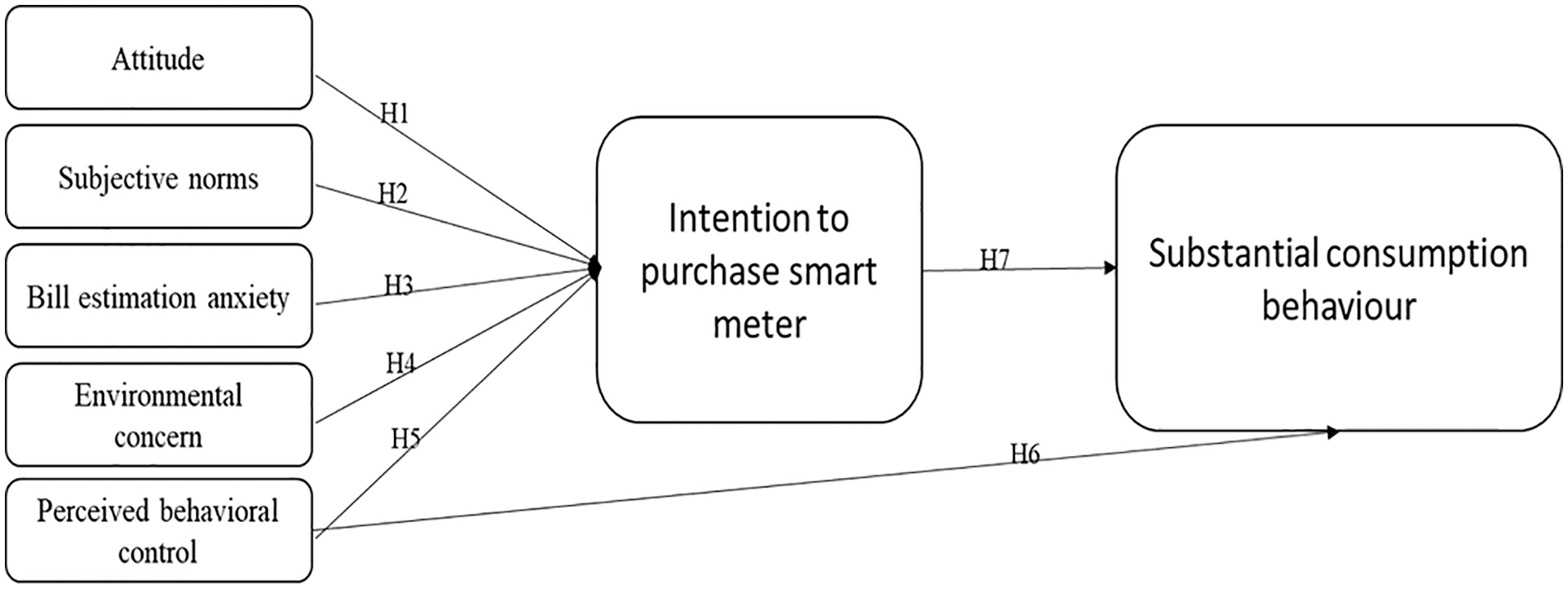
Original Theory of Planned Behavior (TPB).
Furthermore, the subjective norm shows statistical significance with SM purchase intention which indirectly predicts sustainable consumption behavior. The finding affirms earlier research (Alsaggaf & Althonayan, 2018; Hsiao & Tang, 2014; Yadav & Pathak, 2017) which recognizes subjective norm as an antecedent of intention and by extension behavior. This implies that internal (e.g., wife, family members) and the external (e.g., friends, peer group) influences combine seamlessly to drive electricity consumers’ intention to install SM. Sometimes, a typical consumer may be unprepared for SM usage yet social pressure may awaken action. Doubtless, peer group interactions (e.g., discussion of monthly electricity bills) potentially re-create life patterns of members in terms of product consumption or innovation or technology adoption. Also, in Nigeria where electricity consumers are often ripped-off their rights through arbitrary billing system, it is common to witness wives exerting intense pressure on husband to procure SM to escape unscientific billing and somewhat unwarranted embarrassing disconnection from national grid which tends to devalue consumer dignity within neighborhood. Also, the statistical significance of SN may partially be linked to the fact that consumers to some extent use possession of SM to measure individual status and authority in Nigeria society. As Nigerian culture is traditionally susceptible to social group influence, smart meter promotion using propaganda/message enmeshed in social atmosphere may help build user interest in SM among Nigeria electricity consumers. Also, policy makers can strategically use environment-focused promotional campaigns to draw attention of energy consumers to the benefits and impact of SM using significant others such as celebrities, community traditional and religious leaders to further strengthen social pressures and encourage SM adoption toward a sustainable environment.
That bill estimation anxiety has the second strongest influence on intention to purchase SM considerably captures the ongoing feeling of a typical local electricity consumer in Nigeria. Interestingly, the finding aligns partly with prior research in the extant literature (Anyaehie et al., 2018; Oseni, 2015). The concept of EB finds explanation in “intentional failure” of energy suppliers to provide infrastructural requirements and renewal of existing facilities to surreptitiously exploit electricity consumers using non-availability of meter as excuse for bill estimation. From suppliers’ perspective again, the near-monopolistic status of electricity industry in Nigeria somewhat provide foundation for minimal customer-care disposition. Notwithstanding, this study speculates that the unprecedented concern for estimated billing draws largely from growing consumerism through the activities of Network of Electricity Consumers’ Advocacy of Nigeria which underscore shift in interest in favor of SM demand. The consumer movement is increasingly re-awaking and questioning the docility of consumers thereby propelling them to seek their rights in buyer–seller relationship. The crushing effect of “crazy bills” estimation amid dwindling income provokes a seemingly endless stream of complaints propelling National Electricity Regulation Commission to issues order No/NERC/197/2020 to electricity distribution companies to cap estimated bills issued to unmetered consumers in Nigerian Electricity Supply Industry. In terms of policy implications, roll-out of actionable policy framework with clear timeline geared toward the provision of SM to unmetered and intending consumers of electricity by energy suppliers to protect consumers from heart-breaking-exploitation has become urgent. Again, stringent penalties should be spelt-out for defaulting companies which may include withdrawal of license. Importantly, territorial revision where companies may be limited to two states instead of assigning a geo-political zone (6 or more states) to an energy supplier may help engender competitiveness in service delivery quality. Enthronement of SM regime among energy users provides a clear path to energy efficiency and consumption.
Consistent with the study postulation, environmental concern and purchase intention of SM were significantly correlated; this is an indication that relationship exists between EC and PI of SM. In fact, it proves that presently, electricity consumers in Nigeria and perhaps Sub-Saharan Africa (SSA) think beyond probably cost-saving; environmental stewardship expressed in terms of environment care tends to inform purchase decisions. This understanding could be informed by the increasing awareness of depletion of natural resources and the concern for climate change. Therefore, a control of energy consumption through use of SM emanating from this concern for environment may reduce the unfavorable effects on the environment and create a favorable atmosphere for future generations’ survival as consumers consciously search for sustainable alternatives which still meet their energy requirements. This finding corroborates for instance Wang et al. (2014) and Zhang et al. (2018) but departs from Lazowski et al. (2018). The symmetry of this finding with earlier studies may most likely be linked to an unprecedented rise in advocacy by National Environmental Standards and Regulations Enforcement Agency (Establishment) [NESREA] 2007, mandated to ensure a cleaner and healthier environment for residents in Nigeria. NESREA town-hall consumer engagements and publications in diverse media appear to be changing rapidly consumers’ purchase patterns in favor of products that are pro-environment to curb environmental abuses and climate change deterioration. Based on this understanding, policy makers and energy suppliers can leverage on this finding in crafting SM advertisements aimed at encouraging environmental friendliness for better living for all. Also, as a potent means of reducing CO2, government through NERC can put in place incentive packages to attract and fast-track migration to SM technology.
This study confirms PBC as the most influential variable predicting SM purchase intention in the TPB variables studied. This is evident in the individual contributions of the measurement items’ mean values as shown in Table 1 swinging between 3.50 and 3.53 and standard deviations ranging from 1.124 to 1.275 with path coefficient of 0.645 indicated in Figure 3. This finding potentially indicates that consumers handle in a relatively effective fashion those considered as disabling elements. Suggestively, electricity consumers being studied have firm belief and confidence that they have what it takes to purchase SM and that there are no unforeseeable barriers that may prevent them from engaging in the purchase and installation decisions. This study establishes the primacy of PBC as the principal determiner of intention in conformity with prior studies (Ajzen et al., 2011; Chang & Watchravesringkan, 2018; Heeren et al., 2016; Hsiao & Tang, 2014). This finding differs from Zhang et al. (2018) who found no correlation between young consumers’ purchasing intentions in green housing in China. The PBC—purchasing intention significant-positive correlation in Nigeria context may be explained by the increasing wealth among the growing middle class and exponential spikes in education among consumers. Consumers feel that they have money and possess minimal technical skill-set to operate SM; also, purchase of SM is voluntary, so there are near-zero barriers.
In contrast to earlier research findings such as Davis et al. (2009), Ajzen (1991), and Enshassi et al. (2017), this study fails to statistically support direct PBC—sustainable consumption correlation postulation. PBC was rather found to influence sustainable consumption indirectly through intention. This finding came as a surprise because some previous research studies even those in energy areas support PBC and actual behavior relationship.
In addition, the direct relationship between behavioral intentions and sustainable consumption behavior was confirmed, thus supporting the notion that actual behavior is a function of intentions (Ajzen, 1985). This result implied that the SM system can stimulate the Nigeria households to modify their behavior and begin to consume electricity in a sustainable manner. It also suggests that sustainable electricity consumption is based on a set of beliefs, social influences, among others. Behavioral modifications such as procurement of energy-efficient appliances, conservation of energy, and a drastic reduction in the use of energy-consuming appliances are few of the sustainable behavior reported to have been triggered because of using the PPM system. The overall sustainability-implication of the study is the usefulness and applicability of the extended TPB in influencing households’ sustainable electricity consumption lifestyle. As found in this study and supported in a previous study (Boyd, 2008), consumers experiencing very high electricity expense or consumes high volume of electricity are more likely to express intention toward the SM system probably because of expected decrease in their electricity bills. The positive effect of this result on the sustainability agenda is the reduction of pressure on the national electricity grid. There is no doubt that unmetered households or consumers have the tendency of using electricity uncontrollably. Procuring and utilizing high electricity consuming appliances and gadgets, this indirectly increases pressure on the electricity grid and causes large amount of Co2 and gas emission to be released in the atmosphere. So, to cushion this tide, it serves best for electricity providers to target their marketing campaigns on all utilities-based benefits. That is, the benefit of the consumer having to save more when the SM is adopted and the benefit of having to leave in an eco-friendly society. Behavioral transformation could also take place if households or consumers are meant to understand that electricity supply could be increased and become more reliable if they (consumers) switch to using the SM, because that way, less pressure will be on the electricity grid and other electricity infrastructures.
Theoretical Implications
Theoretically, this research contributes importantly to scanty limited literature in SM acquisition intention motivation from among neglected and marginalized electricity consumers in sub-urban location in developing economies. First, this research confirms the plausibility of TPB in understanding antecedents—purchase intention in terms of SM purchase by electricity consumers. The results indicate that the original TPB—Figure 2 and extended theoretical proposition—Figure 1 sufficiently fit the sampled data. In terms of variance explained (R2), the model fit of the original TPB increased considerably following the incorporation of more latent constructs—bill estimation anxiety and environmental concern as components of the proposed framework. On comparison, the variance explained rose from 40.2% in the original TPB to 60.4% (20.2% increases) for extended TPB model. The improvement in the model fit validates the inclusion of those two factors in TPB with regard to predicting SM purchase intention among electricity consumers, particularly in developing economies. Although literature evidence shows that TPB variables such as attitude, subjective norm, and perceived behavioral control have been studied extensively in consumer decisions to engage in the purchase intention in diverse domains, study that incorporates bill estimation and environmental concern in TPB to broaden and deepen understanding regarding antecedents—purchase intention relationship in electricity sector particularly in developing setting where SM technology is nascent and evolving is lacking. The inclusion of the unexamined constructs fills important knowledge void and enriches understanding of their effects on purchase intention of SM and sustainable energy consumption from the prism of developing economy.

Preliminary research framework (extended TPB).

Extended TPB structural results.
Limitations and Future Research Themes
This study has some limitations which indirectly offer windows for future research efforts. First, participants in this enquiry are confined to electricity consumers in medium-small sub-urban cities with presumably lesser economic strength. Thus, research could survey electricity consumers resident in metropolis whose economic capability may likely be stronger for result comparison. Second, potential influences of moderating variable(s) in relation to purchasing intention of SM by examining respondents was/were not carried out in this study. Future researchers could incorporate moderator(s) such as government financial incentives in the research model for better understanding of consumers’ purchase intention of SM in developing setting. In addition, although bill estimation anxiety embedded in this research is one of the contextual variables that has dominated policy debate in Nigeria, there are still some cultural issues that were not explored in this article. Future research could consider cultural orientation such as individualism/collectivism tendency as drivers in SM uptake intention. This study did not apply any form of probability sampling technique in enlisting respondents; this approach may bias the sampled respondents and the data used in the analysis. Using simple random sampling approach in selection of respondents in future research may be helpful for generalization of findings.
Conclusion and Policy Implications
Many conclusions are drawn based on the findings of this investigation. This research confirms that TPB can serve effectively as a research model for predicting electricity consumers’ purchase intention of smart meter. Also, there is a statistical support proving that the predictive power of TPB can be enhanced further through the inclusion of metrics of bill estimation anxiety and environmental concern. Put differently, bill estimation and environmental concern seem to be pivotal factors, thereby deepening understanding and predictability of electricity consumers’ purchase intention concerning smart meter. Findings of this study show that among electricity consumers particularly in Nigeria, users’ personal attitude, subjective norm, perceived behavioral control especially, bill estimation anxiety and environmental concern substantially predict electricity consumers’ intentions regarding purchase of smart meter and indirectly influence sustainable consumption behavior. However, perceived behavioral control does not influence sustainable consumption behavior directly but indirectly through the purchase intention. This somewhat surprising finding calls for further investigation to improve understanding regarding its departure from literature evidence. In terms of policy implications, the rollout of interim energy policy capping monthly bills to unmetered and postpaid energy consumer by Nigerian Electricity Regulation Commission aimed at checking upward billing, de-escalation of widespread consumers’ complaints and tacitly compelling energy providers to fast-track smart meter installation has become urgent. Importantly, this present practice where each energy company is assigned a geo-political zone comprising six or more states requires visitation for efficiency and improved customer services delivery. Policy guidelines that limit geographical coverage of energy providers to a maximum of two states in Nigeria may spur competitiveness and better service delivery. Overall, Nigerian Electricity Regulation Commission requires holistic re-examination of terms of engagement of energy providers for quicker transition to sustainable energy consumption behavior.
Footnotes
Acknowledgements
The authors acknowledge with huge thanks the suggestions made by Prof. Anayo D. Nkamnebe which helped to sharpen the research ideas and eventually the output. We also acknowledge Nnamdi Edwin Ugwu for his assistance in keying data into excel sheet for analysis.
Declaration of Conflicting Interests
The author(s) declared no potential conflicts of interest with respect to the research, authorship, and/or publication of this article.
Funding
The author(s) received no financial support for the research, authorship, and/or publication of this article.
Ethical Statement
The rights and confidentiality of participants were highly respected. The authors recruited only participants that were willing to take part in the survey.
