




Abstract
This study investigates the consumer socialization practices of parents in single versus multi-child and nuclear versus extended families in an emerging market. Previous consumer socialization research has focused primarily on western cultures. We examine parenting in a developing market and suggest that single-child families are more nurturant and maintain greater control of their children’s media exposure than multi-child families. The findings indicate that Modal Indian consumer socialization practices may be shifting from an Authoritarian to an Authoritative parental style with greater maternal intervention in media exposure and support for regulating children’s advertising. Implications for marketers, consumer educators, and public policy makers are discussed.
Keywords
Introduction
India is among the world’s largest economies. It is rapidly urbanizing, projected to be the largest nation in terms of population as early as 2023 (UN Report, 2022), has a population where one-third is below the age of 15 (Central Statistical Office, 2018), and is continuing its evolution from an agrarian to a market-based, consumer society. Economic changes, moreover, impact cultural norms and perceived best practices in child-rearing. Yet, while India is one of the largest consumer markets in the world and consumer preferences in India vary markedly from the United States (Koo, 2017), the bulk of the research on consumer socialization and child-rearing has been conducted in developed nations, particularly in North America. This paper examines the consumer socialization practices of Indian parents in single versus multi-child and nuclear versus extended families. Previous examinations of parental style and associated consumer socialization practices, such as controlling and mediating media exposure and consumption, have focused primarily on Western nations, particularly the U.S. (e.g., Carlson & Grossbart, 1988; Mikeska et al., 2017). Furthermore, the research that has been conducted in other regions and nations, (e.g., Kaur & Singh, 2006; Rose, 1999; Rose et al., 2003) has not examined differences in family type or the number of children in the household.
This study examines parental mediation of children’s media use in a developing nation: India. Three parental styles are empirically examined: authoritative (warm and restrictive), authoritarian (cold and restrictive), and permissive (warm and non-restrictive), while parental mediation of children’s media use is assessed on two dimensions: control of children’s media use and the extent to which parents discuss and explain media tactics and practices to their children.
This paper makes three contributions to the literature. First, it contributes to our understanding of parental consumer socialization practices in developing nations. Although over 80 percent of the world’s population lives in developing nations (World Data Info, 2024), previous consumer socialization research has focused primarily on developed nations (e.g., Mikeska et al., 2017; Rose, 1999). Second, it examines two potentially competing drivers of consumer socialization practices, family structure and the number of children. The number of children in the family is an under-researched area. Previous consumer socialization research has focused primarily on differences in parental practices across parents in nuclear families (e.g., Hadjicharalambous & Demetriou, 2020; Moschis, 1985), with scant research on the potential impact of the number of children or potential differences between extended and nuclear family structures (see Flurry & Veeck’s, 2009 research on extended and nuclear families in China for an exception). Third, this study furthers our understanding of the interaction between specific parental styles and parental mediation practices in a developing nation. Practically, the results from this study can be used to predict parental reactions to media campaigns and mediation practices based on shifting parental attitudes and family structures within India and other developing nations. Examining potential differences between different family structures (nuclear vs. extended), different family sizes, and different parental styles will help in determining the dynamic influences and approaches to child rearing. Families with more children, for example, may be more time crunched, which might impact parental practices. More authoritative parents may interact more frequently with their children and impose greater regulations of their children’s consumption. Given that parental regulation is associated with positive child outcomes (Mikeska et al., 2017), these differences are important, because they impact a society and its children.
Theoretical Background and Hypotheses Development
Consumer Socialization and Family Structure
The family is the primary socialization agent (Hayta, 2008). Families actively and passively promote children’s learning and acquisition of skills (Moschis, 1985). Although the family is one of the most important influences on consumer behavior (Schiffman et al., 2022), most of our assumptions regarding family are based on Western, especially American families, necessitating additional research in non-Western contexts. In the West, husband-wife ties take primacy, whereas in China, Japan, or India parental ties often carry comparable weight. Extended families are more prevalent in other parts of the World, including India, Eastern Europe, and Southeast Asia, than in North America.
Nuclear Versus Extended Families
The nuclear family (which includes a couple and their children) is the dominant family structure in North American and individualistic countries. Extended families, which involve at least three generations living together, are more common in Asian, collectivist cultures, such as India. Hota and Bartsch (2019) compared nuclear and extended family structures in India. Their research found that children raised in nuclear families were characterized by higher consumption independence and autonomy than children in extended families.
Single-Child Versus Multi-Child Families
Another factor impacting family dynamics is the number of children in the family. Worldwide the average number of children per household is shrinking. Historically, single-child families were the exception, and often characterized as overprotective and spoiling their children (Thompson, 1974). Consistent with this characterization, Khadaroo and MacCallum (2021) found single-child families were more child-centered and less restrictive than families with multiple children in their qualitative results; however, they did not find difference across family types in their quantitative survey. Thus, additional research seems merited.
Indian Parenting: A Time of Transition
Hofstede (1980) identified Indian society as “collectivist.” Although urbanization and modern employment patterns sometimes dictate mobility and the need for adult children to geographically separate from their parents, emotionally the family remains close, and family relationships are of prime concern. Many Indian families, moreover, still have three generations living together, which is far less common in Western societies. Indian families frequently feature a son that is married and is staying with his wife and their children in the same home as his parents. Family bonds are very strong in India. However, Indian families are changing. They are in the process of shifting from being strictly hierarchical to more egalitarian due to the influence of external factors, including economic development and an explosion in media availability and usage (Verma & Kapoor, 2003). The prevalence of the nuclear family structure is also growing. In this backdrop, only limited attempts have been made to discuss the consumer socialization of Indian families (Hota & Bartsch, 2019), and to compare traditional multi-generational parental mediation with nuclear-family mediation.
Parental Style
Parents adopt different approaches and styles when raising their children. The most frequently used parental styles are Authoritative, Authoritarian, and Permissive (Baumrind, 1971; Carlson & Grossbart, 1988; Rose, 1999). Authoritative (warm and restrictive) parents, as compared to Authoritarian (cold and restrictive) and Permissive (warm and non-restrictive) parents are more active in communicating with their children about consumption, and vigorously mediate their children’s media usage. Authoritarian mothers avoid intimacy, discourage communication, and do little to teach their children to adapt to outside influence. Authoritative mothers, in contrast, restrict consumption, mediate media exposure, and are nurturing. They express more concern about advertisements than Permissive parents, are the most negative about advertising, and the most active in consumer socialization (Carlson & Grossbart, 1988).
Subsequent research examined consumer socialization and parental style in an international context. Rose (1999) examined consumer socialization in the United States and Japan. Socialization was defined by a maturational approach to parenting in Japan and by a greater emphasis on autonomy in the United States. Additional research examined the link between parental style and consumer socialization among Australian, Indian, and Greek mothers of children between the ages of three and eight (Rose et al., 2003). Five basic patterns of consumer socialization were found. Authoritative (warm and restrictive) and Permissive (warm and nonrestrictive) parents promote independence, frequently shop with their children, and allow their children a high degree of influence in family purchases. Authoritarian parents (cold and restrictive) allow their children a low level of influence on parental purchases, provide few opportunities for observation through co-shopping and place fewer restrictions on their children’s media exposure. Permissive and authoritative parents were mainly from Australia, which is consistent with its individualistic culture, and in Greece, potentially reflecting a shift in Greek culture with its increasingly advanced economy. Authoritarian parents were predominantly from India with a minority from Australia. The remaining two parental styles, Protective and Indulgent (with their high levels of fostering dependence) were almost exclusively found in the collectivist nations of India and Greece (Rose et al., 2003).
Carlson et al. (2011) synthesized previous work on consumer socialization. They presented a discussion of parents as consumer socialization agents. One stream of research (e.g., Moschis, 1985; Rose et al., 1998) examines family communication patterns. Mothers who respect and solicit children’s opinions in general also communicate with their children in ways that foster and develop children’s consumer-related decision-making. Thus, parental styles are antecedents of family communication patterns (Carlson et al., 2011). Generally, Authoritative parents are warm and frequently interact with their children. They set limits and are more restrictive than permissive parents. Authoritarian parents, on the other hand, are more restrictive and colder than permissive parents, while neglecting parents provide low levels of restrictiveness and parental supervision (Carlson et al., 2011).
A subsequent meta-analysis of parental style and consumer socialization examined 73 studies that focused on consumption and media-related child outcomes. It specifically examined 173 unique consumer socialization-related dependent variables, ranging from understanding advertising practices to child healthfulness/weight and shoplifting. The findings indicate that Authoritative parenting is preferable to Indulgent and Neglecting parenting when positive consumer socialization outcomes are considered. Children of Authoritative parents, however, contrary to expectations and previous assertions regarding the superiority of Authoritative parenting (Carlson & Grossbart, 1988), performed no better than the children of Authoritarian parents. Thus, the results highlighted the importance of setting limits and restrictiveness in successful parenting and consumer socialization (Mikeska et al., 2017).
Additional research has examined consumer socialization in China. Flurry and Veeck (2009) surveyed 819 urban Chinese families from both nuclear and extended families. They found that the influence of children in family decision making was muted compared to expectations, given China’s one-child policy at the time. Mothers played an important and dominant influence in selecting goods, including selecting food and clothing for their children. Lu and Chang (2013) subsequently found that modern Chinese parental styles were largely authoritative rather than authoritarian, which contradicted and contrasted with earlier studies that described Chinese parenting as authoritarian and restrictive rather than egalitarian (Chao, 2001). Thus, the dominant type of parental style may potentially evolve as a society develops, which suggests the need for additional studies in additional nations, such as the present study, in India.
Parental Mediation
Another set of studies has examined the types of mediation that parents employ in relation to their children’s media use. Mittal (2011) found that most Indian children experience parental intervention/control regarding their television viewing and watched approximately 10 hr of television weekly. Shin and Kang (2016) examined parental regulation of teenager social media use in Singapore. They found that instructive parental mediation, which centered on parent-adolescent interaction, was more effective than restrictive parental mediation, which centered on rulemaking.
The effects of three parental mediation strategies; active, restrictive, and co-viewing were, however, examined more broadly in a meta-analysis of 52 empirical studies. In active mediation parents engage their children in discussions of media content and proper media use. In restrictive mediation, parents set limits on their children’s media use and/or restrict specific content. Finally, in co-viewing parents jointly consume media with their children, without vigorously engaging in discussions. Overall, restrictive mediation was more effective than active mediation in reducing the time children spend on media, while active and co-viewing mediation were more effective than restrictive mediation in reducing the risk of media-related consumption (Chen & Shi, 2019).
Additional research has examined the relationship between parental style and the types of parental mediation employed. Nurturing parents (of children between the age of 4 and 12) were more involved with their children’s media viewing, more likely to train their children to be skeptical of advertising, and more likely to discuss advertisements with their children than less nurturing, more authoritarian parents (Wisenblit et al., 2013).
Hypotheses
Previous research has examined the relationship between two major characteristics of family structure that impact consumer socialization: extended versus nuclear families and single- versus multi-child families. Additional research has examined the effect of basic modes or styles of parenting on various consumer socialization outcomes. This study integrates this research by examining the impact of family structure (extended vs. nuclear) and the number of children in the family (single- vs. multi-child families) on parental style and their associated effects on parental mediation of the media within the context of an emerging market.
Family structures influence parents, which results in different consumer values being instilled in their children. Extended families value compliance and obedience. They foster interpersonal adjustments and cooperation and have previously exhibited stricter consumer socialization practices than nuclear families (Hota & Bartsch, 2019). Nuclear families tend to be more individualistic. They foster egalitarian behavior, emphasize independence and self-reliance, and have previously exhibited more lenient socialization practices than extended families (Hota & Bartsch, 2019). Thus, mothers in extended families should exhibit higher levels of strictness and dependence than nuclear families:
H1: Extended families will exhibit higher levels of strictness (H1a) and fostering dependence (H1b) than nuclear families.
Historically, parents of single-child families have been characterized as indulgent and giving too much attention to their children (Khadaroo & MacCallum, 2021). They acquire more skills at home through enhanced parent-child interactions and discussions than multi-child families (Hadjicharalambous & Demetriou, 2020). Thus, we would expect socialization to vary depending on the number of children in the household. Typically, in comparison to parents with multiple children, parents in single-child households tend to be more anxious and attentive towards their children (Falbo & Polit, 1986), which should lead to higher levels of restrictive and instructive media exposure.
H2: Single-child families will exhibit higher levels of nurturance (H2a) and fostering dependence (H2b) than families with multiple children.
H3: Single-child families will exhibit higher levels of restrictive parental mediation (H3a) and instructive media exposure (H3b) than families with multiple children.
Research in psychology and consumer socialization has consistently found three parental styles: authoritative (warm and restrictive), authoritarian (cold and restrictive), and permissive (warm and non-restrictive) (e.g., Baumrind, 1971; Carlson & Grossbart, 1988; Rose, 1999). Although past studies have not looked at parental style differences among single versus multi-child families, a recent study in the Middle East found that single-child families were more likely to exhibit an authoritative parental style than multi-child families (Hadjicharalambous & Dimitriou, 2020). Families with multiple children are also more time-crunched, and perhaps more traditional than single-child families (Khadaroo & MacCallum, 2021). Given these findings, we hypothesize that:
H4: Single-child family households will exhibit lower levels of authoritarian parenting than multi-child families.
Parent-child interactions about consumption and media exposure enhance children’s consumer skills. Theory suggests that authoritative parents are more likely to control their children’s media use and are more concerned about advertisements than authoritarian and permissive parents (Carlson & Grossbart, 1988; Carlson et al., 2011). Permissive parents are less restrictive but exhibit higher levels of parent-child interaction than authoritarian parents (Baumrind, 1971; Rose, 1999; Wisenblit et al., 2013). Thus, it is posited that:
H5a: Authoritative parents are more likely to explain media to their children (utilize instructive media mediation) than authoritarian parents.
H5b: Permissive parents are more likely to explain media to their children (utilize instructive media mediation) than authoritarian parents.
H6a: Authoritative parents are more likely to control media exposure (utilize restrictive parental mediation) than permissive parents.
H6b: Authoritative parents are more likely to control media exposure (utilize restrictive parental mediation) than authoritarian parents.
Methodology
Initial Qualitative Interviews
We began by conducting 13 semi-structured phone interviews in New Delhi, India in either English or Hindi, depending on the language preference of respondents, to better understand current parental practices among different family types in India. All interviewed were mothers or grandmothers whose eldest child or grandchild was in the age group of 3 to 14 years. Choosing children from the age group 3 to 14 years is based on the consumer socialization stages: perceptual stage (3–7 years), analytical stage (7–11 years) and reflective stage (11–16 years) (Roedder-John, 1999). The interviews were recorded, and Mothers/Grandmothers were asked basic questions such as, “to describe their family,” “who takes care of their children and how much time children spend with their parents/grandparents,” “Does your child have a TV in their room or personal mobile phone and laptop?,” “Do you limit your child’s screen time? If so, why?,” “Do you give pocket money to your child,” etc. Based on the findings from the interviews and previous literature we designed our questionnaire for the study.
IRB Permission
As part of best practices two authors successfully completed training in Human Subjects Research before initiating the survey. This included a review of The Belmont Report: Ethical Principles and Guidelines for the Protection of Human Subjects of Research; the U.S. Department of Health and Human Services (HHS) regulations for the protection of human subjects at 45 CFR part 46; the relevant institutional policies and procedures for the protection of human subjects.
Survey
We recruited respondents via a stratified sample in India that began by dividing Delhi, the capital of India, into five zones. Delhi is a city with significant socioeconomic and demographic variations across these zones. Central Delhi is known for its historical significance and government offices, while South Delhi houses affluent neighborhoods. North, East, and West Delhi offer a mix of old and new residential areas, along with industrial pockets. Stratified sampling ensures that data reflects this diversity.
Data were collected by utilizing flyers, social media, posting on bulletin boards, and asking friends, colleagues, students, and acquaintances for the names of mothers of children between the ages of 3 and 14. The survey was conducted online using Qualtrics. The survey’s expected time to complete was around 15 min. Respondents were given the choice to complete the survey in either English or Hindi. The Hindi version was professionally translated and reviewed by two researchers who are fluent in both English and Hindi.
Sample
To test our hypotheses, we collected data from 279 Indian mothers having the eldest child in the age group of 3 to 14 years old. Table 1 shows the demographic profile of the respondents.
Sample Characteristics.

Note.
Total number of respondents = 279.
5% respondents did not provide this information.
10% respondents did not provide this information.
9% respondents did not provide this information.
19% respondents did not provide this information.
Questionnaire
Several questions examined the respondents’ family structure (age and number of children, nuclear versus extended family, number of members in the family, and age and educational details of the respondent and their spouse). Next, we measured three constructs central to parent-child interactions: nurturance, strictness, and fostering dependence. These scales have been employed in previous research in both individualistic and collectivist cultures (e.g., Carlson & Grossbart, 1988; Rose, 1999; Rose et al., 2003; Schaeffer & Bell, 1958). Nurturance measures the degree to which parents openly express affection and share feelings and experiences with their children (Rickel & Biassatti, 1982). Strictness examines the extent to which parents endorse strict discipline and training, while fostering dependence examines the extent to which mothers endorse a protective and sheltering attitude toward their children (Schaeffer & Bell, 1958). All items were measured on a 7-point scale ranging from 1 (strongly disagree) to 7 (strongly agree). We also utilized a three-item scale of instructive mediation and a five-item scale of restrictive mediation developed by Valkenburg et al. (1999).
Results
Reliability of Constructs
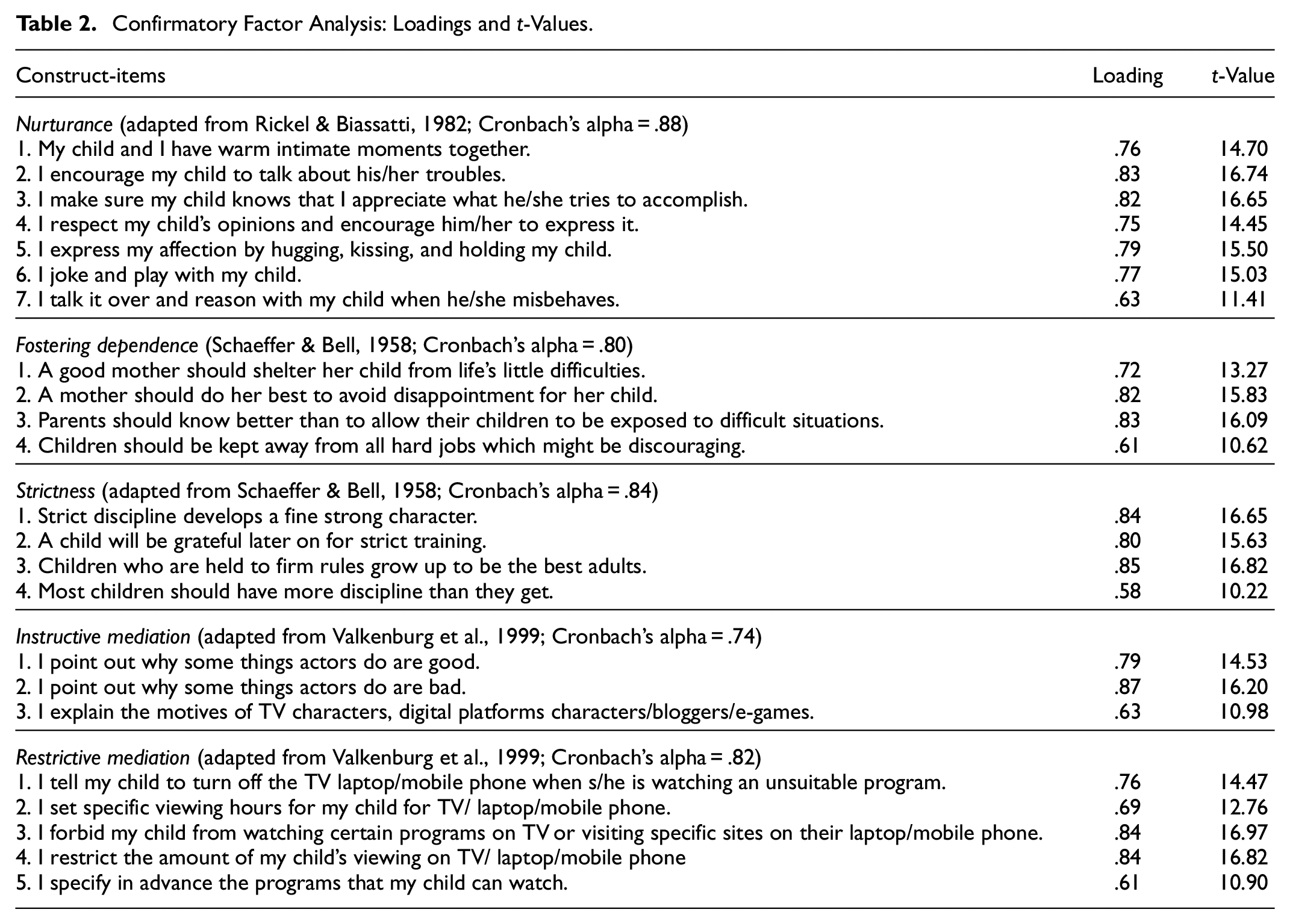
All scales exhibited acceptable reliability, between .74 and .88 (Anderson & Gerbing, 1988; Nunnally, 1978) (see Table 2). Convergent and discriminant validity were tested using confirmatory factor analysis. All items load significantly on their corresponding factors, with each item’s loading on its focal construct greater than its loading on any other construct, which indicates convergent validity (Table 3). The average variance explained (AVE) for each construct is greater than the square of the correlation between the focal construct and each of the other constructs, which indicates discriminant validity (Fornell & Larcker, 1981).
Confirmatory Factor Analysis: Loadings and t-Values.
Descriptive Statistics—Means, Standard Deviations, Cronbach’s Alphas, Correlations, and AVEs.

Note. Correlations greater than 0.12 (absolute value) are significant at the .05 level (n = 279).
Diagonal elements indicate average variance extracted (AVE).
Analysis
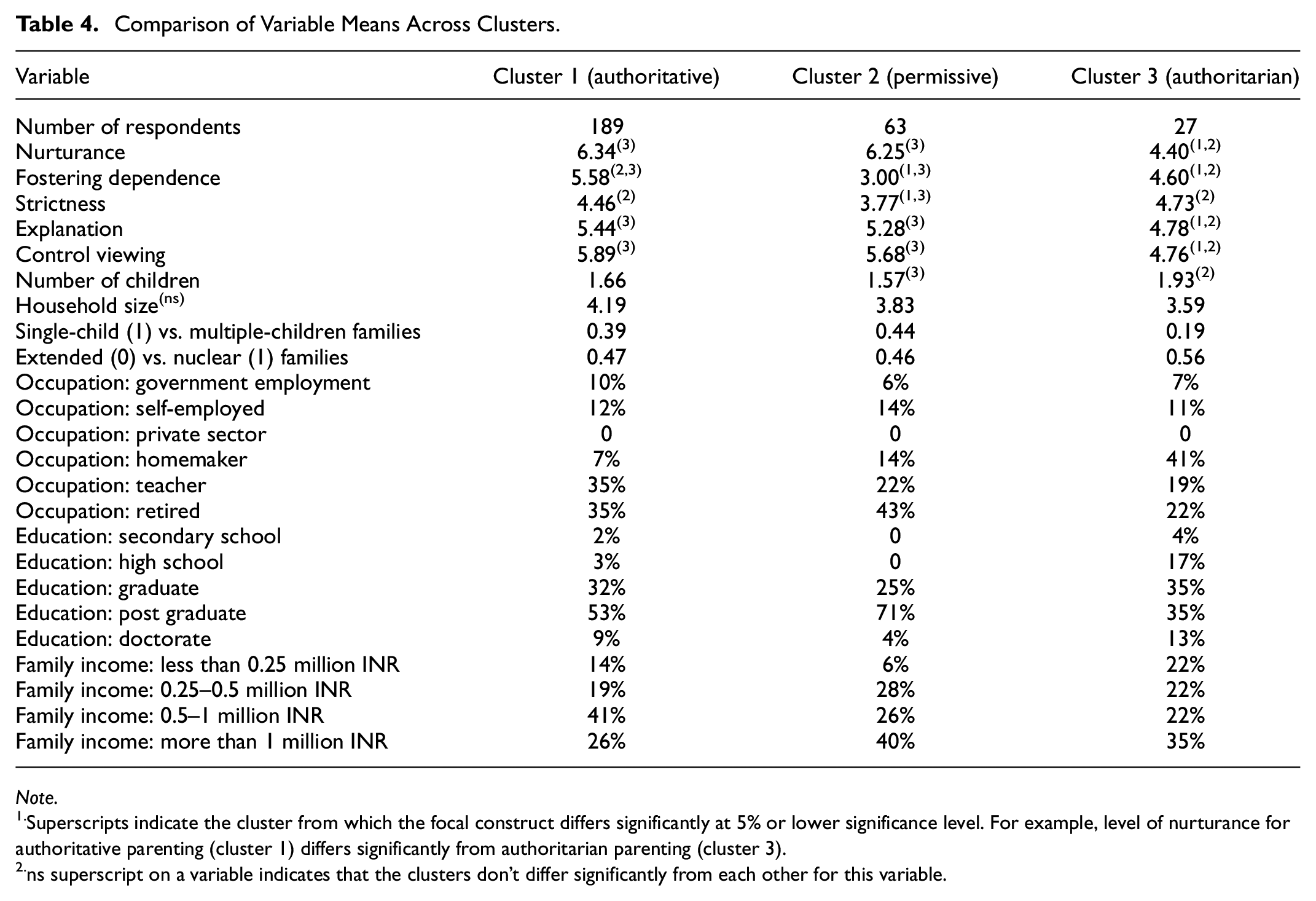
Cluster analysis was conducted based on three constructs: nurturance, fostering dependence, and strictness, using a two-step clustering procedure in SPSS. It resulted in three clusters—see Table 4. These clusters broadly reflect the three parenting styles of authoritativeness, permissiveness, and authoritarianism. The first cluster comprising 189 respondents is high on nurturance (significantly higher than authoritarian) and strictness (significantly higher than permissive), and the highest on fostering dependence. These are characteristics of authoritative parenting. The second cluster comprising 63 respondents is high on nurturance (significantly higher than authoritarian), but the lowest on fostering dependence and strictness, which are characteristics of permissive parenting. The third cluster comprising 27 respondents is high on strictness (significantly higher than permissive) and the lowest on nurturance, which are characteristics of authoritarian parenting.
Comparison of Variable Means Across Clusters.
Note.
Superscripts indicate the cluster from which the focal construct differs significantly at 5% or lower significance level. For example, level of nurturance for authoritative parenting (cluster 1) differs significantly from authoritarian parenting (cluster 3).
ns superscript on a variable indicates that the clusters don’t differ significantly from each other for this variable.
Hypotheses Tests
Hypothesis 1, which posits that extended families will exhibit higher levels of strictness (H1a) and fostering dependence (H1b) than nuclear families, was not supported. No significant difference was found for strictness, t(277) = 0.51, p = .61 or fostering dependence, t(277) = 0.26, p = .79, between extended and nuclear families (MNuclear = 4.37, SD = 1.27 for strictness and MNuclear = 4.88, SD = 1.39 for fostering dependence, while MExtended = 4.29, SD = 1.30 and MExtended = 4.92, SD = 1.34 respectively.
Hypothesis 2 examines single- versus multi-child families. Single-child families are expected to have higher levels of nurturance (H2a) and fostering dependence (H2b) than multi-child families. As expected, the 107 families with an only child (M = 6.31, SD = 0.67) compared to the 172 families with multiple children (M = 6.03, SD = 0.80) demonstrated significantly higher level of nurturance, t(277) = 3.0, p < .01. Thus, hypothesis 2a was supported. However, there was no significant difference for fostering dependence (H2b), t(277) = 1.40, p = .16, despite only child families (M = 4.99, SD = 1.35) attaining directionally higher scores than families with multiple children (M = 4.76, SD = 1.36).
Hypothesis 3 states that single-child families will exhibit higher levels of controlling media exposure (H3a) and explaining media (H3b) than multi-child families. This hypothesis was partially supported. As expected, single-child families (M = 5.88, SD = 0.74) compared with multi-child families (M = 5.64, SD = 0.98) demonstrated a significantly higher level of controlling media exposure, t(277) = 2.23, p = .03. However, no significant difference was found for explaining media, t(277) = 0.69, p = .49 between single-child and multi-child families (Msingle-child = 5.39, SD = 0.86 and Mmultiple-children = 5.31, SD = 1.04).
Hypotheses 4 examines the parental styles of single- versus multiple-child families. Single-child family households are expected to exhibit lower levels of authoritarian (H4) parenting than households with multiple children. Conducting score tests for equality of proportions shows that single-child families exhibit significantly lower levels of authoritarian parenting than multi-child families (proportion = .19 and .81 for single- and multiple-child families, respectively, z = 3.27, p < .01), which supports hypothesis 4. Additional post-hoc differences were also found for authoritative parenting (proportion = .39 and .61, respectively, z = 2.98, p < .01), with multi-child families reporting higher levels of authoritative parenting than single-child families. These differences suggest higher levels of strictness among multi- than single-child families.
Hypothesis 5 posits that authoritative (H5a) and permissive (H5b) parents are more likely to explain media to their children than authoritarian parents. A one-way ANOVA test shows that families with varying parenting styles differ in how much they explain media to their children (F2, 276 = 5.87, p < .01). Tamhane’s T2 post hoc test for multiple comparisons found that compared with authoritarian parents, the mean value of explaining media was significantly higher for authoritative (ΔM = 0.66, p < .01) and permissive (ΔM = 0.50, p = .05) parents, which supports hypothesis 5 (Tamhane, 1979).
Hypothesis 6 states that authoritative parents are more likely to control media exposure than permissive (H6a) or authoritarian (H6b) parents. A one-way ANOVA test shows that families with varying parenting styles differ in how much they control the viewing of media by their children (F2, 276 = 21.80, p < .01). Tamhane’s T2 post-hoc test for multiple comparisons found that the mean value of controlling viewing was significantly higher for authoritative parents as compared with authoritarian parents (ΔM = 1.14, p < .01), and significantly higher for permissive parents as compared with authoritarian parents (ΔM = 0.92, p < .01). There was no statistically significant difference between authoritative and permissive styles of parenting (ΔM = 0.22, p = .25). Thus, hypothesis 6 was partially supported.
Discussion
Theoretical Implications
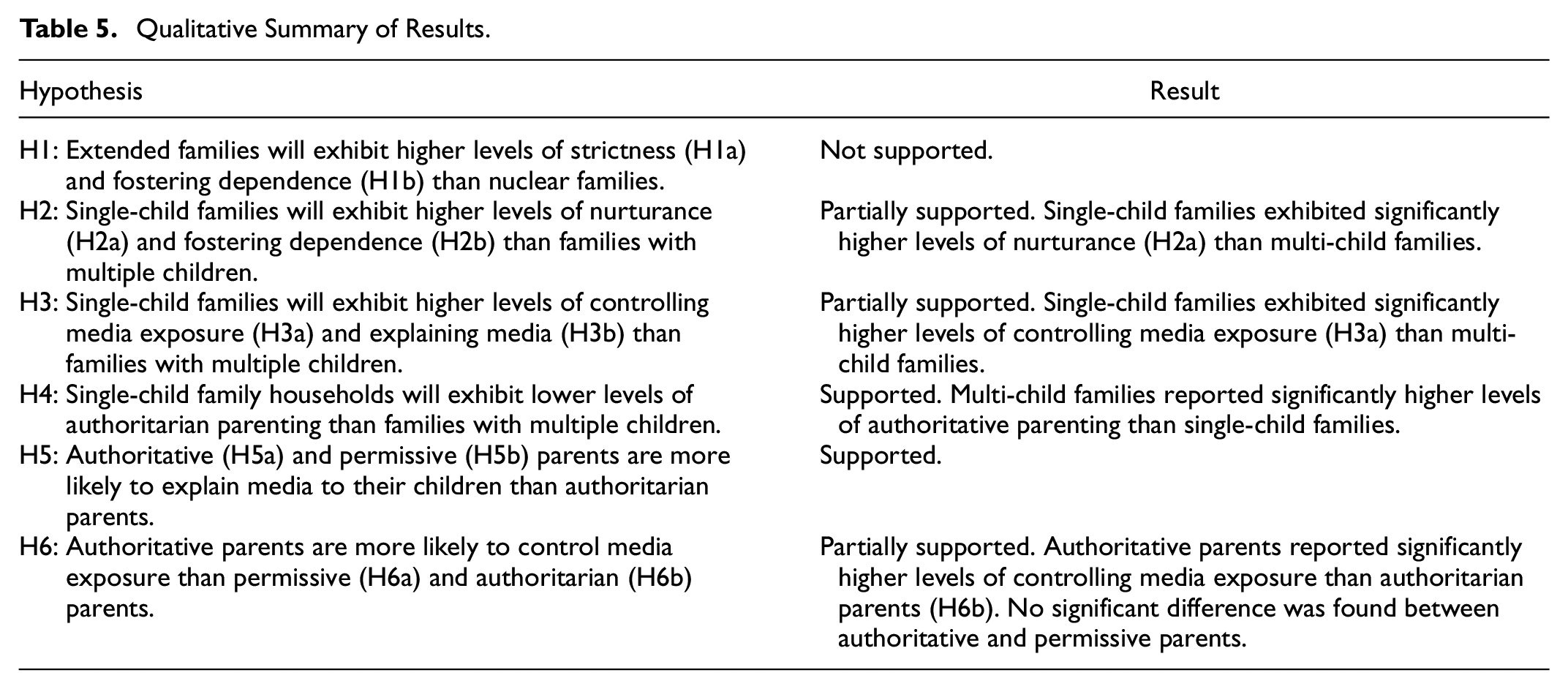
Table 5 presents a summary of the results. Single-child families exhibited significantly higher levels of nurturance and control of their children’s media exposure than families with two or more children. Contrary to previous results (Hota & Bartsch, 2019), however, no significant differences were found between nuclear and extended families.
Qualitative Summary of Results.
This study suggests that patterns of child-rearing may be more influenced by collective individual preferences (parental style) than by the number of people involved in child-rearing (nuclear vs. extended families). Parental style also appears to be influenced by practical considerations, such as time constraints. Multi-child families exhibited higher levels of authoritarian and authoritative parenting but lower levels of controlling media exposure than single-child families. Together, these results extend previous research on consumer socialization (e.g., Carlson & Grossbart, 1988; Rose, 1999) by highlighting the importance of the number of children in the family.
This study also extends previous research on consumer socialization, and more specifically, research on developing non-Western nations by examining differences in parental mediation of children’s media consumption across different parental styles. Authoritative and permissive parents were (as expected) more likely to explain media to their children than authoritarian parents, which is consistent with previous findings that nurturing parents are more likely to discuss advertisements and train their children to be skeptical of advertising than less nurturing parents (Wisenblit et al., 2013).
Although limited, previous cross-cultural research in India (Rose et al., 2003) highlighted the restrictiveness of Indian parents when compared to other nations, specifically, Australia and Greece. Our findings elaborate on these results; while Indian parents were classified primarily as authoritarian by Rose et al. (2003), most were classified as Authoritative in our study, which may suggest a shift in Indian parenting, similar to shifts seen in China (Lu & Chang, 2013). Recent research suggests that the key to effective parenting is for parents to maintain and set limits for their children. A comprehensive meta-analysis (Mikeska et al., 2017) found that Authoritative parents performed no better than Authoritarian parents in fostering positive consumer socialization outcomes, while both performed better than the children of less restrictive parental styles (Permissive and Neglecting parents).
This study finds that authoritative and permissive parents were more likely to explain media to their children than authoritarian parents, which is consistent with higher levels of parent-child interaction, which insulates them from the detrimental effects of media exposure (Chen & Shi, 2019). Authoritative parents also maintained a higher level of control over their children’s level of media exposure than authoritarian parents. Although this may seem surprising at first, previous studies (e.g., Carlson & Grossbart, 1988) have found that authoritative parents are the most negative about advertising directed to children and the most active in their children’s consumer socialization.
Overall, these results are encouraging. Given the positive outcomes associated with parental limits and restrictiveness in consumer socialization (Mikeska et al., 2017) and active and restrictive mediation of children’s media use (Chen & Shi, 2019), the preponderance of Authoritative parenting found in India in this study is consistent with potentially successful child-rearing outcomes.
Practical Implications
Children are naive consumers with limited capacity to make informed choices (Preston, 2004). Our findings suggest there has been a shift in Indian parenting from Authoritarian to more Authoritative parenting. Authoritative parents are more likely to explain media to their children and are more engaged in co-viewing and discussing advertising with their children than authoritarian parents, which implies that parents should be increasingly open to educational products and sensitive to efforts that exploit children’s vulnerabilities. Managers could also link parental style with demographic and psychographic variables in designing their promotion strategy. As can be seen in Table 4, Authoritative parents tend to be more educated and have higher incomes than Authoritarians. Thus, managers targeting upper-middle class children can anticipate greater parental mediation in product consumption and media exposure.
This study further demonstrates the different family and cultural contexts in which Indian children are nurtured. No significant differences were found in the upbringing of children between nuclear and extended families; however, single-child families exhibited significantly higher levels of nurturance and control of their children’s media exposure than families with two or more children. Marketers can use such contexts to understand the family structure in emerging markets and potentially the reaction of parents to their marketing programs.
Limitations and Future Research
As with all research, this study also has limitations that provide possibilities for future research. Only the perspective of mothers was examined in this study, given the dominant role of mothers in socialization (Baumrind, 1971), and resource constraints. Future research could examine additional consumer socialization agents, such as fathers and grandparents and conduct longitudinal studies in other promising markets, such as Southeast Asia and Latin America.
The sampling of middle to upper-middle class respondents from a large city is another limitation. Future research could further examine consumer socialization agents related to children’s development among different social classes and family structures. Additional research could also be conducted that examines the consumption of specific products, for instance, food items popular among children and how particular parental styles affect consumer socialization.
Conclusion
This research builds on previous research conducted primarily in the US. It enhances our understanding of parental style and parental mediation in developing markets, Asian nations, and in additional forms of family structures (non-nuclear families, and single- vs. multi-child families). Our findings suggest that there has been a shift in Indian parenting from Authoritarian to Authoritative parenting, which implies greater intervention in children’s media exposure and greater support for regulating advertising directed toward children. Although we did not find any significant difference between nuclear and extended families, key differences were found between single- versus multi-child families, with single-child families exhibiting higher levels of nurturance and control of their children’s media exposure than families with two or more children. Thus, this study expands our knowledge of the influence of parental styles on children’s media exposure and consumption behavior in emerging markets.
Supplemental Material
sj-xlsx-1-sgo-10.1177_21582440241278381 – Supplemental material for Examining Household Composition, Parental Style, and Consumer Socialization Practices Towards Children’s Media Consumption
Supplemental material, sj-xlsx-1-sgo-10.1177_21582440241278381 for Examining Household Composition, Parental Style, and Consumer Socialization Practices Towards Children’s Media Consumption by Sheetal Kapoor, Gregory M. Rose, Rupinder P. Jindal and Eugene Sivadas in SAGE Open
Footnotes
Declaration of Conflicting Interests
The author(s) declared no potential conflicts of interest with respect to the research, authorship, and/or publication of this article.
Funding
The author(s) received no financial support for the research, authorship, and/or publication of this article.
Ethical Approval
The paper uses survey data, and we had institutional IRB approval for data collection. We subscribe to and comply with all publication ethics guidelines.

Data Availability Statement
This paper is not under review or consideration by any other journal.
Supplemental Material
Supplemental material for this article is available online.
References
Supplementary Material
Please find the following supplemental material available below.
For Open Access articles published under a Creative Commons License, all supplemental material carries the same license as the article it is associated with.
For non-Open Access articles published, all supplemental material carries a non-exclusive license, and permission requests for re-use of supplemental material or any part of supplemental material shall be sent directly to the copyright owner as specified in the copyright notice associated with the article.
