




Abstract
English as a foreign language education is a top national priority in China, and improving learners’ English language proficiency is a concern. However, most research focuses on how to enhance English proficiency in the educational environment. Investigations of the impacts of family environment on English language development are limited. This study explored the relationship between family environment and English language proficiency among 975 first-year Chinese undergraduate students. One-way ANOVA, regression analysis, and mediation analysis were performed to determine the variations in English proficiency among Chinese university students based on their family socioeconomic status and parenting styles, how well these predicted Chinese university students’ English achievement, and whether parenting styles mediated the link between family socioeconomic status and English proficiency. The results indicated that although the effect of family socioeconomic status on English proficiency appeared minimal, neglectful parenting, rather than authoritative parenting, had a significantly positive influence on English proficiency. This study also provided evidence of the mediating role of parenting styles between family socioeconomic status and English outcomes.
Keywords
Introduction
As communication between people of different cultures and nations intensifies, the significant role of English as a global language is widely recognized. Currently, English is introduced as a foreign language (FL) at younger grade levels in the formal education system in China (Butler & Le, 2018; X. Zhang et al., 2023). English as a foreign language (EFL) is a mandatory academic course starting from the third year of primary school and lasting until the second year of university across China (Y. J. Jiang, 2003). With the penetration of English learning in the Chinese education system alongside the fact that China has the highest number of English learners worldwide (Bolton, 2006; Bolton & Bacon-Shone, 2020; Crystal, 2008), how to improve English language proficiency is a major concern (Bolton et al., 2015).
English learning is a process of becoming socialized that may be mediated by social factors in the environments where language learning takes place (Gao, 2006; Thorne, 2005). It is ubiquitous and can take place in a family context (Dong & Chow, 2022; Y. Jiang et al., 2024; Watson-Gegeo, 2004). Based on ecological systems theory (Bronfenbrenner, 1979), the family environment is an important factor among the five systems that significantly influence language development (Bradley & Corwyn, 2002; Liu & Chiang, 2019). Similarly, social constructivists have highlighted the impacts and importance of the family context on individuals’ language learning. They believe that individuals’ knowledge construction takes place in communication and interaction (Hirtle, 1996) with their parents at home, and the language parents use is the first tool mediating children’s knowledge construction (Halliday, 1975). Additionally, research showed that students’ attitude toward learning EFL could be influenced by their parents. Students tended to mirror their parents’ outlook on the target language, ultimately impacting their English learning achievements (Getie, 2020). This means that cultivating and advancing learners’ English language proficiency in the educational environment is not enough because learners are intensively exposed to language in the family environment before receiving training in the educational environment. In other words, family contextual factors are proximal contexts where FL development takes place (Butler, 2015; Butler & Le, 2018; Fan & Zhang, 2014; Y. Jiang et al., 2024; R. Luo et al., 2021; X. Zhang et al., 2023). Here, low family socioeconomic status (SES) could place language learners at disproportionate risk for poor language outcomes (R. Luo et al., 2021).
In view of the prevalence and importance of EFL learning in China, as well as the stipulation of The Family Education Promotion Law of the People’s Republic of China that came into effect on January 1, 2022 to guide society in paying attention to family, family education, and parents’ role. In addition, considering the large gap between the rich and poor countrywide (National Bureau of Statistics of China, 2021), it is essential to understand the relationship between family environment and English development, as well as the mechanism underlying it in the context of China, which is currently understudied (Abbasian et al., 2020; Butler & Le, 2018). Therefore, this study aimed to explore the impacts of family environment, including family SES and parenting styles, on the English language proficiency of Chinese university students using different analytical methods. Another purpose of the study was to investigate whether parenting styles would mediate the relationship between family SES and English learning. Answers to these questions may provide practical guidance for parents to embrace their responsibility at home, unveil new opportunities to reduce the disparity in English learning outcomes, and suggest potential interventions to address the disparities in Chinese students’ English achievements stemming from the family environment. Moreover, understanding the contribution of family environment to learners’ English language proficiency could help reduce biases in the assessment of English evaluation, particularly among students from disadvantaged family backgrounds. In addition, the results of this study may make important contributions in terms of informing parents and English teachers in China on how schools and families can cooperate to enhance and support university students’ English development. As such, it provides guidance for implementing family-school or teacher-parent partnerships to develop the English language proficiency of Chinese learners.
Literature Review
Family Environment
The family is a basic social unit where individuals’ values and attitudes are established and nurtured. It is the primary and most significant environment to which individuals are exposed (Z. Li & Qiu, 2018). Furthermore, before adolescence, individuals spend the most time with family members. Based on ecological systems theory, individual development is shaped by nested environmental systems such as the microsystem, mesosystem, exosystem, macrosystem, and chronosystem (Bronfenbrenner, 1979). This implies that learners’ English language development arises from a multifaceted interaction of social, cultural, school, and familial influences, with individual differences positioned in the middle (Bronfenbrenner, 1979). Family environment, as the most critical component in the transference of talent and ability into achievement, is composed of four dimensions, namely family structural characteristics (also called family demographic information), family climate, parents’ values, and enacted values (Olszewski et al., 1987).
The three key variables of family SES are parental education, parental occupation, and family economic conditions (Bradley & Corwyn, 2002; Conger et al., 2010; Sirin, 2005), all elements in the major conceptual area of family demographic information. Parenting styles, which refer to the behaviors and strategies parents use to control and socialize their children (Darling & Steinberg, 1993; Lightfoot et al., 2009; Sumanasekera et al., 2021), are categorized in the family climate dimension (Olszewski et al., 1987). Parenting styles can be studied using two approaches: the dimensional and typological approach. The dimensional approach proposes parenting dimensions including love and autonomy (Schaefer, 1959), and emotional warmth and involvement (Baldwin, 1948), and separately explores the effects of various dimensions of parenting styles (Baumrind, 1966; Y. Wang et al., 2020). For example, parenting style is considered a construct focusing on the emotional climate of parenting along the dimensions of firmness (or demandingness) and warmth (or responsiveness; Baumrind, 1966, 1971; Maccoby & Martin, 1983). A typological view advocates four parenting styles along these two dimensions: authoritative (high warmth and firmness), authoritarian (low warmth but high firmness), permissive (low firmness but moderate to high warmth), and neglectful (low in both dimensions; Baumrind, 1971).
Family SES and Language Learning
Family SES, a dimension in the family environment (Olszewski et al., 1987), is closely correlated with first (e.g., Sorenson Duncan & Paradis, 2020), second (e.g., Goldenberg et al., 2008; R. Luo et al., 2021), and foreign language development (e.g., Butler, 2014; Butler & Le, 2018; Choi et al., 2020; Shin & So, 2018). Regarding the influence on language development, various studies indicated family income (Butler & Le, 2018; Kieffer, 2010; Sanjurjo et al., 2018) and parents’ education level (Abbasian et al., 2020; Iwaniec, 2020; Liu & Chiang, 2019; Shu et al., 2002; Sorenson Duncan & Paradis, 2020) among the SES variables as strong indicators of young learners’ language learning outcomes in various language domains such as receptive skills (e.g., Abbasian et al., 2020; Butler, 2014; Nikolov & Csapó, 2018), vocabulary (e.g., Friend et al., 2017; Levine et al., 2020; R. Luo et al., 2021), speaking (Butler, 2014), and general language proficiency or literacy (Butler & Le, 2018; Su et al., 2017). The roles of particular family factors in children’s English development may vary across the facets of English development (X. Zhang et al., 2023).
Concerning receptive skills, previous studies showed that family SES influenced reading and listening performance. For instance, Abbasian et al. (2020) conducted a study in Iran on 300 senior high school students. The aim was to investigate whether SES and parents’ educational background could forecast students’ success in English reading and listening comprehension exercises. The results showed that the students’ SES and parental education background were statistically meaningful and correlated with their reading and listening comprehension scores. A further multiple regression analysis indicated that the highest level of parents’ education was the most influential predictor of these senior high school students’ English receptive skills (Abbasian et al., 2020). This was attributed to more extensive parent-child cultural activities in families with parents who have higher levels of education (Shu et al., 2002). In addition, Liao (2007) found a close association between students’ learning ability and their family environment (Liao, 2007). Similarly, Nikolov and Csapó (2018) analyzed the relationship between the reading comprehension of 1,334 Hungarian students in Grade 8 and their parents’ education level. They confirmed that mothers’ education level demonstrated a strong correlation with English reading comprehension achievement (Nikolov & Csapó, 2018).
However, although the close relationship between SES and receptive skills in language has been well-documented, the differences in receptive skills according to SES were identified later than in the other language domains (Butler, 2014). A study to determine the relationship between family SES and children’s EFL learning in different grades was conducted among 572 Chinese English learners in the fourth, sixth, and eighth grades in a medium-sized city in China. It revealed that a significant difference in reading and writing stemming from family SES did not emerge until the eighth grade (Butler, 2014). However, differences in speaking performance were already identified in the fourth grade (Butler, 2014), which remained in the 10th and 11th grades (Huang et al., 2018). Whereas, differences in vocabulary development according to SES were also found very early among children aged 2 to 5 years (Friend et al., 2017; Levine et al., 2020). The results revealed that children from higher SES families had larger vocabularies on average than their lower SES peers (Levine et al., 2020). The magnitude of this SES gap based on the child’s age remained consistent during the preschool years (Levine et al., 2020). Furthermore, the associations between family SES and vocabulary learning processes have also been documented in a study of dual language learners aged 3 to 5 years (R. Luo et al., 2021). Yet earlier work involving toddlers did not report notable SES variations (Horton-Ikard & Ellis Weismer, 2007). These varying results may stem from differences in the age ranges examined and tasks employed (R. Luo et al., 2021).
Apart from separate language skills, the influence of family SES on general language performance is also documented. A longitudinal study on 189 Chinese middle school students examined the influence of family SES on English learning progress over time. A significant finding was that both parental income and educational level were positively correlated with students’ English proficiency (Butler & Le, 2018). This result aligned with another study conducted in China (Zou & Zhang, 2011). Moreover, a similarly strong positive association between parents’ educational level and EFL learning was found among Hungarian primary school students (Nikolov, 2009), alongside their comprehensive literacy skills. Su et al. (2017) conducted a longitudinal study to examine the influence of family SES on the literacy skills of 293 children in a primary school in Beijing. According to the results, SES (composed of parents’ education and income) was the most significant predictor of their Chinese literacy ability (Su et al., 2017).
The results of these studies indicate that regardless of geopolitical context, in both Western and Eastern countries, a close and significant interaction exists between family income, parents’ educational level, and language outcomes in first/second/foreign language learning (Murphy, 2018). However, a major research gap is evident. Although family SES is operationalized as consisting of three constructs—family income, parents’ highest educational level, and parental occupation (Bradley & Corwyn, 2002)—only evidence on the first two constructs has been provided (e.g., Abbasian et al., 2020; Hakuta et al., 2000; Su et al., 2017). Very little attention has thus far been paid to the role of parental occupation on FL development. Although parental occupation was initially surveyed in Butler (2014), it was not included in the subsequent analysis due to extremely biased responses. Almost none of the parents surveyed used English in their workplaces (Butler, 2014). This may have been because of limitations in the recruitment of samples, which were restricted to a medium-sized city in China (Butler, 2014). Ultimately, the participants in the study were not representative enough. Moreover, although a small number of parents use English at their work or when communicating with their children at home, which is common in an FL context like China, parental occupation is still assumed to impact children’s English learning achievement. This is because parents in different occupations may have different beliefs and expectations regarding their children’s academic achievement in English due to its popularity and significance in Chinese society. This may lead to the variance in students’ English learning outcomes (Butler & Le, 2018).
In addition, most research on the relationship between SES and language learning has been conducted on young learners aged 3 to 6 years (e.g., Y. Jiang et al., 2024; Pace et al., 2017; Yeomans-Maldonado & Mesa, 2021), excepting the study of Butler and Le (2018). As such, studies on learners in tertiary education to determine the effect of family SES on language learning are limited. For the abovementioned reasons, it is necessary to explore the influence of family SES, with the incorporation of parental occupation, on EFL learning among university samples from a wider region in China, which is what this study sets out to do.
Family SES, Parenting Styles, and Language Learning
Despite ample evidence of the close link between family SES and language achievement, limited attention has been paid to the associations between parenting styles and FL learning (Butler & Le, 2018; Kiuru et al., 2012; J. Li, 2023), an important dimension of the family environment (Olszewski et al., 1987). Among the limited research, an empirical longitudinal study confirmed the contributions of two dimensions of parenting, namely parental cognitive and affective dimension (specifically autonomy support in it), to children’s word learning and involvement in word-learning activities (Wei et al., 2019). Specifically, parental cognitive support was closely linked to children’s capacity to grasp new words, and the children showed increased interest and participation in word-teaching tasks if their parents adopted more autonomy support (Wei et al., 2019). Moreover, the roles of various parenting styles in language learning were revealed in first language reading and spelling skills. These results indicated the positive impact of an authoritative parenting style on the development of the first language spelling skills of children in Grades 1 and 2. Furthermore, this parenting style was found to be advantageous in enhancing the spelling ability of children at risk of reading disabilities (Kiuru et al., 2012).
In addition to the impacts of parenting style on first language learning, their influence was also found in foreign and second language contexts. For example, according to Roopnarine et al. (2006), a negative correlation was found with receptive language skills and English-language vocabulary for kindergarteners with non-authoritative parents. Similarly, Butler and Le (2018) conducted a quantitative longitudinal study to explore the influences of an autonomous and a controlled parenting style on EFL learning among Chinese middle school students. It revealed that children’s English performance was positively influenced by parental engagement in an autonomous parenting style. On the contrary, a controlling parenting approach was negatively correlated with English performance (Butler & Le, 2018). This is because an autonomy-oriented parenting style was linked to a healthier parent-child relationship and was more likely to generate higher levels of self-assurance as reported by children (Chen et al., 1997), leading to better performance in language learning (Krashen, 1982). In addition, empirical evidence connected parenting styles to students’ FL learning anxiety in the classroom (J. Li, 2023). The study was conducted among 247 Chinese college students to examine the extent to which parenting styles could predict English language classroom anxiety. It showed a significant relation between parenting styles and Chinese students’ English learning anxiety (J. Li, 2023). To be specific, parental warmth and monitoring had a positive and significant correlation with classroom anxiety in English learning. Conversely, students who experienced rejecting-neglecting parenting were found to have a lower possibility of developing language anxiety in English classes than those who experienced authoritative, authoritarian, or permissive parenting styles (J. Li, 2023).
Apart from substantial evidence on the predictive role of family SES in individuals’ language achievement (e.g., Butler & Le, 2018; Levine et al., 2020; R. Luo et al., 2021), recent studies have also tried to elucidate the mechanism underlying this relationship. Some have explored the impact of brain structure and functioning (Merz et al., 2020; Su et al., 2021) as well as the home literacy environment (Y. Jiang et al., 2024). Several studies showed that children from low SES households have the potential to achieve language proficiency comparable to their counterparts from more affluent backgrounds given appropriate learning opportunities such as higher quality shared reading interactions (Dexter & Stacks, 2014), help with homework (Reyes & Azuara, 2008), parental tutoring of English (Yeung & King, 2016), and rich home literacy activities (X. Zhang et al., 2023). Moreover, empirical findings revealed that the link between family SES and children’s academic outcomes was mediated by parenting styles (e.g., Conger & Donnellan, 2007; S. Luo et al., 2021). This is supported by the notion that SES is related to parenting styles (e.g., Chen et al., 2000; Korecky-Kröll, 2021). For instance, parents from high-SES backgrounds often employed conversation-eliciting parenting strategies, while those from low-SES backgrounds tended to adopt a more behavior-directing style (Korecky-Kröll, 2021). Research has also indicated that parents from high SES families are more capable of adapting to their children’s increasing need for autonomy during their middle school years (Butler & Le, 2018), and mothers in China with a higher level of education were more inclined to embrace authoritative parenting approaches (Chen et al., 2000). Whereas, children of different ages showed different preferences regarding parenting styles: Older children exhibited a greater preference for autonomy and less reliance on parental involvement (Butler & Le, 2018), while younger ones preferred more parental involvement.
Grounded on ecological systems theory (Bronfenbrenner, 1979), family SES is an environmental element at the exosystem level (Grolig, 2020; R. Luo et al., 2021). Its impact is not direct and can be mediated by other components (Bradley & Corwyn, 2002) such as parenting styles in the microsystem. Consequently, these influence individual development (the individual level; Bronfenbrenner, 1979). Ecological systems theory provides a theoretical perspective for understanding the link between family SES and individuals’ academic achievements, and the mediating role of parenting styles in the connection between SES and individual development. However, to our knowledge, although concurrent associations between parenting styles and students’ language learning outcomes and anxiety have been established (e.g., Butler & Le, 2018; J. Li, 2023), research on the extent to which parenting styles mediate the impact of SES on language development is rare. Only Sánchez (2023) suggested the mediating role of parenting in the impact of SES on the language abilities of preschool-aged children (Sánchez, 2023). As such, a significant gap remains regarding the pathways among family SES, parenting styles, and FL learning achievements. Moreover, the mechanisms underlying the impact of family SES and parenting styles on language development need further exploration (Y. Jiang et al., 2024). In light of the prevalence of English education in China’s schooling system and its status as the global leader in terms of the number of English language learners (Bolton & Bacon-Shone, 2020), better understanding the links between family SES, parenting styles, and English learning achievements is crucial for facilitating Chinese students’ English learning journey and the design of more effective intervention programs.
As noted, most research thus far has been conducted on participants in kindergarten (e.g., Wei et al., 2019), primary school (Kiuru et al., 2012), or middle school (Butler & Le, 2018). There is little discussion on the impacts of parenting styles in undergraduates’ English language learning. Subsequently, the differences in attitudes and parenting style preferences between learners of different ages (Fu et al., 2019; Stockburger & Omar, 2015) may yield different results. In addition, among the limited number of studies, most were conducted using a dimensional parenting style approach to examine parental behaviors such as autonomy and control (Butler & Le, 2018; Kiuru et al., 2012), which further highlights the limitation of identifying the combined effects of various parenting dimensions (Baumrind, 1966, 1971). Furthermore, scant research has adopted a typological approach to find the interactive effects of various parenting styles on English language learning. Against this background, the current research, via a typological approach, aimed to explore the relationships among family SES, parenting styles, and English language proficiency of Chinese university students. The study also sought to uncover the underlying mechanisms linking family SES and English language proficiency by examining the potential mediating effect of parenting styles, an understudied area.
Research Hypotheses and Questions
Based on a review of the literature, several hypotheses were formulated regarding the influence of family SES and parenting styles on the English language proficiency of Chinese university students. Previous studies suggested a positive correlation between students’ English proficiency and parental income (Butler & Le, 2018; Zou & Zhang, 2011) and educational level (Butler & Le, 2018; Nikolov, 2009; Zou & Zhang, 2011). Both these are categorized in the realm of family SES. Moreover, given parents’ varied beliefs and expectations based on their occupations in Chinese society, it is posited that parental occupation may also impact students’ English learning outcomes (Butler & Le, 2018). In terms of parenting styles, research indicated that children’s English performance was positively affected by an autonomous parenting approach and negatively impacted by a controlling or non-authoritative style (Butler & Le, 2018; Roopnarine et al., 2006).
Thus, it is assumed that Chinese university students from diverse SES backgrounds (including family income, parental education, and occupation) and with parents having different parenting styles would differ in their English language proficiency. Furthermore, it is proposed that family SES and parenting styles could serve as predictors of undergraduate students’ English proficiency in China. This can be investigated via regression analysis. According to Chen et al. (2000) and Korecky-Kröll (2021), parenting styles were partially influenced by family SES and played a mediating role in the connection between family SES and academic performance (Conger & Donnellan, 2007; S. Luo et al., 2021). Consequently, it is hypothesized that parenting styles would mediate the connection between family SES and English proficiency among Chinese university students in this study.
To address the research gaps mentioned earlier, this study explored the influence of family SES and parenting styles in the family environment on English learning outcomes among Chinese university students, alongside clarifying whether parenting styles mediate the relationship between SES and English proficiency. Family SES in this paper includes the family’s economic level, parents’ highest level of education, and parents’ occupation. Regarding parenting style, the current study utilized the typological approach to explore its influence on the development of Chinese university students’ English language proficiency. The research questions addressed in this study were as follows:
Methods
To answer the research questions, this study adopted a correlational quantitative cross-sectional design to identify relationships and trends in the data of a large population of Chinese EFL learners (Patton, 2002). In this study, gender and place of living were treated as control variables because previous evidence showed that these were important factors influencing individuals’ FL proficiency (Öztürk & Gürbüz, 2013; Song & Wang, 2014).
Participants
China has a vast territory and is classified into several geographic regions. A large gap in economic levels, and large differences in wage levels and education are evident in various regions (National Bureau of Statistics of China, 2021). To ensure greater comparability of the National Matriculation English Test (NMET) score, which was used to measure the English proficiency of Chinese university students in this study (refer to the next section for more information), and to ensure that participants were representative enough and sampled from diverse family SES backgrounds, Chinese university students using the National Level-B test paper in the NMET were selected as the population of this study. This is because most provinces use the National Level-B test paper, which thus covers the widest geographical regions. Based on these criteria, five geographic regions (East China, North China, Central China, Northwest China, and Northeast China) were sampled. Given that lifestyles in some provinces such as Inner Mongolia and Xinjiang differ from those of most other provinces in China, only those with similar lifestyles were selected. Together with the criteria of selecting only one province from each of the five geographical regions of the country, five provinces—Jiangxi, Henan, Shaanxi, Jilin, and Shanxi—were finally chosen. As a result, 975 first-year Chinese university students (847 female and 128 male) enrolled in September 2022 were recruited from many universities in the abovementioned five provinces of China. Participants voluntarily participated in the study and their rights were protected according to the ethical standards approved by the Academic Committee of Jiangxi Normal University.
Research Instruments
English Language Proficiency Measurement: NMET Score
Given that the NMET is the latest national test every first-year Chinese undergraduate student must complete in China, and due to its comparability of scores, the English language proficiency of the students in this paper was represented by their NMET score. This information was collected through a question on their NMET score in the demographic information survey of this study. As a mandatory national examination for all Chinese university learners, the NMET is significant and robust in terms of reliability (X. J. Li, 1990), validity (Lin, 2015), fairness (H. Zhang, 2019), and the ability to differentiate varying levels of proficiency (Cheng & Qi, 2006). It assesses test takers’ abilities in English writing, reading, listening, and understanding of grammar and vocabulary with a full score of 150. There are eight sets of test papers in the 2022 NMET. As mentioned, the population of this study was students using the National Level-B Test paper in their NMET. In this study, the mean NMET score was 119.3 (SD = 15.57, Max = 148, Min = 11) and the median score was 123, indicating relatively good mastery of English among Chinese university students. The NMET scores were converted into z-scores for further data analysis.
Demographic Information Survey
A demographic information survey was designed for the purposes of this study to collect information on participants’ age (M = 18.59, SD = 1.17), gender (847 female and 128 male), place of living (557 from rural areas and 418 from urban areas), NMET score, and family SES. Family SES was measured according to three indicators: family income, parents’ highest level of education, and parental occupation (Bradley & Corwyn, 2002; Hauser, 1994; Yang, 2003). The parental data on the highest levels of education and occupational status for either the father or mother were used to indicate parents’ educational level and occupational status (Ghobadzadeh et al., 2019).
The Chinese Revised Steinberg Parenting Scale
The Chinese Revised Steinberg Parenting Scale (CR-SPS; G. Li, 2014) was adopted in this study to measure the parenting styles of Chinese university learners’ parents. The CR-SPS is measured on a five-point Likert Chinese scale proposed by G. Li (2014) based on the Steinberg Parenting Scale (SPS; Steinberg et al., 1992). The items were translated into Chinese by Long et al. (2012). It includes 18 items in 2 subscales that measure parental warmth (10 items) and firmness (8 items; G. Li, 2014). The parental warmth scale evaluates the extent to which Chinese university students perceive their parents as responsive, loving, and involved, and the firmness scale measured their parental supervision and boundary setting (Steinberg et al., 1992). In this study, the participants, rather than their parents, filled out the questionnaires on parenting styles. This is because people’s interpretations of the environment they inhabit have a greater impact on their personal growth than the actual environment (Bronfenbrenner & Ceci, 1994). The CR-SPS on parenting style presented adequate internal consistency in the current research: Cronbach’s α was .826, .758, and .844 for the warmth subscale, firmness subscale, and total scale, respectively.
Data Collection and Analysis
The research data of this study were collected online using the well-known smartphone-based investigation tool Wenjuanxing. The consent forms and questionnaires were set up online and participants easily accessed the survey via the link provided by the researchers. The online consent forms outlined the objectives of the study and assured the privacy of information.
The data analysis of this study included three phases. In the first phase, participants were divided into high, medium, and low SES groups. In the study, the first principal component was utilized to construct a single measure of family SES (McKenzie, 2005), and a principal component analysis (PCA), as a common approach to factor analysis, was adopted to reduce the dimension of family SES (Yuan et al., 2010). After assigning a score value to each survey option, the scores obtained for the three main indicators were converted into standardized scores. A factor analysis was then performed to obtain the covariance, eigenvectors, and eigenvalues of the variables (Yuan et al., 2010). Next, each participant’s family SES index was calculated using a PCA, with higher scores reflecting a higher family SES index (McKenzie, 2005; Yuan et al., 2010). The participant’s family SES index was computed based on the following equation. After obtaining the family SES index of each participant, a K-means cluster analysis was conducted to classify participants’ households into the high, medium, and low SES groups.

The second phase involved classifying participants into groups based on four parenting styles following the typological approach, namely the authoritarian, permissive, authoritative, and neglectful styles (Baumrind, 1971). A K-means cluster analysis was performed for the standardized mean score for the items for warmth and firmness, two parenting style dimensions, to cluster participants’ families into four clusters with 100 maximum iterations.
In the third phase, the data was analyzed to address the research questions. To answer the first research question, one-way ANOVA was employed to probe potential differences in English proficiency among Chinese university students from different family SES backgrounds and with parents holding different parenting styles. Then, multiple linear regression analysis was conducted to address the second research question on how well participants’ family SES and parenting styles could predict their English performance. Last, the mediating role of parenting styles in the link between SES and the English proficiency of Chinese university students was tested using the biased-corrected Bootstrap method. Repeated sampling was performed 5,000 times with a 95% confidence interval (Hayes, 2009).
Results
Sample Characteristics
Regarding family SES, 35.69% (n = 348) were low SES families, 42.87% (n = 418) medium SES families, and 21.44% (n = 209) high SES families. As such, almost half the Chinese university students in this study had moderate income, and the data on their family SES were normally distributed. In addition, the three SES groups differed statistically significantly with regard to the family SES index test in the ANOVA (p < .001), and the number of each group was normally distributed. For parenting styles, 29.1% (n = 284) of participants perceived their parents as having an authoritarian style, 25% (n = 244) as authoritative, 28.4% (n = 277) as permissive, and 17.4% (n = 170) as neglectful. This confirms that the Chinese university students came from families demonstrating diverse parenting styles.
Differences in English Language Proficiency for Chinese University Students From Different Family SES Backgrounds and Parenting Styles (RQ1)
Table 1 shows the means and standard deviations for the NMET scores regarding family SES. The Chinese university students’ NMET scores differed significantly according to family SES (F = 4.495, p < .05). A further post hoc analysis with Bonferroni-corrected pairwise comparisons indicated that the NMET scores of Chinese university students in high-SES family groups showed higher levels of achievement in English compared to their counterparts from low and medium-SES family backgrounds. The differences were significant, although the differences in the NMET scores between participants from low and medium-SES family groups were not significant. These results indicated differences in English proficiency between those from high SES families and the other two groups. The low SES group was not significantly distinct from the medium group in their English language proficiency.
ANOVA of the Differences in English Language Proficiency according to Family SES (N = 975).

p < .05.
Table 2 presents the results of the ANOVA showing the differences in the NMET scores of Chinese university learners with parents endorsing different parenting styles. As shown, there are no significant differences in their English achievement (F = 1.661, p = .174 > .05), indicating that the various parenting styles, as per the typological approach, did not significantly affect students’ English language proficiency.
ANOVA of the Differences in English Language Proficiency according to Parenting Styles (N = 975).

Predictability of Family SES and Parenting Styles for Chinese University Students’ English Language Proficiency in Regression Analysis (RQ2)
Table 3 presents the results of the multiple linear regression analysis of family SES and NMET score, with gender and place of living as control variables. The established regression model between family SES and the English performance of Chinese undergraduate learners represented by their NMET score was non-significant (β = .028, p = .461 > .05). However, place of living predicted Chinese university students’ NMET success (β = .09, p = .018 < .05).
Multiple Linear Regression Results for Family SES and NMET Score (N = 975).
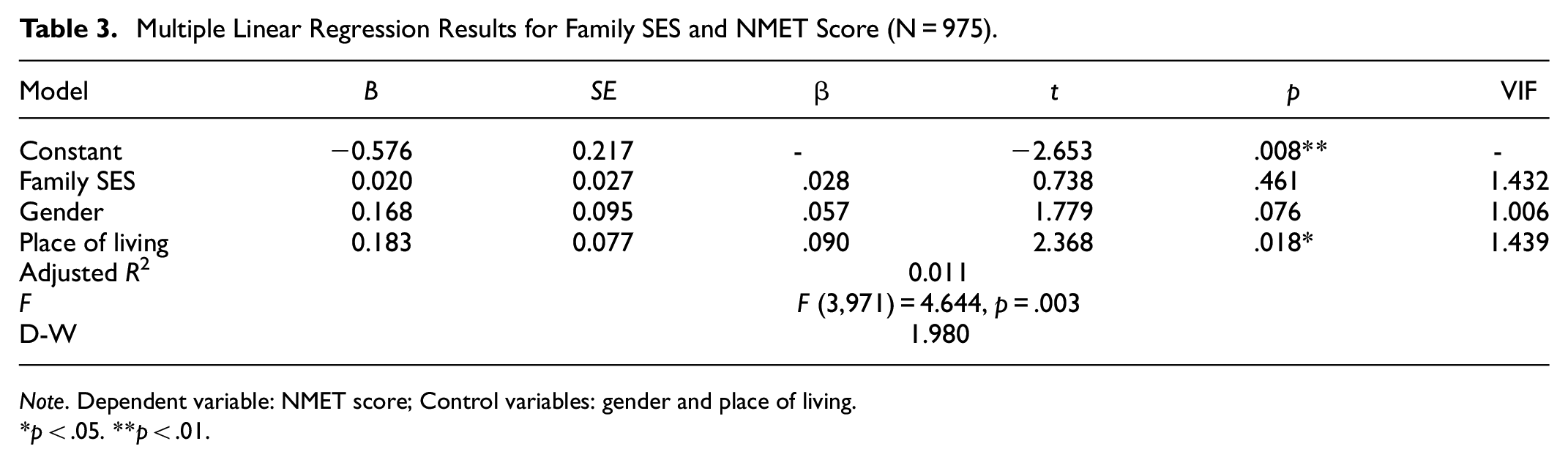
Note. Dependent variable: NMET score; Control variables: gender and place of living.
p < .05. **p < .01.
Regression analysis was also performed to explore the predictability of parenting styles for Chinese learners’ English language proficiency. Since parenting styles are categorical variables, three dummy variables were created to include in the path models to represent the parenting styles of the parents of Chinese university students in this study: PS_Permissive, PS_Neglectful, and PS_Authoritarian. An authoritative parenting style, considered the most effective approach (Steinberg et al., 2006), was treated as the comparison group (see Table 4). For each dummy variable, each participant was given a score of “0” or “1” (Hayes & Preacher, 2014). Participants from a permissive, neglectful, and authoritarian home were coded respectively as “100,”“010,” and “001.” The comparison group from an authoritative home was coded as “000.”
Coding of Parenting Style Dummy Variables.

Controlling for the effects of gender and place of living, the dummy variables of three parenting styles were employed to check their contribution. Table 5 displays the results of the multiple linear regression analysis for parenting styles and participants’ English language proficiency. The table shows that PS_Authoritarian, PS_Permissive, and PS_Neglectful explained 1.8% of the variance in Chinese university students’ NMET score, which was statistically significant (F(5,969) = 4.513, p = .000). Among the three parenting styles, only PS_Neglectful was significantly positively related with the NMET score (β = .114, p = .003 < .01). This implies that Chinese undergraduate learners whose parents have a neglectful parenting style score higher in the NMET than those whose parents have an authoritative style. The following represents the regression equation of the model:
Multiple Linear Regression Results for Parenting Styles and the NMET Score (N = 975).
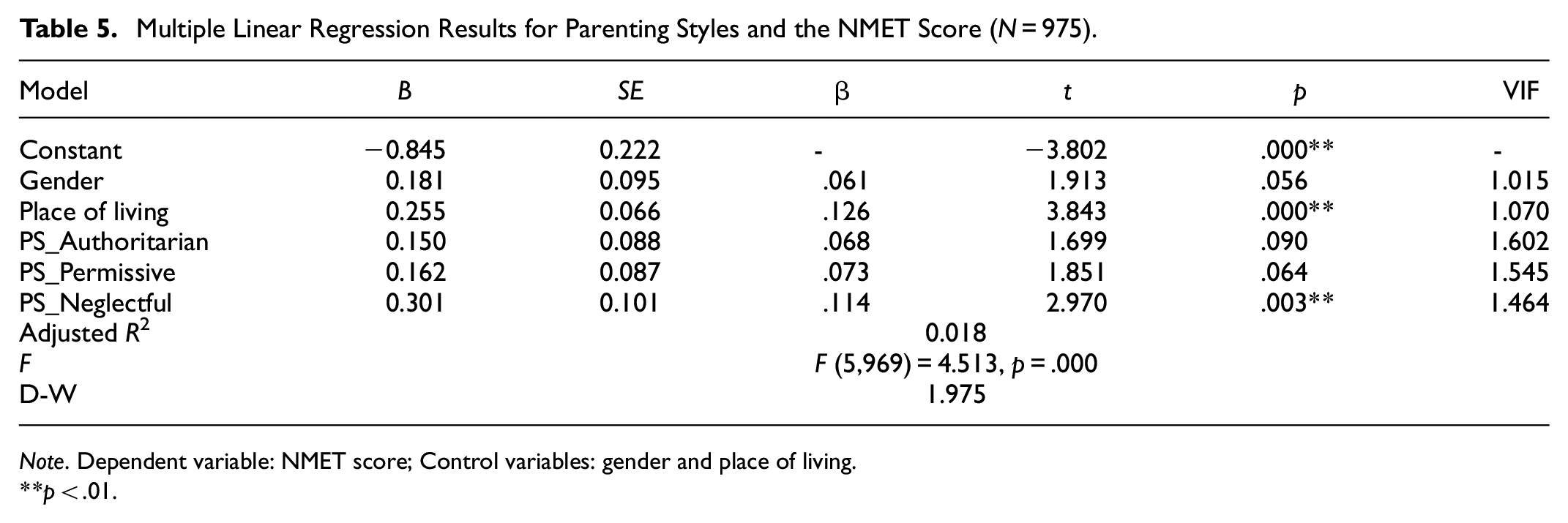
Note. Dependent variable: NMET score; Control variables: gender and place of living.
p < .01.
NMET score = −0.845 + 0.255*place of living + 0.150*PS_Authoritarian style + 0.162*PS_Permissive style + 0.301*PS_Neglectful style + 0.181*gender
Mediating Role of Parenting Styles in the Relationship Between Family SES and English Language Proficiency of Chinese University Students (RQ3)
Table 6 provides the results for the mediating role of parenting styles in the pathway between family SES and English proficiency among Chinese undergraduate students while controlling for gender and place of living. Following Hayes and Preacher (2014), the mediating effect of PS_Authoritarian, PS_Permissive, and PS_Neglectful (Table 6) in the pathway from family SES to NMET score is compared to authoritative parenting. As Table 6 shows, the 95% confidence intervals for the path Family SES → PS_Neglectful style → NMET score was (−0.052, −0.010). This reveals the full mediation of a neglectful style between family SES and the English proficiency of Chinese university students because there is no zero between the upper and lower limits. It implies that although the regression analysis did not find a direct effect between family SES and language proficiency, the underlying mechanism could be that the influence of family SES on Chinese university students’ performance in EFL learning was exerted indirectly through the neglectful parenting style of their parents.
Results of the Mediating Effects Test.

p < .05. **p < .01.
Discussion
This study explored the impacts of Chinese undergraduate students’ family environment, namely family SES and parenting styles, on their English language proficiency. The results of the one-way ANOVA demonstrated significant differences in English language achievement between students from high-SES families and those from low and medium-SES families. However, the impact of family SES on English language proficiency was not significant in the regression analysis with gender and place of living as the control variables. The ANOVA also showed that the variation in English proficiency among Chinese undergraduate learners whose parents adopted four different parenting styles was non-significant. Nevertheless, neglectful parenting, compared with an authoritative style, had a significantly positive effect on the English language achievement of Chinese university students in the regression analysis. Furthermore, the findings showed the mediating role of a neglectful style in the pathway from family SES to the English language proficiency of Chinese university students. This finding echoes the results of Conger and Donnellan (2007), and Sánchez (2023), which confirmed the mediating role of parenting styles between family SES and academic achievement.
Following ecological systems theory (Bronfenbrenner, 1979), this study selected related factors in the family system (SES in the exosystem and parenting styles in the microsystem) to investigate the influence of family environment on Chinese university students’ English language proficiency and detect whether parenting styles could mediate the link between SES and students’ English achievement. The unveiling of the intermediary function of neglectful parenting in connecting family SES with the English proficiency of the Chinese undergraduate students in this study supports the theory. This implies that students do not directly experience the exosystem (family SES in this research), but interact with the microsystem (parenting styles in the study; S. Luo et al., 2021). Nevertheless, despite uncovering evidence of the mediating role of parenting style, this study showed a different function of various parenting styles from the results indicated in S. Luo et al. (2021). They confirmed that an authoritative parenting style was the primary mediator between family SES and individuals’ development. Whereas, neglectful parenting was the one linking SES and English achievement of Chinese university samples in this study. This variation could be attributed to the differences in participants’ ages. The participants in S. Luo et al. (2021) were young children aged 3 to 6 years, while the ones in the present study were university students. Studies have found that learners of varying ages may exhibit different preferences for their parents’ parenting styles (e.g., Butler & Le, 2018; Stockburger & Omar, 2015). This highlights the contribution of this study in disclosing the significantly positive effect of a neglectful parenting style in English language proficiency and its mediating role between family SES and the English learning in the context of Chinese university samples.
Regarding the discrepancy between the results of the regression and ANOVA analysis, it could be attributed to several reasons. First, ANOVA is a statistical method that measures the relationship between two or more variables, whereas regression analysis is a statistical method that tries to identify important predictors of a particular outcome. Therefore, one potential reason for the inconsistency between the results could be that while family SES is associated with English performance, other variables have stronger predictive power in determining language achievement. In this study, the outcome was English language performance, and the predictors in the regression analysis included family SES, gender, and place of living. Based on the results of the regression analysis, the predictive power of place of living (β = .09, p < .05), a control variable in this study, was stronger than that of family SES (β = .028, p > .05). In other words, the predictability of family SES may be confounded by that of place of living in the regression analysis. Second, the inconsistency between the results of the analyses could be attributed to the fact that the connection between family SES and the English language performance of Chinese university students is mediated by other variables such as the neglectful parenting style noted in this study. The results revealed that family SES can indirectly affect undergraduate learners’ English language proficiency through their parents’ neglectful parenting.
Back to the significant differences in English performance between the participants from various SES groups shown in the one-way ANOVA, this study confirms the positive role of family SES in the English development (Abbasian et al., 2020; Butler & Le, 2018; R. Luo et al., 2021; Nikolov & Csapó, 2018; Su et al., 2017) of undergraduate students in China. This provides empirical evidence of the consistency of the critical role of SES in language learning across different age groups, spanning from preschoolers (Levine et al., 2020; R. Luo et al., 2021), to high school students (Abbasian et al., 2020; Butler & Le, 2018), and now undergraduates. This study also extends previous studies (e.g., Butler & Le, 2018; Su et al., 2017) by exploring the relationship between SES and English learning by incorporating parental occupation into the SES of Chinese university English learners. The results of this investigation confirm the significance of SES in English learning, even when SES is assessed as a composite index comprising the indicators of family income, parental education, and parental occupation. The reason may be that English language learners from well-off families can be provided with necessary, and even superior, learning environments. This includes having more opportunities to receive a good education in formal schools and to have more English books, a higher-quality learning equipment, and computers to assist English language studies (Q. Wang, 2014). In addition, parents with higher educational levels, an indicator of family SES in this study, tend to create more parent-child home-based cultural activities (Y. Jiang et al., 2024; R. Luo et al., 2021; X. Zhang et al., 2023), which may predict learners’ EFL learning achievement (R. Luo et al., 2021). Examples are reading books together, watching educational English TV programs (Dexter & Stacks, 2014; Uchikoshi, 2006), helping with homework (Reyes & Azuara, 2008), parental tutoring of English (Yeung & King, 2016), and enabling a higher frequency of independent reading at home or taking children to bookstores and libraries (Shu et al., 2002). Some of these home-based cultural activities are only applicable in homes where parents are well-educated and have a certain level of proficiency in English. Furthermore, parental occupations are considered as social capital, which can reflect the quality of individuals’ family environment (Bradley & Corwyn, 2002). Parents with different occupations may have distinct attitudes and expectations regarding their children’s success in English learning, given its popularity and prominence in Chinese society (Butler & Le, 2018). This may have led to the variance in students’ English outcomes in this study.
Following the learning theory of social constructivists, the abovementioned learning environments could be considered situation in social constructivism, an element that benefits English language learning (Vygotsky, 1978). This means a richer learning environment at home that could facilitate individuals’ EFL development. In addition, the positive predictability of these richer home-based literacy activities for English achievement is aligned with the notions of ecological systems theory (Bronfenbrenner, 1979), which highlights the shared experiences and interactions between individuals and their significant others such as those in the family environment and parents (direct microsystem) in individual development. Essentially, parent-child interactions at home and the home-based experiences relating to FL provided by parents with higher educational levels enable a supportive family learning environment that could increase exposure to the target FL outside of school (Enever, 2011). This may facilitate the development of FL learners’ language proficiency.
Furthermore, based on the ANOVA, this study found no significant difference in the English proficiency of undergraduate students who identified their parents as employing four distinct parenting styles. However, according to the regression analysis, neglectful parenting exhibited greater significantly beneficial impacts on the English language proficiency of Chinese university students than did an authoritative parenting style. Thus, Chinese undergraduate learners whose parents applied a parenting style characterized by the combination of low warmth and firmness (neglectful parenting) performed the best in English language learning. This outcome can be clarified from an ecological systems theory perspective, which holds that individuals’ development is the result of the interaction between their family environment and their characteristics and experiences (Bronfenbrenner, 1979). Authoritative parents, characterized by high levels of firmness, perhaps place greater pressure on their children to achieve high grades and test scores, which could have negative effects on their children’s study (university students in this study) depending on how the child perceives the pressure (Oxford, 2016). In contrast, a neglectful parenting style characterized by a low level of firmness may put less pressure on them, which could be beneficial for developing proficiency in English. This result is aligned with those of J. Li (2023), who found that children with parents employing neglectful parenting had less English learning anxiety in the classroom (J. Li, 2023). Students’ desire to be accepted may result in their belief that they can only gain approval if they meet perfection standards, consequently revealing their feelings of anxiety and emotional vulnerability in the classroom (J. Li, 2023), and leading to failure in learning English. This is particularly true in the context of China, where English learning and the NMET are highly emphasized. Parents may demonstrate excessive concern regarding students’ studies. Furthermore, the sample of this study comprised English learners who had just graduated from high school. As such, they may prefer more freedom in the family environment to being obedient to their parents (Stockburger & Omar, 2015). Therefore, English learners in this rebellious stage may consider their parents’ care and warmth as excessive interference, and thus refuse to accept their suggestions and concerns (Fu et al., 2019).
Also important is that as English lessons become increasingly more complex at the senior middle school level compared to in primary school, most parents in China find it challenging to directly assist their children’s English learning due to their limited capacity (Butler & Le, 2018). Consequently, authoritative parents, who are high in warmth and control, may hinder their adolescent children’ success in English learning. This finding is consistent with the results that Chinese English language learners in higher grades exhibit a growing preference for autonomy as they grow up (Butler, 2017), and parenting styles involving a high level of autonomy for their children are positively correlated with English language performance (Butler & Le, 2018).
Conclusion
In this study, the relationships between family environment and English language proficiency as well as the mediating role of parenting styles in the pathway from family SES to English language learning were confirmed among Chinese undergraduate students. Overall, based on the results of the ANOVA, regression analysis, and mediation analysis, the impact of family SES on English language proficiency appeared weak or non-significant. Although there may be some variations in English proficiency across different family SES groups, the impact of family SES alone on English language proficiency may not be substantial or statistically significant. This may be attributed to the finding of the indirect effect of family SES background on Chinese university students’ English performance when a neglectful parenting style, the one unveiled to exert notably positive impact on their English achievement in this study, is applied as a mediator between them.
Implications
Theoretical Implications
In discovering the impact of parenting styles on the English proficiency of Chinese undergraduate students, it is suggested that family environment should be reinforced in formulating FL learning theories. Furthermore, application of ecological systems theory (Bronfenbrenner, 1979) could be extended to the development of individuals’ FL abilities. To understand performance and development in language learning, it is recommended to not only focus on learners and their school environment, but also on their interactions with the family environment. Moreover, in addition to fields including philosophy, psychology, and science (Walker & Lambert, 1995), the findings of this study regarding the influence of family SES and parenting styles on English learning outcomes provide empirical evidence for applying the theory of social constructivism to the theory and practice of EFL learning in China (Du & Liang, 2021).
Pedagogical Implications
Several pedagogical implications can be drawn from the findings of this study. First, the findings imply that disparities in the advancement of Chinese undergraduate learners’ English language development stemming from SES background may be compensated by their parents’ adoption of the right parenting style. This highlights significant implications for learners from low-SES families in China due to the substantial discrepancies among individuals in family financial status, parental occupation, and parents’ education level (National Bureau of Statistics of China, 2021). Second, the finding of the positive role of neglectful parenting versus authoritative parenting in English performance in tertiary education could guide parents on how to fulfill their parental responsibilities. This suggests that parents in China adopt low parental firmness and warmth to facilitate their adolescent children’s English learning. Third, the important role of family environment in the English learning outcomes of Chinese university learners highlights that EFL teachers should consider English learners’ diverse family environment, especially parents’ parenting styles, when evaluating and assessing English language performance. The results also imply that schools and families should cooperate to enhance and support English learning. Building a partnership between teachers and parents to develop English learning in higher education is also encouraged.
Limitations and Recommendations for Future Study
Some limitations in this research can be addressed in future research. First, the data on parents’ parenting styles were collected from the perspective of their children (the participants of this study), meaning that there may be mismatches between learners’ perceptions of their parents’ behaviors and attitudes versus parents’ actual practices in real life. This is due to the inaccuracies caused by memory biases and subjective attitudes. Future studies could incorporate both parent self-reports and children’s perceptions to better understand parenting styles and their impacts on students’ English development. Second, individual characteristics and other family factors such as the presence of grandparents and number of siblings, which might influence the effect of family environment on learners’ English performance, were not considered in the study. Thus, future studies could include these variables to analyze the nuanced effects of family environment on English performance. Third, NMET, which represented participants’ English language proficiency in this study, does not include a speaking test. This may provide an incomplete picture of participants’ overall English proficiency and lead to inaccuracies in the conclusions drawn about the influence of family environment on English language proficiency. As such, future research could examine the influence of family environment on oral English proficiency. Furthermore, due to minimum evidence on the positive effect of a neglectful parenting style versus an authoritarian style on EFL achievement and its mediating effect between family SES and English language proficiency in China, there is still room for further verification in future work.
Footnotes
Declaration of Conflicting Interests
The author(s) declared no potential conflicts of interest with respect to the research, authorship, and/or publication of this article.
Funding
The author(s) received no financial support for the research, authorship, and/or publication of this article.
Ethics Statement
This study adheres to the ethical principles and guidelines for research involving human participants. The research protocol has been reviewed and approved by the Academic Committee of Jiangxi Normal University. The participants in this study come from multiple universities across China. All participants involved in this study provided informed consent online before their participation, and their rights, privacy, and confidentiality have been protected throughout the research process.
In conducting this study, ethical considerations were carefully considered. The research team ensured that all participants were fully informed about the study’s purpose. Participants were given the opportunity to ask questions and withdraw from the study at any point without any negative consequences.
To maintain confidentiality, all collected data were anonymized and securely stored. Only authorized researchers had access to the data, and all identifying information was kept separate from the research findings. Any published results or reports will be presented in a way that ensures participants’ anonymity and respects their privacy.

Data Availability Statement
The data will be made available on a reasonable request.