




Abstract
The Philippines saw an increase in adolescent overweight and obesity prevalence of 6.7% from 2003 to 2018 with an expectancy of 30% adolescents in 2030. Increasing cases may pose a serious health risk and cost burden to the basic health care delivery system. Despite studies evaluating different factors contributing to overweight and obesity, there is still a need for more research linking wealth status and parental factors to overweight and obesity in Filipino late adolescents. The study aimed to understand the association between parental factors and wealth status in the development of adolescent overweight and obesity. The research used cross-sectional study design with a sample size of 200 pairs of adolescents and parents through purposive sampling. Adolescents with Body Mass Index classification of obese or overweight, residing in Manila City, and aged 18 to 19 years old were included in the study. Self-administered questionnaires were answered by parents and used to assess each household’s wealth status, parents’ nutrition knowledge, parenting style, and eating behavior. Data was processed using binomial logistic regression determining the association of the factor. Results showed that parents’ nutritional knowledge on diet, disease, and weight management section (p = .045), permissive parenting style (p = .037), and Emotional Under-Eating (EUE) section (p = .014) have significant association with adolescents being overweight and obese. The parents’ nutritional knowledge on diet, disease, and weight management, permissive parenting style, and dietary behavior on EUE is significantly associated with adolescent overweight and obesity.
Plain language summary
The content of the study primarily focused on parental factors in the overweight and obesity status of adolescents, and other contributing factors such as psychological, physiological, or genetics were not within the scope of the study. The study provided evidence on the factors chosen, signifying its relationship to adolescent overweight and obesity; however, the research did not include interventions to address the problem. Furthermore, the cross-sectional study design limited the consideration of possible changes in the identified factors over time. Moreover, the 151-item questionnaire may have been complained about by participants due to it being lengthy. Additionally, the findings of this study are limited to the selected schools and may not define the general population of Manila City. At the same time, the only factors seen to affect adolescents’ weight status were the lack of knowledge of diseases, permissive parenting, and emotional undereating of the parent, with wealth status not significant. This shows that the habits and behavior of the parent would be the main influencing factor for the development of overweight and obesity in adolescents.
Keywords
Introduction
The prevalence of Overweight and Obesity among adolescents poses significant global challenges to chronic disease prevention and lifelong health. According to World Health Organization (2021), Overweight weighs excessively for an individual’s height, with a percentile of 85th, while Obesity is greater than overweight, with a percentile of more significant than 97th. Between the ages of 10 and 19 years, adolescence is the stage of life between childhood and adulthood (WHO, 2019). It is a vital time to lay the groundwork for good health and a one-of-a-kind period in human development. In addition, women in the late adolescent phase are already developed, while young men’s height, weight, muscle mass, and body hair continue to develop. During late adolescents, the capacity to settle on autonomous choices is advanced. (3-C Family Services, 2018). According to Mazidi et al. (2018), being obese in late adulthood is a precursor to adulthood obesity, which increases the risk of morbidity and mortality from non-communicable diseases (NCDs) such as type 2 diabetes, cardiovascular disease, and cancers. Also, household and environmental factors, lifestyle preferences, and cultural settings play significant roles in the obesity epidemic (Lee et al., 2019). Based on the Expanded National Nutrition Survey (ENNS) results in 2019, 9.9% of males and 9.7% of females were overweight and obese, with a total percentage of 9.8. Meanwhile, Overweight and Obese late adolescents in rural areas have 8.3% and 12.1% in urban areas.
An individual’s household and family environment substantially contribute to their weight status and lifestyle (Bahreynian et al., 2017), and according to Larsen et al. (2015), parents with unhealthy dietary behavior lead to adopting their late adolescent offspring similar habits; thus, suggesting a parental influence on late adolescence weight status. Moreover, on a household level, the prevalence of overweight and obesity depends on the family’s wealth characteristics, such as location and wealth status (Ahmad et al., 2018). In addition, parents with lower nutritional knowledge are also more likely to accustom an unhealthy diet, which can affect late adolescents negatively (Kigaru et al., 2015). Furthermore, it was found that parenting styles can influence adolescent risk behaviors (Newman et al., 2008). The authoritarian parenting style limits the late adolescent’s intake, which increases the likelihood of overindulging.
Studies abroad, like Sitaula et al. (2023), have examined the relationship of different factors with the development of obesity among late adolescents and adults. However, no known studies have analyzed the role of parents in the development of obesity in adolescents in the Philippines. As such, the study aimed to understand the role of parental factors, specifically parental nutrition knowledge, parenting style, dietary behavior, and wealth status, in the development of adolescent overweight and obesity. This research targeted the determinants of the malnutrition agenda, specifically the overweight adolescents from the PPAN Research Agenda 2019 to 2022 Priorities of the Philippine Plan of Action for Nutrition (2021). The study wished to provide parents with further knowledge and awareness to aid in understanding and preventing obesity and overweight in adolescents. Furthermore, future researchers can use the findings of this study as a reference document to conduct research on a related subject or pursue a similar course of study on overweight and obesity. Additionally, this study can help parents better support late adolescents by learning more about nutrition and improving their eating habits, lifestyle, and behavior, contributing factors to their weight status and nutritional quality. Lastly, this is to give awareness about another possible way to intervene: in schools where the parent and adolescent are involved with the use of symposiums or programs that keep both aware.
Theoretical Background
Conceptual Framework
A conceptual model was used to define the independent and dependent variables. Nutritional knowledge, parenting style, and diet behaviors are measured as parental factors that may lead to the overweight and obesity status of adolescents. Another factor considered was wealth status, as it determined the possible allotment of the budget for food that affects food choices at home. Wealth status was separated as Nutrition knowledge, parenting style, and diet behavior are caused by the parent taking care of the adolescent, and these are also behavioral aspects that are different from wealth status. These two variables were considered independent variables as it changes per participant and affects the adolescent status, which is the dependent variable (see Figure 1).

Parental factors framework.
Literature Review
Previous research has indicated that childhood and adolescent overweight and obesity are linked to wealth status, as supported by You and Choo (2016) with adolescents in grades 7 to 12 years. A comparative study by Pathak et al. (2018) found results that adolescents living in urban areas with a higher annual family income were more at risk of overweight/obesity than adolescents living in rural areas. Another study from Platon-Desnacido et al. (2022) also supported this claim wherein those who belong to the rich and wealthiest quintiles were twice more likely to be overweight and obese than adults in the poorest quintile. Hence, this study focused on the relationship between wealth status adolescents overweight and obesity. Locally, there are a few studies on the association between wealth determinants linked to adolescent overweight and obesity.
Parental nutrition knowledge is the foundation of late adolescent’s nutrition knowledge and it contributes to the late adolescent’s food preferences and eating habits by managing dietary restrictions, providing nutrition knowledge, and establishing eating behaviors (Lipowski et al., 2018). A study by Romanos-Nanclares et al. (2018) showed that their results disagree with previous studies saying that parental nutrition knowledge can only influence the late adolescent’s nutritional quality. Considerable discussions have focused on the impact of parental nutrition knowledge; however, few studies have focused on the effects of parental attitudes on the late adolescent’s food intake, eating habits, and diet quality. Moreover, based on the study of Liu et al. (2021), late adolescents are more likely to eat healthily if their parents provide nutrition education on both types of knowledge, particularly nutrition benefits. However, parents’ lack of nutrition knowledge or concern hampered healthy meals for late adolescents. On the other hand, a study by Asakura et al. (2017) suggested that higher parental nutrition knowledge was associated with higher vegetable consumption. Hence, this study aimed to emphasize the significance of determining parental nutrition knowledge on the late adolescent’s eating habits and continuing health and assessed nutrition knowledge as one of the variables in deciding the role of parents on the weight status of adolescents ages 18 to 19 years. Furthermore, studies mentioned were based internationally and data was acquired from participants of different races and backgrounds. Nevertheless, local studies are still insufficient and needed based on the local participants in the Philippines.
Parenting style is a significant determinant in measuring a parent’s influence on the youth (Lorence et al., 2019). Parenting style is categorized as authoritative (high demandingness, high responsiveness), authoritarian (high demandingness, low responsiveness), and permissive (low demandingness, high responsiveness), according to Li (2022). A study in Lebanon by Hayek et al. (2020) stated that authoritative, authoritarian, and permissive parenting significantly differed in adolescents’ diet and alcohol intake. Results showed that adolescents with authoritative parents were likelier to follow a healthy diet and drink less alcohol. Another study by Loncar (2019) found that mothers with an authoritarian parenting style have adolescent sons with higher BMI. A study by Rutledge et al. (2019) showed that permissive parenting resulted in higher weight. In addition, a study by Jennings et al. (2019) found that authoritarian and permissive parents have children who eat for pleasure and have a scarcity of internal cues on hunger than those of authoritative parents, eventually leading to higher BMI. Moreover, Monge-Rojas et al. (2022) found that paternal authoritarian and permissive parenting had an association with overweight and obesity of adolescents ages 15 to 18 years. Hence, this study measured parenting style as one factor in determining parents’ role in the weight status of adolescents ages 18 to 19 years. On the other hand, a study by Larsen et al. (2018) suggested that evidence does not show a connection between parenting style and obesity. However, it was pointed out that other confounders, such as nutrition knowledge, should have been considered. These findings explain why a lack of inclusion of other factors can make a study incomplete; measuring more than one parental factor is necessary to achieve a conclusive result on parental influence. Literature has shown conflicting results on the role of parenting style on diet and weight status. Thus, this study aimed to include other factors, such as parenting style, when associating the two variables. Moreover, the studies were based abroad, and data were obtained from participants of different nationalities and cultures. Thus, there is still a need for studies based on Filipino participants in the Philippines.
Eating behavior is a series of actions interconnected with one another from the decision of how to eat, how to prepare, and what to purchase (Mahmood et al., 2021). Meanwhile, the overall scope of dietary behavior pertains to dietary intake, eating behavior, and food choice (Marijn Stok et al., 2018). A study by P. J. Chen and Antonelli (2020) suggests that dietary behavior is affected by social environments such as home and family. Another study by Ma and Hample (2018) showed that intake of fruits and vegetables among adolescents are positively impacted by their parents’ intake without the need for force; however, adolescents were not influenced by their parents’ intake of sugary drinks. The findings from the study of Ma & Hample shows that adolescents model after their parents’ diets and food choices but also make their own decisions regarding what they consume. Hence, this study related parents’ dietary behavior to their overweight and obese adolescent. On the other hand, a study conducted by Daly et al. (2022) stated that different factors affect the food choices of adolescents. Results from the aforementioned study showed that food choices are mostly influenced by peers and home environments where it is still influenced by parents as adolescents will still stay with their parents. Thus, this study aimed to understand if parental dietary behavior affects overweight and obese status of adolescents. Literature shows that there is a lack of local studies on the relationship between parent and adolescent dietary behavior. Hence, there is a need for studies based on local participants and data in the Philippines.
Methods
Study Design
The research utilized a cross-sectional study design to see the association of wealth status, nutrition knowledge, parenting style, and dietary behavior to the overweight and obesity status of adolescents with the use of binomial logistic regression.
Study Setting and Population
The setting of the study was based in Manila as according to the Expanded National Nutrition Survey 2018 (ENNS) results, based on the BMI-for-age, prevalence of overweight and obese adolescents in the City of Manila was one of the top 5 cities with the highest prevalence. During late adolescence, those with overweight and obesity status were more likely to be obese in adulthood (Simmonds et al., 2016). As supported by the study of Aliss et al. (2020), the sample size should be 200 eligible participants in Manila City. Hence, this study utilized a purposive sampling technique. The inclusion criteria were as follows for parents and adolescents; (1) are both Filipino citizens, (2) adolescent is 18 to 19 years old, (3) adolescent’s BMI is classified as overweight or obese, (4) parents and adolescents reside in the same household, and (5) lives in Manila City and is currently studying at Manuel A. Roxas High School, Esteban Abada High School, Manuel L Quezon Senior High, NU Nazareth School, Centro Escolar University, and Perpetual Help College of Manila.
Tool Measures
Household Membership and Information Questionnaire
The Household Membership and Information Questionnaire (HMIQ) was adapted and retained general household information but excluded questions pertaining to food insecurity and educational attainment (Coates et al., 2007). As supported by Poirier et al. (2020), wealth indices are equally valid as distinct measures of household SES from income and can be alternative measures of wealth background when occupational data are unavailable. For measuring the wealth status it was adapted from the Philippine Institute for Development Studies (PIDS) income classification table which classified seven classes based on monthly income: poor: less than P10,957; low-income (but not poor): greater than or equal to P10,957 but less than P21,914; lower middle class: greater than or equal to P21,914 but less than P43,828; middle class: greater than or equal to P43,828 but less than P76,669; upper middle income: greater than or equal to P76,669 but less than P131,484; high income (but not rich): greater than or equal to P131,484 but less than P219,140; and rich: greater than or equal to P219,140 (Albert et al., 2020).
General Nutritional Knowledge Questionnaire
The General Nutritional Knowledge Questionnaire (GNKQ) by Kliemann et al. (2016) was adapted to measure nutritional knowledge of the participants. It comprised four independent sections, each evaluating a different aspect of nutrition knowledge such as dietary recommendations, with nine questions; food groups, with 10 questions; healthy food choices and diets, with 13 questions; and disease and weight management with 16 questions. For the scoring guide, under section 1, each item carried one point for a correct response. The subsections of the first and third questions had separate items, and the maximum score is 16. For section 2, each entity carries one point for a proper answer. In questions with lists of foods, every meal was handled as a separate item, included in query 1, 2, 3, 4, 5, 6, and the most rating was 36. Section 3 cites points for each correct answer, with the highest score of 12. Finally, in section 4, 1 point was granted for each correct answer. Subsections of question 13 are treated as separate items and have a full score of 20 points.
Parenting Style Questionnaire
The Parenting Style Questionnaire (PSQ) was adapted to measure parenting style of a parent whether they are authoritative, authoritarian, or permissive parenting. It is a parent-reported instrument from the Parent Engagement Modules Series by the California Department of Education (2021). It is composed of three parts, 11 questions for authoritative parenting, 12 questions for authoritarian parenting, and 4 questions for permissive parenting. The PSQ utilizes a scale system from 1 (never) to 6 (always) to answer the questions. All numerical answers per part are added then divided by 11, 12, or 4 (number of questions per part). The result is determined based on the highest score obtained from all parts.
Adult Eating Behavior Questionnaire
The Adult Eating Behavior Questionnaire (AEBQ) developed by Hunot et al. (2016) was adapted and it is a self-report tool that measures appetitive traits of adults. It contains 35 questions and are categorized into seven scales namely hunger (H) and food responsiveness (FR), emotional overeating (EOE), enjoyment of food (EF), emotional undereating (EUE), food fussiness (FF), slowness in eating (SE), and satiety responsiveness (SR). The factors can be grouped into two scales namely food approach scale containing H + FR, EOE, and EF and food avoidance scale containing EUE, FF, SE, and SR. Each question was answered using a scale from 1 (strongly disagree) to 5 (strongly agree) and was tallied per scale. From the study of Molitor et al. (2021) the food approach scale showed an acceptable margin for adolescents with obesity. The seven scales were used to measure eating behavior while the two main scales were used to further define the behavior to avoid or approach food.
Data Collection
A formal letter was sent to the Department of Education (DepEd) and selected schools in Manila City for their permission to participate and assist in the study’s data collection. The schools were randomly selected through the fishbowl method, where every school in Manila was listed on a piece of paper and then placed in a bowl, and the paper was grabbed one by one to randomize the picking of schools. Once permitted, an onsite anthropometric assessment was done in the schools’ premises. Before assessing the students, a parent consent form was first given where the parent made known about the study and if they would allow their child to participate. Before starting with the anthropometric measurements, a short introduction in the class was done while the consent form was collected and a verbal consent on taking their height and weight. Weight was taken using Tanita Hd-325 with the participants standing straight and facing forward without shoes. Height was taken with a calibrated microtoise by number one with the participant standing straight, and facing forward without shoes. BMI was computed using the metric system and with the use of formulas from google sheets. Participants with a BMI classification of overweight or obese were recruited for the study by talking with them after the anthropometric measurement. Results are not made public and are between the researcher and participant only.
A printed copy of the 151-item questionnaire with an option of English or Filipino language was given to eligible participants. A QR code is also made available to address any questions they may have while answering the questionnaire. It contained questions on parenting style (adapted from PSQ), nutrition knowledge (adapted from GNKQ), and eating behavior (adapted from AEBQ) answered by their parents. All tools used were with permission from their respective developers and researchers. The teachers of the participants and class presidents were requested to collect the answered questionnaires. After 2 days, the researchers collected the accomplished surveys from the schools and examined the questionnaires if all questions were filled. A small token was given to participants who returned the questionnaires as a form of appreciation. The questionnaire mostly took 20 to 30 minutes to answer, and there were some complaints about the length of the questionnaire, but it was doable with a response rate of 79%. The main reason for the questionnaire to be left unanswered was parents not wanting to answer it as it is sensitive for them. In contrast, for some, they were responded to but were not valid as many blank pages were left, and lastly, the others never contacted us back (see Figure 2).

Data collection flow.
Data Encoding, Editing, and Analysis
The Statistical Package for the Social Sciences (SPSS) was used to process the data. Specifically, the binomial logistic regression which was executed through SPSS to compare the independent variables, nutritional knowledge, parenting style, dietary behavior, and wealth status to the dependent variable, adolescent BMI classification. The analysis showed the probability of each factor to occur when compared to the BMI classification. Data was encoded by the researchers using Google Sheets with restricted permissions. For incomplete questionnaires, participants were contacted to complete it but the majority were unresponsive hence, their questionnaires were considered invalid and excluded from the study.
Study Limitations
The content of the study primarily focused on parental factors in the overweight and obesity status of adolescents, and other contributing factors such as psychological, physiological, or genetics were not within the scope of the study. The study provided evidence on the factors chosen, signifying its relationship to adolescent overweight and obesity; however, the research did not include interventions to address the problem. Furthermore, the cross-sectional study design limited the consideration of possible changes in the identified factors over time. Moreover, the 151-item questionnaire may have been complained about by some participants due to it being lengthy. Additionally, the findings of this study are limited to the selected schools and may not define the general population of Manila City. Although there were limitations in the study, the integrity of the research was maintained. At the same time, the locations were focused on schools that participated, where the school and the researchers discussed the results and interventions possibly done in a school setting.
Ethical Considerations
The research study was carried out according to an accredited ethics review board. Researchers must adhere to clarity, lawful purpose, and proportionality in gathering, keeping, and processing personal data under Privacy Act 2012. All participating parties must treat the terms and conditions of the agreement and data provided with confidentiality. All data was in secured document files and kept in a password-protected drive. The participants are anonymous through an allotted exclusive code. After 2 years, the data will be deleted. Printed copies of the information sheet and consent form were given to the participants. As an incentive, participants received a small token. Participants who wished to withdraw from the study were allowed to do so without consequence. The study was designed to provide further knowledge on the causes of overweight and obesity in Filipino adolescents. It can be a stepping stone for future public health programs addressing overweight and obesity.
Results
The study aimed to know the parental factor and wealth status of overweight and obesity status of adolescents ages 18 to 19 years in selected schools in Manila City. Out of the 244 participants, 51 participants failed to complete the questionnaire and were excluded. A total of 193 participants were included in the study, which was lower than the targeted sample size of 200. The following data shows the results derived from the data gathering process.
Table 1 presents the numerical analysis demographic profile of the participants (n = 193). There were more female participants (n = 107) in comparison to male participants (n = 86). For the monthly household income, 45.6% of the families belong to the lower middle class. Majority on the classification of adults who answered the questionnaire were mothers (n = 132). Adolescents 18 to 19 years old classified as overweight were 66.3% from the total sample. Whereas, 33.7% of the adolescents were classified as obese.
Demographic Profile of the Participants.

Table 2 presents the mean, media, and mode for the BMI of adolescents. It can be seen that the BMI of adolescents has a mean of 29.8 (
BMI of Adolescents.

Note. The BMI formula is weight in kilograms (kg) divided by height in meters squared (m2).
Table 3 shows the inferential statistics of wealth status leading to being overweight or obese of adolescents. It can be seen on the table that wealth status has a p-value of .742.
Relation of Wealth Status with BMI Classification of Adolescent.

Table 4 shows the parents’ nutrition knowledge results leading to being overweight or obese adolescents. It can be seen in the table that diet, disease, and weight management (4) has a p-value of .045.
Relation of Nutrition Knowledge Per Section to BMI Classification of Adolescent.
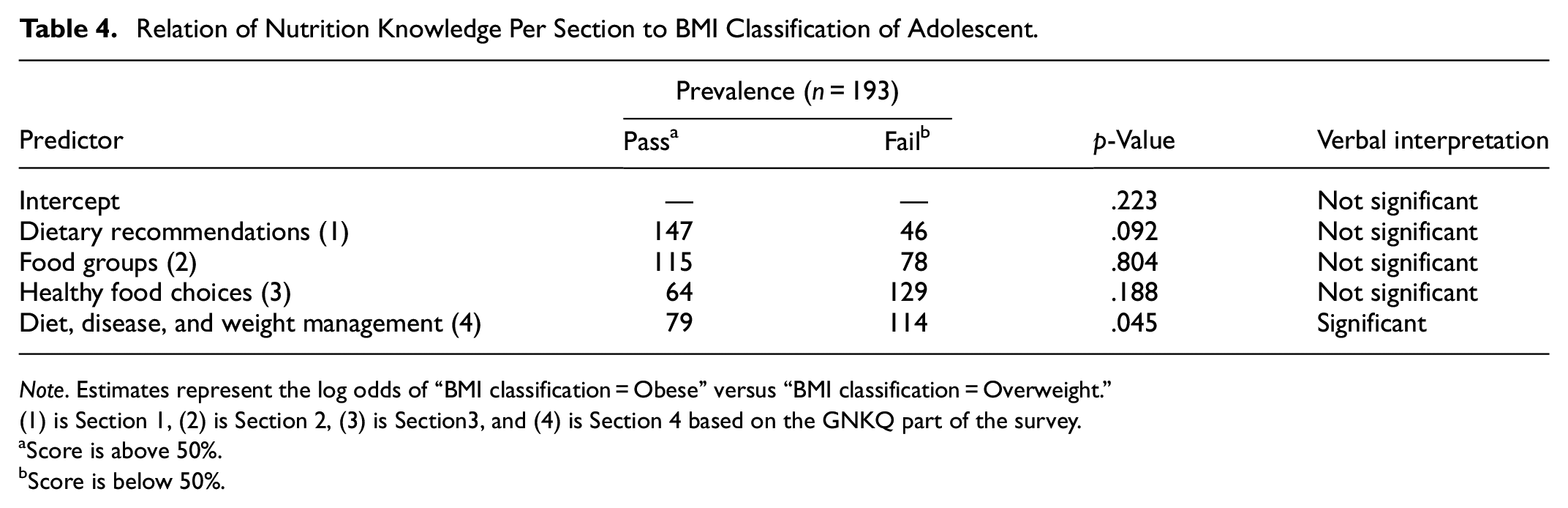
Note. Estimates represent the log odds of “BMI classification = Obese” versus “BMI classification = Overweight.”
(1) is Section 1, (2) is Section 2, (3) is Section3, and (4) is Section 4 based on the GNKQ part of the survey.
Score is above 50%.
Score is below 50%.
Table 5 presents the parenting style leading to being overweight or obese of adolescents. It can be seen on the table that permissive parenting style has a significant p-value of .037.
Relation of Parenting Style to BMI Classification of Adolescent.

Note. Estimates represent the log odds of “B = Obese” versus “B = Overweight.”
Based on the highest score of the parent.
Table 6 shows eating behavior leading to overweight and obesity of adolescents. It can be seen on the table that EUE has a p-value of .014.
Relation of Eating Behavior to BMI Classification of Adolescents.

Note. Estimates represent the log odds of “BMI classification = OBESE” versus “BMI classification = overweight.”
H = hunger; FR = food responsiveness; SR = satiety responsiveness; EUE = emotional under-eating; FF = food fussiness; EOE = emotional overeating; EF = enjoyment of food; SE = slowness in eating.
Prevalence of those with highest score per scale.
Discussion
Wealth Status
The results of this study revealed that wealth status is not significantly (p = .742) associated with overweight and obese status in adolescents in Manila City. The majority of the respondents belong to the lower middle class among all the other classes. This is inconsistent with the results of some studies that show wealth status as a strong predictor of overweight, obese status in adolescents (Pathak et al., 2018). The results may be due to factors not investigated, such as gender, place of residence, educational attainment, and food security. Williams et al. (2018) established no link between wealth status and adolescents being overweight and obese. Relatively, it was found that families belonging to a lower wealth status were twice more likely to have overweight and obese adolescents than those with a higher wealth status (Platon-Desnacido et al., 2022). However, it was also noted that the relationship between wealth status and overweight and obesity status of adolescents function differently depending on the culture, geographical regions, and income economies (Williamson et al., 2020). In this regard, access to food is not the main reason for developing overweight and obesity in adolescents; that is mainly affected by behavior rather than access.
General Nutrition Knowledge
The nutrition knowledge results show that only section 4: diet, disease, and weight management, was significant (p = .045) in the chance of indicating overweight or obese BMI classifications in adolescents in Manila City. This result is consistent with a study by Romanos-Nanclares et al. (2018) that disagreed with previous studies saying that parental nutrition knowledge can only influence their children’s nutritional quality. Moreover, the findings from the results of nutrition knowledge showed that participants passed sections 1, 2, and 3 of the questionnaires. This is consistent with the study of Shangraw (2022) that parents with higher nutrition information scores had kids with a higher BMI classification. In addition, although there is a significant correlation between nutrition knowledge and obesity, this study’s findings differ from those of comparable studies, which found that participants who were obese had lower nutritional knowledge than those with a normal BMI. (Akkartal & Gezer, 2019; Keay et al., 2018). Thus, under section 4 of nutrition knowledge, based on the study by National Institute of Diabetes and Digestive and Kidney Diseases (NIDDKD, 2022), health and weight management may be affected by the parents’ eating and lifestyle habits, that some households may eat numerous unhealthy foods or beverages high in added sugar, fat, and salt. Also, some families may engage in inactive behaviors such as watching television, using a computer, or using a mobile device.
Parenting Style
The results of this study revealed that permissive parenting is significant (p = .037) in the possibility of predicting overweight or obese BMI classifications in adolescents in Manila City. This finding is consistent with previous studies correlating permissive parents with higher BMI of their children (Alahmadi, 2019; Rutledge et al., 2019). It is more probable that children of permissive parents are more liberated when choosing foods to eat, thus, resulting in unhealthy food choices and being overweight or obese (Burke et al., 2019). Moreover, permissive parenting styles were associated with a lower intake of fruits and vegetables and an increased intake of sugary beverages contributing to the development of overweight and obesity (Balantekin et al., 2020). However, the frequency of scores of the PSQ in this study showed that authoritative parenting is the most prevalent parenting style among the three tested. This is inconsistent with most studies relating authoritative parenting style to healthier BMI (Y. Chen et al., 2019; Larsen et al., 2018; Selland et al., 2021). On the other hand, Jennings et al. (2019) suggested that authoritarian and permissive parents have children who eat for enjoyment and lack internal cues to feel hungry than those with authoritative parents, eventually leading to higher BMI. This is inconsistent with the study’s results, wherein only permissive parenting significantly correlated with high BMI. Y. Chen et al. (2019) suggested that non-authoritative parenting styles (authoritarian and permissive) may have adverse effects on maintaining healthy body weight until adulthood compared to authoritative parenting. These findings highlight the importance of parenting style regarding weight gain and BMI status during adolescence and eventually adulthood.
Eating Behavior
The results of the relation of eating behavior to BMI classification of adolescents in Manila City showed that only the EUE scale from the food avoidance scale was considered significant (p = .014) in determining the probability of an adolescent being obese and overweight. This is inconsistent with the results of other studies stating that food approach scales have had a higher probability of having a higher BMI classification (Cohen et al., 2021; He et al., 2021; Mallan et al., 2017). In the study of Hunot-Alexander et al. (2021), it was found that emotional overeating had a higher probability of a higher BMI, which is a part of the food approach scale, while for the scales under the food avoidance scale (SR, EUE, FF, and SE), have a lower BMI result overall. The results may have been limited due to factors outside the study, such as time spent outside the home, the influence of friends, and another person taking care of them. Based on the study of Hill et al. (2018), stress levels for adolescents are negatively correlated with healthy eating behaviors. As such, stress levels can be a factor that leads to unhealthy eating behaviors. In this regard, it is possible that adding other factors in conjunction with the AEBQ can help further determine the causes of adolescent overweight and obesity. EUE affects the adolescent population differently as seeing their parents eating less causes them to eat more, and parents’ habits affect the adolescent.
Conclusion
This study intended to find the relationship of parental factors and wealth status with overweight and obesity in adolescents ages 18 to 19 years in selected schools in Manila City. Wealth status is not significantly associated with the overweight and obese status of adolescents. However, nutrition knowledge scores in section 4: diet, disease, and weight management (p = .045), permissive parenting (p = .037), and EUE (p = .014) have shown significance in the association of these factors with overweight or obesity in adolescents. Since wealth status did not affect the overweight and obesity prevalence, there is more focus on the nutrition knowledge, parenting, and eating behavior of the parent. As such habits of the parents would be the most likely reason for the development of overweight and obesity of the adolescent rather than access to food.
Recommendations
The study recommends that future research focus on a younger age group. Likewise, aim to establish which environmental factors are associated with a parent’s EUE. The findings of the study support parent-based interventions aimed at improving diet quality. Education and opportunities provided at home and school should involve parents and institutions to help adolescents adopt healthy eating and activity behaviors which may reduce overweight and obesity risk and assist them in achieving a healthier body composition. One of the steps taken was discussing with the schools the results and what are possible topics to be discussed for the students as well as the parents. Symposiums at schools focus on the different diseases regarding being overweight or obese. Moreover, homes are to change the habits like eating with the whole family and changing the parenting approach to adolescents.
Footnotes
Acknowledgements
The researchers extend their gratitude to their research adviser, Ms. Florimae E. Paimalan, RND, MHPEd, for guiding and advising the group throughout the process of completing and writing this thesis. As well as to the following people who kindly assisted the researchers during the data gathering process: Mr. Marius Hernani S. Garcia, Mr. Ramy Hinolan, and Mr. Christopher Benta (principal and faculty staffs of NU Nazareth Senior High School); Mr. Cipriano T. Lauigan, Mr. Mark Gil V. Tabor, and Mrs. Ivy S. Sapasip (principal, assistant principal, and grade-12 coordinator of Manuel A. Roxas High School); Mr. Daniel Fajilan (PE teacher of Perpetual Help College of Manila); Mr. Erwin D. Caspe (team leader for academics of Centro Escolar University); and Mr. Ramir Jimbert Biligan (teacher of Manuel L. Quezon High School).
Declaration of Conflicting Interests
The author(s) declared no potential conflicts of interest with respect to the research, authorship, and/or publication of this article.
Funding
The author(s) received no financial support for the research, authorship, and/or publication of this article.
