




Abstract
Mediation provides a means of resolving disputes that promises to reduce litigation while avoiding further damage to party relationships. The present study addressed the question whether parents engaged in parenting disputes generated by divorce or separation received the promised benefits of mediation when services were delivered by means of community mediation, which combined the dual features of free services and volunteer mediators. Reported outcomes such as agreements, party satisfaction, relationship changes, and court involvement, as well as the connection between these outcomes and party factors of custodial status and income level, were examined, and several encouraging trends emerged. Results indicated that an economically diverse group of disputing parents were provided access to mediation services delivered under community mediation. Moreover, the prospect of avoiding litigation motivated a majority of parents to participate in community mediation. The positive outcomes reported by most parents, irrespective of income level and custodial status, included agreement and process satisfaction rates consistent with national trends, the development of parenting plans, and for a sizable minority of parents, reduced court involvement and improved between-parent interactions. However, non-custodial parents tended to be significantly more positive about mediation’s helpfulness with parenting issues than were custodial parents.
Keywords
Conflict between couples who are divorcing or separating can thwart efforts to arrive at the decisions and agreements needed for the dissolution of their relationship. Moreover, parental conflict during divorce or separation can adversely affect children (Leite & Clark, 2007). Mediation provides these disputants with a voluntary conflict resolution process in which an impartial third party helps them discuss their issues and explore options for a mutually acceptable agreement (Shaw, 2010; Wilkinson, 2001). It has proven to be a valuable conflict resolution strategy in the divorce or separation context by providing a means of resolving disputes that reduces litigation while avoiding further damage to party relationships (Caprez & Armstrong, 2001; Shaw, 2010).
Mediation and Its Benefits
Relying on the courts to resolve divorce/separation disputes has the disadvantage that the conflict and distrust between parties are often exacerbated by the adversarial stance of court trials (Moses, 2009). Mediation provides a non-confrontational alternative to litigation: the neutral mediator acts as facilitator while disputants strive to arrive at agreements of their own making by analyzing their issues, communicating needs and interests, and examining various solutions (Chandler, 1990). Evidence of the effectiveness of mediation as a dispute resolution strategy for divorce/separation disputes has been demonstrated by a 50% to 80% range of settlement rates, a high degree of party satisfaction, and, compared with litigation, less relationship damage and improved non-custodial parenting (Ballard, Holtzworth-Munroe, Applegate, & D’Onofrio, 2011; Caprez & Armstrong, 2001; Emery, Sbarra, & Grover, 2005; Pearson & Thoennes, 1984, 1988).
When children are involved, the relationship-protection benefit of mediation becomes especially important. Even though parents are disengaging from one another, they remain linked by a parenting relationship that must weather the challenges of family disruption and disagreement over custody, child support, and visitation, among other issues. Over the past few decades, a growing number of people have turned to mediation to deal with disputes arising from divorce or separation, particularly disagreements about parenting their children (Emery et al., 2005). It is noteworthy that when mediation is used in divorce cases, it often involves contested custody or visitation (Beck & Sales, 2000).
Community Mediation
As private and for-profit practitioners have come to dominate the delivery of mediation services, mediation has become too expensive for many lower income individuals (Ray, 1997). To increase access to mediation services (among other goals), community mediation evolved out of mediation through the use of trained community volunteers to deliver free or low-cost mediation services under the auspices of non-profit organizations or public agencies that also engage in education and outreach (Hedeen, 2004; Ray, 1997; Wilkinson, 2001). By offering free services from trained volunteer mediators, community mediation places the advantages of mediation within reach of lower income disputants, including lower income divorcing or separating parties (Hardin, 2004; Hedeen, 2004).
According to theorists, the defining characteristics of community mediation—providing direct public access to dispute resolution services, using trained community volunteer mediators, offering services regardless of ability to pay, and achieving diversity among mediators, staff, and governing board of the non-profit or government service provider (Hedeen, 2004)—are necessary to accomplish the overarching goals of community mediation. 1 “Community mediation is truly dispute resolution ‘of the people, by the people, and for the people’” (Hedeen, 2004, p. 101) when it pursues its mission to expand access to justice, reduce conflict, and strengthen community capacity for dispute resolution.
The Controversy Surrounding Community Mediation of Divorce or Separation-Related Parenting Disputes
From the perspective of parents dealing with divorce/separation-related parenting disputes, though, the value of community mediation simply resides in the mediation services provided. The free services and the use of volunteer mediators, which are at the heart of community mediation, generate doubts about the quality of services offered (McGillis, 1997; Ray, 1997). The question that is relevant to these users of community mediation and addressed in the present study is whether estranged (i.e., divorcing/divorced or separating/separated) parents engaged in parenting disputes receive the benefits of mediation—that is, whether their disputes get settled, their burden of court procedures is lightened, and additional relationship harm is avoided—when mediation services are delivered through community mediation which combines the dual features of free services and volunteer mediators. Thus, this inquiry proceeds by examining the community mediation outcomes of parenting disputes as reported by participating parents.
The Need for Evidence That Addresses Doubts About Community Mediation of Divorce or Separation-Related Parenting Disputes
Public awareness of community mediation is low (Baron, 2004), and as a result, potential users of divorce/separation community mediation are placed in the position of consumers who, unfamiliar with a prospective purchase, tend to rely on price as a gauge of quality (Cialdini, 1993). In view of the widespread unfamiliarity with community mediation, when individuals provide their services for free as volunteer mediators do, and mediation services are provided at no charge through community mediation programs, doubts arise about the quality of the services offered, to the detriment of party participation (Hedeen & Coy, 2000; McGillis, 1997; Ray, 1997). Pro bono divorce mediation is underutilized (Pearson & Thoennes, 1988), and participation may well be further depressed when misgivings about service quality beset not only parties but also the professionals and experts in the field of divorce/separation. “Individuals [in divorce disputes] whose attorneys are ambivalent or opposed to mediation are very reluctant to try it” (Pearson & Thoennes, 1988, p. 431).
Evidence regarding the purported benefits of dealing with divorce/separation-related parenting disputes through community mediation—as measured by its outcomes—will enable disputants to make better-informed decisions about whether to participate in a community mediation program. Courts and attorneys can use such evidence to make research-based referrals to an appropriate method of alternative dispute resolution for parties in conflict. Policies that seek to minimize the harm to children in disrupted families in need can be developed based on research results. 2
The benefits of community mediation has been shown for disputes involving small claims and other civil cases, parent–child conflict, citizen’s police complaints, workmen’s compensation, and permanency and juvenile issues, among others (Anderson & Whalen, 2004; Charkoudian, 2005, 2010; Gazley, Chang, & Bingham, 2006; Maiman, 1997; Mandell & Marshall, 2002; Merry & Rocheleau, 1985; Police Assessment Resource Center and Vera Institute of Justice, 2006; Wilkinson, 2001; Wissler, 1995, 2004). In the divorce/separation context, community mediation was proven to be useful in generating divorce agreements in domestic violence situations (Chandler, 1990). Additional research into various community mediation outcomes involving other divorcing/separating party situations would be valuable.
Much prior research into divorce mediation involving volunteer mediators—studies concerning, for example, factors that promote divorce agreements through mediation, the integrity of agreements that reach trial, gender differences in mediator communication, the effects of linguistic framing by mediators, and a comparison to litigation with respect to satisfaction, joint custody agreement, and reliable child support (Bautz & Hill, 1989; Drake & Donohue, 1996; Wagner, 1990; Wall & Dewhurst, 1991)—makes no reference to free services or to community mediation per se. By the same token, studies into divorce mediation that provided services free of charge do not explicitly mention community mediation or the use of volunteer mediators (e.g., Ballard et al., 2011; Caprez & Armstrong, 2001). 3 Because concerns have been raised that these changes in the delivery of mediation services—pro bono services from volunteer service providers—diminish the benefits of the mediation process for participants, including divorcing or separating parties (McGillis, 1997; Ray, 1997), additional research into community mediation of divorce/separation parenting disputes would be useful to the practice of divorce/separation mediation, to policy making directed at assisting families in need with divorce/separation-generated disputes (Hutson, 2007; Moses, 2009; Yates, 1997) as well as to the research literature.
Subject of study
Accordingly, the present study expands on previous research into divorce/separation mediation outcomes by examining the outcomes of community mediation of parenting disputes as reported by estranged parents, such as agreements, party satisfaction, relationship changes, and court involvement, as well as the connection between these outcomes and party factors of custodial status and income level. A fair inquiry into the extent to which mediation benefits are available to participants in community mediation demands an expansive view of mediation outcomes. 4 The array of outcomes studied here provides such a broad view.
Research and other circumstances indicate that a clearer understanding of mediation outcomes will result from taking the influence of custodial status and income level into account. The impact of income level merits investigation because of the community mediation goal to increase participation of lower income individuals combined with research findings of a positive association between income and mediation satisfaction (Leite & Clark, 2007). The value of studying the effect of custodial status is demonstrated by evidence for increased contact between non-custodial parents and children due to mediation (Emery et al., 2005) and legal distinctions concerning parental rights and responsibilities 5 that often create differences in parents’ needs and interests regarding the rearing of their child.
Based on prior research and community mediation theory, it was anticipated that the majority of the estranged parents using community mediation to resolve their parenting issues would be lower income, who turned to community mediation primarily because of its free services. Agreement rates were expected to be consistent with those achieved by divorce mediation generally and fall within the 50% to 80% range. In light of the demonstrated connection between mediation satisfaction and income level (Leite & Clark, 2007) and the expected predominance of lower income parties in the population served, party satisfaction was expected to be below the 77% divorce mediation satisfaction rate found in one study (Pearson & Thoennes, 1988). Given the child-centered disputes that brought estranged parents to mediation and the concern with costs that may be reasonably attributed to lower income parties, it was also hypothesized that most parents would report improvements in their parenting relationship and reductions in court involvement rather than progress in their between-parent interactions. In view of research-based evidence for the beneficial effects of mediation on non-custodial parenting, it was further hypothesized that more non-custodial than custodial parents would find mediation useful in addressing parenting relationship issues.
Method
The present study relied on an exit questionnaire and a follow-up interview to elicit feedback about the community mediation process from parents involved in mediating parenting disputes generated by divorce or separation.
Participants
The participants involved in this study were parents qualifying for mediation services from the Massachusetts Parent Mediation Program (PMP), sponsored by the Massachusetts Department of Revenue’s Child Support Enforcement Division under a federal Access and Visitation grant and administered by the state’s office of dispute resolution, the Massachusetts Office of Public Collaboration (MOPC) at the University of Massachusetts Boston. At the time of the study, the PMP operated in five community mediation centers, offering up to six hours of free mediation services under a co-mediation model to divorced, separated, or never-married parents in military, veteran, or civilian families to deal with parenting issues surrounding custody, access, parenting time, and visitation (MOPC, 2011). To be qualified for PMP services, the family configuration, in practice, had to consist of a custodial parent and a non-custodial parent, with neither actively engaged in substance abuse or domestic violence, among other conditions. 6 Parents either contacted the centers or were referred by the court for access to PMP mediation services. Mediation services were primarily delivered by volunteer mediators (and, occasionally, by community mediation center staff), all trained according to state court requirements for dispute resolution neutrals (i.e., Massachusetts Supreme Judicial Court Rule 1:18). A typical parenting conflict case involved an average of nearly three mediation sessions. 7 During the study year, 131 cases of parenting conflict were mediated.
Procedure
Over the period of a year, parents who participated in mediation sessions offered by PMP were asked to provide feedback about the outcomes of mediation by completing a questionnaire containing a combination of closed-ended questions and questions with multiple choices that included an open-ended “other” option, to which the respondent could select all the opt ions that applied, either in writing or through interviews.
Parents in the PMP were invited to voluntarily fill out a questionnaire, usually supplied by a mediator after their last mediation session. They were asked to provide demographic information, to evaluate process features, to identify their reasons and expectations for, their sources of information about, and the mediation outcomes of, mediating in this parent mediation program. Seventy-six usable questionnaires were obtained.
Following a four- to eight-week interval after the mediation session, 43 willing parent parties responded to a follow-up questionnaire in telephone interviews conducted by center staff. Parties were asked about post-mediation changes in parent–child and between-parent relations and in their financial situation.
The frequency of responses to questionnaire items was determined, and the percentage of respondents responding similarly to respective questionnaire items was calculated. The resultant percentages formed the basis for identifying likely trends and key developments exhibited by the data. Chi-square tests were performed to determine whether relevant variables were independent of one another or not.
Results
Demographic data regarding the population studied were obtained from optional closed-ended questions that asked parties to describe their racial/ethnic identity and financial circumstances. With a 100% response rate, party respondents predominantly self-identified as White (87%). When asked to select their income category from among eight choices ranging from less than US$10,000 to US$65,000 or more, 89% of party participants responded. During the study year, the national median household income was US$50,054, and a family of two earning US$29,420 was at 200% of national poverty (Luhby, 2012, September 12). With respect to these financial distinctions, an examination of party participant responses revealed that over a majority (56%) earned US$29,000 or less while 23% earned at least US$50,000. The largest cluster of respondents (24%) was in the US$10,000 to US$19,000 income category. As a parent’s custodial role can play a part in fashioning the results of mediating parenting disputes, information about custodial status was obtained from all parties. The party participants in the present study consisted of comparable numbers of custodial (53%) and non-custodial parents (47%).
Considering community mediation’s low public profile (Baron, 2004), the questionnaire included an inquiry into the source of the party’s awareness of the mediation program. Out of seven choices, four court-related (recommended by a judge, ordered by a judge, recommended by court personnel, information shared by court personnel) and three non-court-related (referred by family or friend, internet, and the open-ended option of “other”), the vast majority of participants (63%) heard about mediation from court sources (29% from judges and 34% from court personnel). Eight percent of party participants were ordered to mediate by the court.
Community mediation offers users the benefits of free mediation services, community access, and an alternative to litigation (Hedeen & Coy, 2000). Furthermore, prior research indicates that most divorcing parents participate in community mediation “because they thought it would be the ‘least expensive’ way to settle” (Bautz & Hill, 1989, p. 36). Mindful of this research and the predicted benefits, the questionnaire provided party participants the opportunity to indicate all their reasons for choosing to mediate from a list that contained the following options: mediation as better option than court, previous positive mediation experience, easy accessibility, local access, free services, and the open-ended option “other.” Out of 76 parties, mediation as a better option than court was, at 64%, the most popular reason to mediate with free services a distant second, motivating 30% of the group. Eighteen percent of respondents included both reasons—those relating to cost and litigation alternative—among their reasons to mediate. However, over one third (36%) of responding parents selected mediation as a better option than court as their sole reason for mediating whereas free services was the only reason for 5% of the parents.
To examine the relationship between motivation and income, parties’ reasons for mediating were sorted by income level based on 68 usable responses. The null hypothesis that there was no relationship between reasons to mediate and income levels of US$29,000 or less and of US$50,000 or more could not be rejected, χ2 = 3.24, df = 5, p > .60.
Party assessment of the outcomes of mediation was elicited with respect to impact on relationships, finances, agreements, and third-party involvement. Parents were asked to identify all the achievements obtained in mediation from an array of 12 options. 8 The completeness of the array of choices presented is suggested by the small number of respondents selecting “other.” A sizable portion of participants (89% of 68 usable responses) considered that mediation resulted in some achievements. As Table 1 shows, among the top five selections, over half the party participants (62%) reported that mediation impacted parenting plans, and between one third and nearly one half pointed to reduced court involvement (46%), improved inter-parent communication (44%), reduced between-parent conflict (38%), and improved conflict resolution skills for between-parent conflicts (37%).
Percentage of Parties Selecting Mediation Achievements.

The production of agreements is regularly used to measure the success of mediation, including community mediation (Emery et al., 2005). Party beliefs about whether agreements were an outcome of their mediation were elicited by providing participants with a list of three possible mediation results, namely, agreement reached, no agreement, or the option of an open-ended “other.” With an 87% response rate, 61% of responding party participants reported reaching agreement while 35% did not. Similarly, a 62% agreement rate was achieved for parenting plans, a subset of divorce/separation agreements in which the various responsibilities for the children are apportioned between the parents (Moses, 2009).
To gauge mediation’s impact on the parenting relationship, party participants were asked to indicate all the ways that mediation helped them as parents in response to a closed-ended question that listed nine options. Out of the nine options presented, eight reflected the typical issues concerning children that get contested by estranged parents as well as those parenting factors often used by the courts to assess parental fitness(to wit, parenting time, access, visitation, financial support, involvement with education and extra-curricular activities, understanding parenting skills, and personal connection to child) (Serrato, 2013). Three fourths of party participants responded, all acknowledging mediation’s helpfulness with some aspect of parenting. However, not one of these eight parenting assistance options garnered a majority of party responses. One third (33%) of parties were helped with parenting time, and slightly more than a quarter (26%) received child visitation assistance while the remaining six parenting assistance options were chosen by 17% or fewer respondents. The case was otherwise for the ninth parenting assistance choice, namely, between-parent communication about parenting. Notably, a large majority of responsive participants (61%) considered that mediation helped them better express parenting expectations to the other parent.
The responses regarding mediation outcomes were further analyzed to determine whether there was an association between mediation outcome and custodial status. To determine whether parties’ custodial status was associated with differences in reported mediation outcomes, the responses of parties regarding the achievements of mediation were sorted by custodial status. Table 2 presents the results of these calculations in percentages.
Mediation Achievements According to Custodial Status.

On the whole, custodial and non-custodial parents did not significantly differ in their selection of all the achievements issuing from mediation (mediation achievements by custodial status: χ2 = 13.32, df = 11, p > .20). As Table 2 shows, both custodial and non-custodial parents counted parenting plans, improved parental communication, and reduced parent conflict and court involvement in the top five of mediation’s accomplishments. Similarly, custodial parent participants did not markedly differ from non-custodial parent participants in their reports of reaching agreement (63% of 35 custodial parents and 58% of 31 non-custodial parents).
In contrast, custodial status did make a difference in parties’ assessment of mediation’s help with parenting. The evidence of an association between custodial status and party responses to mediation’s helpfulness with parenting was strong (χ2 = 27.2, df = 8, p = .001). The data in Table 3, which present the percentage of parties choosing each option of parenting assistance obtained through mediation as disaggregated by custodial status, reveal that a greater proportion of non-custodial parents found mediation to be helpful with parenting than did custodial parents for nearly all forms of listed issues.
Parenting Assistance According to Custodial Status.
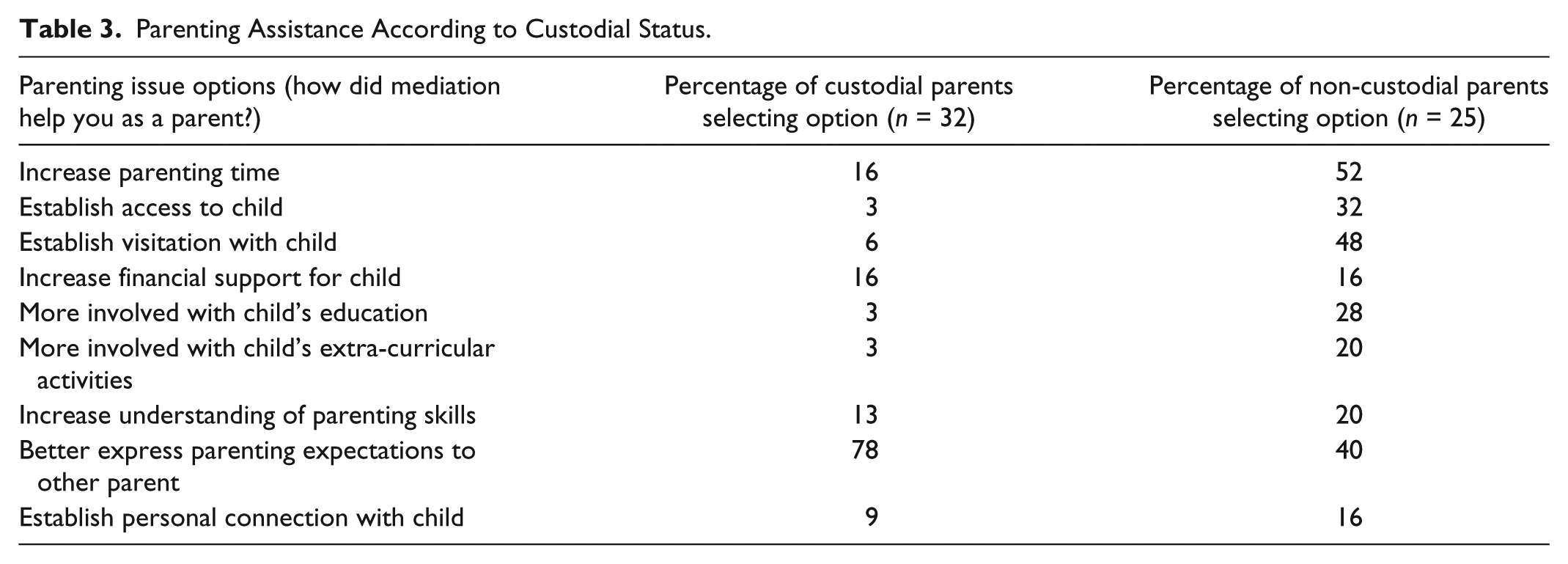
The option of “better express parenting expectations to other parents,” however, proved a striking exception. A substantially greater number or proportion of custodial parents (78%) acknowledged mediation’s help with communicating parenting expectations than did non-custodial parents (40%).
The persistence of post-mediation changes was examined in guided interviews of 43 party participants after a four- to eight-week interval following mediation. Interviewees were asked to indicate whether features of their relationship with the other parent and with their child, as well as aspects relevant to their financial situation, had increased, decreased, or stayed the same since mediation (or relevantly similar language). 9 The purpose of these questions was to measure the impact of mediation on reducing conflict and protecting relationships using indicators involving parent-to-parent and parent–child interactions. Parents’ financial situation was also a relevant indicator due to research indicating a connection between parent conflict and reliability of child support payments (Hutson, 2007; Yates, 1997). Sustained post-mediation changes (that is, reported increases or decreases) in nearly all the categories were generally absent. Almost half or more of interviewees considered the situations of inter-parent communication (49%) and conflict (65%) to be static; at least 65% considered their relations with their child to be unchanged; and family finances remained the same or did not apply for 60% and more of interviewees. The only suggestion of durable post-mediation changes concerned the interviewee’s ability to resolve conflicts with the other parent—half of those interviewed reported an increase in this ability.
Community mediation tends to rate highly in party satisfaction (Wissler, 1995), and 95% of participants in community mediation programs across the country indicated their readiness to use mediation again (Wilkinson, 2001). With a 99% response rate, nearly all participating parents indicated their willingness to use the mediation services of the program again (95%) and recommend it to others (99%). Differences between high- and low-income participant responses with respect to satisfaction were not meaningful as at most one participant from either the lower or higher income categories was disinclined to either use or recommend the mediation services.
Discussion
This study shows that community mediation can provide contending parties at a variety of income levels with access to mediation services for divorce/separation-related parenting disputes. The low income of most (56%) of the parties plus the minimum US$50,000 income of over one fifth (23%) of the parties indicate that, with respect to parenting disputes, community mediation lived up to its promise of serving those with low incomes and did so without ignoring the dispute resolution needs of those more comfortably circumstanced.
Study results also furnished evidence that the benefits of mediating parenting disputes arising from divorce or separation were available to estranged parents who received mediator services under community mediation that incorporated both free mediation services and volunteer mediators. The favorable reactions to the community mediation of parenting disputes exhibited by parent participants with respect to their willingness to participate in the program and recommend it to others were independent of income level and consistent with other research results (Wilkinson, 2001). Similarly, the agreement rate of 61% reported in this study is consistent with mediation and community mediation trends for other types of disputes (McGillis, 1997; Wilkinson, 2001).
The present study suggested that community mediation’s greatest allure for party participants resided in its offer of an alternative to litigating parenting issues. The free mediation services and convenience provided by community mediation of parenting disputes attracted a minority of parties: approximately one third of parties turned to mediation because of considerations of cost (30%) or convenience (35% of combined accessibility categories). For most of the participating parties, though, community mediation provided a sought-after alternative to settling disputes in court. It was the most popular reason for parties’ choice of mediation—64% considered mediation preferable to court and 46% identified the reduction in court involvement as a mediation achievement. Moreover, avoiding litigation was a prevalent reason for parties at both lower and higher income levels. These data lend themselves to the understanding that while community mediation may eliminate economic barriers to using mediation for parenting disputes, 10 it is the prospect of a substitute for litigation that brings people to the community mediation table. Alternatively, it may be that the absence of service fees alleviated parties’ financial concerns and allowed non-economic considerations to predominate in electing mediation. The relationship between fee structure and reasons for mediating warrants further investigation beyond the scope of this particular study.
The importance of litigation avoidance in motivating disputing individuals in the throes of divorce/separation to turn to community mediation may be further explained by data in this study, which show that—unlike the Bautz and Hill (1989) study where participants were primarily concerned about cost and identified friends, therapists, and the media as their sources for information about mediation—the court was the source of information about the community mediation program for a large majority of the parties. It is reasonable to infer, first, that the court’s status as an authority in the adjudication of family disputes may well have conferred enhanced legitimacy on community mediation as an alternative dispute resolution process, making it an attractive choice for the majority of parties. Second, inasmuch as divorce actions involve court proceedings, a majority of parties may have already experienced the detrimental effects of divorce litigation on their relationship or their pocketbook (Moses, 2009, ). Thus, for many parties, the court played an important role in their selection of community mediation to settle their parenting disputes.
Besides avoiding litigation, the formation or revision of parenting plans loomed large for participating parents. Parenting plans allocate rights and responsibilities for child-rearing between parents. As a result, these plans are an important vehicle for effective co-parenting, forestalling disagreements about child-rearing between estranged parents (Moses, 2009). Moreover, such plans may be legally mandated. Massachusetts law provides that a type of parenting plan known as a shared custody implementation plan is to be submitted to the court by parties contesting child custody (Massachusetts General Law ch.208 §31). Working on parenting plans proved to be a prevalent accomplishment of the community mediation process according to party participants.
Although child-rearing issues formed the substance of the disputes that gained entrée into the community mediation program examined here, most parties wanted mediation to assist them with their inter-parent relationship, that is, with the way they interacted with one another in handling their disagreements. Indeed, 25% fewer parties responded to the survey question about mediation’s helpfulness with parenting than to the question about mediation achievements. Improved between-parent communication and conflict management were in the top quartile of most parties’ mediation accomplishments. For most participants, then, matters concerning the relationship between parents were at the forefront of concerns that they brought to the mediation table. It is noteworthy that reducing parent conflict through improved parent-to-parent relationships can redound to the benefit of the children (Emery et al., 2005).
Among the three-fourths of parents who responded to the question concerning parenting assistance, non-custodial parents tended to be significantly more positive about mediation’s helpfulness with parenting issues than were custodial parents. Among all responding parties, the only option that garnered a majority of responses (at 61%) concerned inter-parent relations, namely, inter-parent communication of parenting expectations. Although, when responses in this category were disaggregated by custodial status, the proportion of non-custodial parties finding that mediation helped them express parenting expectations proved fairly substantial (at 40%), it paled in comparison with the robust response of custodial parent parties (at 78%). The possibility that this result portends a nascent beginning of cooperative co-parenting by these estranged parents, however, awaits further investigation.
It may be that these reported developments in the relationships between parents will prove temporary. Implementing the mediation agreement and sustaining positive changes are challenging tasks: As one party pointed out, “You gave us great tools to work with. Easier said than done of course.” When the first flush of enthusiasm about a successful mediation wears off, reality may set in and parties may return to their old conflict habits. As another party noted, “Yes, [the] day of mediation seemed wonderful and positive, we came to an agreement. The very next day he tried to get out of it.” Encouraging hints that the changes in inter-parent relationships following mediation may have some staying power are suggested by parties interviewed after a four to eight-week interval, where half indicated that their ability to resolve conflicts with the other parent had increased.
The present study is constrained by its reliance on retrospective self-reporting (see, for example, Howard, Millham, Slaten, and O’Donnell [1981] on response shifts and self-reports and Maiman [1997] on discrepancies between documented and party-reported mediation agreements). The biases that typically attend backward-looking self-reports are mitigated by the role that self-reports here play as a primary source of knowledge about the parties’ perceptions and cognitions concerning the outcomes produced by mediation. In any event, to the extent that sensitive matters were broached in this inquiry, the precautions taken to preserve confidentiality may have improved response quality (Singer, von Thurn, & Miller, 1995).
Future research is needed to determine the extent to which the results of this study can be generalized. These results were collected from participants in a particular community mediation program with features that may limit generalization. The program operated under Massachusetts law, employed a co-mediation approach, offered multiple mediation sessions, and worked with a primarily White population. Additional research is needed to determine how community mediation of divorce/separation-related parenting disputes fares when the population served is diverse, a different mediation style is employed, mediation is limited to a single session, or when other laws govern parenting disputes, particularly with regard to such features as custodial status, parenting plans, and mediator training.
Conclusion
The present study provided a measure of reassurance that the benefits of mediating parenting disputes between estranged parents are not diminished when mediation services are free and provided predominantly by volunteer mediators. The study results yielded promising signs that community mediation offers an economically diverse group of disputants, particularly those of low income, access to an effective dispute resolution process that addresses divorce/separation-related parenting disputes. Regardless of income, most participating parties turned to community mediation because it presented an alternative to litigation, and, according to the majority of the parties, community mediation did not disappoint. The reported agreement rate of 61% here was consistent with other mediation research findings as were the generally favorable party reactions to participating in the program.
The community mediation process proved successful to some degree at all levels of income and for both custodial and non-custodial parents. The majority of the disputing parents emerged from community mediation with reports of the development of parenting plans, and a sizable minority claimed reductions in court involvement and improved between-parent interactions. Moreover, mediation furnished the estranged parents with an opportunity to communicate with one another, particularly about expectations concerning parenting for a large majority of responding custodial parents. In the end, any decrease in the conflict between estranged parents that is attributable to their participation in community mediation may increase the well-being of their children.
Footnotes
Declaration of Conflicting Interests
The author(s) declared no potential conflicts of interest with respect to the research, authorship, and/or publication of this article.
Funding
The author(s) received no financial support for the research and/or authorship of this article.