




Abstract
Project-based learning (PBL) is a transformative approach to college education with the potential to develop comprehensive skills such as critical thinking, problem-solving, and teamwork. This study explores factors influencing the effectiveness of PBL and proposes strategies for its enhancement among Chinese college students. Utilizing the Input-Environment-Output (IEO) model as a theoretical framework, we conducted an empirical analysis of PBL outcomes and their determinants. The study employed advanced data analysis techniques, including structural equation modeling (SEM), to demonstrate the positive impact of PBL on knowledge integration, project skills, and self-efficacy. The effectiveness of PBL, however, is influenced by various factors, including instructional design, teacher guidance, student participation, and the disciplinary and institutional contexts. Based on a survey of 553 Chinese college students, the findings suggest that targeted improvements in these areas can optimize PBL to better meet students’ educational needs. The results provide actionable insights for educators and policymakers on enhancing PBL strategies to foster a more engaging and effective learning environment.
Plain language summary
This study looks at a teaching method called Project-Based Learning (PBL), which is a way for students to learn by working on projects. We wanted to find out how well this method works for college students in China and what can be done to make it even better. We used a model called the Input-Environment-Output (IEO) to understand how different things like teaching designs, teacher support, and the college environment can affect how well students do in PBL. We found that PBL helps students to integrate knowledge, improve project skills, and boost their confidence in their abilities. However, we noticed that some factors like how lessons are planned, how much teachers guide students, and how involved students are can make a big difference in how effective PBL is. From our survey of 553 Chinese college students, we discovered that making certain improvements in these areas can greatly improve PBL. This will help students’ educational needs be met better. Our findings give useful insights for teachers and policymakers on how to enhance PBL strategies and create a more engaging and effective learning environment for students. In simple terms, we are saying that when students work on projects, they can learn better, but we need to pay attention to how we plan these projects, how teachers help students, and how the college helps too. This way, students can become more skilled and confident in their learning.
Introduction
In today’s academic landscape, universities and colleges are increasingly prioritizing not only traditional academic skills but also fostering digital literacy, critical thinking, effective communication, teamwork, and other essential competencies among students (Granado-Alcón et al., 2020; Mielikäinen & Viippola, 2023; Thornhill-Miller et al., 2023; Turiman et al., 2012). Within the Chinese educational context, the entrenched prevalence of examination-driven education has perpetuated traditional teaching methodologies in tertiary institutions, wherein students are solely expected to memorize specialized knowledge for the sole purpose of passing the culminating examinations that ultimately determine their final academic grade (Xu and Liu, 2010). These methods, which include indoctrination, formalism, and rote learning, are at odds with the transformative development required of tertiary education in the modern era, as highlighted by Yang (2021).
Moreover, the traditional “teacher-centered” pedagogical approach predominantly features the teacher as the primary knowledge transmitter, with students in a passive recipient role. Despite its effectiveness in classroom management, this approach may constrain student innovation and engagement, leading to decreased attentiveness when interest is lost (Barman, 2013; Bo et al., 2022). The rigidity of traditional teaching methods frequently creates a gap between academic curricula and the practical skills needed in today’s world, presenting a substantial challenge for higher education (Bo et al., 2022; Sanna & Laura, 2020).
To address educational disparities, a fundamental shift towards diverse teaching methodologies is crucial, with a strong emphasis on project-based learning (PBL). PBL fosters an interactive, student-centered learning environment, cultivating self-motivation, critical thinking, and problem-solving skills through real-world challenges (Chen & Yang, 2019; Hu, 2017; Saira & Hafeez, 2020; Turiman et al., 2012; Zhang & Ma, 2023). Extensive research consistently demonstrates PBL’s effectiveness in enhancing academic performance and student engagement, indicating its potential to better prepare learners for societal demands and lifelong learning (Bertel et al., 2022; Henriksen et al., 2019). By engaging in authentic project-based tasks, students develop a sense of ownership and autonomy in their learning journey, fostering heightened motivation and self-directed learning tendencies (Alorda et al., 2011). In China, project-based learning emerged in the late 1980s in colleges and universities to pioneer higher education reforms. It has enabled students in underprivileged areas to develop sound work ethics, gain self-esteem, and build confidence (Lyu, 2023).
In this context, PBL as a student-driven approach offers a new pathway and potential for Chinese college students. Given the significance of fostering college students’ soft skills and project-oriented skills, this study aims to examine the knowledge integration, project skills, and self-efficacy levels of college students participating in PBL. Through a comprehensive questionnaire survey, we intend to assess the outcomes of PBL and identify the key influencing factors. Utilizing a structural equation model (SEM), we will analyze the relationships between these outcomes and the identified factors. Ultimately, this research will propose effective strategies for implementing PBL in universities and colleges, aiming to enhance PBL practices and improve the overall educational experience for college students.
Theoretical Model and Research Assumptions
This study is underpinned by the Input-Environment-Output (IEO) model, as proposed by Astin (1993), which has been instrumental in assessing the impact of universities, particularly focusing on the quality of the learning experience for college students. The IEO model delineates three primary components: Input, Environment, and Outcome. Inputs encapsulate the personal attributes students bring into the educational setting, including their initial talents and developed qualities. Environment pertains to the actual educational experiences students encounter, while Outcome encompasses the desired talents institutions aim for students to develop within the educational milieu (Astin, 1993).
In terms of how to evaluate effect of higher education, Astin and Antonio (2012) argued that learning outcomes in higher education can be categorized into two types: cognitive and affective outcomes. Cognitive learning outcomes include the knowledge and skills of general education and the knowledge and skills of professional education; affective outcomes include indicators such as self-perception, personal attitudes, student satisfaction, etc.
According to the IEO model constructed by Astin and Antonio (2012), students’ pre-enrollment individual characteristics and experiences are the “input” variables that influence students’ learning outcomes, such as demographic background information, behavioral patterns, and educational backgrounds; organizational characteristics of the institution, training programs, curriculum and instruction and student engagement are the “environment” variables. The “input” and “environment” together influence student learning outcomes (Cuellar et al., 2017). For example, Strayhorn (2012) applied the IEO model, using individual characteristics such as gender and ethnicity as “inputs” and variables including school-student interactions as “environment.”Keup (2006) conducted the study regarding the demographic variables (gender and race) and academic achievement and self-confidence prior to college as the “input” and institutional types and college experiences as the “environment.”Pascarella’s (1985) General Model for Assessing the Effects (GMAE) of Differential environments on Student Learning and Cognitive Outcomes extended the IEO model and divided “inputs” into the institutional level and the level of individual characteristics, and “environments” into the institutional organization, the institutional environment, the interpersonal aspects of the school (faculty, students, peers), and the quality of the student’s individual efforts (Pascarella & Terenzini, 2005). Besides, Pike et al. (2012) revealed students’ academic majors were significantly related to learning outcomes, and Hsieh (2014) found various student background characteristics can significantly predict different types of learning outcomes, which confirmed student’s majors play an important role in explaining learning outcomes.
Project-based learning refers to an inquiry-based learning approach that engages students in self-directed knowledge-building to develop products in the real world (Y. Chang et al., 2024; Wiek et al., 2014). It is project-centered learning in which students learn from the process of gathering information in which students ask questions, make assumptions, design solutions, self-direct themselves, collaborate with each other, solve problems, and produce results (Choi et al., 2019). Lin (2018) proposed that according to the division criteria of cognition, skills, and affective attitudes in Bloom’s Classification of Educational Objectives, project-based learning outcomes can be divided into knowledge integration, project skills, and self-efficacy.
Further elaborating on learning outcomes, Astin and Antonio (2012) categorize them into cognitive and affective domains. Cognitive outcomes encompass general and professional knowledge and skills, while affective outcomes include self-perception, personal attitudes, and student satisfaction. In accordance with Astin and Antonio’s (2012) IEO model, students’ pre-enrollment individual characteristics and experiences serve as the “input” variables influencing learning outcomes. These include demographic background, behavioral patterns, educational backgrounds, and institutional factors such as training programs and curriculum. The interaction between inputs and the learning environment significantly influences student learning outcomes (Cuellar et al., 2017).
Project-based learning (PBL) is a pedagogical approach that engages students in inquiry-based learning, requiring them to develop real-world products through self-directed knowledge building (Wiek et al., 2014). Lin (2018) categorizes PBL outcomes into knowledge integration, project skills, and self-efficacy, aligning with Bloom’s Classification of Educational Objectives.
Knowledge integration emphasizes the contextualization of students’ ideas and concepts. During the process of completing a project, students inevitably integrate new and existing knowledge and engage in investigation, research, communication, and collaboration. This final output further deepens the connection and integration of knowledge (C. C. Chang & Tseng, 2011).
Project skills refer to the skills or literacy that individuals need to engage in the project process (Bell, 2010; Martinez, 2022). Brassler and Dettmers (2017) proposed that the evaluation of the project-based learning process consists of five factors: posing a problem, understanding the problem, gathering resources, analyzing and reasoning, and summarizing and presenting.
Self-efficacy, as posited by Bandura (1977), denotes individuals’ confidence in navigating new environments or tasks, exerting a significant influence on learning engagement and outcomes. Rakoczy et al. (2019) demonstrated that self-efficacy mediates the relationship between formative assessment and learning outcomes, showing that self-efficacy enhances the perceived usefulness of feedback and learning engagement, thereby improving learning outcomes. Furthermore, Cattelino et al. (2019) explored the mediating role of self-efficacy in the relationship between parental and school external control and students’ academic achievement. Their findings suggest that reasonable programs and interventions aimed at boosting self-efficacy can help students succeed academically. Gutiérrez et al. (2017) proposed that teachers’ autonomy support can enhance students’ academic achievement, with self-efficacy and engagement in learning serving as mediating variables. This indicates that self-efficacy plays a crucial mediating role among various external conditions that contribute to students’ learning outcomes. Thus, fostering self-efficacy is essential for improving educational practices and student performance.
With respect to the influencing factors of students’ learning outcomes, PBL on the one hand, has special design requirements during implementation, such as being based on real-world problems, having a clear research plan and organization, and final outputs and summary reflections (Harmer & Stokes, 2014; Hasni et al, 2016), and equally inseparable from the active guidance of the teacher and the active participation of the students, where the teacher’s involvement, progress concern, attitude performance, and positive encouragement are related to the formation of the teacher’s guiding role, while the students’ sense of responsibility, independent learning, peer collaboration, and the use of technological tools are also related to the outcome of the students’ project-based learning (Gómez-Pablos et al., 2017). Meanwhile, college support also has an impact on student project-based learning outcomes, which includes the hardware environment such as the technological infrastructure and relevant facilities and software environment of the colleges such as the training (Almulla, 2020; Saimon et al., 2023), both of which are conducive conditions for conducting project-based learning.
Building upon Astin’s IEO model, Pascarella’s GMAE model, and the mediating role of self-efficacy, this study incorporates variables reflecting individual characteristics, instructional design, teacher guidance, and college support as determinants of PBL outcomes. Self-efficacy serves as a mediating variable in the relationship between these determinants and PBL outcomes. The proposed framework aims to elucidate the relationship between PBL and various influencing factors, guiding the formulation of hypotheses for empirical examination. Research framework (Figure 1) illustrating the interplay between PBL, influencing factors, and learning outcomes among college students. The model incorporates inputs, including individual characteristics and prior experiences; environmental factors, such as teacher guidance, student participation, instructional design, college support; and output, including knowledge integration, project skills, and self-efficacy. Self-efficacy acts as a mediating variable in the relationship between influencing factors and learning outcomes.
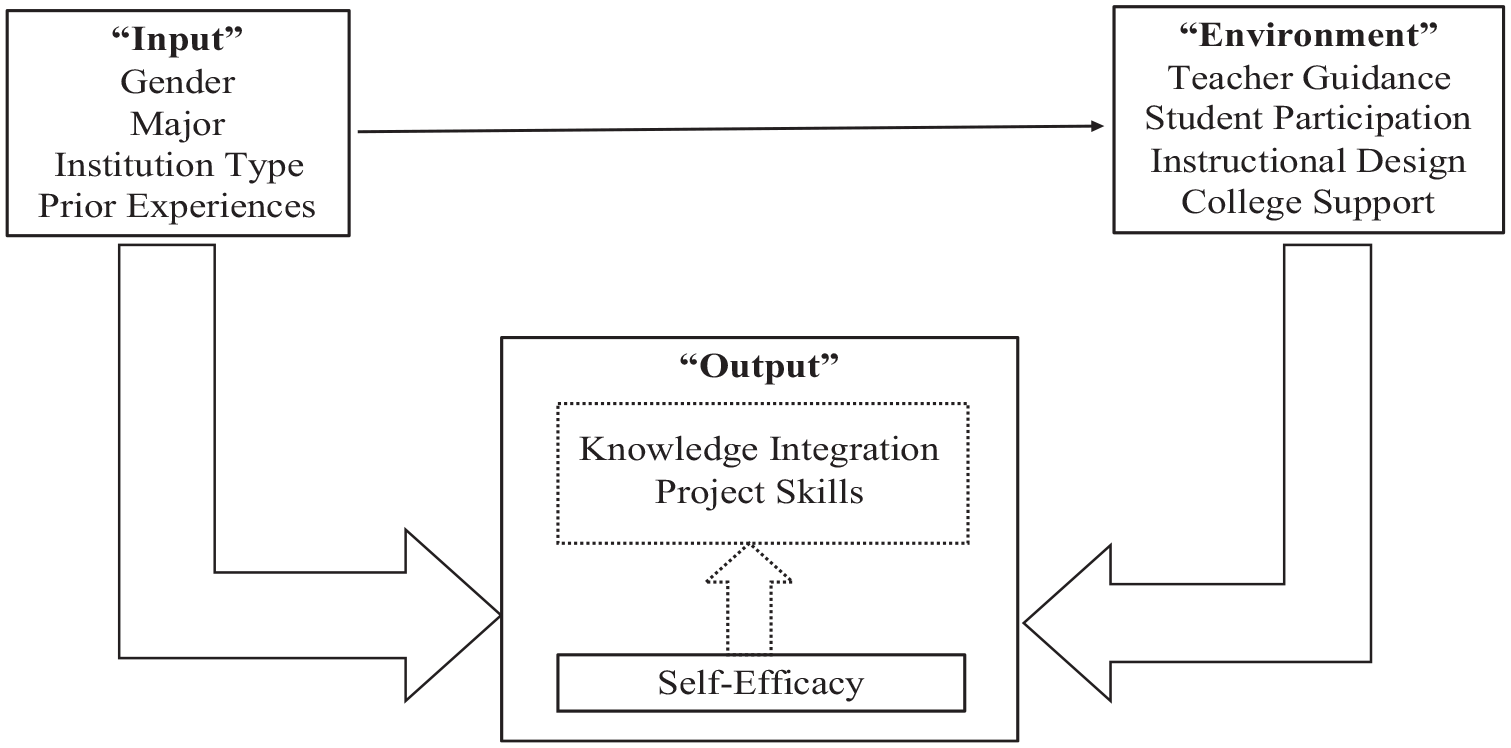
Research framework.
Thus, this study aims to investigate the relationship between project-based learning and various influencing factors for college students. The specific research hypotheses are formulated as follows:
H0: There is no significant difference in the mean levels of knowledge integration, project skills, and self-efficacy among college students participating in project-based learning.
H1: There are significant differences in the mean levels of knowledge integration, project skills, and self-efficacy among college students participating in project-based learning, which may be associated with demographic or other variables.
H2: The participation of college students in scientific research, academic activities, innovation and entrepreneurship competitions, and social practice services will have a significant positive effect on their project-based learning outcomes, particularly enhancing knowledge integration, project skills, and self-efficacy.
H3: Self-efficacy mediates the relationship between student participation, instructional design, teacher guidance, and college support, and the project-based learning outcomes of knowledge integration and project skills among college students.
These hypotheses expand our understanding of the various factors that contribute to the success of project-based learning among college students. By examining the influence of student participation, instructional design, and college support, we can identify effective strategies for enhancing knowledge integration and project skills within the project-based learning context.
Methodology
This study employs a quantitative research approach to investigate the effectiveness of Project-Based Learning (PBL) among college students in the Chinese educational context. The methodology encompasses the following key components: questionnaire design and pre-survey, data collection, and analysis.
Questionnaire Design and Pre-Survey
The questionnaire, as the research tool of this study, is mainly based on the existing project-based learning evaluation scale, with reference to some of the questions and self-edited some of the questions, which is finally integrated.
The questionnaire consists of three parts. The first part is the basic information, which mainly investigates the gender, institution, major and academic experience, innovation and entrepreneurship competition experience, social practice and service experience which are related to the PBL. The second part is a project-based learning evaluation scale for college students, which consists of three factors, including knowledge integration, project skills, and self-efficacy, with a total of 20 items, coded as B1–B6, C1–C10, and D1–D4, respectively. The third part is a project-based learning influencing factors scale for college students, which is divided into four factors: teachers’ guidance, students’ participation, instructional design, and college support, coded as E1–E4, F1–F4, G1–G5, and H1–H4 respectively.
The questionnaires in the second and third parts of the study were based on a 5-point Likert scale, with values ranging from 1 to 5, with 1 indicating strong disagreement, 2 indicating disagreement, 3 indicating fair, 4 indicating agreement, and 5 indicating strong agreement. In the process of scale development and design in this study, the structural composition of the questionnaire and the selection of questions were based on the academic division of project-based learning dimensions, followed the strict principles of questionnaire design and scientific requirements, and deliberated on the language expression from the perspective of the audience. After repeated revisions, the questionnaire was first sought out by students on the campus to make corresponding suggestions, and then finally evaluated and approved by five experts for a small-scale pilot test, which ensured the content validity of the questionnaire to a certain extent. In order to test the scientific validity of the questionnaire, after the questionnaire design is completed, the questionnaire needs to be scientifically tested so as to delete some of the question items.
Therefore, the pre-survey of the questionnaire was carried out first. The pre-survey was distributed in J University, and a total of 112 samples were recovered, and after the questionnaire responses were sorted and analyzed, the invalid questionnaires were excluded, and 87 valid data were obtained, and the recovery rate of the valid samples was 77.68%. After the pre-survey, the item analysis, validity test, and reliability test of the pre-test questionnaire should be carried out sequentially. Item analysis was conducted by using the critical ratio method and homogeneity test, and the test showed that the decision value of each item was greater than 3, and the total correlation coefficient of the questions was greater than .4, so all the items were retained after the preliminary analysis.
The validity test is mainly through exploratory factor analysis of SPSS.26, in which the Kaiser-Meyer-Olkin value (KMO) value of the Project-based Learning Evaluation Scale is .869, which is suitable for factor analysis. Three principal components are extracted for exploratory factor analysis by principal component analysis, and the cumulative explained variance of the three factors is 62.87%. The factor loadings of B1, B2, B3, and B4 in factors 3 is from .658 to .824 deleting B5 and B6, the factor loadings of C1, C3, C5, C6, C7, and C10 in factors 2 is from .613 to .780 deleting C2, C4, C8, and C9, and the factor loadings of D2, D3, and D4 in factors 2 is from .634 to .791 deleting D1. The KMO value of the Project-Based Learning Influencing Factors Scale is .904, and four factors are extracted by principal component analysis, and the explained variance of the four factors is 77.26%. This part of the scale is divided into four subscales based on the references, including teacher guidance, student participation, instructional design, and college support, and the variables included in each subscale are clearly and strictly defined, so the scale is carried out using the hierarchical and individual exploratory factor analysis method, in which the KMO values of each subscale are respectively .834, .824, .854, and .735, and factor loadings of E1–E4, F1–F4, G1–G5, and H1–H4 are .811–.933, .770–.914, .747–.911, and .774–.869.
The reliability analysis uses Cronbach’s α coefficient index, and SPSS.26 is used to test the reliability of the total scale of and the subscales of each factor, and the α coefficient of the total scale is .917, and the α coefficients of the subscales of each level are between .736 and .895, which means that the internal consistency reliability of the scale and the subscales of each level is good. Reliability analysis, employing Cronbach’s alpha coefficient, demonstrates good internal consistency reliability for both scales.
Data Collection and Analysis
The survey object of this questionnaire is full-time enrolled college students, and it is mainly distributed in a combination of online and offline, online mainly in the east, middle and west regions of China to select different levels, institutions and majors, through WeChat, QQ, and other social media to conduct random sampling, and offline mainly for the four universities in Province J of China within the project-based learning as the main teaching mode of the class for the centralized questionnaire distribution and recovery.
A total of 688 samples were recovered from the formal research, and after the questionnaire responses were sorted and analyzed, firstly, the initial screening was conducted to eliminate the invalid questionnaires that appeared in the cases of too short response time and consistency of the answers; secondly, this questionnaire is mainly targeted at the college students who have had project-based learning experiences, so this questionnaire was set up to screen the questions when it was designed, and invalid questionnaires that did not have the experience in the project-based learning were excluded in the secondary screening. Finally, 553 valid data were obtained, and the recovery rate of valid samples was 80.38%.
Analyzing the valid data through SPSS.26, among the 553 valid questionnaires, there are 235 males, accounting for 42.50%, and 318 females, accounting for 57.50%; in terms of the distribution of institutions, there are 205 people from the double first-class colleges (it refers to the universities and colleges supported by national strategy in China aimed at cultivating worldwide first-class universities and disciplines), accounting for 37.07%, there are 318 people from the general colleges, accounting for 57.50%, and there are 30 people from the higher vocational colleges, accounting for 5.43%; from the distribution of specialties, there are 231 people from humanities and social sciences, accounting for 41.77%, and 322 people from science, technology, agriculture and medicine, accounting for 58.23%; 426 people have participated in scientific research and academic activities, accounting for 77.03%, and 127 people haven’t participated in them, accounting for 22.97%; 387 people have participated in innovation and entrepreneurship competitions, accounting for 69.98%, and 166 people haven’t participated in them, accounting for 30.02%. 476 people have participated in social practice and service activities, accounting for 86.08%, and 77 people have not participated, accounting for 13.92%.
After the data were formally processed, the data analysis of this study was mainly divided into three parts, the first part was the reliability and validity test, which was mainly based on Cronbach’s alpha coefficient, CR value (Composite reliability combined reliability) and AVE value (Average variance extracted). The second part is the descriptive analysis and analysis of variance, which mainly includes the analysis of the current situation of the project-based learning outcomes of college students and the analysis of the variance of knowledge integration, project skills, and self-efficacy levels on demographic variables in the project-based learning outcomes of college students. The third part is the structural equation model (SEM) analysis of the project-based learning outcomes of college students and each influencing factor, in order to clarify the path relationships that exist among the variables.
Results
Reliability and Validity Test
The validity of the scale is generally tested through the two dimensions of reliability and validity. The secondary reliability and validity test of the scale by SPSS 26.0 and Smart PLS 4.0 shows that the alpha coefficients of each latent variable are between .691 and .850, which are all greater than .65; at the same time, the CR values are between .811 and .889, which are all greater than .8, indicating that the scale has good reliability. The AVE values of each latent variable ranged from .519 to .679, all of which were greater than .5, and the overall values of the factor loadings on each observed variable were greater than .7, indicating good convergent validity.
Descriptive Statistical Analysis
This section provides an overview of the project-based learning (PBL) outcomes among college students, offering insights into the central tendencies and dispersion of key variables such as knowledge integration, project skills, and self-efficacy. The descriptive statistics serve as a foundation for understanding the general performance and experiences of students engaged in PBL, addressing Hypothesis (H0) by presenting the mean scores and standard deviations of PBL outcomes.
According to Table 1, college students’ project-based learning has the highest level of knowledge integration (M = 3.86), indicating that the enhancement of knowledge dimensions is a more prominent outcome of project-based learning. Among them, the mean value of the formative integration index item is higher than that of the organizational integration index item, indicating that college students perform better in learning new knowledge, but are slightly weaker in connecting and organizing knowledge. The mean value of project skills (M = 3.80) is in the middle, with students performing better in asking questions, understanding problems, collecting resources, and presenting results, while the ability to use evidence is lower. The level of self-efficacy has a lower mean value compared to the other two, indicating that university students lack confidence and have slightly weak self-belief when it comes to project-based learning.
Overall Project-Based Learning Outcomes for College Students.

Impact of Demographic Variables on Project-Based Learning Outcomes
Building on the descriptive analysis, this section delves into the relationships between demographic variables and PBL outcomes using inferential statistics. It directly responds to Hypothesis 1 (H1) by employing independent samples t-tests and ANOVA to examine if there are significant differences in PBL outcomes across genders, major categories, and institutional types. Additionally, this section explores the impact of students’ extracurricular experiences, such as participation in scientific research, innovation and entrepreneurship competitions, and social practice services, which are proposed in the research hypotheses (H1 and H2). The analysis of variance (ANOVA) results contributes to understanding the extent to which these demographic factors and experiences influence the levels of knowledge integration, project skills, and self-efficacy among college students engaged in PBL.
As can be seen from Table 2, there is no significant difference in the levels of knowledge integration, project skills and self-efficacy of project-based learning among college students in terms of gender. However, there is a significant difference in terms of major categories, with students in science, technology, agriculture and medicine significantly outperforming students in humanities and social sciences in knowledge integration, project skills, and self-efficacy. This is consistent with findings from the offline pre-survey, which indicated that students in these fields have higher self-efficacy due to their frequent involvement in project development and interdisciplinary knowledge integration.
Results of the Analysis of Variance of Project-Based Learning Outcomes on Demographic Variables.

p < .05. **p < .01. ***p < .001.
One-way ANOVA (Analysis of Variance) was mainly used to test the significance of differences in the mean scores of knowledge integration, project skills, and self-efficacy in project-based learning in terms of institution type. First, for the dimension of knowledge integration, before conducting the ANOVA, a test of the homogeneity of variances was required for this dimension, the F-value of Levene’ s statistic was 1.11 (p = .33 > .05), indicating that the reorganization of the sample did not violate the homogeneity of variance. According to the results of ANOVA, the F-value of Knowledge Integration was 9.59 (p < .001) reaching the level of significance, indicating that there is a significant difference in the knowledge integration among students from different institutions. The post hoc comparison of this study adopts the LSD (Least—Significant Difference) method, and the data concludes that the students of double first-class colleges and universities are significantly higher than the students of general undergraduate colleges and universities in the dimension of knowledge integration, and the students who are admitted to the double first-class colleges and universities have higher academic achievements than general undergraduate colleges and universities. Second, as far as the Project Skill is concerned, the F-value of the Levene’s statistic is .64 (p = .53 > .05), and the F-value of the project skill test was 15.50 (p < .001) reaching the level of significance, indicating the students of double first-class colleges and universities are significantly higher than the students of general undergraduate colleges and universities, and the students of higher vocational colleges and universities are significantly higher than the students of general undergraduate colleges and universities.
There is significant variability in the impact of extracurricular activities on PBL outcomes. Students who participate in scientific research and academic activities exhibit higher levels of knowledge integration and project skills than those who do not. Those involved in innovation and entrepreneurship competitions show significantly higher levels of knowledge integration, project skills, and self-efficacy. Social practice and service activities, while important, show no significant difference in outcomes compared to those who do not participate. These findings suggest that involvement in specific extracurricular activities enhances students’ ability to acquire and integrate new knowledge, develop project skills, and build self-efficacy, thereby supporting more effective project-based learning.
Structural Equation Model Analysis
In order to clarify the path relationships among the variables and test the mediating role of self-efficacy, this study proposes to use partial least squares (PLS) structural equation model to construct a causal model of the variables.
First, the use of structural equation model requires an assessment of the overall model fit goodness, and the overall model fit metrics of this study, SRMR = 0.05 (<0.08), d_G = 0.42 (<0.95), and NFI = 0.84 (Henseler et al., 2016), indicate that the model of project-based learning outcomes and influencing factors of college students constructed in this study is feasible. Structural equation model was developed through Smart PLS 4.0, and the model diagram presentation was set to show path coefficients and p-values for the internal model, t-values for the external model, and R-square for the factor dimensions, see Figure 2, and direct and indirect effect tables for the path relationships among variables were derived, see Tables 3 and 4.

Structural equation model of project-based learning outcomes and influencing factor variables.
Direct Effects of Project-Based Learning Outcomes and Influencing Factor Variables.

Indirect Effects for Project-Based Learning Outcomes and Influencing Factor Variables.

The SEM analysis results generally support H1 and H3 and partially support H2, with the exception of the role of college support. The results do not directly address H0, but the significant path coefficients and mediating role of self-efficacy suggest that there are indeed differences in the mean levels of the variables, which would contradict H0’s assertion of no significant difference.
As shown in Table 3, in the knowledge integration level of college students’ project-based learning, instructional design factors show the most significant effect (β = .26, p < .001), student participation factor (β = .17, p < .01) and college support factor (β = .14, p < .01) also have a significant impact on the knowledge integration level of college students, which indicates that in the process of project-based learning, the integration of students’ interdisciplinary knowledge or the connection between existing experience and new knowledge depends more on the instructional design of teachers, and due to the lack of a clear understanding of the orientation of students towards project-based learning, the factor of student participation has a slightly less impact than the instructional design of teachers. It should be noted that college support also plays an indispensable role in the process of students’ project-based learning, and the hardware and software environments provided by the college can help students better learn new knowledge and new methods. The teacher guidance factor (β = .08, p > .05) is not significant enough in this model, which can be attributed to the fact that teacher guidance is more inclined to be a kind of psychological support, while the students’ knowledge integration ability mainly relies on the students’ cognitive development ability. From the perspective of college students’ project-based learning program skills, the most significant factor affecting learning outcomes is also the instructional design (β = .25, p < .001), which is in line with the research expectations, because project-based learning, as a specific learning mode, is carried out in the process of the corresponding requirements of the teaching process, and the relationship with the instructional design is inseparable. At the same time, project-based learning cannot be carried out without students’ participation (β = .22, p < .001), and project-based learning can be successfully implemented only if students are actively involved. In addition, the role of teacher guidance (β = .05, p > .05) and college support factors (β = .07, p > .05) in this dimension is not significant enough, stemming from the characteristics of the project-based learning students’ subjectivity, and in the process of the output of the results, the students, in accordance with the scientific design of the teaching and learning, put forward problems, analyze problems, solve problems, actively practice the research plan, and finally form the results independently by students, and the influence of the factors of teachers’ guidance and college support in this path is a little weak. In terms of self-efficacy in project-based learning, instructional design (β = .26, p < .001), teacher guidance (β = .33, p < .001), and student participation (β = .17, p < .01) can all contribute to the formation of self-beliefs in project-based learning, which can significantly help students build up self-confidence in their learning, stimulate the internal drive for continuous exploration and learning motivation, and facilitate students’ learning in project-based learning, which is conducive to the development of higher levels of knowledge integration (β = .24, p < .001) and project skills (β = .34, p < .001) in project-based learning.
According to the influence path validation of the structural equation model, self-efficacy plays a mediating role in the process of teacher guidance, student participation, and instructional design influencing the project-based learning outcomes of college students. Among them, the instructional design factor (β = .33, p < .001) has the most significant effect on self-efficacy, and the path coefficient is higher than the path coefficient of instructional design on knowledge integration and project skills. Teacher guidance factor (β = .26, p < .001) also has a significant effect on students’ self-efficacy, and it should be noted that the teacher guidance factor does not have a significant effect on students’ knowledge integration and project skill level, which shows that teacher guidance firstly affects students’ self-efficacy, and then affects students’ knowledge integration and project skill level. Meanwhile, student participation (β = .17, p < .01) also has a significant effect on self-efficacy in conjunction with expectations. However, college support (β = .03, p > .05) did not significantly influence students’ self-efficacy. According to Figure 2, it can be seen that the effect of self-efficacy on the level of students’ knowledge integration (β = .24, p < .001) and project skills (β = .34, p < .001) show a significance, and the effect of self-efficacy on project skills present the highest path coefficients in the model. In view of this, the influencing path of self-efficacy as a mediating role in project-based learning among college students can be summarized in Table 4.
These findings suggest that improving instructional design and encouraging student participation are critical strategies for enhancing project-based learning outcomes. Additionally, fostering self-efficacy among students is essential for maximizing their knowledge integration and project skills.
Discussion
Comprehensive Benefits of Project-Based Learning
Our study reinforces the manifold advantages of project-based learning (PBL), highlighting its significant impact on various dimensions of student learning. The findings from our structural equation model analysis, descriptive statistics, and variance analysis collectively affirm the positive influence of PBL on knowledge integration, project skills, and self-efficacy enhancement among college students. The results regarding knowledge integration demonstrate that PBL effectively promotes students’ ability to assimilate and apply new knowledge, consistent with previous research by Zhang and Ma (2023) and Bertel et al. (2022). Additionally, the emphasis on project skills aligns with observations by Lyu (2023) and Saira and Hafeez (2020), who noted the development of practical problem-solving abilities through PBL. Our study extends this understanding by showing significant improvements in asking questions, understanding problems, and presenting results—a critical set of skills for real-world applications. Moreover, the enhancement of self-efficacy, as a central theme in our discussion, is further supported by Turiman et al. (2012), who highlighted the positive impact of PBL on students’ self-perception of their learning capabilities. Our analysis indicates that PBL substantially elevates students’ self-efficacy, crucial for fostering confidence and motivation for self-directed learning, as noted by Alorda et al. (2011). The mediating role of self-efficacy revealed through our structural equation model underscores its pivotal position in influencing instructional design, teacher guidance, and student participation on learning outcomes, aligning with Hu’s (2017) assertion that PBL fosters interdisciplinary thinking and practical skills among college students.
Disciplinary and Institutional Variances in Project-Based Learning Outcomes
The impact of project-based learning (PBL) is nuanced, with disciplinary and institutional contexts playing pivotal roles in shaping learning outcomes. Our study’s variance analysis corroborates the notion that the benefits of PBL are not uniformly distributed across different fields of study and types of institutions, echoing previous findings by Pike et al. (2012) and Hsieh (2014). Students in science, technology, agriculture, and medicine majors scored significantly higher in knowledge integration, project skills, and self-efficacy compared to their counterparts in humanities and social sciences. This disparity may stem from the applied and interdisciplinary nature of STEM fields, which often involve project-based approaches closely aligned with real-world applications. For institutions offering general education and those with a focus on humanities and social sciences, PBL should emphasize not only knowledge acquisition but also its application and synthesis. The PBL process in these disciplines should facilitate the integration of knowledge from various domains, enabling students to categorize and logically structure information under a unifying project theme, as suggested by Xiong (2021). Moreover, our study indicates that institutional support significantly influences the effectiveness of PBL, with students from certain institutions showing higher levels of knowledge integration and self-efficacy. This suggests that institutional support plays a crucial role in enhancing PBL outcomes.
The Role of Teacher Guidance, Student Involvement, and College Support in PBL
The effectiveness of project-based learning (PBL) is significantly influenced by the quality of teacher guidance and the level of student involvement—two interrelated factors essential for a successful PBL experience. Our findings align with Gómez-Pablos et al. (2017), emphasizing the indispensable role of teacher guidance and student participation in shaping PBL outcomes. Teachers’ active engagement and students’ responsibility are pivotal to the successful completion of project-based tasks. Moreover, our study underscores the importance of innovative instructional design in facilitating PBL, as highlighted by Xia (2022). College support is also crucial, as indicated by Saimon et al. (2023) and Almulla (2020), enabling a conducive atmosphere for PBL. The support from colleges, encompassing both hardware and software environments, is critical for providing students with the necessary resources and platforms for meaningful learning experiences.
Significance of Student Self-Efficacy in PBL
The collective culture among Chinese college students underscores the significance of self-efficacy in project-based learning (PBL). Bandura’s (1977) self-efficacy theory aligns with our findings, highlighting that individuals thrive when they perceive care and support from their environment, leading to higher levels of self-efficacy and improved learning outcomes. Our study’s results indicate that self-efficacy acts as a pivotal mediator between influencing factors and learning outcomes within PBL. Students with heightened self-efficacy are more likely to experience positive emotions and beliefs, fostering a proactive approach to learning and leading to enhanced performance. This positive cycle is further supported by Rakoczy et al. (2019), who emphasized self-efficacy’s role in the effectiveness of formative assessment, integral to PBL. Moreover, self-efficacy and engagement serve as crucial mediating variables connecting supportive teaching practices with improved student outcomes, as proposed by Granado-Alcón et al. (2020).
Conclusion
Drawing upon the IEO model in the field of higher education, this study investigated the project-based learning outcomes of college students and the influencing factors through a questionnaire survey and structural equation modeling. The study yielded the following conclusions:
First, our study found that Chinese college students’ performance in knowledge integration within project-based learning surpassed that of project skills and self-efficacy. This suggests that students excel in synthesizing and applying knowledge across disciplines through project-based learning. Second, there is no significant difference in the project-based learning outcomes of college students by gender, but there is a significant difference in the types of major, and institution, and there is a significant difference in the experience of participating in scientific research and academic activities and innovation and entrepreneurship competitions. Third, the factors of teacher guidance, student participation, instructional design, and college support have a direct positive and significant effect on the project-based learning knowledge integration and project skill level of college students, and the factors of teacher guidance, student participation, and instructional design have a positive and significant effect on the project-based learning outcomes of college students indirectly through self-efficacy.
The study’s findings inform theory by enhancing the understanding of factors shaping project-based learning outcomes. In practice, educators can optimize PBL experiences by prioritizing teacher guidance, student participation, instructional design, and college support. Policymakers can leverage these insights to advocate for policies promoting effective PBL practices, interdisciplinary collaboration, and educational investments. Overall, the study contributes to improving PBL effectiveness, fostering student success, and aligning educational practices with the demands of the modern workforce.
Despite the valuable insights gained from this study, several limitations should be acknowledged. Firstly, the study relied on self-reported data from a sample of 688 college students, which may introduce response bias and limit the generalizability of findings. Secondly, the study primarily focused on the influence of demographic and environmental factors on project-based learning outcomes, overlooking other potential variables such as prior academic achievement or motivation. Future research should consider a more comprehensive range of factors. Finally, the study’s cross-sectional design precludes causal inference, highlighting the need for longitudinal studies to elucidate the dynamic nature of project-based learning processes and outcomes over time.
Supplemental Material
sj-docx-1-sgo-10.1177_21582440241276600 – Supplemental material for Empowering Education: Unraveling the Factors and Paths to Enhance Project-Based Learning Among Chinese College Students
Supplemental material, sj-docx-1-sgo-10.1177_21582440241276600 for Empowering Education: Unraveling the Factors and Paths to Enhance Project-Based Learning Among Chinese College Students by Yuanyuan Shi and Weimin Li in SAGE Open
Footnotes
Acknowledgements
We express our sincerest gratitude to all the students who participated in our research project survey. Without their valuable input, this study would not have been possible. We would also like to extend our thanks to the teachers who assisted in ensuring the smooth operation of this research. Their support and cooperation were crucial in the successful completion of this study.
Declaration of Conflicting Interests
The author(s) declared no potential conflicts of interest with respect to the research, authorship, and/or publication of this article.
Funding
The author(s) disclosed receipt of the following financial support for the research, authorship, and/or publication of this article: We acknowledge the funding support from the Doctoral Program of Innovation and Entrepreneurship in Jiangsu Province (Grant No. 171125006) and the Ministry of Education’s Humanities and Social Sciences Project (Grant No. 23YJCZH184).
Ethical Approval
The survey for this study was conducted with the full consent and approval of the Professors’ Committee of the Faculty of Education at Jiangsu University. The survey methodology and questionnaires used in this study were carefully crafted and agreed upon by the respondents, ensuring their active involvement. Communication and agreement between the researcher and the respondents primarily took place through convenient channels such as WeChat and emails. Transparency was a priority throughout the survey process. Every respondent was clearly informed that their participation was anonymous, and their personal information would remain confidential. The data collected in this study will be utilized exclusively for scientific research purposes. To ensure the voluntary nature of participation, all respondents were assured that they had the freedom to withdraw from the survey at any point without any negative consequences. Respecting the privacy of the participants, strict measures were implemented to securely store and protect the collected data, limiting access exclusively to the research team. Adhering to ethical guidelines and regulations, this study prioritized the well-being and rights of the participants. It is through these measures that we strive to conduct responsible and valuable research.

Data Availability Statement
The datasets generated and analyzed during the current study are available from the corresponding author on reasonable request.
Supplemental Material
Supplemental material for this article is available online.
References
Supplementary Material
Please find the following supplemental material available below.
For Open Access articles published under a Creative Commons License, all supplemental material carries the same license as the article it is associated with.
For non-Open Access articles published, all supplemental material carries a non-exclusive license, and permission requests for re-use of supplemental material or any part of supplemental material shall be sent directly to the copyright owner as specified in the copyright notice associated with the article.
