




Abstract
The swift incorporation of artificial intelligence (AI) into higher education has significantly propelled the digital transformation of education. This advancement is crucial for educators aiming to augment teaching quality through AI technologies, such as ChatGPT. However, the acceptance of ChatGPT among college students remains underexplored. This paper aims to clarify the determinants influencing college students’ acceptance of ChatGPT and to facilitate its widespread adoption in higher education. To achieve this, we integrate the Technology Readiness Index (TRI), Technology Acceptance Model (TAM), and Theory of Planned Behavior (TPB) to develop a novel research framework. Employing a mixed-method approach that includes PLS-SEM and fsQCA, we analyze data from 298 Chinese college students. Our findings indicate that discomfort and insecurity adversely affect Perceived Ease of Use (PEU) and Perceived Usefulness (PU) in the context of ChatGPT adoption. Additionally, both PEU and PU positively impact attitudes, which, in conjunction with Subjective Norms (SN) and Perceived Behavioral Control (PBC), bolster the intention to accept ChatGPT. Insights from fsQCA reveal that the acceptance of ChatGPT among students is not driven by a singular factor but by an amalgamation of these elements, underscoring the complex nature of technology adoption. The paper concludes with practical recommendations for educators and designers to refine curriculum design and teaching methodologies, boost student engagement and learning efficacy, and promote the broader adoption of educational technology.
Plain language summary
This study contributes to the existing literature by amalgamating the Technology Readiness Index (TRI), Technology Acceptance Model (TAM), and Theory of Planned Behavior (TPB) into a novel research model to identify significant factors that influence Chinese college students’ acceptance of ChatGPT via a mixed approach that combines PLS-SEM and fsQCA within higher educational settings.
Keywords
Introduction
Chat Generative Pre-Trained Transformer (ChatGPT), an emerging technology spanning various industries, has become one of the most popular AI applications on the Internet since it was launched by OpenAI on November 30, 2022 (Chen, 2023). As an AI technology, ChatGPT integrated large amounts of data and advanced computing methods, which can string words and offer substance for users’ decision-making based on their conversational input (Sundar, 2023). It means that the functions of ChatGPT are not limited to simple chat, but can also churn out convincingly fluent text, such as prose, poetry, computer code, and even scientific research papers (Jo, 2023). Thus, “Millions are using it” (Editorials, 2023), which has also garnered significant attention from scholars, especially educators.
Within the sphere of the education sector, the rapid integration of AI technologies in traditional higher education has led to the utilization of smart technologies such as augmented reality, virtual reality (Wu et al., 2020), and game-based learning systems (Hwang et al., 2013; Subhash & Cudney, 2018), which can enhance student engagement and motivation in the classroom (Shen et al., 2022), cater to the personalized needs for all categories of students (Chatterjee & Bhattacharjee, 2020), promote students’ creativity and self-efficacy (Wang et al., 2023), improve course satisfaction of undergraduates (He et al., 2022), and even forecast student attrition rates to alert educators to improve teaching methods and quality (Salas-Pilco & Yang, 2022). As an AI technology utilizing natural language processing and deep learning technologies, ChatGPT has also demonstrated numerous advantages, including the enhancement of education quality (Khan et al., 2023), the promotion of innovative teaching practices (van Dis et al., 2023), and the alleviation of teaching pressure (Aljanabi et al., 2023). Thus, the significant effects of AI technologies on knowledge dissemination have been substantiated. However, unless the technology is accepted, its usefulness will be limited (Oye et al., 2012). Therefore, understanding technology adoption is of paramount importance. Several techniques were used to assess the embrace of AI tools in schools, including SEM (Chatterjee & Bhattacharjee, 2020), PLS-SEM (Foroughi et al., 2024; He et al., 2022; Wang et al., 2023) and fsQCA (Foroughi et al., 2024; Pappas et al., 2019), as well as theoretical frameworks such as the TPB, TAM, and TRI (Alhasan et al., 2023). However, technology adoption has evolved into a complicated process that includes multiple characteristics such as individual traits, external environment, and various enabling variables (Ajzen, 1985; Gefen et al., 2003; Kamble et al., 2019; Thompson et al., 1991). Likewise, there has been little empirical study on what variables influence students’ acceptance of ChatGPT in higher learning. However, Kwet and Prinsloo (2020) highlighted the necessity for additional empirical studies in the realm of smart education. Hence, in alignment with the suggestion of Kwet and Prinsloo (2020) and drawing upon the theoretical framework proposed by Kamble et al. (2019), this study integrates TRI, TAM, and TPB into an SEM-based model. This integration aims to bolster the model’s explanatory capacity and delve deeper into the acceptance patterns among college students.
Past investigations mainly concentrated upon the incorporation of AI-powered educational tools with limited attention given to their potential advantages in both students’ learning experiences and educators’ teaching methodologies. Thus, this paper focuses on the usage of ChatGPT, aims to explore the determinants influencing Chinese college students’ acceptance, and provides practical suggestions for designers and educators within higher education contexts. In addition, the construction of an enhanced framework, merging TRI, TAM, and TPB, seeks to validate its adaptability and operate as an essential roadmap for subsequent studies. Moreover, social science academics are advised to use all available statistical methods to fully investigate and comprehend the phenomena they study according to J. F. Hair et al. (2019). However, prior research heavily relied on PLS-SEM as a symmetrical method grounded in regression techniques. Kang and Shao (2023) pointed out the limitations of regression analysis, emphasizing its potential to compromise the validity of results when comprehending the complexities of human behaviors. Hence, this study opted for an asymmetric approach (fsQCA), allowing for simultaneous assessment of various alternative causal configurations, which aims to investigate how various sets of factors may explain students’ proclivity for accepting ChatGPT. Finally, employing an innovative mixed methodology that combines PLS-SEM and fsQCA, this study aims to identify linear relationships among determinants and outlines causal combinations within higher education settings, which not only addresses previous study limitations but also provides a more robust understanding of ChatGPT acceptance. Therefore, this paper expands the current knowledge on AI technology acceptance within higher education by accomplishing the following three objectives:
(1) To develop an advanced framework by integrating TRI, TAM, and TPB, aiming to comprehensively identify determinants that influence the acceptance intention of ChatGPT and provide a valuable roadmap for future research in higher education domains.
(2) To employ a mixed approach that combines PLS-SEM and fsQCA techniques to address methodological limitations of earlier studies and provide a comprehensive and deeper understanding regarding ChatGPT acceptance intention.
(3) To provide practical implications for educators and designers to improve curriculum design and teaching methods, enhance students’ learning motivation and effectiveness, and promote the popularization of educational technology within higher educational settings.
Integrating TRI, TAM, and TPB into a novel framework and validating its adaptability within higher education settings, this paper identifies the determinants shaping college students’ acceptance of ChatGPT. From linear (PLS-SEM) and configuration perspectives, this paper conducted a path test, mediating test, and configuration analysis. Practical suggestions are offered to education and designers within higher education, which aim to elucidate the determinants driving ChatGPT acceptance intention, deepen the understanding of these determinants, promote its popularization, and provide a valuable roadmap for future research in higher education domains.
Research Model and Hypotheses
Model Conceptualization
To fortify the adaptability of the research framework and offer a valuable roadmap for future research in similar domains, this study integrates the TRI, TAM, and TPB for several key reasons. TAM has garnered significant research attention in the education sector for its exceptional explanatory power concerning users’ acceptance of technology (Alhasan et al., 2023; Davis, 1989; Shen et al., 2022). Thus, TAM has been seen as the basic theory in this study. However, many TAM studies have been criticized for disregarding external variables (Gillenson & Sherrell, 2002; Holden & Rada, 2011), resulting in diminishing predictive and explanatory capabilities of TAM. Furthermore, the inherent complexity of relationships across different research backgrounds leads to the challenge to explain and predict these intricate relationships based on single or partial theories (Bagozzi, 2007; Legris et al., 2003). Thus, it is imperative to enhance the accuracy and predictive abilities of existing research models, such as TAM (Venkatesh & Bala, 2008; Wixom & Todd, 2005) and TPB (Jun & Arendt, 2016; Kim & Hwang, 2020; Lung-Guang, 2019). Kamble et al. (2019) proposed that integrating user-controlled elements with TAM can improve the adaptability and flexibility of the research framework and provide a more robust and nuanced understanding of technology acceptance. Thus, endeavors have been made to boost the anticipatory ability of individual decision-making across various contexts via combining TAM and TPB. (Cheung & Vogel, 2013; Del Pozo et al., 2021; Huang et al., 2023). In addition, TRI is critical for determining users’ willingness to embrace emerging technologies, particularly as personality traits significantly impact cognitive dimensions (Chittipaka et al., 2023; Kuo et al., 2013; Matsepe & Van der Lingen, 2022). Thus, the amalgamation of TRI, TAM, and TPB has been widely utilized in forecasting technology acceptance. Therefore, a novel framework was developed by integrating TRI, TAM, and TPB, in accordance with the recommendation of Hu et al. (1999) and drawing from the insights from Walczuch et al. (2007). TRI serves to identify inhibiting factors rooted in individual personality perceptions. Meanwhile, both TAM and TPB scrutinize the developmental process of attitudes and acceptance toward ChatGPT based on system-specific perceptions.
Research Hypothesis
Technology Readiness Index (TRI)
TRI refers to a person’s proclivity for accepting novel technologies (Parasuraman, 2000). In developing a novel framework to analyze college students’ acceptance of ChatGPT within higher education settings, this study integrates insights from TPB, TAM, and TRI. To ensure the model’s efficiency and practical utility, and to avert difficulties in interpretation stemming from conceptual redundancy, this paper argued that Optimism and Innovativeness are effectively represented by their counterparts in TPB and TAM. The decision to exclude Optimism and Innovativeness from TRI as distinct variables in our model is based on several considerations. Firstly, both PEU and PU from TAM comprehensively encapsulate the essence of Optimism. These constructs explicitly reflect individuals’ positive expectations regarding the efficacy of technology in enhancing work productivity, thus encapsulating the optimistic aspect of technology adoption. This alignment negates the need for separate variables for Optimism. Secondly, SN and PBC within TPB intersect with Innovativeness, addressing aspects of social influence and individuals’ perceptions of control over new technology. Thus, to enhance the research’s precision and applicability while maintaining the theoretical framework’s clarity and coherence, discomfort and insecurity are included in the framework of this study.
Discomfort (DIS) reflects the individual’s lack of control and the sense of being overwhelmed by technologies, while insecurity (INS) refers to the individual’s distrust of technology and concerns about its potentially harmful consequences. Parasuraman and Colby (2001) indicate that TRI is the overall tendency of individuals to accept new technologies, which results from the interaction of driving and inhibiting factors. In previous studies that refer to TRI, discomfort negatively affects PEU, and people with a high level of discomfort toward new technologies tend to feel overwhelmed by the complexity of technology. Meanwhile, discomfort has been shown to hurt PU due to its inhibitory factors that reduce users’ technical readiness (Kuo et al., 2013; Parasuraman, 2000; Walczuch et al., 2007). Additionally, individuals with a higher degree of insecurity tended to perceive new technologies as less useful and less user-friendly, resulting in a negative impact on their PU and PEU (Walczuch et al., 2007). Building on prior studies, this paper considers that insecurity is a predictor of reduced levels of both PU and PEU.
H1a: Discomfort negatively affects the PEU of ChatGPT.
H1b: Discomfort negatively affects the PEU of ChatGPT.
H2a: Insecurity negatively affects the PEU of ChatGPT.
H2b: Insecurity negatively affects the PEU of ChatGPT.
Technology Acceptance Model (TAM)
Davis (1989) extended TAM originating from TRA by Fishbein and Ajzen (1977). PEU and PU emerged as determinants to affect an individual’s attitude and behavioral intention to adopt new technologies. Perceived ease of use (PEU) pertains to the extent to which individuals perceive the application’s ease of use, while perceived usefulness (PU) denotes an individual’s subjective probability that utilizing the technology will improve their work performance. In addition, Attitude, defined as a person’s positive or negative evaluation, is influenced by PEU and PU, which in turn, positively impacts the individual’s behavioral intention to engage in a specific behavior (Ajzen, 1991; Oliver, 1997). In the context of higher education, Shen et al. (2022) and Alhasan et al. (2023) found that PEU played a significant role in facilitating users’ PU and behavioral intention to use; PU positively affected behavioral intention; attitude positively affected behavioral intention.
H3a: PEU positively affects the PU of ChatGPT.
H3b: PEU positively affects attitude toward ChatGPT.
H4: PU positively affects attitude toward ChatGPT.
H5: Attitude toward ChatGPT positively affects acceptance intention.
Theory of Planned Behavior (TPB)
Developed by Ajzen (1985), TPB extended from TRA (Fishbein & Ajzen, 1977). TRA proposed that the major triggers of behavioral intention were attitude and subjective norms. Ajzen (1991) found previous studies only considered subjective elements, ignoring objective factors. Thus, PBC has been added to TPB, which makes it more functional in its application. Additionally, TPB is widely used to explore acceptance across various information technology (Cheung & Vogel, 2013; Hua & Wang, 2019). Subjective norms (SN) are the level that someone holds that an important proportion of people believe they should engage in a particular behavior. (Ajzen, 1991). It has been observed that SN has a significant impact on behavioral intention (Choi et al., 2008; Hua & Wang, 2019). Cheung and Vogel (2013) found that peer influence is the most significant determinant influencing the acceptance of collaborative technologies for e-learning.
H6: SN positively affects the acceptance intention of ChatGPT.
Perceived behavioral control (PBC) is introduced into TPB by Ajzen (1991), which refers to individuals’ perceptions regarding their capability to execute a specific behavior and serves as a predictive factor for behavior. Kamble et al. (2019) have found that PBC positively affected blockchain technology adoption in the realm of supply chains. Hua and Wang (2019) examined PBC significantly driving consumers’ intention to purchase energy-efficient applications based on a combined framework of TAM and TPB. Ajzen (1991) incorporated PBC control into TPB. This concept pertains to individuals’ perceptions regarding their capability to execute a specific behavior, with the understanding that PBC, along with behavioral intention, can serve as a predictive factor for behavior. In a study by Kamble et al. (2019), it was discovered that PBC had a positive influence on the adoption of blockchain technology within the realm of supply chains.
H7: PBC positively affects the acceptance intention of ChatGPT.
Methodology
The main objective of this paper is to establish causal linkages among variables originating from TRI, TPB, and TAM and provide a more robust and nuanced understanding and a valuable roadmap for future research in the acceptance of AI technology literature within higher educational domains, as shown in Figure 1. PLS-SEM serves as an excellent statistical tool employed with techniques like regression analysis to analyze the causal relationships among variables, which has been used in students’ intentions for online learning (Ye et al., 2023), micro-lectures (Wijaya & Weinhandl, 2022), and IoT services (Alhasan et al., 2023). This study focused on college students to investigate the determinants influencing ChatGPT acceptance and established research models and hypotheses derived from the integrated theories of TRI, TPB, and TAM. Therefore, it is suitable to evaluate the research framework based on the mixed approach that combined PLS-SEM and fsQCA. Sample characteristics were examined using SPSS 26.0 software based on questionnaire data. Path analysis was conducted with Smart 3.0, while a configurational approach was applied using fsQCA 3.0, examining both external and internal determinants. This comprehensive methodological approach facilitated in-depth discussions and informed recommendations for educators and designers, which aims to provide a scientifical basis for the integration of AI technologies into higher education in the future.

Research model.
Measurement of Constructs
The observational variables should match each other to achieve a high degree of interpretation (Churchill, 1979). Thus, Table 1 shows that the items of discomfort and insecurity were adapted from Dong et al. (2020); the measurements of PEU and PU were taken from the study of Davis (1989), M.-C. Lee (2010); the measurements of attitude toward ChatGPT, SN, and PBC were adapted from Davis (1989), M.-C. Lee (2010), and Taylor and Todd (1995). In addition, the questionnaire was validated rigorously by several frontline teachers in AI-assisted teaching to enhance content validity and reliability. The replies were graded on a 5-point Likert Scale, with 1 being completely opposed and 5 being completely in agreement.
Summary of Measurement Scale.

Sample and Collection
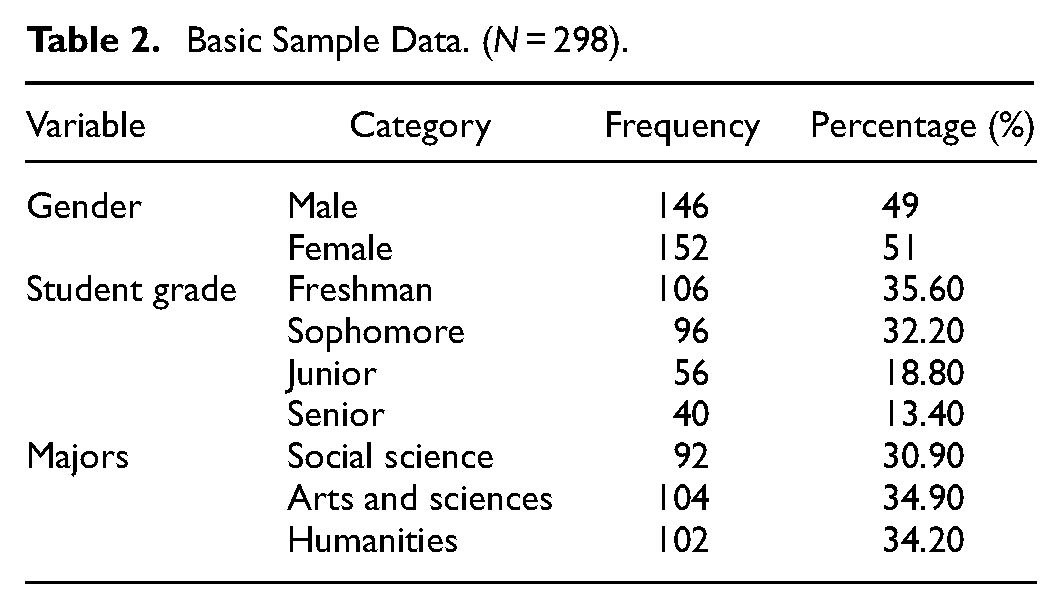
An online questionnaire through Questionnaire Star (www.wjx.cn) was used, which had several advantages, including the absence of geographic limitations, lower costs, and faster data collection. A sample size of 300 is adequate (Comrey & Lee, 2013). In total, 298 university students shared their willingness through the questionnaire. Participants who refused to provide informed consent or submitted incomplete questionnaires were excluded from the study. Basic demographic information was collected and presented in Table 2, the number of freshmen and sophomores was higher than that of juniors and seniors, which is because seniors are under pressure of employment and postgraduation examinations, resulting in them having no time to take care of other things, such as participating in questionnaire surveys. A convenience sampling method was used to survey full-time college students at a university in Chengdu, China, which entails the collection of data from a readily accessible population (Rahi, 2017). The data were collected in January 2023, a month after the release of ChatGPT. The objectives and voluntary nature of the activity are notified to the participants before they are invited. All participants then were provided with ample time to finish questionnaires in their native language and explicitly informed that their responses would remain strictly confidential. As well as, they were instructed to submit their answers only if they were familiar with the concept of ChatGPT. Additionally, before completing the questionnaire, the survey administrators presented a concise video introducing and explaining the various services offered by ChatGPT.
Basic Sample Data. (N = 298).
Data Analysis
To comprehensively explore the acceptance of ChatGPT among college students, a combined method of PLS-SEM and fsQCA was employed to verify the proposed hypotheses. PLS-SEM is more suitable for theory exploration in new areas. Thus, the PLS-SEM technique was adopted in this paper following the suggestions of Dash and Paul (2021). Additionally, fsQCA was considered as a complement for PLS-SEM to explore complicated multiple causal relationships of antecedent variables (Fiss, 2011). Compared with traditional linear analysis, fsQCA can not only explore various configurational paths but also examine the necessary variables for success (Woodside, 2013). Thus, it is suitable to adopt fsQCA to study the configurational effect of various antecedent variables within the higher education context. Additionally, the software used in this paper to conduct data analysis included SPSS 26.0, Smart 3.0, and fsQCA 3.0. More specifically, SPSS 26.0 was used to examine common method bias; Smart 3.0 (symmetric test) and fsQCA 3.0 (asymmetric test) were employed to identify a richer and deeper understanding of the acceptance of ChatGPT among college students from linear and configuration perspectives respectively.
Results
Symmetric Analysis
Common Method Bias
According to the advice of J. F. Hair (2009), the common method bias (CMB) should be tested before proceeding with PLS-SEM analysis. Harman’s single-factor test identified seven factors with eigenvalues greater than 1, explaining 78.038% of the total variance. The first factor accounted for 34.026%, which did not exceed half the total variance as Podsakoff et al. (2003). Thus, the study was deemed to be free of significant CMB.
Measurement Model Assessment
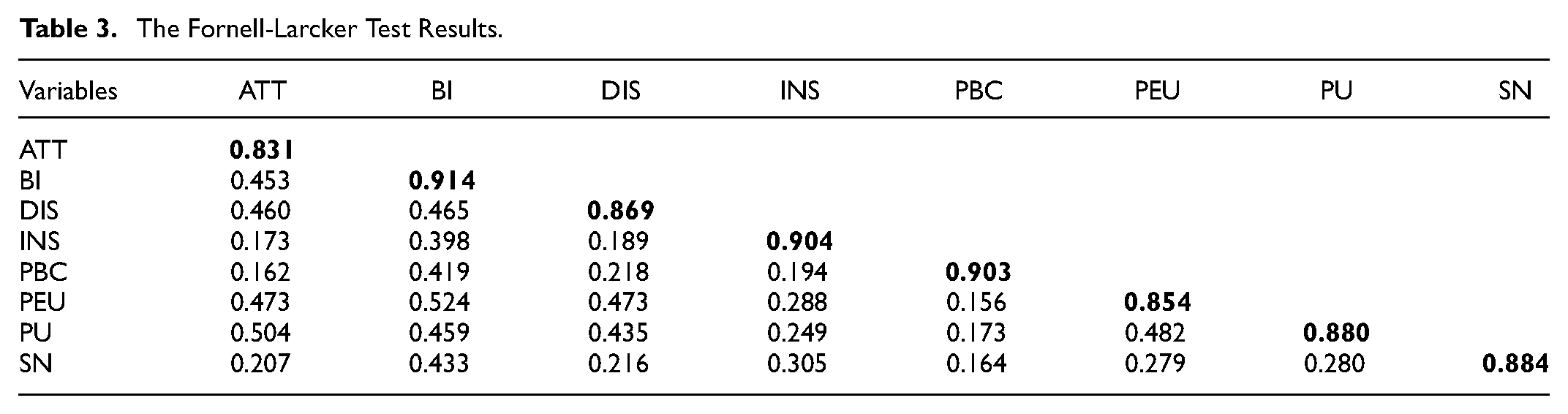
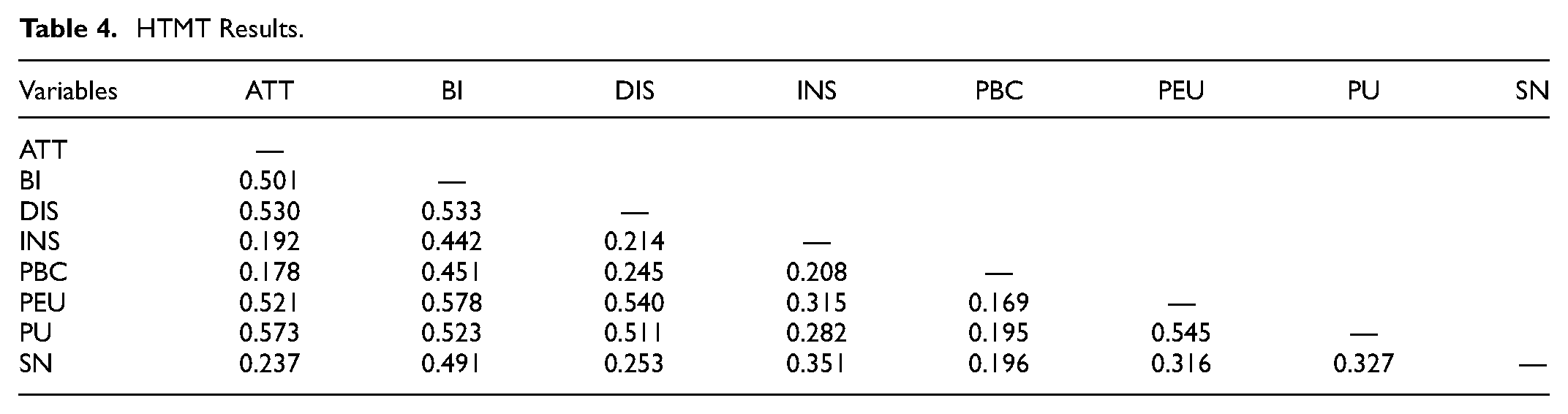
The measurement model was evaluated in this study by calculating “standardized loadings,”“composite reliability” (CR), and “average variance extracted” (AVE). Table 1 demonstrates that the items’ Cronbach alpha (α) values exceeded .83, standardized loadings exceeded the threshold of .7, CR values above the acceptable threshold of .7, and AVE values above the threshold of .5 (F. Hair et al., 2014). Discriminant validity was evaluated by the Fornell-Larcker criterion and HTMT. Table 3 shows that the bold square root of AVE values is greater than the correlation between variables, indicating that all variables in this model met the standard of discriminant validity. To enhance the robustness of the aforementioned results, this paper followed the approach of Henseler et al. (2015) to compute HTMT. As presented in Table 4, all of the HTMT values were below 0.85 (Kline, 2023). Therefore, the data of this paper is suitable to conduct subsequent research.
The Fornell-Larcker Test Results.
HTMT Results.
Structural Model Assessment
Figure 2 indicates that the independent variables explained 41.9% of the variance in behavioral intention (R2 = .419). Table 5 demonstrates that students’ attitude toward ChatGPT was positively influenced by SN (H6: 0.309, p < .001), PBC (H7: 0.316, p < .001), and attitude (H5: 0.337, p < .001). Meanwhile, the attitude to use ChatGPT in class was positively influenced by PEU (H3b: 0.3, p < .001) and PU (H4: 0.358, p < .001). Moreover, PEU was negatively influenced by discomfort (H1a = 0.432, p < .001) and insecurity (H2a: 0.21, p < .001); PU was negatively influenced by discomfort (H1b: 0.265, p < .001). Moreover, to deepen the understanding of the influencing factors of college students’ acceptance of ChatGPT, this paper analyzes the mediating effect based on the Bootstrapping test proposed by Hayes (2009). Table 6 revealed the mediating roles of PEU, PU, and attitude toward ChatGPT, which indicates that both discomfort and insecurity can shape the students’ acceptance of ChatGPT in higher educational settings.

Research model validation.
Hypothesis Test.

p-Value < .001.
Mediating Effects.

Note. VAF = variance account for.
Asymmetric Analysis
Given the limitations of PLS-SEM in capturing non-linear relationships associated with students’ acceptance of ChatGPT, an asymmetrical approach was used in this study. This option was chosen to assess predictors’ collective impact in a complementary manner.
Calibration
Before conducting fsQCA analysis, the questionnaire data must be calibrated into fuzzy set measures ranging from 0 to 1 (0 refers to null membership, 0.5 denotes a crossover point, and 1 represents full membership). There are direct and indirect methods while performing data calibration. Furthermore, the data style and sample distribution also need to be considered. Since this paper used a 5-point Likert scale, a direct calibration method was conducted. Thus, we added and averaged the scores of various measurement questions. Then, The mean values of each variable corresponding to the 95%, 50%, and 5% percentiles were chosen as bases to compute the degree of membership, according to Rihoux and Ragin (2008). Finally, the raw data were calibrated with the fsQCA 3.0.
Necessary Conditions Analysis
Prior to performing configurational analysis, it is necessary to conduct a necessity analysis of antecedent conditions. Greckhamer et al. (2018) suggested that a consistency value of more than 0.9 for each configuration indicates that it is a necessary antecedent condition for the results. Herein, the consistency values for high and low levels of the acceptance of ChatGPT ranged between 0.53–0.80 and 0.59–0.76, respectively. As seen from Table 7, none of the single conditions exceeded 0.9, indicating that the single conditions in this paper cannot be considered necessary conditions and have sufficient explanatory power for official endorsements. Thus, this paper conducted a configuration analysis to explore the performance of students’ acceptance of ChatGPT.
Necessity Analysis.

Configuration Results
Following the data calibration and necessity analysis, the configuration study of causative elements for ChatGPT acceptance was performed. After conducting a truth table, many combinations of causative factors for ChatGPT acceptance were found. The case frequency threshold was set to 1.5% of the original case number (Ragin, 2009) or 3 (cases greater than 150; Pappas & Woodside, 2021). And the frequency threshold was set in at least one case to exclude the configurations that did not exist. According to the suggestion of Zhang et al. (2023), the cut-off points of consistency and coverage were set to 0.8 and 0.6 to improve the percentage of case combination explanations (Hadani et al., 2019; Pappas & Woodside, 2021; Ragin, 2009). Then, standard analysis was conducted with the default program setting in simplifying the quality implications and the counterfactual analysis, which is in line with the suggestion of Pappas and Woodside (2021). As seen in Table 8, four configuration schemes that can lead to a high level of acceptance of ChatGPT were identified according to the intermediate and concise solution, the overall consistency of the high level was 0.936, indicating relatively strong explanatory power. The overall coverage of the high level was 0.567, demonstrating that the four combinations encompass half of the results. Furthermore, core present factors included discomfort, insecurity, PEU, SN, and PBC. At the same time, four configuration schemes that lead to low-level acceptance were identified. The overall consistency and coverage were 0.955 and 0.439, respectively. Core missing factors include discomfort, insecurity, attitude, SN, and PBC.
Configuration Analysis.

Note. Large circles indicate core conditions and small circles peripheral conditions. Black circles (“
Various methods can be employed to conduct robust tests (Zhang et al., 2023). Thus, this paper adjusted the consistency threshold from 0.8 to 0.85 to test the stability. Then, the results that the four configuration schemes for high/low level attitude were still supported by comparing the before and after adjustment results.
Discussion
While ChatGPT has sparked discussions spanning various industries, it remains unclear whether Chinese college students are inclined to embrace it within higher education settings. This study contributes to the existing literature by amalgamating TRI, TAM, and TPB into a novel research model to identify significant factors that influence Chinese college students’ acceptance of ChatGPT via a mixed approach that combines PLS-SEM and fsQCA within higher educational settings.
PLS-SEM findings from this study highlight critical factors influencing the acceptance of ChatGPT. Discomfort and insecurity are identified as having negative impacts on the acceptance intention of ChatGPT. Conversely, PEU, PU, SN, PBC, and attitude toward ChatGPT positively influence the acceptance intention. Furthermore, the study examines the mediating roles of PEU, PU, and attitudes in the context of ChatGPT acceptance. Complementing these insights, fsQCA identifies four distinct configurations that lead to high acceptance levels of ChatGPT. This analysis demonstrates that acceptance is not driven by a singular factor but by various combinations of these conditions. Finally, the discussion of the results incorporates findings from both PLS-SEM and fsQCA methodologies, offering a multifaceted understanding of the factors that drive the acceptance of ChatGPT. This dual-methodological approach provides a comprehensive view of the determinants of technology adoption, highlighting the complexity and interdependence of various influencing factors in the context of educational technology acceptance.
The discomfort experienced by college students exhibited a negative impact on both PEU and PU. This suggests that students who harbor apprehension or distrust toward emerging technologies tend to resist the adoption of ChatGPT. Their perspective conveys a belief that ChatGPT is challenging to manage and poses potential privacy risks, contributing to their refusal to embrace this technology. H1a is consistent with earlier investigations conducted by Mahmood et al. (2023). Their research indicates that employees who do not encounter discomfort perceive the system as capable of efficiently, comfortably, and accurately accomplishing tasks within specified time frames. Conversely, H1b diverges from the conclusion of Mahmood et al. (2023), which highlighted that employees in the financial sector experienced stress due to the complexity of new systems and applications, consequently affecting their usage experience. Additionally, both H1a and H1b contrast with the conclusion of Walczuch et al. (2007) who suggested that students were not overwhelmed by technology’s complexity. The specific reasons for the contradictory view may be that contemporary university students, with their stronger learning abilities, are unwilling to tolerate the anxiety and discomfort associated with ChatGPT, despite the benefits of increased convenience and learning efficiency.
Insecurity was also found to harm PEU (H2a), aligning with Walczuch et al. (2007). This outcome suggests that college students often perceive simpler technology as potentially posing greater risks to personal information, leading to adverse outcomes. However, the results (H2b) did not verify the influence of insecurity on PU, contrasting with Mahmood et al. (2023) suggestions that employees remain unaffected and perplexed by system security and trust issues. This disparity might arise because college students lack a comprehensive comprehension of ChatGPT’s operational principles, data privacy, or security aspects, impeding their ability to link insecurity with the actual usefulness of the technology. Moreover, external information sources, such as social media or peers, often shape college students’ perceptions of the genuine utility of technology. Consequently, even when there is a potential risk of information exposure, college students may not readily acknowledge it due to their reliance on external influences.
PEU significantly influences college students’ PU within higher education settings, aligning with several studies (Lin et al., 2021; Rafique et al., 2020). Rafique et al. (2020) highlighted the substantial impact of users’ perceived ease of utilizing mobile library applications on PU. Mahmood et al. (2023) demonstrated that PU of Internet banking system adoption can be predicted by PEU significantly. Additionally, Zou and Huang (2023) demonstrated that doctors’ ease of using ChatGPT in their academic paper writing significantly shaped its PU. Similarly, if college students believe ChatGPT is difficult to incorporate into their learning practices, they may believe its impact on improving learning efficiency is limited. Conversely, believing ChatGPT is simple to use correlates with believing it is beneficial and supportive of their academic performance.
College students’ attitudes toward utilizing ChatGPT in learning emerged as a significant predictor of acceptance intention. Contrary to some previous research that excluded attitudes from TAM because of its little involvement in mediating the impacts of PEU and PU on acceptance intention (D. Y. Lee & Lehto, 2013; Yang & Wang, 2019), this study discovered that attitude not only affects accept intention directly but also mediates the effects of PU and PEU on it. The discovery substantiated the initial version of TAM proposed by Davis (1989) and upheld Ajzen (1991) assertion that individuals’ intentions to engage in a behavior are significantly shaped by their attitudes toward it. Put simply, college students demonstrate a greater inclination to partake in the behavior while they hold a positive perception of using ChatGPT in their learning. From a comparative viewpoint, it was observed through mediation analysis that PEU exerts a more significant influence acceptance intention of ChatGPT compared to PU. Conversely, PU demonstrates a more substantial effect on the attitude toward accepting ChatGPT than PEU. This suggests that students are more likely to accept and use ChatGPT because they find the technology easy to use, not just because of its usefulness for achieving goals. However, in terms of attitude formation, students’ PU of ChatGPT is more significant for attitude shaping, which may be because students think that the technology has more value for improving learning or solving problems, thus forming a more positive attitude. This explanation is based on the academic understanding of TAM and the psychological paradigm, which helps to explain the influence of different factors on students’ acceptance and attitude formation of ChatGPT. Thus, this paper demonstrates how college students’ attitudes toward using ChatGPT in their learning, which are influenced by how helpful and simple they think it is, are crucial in mediating their effects on students’ intentions to accept ChatGPT.
SN is found to have a direct effect on college student’s intention to accept ChatGPT, which corroborated the findings based on the TPB such as Rajeh et al. (2021), To and Tang (2019), Zamani-Alavijeh et al. (2019). College students’ positive subjective norm of ChatGPT indicates that they feel positive support or expectation from their surroundings or classmates, which has a significant positive impact on the acceptance and use of ChatGPT in learning. This shows that when college students feel the positive support or expectation of the social environment for the use of ChatGPT, they are more likely to accept and adopt this technology in learning. PBC has the predictive power for the acceptance of ChatGPT, which is consistent with the findings of Tan et al. (2023). College students typically tend to embrace ChatGPT when they possess ample resources to support its usage. Moreover, when students believe in their capability to effectively control the utilization of ChatGPT, they exhibit a greater inclination to employ this technology in their learning endeavors, which is in accordance with Hadadgar et al. (2016). In addition, this study uncovered a descending order of influence concerning the impact of attitude, SN, and PBC on ChatGPT acceptance intention. attitude holds the strongest sway over acceptance intention, followed by SN, while PBC exhibits a weaker effect. This hierarchy might stem from the nature of individual attitudes toward new technologies, shaped by personal cognition and emotional responses, resulting in varying attitudes toward ChatGPT. Conversely, SN, influenced by social environments and others’ expectations, yields a more consistent albeit weaker impact. Personal attitudes directly influence technology preference and individual decision-making, contrasting with the relatively weaker impact of PBC. SN, in contrast, exerts a stronger influence in university settings, reflecting the significant influence of peers, instructors, or social circles on students. Students’ susceptibility to social pressure and external expectations increases when perceiving favorable attitudes toward ChatGPT from influential figures, encouraging technology adoption. Within higher education, individuals often conform to societal expectations, elevating the role of SN in collective behavior and decision-making. Recognizing widespread acceptance of ChatGPT in social environments positively influences student acceptance, overriding low individual PBC. This emphasizes the pivotal role of personal attitudes and societal influences in technology adoption decisions, providing insights for promoting technology acceptance among students.
While PLS-SEM proposed a singular optimal model portraying the cumulative impact of factors affecting students’ acceptance of ChatGPT, it is important to acknowledge the diversity among college students, each possessing unique characteristics. Therefore, this paper aims to delineate four combinations of factors that could potentially elucidate both low and high levels of ChatGPT acceptance. In terms of the asymmetric configurations of factors, the results of the fsQCA analyze the high or low level of acceptance of ChatGPT. More specifically, the necessity analysis reveals that no single causal factor can independently lead to high or low levels of acceptance of ChatGPT, which emphasizes the importance of combining these factors to better explore the underlying mechanism of official endorsements. Furthermore, the sufficiency analysis results demonstrate that multiple configurations can account for both high and low levels of acceptance of ChatGPT among college students. Notably, discomfort and PU were the factors present in the high-level configurations and the subjective norms were the only factors that present in the low-level configurations. Thus, this suggests that both discomfort and PU foster loyalty toward the acceptance of ChatGPT among college students.
Implications
Theoretical Implications
This paper’s contributions to the acceptance of AI technology literature within higher education are discussed below. Firstly, by amalgamating TRI, TPB, and TAM into a novel research framework, this study fills a hole in existing research by examining the elements that influence college students’ adoption of ChatGPT. The outcomes highlight the study model’s effective forecasting capability, with the model accounting for a significant share (41.9%). These insights not only enrich the educational landscape but also address a research void concerning the determinants influencing college students’ acceptance of ChatGPT. Additionally, through the exploration of the mediating effects of PEU, PU, and attitude, we expand the applicability and explanatory scope of the TRI, TPB, and TAM models in higher educational settings, which adapts the model to numerous AI technical environments and personalizes a robust foundation for performing identical studies. Moreover, this paper utilizes both PLS-SEM and fsQCA methodologies within higher education settings, which provides a more holistic understanding of the students’ acceptance of ChatGPT. It enables researchers to determine the net effect of variables through a linear analysis and outline causal combinations resulting in desired outcomes via fsQCA.
Practical Suggestions
The paper offered practical implications for developers involved in ChatGPT design and teachers who are involved in higher education institutions. Both PEU and PU significantly influence students’ attitudes toward ChatGPT, which highlights the importance of prioritizing the usability and usefulness of ChatGPT for designers and educators. Attach importance to the design of ChatGPT. A clear interactive interface, accurate navigation elements, and prompt response speed are significant prerequisites, which reflect the feature of ease of use for college students. Moreover, the scientific and professional nature of the education field needs continuous optimization, which can not only improve students’ efficiency but also expand their thinking and exercise logic. Be familiar with the ChatGPT rules. Teachers should familiarize themselves with its functions and purposefully demonstrate its convenience through specific cases before introducing ChatGPT effectively into class, which enables students to perceive its crucial role so that students can have a better understanding regarding its ease of use and usefulness.
Discomfort and insecurity negatively impact PEU and PU, thus antecedents of students’ personality characteristics should be considered by educators. Strengthen the investigation of students’ technical readiness. Personalized education can better meet the individual needs of students, help them better develop their potential, and achieve the best learning results. Thus, teachers offer differentiated and personalized teaching methods to promote effective learning according to their technical readiness levels. Reduce the influence of inhibitory factors. Teachers can explore new and interesting guidance methods such as inquiry-based, collaborative, problem-solving, and experiential learning using ChatGPT. Such methods can help students with weak acceptance abilities perceive the usefulness of the technology and increase their optimism. Additionally, college students are generally open to new things, but teachers still should focus on reducing the influence of inhibitory factors and anxiety. Because complex technologies that are difficult to control and trust can make students perceive them as challenging to use with little effect.
PBC and SN positively affect acceptance intention, which suggests that educators should actively mobilize the influence of class peers and themselves. Stimulate the teacher’s and monitors’ demonstration role. Teachers play a crucial role in students’ acceptance of ChatGPT. To begin with, teachers’ advocacy and implementation of classroom changes is a key factor that affects students’ acceptance of this technology. Additionally, the role of the monitor should be explored. Compared to regular students, monitors often have a sense of power and prestige in the class, which can influence the behavioral intentions of their peers. Educate students on self-management. PBC is also a significant factor. Internal factors, such as professional knowledge, skills, confidence, and experience, serve as the foundation and driving force for teachers’ beliefs. External factors, such as group dynamics, systems, and external support, also play a role. Teachers can improve students’ PBC in both internal and external aspects to enhance their willingness to accept this technology. Specifically, teachers should encourage students’ confidence in class to help them overcome difficulties and problems while using ChatGPT. Additionally, teachers should provide support and help tailored to students’ subject background, learning experience, and personality characteristics, thereby improving the accuracy and perceptibility of chat support.
Conclusion
ChatGPT has become one of the most popular AI applications on the Internet and sparked discussions regarding its applications in education due to its potential capability to improve teaching quality, models, and content in higher educational settings. Thus, by integrating TRI, TPB, and TAM into a novel research model, this paper identifies factors influencing college students’ acceptance of ChatGPT. With 298 responses from college students in Sichuan, China, a mixed approach (PLS-SEM and fsQCA) was used to provide a deeper comprehension of the determinants shaping college students’ acceptance of ChatGPT. PLS-SEM results found PEU, PU, PBC, SN, and attitude as significant drivers and DIS and INS as negative drivers of the acceptance intention of ChatGPT. PEU, PU, and attitude play a mediating role in the process. fsQCA demonstrated that four combinations of variables may contribute to the high acceptance of ChatGPT. Finally, practical guidance for educators and designers is provided.
Limitations and Future Research
Some constraints to this study ought to be tackled in subsequent investigations. Firstly, this study focuses solely on Chinese college students, which may limit the generalizability of the findings to other cultural and geographical contexts. Thus, subsequent research should enhance its applicability to students in different regions or with different cultural backgrounds. Secondly, this research employs a cross-sectional design, which leads to the limitation of establishing causality. Therefore, longitudinal studies need to be conducted to provide more robust insights into the changes in students’ acceptance of ChatGPT over time. Thirdly, the study primarily focuses on psychological factors influencing ChatGPT acceptance intention and does not extensively consider external environmental factors such as self-efficacy and perceived risk that could also play a significant role. Thus, future researches need to fully capture various determinants shaping the acceptance of ChatGPT within educational settings. Finally, the characteristics of the sample, such as age range, academic major, and technology experience, could influence the results. The study does not thoroughly explore how these characteristics might affect the acceptance of ChatGPT, which could be a limitation in understanding the broader applicability of the findings. Thus, follow-up research can increase the depth of research from this aspect.
Footnotes
Acknowledgements
Thanks to the editors for their contributions to the publication and revision of the paper.
Declaration of Conflicting Interests
The author(s) declared no potential conflicts of interest with respect to the research, authorship, and/or publication of this article.
Funding
The author(s) disclosed receipt of the following financial support for the research, authorship, and/or publication of this article: This research was funded by Chengdu Philosophy and Social Science Research Base-Chengdu Park City Demonstration Zone Construction Research Institute: GYCS2022-ZD002 and Sichuan Province Key Research Bases of Philosophy and Social Sciences-Regional Information Technology Public Management Research Institute QGXH22- 03.
Ethics Statement
This study was approved by the ethnics committee of Chengdu university of technology. We certify that the study was performed in accordance with the 1964 declaration of HELSINKI and later amendments.

Data Availability Statement
Raw data supporting the conclusion of this paper will be provided by the authors, Yipeng Zhao if necessary.