




Abstract
According to a survey regarding indigenous employment, in Taiwan, a high proportion of indigenous people are engaged in construction work compared with the overall population. However, among indigenous construction workers, 56.15% have received no occupational safety or health training, and 9.39% have encountered occupational accidents in their workplaces. Therefore, this study aimed to develop employee assistance programs (EAPs) for indigenous workers in Taiwan by focusing on three dimensions—namely work, life, and health—and by establishing corresponding implementation paths for these EAPs. A modified Delphi method was adopted to screen EAP measures for the workplaces of indigenous workers, and a formal evaluation followed. Subsequently, the analytic hierarchy process was employed to calculate the overall weights among the factors in order to discern the relative importance of each factor in achieving the target goal or to resolve target problems and establish an order of priority. The results indicated that health was the most important of the three dimensions of indigenous EAPs, followed by the life dimension and then the work dimension. Compared with previous studies regarding Han Taiwanese workers, mental health services in the health dimension were particularly important in the present study. Finally, regarding the health dimension, this study suggests developing mental health services that respect indigenous culture and therefore are appropriate for indigenous people, such as the establishment of drug and alcohol addiction support groups and mental health service systems. In addition, corresponding welfare measures can be offered to enhance people’s motivation to change.
Keywords
Research Background and Motivation
Taiwan established its Council of Indigenous Peoples (CIP) on December 10, 1996, to improve indigenous living environments and to promote measures that safeguard the rights and interests of Taiwan’s indigenous people. The Indigenous Peoples Employment Rights Protection Act was enacted at the end of October 2001 to implement more active and comprehensive employment protection measures and to integrate the existing laws and ordinances related to the employment of indigenous people. The goals of this act are twofold. First, it encourages employment, that is, securing indigenous people’s right to work, by increasing the rate of employment and decreasing the rate of unemployment in the indigenous population. Second, it safeguards this population’s livelihood by increasing their wages and overall quality of life. Indigenous people in Taiwan have long been socioeconomically disadvantaged, and this is reflected in their having employment disadvantages and a lower average income. These disadvantages are the result of personal intrinsic factors and social factors. The personal intrinsic factors are related to material or monetary living needs, special work concepts, stereotypes, and transient habits. The social factors involve a high proclivity for taking temporary work, having insufficient channels for employment information, having overall low education levels, lacking professional skills, and having insufficient numbers of employment centers (Ma & Wu, 2015).
According to the 2019 CIP report on employment among indigenous people, although the number of employed indigenous people has increased in quantity, in terms of quality, their employment rate in highly labor-intensive jobs, particularly those in the manufacturing and construction industries, is higher than that of the national population. In these industries, technical work is susceptible to economic and political effects, such as the relocation of jobs overseas, modest wage increases, and mandatory cap on weekly work hours. Such employment policies can have major impacts on the labor market, with labor-intensive markets being most strongly affected. Furthermore, the Taiwanese government has enabled a considerable number of foreign workers to enter the country for work that is highly similar to that generally sought by indigenous people, which has affected the employment of indigenous people with comparable degrees and technical skills (K. H. Huang & Yu, 2006). A study by the Institute of Labor, Occupational Safety and Health of Taiwan, which operates under the purview of the Ministry of Labor, discovered that accidental injuries have historically been the leading cause of death among indigenous workers and occur at a rate 2.2 times higher than that of national workers. When traffic accidents are excluded from consideration, occupational accidents are the main cause of accidental injury. Other investigations by the aforementioned institute have also discovered that indigenous workers are at a greater risk of severe occupational injury than workers of any other background, which may be related to physical examinations not being conducted before people start work, preservice training being insufficient, protective gear not being used, or employees being exposed to physical hazards in the working environment. Labor and health insurance statistics also indicate that the incidence rate of occupational injury among indigenous workers is higher than that of the overall worker population (C. J. Chen et al., 2011).
In 1994, the Ministry of Labor began promoting employee assistance programs (EAPs) for enterprises (Ministry of Labor, 2017). These programs incorporated the approaches and concepts used in industrial social work to offer services within enterprises and institutions to assist workers with psychological, physiological, financial, family, marital, interpersonal, and professional problems (H. C. Hsieh, 1996). The implementation of EAPs has primarily focused on providing employees with professional assistance to improve their physical and mental health and their ability to adapt their lives to improve their overall health and thereby improve their work efficiency.
Legislation, research, and trends related to indigenous society, employment, and workplace health reveal that EAPs that meet the needs of indigenous people remain lacking and that action to establish such EAPs has yet to be initiated. Furthermore, research on indigenous studies has mostly involved adopting a macroscopic perspective on topics such as the development of indigenous industries (K. Y. Hsu & Wang, 2004), the effects of foreign labor on indigenous employment, and indigenous labor cooperatives (K. H. Huang & Tseng, 2005). Few studies have adopted a microscopic perspective or investigated the impact of individuals’ interactions with the environment they are in. Furthermore, empirical studies conducted in Taiwan have revealed that indigenous people face several types of employment difficulties and thus require urgent assistance. Therefore, the goals of the present study were to determine the general status of workplace health among indigenous people and, on the basis of the findings, to develop a system of EAPs for indigenous workers that includes EAP implementation paths and measures that correspond to the various workplace health scenarios faced by indigenous workers.
Literature Review
Indigenous Employment Hardships
According to a 2021 report on employment conditions among indigenous people, the labor force participation rate among indigenous people in that year was 62.2%; that is, 6 out of every 10 indigenous people—approximately 270,000 indigenous people—belonged to the labor force (Council of Indigenous Peoples [CIP], 2022). This renders indigenous employees an irreplaceable group within the domestic labor population. Because the labor force participation rate among indigenous people is high, greater attention must be paid to their mental health in the workplace. Identifying a means of alleviating the work-related stress of indigenous people particularly warrants discussion, given the high level of competition in the modern labor market (Cho, 2009). Research on indigenous tribes has indicated that indigenous people who insufficiently adjust to changes in both their work and life experience higher levels of life stress than their peers of Han descent do (Lian, 2004; Y. C. Lin, 2001).
S. Y. Huang (2015) asserted that indigenous people encounter many hardships in their employment. On a social level, these hardships may be caused by discrimination from business owners against indigenous people, which can be further distinguished into prejudice and statistical discrimination. Prejudice may involve a business owner believing that indigenous people are poor learners, are not punctual, are lazy and irresponsible, or are insubordinate. Business owners may form impressions related to the performance of indigenous workers on the basis of their past hiring experience. Employers tend to believe that indigenous workers are physically fit but less responsible and less knowledgeable in their work, which often results in indigenous workers being hired for only physical jobs (K. C. Hsieh & Chen, 1998). The psychological stress of this prejudice and discrimination makes indigenous workers more likely to resign or to be laid off when they encounter unfair treatment. Indigenous workers therefore generally experience workplace and employment instability. These aforementioned Taiwanese studies both reflect and highlight the psychological needs of the indigenous labor population. The problems encountered by indigenous workers are not limited to those of cross-cultural interactions; they also involve mental health problems, such as those related to environmental adaptation. Because indigenous people are a major constituent in Taiwan’s labor structure, dedicating resources to addressing the employment issues faced by such people is imperative.
Many researchers—such as C. C. Lu (2002), Kuo et al. (2013), Kuo and Huang (2010), Kuo and Hsu (2010), Ma and Wu (2015), Tsai (2009), Chang (2016)—have focused on the employment hardships faced by indigenous people and summarized the factors as belonging to two principal groups: personal causes and social causes. Personal causes include low levels of education, unique concepts related to work, transient habits, underdeveloped professional skills, remote living conditions, insufficient human capital, and the limitations of low-wage and unskilled labor. Social causes include issues related to social discrimination and social adaptation, being crowded out by foreign labor, the government’s lack of active and effective policies that promote overall Indigenous employment or an implementation framework, postindustrialization unemployment, stereotypes about indigenous people, conflicts between mainstream and indigenous culture, inequitable distribution of social resources, higher rates of temporary employment, insufficient employment consultation channels, insufficient employment service centers, and difficulty in obtaining funding. In summary, the social context of indigenous growth, together with the interaction climates and structures of social institutions, have shaped the hardships and problems of indigenous employment.
Chiou (2007) and Kuo et al. (2013) have proposed guidelines for policies targeting the employment difficulties faced by indigenous people in cities. Their recommendations relating to education include emphasizing investment in education for indigenous people, creating jobs and training resources suited to indigenous people, encouraging indigenous people to complete higher education programs, removing the obstacles to indigenous people completing such programs, and regularly assessing the education and employment conditions among indigenous people. Their other policy recommendations include implementing legislation that establishes indigenous people employment quotas in the public and private sectors, enforcing antidiscrimination laws, improving the accessibility of employment information, and improving the functions of the CIP. In their discourse on affirmative action for indigenous workers, S. J. Chen and Lu (2022) asserted that endeavors to prevent injustice between different ethnic groups have led to another form of discrimination and that the criteria for granting preferential or differentiated treatment should remain as consistent as possible. They further argued that the main obstacle to indigenous people gaining employment is insufficient employment information. Therefore, policies that guarantee indigenous employment should focus on how indigenous workers can be assisted in acquiring sufficient employment information.
A 2019 survey of indigenous employment revealed that 75.51% of indigenous workers employed in the agriculture, forestry, fishing, and animal husbandry industries did not receive training materials on work safety and the prevention of occupational accidents and that 78.12% did not receive any training classes on occupational health and safety or the prevention of occupational accidents (CIP, 2020). These statistics indicate a general lack of occupational health and safety awareness among workers employed in such industries. The report also stated that 17.29% of indigenous people in these industries had experienced occupational accidents and that these industries have a higher risk of occupational accidents. J. H. Hsu et al. (2012) investigated occupational accidents among indigenous workers and discovered that the employment policies enacted by the government have led to a significant rise in both the temporary employment of indigenous workers and the number of occupational accidents. The number of occupational accidents among indigenous workers more than doubled from 2005 to 2009, a trend that reflects the increasing need for occupational education and training among indigenous workers. Furthermore, research demonstrated that the rate of death or disability due to occupational accidents and the death rate per thousand people among indigenous workers were higher than those among all national workers. A higher risk of occupational injury was associated with poor working conditions, being a man, being older, and having a low education level. Health conditions and behaviors such as habitual smoking, drinking, and chewing betelnut were also associated with an increased risk of occupational injury (M. L. Hsieh & Hsu, 2009). In addition, as discovered by C. J. Chen and Hsieh (2007) in their investigation of occupational injuries and health hazards among indigenous workers, a higher proportion of indigenous workers are employed in jobs with irregular pay, do not compensate family workers, have working environments with falling hazards, have working environments in which protective gear is required but not used, have workplaces with poor safety and protection measures, and have workplaces characterized by a lack of concern for workplace labor accidents. Indigenous workers are also more likely to have unhealthy behaviors, including smoking, drinking, and chewing betelnut, which are also risk factors for occupational injury.
The studies conducted by the CIP and other researchers have provided insight into the many hardships of indigenous employees, which researchers have summarized as being mostly related to mental health problems—such as those related to discrimination or a lack of understanding of indigenous culture in the workplace—or life adaptation—including urban or cultural adaptation. The sources of employment hardship can be traced back to interaction factors within the social contexts and social institutions to which indigenous individuals belong. The subsequent occupational accident factors not only affect the safety of the indigenous labor population but also have far-reaching effects on the stability of the labor population structures in Taiwan. Many policies have been enacted in response to these concerns. Furthermore, because of the scarcity of research in which a microscopic perspective on indigenous labor groups and on the effects of interactions between indigenous individuals and their environmental settings, the present study sought to identify a means of complementing such policies by providing insight and opinions on how assistance can be provided to indigenous employees.
Empirical Studies on Indigenous Workplace Health
C. J. Chen (2012) developed health promotion programs for indigenous female workers that prioritized strengthening community action and developing personal skills. The programs, listed in order of Chen’s understanding of their importance, were related to reducing or quitting alcohol consumption, quitting betelnut use, eating healthy, preventing disease, quitting tobacco use, reducing stress, and maintaining physical well-being.
The Ministry of Labor (2014) lists the coverage of EAPs as involving the three dimensions of work, life, and health. Services in the work dimension involve management strategies, work adaptation, and career assistance. Services in the life dimension involve offering assistance with personal problems that may affect the employee’s work by, for example, offering consultations related to interpersonal relationships, marriage, parenting, family care, financial management, and legal issues. Services in the health dimension involve maintaining employees’ personal health by offering health and medical services in the workplace, which increases the quality of employees’ work and lives. Researchers have generally categorized and analyzed indigenous workplace health on the basis of these work, health, and life dimensions, as indicated in the following.
Work Dimension
Attitudes, subjective norms, and environmental factors have been discovered to have positive effects on occupational behavioral intentions. Furthermore, evidence indicates that the participation of indigenous people in occupational training can be encouraged through subjective norms and environmental factors. The overall political and economic environment and government manipulation have been reported to be environmental factors that can be beneficial to indigenous employment (K. H. Huang et al., 2005; K. H. Huang & Yu, 2006). Among care workers of indigenous descent, task stress is the greatest source of job stress, inner satisfaction is the greatest source of job satisfaction, and interpersonal interaction is the highest contributor to quality of working life (M. H. Lin et al., 2009). J. Huang (2018) argued that supervisor–subordinate relationships, organizational identification, and work satisfaction can improve the task performance of indigenous adults in the workplace. Short-term employment programs provide only temporary job opportunities during unemployment periods and are limited in their contributions to the sustainable operations of hometown industries (Ma & Wu, 2015).
When businesses establish workplace environments and treat employees in ways that meet employee expectations and when managers have friendly interactions and relationships with their employees, employees consider handling job stress to be a responsibility entrusted to them by their organization. Moslehpour et al. (2022) conducted a study in Mongolia regarding data related to employee job satisfaction factors collected from 202 employees and found perceived mission statement quality, romanticism in management philosophy, an ethical psychological climate, low tendency of ethical ambiguity, and managers’ emotional competence to positively influence the job satisfaction of employees. Among these factors, managers’ emotional competence was found to be the most important. In addition, job expectations influence job satisfaction (Bezdrob & Šunje, 2021), and Bastida et al. (2022) found that job discretion both affected employee well-being and influenced the supervision of other employees and organizational policy decisions through job autonomy. Accordingly, in addition to improving working environments and creating a harmonious work atmosphere, uniting employees around the values and goals of their department and promoting job discretion are essential for increasing employee job satisfaction. Accordingly, many studies have recommended strengthening safeguards for indigenous people, extending employment periods, setting fixed retention quotas for employees who perform well, and establishing a greater number of support mechanisms. In addition, vocational training can be offered in conjunction with government-guided development of the tourism-related and care service industries of tribal hometowns. Finally, establishing partnerships with businesses can enable the seamless connection of vocational training with employment for indigenous people and lead to the development of employment spaces that incorporate training and practice.
Life Dimension
The creation of employment opportunities in indigenous hometowns should involve the promotion of local cultural industries and jobs that provide services to older individuals and children as well as the establishment of local employment service networks (Ma & Wu, 2015). The overall quality of life among Indigenous care workers was demonstrated to differ according to age, education level, marital status, and religion (Y. J. Huang, 2008). H. C. Lu (2016) argued that the ethnic and cultural differences of indigenous people that may lead to problems include those related to lifestyle and hygiene habits, educational philosophies, parent and teacher communications, and methods of educating children. These differences have led to difficulties for Han educare providers in indigenous regions. S. A. Chen (2018) reported that the lifestyle habits of indigenous parents affect the operations of administrative work in education. These findings demonstrate that conflicts related to culture and lifestyle may arise between Han Taiwanese people in indigenous regions and local indigenous people.
To overcome these cultural differences, Han service providers can enroll in classes on indigenous cultures to enhance their ability to identify with and understand such cultures and to better understand the needs of indigenous children with respect to curriculum design. Alternatively, service providers from the same ethnic group can be appointed. Members of the same ethnic group are able to more easily understand each other and to form a common group based on their shared culture, language, customs, and lifestyle habits. However, due to their remoteness, indigenous hometowns often lack social welfare and medical resources and sufficient care workers. Therefore, suitable care may be difficult to obtain. In addition, the exodus of adults in search of work has both led to and revealed that indigenous villages often lack sufficient older adult care and childcare. Providing older adult care and child educare services to individuals in these villages is crucial because doing so would provide indigenous care workers with professional care experience and create new work opportunities in the areas (S. A. Chen, 2018).
Health Dimension
Cho (2009) advised that indigenous employees should use humor to increase their social capital in the workplace, which can effectively lower their work stress and prevent their physical and mental health from being negatively affected. H. C. Chen (2012) discovered a negative correlation between work stress and exercise participation among elementary school teachers in indigenous areas within Kaohsiung City. That is, he discovered that higher levels of work stress were correlated with lower degrees of exercise participation and, conversely, lower levels of work stress were correlated with higher degrees of exercise participation.
The majority of indigenous families feature single-parent households, divorced parents, or grandparents as the primary caregivers. Indigenous employees therefore bear the dual responsibility of supporting and taking care of their families. Compounded with the stress and difficulties encountered in the workplace, these burdens affect employees’ physical and mental health. Places of employment in indigenous villages are generally lacking in employees, and during staffing shortages, employees may be required to take on multiple positions. Therefore, administrative agencies should enact corresponding support measures to prevent the physical and mental health of indigenous workers from deteriorating due to anxiety related to the compounded stress related to their family and work lives.
These empirical studies on the effects of workplace health among indigenous workers demonstrate that work, life, and health exert mutual influences on each other. For example, because of the influences of job hiring systems and the available job opportunities, indigenous workers are at a disadvantage with respect to their life adaptation and economic conditions and may be forced to seek employment outside of their hometowns. Because of this, they no longer contribute to the development of their village or village life. Furthermore, this migration may generate stress that manifests as behaviors that adversely affect their health. Although the relevant authorities have implemented programs to address these concerns, a means of providing appropriate services—assistance programs developed with consideration of the work, life, and health dimensions of individuals’ cultural backgrounds rather than simply the institutional or legal provision of resources—must be explored.
Research Method
Research Process
This study analyzed the literature on indigenous workplace health and EAPs by using interpretive structural modeling (ISM) and the analytic hierarchy process (AHP). First, indigenous EAP measures were selected using a modified Delphi approach. A formal evaluation was completed by asking respondents to rate and clarify issues through ISM. The AHP was then used to determine the overall weights among the factors and the importance of each factor in its contribution to the target goal or target problem to be solved. The factors were arranged in order of priority. Finally, research findings were presented, and suggestions were proposed.
Participants
A survey was designed and was conducted in three stages. The first stage involved the retention or removal of indigenous EAP measures through a modified Delphi approach. The second and third stages involved the analysis of indigenous EAPs through ISM and the AHP, respectively. For the modified Delphi approach, the sample size of the first stage needed to be no fewer than 10 experts to ensure a low sample error and high credibility (Dalkey, 1969). If heterogeneity is high among such a group of experts, the corresponding sample size can be reduced to 5 to 10; conversely, if homogeneity is high among the experts, the sample size should be expanded to 15 to 30 (Delbecq et al., 1975).
In the first stage, 47 experts comprising 5 (10%) indigenous scholars, 22 (46%) affairs organizers, and 20 (44%) workers were asked to respond to 22 items related to indigenous EAPs. The same 47 participants were then invited to participate in the second and third stages, which respectively involved ISM and AHP data collection, to ensure that the study findings in these two stages would be derived from the same set of perspectives and stances. The surveys were administered online; the respondents completed the ISM survey first and the AHP survey second. Additionally, both the total number of research participants (47) and the three categories of indigenous research participants met the requirements for homogeneity and heterogeneity of the experts; these requirements were stipulated on the basis of the modified Delphi method (Dalkey, 1969; Delbecq et al., 1975).
Research Tools
Modified Delphi Survey
The first-stage survey was completed using a modified Delphi approach. The questionnaire items were drafted directly, without a first round of expert interviews, on the basis of the information gathered from the literature review. The experts were invited to share their opinions on the proposed items. The scope of the opinions they were asked to provide was limited to reduce the difficulty of and time required to compile their answers (Murry & Hammons, 1995). The structured questionnaire of the first stage was developed with reference to the research goals, literature review, and EAP measures of the Ministry of Labor; various indicators of indigenous workplace health identified in the literature review were summarized. The respondents ranked their identification with the questionnaire items on a 5-point Likert scale with possible answers of Strongly Disagree, Disagree, Neutral, Agree, and Strongly Agree. The experts were asked to rate each management function indicator on the basis of their personal identification with it. The experts were provided with a field in which they could write any additional opinions or revisions.
ISM Survey
The purpose of ISM is to compile information to construct and deconstruct basic relationships among complex systems or state elements. ISM is employed to develop management decision-making tools for solving and analyzing complex situational problems (Li, 2005). ISM was the modeling tool used in this study because the study involved systematic and logical consideration of complex issues and the construction of an overall system architecture based on the relationships among all variables in the study framework.
The hierarchal architecture of this study was modeled using ISM; the overall system architecture was based on the relationships among the variables in the study framework. Respondents were asked to answer “yes” or “no” to questions such as “When indigenous EAP measures that target workplace health are implemented, which of the following EAP measures may affect another such measures?” The responses were analyzed using ISM software (Concept Star) that enables relational modeling that features an intuitive human interface and automatic visual display. This software enables researchers to identify paths and execute thought-forming modules that can further understanding of situations or decision-making thinking.
AHP Survey
The AHP is an approach to decision-making developed by Saaty (1980); it involves using a scientific method to carefully assess complex or ambiguous situations and achieve effective decision-making. Although humans have limited mental capacities, they frequently face problems of varying magnitudes that require them to make decisions. When people are presented with alternatives and options, they generally make decisions on the basis of their experience or subjective judgments, and these decisions have far-reaching implications.
The AHP questionnaire was based on the assessment results for the questions; the recruited experts were asked to rate the relative importance of the EAP criteria. The questionnaire was designed to feature pairwise comparisons on 9-point nominal scales; each criterion was ranked as being of Extreme Importance, Very Strong Importance, Strong Importance, Moderate Importance, The Same Importance, or between these options. Consequently, each criterion could be assigned a weight of 1 to 9. The evaluation factors for each level were used as benchmarks to establish a pairwise comparison matrix. Hierarchical data analysis was performed using Super Decisions; after the questionnaire responses of each respondent were input, the consistency index (CI < 0.1) and consistency ratio (CR < 0.1) of the responses were determined, and the first-level decision-making problems were verified. The reasonability of the questionnaire responses and the decision-making were determined, and the second-level and third-level decision-making elements were compared and analyzed.
Research Results
The results of the literature review were compiled, and a preliminary framework for indigenous EAP indicators was created. Subsequently, a modified Delphi approach was used to select the measures with the greatest relevance, and these measures were used to determine the scope of the questionnaire. The ISM questionnaire was used to compile recruited experts’ knowledge and experiences to obtain a consistent and specific consensus. An AHP questionnaire was then developed to complete importance ranking. The collected data was processed using the Super Decision and Microsoft Excel programs, with AHP used to analyze the weights of the indicators at each level and to construct a weights system for the indicator framework. An analysis of the questionnaires and the results are presented in the following section.
Modified Delphi
The modified Delphi approach was developed by adjusting the more time-consuming conventional Delphi approach. The conventional approach involves challenges related to difficulties in controlling progress and to contradictions being present in an expert panel’s opinions. In 1996, Murry and Hammons proposed a modified Delphi approach that was similar to the original approach in its implementation and statistical methods—that is, it retained the applicability and advantages of the original method—but involved a simpler survey process.
In the present study, the consistency among the experts’ opinions was determined on the basis of the quartile deviation (QD) for the 22 items related to the EAP criteria. The mean scores ranged from 3.38 to 4.04, and the overall mean was 3.70. When the QD was less than or equal to 0.5, the expert opinions were considered to have reached consensus; conversely, a QD greater than 0.5 indicated a lack of consistency, and the indicator was removed. Indicators with QDs less than or equal to 0.5 were retained and marked as essential measures. The results of the second-stage Delphi questionnaire are presented in Table 1.
Results of the Modified Delphi Questionnaire.
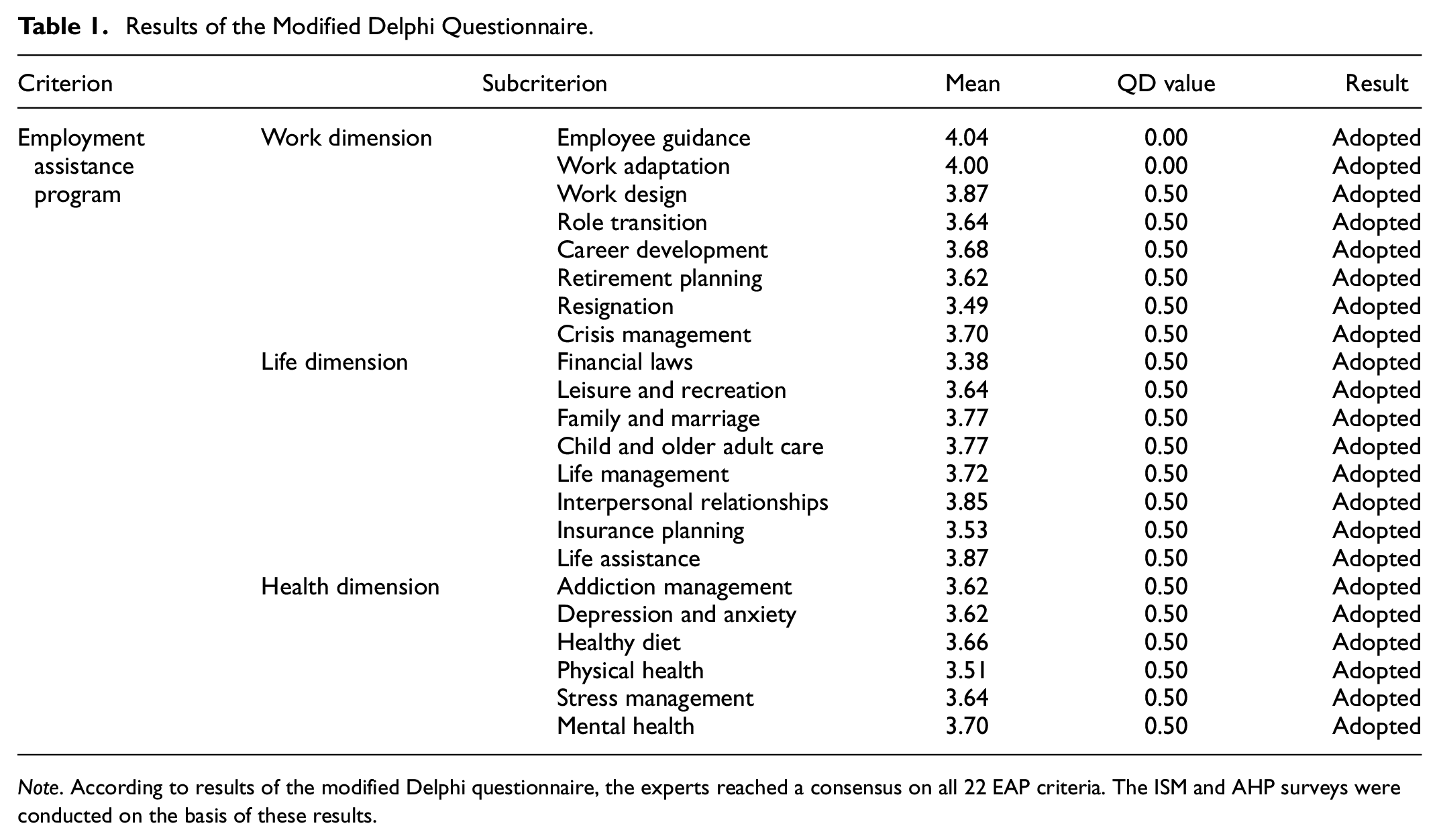
Note. According to results of the modified Delphi questionnaire, the experts reached a consensus on all 22 EAP criteria. The ISM and AHP surveys were conducted on the basis of these results.
ISM Analysis
When a matrix is constructed using ISM, the relationships between elements are represented as either 1 or 0, with the values respectively indicating if an element is relevant or not. All structural elements are then transformed into a hierarchical chart illustrating the distributions of each structural element. In the present study, 47 experts were invited to determine whether causal relationships were present between any two constructs. A matrix was constructed by assigning the presence of a causal relationship a value of 1 and the absence of such a relationship a value of 0. The resulting matrices describing the ISM causal relationships between the EAP measures were used to create the structural diagrams of Figure 1.
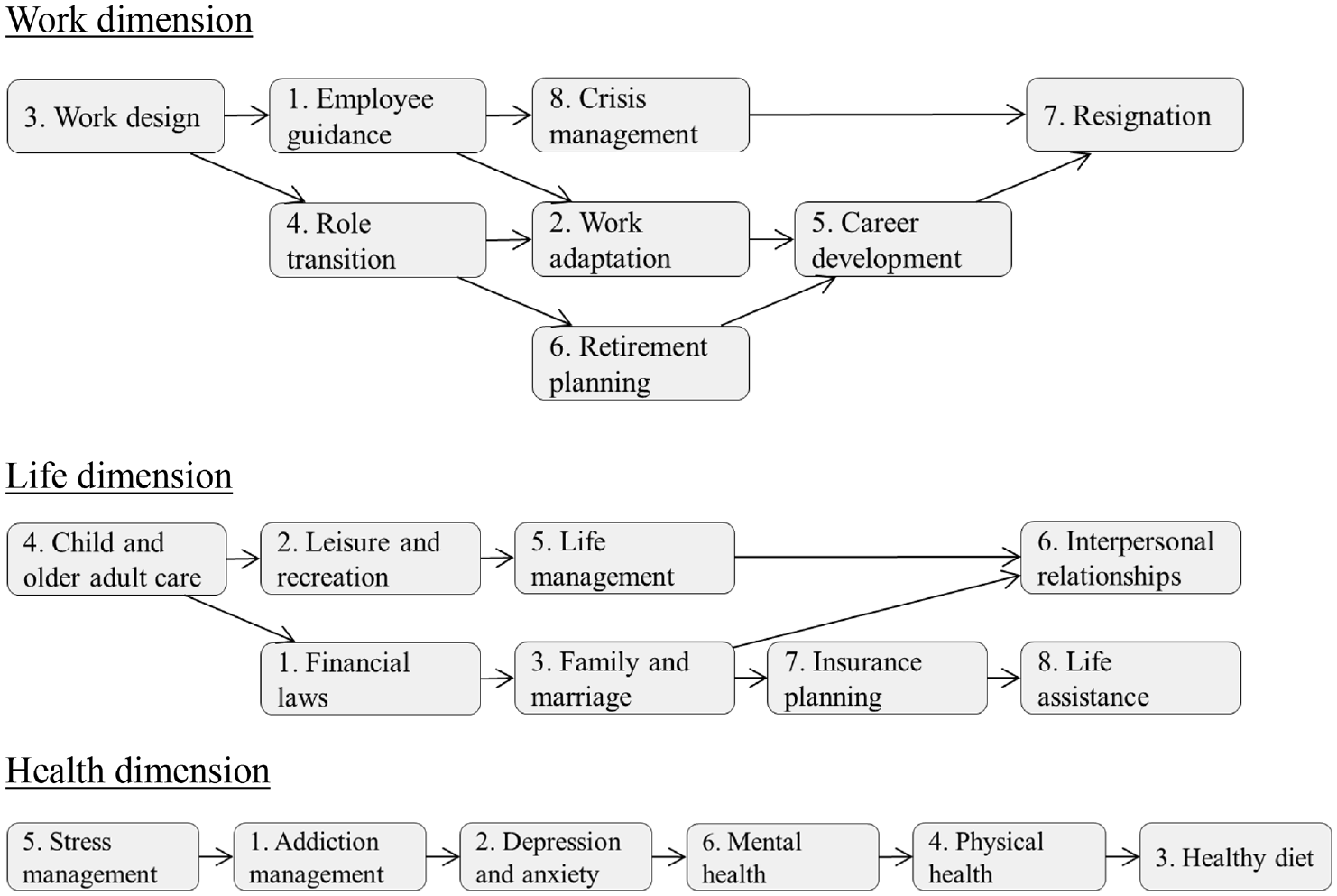
Indigenous EAP hierarchy charts.
In Figure 2, the leftmost items are the primary EAP constructs. Figure 2 demonstrates the relationships between the three EAP dimensions (work, life, and health).

AHP structural elements.
Analysis of the ISM EAP matrix for the work dimension revealed that work design simultaneously affects employee guidance and role transitions, which in turn influence crisis management, work adaptation, and retirement planning. These three constructs subsequently affect career development and resignation.
According to the analysis of the ISM EAP matrix for the life dimension, child and older adult care affects leisure and entertainment, which affects life management, which affects interpersonal relationships. Child and older adult care also affects financial law, which affects family and marriage, which in turn affects interpersonal relationships and insurance planning, which affect life assistance.
Analysis of the ISM EAP matrix for the health dimension revealed that stress management affects addiction management, depression and anxiety, mental health, physical health, and healthy diet, in that order.
By analyzing the mutual effects among the EAP measures, indigenous people and experts on employee assistance can participate in discussions that involve greater understanding of the needs of indigenous workers, which can enable selection of the most appropriate implementation paths for improving workplace health among such workers.
AHP Analysis
The AHP is applied in three steps: establishing a hierarchy, comparing criteria or programs in pairs, and determining the overall priority values of each selected program (Žavbi & Duhovnik, 1996). Hierarchical structures can be established by simplifying complex systems or problems into three levels, with the highest level representing the ultimate objective, the second level representing criteria, and the third level representing alternatives. In the present study, based on the criteria, mentorship function was divided into three dimensions, each of which were distinguished into numerous subdimensions. No more than seven subdimensions were employed for each dimension to prevent the hierarchical consistency of the subdimensions from being affected (Saaty, 1980). Figure 2 presents the diagram of the structural elements established through the AHP analysis.
The AHP analysis was employed to explain the opinions obtained from the questionnaire on indigenous workplace health and EAP systems. The results were expressed through the weights obtained through the AHP analysis and included the priority of key factors and the rankings of priority weights. For example, the weight rankings of the work, life, and health EAP dimensions at level two were determined, after which the relative importance of the EAP measures at level three were similarly determined. The weights of the opinions of 47 experts were summed and averaged to obtain the weight indicators of the indigenous workplace health and EAP measures. The key indicator with the highest weight value was selected as the first-priority factor; the remaining indicators were ranked according to their weight values.
The expert survey involved the pairwise comparison of the key hierarchical factors based on their differences in importance to each other. Importance was rated on a scale of 1 to 9 on the basis of five levels of importance, as presented in Table 2.
Fundamental Scale of Pairwise Comparisons.

Source.Saaty (1980).
The weight values were calculated on the basis of the aforementioned scores through using AHP software analysis. The values were considered to indicate the experts’ opinions on the key indicators of indigenous workplace health and EAP measures. The first-priority factor was selected with consideration of the weight values and the weight relationships of the other factors.
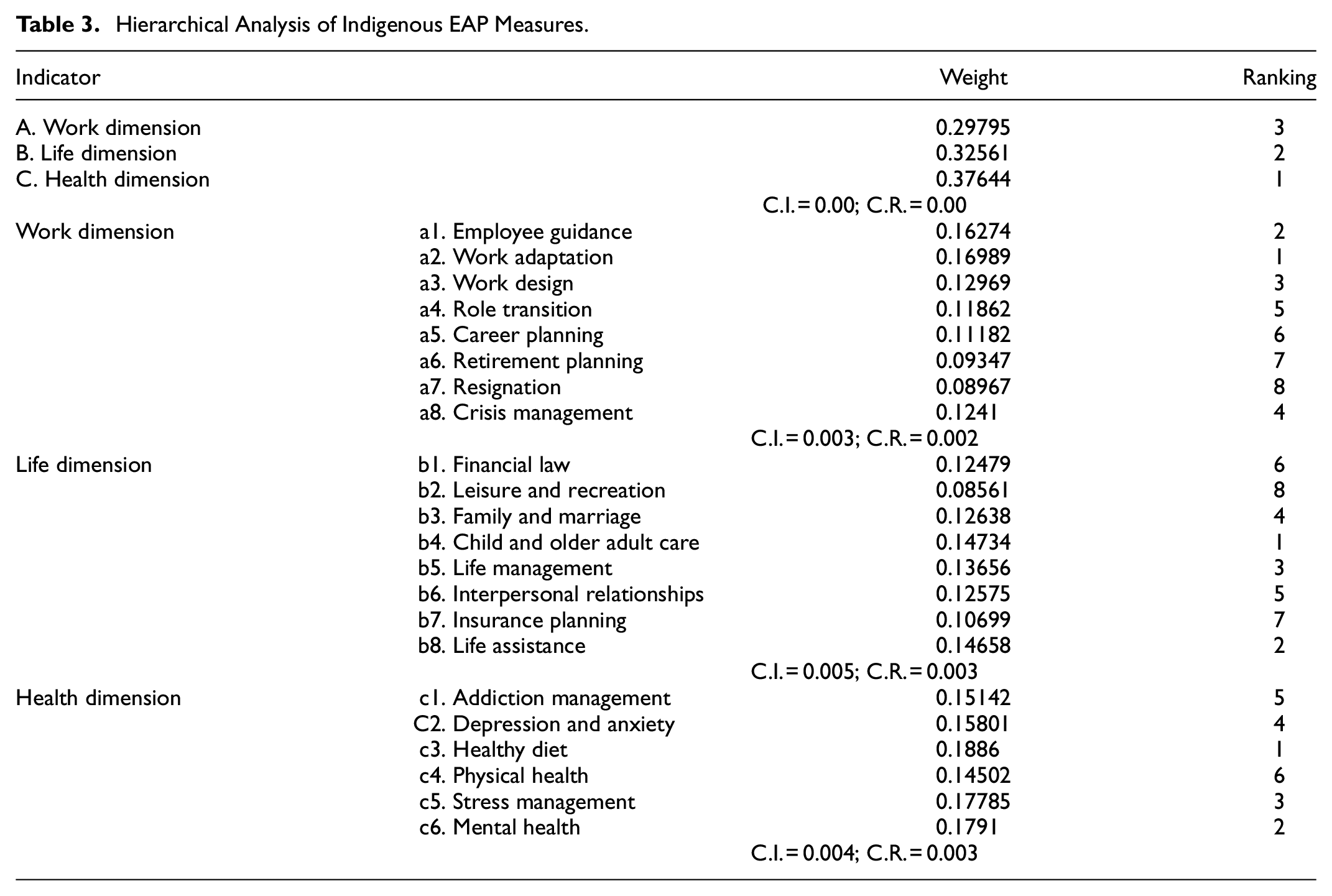
The 47 experts ranked the health dimension as the most important at the second level; the weight value was 0.376. The life dimension was ranked second, with a weight of 0.326, and the work dimension was ranked third, with a weight of 0.298. These results demonstrate that health was considered to be the most important dimension of indigenous EAPs, and the life dimension was only slightly more important than the work dimension was.
At the third level, the EAP measure ranked the most important in the work dimension was work adaptation; the weight value was 0.170. The other measures, in order of importance, were employee guidance (0.163), work design (0.130), crisis management (0.124), role transition (0.119), career development (0.112), retirement planning (0.093), and resignation (0.090). The rankings demonstrate that the employees believed work adaptation measures to be the most important among the EAP processes used by indigenous workers and that resignation was the least important, with a score of only 0.090. This low score indicates that resignation measures are either uncommonly offered in the workplace or less valued by indigenous employees.
In the life dimension, child and older adult care was ranked the most important, with a weight value of 0.147. The other measures, in order of importance, were life assistance (0.147), life management (0.137), family and marriage (0.126), interpersonal relationships (0.126), financial law (0.125), insurance planning (0.107), and leisure and recreation (0.086). These rankings demonstrate that the experts agreed that child and older adult care measures were the most important among the EAP processes within the life dimension that are used by indigenous workers and that leisure and recreation was the least important, with a score of only 0.086. This low score indicates that leisure and recreation measures are either uncommonly offered in the workplace or less valued by indigenous employees.
In the health dimension, healthy diet was ranked the most important measure, with a weight value of 0.189. The other measures, in order of importance, were mental health (0.179), stress management (0.178), depression and anxiety (0.158), addiction management (0.151), and physical health (0.145). These rankings demonstrate that the experts agreed that healthy diet measures were the most important among the EAP processes in the health dimension that are used by indigenous workers and that physical health was the least important, with a score of only 0.145. This indicates that physical health measures are either uncommonly offered in the workplace or less valued by indigenous employees.
A comparison of the indigenous EAP measures revealed that level two comprised 3 dimensions, and level three comprised 22 subdimensions (8 for the work dimension, 8 for the life dimension, and 6 for the health dimension). The weights of each dimension and subdimension are presented in Table 3; CI = 0.00. According to Saaty (1980), when CI ≤ 0.1 and CR ≤ 0.1, a matrix has a high degree of consistency (i.e., a consensus among experts who have participated in a survey).
Hierarchical Analysis of Indigenous EAP Measures.
Discussion
Work Design Has Major Effects on Other Work Dimension Measures
The four basic principles of scientific management proposed by Taylor (1919) are job specialization, job systemization, job simplification, and job standardization. Moregson and Humphrey (2006) identified 21 work design characteristics that can be sorted into four dimensions: task (autonomy, task variety, task significance, task identity, and feedback from job), knowledge (job complexity, information processing, problem solving, skill variety, and specialization), social (social support, interdependence, interaction outside the organization, and feedback from others), and contextual (ergonomics, physical demands, work conditions, and equipment use). The definitions of the principles and characteristics of work design demonstrate that the content and features of a job affect, for example, employees’ role transition, job engagement, and interactions with the social environment. In the work dimension, indigenous EAPs mostly focus on work adaptation—indigenous people are sensitive to rejection because of ethnic divisions in the workplace and may feel some degree of discrimination and exclusion to be present (Liu et al., 2017). Research on policy implementation has demonstrated that in the development of employment programs, establishing indigenous human capital management systems, drafting pragmatic employment policies and implementation frameworks, and integrating skills training with local resources (Ma & Wu, 2015) promotes indigenous employment. In addition, clear work designs in the form of work guidance and arranged role transitions can improve the work adaptation of indigenous workers in the workplace. In the present study, resignation having a weight value of only 0.90 indicates that resignation measures are either uncommonly offered in the workplace or less valued by Indigenous employees.
Child and Older Adult Care is the Foremost Considerations in the Life Dimension
Kui (2021) investigated the role of family homecare services for adults in indigenous areas as a means of anchoring the culture and lifestyle habits of indigenous tribes. However, factors such as the convenience of transportation, spatial and economic scarcity, and cultural features influence the burden of childcare and older adult care for indigenous people, which in turns upsets their work–life balance. Ma and Wu (2015) argued that the promotion of local cultural industries, the establishment of child and older adult care services, and the establishment of local employment service networks can provide indigenous tribes with more employment opportunities and facilitate their workplace adaptation. The results of the present study indicate that in the life dimension, indigenous workers prioritize child and older adult care; this may be because indigenous workers are often required to leave their tribes in search of work opportunities. A lack of transportation and medical access can lead to a vicious cycle of demand and insufficient supply (Liu et al., 2010), and a lack of immediate care resources for the older or young members of a family may cause indigenous workers in the city to spend more time traveling home to take care of their families. Providing better benefits may improve indigenous employees’ work performance and enable companies to increase their production and financial performance (Avgoustaki & Frankort, 2018). Work–life imbalance can also be reflected in the leisure and life management dimensions (Avgoustaki & Bessa, 2019).
Stress Management Has Effects on Other Aspects of the Health Dimension
The stress most often felt by indigenous people is social stress, which has been associated with social discrimination and excessive drinking. Furthermore, unfavorable economic and labor conditions have both physical and mental health effects for such people, mainly due to the scarcity of health-care resources in indigenous tribes (Hou et al., 2012). The Ministry of Health and Welfare (2018) investigated its indigenous mental health promotion programs and discovered that the mental health hardships in indigenous hometowns are related to education level, a lack of a fixed income, changes to demographic structures, labor and familial relationships, grandparents assuming the role of a parent, the decline of indigenous cultures, culture shock, stress coping strategies, leisure and entertainment, psychological adaptation, substance abuse, physical health disorders, and chronic diseases. The ministry also discovered that alcoholism and tobacco addiction are more prevalent among indigenous workers than among non-indigenous workers. These addictions are likely caused by compounded social stress from living within a multicultural environment and likely also affect mental health. Browngidge (2008) reported that mental illness, drug abuse, HIV risk behaviors, and domestic violence can affect the health of indigenous women. Drug abuse not only affects the physical and mental health of an individual but also has a ripple effect on the overall family as well as on the individual’s job performance. Chou (2020) reported on his experience with providing psychological counseling to indigenous people, and the cases presented in his book reveal the considerable breadth of the mental health concerns faced by indigenous people. Chou discussed problems related to the spread of Christianity, homophobia, domestic violence, older adult care, personal identity, and career identity. The literature has indicated that mental health is influenced by not only personal factors. Therefore, feelings of oppression related to indigenous cultural developments, cultural loss, and unsuitable or nonexistent social policies must also be analyzed (Browngidge, 2008; Jones, 2008; Oetzel & Duran, 2004; Wang, 2001); the effects of psychological stress can extend to other dimensions.
In summary, in indigenous EAPs the order of importance of the three dimensions is, from high to low, life, work, and health. This may be attributed to environmental culture (e.g., residence environment, care for the family, cultural difference, and ethnic adaptation) being considered the fundamental requirements for work adaptation by indigenous workers.
Conclusion
Theoretical Contributions
A comparison of the overall weight of the dimensions in the indigenous EAPs revealed that the order of importance of these dimensions from high to low was life, work, and then health. This order could be attributed to aspects of environmental culture (e.g., residence environments, family care, cultural differences, ethnic adaptation) being considered the fundamental requirements driving work adaptation among indigenous workers. Overall, this study found that work design had major effects on other measures in the work dimension and that few workplaces have established systems for job resignation and transition. In the life dimension, child and older adult care was the primary concern, possibly influenced by transportation convenience. Finally, in the health dimension, stress management influenced other measures in this dimension.
Practical Implications
Regarding the work dimension, this study suggests enforcing the employment programs and tribal development programs provided by the Indigenous Peoples Employment Rights Protection Act and the Indigenous Peoples Basic Law. Such enforcement could be achieved, for example, by working with indigenous development centers to help tribal regions obtain funding and subsidies as well as support in the form of employment programs and training. Such resources could also be utilized to implement additional employment measures, such as affirmative action hiring, counseling services for indigenous people to form labor cooperatives, and the provision of general vocational training. Additionally, focus could be placed on employee guidance, career development, work design, and work adaptation to enable indigenous workers to find suitable professional roles through the EAPs. In addition, in conjunction with employment programs, assistance could be provided to indigenous workers to smoothly transition between jobs, handle career crises, and even plan for retirement; such assistance could strengthen the support mechanism for job transitions. As mentioned by Kuo et al. (2013), the government should establish relevant training programs to enable indigenous workers to obtain certification in suitable fields of employment and to reinforce employment counseling and employment matching functions. Establishing vocational training courses targeted at indigenous people would facilitate the development of more appropriate training courses that in turn could improve indigenous people’s professional skills and their ability to acquire long-term, stable technical work rather than only temporary and menial jobs. By equipping indigenous people with formal professional skills, EAPs can achieve their work adaptation goals and implement work designs based on identifying the right people for the right jobs. Through such identification from both the worker and manager perspectives, indigenous EAPs could play a major role in the provision of work assistance. Regarding the life dimension, more daycare centers, kindergartens, and long-term care institutions should be established to ease the burden of care on young and middle-aged indigenous workers. Given the higher proportions of indigenous families with single parents and those with grandparents serving as parents (Kuo & Huang, 2010), as well as the remoteness of indigenous villages, the development of holistic care facilities integrated into existing facilities in local villages could improve the quality of childcare and older adult care, which in turn would likely considerably improve indigenous employment stability. Furthermore, social resources could be incorporated to establish secure living environments; such resources could include insurance planning and life assistance, financial legal consultation and assistance with solving adaptation problems, and the establishment of local community interpersonal support networks.
Regarding the health dimension, stress management should be prioritized; in other words, mental health services appropriate to indigenous people should be developed. Such development could be achieved, for example, by establishing addiction support groups; offering welfare measures to enhance people’s motivation to change; and encouraging business owners to understand that cultural differences may lead to differences in life adaptation, responses to emotional distress, and forms of psychological stress. Finally, mental health services and programs suited to indigenous people could also be offered, for example, through services provided by indigenous therapists and classes regarding healthy eating and healthy habits to counteract the physical and mental damage of alcohol and drug addiction.
Future Research
Although this study conducted a questionnaire survey developed using a modified Delphi method and hierarchical data analysis to empirically explore the content of health services that indigenous workers require in the workplace, we were able to identify only items and the importance of these items at this stage. Future studies could use methods such as ISM to better understand the pathways between the factors influencing the identified items in order to develop more beneficial services despite limited resources.
Footnotes
Appendix 1. Questionnaire Excerpts
Declaration of Conflicting Interests
The author(s) declared no potential conflicts of interest with respect to the research, authorship, and/or publication of this article.
Funding
The author(s) received no financial support for the research, authorship, and/or publication of this article.
Ethical Approval
This noninterventional study required no ethical approval because of its nature, nor did it take place within any private or protected space. Therefore, no specific permissions were required in the geographical regions specific to this study. In addition, all the participants’ data have been anonymized and were analyzed only for the purposes of this study.
Informed Consent
Before the participants participated in this study, the researchers informed them of their rights regarding confidentiality. These rights, as they were presented to the participants, are described in detail as follows:
1. Participation in this research is confidential. In the survey, participants will not be asked any questions that may reveal any personal information. In the event of any publication or presentation of the following research, no personally identifiable information will be shared because the participants’ names will in no way be linked to their responses.
2. Each participant’s participation in this research is completely voluntary, and each participants can halt their participation at any time. The participants are not required to answer any questions that they are not willing to answer.

Data Availability Statement
The datasets generated and analyzed during the current study are not publicly available but can be obtained from the corresponding author upon reasonable request.