




Abstract
This qualitative study sought to explore how women entrepreneurs leverage the Internet to empower their entrepreneurial activities in the Chinese context. To this end, we first conducted semi-structured interviews with 30 women entrepreneurs, and then analyzed their transcripts by following the principles of thematic analysis from grounded theory method. After the three-phase coding procedure, we developed a conceptual model of Internet use of women entrepreneurs which were composed of Internet marketing, Internet purchasing, and Internet learning. The current study provides the first evidence for the multidimensional construct of Internet use with a sample of women entrepreneurs in China. A hypothesis concerning the relationship between Internet use and women entrepreneurial performance is proposed for future investigation. Implications for women entrepreneurs and policymakers are discussed.
Plain language summary
With the proliferation of digital technologies, an increasing number of women entrepreneurs leverage the Internet to run their businesses. But how do women entrepreneurs incorporate the Internet into their businesses in ways that make them feel empowered? In this article, we investigate this question by conducting semi-structured interviews with 30 Chinese female entrepreneurs and analyzing their transcripts via grounded theory method. Results show that the conceptual model of Internet use from a lens of female entrepreneurs encompasses Internet marketing, Internet purchasing, and Internet learning, which constitutes our major contribution to the literature on women entrepreneurship. We hypothesize that these Internet use has the potential to improve the entrepreneurial performance of women and recommend further studies in this regard. Based on our findings, we provide policymakers with suggestions to digitally empower women entrepreneurs, and offer women entrepreneurs implications on the effective use of new digital technologies. However, since all the interviewees came from China, the dimensions of Internet use identified in our article may not be applicable to women entrepreneurs in other cultural contexts with different digital environments.
Introduction
With an increasing number of women entrepreneurs and their positive effects on the social-economic development, research on women entrepreneurship has experienced a significant growth over the past two decades (Cardella et al., 2020). Many studies, to date, have shown that women entrepreneurs face greater challenges and barriers than their male counterparts, such as narrow social networks, limited entrepreneurial resources and work-family conflicts, which will restrict the development of women entrepreneurship to a great extent (Bozoğlu Batı & Armutlulu, 2020; Guzman & Kacperczyk, 2019; Said & Enslin, 2020). Therefore, women-owned enterprises tend to feature slower growth, less expansion, lower technological content, and relatively limited social influence as opposed to men-owned ones (Shakeel et al., 2020; Thébaud, 2015). Given that the potential of female entrepreneurs has not been fully tapped, efforts have been made by researchers to examine how to promote women entrepreneurship (Melissa et al., 2015; Thomas & Moisey, 2006).
With the advent of the digital era, the external entrepreneurial environment has undergone dramatic changes (Autio et al., 2018; Bi et al., 2017). Among the contextual factors that affect female entrepreneurship, the Internet has become a focus of academic concern in recent years (Mehta & Sinha, 2022; Orobia et al., 2020). Especially since the outbreak of COVID-19 in 2020, quite a few women entrepreneurs have attempted to run their businesses online (Afshan et al., 2021). The Internet is characterized by low entry threshold, abundant free information, and no constraints of time and space (Martin & Tiu Wright, 2005), making it possible for those who are under-resourced and socially disadvantaged to participate in entrepreneurial activities (Dy et al., 2017; Martinez Dy et al., 2018; Shao et al., 2022). Although Ughetto et al. (2020) suggested that the Internet has enabled women to enjoy more work flexibility, enlarge their social networks, and acquire abundant resources, they also pointed out that there is still a limited understanding of the role played by digital technologies in driving women entrepreneurship. Specifically, some studies simply examine the extent to which female entrepreneurs use the Internet (Pergelova et al., 2019), failing to considering how female entrepreneurs leverage the Internet to carry out entrepreneurial activities; other studies mainly focus on a single aspect (e.g., social media) to characterize female entrepreneurs’ Internet use (Melissa et al., 2015), ignoring that the Internet may empower female entrepreneurs in multifaceted ways. Simply put, research on how women entrepreneurs employ new digital technologies in conducting business is quite scant (Manolova et al., 2020; Ughetto et al., 2020).
To fill the above gaps, the current study attempts to explore how women entrepreneurs integrate the Internet into their businesses in ways that make them feel empowered. We focus specifically on female entrepreneurs since internet-based digital technologies can help them eliminate many obstacles they face in traditional entrepreneurial situations. Given the explorative nature of the research question with its focus on conceptualizing Internet use in a multidimensional way, we aim to conduct semi-structured interviews with Chinese women entrepreneurs, and analyze their transcripts using a grounded theory approach. This study contributes to the entrepreneurship literature by enriching the connotation of Internet use from a perspective of women entrepreneurs. It also advances the research on the intersection of digital technology and female entrepreneurship in China. Hopefully, the results of the current study will be beneficial to scholars who are interested in female entrepreneurship, along with female entrepreneurs struggling to facilitate their entrepreneurial development in the era of digital technology.
Literature Review
The Status Quo of Women Entrepreneurs in China
Women entrepreneurs are recognized as those who join the process of setting up an enterprise, sharing part of its property rights, and taking charge of company operations (Becker-Blease & Sohl, 2007). Female entrepreneurship not only helps women realize their own economic independence and life value, but also creates more employment opportunities for the labor market and promotes socio-economic development (Bullough et al., 2022). The initiative of Mass Entrepreneurship and Innovation proposed by ex-premier Li Keqiang in 2014 is seen as an important national strategy to promote entrepreneurial activities, in which women entrepreneurs are expected to play a vital role (Central Government of the People's Republic of China, 2015). Despite the rising number of female entrepreneurs in China over the past few decades, there is still a gender gap in entrepreneurship, as detailed below.
First, gender stereotypes rooted in the Chinese culture largely impedes the development of women entrepreneurship since men and women are expected to play different gender roles in social and family domains (Liu, 2013). Traditionally, men are regarded as breadwinners whereas women are treated as caregivers of the family (Franzke et al., 2022). Although an increasing number of women have joined the labor market in the modern society, the image of women being gentle, irrational, sensitive, and maternal is still considered incompatible with the role of entrepreneur (Xiong et al., 2018). Gender biases in the traditional culture add to the challenges of female entrepreneurs, making it difficult for them to obtain external financing (Wang et al., 2019). Even if female entrepreneurs achieve career success, they are often portrayed by the media as “iron women” or “super women” (Zhao & Yang, 2021).
Work-family conflict has been another consistent issue facing many Chinese women entrepreneurs since they struggle to fulfill work and family roles at the same time (Chen et al., 2018a). Compared with the western individualist culture, the Chinese collectivist culture attaches more importance to the harmony of interpersonal relations, so building a harmonious family is an essential part of Chinese women’s life (Cooke & Xiao, 2021). A large body of studies have demonstrated that facing a dual burden in career development and family care is likely to reduce women entrepreneurs’ dedication to their businesses, thereby negatively influencing their entrepreneurial performance (Zhao & Yang, 2021).
Finally, the Chinese traditional culture lays a strong emphasis on guanxi which is defined as connections to powerful people (Ren & Chadee, 2017). Guanxi networks can enable entrepreneurs to develop business knowledge and have access to important resources, but women entrepreneurs are in a disadvantaged position as opposed to their male counterparts regarding available guanxi networks (Matthew Scott et al., 2014). This is because female entrepreneurs’ social networks mainly rely on their families and friends, and generally find it difficult to build new guanxi in male-dominated business environments (Cooke & Xiao, 2021). Research has shown that lack of access to guanxi often constrains female entrepreneurs from obtaining key resources, thereby affecting their entrepreneurial development (Franzke et al., 2022).
Given that Chinese women entrepreneurs face more barriers in career development than their male counterparts, it is a crucial question in gender equality to understand ways to promote the development of women-owned businesses.
Women Entrepreneurial Empowerment Through the Internet
With the arrival of digital technology, the popularization of the Internet has revolutionized the business environment (Kraus et al., 2019). The Internet provides an open, free, and equal platform (Chen et al., 2018b), thus creating numerous opportunities for current and prospective entrepreneurs (Dholakia & Kshetri, 2004). Opening up a business online is particularly attractive to women who often face the aforementioned issues such as work-family conflict and lack of guanxi (Golzard, 2019). In China, women are encouraged to make full use of the fast-growing Internet technology to carry out innovative and entrepreneurial activities in the new economic era (All-China Women's Federation, 2018). Adaptation of technology has enabled Chinese women to create various flexible entrepreneurial forms, and they particularly occupy a dominant position in social media platforms. According to the “Internet + Her Era: Female Entrepreneurs Report” released by Alibaba Research Institute of China in 2015, female entrepreneurs accounted for merely 3.6% in the traditional entrepreneurial field, but occupied >50% in the Internet entrepreneurial ecosystem, and the proportion of female entrepreneurs was as high as 67% in the service industry. As such, the Internet, as a means of entrepreneurial empowerment, has provided numerous opportunities for Chinese women entrepreneurs.
With a growing number of women entrepreneurs using the Internet technology to carry out entrepreneurial activities, the topic on the intersection of digital advancements and female entrepreneurship has attracted increasing attention from scholars (Mehta & Sinha, 2022; Orobia et al., 2020). Melissa et al. (2015) documented Internet use as social media (e.g., Facebook) when their research was targeted at women entrepreneurs in Indonesia. Delacroix et al. (2019) found that Facebook could increase women’s social capital, thus promoting their micro-entrepreneurship activities on the Internet platform. In Thomas and Moisey’s (2006) study, Internet use was largely manifested by online informal learning among women entrepreneurs. Pergelova et al. (2019) simply paid attention to the frequency of Internet use when they conducted research on digital technologies and female-led companies. Nevertheless, there is still little research on the digital aspects of female entrepreneurship as the extant studies fail to paint a comprehensive picture of how women entrepreneurs leverage the Internet technology to run their businesses (Manolova et al., 2020; Ughetto et al., 2020). Cooke and Xiao (2021) suggested that research in the field of online entrepreneurial activities of women in China is scant. Therefore, the present study offers an initial inquiry into how the Internet facilitates the business activities of Chinese women entrepreneurs.
The Present Study
To establish a theoretical framework, the current study uses the concept of Internet use as a way to understand how women entrepreneurs incorporate the Internet into their businesses in ways that make them feel empowered. This concept not only emphasizes the use of internet technology to conduct entrepreneurial activities, but also highlights the relations with other stakeholders (e.g., customers, suppliers) established in the Internet context. To construct the dimensions of Internet use, we attempt to carry out semi-structured interviews with Chinese women entrepreneurs, and then analyze their transcripts via grounded theory method. The qualitative nature of the present study allows us to capture real accounts of participants’ experiences of using the Internet in their business activities. We hope the results of this study can enrich the literature on women entrepreneurship and inform implications for practitioners.
Method
Participants
When it comes to choosing samples, grounded theory method emphasizes theoretical sampling strategy to ensure that participants are widely representative (Glaser et al., 1968). Criteria for participants were (a) having Chinese citizenship, (b) self-employed women or women having founded an enterprise, and (c) incorporating the Internet into their entrepreneurial activities. A total of 30 participants were interviewed in the current study. Among these participants, 16 were married while 14 were unmarried. Concerning educational backgrounds, 17 participants reported holding an associate degree or less, 7 participants reported holding a bachelor’s degree, and 6 participants reported holding a master’s degree and above. As for age groups, there were only 2 participants aged 30 or below, thirteen aged between 31 and 40, 10 aged between 41 and 50, and 5 aged above 50. Regarding business experience, 3 participants have run their enterprises for less than <1 year, 12 for 1 to 3 years, 6 for 4 to 6 years, 5 for 7 to 10 years, and 4 for >10 years. Participants also differed in enterprise size with 3 having 1 to 10 employees, 16 having 11 to 20 employees, 8 having 21 to 50 employees, 2 having 51 to 100 employees, and 1 having >100 employees. In terms of the industry of enterprises, most participants’ business belonged to service industry (n = 12), followed by trade sector (n = 7), high technology industry (n = 5), manufacturing industry (n = 3), and other industries (n = 3). Their enterprises covered different parts of China, including central region (n = 12), eastern region (n = 9), western region (n = 6), and northeastern region (n = 3).
Protocol Development
In order to obtain valuable information during the interview, we drew up a semi-structured interview protocol concerning entrepreneurial activities carried out on the Internet (Brinkmann & Kvale, 2015). Following the recommendation of Hill et al. (2005), we shared this protocol with five pilot female entrepreneurs to gain their feedback on the questions of the interview. Having received their suggestions, we refined some questions to make them more consistent with the real situation. We also invited two experts in the field of entrepreneurial management to help us check the content validity of the interview questions, and made some minor revisions to the wording of the questions so that they were more concise and understandable.
The interview protocol of the current study was divided into three parts. The aim of the first part was to state the research purpose and confidentiality commitment to the participants. This could dispel their worries and allow them to be open-minded to the forthcoming interview. The second part focused on the personal information of the participants and the basic information of their enterprises, including age, education background, marital status, location of the enterprise, specialized business, operating years, scale, profit, etc. Through seemingly simple small talk, we aimed to establish a rapport with the participants and further gain their trust so that we could proceed with the subsequent core questions. The third part was the core content of the interview, aiming to understand participants’ Internet embedding behaviors. We raised 10 questions in total. The first nine questions were listed as follows: “What do you think are the characteristics of the Internet platform compared to other platforms?,”“Do you have a good network platform to recommend? Why do you recommend this platform?,”“How did the Internet help when you started your business?,”“What resources can you gain by using the Internet to run a business?,”“How do you advertise or sell your products or services online? How does it work?,”“What do you think about promoting products or services through short videos, live streams, etc.? Have you tried it? How does it work?,”“How do you maintain relationships with customers through the Internet?,”“Do you find business partners via the Internet? How effective is this cooperation?,”“Do you engage in online learning? What do you learn?.” Finally, at the end of the interview, we asked participants to give some suggestions to those women who want to start an online business. This question would allow them to share their experience of employing the Internet to carry out entrepreneurial activities in greater detail.
Procedure
We recruited participants primarily through the first author’s social networks and used a snowball sampling technique. More specifically, we posted an advertisement of the current study on the first author’s WeChat which is a social networking app with over 1.2 billion Chinese users. This allowed us to expose our advert to at least 3,000 adults who were diverse in educational background, age, occupation, etc. and scattered around the country. We heavily relied on word of mouth to inform potential participants of our study. Participants who showed interest in the study were directed to call or text the first author to gain more information about the study and to schedule a suitable time for a semi-structured interview which would last between 40 and 60 minutes. Given that the COVID-19 pandemic restricted the offline flow of people, we decided to conduct online video interviews via Tencent conference software (Parvaresh-Masoud & Varaei, 2018). Meanwhile, in order to facilitate the interaction with the participants, we attempted to learn about their basic information in advance through various channels like the websites of their companies, their social media and so forth.
At the beginning of each interview session, we explained the purpose of this research to participants, and promised that the interview contents would be kept confidential. Only after we obtained their consent form did we begin to record the session. During the interview, we adhered to the principles of listening carefully, actively interacting, and taking detailed notes. All interviews were conducted in accordance with the order of the protocol to ensure that participants answered all the questions prepared ahead of time. Throughout the interview, we encouraged participants to offer detailed descriptions either by showing curiosity about their last remarks or asking for relevant examples of what they said. For example, when the participants simply answered a question without fully clarifying their points, we would use such prompts as “Why is that?,”“Any examples?” and so on. In order to have a better understanding of our participants, we also asked them to provide electronic information about their enterprises which did not involve business secrets, such as product brochures, stories of enterprise development, etc.
After each interview, we organized our recordings and notes within 24 hours to form a transcript of the original data. There were several benefits of doing so. Firstly, we were able to recall the details of each interview in time during the process of data sorting. To be specific, we converted audio data into text data by using Iflyhear app developed by IFlytek (the largest intelligent voice technology provider in China), and compared it with our notes to form a complete transcript of interview data. When we found that there were ambiguous words or statements in the transcript, we would contact participants immediately to help us proofread the relevant information (Creswell & Poth, 2018). Additionally, we used a research journal for the purpose of drawing lessons from each interview in a timely manner (Flick, 2009). By conducting self-reflection, we were able to maintain the advantages shown in the previous interview, and to avoid the same mistakes in subsequent interviews. Finally, we shared the data transcripts with participants for their confirmation before conducting data analysis (Morrow & Susan, 2005; O’Reilly & Kiyimba, 2015). When we had completed 30 interviews, we observed that additional interviews did not add any novel information to our topic, and thus we stopped conducting further interviews.
Data Analysis
Transcripts were inductively analyzed using three phases of the thematic analysis (Charmaz, 2005; Miles et al., 2014). At the first stage of the coding procedure-open coding, we labeled valuable remarks from the original interview data, and then conceptualized the phenomena reflected by each label. Those concepts reflecting similar phenomena were further grouped into initial categories and named with technical terms. In the second stage-axial coding, we started a new round of exploration on initial categories, extracting sub-categories, and main categories. In the final phase-selective coding, we hierarchically arranged main categories, sub-categories, and initial categories, after which a conceptual model was developed.
To ensure the credibility of the coding process, the first author invited another three researchers in the field of management including a professor, an associate professor, and a doctoral student to form a four-person coding team. All coding team members were familiar with grounded theory method and had a good grasp of coding procedures. We first carried out the three-phase coding process independently and then met to check the coding results afterward. When the coding results were inconsistent, we worked together to discuss changes and, if necessary, consulted some leading experts in the grounded theory. Taken together, the determination of final categories was subject to constant comparison until consensus was reached within the coding team (Corbin & Strauss, 2014).
It is also worthwhile to mention that theoretical saturation was tested to verify whether the main categories and sub-categories generated in the process of coding were comprehensive enough. To this end, we had a brief interview with the previous 30 participants again after 3 months and found that the information they provided could be covered by the categories extracted in our previous data analysis. Additionally, we interviewed another two participants and conducted a new round of data analysis. We found that the newly obtained data did not help us derive new information. Based on the above two methods, we came to the conclusion that the conceptual model constructed in this study was theoretically saturated.
Results
In strict accordance with grounded theory method, we had semi-structured interviews with 30 female entrepreneurs, then conducted data analysis via 3 steps, and finally developed a conceptual model of Internet use, which encompassed 3 main categories, 7 sub-categories, and 14 initial categories (See Appendix). In the sections below, we will discuss the three main categories and their respective sub-categories in greater detail. We have also included representative extracts to support our interpretations as well as to help readers contextualize categories extracted by the coding team.
Main Category A: Internet Marketing
The main category labeled “Internet marketing” captures the marketing activities carried out by participants of this study through the Internet, including media promotion, online community operation, and platform sales. In this way, the marketing goals of “attracting customers,”“retaining customers” and “selling goods” could be achieved respectively. Specifically, participants reported that they attempted to promote products or services via social media to attract customers’ attention, to maintain a long-term relationship with customers in online communities, and to sell products on various e-commerce platforms to achieve sales growth.
Sub-Category A1: Media Promotion
Participants expressed their experience of using new media technology such as short videos and live streams to promote their products or services. Firstly, most participants described media promotion as a means to gradually accumulate followers. Participant 9 put it this way, “I update at least short videos every week, and release them simultaneously on multiple media platforms. I also live stream every night to attract customers.” Additionally, 20 participants relied on media promotion for the purpose of winning a good name for their enterprises and specifically mentioned the importance of providing value for customers. Just as participant 12 mentioned, “Whether it is live streams or short videos, the most important thing is to provide useful information if you want to build a good reputation and obtain positive word-of-mouth. After all, who produces the best content stands out.” Overall, media promotion was used by participants for the sake of attracting potential customers and building brand images.
Sub-Category A2: Online Community Operation
Participants revealed that operating online communities via social media was one of the most important daily routines. First, many participants emphasized the significant role of online community in maintaining a good relationship with customers. Participant 6 put it this way, “I actively interact with other members in online communities by offering help, answering questions, sharing information, etc. In this way, I gradually establish a close relationship with our existing and potential customers.” In addition, the majority of participants suggested that online communities are good places to promote their products or services. Participant 2 stated, “Members in the online community can act as our word-of-mouth advertising. When I send some ads to promote our products in the online community, I will use a little digital money to encourage everyone to share the ads with their friends. And I’m happy to see they are pretty willing to do so.”
Sub-Category A3: Platform Sales
Participants described that they carried out product promotion and transaction activities via third-party network platforms. A typical case in point is Taobao which is the largest e-commerce platform in China. Twenty-eight participants told us that they sold products or services on Taobao or other similar platforms. Participant 11 said, “I have used Taobao for many years. It allows me to earn a living in such a small town. I can get access to customers all over the country. It has totally changed my life.” Participant 4 expressed the same idea, “Integrating into a commercial platform brings us a lot of convenience. For example, they can promote your products to potential customers as long as you pay the money. They also offer us valuable information about customers, like their needs, preferences, comments, and stuff like that.” Therefore, as suggested by most participants of this study, online platforms could help women entrepreneurs increase their sales.
Main Category B: Internet Purchasing
The main category labeled “Internet purchasing” represents the fact that participants were looking for suppliers via the Internet for the purpose of obtaining raw materials as well as other key resources which were conducive to their entrepreneurial activities. Suppliers here referred to merchants who have no business overlap with the participants of this study. As such, in addition to buyer-seller relationships, participants were very likely to establish cooperative relationships with their suppliers after several business transactions.
Sub-Category B1: Raw Materials Control
Most participants specifically mentioned that cost control and quality control were two important factors that they always took into account when buying raw materials on the Internet. First, participants were likely to save money for their companies if they chose to buy raw material online. For example, participant 1 who ran a hotpot restaurant shared her experience of how to reduce the cost for her business. “There is an online platform called Nice Food Mall where we can get the cheapest food with guaranteed quality. And their employees send the food we order directly to our place earlier in the morning, so we don’t need to travel a long distance to get the food. It’s really convenient.” In addition, some participants expressed the idea of relying on the Internet to obtain raw materials of the best quality. Participant 15 commented, “There is a wider selection online, I can shop around based on user comments and product information, so I find who can provide the best quality stuff for our production.”
Sub-Category B2: Win-Win Cooperation
Most participants described their relationships with suppliers as win-win cooperation. Two initial categories emerged to describe such kinds of relationship. The first one was reciprocal behavior, which meant that participants and their suppliers shared important resources with each other such as customers. As participant 20 noted, “You not only get cheap raw materials from your suppliers, but also other resources. Once you build a good relationship with them, they will also recommend their customers to you.” The second one was mutual trust, which meant that participants were able to establish a close rapport with their suppliers by exchanging valuable information on a regular basis. Participant 16 mentioned, “I talk with my suppliers quite often to see if there is any useful information to my business. And they are pretty sincere, friendly, and trustworthy. Maybe that’s because I also tell them what I know.”
Main Category C: Internet Learning
The main category labeled “Internet learning” reflects the learning activities carried out by participants through the Internet, including self-improvement and mutual learning of experience. Nowadays, the Internet has become a vital space for entrepreneurial learning, enabling women entrepreneurs to have access to more learning opportunities at a lower cost. While some participants reported that they often searched for entrepreneurship-related information by browsing websites or taking online courses, others described online learning as the positive interaction with other stakeholders in virtual communities.
Sub-Category C1: Self-Improvement
Almost all participants expressed the need to actively update their knowledge base to adapt to the ever-changing business environment. Participant 5 remarked, “Plenty of free learning resources are available online, and some successful entrepreneurs share their experience via articles or videos. As long as you take the time to search, you can definitely find what you want.” Additionally, almost all participants expressed their strong will to enhance their competence since they repeatedly mentioned “fierce competition.” Participant 19 indicated, “As entrepreneurs, we must keep up with the times, or we will be left behind. We don’t want to lose any opportunities for growth.” Overall, both active learning and focusing on growth reflected participants’ strong intrinsic motivation to achieve self-improvement.
Sub-Category C2: Mutual Learning of Experience
Participants described mutual learning as experience acquisition and experience sharing. To achieve this, they communicated with business partners, competitors and other stakeholders on a regular basis. First of all, 22 participants of this study mentioned that they attempted to obtain valuable experience of other entrepreneurs through the Internet. Participant 3 noted, “You gotta talk to people, especially those experienced entrepreneurs. I understand some woman entrepreneurs complain they don’t know many people, but why not search online? You need to take the initiative to approach anyone who can help you online.” Furthermore, 23 participants of this study said that they actively shared their entrepreneurial experience via live streams or short videos in order to spread their influence. As participant 1 put it, “My personal brand works pretty well, I mean I have lots of followers on social media because I share what I know. Everyone can see it via my videos or live streams. I think the best business model is altruism.”
Discussion
We conducted semi-structured interviews with 30 Chinese female entrepreneurs who were asked to share their experiences of leveraging the Internet to carry out entrepreneurial activities. After the thematic analysis of the interview data, we identified three main categories of Internet use of participants, namely Internet marketing, Internet purchasing, and Internet learning. The three main categories fully depicted the behavioral characteristics of women entrepreneurs’ Internet use, and reflected a business network consisting of customers, suppliers, and other stakeholders on the Internet.
Internet Marketing
The first main category extracted in this study is Internet marketing including media promotion, online community operation, and platform sales. First, media promotion reflects the behaviors of female entrepreneurs to promote their products to potential customers in the Internet context. As an extension of marketing, media promotion in the Internet era mainly transmits content in the form of graphics, videos, and live streams so that target users can have more direct access to information about products (Oppong et al., 2020). Female entrepreneurs with strong awareness of network media are good at using TikTok, Twitter, and other social media to publicize their products, which not only plays a positive role in building brand images, but also enables enterprises to obtain more customers at a lower cost (Golzard, 2020). As Rahimnia and Hassanzadeh (2013) proposed, if an enterprise actively promotes its products through the Internet, it can quickly penetrate the market of target users. E-marketing can also allow female entrepreneurs to receive comments and feedback from consumers in developing products or services (Jones, 2010).
Second, online community operation can effectively gather all existing and potential customers in a virtual social group. Some participants suggested that women entrepreneurs should make use of their character strengths such as tenderness, empathy, patience, good communication skills to provide quality service for customers in the online community. For example, they can provide valuable information for other members in the community, and take the initiative to solve problems for others. By doing so, as suggested by most participants, female entrepreneurs can not only win the trust and recognition of community members, but also accumulate a number of loyal followers who can form a good word-of-mouth effect. This is consistent with the observation of Zhu et al. (2016) that information or emotional support gained from online communities can stimulate customer citizenship behavior, making them willing to provide useful feedback or recommendations to the company, and help other customers in online communities.
Finally, participants reported that they also sell their products or services through the Internet, which can be embodied by third-party network platforms such as Taobao. The advantage of using these platforms is that they allow women entrepreneurs to have access to a number of potential customers throughout the country, which can reduce the cost of advertising, and maximize the profits of their enterprises. Just as Delacroix et al. (2019) put it, using digital platforms enables women entrepreneurs who lack social networks to expose their products to more potential customers and thus increase sales.
Internet Purchasing
The second main category extracted in this study is Internet purchasing including raw material control and win-win cooperation which reflect the interaction between female entrepreneurs and suppliers via the Internet. According to Michael Porter’s Five Forces Model, besides customers, there are other stakeholders, such as suppliers, that determine enterprise profitability (Grundy, 2006). Meanwhile, Lancioni et al. (2000) pointed out that the Internet promotes the cooperation between entrepreneurs and suppliers, and can bring higher production efficiency to enterprises by reducing the cost of raw materials. Additionally, many participants reported that the openness and sharing of network information could help them break through their own disadvantages in social networks, and promote their information exchange with online partners in a timely manner. As proposed by Shi et al. (2016), the Internet enables more frequent communication among stakeholders, and timely communication of information between them plays a crucial role in entrepreneurial activities. It can be seen that the Internet has become an important context for female entrepreneurs to interact with suppliers, which is also consistent with the ideas suggested by Delacroix et al. (2019).
Internet Learning
The third main category extracted in this study is Internet learning which encompasses self-improvement and mutual learning of experience on the Internet. Entrepreneurial learning is an essential prerequisite for entrepreneurial success (Deakins & Freel, 1998). With the popularity of digital technologies, profound changes have taken place in individuals’ learning styles, and entrepreneurial learning extends from real social networks to virtual social networks (Schou et al., 2022; Thomas & Moisey, 2006). In the context of the Internet, entrepreneurial learning has become more convenient and less expensive than before. Women entrepreneurs who used to be disadvantaged in human capital are able to carry out independent learning anytime and anywhere in order to improve themselves. Additionally, women entrepreneurs can participate in community learning with other stakeholders. This “collective learning” approach aligns with Secundo et al.’s (2021) idea that entrepreneurs can exchange information with stakeholders on social media platforms to make progress together. Put another way, women entrepreneurs can not only gain valuable entrepreneurial experience via communicating with online members, but they can also share their secrets of doing business with other entrepreneurs.
Theoretical Implications
In the digital era, the Internet has become an important context for entrepreneurs to carry out entrepreneurial activities (Tan & Li, 2022). Given women entrepreneurs face more challenges in the offline entrepreneurial process than their male counterparts, such as work-family conflict and lack of entrepreneurial resources (Guzman & Kacperczyk, 2019; Mozumdar et al., 2020; Wu et al., 2019), Internet-based digital technologies can effectively change this situation, allowing them to gain more flexibility in work, diversified information channels, and abundant entrepreneurial resources (Mehta & Sinha, 2022; Rajahonka & Villman, 2019). Although the economic effects of the Internet on women entrepreneurs have already been discussed by scholars (Golzard, 2020), how women entrepreneurs utilize the Internet to empower their business activities is not clear. Most studies have merely focused on the role of social media in women-owned businesses (Camacho & Barrios, 2022; Chaker & Zouaoui, 2023), failing to paint a full picture of how women entrepreneurs make use of the Internet to facilitate their entrepreneurial activities. The current study filled this gap by establishing a multidimensional conceptual model of Internet embedding behaviors to showcase how women entrepreneurs employ the Internet technology to run their businesses, effectively responding to recent calls by some scholars (e.g., Manolova et al., 2020; Ughetto et al., 2020) that there is a need to explore the role played by digital technology in empowering women entrepreneurship. As suggested by Afshan et al. (2021), there are indeed differences in entrepreneurial activities between male and female entrepreneurs. Our study mainly contributes to the entrepreneurship scholarship by enriching the connotation of Internet embedding behaviors from a lens of women entrepreneurs. We also extend the literature on the intersection of female entrepreneurship and digital technology in the Chinese context.
Practical Implications
The current study has important implications for both women entrepreneurs and policymakers. First, the three main categories extracted in this study can help women entrepreneurs to have a deeper understanding of the role of the Internet in doing their businesses. In other words, women entrepreneurs should make full use of the Internet to carry out Internet marketing, Internet purchasing, and Internet learning. In terms of Internet marketing, women entrepreneurs can not only promote their products or services via short videos, live streams, etc., but also operate online communities to establish a close relationship with present and potential customers. They could also consider engaging in some network platforms to sell products. As far as Internet purchasing is concerned, searching for online suppliers can allow women entrepreneurs to obtain raw materials at a relatively reasonable price, and to gain other critical resources or information. Therefore, women entrepreneurs are encouraged to purchase materials online and build a good relationship with online suppliers. Regarding Internet learning, women entrepreneurs should not only take the initiative to acquire new knowledge and skills to adapt to the updating business world, but they also need exchange experience or valuable information with other stakeholders in online communities.
The second major recommendation is given to policymakers who should create better conditions for the use of the Internet across the country. For example, governments could provide efficient and convenient Internet services for all entrepreneurs by further improving network infrastructures and accelerating the layout of 5G new technology. Additionally, policymakers should strive to improve women entrepreneurs’ awareness of using the Internet in their business activities, and make Internet skill training accessible to all women entrepreneurs as well as potential ones. Given that some women entrepreneurs generally lack proficiency with Internet marketing, governments should consolidate various resources to provide them with free training courses about how to make short videos, how to start online stores, and how to start up live streams. It would also be worthwhile to publicize some stimulating stories of successful female entrepreneurs in the Internet field to further emphasize the significant role of digital technologies in entrepreneurial activities. These measures can help to improve women entrepreneurs’ capability to utilize the Internet well.
Limitations and Future Directions
The results of the current study should be considered in light of several limitations. First, we conducted online interviews, which might have prevented us from establishing a closer rapport with participants. As a result, we may fail to gather more in-depth qualitative data from them. So carrying out face-to-face offline interviews is strongly recommended in order to obtain more comprehensive information. Second, we merely sampled Chinese women entrepreneurs whose Internet use behaviors may not be applicable to those in other cultural contexts with different digital environments. Therefore, future investigations are encouraged to conduct cross-cultural comparative studies regarding Internet use of women entrepreneurs from different countries and regions. Third, this study explored Internet use from a perspective of female entrepreneurs, so we do not know whether the findings are applicable to male entrepreneurs. As such, it is advisable for future researchers to collect qualitative data on both genders so that they could establish a more inclusive conceptual model of business-related Internet use. Fourthly, we did not include Covid-19 in our interview protocol, which could prevent us from deriving more interesting results. It would be worthwhile to compare participants’ Internet use behaviors before and after the Covid-19 pandemic in the future studies. Lastly, although our participants expressed the idea that Internet marketing, Internet purchasing, and Internet learning were conducive to their entrepreneurship, we did not carry out a quantitative study to verify the effects of Internet use on women entrepreneurial performance. Accordingly, we suggest future studies to develop a scale for measuring Internet use, and to test whether this construct is predictive of women entrepreneurial performance.
Conclusion
In sum, the current study sought to explore how women entrepreneurs leverage the Internet technology to run their businesses. We conducted semi-structured interviews with 30 women entrepreneurs in China and adopted grounded theory method to analyze their transcripts. Data analysis revealed 3 main categories, 7 sub-categories, and 14 initial categories. The conceptual model of Internet use of women entrepreneurs encompassed Internet marketing, Internet purchasing, and Internet learning. These results inform directions for future studies as well as practical implications for policymakers and women entrepreneurs.
Footnotes
Appendix Results of the Coding Analysis
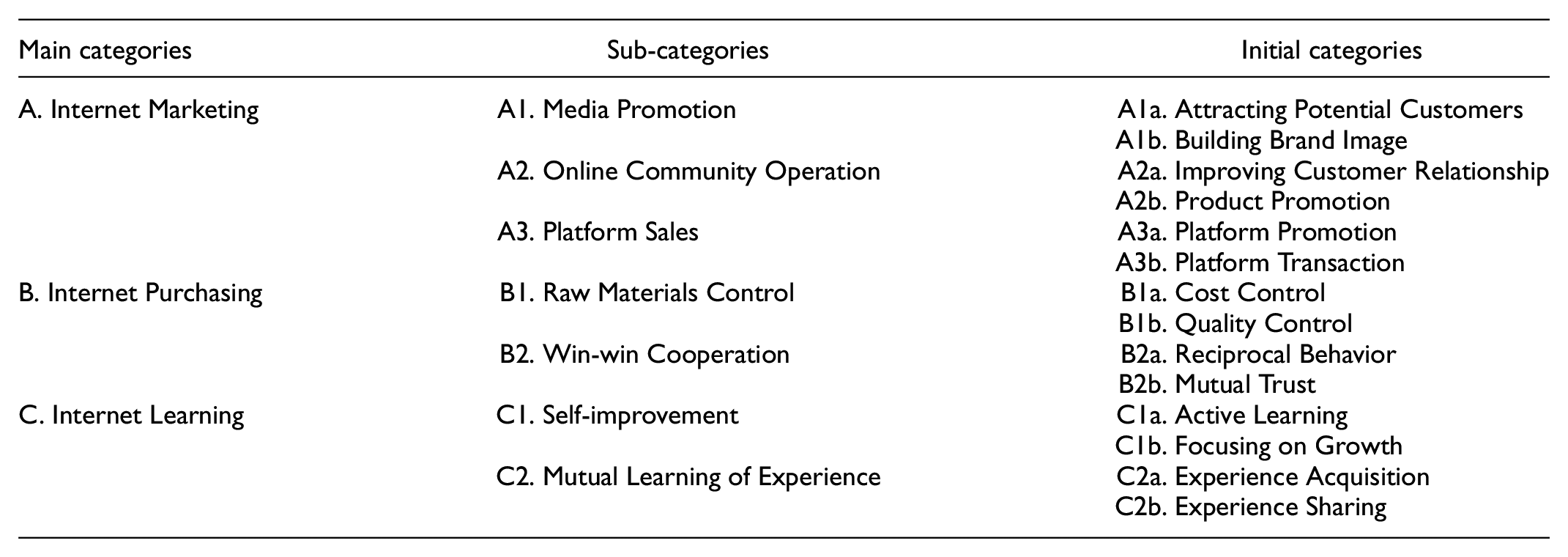
| Main categories | Sub-categories | Initial categories |
|---|---|---|
| A. Internet Marketing | A1. Media Promotion | A1a. Attracting Potential Customers |
| A1b. Building Brand Image | ||
| A2. Online Community Operation | A2a. Improving Customer Relationship | |
| A2b. Product Promotion | ||
| A3. Platform Sales | A3a. Platform Promotion | |
| A3b. Platform Transaction | ||
| B. Internet Purchasing | B1. Raw Materials Control | B1a. Cost Control |
| B1b. Quality Control | ||
| B2. Win-win Cooperation | B2a. Reciprocal Behavior | |
| B2b. Mutual Trust | ||
| C. Internet Learning | C1. Self-improvement | C1a. Active Learning |
| C1b. Focusing on Growth | ||
| C2. Mutual Learning of Experience | C2a. Experience Acquisition | |
| C2b. Experience Sharing |
Acknowledgements
The authors would like to thank the editor and anonymous reviewers for their comments on an earlier version of this manuscript.
Declaration of Conflicting Interests
The author(s) declared no potential conflicts of interest with respect to the research, authorship, and/or publication of this article.
Funding
The author(s) received no financial support for the research, authorship, and/or publication of this article.
Ethics Statement
This article received ethical approval from the first author’s university, and was conducted according to the guidelines of the Declaration of Helsinki. All subjects were informed about the purpose of the study and participation was fully on a voluntary basis. Participants were ensured of confidentiality and anonymity of the information associated with the surveys.
Informed Consent
All subjects were informed about the study and participation was fully on a voluntary basis. Participants were ensured of confidentiality and anonymity of the information associated with the surveys.

Data Availability Statement
All data analyzed or generated are available in the paper.