




Abstract
In this article, we introduce qualitative research from an interactionist perspective. We specifically explore qualitative research itself as a semiotic process with associated actions. This enables researchers to make sense of human interactions in the world rather than solely focusing on semiotic analysis of qualitative data. We introduce Peirce’s semiotics and Vygotsky’s mediated action as tools for conceptualizing qualitative research in a semiotic mediation process. Understanding qualitative research as a semiotic mediation can help social scientists better understand their own role in research, while vicariously gaining experiences about human interactions that they later present to others.
Qualitative social scientists understand research to be pluralistic in nature, where diversity in beliefs, approaches, and methodology are all welcomed and celebrated (Frost et al., 2010). Among scholars with these diverse views, qualitative research is held together with a common goal—looking at the world from a non-reductionist perspective (Gemignani, Brinkmann, Benozzo, & Puebla, 2014). Once qualitative researchers embrace this non-reductionist perspective, they rely on themselves as human instruments for collecting data that will allow them to make sense of their experiences (Lincoln & Guba, 1985).
The purpose of this article is to explore qualitative research from an interactionist perspective and articulate what that means for methodological purposes. We will first introduce our interactionist framework relying on Blumer and his conceptualization of the interactionist perspective within the social sciences and the implications to research methodologies. Then we will introduce Peirce’s and Vygotsky’s work on semiotics and mediated action and discuss how their perspectives on semiotics can help researchers take an active role in research while making meaning of the world through interactions with participants. We will discuss how qualitative research involves the researcher to engage in a series of nested actions within a holistic semiotically mediated activity. Research as a holistic mediated activity is dependent on the nested actions in which the researcher engages in independent units of mediated actions that can shape their experience of participating in research. We will introduce two sample studies completed by the first author and past collaborators. Finally, we will refer to these two studies as we introduce how to engage in qualitative research as a mediated activity.
The goal for this article is to expand our understanding of qualitative research as a series of semiotic processes for understanding human interactions. This perspective highlights the interactions in participants’ lives that researchers experience through fieldwork by paying close attention to the interactions they encounter as investigators. We became interested in this discussion because we found that there are plenty of publications in the social science literature related to taking an interactionist position, but there is a lack of discussion regarding how to methodologically engage in qualitative research processes from this perspective. We believe that this perpetuates a situation where qualitative research continues to become popular among social scientists without their full commitment to addressing human interactions in the sociocultural context (Atkinson, 2015). In other words, it creates a space in the literature for authors to pay lip service to taking an interactionist position, but many times, authors neglect to reflect and share how to engage in research as interactionists.
Practical Motivations for Writing This Article
The motivation for writing this article is based on conversations that the first author had with coauthors about her experiences teaching an introductory qualitative research course. The coauthors were graduate students in the first author’s doctoral research team. Within the team, all authors regularly collaborate on both empirical and theoretical research projects where many conversations related to this article emerged. While the first author led the conceptualization and writing of this article, the coauthors made significant and valuable conceptual and editorial contributions that made it possible for the team to complete this project.
The introductory qualitative research course, which the first author teaches regularly, includes topics that are often represented in introductory texts such as (a) discussions on the history and theories related to various qualitative research approaches, (b) qualitative research design and rigor, (c) qualitative data collection and analytical methods, and (d) writing qualitative research reports. The first author typically engages students in assignments that make them examine past experiences with research, personal experiences, their ontology, their epistemology, and how all affect qualitative research experiences.
After teaching this introductory course for several years, the first author found that early in the semester, many students embrace the study of human interactions as a vital part of social science, but then have difficulty conceptualizing qualitative research as a holistic process. Through course activities and assignments, students understand and begin to use the non-reductionist approach to research and begin celebrating it in their project planning processes; however, they often lose sight of it when collecting and analyzing data. When this happens, to legitimize their work, students rely on qualitative research data collection methods such as interviews and observations as well as thematic analysis methods. Unfortunately, then they become procedurally focused in going through the “steps” involved in completing their research projects as opposed to reflecting deeply while engaging in a holistic research activity.
As researchers, we believe that human interactions, whether they are in natural settings or in laboratory settings, cannot be collected and recorded in their entirety as data through qualitative or quantitative methods. What becomes “data” in both approaches are manifestations from our experiences of organic interactions in the world; however, research methods that are currently available to social scientists often represent complex organic human experiences as static reified objects such as numbers, graphics, or narratives. Within this context, qualitative research is a quest for a better understanding of the interactions involved in human activity, and it is difficult for social scientists to engage in this quest when they are unable to see qualitative research as a holistic activity.
Interactionist Epistemology: Being an Interactionist Qualitative Researcher
Taking an interactionist approach to qualitative research is not necessarily a new idea. For example, qualitative researchers who use the grounded theory method often take an interactionist approach in data analysis (Chamberlain-Salaun, Mills, & Usher, 2013). Strauss (1987) summarized that the works of American Pragmatists, including John Dewey, George H. Mead, and Charles Peirce, heavily influenced his grounded theory development work with Glaser in Glaser and Strauss (1968). Strauss, who studied under Herbert Blumer, a sociologist, also recognized the traditions of the Chicago School at the University of Chicago in the 1920s to mid-1950s as a strong influence of his interactionist approach (Chamberlain-Salaun et al., 2013).
As a leading interactionist, Blumer saw the shortcomings of social sciences’ excessive reliance on the scientific method in the 1920s and 1930s. He started a new line of conversations during the 1960s, encouraging researchers to engage in naturalistic investigations that addressed issues that could not be addressed in lab settings such as “mass behavior, collective behavior, race, prejudice, morale, public opinion, power, industrialization, urbanization, fashion, and attitude” (Tucker, 1988, p. 118). Blumer (1969) contended that meaning in the world was constructed through interactions among people rather than individual additive psychological experiences. In his words, “The meaning of a thing for a person grows out of the ways in which other persons act toward the person with regard to the thing. Their actions operate to define the thing for the person” (pp. 4-5). Blumer (1969) made a point that “person” in his explanation of interactionism indicated both the researcher and participant. Social scientists need to approach research methodology understanding that they themselves are participating in the human interactions experienced as part of research.
Interactionist qualitative researchers identify with the constructivist qualitative paradigm (Lincoln & Guba, 1985, 2013) and believe that methodologically researchers participate in investigations to make sense of the world. Interactionist researchers take an active role in the collective activity involved in social science research (Becker, 1988) and cannot take a role of a distanced observer. They engage in scientific inquiry as a series of semiotic interactions in natural settings, which give them opportunities to vicariously experience participant daily symbolic interactions (Blumer, 1969; Denzin, 2007).
Social science researchers purposefully join “an ecology of people, meanings, and things” (Lemke, 1997, p. 38) to understand meanings within the ecosystem. Once researchers enter participant ecosystems, they focus on understanding the participants’ lived realities through social interactions (Holstein & Gubrium, 2011). They are active agents in the research process and engage in purposeful sense making through participants’ experiences (Charmaz, 2014; Lincoln & Guba, 2013). They find new meanings in the world by cocreating those meanings with participants (Stetsenko, 2015).
Peirce’s and Vygotsky’s Semiotics and Mediated Action
In the following section, we will share our understanding about Peirce’s work on semiotics and Vygotsky’s work on mediated action to explore how researchers experience interactions throughout their research process. We believe that Peirce’s and Vygotsky’s works can help better articulate how we engage in and understand interactions within our world. Their work also helps explain qualitative research as a series of semiotic mediated actions held together by the researchers’ quest for making sense of experiences.
Peirce’s Semiotics
Peirce’s explanation of semiotics is one way of looking at how we know what we know and how we communicate what we know (Cunningham, 1992). The foundation for Peirce’s work in semiotics states that signs, object, and interpretant are in a triadic relationship, where the object is whatever can be represented, a sign is the effect that an object has on a person, and the interpretant is feelings, actions, or thoughts that are evoked as a result of a person interacting with an object and the sign (Houser, 1987). A sign has an influence on a person that starts an interaction between the object, sign, and interpretant that helps individuals to make meaning from their world (Ma, 2014). Peirce also believed that for signs to lead to meaning, a person encountering signs needs to understand its “collateral experience” or “experiential knowledge,” which signs alone do not hold and which human beings can learn only when interacting with the sign in context (Bergman, 2009, p. 259).
Peirce emphasized the role of signs to move away from defining knowledge as a one-to-one correspondence between a stimulus and response, which he considered to be an “artificial” method for studying knowledge (Bergman, 2009; Shank, 1992). Peirce believed that human beings come to understand the world “mediated through signs and can never, therefore, be isomorphic with the objects of the world” (Cunningham, 1998, p. 169). From this perspective, knowledge is not a direct facsimile of what people see in the world, and instead, is about how individuals make sense of what they see and experience in the world. This sense making involves a personal semiotic sign reaction based on interactions the individuals experience with the world.
Peirce referred to abduction as a reflective process for making sense of signs in the world as we experience a world of signs (Shank, 1998). Peirce (1998) explained,
The abductive suggestion comes to us like a flash. It is an act of insight, although of extremely fallible insight. It is true that the different elements of the hypothesis were in our minds before; but it is the idea of putting together what we had never before dreamed of putting together which flashes the new suggestion before our contemplation. (p. 227)
Abduction does not necessarily lead to certainties but instead provides a creative leap in the research process to reach a stable state of beliefs (Shank, 1987).
Peirce’s approach to semiotics can help social scientists engage in sense making within their world while appreciating research as a semiotic process. Interactionist qualitative researchers experience objects, signs, and interpretant while engaging in research by throwing themselves into highly situated and contextualized settings. They gain abductive insights and find new meanings in their world through the creative leaps made by participating in a semiotic process that came about from their research efforts.
Vygotsky’s Mediated Action
Vygotsky (1987) was concerned that psychologists in the 1920s were being misguided by endorsing the Cartesian dualistic metaphor that separated the mind and body from psychological analysis. Similar to Blumer, Vygotsky was concerned about how social scientists were limiting the scope of their work within the confines of the scientific method as it was conceptualized at his time by experimental design involving advanced statistical methods. He was instead interested in developing research methods to examine semiotic processes in human activity and its sociocultural context. Vygotsky specifically focused his work on examining the connection between thinking, language, and sociocultural settings (Wertsch, 1998). He proposed mediated action as a semiotic model for developing a holistic account of how people make sense of their world.
Mediated action is an interpersonal communication individuals engage in while negotiating the multiple goals and tensions they encounter in their daily activities (Kozulin, 1996; Wertsch, 1998). Vygotsky considered mediated action as the unit of analysis that connected the human action, mind, and sociohistorical setting as part of an inseparable whole (Valsiner, 2001; Wertsch, 2000). Mediated action conceptually captures how individuals and groups of individuals engage in a dialogic inquiry with artifacts, prior knowledge, peers, and their cultural setting while influencing and transforming one another (Wells, 1999).
Vygotsky defined mediated action as the interaction shared among the subject, tool, and object while the subject is engaging in an activity (Cole, 1996). The subject is the individual or a group of individuals acting as agent(s) in an activity, and the tool is the material or psychological artifact that serves as a resource and introduces the subject to signs that may or may not help attain the object (Yamagata-Lynch, 2010). In Vygotsky’s model, a sign is a by-product of tools. There are some disagreements related to the translations of the word “object” from Vygotsky’s native Russian language to English, but in general, the object is referred to as the goal, motive, or the reason why an individual or a group of individuals choose to participate in an activity (Kaptelinin, 2005). The object has also been described as what holds the activity together for the subject to participate (Hyysalo, 2005). This definition of the object differs from Peirce’s, and from this point in this article when we refer to the object, we will do so from a Vygotskian perspective.
As an example of mediated action and its transformative influence on the subject, tool, object, the sociocultural setting, and their inseparability from one another, we will rely on Wertsch’s (1998) work. Wertsch engaged in an analysis of pole-vaulting as an example of mediated action. In this example, the pole vaulter is the subject of the activity. The vaulter relies on the pole materials as well as their prior experiences as a tool that instigates sign processes for conceptualizing how to participate in the sport and help him or her jump over the cross bar with maximum height, which is the object of the activity. According to Wertsch, pole-vaulting has a long history and it has been a part of the modern Olympic games from its inception in 1896. Over the years, there were drastic changes in the nature of the sport as the materials used for the pole changed. Wertsch discussed how historical pole-vaulting records and the style in which the vaulters jumped were closely related to the evolution of the materials used for the poles.
According to Wertsch (1998), materials used for the pole evolved from heavy and inflexible materials such as hickory, ash, or spruce, to bamboo, then steel and aluminum, and fiberglass. Each time that the preferred pole material among vaulters changed, the nature of the game changed. When bamboo was adopted over heavy wood, vaulters approached the vaulting box at much higher speeds, which gave them more height in their jump. When fiberglass was adopted, its flexibility and strength completely changed how the vaulters started to jump. They began bending the pole 90° during takeoff, which gave them even more record-breaking heights. The evolution of the materials used for the pole over the years had completely changed how the vaulters designed their jumping experience for the sport.
In Wertsch’s (1998) example, pole-vaulting as a mediated activity cannot be understood without the individuals engaging in the sport, their interaction with the pole, and the type of pole-vaulting experience that the pole material introduced to the activity. This example can help social science researchers start to see how individuals taking part in a mediated activity and the sign reaction that tools introduce to individuals are inseparable (Wertsch & Rupert, 1993). Similar to the historical pole-vaulting experience, from an interactionist perspective, the researchers’ entire experience within a scientific investigation is a mediated activity that potentially leads to abductive insights and cannot be separated into a sequential set of procedures.
Qualitative Research as a Mediated Activity With Nested Actions
Engaging in interactionist qualitative research gives the researcher the opportunity to “maximize the conditions in research itself for producing ideas, insights, conceptualizations, and generalizations that are developed in close congruence with the meanings, variations, consequences, and process” (Broadhead, 1980, p. 30). Interactionist social science researchers do not assume that following systematic mechanical processes is the only approach for exploring truths (Toomela, 2010). Instead, they question their curiosity and doubts through research processes to find a stable state of their beliefs (Peirce, 1992). They engage in research while examining how their personal identity, researcher identity, personal and research activities, and interactions with participants influence their sense-making processes (Chamberlain-Salaun et al., 2013). From this perspective, all experiences that researchers encounter in a study are potential tools that can initiate sign processes within the mediated activity.
When qualitative research is viewed as a semiotic mediated activity, investigators become the subject of the research. The researcher is driven by his or her curiosity and dives into participants’ daily activities with the object of finding a balanced state of beliefs. During this semiotic process, the researcher encounters tensions that introduce varying degrees of ambivalence that they work to overcome through their sense-making process (Abbey & Valsiner, 2005). The researcher creates and finds emergent tools from which he or she experiences sign processes that shape his or her sense making of the world. Through these activities, the researcher begins to experience the world differently; what used to be novel, invisible, and unfamiliar becomes transformed and visible (Von Uexkull, 1934/1957). This transformation occurs as researchers co-construct new meanings of the world with participants in their ecosystem.
Actions are short-term activities related to the mediated activity as a whole and hold the activity together (Leontiev, 1974). When qualitative research is viewed as a series of nested actions, it helps construct a holistic understanding of both researcher and participant experiences. We believe that it can be helpful for social scientists taking an interactionist approach to understand research as a mediated activity for making sense of human activities within sociocultural contexts.
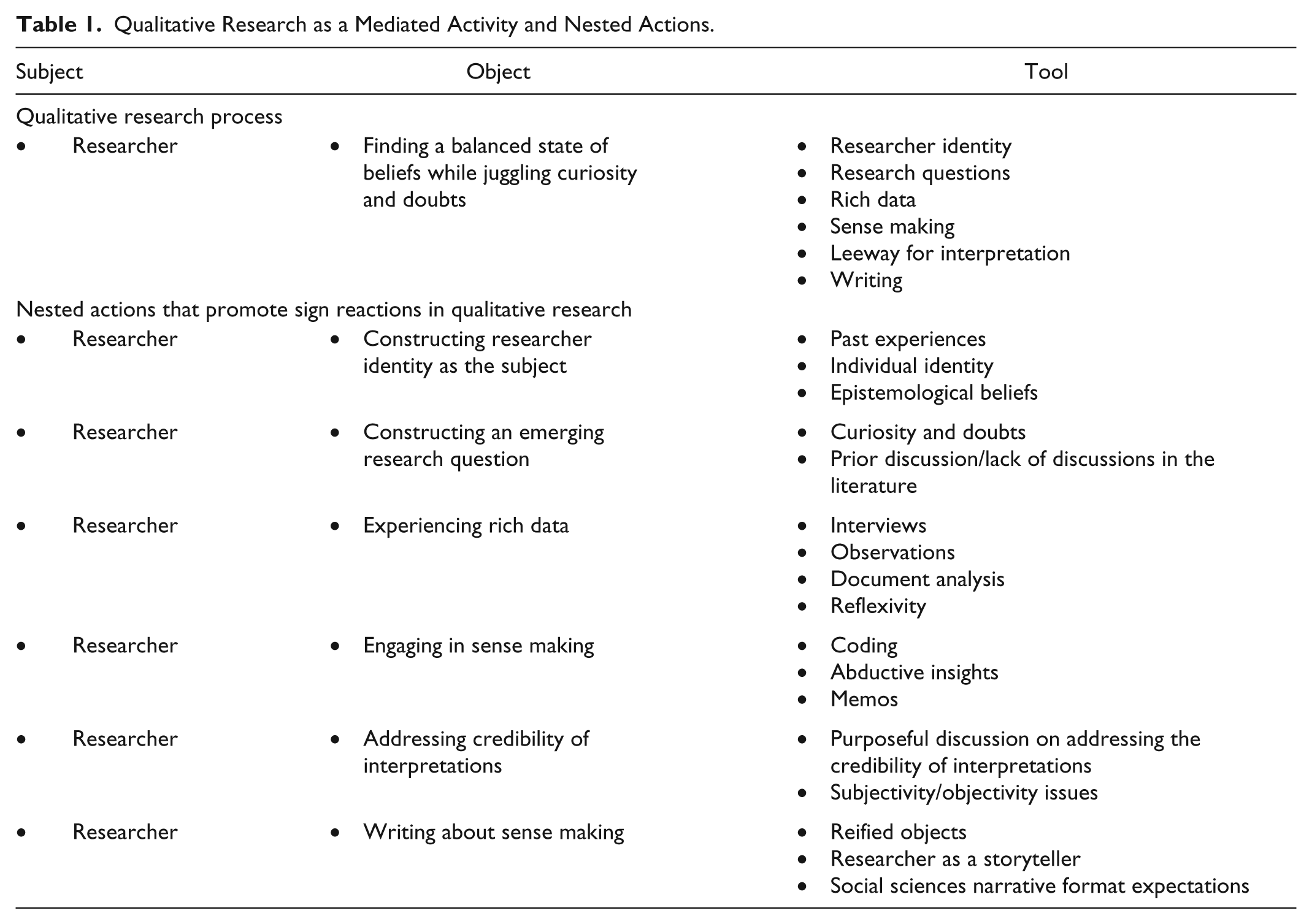
Table 1 shows how we see qualitative research as a mediated activity and the methods involved in this activity. The delicate juggle between the researcher’s curiosity and doubt is what drives him or her to participate in this activity. The researcher frequently relies on nested actions, which are independent units of mediated actions. These nested actions can serve as tools that mediate sign reactions in the research process, which may trigger abductive insights. These insights help the researcher gain new understandings about their participants and the phenomenon in which they are interested. The nested actions include (a) constructing researcher identity as the subject, (b) constructing emerging research questions, (c) experiencing rich data, (d) engaging in sense making, (e) addressing credibility of interpretations, and (f) writing about the sense making.
Qualitative Research as a Mediated Activity and Nested Actions.
Sample Studies
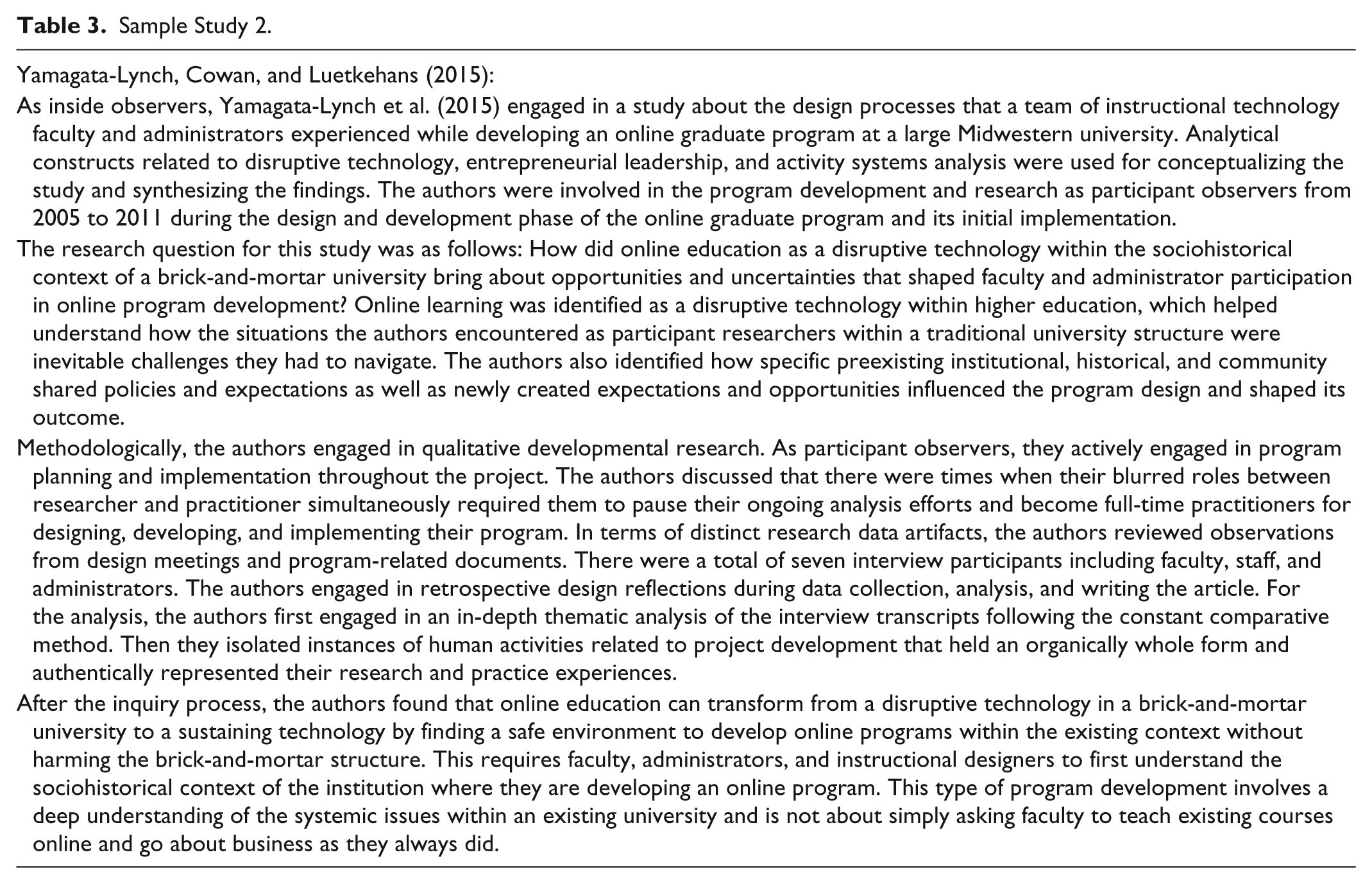
We will introduce two sample studies to help demonstrate how qualitative research can be conceptualized as a series of mediated activities with nested actions. Both studies are projects that the first author led in the past. Tables 2 and 3 provide a description of each study including the research context, research question, research methods, and findings. The first study is contextualized within K-12 teacher professional development. The researchers, which include the first author and her collaborator at the time, acted as an external observer of the phenomenon of study. The second study took place in a higher education setting and as researchers, the first author and her collaborators at the time were participant observers of the phenomenon of study. In both works, the authors relied on Cultural Historical Activity Theory (CHAT) as the theoretical framework for making sense of observations in the data. After we introduce the sample studies, we will discuss how each nested action introduced in Table 1 can be explained in the sample studies.
Sample Study 1.

Sample Study 2.
Constructing Researcher Identity as the Subject
Constructing researcher identity as the subject of a research project is the object of one of the nested actions. To attain this object, researchers experience dialectical interactions shared among themselves, the research process, participants, and the situational setting. In qualitative investigations, the researcher as the subject vicariously experiences participant sense-making activities (Yamagata-Lynch, 2010; Keats, 2009). The researcher relies on his or her past experiences, individual identity, and his or her beliefs to serve as tools while engaging in this mediated activity. In this process, researchers can better rely on the flashes of abductive insights which are a by-product of their participation. Researchers can avoid dismissing flashes of abductive insights as irrelevant, insignificant, or subjective reactions that distract them from the research by relying on their reflexivity through this process.
As the subject of the research project and the human instrument, researchers need to confront, evaluate, and construct an identity by interacting with participants in their ecosystem. Smith (2012) discussed how it became confusing to construct her researcher identity when engaging in a study about elite athletes’ recovery experiences from traumatic head injuries because Smith herself was a past Olympian who recovered from a head injury. While Smith was not necessarily a participant of her study, she was a participant within the community of athletes with traumatic head injuries. Smith’s unique past experiences, the nature of her doubts, and the signs she encountered during research influenced the way she saw herself as an athlete recovering from injury and her role as a researcher.
In Sample Study 1, the authors had to build a relationship with K-12 teachers at a partner school district whom they asked to take time out of their busy schedule to participate in semi-structured interviews. To build the relationships, the authors informally presented their personal role at the university and their beliefs about teacher professional development. When participants are assessing the potential risks associated with taking part in a research project and allowing access to their lived worlds, it is important for them to know who we are as the subject as well as how we see the world.
In Sample Study 2, the authors were participant researchers, which meant that they were participating in two overlapping activities as the subject with different objects and tools. In the two simultaneous activities, one object was related to research, and the other was related to program development. In addition, in these symbiotic activities, there were tools specific to the research, and tools specific to program development. In these situations, while entry into the participant ecosystem may be easier than entry into it as an outsider, it is much more difficult to see the boundaries of the participant and researcher daily activities because there is no distinct sense of entering and exiting participant ecosystems. Therefore, when researchers are active participants within a qualitative study, they need to constantly juggle their two identities while engaging in multiple activities with different objects. In Sample Study 2, this made the authors extremely aware of their role in research and practice, and required them to question how their abductive insights came about: as a researcher, participant, or both. They also had to take note of what they experienced in their research writing based on their roles. The authors referred to the dilemmas involved in negotiating their participant observer identity as follows:
While we actively engaged in program planning and implementation our participant role often took the majority of our efforts because we were engaged in the daily operations and once our program launched we had to address student needs. There were times when our blurred roles between researcher and practitioner simultaneously required us to pause our ongoing analysis efforts and become a full time practitioner for designing, developing, and implementing our program. (Yamagata-Lynch et al., 2015, p. 12)
One way of addressing researchers’ identity is by reflecting on epistemological positioning, which is inescapable whether researchers are aware of it or not (Carter & Little, 2007) and acts as a tool while the researcher constructs his or her identity. The researchers’ theory about what is considered to be true in the world and how they come to know what is true will affect their semiotic sense-making process. The researchers’ epistemology affects the way that they choose to confront their doubts (Creswell, 2013). Many introductory qualitative research courses include a reflexivity or epistemology paper as an assignment with the purpose of helping students become aware of their positioning and how it can affect their sense-making process. It is never easy for students to confront themselves as a private individual and as a researcher because often times they are encouraged to keep the two separate until the very first qualitative research course. The reflexivity or epistemology assignments in these courses are designed to help students become aware and take an active role in discovering what type of subject they are likely to become while participating in qualitative research. These types of assignments are designed to help students begin seeing how they are likely to interact with their world both in research and in practice.
An additional approach that encourages critical reflection during the research process comes from Peshkin’s (1988) discussion of the multiple Subjective I’s. When Peshkin was engaging in research for his book God’s Choices, he discussed what he calls a subjectivity audit. Through this audit, he found multiple selves, which he identified as I’s, that made up who he was as a whole person and affected the way he made sense of the world. He also found that the I’s in his research were context-specific, and it was likely that in other research situations, he would find a different set of I’s. In other words, researchers may find new aspects of themselves as the subject while constructing their identity depending on the ecosystem in which a study is taking place. Peshkin’s awareness of his multiple Subjective I’s encapsulated the transactional mediated process involved in the construction of the researcher identity.
Cihelkova (2013) also found research identity to be dynamic, stating that
subjectivity is essentially a quintessence that is constantly changing. I dare enough to say that subjectivity is the inner essence of flux. To capture personal, societal, or research subjectivity is difficult! I have to ask if it is even possible and actually desirable. I dare to say that it is impossible because the inner essence of flux (subjectivity) is indeed flux; hence an infinite number of possible transmutations of an infinite number of possible forms of subjectivity are out (and in) there for us to study. (p. 2)
Cihelkova is pointing out that as the subject of a research activity, the researcher is constantly changing while interacting with the environment and the research situation. As the researcher finds new dimensions of himself or herself, he or she finds new tools and signs that lead to new ways of making sense of the world.
Constructing Research Questions
Another nested mediated action is constructing emerging research questions to frame the research process. The tools that researchers rely on in this action are their own curiosity and doubts, which they add to prior discussions or lack of discussions in the literature about participant activities/phenomena of interest. The research question provides a way into the participant’s world and serves as a guide for experiencing mediated activities that are critical to researcher sense making. Research questions affect the data collection, interpretation, analysis, and writing of the report (Denzin, 1989; Merriam, 2009). Researchers may find that their questions must evolve as they spend more time in the research process and they become able to see what they could not prior to starting their investigation. This emergent aspect of reframing research questions is the investigator’s response to the new signs they encountered as a result of interactions with participants, which provided opportunities to see the world with new meanings.
In addition, researchers can rely on past discussions or lack of discussions in the literature relevant to their curiosity and doubts as tools for identifying research questions. Researchers can encounter new signs from reviewing the literature, which can guide their construction of emerging questions and help them to enter the research with a sense of focus. Most current qualitative proposals and reports are expected to include a literature review to ensure that researchers do not enter the field blind (Rossman & Rallis, 2012) and to help students to join existing conversations in their field. In addition, examining theoretical, methodological, and empirical literature can help researchers make sense of how to approach their doubts (Flick, 2014). When other researchers and practitioners share similar curiosities, the research has the potential to become a social activity of interest shared among social scientists.
Sample Study 1 began with the researchers’ curiosity. The researchers were curious about what aspects of teachers’ work life helped or impeded them from implementing new ideas gained from professional development into the classroom. It started with a simple question based on the first author’s past experience as a facilitator of a teacher professional development program. As a member of a professional development provider team and through interactions with teachers, she observed that, when teachers found a workshop or information useful to them, they went back to their classroom and soon implemented new ideas into their teaching practices. When teachers did not find a professional development experience useful to them, they often shared informally that the experience was a waste of time.
When reading the literature, the authors found that there were not many studies that examined how situational factors affect a teacher’s ability to integrate what they learn from professional development into the classroom. The authors also became interested in examining inner contradictions, or the specific types of conflict in human activity that bring tensions and can instigate change in the nature of an activity as a result of efforts to overcome the inner contradictions (Yamagata-Lynch and Haudenschild, 2009; Engeström, 1987). The interaction between the researchers’ experience-based original question and conversations in the existing literature led to the following research questions:
(a) What do teachers perceive as situational factors that bring inner contradictions in their professional development? (b) How are the inner contradictions related to one another? (c) How do inner contradictions influence teacher professional development? (Yamagata-Lynch and Haudenschild, 2009 p. 510)
These questions were broadly framed to provide the authors room to explore shared experiences among participants to make sense of the data.
Experiencing Rich Data
Experiencing rich data is an object for another nested mediated action and is referred to as a staple characteristic in qualitative research (Brekhus, Galliher, & Gubrium, 2005). Rich data are “detailed, focused, and full” (Charmaz, 2014, p. 23). Experiencing rich data is not about capturing existing truths in the field by following procedures, as is the case with experimental design investigations. Instead, it involves purposeful social meaning making with sign processes as researchers interact with participants (Bengtsson, 2014). Interviews, observations, and document analyses are often referred to as primary tools for experiencing rich data (Charmaz, 2004; Merriam, 2009). Many introductory qualitative research texts can help guide students in identifying how to collect data. These data collection methods are cultural tools in qualitative research that have evolved throughout paradigmatic and methodological shifts. Therefore, when social scientists are learning about techniques for data collection, they also need to engage in actions with these methods to help them experience rich data.
Collecting data does not guarantee that the investigator will experience rich data about human activity. Rich data are not abundantly available in the field to be collected. It is created and generated through mediated actions in which researchers engage while building relationships with participants (White & Drew, 2011). In any practice, it is difficult for newcomers to see how old timers interact in transactional processes with cultural tools while redefining themselves, their practice, and the tools (Lave & Wenger, 1991; Wertsch & Rupert, 1993).
Experiencing rich data also involves creating data through a reflexive process where researchers start to see the world differently (Berger, 2015). The reflexive process involved in experiencing rich data shapes researchers’ experiences within the research (Arber, 2006). We specifically associated the reflexive process as a tool for experiencing rich data because while engaging in data collection, qualitative researchers are reflexive with the purpose of finding and creating data (Stronach, Garratt, Pearce, & Piper, 2007). Researchers rely on their abductive insights to determine which part of their experience in the field is relevant to their research interests and which are not. In this process, it is quite normal for researchers to encounter numerous uncertainties related to how to represent what they learned as data (Macbeth, 2001).
In Sample Study 1, as outside observers of teacher experiences in professional development, the authors relied solely on what teachers and administrators chose to share in narrative form during interviews as primary source data. The authors relied on these narratives and put significant effort reflecting on making sense of the participants’ symbolic meanings of the phenomena, experiences, and terminologies. They focused on this to experience sign mediated actions about teacher professional development similar to the participants. To engage in the semiotic experience as fully as possible, the researchers relied on narratives from multiple sources including related documents.
In contrast, as participant observers, the authors considered that all of their experiences were data and engaged in additional participant interviews in Sample Study 2. The authors put significant effort in identifying the unit of data that sufficiently provided the sign mediated activities that would help make sense of the participant researcher experience. For example, the authors had close to a year and half worth of design team meeting minutes, which were all relevant to the program design activity, but not necessarily all relevant for the research activity. In other words, as participants, the mediated action was highly intense, and the authors had to find time during and after their participation in online program development to find the data that captured the essence of the entire experience and helped others to make sense of the research.
Engaging in Sense Making
Qualitative researchers engage in sense making as an action in the research process by relying on tools such as coding, abductive insights, and memos. Researchers make sense of the experiences they gain from their investigation by “associating data with idea” (Richardson & Kramer, 2006, p. 500) or from a mediated action perspective—data as tools to signs then meaning. Researchers engage in sense making while they interpret experiences and unpack the semiotic interactions that they vicariously live through their participants (Wolcott, 1994). Wolcott (2009) referred to this process as interpretation and described it as follows:
Interpretation . . . is not derived from rigorous, agreed-upon, carefully specified procedures, but from our efforts at sense-making, a human activity that includes intuition, past experiences, emotion—personal attributes of human researchers that can be argued endlessly but neither proved nor disproved to the satisfaction of all. Interpretation invites the reflection, the pondering, of data in terms of what people make of them. (p. 30)
In this sense-making process, qualitative researchers are interested in understanding “the hows and whats of social reality” (Holstein & Gubrium, 2011, p. 342).
Coding is one tool that researchers can rely on while making sense of their research experiences. Codes have symbolic meaning and have “summative, salient, essence-capturing, and or evocative attribute for a portion of language-based or visual data” (Saldaña, 2013, p. 3). Coding is a mediated action where researchers actively experience signs for the purpose of finding signs from which they can gain abductive insights (Lipscomb, 2012). It is a concentrated act of abduction focused on experiencing signs and understanding their meaning in context.
As a human instrument, researchers need to actively take note of their sense making as it evolves through interactions with participants in their ecosystem. Memos are often recommended as a way to capture these initial abductive insights. Memos are reified objects that record how a researcher is working to reach a stable state of beliefs. We define reified objects as in-the-moment commodities that represent the essence of a phenomenon in a convenient format to engage in an exchange and discussion about it, but not about the phenomenon itself (Lukács, 1972). Researchers create reified objects during the research process that hold the essence of the interactions they experience (Inckle, 2010) and act as tools for continued sense making.
Not all ideas in memos will lead to meaningful insights because the ideas expressed are in-the-moment signs that have the potential to become tools that will specifically help the researcher attaining the object of their research to find a balanced state of beliefs while juggling curiosity and doubts. However, the ideas reflected in memos can be a bridge for the researcher to connect one insight to another while getting closer to finding a balanced state of beliefs. On a daily basis, when people engage in mediated action, they take no notice of these types of signs. Engaging in interactionist qualitative research is about taking note of and making sense of these signs by becoming aware of the tools and their role in the research process.
In both Sample Studies 1 and 2, the authors relied on thematic analysis of the data with the constant comparative method. Both studies involved multiple authors, which allowed all involved to share the codes they identified, abductive insights, and memos with one another. At times, the authors also had opportunities to share their initial insights with participants as they continued with their quest to make sense of the phenomena they were studying. These activities helped authors to jointly participate in sense making while asking and answering questions of one another and the participants, and evaluating whether their experiences were addressing the initial curiosity that drove them to engage in the research. The authors shared with one another their interpretation of participant experiences based on what made sense during the coding and interpretation process. The authors also negotiated with one another which interpretations and abductive insights were meaningful for addressing their original curiosity and doubts, and which ideas were to be set aside for a future study.
Addressing Credibility of Interpretations
From a semiotic perspective, “signs characteristically leave a certain leeway of interpretation” (Bergman, 2009, p. 263), which brings to question how does an individual know that his or her interpretation is credible. In quantitative research, there are several methodological measures that are put in place in a study to control the amount of sign reactions that researchers could experience to limit the leeway of interpretation. However, in interactionist qualitative research, investigators reach a stable state of beliefs by engaging in several mediated actions that purposefully expands the number of signs for them to experience. For example, in Sample Study 2, as participant observers, the authors regularly encountered mediated actions for making sense of their program development experiences. In these experiences, it was difficult to discern how personal experiences, professional experiences, and research experiences were all contributing to the meanings the researchers were making on the fly. This type of approach inevitably multiplies the leeway of interpretation and puts into question the credibility of the researchers work.
What this means is that when qualitative researchers share their research process and what they learned from it with others, there is more work for the reader who is asked to invest in understanding the researcher’s sense-making experiences. To help newcomers to qualitative research engage in the process of addressing credibility of interpretations, we suggest that they address it as a nested action in research. One tool for addressing this is an honest and purposeful discussion about how the researcher made an effort in reaching credible interpretations. In this discussion, researchers can share their reflections on relevant issues that can help the reader vicariously experience the researchers’ sense making. By these discussions, readers are able to assess the value of the researchers’ work in relation to their own curiosity and doubts.
Other tools for addressing credibility of interpretations are concepts related to how a researcher’s subjectivity/objectivity can affect his or her work. These discussions include works on trustworthiness (Lincoln & Guba, 1985), multiple approaches to triangulation (Denzin, 1989), and more recently, discussions on rigor and excellence (Tracy, 2010). Discussions in the literature have demonstrated that currently there is no consensus on how to assess the influence of subjectivity/objectivity to the quality and rigor of qualitative investigations (Santiago-Delefosse, Bruchez, Gavin, Stephen, & Roux, 2015). An interactionist way of working with this situation is to recognize that sign reactions and the resulting abductive insights are personal by nature; therefore, researchers need to address the credibility of their interpretations in the context of subjectivity/objectivity discussions. By doing so, researchers are not proving the scientific value of their work, but are giving an opportunity for readers to assess what meaning the researchers’ work have for them.
In the first author’s experience, the honest and purposeful discussion of data collection and analysis methods for a study is an area that editors and reviewers often request to cut out prior to an article being published to address word count limitations. Nevertheless, this type of discussion is included in some detail in both sample studies. In the Sample Study 1 methodology section, the authors discussed the following topics: (a) research question, (b) research participants, (c) data collection, and (d) data analysis. In these sections, the authors described research methodology as a whole process rather than steps taken. The authors also shared specific methodological decisions that came about as a result of interactions with the literature and participants, and how those interactions shaped the researchers’ interpretation of participant experiences. In the methodology section of Sample Study 2, the authors discussed the following topics: (a) research practice approach, (b) program context, (c) data sources, (d) analytical methods, and (e) efforts for maintaining trustworthiness. Similar to Sample Study 1, the researchers not only described their interaction with the literature but also provided a considerable explanation of what it meant to be a participant observer sharing examples of situations where they questioned how their role in program development affected their research interpretations and how they dealt with those situations.
Writing About the Sense Making
The final nested action we will discuss is writing about researchers’ sense making. Writing helps researchers find and commit to a stable state of beliefs (Pelias, 2011; Richardson, 2000), and share them with others (Keats, 2009). Writing enables researchers to express new meanings to the world. It is also an artifact designed by researchers for the reader to vicariously experience their sense making. Therefore, the writing that a researcher shares with readers serves as a tool for readers to engage in mediated actions about the researcher’s work. The tools that researchers rely on for writing include translating experiences to reified objects, storytelling, and the social sciences narrative format.
Translating researcher experiences is a tool in writing that involves researchers expressing and articulating their messy real-world semiotic experiences into reified objects. In this process, researchers transform abstract ideas to a tangible written form that can have more permanent and concrete qualities (Sfard, 1998). Reified objects may have concrete characteristics, but do not necessarily fully capture the researcher’s whole experience (Wenger, 1998). In addition, just because reified objects have concrete form, it does not mean that they are automatically presumed to be true. However, by sharing experiences in writing, researchers can provide opportunities for readers to interact with their understanding of the world.
Once interactionist qualitative researchers have translated their experiences into reified objects, they can rely on storytelling as a tool for writing. Qualitative researchers are authors who engage in storytelling with the goal for readers to invest their time in making sense of their story. Stories in general make more sense to readers when there is a flow organized by a beginning, middle, and an end (Eisner, 2008). In most cases, social scientists do not experience the research process in such an organized manner. However, they need to find ways to bring organization to the organic messy real-world stories. Through the storytelling process, researchers need to design an experience for the reader to experience an “organic unity” (Parrish, 2006, p. 75).
Depending on whether researchers engage in research as an observer or a participant observer, the goal of writing experiences in reified form can be different. For example, in Sample Study 1, one goal while writing the research report was to portray the research experience and findings regarding teacher perceptions about professional development in a shared reified artifact form through narratives while portraying their experiences through the eyes of an outsider. In Sample Study 2, another goal was to write the essence of the authors’ experiences in both research and practice as holistically and coherently as possible without introducing too many distracting details of the program development experience.
The final tool for writing as a mediated action that we will discuss is the social sciences narrative format. At first, it may seem difficult to fit interactionist qualitative research experiences into this format; however, it is the expected form of communication in the peer review process (Roulston & Shelton, 2015). Researchers often need to work with this format because it is a common language for sharing results and experiences from empirical work even though it is best suited for works that follow the experimental design framework. Using the social sciences writing format often requires that researchers follow professional style guides; read the writing guides for specific journals; in some cases, write in third person narratives; and quite often, work within word count or page limits. Therefore, qualitative researchers need to purposefully design their writing by leveraging the communicative value of the social sciences format while finding ways to authentically represent their sense-making experiences.
In both sample studies, the authors found it challenging to communicate a holistic narrative of their qualitative research experiences with a beginning, middle, and an end while following the traditional writing style in social sciences that is set up for describing a step-by-step process. As a result, both studies were written sequentially to portray that the study themselves followed a conceptualization, implementation of methods, analysis, and reaching conclusions structure, even though in reality much of the conceptualization of the study continued while implementing the study and analyzing the data. However, the authors’ followed the traditional writing style because of the communicative values shared among scholars as reified artifacts, and any other form may bring challenges to readers for making sense of the authors’ work.
Conclusion
We began this article with the intent of helping social scientists see interactionist qualitative research as a shared sense-making process with participants that cannot be broken down into procedures. We introduced the work of Blumer to define the interactionist perspective, and then introduced Peirce’s and Vygotsky’s work related to semiotics and mediated action. Then we shared how newcomers to qualitative research can conceptualize research as a semiotically mediated whole activity. Our argument has been that, when qualitative researchers start to see their agentive role in research, they will be able to understand how the interactions they experience with participants lead to cocreation of meanings about the participant lived experiences and their world.
We are aware that even when researchers embrace an interactionist perspective, it can be challenging to overcome the shadows of the popular approach in the social sciences which is derived from the scientific method and has historically been associated with advanced quantitative methods. This can present a challenge for newcomers to qualitative research and prohibit them from approaching research methodologies as a holistic process, which requires that they take an active, rather than passive, role. Instead, they may retreat to what they are used to and treat methods as a step-by-step process that ensures they collect and analyze what quantitatively are considered good data.
What we proposed in this article is one framework that can help social scientists start to gain an alternative perspective for approaching research as a holistic activity and enact the interactionist perspective in methodological actions. Although we believe that all social science researchers are actively engaging in a semiotically mediated activity within an ecosystem where their participants are interacting with a phenomenon of interest, we understand that not all would agree with us. However, it is our hope that our ideas and examples will help newcomers engaging in qualitative research look at research methodology as a whole experience rather than a sequential set of procedures and realize that they have a critical role in shaping how they come to understand what they understand from interactions with participants and their world.
Footnotes
Declaration of Conflicting Interests
The author(s) declared no potential conflicts of interest with respect to the research, authorship, and/or publication of this article.
Funding
The author(s) received no financial support for the research and/or authorship of this article.