




Abstract
Women have become an increasingly important force in entrepreneurship, and their relatively low entrepreneurial competence has aroused widespread attention from the academia. Drawing from the resource-based theory and the social support theory, this study aims to explore the impact of Internet use on women’s entrepreneurial competence and the roles of entrepreneurial resource acquisition and family support in this relationship. After collecting a sample of 328 women entrepreneurs in China, this study demonstrates that Internet use is positively related to women’s entrepreneurial competence, and this relation is partially mediated by entrepreneurial resource acquisition. Moreover, family support moderates the relation between Internet use and entrepreneurial resource acquisition as well as the mediating effect of entrepreneurial resource acquisition. The results of the current study contribute to revealing how Internet use affects women’s entrepreneurial competence, including its direct and indirect effects and boundary conditions. Practical implications for policy-makers and female entrepreneurs are also provided.
Plain Language Summary
Purpose: How to enhance women’s entrepreneurial competence has always been a hot topic in entrepreneurship research; however, the mechanism through which Internet use affects women’s entrepreneurial competence remains to be fully understood. To address this gap, the present study aims to explore the mediation effect of entrepreneurial resource acquisition and the moderation effect of family support in the relationship between Internet use and women’s entrepreneurial competence. Methods: The theoretical model was tested empirically using questionnaire data collected from a sample of 328 female entrepreneurs in China. Conclusions: Internet use has a positive impact on women’s entrepreneurial competence, which is partially mediated by entrepreneurial resource acquisition. Moreover, family support strengthens the relation between Internet use and entrepreneurial resource acquisition as well as the mediating effect of entrepreneurial resource acquisition. Implications: This study provides suggestions for both policy-makers and female entrepreneurs to improve their entrepreneurial competence, such as how to make full use of Internet technology and family support. It also provides suggestions for policy-makers to promote women’s entrepreneurial competence, such as integrating educational resources to provide training courses on Internet entrepreneurship skills for female entrepreneurs. Limitations: This study collected questionnaire data in China, which may limit the generalization of research conclusions.
Keywords
Introduction
Female entrepreneurship is not only closely related to their own economic interests and the realization of personal value (Cardella et al., 2020), but can also contribute to the well-being of societies by generating employment opportunities, innovations and wealth (Chatterjee et al., 2018). Over the past few decades, female entrepreneurial activities are booming in Asian countries such as China. However, exiting studies have shown that women are confronted with more obstacles than men in the process of entrepreneurship, including financing difficulties, work-family conflicts, gender discrimination, lack of entrepreneurial resources and abilities (Brindley, 2005; Shakeel et al., 2020). In particular, women in Asia are expected to shoulder the responsibility of housework and childcare (Shakeel et al., 2020). These barriers will restrict the development of female entrepreneurship to a large extent (Fairlie & Robb, 2009; Jamali, 2009; Wu et al., 2019). Therefore, compared with their male counterparts, women-owned businesses tend to have slower growth, smaller scale, lower technology content, and relatively limited social influence (Thebaud, 2015). Considering that the potential of female entrepreneurship has not been fully exploited, it is of great significance to promote the high-quality development of female entrepreneurship, and Internet-based digital technologies are likely to help female entrepreneurs break through the above obstacles.
The popularity of the Internet has not only unprecedentedly promoted women entrepreneurship, but also made the empowering effect of Internet use on women entrepreneurship widely concerned by the academic community (McAdam et al., 2020). First, the Internet is characterized by low threshold and low risk, making it possible for women who are originally in a disadvantaged position to equally participate in entrepreneurial activities as men (Martin & Wright, 2005). Second, the Internet provides favorable conditions for female entrepreneurship by providing channels for disseminating entrepreneurial information and resources, reducing the cost and threshold of entrepreneurship (Dy et al., 2017). Third, the Internet can effectively expand the range of interpersonal communication through social media technology (e.g., Facebook), thereby enhancing women’s social capital and promoting their micro-entrepreneurship activities on the platform (Delacroix et al., 2019). Although existing research has illustrated the impact of Internet use on women’s entrepreneurial choices or intentions, few studies have delved into the effect of Internet use on their entrepreneurial competence. Given the fact that entrepreneurial competence can contribute to the sustainable growth of enterprises, the research on how to enhance women’s entrepreneurial competence from the perspective of Internet use has important theoretical and practical significance.
The resource-based theory asserts that resources are the basis for the survival and development of businesses (Erikson, 2002). The success of entrepreneurship largely depends on whether entrepreneurs can identify and utilize the heterogeneous resources in the entrepreneurial environment (Alvarez & Busenitz, 2001). We believe that Internet use can offer female entrepreneurs various tangible or intangible entrepreneurial resources, and then affect their entrepreneurial competence. Based on this, this study will explore whether resource acquisition acts as a mediator between Internet use and women’s entrepreneurial competence. Moreover, according to the social support theory, the success of entrepreneurship cannot be separated from external support (Cabrera & Mauricio, 2017). Studies have suggested that family support is more significant for female entrepreneurs, especially the support from important family members such as parents and spouses, which can help female entrepreneurs obtain start-up funds and necessary emotional support (Aldrich & Cliff, 2003; Mari et al., 2016). Women have long been regarded as socially disadvantaged and have limited resources to engage in entrepreneurial activities (Panda, 2018). Compared with other external environmental factors such as policy and cultural support, family support has the most direct impact on women entrepreneurs’ access to entrepreneurial resources (D. H. Welsh et al., 2014). Therefore, this study will also examine whether family support serves as a moderator in the link between Internet use and women’s entrepreneurial competence.
To resolve the above-mentioned propositions, we aim to survey a sample of female entrepreneurs in the context of China, examining the mediation effect of entrepreneurial resource acquisition and the moderation effect of family support in the relationship between Internet use and women’s entrepreneurial competence. It is hoped that the results of this research will shed light on whether and how Internet use can affect women’s entrepreneurial competence.
Theoretical Background and Hypotheses Development
With the popularization of Internet information technology, a growing number of entrepreneurs carry out entrepreneurial activities through the Internet (Chen et al., 2018). Wang and Gao (2021) pointed out that the Internet is an important context for the growth of current start-ups. They believe that Internet use reflects the frequent contact between entrepreneurs and the external world, which can help nascent enterprises obtain various resources and achieve sustainable development. Poon and Swatman (1997) conducted multiple case studies on 23 small and medium-sized companies in Australia and found that entrepreneurs maintain and expand their relationship networks with customers and business partners via the Internet. As such, Internet use in the present study mainly refers to information acquisition and social communication.
Entrepreneurial competence refers to knowledge and skills possessed by entrepreneurs to be competent for various entrepreneurial tasks, and is directly related to the development of their enterprises (Amit et al., 1990). Generally speaking, having high entrepreneurial competence helps entrepreneurs find valuable business opportunities in time and rationally allocate internal and external resources to carry out their entrepreneurial activities (Bayon et al., 2015). Although some women entrepreneurs have accumulated wealth, skills and experience from their previous jobs, they are still at a disadvantage in terms of overall ability (Xavier et al., 2011). Therefore, how to improve women entrepreneurial competence is the main focus of the current study.
Considering that resources play a critical role in entrepreneurial activities (Brush et al., 2001), resource acquisition has been widely concerned by the academic community. In early studies, resources were defined as unique resources within an organization and abilities to acquire external resources (J. B. Barney, 1991; Chandler & Hanks, 1994). Later, Greco et al. (2013) divided resources into tangible asserts (e.g., technical equipment, production materials, etc.) and intangible asserts (e.g., relationship, knowledge, information, patent, etc). Based on these studies, Wiklund and Shepherd (2003) divided resource acquisition into asset resource acquisition and knowledge resource acquisition. The former refers to the acquisition of tangible resources such as capital, material and talent, while the latter refers to the acquisition of intangible resources such as technical know-how and intellectual property rights. The operational definition of entrepreneurial resource acquisition by Wiklund and Shepherd (2003) was employed to carry out this research.
Family support is considered fundamental for the success of entrepreneurship (Powell & Eddleston, 2013). Family support refers to tangible and intangible support that entrepreneurs can obtain from their family members, and plays a vital role in their entrepreneurial cognition, behavior and performance (Welsh et al., 2014). Most studies have divided family support into financial support and emotional support (e.g., Mari et al., 2016). First, financial support refers to financial sponsorship given to entrepreneurs by family members, which is crucial for the survival and development of enterprises (Xu et al., 2020). Second, emotional support refers to the spiritual support from family members in the form of encouragement and understanding, which can motivate entrepreneurs to insist on their goals and maintain positive attitudes in the difficult period of entrepreneurship (Van Auken & Werbel, 2006).
Internet Use and Women’s Entrepreneurial Competence
Entrepreneurial competence is a set of skills and knowledge held by entrepreneurs that can contribute to entrepreneurial success (Gressgård & Hansen, 2015). If entrepreneurs desire to stand out in the fierce market competition, an effective way is to enhance their entrepreneurial competence (Rasmussen et al., 2011). According to the resource-based theory, the key to the success of entrepreneurial activities lies in the capability of entrepreneurs to integrate and allocate heterogeneous resources embedded in a specific entrepreneurial environment (Barney, 1991). In the era of digital economy, the Internet has become an important context for entrepreneurs to improve their entrepreneurial competence (Fischer & Reuber, 2014). In this context, entrepreneurs have more ways to acquire knowledge, resources and information, which is conducive to enhancing their entrepreneurial competence (Lancioni et al., 2000; Poon & Swatman, 1997; Shi et al., 2016). An empirical study has shown that Internet use has a significant positive impact on entrepreneurial competence of farmer entrepreneurs (Xie & Wang, 2021). Since women entrepreneurs face the same problems of lack of resources and abilities as farmer entreprenuers, we believe that Internet use can also help female entrepreneurs break through their own limitations in cognition, and enhance their capabilities. Hence, we propose the following hypothesis.
Internet Use and Entrepreneurial Resource Acquisition
The resource-based theory asserts that the key resources that are scarce and difficult to imitate and replace are the basis for the development and expansion of enterprises (Alonso & Bressan, 2016), and lack of resources is often the main difficulty faced by female entrepreneurs (Jamali, 2009; Morris et al., 2006; Wu et al., 2019). Due to the limitations of their own resources, female entrepreneurs are confronted with the key challenge of obtaining entrepreneurial resources from the external environment (Guzman & Kacperczyk, 2019). The Internet is characterized by openness, borderlessness and strong interaction, which can provide important channel for entrepreneurs to obtain abundant entrepreneurial resources (Joo et al., 2017). Additionally, Internet platform can realize extensive link, personalized supply and precise matching of resources (Jome et al., 2006). This is particularly in line with the needs of female entrepreneurs since the lack of entrepreneurial resources and relevant experience virtually increases their dependence on the Internet (Pergelova et al., 2019). In particular, the use of social media platforms and online communities enables female entrepreneurs to establish a wide range of social relationships, thereby allowing them to obtain various resources at a lower cost and a higher pace (Ughetto et al., 2020). Hence, we propose the following hypothesis:
Entrepreneurial Resource Acquisition and Entrepreneurial Competence
Entrepreneurial competence is in essence the ability of entrepreneurs to utilize resources (Dawa et al., 2021; Thebaud, 2015). Entrepreneurial resources, such as knowledge, information, technology and so on, exert an important impact on the formation and improvement of entrepreneurial competence (Mishra & Zachary, 2014). It can be said that entrepreneurial resources are the basis of entrepreneurial competence, or that entrepreneurial competence is the result of developing and utilizing entrepreneurial resources (Gupta et al., 2019). Therefore, obtaining enough entrepreneurial resources is the premise for female entrepreneurs to improve their entrepreneurial competence. As such, the following hypothesis is proposed:
The Mediation Role of Entrepreneurial Resource Acquisition
According to the resource-based theory, resources play a crucial role in the entrepreneurial process (Brush et al., 2001; Erikson, 2002). In this process, entrepreneurs need to obtain key resources from the external environment and integrate these resources effectively (Alvarez & Barney, 2007). Since the lack of resources restricts female entrepreneurial development, they need to obtain resources in the external environment to improve their entrepreneurial competence (L. Wu et al., 2021). However, as a relatively vulnerable group in society, it is difficult for female entrepreneurs to rely on the traditional offline environment for entrepreneurial resources, so the Internet is an important way to effectively address the lack of resources and improve their entrepreneurial capacity. Dy et al. (2017) pointed out that the use of the Internet can enable female entrepreneurs to obtain more up-to-date information at a lower cost and rapidly grasp the changes of the market, thus enhancing their ability to identify more entrepreneurial opportunities in the market. Ukpere et al. (2014) believed that female entrepreneurs can obtain abundant information and resources by using such Internet technology as social media, which can change their shortage of human and social capital and improve their entrepreneurial ability. Bernhard and Olsson (2021) suggested that the Internet, as a content platform, can enable female entrepreneurs to obtain a large number of learning resources, so as to effectively make up for their lack of knowledge, skills and experience. Additionally, the interaction with other stakeholders (e.g., suppliers) in the context of the Internet helps female entrepreneurs to obtain experiential resources, which in turn enables them to acquire new business ideas and the ability to innovate enterprise management mode (Shi et al., 2016). In sum, female entrepreneurs who use the Internet to carry out entrepreneurial activities are likely to obtain various resources, which will in turn enhance their entrepreneurial competence. As such, the following hypothesis is proposed:
The Moderation Role of Family Support
As suggested by the social support theory, family support is an effective channel for entrepreneurs to obtain external resources (Welsh et al., 2016). Berrone et al. (2014) claimed that entrepreneurs with more family support tend to be more successful. Family members can not only provide tangible resources for entrepreneurs, but also intangible resources that are hard to replicate, (Grande, 2011). Existing studies mainly focus on husband support to female entrepreneurs (Neneh, 2017). As the saying goes, every successful man has a virtuous wife behind him. In fact, the majority of successful female entrepreneurs are also dependent on their husbands’ support (Nikina et al., 2015). First, as women who opt to start ventures generally have difficulties in fund raising, the financial support provided by their husbands is a vital source of start-up funds for women (Mari et al., 2016). Additionally, emotional support from husbands is also very helpful for women entrepreneurs (Jennings & McDougald, 2007; Said & Enslin, 2020). This is because husband’s understanding and encouragement can help female entrepreneurs to obtain psychological resources such as self-efficacy so that they can deal with various challenges with a positive and optimistic attitude in the process of entrepreneurship (Powell & Eddleston, 2013). As a contextual resource that affects females’ resource acquisition in the process of entrepreneurship, family support is likely to be an important moderator between Internet use and entrepreneurial resource acquisition. In other words, if women entrepreneurs can receive more support from their family, they will have more time and energy to devote to Internet entrepreneurship, and in turn obtain more resources to run their businesses. As such, we propose the following hypotheses.
Just as Cardella et al. (2020) put it, if family members can solve the worries of female entrepreneurs and shoulder the responsibility of housework and childcare, then female entrepreneurs will have more time and motivation to devote to the Internet entrepreneurial activities, and are more likely to transform the entrepreneurial resources obtained in the Internet context into their own abilities. On the other hand, if women entrepreneurs receive less support from their families in terms of housework and caregiving, then their family roles are likely to prevent them from devoting themselves to Internet ventures. Moreover, the lack of financial, emotional and information support from family members will further restrict the development of female entrepreneurship (Xu et al., 2020). Therefore, we speculate that family support is likely to positively moderate the indirect impact of Internet use on women’s entrepreneurial competence via entrepreneurial resource acquisition. Put another way, if family support is higher, it will strengthen the mediation effect of entrepreneurial resource acquisition between Internet and women’s entrepreneurial competence. As such, we propose the following hypotheses.
Figure 1 is the research model which reflects the above hypotheses.

Research model.
Method
Procedure and Samples
After designing all measurement items via an online platform for data collection called WJX (www.wjx.cn), we shared the survey link with the samples through social networking platforms. The respondents were told that the survey was targeted at female entrepreneurs and it was about how Internet use affected their entrepreneurial activities, so only self-employed women could participate in the survey. We also gave participants our promise that the data were only used for scientific research. Since it is difficult to directly approach a large number of female entrepreneurs, we adopted the snowball sampling method to collect our data. On the one hand, we sent the survey link to those women entrepreneurs whom we could approach directly. When they completed the questionnaire, they were asked to send the questionnaire link to other businesswomen they know. On the other hand, we relied on our social network relationships such as friends, teachers, alumni and so on to recommend female entrepreneurs to us. After these recommended subjects finished filling out the questionnaire, they were also required to share the questionnaire link with other appropriate subjects. In order to motivate participants to actively share our survey link, we promised that they would be given a free consultation service for their efforts. A total of 350 eligible women participated in the survey, and 22 responses were removed because of giving regular answers (e.g., “444” or “7676) or answering all items within 60 s. We finally obtained 328 valid responses with estimated response rate of 93.7%. According to Bagozzi and Yi (2012), the number of samples should preferably be 5 to 10 times the number of items. The ratio between the number of samples and the number of items in this study is around 17, meeting the threshold.
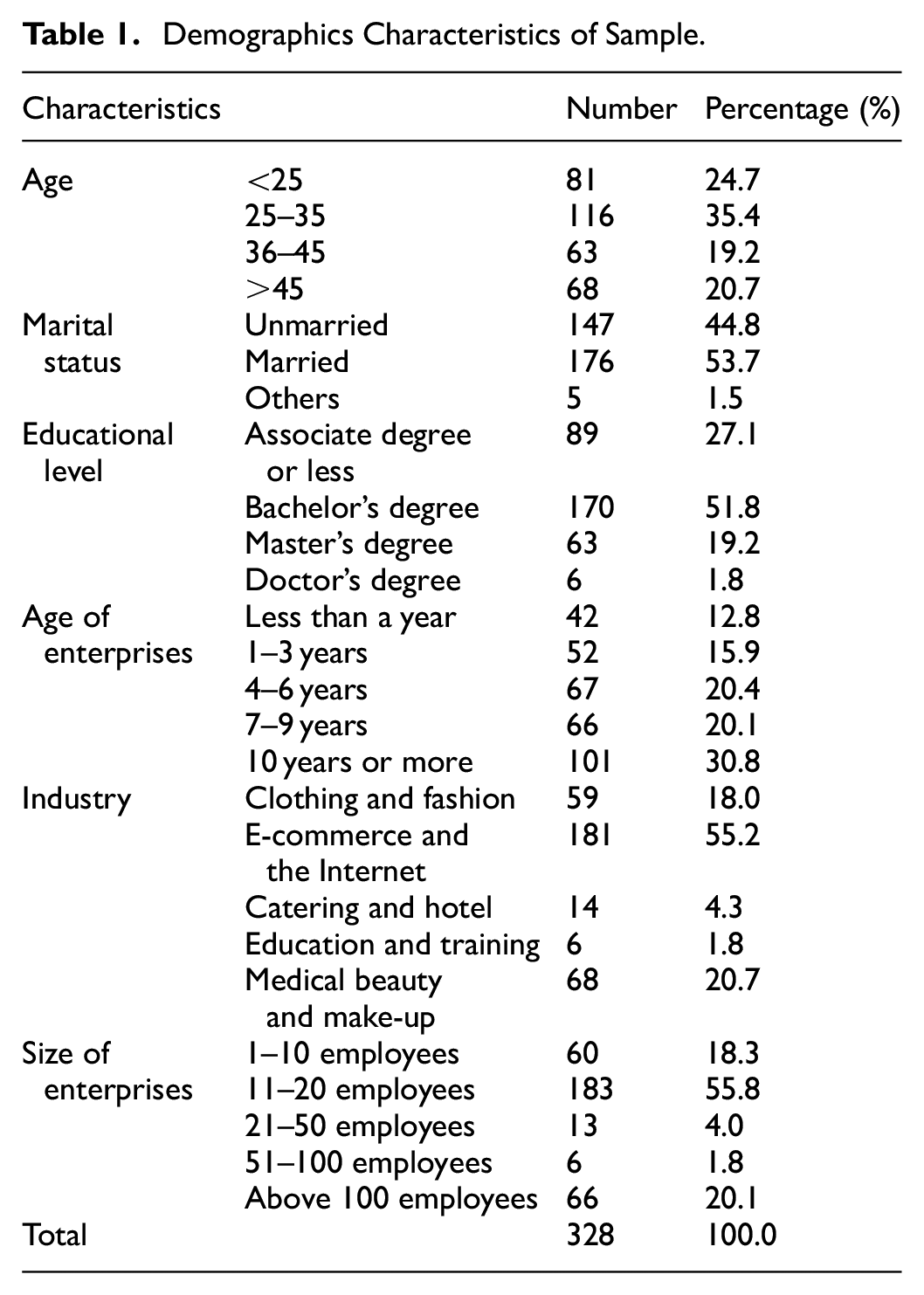
The respondents came from different parts of China, and were distributed in a variety of sectors such as e-commerce, medical beauty, education, etc. As far as marital status is concerned, married female entrepreneurs accounted for 53.7% while unmarried female entrepreneurs represented 44.8%. In terms of age, most subjects were between 25 and 35, making up 35.4%. Regarding educational level, 27.1% held an associate degree or less and 51.8% received a bachelor’s degree. Table 1 displays the demographic profile of the sample.
Demographics Characteristics of Sample.
Measures
We referred to previous studies in related fields, and adopted scales with good reliability and validity. Since most scales were taken from international journals, we strictly followed the back-translation procedure as suggested by Brislin (1986). First, we invited a professor of management who is proficient in English to translate English measurement items into Chinese. We furthered discussed Chinese items with this professor to ensure that every item conforms to Chinese reading habits. Afterward, we translated Chinese items back into English to make a comparison between original version and back-translated version. After confirming that the translated version was almost identical to the original one, we finally established initial measurement items. We then sent an electronic link to the initial questionnaire to several female entrepreneurs and invited them to raise issues about the language or content of the questionnaire. Based on their feedback, we further revised the questionnaire to ensure that it could be accepted by the subjects. A 7-point Likert scale (1 = “strongly disagree”, 7 = “strongly agree”) was used for all the measurement items.
Internet Use
To measure Internet use, we adopted four items adapted from Joo et al. (2017) and Yang et al. (2017). Sample items were “A lot of my work needs to be done through the Internet,” and “I like to communicate with people through the Internet.” The Cronbach’s α of this scale was .888 in the current research.
Entrepreneurial Resource Acquisition
We measured entrepreneurial resource acquisition with a five-item scale adapted from Wiklund and Shepherd (2003). Sample items were “I can obtain raw material resources at a lower cost,” and “I can obtain information of new market development.” In the current study, the Cronbach’s α of the total scale was .858.
Family Support
Family support was measured by five items adapted from prior studies (Eddleston & Powell, 2012; Mari et al., 2016). Sample items were “I rely on the advice of my family to help me run my business,” and “When I am frustrated by my business, someone in my family tries to understand and comfort me.” In the current study, the Cronbach’s α of the total scale was .838.
Women’s Entrepreneurial Competence
We drew on the research by Man et al. (2002) and selected five items to measure women’s entrepreneurial competence. Sample items were “I can identify high-quality business opportunities through various means,” and “I can persevere in the course of business difficulties.” In the current study, the Cronbach’s α of the total scale was .846.
Control Variables
Similar to previous studies on female entrepreneurship (Mari et al., 2016), this study took female entrepreneurs’ age, marital status and educational level, as well as their enterprises’ age, industry and scale as control variables.
Results
Common Method Bias Testing
Regarding common method deviation, we carried out Harman’s single-factor test by putting all the items to load on a single unrotated factor (Podsakoff et al., 2003). This single factor explained 39.505% of the total variation, which was below the warning standard of 50%. Therefore, our data was free from serious common method bias and suitable for the following analyses.
Confirmatory Factor Analysis
This study mainly measured four variables, namely Internet use, entrepreneurial resource acquisition, women’s entrepreneurial competence and family support. AMOS 21.0 was employed to conduct confirmatory factor analysis on the six models, and the results are shown in Table 2. It is clear that the fit indexes of the four-factor model (χ2/ df = 1.202, CFI = 0.990, TLI = 0.988, RMSEA = 0.025, GFI = 0.947) were superior than those of the three-factor model, two-factor model and one-factor model. Thus, the proposed model has the best fit with the actual data.
Results of Confirmatory Factor Analysis.
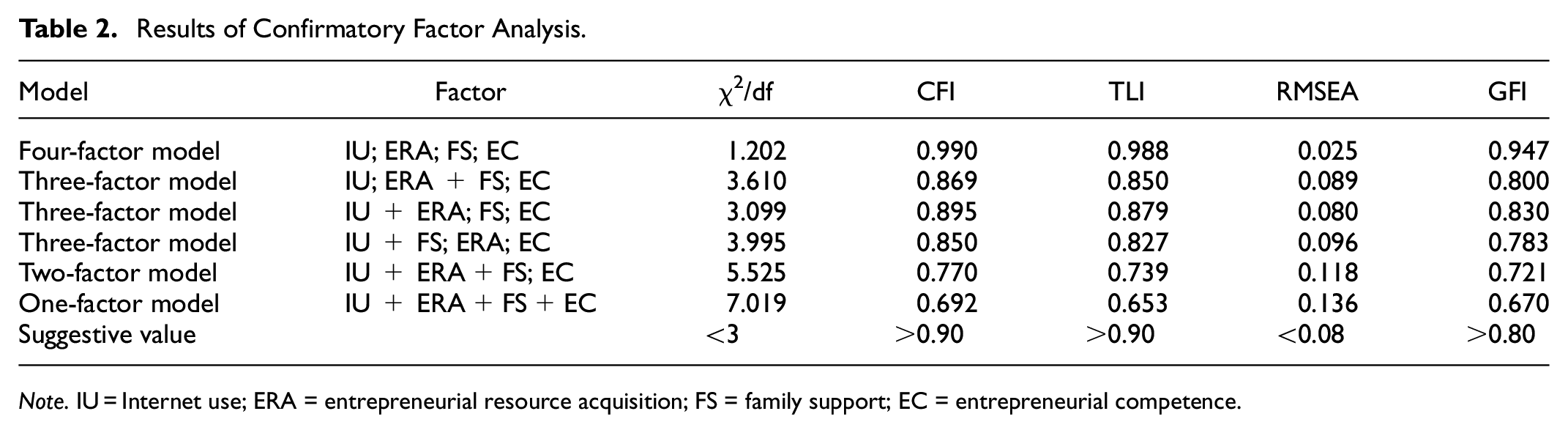
Note. IU = Internet use; ERA = entrepreneurial resource acquisition; FS = family support; EC = entrepreneurial competence.
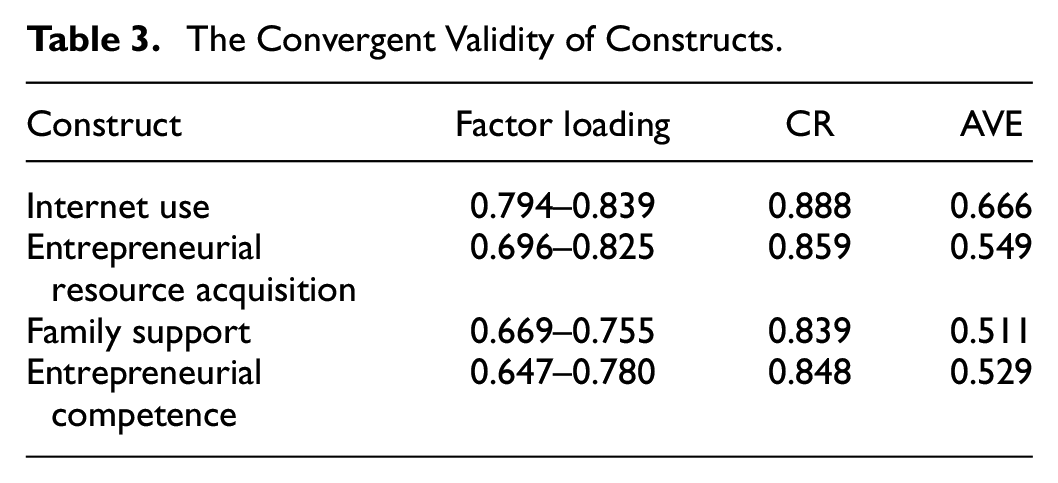
As shown in Table 3, the convergent validity of the current variables was met with all items loading above 0.5 on their respective factors, composite reliability (CR) exceeding 0.7 and the Average Variance Extracted (AVE) exceeding 0.5 (Fornell & Larcker, 1981). The discriminant validity was also satisfactory with the square roots of AVE exceeding the correlation coefficients between study variables (shown in Table 4).
The Convergent Validity of Constructs.
Descriptive Statistics and Correlation Analysis.

Note. Numbers in bold on diagonal are the square root of AVE of each variable.
p < .01.
Descriptive Statistics and Correlation Analysis
In this study, SPSS 21.0 was used for correlation analysis of all variables. Table 4 reflects mean values, standard deviations as well as the correlations among variables. The results showed that Internet use was positively correlated with Women’s entrepreneurial competence (r = .573, p < .01) and entrepreneurial resource acquisition (r = .575, p < .01). Entrepreneurial resource acquisition was also positively associated with women’s entrepreneurial competence (r = .555, p < .01).
Hypothesis Testing
We performed the structural equation mode to test the hypothesized relationships in the proposed research model. Given that the model showed an excellent fit to the data (χ2/ df = 1.329, GFI = 0.959, AGFI = 0.941, NFI = 0.959, TLI = 0.987, CFI = 0.989, RMSEA = 0.032), we proceeded with the model path analysis. As shown in Table 5 about path analysis, Internet use positively affected women’s entrepreneurial competence (β = .396, p < .001) and entrepreneurial resource acquisition (β = .687, p < .001). Likewise, entrepreneurial resource acquisition positively affected women’s entrepreneurial competence (β = .356, p < .001). Therefore, hypotheses 1 to 3 were verified.
Model Path Analysis.

Note. IU = Internet use; ERA = entrepreneurial resource acquisition; EC = entrepreneurial competence.
p < .001.
In order to further explore whether there is mediation effect in these significant paths, the bootstrap program was run in AMOS 21 in this study and repeated 5,000 times with the confidence interval standard set at 95%. As shown in Table 6, the indirect effect of Internet use on women’s entrepreneurial competence via entrepreneurial resource acquisition was 0.247, and the 95% confidence interval was [0.112, 0.389], excluding 0, indicating that entrepreneurial resource acquisition had a significant mediating effect between Internet use and women’s entrepreneurial competence, so hypothesis 4 was verified.
Mediation Effect.

Note. IU = Internet use; ERA = entrepreneurial resource acquisition; EC = entrepreneurial competence, LLCI = bias corrected lower limit of 95% confidence interval; ULCI = bias corrected upper limit of 95% confidence interval.
p < .01.
The moderation impact of family support was evaluated by multiple hierarchical regression. As displayed in Table 7, the interaction effect of Internet use and family support on entrepreneurial resource acquisition was significant (β = .286, p < .001). Moreover, a slope diagram was plotted to show the moderation effect of family support (Figure 2). It is clear that the positive relation between Internet use and entrepreneurial resource acquisition was strengthened when the level of family support was higher. As such, hypothesis 5 was verified.
Result of Multiple Hierarchical Regression Analysis.

p < .05. ***p < .001.
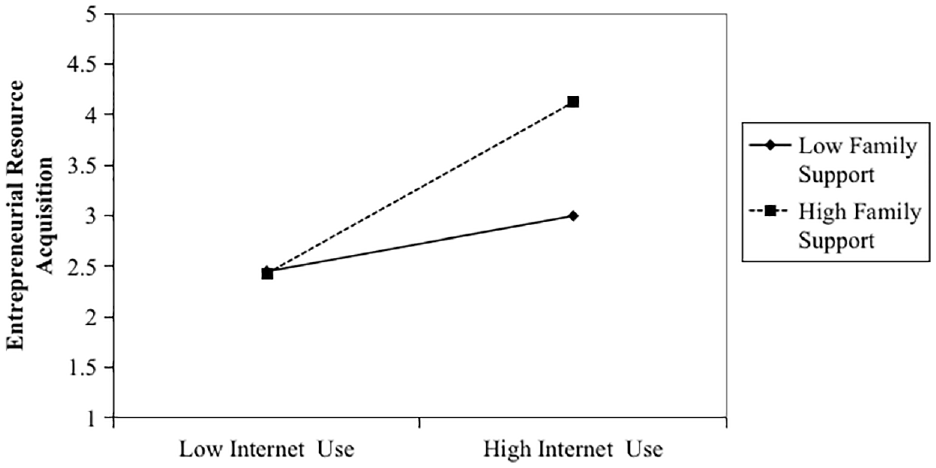
Visualization of moderation effect.
To evaluate the moderation effect of family support on the mediation effect of entrepreneurial resource acquisition, this study applied the Process Program in SPSS 21.0 and selected Model 7 to conduct random sampling test with Bootstrap method for 5,000 times. According to the results in Table 8, the index of moderated mediation was pronounced (β = .066, 95% CI [0.032, 0.112]). Besides, the mediating effect of entrepreneurial resource acquisition was more pronounced when the level of family support was high (β = .251, 95% CI [0.142, 0.376]) than when the level of family support was low(β = .097, 95% CI [0.042, 0.176]). Thus, family support had a moderating effect on the mediating effect of entrepreneurial resource acquisition (hypothesis 6 was verified).
Moderated Mediation Effect of Family Support.

Note. LLCI = bias corrected lower limit of 95% confidence interval; ULCI = bias corrected upper limit of 95% confidence interval.
Discussion
Drawing from the resource-based theory and the social support theory, this study is the first to explore how Internet use links to women’s entrepreneurial competence, as mediated by entrepreneurial resource acquisition and moderated by family support. All hypotheses were confirmed and shed light on whether and how Internet use might relate to women’s entrepreneurial competence. In the following sections, we discuss these findings by highlighting theoretical contributions and practical implications.
Theoretical Contributions
First, although prior studies have explored the impact of human capital, social network and traditional external environment on female entrepreneurship (Greve & Salaff, 2003; Jones & Tullous, 2010; Venugopal, 2016), whether the virtual external environment like the Internet can affect women’s entrepreneurial competence is unknown. Additionally, scholars have not reached a consensus on whether the Internet can empower female entrepreneurship. While Ughetto et al. (2020) believe that the Internet will promote the development of female entrepreneurship, Dy et al. (2017) argue that female entrepreneurs will face the same obstacles in the Internet context as in the offline entrepreneurial environment. However, this empirical study shows that Internet use has a positive effect on women’s entrepreneurial competence, thereby filling the gap of existing studies and resolving the above dispute. As such, this study not only proves that Internet use has an empowering value on women’s entrepreneurial competence, but also provides a new theoretical perspective for the research on the antecedents of women’s entrepreneurial competence.
Second, entrepreneurial resource acquisition is found to play a partial mediating effect between Internet use and women’s entrepreneurial competence. Although previous scholars have shown that Internet technology is predictive of entrepreneurial resource acquisition (Chen et al., 2018), and entrepreneurial resources acquisition can impact entrepreneurial competence (Wu et al., 2021), they have failed to include entrepreneurial resource acquisition in the relationship between Internet use and women’s entrepreneurial competence. However, our study shows that when female entrepreneurs integrate the Internet into their entrepreneurial activities, they are more likely to have access to various entrepreneurial resources, which will in turn enhance their entrepreneurial competence. So this study not only opens the “black box” of how the Internet enables female entrepreneurs to have greater competence, but also provides a new idea for re-understanding the role of resource acquisition in the process of female entrepreneurship in the context of the Internet.
Finally, although some scholars have proposed that family support can help women gain access to entrepreneurial resources and enhance entrepreneurial competence (Mari et al., 2016; Welsh et al., 2016; Xu et al., 2020), but few studies regard family support as an important moderating variable to carry out corresponding studies. The current study shows that family support serves as a moderator between Internet use and entrepreneurial resource acquisition, and also moderates the mediation effect of entrepreneurial resource acquisition between Internet use and women’s entrepreneurial competence. More specifically, as the “support group” for female entrepreneurs, family can provide the most direct support for female entrepreneurs. Whether it is spiritual encouragement or voluntary undertaking of housework, family support can alleviate the worries of female entrepreneurs so that they have more time and energy to embed in the Internet and take advantage of the empowering value of the Internet for their entrepreneurship. Therefore, this study also makes a certain contribution to clarifying the boundary conditions of Internet use on women’s entrepreneurial competence.
Practical Implications
To promote the sustainable development of women-owned enterprises, the findings of the current study can provide several implications for female entrepreneurs and governments. First and foremost, given the core role of Internet use in influencing women’s entrepreneurial competence, governments should encourage female entrepreneurs to use the Internet in their process of entrepreneurial activities. For example, governments should publicize stories of successful female entrepreneurs in the Internet field, providing female entrepreneurs with vivid learning materials, and stimulating their intrinsic motivation to make use of the Internet in entrepreneurial activities. Additionally, governments should adopt a series of measures to help female entrepreneurs use Internet technology in a scientific manner. For example, regular lectures on the Internet and female entrepreneurship should be conducted, and more educational resources should be integrated to provide training courses on Internet entrepreneurship skills for female entrepreneurs
Second, female entrepreneurs should realize the significance of entrepreneurial resource acquisition, and constantly obtain the tangible and intangible resources needed for entrepreneurial activities from the Internet in order to enhance their entrepreneurial competence. This is partially consistent with Ughetto et al.’s (2020) suggestion that female entrepreneurs need to make use of Internet technology for the sake of entrepreneurial resources. For example, female entrepreneurs should proceed from their own needs and actively communicate with other stakeholders through online platforms. This will not only make them obtain entrepreneurial resources that are beneficial to the development of enterprises, but also break through their own bottlenecks in experience and knowledge.
Third, women entrepreneurs should try their best to win the understanding and support of their family members. For example, women should actively communicate with their family before preparing to start a business, and strive to obtain the maximum support from their families in terms of financial and emotional resources. At the same time, female entrepreneurs should consider whether they can take the dual responsibilities of entrepreneurship and family because housework and childcare will largely prevent them from conducting entrepreneurial activities. Therefore, female entrepreneurs should actively seek family support in undertaking family responsibilities. Only in this way can they embed in the Internet context and carry out a series of entrepreneurial activities.
Conclusion
Based on a sample of Chinese female entrepreneurs, this study showcases that Internet use positively impacts women’s entrepreneurial competence, as partially mediated by entrepreneurial resource acquisition. Moreover, family support moderates the relation between Internet use and entrepreneurial resource acquisition as well as the mediating effect of entrepreneurial resource acquisition. From a theoretical perspective, these findings contribute to revealing how Internet use affects women’s entrepreneurial competence, including its direct and indirect effects and boundary conditions. Additionally, this study provides practical implications for policy-makers and female entrepreneurs.
Limitations and Future Directions
There are still some deficiencies in the current research which should be avoided in future studies. First, this study adopted cross-sectional data to explore the relationship between Internet use, entrepreneurial resource acquisition, women’s entrepreneurial competence and family support, ignoring that these four variables are likely to experience dynamic changes during the development of women-owned enterprises. Therefore, future research is encouraged to collect longitudinal data for empirical analysis. Second, although our measurement items were designed based on mature scales taken from famous journals at home and abroad, it is still likely that the measurement of some variables could not meet the objectives of this study. Therefore, it is suggested that future studies should combine the grounded theory method and empirical studies to develop the scale of key variables (e.g., Internet use). Third, since entrepreneurial competence is the result of multiple factors, relying on a single mediator may not fully explain the impact mechanism of Internet use on women’s entrepreneurial competence. Therefore, future studies should examine the mediating effect of other variables to gain a deeper insight into the underlying mechanism. Finally, due to limitations in time and resources, the regions and industries covered by our survey sample were relatively constrained. Therefore, follow-up research should further expand the scope of the sample to enhance the applicability of the relevant findings.
Footnotes
Acknowledgements
Special thanks to all the subjects for participating in the survey.
Declaration of Conflicting Interests
The author(s) declared no potential conflicts of interest with respect to the research, authorship, and/or publication of this article.
Funding
The author(s) received no financial support for the research, authorship, and/or publication of this article.
Ethics Statement
Due to the observational nature of the study, and in the absence of any involvement of therapeutic medication, no formal approval of the Institutional Review Board of the local Ethics Committee was required. Nonetheless, all subjects were informed about the study and participation was fully on a voluntary basis. Participants were ensured of confidentiality and anonymity of the information associated with the surveys. The study was conducted according to the guidelines of the Declaration of Helsinki.

Data Availability Statement
The first author will supply the relevant data in response to reasonable requests.