




Abstract
Although an extensive research tradition has examined the impact of Internet access on individual well-being, limited attention has been given to its effect on subjective health. This study addresses this gap by utilizing data from the Chinese General Social Survey to explore the association between these two indicators in a developing country scenario. We find a significant positive correlation between Internet use and improvements in subjective health. Furthermore, this paper shows that Internet use can increase subjective health through income effect, health literacy, social relations, and the learning effect. Heterogeneity analysis indicates that the beneficial impact is more pronounced among women and individuals with lower education levels compared to men and those with higher education. Moreover, individuals in less developed regions experience greater improvements in subjective health from Internet access. Additionally, this study confirms that using the Internet as a primary source of information leads to greater improvements in subjective health than traditional media, and both work-related and leisure-related Internet use are confirmed to improve individuals’ subjective health. These findings suggest that expanding Internet access, particularly in economically disadvantaged areas, can serve as an effective strategy for developing countries to enhance public health outcomes.
Plain language summary
The Internet has become an essential part of people’s daily lives. This study explores how Internet use impacts subjective health by utilizing data from the Chinese General Social Survey. The results show that Internet use is beneficial for improving Chinese residents’ subjective health by increasing their income, cultivating health literacy, maintaining social relations, and enhancing learning activities. Besides, the conclusions indicate that the positive correlation between Internet use and subjective health may be more pronounced for the economically and socially vulnerable population. This study provides several policy implications for developing countries to improve public health through digital innovations
Introduction
Recent decades have witnessed the rapid development of information and communication technologies (ICTs), bringing about tremendous changes in economic and social systems worldwide (Abdulqadir & Asongu, 2022; Basnet & Donou-Adonsou, 2016; Chau et al., 2024; Işik & Alkaya, 2017; Niebel, 2018; Zhang, Cai, et al., 2019). In particular, with the widespread adoption of the Internet, nearly every aspect of human activity has become closely intertwined with digital networks. According to International Telecommunication Union (ITU), the global Internet penetration rate had reached 68% in 2024, a significant increase from just 16% in 2005 (ITU, 2025). The rapid diffusion of the Internet has profoundly influenced not only material aspects of life, such as income distribution (Bauer, 2018; Canh et al., 2020; Nie et al., 2024; Zhang & Gong, 2024), consumption (Wang & Hao, 2018; Zhang et al., 2022a), and the job market (Beard et al., 2012; Castellacci & Viñas-Bardolet, 2019), but also includes the public attitudes and perceptions toward the physical world and daily activities (Huang & Chen, 2022; Mitchell et al., 2011; Zhang, Cheng, et al., 2019, 2020) . Against this backdrop, exploring the connection between Internet use and individual welfare and cognition, as well as understanding the underlying mechanisms, is of great practical significance for public policy interventions.
Previous studies have long examined the relationship between Internet use and subjective well-being (SWB). However, there is still no clear consensus on this topic. First of all, the influence of digital technology on people’s SWB should depend on the purpose, intensity, and the content of online activities (Castellacci & Tveito, 2018; Longstreet & Brooks, 2017; Nakamura et al., 2012; Nie et al., 2017; Phu & Gow, 2019). Moreover, research has also shown that SWB is determined by people’s attitudes towards the information on the Internet (Zhang, Cheng, & Yu, 2020). Furthermore, the impacts of Internet use on SWB may differ significantly across populations. For example, it can be determined by users’ demographic characteristics and their socioeconomic status (Castellacci & Tveito, 2018; Hughes & Burke, 2018). Finally, differences in the indicators used to measure SWB (e.g., life satisfaction and subjective depression) may lead to substantial heterogeneity in the observed “happiness effect” of Internet use (Lu & Kandilov, 2021; Zhang, Cheng, & Yu, 2020).
Therefore, the present study aims to extend the underlying strand of research by estimating the influence of Internet use on subjective health, a self-reported indicator of an individual’s health status (Zhao et al., 2023), which is similar to and strongly associated with SWB (Bollen et al., 2021; Habibov & Afandi, 2016; Kekäläinen et al., 2020; Tiliouine, 2009). Specifically, by adopting the Chinese General Social Survey (CGSS) covering the period 2010 to 2021, this work estimates an ordered probit model and adopts the conditional mixed process (CMP) estimator to address potential endogeneity. We find that Internet use has a statistically significant and positive correlation with Chinese residents’ subjective health. The contributions of our study are as follows: firstly, it enriches literature on the association between Internet adoption with individual well-being by exploring how it affects people’s subjective health. Moreover, by using a pooled cross-sectional dataset from 2010 to 2021, this study provides a long-term analysis of this issue; secondly, it disaggregates the influences of Internet use on subjective health by individual characteristics, regional differences, information access channels, and the purpose of Internet use. The findings should provide additional information to reveal the internal relationship between the two indicators; thirdly, this paper further identifies four mechanisms through which Internet use improves individual subjective health: income effect, health literacy, social relations, and the learning effect. The conclusions are conducive to offer several implications for improving health outcomes in developing countries through targeted health interventions leveraging Internet technologies.
Literature Review and Theoretical Mechanism
Literature Review
Determinants of Individual Health Status
As a primary component of human capital, health is the foundation of human survival and critical to individual well-being and the sustainable development of nations (Angner et al., 2009; Cattaneo et al., 2009; Li & Jiang, 2023; Ljunge, 2016; Perneger et al., 2004; Zhou, Qin, & Liu, 2020). As Grossman (1972) suggested in his classic health capital model, health capital functions not only as a consumer good that enhances individual utility, but also as an investment good that contributes to income generation. The modern mainstream economic literature has widely established that health capital is a key driver of economic growth (e.g., Aísa & Pueyo, 2004; Bhargava et al., 2001; Fumagalli et al., 2024; Lucas, 1988; Romer, 1986; Well, 2007). Conversely, the deterioration of public health or emerging health threats poses significant challenges to regional economic development. For example, according to the Financing for Sustainable Development Report 2021, the COVID-19 pandemic may put many countries around the world at risk of losing a decade of development gains (United Nations, 2021).
An individual’s health status is determined by multiple factors (Zhang et al., 2022b). The prior research can be broadly categorized into the following aspects: (1) external environment and health outcomes. Within this strand, a growing body of research indicates that ecological degradation is closely linked to adverse health outcomes and increased healthcare costs (Aloi & Tournemaine, 2011; Do et al., 2018; Leibowitz, 2004; Lu et al., 2017); (2) economic development and its health impacts. One prominent area of focus is the impact of urbanization on public health. Some studies argued that urban areas often have abundant medical resources, advanced equipment, and skilled professionals, which collectively improve health outcomes as urbanization progresses and populations shift to cities (Liu et al., 2003; Galea et al., 2005; Vlahov et al., 2007). However, other research highlights the negative health consequences of urbanization, including higher rates of obesity, diabetes, and hypertension (Goryakin et al., 2017; Popkin, 1999; Van de Poel et al., 2012); (3) educational attainment and health outcomes. There is strong evidence supporting a correlation between higher education levels and better health outcomes, as education not only enhances economic opportunities but also influences health-related decisions and behaviors, including smoking, alcohol consumption, physical activity, and sexual practices (Belfield & Kelly, 2013; Cutler et al., 2010; Dursun et al., 2018; Groot et al., 2007; Keats, 2018; Ross & Wu, 1995); (4) health policy intervention and public health expenditure (e.g., Arthur & Oaikhenan, 2017; Edeme et al., 2017; Kim & Lane, 2013; Novignon et al., 2012); (5) other socioeconomic and non-economic determinants of health outcomes, such as health literacy (Paasche-Orlow & Wolf, 2007), tourism development (Godovykh & Ridderstaat, 2020), politics (Navarro, 2008), early experiences (Chen & Zhou, 2007; Cheng et al., 2024), water quality (Gundry et al., 2004; Zhang, 2012), etc.
Objective Health and Subjective Health
Both objective health and subjective health are widely used to measure public health status in previous literature. In general, objective health refers to the physical and biochemical indicators obtained through medical examinations or laboratory tests, along with other observable metrics. For example, at the micro level, objective health indicators can be the number of surgeries, whether a person has chronic disease, and body mass index (BMI) (Chen & Liu, 2022; Elran-Barak et al., 2019; Li et al., 2018; Linn & Linn, 1980; Wu et al., 2013). At the macro level, proxies such as infant mortality rate, life expectancy, HIV/AIDS-related mortality, and total population mortality are often utilized to represent objective health (see as Oduyemi et al., 2021; Oladosu et al., 2022; Vu, 2020; Zhang et al., 2022b)
In contrast, subjective health refers to an individual’s self-assessment of their health status, often known as self-reported health. Subjective health is important because it encompasses not only physical and mental health but also cognitive well-being, capturing potential health risks that objective indicators might overlook (Bollen et al., 2021). For example, younger populations generally exhibit lower disease prevalence, making objective indicators less effective for assessing their health status. Subjective health is particularly valuable in such cases, providing insights into health conditions that are difficult to quantify. As defined by World Health Organization (WHO, 1948), ‘good’health is a state of complete physical, psychological and social wellbeing and not merely the absence of disease or infirmity.
Effect of Internet Access on Health Status
As a representative general-purpose technology (GPT), Internet technology has increasingly integrated with the medical field in recent years (Croll, 2011; Zhang et al., 2022b). The advancements of digital technology and the Internet of Things (IoT) have driven the development of innovative solutions that provide comprehensive support for residents’ health needs (Andargoli, 2021). For instance, the advent of electronic health (e-health) systems is regarded as a pivotal innovation to improve medical services (Altab et al., 2022). Additionally, the Internet has become an essential channel for governments and public health institutions to advance healthcare reforms and disseminate health-related policies efficiently. Moreover, with the growing popularity of platforms such as WeRun on WeChat and menstrual tracking apps, the Internet is playing an increasingly important role in shaping personal health management practices.
Against this backdrop, a substantial body of research has explored the impact of Internet diffusion on public health outcomes, with mixed conclusions. From a macro perspective, studies by Lee et al. (2016), Dutta et al. (2019), Majeed and Khan (2019), Rana et al. (2020), and Zhang et al. (2022b) suggested that Internet expansion can improve public health outcomes, such as increasing life expectancy and reducing mortality rates. At the micro level, de Jong et al. (2014) found that Internet-based asynchronous communication improves the management of chronic conditions. Using data on older adults in Japan, Nakagomi et al. (2022) confirmed a positive relationship between Internet usage and subsequent health improvements among the elderly.
Inversely, other studies argued that the popularity of the Internet does not necessarily lead to improvements in health outcomes, especially the effects of excessive Internet use or Internet addiction. Research indicated that excessive use of the Internet may reduce an individual’s interpersonal ability (Akbulut, 2013; Gür et al., 2015) and increase their over-dependence on the Internet, which negatively affects psychological well-being and productivity (Bélanger et al., 2011; Kuss & Griffiths, 2011; Gür et al., 2015; Li et al., 2014). There is also evidence that excessive Internet use is associated with the sleep deprivation (Do et al., 2013). Additionally, over-reliance on social networking sites has been shown to have many negative effects on individuals, such as neglect of personal life, escapism, mood instability, and hiding online behaviors (Kuss & Griffiths, 2011; Valenzuela et al., 2014).
Theoretical Mechanism: Internet Use and Subjective Health
This paper elaborates the association mechanism between Internet use and an individual’s subjective health from four paths (see as in Figure 1).

Relationship between Internet use and subjective health.
The first mechanism is the income effect. According to Grossman’s health capital model (Grossman, 1972), increased income plays a critical role in enhancing individuals’ perceptions of health. Higher income not only allows for greater material consumption but also facilitates access to leisure and recreational activities that contribute to overall well-being. Moreover, it enables individuals to adopt effective health management strategies when facing health risks, thereby boosting their ability and confidence to address potential future challenges. Over the past few decades, the Internet has become a pivotal tool in the labor market. A substantial body of economic research has demonstrated that Internet use significantly contributes to higher income levels in the labor force (e.g., DiMaggio & Bonikowski, 2008; Falck et al., 2021; Zhou, Cui, & Zhang, 2020). Furthermore, the Internet provides disadvantaged populations with a wider range of resources and opportunities to increase their income, such as promoting online consumption activities (Zhang et al., 2022a). Therefore, Internet use may enhance subjective health by increasing personal income.
The second pathway through which Internet use influences individual subjective health is by enhancing health literacy. In the digital age, the Internet has become a dominant source of information, revolutionizing the way knowledge is stored, disseminated and accessed. Its advantages, such as low transmission costs and wide accessibility, have facilitated the spread of modern health-related knowledge, raising awareness of potential health risks associated with unhealthy habits like smoking and excessive drinking (Zhang et al., 2022b). Du et al. (2020) found that during the COVID-19 pandemic, individuals increasingly turned to the Internet for emotional support and health-related information. Similarly, Suziedelyte (2012) has shown that searching for online health information can further increase users’ demand for health services. Furthermore, unlike the pre-digital era, when medical information was largely confined to professionals, the Internet can provide convenient medical knowledge and resources for people to engage in health management activities (Rice, 2006; Ybarra & Suman, 2006; Zhang et al., 2022b; Zucco et al., 2018). For example, various health-related Internet applications can help users record and track their health data (such as physical activity, diet, and sleep patterns), as well as provide individuals with additional personalized health advice (such as medication reminders and health goal setting). According to planned behavior theory (Ajzen, 1991), this accessibility and technological innovations can enhance individual perceived behavioral control, thereby increasing their behavioral motivation to make informed health decisions and take action on positive health management activities.
The third mechanism by which Internet use impacts subjective health lies in its influence on social relations. An extensive body of research underscored the importance of social connections in promoting subjective health (see as Berkman, 1995; Holt-Lunstad, 2018; Lin, 1999; Su & Ferraro, 1997; Tsur et al., 2019). Some literature indicated that social relations can affect people’s participation in health promoting behaviors and provide crucial social support during health challenges (Melchior et al., 2003; Tay et al., 2013). Other studies even suggested that social relations can predict mortality (Avlund et al., 1998; Helweg-Larsen et al., 2003; Rasulo et al., 2005). As a powerful communication tool and platform, the Internet eliminates space-time barriers and helps individuals build stronger social networks. This is particularly beneficial for marginalized groups, providing them with broader social support. For instance, social media platforms and search engines facilitate connections between individuals with shared experiences, thus greatly improving one’s ability to obtain social support. In this regard, using data from seven European countries, Wangberg et al. (2008) demonstrated that Internet use can predict positive subjective health outcomes by strengthening social support networks.
The fourth pathway is through the learning effect. Lifelong learning has long been recognized as a critical factor in personal health (e.g., Hammond, 2004; Narushima, 2008; Narushima et al., 2018). Learning activities stimulate intellectual engagement, foster critical thinking, promote adaptability, and help individuals navigate evolving social demands (Hammond, 2004). Coleman (2017) suggested that even a short time of reading can significantly reduce people’s stress. The Internet has revolutionized knowledge dissemination, drastically reducing educational costs, expanding access to learning opportunities, and making lifelong learning more attainable. According to self-determination theory (Deci & Ryan, 1985), the Internet greatly promotes autonomy by providing rich personalized learning resources and platforms, enabling learners to freely choose content and methods according to their interests and needs. In addition, by incorporating online discussion boards and interactive games, the Internet platform creates an interactive learning experience that enhances the fun and engagement of learning and helps to increase an individual’s intrinsic motivation to learn.
Based on the above analysis, we propose the following research hypotheses:
Methodology
Material
The empirical data for this study is sourced from CGSS. The survey is mainly performed by the Renmin University of China. Each year, CGSS conducts face-to-face interviews with more than 10,000 respondents, collecting information that reflects China’s economic and social development from multiple dimensions. The CGSS has gained significant social influence, serving not only as an important reference for government policymaking but also as a key resource for academic research on Chinese social issues (e.g., Ma & Chen, 2020; Zhang, Cheng, et al., 2020). To date, CGSS has released data in three phases. The first phase, initiated in 2003, includes five annual surveys, while the second phase, starting in 2010, encompasses six annual surveys. The third phase started in 2021, and only data conducted in 2021 have been published so far. Since the first phase lacks data on respondents’ Internet usage behavior, this study utilizes data from the second phase and third phase. Specifically, it includes data from the CGSS conducted in 2010, 2012, 2013, 2015, 2017, 2018, and 2021, forming a pooled cross-sectional dataset (the 2011 survey does not include Internet use information).
Benchmark Model
We adopt the following econometric model to investigate the relationship between Internet use and an individual’s subjective health:

where
The dataset has been processed as follows: samples with uncertain information about the respondent’s answer and samples with missing values for all variables are removed. Finally, a total of 78,900 samples are obtained in the benchmark model analysis. Table 1 reports the detailed information on above variables. It can be found that the average subjective health was 3.5677 and 50.06% of the samples were Internet users. The average age of the sample was about 50, with a male ratio of 48.02%. Moreover, the proportion of urban residents in our sample is 62.27%, and the proportion of married population is 76.99%, while more than half of the samples have only received the education of junior high school and below.
Descriptive Statistics of Variables.

Mediating Variable
As discussed in the theoretical section, we attempt to examine how Internet use affects subjective health through four channels: income effect, health literacy, social relations, and the learning effect. To achieve this, our work adopts the mediating effect model to identify the above four influence channels (Baron & Kenny, 1986). Specifically, the mediating effect model involves two key steps. In the first step, we estimate the impact of Internet use on the mediating variables (e.g., income, health literacy, social relations, and learning activities). In the second step, we incorporate both Internet use and the mediating variables into Equation (1) to assess their combined influence on subjective health.
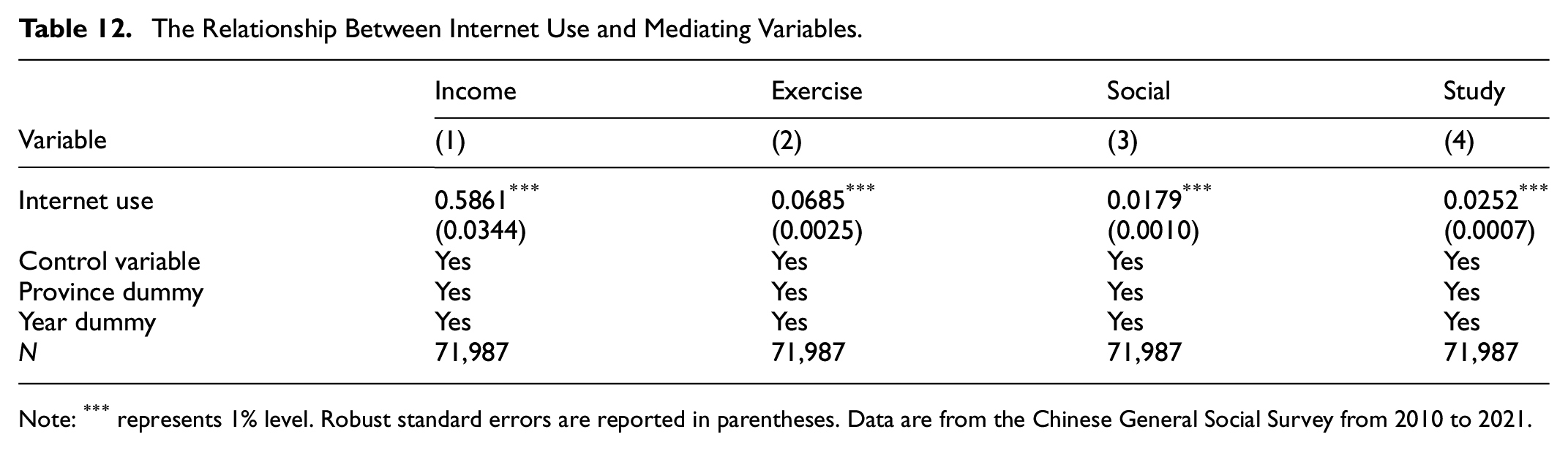
According to CGSS, the four mediating variables are set as follows: (1) the mediating variable for income effect is measured by the logarithm of personal total income plus 1 (denoted by income); (2) the frequency of residents participating in physical exercise is employed as a proxy for health literacy. This indicator is an ordered variable ranging from “never = 1” to “every day = 5” (denoted by exercise); (3) the mediating variable for social relations is measured by the frequency of social activities conducted by respondents over the past year. The variable is an ordered variable with “never = 1”, “rarely = 2”, “sometimes = 3”, “often = 4”, and “very frequently = 5” (denoted by social); 4) the mediating variable for learning effect is obtained by asking the question about the frequency of learning activities carried out by the respondents in the past year. Similar to social relations variable, it is an ordered variable scale from “never = 1” to “very frequently = 5” (denoted by study).
Internet Use and Individual Subjective Health: Statistical Description
Figure 2 shows the average subjective health for Internet users and non-users. The results indicate that the average subjective health for Internet users is 3.90, which is significantly (verified by t-test) higher than that for non-Internet users (3.23).

Average subjective health for Internet users and non-users.
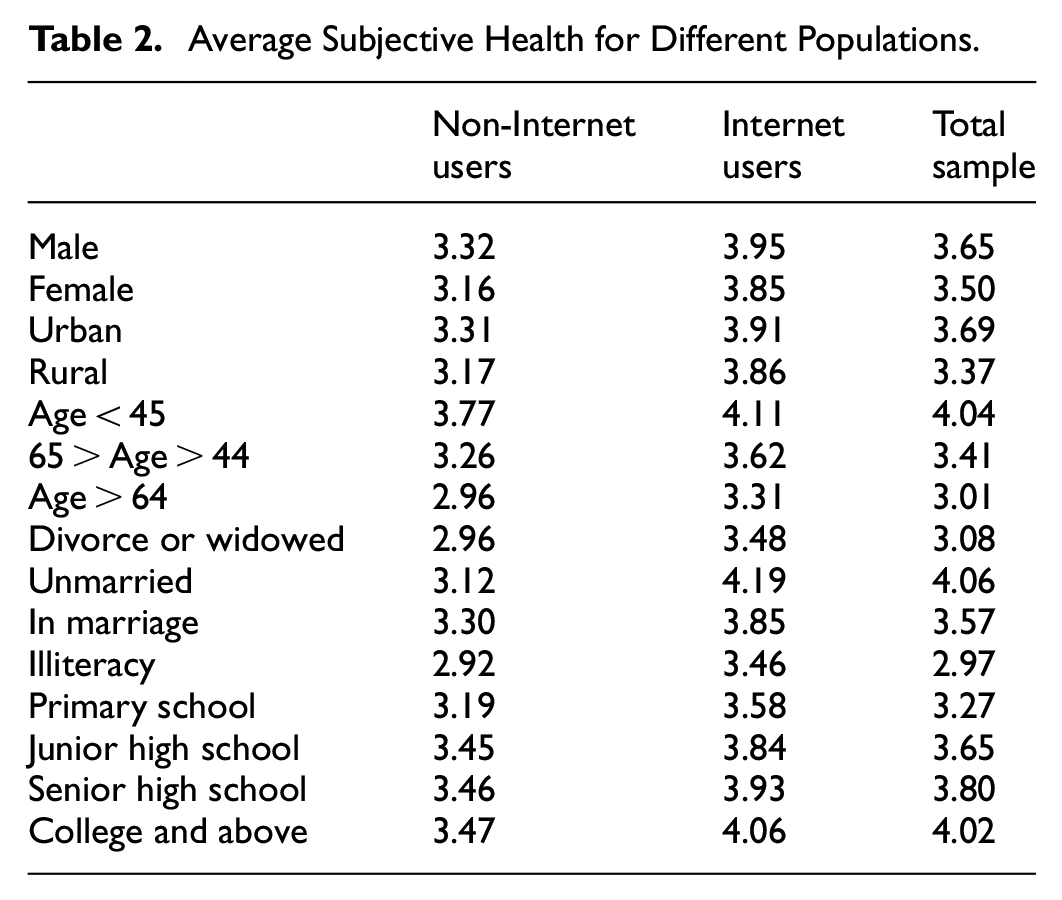
Table 2 reports the average subjective health scores across various population groups. First of all, the average subjective health of different populations varies. Specifically, men and urban residents report higher average subjective health scores compared to women and rural residents, respectively. Additionally, the average subjective health decreases with age but increases with the education level. Differences in subjective health are also observed across marital status, with unmarried individuals reporting the highest average subjective health, followed by married individuals, while divorced or widowed individuals report the lowest scores. Furthermore, across all population subgroups, respondents who use the Internet consistently report higher average subjective health scores than those who do not.
Average Subjective Health for Different Populations.
Figures 3 and 4 present the average subjective health for Internet users and non-users across years and regions, respectively. The results still indicate that respondents using the Internet report higher average subjective health than their comparators. Besides, the average subjective health status also varies by regions and years, indicating that it is necessary to consider the temporal and regional heterogeneity in our model.

Average subjective health for Internet users and non-users across regions.

Average subjective health for Internet users and non-users across years.
Results and Discussions
Baseline Results
Considering that subjective health is an ordered variable from 1 to 5, we adopt the ordered probit model to estimate Equation (1). Column (1) in Table 3 reports the results without including control variables and it shows a statistically significant positive correlation between Internet use and subjective health. After incorporating control variables, the results in column (2) show that Internet users are 4.36% more likely to feel “very healthy” compared to non-Internet users. Furthermore, columns (3)-(7) give estimation results using the annual survey data separately. Results suggest that using the Internet can significantly improve people’s subjective health for each year. Therefore, research hypothesis H1 is verified. Our results are consistent with Khan et al. (2016), Wangberg et al. (2008), and Wan et al. (2022), who suggested that Internet use is conducive to improving individual health. Moreover, the findings in our study also supports the growing body of literature emphasizing the role of Internet use (or smartphone use) in empowering people to maintain subjective well-being (see as Greyling, 2018; Nie et al., 2021; Li & Zhou, 2021).
Baseline Regression Result: Internet Use and Subjective Health (Marginal Effect).
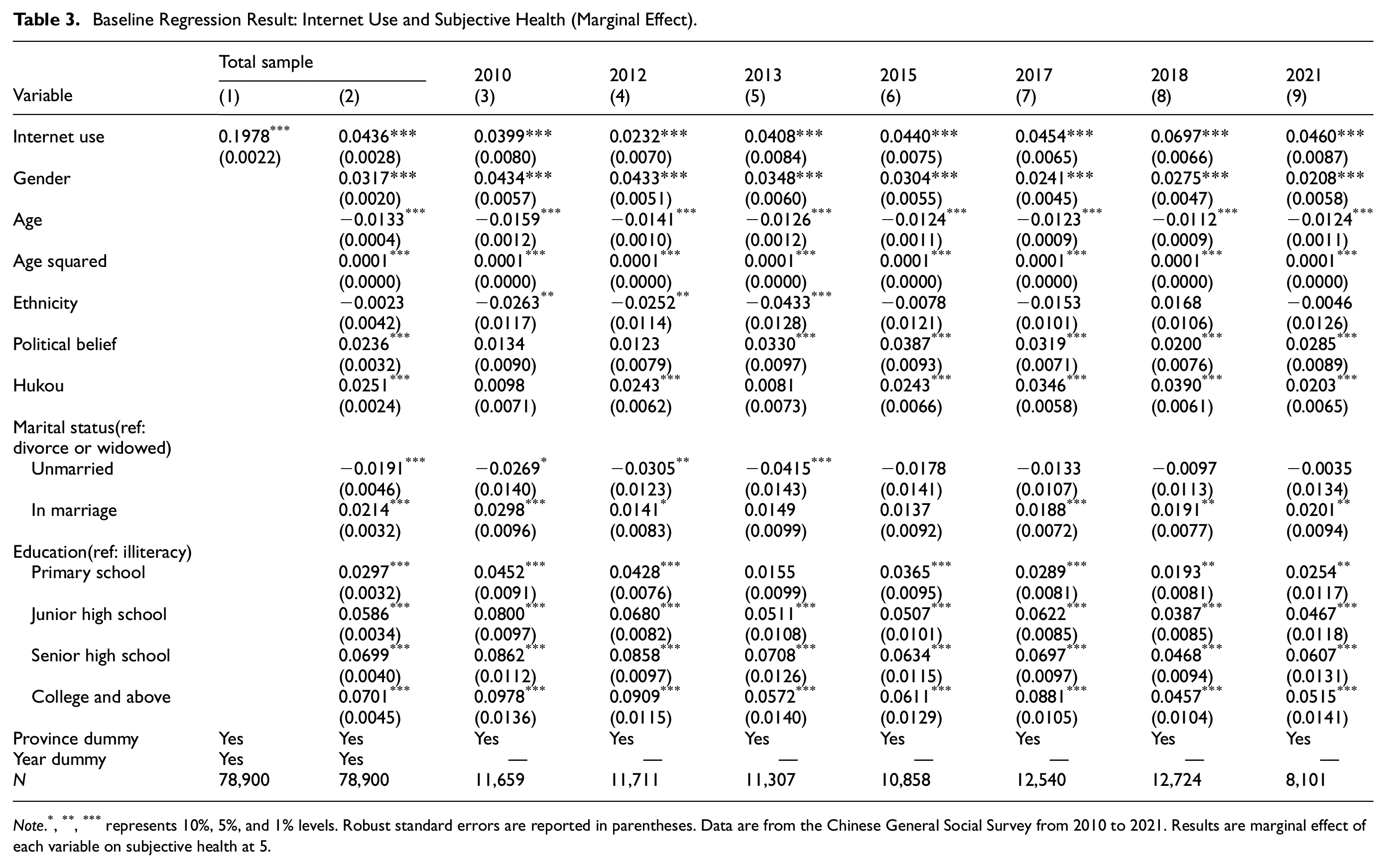
Note.*, **, *** represents 10%, 5%, and 1% levels. Robust standard errors are reported in parentheses. Data are from the Chinese General Social Survey from 2010 to 2021. Results are marginal effect of each variable on subjective health at 5.
As for the control variables, we find a significant positive correlation between gender and subjective health, indicating that men feel healthier than women in China. The result is consistent with the most well-established research on gender differences in subjective health (e.g., Assari, 2014; Eriksen et al., 1998). Age has a U-shaped relationship with the subjective health. In terms of different marital status, we find a positive association between marriage and higher subjective health, indicating that marriage plays a significant role in enhancing the happiness and well-being of Chinese residents. Political identity is significantly positively correlated with subjective health which can be attributed to party membership serving as an important form of social capital that influences personal material wealth, life perspectives, and psychological cognition in China. Hukou is positively correlated with subjective health, (significant at the 1% level), confirming that compared with rural residents, the subjective health of urban residents is higher. This can be explained by the fact that urban areas in China have more developed medical security system and more accessible living service facilities than rural areas. Consistent with Ross and Van Willigen (1997), Baron-Epel and Kaplan (2001), and Assari (2018), our study finds that access to education significantly improves Chinese residents’ subjective health. These findings underscore the importance of socioeconomic and demographic factors in shaping subjective health outcomes.
Robustness Checks
This paper conducts several robustness checks to ensure the reliability of above finding. Firstly, the key independent variable used in baseline model regression is a binary variable. Considering that the intensity of Internet use may vary among individuals, we replace the key independent variable with the frequency of Internet use (denoted by Internet_frequency). The indicator is an ordered variable ranging from “never = 1” to “every day = 5”. The results in Table 4 indicate that Internet_frequency is still positively associated with subjective health.
Robustness Check: Frequency of Internet Use and Subjective Health (Marginal Effect).

Note.*** represents 1% level. Robust standard errors are reported in parentheses. Data are from the Chinese General Social Survey from 2010 to 2021. Results are marginal effect of each variable on subjective health at 5.
Secondly, we replace the dependent variable with specific aspects of respondents’ subjective health. Two variables are constructed to capture the impact of health problems on their work activities and subjective mental health, denoted by subjective_job health and subjective_mental health, respectively. Specifically, subjective_job health is obtained by asking respondents whether their work or other daily activities were affected by health problems during the past 4 weeks. Analogously, subjective_mental health is constructed by asking respondents how often they felt depressed in the past 4 weeks. These two indicators are both ordered variables with “always = 1” to “never = 5”. Results in Table 5 show that Internet use is positively correlated with subjective_job and subjective_mental health, suggesting that using the Internet can improve an individual’s subjective health in work domain and subjective mental health.
Robustness Check: Replacing the Dependent Variable.

Note.*** represents 1% level. Robust standard errors are reported in parentheses. Data are from the Chinese General Social Survey from 2010 to 2021. Results are marginal effect of each variable on subjective health at 5.
Thirdly, we exploit other methods to estimate the relationship between Internet use and subjective health, as shown in Table 6. Columns (1) to (4) indicate that the coefficients of the key independent variable are still significantly positive under the generalized ordered logit regression and OLS estimator.
Robustness Check: Adopting Other Estimation Method.

Note.*** represents 1% level. Standard errors are reported in parentheses. Data are from the Chinese General Social Survey from 2010 to 2021. Results are marginal effect of each variable on subjective health at 5.
Fourthly, Internet use in our study may be endogenous because of several unobservable factors that can influence both the residents’ Internet use and subjective health (e.g., personal preferences and early experience). Therefore, the instrumental variable method is adopted to address the endogeneity problem. In existing literature, regional informatization development level or aggregation indicator is widely used as the proxy of the instrumental variable for Internet use or Internet penetration (Castellacci & Viñas-Bardolet, 2019; Zhang et al., 2022a; Zheng et al., 2019). In general, whether a person uses the Internet is partly determined by the regional informatization level. Nevertheless, the development level of regional informatization, which often depends on government investment policies should be exogenous to an individual’s subjective health. Therefore, we utilize fixed broadband penetration in respondents’ province to construct an instrumental variable. To further ensure the exogeneity of that instrumental variable, we lag fixed broadband penetration by 3 years. Notably, we also add instrumental variable to the baseline model and run a OLS regression, as shown in column (1) of Table 7. The results suggest that the coefficient of the instrumental variable is not significant, indicating that after controlling for Internet use, the instrumental variable should have no direct effect on subjective health. This finding supports, to some extent, that the instrumental variable meets the exclusion restrictions (Zhang et al., 2022a).
Internet Use and Subjective Health: CMP Model.

Note.*** represents 1% level. Robust standard errors are reported in parentheses. Data are from the Chinese General Social Survey from 2010 to 2021. Results are marginal effect of each variable on subjective health at 5.
Because subjective health is an ordered variable, this paper uses the conditional mixed process estimator (CMP) to conduct the instrumental variable estimation (Roodman, 2011). In our study, the CMP model comprises a probit model to predict the probability of an individual using the Internet and an ordered probit to estimate the association between Internet use and subjective health. CMP model employs the maximum likelihood method to jointly estimate Internet use model and subjective health model, and generate the correlation coefficients (as shown in Atanhrho_12 test) of their error terms to determine whether an endogeneity problem exists. As shown in columns (2) and (3), the results indicate that instrumental variable is positively correlated with Internet use, and Internet use is also significantly positively correlated with subjective health, further supporting the main conclusion.
Heterogeneity Analysis
The previous sections have examined the correlation between Internet use and individuals’ subjective health in the full sample. However, the relationship may exhibit heterogeneity across different populations and regions. Therefore, this paper further analyzes the impact of Internet use on individual subjective health by introducing interaction terms between Internet use and socioeconomic characteristics into the benchmark model.
As shown in Table 8, column (1) reports the results of adding the interaction term between Internet use and education into the benchmark model. Education is recoded as a binary variable: 1 if respondents have received senior high school education or above and 0 otherwise (denoted as high education). Column (2) presents the gender differences in the health effects of Internet use, while column (3) examines whether the relationships vary by age. Accordingly, the sample is divided into three age groups: young (age < 45), middle-aged (45 ≤ age < 65), and old-aged (age ≥ 65), with two corresponding dummy variables.
Internet Use and Subjective Health: Heterogeneity Analyses By Education, Gender, and Age.
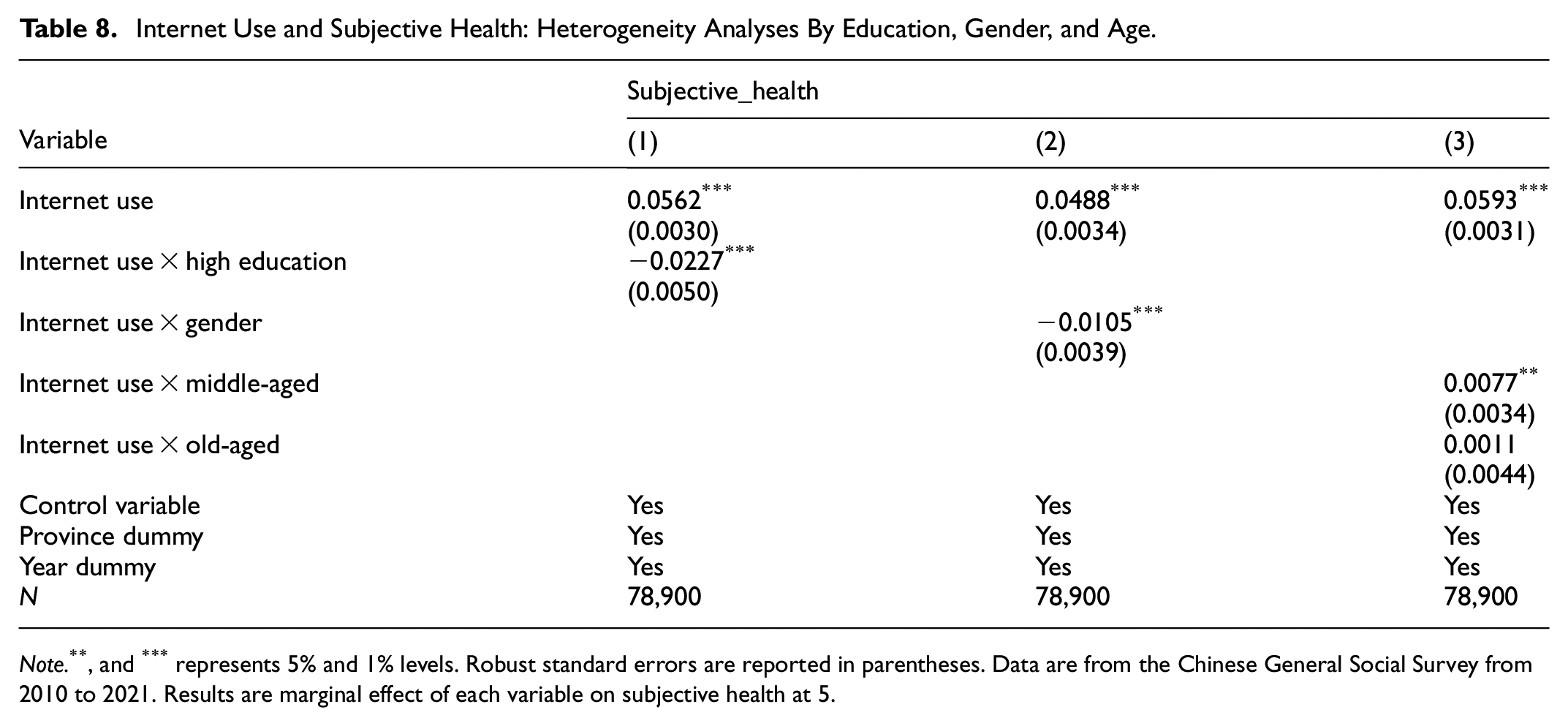
Note. **, and *** represents 5% and 1% levels. Robust standard errors are reported in parentheses. Data are from the Chinese General Social Survey from 2010 to 2021. Results are marginal effect of each variable on subjective health at 5.
First, the interaction term between Internet use and education is significantly and negatively correlated with subjective health. This indicates that Internet use has a greater facilitating effect on subjective health of individuals with lower education levels. A possible explanation is that, compared with the lower-educated population, individuals with higher education levels generally have higher incomes and stronger health awareness. Therefore, the Internet offers lower-educated individuals more opportunities to improve their health by compensating for material disadvantages. For example, these benefits can include increasing their income through non-agricultural employment and providing better access to medical services and products via online healthcare platforms. Second, regarding gender differences, column (2) confirms that the correlation between Internet use and subjective health is more pronounced for women. This may be because the Internet provides Chinese women with more job opportunities, medical information, and social networks, helping to offset their traditionally disadvantaged position in society. Third, column (3) shows that the association between Internet use and subjective health does not differ significantly between younger and older adults. However, Internet use has a stronger health-enhancing effect on middle-aged individuals. Interestingly, compared with younger people, the elderly often have lower Internet access rates. In recent years, many developing countries have been entering an aging society. This is especially true in rural areas, where the migration of young laborers to non-agricultural jobs has left many elderly individuals living alone, leading to inadequate care for their physical and mental health. Therefore, the finding may imply that the Internet holds significant potential for improving health outcomes in aging societies.
Table 9 presents the results of adding the interaction terms between Internet use and regional dummy variables into the benchmark model. Column (1) examines the urban-rural differences, while column (2) explores regional disparities among eastern China, central China, western China, and the northeastern China. The results reveal that the positive impact of Internet use on subjective health is stronger in rural areas compared to urban areas. Additionally, this positive effect is more pronounced in central China, western China, and northeastern China than that in eastern China. In general, China’s urban and eastern regions generally have better medical resources and higher levels of economic development than rural areas and the central and western regions. Thus, the conclusions suggest that Internet access is expected to reduce health inequalities between regions within China.
Internet Use and Subjective Health: Heterogeneity Analyses by Regions.
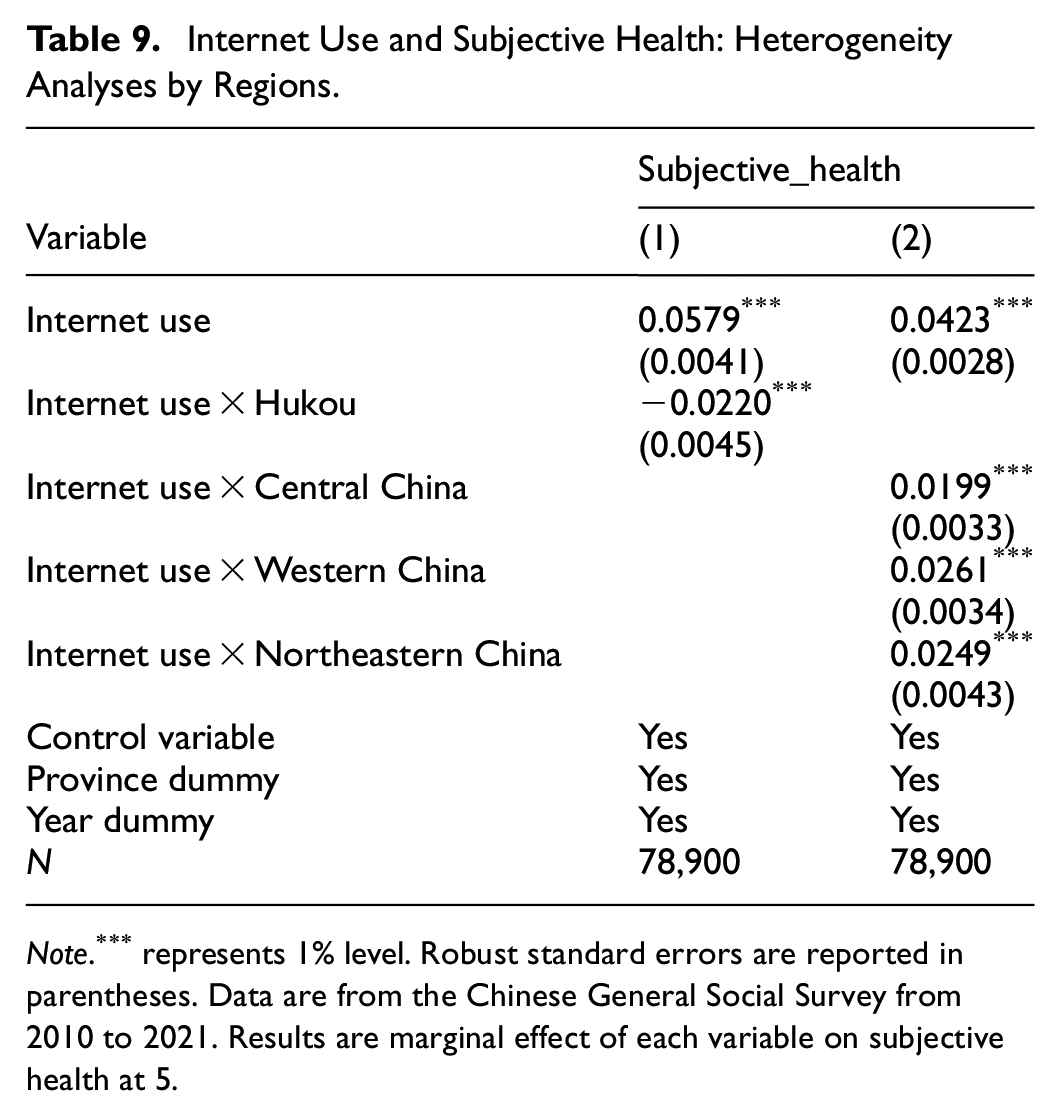
Note.*** represents 1% level. Robust standard errors are reported in parentheses. Data are from the Chinese General Social Survey from 2010 to 2021. Results are marginal effect of each variable on subjective health at 5.
Information Access Channels, Purpose of Internet Use and Subjective Health
As an emerging medium for information access, the Internet differs significantly from traditional media such as newspapers and television. For example, the Internet allows users to conveniently search for health-related information in real time. With advancements in online healthcare and big data technologies, the Internet can provide people with more professional health management and medical information services and plays an increasingly important role in safeguarding public health. With that in mind, we further explore how residents’ different information access channels affect their subjective health. Specifically, based on the question in CGSS “which is your most important information source media (including newspaper, magazine, radio, television, Internet, and mobile phone customization)”, we categorize personal information access channels into five dummy variables. Table 10 presents the impact of these channels on subjective health. The results show that using the Internet as the primary source of information has a significantly stronger positive effect on subjective health compared to traditional media such as newspapers, magazines, radio, television, and mobile phone customization.
Information Access Channels and Subjective Health.

Note. *** represents 1% level. Robust standard errors are reported in parentheses. Data are from the Chinese General Social Survey from 2010 to 2021. Results are marginal effect of each variable on subjective health at 5.
In addition, considering that differences in the purpose of Internet use may determine the association between Internet use and subjective health, this paper further examines the impact of different types of Internet use purposes on subjective health. Due to data limitations, we only examine the impact of the use of the Internet at leisure time (such as for entertainment, chat, and video watching) and the use of the Internet at work on subjective health. Specifically, we construct a binary variable that reflects whether respondents use the Internet in their leisure time (0 for never use, 1 for otherwise) and add it to the baseline model. Table 11 shows that Internet use at leisure time can significantly improve subjective health. Moreover, the coefficient of the key independent variable is still significantly positive after controlling for the variable of Internet use at leisure time, indicating that the use of the Internet at work can also significantly promote an individual’s subjective health (Gong et al., 2020).
Purpose of Internet Use and Subjective Health.

Note.*** represents 1% level. Robust standard errors are reported in parentheses. Data are from the Chinese General Social Survey from 2010 to 2021. Results are marginal effect of each variable on subjective health at 5.
Mechanism Analysis
As aforementioned, we further examine the mechanism through which Internet use affects subjective health by analyzing four pathways. In this section, we remove the missing values for all mediating variables and 71,987 samples are used for the analysis. Table 12 shows the estimation results that determine the relationship between Internet use and mediating variables. The findings show that Internet use is positively correlated with all four mediating variables, indicating that Internet use can enhance income, foster healthy habits, increase social interaction, and promote learning activities.
The Relationship Between Internet Use and Mediating Variables.
Note: *** represents 1% level. Robust standard errors are reported in parentheses. Data are from the Chinese General Social Survey from 2010 to 2021.
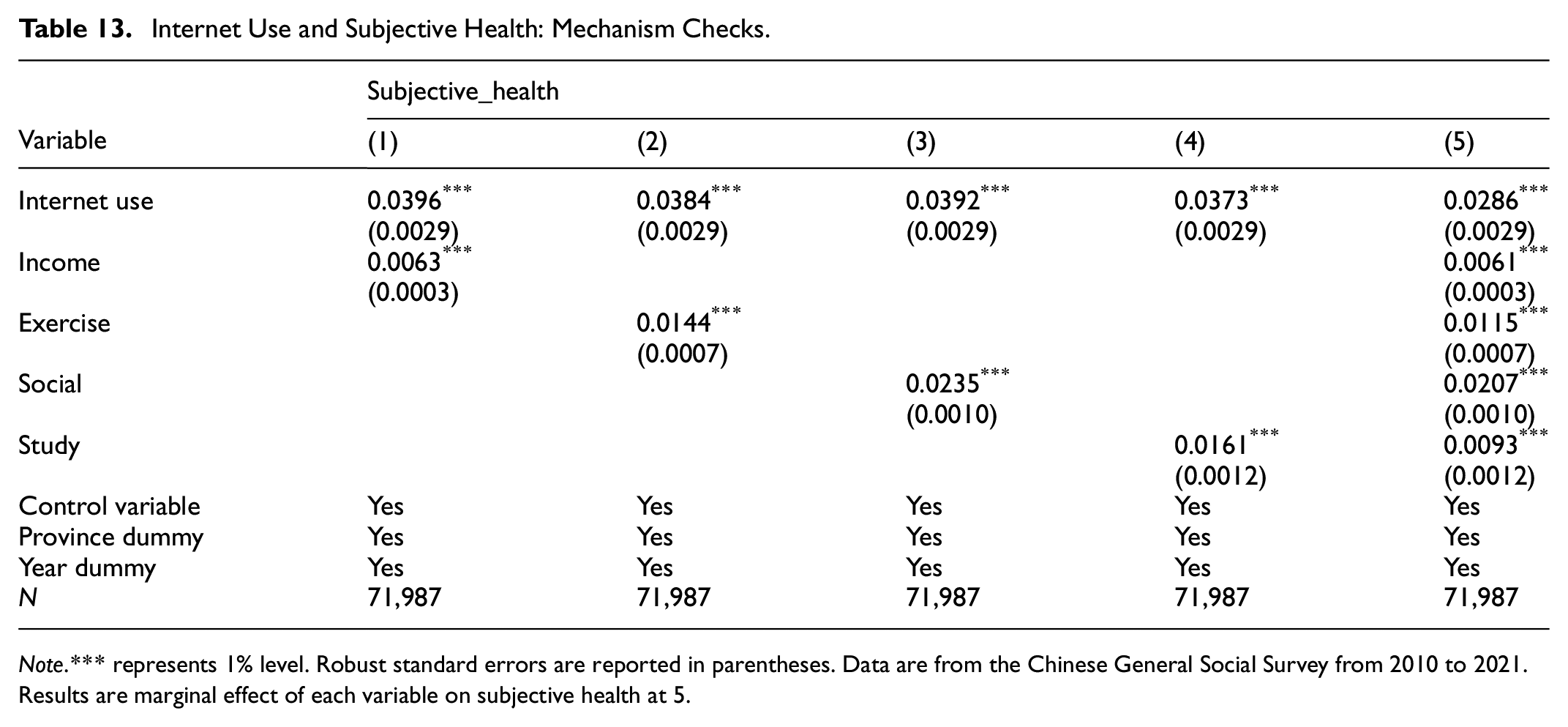
Table 13 reports the results on the association of subjective health with Internet use and mediating variables. It indicates that both Internet use and the four mediating variables have significant positive correlation with individual subjective health. The findings suggest that Internet use can improve an individual’s subjective health via income effect, health literacy, social relations, and learning effect. Therefore, the research hypotheses H2-H5 are supported.
Internet Use and Subjective Health: Mechanism Checks.
Note.*** represents 1% level. Robust standard errors are reported in parentheses. Data are from the Chinese General Social Survey from 2010 to 2021. Results are marginal effect of each variable on subjective health at 5.
Conclusion, Policy Implications and Limitations
Health is fundamental to human survival and has long been a focus for researchers and policymakers. Understanding the factors influencing both subjective and objective health is crucial for improving public welfare and developing effective health intervention policies that promote economic sustainability. In recent decades, information technologies, particularly the Internet, have become integral to both work and daily life. This study conducts an empirical analysis using CGSS data to explore the relationship between Internet use and subjective health, responding to the growing integration of Internet technology in the health sector. Our findings confirm that Internet use significantly enhances Chinese residents’ subjective health. Furthermore, we identify four key mechanisms through which this effect occurs: increased income, enhanced health literacy, strengthened social relationships, and greater engagement in learning activities. Additionally, our study reveals that the association between Internet use and subjective health varies across various demographic and regional groups. Specifically, Internet use has a more pronounced positive impact on women and individuals with lower education levels compared to men and those with higher educational attainment. Moreover, this effect is stronger in economically underdeveloped regions compared to more developed areas. Finally, individuals who primarily use the Internet to access information report higher levels of subjective health than those who rely on traditional information sources.
The finding in our study that Internet use can improve an individual’s subjective health has certain policy implications. Today, many potential threats to human health persist, particularly in developing countries where medical resources are insufficient and health literacy is lacking. In general, a healthy individual must not only maintain physical health, but also good mental health, the ability to adapt to society, and strong moral character. Therefore, our study underlines the importance of promoting information technology to improve public health. Moreover, the finding that Internet use has a more significant positive effect on subjective health in economically less developed areas highlights the potential of Internet penetration to compensate for the lack of medical infrastructure in these regions. In addition, our paper identifies several strategies for improving public health through the Internet platforms. These strategies may include: (1) strengthening Internet-related skills training to increase the income and well-being of disadvantaged populations; (2) disseminating modern health knowledge and improving citizens’ health literacy through online platforms; (3) providing health-related social support and enhancing social capital through online networks; (4) enhancing Internet-based learning platforms to promote the concept of lifelong learning among the public.
However, this paper has several limitations. First, it uses cross-sectional data rather than panel data, which makes it difficult to examine the long-term dynamic relationship between Internet use and individuals’ subjective health. Theoretically, changes in behavior and cognition due to Internet use are a dynamic and long-term process. Moreover, using data after 2021 to reveal recent changes in the relationship between Internet use and subjective health is also encouraged, especially in the post-pandemic era. This is important because the COVID-19 pandemic has significantly changed Internet usage patterns and may introduce new factors that affect health outcomes. Second, although we use instrumental variables to address endogeneity, the cross-sectional nature of the data omits certain individual and temporal factors, making it difficult to accurately establish the causal relationship between Internet use and improvements in subjective health. Third, due to data limitations, the dependent variable in this study is an ordered variable while the independent variable is binary variable. As a result, we cannot assess how specific online content or activities affect subjective health. Fourth, the sample only includes individuals aged 17 and over, and future research could explore whether Internet use affects subjective health for adolescents. Finally, this paper focuses only on how Internet use improves subjective health through income effect, health literacy, social relations, and learning effect. Future studies could identify other aspects of Internet use that may negatively affect subjective health and further explore whether the improvement effect of Internet use on individuals’ subjective health will further lead to changes in their objective health indicators.
Footnotes

Funding
The author(s) disclosed receipt of the following financial support for the research, authorship, and/or publication of this article: This work was supported by the National Social Science Foundation of China (18BJY108), Shanghai Pujiang Program (22PJC042), the Chinese Ministry of Education Youth Fund Project (23YJC630228), and the Fundamental Research Funds for the Central Universities (2023ECNU-YYJ040).
Declaration of Conflicting Interests
The author(s) declared no potential conflicts of interest with respect to the research, authorship, and/or publication of this article.