




Abstract
In early 2021, China introduced the “30–60” objective of “Carbon Neutral and Carbon Peak,” establishing low-carbon and high-quality development as a pivotal direction for China’s economic and social progress. China’s textile industry assumes a vital role in achieving low-carbon and high-quality development. Technological innovation emerges as a means to meet environmental regulations, facilitating an advantageous synergy between economic prosperity and environmental protection. The purpose of this study is to investigate the relationship between direct environmental regulation (DER) and enterprise innovation in the context of the Chinese textile industry. To achieve it, the study utilizes data collected from publicly listed textile companies in China, covering the period from 2004 to 2018, to construct a moderation-mediation model that explores the complex interplay between DER and enterprise innovation. The study’s novelty lies in comparing the impact of environmental regulation on innovation quality through substantive innovation and green innovation, as well as conducting stratified classification analyses by incorporating heterogeneous factors such as DER intensity, region, and sub-industry. The results demonstrate that DER significantly promotes both the input and output quality of innovation in Chinese textile enterprises, exhibiting a complex pattern of mediating and moderating effects. Specifically, DER exerts a substantial influence on the capital investment in innovation by Chinese textile enterprises, with high-intensity DER yielding more pronounced effects. The impact of DER on enterprise innovation quality is also contingent upon enterprise heterogeneity. Additionally, innovation capital investment serves as a pivotal mediating factor that links DER to the innovation quality of Chinese textile enterprises. The enterprise scale exhibits a moderating effect between DER and enterprise innovation quality. In summary, the mediation of innovation input and the moderation of enterprise scale collectively contribute to a comprehensive moderation-mediation effect on the relationship between DER and innovation quality in Chinese textile enterprises. Based on these findings, this study provides novel empirical support for the narrow “Porter Hypothesis” and offers targeted recommendations for enterprise management and policymakers in future applications.
Plain language summary
Purpose: The study is to investigate the relationship between direct environmental regulation (DER) and enterprise innovation in the context of the Chinese textile industry. Methods: The study utilizes data collected from publicly listed textile companies in China, covering the period 2004–2018, constructing a moderation-mediation model that explores the complex interplay between DER and enterprise innovation. Conclusions: The results demonstrate that DER significantly promotes both the innovation input and output quality, exhibiting a complex pattern of mediating and moderating effects. Specifically, DER exerts a substantial influence on the innovation capital investment, with high-intensity DER yielding more pronounced effects. The impact of DER on enterprise innovation quality is also contingent upon enterprise heterogeneity. Additionally, innovation capital investment serves as a pivotal mediating factor that links DER to the innovation quality. The enterprise scale exhibits a moderating effect between DER and enterprise innovation quality. In summary, the mediation of innovation input and the moderation of enterprise scale collectively contribute to a comprehensive moderation-mediation effect between DER and innovation quality in Chinese textile enterprises. Implications: Based on these findings, this study provides novel empirical support for the narrow “Porter Hypothesis” and offers targeted recommendations for enterprise management and policymakers in future application.
Keywords
Introduction
In the third decade of the 21st century, the dilemma between economic development and environmental protection has reached a new stage for integrated sustainable development (Taghvaee et al., 2023; Taghvaee, Nodehi, & Saboori, 2022). In the face of severe climate impacts caused by global warming, in early 2021, China introduced sustainable development goals, to achieve carbon peak by 2030 and carbon neutral by 2060. Establishing low-carbon and high-quality development has become a vital direction of China’s economic and social sustainable development, and traditional manufacturing industries bear a major mission. As a key manufacturing industry in China, in 2022, China’s chemical fiber production reached 64.88 million tons, accounting for more than 70% of the world’s output; the export value of textile and clothing products was 340.95 billion US dollars, accounting for more than 30% of the global export share of similar products. Textile industry needs to respond to the national sustainable development strategy. However, according to China’s 2012 revision of Industry Classification Guidelines for Listed Companies, several sub-sectors of the textile industry, including textiles, chemical fibers and leather, are heavily polluting industries, facing strict direct environmental regulation (DER) pressure. It is necessary to realize green transformation as soon as possible for these heavily polluting enterprises, the Chinese textile enterprises. And technological innovation can be an effective and efficient way. As Environmental Kuznets Curve shows (Taghvaee, Nodehi, Saber, & Mohebi, 2022), technological innovation emerges as a means to meet environmental regulations, facilitating an advantageous synergy between economic prosperity and environmental protection. The aim of this study is to validate the above logic as a feasible framework for informing both managerial practices and policy-making for the developing country (Ali, Jiang, Murtaza, & Khan, 2022). By taking into account the heterogeneity of enterprises, the managerial implications can be more specific and relevant. Therefore, it is of great practical significance to study the influence of DER on innovation quality of Chinese textile enterprises.
The research topic of environmental regulation and enterprise innovation has been widely explored since the emergence of the Porter hypothesis, which claims that “adequate environmental regulation can encourage enterprises to conduct more innovative activities” (Porter & van der Linde, 1995). Jaffe and Plamer further divided the Porter hypothesis into Narrow Porter hypothesis, Weak Porter hypothesis and Strong Porter hypothesis. The Narrow Porter hypothesis emphasizes that only certain environmental regulations can stimulate enterprise innovation. The Weak Porter hypothesis states that environmental regulation can only stimulate certain innovations. Strong Porter hypothesis holds that new environmental regulations can guide enterprises to discover some new opportunities that have not been discovered before, and innovation can bring profits to enterprises and solve environmental problems at the same time (Jaffe & Palmer, 1997). We understand that environmental regulations may exert pressure on a firm’s innovation expenditure through cost effects and innovation offset effects (Ding et al., 2022). High R&D is critical to green growth, but too strict environmental regulations can be detrimental to green growth (Zhang et al., 2023). It is also argued that heavily polluting subjects must increase research and development activities to promote green technologies and introduce strict environment regulations to complement other mitigation policies (Su & Gao, 2023). In addition, studies also have explored DER and innovation in the Chinese context: research on the technological innovation of urban energy conservation and emission reduction in China shows that DER with a lag period have a greater promoting effect on technological innovation than market-based ones (Q. Ye et al., 2018). DER have a significantly positive short-term effect on highly nationalized industries (B. B. Wang & Qi, 2016). Direct regulatory environmental policy tools can only inhibit industrial solid waste pollution (Zeng et al., 2016).
Most of previous studies employed macro data at provincial and industrial level, to study general polluting industries (B. B. Wang & Qi, 2016; Q. Ye et al., 2018; Zeng et al., 2016). It is rarely pay attention to textile industry, a traditional vital manufacturing industry of China, at the enterprise level, which identify the knowledge gap within the existing literature. The study’s potential marginal contribution also serves to bridge the existing gap by: (1) The study incorporates the innovation input as the mediating variable and the enterprise scale as the moderating variable. A comprehensive moderation-mediation model of DER and innovation quality was constructed specifically for Chinese textile enterprises. This model presents a novel perspective for further research on the topic; (2) The study analyzes both the innovation input and output, subdivide innovation quality into substantive innovation and green innovation, and compare whether DER has effectively promoted the innovation quality of Chinese textile enterprises. To some extent, it enriches the existing enterprise innovation research dimension; (3) The study further discusses the impact of DER according to the enterprise heterogeneity factors. It clearly reveals the path of DER affecting textile enterprise innovation under different DER intensity, regions and sub-industries, providing theoretical reference for textile enterprises to choose suitable innovation path. In this way, the main objective of the study is to take the micro data of Chinese textile enterprises to conduct stratified classification analyses by multiple regression models, including ordinary least squares (OLS) and Poisson distribution with Stata 16.0, exploring the mechanism between DER and enterprise innovation.
The paper will be arranged as follows: the literature review on DER and enterprise innovation for four hypotheses to be proposed is in part 2. The presentation of data sources and model construction is in part 3. The analysis of large sample statistical results for the 11 models is in Part 4. At the end of the paper, it provide suggestions to Chinese textile enterprises and policy makers based on the research conclusions.
Theoretical Framework
In the present stage of social development, we aspire to promote economic growth and preserve the ecological environment simultaneously, but achieving a win-win situation is challenging (C. Liu & Kong, 2021). Innovation is a crucial factor for development. However, the influence of DER on enterprise innovation is not a straightforward causal relationship. That is to say, it is not merely by strengthening or loosening environmental regulations that one can effectively stimulate enterprise innovation (Sherman et al., 2020). We need to open the “black box” to extract the complex mechanism between the two.
From the cost perspective, environmental regulation will impose compliance costs on enterprises, thereby diminishing their innovation investment (J. Liu & Xie, 2020; W. Wu et al., 2020). However, confronted with stringent DER, enterprises are motivated to comply with the standards through innovation, enhancing their competitiveness in the industry (García Marco et al., 2020). The response is also influenced by enterprise heterogeneity (Sheng et al., 2022; Z. Wang et al., 2022). When the intensity of environmental regulation is low, enterprises lack adequate incentive to invest in innovation. As the intensity of environmental regulation increases, enterprises have to further reduce costs through technological innovation (R. Wu & Lin, 2022). Environmental regulation can even be extracted as investment-driven category, which demonstrates the significance of environmental regulation on resource allocation (Dai et al., 2021). In this way, we propose:
Hypothesis 1: DER will have an positive impact on the enterprise innovation input.
Hypothesis 1a: The positive influence of DER on enterprise innovation input will be affected by enterprise heterogeneity.
Whether DER can stimulate enterprise innovation depends on whether the cost of environmental regulation exerts enough pressure on enterprises. In the short term, DER can improve the green performance of enterprises by elevating the environmental protection threshold of the industry. But in the long run, it can be solved only by technological innovation (H. Li et al., 2020). In a relatively stable market environment, regulation can improve innovation performance (Blind et al., 2017). When there is expectation of environmental regulation in the future, the impact of innovation capability on green innovation is more obvious (Tsai & Liao, 2017). When environmental regulations are stricter, innovation performance will rise correspondingly (X. Li et al., 2021; Rubashkina et al., 2015), but there may be a threshold effect (J. Liu et al., 2020). More specifically, DER can effectively stimulate green innovation in heavily polluting industries (Cai et al., 2020). Studies have shown that DER can promote enterprise technological innovation by improving R&D intensity (Mbanyele & Wang, 2022). And environmental investments have positive effect on green innovation (R. Li et al., 2022). R&D input plays an mediating role in the green innovation of manufacturing enterprises (Sun et al., 2022). However, some studies believe that DER will inhibit enterprise innovation, because the “rebound effect” brought by innovation will be detrimental to the environment (Y. Liu et al., 2018). Research also shows that the influence on technological innovation is indeed affected by heterogeneous factors, such as the enterprise’s property rights (Liang et al., 2023). In this way, we propose:
Hypothesis 2: DER will positively affect enterprise innovation quality.
Hypothesis 2a: DER will positively affect enterprise innovation quality through innovation input.
Hypothesis 2b: The positive influence of DER on enterprise innovation quality will be affected by enterprise heterogeneity.
Both internal R&D activities and environmental uncertainty act as moderating factors in the relationship between institutions and enterprise innovation (Tang, Hu, Petti, & Rer, 2019). In different industries with varying green performance, the impact mechanisms of environmental regulation on enterprise innovation also differ (Yuan et al., 2017). Executive compensation moderates the relationship between environmental regulation and enterprise innovation, but the moderating effect varies in the research stage and the development stage (W. Wu et al., 2020). Regulation intensity, industrial innovation speed, and industrial pollution intensity can all act as moderating factors of green innovation affecting enterprise brand value (Yao et al., 2021). Some scholars believe that large-scale enterprises with more fixed assets are more constrained by environmental regulation due to the higher cost of withdrawing from the market (Cao et al., 2022). While some studies have shown that green industrial policies are more effective in enhancing the green total factor productivity of manufacturing enterprises in small-scale enterprises (P. Ye et al., 2022), which means that the scale of enterprises will have a moderating effect on the impact of environmental regulation (M. Wu, 2022), then we propose:
Hypothesis 3: Enterprise scale has a negative moderating effect on the relationship between DER and enterprise innovation quality.
Some research shows that knowledge spillover acts as a partial mediator in the innovation stage and green economy. Absorptive capacity can moderate the relationship between knowledge spillover and green economy, and environmental regulation can also negatively moderate the relationship between them (Zhao et al., 2019). Similarly, an enterprise’s ecological strategy will play a mediating role between environmental regulation and sustainable business growth, and managerial environmental concern will play a moderating role on the mediating effect (Amara & Chen, 2020). The influence of government environmental subsidy on enterprise performance through green innovation will also be moderated by many factors (Hu et al., 2021). Regarding hypotheses 2 and 3, we conjecture that there might be moderation-mediation model between DER and enterprise innovation, then we propose:
Hypothesis 4: DER affects innovation quality through mediating variable innovation input, and enterprise scale plays a moderating role on the mediating effect.
Therefore, the relationship of the above four hypotheses is depicted in Figure.1 as the theoretical framework:

Theoretical framework.
Methodology
Data Sources
The study is based on the report data of 111 Chinese listed textile enterprises from 2004 to 2018. The financial data is derived from the China Stock Market & Accounting Research (CSMAR) database, and the environmental data is extracted from the enterprise financial reports by manual sorting. There are many missing environmental data, due to the incompleteness of disclosure. After excluding the samples of missing data, a total of 406 valid samples were obtained.
Variable Measurement
Dependent Variables
Since the study primarily explores the impact of DER on innovation quality of Chinese textile enterprises, innovation quality can be measured from the input side and output side respectively. The input side mainly considers the enterprise’s innovation capital input (calculated by the enterprise’s R&D expenditure; Javeed et al., 2021). The quality of innovation at the output side is mainly measured by substantive innovation and green innovation.
Substantive innovation: referring to the method of W. Li and Zheng (2016), the paper will measure the substantive innovation performance of textile enterprises by invention patents. Compared with design patent and utility model patent, invention patents entail a higher level of technological content and better represent the innovation quality of enterprises.
Green innovation: the primary focus of this study is to examine the influence of DER on the innovation quality of textile enterprises, thereby recognizing the significance of green innovation as a crucial dimension within innovation quality. In this context, green patents serve as a widely adopted metric for assessing the performance of green innovation (Yu & Cheng, 2021).
Independent Variables
Direct environmental regulation (DER): the government imposes environmental compliance obligations on enterprises through administrative means. Due to incomplete disclosure of pollutant emission data by the sampled enterprises, this study employs the environmental protection subsidies received by the enterprises as a proxy measurement, as suggested by Dai et al. (2021). This approach captures the effect of stringent environmental regulations wherein the government provides subsidies to enterprises for environmental protection purposes.
Mediating/Moderating Variables
Innovation capital investment: refers to the capital investment of enterprises in innovation activities, which is generally measured by R&D expenditure (Milani, 2017).
Enterprise scale: measured by the asset scale of the enterprise (Wei et al., 2021).
Control Variables
Due to the varying degree of different industries, the intensity of DER in different region is not the same, and the property rights will affect the managerial response to DER. Considering the influence of enterprise heterogeneity, the sub-industry (clothing, textile, fiber, leather), region (eastern, and central), and property rights (private or not) of enterprise are included in the model as control variables. In addition, since the enterprise’s innovation manpower input and business performance also affect the enterprise’s innovation input and output quality, the enterprise’s innovation manpower input (proportion of R&D personnel), revenue growth rate, cost profit margin and return on total assets (ROA; Yu & Cheng, 2021) are also taken as control variables.
Model Specification
According to the theoretical framework in Figure 1, we can find that DER exhibits a complex relationship with enterprise innovation quality. Therefore, considering the above theoretical basis and the characteristics of variables, we systematically verify the complete logical chain from DER to the quality of enterprise innovation, step by step. Considering the influence of enterprise heterogeneity, the mediating effect of innovation input and the moderating effect of enterprise scale, the following model (1) to (11) are established.


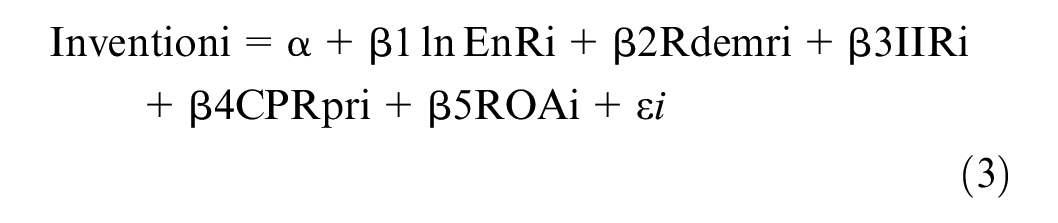

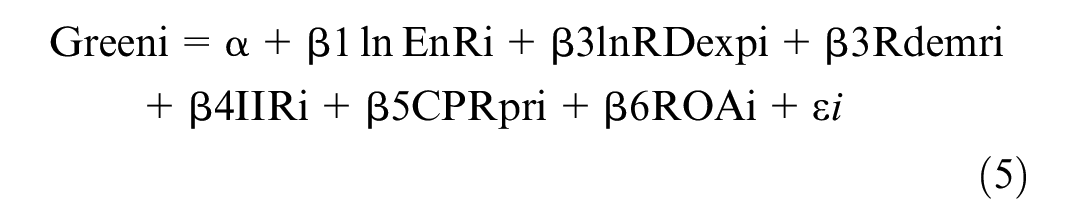


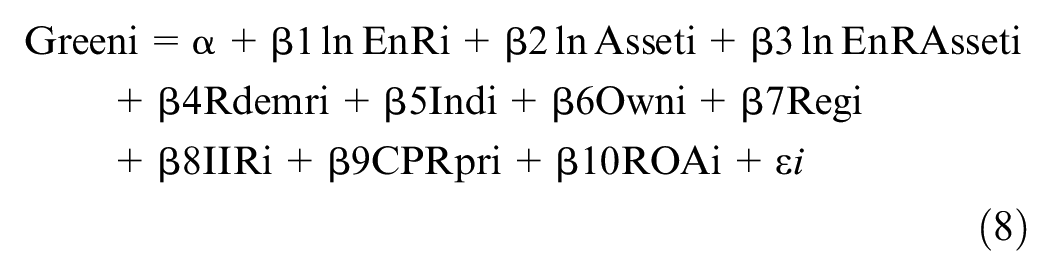
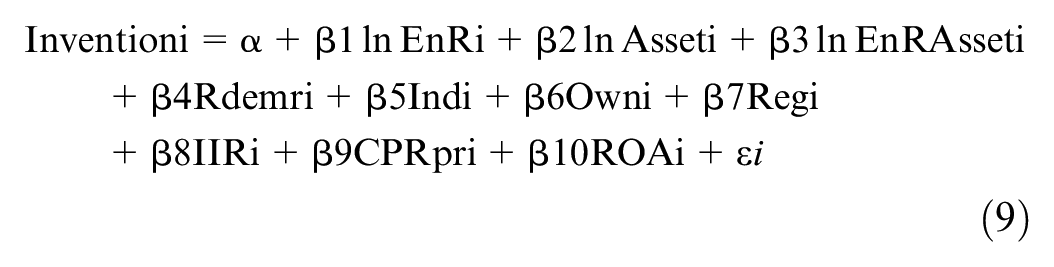


In the model, ln is the natural logarithm; RDexp stands for innovation capital investment; EnR stands for DER; Invention is substantive innovation; Green is green innovation; Rdemr is innovation manpower input; Ind, Own, and Reg are the heterogeneity factors of sub-industry, ownership and region, respectively. Asset is the enterprise size; IIR, CPR, and ROA are control variables of income growth rate, cost profit margin and return on total assets respectively. i represents each sample textile enterprise; α is the intercept that does not vary with individual; β is the parameter to be estimated; ε i is the error term that follows normal distribution.
Firstly, we construct the basic model (1) of the input side according to hypothesis 1. Secondly, for hypothesis 2, Poisson regression is employed by models (2)–(3) and (5)–(6) to test the impact of DER on innovation quality, as all dependent variables to measure innovation quality are counting variables. Additionally, models (2) to (6) utilize stepwise causal regression (Judd & Kenny, 1981) to assess the mediating effect of innovation investment. Thirdly, in consideration of hypothesis 3, accounting for potential variations in the mechanism between DER and innovation quality across enterprises of different scales, we introduce interaction terms in models (7) to (9) to examine the moderating effect of enterprise scale. At last, referring to models (2) to (9), the relationship between DER and innovation quality of textile enterprises is found to possess both mediating effect and moderating effect. Models (10) and (11) hopes to verify the combined influence within the mechanism outlined in hypothesis 4.
Results
Descriptive Statistics
Table 1 describes the data ranges of major variables, providing us a basic recognition of the study sample data. It can be seen from Table 1 that there are huge disparities in both the DER intensity and the innovation investment of Chinese textile enterprises. It is reflected in the performance of innovation activities as well. Some enterprises do not have any patents, but some enterprises have quite a large number of patents. When we conduct in-depth analysis of the sample data from the perspective of firm heterogeneity, we find that the top 10 samples in terms of the number of invention patents and green patents predominantly come from the textile industry, while the top 10 samples in terms of DER mostly originate from the fiber and clothing industries, all of which are non-private enterprises. The interesting phenomenon prompts us to employ regression models for further exploration of the specific impact mechanisms of DER on innovation of Chinese textile enterprises.
Descriptive Statistics of Main Variables.

The General and Heterogeneous Effect of DER
First, the impact of DER on the innovation input of Chinese textile enterprises is examined. From the results of Table 2 below, we can find that DER plays a significant role in stimulating enterprises’ innovation capital investment. It confirms that DER has a positive influence on the first stage of innovation activities (capital investment) of Chinese textile enterprises. The input is only the beginning of enterprises’ innovation activities. We are more interested in whether DER can really affect the quality of innovation performance of Chinese textile enterprises. The effect of DER on substantive innovation and green innovation is tested separately. It can be seen from Models (2) and (3) in Table 3 that DER has a significant positive effect on green innovation and substantive innovation of Chinese textile enterprises.
DER to Innovation Input by Intensity Model.

Note. t-Statistics in parentheses.
p < .1. **p < .05. ***p < .01.
DER to Innovation Output by Intensity Model.

Note. t-Statistics in parentheses.
p < .1. **p < .05. ***p < .01.
Do DER of different intensities have same impact on the innovation input and output quality of Chinese textile enterprises? To test it, DER is further divided into high intensity group and low intensity group. According to the results in Table 2, it can be observed that high intensity DER has a much stronger positive effect on innovation investment of Chinese textile enterprises than low intensity DER. In terms of output quality, we can see from Table 3 that both green innovation and substantive innovation are verified in the same way. In other words, high intensity DER has a more significant positive effect on the innovation quality of Chinese textile enterprises than low intensity DER.
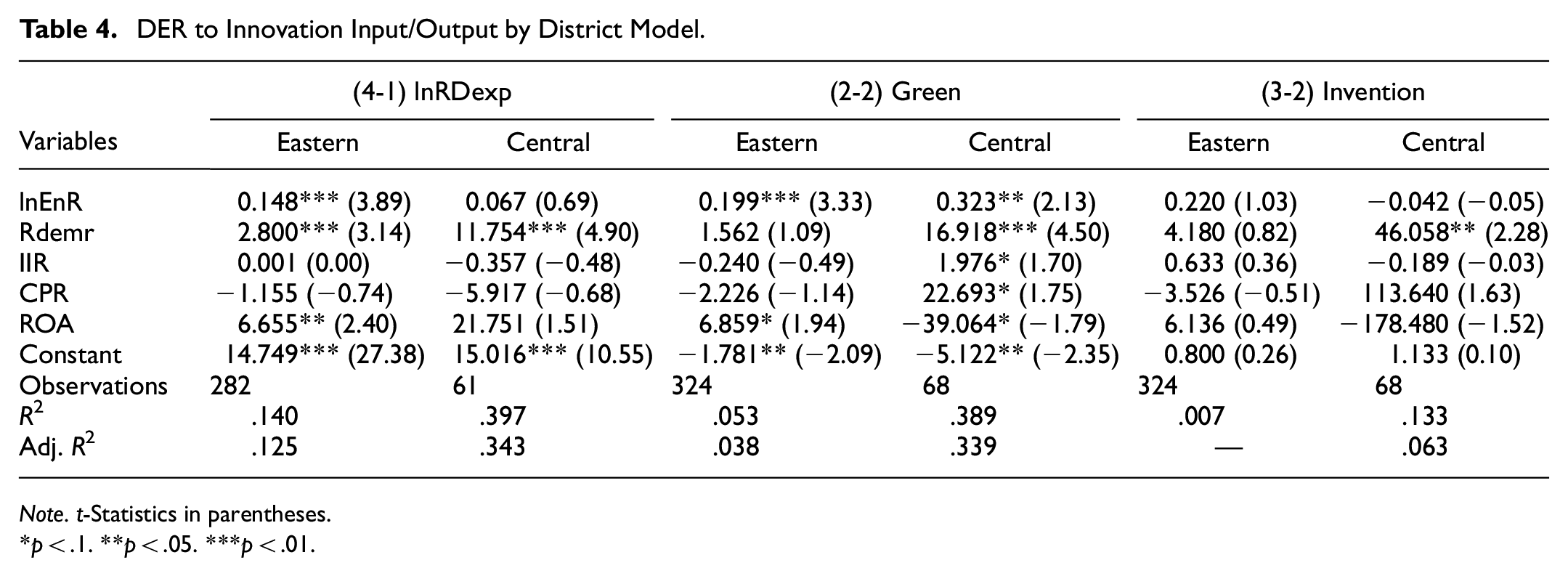
To examine the regional heterogeneity of DER effects, we classified the sample enterprises into two regions (eastern and central) based on the location of textile enterprises. Table 4 shows that DER has a significant positive effect on both innovation input and output quality in eastern China. In contrast, in the less developed regions such as central China, low-intensity DER may increase management costs and have no significant effect on enterprise innovation activities. However, in model (2-2) indicates that the central region also experiences a significant positive effect of DER on green innovation. It suggests that DER has substantially improved the green innovation of Chinese textile enterprises in the central region.
DER to Innovation Input/Output by District Model.
Note. t-Statistics in parentheses.
p < .1. **p < .05. ***p < .01.
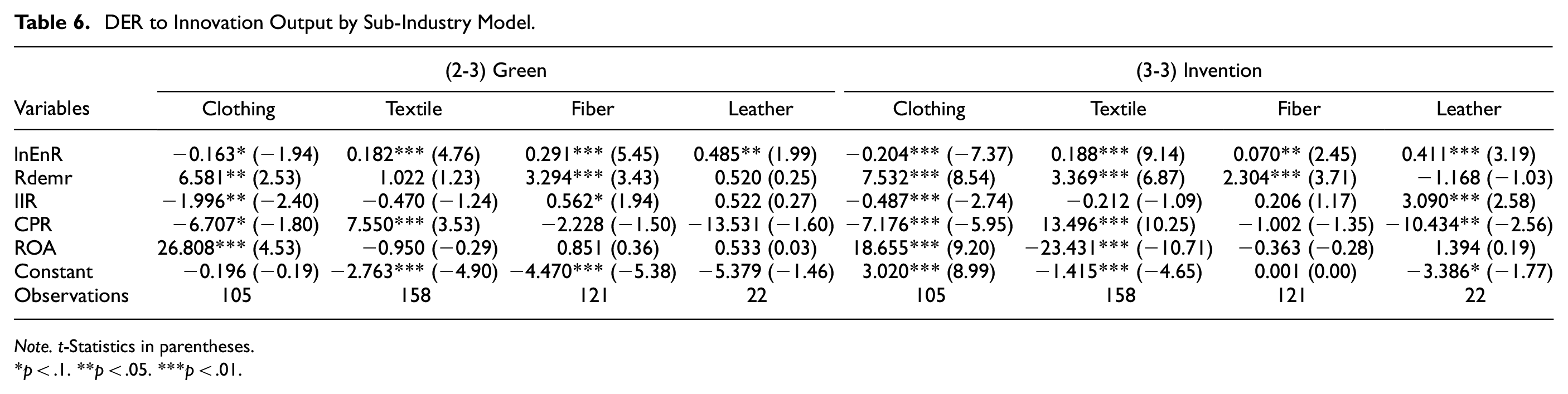
DER effects may also vary across different industries, depending on the level of environmental pollution. Although the study focuses on Chinese textile enterprises, the general textile industry can be further divided into four sub-industries: clothing, textile, fiber, and leather. The clothing industry is less polluted than the other three, and thus less subject to DER. From Table 5, for the innovation input, it shows that DER has a significant positive impact on the clothing industry and textile industry. However, for the innovation quality (Table 6), it reveals that DER has a negative impact on the clothing industry, while it has a significant positive impact on the other three sub-industries with higher pollution.
DER to Innovation Input by Sub-Industry Model.

Note. t-Statistics in parentheses.
p < .1. **p < .05. ***p < .01.
DER to Innovation Output by Sub-Industry Model.
Note. t-Statistics in parentheses.
p < .1. **p < .05. ***p < .01.
The Mediating Effect
Stepwise causal regression test (Judd & Kenny, 1981) is used to further test whether there is a mediating effect of innovation input. Table 7 shows that innovation input has a significant and partial mediating role in the relationship between DER and green innovation and substantive innovation of textile enterprises. It means that DER can directly improve the innovation quality of Chinese textile enterprises (Y. Wang et al., 2021), as well as indirectly through the innovation input. Moreover, the effect of DER on the green innovation is more significant than that on the substantive innovation, which aligns with the goal of DER, indeed positively guiding green innovation behavior of China’s textile enterprises.
DER to Innovation Quality Model (Mediating Effect of Innovation Input).

Note. t-Statistics in parentheses.
*p < .05. ***p < .01.
The Moderating Effect
In addition to the above basic model, this part examines whether enterprise scale moderates the relationship between DER and Chinese textile enterprises innovation. Model (7) to (9) in Table 8 shows that the enterprise scale has a significant positive moderating effect on the relationship between DER and the enterprise innovation input, but a significant negative moderating effect on the relationship between DER and the enterprise innovation output quality. It implies that the larger the scale of Chinese textile enterprises, the more DER enhances their innovation input, but the less DER improves their innovation quality. A possible explanation is that large enterprises have more capacity to invest innovation capital under DER. However, when they reach a mature stage of development, the threshold for improving the innovation quality becomes higher and the marginal effect decreases.
DER to Innovation Input/Quality (the Moderating Effect of Enterprise Scale).

Note. t-Statistics in parentheses.
*p < .05. ***p < .01.
The Moderating-Mediating Effect
To unravel the “black box” of DER and innovation quality of Chinese textile enterprises, we argue that it is not only a single moderating or mediating effect, but also a combined moderating-mediating effect.
By comparing models (10) and (11) in Table 9, we can find that, enterprise scale moderates the mediating effect of innovation capital investment on the relationship between DER and innovation quality of Chinese textile enterprises, but the specific effects differ for substantive innovation and green innovation. In the model (10) of green innovation, the significant coefficient of interaction term lnEnRAsset indicates that enterprise scale has a significant negative moderating effect on the relationship between DER and innovation capital investment. In the model (11) of substantive innovation, the coefficients of interaction terms lnEnRAsset and lnRDAsset are both significant, which confirms that enterprise scale has a significant negative moderating effect on both the relationship between DER and mediating variable innovation capital investment, and the relationship between the mediating variable innovation capital investment and substantive innovation.
DER to Innovation Quality (the Moderating-Mediating Effect).

Note. t-Statistics in parentheses.
p < .1. **p < .05. ***p < .01.
Robustness Test
To further verify the robustness of the above analysis, we perform the tests from the innovation input and output separately (Table 10). Firstly, for the innovation input, the raw data is used to replace the logarithmic transformation data for the main variables, and the conclusion is consistent with the previous model (1). That is, DER can effectively stimulate the R&D investment of Chinese textile enterprises. Second, for the innovation output, green patents and invention patents are replaced by general patents, which still confirms that DER can significantly enhance the innovation performance of Chinese textile enterprises, same as model (2) and (3). Additionally, considering the heteroscedasticity of model, we change the estimation method from OLS to FLGS, and obtain a robust result.
Robustness Test Result.

Note. t-Statistics in parentheses.
p < .1. **p < .05. ***p < .01.
Discussion
Firstly, DER can significantly stimulate innovation capital investment of Chinese textile enterprises. Although the ultimate goal of DER is to improve environmental quality, it still requires input to produce output. The innovation capital input is an important mediating factor connecting DER and innovation quality of Chinese textile enterprises. It is consistent with previous study (Borsatto & Amui, 2019), supports the narrow Porter Hypothesis (Jaffe & Palmer, 1997), and enriches the conclusion in a deeper way by enterprise heterogeneity.
We find that, unlike the eastern region with stricter DER, the effect of DER on green innovation is significant in the central region, which is a noval and extended finding for current study (Y. Wang et al., 2021). It also indicates that in recent years, China’s environmental regulation has greatly supported the greening of enterprise in the low-intensity DER region. The positive impact of DER on innovation quality is more significant in pollution-intensive industries than cleaner industries (Ali, Jiang, Hassan, & Shah, 2022; Mbanyele & Wang, 2022).
In addition, the enterprise scale has a negative moderating effect on the relationship between the DER and innovation quality of Chinese textile enterprises, which differs from previous study (Borsatto & Amui, 2019). As the enterprise scale increases, the development becomes more stable and mature, the marginal effect of innovation output decreases, and the difficulty of improving innovation quality will increases. It is a new finding requires policy-makers’ attention.
At last, to conclude: DER affects innovation quality through the mediating variable innovation input, and enterprise scale moderates this effect (P. Ye et al., 2022). However, the moderated mediating effect has different influence mechanisms on green innovation and substantive innovation, which is a novel contribution of the study. In the green innovation model, the moderating effect operates on the relationship between DER and mediating variables. In the substantive innovation model, the moderating effect affects both the relationship between DER and mediating variable, and the relationship between the mediating variable and innovation quality.
Conclusion and Policy Implications
Conclusion
Based on the empirical results presented above, it is evident that DER plays a significant role in enhancing both the capital input and the output quality of the innovation of Chinese textile enterprises. However, the relationship is not a straightforward path from A to B. To gain further insights, we delve into the underlying mechanisms and observe the presence of intertwined mediating and moderating effects.
The positive impact of DER on the input of Chinese textile enterprises represents a pivotal initial step towards improving the innovation quality. Hypothesis 1 is verified. Furthermore, the empirical results support the validity of Hypothesis 2 and 2a, indicating that DER does affect innovation quality through innovation capital input. Interestingly, the promoting effect of DER on green innovation surpasses its impact on substantive innovation, aligning with the original objective of environmental regulation
Furthermore, the intensity of DER exerts an impact on the underlying mechanism. High-intensity DER demonstrates a more significant positive effect on enterprise innovation input compared to low-intensity DER. Notably, the intensity of DER exhibits regional and industrial disparities, hypothesis 2b verified. Specifically, the central region of China exhibits relatively weaker DER intensity in comparison to the eastern region. Consequently, the influence of DER on enterprise innovation investment is more prominent in the eastern region, while it is not particularly evident in the central region. Moreover, when considering sub-industries, high-intensity DER has a more significant promoting effect on enterprise innovation investment in the clothing and textile industry. Hypothesis 1a is verified. The observation also can be attributed to the fact that sub-industries such as textile, fiber, and leather, which inherently generate more pollution, are subject to stricter DER regulations when compared to the clothing industry.
In addition, although all the sample enterprises are listed companies, there exists a significant disparity in scale, ranging from the smallest enterprise with assets of 300 million RMB to the largest enterprise with assets exceeding 60 billion RMB. Despite this substantial variation, the empirical results demonstrate that enterprise scale indeed exerts a moderating effect on the relationship between DER and enterprise innovation quality, supporting hypothesis 3. Specifically, the scale factor exhibits a significant positive moderating effect on innovation investment. Larger firms are more capable of investing in innovation capital under DER. However, on the output quality aspect, the enterprise scale plays a negative moderating role.
Finally, from a comprehensive perspective, the mediating effect of innovation input and the moderating effect of enterprise scale do not act independently on the relationship between DER and the innovation quality of Chinese textile enterprises, but rather function as a comprehensive moderating-mediating effect. Hypothesis 4 is verified.
To summarize, all the hypotheses have been verified, and the conclusions can be effectively summarized and depicted in the Figure 2.

Conclusion diagram.
Policy Implications
At the government level, first, the rationally designed DER promotes enterprise innovation. Although the DER is relatively mandatory, it cannot reach the expected aim if it is too strong or too weak, so it needs to be designed reasonably. Weak DER fail to achieve the effect of “command,” instead just increases the implementation cost of policies. However, too strong environmental regulation will increase the compliance cost of enterprises (Zhang et al., 2023), reducing the investment in innovation activities (Ding et al., 2022). Therefore, a reasonably designed DER can not only guide enterprises to increase investment in innovation, improve the quality of innovation, and produce green products with substantive innovation, so as to achieve the ultimate goal of environmental protection. Since policy pressure can stimulate fundamental innovation of enterprises, and policy incentive can make enterprises further “icing on the cake” (Tang, Hu, Petti, & Thürer, 2019). The flexibility of environmental regulations can effectively improve the positive effect of promoting enterprise innovation (Zhou et al., 2021). Therefore, in addition to the “command,” the government can provide incentives by offering funding (Cantor et al., 2021) to appropriately help enterprises reduce their compliance costs. However, such incentive policies are suggested to be carried out in the form of post-funding or policy profile to improve the effectiveness (Ali et al., 2019; Yu & Xu, 2022). Second, the government can consider more targeted policy by the enterprise heterogeneity, such as region, enterprise scale and industry. For example, when constructing DER, do not ignore the central and western region of China with stereotypes. The central and western regions are also paying increasing attention to green development. The numerous small-medium Chinese textile enterprises are the backbone of technological innovation activities, need more attention. And green industrial policy can effectively promote the green total factor productivity of manufacturing enterprises (P. Ye et al., 2022).
At the enterprise level, enterprises of different scales need to recognize their own influence mechanism between DER and innovation quality, and strive to enhance the green and substantive innovation. First, enterprises should adopt different strategies according to the different impacts of DER on substantive and green innovation. Sometimes, environmental regulations may stimulate non-substantive innovation but inhibit substantive innovation (R. Wu & Lin, 2022). However, only substantive innovation and green innovation can truly improve the innovation quality of enterprises under DER, and generate the “compensation effect” of innovation (Deng et al., 2019), which can increase cost efficiency and profitability (Chan et al., 2016). Second, the enterprise scale matters. The effect of DER on improving the quality of enterprise innovation is more significant for small-scale enterprises. These enterprises should actively increase their innovation input and seize the opportunity to produce green and substantive innovation efficiently. However, large-scale mature enterprises may face more challenges and barriers to achieve breakthroughs, and thus need more capital, time, patience and persistence.
Research Limitations and Prospects
The study has two limitations. First, the data coverage is limited to the period before 2018. The COVID-19 pandemic, which broke out in 2019, has significantly affected the social and economic environment as well as the innovation behavior of enterprises. Future research need to extend the data period to include the post-pandemic years and conduct comparative analyses. Second, the sample size and structure are constrained by the availability of non-equilibrium panel data. This may result in low model fit and weak statistical power. For the leather industry, the validity of the study’s conclusions needs further verification. For the western region, the data results were excluded due to insufficient samples. Future research need to collect more data through surveys or other methods to increase the representativeness and robustness of the research conclusions.
Footnotes
Declaration of Conflicting Interests
The author(s) declared no potential conflicts of interest with respect to the research, authorship, and/or publication of this article.
Funding
The author(s) disclosed receipt of the following financial support for the research, authorship, and/or publication of this article: This research was funded by “The Belt and Road” Regional Standardization Research Center of China Jiliang University (BRZK22C), the National Social Science Foundation of China (21BJY222), and Zhejiang Province Soft Science Research Program Project (2023C35086; 2023C35028). And Scientific Research Starup Fund of Zhejiang Sci-Tech University (Grant No. 21062293-Y).

Data Availability Statement
The data presented in this study are available on request from the corresponding author.