




Abstract
Green innovation is a cornerstone for achieving economic prosperity, ecological progress, and sustainable development. This study analyzes data from listed manufacturing companies (2010–2022) using a dual machine learning approach to examine how technology innovation corridors influence corporate green innovation, particularly through cluster effects. It also investigates how the integration of industry, urban areas, and human capital moderates this relationship. The results indicate that these corridors significantly promote corporate green innovation by fostering the agglomeration of capital, talent, and industrial clusters. This effect is particularly pronounced in state-owned enterprises, less polluting industries, and firms with female executives. In addition, a higher degree of integration between these departments and communities enhances the positive impact of innovation corridors on corporate green innovation. These findings provide valuable insights for policy-making and business strategy, guiding the effective utilization of regional innovation assets to achieve strategic transformation.
Keywords
Introduction
Cultivating new, quality productive forces is essential and represents a key focus in advancing high-quality development. It is imperative to persistently propel innovation, thereby accelerating the evolution of new-quality productive forces. Within this framework, green innovation has been accorded a central role, perceived as the linchpin of high-quality economic growth, and particularly essential in realizing the objectives of carbon peaking and carbon neutrality (B. H. Lin et al., 2024). Enterprises are the primary drivers of green innovation, and reinforcing their leading role is crucial (Carpenter et al., 2004; Hambrick & Mason, 1984). In 2021, the State Council promulgated the “Guiding Opinions on Accelerating the Establishment of a Comprehensive Green and Low-Carbon Circular Development Economic System,” underscoring the necessity to expedite the construction of a green innovation system with enterprises at its core, thereby providing enduring momentum for the green, low-carbon, and circular economic paradigm. However, despite economic incentives, many enterprises face constraints like technological path dependency, financial limitations, and insufficient market awareness (Gao et al., 2019). These challenges make them susceptible to the “low-end lock-in” dilemma, thereby impeding their transition from polluting, energy-intensive production models to sustainable alternatives. Moreover, green technological innovation demands significant financial outlays, presenting a formidable threshold for small and medium-sized enterprises (Kong et al., 2022). Although the volume of patent authorizations in China has surged, the quality of these patents leaves ample room for enhancement, particularly in the information technology sector, where numerous patents have limited practical utility. For instance, only 20% of China’s patents are categorized as invention patents, a stark contrast to the 90% benchmark in the United States, highlighting the imperative to bolster advanced innovation capabilities. Consequently, enterprises struggle to achieve sustainable development, which in turn undermines their market competitiveness. In this milieu, the establishment of technology and innovation corridors is highly anticipated and viewed as a potent avenue for catalyzing green innovation among enterprises.
The science and technology (sci-tech) innovation corridor is a regional economic model that leverages geographic proximity and transportation routes to promote knowledge spillover, efficient resource flow, and collaborative innovation. Its economic importance stems from breaking administrative barriers and integrating key innovation factors-talent, capital, technology, and data-thereby deepening the links between industrial, innovation, and capital chains. This approach enhances overall regional innovation efficiency and total factor productivity. In this model, the technological spillover from central cities and the industrial capacity of surrounding areas complement each other, realizing coordinated economies of scale and scope.
For instance, the G60 Sci-Tech Innovation Corridor in the Yangtze River Delta spans nine cities across Shanghai, Jiangsu, and Zhejiang. It contributes approximately 1/15 of China’s GDP and hosts about one-fifth of its listed companies. It is a typical example of regional innovation development in China. While promoting the agglomeration of high-tech industries, it also actively explores the application path of green and low-carbon technologies. However, from the enterprise level, does participation in the sci-tech innovation corridor really enhance green innovation ability? Is the underlying mechanism resource acquisition, knowledge spillover, or institutional incentives? These issues have not been clarified. Therefore, from a micro-enterprise perspective, a systematic examination of the sci-tech innovation corridor’s impact on green innovation serves a dual purpose: it helps reveal the economic effectiveness of regional innovation policies and provides a theoretical and practical basis for optimizing the corridor’s governance mechanism to achieve the “dual carbon” goals.
Literature Review
The literature related to this study falls into three main streams, though none directly address our research question. The initial stream delves into corporate green technological innovation, encompassing the following three pivotal dimensions: Firstly, the trajectory of corporate green innovation. The pathway of green technological innovation encompasses three critical phases: greening the innovation origins, greening the technological development and dissemination process, and greening the corporate management framework (Guo et al., 2018; D. X. Hu et al., 2022; M. Y. Wang et al., 2021). This process integrates environmental concerns from the initial idea through to technology development and dissemination, culminating in a comprehensive green transformation of corporate operations. Secondly, the catalysts and influencer elements. The propellants driving corporate green innovation are multifaceted, comprising regulatory and policy directives (Du & Guo, 2023; F. Li et al., 2024; G. C. Wu et al., 2022), shifts in market requisites (Hou & Guo, 2023; R. J. Lin et al., 2013), environmental tax reform (H. Hu et al., 2025), green finance and credit (X. Li et al., 2025; Xu & Lin, 2025), development of artificial intelligence (X. He et al., 2025), the augmentation of corporate social accountability, and the impetus of technological evolution (Mo et al., 2022; S. X. Song et al., 2024; Yi et al., 2024; Yikun et al., 2022). Additionally, factors such as organizational structure (Lou et al., 2023; Negi et al., 2023) and external collaborative networks (Peiró-Signes et al., 2024; Sánchez-Sellero & Bataineh, 2022) are also considered crucial for the success of green innovation. Thirdly, the repercussions and assessment of corporate green innovation outcomes are considered. Corporate green innovation yields not only environmental dividends, such as diminished carbon footprints and heightened ecological integrity, but also economic advantages, including cost reductions, market expansion, and competitive fortification (Cheah et al., 2024; M. Y. Wang et al., 2023; Q. J. Wang et al., 2022). Consequently, the performance evaluation framework for green innovation typically comprehensively assimilates environmental, economic, and social metrics.
The second body of literature focuses on the development of sci-tech innovation corridors, delving into three primary dimensions: Firstly, the concept and characteristics of these corridors. A sci-tech innovation corridor is typically defined as a spatial framework along major urban thoroughfares, aggregating innovative elements, distinguished talent, nascent industries, and reformative systems to support regional innovation and growth robustly. Its defining attributes include a dense concentration of innovative resources, a seamless integration of industry, academia, and research, a superior ecosystem for innovation and entrepreneurship, and a progressive evolution of policies and systems (Y. R. Yan et al., 2023). Secondly, it examines international precedents and their inspirations for the creation of such corridors. The California 101 Highway Innovation Corridor, renowned globally, epitomizes the critical interplay between education, research, and industry, with its robust high-tech industry cluster and prestigious educational institutions such as Stanford University (Loukaitou-Sideris, 2013). Tokyo Tsukuba Corridor, as a technological hub in Japan, has amassed a significant number of research and development entities and high-tech enterprises through strategic government planning and investment, underscoring the pivotal role of governmental leadership in fostering technological innovation (Y. Wu et al., 2020). The London-Cambridge Corridor, anchored by the esteemed Cambridge University, accelerates the rapid advancement of biotechnology, information technology, and other sectors. This is achieved through collaborative efforts between industry, academia, and research, showcasing the successful transition from academic inquiry to commercial application (Turner, 2007). Finally, it explores how a sci-tech innovation corridor profoundly influences the technological innovation of cities along its route. It transcends regional administrative boundaries, facilitates the sharing of innovative resources, and plays a cardinal role in achieving high-quality integrated development between cities, establishing a network of scientific and technological innovation cooperation (Isinkaralar, 2024).
The third stream of literature investigates how industrial agglomeration affects green technology innovation (Y. Song et al., 2023). The studies are mainly based on panel data at the city or industry level, empirically analyzing the effects of new-energy industry agglomeration (T. C. Li et al., 2023), financial agglomeration (Y. He et al., 2023; Y. Yan et al., 2025), data factor agglomeration (Han et al., 2024; S. Yang et al., 2025), and industrial co-agglomeration (Zeng et al., 2021) on green technology innovation indicators such as the number of green patent applications or the improvement of energy efficiency. The study finds that appropriate industrial agglomeration can significantly promote the R&D and application of green technologies through mechanisms such as knowledge spillover, resource sharing, and specialized labor markets. However, excessive agglomeration may lead to intensified resource competition and increased environmental pressure, resulting in diminishing marginal effects or even inhibitory effects (N. N. Yang et al., 2024). In addition, this impact may exhibit heterogeneity because of differences in regional development levels, the intensity of environmental regulations, and innovation infrastructure (Peng et al., 2021).
Existing studies have overlooked the impact of constructing sci-tech innovation corridors on enterprises’ green innovation, thus ignoring potential pathways for action. However, in promoting enterprises’ green innovation, the sci-tech innovation corridor, as a special spatial carrier integrating policy guidance, resource agglomeration, and network collaboration, holds irreplaceable strategic significance. Resource-based theory emphasizes that the uniqueness and non-imitability of a firm’s internal resources are the keys to obtaining sustainable competitive advantages. From this perspective, the sci-tech innovation corridor provides a solid resource foundation for enterprises to carry out green technology innovation by aggregating high-level human capital, advanced R&D facilities, and dense information flows (Hameed et al., 2023). However, relying solely on internal resources makes it difficult to achieve systematic breakthroughs. Especially against the backdrop of high initial costs and great market uncertainties in green technologies, coordinated support from the external policy environment is crucial. Social network theory further points out that the interactive relationships among organizations profoundly influence knowledge flow, resource integration, and technology diffusion. In the sci-tech innovation corridor, enterprises not only rely on their own capabilities but are also embedded in a complex cooperation network composed of universities, research institutions, upstream and downstream enterprises, and intermediary organizations. Such formal or informal social connections facilitate resource sharing, risk sharing, and collaborative innovation, significantly enhancing the R&D efficiency and transformation speed of green technologies (Rehm & Goel, 2017). However, the exertion of the network effect is often regulated by institutional environments. In particular, the design quality of the policy mix determines whether resources are effectively allocated and whether cooperation can be stable and continuous. Institutional theory focuses on how external institutional pressures shape corporate behavior, including mandatory regulations, normative expectations, and cognitive legitimacy requirements (Balzano et al., 2025). In constructing sci-tech innovation corridors, governments typically introduce a series of policies to support green innovation, including diverse tools such as financial subsidies, tax incentives, green procurement, and emission standards. In recent years, the academic community has gradually begun to pay attention to the coordination and consistency of the “policy mix,” that is, whether different types of policies form complementary rather than offsetting effects (Kern et al., 2019; Magro & Wilson, 2019). For example, suppose supply-side policies (such as R&D investment support) lack corresponding demand-side policies (such as market incentives for green products). In that case, it may lead to “technological achievements without applications.” If strict environmental regulations are not accompanied by capacity-building support, it may increase the burden on small and medium-sized enterprises and suppress their willingness to innovate (Yao et al., 2025). Therefore, the institutional design in the sci-tech innovation corridor lies not only in the strength of individual policies but also in the coordination and dynamic adaptability of the overall policy mix (Milhorance et al., 2020; Toan, 2024).
Within the framework of sci-tech innovation corridors and green development, advancing corporate green innovation is the key to high-quality productivity. This study explores how such corridors spur green innovation through urban spatial strategies and the industry-city-people integration paradigm, which enhances spatial layout, public services, and talent mechanisms. This study establishes a theoretical basis and provides empirical evidence, offering strategic insights for boosting innovation capacity and facilitating economic transformation.
Theoretical Analysis
Policy Background
Against the backdrop of the new normal in the global economy, innovation has become the core engine of economic growth. Given the high demand for various resources in innovation activities, cross-domain and cross-entity cooperation has become essential for transforming innovation achievements and fostering the rapid development of regions. As an innovation cooperation platform that integrates the forces of local governments, enterprises, universities, research institutions, and financial institutions, the regional innovation system is crucial for promoting innovation and development within the region (Chung, 2002). Among them, scientific and technological innovation resources, as strategic core elements, directly reflect the maturity and competitiveness of the regional scientific and technological innovation system. Their abundance, quality, and allocation efficiency are key indicators for evaluating regional innovation capabilities (G. Y. Zhang et al., 2018). Therefore, to more effectively integrate and optimize regional scientific and technological innovation resources, the sci-tech innovation corridor has emerged as an important part of the national strategy. It has been incorporated into the 14th Five-Year Plan, with its construction elevated to a national initiative. As an important axis in the regional innovation system, it connects various innovation nodes, promotes the free flow and efficient allocation of elements such as talent, capital, and information, and is a key force in achieving regional collaborative innovation and balanced economic development.
China’s sci-tech innovation corridors are distributed in a “five-triangle” pattern, covering key areas in the eastern, central, and western regions, demonstrating geographical and regional differentiated strategies. The eastern region focuses on international scientific and technological innovation docking, the central region emphasizes regional connection and radiation, and the western region aims for inland interconnection. As of February 2024, China’s sci-tech innovation corridors are located in regions such as the Yangtze River Delta, the Pearl River Delta, the Central Plains, the Beijing-Tianjin-Hebei region, Central South China, the eastern region, and the southeast region, establishing nine sci-tech innovation corridors, including the G60 Sci-Tech Innovation Corridor in the Yangtze River Delta, the Guangzhou-Shenzhen-Hong Kong-Macao Sci-Tech Innovation Corridor, the Beijing-Tianjin-Hebei Sci-Tech Innovation Corridor, the Ganjiang River Sci-Tech Innovation Corridor, the Chengdu-Chongqing Sci-Tech Innovation Corridor, the Zhengzhou-Kaifeng Sci-Tech Innovation Corridor, the Jinan-Qingdao Sci-Tech Innovation Corridor, the Fuzhou-Xiamen-Quanzhou Sci-Tech Innovation Corridor, and the Xiangjiang River West Bank Sci-Tech Innovation Corridor. Among them, the G60 Sci-Tech Innovation Corridor in the Yangtze River Delta, the Guangzhou-Shenzhen-Hong Kong-Macao Sci-Tech Innovation Corridor, and the Beijing-Tianjin-Hebei Sci-Tech Innovation Corridor are relatively mature. As demonstration projects strongly supported by the government, these corridors use policy incentives, resource integration, and environmental optimization to promote scientific and technological progress, industrial upgrading, and economic growth in the cities and regions.
Science and Technology Innovation Corridor, Agglomeration Effect, and Green Innovation
Guided by green principles, the sci-tech innovation corridor aims to foster a supportive ecosystem for green innovation. Its core objective is to create a spatial platform where innovative elements can leverage knowledge spillovers and agglomeration economies to promote technological advancement. The foundation of this approach lies in the establishment of a “corridor” that seamlessly connects all innovation nodes, enabling the efficient flow of colleges, research institutions, enterprise R&D centers, and other innovative entities, thereby fostering an innovation ecosystem conducive to knowledge dissemination and agglomeration economic growth (Brock & Taylor, 2005). This initiative provides essential infrastructure and policy support for business growth while also creating an environment conducive to green technological innovation. It achieves this by optimizing resource allocation, fostering collaboration and exchange, and using other strategic means. The establishment of a sci-tech innovation corridor accelerates the conversion of scientific and technological achievements into tangible productivity, elevates the adoption and application levels of green technology within enterprises, and fosters sustainable development of the entire regional economy. Specifically, the Sci-Tech Innovation Corridor expedites the rapid dissemination of knowledge and technology, mitigates research and development costs and risks for enterprises, and enhances their innovation capabilities by constructing physical and virtual platforms conducive to technological innovation. Concurrently, the government’s preferential policies and dedicated funding support for the construction of sci-tech innovation corridors, including tax reductions, subsidies, and other measures (Q. Zhang et al., 2010), have directly catalyzed enterprises to increase investments in green technology research and development, explore new avenues for energy conservation and emission reduction, create environmentally benign products and services, and achieve a harmonious balance between economic and social benefits.
From the perspective of capital agglomeration, technological innovation zones frequently draw a considerable influx of financial resources. This includes venture capital, private equity funds, and an array of other financial institutions that coalesce into a vibrant cluster within the capital market. This milieu makes it notably more expedient for enterprises seeking funding, especially nascent or high-growth green innovation ventures that require significant capital outlays. Ample funding assurances are instrumental in sustaining a company’s R&D endeavors, hastening the development of cutting-edge technologies, and facilitating the swift transformation of scientific breakthroughs into market-competitive products and services.
From the perspective of the talent clustering effect, innovation corridors generally attract a cadre of high-caliber professionals, including scientists, engineers, and management specialists, who contribute with avant-garde ideas and technical expertise. The concentration of such talent not only enhances companies’ independent R&D capabilities but also sparks greater creativity and inspiration through knowledge exchange. This fosters interdisciplinary collaborative endeavors and yields more visionary and pragmatic green solutions. Concurrently, the presence of a conducive working atmosphere and promising career trajectories attracts more exceptional graduates to affiliate with local enterprises, thereby further enhancing the talent reservoir and instigating a synergistic cycle. Furthermore, the innovation corridor constitutes a comprehensive innovation continuum, spanning from fundamental research to industrial implementation and dissemination. Each segment is well supported, propelling the integrated progression of industry, academia, and research, expediting technology transition, refining educational standards, and cultivating market-aligned professional talent. Extensive collaborative networks established among academic institutions and research organizations offer prospects for continuous learning, a vital element in sustaining innovative dynamism (Figueiredo et al., 2023).
From the perspective of industrial cluster dynamics, establishing technological innovation corridors presupposes that spatial proximity can expedite the flow of information and facilitate the mutual exchange of technology. This premise is grounded in industrial clustering theory, which posits that concentrating interconnected firms in a defined geographic area can generate economies of scale, enable cost-sharing of infrastructure and services, and foster knowledge spillovers and technological advancements (J. J. Song, 2022). As more pertinent industrial enterprises establish themselves within these innovation corridors, they refine their strategic orientations based on resource allocations, circumvent disorderly competition, achieve functional interaction, and adhere to the doctrine of comparative advantage. Each region focuses on its most formidable domains and the upstream and downstream industrial linkages, which culminate in a comprehensive industrial ecosystem. This mode of clustered development not only facilitates resource sharing and technological spillovers but also reduces transaction costs and enhances production efficiency. For instance, raw material purveyors, manufacturers, and distributors collaborate closely within the same locale, collectively striving to curtail carbon emissions and manage waste disposal to realize sustainable supply chain administration.
Science and Technology Innovation Corridor, Integration of Industry, City, and People, and Green Innovation of Enterprises
In the ever-evolving landscape of the global innovation network, cities stand as pivotal nodes for the exchange and dissemination of innovative resources, confronting novel challenges and unprecedented opportunities. Within the traditional paradigm of urban planning, central cities grapple with constraints imposed by limited land resources, hindering their ability to attract more high-end resources. Conversely, peripheral cities, constrained by suboptimal business environments, struggle to realize their latent potential fully. Furthermore, the conventional model of urbanization has given rise to issues such as the disjointed relationship between industry and cities (Jan et al., 2019). To address these multifaceted issues, China introduced the concept of “industry-city integration” in 2014, which was subsequently incorporated into the “National New Urbanization Plan (2014–2020).” This initiative emphasizes a human-centric approach, aiming to foster harmonious and synergistic development between the industry and the city. As the new urbanization strategy continues to deepen and evolve, the concept of “industry-city-people deep integration” has been further articulated, placing even greater emphasis on addressing human needs and the unification of urban functions. The 20th National Congress of the Communist Party of China reiterated this strategic direction, underscoring the importance of advancing new urbanization with a central focus on people. Therefore, the acceleration of achieving deep integration between industry and city, rooted in human needs, ultimately aspires to establish a high-level complex system that seamlessly integrates industry, population, cities, and culture. In this context, the recent issuance of the “Construction Plan for the G60 Science and Innovation Corridor in the Yangtze River Delta” signifies not only the central role of the industry-city integration strategy in the corridor’s development but also its pivotal role in fostering green innovation. According to the tenets of the new spatial economics theory, the pivotal role of human resources in innovation development is further accentuated, marking a shift from a primary focus on “where to produce” to a more exploratory inquiry into “where innovation happens” (Atatsi et al., 2022). By optimizing the structure of human capital, innovation levels can be significantly enhanced. This leads to improved working environments, increased job satisfaction, and a higher quality of life for highly skilled labor, thereby attracting and retaining high-end talent more effectively. Moreover, a healthy and robust innovation ecosystem plays a crucial role in facilitating efficient resource allocation, promoting interaction and collaboration among various innovation entities, and offering opportunities for enterprises to collaborate on green supply chain management and resource recycling. This collaborative approach helps individual enterprises avoid the sense of isolation often experienced in innovation endeavors.
Research Design
Sample Selection and Data Sources
Publicly listed manufacturing firms, as leaders in their sectors, generally possess stronger technological foundations and greater R&D capabilities. Their strategic initiatives and achievements in green innovation inspire peers and competitors alike, helping to propel the entire industrial chain toward sustainability. Consequently, this study selects manufacturing corporations listed on the A-share markets in Shenzhen and Shanghai from 2010 to 2022 as the primary focus of its investigation. This study emphasizes the green innovation metrics of these enterprises, which were culled from the patent registry of the China National Intellectual Property Administration (CNIPA) and refined according to the green standards delineated by the World Intellectual Property Organization (WIPO). This study treats the 2016 launch of the G60 Sci-Tech Innovation Corridor in the Yangtze River Delta as the policy’s starting point. The primary reason is that in 2016, the Songjiang District pioneered an industrial development plan to establish the ‘G60 Sci-Tech Innovation Corridor’ along the G60 Expressway, which marked the official launch of this regionally coordinated innovation and development strategy. As the core event affected by the sci-tech innovation corridor policy, this study selects 23 core cities and 105 surrounding cities based on this benchmark, using information from the official websites of local governments. These cities cover the Beijing-Tianjin-Hebei region, Jiangsu, Zhejiang, Shanghai, and Anhui, as well as provinces and municipalities such as Guangdong, Jiangxi, Henan, Shandong, and Fujian, thus constructing the research sample. The degree of industry-city-people integration is included as a moderating variable. In China’s ongoing urbanization, prefecture-level cities often lead socio-economic transformation. The degree and manner of integration among industry, urbanization, and population vividly testify to pivotal features such as industrial evolution, the reconfiguration of the urban-rural spatial matrix, and shifts in demographic composition within the urbanization process. Hence, data from prefecture-level cities are employed to gauge the extent of integration, sourced from the “China Urban Statistical Yearbook.”
Model Selection
Double Machine Learning Model
In assessing the impact of policy measures or external disruptions on specific economic variables, conventional causal inference methods, such as Difference-in-Differences (DID) and Propensity Score Matching Difference-in-Differences (PSM-DID), have been shown to perform satisfactorily in various contexts. However, these methodologies rely on certain assumptions, such as the parallel trends assumption, which may not always hold in practice. To address these limitations and improve the precision and efficiency of analyses in the context of complex datasets, a dual machine learning (DML) model has emerged in recent years. The DML model employs machine learning algorithms to estimate the conditional expectation of disturbances, capturing intricate nonlinear relationships with flexibility. It effectively manages high-dimensional data, circumventing the curse of dimensionality. Therefore, this study adopts the DML model, building on existing research, to evaluate the influence of innovation corridors on corporate green innovation, delivering more accurate and reliable policy impact assessments. This enables policymakers to make decisions based on robust empirical evidence, thereby enhancing the effectiveness and relevance of policy measures. The model is as follows:

In Equation 1,

In Equation 2,

Causal Mediation Model Based on Machine Learning
To further examine the transmission path of the agglomeration effect, this study first tests the impact of the sci-tech innovation corridor on the agglomeration effect using double machine learning. It then explores the complete mechanism path of the impacts of the sci-tech innovation corridor and the agglomeration effect on green innovation. Compared with the traditional mediation effect model, the causal mediation model regards the treatment variable Policy as the determinant of the mediating variable Medi. Meanwhile, it also considers both the treatment variable Policy and the mediating variable Medi as determinants of the explained variable lnGreen. The direct and indirect effects of the treatment and the control groups are shown in Model (4):

Variable Selection and Indicator Definition
Explained Variables
Patents function as a legal framework for protecting novel technologies and inventions. The number of green patents granted to enterprises directly mirrors their efforts in research and innovation in environmental protection, clean energy, energy conservation, and emission reduction. Therefore, this study assesses the level of green innovation in enterprises by quantifying the number of green patent applications and authorizations. To align the patent count as closely as possible with a normal distribution, this study increments the count of both types of green patents by one. Subsequently, it computes the natural logarithm, resulting in the sequential measures of green patent applications (lnApplyG) and green patent authorizations (lnGrantG).
Core Explanatory Variables
By serving as a pivotal strategy to advance science and technology and safeguard intellectual property, the innovation and technology corridor fosters an optimal platform for enterprises to pursue green innovation. Consequently, this study regards this initiative as a condition resembling a natural experiment, thereby discerning the shock effects of the policy after the establishment of the regional innovation and technology corridor via the interaction effect between the creation of enterprise-specific attribute variables (treat) and temporal indicators preceding and succeeding the enactment of the policy (time). In particular, enterprises domiciled within the cities encompassed by the innovation and technology corridor are designated as treat = 1, constituting the experimental group. In contrast, those outside this corridor are assigned treat = 0, forming the control group. Additionally, the temporal phases antedating and postdating policy implementation are denoted as time = 0 and time = 1, respectively.
Mechanism Variable
Capital Agglomeration (Capital), the extent of a company’s R&D investment, mirrors its strategic emphasis and capital allocation priorities. A substantial R&D investment signifies a company’s adeptness at marshaling and directing capital toward long-term development and enhancing innovation capabilities. Hence, this study employs the ratio of a company’s total R&D expenditure to its operating income (R&D investment ratio) as a metric to gauge the concentration of corporate capital. Talent Agglomeration (lnPersonnel), research, and development are central to corporate innovation activities and are intrinsically linked to the development and refinement of novel technologies and products. As the principal actors in this endeavor, the number of R&D personnel epitomizes the magnitude of human capital investment in a company’s innovation pursuits. Consequently, this study uses the natural logarithm of the number of R&D personnel to measure the enterprise’s talent concentration. In industrial agglomeration (Industrial), the Herfindahl-Hirschman Index (HHI) is a widely recognized tool for quantifying market concentration. Evaluating the distribution of firms within a region elucidates the extent and structure of the industrial agglomeration. Thus, this study adopts the HHI to measure the industrial agglomeration of enterprises.
Adjustment Variables
The degree of integration among industry, city, and population (Integration) is assessed using indicators selected from three subsystems: population, industry, and urban area. The entropy weight method is used for calculation. The specific indicators are listed in Table 1.
Evaluation Index System for Integration of Industry, City, and People.

Control Variables
This study encompasses a series of control variables in its exploration of promoting green innovation within enterprises through the establishment of sci-tech innovation corridors. The enterprise characteristic variables included are as follows:
Firm size (lnScale): It is represented by the natural logarithm of the total assets. Larger-scale enterprises usually have more resources to invest in R&D and green innovation. Asset-liability ratio (Liabilities): It is the ratio of liabilities to total assets. High liabilities may limit a firm’s long-term investment ability, including projects such as green innovation, which have long cycles and high risks. Firm age (lnAge): It is represented by the natural logarithm of the number of years since listing, reflecting the firm’s maturity and historical accumulation. Older firms may have more stable management structures and innovation experience, but they may also face innovation inertia due to path dependence. Asset structure (Structure): It is the proportion of fixed assets and net inventory in total assets, which reflects the degree of heavy-asset nature of the enterprise. Heavy-asset enterprises may experience reduced flexibility and willingness for green technology innovation due to high transformation costs. Cash flow (Cash): It is the proportion of net operating cash flow in total assets, reflecting the firm’s internal financing ability. Sufficient cash flow is an important guarantee for supporting green R&D investment. Profitability (lnProfit): It is represented by the natural logarithm of the net profit at the end of the year. Firms with strong profitability are better able to bear the costs of innovation activities, and their profit levels may incentivize them to maintain competitive advantages through green innovation.
The main corporate governance variable is the concentration ratio of the shareholdings of the top 10 shareholders (Shareholder). The ownership concentration affects the efficiency of strategic decision-making and the long-term orientation of the enterprise. A higher shareholding concentration may enhance the support or supervision of major shareholders for the enterprise’s green transformation.
The descriptive statistics of all the variables mentioned above are shown in Table 2.
Descriptive Statistics of Variables.

Empirical Analysis
Multicollinearity Test and Correlation Analysis
Multicollinearity Test
To prevent biased estimates or inflated standard errors from multicollinearity, we conducted a multicollinearity test prior to the benchmark regression. The test results are shown in Table 3. The results indicate that the variance inflation factors (VIF) of all variables are below 2, with a mean VIF of 1.22, which is far lower than 10. This shows that there is no serious multicollinearity problem among the variables.
Results of the Multicollinearity Test.

Correlation Analysis
This study further conducts a Pearson correlation analysis, taking the number of a company’s green patent applications as an example. The results are shown in Table 4. The results indicate that the correlation coefficients between variables are all less than .5, suggesting that there is no collinearity problem among the variables. Secondly, there are significant correlations between the dependent variable, the explanatory variables, and the control variables (due to space limitations, the results of the transmission-mechanism variables and moderating variables are not presented).
Results of the Correlation Analysis.

Benchmark Regression
To test the impact of the sci-tech innovation corridor on enterprises’ green innovation, this section uses the double machine learning (DML) model to examine its influence. The sample segmentation ratio is set at 1:4, and the random forest algorithm is applied in the prediction and estimation processes for both the main and auxiliary regressions. The regression results are shown in Table 5.
Benchmark Regression.

Note. The values enclosed in parentheses represent standard errors.
, **, and *** denote significance at the 10%, 5%, and 1% levels.
The regression results in columns (1) and (2) indicate that the construction of the sci-tech innovation corridor has a positive impact on both the number of green patent applications and the number of green patent authorizations of enterprises, and it passes the significance test at the 1% level. Specifically, the implementation of the sci-tech innovation corridor policy has led to an increase of approximately 5.1% in the number of green patent applications and about 10.9% in the number of green patent authorizations of enterprises. That is to say, the sci-tech innovation corridor not only stimulates enterprises’ investment in and output of green technology R & D (reflected in the increase in the number of applications), but also significantly enhances the possibility that innovation achievements can pass the review and obtain authorizations, reflecting the dual-promoting effect of the policy on the “quality” and “quantity” of enterprises’ green innovation.
These findings indicate that for enterprises long constrained to the low end of the industrial chain due to limited technology, resources, or market access, the sci-tech innovation corridor serves as a key regional policy tool. It provides a more favorable institutional environment and support for green technology R&D and sustainable innovation. By aggregating resources, enhancing collaboration, and optimizing the innovation ecosystem, the corridor helps these enterprises achieve green technology breakthroughs and advance toward high-quality development.
Robustness Check and Endogeneity Analysis
Robustness Check
Parallel Trend Test
To ensure that the estimated coefficients obtained from the benchmark regression results represent the net effect of the policy, this study uses the event-study method to conduct a parallel trend test. Using the period before the implementation of the pilot policy for constructing the sci-tech innovation corridor as the base period, we identify systematic differences between the experimental and control groups before and after the innovation policy’s implementation. This is done through the statistical significance of the dynamic treatment effect coefficients. The test results are shown in Figure 1 (due to space limitations, only the results of the number of green patent authorizations are presented). In the figure, the dots and the lines at both ends of the dots represent the regression coefficients of the dummy variable of the sci-tech innovation corridor construction policy and the corresponding confidence intervals at the 95% level, respectively. As can be seen from the results in Figure 1, before the implementation of the sci-tech innovation corridor policy, the estimated coefficients of the policy variable are not significant and fluctuate around zero, indicating that there is no significant difference in the changing trends of green technology innovation between the experimental group and the control group. Meanwhile, the estimated coefficients of the policy variable on enterprises’ green technology innovation are significantly positive after the policy’s implementation, indicating that the construction of the sci-tech innovation corridor has promoted this innovation.
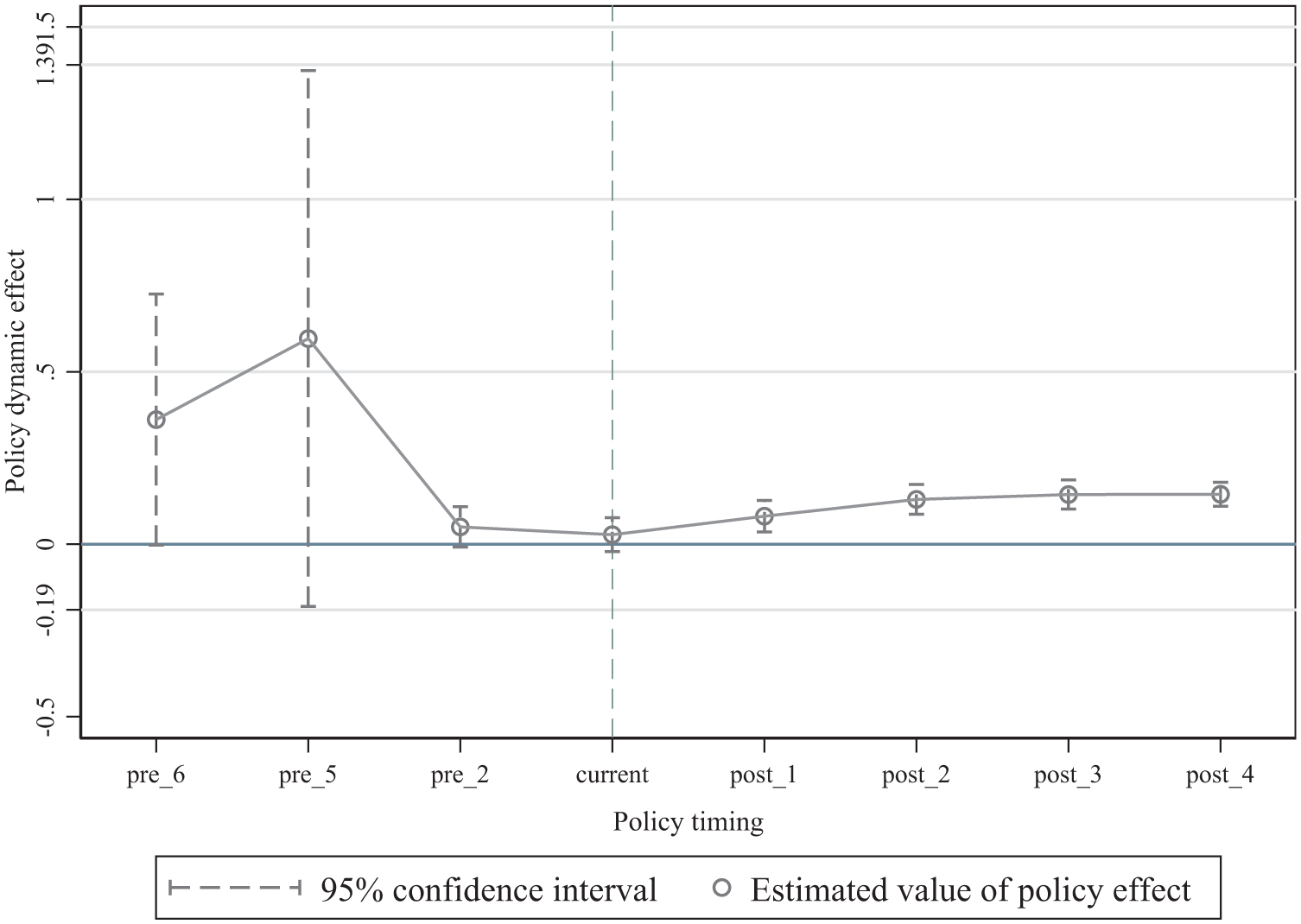
Parallel trend test.
Placebo Test
To rule out the influence of unobserved factors that might bias our benchmark results, we conduct a placebo test. Specifically, we use Stata to randomly assign the construction year of the sci-tech innovation corridor and repeat this process 1,000 times. The kernel density distribution plotted with the coefficients of the 1,000 repeated regressions is shown in Figure 2 (due to space limitations, only the results of the number of green patent authorizations are presented). The estimated coefficients of the randomly generated dummy variable for the pilot policy in the sci-tech innovation corridor construction follow a normal distribution centered around zero. In contrast, the benchmark regression coefficient lies outside the entire distribution. This indicates that the benchmark regression results are not affected by unobserved factors and are robust.

Placebo test.
Other Robustness Tests
To further examine the reliability of the benchmark regression results, this study conducts robustness tests using the following other methods. Initially, the sample partition ratio is adjusted from the initial 1:4 to 1:6, with the outcomes presented in columns (1) and (2) of Table 6. Subsequently, the methodology for quantifying corporate green innovation is modified. Considering the high degree of innovation and novelty embodied in utility models, the total count of applications and grants for green utility model patents is summed with one and subjected to a natural logarithmic transformation for re-evaluation, with results delineated in columns (3) and (4) of Table 6. Furthermore, a winsorization procedure is employed to mitigate the influence of extreme values. Following the winsorization of each variable and rerunning the regression analysis, the findings are exhibited in columns (5) and (6) of Table 6. In accordance with these test results, the explanatory variables maintain consistent directions, be they positive or negative, and levels of significance in alignment with the benchmark regression outcomes. Therefore, it is substantiated that the regression results exhibit robustness. Fourth, replace the regression method. To eliminate potential biases caused by differences in model specifications or estimation methods, this study selects the DID model to conduct the regression again. The results are shown in columns (7) and (8) of Table 6.
Robustness Test Results.

Note. The values enclosed in parentheses represent standard errors.
, **, and *** denote significance at the 10%, 5%, and 1% levels.
Based on the above test results, except for the difference in the significance level between the replaced regression model and the benchmark regression, the signs and significance levels of the coefficients of the explanatory variables in the other results are consistent with those of the benchmark regression. This is because the DML model more effectively addresses the issues of high-dimensional control variables and misspecification of the functional form through cross-fitting and regularization methods. It is also more flexible in controlling confounding factors. Therefore, its estimation results may be more robust in terms of significance level than the DID model. The DID model strongly relies on the parallel trend assumption and is relatively limited in the flexibility of controlling covariates, which may lead to a decrease in the significance of the estimated coefficients. Although there are certain differences in the significance levels between the two models, the sign directions and economic implications of the core explanatory variables remain consistent and fluctuate within a reasonable range. Therefore, the regression results are highly robust.
Endogeneity Analysis
Considering the potential endogeneity problem in the impact of the sci-tech innovation corridor’s construction on enterprises’ green innovation, this study uses the instrumental variable method to address the model’s endogeneity issue. Specifically, for policy-piloted enterprises, we set the next year t2 = time + 1, and use IV = treat * t2 as the instrumental variable. This instrumental variable is highly correlated with the core explanatory variable “construction of the sci-tech innovation corridor” (treat). Since the introduction of t2 as a time variable can effectively capture the dynamic changes of the policy pilot over time, meaning the policy effect gradually emerges in the year following the pilot, thus meeting the correlation requirement of the instrumental variable. Moreover, as a lag term of the policy implementation time, t2 affects enterprises’ green innovation only by influencing the policy implementation process. It does not directly participate in the micro-decision-making of enterprises and does not change with their short-term business behavior, which meets the exogeneity assumption. In addition, constructing t2 by moving the pilot year back by 1 year helps to alleviate the time mismatch problem between policy implementation and enterprises’ innovation response. It avoids estimation bias caused by reverse causality.
Therefore, this instrumental variable well meets the correlation and exclusivity requirements that need to be considered when selecting instrumental variables. Combined with the results of econometric tests, the LM test passes the 1% significance level test, proving that the selected instrumental variable is identifiable. The Wald F-statistic is greater than the critical value, passing the weak instrumental variable test, which proves the reliability of the instrumental variable. We use the two-stage least squares method (2SLS) to conduct an empirical test of the instrumental variable. Column (1) in Table 7 shows the regression results of the first stage. The results indicate that the instrumental variable (IV) has a significant positive relationship with the construction of the sci-tech innovation corridor (Policy), suggesting that IV can substitute for Policy. Columns (2) and (3) show the regression results of the second stage. The results indicate that, after accounting for the instrumental variable, the construction of the sci-tech innovation corridor continues to have a significant positive effect on enterprises’ green innovation.
Endogeneity Analysis Results.

Note. The values enclosed in parentheses represent standard errors.
, **, and *** denote significance at the 10%, 5%, and 1% levels.
Analysis of Heterogeneity
Heterogeneity of Enterprise Property Rights Nature
This study divides the sample into state-owned enterprises (SOEs) and non-SOEs based on the identity of the actual controller. Differences in ownership shape key factors such as investment decisions, capital access, governance, and incentives. These differences, in turn, mediate how the technology innovation corridor influences corporate green innovation. As shown in Table 8, the positive effect of the technology innovation corridor on green innovation is stronger in SOEs. Compared to non-SOEs (private, joint-venture, and foreign-funded enterprises), SOEs generally have closer ties with the government, thereby enabling them to benefit from policy support and resource allocation more directly. In the context of technology innovation corridor construction, the state and local governments often prioritize and support SOEs in their endeavors to develop and apply green technologies. This support includes financial subsidies, tax incentives, and research and development funding, thus laying a solid foundation for SOEs to engage in green innovation. Moreover, some SOEs have accumulated extensive technical foundations and R&D capabilities in traditional industries, which provide favorable conditions for independent research and development, as well as the absorption and re-innovation of green technologies.
Heterogeneity of Property Rights of Enterprises.
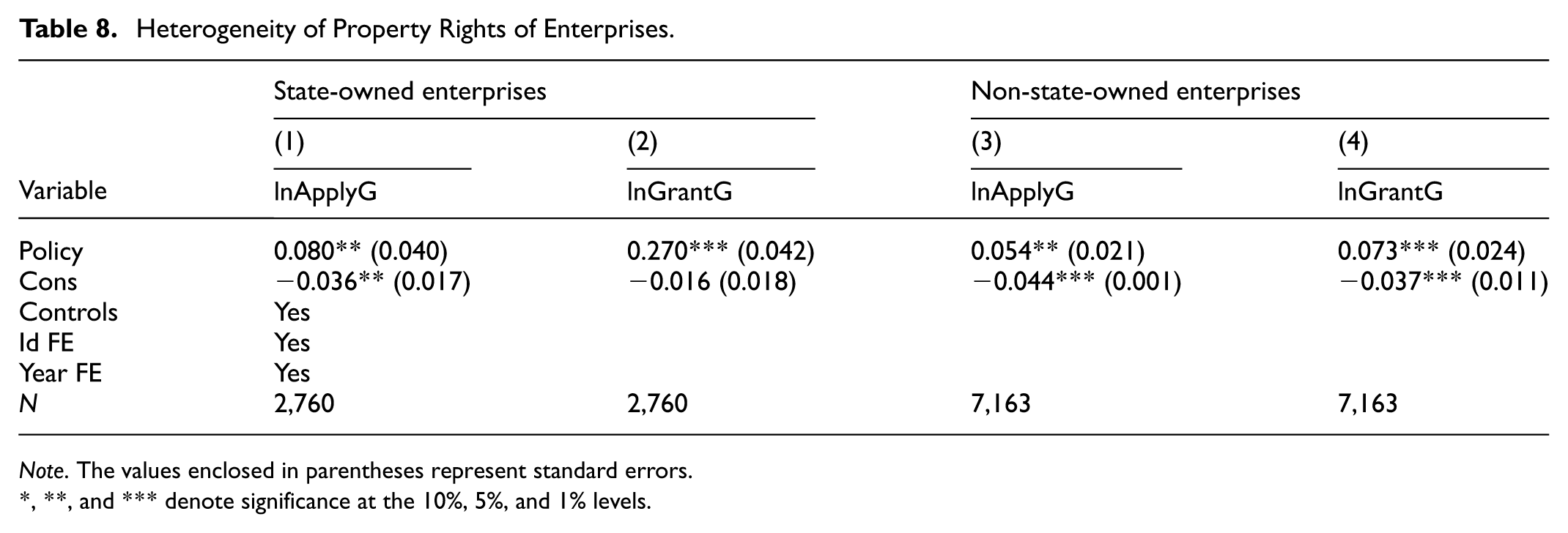
Note. The values enclosed in parentheses represent standard errors.
, **, and *** denote significance at the 10%, 5%, and 1% levels.
Heterogeneity of Industry Characteristics
This study classifies the entire sample of enterprises into heavy pollution and light pollution industries based on their classification as heavy pollution sectors. Given that industry pollution impacts the policy landscape, market orientation, resource allocation, and other facets, it influences the extent of enterprises’ responses and actual outcomes in green innovation within the framework of sci-tech innovation corridors. Varied industry traits contribute to a divergence in green innovation trajectories and outcomes. Table 9 elucidates that within light pollution industries, the establishment of sci-tech innovation corridors exerts a more pronounced influence on green innovation. This is primarily because these industries typically incur lower environmental governance expenses and encounter less resistance to technological transformation. The sci-tech innovation corridor fosters more effective adoption of clean production technologies and the execution of green management practices among enterprises involved in light pollution. It does so by facilitating technological exchanges, resource sharing, and collaboration along the upstream and downstream segments of the industrial chain. Enterprises in these industries often exhibit a heightened sensitivity to novel technologies. Their eco-friendly production processes predispose them to achieve swift iterations and widespread diffusion of green technological innovations.
Heterogeneity of Industry Characteristics.

Note. The values enclosed in parentheses represent standard errors.
, **, and *** denote significance at the 10%, 5%, and 1% levels.
Additionally, light pollution industries are frequently deeply entwined with high-tech sectors. By capitalizing on the research and development platforms and talent aggregation benefits within the sci-tech innovation corridor, the pace of green technology research and development can be expedited, and its outcomes swiftly translated into productive capacity. This not only enhances the market competitiveness of enterprises but also drives the regional economy’s transformation toward low-carbon and circular paradigms, creating an interaction between economic growth and environmental stewardship.
Heterogeneity of Management Characteristics in Enterprises
This study divides the full sample of enterprises based on whether there are female executives in corporate management. This is because gender differences among corporate management can influence the strategies and effects of enterprises’ green innovation implementation. This occurs within the context of constructing sci-tech innovation corridors, affecting multiple aspects such as the decision-making process, corporate culture, and talent strategies. The results in Table 10 indicate that for enterprises with female executives in management, the impact of constructing sci-tech innovation corridors on green innovation is more pronounced. This indicates that the gender of management can impact policy-making (Bhattacharyya & Rahman, 2020). Since females are generally considered to hold a more positive attitude toward environmental concerns and sustainability issues (S-hang, 2024), integrating this environmental awareness into corporate strategy (Galletta et al., 2022) may encourage the adoption of more environmentally friendly production and business methods. In an innovative environment like the sci-tech innovation corridor, this tendency will be magnified, and enterprises are more inclined to try new technologies and methods to achieve green goals.
Heterogeneity of Management Characteristics.

Note. The values enclosed in parentheses represent standard errors.
, **, and *** denote significance at the 10%, 5%, and 1% levels.
Transmission Mechanism Test
This study further examines the transmission mechanism through which the construction of sci-tech innovation corridors promotes corporate green innovation from the perspectives of capital agglomeration effect, talent agglomeration effect, and industrial agglomeration. The Bootstrap test is used to calculate the effect size of each mediating variable. The results are shown in Table 11.
Transmission Mechanism Test.

Note. The values enclosed in parentheses represent standard errors.
, **, and *** denote significance at the 10%, 5%, and 1% levels.
As a strategic mechanism for cultivating regional collaborative innovation and economic prosperity, the development of innovation corridors has profoundly and positively influenced the agglomeration of corporate capital. According to the regression analysis findings presented in Column (1), as the construction of innovation corridors advances, corporate innovation capital has been successfully amassed. This underscores the effectiveness of policy implementation and establishes a robust material basis for future corporate innovation endeavors. Moreover, in Columns (2) and (3), when the explanatory variables (construction of innovation corridors) are integrated alongside the mediating variables (capital concentration) into the model, the regression analysis indicates that capital concentration not only directly catalyzes corporate green innovation initiatives but also amplifies the impact of innovation corridors on corporate green innovation capabilities. This suggests that capital concentration functions as a conduit, aiding enterprises in surmounting technical stagnation or “low-end lock-in” stemming from resource constraints while pursuing sustainable development.
Columns (4) to (6) present the examination results of the functional pathways underlying the effect of talent agglomeration. Column four specifically provides the regression outcomes of the scientific and innovation corridor on talent agglomeration, revealing a significant positive impact. This indicates that the implementation of the corridor policy facilitates the concentration of skilled professionals. Upon analyzing columns five and six, it becomes evident that incorporating mediating variables not only preserves the corridor’s positive influence on talent agglomeration but also highlights its subsequent positive effect on firms’ green innovation capabilities. This suggests that the effective execution of the corridor policy not only fosters a conducive talent ecosystem but also enhances regional human capital quality. This, in turn, drives firms’ green technological innovation and achieves sustainable development that aligns both economic and environmental objectives.
In Column (7), the policy governing the technology and innovation corridor wields a notably affirmative influence on industrial enterprise clustering. This underscores that the policy efficiently propels the refinement of resource distribution, curtails operational expenses for businesses, augments innovative prowess, and bolsters industrial interaction, thus expediting the congealing and maturation of industrial clusters. Moreover, the findings delineated in Columns (8) and (9) offer a more profound explication of this dynamic, indicating that a conducive industrial milieu is essential not only for corporate evolution but also constitutes a pivotal driver compelling enterprises toward eco-friendly innovation. By fostering industrial clustering, the technology and innovation corridor enables enterprises to share infrastructure and specialized services, thereby reducing the costs of green technology research and implementation. Furthermore, it heightens inter-enterprise competition, spurring them to persistently explore eco-innovative methodologies such as energy efficiency, emission abatement, and resource recycling to secure a competitive edge.
A comparison of the three transmission mechanisms shows that capital agglomeration makes a greater contribution (1.651%, 5.133%), mainly because it plays a role in directly supporting and efficiently allocating resources in green innovation. The R&D of green technologies requires large investments, involves a long cycle, carries high risks, and thus heavily depends on continuous financial support. Sci-tech innovation corridors effectively relieve the financing constraints and enhance the R&D investment and risk-bearing capacity of enterprises by guiding policy-based funds, venture capital, and green finance to gather toward enterprises. At the same time, capital agglomeration improves the efficiency of resource allocation. An active capital market can more accurately identify and support high-quality green innovation projects, accelerating technological breakthroughs and industrialization.
Adjustment Effect Test
The study delves deeper into the moderating influence of the interaction among industry, urban planning, and talent (Integration) on the nexus between the advancement of a sci-tech innovation corridor and the level of corporate green innovation, employing a dual machine learning framework. The regression outcomes, detailed in Table 12, reveal that the interaction term Policy × Integration, which encapsulates the convergence of sci-tech innovation corridor policies with the integration of industry, urban planning, and talent, yields regression coefficients of .191 and .173 for corporate green innovation. Both coefficients are statistically significant at the 1% level, underscoring a positive moderating effect of integrating industry, urban planning, and talent on corporate green innovation, driven by the impetus of the sci-tech innovation corridor. This integration operates by refining resource allocation, catalyzing knowledge dissemination, and elevating skill levels. These efforts effectively invigorate the green innovation potential of enterprises within the corridor and dismantle the “low-end lock-in” quandary induced by technological path dependencies, thus propelling industrial evolution and sustainable progress. The symbiotic relationship between talent and urban development provides a continuous source of innovation momentum for enterprises, thereby reducing the risk of prolonged technological stagnation. Consequently, it is imperative to underscore the strategic significance of integrating industry, urban planning, and talent. This integration ensures its dual role in fostering economic growth and providing robust support and incentives, thereby maximizing its positive impact on nurturing green innovation.
Adjustment Effect Test.

Note. The values enclosed in parentheses represent standard errors.
, **, and *** denote significance at the 10%, 5%, and 1% levels.
Research Conclusion and Implications
The innovation corridor acts as a strategic hub that integrates scientific research, technology development, and industrial incubation. It acts as a robust platform to foster green innovation within enterprises. Using a sample of A-share listed companies in Shanghai and Shenzhen (2010-2022), this study investigates the impact of innovation corridor construction on corporate green innovation. It also explores the underlying mechanisms and the moderating role of industry-city-people integration. The research outcomes reveal the following insights: Firstly, implementing policies related to the innovation corridor construction propels corporate green innovation, a phenomenon driven by the “incentive effects” of capital concentration, talent aggregation, and industrial clustering. Secondly, the positive influence of the innovation corridor on green innovation is more pronounced in state-owned enterprises, industries with low pollution levels, and organizations with female executives in leadership roles. Thirdly, the interaction of industry, city, and talent plays a constructive regulatory role in the relationship between the innovation corridor and corporate green innovation.
This study provides policy recommendations in three key areas.
The government should take the lead in formulating preferential policies to attract capital and talent into the sci-tech innovation corridor. For example, it can optimize the financing environment through measures such as providing tax breaks and setting up special funds to support green technology innovation projects. Meanwhile, to strengthen the agglomeration effects of capital, talent, and industries, the government should implement differentiated support. The local development and reform commission should take the lead in establishing a “special financing channel for green innovation of non-state-owned enterprises” to provide low-interest loans and guarantees. In addition, the government should implement the “Special Zone Program for Green Innovation Talents,” where high-level talents will get a 50% tax refund on personal income tax in the first 3 years, with priority given to housing and children’s education. The green financing coverage rate and patent conversion rate of non-state-owned enterprises should be included in the assessment of local governments. This will improve the precision and effectiveness of policies, thereby enhancing the attractiveness of the science-and-technology innovation corridor to diverse entities.
Given the relatively weak policy effects among non-state-owned enterprises, high-pollution industries, and enterprises without female management, targeted reinforcement measures are needed. First, to motivate green transformation in high-pollution industries, the environmental protection department should establish a “Support Program for Green Technology Breakthroughs in High-Pollution Industries.” Select leading enterprises in industries such as steel, chemical, and cement, and provide special funds for environmental technology transformation subsidies. The subsidy amount should be directly linked to the output of green patents, and enterprises should be required to formulate a 3-year emission reduction roadmap. The completion rate of emission reduction targets should be included in the environmental protection credit rating. Second, to increase the participation of non-state-owned enterprises, promote the establishment of “green innovation consortia” between state-owned and private enterprises. Reward technology-outputting parties according to their technology transfer income to promote knowledge spillover. Finally, to promote the positive effect of “female management enhancing green innovation,” it is recommended that the State-owned Assets Supervision and Administration Commission and the Federation of Industry and Commerce jointly issue the “Green Governance Guidelines.” Enterprises are encouraged to establish a ‘Chief Sustainability Officer’ position within the board or senior management, and female candidates should be given priority. Enterprises with a female executive ratio of over 30% should receive extra points when applying for science and technology projects, and this ratio should be a key indicator for the enterprise’s ESG rating.
Academic institutions should strengthen collaboration with enterprises by building comprehensive industry-university-research partnerships to furnish technical support and services to enterprises operating within the innovation corridor. This is especially pivotal during the R&D phase of green technology, where academic institutions can offer avant-garde technical advisement and experimental apparatus-sharing services. They should actively participate in corporate R&D to help overcome technical challenges and accelerate the commercialization of scientific breakthroughs. Moreover, harmonizing the industry, urban fabric, and human ecology within the region by crafting habitable and business-conducive urban landscapes is indispensable to attract high-caliber talent and create a propitious living and working environment. This will erect a sturdy human capital edifice to sustain the ongoing development of green innovation.
Although this paper reveals the positive impact and mechanisms of science and technology innovation corridors on corporate green innovation, certain limitations still exist: Firstly, it relies on data from listed companies, neglecting the innovation behaviors of small and medium-sized enterprises and non-listed entities. Secondly, the identification of policy effects depends on macro-level quasi-natural experimental designs, making it difficult to completely exclude the interference of other simultaneous policies or external shocks. Future research could incorporate enterprise micro-behavioral data or conduct cross-regional comparisons to further validate the robustness and generalizability of the role of science and technology innovation corridors. Overall, this study provides valuable evidence for understanding how regional innovation platforms can promote green transformation and lays the foundation for subsequent exploration of policy synergy and institutional optimization.
Footnotes

Author Contributions
All authors contributed to the study conception and design.
Funding
The authors disclosed receipt of the following financial support for the research, authorship, and/or publication of this article: This work was financially supported by Northwest Minzu University Talent Introduction Scientific Research Project: Research on the Impact of Technological Progress Paths on Urban Pollution Reduction and Carbon Emission Reduction (No. xbmuyjrc202507).
Declaration of Conflicting Interests
The authors declared no potential conflicts of interest with respect to the research, authorship, and/or publication of this article.
Data Availability Statement
The datasets used or analyzed during the current study are available from the corresponding author upon reasonable request.
Declaration of Artificial Intelligence Applications
This manuscript does not involve the use of artificial intelligence.