




Abstract
Wellness tourism has grown popular and augmented the global market due to increasing healthy lifestyles. Based on the expectancy disconfirmation theory, the study aims to determine the antecedents and significance of tourists’ revisit intention for wellness tourism. A quantitative method has been adopted. Data was collected from 361 tourists at wellness centres in Malaysia, and structural equation modelling was used to analyze the measurement and structural model. The majority of respondents are female, aged between 21 and 30, unmarried, with an average monthly income of USD 2,000. The study found that tourists’ satisfaction was influenced by perceived value from social and emotional perspectives, while their experience was shaped by their emotional and quality perception of value content. Rewards had a significant impact on both satisfaction and travel experience. Tourists were more likely to recommend a wellness vacation if they were satisfied, but it was their unique travel experience that triggered revisit intention. E-word-of-mouth played a mediating role and revealed a positive relationship between satisfaction, revisit intention, and word-of-mouth. This study demonstrated the importance of determining the underlying factors to create tourists’ revisit intention. The implications from theoretical and managerial viewpoints provide insights to scholars and practitioners to revitalize the tourism industry after COVID-19.
Plain language summary
Wellness tourism has gained popularity and expanded in the global market due to the increasing adoption of healthy lifestyles. This study aims to explore the antecedents and significance of tourists’ intention to revisit wellness tourism destinations. Data were collected from 361 tourists at wellness centers in Malaysia. The majority of respondents were female, aged between 21 and 30, unmarried, with an average monthly income of USD 2,000. The study revealed that tourists’ satisfaction was influenced by perceived value from social and emotional perspectives. Additionally, their overall experience was shaped by their emotional response and the perceived quality of value content. Rewards were found to have a significant impact on both satisfaction and travel experience. Tourists were more likely to recommend a wellness vacation if they were satisfied, but it was their unique travel experience that triggered the intention to revisit. Furthermore, electronic word-of-mouth played a mediating role, highlighting a positive relationship between satisfaction, revisit intention, and word-of-mouth. This study underscores the importance of identifying underlying factors to foster tourists’ intention to revisit. The implications from theoretical and managerial perspectives provide valuable insights for scholars and practitioners seeking to revitalize the tourism industry post-COVID-19.
Keywords
Introduction
Tourism is crucial to the country’s service economy, increasing foreign exchange earnings, creating job opportunities, increasing funds, and attracting investments (Comerio & Strozzi, 2019). Among others, wellness tourism has grown in popularity and is augmenting the global market due to increasing interest in healthy lifestyles (Dillette et al., 2021). The term “wellness” has entered a new norm associated with anything that can make somebody feel great or comfortable (Steiner & Reisinger, 2006). A wellness lifestyle is allied with a specific state of well-being, integrating the harmony of body, mind, and spirit (Damijanić, 2019). People’s awareness of the importance of “wellness” in their lives has recently increased (Backman et al., 2022; Marsh et al., 2023). Amidst the COVID-19 pandemic, the highly indeterminate environmental situations, such as epidemics, economic instability, and political uncertainty, have resulted in changes in marketing approaches for a country such as Malaysia (Balasubramanian & Hanafiah, 2022). Numerous tourism providers implement aggressive marketing tactics to lure more visitors and boost their revenue (Izzah Zailani et al., 2023). While scholars have identified the impact of e-WOM on wellness tourism during the COVID-19 period (Goyal & Taneja, 2023), other studies have recognized the wellness trends, healthy and peaceful lifestyles perspective (Choudhary Qadir, 2021; Sivanandamoorthy, 2021). Some argue that tourism has been resilient to external shocks, as there is enough evidence that the impact and recovery from the COVID-19 pandemic will be unprecedented (Okafor et al., 2022; Wieczorek-Kosmala, 2022). When circumstances dictate, tourism providers are swarming to develop other opportunities to capitalize on growth in the leisure industry. The categories of wellness tourism include healthcare and healthy eating, spa and beauty, mind-body, spiritual and connection, eco and adventure, and fitness and personal growth activities include yoga, hiking, gym, and massage (Dini & Pencarelli, 2022). Tourists who focus on well-being are usually proactive in searching for tour packages to enhance their personal quality of life, focusing on illness prevention (Luo et al., 2018; Yang et al., 2023).
Many social circumstances have triggered the future expansion of interest in wellness tourism. For instance, changes in demographic structures (such as the aging of the population), the need for stress reduction among the working population, an expanding desire to live longer and better (through healthy lifestyles), a concern with health paradigms toward prevention and alternative ways of healing, and an alternative look for new distinctive recreation, as well as other tailored forms of wellness travel (Smith, 2022). Wellness tourists are attracted by wellness therapy’s affordable and reasonable prices (Xie et al., 2022). Most hotels or resorts offer a wide selection of high-end, branded destination spas, standard-style spas, and fitness facilities. Wellness tourism is forecast to continue growing annually over the next few years, reaching $919 billion in times to come (Global Wellness Institute, 2018).
While the tourism industry strives to strike a balance to cope with the COVID-19 crisis, wellness tourism operators also face intense competition to enrich the value of their wellness services and expect rewards (Casado-Aranda et al., 2021). Many have attempted to adjust with recovery measures, including arrangements to comply with travel boundaries and rethinking strategies to restore tourists’ confidence (Rivera et al., 2022). It includes a future-oriented market alteration, demand for creativity, and a comprehensive approach to gaining a competitive advantage. While the pandemic has been stressful for many, there is no doubt that the demand for wellness travel will soar. Tourists are more selective in choosing wellness services regarding comfort, relaxation, satisfaction, and enjoyable experiences (Y. Li et al., 2023). Researchers have found that vacations can reduce the risk of anxiety and boost overall life satisfaction and travel experiences (Y. Chen & Li, 2018; Kwon & Lee, 2020). Simultaneously, spiritual benefits could improve tourists’ quality of life.
In order to succeed in wellness tourism development, it is crucial to understand the factors that attract tourists to pay for wellness visits. Tourists continually seek enjoyment with a comfortable and healthy lifestyle; however, it is tough for tour operators to maintain revenues by continuously seeking new customers. Consequently, it is essential to comprehend strategies to keep existing tourists dependent on wellness services and remain loyal (Dillette et al., 2021). Thus, the research questions for the study are whether tourists’ intention to revisit wellness tourism destinations will be influenced by satisfaction, experience, and word-of-mouth (WOM). Specifically, we intend to examine the mediating effect of e-Word of mouth (e-WOM) on the relationship between experience and revisit intention as well as between satisfaction and revisit intention. Apart from this, we aim to investigate how perceived value and rewards influence both the overall experience and satisfaction. The study’s results can help bridge the research gap and provide practical insights to boost the demand for wellness tourism.
The research will take place at wellness centres situated in Malaysia. Malaysia is featured on the list of the top 15 most-visited destinations by the United Nations World Tourism Organization (World Trade Organization, 2019). The country is also listed as one of the top 10 wellness tourism markets in the Asia Pacific region (Sopha et al., 2019). Tourist expenditures are RM20.5 billion, with 8.3 million trips and a growing trend for wellness vacations and packages.
Underpinning Theories
The theoretical framework of wellness tourism comprises the connections between tourists’ distinct experiences with wellness and the motivational factors that influence destination choice. Specifically, the expectancy-disconfirmation theory has received the widest acceptance as it applies to the notion. The expectancy disconfirmation process is derived from two processes: the development of expectations of the experience and the disconfirmation judgment when individuals compare their experience against their expectations. Along with consumption values theory, it explains individuals’ purchasing preferences, where individuals with different values that comprise the perceived value dimensions, such as price, quality, social and emotional, affect their behaviors and preferences. These values can be crucial motives in purchasing decisions. In addition, the expectancy theory is a model of motivation that falls under the umbrella of loyalty psychology (Zeithaml et al., 1996). In the tourism industry, tourists are considered loyal if they regularly purchase a product or service within a specific time period. This is often determined by how frequently individuals visit a particular destination or attraction, which includes their intention to revisit.
Based on the above discussion and theoretical approaches, it is undeniable that providing the highest level of satisfaction in wellness services is complicated, and meeting tourist requirements is demanding. While it is challenging to maintain revenues by continuously seeking new customers, it is crucial to attract tourists to revisit the same destinations. Therefore, investigating the factors that influence tourists’ choices, preferences, and reasons for revisiting a destination is essential.
Perceived Value, Satisfaction and Experience
Perceived value has been widely studied and discussed in marketing research (S.-C. Chen & Lin, 2019) and hospitality and tourism research (Chang et al., 2014; Jeong & Kim, 2020; Seow et al., 2017). It is defined as “a consumer’s overall assessment of the utility of a product (or service) based on perceptions of what was received” (Zeithaml, 1988, p. 10). From a marketing point of view, it is called customer value, which serves as “the fundamental basis for marketing activity” (Holbrook, 1994, p. 22). It involves a trade-off between benefits received and sacrifices made to consume products or services (Jeong & Kim, 2020; Lovelock, 2001).
Past studies have empirically tested that perceived value is positively related to satisfaction and experience in different tourism contexts, such as cultural tourism (H. Lee et al., 2019; Song et al., 2015), creative tourism (Chang et al., 2014), sports tourism (Jeong & Kim, 2020), nature-based tourism (M. Kim & Thapa, 2018), theme parks (Jin et al., 2015), responsible tourism (Um & Yoon, 2021), and halal tourism (Isa et al., 2018). Satisfaction can be defined as the extent to which an individual believes an experience gives rise to positive feelings (Rust & Oliver, 1994). Customers are more likely to be satisfied with a product or service when their perceived benefits outweigh the cost, effort, and time they invested into the purchase (S.-C. Chen & Lin, 2019). On the other hand, if a product or service fails to meet their expectations, it can lead to dissatisfaction and discourage them from making future purchases (M. Kim & Thapa, 2018). When it comes to wellness tourism, tourists consider both the benefits and drawbacks of expenses and expected results. Therefore, the perceived value represents the tourists’ consideration of how much their tourism experience will positively impact their mental and physical health. If tourists perceive greater value in any wellness tourism activity that enhances or maintains their well-being, it will lead to a higher level of satisfaction.
Experience is “an event that engages oneself in a personal way” (Pine & Gilmore, 1999, p. 12). Specifically, in the context of tourism, a tourist’s experience during their trip to their preferred tourist destination is very crucial. It reflects how much a tourist agrees with achieving physical and mental health benefits from wellness tourism experiences. If tourists perceive that the benefits of their visit outweigh the costs of activities such as visiting, seeing, learning, and enjoying, they are more likely to have a positive experience (M. Kim & Thapa, 2018). Thus, this study proposes the following hypotheses:
H1: Perceived value is positively related to satisfaction.
H1a-d: (a) Social, (b) emotional, (c) quality, and (d) price are positively related to satisfaction.
H2: Perceived value is positively related to experience.
H2a-d: (a) Social, (b) emotional, (c) quality, and (d) price are positively related to experience.
Rewards, Satisfaction and Experience
Rewards are among the most effective ways to motivate humans to engage in the desired behavior (Rigby & Ryan, 2018). To date, much of the current work has focused on employees in the context of tourism, where it has been affirmed that rewards are significantly and positively related to employee satisfaction and enhance their experience (Koo et al., 2020; Murray, 2021; Norbu & Wetprasit, 2021). For instance, rewards are used as motivational tools to enhance hotel employees’ job satisfaction and performance (Norbu & Wetprasit, 2021). Despite these excellent research outcomes, there needs to be more research examining the relationship between rewards and satisfaction, and experiences in the context of wellness tourism. Similarly, gaining rewards could strengthen consumer satisfaction after experiencing a product or service (Chung & Lee, 2016; Krisna et al., 2019).
In the context of wellness tourism, the rewards include providing tourists with a sense of comfort, meeting interesting people, enjoying a calm atmosphere, and taking leisure time. Deci and Ryan (2012) indicated that rewards could reinforce one’s behavior and action for a desirable outcome. Seow et al (2017) further argued that perceived rewards could prompt tourists’ behavioral intention for medical tourism. Obtaining rewards from gamified activities will significantly increase tourists’ satisfaction in the maze park and their psychological experiences, such as fun, flow, enjoyment, and satisfaction (Y.-N. Kim et al., 2021). Conversely, tourists who do not perceive any rewards from the subscribed wellness program are likely to be dissatisfied with the wellness tourism package as well as leading to a poor overall experience. For instance, tourists are likely to have unpleasant experiences and low satisfaction during the services if they do not receive adequate physical rest, lack a sense of comfort, and are in an environment without a positive atmosphere.
Thus, the following hypotheses are proposed.
H3: Rewards are positively related to satisfaction.
H4: Rewards are positively related to experience.
Satisfaction, Experience, e-Word of Mouth, and Revisit Intention
The term “word of mouth” (WOM) has been empirically researched in the past decade in the context of tourism and marketing research (Cho et al., 2014; J.-Y. Kim & Hwang, 2022; Lai & Hitchcock, 2020; Lai et al., 2021; Setiawan et al., 2021) and treated as one of the essential tools to understand tourists’ behavioral intentions (Setiawan et al., 2021). Verbal and interpersonal communication refers to a product, service, or brand that occurs between a communicator and a receiver" (Lai & Hitchcock, 2020, p. 613). With the evolution of technology, WOM has since evolved into e-WOM or electronic word of mouth, where tourists now freely and conveniently share their experiences on social media platforms (Farrukh et al., 2022). It can be defined as “communication that may contain positive or negative statements by actual, former, or potential customers about a service, product, or destination and is made available to a broader audience with the help of the internet” (Farrukh et al., 2022, p. 2).
Past studies have empirically affirmed that satisfaction and experience positively relate to e-WOM among tourists (J.-Y. Kim & Hwang, 2022; Kotoua & Ilkan, 2017; Setiawan et al., 2021). Most customers or tourists share their satisfaction and dissatisfaction experiences on their social media platforms (Turki et al., 2017). Suppose tourists have a favorable or unfavorable experience during their visit. In that case, they tend to speak out through e-WOM by recommending or not recommending others, including their relatives, friends, and colleagues, to visit the same tourism destination or revisit it (Wang et al., 2017). A recent study conducted in the context of cuisine tourism by Lai and his colleagues posited that tourists who have a great cuisine experience and are satisfied with the cuisine served by restaurants would have a positive e-WOM generation intention (Lai et al., 2021). In contrast, tourists who have an unpleasant tour which resulted in low satisfaction and poor experiences will be unlikely to share, amplifying the likelihood of positive e-WOM. These tourists are less likely to influence their peers and may be reluctant to participate in online reviews and ratings. Therefore, this study proposes the following hypotheses:
H5: Satisfaction is positively related to e-word of mouth.
H6: Experience is positively related to e-word of mouth.
Similarly, tourists’ satisfaction and experiences from their previous visits will influence their intention to revisit the same destinations (Cho et al., 2014; H. Lee et al., 2019; H. Li et al., 2021; Teng, 2021). Revisit intention can be defined as a tourist’s intention to revisit the destination for wellness tourism after they have experienced the activities on their previous visit (H. Li et al., 2021). Exploring tourists’ revisit intention is one of the main focuses of tourism research (Chang et al., 2014). Most health/wellness/medical research studies have focused on tourists’ visit behavioral intention (Seow et al., 2018; Seow et al., 2021; Seow, Choong, Chen, et al., 2022; Seow, Choong, Choong, et al., 2022), with limited research on revisit intention for wellness tourism. H. Li et al. (2021) revealed that tourists who were satisfied with their previous visits and had a positive experience are likelier to revisit the same tourist destination. On the other hand, tourists who have had an unpleasant tour will create lasting negative memories, further discouraging them from considering a return to the same destination. Likewise, low satisfaction erodes trust in the destination or service, making it less likely that they will revisit for a similar wellness program. Thus, the following hypotheses are proposed:
H7: Satisfaction is positively related to revisit intention.
H8: Experience is positively related to revisit intention.
Both e-WOM and revisit intention are interrelated (Rasoolimanesh et al., 2021). One of the top reasons that tourists intend to revisit the same destination for tourism is through e-WOM (Kanwel et al., 2019; Sharipudin et al., 2023). Tourists recommend and encourage others, including their friends, colleagues, relatives, or companions, to revisit the same tourist attraction by sharing their good visit experiences of specific destinations (Harahap & Dwita, 2020). Positive e-WOM is more likely to stimulate tourists to revisit a place, whereas negative e-WOM will reduce the intention to revisit a place. A positive e-WOM is usually arises from a memorable and enjoyable tour experience. Not only do individuals share their positive experiences with others, but the positive emotions associated with those experiences also motivate them to consider revisiting the same destination for a similar wellness program. Thus, the following hypothesis is proposed:
H9: E-word of mouth is positively related to revisit intention.
Mediating Effect of e-Word of Mouth
Tourists’ travel intentions, revisit intentions, and decision-making processes are influenced by satisfaction (H. Lee et al., 2019; H. Li et al., 2021), experiences (H. Lee et al., 2019; Teng, 2021), and e-WOM (Kanwel et al., 2019; Sharipudin et al., 2023). As discussed earlier, tourists who are satisfied and have positive experiences during their first or previous visit to a destination are likely to share their good experiences with their friends, companions, colleagues, and relatives (J.-Y. Kim & Hwang, 2022; Kotoua & Ilkan, 2017; Setiawan et al., 2021). Additionally, tourists’ satisfaction and experiences can drive them to revisit the same destination in the future (H. Lee et al., 2019; H. Li et al., 2021). Hence, we also speculate and propose that e-WOM will play a role as a mediator in the satisfaction-revisit intention relationship and the experience-revisit intention relationship.
We posit that tourists who find satisfaction in a wellness program or tour may not be immediately inclined to revisit the same destination. However, if they observe other tourists expressing satisfaction with the wellness program and sharing their positive experiences online, it has the potential to amplify their intention to revisit the destination for wellness tourism. In essence, the likelihood of travellers or wellness tourists returning to the same destination for wellness experiences is increased when they not only personally gain satisfaction but also witness and engage with positive e-WOM from others. Conversely, even tourists with positive past experiences may not be motivated to revisit the destination for wellness tourism if they come across negative comments or complaints about the place, underscoring the influential role of e-WOM in shaping travel decisions. Thus, the following mediating hypotheses are proposed.
H10: E-word of mouth significantly mediates the relationship between satisfaction and revisit intention.
H11: E-word of mouth significantly mediates the relationship between experience and revisit intention.
The Research Model
Based on the aforementioned, this study proposes a research framework illustrated in Figure 1. The framework suggests that perceived value attributes and rewards are the antecedents of satisfaction and experience. Additionally, the study proposes that e-WOM mediates the relationship between satisfaction, experience, and revisit intention.

Proposed research model.
Research Methodology
Sample and Procedure
Since this study is more objective in nature where observed variables were identified with a proposed research model and well formulated hypotheses, thus a quantitative method was utilized by inviting international tourists at wellness centres in Malaysia to participate in the survey. Cross-sectional approach was adopted by collecting data at a single point in time. It helps to minimize the issue of drop-out response rate (J. Hair et al., 2019). It’s also due to the nature of study where the target respondents are international tourists which not easily approached to participate in the survey for multiple times.
A self-administered survey was used to collect data from respondents within 2 months. Cole (2005) found and suggest that survey method is more appropriate and should be used for tourism-related study as it resulted in better response rate, data quality and internal consistency of scales. Four research assistants were recruited and trained to conduct the fieldwork. Prior to the fieldwork, ethical clearance was approved by the research institute. Permission to survey wellness centre premises was obtained from the management of the respective wellness centres. To ensure that we able to measure the constructs more accurately, a purposive sampling technique was used to select respondent. This is to ensure only international tourists who have visited Malaysia before to take part in the survey.
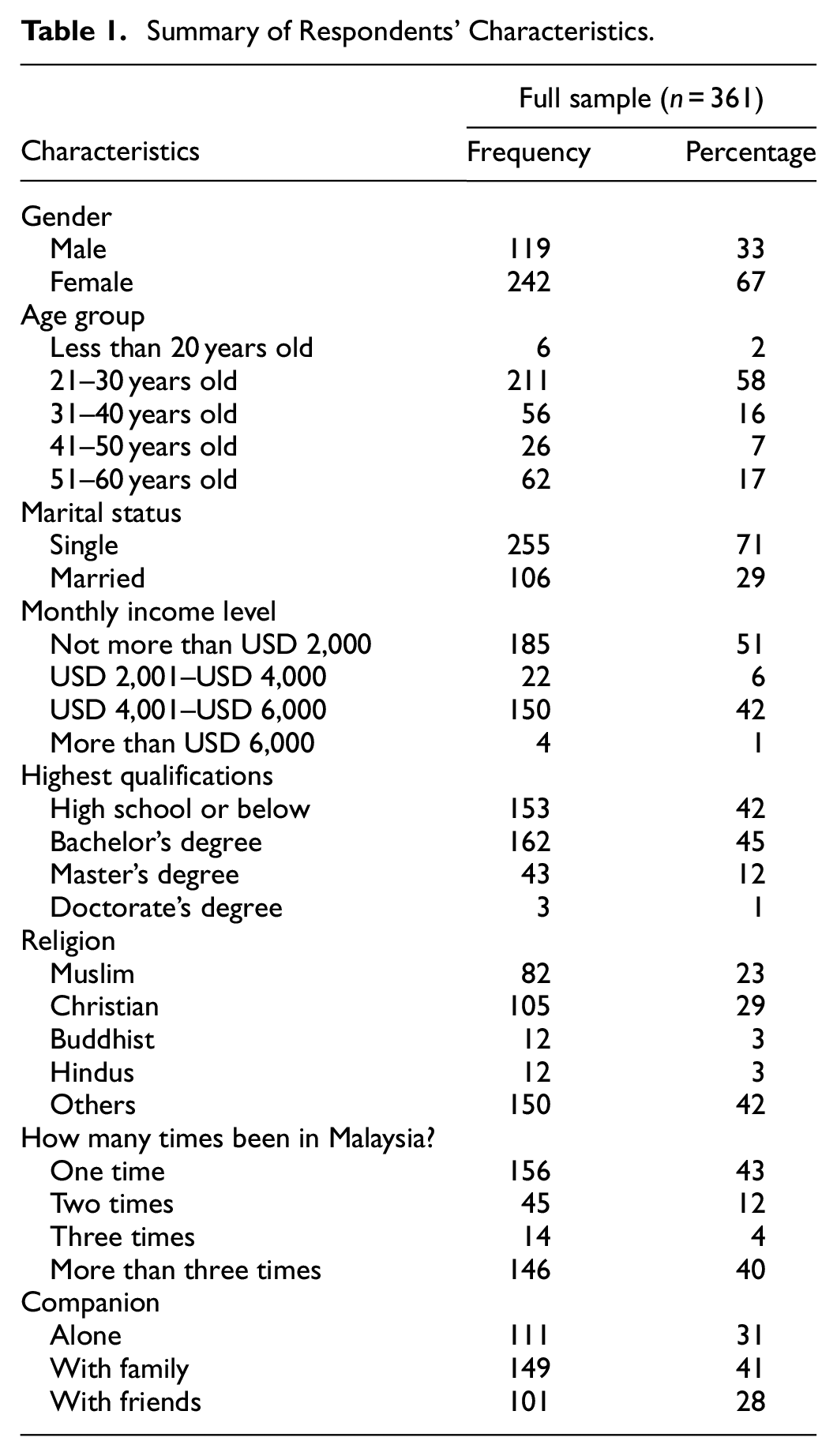
Wellness centre employees assisted research assistants in approaching and identifying clients who were international tourists to participate in the survey. A total of 361 respondents agreed to participate by filling up the survey. Table 1 shows the details of the respondents’ profiles.
Summary of Respondents’ Characteristics.
Research Instruments
The measurement scales were adopted from past studies on a 5-point Likert scale, with one indicating “strongly disagree” and five indicating “strongly agree.” All items were pre-tested by three professors and three international tourists on the relevancy of the items in this study context. After that, a pilot test was conducted to ensure the adopted measurement items had adequate inter-item reliability. We measured behavioral intention with five items developed by Jin et al. (2015) and Sharma and Nayak (2019). For e-WOM, it was measured by Doosti et al.’s (2016) five-item scale. A 5-item scale by J.-H. Kim et al. (2010) was adapted to measure experiences, whereas satisfaction was measured by five-item scale from Jin et al. (2015) and Song et al. (2015). The measurement items for perceived value were taken from Jin et al. (2015) and Song et al. (2015). For reward, it was measured by the 5-item scale from Pesonen and Komppula (2010).
Data Analysis
The partial least squares technique (PLS) was selected to analyze the proposed relationships using SmartPLS 3.2.9. The PLS was chosen because it corresponds well to the predictive nature of this research, which aims to investigate how well endogenous constructs can be predicted by exogenous constructs (J. F. Hair et al., 2019). Since the survey data usually are not normally distributed, this technique does not require assumptions on the multivariate normality of the data. It is an appropriate method to deal with this condition (Hair et al., 2017).
The Webpower website was utilized to evaluate the multivariate normality of the data (Cain et al., 2017). According to the results obtained from this online tool, the collected data in the current study were not normal since the p-values of Mardia’s multivariate skewness and kurtosis were below 0.01. Thus, PLS is an appropriate method for data analysis for the current study due to its flexibility in normality assumptions. Based on Anderson and Gerbing’s (1998) suggestions, this study followed a two-step approach in which the validity and reliability of the instruments will be evaluated, followed by testing the proposed hypotheses.
Since present research data were obtained from a single source, Common Method Bias (CMB) is a severe data issue. To evaluate CMB, the current research followed Kock’s (2015, 2017) suggestions to examine the full collinearity by creating a dummy variable as dependent variable. As shown in Table 2, the variance inflation factor (VIF) for all constructs involved in this research is less than 3.3, specifying that single source data in this research is not problematic.
Full Collinearity Analysis.

Note. SV = social value; EV = emotional value; QV = quality value; PV = price value; REW = rewards; SAT = satisfaction; EXP = experience; EWOM = E-word of mouth; RI = revisit intention.
Results
Assessment of Measurement Model
In order to assess the measurement model, we conducted confirmatory composite reliability as recommended by Hair et al. (2020) which consists of seven steps. In the first step, we tested the indicator’s loadings and its significance. Table 3 reveals that most of the item’s loadings were well above the minimum threshold of 0.708. Considering that the factor loadings between 0.5 and 0.7 can be retained if AVE and CR values of the related constructs exceed the recommended values (J. F. Hair et al., 2019), the item (Experience 5) with a loading of 0.551 was retained in the analysis. Whereas the significance of the path (indicator with construct), all were shown statistically significant at the level of 0.001.
Measurement Model Evaluation.

Note. IR = indicator reliability; CR = composite reliability; AVE = average variance extracted.
Significant at 0.001.
For Step 2 and 3, we evaluated the indicator reliability and composite reliability using factor loading by considering an acceptable value of 0.7. As shown in Table 3, the indicator loadings for all items and composite reliability for all constructs were surpassed the minimum cutoff value of 0.7. Thereby, it was considered to evaluate the internal consistency reliability (Hair et al., 2020). In step 4, we examined the average variance extracted (AVE) and maintaining the cut-off value of 0.5. All the construct’s AVE are higher than the acceptable value of 0.5 (J. F. Hair et al., 2019). Thus, the convergent validity of the measurement model is well ascertained.
For step 5, the heterotrait-monotrait ratio (HTMT) was assessed to evaluate the discriminant validity (Henseler et al., 2015). The results showed that constructs HTMT ranged from 0.143 to 0.839 and were less than 0.85 (Table 4); thus, the criterion for the discriminant validity of variables under study was met (Kline, 2016).
Hetrotrait-Monotrait Ratio (HTMT.85).

Note: EWOM = E-word of mouth; EV = emotional value; EXP = experience; PV = price value; QV = quality value; RI = revisit intention; REW = rewards; SAT = satisfaction; SV = social value.
In step 6, we conducted the inter-correlational analysis by including several control variables such as gender, age group, and income level. Table 5 illustrates that most of the correlation score are significant at the level of .001 or .05.
Intercorrelation Analysis.

Note. * = significance level of 0.05; ** = significance level of 0.001.
For step 7, the Measurement Invariance Assessment (MICOM) was performed through permutation multigroup analysis. We found that there is significance difference in term of variance for social value, quality value, satisfaction, and revisit intention. Thus, this concludes a partial measurement invariance (Henseler et al., 2016). Cheah et al. (2020) indicated that MICOM is required to be tested and important when you intend to make valid and meaningful comparisons across different groups or conditions. Thereby, given that this study does not involve the comparison of two distinct groups, partial measurement invariance is deemed acceptable.
Structural Model Evaluation
The model accuracy was evaluated using the explained variance proportion, and the R2 values of satisfaction, experience, e-WOM, and revisit intention were 0.137, 0.244, 0.036, and 0.366, respectively. Next, the Stone-Geisser Q2 values of the construct were assessed to evaluate the model’s predictive relevancy. The Q2 values of satisfaction (0.080), experience (0.098), e-WOM (0.021), and revisit intention (0.250) were above zero, denoting the model is in high predictive relevancy.
The study also used a non-parametric bootstrapping technique with 5,000 replications to assess the proposed hypotheses (J. F. Hair et al., 2019). Based on the results (see Table 6), social value has a negative influence on satisfaction (β = −.118; p < .05), and emotional values have a positive effect on satisfaction (β = .168; p < .05), while quality (β = .059; p > .05) and price values (β = −.135; p > .05) did not affect satisfaction (see Table 5). The findings supported the positive effects of emotional (β = .213; p < .01) and quality values (β = .211; p < .01) on experience. However, the impacts of social (β = 0.101; p > 0.05) and price values (β = −.070; p > .05) on experience were not supported. The positive effects of rewards on satisfaction (β = .274; p < .01) and experience (β = .158; p < .05) were supported. Furthermore, satisfaction (β = 0.196; p < .01) is positively related to the e-WOM, but experience (β = −.012; p > .05) is not a significant predictor of e-WOM. The results also revealed that experience (β = .107; p < .05) and e-WOM (β = .590; p < .01) are supported in having a positive influence on revisit intention. Contrary to our prediction, satisfaction (β = −.025; p > .05) was not found to have a significant relationship with revisit intention.
Hypotheses Testing.

p < .05. **p < .01.
Regarding the mediating hypotheses, the results specify that satisfaction (β = .116; p < .01) indirectly affects revisit intention via e-WOM. It indicated that the e-WOM mediated the relationship between satisfaction and revisit intention. However, experience (β = −.007; p > .05) did not indirectly affect revisit intention through e-WOM.
Discussion
Despite its significance in the tourism industry, there needs to be more research on wellness tourism in the existing literature. The current study successfully contributed to the growing body of knowledge in wellness tourism. In particular, by integrating expectancy-disconfirmation theory and consumption values theory, the present research unearthed the intricate relationships among dimensions of perceived value, rewards, satisfaction, and experience and discovered the possible influence of such associations on wellness tourist revisit intentions by considering e-WOM as a mediator. The study’s findings are detailed below.
Our study’s findings confirmed that social and emotional values are positively related to satisfaction, which is consistent with prior studies (e.g., Moharana & Pradhan, 2019; Rasoolimanesh et al., 2022). The findings provide conclusive evidence that tourists’ emotional value affects how they perceive their feelings, affecting how satisfied they are. Since wellness services are hedonic and connected to the tourists’ emotional responses, thus wellness service providers need to pay more attention to creating a positive emotional bond with tourists. Regarding the positive association between social value and satisfaction, wellness tourists feel more satisfied due to their self-identity and interaction with other tourists who enjoy receiving wellness-related services. In contrast to our suggestion, the finding needed to verify the antecedent role of quality and price value in shaping tourists’ satisfaction.
Moreover, the influence of price value on tourists’ satisfaction and their experience of using wellness-related services was not significant. These results can be justified particularly in the context of wellness tourism, where tourists are less concerned about the service’s price (economic value) as they care about having healthier lifestyles. Although our findings contradicted with several past studies such M. Kim and Thapa (2018) and H. Lee et al. (2019), it is in line with the findings of a study conducted by Soonsan and Somkai (2022). Their results did not support the relationship between social value and experience. Since some wellness services will be offered privately and are not publicly visible, perceived social value is not a significant factor for wellness tourists to affect their experience. Another possible reason is that wellness tourism is often motivated by the desire for unique and enriching experiences rather than being solely influenced by the cost of services and programs.
The effects of emotional and quality value on tourists’ experience were supported following prior research (M. Kim & Thapa, 2018). If tourists feel that wellness services are enjoyable, these positive emotions influence their experience of visiting a specific destination, ultimately affecting their intent to revisit it. Conversely, if tourists received a poor services, it will lead to low satisfaction and subsequently result in an unpleasant experience.
Concerning the significant association between quality and tourists’ experience, the finding suggests that if tourists’ expectations regarding the quality of the service are fulfilled, this results in an excellent experience. As mentioned, tourists in this niche place a significant emphasis on the quality of the program and how they will benefit from it. They prioritize the overall experience and the potential positive impact on their well-being instead of focusing on cost factor.
The findings also uncovered the significant effect of rewards on satisfaction and experience. These findings are in line with past studies includes Chung and Lee (2016), Y.-N. Kim et al. (2021), and Krisna et al. (2019). External factors often encourage individuals to perform a particular behavior. One of the most potent external factors that might motivate someone to engage in a particular behavior is the prospect of rewards (M. Kim & Thapa, 2018). In the context of this study, when tourists visit a destination for wellness-related purposes, they can be rewarded by enjoying a calm atmosphere and taking leisure time. Hence, these rewards can encourage tourists to visit a destination for a better traveling experience and satisfaction.
Following prior research (Lai et al., 2021), our findings verify the influence of satisfaction on e-WOM. However, the results did not support the effect of experience on e-WOM which contradicted with H. Li et al. (2021). Tourists’ satisfaction with a specific destination might have a crucial effect on their intention to create an e-WOM since it happens quickly during their journey. However, their experience cannot encourage them to generate e-WOM. The findings showed that e-WOM and tourists’ experience improved their intention to revisit the destination following prior research (H. Li et al., 2021). These results indicate that tourists’ own experience of a specific visited destination and others’ experiences shared/recommended/suggested online have a combined effect on encouraging tourists to revisit a destination. In short, a tourist with a great experience often contribute to satisfaction, but it does not necessarily guarantee that they will engage in e-WOM. Additionally, tourists who perceived a great satisfaction are more incline to actively engage in e-WOM.
Surprisingly, and in contradiction with our suggestion, it was found that satisfaction is not playing an influential role in tourists’ revisit intention, which is inconsistent with prior studies (Rasoolimanesh et al., 2020). This result supports the idea that satisfaction has an indirect impact on the revisit intention of tourists via e-WOM, which is empirically supported by our findings regarding the mediating role of e-WOM on the relationship between satisfaction and revisit intention. It implies that satisfied tourists are strongly encouraged to spread and disseminate their favorable experiences through e-WOM, which, in turn, encourages other tourists to revisit the destination. However, the indirect influence of experience on revisit intention via e-WOM was not supported. This suggests that tourists who have had a fulfilling experience after participating in a wellness program may not automatically share their positive feedback electronically but are more likely to consider returning to the same destination for similar services.
Theoretical Implications
Based on the findings of the current research, several theoretical implications are provided. Theoretically, the study contributes to the existing body of knowledge in wellness tourism. This study integrated the expectancy-disconfirmation theory and consumption values theory to investigate the drivers of revisit intention differently. We investigated the impact of social, emotional, quality, and price (as sub-dimensions of value) and rewards on tourists’ satisfaction and experience. Nonetheless, we discovered that not all value dimensions significantly contribute to tourists’ experience and satisfaction. An important revelation is that emotional value is the sole dimension that significantly enhances tourists’ experience and satisfaction with wellness tourism. Our findings suggest that rewards are crucial factors that positively influence tourists’ experience and satisfaction. Furthermore, we confirmed the significance of tourist experience and e-WOM in contributing to their revisit intention. Moreover, current research highlights the influence of the e-WOM on the transitional association between tourists’ satisfaction and their revisit intention.
Practical Contributions
From a managerial standpoint, the present research has various implications for wellness tourism managers, wellness service providers, tour operators, marketers, and destination management organisations (DMOs). E-WOM was critical in encouraging tourists to revisit the destination. Since marketers must promote their destination with a particular and restricted budget, and because e-WOM is a promotional tool that requires a minimal budget (Sijoria et al., 2019), marketers must understand the influential factors that shape online comments, posts, and reviews which results in increased intention to revisit the destination. In addition to traditional methods, a more flexible and cost-effective approach involves harnessing the power of social media. Wellness tourism agencies and marketers, for instance, can effectively utilize platforms like Instagram, Facebook, and Twitter. Through visually captivating posts, videos, and stories, they can showcase a diverse array of wellness activities and destinations to a broader target audience.
Online campaigns prove instrumental in attracting attention from potential international tourists. Initiatives such as hosting campaigns or competitions that motivate tourists to share their experiences, implementing hashtag campaigns, and conducting additional online webinars all serve to promote and advertise the wellness tourism program. These strategies leverage the dynamic and widespread reach of social media, making it a valuable tool for engaging a global audience and fostering interest in wellness tourism offerings. Since satisfaction has a positive link with e-WOM, it is essential for wellness service providers to understand the factors that satisfy or dissatisfy their tourists. To get favourable post-purchase ratings and reviews, wellness service providers must devote more resources and concentrate more on determining tourists’ needs via appropriate feedback mechanisms and fulfilling them accordingly.
Social and emotional values were determinants of tourists’ satisfaction. Therefore, travel agency administrators of DMOs need to include more entertaining and enjoyable components in their wellness service packages to enhance the positive emotional value of the destination. To enhance emotional value of tourists, having a proficient staff within a wellness company is crucial. Staff members must be equipped to deliver professional services that meet the needs of the guests. Training staff in empathy, attentiveness, and understanding of guests’ emotional needs is imperative. This training is designed to cultivate a welcoming and supportive atmosphere, ensuring that visitors feel cared for and emotionally attended to during their wellness experience.
Furthermore, wellness service providers should know that tourists treat wellness destinations for social outgoings and not only for receiving wellness-related services and fun. Results identified that quality value results in a high level of experience. This finding implies that DMOs must be continuously involved to enhance the quality of the services and facilities and constantly deliver an acceptable standard of services. For instance, according to the tourists’ responses, they can conduct surveys to determine their services’ weaknesses and improve the quality of certain services.
Finally, in the current research, the findings affirmed that the tourists’ perception of rewards significantly affects satisfaction and experience. These findings provide evidence for wellness tourism managers and providers to offer wellness-related activities such as free nutritional workshops, yoga, and meditation classes, spa treatments, carnival, outdoor activities, and wellness retreats that can generate well-being rewards and benefits for tourists. A personalized rewards method involves tailoring the wellness programme according to tourists’ individual preferences and interests. This approach not only adds extra rewards but also boosts the perceived value of the experience. As a result, tourists feel that their expenditure is justified, enhancing overall satisfaction.
Limitations and Future Research Directions
Although the current research has provided insights into tourists’ satisfaction, experience, and revisit intention for wellness tourism, the findings have several drawbacks that deserve attention. Even though various factors have been incorporated into the present research’s model, future studies can consider other factors such as stimulating environment (Backman et al., 2022), destination image (Soliman, 2021), and attitude (Hudson et al., 2017) to enhance the explanatory power of the model and enrich our understanding of the critical variables that increase tourists’ intention to revisit the destination. This research obtained data from international tourists in Malaysia; hence, the results cannot be generalized to other countries without caution. Consequently, we support the idea of doing future studies in other destinations based on the current research model to compare the findings or validate the research model. The cross-sectional design is applied in current research that restricts causal inferences. It is possible that COVID-19 influences the wellness motivations of tourists. Therefore, it is suggested that future studies employ a longitudinal approach to monitor the dynamic changes in the motivations of wellness tourists. Given that COVID-19 may affect the motivations of wellness tourists, future studies can employ a stage-of-change approach to understand the dynamic changes in wellness tourists’ behaviour.
Footnotes
Acknowledgements
Authors would like to express their gratitude to both institutions, Universiti Tunku Abdul Rahman and I-Shou University, for their support of this project.
Declaration of Conflicting Interests
The author(s) declared no potential conflicts of interest with respect to the research, authorship, and/or publication of this article.
Funding
The author(s) received no financial support for the research, authorship, and/or publication of this article.
Ethics Approval
The questionnaire and methodology for this study were approved by the Human Research Ethics committee.

Data Availability
The datasets generated during and/or analysed during the current study are not publicly available due the data is required to be kept confidentially which requested by third party but are available from the corresponding author on reasonable request.