



Abstract
The hair salons industry has seen many players coming into the market due to low entry barriers and thus it is getting harder to attract new customers in a highly competitive market. As a result, operators are competing more on delivering better services. Like other service businesses, hair salons understand the importance of maintaining high-quality customer service. Since it is nearly impossible to cater to all customer needs as they prefer, handling service failures effectively is considered to be vital. This study aims to examine the processes in which perceived justice of service recovery influences recovery satisfaction and thus this leads to customer loyalty. To achieve this purpose, an online survey was administered to 434 people who reside in the greater Seoul metropolitan area, South Korea, and have visited hair salons for hair care services. The results indicated that customers’ perceived service recovery justice affects satisfaction and finally contributes to customer loyalty, which reconfirms the finding of prior studies that appropriate compensation and the customer-service provider-relationship positively influence customers’ recovery satisfaction. This study also provides hair care service providers with directions on how to restore customers’ recovery justice following service failures.
Plain language summary
This study aims to examine the processes in which perceived justice of service recovery influences recovery satisfaction and thus this leads to customer loyalty. To achieve this purpose, an online survey was administered to 434 people who reside in the greater Seoul metropolitan area, South Korea, and have visited hair salons for hair care services. The results indicated that customers’ perceived service recovery justice affects satisfaction and finally contributes to customer loyalty, which reconfirms the finding of prior studies that appropriate compensation and the customer-service provider-relationship positively influence customers’ recovery satisfaction. This study also provides hair care service providers with directions on how to restore customers’ recovery justice following service failures.
Keywords
Introduction
Due to the impact of struggling market growth and fiercer competition, retaining existing customers has been considered more important than acquiring new customers in the service industry (Blodgett et al., 1997; Smith & Bolton, 2002). As relationship marketing emerges, many companies see customer retention as one of the key factors to thrive and try to maintain high-quality services. However, meeting the varied needs of customers all the time is close to impossible, which is why service failures are understood as unavoidable occurrences and businesses need to focus more on addressing and following up on service failures effectively (Ha & Jang, 2009; Li et al., 2022; Mattila, 2010; Pugh et al., 2018).
As the beauty service businesses, including beauty or hair salons, are competing on making customers more engaged across various channels from YouTube to blogs to social media, customer expectations of a product or service are getting high (Y. J. Kim et al., 2021; Pikoos et al., 2020). At the same time, this could lead to more complaints from customers when they find their expectations are not met by the service provided. Moreover, customers can register their complaints on various channels these days (Patterson et al., 2006). Considering distinctive characteristics of beauty salons, for example, various kinds of services and treatment offerings, different needs and requests from customers with different backgrounds and preferences, etc., service failures and the subsequent customer complaints are expected to rise rapidly. As an example, there has been a significant increase in consumer complaints regarding hair services reported to “the Korea Consumer Agency” over the past decade. The number of cases has more than doubled, rising from 292 in 2012 to 698 in 2022. This trend is highlighted by the fact that the total number of counseling sessions addressing dissatisfaction with hair services reached 17,696 between January 2017 and January 2019 across 1,372 consumer-counseling centers (H. W. Lee & Kim, 2020). This issue ranked 11th in the service industry for the frequency of consumer dissatisfaction.
Reviewing prior studies on service failures, customer satisfaction and behaviors vary depending on the cause and severity of service failures. They also reported that customers become more loyal once service recovery is completed successfully than their counterparts who never experienced service failures (Etzel & Silverman, 1981). In other words, a service failure itself does not necessarily result in consumer loss, rather, it is possible to cause the disaffected customer to revisit and even engage in positive word-of-mouth by addressing a service failure fairly and implementing an appropriate service recovery procedure with effective responses and compensation (Gilly, 1987; McCollough, 2000). Therefore, understanding the service recovery mechanism, including determining the cause of failures and making efforts to prevent customer loss and regain customer trust, is an essential part of marketing strategies (del Río-Lanza et al., 2009; Gustafsson, 2009). Furthermore, fair response to customers will be their first obligation for the sustainability of the enterprise (Harrison-Walker, 2019). Recovering from the failure of beauty services means preserving something available over a period of time to continue its operations.
A review of the literature on recovery justice found that many studies have been conducted on the relationship between service recovery justice and customer satisfaction or the relationship between service recovery and repurchase intention. However, although service recovery has been a prominent focus in customer relationship literature for decades, there have been few attempts to investigate service failures and recovery in the beauty service sector compared to other service industries. Given its market size and distinctive characteristics, the beauty service sector still has unexplored areas, such as successful or failed customer retention, or how to restore customer satisfaction. Therefore, more work needs to be done to understand what impacts service recovery has on the sustainability of the beauty service industry. Furthermore, prior research on service recovery justice has sometimes overlooked the fact that it should start with the service failure experiences of the participants. Therefore, it is necessary to first identify the components of recovery justice relevant to the beauty service industry and study how, among individuals who have experienced service failures, their perception of recovery justice influences the process and impact on loyalty. This highlights the need for such research in the beauty service industry. To address the research gap mentioned above, we formulated the following research questions:
RQ1. What are the dimensions of service recovery justice in the beauty service industry?
RQ2. How does the service recovery justice affect customer loyalty?
This study seeks to answer the research questions by examining the relationship between service recovery justice and customer loyalty in the service failure situations of the beauty service industry. This study was initiated from the interest in service satisfaction in the beauty service sector and developing business strategies for hair salons where service failures occur inevitably. Specifically, we observed those who have experienced service failures in a hair salon to examine how customers’ perception of recovery justice influences satisfaction and thus leads to loyalty.
This paper is organized as follows. The next chapter introduces an extensive review of literature on service failures and service recovery justice in the beauty service sector. Hypotheses development, described in the third chapter, shows how service recovery justice relates to customer satisfaction and thus leads to customer loyalty. Our methodology and data analysis results are described in the fourth section. The key findings and implications of this study are discussed in the fifth section. Limitations and the directions for future work are outlined in the last section.
Literature Review
Service Failure in the Beauty Service Industry
Customer service, playing a vital role in the service industry, is delivered during every interaction with customers (del Río-Lanza et al., 2009). While delivering a service, the service provider tries to keep good customer relationships by providing a high level of service. Nevertheless, various factors in every touchpoint can lead to service failures and it is extremely hard to provide a flawless service (B. Choi & Choi, 2014; del Río-Lanza et al., 2009; Hu et al., 2013). Also, service failures can be detrimental to the business performance of the service company by entailing low sales, business closures, or loss of regular customers (Allen et al., 2015).
Although numerous sources of cause result in service failures, the characteristics of services—intangibility, inseparability, and heterogeneity—can also play a part. Among others, heterogeneity is one of the major factors causing service failures because every act of delivering services is not standardized (S. A. Kim, 2012). Since a service is delivered through personal interactions between customers and employees, it is impossible to provide the same service or make each service experience identical (J. L. M. Lee et al., 2020).
Previous studies presented different definitions of service failures. del Río-Lanza et al. (2009) stated that a service failure is making customers feel negative about service due to errors or mistakes that happened at the time-of-service delivery. According to Grönroos’s (1988) definition, a product/service failure occurred when the benefit received by customers from a product or service is below customers’ expectations. Johnston (1995) mentioned that it is any situation where something goes wrong, regardless of responsibility, in delivering a service, and the service provider needs to be solely responsible for service failures.
Bell and Zemke (1987) argued that service failures may change the image of service firms when they are handled through appropriate recovery procedures, and customer satisfaction following the service recovery increases customer intention to repurchase the service. They emphasized that customers satisfied with appropriate service recovery assess more highly of a company than those who experience non-faulty service. In contrast, customers dissatisfied with service failure and inappropriate recovery efforts tend to engage in compliant behavior or negative word-of-mouth communications, which may damage the reputation of service firms (Ha & Jang, 2009).
In particular, customers’ negative emotions triggered by a service failure in hair salons are different from the emotional stress generated from a mistaken delivery, the hassle of returning a damaged item for a refund, or the rude behavior of a salesperson in a clothing store. Customers in a hairdressing salon can look in the mirror to see the change of look, and their new hairstyle, whether it is satisfactory or not, lasts for about a few weeks or months (H. W. Lee & Kim, 2020). People generally think that the hairstyle is an important part of appearance that is first noticed by others. Thus, the nature of haircare services is more sensitive than other service areas (M. S. Choi & Kim, 2023; Heo & Kim, 2021). Especially, a hair salon serves as a place of relaxation where female customers are usually offered drinks and treats and enjoy chatting with other customers during the service. These distinctive characteristics make it more difficult to respond to service failures in hair salons.
Keaveney’s (1995) study reported that core service failures (44%) are the major reason for a customer’s exit, followed by the failures that occurred at customer touch-points with the service provider (34.1%). Fitzsimmons and Fitzsimmons (1999) argued that only 4% of customers express complaints about the service failures they experienced to maintain the relationship with the service firms. They further showed that 60% of customers whose complaints were addressed well will not defect to competitors, and 95% of customers whose complaints were addressed quickly will keep the relationship with the service provider. Since customers who remain silent about service failures are more likely to defect to competitors than those who complain, it is necessary to understand the importance of service recovery management following service failures (Y. G. Kim et al., 2018).
Effective handling of service failures is critical because a service failure is detrimental to customer relationship management and thus negatively affects corporate growth and profitability. Therefore, identifying the cause of service failures and implementing effective service recovery processes can help service providers avoid harmful consequences and encourage positive customer behaviors, thereby improving customer satisfaction and loyalty (Hong, 2018).
The primary focus of service providers is achieving customer satisfaction and their business performance depends on how to retain customers by improving service quality and providing excellent services (S. S. Kim, 2023). Hence, what’s required is to keep service failure situations in control by determining the cause of failures and making appropriate service recovery efforts.
Service Recovery Justice
Adams’s (1963) justice theory, developed and refined by social psychologists and organizational psychologists, has provided a critical theoretical framework for marketing research that explains how customer satisfaction is regained in the service recovery processes (Mccoll-Kennedy & Sparks, 2003). This theory focuses on the cognitive process of comparing weighted values of one’s inputs or contributions to achieving a goal with the outputs or rewards one can take in return. The theory also discusses that each one compares its input-output ratio with others to calculate what is fair (Migacz et al., 2018).
Previous studies linked these cognitive comparisons to consumers’ behavior associated with service recovery. Customers use other customers who faced the same situation as their comparisons to check whether they are treated fairly. In other words, if they think they receive sufficient compensation for a service failure, they feel treated fairly. In contrast, if they think their inputs—efforts, time, or cost—exceed the compensation, they feel treated unfairly, which is the moment customers perceived unfair justice. To recover perceived injustice, customers request compensations or have complaint behavior intention (Weun, 1997). The successful recovery of a defective service leads to customer satisfaction, generating more affection for the service firms or providers (Wei et al., 2020). Conversely, customers switch providers when their issues are resolved unsatisfactorily (C. H. Lee et al., 2015, 2021; Lilienthal, 1997).
Plenty of previous studies observed service failures from the perspective of justice (Zhu et al., 2021). Customers’ perception of fair treatment determines the levels of customer satisfaction and behavior intention in the future. In other words, they regard being treated fairly as justice execution (Mccoll-Kennedy & Sparks, 2003). Based on the justice framework, customers tend to assess whether their complaints are addressed fairly or not depending on procedural justice, interactional justice, and distributive justice (Ampong et al., 2021).
Procedural justice reflects the extent to which the processes to rectify service failures are fair. It relates to the organization’s systemic and appropriate procedures to resolve problems and handle customer complaints. Also, it represents whether the means used to achieve the ultimate purpose are fair (Bahri-Ammari & Bilgihan, 2017), meaning the assessment of methods used to achieve the desired results (Alexander & Ruderman, 1987; Cheng et al., 2019).
Interactional justice refers to the employees’ attitude toward the communication phase to resolve the conflict between employees and complainants. It is about the interpersonal relationship between the service provider and customers, assessing whether complainants are treated fairly (Blodgett et al., 1997; Nadiri & Tanova, 2016). Interactions with justice play a crucial role in comprehending how customers respond after making a complaint in high-contact service sectors such as beauty service industry. Even when customers find the resolution and process of addressing their complaints reasonable, they may still perceive unfair treatment if they feel that the way the message was conveyed to them was unjust (Bahri-Ammari & Bilgihan, 2017).
Distributive justice is defined as customers’ perception of fairness about the outcome they receive. It relates to rewards or benefits given to customers to resolve their complaints during the service recovery processes (Albrecht et al., 2017). For example, it includes the perceived justice about tangible compensation for service failures, such as price discounts, refunds, or coupons (Cheng et al., 2019; Liu et al., 2019; Mattila, 2001).
The initial research on justice centered around distributive justice, which later extended to interactional justice between customers and employees and procedural justice involving decision-making processes. Since this study focused on the recovery from service failures, customers’ perceived justice was examined by the three constructs – procedural justice, interactional justice, and distributive justice.
Hypotheses Development
Service Recovery Justice and Customer Loyalty
In the beauty service industry, increasing customer loyalty is considered more important than acquiring new customers. Thus, beauty service providers need to make efforts to build an ongoing relationship with customers in a positive manner, which is the ultimate goal of beauty service businesses (Yun & Kim, 2023). However, it is extremely hard to cater to the diversified needs of customers in the haircare service. If a service failure occurs, customers may actively protest or complain about an unfavorable service experience (Ryou, 2015). Service failures result in dissatisfaction with service providers, which may cause customers to produce unfavorable word-of-mouth or fail a complaint to providers (T. T. Kim et al., 2009). To rectify a service failure situation, service providers implement recovery processes by which they can repair a problem that leads to a service failure and develop better customer relationships by turning dissatisfied experiences into positive ones, thereby preventing customer defection (Fornell & Wernerfelt, 1987). In other words, handling complaints effectively and recovering from service failures are critical in minimizing customer defection and building customer loyalty. To summarize, service recovery is important because it not only improves customer satisfaction but also fosters a positive customer relationship (Blodgett et al., 1997; J. Kim et al., 2014; Smith & Bolton, 2002).
In the field of marketing, loyalty has been defined as “a deeply held commitment to re-buy or re-patronize a preferred product/service consistently in the future, thereby causing repetitive same-brand or same brand set purchasing, despite situational influences and marketing efforts having the potential to cause switching behavior” (Oliver, 1999, p. 34). Loyalty measurement has incorporated two behavioral variables throughout time, specifically, the revisit intention and recommendation intention (Prayag, 2012). In this study, we also aim to utilize these two concepts as variables for loyalty. Ha and Jang (2009) reported that recovery efforts to correct service failures play a crucial role in maintaining a solid relationship with existing customers and also found that customers’ perception of justice during service recovery positively influences their revisit intention. Additionally, B. Choi and Choi (2014) stated that perceived service recovery justice ultimately influences customer word-of-mouth intention. Based on these previous findings, we assumed that service recovery justice may have a positive effect on customer loyalty in the context of haircare service failure and recovery. Therefore, this study proposes the following hypotheses:
Service Recovery Justice and Customer Satisfaction
Many researchers have presented the findings about the relationship between recovery justice and customer satisfaction. For example, Goodwin and Ross (1992) reported that distributive justice, procedural justice, and interactional justice influence customers’ perceived recovery satisfaction. Blodgett et al. (1997) verified that justice is closely associated with customer satisfaction that is specifically influenced by three dimensions of justice. The findings of del Río-Lanza et al. (2009) showed that the three dimensions of justice, together with information justice, affect customers’ emotions, which consequently has a significant positive impact on customer satisfaction.
These prior studies show that perception of justice during service recovery is the most important prerequisite for customer satisfaction (e.g., Harris et al., 2006; Maxham, 2001; Maxham & Netemeyer, 2002; Stauss, 2002). In other words, implementing fair recovery processes effectively to achieve customer satisfaction is an essential part of the service firms’ strategies in building customer relationships.
Therefore, we referred to numerous pieces of literature and assumed that service recovery justice perceived by hair salons customers will influence customer satisfaction, which led to the following hypothesis:
Customer Satisfaction and Loyalty
Customers’ previous experience with products or services determines their future purchase behaviors and influences the decision to stay with the current providers or switch to other competitors (Chebat & Slusarczyk, 2005). Making service recovery efforts is more than just addressing the complaint of an unsatisfied customer because it contributes to enhancing customer retention while preventing customer loss, thereby improving profitability (C. H. Lee, Chen, & Trappey 2019, C. H. Lee, Zhao, & Lee, 2019). Therefore, service recovery is a vital part that helps businesses last longer. Customers satisfied with service recovery show positive responses, including positive word-of-mouth, recommendation, repurchasing, or additional purchasing in the future (Zeithaml et al., 1996). Furthermore, it was reported that customers’ satisfaction with recovery efforts has a positive effect on positive recommendation intention and a negative effect on negative recommendation intention (Weun et al., 2004). Customers tend to have more trust in the information provided by their human informants such as family, friends, or neighbors than commercial advertising (Chung & Kim, 2020). They acquire the information related to purchasing or consuming products based on other consumers’ experiences. In the same vein, the information or recommendation based on word-of-mouth communication may encourage customers to choose and purchase a particular service. Therefore, this study proposes the following hypotheses on the relationship between customer satisfaction and the intention to recommend/revisit:
Ok et al. (2005) investigated how recovery satisfaction influences overall satisfaction and customers’ future behaviors, including their intention to revisit and recommend, and found that recovery satisfaction and overall satisfaction are both influenced by perceived justice and consequently lead to positive behavioral intentions. Based on this, we assumed that the relationship between recovery justice and customer loyalty may be mediated by customer satisfaction. Hence, the following hypotheses were proposed:
Based on the hypotheses derived developed, we have established the research model. Figure 1 illustrates the research model of this study, where recovery justice influences customers’ revisit intention and recommendation intention, and customer satisfaction mediates the recovery justice-revisit intention relationship and the recovery justice-recommendation intention relationship. Several scholars have suggested that perceived justice is a multidimensional concept in three dimensions (Tax et al., 1998); procedural justice, interactional justice, and distributive justice. As these three dimensions are substantially different from each other, we set the service recovery justice as a second-order formative construct (Chao & Cheng, 2019).

Research model.
Methodology
Survey Items
The proposed research model went through an empirical verification and the four variables—recovery justice, customer satisfaction, revisit intention, and recommendation intention—were measured with items drawn from previous studies. All measurement items were corrected or modified to fit the context of this study and assessed by using the five-point Likert scale (1 = strongly disagree; 2 = disagree; 3 = neither agree nor disagree; 4 = agree; 5 = strongly agree).
Recovery justice was established as a second-order factor consisting of three subfactors – procedural justice, interactional justice, and distributive justice. Drawn from the works of Goodwin and Ross (1992), Maxham and Netemeyer (2002), Mattila and Wirtz (2004), five questions for each subfactor were developed. Based on measurement variables suggested in Mano and Oliver’s (1993) work, customer satisfaction was measured with four questions that had been revised to meet the purpose of this study. Likewise, three questions were developed to measure revisit intention based on the research of Bitner (1990). Recommendation intention was measured with three questions that had been developed and revised based on the research of Lundeen et al. (1995), Naylor and Kleiser (2000), and Zeithaml et al. (1993).
Four questions about gender, age, education, and income level were added as demographic questions, which were also used as control variables. Therefore, the finalized questionnaire contained 29 questions, as shown in Table 2.
Data Collection
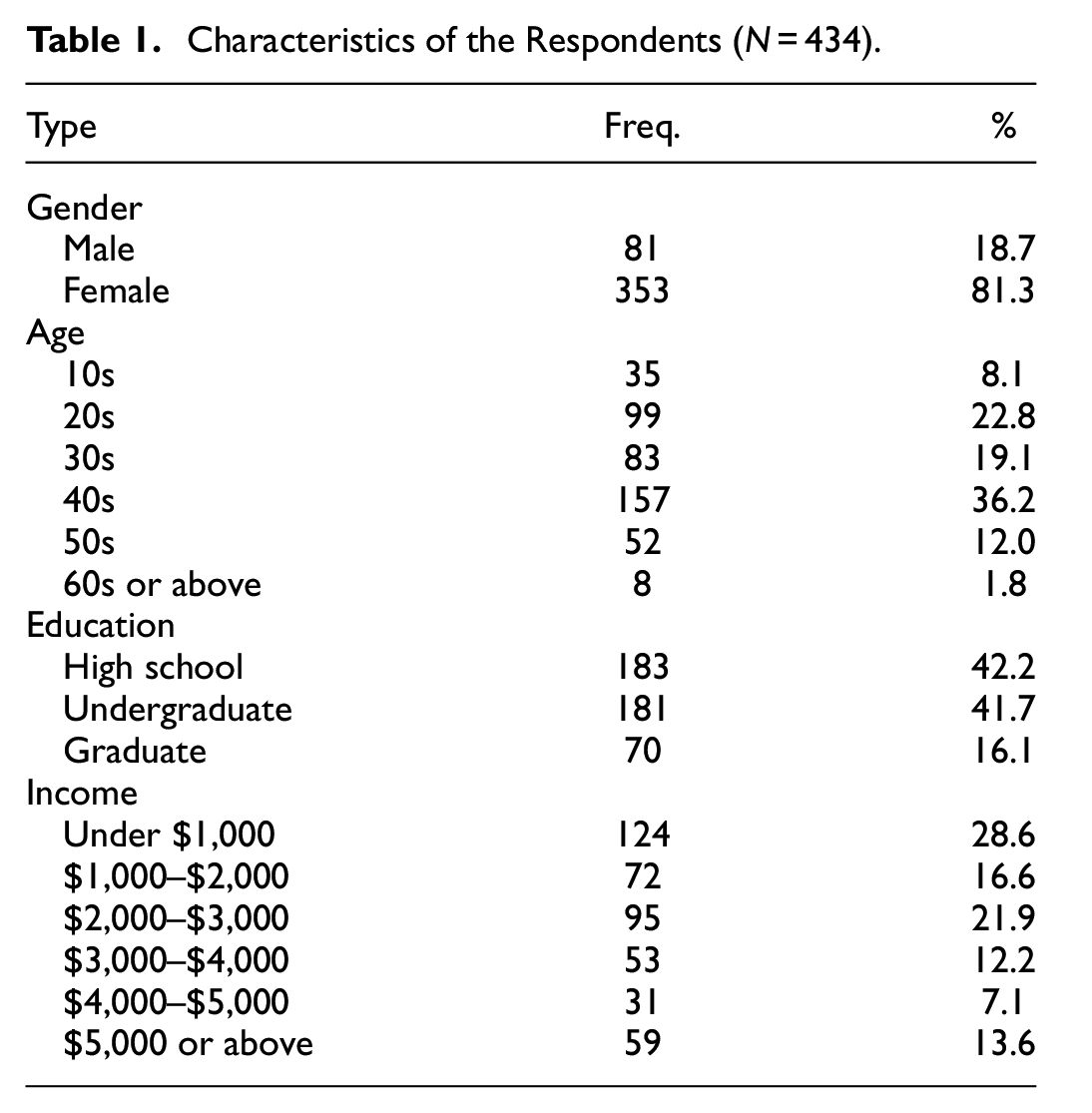
This study aims to examine the effect of recovery justice on customer satisfaction and loyalty in service failure situations. We hired a survey agency to administer an online survey of those aged 19 or older who reside in the Seoul and Metropolitan area, South Korea. The question asking about the previous experience of service failures in a hair salon was placed at the beginning of the questionnaire. When a respondent answered that he/she had never had service failures in a hair salon, the survey was closed right away because he/she was not eligible. The survey lasted about a week during June 2020 and 434 responses were returned. Table 1 shows the demographic characteristic of respondents.
Characteristics of the Respondents (N = 434).
Data Analysis Method
We analyzed collected data using SmartPLS 3.3 (Ringle et al., 2015) which is a proper tool to test the measurement and structural models simultaneously. Since the survey instruments in this study were derived and modified based on the existing ones, it was necessary to retest their reliability and validity.
Data Analysis
Test of Measurement Model
Among the variables of the proposed research model, recovery justice was set as a second-order formative construct. Accordingly, this study assessed the reflective measurement model and formative measurement mode, respectively. First, we ran a factor analysis by inputting all measurement items, and factor loadings for all items exceeded 0.7 (Bagozzi & Yi, 1988). As shown in Table 2, Cronbach’s alpha for each latent variable was over .7, and the composite reliability (CR) values and average variation extracted (AVE) values exceeded the recommended threshold of .7 and .5, respectively (Chin, 1998; Fornell & Larcker, 1981; Hair et al., 2011). These results show that the proposed model has sufficient reliability. To assess the discriminant validity of the model, we compared the correlation coefficients among variables with the square root of the AVEs of variables, excluding a second-order formative variable. As Table 3 shows, the square root of the AVE for each variable was higher than the correlation between the specific variable and any of the other variables, supporting the discriminant validity of the model.
Reliability and Validity Test.

Note. CR = composite reliability; AVE = average variance extracted.
Discriminant Validity.

Note. Bold numbers in diagonal are root square values of AVE.
Next, we assessed the second-order formative measurement model for collinearity and significance according to Hair et al.’s (2014) suggestion. In this study, a second-order formative construct consists of 15 first-order indicators. As a result of calculating the VIF values for them, the largest one was 4.064 (PJ3), which is below the threshold value, 5. The results indicate that no serious collinearity issues are found among the first-order formative indicators, and our path analysis results are acceptable. As for the significance, the 15 first-order indicators were found to be statistically significant as their outer loadings were significant at p < .001, indicating all first-order formative indicators are deemed valid. Based on the assessment of collinearity and significance, we concluded to proceed with the structural model test for recovery justice, the second-order formative variable in this study.
Test of Structural Model
We chose to use the PLS (Partial Least Squares) method, a statistical program for empirical analysis of collected data, to verify the hypotheses proposed in this study. This method is a useful tool to analyze the model containing a small number of data or formative indicators. SmartPLS 3.3 was employed to conduct structural model analysis, and the results are shown in Figure 2.

Results of structural model analysis.
Recovery justice was found to have a statistically significant effect on customer satisfaction (β = .595, p < .001), thus H3 was accepted. Also, customer satisfaction was found to significantly influence both revisit intention (β = .664, p < .001) and recommendation intention (β = .544, p < .001). Therefore, H4 and H5 were accepted. Moreover, recovery justice had a statistically significant effect on both revisit intention (β = .110, p < .05) and recommendation intention (β = .193, p < .01). Therefore, H1 and H2 were accepted. Four control variables—gender, age, education, and income level—were found to have no statistically significant effects on the relationships among other variables.
To conclude, the structural model test results indicate all paths of the research model are statistically significant, and all five hypotheses are supported. In addition, all the R-square values ranged from .354 to .541, indicating that this study’s model is valid and appropriate.
Mediation Effect of Customer Satisfaction
This study adopted Baron and Kenny’s (1986) approach to verify the mediation effect of customer satisfaction. First, the structural model test was conducted for the other three constructs after excluding customer satisfaction. As a result, the effect of recovery justice on revisit intention (β = .506, p < .001) and recommendation intention (β = .517, p < .001) were both statistically significant. Then, the test was conducted again when customer satisfaction is included as a mediator. It was found that the causal relationships between recovery justice and revisit intention (β = .110, p < .05), and between recovery justice and recommendation intention (β = .193, p < .01) are still statistically significant, but the path coefficient values and the levels of significance are reduced than when customer satisfaction is excluded. These results show that customer satisfaction has a partial mediation effect on the recovery justice and revisit intention relationship and the recovery justice and recommendation intention relationship. Hence, H6 and H7 were accepted. The analysis results of medication effects are contained in Table 4.
Mediation Effect Test.
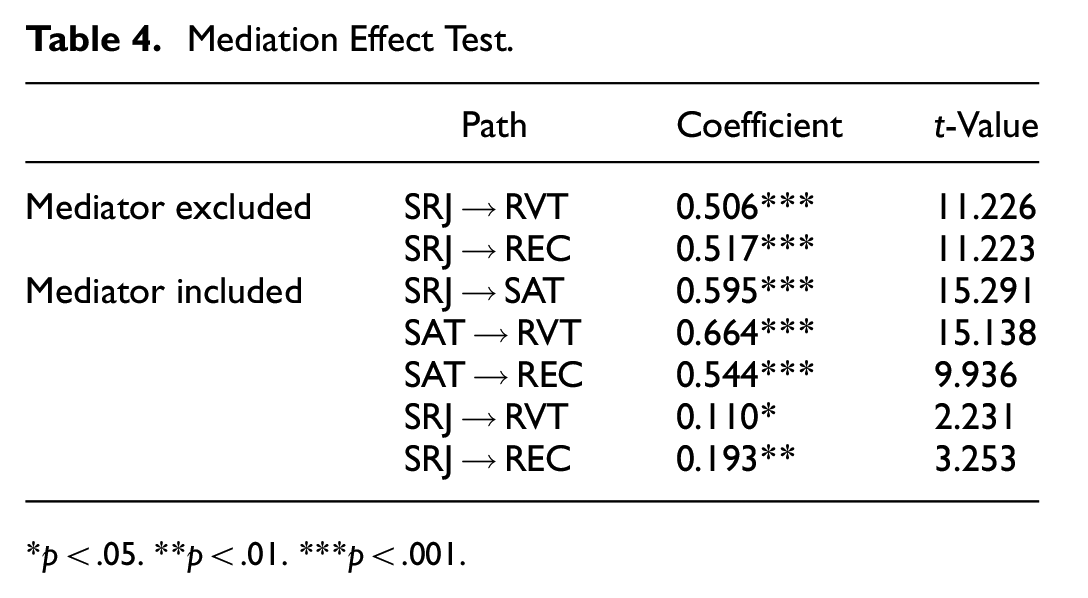
p < .05. **p < .01. ***p < .001.
Discussions
Summary of the Results
This study aims to explore how recovery justice affects customer satisfaction and this links to customer loyalty in a service failure situation. The findings of this study are shown in Table 5.
Summary of the Results.

First, service recovery justice, consisting of three dimensions—procedural justice, interactional justice, and distributive justice—has a positive impact on customer satisfaction. While previous studies studying the impact relationship between service recovery justice and recovery satisfaction showed that not all dimensions of justice were adopted which especially depends on the type of service (Park et al., 2015), perception of service recovery justice as a whole in the beauty service industry had a significant impact on recovery satisfaction.
Second, customer satisfaction has been shown to have a positive impact on revisit intention and recommendation intention. These results are also consistent with previous studies (Chun & Nyam-Ochir, 2020; Phillips et al., 2013) showing that royalty increases as a result of customer satisfaction in various industries.
Third, service recovery justice affects revisit intention and recommendation intention by means of customer satisfaction. This finding is consistent with the arguments of existing studies that emphasize the role of customer satisfaction (Siu et al., 2013), indicating that service recovery justice must be well aligned with satisfaction that leads to customer loyalty.
To summarize, this study confirmed that perceived justice in the service recovery processes contributes to satisfying customers, which, in turn, encourage customers to be more loyal to the service company.
Theoretical Implications
Based on the above-mentioned findings, this study provides the following theoretical implications. While many studies have been conducted on service recovery, few studies have been conducted on service failures and recovery in the beauty service sector compared to other service industries. Considering the characteristics of the beauty industry that meets customers with various backgrounds, needs, and requirements, service failures, and complaints are expected to continue to increase. In this regard, the first implication is that we have looked at recovery justice as an important factor that can affect the sustainability of beauty service companies by applying the existing service recovery model to the beauty service sector.
Second, our attempt is meaningful because this study provided empirical evidence of the effect of recovery justice on service satisfaction after a service failure, which had been somewhat overlooked in the beauty service sector. This study, by exclusively targeting customers who have experienced service failures, perfectly aligns with the research objective of service recovery, allowing for a clear interpretation of the role of justice.
Practical Implications
Besides the academic implications mentioned above, there are also practical implications as follows. First, it is necessary to understand the nature of hair care services to provide satisfactory services and respond to customer complaints appropriately. Since customer service in hair salons starts from the moment a customer walks in the door, employees need to be conscious of every moment of contacting customers and providing services. Also, responses to any problems or complaints should be made timely when a service failure happens, and appropriate compensation should be provided based on customers’ complaints and requests. Along with tangible compensations such as discounts, free services, or bonus mileage, measures to maintain long-term relationships with customers will play a critical role in addressing service failures. For the hair salon staff, it is recommended to have training sessions on expected attitudes and manners. Moreover, it is important to inform customers of compensation policies following a service failure.
Second, the findings of this study imply that the procedures to handle service failures need to be fair and the responsible employees should apologize to customers courteously. Based on our findings, the beauty service industry needs to elaborate its strategies containing fair service recovery processes that help address unavoidable failures in customer service and encourage positive consumer behaviors (e.g., providing guidance on how to handle situations when a customer is dissatisfied with their hairstyle). By doing so, they are expected to recover from service failures appropriately, retain positive relationships with existing customers, and attract new customers, thereby improving profitability. Furthermore, in the context of the beauty service industry, it may be worthwhile to consider the development of service design approaches such as service-quality-driven service design (e.g., C. H. Lee, Chen, & Trappey 2019, C. H. Lee, Zhao, & Lee, 2019) or requirement-driven and strategy-based service design (e.g., C. H. Lee et al., 2021).
Lastly, this study confirmed that customers have stronger revisit and recommendation intentions when they are satisfied with the firm’s recovery efforts after perceiving recovery justice. This indicates that making appropriate recovery efforts is better than considering service failures only fatal. Therefore, it is recommended to turn the failures into opportunities to keep existing customers while attracting new customers.
Limitations and Future Research
This study has some limitations that need to be considered. First, the research subjects were confined to customers who live in the greater Seoul metropolitan area, South Korea, and have had unsatisfactory experiences. Given that 81% of the respondents were women, the sample of this study does not represent the population. Therefore, the findings might not be generalized to a broader population. We expect that women are the major customer base for most hair salons and there would be little difference according to geographical locations. Nevertheless, future studies need to investigate the differences in perceived justice between male and female customers, thereby taking the quality of research to the next level. Second, customers’ recognition of service failures is sometimes short-lived. To help the survey participants recall their past complaints, it is recommended to provide descriptions of different types of service failures before administering the questionnaire. Third, this study has limitations of one-off longitudinal research. Therefore, we recommend cross-sectional studies over an extended period of time for future studies. Fourth, our survey was conducted during the Covid-19 pandemic, which might limit data collection in terms of sampling. The hair care service cannot be delivered remotely or online, and in-person appointments in hair salons decreased significantly during the pandemic (Tan et al., 2020). However, we judged that the pandemic-related circumstances do not affect the subject of this research—perceived justice and customer loyalty in the situation of beauty service failure. Nevertheless, future studies need to be performed without the impact of the pandemic so that their results can be more applicable to relevant disciplines. Lastly, the association or society organized by beauty service professionals needs to make efforts to develop quantitative standards, such as service index or improvement indicators, which will contribute to improving the quality of research.
Conclusion
In the beauty service industry, maintaining high service quality is crucial, but managing service failures is equally important, as it’s impossible to always meet the diverse preferences and demands of customers. This study aimed to examine the process by which perceived service recovery justice in the context of beauty service failures leads to customer satisfaction and subsequently, loyalty. The overall findings suggest that even in situations of service failure, if customers perceive justice in the service recovery process, it can lead to satisfaction and, consequently, foster loyalty. In essence, appropriate responses, compensation, and fostering genuine interpersonal relationships between customers and staff can turn crises into opportunities. These results can provide beauty service providers with guidance on how to manifest justice in the service recovery process when service failures occur.
Footnotes
Acknowledgements
None.
Declaration of Conflicting Interests
The author(s) declared no potential conflicts of interest with respect to the research, authorship, and/or publication of this article.
Funding
The author(s) received no financial support for the research, authorship, and/or publication of this article.
Ethics Statement
Not applicable.
Data Availability Statement
Data sharing not applicable to this article as no datasets were generated or analyzed during the current study.
