




Abstract
This paper aims to identify the constrains faced by female entrepreneurs in Egypt. This study also intends to examine the influence of formal and informal institutional factors on women’s entry into entrepreneurship in Egypt. In addition, to explore the factors enable women entrepreneurs to overcome the barriers they may face. The qualitative research approach was adopted in the study to explore the challenges experienced by Egyptian female entrepreneurs. Purposeful sampling was employed and twenty-five (25) women entrepreneurs were selected from five Egyptian governorates to conduct semi-structured interviews to collect primary data. The findings indicated that the main constraints faced Egyptian women entrepreneurs arise from difficulty in raising capital, socio-culture commitments, sexual harassment, work-family conflict and lack of managerial skills. The study found factors such family-husband support, religious values, personal traits and technological skills are crucial for overcome constraints faced by women entrepreneurs. The study recommends creating a funding program targeting female entrepreneurs and raise the awareness about the importance of women entrepreneurship as well as take necessary actions to prevent sexual harassment phenomenon. Minimal research has examined female entrepreneurship in Egypt. Therefore, this study offers valuable insights of constraints faced by women entrepreneurs in Egypt. The study contributes to the women’s entrepreneurship literature from the perspective of an Arab Islamic developing country.
Keywords
Introduction
The role of entrepreneurship in economic has been recognized globally. Economists consider entrepreneurship a mechanism for economic growth and development (Hamdan et al., 2020; Saberi & Hamdan, 2019). Moreover, entrepreneurship has been considered as a critical tool to create change in addressing the social and economic dilemma (Welter et al., 2017). Entrepreneurship generally plays a vital role in nation development, women entrepreneurship positively change social aspects of the countries (Zayadin et al., 2020, 2022). The increasing rate of women entrepreneurship, especially in developing economics has enhanced the overall household wellbeing and consumption (Mahajan & Ranjan Bandyopadhyay, 2021). Entrepreneurship empowers women economically (Yen Ng et al., 2022) and provides them opportunities for self-expression and fulfilment (Byrne et al., 2019). In spite the crucial benefit of the entrepreneurship on the national development, however, it has positive effect specifically on women. Female entrepreneurship allows women to alleviate some structural pressure and enact agency, defined as the “capacity to act” (Charrad, 2010). Concurrently, women continue confront institutional barriers to entrepreneurial activities (Bianco et al., 2017; Cabrera & Mauricio, 2017). Thus, it is significant to investigate women entrepreneurship phenomenon by exploring the related motivations and challenges. The capacity to act can only be explained within specific social structure (Ghouse et al., 2017). The women’ empowerment and entrepreneurship are embedded within specific context and should be examined accordingly (Foss et al., 2019; Wood et al., 2021). Few Studies have investigated women entrepreneurship in MENA context (Aljuwaiber, 2020; Naguib, 2022; Rayan, 2019). According to Global Entrepreneurship Monitor (GEM)’ definition, entrepreneurship is “Any attempt at new business or new venture creation such as self-employment, a new business organization, or the expansion of an existing business, by an individual, a team of individual, or an established business” because the (GEM) dataset is survey-based, it concerns of statics of all types of start-ups, both formal and informal businesses.
Notwithstanding the number of female entrepreneurs have demonstrated a gradual increase globally, it is significantly less than male entrepreneurs (De Bruin et al., 2006; Léger-Jarniou, 2015). Globally, established business ownership rate for women is 5.6%, representing one in three established business owners (GEM, 2021). This gender disparity in entrepreneurship field attributed to unique challenges face women in developing countries. Women are not given the same opportunities as male entrepreneurs and experience unfair access to resources (Panda, 2018a; Rudhumbu & Maphosa, 2020). Gender-based discrimination, managing a patriarchal structural society, and balancing business and family life (Brush et al., 2019; Gërguri-Rashiti & Rotabi, 2021), All of these challenges affect the of female entrepreneurship rate, where only (36%) of the business owned by female globally (World Bank, 2020). In Egypt, established women entrepreneurship is (14.6%) comparing to men entrepreneurship (85.4) (GEM, 2020/2021). While women participation in early entrepreneurship is (24.4%) compared to (75.6%) for men, this means that approximately one out of four early stage business owners are women compared to (40%) early stage business owner globally (GEM, 2020/2021).
Theoretically, few studies have offered an in-depth view of the challenges faced by women entrepreneurs; however, they neglect the heterogenous socio-economic context of the developing countries. It is necessary to investigate a specific country’s ecosystem as women are confronting various constraints in becoming entrepreneurs which may vary according to country. These variations are dependent on economic, educational and cultural differences (Bui et al., 2018; Shastri et al., 2022). Therefore, more context-specific research in developing economies is needed to address specific national and cultural factors that complicate women entrepreneurs’ situations (Ghouse et al., 2017). Such studies would clarify why women entrepreneurship is thriving in many nations yet trivial in others.
One of the countries which has dearth of research on female entrepreneurship is Egypt. A systematic study by Panda (2018a) examined published studies that have investigated the constraints and challenges experienced by female entrepreneurs in developing countries. The study found 35 studies concentrated in 90 developing countries whereby Egypt was excluded (Panda, 2018a).
That low rate of women entrepreneurship is worth studying to explore the factors that deter Egyptian women from engaging in entrepreneurial activities. To identify the constraints female entrepreneurs face, we need context-specific research. Entrepreneurship is not an isolated economic field, however, rather, a socially embedded activity (Landström & Harirchi, 2018). Women entrepreneurship cannot be understood without contextualization (Foss et al., 2019; Hechavarría & Ingram, 2019). Thereby, it is significant to understand the entrepreneurial ecosystem where different economic, socio-culture, legal and institutional entities co-exist (Foss et al., 2019). Every entrepreneurial ecosystem is “embedded in an institutional context which includes formal regulatory measures and informal institutions such as culture norms” (Elam et al., 2019). Cultural context can significantly impact women’s entrepreneurship through family burdens including children caring, housework, as well as gender stereotype of roles, which may lead to occupational segregation (Banihani, 2020; Poggesi et al., 2019). Accordingly, the current study will examine Egypt’s formal and informal institutions, and current socio-economic indicators reflecting the situation of women’s entrepreneurship in this context. The study is posited by the following research questions:
– What are the factors that hinder Egyptian women from engaging in entrepreneurial activities?
– What strategies Egyptian women entrepreneurs are using to overcome the entrepreneurial challenges?
This study is important as it contributes to the entrepreneurship discipline by highlighting key constraints for women who engage in entrepreneurial activities. Furthermore, this study is crucial since female entrepreneurs are significant part of the Egyptian economic development but are under studied. Thus, the findings of this study by identifying the issues and obstacles experienced by female entrepreneurs would assist policymakers and related agencies to address the challenges.
The next section reviews the relevant literature concerning female entrepreneurs’ challenges in developing countries. This is followed by an explanation of the theoretical framework, research methodology and the findings. The final section concludes and explains the limitations of the study.
Literature Review
Research argues that female entrepreneurs in developing economics confront multiple challenges that encompass internal and external factors (Panda, 2018b). Internal constraints could be negotiated by the entrepreneur’s traits, while external challenges are out of the entrepreneur’s control (Panda, 2018a). For example, female entrepreneurs in Africa are unlikely to face internal family restrictions but are impacted by external factors such as market and funding issues (Pico Gil et al., 2022). In contrary to Muslim women who may face difficult challenges due to traditional family beliefs, the external economy is supportive of business (Gupta & Mirchandani, 2018; Tlaiss & McAdam, 2021). The entrepreneurial activity is the same for men and women. However, in practice, women confront many challenges which prevent them from receiving and exploiting potential opportunities. For example, in many developing nations, entrepreneurs are more likely to handle unstable and complicated bureaucratic business environment than entrepreneurs in developed economics (Panda, 2018a).
Nevertheless, the diversity of challenges in developing countries are more likely to affect all female entrepreneurs. The challenges include financial constraints, gender discrimination, work-family imbalance, lack of infrastructure support, hostile business, economic and political environment, insufficient entrepreneurship training and education, and personality based-constraints (Özsungur, 2019; Roomi et al., 2018; Sarmah et al., 2021). Some of the prominent constraints are as follows:
Financial Challenges
Inadequate starting capital is a significant constraint for female entrepreneurs in developing countries (Pham & Talavera, 2018; Saviano et al., 2017). Women entrepreneurs are facing stiff challenges in attaining external finance resources than men (Lindvert et al., 2017). This may attributed to the fact that a majority of women does not have enough assets to place as collaterals or guarantors to obtain small loans from financial institutions (Isaga, 2019; Jha & Alam, 2022). The lack of credit history, information asymmetry all of which hamper entrepreneurs, especially female entrepreneurs to access fund (Brush et al., 2018). The negative perception that entrepreneurship is an inappropriate career opportunity for women aggravates the financing situation (Kalafatoglu & Mendoza, 2017; Maden, 2015).
Cultural Challenges
Culture represents traditions, beliefs, values and norms shared in a society which constitute its culture (House et al., 1999). Various values embedded in a culture include dedication to work and acceptance of risk and orientation towards self-employment which influence entrepreneurship’s rate and pace (Lee, 2018; Tur-Porcar et al., 2018).
There is also growing evidence about culture values, attitudes and beliefs represent as constraints for female entrepreneurs in developing countries (Kalafatoglu & Mendoza, 2017; Vershinina et al., 2018). The restrictions and gender discrimination are deeply embedded in society and act as constraints restrain women’s mobility, independency and career opportunities, thus consequently conducive towards structural inequality within a society (Roomi et al., 2018).
In a male-dominated society such as Arab countries, religion is used as an instrument to promote males’ self-interest. For instance, although the Islam does not prevent women from working (Tlaiss & McAdam, 2021), the segregation of women is norm and rooted in many Muslim societies (Gërguri-Rashiti & Rotabi, 2021; Roomi et al., 2018). Moreover, structural inequalities are practiced against women, as both society and family are male-dominated and do not encourage women to work outside home in developing countries (Shastri et al., 2022).
Family-Work Balance
Many challenges still exist with regard to the gender role in the society, where the women role identified by the society affect their entrepreneurial activity rate and pace.
Women in developing countries are still solely responsible for childcare and household chores (Tlaiss, 2015a; Xheneti et al., 2018), and these responsibilities often create work and family conflict (Abdelsalam et al., 2020; Adikaram & Razik, 2022). Thus, in this context, female entrepreneurs are required to balance their work life and family, and often find themselves work a double day (at home and at work). For example, in Arab societies, if women business activities obstruct their family role, they have to leave the business (Erogul et al., 2019; Tlaiss, 2019). The majority of women entrepreneurs are unable to offer enough time for business-related activities such as networking and mentoring which contribute to poor performance (Panda, 2018b).
Human Capital Challenges
Research underscores that a human capital including the skills and knowledge which an entrepreneur attainted through schooling, training programme, and work experience are crucial resources to start and operate businesses (Aboobaker, 2020). The lack of relevant entrepreneurial skills such as managing capital, keeping books, marketing and supply-negotiating ability are challenges hindering women entrepreneurship performance. Evidence has demonstrated that individuals with a higher quality human capital achieve successful outcome in entrepreneurial activity (Adom & Tiwaa Asare-Yeboa, 2016). However, research argues that women in developing countries are likely to have relatively low human capital (education, training and experience) compared to men due to culture influence (Brixiová et al., 2019; Chen et al., 2021). Therefore, the lack of human capital of entrepreneurial skills and qualification hinder female entrepreneurs from starting a business.
Sexual Harassment
Create safe environment and women-friendly working climate is fundamental to promote women entrepreneurship. In contrary, unsafe and hostile working environment would lead to fewer women entering or remaining in entrepreneurial activities. Unfortunately, the majority of the studies concentrated on violence against the women indoor workplace such organization and factories with scant research investigate the impact of the phenomenon on women entrepreneurship. However, this section would demonstrate the available literature about the phenomenon and its influence on working in general, and focusing more in sexual harassment in Egypt. At the centenary of International Labor Organization (ILO), the violence and harassment convention (No. 190) and its accompanying recommendation (No. 206) were adopted (International Labour Organization, 2019). Although there is no consensus among scholars about the sexual harassment definition, however, the convention (No. 190) defines violence and harassment as “a range of unacceptable behaviors and practices, or threats therefore, whether a single occurrence or repeated, that aim at, result in or are likely to result in psychological, sexual or economic harm, and gender-based violence and harassment.” (SH) can deliberately and negatively affect the performance and career aspiration by creating an intimidating, hostile, abusive, or offensive climate that erodes the victim’s confidence and ability to achieve success in personal and professional field (Jacobson & Eaton, 2017; Jagsi et al., 2016; Mclaughlin et al., 2017). In Egypt, the predominance of sexual harassment in the public space has been addressed and related with security state, political repression, and a lack of state-sponsored social well-being (Hammad, 2017). Common practices of public harassment in Egypt are catcalling, staring, stalking, unwanted touch, suggestive exposure and unsolicited phone call (Abdelmonem & Galán, 2017).
Research Gap and Contribution to Literature
Due to limited studies on women’s entrepreneurship in developing economics (Rashid & Ratten, 2020) especially, researchers have called for more studies to conducted on concentrating on female entrepreneurs in the non-Anglo context (Bastian, Sidani, & El Amine, 2018; De Bruin et al., 2007; Henry et al., 2016), that focus on the contextual, socio-cultural aspects to advance knowledge and develop a more comprehensive understanding of the socially constructed phenomenon of female entrepreneurship (Ahl, 2006; Bui et al., 2018; Shastri et al., 2022). In addition, this offers more insight on the external factors that may affect individual behavior instead of determining internal factors only. Thus, this necessitates further studies that concentrate on the impact of external societal and institutional influences (Gartner & Shane 1995).
Institutional approach offers vital practical insights into understanding the role and impact of contexts surrounding individual–level behaviors and process (Scott & Meyer, 1994). According to the institutional theory, institutions are social structures that are constituted of culture-cognitive, normative and regulative elements (Scott, 1995, 2001). Institutional lens is required to capture the contextual view of entrepreneurship in developing economics and to analyze the role of women’s individual agency in negotiating institutional constraints (Giménez et al., 2018). Institutional theory is often used as a theoretical framework to investigate women’ entrepreneurship and various aspects of this discipline (Giménez et al., 2018).
Institutions are rules of the game and they can be either formal such as political, economic and legal constitutions rules, or informal such as norms, values and behaviors in a particular society (North, 1990).
Methodology
An interpretivist approach was employed in this paper to provide voice for females to articulate the challenges they face as entrepreneurs in Egypt (Leitch et al., 2010). The adoption of interpretivist approach to knowledge creation (Bernstein, 1995) where cannot understand the social world without interpretation (Leitch et al., 2010). The understanding of human behavior which entails “capturing the actual meanings and interpretation that actors subjectively ascribe to phenomena in order to describe and explain their behavior” (Guest et al., 2006). Therefore, data were collected from 25 in-depth, face to face, semi-structured interviews with Egyptian female entrepreneurs. The participants were distributed geographically within five Egyptian governorates. The literature on female entrepreneurship calls for an in-depth approach to develop a more detailed comprehension of the issues related to women entrepreneurship (Brush & Cooper, 2012). These semi-structured interviews enable the researcher to capture nuanced insights into women’s every day entrepreneurship (Welter et al., 2017). The qualitative interview approach was deemed appropriate as it compatible with the exploratory nature and objective of the study.
Sample
A mixed sampling procedure including purposive sampling was used to select the interviewees as they provide relevant information to answer research question (Bryman, 2012), and contribute to the literature (Kemparaj & Chavan, 2013). The snowballing approach was utilized to overcome the difficulties in accessing date in the poor-Data countries. Noteworthy that, the approach was used widely in entrepreneurship research focusing on the developing countries context (Bizri et al., 2017; Dzingirai, 2021; Light, 2019; Tlaiss & Kauser, 2019). The researchers approached various institutions to obtain data about Egyptian women entrepreneurs. These institutions such Commercial and Trade Chamber, Medium, Small and Micro Enterprise Development Agency (MSMEDA), and National Council for Women (NCW), were provided connection data about (6) entrepreneurs, and through using snowball strategy, these (6) entrepreneurs enable us to reach to remain (19) entrepreneurs. All of the businesses were in the services sector most of them targeting women and child segment, such as beauty centers, nurseries, cosmetics products, women accessories and clothes, furniture. The concentration of the women’s entrepreneurship in the services sector and small size business acknowledged in the literature (Demirguc-Kunt et al., 2013).
Five Egyptian governorates were selected carefully to ensure that they reflect the characteristics of Egypt. The governorates and the justifications for the selection are presented below.
Cairo. It is the capital of Egypt and hosts 10% of the Egypt population. In addition, to hosting ministries, municipalities, a number of women associations, SME funds, and other institutions which are relevant to this study.
Assiut. It is one of the Upper Egypt governorates. It is considered as one of the poorest governorates in Egypt (CAMPAS, 2017). However, the women entrepreneurship rate in Upper Egypt is too low and Assiut is no exception. Hence, it is worthy to select it on an economic basis, in order to draw a comprehensive understanding of the factors that contribute to low rate of women entrepreneurial activity even though Assiut governorate have many reasons to create push entrepreneurs such are high rate of poverty and low rate of employment.
Aswan. The governorate of Aswan borders with the state of Sudan. It is one thousand kilometers away from Cairo and it is heavily dependent on tourism income. The governorate was chosen due to its ethnic diversity (Arabic—Nubian tribes).
Buhaira. It is a prominent governorate for a multitude of women business, where it has the highest number with (39%) of women entrepreneurs in Egypt (International Labor Organization, 2017). Therefore, it is worthy to explore the challenges experienced by female entrepreneurs throughout their entrepreneurial journey, and how they addressed it.
Sinai. It is located in the north-east of Egypt. Sinai people belong to several nomadic tribes (Bedouins of Sinai) the Bedouins constitute (60%) of the population of the governorate. This study also attempts to examine the impact of Bedouin culture on the women entrepreneurship.
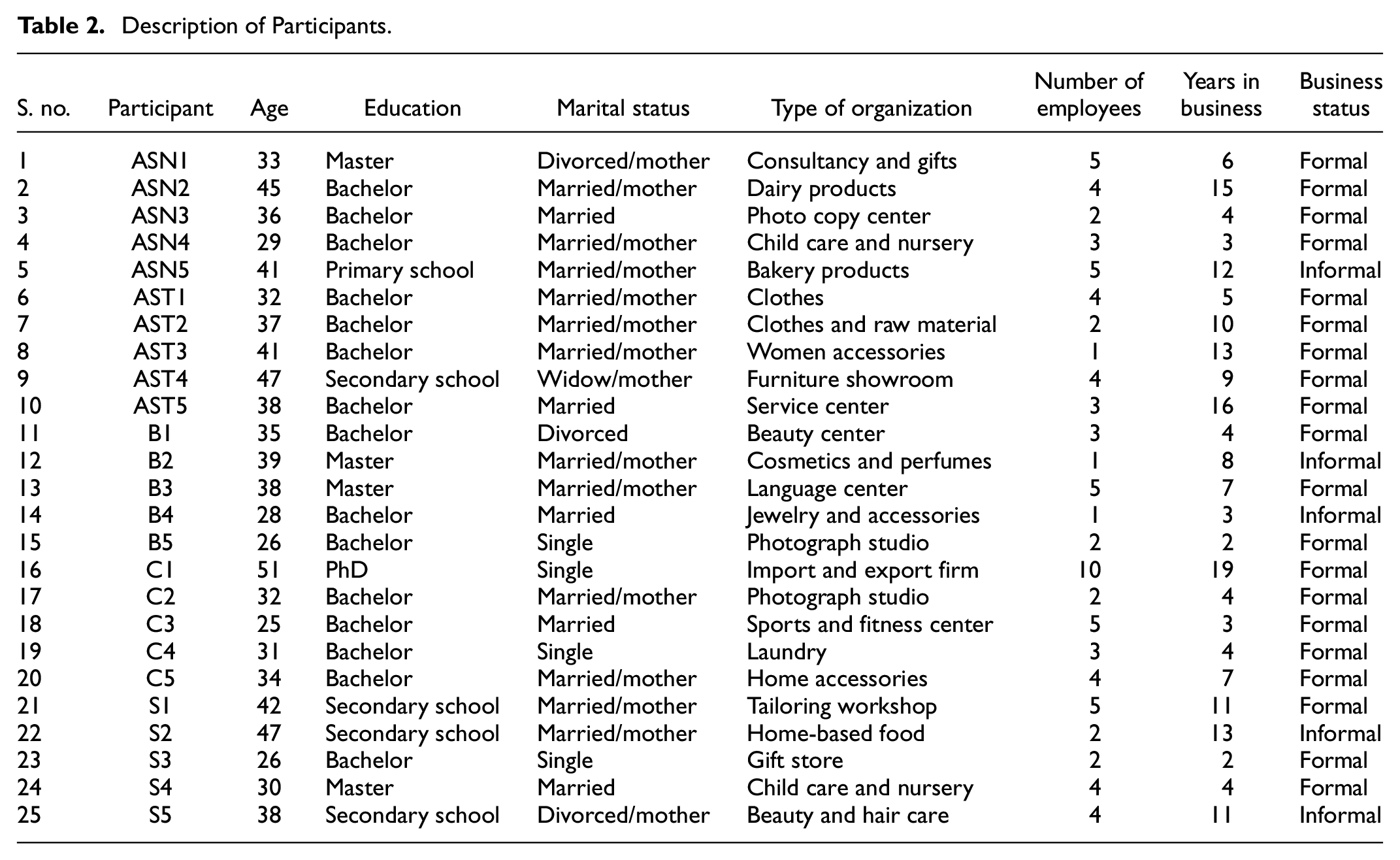
In order to protect the identity of the respondents, a serial number was assigned to the interviewees according to their governorates as shown in Tables 1 and 2.
Sample Area and Interviewees’ Symbol.

Description of Participants.
Procedures
The interviews, conducted in Arabic, were tape-recorded with permission and transcribed. The interviews transcripts were translated to English by the researcher and were then cross-validated by an academic fluent English language. The interviews took place in offices, shops as well as coffee shops based on the preference of the interviewees. The interviews ranged in length from 45 to 90 min. First, the interviewees were asked about their personal demographics (Marital status, educational attainment level) as well as some information about their enterprises. Then the interviewees were asked as open-ended, semi-structured question about the barriers encounter them during startup and operating their business. An interview guide prepared based on entrepreneurship challenges’ literature.
Data Analysis
The in-depth interviews were analyzed using template or thematic analysis. Guided by Leitch et al. (2010), a number of predetermined themes or codes were identified and assembled by the review of literature (Corbin & Strauss, 1990; Miles & Huberman, 1994) against which the data collected from the interview was compared. The interviews transcripts were read, re-read and scrutinized and coded independently by the researchers. Throughout the analysis process, and as a result of continual comparison between the transcripts, the new themes were emerged. This transaction led to axial coding (Corbin & Strauss, 1990), where the initial list of codes was modified to include new themes and sub-themes and to find relationships between these themes. The most recurring themes then were identified using content analysis, in order to give the results a quantifiable measure that may deepen our understanding of entrepreneurship (De Bruin et al., 2007).
Findings and Discussion
This section aims to present the findings of this study from interviews with 25 Egyptian female business owners. The respondents were distributed geographically from five Egyptian governorates namely: Assiut, Aswan, Buhaira, Cairo, and Sinai. These areas are diverse economically, socially and culturally.
Before identify the barriers face Egyptian women entrepreneurs, we will interpret why the interviewees chose the service sector rather than other economic sectors. First, the interviewees lacked of sufficient seed money, thus they prefer services activities which need minimal capital comparing to other sectors. Second, most of interviewees were unsure if they would succeed in their business or not, hence they choose services activities which low-entrance cost and low-exit cost. Third, most of the interviewees have not any manufacturing and agriculture experience.
Therefore, women entrepreneurs prefer to choose service sector that allows them to entrepreneurs while overcome major barriers like the lack of seed capital, know-how and self-efficacy.
Moreover, notably most of these businesses oriented to women and child segment, that due to prevailing socio-culture values which deny the direct treatment of a woman with a man that not family member. Thereby, the women entrepreneurs prefer the type of the businesses that allow them to start and run their venture without transgress the society’ values.
Q1: What Are the Factors That Hinder Egyptian Women from Engaging in Entrepreneurial Activities?
The purpose of the first research question is to fully explore the barriers that female entrepreneurs in Egypt face while establishing their businesses and also to determine if they are still facing these obstacles in sustaining their business ventures. This study argued that the entangled interplay of a specific mix of formal and informal institutions factors are shaping the challenges of women entrepreneurship in Egypt context. Our finding shed light on the significance of taking into consideration all both formal and informal institutions more comprehensively and systemically when attempting to analyze women entrepreneurship in any particular context. Institutional orders regulative of state or informal system (e.g., Society, family, religion, government, and market) are prevailed by multiple sources of rationality and logics that can be differentiated, fragmented and contradicting (e.g., patriarchy, community, structure, equality, self-interest, and individualism).
The finding demonstrates that both of formal regulative institution (bureaucratic regulation rules and requirements) and informal institutions represented in culture and religion, together play a significant role in enabling or constraints female entrepreneurship in Egypt.
The findings indicated that limited financial capital needed to startup and run a business is main obstacle faced by women entrepreneurs in Egypt. Access to funding is a significant item for business venturing without it, female entrepreneurs encounter constraints in their entrepreneurial process and efforts to grow and sustain their business venture. The interviews revealed also that the society norms and traditions are vital in limiting the roles of female entrepreneurs. The momentum of these informal institution such norms and tradition differentiate from region to region in Egypt but still impact people attitude against woman’ role even in a moderate society, thus entrepreneurship. In additional, there are many other entrepreneurial problems which include lack of marketing and management skills, work-family conflict, insufficient trained workers, and shortage of good quality raw materials.
Notwithstanding, female entrepreneurs who are also mothers encounter problems to manage business requirements, family responsibilities and caring for their children. They have to complete business activities and household chores such as cooking, cleaning, washing and running the business. Although the culture of hiring house helpers is emerging, not all families could afford the cost of these helpers. Women entrepreneurs in Egypt are struggling with balancing their mother role and their own ambition, especially those who have to operate outdoor businesses.
Funding Challenges
In regard to the financial difficulties which is a common problem faced by startup entrepreneurs in general and female entrepreneurs specifically in developing countries (Ghouse et al., 2017; Panda, 2018a), the interviews demonstrate that raising of capital was a top hurdle especially for female entrepreneurs belonging to the low and middle economic classes. This finding supports the previous research which have revealed that women entrepreneurs face greater challenges in accessing external funding for their business than men (Lindvert et al., 2017). The finding argues that formal and informal institution attribute to exist of funding constraints. In respect formal institution, it represented in procedures and requirements of financer, where most of financial institutions have very complicated requirements and high interest rates that the entrepreneurs unable to fulfil. However, the informal institution factors represented in Islamic teaching which prohibits dealing with bank interest transactions. The findings divided Egyptian women entrepreneurs into two categories. The first, who were inclined to fund their enterprise through bank loans, but were unable to fulfil a bank requirement (formal factor). Second, those who refused to get loan from banks, either because of religious reasons (informal factors) or because they were afraid of not being able to pay the loan back (Ama et al., 2014). In regards to the first category, the common problems encountered by the female entrepreneurs were rejection of banks to fund startups ventures because banks considered them as high-risk ventures.
When ASN1 was asked if she approached banks to fund her enterprise, she cited that:
“I am a former banker, I know some banks refuse to fund startup enterprises, and other who agree to fund it, charge very high loan interest, because banks classify nascent business as high-risk segment. Thus, most of startups enterprises are excluded from banks’ target, and other who succeeded to get loans, they have to appear high loan interest, hence they charge their products by this interest cost. Ends up, the entrepreneur might offer uncompetitive product price.”
In general, banks avoid to fund nascent enterprises and only concentrate on medium and highly reputed companies.
ASN1 added that:
“the government launched 5% interest initiative which aims to encourage governmental banks to fund business with a charge of not more than 5% interest to promote entrepreneurship. Unfortunately, this initiative not include the small enterprises, it is targeting medium and large enterprises.”
Similarly, respondent C1, confirmed ASN1’s assertations and added another challenge facing female entrepreneurs specifically to those who run their business from home and ho have informal business, she cited that:
“personally, I funded my business from my own money, but I know too many female entrepreneurs, who own home-based business, they do not have outdoor location, therefore, banks reject to funding them, in pretext of lack of official shops.”
C5’ is an owner of a home accessories workshop. She narrated about her struggle to obtain a bank loan:
“when I started my home-base business, I asked for a loan from one national banks, but I disappointed about the difficult requirements such as shop contract, guarantor and trading license. Therefore, in the end, I had to used my saving as the seed money for my business. After the business grew and got all official license, again I headed to a bank, the bank agreed to fund me, but not cash, they release the value of the loan in the form of raw materials or production requirements. However, I need cash to pay worker wages, other operating expenses, thus, really it is a very exhausting process.”
Beside bank requirements were difficult to fulfill by startups, small enterprises and home-based businesses, the amount of the loan offered might also be not sufficient for some ventures.
In regard to the amount of loan offered, S1, an owner of tailoring workshop cited that:
“I contacted the bank for apply loan, it offered (10,000) pounds, but this amount not sufficient for my business venture, thus I used my savings.”
In contrast to bank loan seekers, there are female entrepreneurs who refuse or avoid borrowing from banks. Interviews with this group displayed that Islamic religious values are deeply embedded in the Egyptian society, and these participants’ attitudes against bank transactions are derived from Islamic teachings. Bank loans are still disputed by Islamic scholars as offering loans with interest is forbidden in Islam. This transaction called (ribba).
B5 is a photographer of products and explained her attitude against bank loans. She stated that:
“Bank loan still controversial matter between Islamic scholars, I believe that the loan is haram (means forbidden transactions in Islam). Therefore, I preferred to start the business by my own money.”
AST1 refused the loan bank idea and linking her refusal to Islam teachings against loan interest. When she asked about the funding of her business, she explained that:
“My project had funded by my own money, I started with only (EP2000), My brother lent me (EP800) and my saving was (EP1200), My father instill in our thoughts that interest loan is haram, and he frequently reiterates the popular Egyptian proverb (bank loan demolish home), so, I am following his will. I had not borrowed from banks.”
In a similar vein, AST 2 (drawing on clothes business) also avoided borrowing from banks and attributed her attitude to her doctrine and she mentioned that:
“I deeply believe that interest loan is haram, that what my parent taught me. So, I preferred to borrow from my family to finance my project.”
There are Egyptian entrepreneurs who reject borrowing loans from banks, but for reasons not related religious. They fear the inability to pay the loan back, they are skeptical towards any external funding, therefore, they prefer to borrow from friends and family members (Maden, 2015; Naguib & Jamali, 2015). The lack of financial management skills made women entrepreneurs insecure in their ability to handle financial issues such as borrowing from banks.
In this regard, C2, an owner of a photograph studio, said that:
“I am afraid of bank finance risking, I am not clever on financial issues, thus, I chose to not borrow from the bank, just use my own money.”
Similarly, AST3 who owns a traditional products business, cited that:
“I have not approached any bank, either at startup or at the growth stage. I don’t like loans, afraid of not able to pay the loan back, just thinking about that would make me stressed and loss focus on my work.”
C1, owner of an export firm, explains the attitude of many entrepreneurs toward bank loans. She said that:
“I funded my project using my own money, I have not headed to bank, but many of friends did it. I can tell you that Egyptian banks discourage start up entrepreneurship, there are not holiday repayment or respite and charging very high interest. This situation frustrates entrepreneurs from bank loan.”
Apart from the financial barrier, there are many other barriers that demotivate Egyptian women from engaging in entrepreneurial activities. Among them are family-business balance challenge, negative cultural norms, sexual harassment and lack of management.
Family-Business Balance Challenge
The findings of the study are support the previous research, which argues that the second most considerable challenges for majority of women entrepreneurs are family and motherhood responsibilities. These responsibilities assign to woman by the informal institution as society, in return this role creates obstacles to handle and balance with entrepreneurial activities (Abdelsalam et al., 2020; Erogul et al., 2019; Mustapha, 2016). The women entrepreneurs face social/ personal problems in Egypt specifically those women business owner with motherly role face difficulties to handle both business activities and family commitments towards kids. Like in the case of C2, she revealed that:
“My family responsibilities affect my abilities to manage my business, even to expand it. May I need to postpone the expansion until my children are grown up.”
However, most of middle class and lower middle class not afford a maid and servants to help in household chores. The findings of this study consistent with previous research which argued that childcare and other home responsibilities have negative effect on women’s abilities and willing to initiate successful business (Brush et al., 2009; Panda, 2018a).
Cultural Challenges
Negative informal institution as a cultural norm are prominent barrier encountered by Egyptian women who try star up business. The problem exists obviously in rural areas, where conservatism, patriarchal are deeply embedded in community. The society imposes exercised cultural restrictions on operation of female entrepreneurs. Some women entrepreneurs articulated that they had considerable difficulties in convincing their families to permit them to set up their own businesses. This findings evidenced in literature concentrating in Middle East context, it argued that prominent social norms affect women negatively across the countries (Bastian, Munir Sidani, & El Amine, 2018; Kalafatoglu & Mendoza, 2017). This attributed to the restricted attitude of their families who refuse to have females working out of the house. This notion was mentioned in the interview with AST1, who shed light on this barrier as follows:
“Through starting my business, the biggest challenges were my family rejection. My family is so rigid in this matter, it does not like woman doing job or business, my father was totally rejected this idea. He used to say “what would people say about me? After weeping a lot, and too much efforts and insistence, I succeeded to extract his consent, under one condition that, the business must be operated indoor without needing to go outdoors.” As a female, lives in the Upper Egypt, I cannot go out of the house without accompanied by male members of the family.”
Although this particular respondent succeeded in getting her father’s approval to establish a home-based business, she still faced another problem in marketing her products, as she would not be able to promote her products without go out to participate in exhibitions? Online shopping is not common in Upper Egypt region, especially in the villages. However, this did not stop her from promoting her business, she exercises the personal agency. AST1 revealed how she overcome the marketing dilemma. She narrated that:
“In the first trial of business, I failed to sale my products owing to the exiting restriction where I could not go to market or fair to display my stuff, but I was determined and persevered to success. Thus, when I had chance to participate in handicraft exhibition in Cairo, I approached my father who gave me permission to participate with conditions, first, should travel with my brother, and come back in the night, means no sleep outside the home.”
The respondent’ narrative is highly interesting because it shed light on family and society environment. Although she wanted to start her own business, but she was constrained by her family objections.
The respondents also probably encountered with male-inclined mentality, which prefers to deal with males over females. Many rural women in the interviews reported that they suffer from lack of “social respect”. Such sensation can be attributed to the fact that Egyptian conservative rural society does not recognize women for their work owing to the overwhelming patriarchal gender belief system. As a result, women are not perceived seriously as a business actor. AST4, an owner of a furniture store highlighted:
“Being a woman in business make especial challenges arise differently when it comes to dealing with clients, suppliers and other stakeholders. For example, some clients when come to warehouse, they ask for salesman to deal with them, they feel uncomfortable dealing with me, thus I had to hire salesman.”
Similarly, ASN1 highlighted this cultural challenge:
“It is a strange phenomenon to be businesswomen in Upper Egypt, especially in the villages. This society perspective makes doing business much difficult for women than men. I faced a very strange situation when I decided to rent shop, the lessor asked me where is the man who will sign the contract, I answered, I will sign the contract, he shocked, and grudgingly agreed to complete the signing procedures.”
Respondents AST3 added that:
“Men in our society chocked when women own and manage businesses. Moreover, some of them do not accept to be subordinated by woman.”
In the same culture dilemma but in different geographical area, specifically in South of Sinai governorate, S1 tailoring workshop owner emphasizes the negative impact of male mentality on women entrepreneurial career.
She articulated:
“Women in South Sinai face many obstacles to be entrepreneurs. However, the products were very old in design and promoted at limited marketplace, owing to a very restricted society, which kept women inside their home. Such restrictions have a negative effect on products’ marketing. Moreover, the restrictions inhibit them from professionally growing.”
Female entrepreneurs are facing difficulties to manage their business and family (Abdelsalam et al., 2020). In such society, if woman’ career conflicts her traditional role, she has to leave the career. B2 highlighted this by saying:
“one time when I promoted the products I had to came home late. My husband warned me to not repeat it again. He told me that leave your business if it obstructs the family responsibility.”
The finding revealed that the informal normative pillar as prevailing beliefs, norms and standards of behaviors can present a prominent challenge face Egyptian female entrepreneur.
Sexual Harassment
It is a longstanding problem related to females in Egypt, especially in traditional and poor provinces where the people have lower level of education. Women identified sexual harassment as a significant obstacle in their entrepreneurial journey. Studies argued that above 83% of Egyptian women are exposed to some form of sexual harassment (Abdelmonem & Galán, 2017). Again, informal institution represented in society perception and masculine culture which prevailing in Egypt that promote male dominance and tolerant with male inappropriate practices. In regard to Egyptian women entrepreneurs, the probability to experience such harassment would increase. Common entrepreneurial activities such as walking to the market to purchase materials, approach craft workshops or market the products in such crowded areas, would expose women entrepreneurs to such harassment than male entrepreneurs. The negative impact of sexual harassment on women entrepreneurship aptly evidenced (Haque et al., 2019; Khan et al., 2018), Egyptian women use the barging tactic to mitigate potential harassment in public places, by addressing modestly such as wearing the Islamic veil, hijab or ask a male family member to chaperone. Although harasser do not discriminate, they harass all kinds of women, as respondents told, but such tactics very useful to overcome harassment dilemma. Sexual harassment takes many forms from staring, verbal or even physical harassment. This meaning is empathized by respondent AST2 who trade raw material as she said:
“The most difficult task for me is approaching the market to buy material, the place is traditional and so crowded, and likelihood to be targeting by harassers is high, not wearing the hijab, laughing loudly, wearing flashy clothes, all of which are enough excuses to be harassment target, therefore, I think hundreds of times before walking to market.”
Similarly, B4, owner of an online jewelry and accessories shop said about sexual harassment:
“Being a jewelry designer, I have to deliver my designs and materials to workshop in order to be crafted, the problem here these workshops are located in very crowded areas like Al-Muski or Al-azhar, people, there not used to see women walking alone between workshops, and they keep staring at me, this ridiculous situation makes me uncomfortable, hence, this deactivates the dynamics of women entrepreneurs.”
Sexual harassment, especially in markets and workshops, may limit the women entrepreneur’s choice to purchase material or manufacture products with a reasonable price. Respondent AST3, an owner of traditional accessories shop articulated that:
“The product’s raw material exists in Al-muski, it is a very crowded area, it is a wholesale market where I can buy the material with a low price. However, because harassment is common there, I resort to either accompanied by my brother to walk to this place or buy from uncrowded retail stores with a high price, resulting in selling my product by a high uncompetitive price.”
Lack of Managerial Skills
Among other problems that were mentioned by these female business owners were limited managerial experience and requisite skills. Lack of entrepreneurial and managerial experience is a challenge for many entrepreneurs, but impact is more on women because they do not have work experience. Women in Egypt prefer to work in governmental jobs because these kinds of jobs are distinguished by its fixed duty time, little efforts and repeated daily routine, which is the total opposite of entrepreneurial activities. Therefore, governmental jobs offer little of knowledge and experience needed to operate private business.
About this barrier, Respondent C5 cited that:
“When I decided to go ahead with my dream to open my business, I have the technical skills needed for my project. Shortly, I realized that I had not administrative and accounting experience which is crucial for any project. For example, I did not know how to calculate the cost or pricing of my product. Thus, I resorted to my cousin who was running a successful business, he told me how to operate the business and solve the problems that may appear in the future.”
Obviously, lack of managerial and accounting experience represents a key challenge experienced by female entrepreneurs because calculating the cost and setting the price of product incorrectly may lead to decrease in profit or loss. To illustrate this, respondent C1 who was dealing with small workshops to export their products narrates that:
“I am dealing with many women entrepreneurs, those women have excellent crafts skills and produce amazing products, but they have zero managerial, accounting and negotiation skills, which lead to pricing the products incorrectly, consequently, they are manipulated by merchants or suppliers.”
By identified the barriers faced by Egyptian women entrepreneurs during start up and run their business, now the research attempts to achieve the second research objective, which is unfold the successful strategies followed by Egyptian women entrepreneurs to overcome their entrepreneurial barriers.
Q2: What Strategies Egyptian Women Entrepreneurs Are Using to Overcome Challenges?
The finding of this study also revealed that Egyptian women entrepreneurs adopted many strategies to overcome barriers they face during their entrepreneurial journey. When respondents have been discussed about their barriers and how they overcome it, the interviews shown that:
Self-Family Funding
Many Egyptian women in business face barriers of gaining access to finance their business because of many reasons. To overcome this dilemma, the respondents cited that they adopted alternative informal funding strategies, such as using personal saving, borrowing from their family and friends. This finding in line with studies argued that women use family to grow female business (McCracken et al., 2015; Welsh & Kaciak, 2018).
C2 explained that:
“I had not enough money to start the project so I resorted borrow from my family to fund my business.”
They also create a new idea to get bulk money by make (Jamiaa), the idea of (jamiaa) is cooperate group of individuals to save monthly specific-equally installments. Each member comments to pay his/her installment monthly, the monthly collected installments would be given to one member and rollover all members monthly according to the turn. This process provides bulk money enable the entrepreneurs to initiate their business.
Religious Values
The strong psychosocial built is vital to overcome entrepreneurial difficulties. However, Egyptian women entrepreneurs derived their power from religious values. The interviews demonstrated that religious are deeply embedded in society. The finding resonates with a study argued that Islamic values influence the practice of Muslims in the Arab region (Tlaiss, 2015b). The respondents emphasized that they overcome the problems by their patience and praying for god to give them the strength to confront their difficulties. As respondent to B3 told:
“When I find myself in tough time, I pray for God, the response come fast and the problem solved, as a Muslim I should leave everything to God and say Insha’Allah (If God is willing), after I do my best, therefore, as a Muslim I have to trust almighty’s willing.”
Personal Traits
Some of participants cited that they engaged in determination, self-motivation, confidence and persistence to prove their abilities and override lack of resources and cultural challenges. Persistence has been shown to be a key component of female entrepreneurs’ success (Jaganathan, 2018; Maden, 2015). Due to a negative impression of women as unreliable business owners, the lack of confidence in their skills and are afraid of failing, which causes physiological hurdles to long-term business success. However, in order to override such cultural inhabitations, the participants demonstrated that they were always determinant and persistent to be successful entrepreneur.
Respondent S4 said:
“Females entrepreneurs face too much obstacles, owing to the conservative nature of society as well as business difficulties. However, I am determinant and patient to overcome all these constraints, whatever the constraints I can manage it.”
This Finding aligns with previous research highlighting the significant impact of personal traits on entrepreneurship success (Anh Nguyen et al., 2020; Maden, 2015).
Adopt Technology Skills and Home-Based Entrepreneurship
The finding referred to significance of gaining technological skills, using the digital marketing and social media as strategy to marketing their products specially in mobility-restricted conservative area. The respondents use such skills to save time devoting to their family and create family-work balance. Some respondents revealed that they use social media and digital marketing to promote their business. Regarding this notion, respondent B4 cited:
“Before I got married, I was an accessories designer, but after marriage and especially after having a kid, I stopped the career for a while. However, when I have set up my online shop, this gives me a chance to devote time to my kid and perform home chores.”
This finding supports the literature revealed that adopting digital technology by women entrepreneurs enable them to access more market (Rosenbaum, 2017).
Husband-Family Support
Some of the respondents emphasized the vital of the husband and family’ support for sustain their business. Research has revealed the essential role of spousal on female entrepreneurship (Wolf & Frese, 2018). Many respondents cited that they adopted different strategy to overcome the business obstacle formed by family and motherhood responsibilities by sharing household chores with husbands. Moreover, many respondents revealed that they resort to their family for caring the kids while they busy in the business.
One of participants C3 mentioned:
“My husband has always supported my business, without his physically and emotionally support, I would not have been able to success.”
Conclusions and Limitations
The objective of this paper was to explore the challenges experienced by Egyptian female entrepreneurs during the operation of their business. In addition, to find out how Egyptian female entrepreneurs overcome the challenges facing them. The study was based on semi-structured interviews with 25 women entrepreneurs from five governorates in Egypt. The study responded to calls in the literature for more in-depth research that focuses of women entrepreneurship (Brush & Cooper, 2012; De Bruin et al., 2007; Henry et al., 2016). An interpretive approach was adopted to explore and understand factors that influence women entrepreneurship in Egypt. Furthermore, such perspective enabled to explore the effective strategies that successes in override barriers experienced by female entrepreneurs in Egypt. The study reveals that both formal and informal institution factors that shaping the challenges of female entrepreneurship in Egypt context. Access to financial resources, socio-cultural commitments, work-family conflict, sexual harassment and lack of managerial skills are the main constraints faced by female entrepreneurs in Egypt. While many of findings support the literature of developing economic (Panda, 2018a), the current study’s contribution by adopting an interpretive account of the research context (Egypt). The study also shed light on unique complicated challenges faced by Egyptian female entrepreneurs as sexual harassment, which hinder female entrepreneurs to conduct entrepreneurial activities such as purchasing and marketing. Moreover, the study highlights the specific and unique characters in the Egyptian context, and the negative influence of informal normative institutions on women entrepreneurship. In addition, the study found that entrepreneurs’ negative attitude against bank loans stemming from Islamic values and debate of loan interest. The findings shown that, family-husband support, positive personal traits, religious values and technological skills play a crucial role to overcome hurdles faced by Egyptian women entrepreneurs. The paper enables policymakers to improve the ecosystem that enhancing women entrepreneurship. Reflecting to constraints presented, the study suggests tailoring women funding program targeting female entrepreneurs due to their critical role. In addition, funding program complying with Islamic doctrine needed to fulfill Muslim entrepreneurs needs. The study calls to legitimize home-based businesses by offering legal license. Awareness about sexual harassment needs to be heightened through media program, education curricula as well as issue a set of decrees (regulatory institution) to prevent such phenomenon. Public awareness is also needed to educate the society about the importance of entrepreneurship for the country’s development. The authors argue that if the negative culture (normative context) in Egypt does not change, women entrepreneurship will not record rapid progress.
While the study makes various contributions, there are several limitations. The first limitation is the small sample (25) size and the second limitation is that the research setting was limited to five governorates. Although the sample is small, it does not underestimate the significance of the study’s contributions. Therefore, future research should include other governorates. In addition, the paper recommends for more studies to explore how women use their agency to overcome entrepreneurial constraints.
Footnotes
Declaration of Conflicting Interests
The author(s) declared no potential conflicts of interest with respect to the research, authorship, and/or publication of this article.
Funding
The author(s) disclosed receipt of the following financial support for the research, authorship, and/or publication of this article: The authors are thankful to Ajman University for supporting with the APC.

Data Availability Statement
Data sharing not applicable to this article as no datasets were generated or analyzed during the current study.