




Abstract
Sexual violence within academia is a major concern, and increased attention is being given to bystander interventions to combat these behaviors. This scoping review aimed to investigate bystander intervention programs focused on the prevention of sexual violence in universities worldwide. Literature searches were conducted using ERC, ERIC, Web of Science, PsycInfo, and PubMed databases. The inclusion criteria were: university-based assessments of a bystander intervention program, and pretest–posttest designs. In total, 1,644 articles were identified, of which 68 were included in the final analysis. Most of the programs focused on students as the target population, and the bystander interventions covered different aspects such as creating new community norms for intervening, increasing a sense of responsibility for intervening, increasing the participants’ feelings of competence, and providing role models for positive bystander behavior. There was a clear trend to use a combination of interactive and educational didactic methods. The programs were mostly delivered in person on campuses. Their outcomes included changes in norms, knowledge, and behaviors. In more one-third of the selected articles, the programs and initiatives were assessed using a pretest–posttest design only, almost just as many had additional follow-up conducted within 3 months. Most intervention programs achieved their intended impacts relating to bystanders and sexual violence, at least in the short term. Thus, investments in these types of preventative initiatives by organizations other than academic institutions could be beneficial.
Plain language summary
Sexual violence in universities is a big problem, and academia are now paying more attention to find ways to stop it. This review looked at intervention programs that focuses on bystanders actions as a way to prevent sexual violence in universities around the world. We searched for articles in different databases to find studies that met certain criteria. We found 1,644 articles, but only 68 of them were included in our analysis. Most of the programs focused on students, and they taught bystanders different things like how to intervene, how to feel responsible, how to be confident, and how to be good role models. The programs usually used a mix of interactive and educational methods, and they were mostly done in person on campuses. The programs had different outcomes like changing norms, knowledge, and behaviors. In many of the articles, the programs were only tested before and after they were delivered, but some also had follow-up assessments within 3 months. Most of the intervention programs had positive effects on bystanders and sexual violence, at least in the short term. This means that it could be helpful for organizations other than universities to invest in these types of prevention programs.
Keywords
Introduction
The reported prevalence of sexual violence and sexually harassing behaviors within academic settings is alarming (Batty et al., 2017). While campaigns such as “#MeToo” may have increased international attention given to this topic, the number of women subjected to sexual violence has not decreased in the last decade (Klein & Martin, 2021; World Health Organization, 2021).
Surveys on sexual misconduct in academic settings have consistently revealed pervasive sexual violence, especially among female college students (e.g., Cantor et al., 2015; Kilpatrick et al., 2007). Studies have shown that sexual violence against female students between 18 and 29 years old is particularly prevalent (FRA, European Union Agency for Fundamental Rights, 2014). A survey administered among university students in the United States showed that 44.6% of heterosexual students and 61.4% of non-heterosexual students had experienced sexually harassing behaviors (Cantor et al., 2015). Research has revealed the psychological and physical consequences of sexual violence, including psychological distress (e.g., depression and anxiety) and reduced physical well-being, satisfaction, and engagement (see Fitzgerald et al., 1997; Huerta et al., 2006; Rosenthal et al., 2016).
There is no accepted definition of sexual violence that is broad enough to capture the variety of experiences, yet specific enough to be of practical use. In this review, we used the definition provided by the World Health Organization (2012, p. 2), which defines sexual violence as any sexual act, attempt to obtain a sexual act, unwanted sexual comments or advances, or acts to traffic, or otherwise directed, against a person’s sexuality using coercion, by any person regardless of their relationship to the victim, in any setting, including but not limited to home and work. Sexual violence is therefore an umbrella term that includes concepts such as sexual harassment, sexual abuse, gender-based violence, and sexual assault, among others.
Given the scientifically evidenced frequency of sexual violence among young people, as well as the crucial importance of this specific stage in life, which entails the transition from adolescence to adulthood, a closer examination of individuals’ attitudes, beliefs, and behaviors in academic settings in relation to sexual violence is warranted. Over time, prevention efforts have shifted from focusing on potential victims and perpetrators of sexual violence to promoting comprehensive sexual assault prevention targeting individual, social relationships, community factors, and society factors (Kettrey et al., 2023). Primary prevention is a key element of comprehensive sexual violence prevention, and bystander intervention programs have emerged as a promising strategy to prevent sexual violence on college campuses (Mujal et al., 2021).
Considering the consistently high number of reported cases of sexual violence and the undefined number of unreported cases, the question is how effective are bystander intervention programs in changing the underlying constructions that enable sexual violence? Mujal et al. (2021) conducted a systematic review of bystander interventions aimed at preventing sexual violence, which covered studies published from 2007 to 2017. However, their review only included studies from the USA and Canada, and thus lacked a global perspective on sexual violence within bystander intervention programs. Additionally, since 2017, sexual violence has received increasing attention, partly because of the “#MeToo” movement that has further highlighted the importance of preventing sexual violence. Thus, we expected an increase in published articles in this area from 2017, and we also wanted to include studies conducted outside the USA and Canada. We, therefore, did not include any geographical limitations in our global scoping review. Specifically, we aimed to investigate bystander intervention programs focused on the prevention of sexual violence in universities worldwide. The review focused on the following research questions (RQs):
Who were the participants? (RQ1)
What was the key focus of the content of the included programs? (RQ2)
What didactic methods (e.g., interactive or educational) and delivery formats (e.g., on campus or online) were used? (RQ3)
What were the outcomes and how were they assessed? (RQ4)
Bystander Interventions
Acts of sexual violence are often viewed as dyadic interactions between the victim and perpetrator, a perspective that overlooks the important roles of bystanders (Holm et al., 2023; Jönsson & Muhonen, 2022). The term bystander is used to describe not only an actor who is a passive witness or observer, but also an individual who has the potential to intervene when observing negative behaviors such as sexual harassment (Ng et al., 2020). The bystander intervention framework (Latané & Darley, 1970) clarifies the role of bystanders as important actors, who, although not directly involved, can intervene and thus mitigate and potentially prevent the occurrence of harmful situations (Bowes-Sperry & O’Leary-Kelly, 2005; Latané & Darley, 1968). Moreover, the person “outside” of the situation undertakes an active role, which fosters a feeling of agency as well as a sense of having influence and responsibility (Donaldson & Chen, 2021).
Given the impact a bystander can have in a critical situation, researchers have called for the integration of training programs for bystander interventions and sexual violence awareness (Lee et al., 2019). An integrated approach to bystander intervention training may offer multiple organizational and individual benefits, such as reducing the tolerance for sexual violence within organizations and strengthening the perception that sexual violence is a serious issue that requires attention (Lee et al., 2019). Whereas training to prevent sexual violence may only focus on the perpetrator and the victim, bystander intervention training encompasses all concerned persons within a community or social setting and is aimed at fostering an environment in which sexually violent/harassing behavior is viewed as unacceptable (Bowes-Sperry & O’Leary-Kelly, 2005).
To understand the role of the bystander in relation to sexual violence, Latané and Darley’s (1968) situational model of bystander behavior (SMBB) can be applied. The model suggests that an individual’s decision to intervene in a critical situation is a function of serial choices:
Notice that something is happening,
Interpret the event as an emergency,
Decide that it is their personal responsibility to intervene,
Decide how they want to intervene, and
Implement the planned intervention.
This is a general model that has created a base for several bystander intervention programs. Indeed, some bystander actions or strategies deployed in sexual violence situations have been described as the five D’s: direct, distract, delegate, delay, and document (cf. N. L. Johnson et al., 2019).
Bystander interventions related to sexual violence can be characterized as special education and/or training that underscores the importance of bystander behavior, with the aim of encouraging students to stand up and intervene to prevent sexual violence (Banyard, 2008).
Although bystander studies constitute a relatively new area of inquiry within the research field of sexual violence, they have shown positive outcomes for students’ beliefs and behaviors. Additionally, because participants in bystander intervention programs have demonstrated deeper knowledge of the relevant issues, it has been suggested that they may discern potential situations involving harassing behavior more easily than those who have not participated in such programs (Banyard, 2008; Kania & Cale, 2021).
Bystander intervention programs guide participants in how to identify potentially dangerous situations, take action, and combat sexual violence. Therefore, such programs appear to offer promising approaches to changing attitudes and beliefs that could prevent the occurrence of sexually violent behavior in the first place. However, there is still no clear understanding of when individuals are more likely to intervene and what might prevent them from intervening (Banyard et al., 2004).
Methods
This scoping review was conducted in successive stages, following the theoretical framework developed by Arksey and O’Malley (2005). First, we formulated appropriate RQs and searched for relevant studies. Next, we selected studies to answer the RQs, and charted the gathered data. Finally, we summarized and reported the findings.
Data Sources and Search Strategies
In October and November 2021, we conducted searches of the published literature using five electronic databases: ERC, ERIC, Web of Science Core Collection, PsycInfo, and PubMed. There were no limits relating to publication dates. We initially selected four databases (ERC, ERIC, Web of Science Core Collection, and PsycInfo) to search for published studies and searched the grey literature via Google Scholar. Screening for the search terms using Google Scholar resulted in the identification of 12 additional studies accessible via PubMed. Four of the studies fulfilled the inclusion criteria; therefore, PubMed was included as a database. However, we found no separate grey literature that matched the inclusion criteria.
Before searching the five databases, we investigated known concepts and keywords that describe the phenomena of sexual violence and bystander intervention to identify relevant search terms. To verify that the selected search terms would capture studies that met the aims of the review, we conducted a trial search, which yielded two keywords and related search terms for identifying relevant studies.
Keyword 1: Sexual Harassment: “Sexual violence” OR “Sexual harassment” OR “Sexual Abuse” OR “Gender-based violence” OR “Sexual assault” OR “Dating violence” OR “Sexual violation” OR “victimization” OR “victimization” OR “Sexual misconduct” OR “Rape”.
Keyword 2: Bystander intervention: “Bystander intervention” OR “Bystander behavior” OR “Bystander behavior” OR “Bystander prevention” OR “Bystander program” OR “Bystander programme” OR “Bystander training” OR “Bystander postintervention” OR “Bystander Preintervention” OR “Bystander education”.
The searches for terms related to the two keywords were conducted independently using each of the five databases; thereafter, keyword 1 and keyword 2 were combined.
Study Selection and Eligibility Criteria
Apart from applying the methodological framework for scoping reviews (Arksey & O’Malley, 2005), we adhered to the Preferred Reporting Items for Systematic Reviews and Meta-Analyses (PRISMA) guidelines to report our findings (Tricco et al., 2018). Figure 1 depicts the four PRISMA phases used to identify the relevant studies. After completing the three initial steps outlined in the PRISMA guidelines to identify, screen, and check their eligibility, we selected 68 articles for inclusion in our review (Tricco et al., 2018).

PRISMA 2020 flow diagram for new systematic reviews which included searches of databases and registers only.
Our initial searches, conducted using all five databases, yielded 1,644 studies. We then used Endnote to screen for duplicates, which led to the exclusion of 631 studies. The remaining 1,013 studies were uploaded to Rayyan (a free web tool for conducting reviews), and another duplication check was performed, which resulted in the removal of an additional 148 studies. In total, 779 duplicates, detected using the two programs, were excluded. An initial screening was conducted on the remaining 865 studies using the following inclusion criteria: an empirical study, original paper, bystander intervention program/initiative, focus on sexual violence, inclusion of pretest–posttest assessments, and a university setting/context. Reviews, meta-analyses, and studies for which a full-text version was not available were excluded. The first screening we performed using the defined inclusion criteria entailed reading the titles and abstracts of the articles. It resulted in the exclusion of another 710 studies because they did not match the selection criteria. The full texts of the remaining 155 studies were then screened, ultimately yielding 68 articles. The 68 articles covered 73 studies: five of the articles each evaluated two studies (Alegría-Flores et al., 2017; Jouriles et al., 2016; Lynch & Fleming, 2005; Potter et al., 2019, 2021).
Data Extraction and Analysis
The aim of this review was to investigate bystander intervention programs that focused on the prevention of sexual violence in universities worldwide. We concentrated on the following areas: the participants (RQ1), the key focus of the program’s content (RQ2), didactic methods and delivery formats (RQ3), and outcomes and assessments (RQ4).
We charted the data from the selected studies in a Microsoft Excel table, giving each study a unique reference number to enable easy identification. To facilitate data organization for the next step, we selected relevant measures of interest for answering the RQs, which were entered separately in another Excel sheet and coded, as shown in Table 1. For RQ2 and the first part of RQ4, the identified categories were not mutually exclusive. This meant that one study could focus on both the likelihood to intervene and changes in attitudes and norms. Correspondingly, the studies could assess different outcomes, related to bystander behavior, attitudes, and norms.
Coding for Measures of Interest.

Note. BI = bystander intervention, RMA = rape myth acceptance.
A thematic approach was used to synthesize and collate the literature (Levac et al., 2010). The first author conducted the initial thematic analysis by identifying and sorting the material in relation to the RQs. Thereafter, the second and third authors independently reviewed the data and the set of themes to strengthen the validity of the analysis (Liberati et al., 2009).
Results
Table 2 provides a comprehensive overview of references, program names, participants, focus content, didactical methods, delivery format, outcomes/results and assessments of the included studies.
Articles Included in the Review.
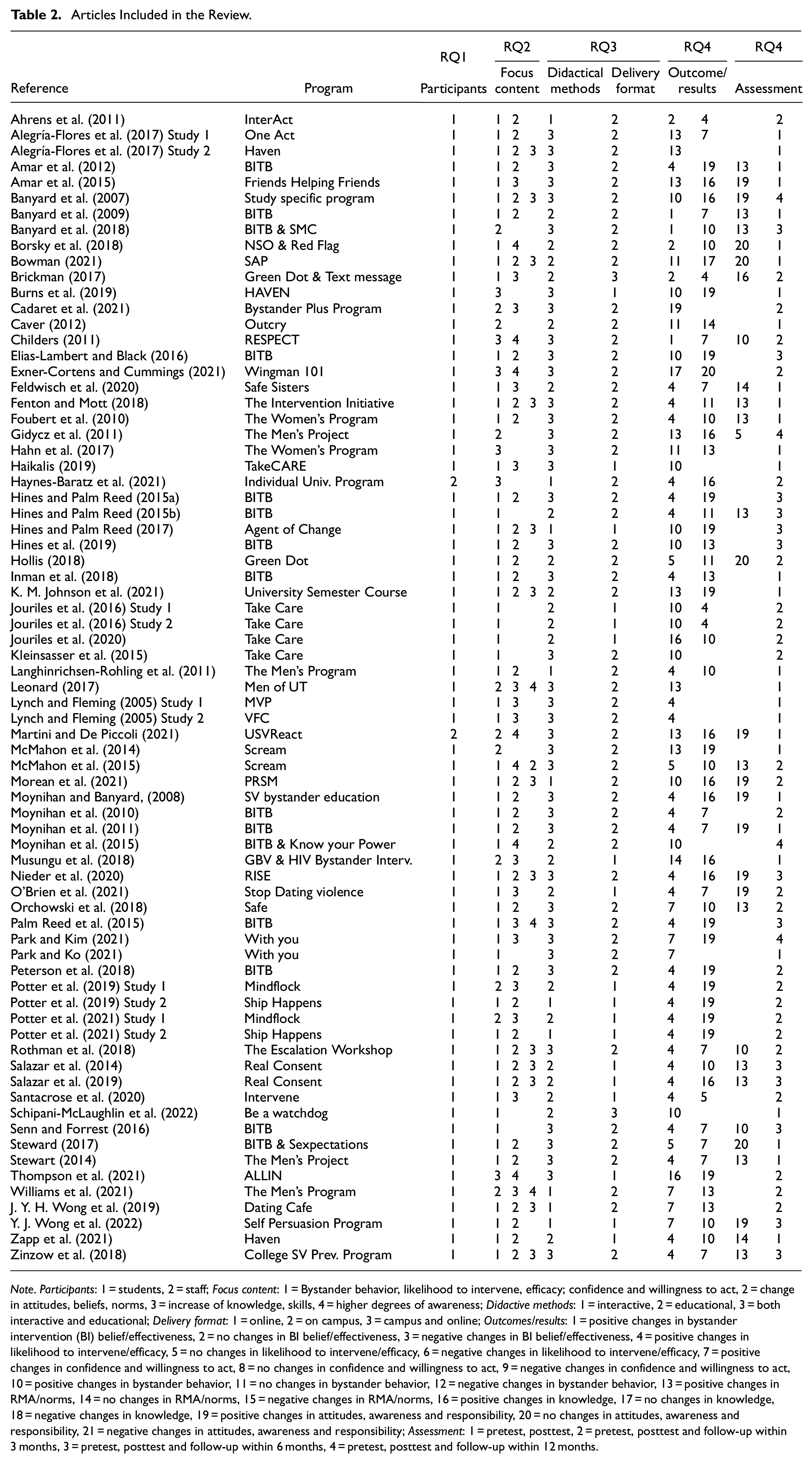
Note. Participants: 1 = students, 2 = staff; Focus content: 1 = Bystander behavior, likelihood to intervene, efficacy; confidence and willingness to act, 2 = change in attitudes, beliefs, norms, 3 = increase of knowledge, skills, 4 = higher degrees of awareness; Didactive methods: 1 = interactive, 2 = educational, 3 = both interactive and educational; Delivery format: 1 = online, 2 = on campus, 3 = campus and online; Outcomes/results: 1 = positive changes in bystander intervention (BI) belief/effectiveness, 2 = no changes in BI belief/effectiveness, 3 = negative changes in BI belief/effectiveness, 4 = positive changes in likelihood to intervene/efficacy, 5 = no changes in likelihood to intervene/efficacy, 6 = negative changes in likelihood to intervene/efficacy, 7 = positive changes in confidence and willingness to act, 8 = no changes in confidence and willingness to act, 9 = negative changes in confidence and willingness to act, 10 = positive changes in bystander behavior, 11 = no changes in bystander behavior, 12 = negative changes in bystander behavior, 13 = positive changes in RMA/norms, 14 = no changes in RMA/norms, 15 = negative changes in RMA/norms, 16 = positive changes in knowledge, 17 = no changes in knowledge, 18 = negative changes in knowledge, 19 = positive changes in attitudes, awareness and responsibility, 20 = no changes in attitudes, awareness and responsibility, 21 = negative changes in attitudes, awareness and responsibility; Assessment: 1 = pretest, posttest, 2 = pretest, posttest and follow-up within 3 months, 3 = pretest, posttest and follow-up within 6 months, 4 = pretest, posttest and follow-up within 12 months.
General Characteristics of the Bystander Intervention Studies
Most of the 68 included articles focused on a US context. Two studies were conducted in South Korea, and one each in the UK, Italy, India, Canada, China, and South Africa.
Since the publication of the most recent review by Mujal et al. (2021), 37 more articles have been published that match the inclusion criteria for the current review. Overall, we identified more than 45 different programs and initiatives that focused on bystander interventions relating to sexual violence in academic settings. The two most common programs reported on in the studies were Bringing in the Bystander (BITB) (15 studies) and TakeCare (five studies). The BITB is grounded in foundational work on bystander-focused prevention. The curriculum views all persons as potential bystanders or witnesses to risky behaviors related to sexual and relationship violence and teaches positive, safe ways to intervene. The model for the content is based on Latané and Darley’s (1968) situational model of bystander intervention (see Banyard, 2011). The TakeCare program is administered online, which makes it possible to reach many students (Karlin & Cross, 2014). In addition to its video format, TakeCare is much briefer than most programs, lasting less than 25 min, compared with one or several sessions lasting an hour or more.
Who Were the Participants? (RQ1)
Because we focused on university settings, various groups such as academic staff, administrative staff, and students would have qualified as potential participants. However, most of the studies (95%) included only the student population, and only two programs focused exclusively on university staff (Haynes-Baratz et al., 2021; Martini & De Piccoli, 2021; see Table 2).
The age of the student participants ranged from 18 to 22 years and, of those studies that reported race/ethnicity, the majority of the students identified themselves as White.
Although 68% of the studies used a mixed-gender group design, the majority of participants were women (in 86% of the cases). Some of the programs, however, like The Men’s Program and Outcry had 100% male participants (Caver, 2012; Elias-Lambert & Black, 2016; Exner-Cortens & Cummings, 2021; Feldwisch et al., 2020; Gidycz et al., 2011; Haikalis, 2019; Langhinrichsen-Rohling et al., 2011; Leonard, 2017; Lynch & Fleming, 2005 (study 1); Orchowski et al., 2018; Salazar et al., 2014, 2019; Stewart, 2014; Williams et al., 2021; Y. J. Wong et al., 2022), while a few programs—Stop Dating Violence, The Women’s Program, and Safe Sisters (Amar et al., 2015; Feldwisch et al., 2020; Foubert et al., 2010; Hahn et al., 2017; Moynihan et al., 2011; Nieder et al., 2020; Steward, 2017)—focused only on female participants.
The selection process in most of the studies depended on the voluntary participation of students, who were approached via study initiators or through other campus-based channels such as student associations. In other studies, participation in the interventions was essentially mandatory, for example, as part of an orientation week or a course.
What Was the Key Focus of the Content of the Included Programs? (RQ2)
To answer RQ2, the program content used in each of the studies was coded into the following categories: Bystander behavior, likelihood to intervene, efficacy, confidence, and willingness to act; Changes in attitudes, beliefs, and norms; Increase in knowledge and skills; and Higher degree of awareness (see Table 1). These categories were not mutually exclusive, that is, one study could focus on, for example, both the likelihood to intervene and changes in attitudes, beliefs, and norms.
The bystander intervention initiatives had different areas of focus. The two most common categories were: Bystander behavior, likelihood to intervene, efficacy, confidence, and willingness to act (56 studies), and changes in attitudes, beliefs, and norms (47 studies; see Table 2). For the first category, the most frequently focused content of the programs was a change in participants’ bystander behavior or the promotion of changes in bystander behavior (Ahrens et al., 2011; Alegría-Flores et al., 2017 (study 1 and study 2); Amar et al., 2012, 2015; Banyard et al., 2007, 2009; Borsky et al., 2018; Bowman, 2021; Brickman, 2017; Elias-Lambert & Black, 2016; Feldwisch et al., 2020; Fenton & Mott, 2018; Foubert et al., 2010; Haikalis, 2019; Hines & Palm Reed, 2015a, 2015b, 2017; Hines et al., 2019; Hollis, 2018; Inman et al., 2018; K. M. Johnson et al., 2021; Jouriles et al., 2016 (study 1 and study 2); Jouriles et al., 2020; Kleinsasser et al., 2015; Langhinrichsen-Rohling et al., 201; Lynch & Fleming, 2005 (study 1 study 2); McMahon et al., 2015; Morean et al., 2021; Moynihan & Banyard, 2008; Moynihan et al., 2010, 2011, 2015; Nieder et al., 2020; O’Brien et al., 2021; Orchowski et al., 2018; Palm Reed et al., 2015; Park & Kim, 2021; Park & Ko, 2021; Peterson et al., 2018; Potter et al., 2019 (study 2); Potter et al., 2021 (study 2); Rothman et al., 2018; Salazar et al., 2014, 2019; Santacrose et al., 2020; Schipani-McLaughlin et al., 2022; Senn & Forrest, 2016; Steward, 2017; Stewart, 2014; J. Y. H. Wong et al., 2019; Y. J. Wong et al., 2022; Zapp et al., 2021; Zinzow et al., 2018). Here, the focus could be on creating new community norms for intervening, increasing a sense of responsibility for intervening, increasing the participants’ feelings of competence, or providing role models that demonstrate positive bystander behavior.
For the second category, changes of attitudes, beliefs, and norms were the focus of the programs’ content in the following studies (Ahrens et al., 2011; Alegría-Flores et al., 2017 (study 1 and study 2); Amar et al., 2012; Banyard et al., 2007, 2009, 2018; Bowman, 2021; Cadaret et al., 2021; Caver, 2012; Elias-Lambert & Black, 2016; Fenton & Mott, 2018; Foubert et al., 2010; Gidycz et al., 2011; Hines & Palm Reed, 2015a, 2017; Hines et al., 2019; Hollis, 2018; Inman et al., 2018; K. M. Johnson et al., 2021; Langhinrichsen-Rohling et al., 2011; Leonard, 2017; Martini & De Piccoli, 2021; McMahon et al., 2014, 2015; Morean et al., 2021; Moynihan & Banyard, 2008; Moynihan et al., 2010, 2011; Musungu et al., 2018; Nieder et al., 2020; Orchowski et al., 2018; Peterson et al., 2018; Potter et al., 2019 (study 1 and study 2); Potter et al., 2021 (study 1 and study 2); Rothman et al., 2018; Salazar et al., 2014, 2019; Steward, 2017; Stewart, 2014; Williams et al., 2021; J. Y. H. Wong et al., 2019; Y. J. Wong et al., 2022; Zapp et al., 2021; Zinzow et al., 2018). One common focus was reducing acceptance levels of the rape myth (i.e., prejudicial, stereotyped, and false beliefs about rape, rape victims, and rapists, which creates a hostile climate for rape victims), as was changes in attitudes.
A focus on increasing the participants’ knowledge and skills in relation to sexual violence and gender-violence issues was identified in 35 studies (Alegría-Flores et al., 2017 (study 2); Amar et al., 2015; Banyard et al., 2007; Bowman, 2021; Brickman, 2017; Burns et al., 2019; Cadaret et al., 2021; Childers, 2011; Exner-Cortens & Cummings, 2021; Feldwisch et al., 2020; Fenton & Mott, 2018; Hahn et al., 2017; Haikalis, 2019; Haynes-Baratz et al., 2021; Hines & Palm Reed, 2017; K. M. Johnson et al., 2021; Leonard, 2017; Lynch & Fleming, 2005 (study 1 and study 2); Morean et al., 2021; Musungu et al., 2018; Nieder et al., 2020; O’Brien et al., 2021; Palm Reed et al., 2015; Park & Kim, 2021; Potter et al., 2019 (study 1); Potter et al., 2021 (study 1); Rothman et al., 2018; Salazar et al., 2014, 2019; Santacrose et al., 2020; Thompson et al., 2021; Williams et al., 2021; J. Y. H. Wong et al., 2019; Zinzow et al., 2018). Here the aim was, for example, increasing knowledge about sexual assault, the prevalence of sexual assault, rape culture beliefs, and sexual consent. Skill improvements included stronger self-efficacy for taking action to prevent violence and reducing perceived skill deficits.
The last category, a higher degree of awareness related to sexual violence, was investigated in 10 studies (Borsky et al., 2018; Childers, 2011; Exner-Cortens & Cummings, 2021; Leonard, 2017; Martini & De Piccoli, 2021; McMahon et al., 2015; Moynihan et al., 2015; Palm Reed et al., 2015; Thompson et al., 2021; Williams et al., 2021). Higher awareness concerned, for example, when and where sexual and intimate partner violence occurs, increasing awareness of rape culture, and dating violence being considered a problem.
What Didactic Methods and Delivery Formats Were Used? (RQ3)
To answer RQ3, the didactic methods used in the studies were coded into one of the following categories: interactive, educational, and both interactive and educational (see Table 1). The type of didactic methods indicated how the content was facilitated and presented to the participants. Some programs were based on interactive activities, whereas others followed more overtly educational approaches (i.e., more of a one-way communication). There was a clear trend toward using a combination of interactive and educational methods (56% of the studies). For example, educational content about the prevalence and consequences of sexual violence was presented, followed by interactive discussions about the meaning and importance of bystanders and their interactive participation in role-playing activities (Banyard et al., 2009; Hahn et al., 2017; Jouriles et al., 2020; Moynihan et al., 2010; Senn & Forrest, 2016). Some studies included measures wherein participants were asked to apply the transmitted knowledge interactively such as in a discussion or a scenario-based role-playing exercise, while others (30% of the studies) provided content using an educational approach. The more educational setting with one-way communication, implies that the participants had limited possibilities for interaction. One study, by Potter et al. (2019; study 1), tested a more playful educational approach that entailed the design of an online trivia game to instruct participants and strengthen their knowledge. The other method that Potter et al. (2019; study 2) tested entailed an interactive approach that focused on a role-based online adventure game with fantasy scenarios to encourage players to act as bystanders and intervene in scenarios involving potential sexual violence.
The delivery format of the programs could be: online, on campus, or a combination of campus and online. The most common format for delivering programs and initiatives was on campus (73% of the studies). For example, the BITB program was implemented on campus with educated trainers. Almost one-fourth of all of the studies were conducted online. Online programs do not require the same resources (e.g., physical space, trainers, and financing) as campus-based initiatives, and they are more convenient to implement because the participants can choose when and where to engage in the program. In only two of the 73 studies, the programs were conducted on campus as well as online, for example, by combining a physical intervention with a social media campaign (Schipani-McLaughlin et al., 2022) or a text message initiative (Brickman, 2017). These initiatives aimed to intensify the outcomes by using an additional online intervention to anchor the knowledge gained from the physical intervention.
What Were the Outcomes and How Were They Assessed? (RQ4)
To answer the first part of RQ4, the outcomes of the studies were coded as a positive change, no change, or a negative change with respect to the following categories: bystander intervention belief/effectiveness; likelihood to intervene/efficacy; confidence and willingness to act; bystander behavior; Rape myth acceptance/norms, knowledge, and attitudes; awareness; and responsibility. For example, the outcomes in the first category (bystander intervention belief/effectiveness) could be positive change, no change, or negative change. Thus, we used 21 options for coding the study outcomes (see Table 1). These categories were not mutually exclusive, that is, one study could include, for example, both a change in the likelihood to intervene and a change in attitudes.
In six studies, bystander intervention belief/effectiveness was measured as an outcome variable (Ahrens et al., 2011; Banyard et al., 2009, 2018; Borsky et al., 2018; Brickman, 2017; Childers, 2011). Three of these studies reported a positive change while the other three studies reported no change.
The most expected and measured outcome was the likelihood to intervene/efficacy. In 38 studies, the focus was on participants’ likelihood to intervene in a situation related to sexual violence (Ahrens et al., 2011; Amar et al., 2012; Brickman, 2017; Feldwisch et al., 2020; Fenton & Mott, 2018; Foubert et al., 2010; Gidycz et al., 2011; Haynes-Baratz et al., 2021; Hines & Palm Reed, 2015a, 2015b; Hollis, 2018; Inman et al., 2018; Jouriles et al., 2016 (study 1 and study 2); Langhinrichsen-Rohling et al., 2011; Lynch & Fleming, 2005 (study 1 and study 2); McMahon et al., 2015; Moynihan & Banyard, 2008; Moynihan et al., 2010, 2011; O’Brien et al., 2021; Palm Reed et al., 2015; Peterson et al., 2018; Potter et al., 2019 (study 1 and study 2); Potter et al., 2021 (study 1 and study 2); Rothman et al., 2018; Salazar et al., 2014, 2019; Santacrose et al., 2020; Senn & Forrest, 2016; Steward, 2017; Stewart, 2014; Zapp et al., 2021; Zinzow et al., 2018). Of these studies, 34 reported a positive change, four reported no change, and one (Santacrose et al., 2020) reported both a positive change and no change in participants.
In 18 studies, the outcome measure was participants’ confidence and willingness to act (Alegría-Flores et al., 2017 (study 1); Banyard et al., 2009; Childers, 2011; Feldwisch et al., 2020; Moynihan et al., 2010, 2011; O’Brien et al., 2021; Orchowski et al., 2018; Park & Kim, 2021; Park & Ko, 2021; Rothman et al., 2018; Senn & Forrest, 2016; Steward, 2017; Stewart, 2014; Williams et al., 2021; J. Y. H. Wong et al., 2019; Y. J. Wong et al., 2022; Zinzow et al., 2018). All of these studies reported a positive change.
Thirty-one studies measured change in actual bystander behavior (Banyard et al., 2007, 2018; Borsky et al., 2018; Bowman, 2021; Burns et al., 2019; Caver, 2012; Childers, 2011; Elias-Lambert & Black, 2016; Fenton & Mott, 2018; Foubert et al., 2010; Hahn et al., 2017; Haikalis, 2019; Hines & Palm Reed, 2015b, 2017; Hines et al., 2019; Hollis, 2018; Jouriles et al., 2016 (study 1 and study 2); Jouriles et al., 2020; Kleinsasser et al., 2015; Langhinrichsen-Rohling et al., 2011; McMahon et al., 2015; Morean et al., 2021; Moynihan et al., 2015; Orchowski et al., 2018; Rothman et al., 2018; Salazar et al., 2014; Schipani-McLaughlin et al., 2022; Senn & Forrest, 2016; Y. J. Wong et al., 2022; Zapp et al., 2021). A positive change was reported in 25 of these studies, and no change was reported in six.
Changes in norms and beliefs, along with an overall reduction in the acceptance of rape myths, were reported as outcomes in 29 of the studies (Alegría-Flores et al., 2017 (study 1 and study 2); Amar et al., 2012, 2015; Banyard et al., 2009, 2018; Caver, 2012; Feldwisch et al., 2020; Fenton & Mott, 2018; Foubert et al., 2010; Gidycz et al., 2011; Hahn et al., 2017; Hines & Palm Reed, 2015b; Hines et al., 2019; Inman et al., 2018; K. M. Johnson et al., 2021; Leonard, 2017; Martini & De Piccoli, 2021; McMahon et al., 2014, 2015; Musungu et al., 2018; Orchowski et al., 2018; Salazar et al., 2014, 2019; Stewart, 2014; Williams et al., 2021; J. Y. H. Wong et al., 2019; Zapp et al., 2021; Zinzow et al., 2018). A positive change was reported in 25 of these studies, while four reported no change.
Change in knowledge related to sexual violence behaviors/bystander behaviors/legislation was measured as an outcome variable in 15 studies (Amar et al., 2015; Banyard et al., 2007; Bowman, 2021; Brickman, 2017; Exner-Cortens & Cummings, 2021; Gidycz et al., 2011; Haynes-Baratz et al., 2021; Jouriles et al., 2020; Martini & De Piccoli, 2021; Morean et al., 2021; Moynihan & Banyard, 2008; Musungu et al., 2018; Nieder et al., 2020; Salazar et al., 2019; Thompson et al., 2021). In 13 of these studies, a positive change was reported, while two studies showed no effect related to knowledge level.
Thirty studies focused on change in attitudes, awareness, and responsibility relating to situations of sexual violence (Amar et al., 2012, 2015; Banyard et al., 2007; Borsky et al., 2018; Bowman, 2021; Burns et al., 2019; Cadaret et al., 2021; Elias-Lambert & Black, 2016; Exner-Cortens & Cummings, 2021; Hines & Palm Reed, 2015a, 2017; Hollis, 2018; K. M. Johnson et al., 2021; Martini & De Piccoli, 2021; McMahon et al., 2014; Morean et al., 2021; Moynihan & Banyard, 2008; Moynihan et al., 2011; Nieder et al., 2020; O’Brien et al., 2021; Palm Reed et al., 2015; Park & Kim, 2021; Peterson et al., 2018; Potter et al., 2019 (study 1 and study 2); Potter et al., 2021 (study 1 and study 2); Steward, 2017; Thompson et al., 2021; Y. J. Wong et al., 2022). Of these studies, 25 reported a positive change and five reported no change.
One of the inclusion criterions in this review was a pretest-posttest design. Most of the studies (41%) used only pretest–posttest assessments, 36% included a 3-month follow up, 18% included a 6-month evaluation, and 5% included a further evaluation after 12 months.
Discussion
The aim of this scoping review was to investigate bystander intervention programs focusing on the prevention of sexual violence in university contexts worldwide. In total, 73 studies (68 articles) met the inclusion criteria and were included in the analysis. The first of the four RQs focused on the program participants. Most studies were conducted with voluntarily recruited students, which could be interpreted as an indication of the students’ overall interest in being informed about this topic. However, because students were also compensated for their participation in several of the studies, their motivations for participating were difficult to determine. Even though most of the studies included both female and male students, the majority of the participants were female. This could indicate that the female students were more aware of the problem and therefore more motivated to participate. Only one of the programs in the included studies focused exclusively on university staff. Sexual violence is a problem not only for students, but also for faculty members. University staff can help contribute to changing the norms and culture, which is necessary for effective campus-based prevention efforts. Consequently, future bystander interventions should include university staff because they are potential bystanders and may also serve as role models for students.
The second RQ investigated the key focus of each program’s content. In most of the studies, the focus was on changing the behavior of bystanders and improving their self-rated likelihood to intervene. The scores for raising awareness were lower than the scores for other factors relating to program content. Students whose levels of awareness about the overall topic of sexual violence and associated risks are generally low may not notice critical situations, even though they may have the appropriate skills or efficacy to intervene. Although the variable, increased confidence and willingness to act, was the focus in some of the programs’ content, scores for the expected outcome and changes induced by associated interventions were lower.
The third RQ addressed in this review focused on how the intervention programs were conducted (i.e., the use of didactic methods and the delivery formats). Most of the programs provided content using a combination of interactive and educational methods. Research has shown that interactive elements such as role-playing in training programs emphasize engagement, which helps students reflect more actively on the training content and practice (Aljuwaiber, 2021). Studies that have compared face-to-face training with online training have shown that the former has a positive impact on students’ behaviors and beliefs as well as on their ability to create meaningful connections and interactions (Anggrawan & Jihadil, 2018). However, such training requires considerably more resources than online training, an issue that may be more prevalent in universities, given the limited availability of monetary and human resources for bystander intervention programs. Furthermore, it is likely that people have become habituated to working with digital tools as a result of forced remote working during the COVID-19 pandemic, and thus online options may be used on a wider scale in the future.
The fourth and final RQ addressed in this review focused on the programs’ outcomes and how they were assessed. The assessed program outcomes generally matched stated expectations of changes in the likelihood of participants intervening, increased self-reported efficacy, and increased likelihood that bystanders would intervene. This finding indicates that the designs of the programs contributed to achieving the expected outcomes and were aligned with the stated focus. Furthermore, the measured outcomes of decreased acceptance of rape myths and changes in norms and beliefs also matched the expected outcomes and foci of the programs.
Our findings show that most evaluations of the reviewed programs were conducted in the short term. Of the 73 selected studies, only 17 entailed 6-month or 1-year or both 6- and 12-month outcome evaluations. Although this indicates that, in general, long-term effects were anticipated, the remaining studies tested only immediately after the intervention (30) or at 3 months (26). Coker et al. (2020) found that bystander interventions conducted in high schools with a longer follow-up period of up to 3 years had long-term effects that may be sustained into early adulthood. Thus, there is a need for intervention programs to be continuously evaluated to develop bystander interventions that generate enduring prevention of sexual violence.
Our findings show, moreover, that bystander intervention programs for addressing sexual violence are still predominantly conducted in a US context, indicating the need to develop and evaluate such programs in countries other than the United States, where cultural concerns may differ. While more countries have conducted bystander intervention programs since 2017, as evidenced in this review, a huge imbalance remains in their global distribution. Because we also included studies from Europe, Asia, and Africa, our review revealed a stronger presence of international studies compared with that conducted by Mujal et al. (2021). The publication of 37 new studies since 2017, when the last review was conducted, indicates the relevance of this constantly evolving topic.
Limitations of the Study
The present study had some limitations that should be addressed in future research. First, given that this was a scoping review, we did not evaluate the quality of the selected studies or the specific assessment methods used, even though a pretest–posttest design was an inclusion criterion.
Second, only five databases were searched, and papers not published with full text or in English were excluded; thus, there is a risk that some relevant studies were not included.
Finally, scoping reviews in general are limited by their specific search strategies. Therefore, we may have overlooked relevant studies that used other associated terms in their titles or abstracts.
Conclusion
The present scoping review of bystander intervention programs focused on sexual violence contributes to the existing literature by providing knowledge about various extant programs and initiatives for training students to become active bystanders and to help others when witnessing a critical situation. Acts of sexual violence are often viewed as dyadic interactions between the victim and the perpetrator, a perspective that overlooks the important role of bystanders. Involving bystanders in prevention programs can lead to better outcomes when combating sexual violence.
Most of the studies included in our review targeted the student population. In the context of academia, staff and faculty members are also important actors in addressing sexual violence, given that it is prevalent in all areas of academia.
A notable and practical finding is that most of the intervention programs examined achieved their intended outcomes relating to bystanders and sexual violence, at least in the short term. This suggests that organizations outside of academia may also benefit from investing in these kinds of preventive initiatives. Providing employees with clear and effective intervention strategies when they witness workplace violations can reduce harassment. Empowering workers to properly challenge abusive behavior can inspire cultures of accountability and safety.
Implications for Future Research
As we stated at the outset, studies have shown that the number of sexually violent acts among students remains high (e.g., 44%–61% among students in the US; Cantor et al., 2015). This situation is alarming and indicates that the efforts by members of the public and of societies to combat this issue have not led to a decrease in rates of sexual violence. Clarification on what individuals perceive as sexually violent behavior and how this may differ when viewed from an intersectional perspective, and in different cultural settings, is necessary to shed further light on potentially effective approaches for tackling this challenge.
Some studies have indicated that gender is an influencing factor in bystander interventions, in that it can be a predictor of, for example, acceptance of rape myths and bystanders’ attitudes (McMahon et al., 2014). Hence, future studies should attempt to advance understanding of the impact of gender on attitudes, behaviors, and beliefs and, more specifically, on how this knowledge can contribute to the design and development of bystander intervention programs. For example, they could evaluate which combinations impact participants in training programs involving single-gender or mixed-gender groups and what the content is of these programs.
Additionally, most programs included in our review lacked a diverse perspective. For example, some focused on female or male heterosexual students but did not consider other sexual identities. Moreover, except for one study (Burns et al., 2019), none of the programs took an intersectional approach; most of them focused either on gender or on social affiliations in student life, such as sporting associations or fraternities/sororities. This lack of research leaves us with fragmented insights into how having several marginalized identities (e.g., being Black, queer, and a woman) may further complicate an individual’s experiences (e.g., Buchanan & Ormerod, 2002; Buchanan et al., 2008; Texeira, 2002). Developing bystander intervention programs that incorporate an intersectional approach could advance understanding of individuals’ attitudes, beliefs, and behaviors relating to sexual violence through the consideration of multiple identities and experiences (Collins & Bilge, 2020).
Footnotes

Declaration of Conflicting Interests
The author(s) declared no potential conflicts of interest with respect to the research, authorship, and/or publication of this article.
Funding
The author(s) received no financial support for the research, authorship, and/or publication of this article.
Ethical Approval
Since this is a scoping review, ethic approval is not applicable
Data Availability Statement
Data sharing not applicable to this article as no datasets were generated or analyzed during the current study.