




Abstract
Extensive studies related to women’s entrepreneurial motivation are available in the western context, however, only a few studies are found focused on factors that motivate Egyptian women to engage in entrepreneurial activities. The study explores in-depth the motivations behind female entrepreneurs’ efforts to establish business ventures in Egypt. It analyses the influence of macrosocial realities and cultural values on the motivation for entrepreneurship. The finding demonstrates how post materialism factors motivate Egyptian women to embrace entrepreneurial activity as a way to maintaining “personal freedom”. The results demonstrate the impact of the Arab patriarchal culture on shaping the Egyptian women motivation. The qualitative research approach is adopted in this study to explore the entrepreneurial motivations of Egyptian women entrepreneurs. Through purposeful sampling, 20 women entrepreneurs were selected from five Egyptian governorates to administer a semi structured interview for the collection of primary data. The findings indicated that the motivation of Egyptian women entrepreneurs cover a variety of intrinsic and extrinsic motivations. Intrinsic motivations include maintaining personal freedom, satisfying their creative impulses, utilizing their knowledge derived from education training courses and work experiences, exploiting business opportunities, achieving a sense of self -actualization, improving social motivation. On the other hand, extrinsic factors include the inability to find a suitable job, death or illness of a family member, the need to supplement the family income, unfavorable job routine. The research on female entrepreneurs in the context of Egypt is essential as this study responded to calls for a thorough understanding of women’s entrepreneurial motivations. By studying these factors, the study would be able to show that motivations are unique and differentiate from other contexts.
Keywords
Introduction
Economists consider entrepreneurship as a mechanism for economic growth and development (Hamdan et al., 2020; Ordeñana et al., 2020; Saberi & Hamdan, 2019). It is witnessed that the higher entrepreneurial activities in a country, the higher it would lead to consumerism and innovation (Galindo-Martín et al., 2019).
Moreover, in the countries that historically have suffered the issue of gender inequality, entrepreneurship has been portrayed as a critical tool to bring in social and economic changes (Zayadin et al., 2020, 2022), that significantly induce women empowerment (Khan & Abass Bhat, 2022; Yen et al., 2022), and reduce poverty (Dzingirai, 2021; Naminse et al., 2019; Xu et al., 2022).
It is widely consented that entrepreneurship has contributed toward economic development and social inclusion, and although both female and male are totally represented among entrepreneurs, the importance of the role of women in the economic gross is well-recognized (Mahajan & Bandyopadhyay, 2021).Women entrepreneurship is one of the fastest-growing areas of development, making a significant contribution to poverty alleviation worldwide, through innovations and the creation of wealth, as well as employment opportunities (Sarmah et al., 2021).
The literature related to the developing world shows that the effect of female entrepreneurship is more useful in terms of household welfare. Women are inclined to spend more on health, education and nutrition (Adzo Seshie-Nasser & Daagye Oduro, 2018). Furthermore, female-owned businesses also tend to employ more women (Adam et al., 2017), thus creating a ripple effect in the context of women empowerment, especially in the developing world.
The need to enhance the status of women and the awareness of women’s roles in the economic growth is no longer considered merely as an issue of gender equality or social justice. Women represent significant human resources; therefore, their participation in economic activities can significantly improve the overall economy of the country.
Women entrepreneurship is considered an essential means of achieving women’s empowerment, hence, there is a growing trend of women entrepreneurs actively launching and managing businesses worldwide (Marques et al., 2019). While entrepreneurship has been a growing area of research globally, concentrating on women entrepreneurship in the western perspective specifically studied their challenges and motivations. However, there is paucity of in-depth researches investigating female entrepreneurship in the Middle East North Africa (MENA) specifically in Arab Middle East (AME), and Egypt is no exception.
MENA’s social, economic, and cultural aspects are totally different from other regions. Existing literature has not presented a thorough understanding about the motivation for women entrepreneurs starting a business in (AME), including Egypt (Panda, 2018). A few Arab women entrepreneurship studies investigated their entrepreneurial motivations and the constraints they face. Behavior and performance of women-led business studies in the Arab world are less likely comparable to other regions (Bastian et al., 2018). So, more research that focuses on the specific national and cultural impact on women entrepreneurs, specifically in developing countries, is gravely needed to understand the challenges and motivations of women entrepreneurs (Ghouse et al., 2017).
The current study aims to explore Egyptian women entrepreneurs’ motivation within macro socio-economic context in Egypt. These types of researches would enable policymakers to enhance female entrepreneurship in developing countries (Leonidou et al., 2020).
Significance of the Study
Given that, females have a variety of motives to engage in business, and these motives vary from context to context, depending on the economic, educational, and cultural disparities (Bui et al., 2018; Shastri et al., 2022; Solesvik et al., 2019).Hence, this study is significant for several reasons. It contributes toward a more thorough understanding of the entrepreneur motivational construct, by providing new evidence from a developing country of what motives drive women to engage in entrepreneurship. In additional, female entrepreneurs are a crucial part of the Egyptian economy but are still understudied (Classification, 2019). Therefore, the findings of this research would assist to develop policies and programs that could encourage and promote economic growth, as well as to address issues related to female empower.
In respect to distinguishing the national and cultural impact, the objective of this study is to explore the factors that motivate Egyptian women to become entrepreneurs using the push and pull motivation theory.
The study is guided by the following research question, What factors motivate women to become entrepreneurs in Egypt?
Contribution of the Study to Literature
However, dearth of studies examines the phenomenon within other side of low-level economic countries in AME region. Moreover, no study explores the factors behind non-materialistic motivation within non-well economic countries such as Egypt.
Therefore, the current study is unique and contribute to subject knowledge for many reasons, first for its purpose to explore women motivation in paucity research context (Egypt) which differentiae from western context culturally and economically from GCC context which exist in the same MENA region. Second, the findings of the study unique in how they demonstrate interplay between the macro and micro factors that create Egyptian female entrepreneurial motivations.
The findings evidenced the strongly impact of culture and religion values upon entrepreneurial motivations. Therefore, the entrepreneurial motivations of women are reflective of characteristic of the Arabic and Muslim culture in Egypt. Finally, the findings unfold very vital conclusion that, although the economic differences among western, GCC and Egypt context, however, the findings illustrate that part of Egyptian women motivations converge with reported in GCC and western context that is non- materialistic motivation
The study is organized as follows: Given the context of the study, the section 1 deals with introduction, sections 2 and 3 present the role of women in Arab culture, and the theoretical back ground respectively. Sections 4 and 5 present methodology and findings, and finally, section 6 concludes the study with policy recommendations, and limitations and suggestions for future research.
Background of Egypt’s Women Situation
Female labor force in Egypt witnessed increase by 0.5% from 2010 to 2015. Thus, female employment rate increased by approximately rate 0.9%, while the female unemployment decreased aggressively from 13.7 to reach 44.3% in 2015. Although Egypt is moving notably toward the direction of entrepreneurship, this is not reflected across the Egyptian women. A recent study investigated the status of women entrepreneurs’ business performance in Egypt descripted it as a “hostile environment” (Welsh et al., 2018).
The study pointed out that the recent unstable political status, Socio -economic and gendered culture in Egypt all conducive to make it as one of the most unpredictable environments in which star-ups can operate in. That unfavorable environment against business women reflected in the number of women entrepreneurships in the country where Egyptian female entrepreneurs account for 1.80%, while their male counterparts account for 10.30% (Ismail et al., 2017).
Egypt is insisting to achieve Global Sustainable Development Goals (SDGs), thereby. Egypt’s sustainabledevelopment (Egypt vision 2030) efforts have been put in place since 2015. Thereby, certain key performance indicators (KPIs) addressing sustainable development goal number five, which is gender equality including increasing the female labor force participation and increasing Egypt’ rank in the international gender gap index. Given that, Egypt adamant to encourage women in business through enforcing law as well as draw policies to enable women to engage in entrepreneurial activities.
To explore women entrepreneurs experience, it is important to examine the culture of entrepreneurship and the position of women in the context. Egyptian society derives its values, beliefs and behaviors from Arab culture.In this regard, many studies refer that, construct such entrepreneurship, Patriarchal sociocultural values and gender inequality negatively effect Arab women’s entrepreneurial (Abou-Moghli & Al-Abdallah, 2019; Aljuwaiber, 2021; Alsaadi et al., 2019; Al-Weshah et al., 2022; Baradie & Tahir, 2019; Constantinidis et al., 2019).
Egypt is patriarchal and male-dominated country with strictly defined gender role, where women are mainly responsible for household duties and caregiver for their children, while men are primarily the breadwinners. Egyptian society as part of Arab world, instill these gender roles in children mentality, they are made to learn how to behave according to gender and expected to adhere to defined gender roles (Laffineur et al., 2018).These macro-sociocultural values portray the social and political institution of the society which reflect and promote values and beliefs (Naguib, 2022; Zaki & Zeini, 2019).
Furthermore, macro-sociocultural values also have wide impact on human behavior including that of entrepreneurship (Hofstede, 1980, 1994, 2001). These macro- sociocultural values are widespread in the Egypt, reflected to that make it hard for Egyptian women to start and manage own business or be engaged in entrepreneurship (El-Fiky, 2022). Despite Islam encourages the idea of women running business (Tlaiss & McAdam, 2021),simultaneously, it supports gender differences by granting men authority over women in terms of financial responsibility, making, marriage and divorce (Khedr, 2017).
These notions have encouraged some of masculinity proponents specifically in rural Egypt to strictly deny the idea of women as business owners (Khodary, 2022).The cultural values, described gender role and society restrictions that Egypt women face at macro level conducive to be affected upon their employment and entrepreneurial experience (Shorbagi et al., 2017).
Theoretical Background
Women Entrepreneur Motivations
Although past studies presented that male and female entrepreneurs as having the same demographic characteristics, there are differences pertaining to their entrepreneurial motivations and challenges (Agarwal et al., 2018; Özsungur, 2019).There are diverse reasons that contribute to women’s decision to engage in entrepreneurship such as the desire for independence (Rayan, 2019; Shastri et al., 2019a), to increase income (Solesvik et al., 2019), and family factors (Isaga, 2019).
The widely known push/pull model (Kirkwood, 2009; Zimmerman, 2013) of entrepreneurship has been described as a useful framework to understand the motivation for a business startup. The push factors, extrinsic in nature, and described as a supply factor, is often seen as factors that push people toward entrepreneurship as a desire to change current uncomfortable state to a desired one (Nguyen et al., 2020). Push factors motivate women to engage entrepreneurship owing to the forced reasons like the perception of necessity and societal pressures and are linked with dissatisfaction (Goswami et al., 2019). Studies demonstrated that individual sengage in entrepreneurship as a result of dissatisfaction with being unemployed or job salary (Nasiri & Hamelin, 2018), dissatisfaction with working hours which create an imbalance in work-life responsibilities (Özsungur, 2019), being an immigrant (Shinnar et al., 2019), or pursuing a family profession (Ramadani et al., 2017).
In addition to working women who are suffering from organizational discrimination and a “glass ceiling’’ situation, push factors play important roles in pushing them away from paid jobs,and shifttowards a solo business (Mahmood et al., 2021). In contrast, the desire to start up a business is due to the expectation of financial needs. Non-financial benefits are considered as pull motivation (Kirkwood, 2009).
Among non -financial reasons are the desire toward independency/autonomy, personal accomplishment, development and social recognition (Shastri et al., 2019a; Tabari & Chen, 2022). Another set of studies suggests that women entrepreneurs may be motivated by both pull-push factors (Dawson & Henley, 2012; Kirkwood, 2009). While women and men were pulled in a similar way toward entrepreneurship, the push factors related to their familial duties play a crucial role in pushing women toward entrepreneurship (Kirkwood, 2009).
While the push and pull model is largely used to analyze the motivation of women entrepreneurs in both developed and developing countries, there is still a lack of studies that examine the effect of institutions on entrepreneurial motivations (Bui et al., 2018).Institutions denote to the stable structures which organize human transaction (Aeeni et al., 2019), and were divided into two types, formal and informal (Kaufmann et al., 2018; North, 2005).
Formal institutions refer to legal, political, and economic constitutions, whereas laws and policies aimed to organize, control and legitimize individual behaviors. While the informal one denotes to norms, values, beliefs and attitudes insociety (Aeeni et al., 2019; Fuentelsaz et al., 2019), which have an important role in shaping desirable entrepreneurial behavior such as risk-taking and independent think.
Societies where institutions treat women equally with men would witness greater entrepreneurial activities (Arabiyat et al., 2019; Pathak et al., 2013), and would pull more women to create their own businesses, and legitimation may be adopted by a formal institution such as to introduce tax incentives, develop entrepreneurial training program,and create funding resources more oriented toward the females.
In the literature, it is noted that the motivation underpinning the creation of businesses differ across countries (Benzing & Chu, 2009; Jabeen et al., 2020; Solesvik et al., 2019). Moreover, research examining entrepreneurial motivation in developed countries found that the challenge and desire for achievement or in other words, non-materialistic motivations (Zgheib, 2018), are more important than necessity or materialistic drives.
Whereas in low-level economic development countries such as Romania, Ghana and Kenya, income increasing or materialistic motivations are significantly more important than non-materialistic ones (Amorós et al., 2020; Benzing & Chu, 2009).These findings suggested that motivational factors may differ among countries according to their development level, perception of business opportunities (Benzing & Chu, 2009; Galindo-Martín et al., 2019; Li & Kang, 2022; Solesvik et al., 2019; Zisser et al., 2019), or culture as well as the role of gender are significant in understanding differences in entrepreneurial motivations.
The literature on gender and entrepreneurship has revealed significant gender differences and noted that financial motives are less important for women (Naguib, 2022; Shastri et al., 2019a; Tabari & Chen, 2022).
Therefore, an individual’s intention to start up a business is based on the motivations that play a crucial role in shaping that individual’s intention. Push and pull model is broadly used to describe entrepreneurial motivation which divided it into two types of motivation: on one hand, push motivations forced the individual to engage in entrepreneurial activities in order to change an undesirable current state to a more desirable one.
While pull motivations draw the individual to entrepreneurial activities based on the opportunity’ perception or need for personal accomplishment. According to the literature which argue that the entrepreneurial motivation differentiate upon the economic, political and culture context, the following table illustrates the major motivations AME women to engage in entrepreneurship. Table 1 presents the existing studies on push and pull motivations of AME’s women.
Push-Pull Motivations: AME’ women.

After demonstrating the literature about women motivation in western and AME context, the study would explore if the Egyptian entrepreneurs’ women motivations similar with those in other contexts, and what is the factors underly these motivations.
Methodology
Given the exploratory nature of the studywhich demanded an adoption of a qualitative method in the present study. A case study approach is appropriate to investigate the relationship-based phenomena (Jack, 2010), specifically for the studies focusing on “how” and “why” questions (Yin, 2009), pertaining to a contemporary phenomenon within a real-life context. The aim of present study is to explore why females take the entrepreneurial path?.
Employment of the qualitative approach as a research strategy can be attributed to the nature of the research which focuses more on the meanings in the behaviors rather than quantification, either for the collection or analysis of data. Contrary to the quantitative methods, the qualitative method is inductivist, constructionist and interpretivist (Azungah, 2018; Pham, 2018)).The role of a researcher is not as an external actor but instead, s/he is involved within the subject of study to uncover the phenomenon (Shidur Rahman, 2017).
This approach is widely adopted because it produces rich information about ambiguous phenomena to gain an understanding of the underpinning reasons, beliefs, and factors (Moser & Korstjens, 2018). Qualitative research method collects open-ended data and then employ it to develop a notion(Busetto et al., 2020).
Egypt as country-specific context comprises of (27) governorates, due to limited time factor only five governorates were selected as the sampling areas. The five governorates were selected carefully, to reflect the real characteristics of Egypt whether economically, ethnically and culturally. Taking into consideration the diversity of the Egyptian culture which ranges from conservative, moderate, to open-minded culture.
The researchers purposely selected the governorates sample area from different geographical areas to examine the extent to which the distance from the capital or huge market will have an impact on the entrepreneur’s decision, and to assess the impact of the various levels of infrastructure and facilities on entrepreneurial activities. Due to the lack of data about female entrepreneurs in Egypt, the study has applied the non-probability sampling, specifically, purposeful sampling to select cases of female entrepreneurs (Ames et al., 2019).
The reason behind this approach is to provide a non -probability sample that is not represented fully, but it is still an information-rich sample. This method targets those cases which can deliberately provide significant information (Moser & Korstjens, 2018). Purposive sampling is used to select the information-rich sample participants who could provide important relevant information about the research questions (Al-Asfour et al., 2021).
The data on women entrepreneurs were collected through conducting 20 sessions of semistructured interviews. This type of interviews had enabled the researchers to ask more open-ended questions and gained rich and in-depth answers from the women entrepreneurs who were willing to share their experiences (Ames et al., 2019; Busetto et al., 2020). For the purpose of checking the reliability and validity of the research, a sample of the interview questions was sent to two entrepreneurship academicians to review the questions and their suggestions to adjust some questions were considered. In addition, a pilot test of the interview questions was performed on a sample of five people to determine whether the questions were easy to understand and answer. Interviews took place between July and December 2020. Each interview lasted between 45 and 75 min; the interviewer used the Arabic language in order to ease the communication with respondents. The interviews were digitally recorded upon interviewee’s consent, and was transcribed a day after the interviews were done. These were then translated into the English language by a professional translator.
The written scripts were between five to ten pages in length. The questions were organized around the(motivations)coding and themes technique, which were used to analyze the data, as such analysis goes deeper beyond the obvious meaning of the words (Clarke, Braun & Hayfield, 2015).
The governorates and the reasons for the selection is presented below.
Cairo
It is the capital of Egypt with a total population of (9,656,074) according to (CAPMAS, 2018). It was chosen for its population as it hosts (10%) of the Egyptian population. It also hosts ministries, municipalities, a number of women associations, SME funds, and other institutions which are relevant to the study.
Assiut
It is one of the Upper Egypt governorates, and is considered as one of the poorest governorates in Egypt (CAPMAS, 2017). However, women entrepreneurship rate in Upper Egypt is very low, and Assiut is no exception. Hence, it is worthy to select it on the economic basis, attempting to draw a fuller understanding of the factors underpinning the low rate of women entrepreneurial activity even though the Assiut governorate has many reasons to create the push factor for entrepreneurs such as the high rate of poverty and low rate of employment.
Aswan
Aswan a governorate borders with Sudan, 1000 kilometres far away from Cairo (capital) and is heavily dependent on tourism as a source of income. The governorate was chosen for itsethnic diversity such as the (Arabic–Nubian) tribes and its diverse economic activity such tourism, .
Buhaira
It is a prominent governorate for a multitude of women-led businesses, as it has the highest number (39%) of women business owners in Egypt (ILO report, 2017). Therefore, it is worthy to explore the factors encourage the women in this governorate to start up their own businesses and attempt to understand which are the motivations behind this high rate of women entrepreneurship in Buhaira.
Sinai
Sinai characterized by tourist attractions such as beach, conference, therapeutic, as well as oasis tourism. It has plenty of mineral materials, Sinai people belong to several nomadic tribes, the Bedouins constitute 60% of the population of the governorate. After the 25th January 2011 uprising, the governorate suffered from terrorist attacks by extremist Islamic militant groups. Sinai governorate was selected for several reasons, including its distinction in Bedouin culture, an attempt to examine the influence of this culture on women entrepreneurship, and to investigate the impact of religious extremist groups on women entrepreneurship.
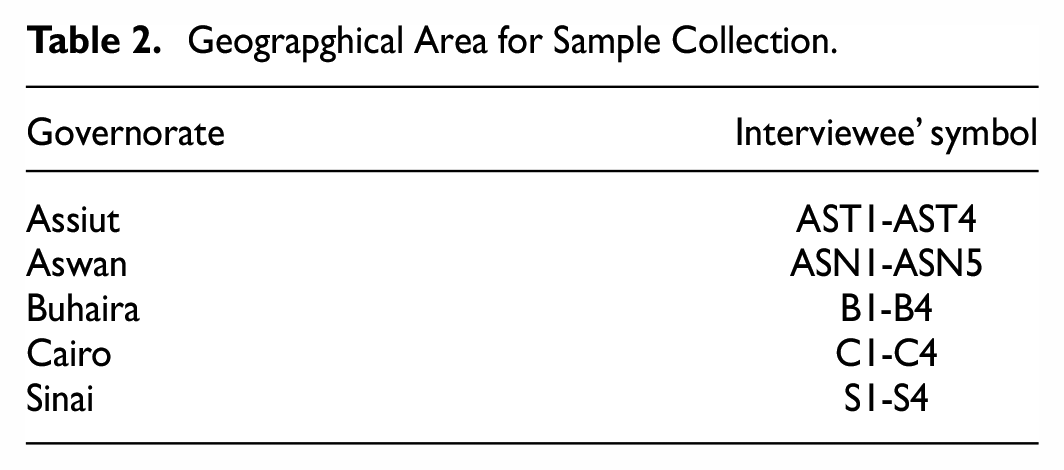
In order to protect the identity of the respondents, a different symbol was assigned to each interviewee as shown in the Table 2:
Geograpghical Area for Sample Collection.
Findings
This section aims to present the findings of the study through analyzing the data collected from twenty Egyptian female business owners. The respondents were distributed geographically from five Egyptian governorates namely: Assiut, Aswan, Buhaira, Cairo, and Sinai. These areas are diverse economically, socially and culturally. The sample was distributed randomly in different sectors.
The research question concentrated on examining the respondents’ understanding of themselves as business owners, especially in the perspective of motivations for establishing their own business avenue.
What are the motivational factors that encourage Egyptian women to get involved in entrepreneurial activities?
The research aimed to answer the question by using semi-structured qualitative interviews. The purpose of the research question was to explore why Egyptian female business owners engage in their own business as a career option. Also to explore their motivations whether it was the push or pull factors or both factors which motivated them to pursue entrepreneurship. The researchers collected very informative data to explore the intentions underpinning the establishment and operation of businesses by these women.
Almost all of the respondents said that one of the main entrepreneurial intentions to start their own business was to satisfy their desires for independence, maintaining “personal freedom” in their conservative society, develop their talents either in drawing, photography, fashion design, etc. Among other reasons of having entrepreneurial intentions were seeking for self-fulfillment, grabbing the availability of business opportunities, supplementing financial needs, disliking job routines, breaking through the glass ceiling, and some of them were pulled by social motivation to become a helpful member of the society. It is obvious that the motivations were divided between pull and push factors.
Results of the interviews demonstrated that most of the businesswomen sold products and services oriented toward the women segment, such as female fashion, beauty centers, kindergartens and ladies party management, retails. Such businesses are characterized by their low exit and low entry barriers. Analysis illustrates that, the interviewees tended to focus on the small range of capital required to start them up.
The most salient and surprising motive is that most interviewees in rural Egypt and although economic level, they pulled to entrepreneurship for non-materialism motivations. They seek to prove their abilities and exert the freedom. As result of barriers and restricted rules defined woman’ behaviors, women were pulled to entrepreneurial activities to have a say in their lives.
Conservative Glass Ceiling Factor
Rather than a career glass ceiling that attributed to hostile female work environment, females in a rural and conservative society are facing different type of the glass ceiling, that ceiling resulted from a conservative and masculine culture. To achieve a breakthrough from this harmful environment, the women adopt an entrepreneurial path to experience the freedom and independence that they were missing. The majority interviewees in rural Egypt emphasizes this meaning.
“I love this kind of handicraft and I have a passion for creating my own business venture. Unfortunately, being a female who has been born and raised in the Upper Egypt society put many obstacles in my way to achieve my dreams. Females in the Upper Egypt region are facing very tough challenges more than any other region in Egypt, women here are not allowed to work outside their home except the governmental jobs which are suitable for women in respect to time and fixed income. Moreover, they cannot travel alone without their guardian or one of her male siblings. Female early marriage is common where the female role is defined to raise kids and perform home chores. In order to achieve self–actualization and satisfy my creative talent, I have started making the handcrafted dresses in my home. By doing so, I fulfill my desire to be an entrepreneur and prove that woman has the ability to succeed in business, at the same time conform with our restricted societal norms by avoiding working outside the home.” Respondent AST 1,a dress designer and maker mentioned this.
This finding emphasizes that the women seek to obtain their independence, freedom and control over their lives which they feel were missing aspects from their lives. Thus, women pushed toward entrepreneurship to recognize them. However, this study is unique in concluding that, The Egyptian women specifically in rural area used entrepreneurial activities and were pushed toward it, to negotiate the macro -sociocultural values embedded within Egyptian society.
More importantly, the finding illustrates that notwithstanding low economic level in Egyptian rural, women there engage entrepreneurship basically by non-materialistic motivations. The interviewees explained their lack of materialistic motivation by referring to socio cultural value and rules which placed financial income on male responsibility.
Job Glass Ceiling Factor
It seems that the glass ceiling factor is one of the reasons underpinning female entrepreneurial activity as many females take the entrepreneurial path to escape either from a non-favorable job condition or their masculine conservative society. Two respondents mentioned their desire to demolish the glass ceiling as their entrepreneurial motivation. As an example of the former situation, ASN1, is a former banker who is currently managing multi- entrepreneurial activities: she has a financial consultation office and is also manufacturing traditional Nubian jewelry.
She mentioned that:
“I joined the banking sector for many years, I have a higher diploma in finance, however, I realized that I could not reach a higher career position which is exclusive for men.This strong nepotism and male domination culture pushed me to embrace autonomy in business. Many colleagues shared the same frustration that some of them took a risk and started their own business venture, while the others have been adapted with that situation.”
Skills and Talent Behind Entrepreneurship Motivation
Three respondents believed that their skills and talent have given them the power and confidence to start their own business.
For example, B1 is a makeup artist and runs her beauty center in Buhaira, who said that:
“I am a lawyer and I had worked in a law consulting office for two years. However, because I am talented in makeup since school days, I used to dress up and make up for myself and my friends. Thus, I quit my salary job and have established my own beauty centre. I took this decision to follow my passion in the field as a makeup artist. In this field, I can develop professionally.”
However, it seems that some entrepreneurs combined their talent with knowledge and leveraged it to start their business. As a photography studio owner, C2, cited that:
“I have always had a passion for photography since school days. I used to take pictures of my relatives, my friends and my family, especially at my relatives’ wedding parties. At the same time, I have graduated from a Commerce college with a degree program containing a subject in marketing. Therefore, in the last year of college, I used to take pictures of other people’s products for the purpose of marketing it (using digital marketing). By doing so, I have exploited my hobby and the knowledge that I acquired during college. After that, I took up a business that includes photography of weddings, birthdays, and other parties.”
In a similar previous narrative, C3, owns a workshop for dyeing fabrics using the batik technique. She has an Art degree and has had a job as an art teacher in the school for many years. She recites her story and tells the reason behind starting her business:
“I have a degree in the art field, I was a teacher in school with a good a monthly salary, I preferred to quit and use my talent and knowledge attained from college to establish my own workshop which specializes on dyeing fabrics by batik technique, it is a new technique in Egypt. The origin of that technique is in South-East Asian countries i.e., Malaysia, Indonesia. I started my business for two reasons: firstly, to recognize myself, and to spend more time for my passion in art.”
Women consider the self-fulfillment factor as a very crucial motivation that pulls them to have their own enterprise.
Financial Needs Motivation
Although all entrepreneurs have different factors as either push or pull motivations, obviously their financial background and status play a vital role to encourage them to pursue business. Three respondents mentioned necessity needs as a factor behind starting their business. As an example, respondent C4 has a dress workshop. Her products are targeting tourists, where she is tailoring dresses with Pharaonic drawings, and she attributed the reason behind starting her business to meeting the financial needs as push factors. She said in this regard:
“My husband is a handicapped and his income was insufficient to give us a better living. My husband did not force me to enter the business field, but I felt that I can do something to increase my family’s resources in order to improve our financial situation. I had gained the skills and know-how from my previous job, as I was a worker in a dress factory for many years. This job gave me many experiences about design and tailoring a female dress. In order to start my own business, I used to save money acquired from that job.”
Similarly, as a necessity motivated entrepreneur, B3, has an online shop selling perfumes and cosmetic products. when she was asked about the motivation behind engaging in a solo job, immediately she answered that:
“Our kids are growing, and our expenses started going up dramatically as their requirements are also increasing. The kids started going to school and we had to pay for school admission and tuition fees. They joined a private education centre to improve their academic level. All of which put a huge financial burden on our shoulders. Furthermore, the limited income of my husband no longer fulfills living needs as before. Thus, I have set my online shop to get dual benefits; and to increase our financial resource and devote sufficient time to perform daily household chores.”
Lack of Employment Opportunity
Inability to find a suitable career-oriented job was also regarded as a reasonable factor given by two of the interviewees. For instance, respondentS4, the owner of a workshop for designing and manufacturing home accessories, cited that:
“I had a job in a reputable company, but after 2011, as soon as the first uprising in Egypt broke out, I had been dismissed from the company. I looked for another job but I failed to find a suitable one. My husband encourages me to start my own enterprise. Before marriage, I had a hobby of designing home accessories. Indeed, I established my workshop in 2016 and it achieves considerable sales.”
Besides the previous examples of push factors, there are other types of extrinsic motives.
Death or Illness of Family’ Head
These motives may be the result of death or illness of the head of the family. That situation applied for respondentsS2. When the interviewer asked her about the motivation behind starting her business, she answered:
“Although I was a teacher, I entered the business field twice. The first time was when my father had fallen ill, and I had to quit from my teaching career to devote my time to manage my father’s cloth shop. I was pushed to this task, after my father recovered and came back to operate his shop, I decided to join the teaching career again. After a while, I hated the job’s killing routine, so again I resigned and decided to engage in the business field. This time it is based on my own willingness.”
As outlined in the S2 narrative, the push factors behind the two times she entered business were: in first time, her father’s illness, and in the second time, it was of her own choice due to dislike the job routine. Moreover, S2 also gave the “role model” factor as a reason behind her push factor, as she added that: “My father is my spiritual role model.” He was working as a physics teacher, but he resigned to launch his cloth shop. He raised me up to be persistence, determined and overcome any obstacles in life.
Balancing Work-Life
Some of the interviewees especially those who have kids cited that, they started a business venture to compromise their work-life balance dilemma. Working from home has always felt desirable by respondents in the shape of the flexibility of working hours, therefore embracing self-business enable them to perform their maternal role and household chores parallel. For instance, in the case of respondentB4, as a mother of one and owner of a women accessories’ online shop, she told the interviewer:
“Before marriage, I was an accessories designer, but after marriage and especially after having a kid, I stopped the career for a while. However, when I have set up my online shop, this gives me a chance to devote time to my kid and perform home responsibilities.”
Most of mothers in this research are inclined to entrepreneurship to manage their domestic family responsibilities and satisfy their ambition to be entrepreneur. Thus, mirror to previous studies within MENA region (Al-Weshah et al., 2022; Lynda Bastian et al., 2018; Naguib, 2022)and outside the region (Solesvik et al., 2019). Interestingly, entrepreneurship flexibility attracted even single female attracted to self -employment on account for their role as future wife and mother.
Exploit Business Opportunity Motivation
Female entrepreneurs of middle and high economic classes are often motivated by the “opportunity” pull factor. These classes are usually educated, well -being economically and with extended network, two of the females who belonged to those classes combined their financial ability with business skills learned at MBA/Ph.D. and use these business modules to exploit an entrepreneurial opportunity.
RespondentC1, is the owner of an import and export firm, who earned her Ph.D. in business. She was motivated to establish her firm by the market gap factor, and she cited that:
“I worked in Gulf cooperation countries (GCC) for many years. That job provided me with a good income, therefore I utilized my savings and knowledge to fill a market gap I found.”
Here in Egypt, there are too many small factories and workshops but these units are not officially registered in order to avoid governmental fees. During my Ph.D. study in the business field, I found that these unofficial units sell their products locally because they cannot export their products, although these enterprises produce very good quality products. They need an official unit as a bridge to export their products. At that moment I realized that this seems like a potential business opportunity. Thus, I established an officially registered company where the goal of this firm is to buy the demanded products from unofficially registered factories and promoting it internationally through my company’s name. Besides my business opportunity motivation, I have patriotic motivation also. “I would like to export national products internationally, indeed, and by doing so, our national Gross Domestic Products(GDP) would increase”.
Social Role Motivation
The entrepreneurs in the middle and high-class societies may be motivated by their social roles, in this case, the entrepreneurs want to contribute to their society or environment. By doing so, they satisfy and recognize themselves. It is interesting to know that three respondents attributed their entrepreneurial motivation to the desire to play a social role. As an example of these entrepreneurs’ category, S1, the owner of a sewing workshop, which produces traditional Bedouin dress (nomadic dress) (Ebaya), when asked about her entrepreneurial motivation, she mentioned that:
“When I came to the south Sinai governorate, I noticed that the Bedouin women, who are sewing (Ebaya) are faced with two problems. Firstly, they are sewing the primitive way and using the same design for years without any innovation, and secondly, because Bedouin is a very conservative society, these craft women cannot travel for marketing their products in other cities like the tourism places. So, I thought to help these women by establishing my workshop. I provided them with new innovative designs, and they take the design to sew them in their homes. And after receiving the final products, I conduct my task which is marketing the products in and out of Sinai. This is the task that the Bedouin women are unable to do, they thank me because the Ebaya design is renewed and the market place is extended.”
Conclusion
One of the major findings of this research in the undertaking of female entrepreneurs in Egypt is the interplay of the push and pull factors. The authors found that Egyptian females are motivated to venturing into business based on the intrinsic factors such as satisfying their creative impulses, need for achievement, overcoming discriminatory culture social recognition, or extrinsic factors such as inability to finding a suitable job, supplementing family’s financial income, owing to death or illness of a family supporter, breaking the glass ceiling, and hating a job routine.
These findings imply that it is quite difficult to isolate female “entrepreneurial motivations from gendered culture that they live, hence, it is necessary to take in consideration the context as a vital factor in shaping the entrepreneurship process” (Hechavarría & Ingram, 2019; Shinnar et al., 2018b). As such, the women were pulled to self -employment to overcome discriminatory culture that effected by prevailing local sociocultural values and expectation.
Although the similarities in entrepreneurial motivation in western context (Zgheib, 2018) and AME region, such as UAE (Jabeen et al., 2020) Bahrain (Benhamed et al., 2019).
Despite, these similarities, a discrepancy from the factors underly these motivations were identified. To explain, Egyptian Females living in a conservative and rural community especially in rural Egypt, embrace the entrepreneurial path to overcome the macro-sociocultural values embedded within Egyptian society. This finding in line with previous results which evidenced a strong life dissatisfaction in general have positive effect on intention to become self- employed(Nguyen et al., 2020).
On the other hand, entrepreneurs in well economic such GCC and western countries incline to self-employment based on their satisfaction with life (Alexandre & Kharabsheh, 2019; Bohra et al., 2020). Egyptian women do not have full freedom to practice available businesses, however, they can take a step forward in the entrepreneurial path.
Egyptian females with bad job experiences cited that they resorted to solo business to avoid harmful and prejudiced environment in a previous job. Such glass ceiling motivation was investigated in a developed context (Camelo et al., 2016), however, it is less found in a developing countries context. The economic, cultural, social, and cognitive elements of women entrepreneurs would play a critical role in the entrepreneur’s decision to select business opportunities (Hechavarría & Ingram, 2019; Spigel et al., 2020; Zhao et al., 2022) .
It is important to note that women may be lured into the business by their skills and knowledge that are derived from their education. Likewise, some female entrepreneurs in Egypt cited taking up knowledge and art attained in education as a motivating factor in establishing their own businesses. Research evidenced the positive relationship between skills derived from education and entrepreneurial intention and motivation (Barba-Sanchez & Atienza-Sahuillo, 2017).
The market opportunity is likely to be among one of the other pull motivations mentioned in the interviews. Egyptian women entrepreneurs showed their ability to recognize opportunities and motivate them to establish their businesses. The impact of detected opportunity and business selection is evidenced (Hassan et al., 2020; Maran et al., 2021). Moreover, solving a critical problem within the society may drive an Egyptian female to create a business opportunity, especially in a conservative and poor society. Educated female entrepreneurs have a social impact, and can solve many problems related to marketing, training and educational challenges
As female business owners hailing from low economic class mentioned, they started up a business based on necessity motivations such as the husband’s joblessness or insufficient family income, high cost of living, and the desire to giving their kids good education and a decent life. Moreover, the present research found that some women might be motivated to pursue the entrepreneurial activity as kind of self-realization.
Policy Recommendation
Women’s entrepreneurship plays a crucial role in the economic and societal aspects of a country. Advanced and empirical education equipped the graduates with skills and knowledge needed to recognize and exploit an entrepreneurial opportunity. Thus, educational policies that implant entrepreneurial qualities should be established by policymakers from early childhood.
Providing entrepreneurial and training courses to youth through the education system may encourage people to venture into the enterprise at an early age. Also, a collective effort from government, private institutions and media sectors are needed to raise awareness especially in the rural conservative society about the importance of the role of female entrepreneurship.
Limitations and Suggestions for Further Research
This study is explorative and aimed to find out the factors motivating Egyptian female entrepreneurs to embrace the entrepreneurial path. While the research provides considerable contributions, there are limitations that should be taken into consideration when interpreting the findings. The sample was selected from five Egyptian governorates among 27 governorates, and only small number of respondents participated in the study, which may limit the generalization of the results. It is the inherent problem of a small sample in a qualitative approach. Therefore, future studies should include other governorates to ascertain if the present results are reflective of all women in other regions in Egypt.
Moreover, additional research is needed to explore entrepreneurial motivation in other MENA countries specifically those understudied context such as north Africa, to compare with the present findings. In our next study, we will consider a longitudinal study to investigate and observe how women entrepreneurs’ motivations change over time.
Footnotes
Acknowledgements
The authors would like to thank the participants and institutions who provide significant data. Without their contribution, this research would not have been appeared in such quality.
Declaration of Conflicting Interests
The author(s) declared no potential conflicts of interest with respect to the research, authorship, and/or publication of this article.
Funding
The author(s) disclosed receipt of the following financial support for the research, authorship, and/or publication of this article: Research funding done by the authors themselves. Article processing charges are borne by Ajman University, UAE.
Ethics Statement
Not applicable.
