




Abstract
This study aimed to develop a Female Sports Spectator Motivation Scale to assess the factors that influence female consumer behavior at sports events. In Study 1, the Delphi method was employed to identify key factors and develop scale items. Participants (n = 410) were selected from the regular Chinese Professional Baseball League season in Taiwan. Study 2 involved participants (n = 413) from the same season, and a multiple linear regression analysis was conducted to assess the predictive validity. Descriptive statistics, exploratory factor analysis, and confirmatory factor analysis were utilized to validate the scale. The results identified stress reduction, emotional connection, game content, aesthetics, self-realization, economics, and social facilitation as influential factors in female sports spectator behavior. This research contributes to a more comprehensive understanding of female sports fans and lays the groundwork for tailored approaches to engage and cater to this important and growing market segment.
Introduction
Significant progress has been made over the past three decades in the expansion of sports opportunities for girls and women (Kim, 2017). Research has firmly established that the gender disparity within the field of professional athletes has gradually narrowed (Wicker et al., 2021). For instance, the proportion of female athletes participating in the Olympics has steadily risen, reaching an unprecedented 49% at the Tokyo 2020 Olympic Games (Gebel et al., 2022). Furthermore, girls and women are not only active participants but also engaged spectators. Thus, the gradual increase in the number of female athletes has given rise to female audiences as a significant market in the sports industry (Cooky, 2018).
In certain major professional sport leagues, female sports spectators constitute more than 45% of the fan base (Conlin et al., 2014). This underscores the importance and growth potential of female sports fans as a target audience for sports teams. At the same time, women’s leagues, such as the Women’s National Basketball Association, Women’s United Soccer Association, and Ladies Professional Golf Association, have emerged. Gradually, the spotlight on female athletes has grown, highlighting their remarkable skills and accomplishments in a variety of sporting disciplines. Featured among these outstanding athletes is Serena Williams, an iconic figure in American tennis who has clinched 23 Grand Slam singles titles, the highest tally in the Open Era. Maria Sharapova, from Russia, is another celebrated figure, having reached the pinnacle of the Women’s Tennis Association (WTA) rankings as World No. 1 in singles on five separate occasions. Mia Hamm, a retired soccer star from the United States, made her mark by securing two International Federation of Association Football (FIFA) Women’s World Cup victories and two Olympic gold medals, earning her a place among the world’s greatest female soccer players. Additionally, Tseng Ya-Ni, a professional golfer from Taiwan, achieved the top ranking in the Women’s World Golf Rankings and won numerous major championships earlier in her career. These athletes have not just triumphed in their sports; they have significantly contributed to enhancing the media visibility and representation of female athletes worldwide (Kim, 2017). These prevailing trends, supported by relevant literature (Cooky, 2018; Farrell et al., 2011; Gebel et al., 2022), demonstrate that sports are no longer male-dominated. Therefore, female sports spectators are, today, a distinct target market. Moreover, research has indicated that men and women attend sporting events for different reasons (Fink, 2015; Kirkup & Sutherland, 2015), necessitating tailored marketing strategies for specific target demographics (Fink et al., 2016).
Recent investigations have shed light on the crucial role of marketing targeted at women, delving into the consumer behaviors specific to female customers (Pope, 2015; Shane-Nichols et al., 2021; Wang et al., 2022). These studies have highlighted the distinctiveness of women in sports and leisure activities, recognizing gender as a significant factor that influences consumer behavior. Despite the persistence of gender roles, individual differences markedly affect these roles, underscoring the importance of catering to the unique needs of female consumers to tap effectively into the female market segment. Common perceptions and studies have often depicted sports enthusiasts as mainly male (Cohen et al., 2017; Farrell et al., 2011). This perspective has suggested that sports are a male-dominated domain, which does not fully represent the varied demographics of sports fans (Cohen et al., 2017). Historically, marketing strategies in sports have been predominantly male-oriented, overlooking the unique preferences and motivations of female fans (Esmonde et al., 2018; Hall & O’Mahony, 2006). Yet, the presence and significance of female fans in the sports sector are increasingly recognized, and their involvement has shown a consistent upward trend (Fink, 2015; Henk et al., 2015; McCarthy, 2008; Robinson & Trail, 2005). As the socio-economic environment evolves, women have achieved greater financial independence, increased job opportunities, and acknowledgment for their expertise, leading to diverging needs and interests from those of men, notably in sports and physical activities (Wang et al., 2022). This change underscores the idea that sports, historically viewed as a male domain, are now more accessible and welcoming, marking a significant shift toward inclusivity. Despite these shifts, the focus of substantial research has remained on consumer satisfaction and service quality, with only a fraction exploring women’s specific needs in sports and leisure and even less on tailored marketing strategies and engagement with the female cohort of fans from a business perspective. In particular, these dynamics change over time with increased female participation in sports and a growing recognition of the commercial potential of female sports fans and athletes. This shift reflects a gradual but significant move away from the traditional male domination of sports and its fanbase toward a more inclusive understanding of sports as a universal human activity. This oversight suggests a significant opportunity for further exploration to enable a full understanding and harnessing of the potential of the female market.
With increasing economic autonomy, job opportunities, and technical expertise, the needs and preferences of women have evolved and diverged from those of men. Recognizing and adapting to these changing dynamics are crucial for enterprises aiming to thrive in today’s highly competitive market (Wang & Chiu, 2023). Furthermore, inherent disparities exist between women and men in terms of their interests and requirements for physical activity and leisure pursuits (Al-Sobayel et al., 2015; Van Uffelen et al., 2017). Ignoring these distinctions and adhering to a historically male-oriented marketing mindset are detrimental to achieving business goals (Wang et al., 2022). The growing influence of female consumers, particularly in Asian markets, should not be underestimated. Studies have highlighted the significance of marketing to women and revealed the consumer behaviors of female customers (Wang et al., 2020). Gender plays a pivotal role in influencing an individual’s access to and experiences of spectator sports (Chang et al., 2020; Esmonde et al., 2015). Therefore, it is essential to develop the female customer market by analyzing the traits of female consumers and understanding the factors that impact their decision-making processes.
Understanding the factors influencing ticket purchases and attendance at sporting events is crucial for athletic directors and sports marketers (Kim & Trail, 2011; Robinson & Trail, 2005). Previous research has extensively explored the motives of sports spectators (Al-Thibiti, 2004; Brokaw, 2000; Hall & O’Mahony, 2006; Kim, 2017; Trail & James, 2001). Existing studies have focused on identifying general motives behind an interest in sports and developing measurement instruments for sports fans (Ridinguer & James, 2002). Early work by Wann (1995) yielded the Sport Fan Motivation Scale (SFMS), which measures such factors as eustress, self-esteem, escape, entertainment, economics, aesthetics, group affiliation, and family. Other scales, including those developed by Milne and McDonald (1999) and Trail and James (2001), have also been used to assess both spectator and participant motivations. These scales cover aspects, such as achievement, knowledge acquisition, aesthetics, drama, escape, family, physical attraction, skills of players, and social interaction. In particular, the SFMS has been used in various studies to explore different aspects of sport fan motivations (Wiid & Cant, 2015). While most studies have focused on male sports spectators, they have provided a foundation upon which to understand the motivations of female sports spectators. Thus, the aim of this study is to construct, develop, and validate the Female Sports Spectator Motivation Scale (FSSMS).
In summary, recognizing the changing needs and preferences of women, along with their increasing economic power, is crucial for businesses. By analyzing the characteristics of female consumers and understanding the factors that shape their consumption decisions, enterprises can effectively engage and cater to this important demographic. Given the limited research on female spectators, this study aims to investigate the motivations of female sports spectators attending sporting events.
Conceptual Framework
Traditionally, the prevailing notion has been that male and female sports fans exhibit differences (Bahk, 2000; Dietz-Uhler et al., 2000; Kim, 2017). Several studies investigating gender-related differences in motivational factors have suggested that men and women attend sporting events for distinct reasons (Deaner et al., 2016; Hall & O’Mahony, 2006; Ridinguer & James, 2002). Genchev et al. (2021) pointed out that male and female fans differ in team identification and sports event attendance. Wiid and Cant (2015) observed divergences in motives between men and women, spanning such categories as eustress, self-esteem, escape, entertainment, economics, aesthetics, group affiliation, and family. Additionally, Ridinguer and James (2002) identified gender-based discrepancies in motives related to achievement, aesthetics, knowledge, empathy, and family. Dietz-Uhler et al. (2000) found gender distinctions in the social aspects of being a sports fan, with women assigning higher importance to social interaction, spending time with family, and aesthetics, and men showing a greater inclination toward prioritizing achievement, empathy, knowledge, action, drama, and physical skills. This divergence stemmed from men’s greater interest in playing and learning about sports, as well as the significance of sports as a component of male identity. Furthermore, Hall and O’Mahony (2006) reported that women placed greater importance on the enjoyment and experiential aspects of a sports event, as well as sharing the experience with friends and family, compared to men. Based on the aforementioned research, we hypothesized that the motives of men and women differ. As asserted by Fink et al. (2002), “if such differences do indeed exist, then it is crucial to identify them in order to develop more effective marketing strategies.”
To bolster our discussion on female sports viewers, we referenced the pivotal study by Milne and McDonald (1999), which was instrumental in decoding the motivations of female sports fans. The study provided an extensive framework for delving into the various factors that attract women to watching sports. This framework examined such elements as desire for social interaction, thirst for knowledge about the sport, search for entertainment, opportunities for familial connection, and appreciation for the athleticism and expertise of the athletes (Milne & McDonald, 1999). Existing research has primarily focused on women’s team sports, offering mixed findings on the drivers of spectator demand (Thomson et al., 2023). This highlights the necessity for fresh research that considers the nuanced differences across contexts and explores the various factors that might influence attendance at different types of sporting events. Recent empirical studies have begun to challenge several generalizations and stereotypes about female fans, who exhibit a range of support styles and reasons for fandom (Qian et al., 2023; Wang et al., 2022). In line with these findings, it is necessary to conduct a more detailed study into the specific aspects of female engagement with spectator sports. In doing so, we aim to obtain a deeper understanding of the motivations and behaviors of women as sports fans.
A notable finding from previous research has indicated that women are more interested in entertainment and information when watching sporting events compared to men (Schallhorn et al., 2017). Moreover, Hoegele et al. (2016) reported that female fans attach more importance to a player’s personality and behavior. Research on sports spectators in Taiwan has also supported the notion that female spectators are more easily influenced by sports stars and tend to attend events featuring certain male sports stars (Li et al., 2016; Peng, 2005).
Despite the growing body of research on the motives of sports spectators, existing scales for measuring these motives have tended to overlook gender differences and are not specifically designed for female spectators. However, considering the increasing presence of female fans, the growth of women’s professional sports (Farrell et al., 2011; Ridinguer & James, 2002), and the notable disparities in motives between female and male sports fans (Hall & O’Mahony, 2006; Ridinguer & James, 2002), it is essential to examine the characteristics and motives of female sports spectators to understand why they engage in watching and following sports. To date, there is a noticeable absence of a valid and reliable measure specifically designed to assess the motives of female spectators.
The primary focus of this study is to broaden our comprehension of sports fans and make valuable contributions to existing knowledge. By delving into the motives of female spectators attending sports events, this study aims to identify the key factors that shape female engagement. This exploration seeks to shed light on the underlying reasons driving female participation in sports spectatorship. A crucial aspect of this research is the development of a comprehensive scale specifically designed to assess the motives of female spectators.
To ensure the scale’s effectiveness, multiple aspects were considered. These encompassed content validity, ensuring that the scale adequately covered all relevant motives and aspects of female sports spectatorship. Construct validity was also addressed, by ensuring that the scale accurately captured and measured the intended constructs of interest. Reliability, another critical component, was considered to establish the consistency and stability of the scale’s measurements over time. Lastly, criterion validity was considered to ensure that the scale accurately predicted or correlated with other relevant criteria or outcomes related to female sports spectatorship.
By achieving these objectives, this research aims to provide valuable insights into the motivation of female sports spectators. The development of a valid and reliable scale tailored specifically to this demographic will provide researchers, practitioners, and marketers with a valuable tool to gain a deeper understanding of the needs and preferences of female sports fans.
Methods
The objective of this study was to develop the FSSMS following the established scale development procedures outlined by Churchill (1979) and Park et al. (2010). The study consisted of three main steps. In the first step, four stages were implemented to construct and generate items for the scale. Stages 1 and 2 involved defining the scope and domain of the items. To identify the key factors of motivation among female sports spectators and develop the scale, the Delphi method was employed. A panel of experts assisted in developing the scale and creating sample items that reflected the underlying constructs.
During the second step, two additional stages were conducted. In Stage 5, a second set of data (Sample 2) was collected from the same Chinese Professional Baseball League (CPBL) games in 2022 using paper and telephone surveys, similar to the first data collection (Sample 1). Stage 6 involved utilizing confirmatory factor analysis (CFA) to examine the items representing the motivational factors. Various statistical analyses were performed to assess the reliability and validity of the FSSMS. Finally, in the third step, Stage 7 focused on conducting a predictive validity analysis to examine the FSSMS. The authors aimed to verify the role of female sports spectators’ motivations in predicting both current and future motivational factors for female spectators.
Overall, this study employed a comprehensive methodology to develop and validate the FSSMS, encompassing multiple stages, data collection from CPBL games, exploratory factor analysis (EFA), CFA, and predictive validity analysis. The intention was to establish a reliable and valid scale that could effectively measure the motivational factors of female sports spectators, providing valuable insights for researchers and practitioners in the field.
Procedures
Stages 1 and 2 of this study involved defining the domain of female sports spectators’ motivations and generating items. These processes were informed by relevant research conducted by Kim (2017), McDonald et al. (2002), and Trail and James (2001). The theoretical framework proposed by Milne and McDonald (1999) served as a foundation for identifying and conceptualizing the factors that contribute to the motivations of female sports spectators. By integrating existing research and theoretical perspectives, the present study aimed to establish a comprehensive understanding of the motivational domain specific to female sports spectators.
Study 1 Using the Delphi Method
The Delphi method was utilized in this study to construct the key factors and develop the scale for measuring the motivations of female sports spectators. Initially, seven factors were identified: game content, self-realization, economics, social facilitation, emotional connection, aesthetics, and stress reduction. To measure each factor, a set of items was generated. To ensure the content validity of the scale, a panel of five Delphi experts, renowned in the fields of statistical measurement, sports marketing, sports management, and professional baseball, was involved. These experts played a crucial role in identifying and selecting relevant items that accurately captured the essence of each factor. The selected items were subsequently used in the measurement of the identified factors (see Table 1).
Characteristics of the Experts Based on the Delphi Method.

Source: Author’s own creation
Note. CPBL = Chinese Professional Baseball League.
During the third stage of the study, the authors collected data from Sample 1, which consisted of 410 participants. The items generated to measure the motivational factors were administered through surveys. EFA was employed to examine the factors of the FSSMS. The authors considered the sample size appropriate for the analysis, considering the number of items in the scale, based on criteria established by Wang et al. (2020). Both on-site paper surveys and telephone surveys were conducted to gather data. The paper survey data were collected from female spectators present at the CPBL regular season games in 2022, primarily in May. The data collection process considered various factors, such as game locations and competitor matchups, to ensure that the surveyed subjects were representative of the female population of sports spectators. Efforts were made to include participants from different sections of the ballpark, enhancing the diversity of the sample.
A total of 305 questionnaires were distributed during the on-site paper surveys, and 265 valid responses were collected, resulting in an 86.88% valid return rate. The telephone survey, also conducted in May, involved making 203 calls, with 145 female subjects completing the questionnaires, yielding a valid rate of 70.73%. Both on-site and telephone participants were asked to rate their level of agreement with each of the 29 items on a five-point Likert scale, ranging from 1 (strongly disagree) to 5 (strongly agree). Importantly, no significant differences were found between the FSSMS scores obtained from the on-site paper surveys and the telephone surveys, indicating consistency in responses gathered through both methods.
In the fourth stage of the study, data from Sample 1 (N = 410) were collected, and EFA was conducted to assess the reliability, validity, and internal consistency of the items comprising the FSSMS.
Through the EFA process, seven factors were identified, each consisting of a set of items. The authors assigned labels to these factors to represent them in a broader sense. The factors were named as game content, self-realization, personal financial background, social facilitation, emotional connection, aesthetics, and stress reduction. The selection of these factor labels was informed by previous research conducted by Park et al. (2010) and Short et al. (2005). Overall, the EFA analysis resulted in the identification of 29 items that aligned with the seven factors mentioned above. This stage of the study aimed to establish the reliability, validity, and internal consistency of the FSSMS items, providing a robust foundation for assessing the motives of female sports spectators.
Study 2
In Study 2, which consisted of two stages, following the recommendations of Churchill (1979) and Park et al. (2010), the authors proceeded to collect a second set of data from Sample 2 (N = 413). The data collection procedures for Sample 2 were identical to those employed for Sample 1. Both on-site paper surveys and telephone surveys were conducted for data collection in this stage. The paper survey data were collected from female spectators present at the regular season CPBL games in 2022, specifically in September. A total of 314 questionnaires were distributed during the on-site paper surveys, with 265 valid responses collected, resulting in an 84.39% valid return rate. The telephone survey, also conducted in September, involved making 205 calls, and a total of 148 female subjects completed the questionnaires, yielding a valid rate of 71.15%.
Participants in both on-site and telephone surveys were asked to rate their level of agreement with each of the 29 items on a five-point Likert scale, ranging from 1 (strongly disagree) to 5 (strongly agree). It is noteworthy that no significant differences were observed between the FSSMS scores obtained from the on-site paper surveys and the telephone surveys, indicating consistency in responses collected through both methods. In Stage 6 of the study, CFA and criterion-related validity analysis were conducted to evaluate the psychometric properties of the 29 items and the seven motivational factors identified in the EFA. This stage aimed to assess convergent validity, discriminant validity, average variance extracted (AVE), and the internal consistency reliability of the developed FSSMS.
Furthermore, to ensure the robustness of the FSSMS factors, the internal consistency of the factors was re-examined using data from a different set of participants, specifically Sample 2. This step aimed to verify the stability and consistency of the identified factors. The results of Stage 6 indicated that the seven factors identified through the EFA—game content, self-realization, personal financial background, social facilitation, emotional connection, aesthetics, and stress reduction—were suitable representations of the FSSMS. The analysis provided supporting evidence for the convergent validity, discriminant validity, AVE, and internal consistency reliability of the FSSMS items and factors.
In Stage 7, which consisted of one stage based on the recommendations of Churchill (1979) and Park et al. (2010), predictive validity was assessed using Sample 2. This analysis aimed to examine the extent to which the motivations of female sports spectators predicted various behaviors exhibited by female sports spectators. The purpose of this stage was to validate the stability and predictive power of the FSSMS between the two sets of participants. Overall, stages 6 and 7 contributed to the evaluation of the FSSMS by assessing its psychometric properties, including factor structure, reliability, and predictive validity.
Ethical Considerations
Since this research did not involve human subjects, it fell within the exemption categories of the Institutional Review Board’s Research Ethics Committee’s (REC) review. According to the Laws & Regulations Database of the Republic of China Human Subjects Research Act (2018), researchers are required to submit their research protocol for review and approval by the REC before conducting a study. However, certain research protocols that fall within the exemption categories as stipulated by the competent authority are exempt from this requirement. In this particular study, the research protocol fell within the scope of the exemption categories for REC review. All study participants provided their consent to participate, and their rights and welfare were protected throughout the research process. The researchers obtained an REC certificate by participating in a workshop on research ethics conducted by a center for research ethics, demonstrating their commitment to ethical research practices.
Results
Construction of Factors by Experts Based on the Delphi Method
The questionnaire in this study was carefully developed using the Delphi method with experts based on relevant research and an understanding of female sports spectators’ motivations. The goal was to ensure that the experts had a clear understanding of the research topic and to build consensus among them. The structured questionnaire included both closed-ended and open-ended questions, aligning with the approach suggested by Sekayi and Kennedy (2017) to adapt the Delphi method to the specific needs of the study.
For the Delphi panel, five experts were selected, each with expertise in areas such as statistical measurement, sports marketing, sports management, and professional baseball. Two rounds of surveys were conducted to gather opinions and insights on the key factors influencing female sports spectators’ motivations. After completing the Delphi questionnaire, the experts reached a consensus that game content, self-realization, economics, social facilitation, emotional connection, aesthetics, and stress reduction were key factors driving female sports spectators’ motivations. These factors were then adopted to construct the FSSMS and develop the scale items.
Moreover, by involving a panel of experts and utilizing the Delphi method, this study ensured a comprehensive and informed approach to identifying the crucial factors underlying female sports spectators’ motivations.
Study 1: Development of the FSSMS Items
In this stage, the authors focused on generating items that were relevant to the motivations of female sports spectators. Following Churchill’s recommendations (1979) and considering previous research (Netemeyer et al., 2003), the authors adopted and modified items from existing scales to develop the FSSMS. They examined aspects of sports spectator motivations deemed appropriate for measuring the motivations specific to female spectators.
The original items were sourced from scales that explored sports fan motivation (Wann, 1995), sports consumer motivation (Milne & McDonald, 1999), sports participation and viewing motivation (McDonald et al., 2002), motivational factors influencing behavior (Mahony et al., 2002), gender differences and viewing motivation (Ridinger & Funk, 2006), and spectator motives (Fink & Parker, 2009).
A total of 29 items were generated, representing the unique characteristics of female sports spectators, including their interaction with game content, self-realization, economics, social facilitation, emotional connection, aesthetics, and stress reduction. These newly developed items are listed in Table 2 of the research paper. To ensure the content validity of these items, a panel of five experts prominent in the fields of statistical measurement, sports marketing, sports management, and professional baseball was selected. These experts assessed the clarity of the items in representing the constructs of female sports spectators’ motivations and their alignment with the purpose of the study.
Initial Items for the FSSMS.

Source: Author’s own creation
Study 1: Constructing the Dimensions of Female Sports Spectators’ Motivations
The development of scales for measuring sports fans’ motivations is an ongoing process with various studies contributing to the field. Wann (1995) was a pioneer who initially constructed the Sports Fan Motivation Scale (SFMS), consisting of eight dimensions including aesthetics, economics, entertainment, escape, positive pressure, family, group affiliation, and self-esteem. Building upon the SFMS, subsequent researchers made modifications and conducted further tests to refine the motivational factors. Milne and McDonald (1999) developed the Motivations of the Sports Consumer Scale, which shares similarities with Wann’s scale and focuses on understanding the consumption motivations and behaviors of sports fans. It comprises 12 dimensions categorized into mental well-being, social, personal, and sports-based factors, aligning with Maslow’s hierarchy of needs.
Trail and James (2001) developed the Motivation Scale for Sports Consumption (MSSC), considering the advantages and disadvantages of previously developed scales. The MSSC identifies nine motivational factors, including achievement, acquisition of knowledge, aesthetics, drama, escape, family, physical attraction, physical skills, and social interaction. Additionally, McDonald et al. (2002) developed a 13-dimension scale based on different types of sports participation, motivations for watching events, psychological needs, and Maslow’s hierarchy of needs. This scale encompasses such factors as physical fitness, risk-taking, stress reduction, affiliation, self-esteem, competition, aesthetics, and self-actualization.
Ridinger and Funk (2006) focused on gender differences and motivations for watching National Collegiate Athletic Association (NCAA) Division I games. They identified 15 factors, including university pride, drama, aesthetics, affordability, excitement, player interest, family/friends, team interest, wholesome environment, escape, socialization, sport interest, role models, and vicarious achievement. It is important to note that the motivations of sports spectators are often influenced by individual needs, and the variations in motivational factors found across studies can be attributed to differences in research topics, subjects, and researchers’ perspectives. However, previous studies have primarily focused on men’s motivations, overlooking gender differences in spectator motivation and specific game situations.
Considering these factors, the present study aimed to modify and propose motivational factors for female sports spectators based on specific circumstances, literature review, and the theoretical framework introduced by Milne and McDonald (1999). Initial factors were categorized into seven dimensions: game content, self-realization, economics, social facilitation, emotional connection, aesthetics, and stress reduction. By focusing on female spectators and considering their unique perspectives, this study aimed to contribute to the understanding of motivational factors in sports spectatorship.
Study 1: Initial Data Collection and Pretesting of Items
In the third and fourth stages of the study, EFA was conducted to identify the underlying factors of the FSSMS. Data for Sample 1, consisting of 410 on-site female spectators during the regular CPBL season in May 2022, were collected. The sample size was deemed appropriate for the analysis based on the number of items in the scale, as suggested by Kyriazos (2018). The results from Sample 1 revealed that a majority of the female subjects were aged 25 to 34 (40.7%), held college or university degrees (58.8%), and were unmarried (74.9%). An EFA was performed to assess construct validity, and the scale items were analyzed using the principal component method of factor analysis with Promax rotation.
The results of the EFA showed that seven dimensions accounted for 68.05% of the total variance. The factor loadings of the scale items ranged from .34 to .96, surpassing the minimum acceptable threshold of .30 for construct validity (Kyriazos, 2018). Consequently, seven factors were identified: Stress Reduction: this factor comprised five items, explained the highest amount of variance (36.02%), and corresponded to the stress reduction dimension of the FSSMS; Emotional Connection: this factor encompassed five items, explained 7.00% of the total variance, and aligned with the emotional connection dimension of the construct; Game Content: this factor included five items, accounted for 6.87% of the total variance, and corresponded to the game content dimension of the construct; Aesthetics: this factor involved five items, accounted for 5.13% of the total variance, and aligned with the aesthetic dimension of the construct; Self-Realization: this factor consisted of three items, explained 4.86% of the total variance, and corresponded to the self-realization dimension of the construct; Economics: this factor comprised three items, accounted for 4.27% of the total variance, and aligned with the economics dimension of the construct; Social Facilitation: this factor included three items, explained 3.90% of the total variance, and corresponded to the social facilitation dimension of the construct.
In addition, the reliability of the scale was assessed using Cronbach’s alpha, indicating satisfactory internal consistency with alpha coefficients ranging from .63 to .92 (see Table 3). In summary, this stage identified seven factors with 29 items as part of the FSSMS.
Results of Exploratory Factor Analysis and Reliability Coefficients.

Source: Author’s own creation
Study 2: Second Data Collection
In this stage, the researchers collected a second set of data from on-site female spectators during the regular CPBL season in September 2022 (referred to as Sample 2, with a total of 413 participants). CFA was conducted to assess the fit of the FSSMS model. The sample size of 413 exceeded the minimum requirement of 200 participants suggested by Boomsma (1982), thus ensuring an adequate sample size for CFA. The results from Sample 2 revealed that the majority of the female subjects in this study were aged 25 to 34 (47.5%), had a college or university degree (68.0%), and were unmarried (69.7%).
Study 2: Reliability and Validity Assessments
In this stage, the researchers utilized CFA following the approach outlined by Anderson and Gerbing (1988) to evaluate the validity of the construct measures. The CFA was conducted using the maximum likelihood method for statistical analysis. The assessment of construct reliability involved calculating the AVE and new Cronbach’s alpha values. Both convergent validity and discriminant validity were examined. To evaluate the overall model fit, the researchers followed the recommendations of Bagozzi and Yi (1988), which included assessing the preliminary fit, overall model fit, and fit of the internal structure of the model. Prior to conducting the CFA, the assumption of normality was tested. The data indicated that the skewness values ranged from −1.34 to −0.02, and the kurtosis values ranged from 1.66 to −0.52. These values were indicative of a normal distribution, as suggested by Kline (1998). Based on these findings, the model was examined as follows.
Preliminary Fit Criteria
Based on the criteria proposed by Bagozzi and Yi (1988), the preliminary fit of the model was examined using several indicators. The data presented in Table 4 showed that the latent constructs in the study met the criteria for preliminary fit. There were no negative error variations, and the error variations were greater than the significance level. The factor loadings ranged from 0.41 to 0.92 (Figure 1), and the standard errors of the parameter estimates ranged from 0.03 to 0.08. Overall, the preliminary fit of the model was deemed acceptable.
Results of Construct Reliability and Validity Tests.

Source: Author’s own creation
p < .05.
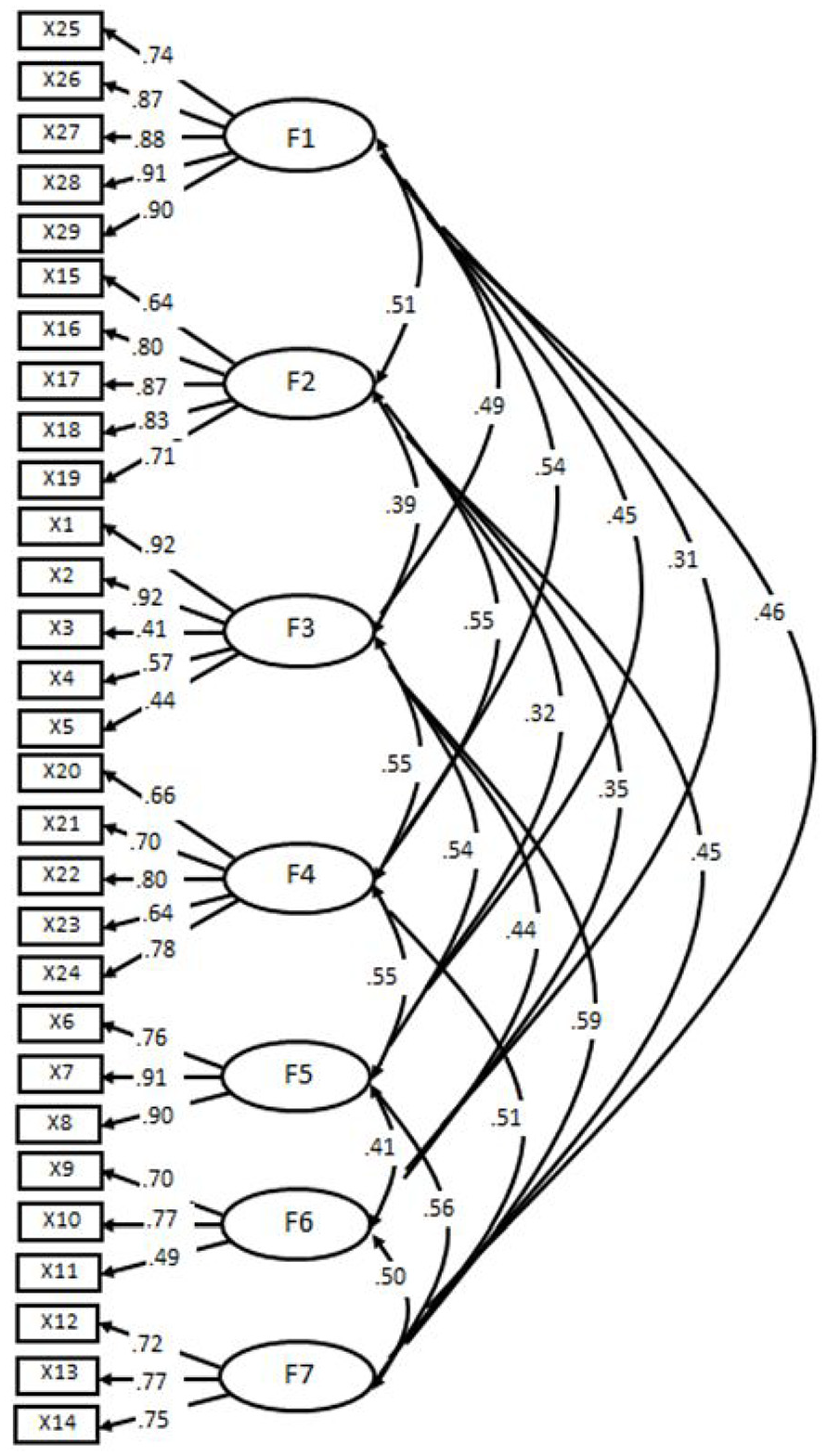
Factor structure and standardized factor loading on the FSSMS model.
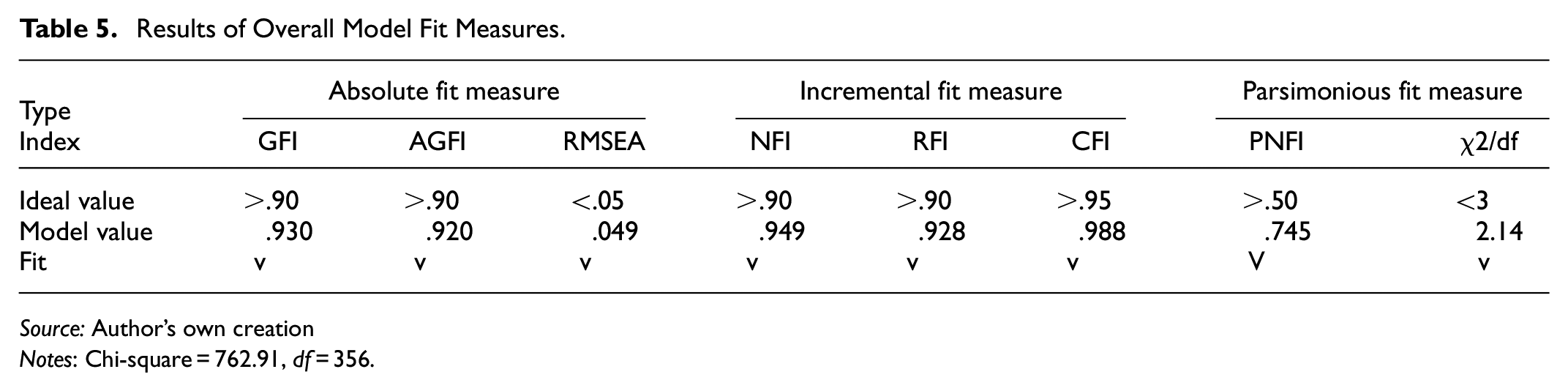
Next, the overall model fit was assessed based on three types of fit measures: absolute fit measures, incremental fit measures, and parsimonious fit measures, as suggested by Hair et al. (1998). As shown in Table 5, the results indicated a good fit for the sample data in this study. The chi-square value was 762.91 with 356 degrees of freedom (df), and the p-value was .00. Additionally, various fit indices, such as GFI, AGFI, RMSEA, NFI, RFI, CFI, PNFI, and chi-square/df ratio, met the criteria for a good fit. These findings suggested that the overall model fit the sample data well.
Results of Overall Model Fit Measures.
Source: Author’s own creation
Notes: Chi-square = 762.91, df = 356.
The fit of the internal structure of the model was evaluated to assess the significance level of parameter estimation and the reliability of each item and latent variable, following the approach proposed by Bagozzi and Yi (1988). As shown, all parameters estimated exceeded the significance level, indicating their statistical significance. The composite reliability for each latent variable exceeded the threshold of 0.6, and the AVE estimate for each latent variable was greater than 0.5. While some R2 values for individual item reliability did not surpass the criterion of 0.5, most values fell above the acceptable level. Furthermore, the seven factors of the FSSMS demonstrated appropriate internal consistency, as indicated by Cronbach’s alpha coefficients ranging from .68 to .93. The AVE values for each factor revealed adequate overall construct reliability for the FSSMS in this study, with values ranging from 0.50 to 0.55 (See Table 6).
Results of the Mean, sd., AVE, and Squared Correlations of Each Construct.

Notes. values for the diagonal elements are the AVE (bold values); values below the diagonal are squared correlations.
Source: Author’s own creation
p < .05.
Convergent validity was assessed based on the t-values and AVE estimates, following the suggestion of Fornell and Larcker (1981). As presented in results, all t-values were significant (p < .05), and all AVE estimates were greater than 0.5, indicating satisfactory convergent validity. Discriminant validity was examined by comparing the AVE values with the squared correlations between constructs, as recommended by Fornell and Larcker (1981). In addition, the squared correlations between each pair of constructs were lower than the AVE for each individual construct, providing evidence of adequate discriminant validity. In summary, the reliability and validity indices of the FSSMS demonstrated that all constructs were acceptable for this study. The FSSMS model adequately represented the sample data, indicating its suitability for assessing the motivations of female sports spectators.
Predictive Validity
The authors investigated the predictive validity of the FSSMS by examining its relationship with the degree of preference for the CPBL among spectators. Participants were asked to rate their interest in watching CPBL games on a five-point Likert scale ranging from 1 (very low) to 5 (very high).
To assess the predictive validity, a multiple linear regression analysis was conducted. The results revealed that the overall model of the FSSMS significantly predicted the degree of female spectator preferences for the CPBL (F = 30.62, p < .05). When considering the individual relationships between the predictors and the dependent variable, most of the predictors were found to predict the motives of female spectators significantly. Specifically, stress reduction (p < .01), aesthetics(p < .01), self-realization (p < .01), and social facilitation (p < .05) were all found to be significant predictors. Consequently, the model accounted for approximately 34.7% of the variance in the dependent variable.
These findings indicated that the FSSMS had predictive validity in understanding the degree of preference for CPBL among female spectators. The identified motives, including stress reduction, aesthetics, self-realization, and social facilitation, all played a significant role in influencing female spectators’ preferences for the CPBL.
Discussion
The primary goal of this study was to fill the research gap concerning the motivations behind female sports spectators’ engagement. Aimed at developing a reliable and valid instrument to measure these motivations, the study sought to contribute to the broader understanding of sports fan behaviors. The creation of the 29-item FSSMS was informed by the seminal works of Wann’s (1995) SFMS, Milne and McDonald’s (1999) Motivations of the Sport Consumer Scale, along with other pertinent research on spectator motivation. Through this literature review, the study formulated an initial version of the FSSMS, providing deeper insights into the motivational dynamics of female sports fans. The FSSMS encapsulated seven dimensions: stress reduction, emotional connection, game content, aesthetics, self-realization, economic factors, and social facilitation, all showing robust reliability and validity.
The FSSMS achieved notable construct validity, explaining a significant 68.05% of the variance. Each factor exhibited strong convergent validity, with AVE scores above .50, and discriminant validity was confirmed, as no squared correlation values surpassed the AVE scores for the constructs. The subscales’ internal consistency was robust, with alpha values meeting or exceeding the .70 benchmark for six of the dimensions. Additionally, the identification of meaningful correlations between the motives and the criterion variable (preference degree for the CPBL) underlined the scale’s predictive validity, underscoring the FSSMS as an effective instrument for probing into female sports spectators’ motivations.
This investigation marked an initial step toward understanding the unique and previously unexplored market segment of female sports fans. Echoing Churchill (1979) and Park et al. (2010), the establishment of a reliable and valid measure is crucial for advancing scholarly knowledge (Qian et al., 2023). In addition, this instrument paves the way for future research and theoretical expansion of sports spectatorship, including the critical examination of cultural and socio-political issues affecting female sports fans (Gebel et al., 2022; Genchev et al., 2021). Understanding these complex layers contributes to a more comprehensive grasp of the sports industry’s responsibility to adapt and respond to the needs of this expanding and distinctive demographic, acknowledging the impact of cultural and socio-political contexts on female sports fandom (Delia, 2020; Simmons et al., 2018). Demonstrating both reliability and validity, the FSSMS stands to enhance research on female sports spectators’ motivations significantly.
Theoretical Implications
This study’s findings provided several theoretical contributions. First, this research enhanced our understanding of a relatively neglected demographic: female sports spectators. Unlike the broader category of sports fans, female spectators are distinct, with gender playing a key role in their identification and conceptualization as a separate group (Milne & McDonald, 1999; Thomson et al., 2023). Historically, the scarcity of female representation in both sports participation and media visibility has reinforced the perception of sports as a predominantly male domain, thus affecting the composition of its fanbase (Qian et al., 2023; Wang et al., 2022). Additionally, the sports industry’s traditional focus on male audiences in the marketing and design of events and products has tended to sideline or undervalue female fans and athletes. This gender-biased marketing and media portrayal have further entrenched male predominance in sports fandom. Against this backdrop, the insights from this study illuminated the behaviors of female sports spectators, filling a gap in the existing body of research.
Furthermore, this research validated that the FSSMS is an effective instrument for exploring the motivations behind female sports spectators’ engagement, focusing on stress relief, emotional connection, game content, aesthetics, self-actualization, economic considerations, and social interaction. These elements, outlined within the framework established by Milne and McDonald (1999), underpinned this study’s approach to comprehending the motivational drivers of female fans as an emotional journey that significantly influences their behaviors. While the significance of female participation in sports has received considerable attention in scholarly work (Gebel et al., 2022; Genchev et al., 2021; Qian et al., 2023; Wang et al., 2022), incorporating an analysis of the motivations of female sports spectators offers a deeper, more nuanced understanding of female fans’ actions and interactions with sports.
Finally, the development and validation of the FSSMS represent an important step forward in sports fan research by highlighting the distinct motivations of female sports fans. This instrument addresses a vital research void by centering on female spectators—a demographic that has not received adequate attention, thereby deepening our comprehension of their motivations. By weaving in motivations like stress relief, emotional connection, aesthetic appreciation, and the value of social interactions, the FSSMS provides an extensive perspective on the factors fueling women’s interest in sports. Moreover, the FSSMS enhances our understanding of female sports fandom from a socio-cultural and political standpoint. It facilitates a nuanced analysis of how societal norms, cultural expectations, and gender politics influence female fans’ engagement with sports (Grappendorf et al., 2020; Wang et al., 2022). By validating measures that account for these broader influences, the scale broadens the scope of investigation into the psychological underpinnings of female fans’ preferences and actions. This exploration into the socio-political dimensions offers insights into the challenges and opportunities within the sports industry to serve this growing and unique market segment more effectively (Delia, 2020; Pavlidis & O’Brien, 2017; Simmons et al., 2018). Overall, this instrument paves the way for the future research and theoretical expansion of sports spectatorship, including the critical examination of cultural and socio-political issues affecting female sports fans. Understanding these complex layers contributes to a more comprehensive grasp of the sports industry’s responsibility to adapt and respond to the needs of this expanding and distinctive demographic, acknowledging the impact of cultural and socio-political contexts on female sports fandom.
Practical Implications
The development of the FSSMS and its demonstrated reliability and validity have several practical implications for various stakeholders in the sports industry. The FSSMS would enable sports marketers to gain a better understanding of the motives of female sports fans. This understanding can guide the development of targeted marketing strategies that resonate with female spectators, thereby enhancing their engagement and attendance at sports events (Fink et al., 2016). By tailoring promotional campaigns, ticket packages, and fan experiences to align with the identified motives, sports organizations can effectively attract and retain female fans.
In addition, the FSSMS provides insights into the specific motives that drive female sports spectators. This information can be utilized to enhance the overall fan experience and create a more inclusive and enjoyable environment for female fans. For example, sports venues can consider offering amenities and services that cater to the identified motives, such as stress reduction areas, opportunities for emotional connection, aesthetically pleasing surroundings, and social facilitation spaces. Therefore, the insights gained from the FSSMS can help sports organizations and sponsors identify potential partnership opportunities that resonate with the motives of female sports spectators. Aligning with brands or initiatives that cater to their preferences and values can enhance the overall fan experience and create meaningful connections with female fans.
Moreover, the FSSMS can inform policy decisions related to gender inclusivity and representation in sports. By recognizing the unique motivations of female sports spectators, sports organizations, governing bodies, and policymakers can implement initiatives that promote gender equality, diversity, and inclusivity in sports, ensuring that the needs and perspectives of female fans are considered. Overall, the practical implications of the FSSMS lie in its ability to guide targeted marketing efforts, enhance the fan experience, drive product development, foster partnerships, and inform policies that promote gender inclusivity in sports.
Limitations and Future Research
The primary aim of this study was to develop an efficient and effective scale, referred to as the FSSMS, to explore the motives of female sports spectators. However, several limitations within the current study point toward the need for further research. First, the samples used in this study were exclusively obtained from the CPBL, the sole professional sports league in Taiwan. Therefore, it is imperative for future research to validate the applicability of the FSSMS with other populations of female spectators. For instance, the FSSMS should be tested on female fans from diverse racial and national backgrounds to enhance and reinforce its validity. Additionally, it would be valuable to examine different sports types, such as football in European countries or baseball in America. This study was conducted using research participants from Taiwan, a small island territory of Asia, and did not consider the diverse perspectives that likely exist in different countries and regions. This limited the generalizability of the research findings. The scale provides a framework that can be adapted and further validated in different cultural contexts, allowing researchers to explore the motivations of female sports spectators in other parts of the world. Future studies should aim to replicate and validate the scale using larger and more diverse samples to enhance its external validity and broaden its applicability across different populations.
Second, although the study utilized seven factors derived from relevant literature, there remained 32% of unexplained variance in spectator motives. Since the data in this research were collected through a questionnaire, further qualitative analysis is warranted to identify potential additional motivations that may exist. Third, while the study successfully developed an effective, reliable, and valid FSSMS, certain scale items demonstrated low factor loadings (e.g., item 5 = .39 and item 11 = .34) and low R2 values (e.g., item 3 = .17, item 5 = .19, and item 11 = .24). Thus, additional research is necessary to validate these items appropriately. Further, investigations are essential to address the limitations of this study. Future research should aim to validate the FSSMS with diverse populations of female spectators, conduct qualitative analysis to identify additional motivations, and refine the scale items that exhibited lower factor loadings and R2 values.
Conclusions
In conclusion, the development of the FSSMS represents a significant advancement in the research on sports fans, specifically focusing on female spectators. Previous studies have primarily overlooked the motivations and behaviors of female sports fans, making the FSSMS a valuable tool for measuring their psychological motivations. This instrument provides a novel avenue for scholars and practitioners to gain a deeper understanding of this emerging and rapidly expanding target market.
This is especially crucial given the transformation of the sports landscape, which is no longer a male-dominated space. It highlights the pressing need to explore and better understand the motivations and preferences of female sports enthusiasts. By utilizing the FSSMS, researchers and industry professionals can access insights into the unique motivations that drive female sports fans, thereby enabling them to develop more effective strategies for engaging with this growing demographic.
Footnotes
Declaration of Conflicting Interests
The author(s) declared no potential conflicts of interest with respect to the research, authorship, and/or publication of this article.
Funding
This work was supported by the National Science and Technology Commission of Taiwan (Award Number: NSTC 113-2410-H-032-063-MY2).

Data Availability Statement
Data sharing not applicable to this article as no datasets were generated or analyzed during the current study.