




Abstract
The ability to work in a team is currently one of the most demanded competencies of professionals and, therefore, constitutes one of the key transversal aspects to be targeted by educational systems. This is especially important at stages prior to job insertion. The aim of the present study was to validate a scale measuring perceptions of teamwork skills within a sample of students undertaking vocational training in the south of Spain. For this, both exploratory (n = 879) and confirmatory (n = 1,843) factor analyses were performed using the IBM SPSS® 26 and IBM Amos Graphics® 23.0 software packages. This permitted a scale to be developed which was formed of ten indicators of teamwork skills. These indicators were grouped into three dimensions, namely, teamwork behaviors, ratings the importance of teamwork and self-perceptions of teamwork capabilities. Adequate fit indices were obtained (KMO = 0.845; CFI = 0.984; NFI = 0.978; IFI = 0.984; RMSEA = 0.037; and SRMR = 0.044). Thus, a robust and reliable scale is presented that rates student perspectives of essential aspects of Vocational Training, such as teamwork skills.
Keywords
Introduction
We are facing a convulsive and constantly changing reality, affected by aspects such as global connectivity, new technologies, digital and communication tools, intelligent systems or social platforms, among others. (Castellanos & Escott, 2020; Davies et al., 2011; Urán-Jiménez & García-Espinosa, 2021). All these changes, which constitute the so-called knowledge society, can be seen as promising but also pose great challenges in the field of the economy, consumption, employment, and of course, in the lives of people, who will have to develop new skills to successfully face citizenship and effectively carry out a job in the not-too-distant future (ManpowerGroup, 2016; World Economic Forum, 2016).
In this changing situation, as indicated by the World Economic Forum (2016), the Organization for Economic Cooperation and Development (OECD, 2018) or the report The future of Employment, developed by the University of Oxford (Benedikt & Osborne, 2013), some jobs will tend to shrink or even disappear, while others will grow rapidly. In either case, new skills will be required to successfully perform a job. But which ones?
In this regard, a great interest has arisen in trying to predict what skills will be necessary to face the challenges that society will face in the coming years. It is about establishing a kind of roadmap, to achieve training in foresight, allowing the development of strategies for the emerging digital world and thus supporting the population with a more sustainable future. This concern is made evident in multiple published studies and reports (Davies et al., 2011; Deloitte Access Economics, 2017; Hays, 2020a, 2020b; LinkedIn, 2020; World Economic Forum, 2016).
Precisely, societal changes experienced over recent decades, driven by the fourth industrial revolution or Industry 4.0 (García-Pérez et al., 2021; Mahou-Fernández & Díaz-Pérez de Lama, 2018; Sukhodolov, 2019), have strongly impacted upon organizations. These organizations now urge more collaborative working styles, which make collective knowledge available to the organization and solve increasingly complex problems with agility, quality, creativity, innovation, and flexibility (Acosta, 2011; Baker et al., 2005; Davies et al., 2011; Hebles et al., 2019; Maxwell, 2008; Torrelles et al., 2011).
Teamwork is a generic and transversal skill that is characterized by its relational dimension. It is defined as the capacity to integrate into and interact with work groups, striving toward achieving common goals (Anderson-Butcher et al., 2014; Atxurra & Villardón-Gallego, 2015; Barraycoa-Martínez & Lasaga-Millet, 2010; González & Wagenaar, 2003). Further, as stated by Torrelles et al. (2011), it is a dynamic, complex and multidimensional skill. A number of dimensions are essential for understanding and defining this skill, specifically: (1) Collective identity which describes the sense of belonging to a group and the resultant commitment and engagement given to activities the group engages in; (2) Communication and interaction between team members for effective functioning; (3) Execution of planned actions in order to achieve team objectives; (4) State of regulation or continuous adjustment to resolve issues, grow, and move closer toward proposed goals. Although it is important to mention that many classifications of the construct exist that show differences in terms of the number and name of these dimensions (Soria-Barreto & Cleveland-Slimming, 2020).
Following Cannon-Bowers et al. (1995) teamwork is a competence that combines knowledge of the tasks and effective performance of a group with a set of individual skills or behaviors that are necessary to act effectively within the group, as well as the attitudes that each member must present to contribute to a right team functioning. Along the same lines, Lower et al. (2017) insist that from a perspective focused on the individual and not on the team, the teamwork competence includes personal attitudes and behaviors. These attitudes are the perception of the relevance that is given to teamwork, the value that is given to the contributions of others and the attitude that one has toward a team. While behaviors often include working collaboratively, encouraging contributions from others, being sensitive to the feelings and perspectives of others, communicating within a group, as well as providing and receiving feedback.
According to Barraycoa-Martínez and Lasaga-Millet (2010) and Lower et al. (2017), psychosocial aspects and skills exist that promote this competence. These include integration capacity, interpersonal communication, empathy, capacity to gather “encultured knowledge,” responsibility, commitment and respect for the team, decision making, time management, conflict resolution, negotiation, accountability and role and leadership recognition.
Teamwork is the most sought-after transversal competence by employers and the most valued competence within professional settings. It is also the most used competence in the daily performance of workers from all sectors (ANECA, 2007; Barraycoa-Martínez & Lasaga-Millet, 2010; Guitert et al., 2007). However, questions have been asked regarding the importance given to this competence by the job market. Such questions are at least partly responded to by the fact that teamwork makes the most of individual talent by organizing workers into teams. This, in turn, increases organizational efficacy, improving financial outcomes and, ultimately, competitivity.
Teamwork has both a personal and a business justification. From an individual perspective, teamwork provides greater security to protect oneself from common threats, raises self-esteem following recognition of contributions made to achieve common goals, gives access to benefits that can only be achieved collectively and increases the sociability or satisfaction of being with others. From a business perspective, teamwork may be encouraged as it generates synergy, commitment and professional development amongst employees. It favors communication between different levels of the organization, promotes effective decision making, generates flexibility in the face of change, and favors learning and creativity, having a positive impact on the levels of knowledge, skills and training of employees (Acosta, 2011; Bacon & Blyton, 2003; Franco & Velásquez-Vázquez, 2000).
Currently, learning at all educational stages seeks to direct part of its efforts toward equipping students so that they develop the necessary skills for their successful incorporation into the job market and the exercise of active and responsible citizenship (Barraycoa-Martínez & Lasaga-Millet, 2010). As stated by Guitert et al. (2007), a basic challenge of current education is that is prepares individuals to fully participate in the knowledge society.
In the higher education setting, the European Higher Education Area (EEES) and the Tuning Project have conceived a framework of generic skills. These skills are common to all knowledge areas and are key in current society. Thus, it is essential that these skills are acquired throughout university formation. Teamwork skills make up interpersonal competencies to which special importance has been given (González & Wagenaar, 2003, 2008), as seen through the multiple research studies and innovation projects that have been conducted in this context (Beddoes & Panther, 2017; Fathi et al., 2019; Ibarra & Rodríguez, 2011; León-Urquijo et al., 2018; Riebe et al., 2016; Sánchez-Marín et al., 2019; Shishah & FitzGerald, 2016; Taylor & Foulds, 2018).
However, efforts to tighten links with the job market should not be limited to the higher education setting. Instead, such efforts must also be extended into other educational stages. In this sense, international recommendations (European Parliament, 2006; European Union Council, 2018; OECD, 2005) urge for schooling to develop the key skills of student as these will be necessary for their personal development, engagement as active citizens, social inclusion, and employment. Specifically, the Definition and Selection of Competencies project (DeSeCo) of the OECD established a framework which lay out the key skills that should be acquired by students in order to ensure their personal, social and economic wellbeing, and their absolute participation in current society. Amongst these skills, the ability to cooperate and work in a team is included (OECD, 2005; Rychen & Salganik, 2003).
In accordance with these recommendations, in Spain, key skills are incorporated as one of the main pillars of the non-university educational system upon which curricular content is designed. The ability to work in a team is developed as part of the competence denominated “sense of initiative and entrepreneurial spirit” (Ministry of Education, Culture and Sport, 2015). Thus, most recent laws in place regarding educational organization, such as the Organic Law of Education (LOE) (Ministry of Education, 2006), partially modified by the Organic Law 3/2020, by which it is modified Organic Law 2/2006, of May 3, of Education (LOMLOE) (Ministry of Education and Vocational Training, 2020b), aim to develop teamwork ability from the outset of the primary education stage and consolidate it in the baccalaureate stage. In the same way, at the vocational training stage, the Royal Decree 1147 (Ministry of Education, 2011) establishing organization of vocational training in the educational system, has the general aim of consolidating habits conducive to teamwork in students.
Currently, Agenda 2030 and its sustainable development objectives urge for a transformation of the professional setting. This transformation takes its roots in the 1st Strategic Plan for Professional Training in the Educational System (Ministry of Education and Vocational Training, 2019), through which it will specifically impact upon innovation promotion, amongst other things. In this sense, the recently published Modernization Plan for Professional Training (Ministry of Education and Vocational Training, 2020a) established a line of action (line 4.1.) aimed at strengthening the abilities associated with innovation and entrepreneurship. In this way, it focuses on developing that which cannot be learned by machines and training aspects such as teamwork skills.
Preparing young people to successfully face citizenship in their adult life becomes essential, and as has been collected, it is one of the challenges of educational systems, including in Spain. Specifically, the competence to work in a team has been identified as key to the development of youth and their transition to adult life (Cater & Jones, 2014). In fact, as mentioned by Lower et al. (2017), this ability is necessary for a person to develop successfully in a multitude of life contexts, beyond the work arena, such as school, home, community, or sport. Its acquisition is fundamental during the youth and this ability for life, as the social competence, also acts as a predictor of healthy youth, because it can contribute to reduce risk factors and problematic or antisocial behaviors among young people, especially in those that belong to marginal contexts (Anderson-Butcher et al., 2008, 2016; Newman et al., 2014).
For this reason, it is so relevant that there are instruments that allow knowing the degree of acquisition of essential skills for future work and life, such as the ability to work effectively in a team. In addition, this can serve to assess whether the efforts being made by educational institutions to approach social requirements and the labor market itself are having the expected success.
However, following Lower et al. (2017), there are limited instruments to measure teamwork competence in young people from an individual perspective, focused on the behaviors and attitudes that a person presents to be an effective member of a team. Indeed, most instruments are designed for professionals, measuring teamwork at work and using inaccessible language. On the other hand, those that are designed for a youth population are aimed at measuring this construct from the team perspective, focusing on aspects such as cohesion, dynamics and team performance. Lastly, the few existing instruments to measure teamwork in young people from an individual perspective have limitations regarding suitability, feasibility, and accessibility.
Precisely, the scarcity of appropriate instruments to measure the ability to work in teams in young people from an individual perspective and the empirical solidity, versatility, accessibility, and simplicity presented by the “Modified Youth Teamwork Scale” (Lower et al., 2017), has inspired this team to choose this instrument to assess perceived competence for teamwork among young people in the context of Vocational Education and Training.
For this reason, the present work has the fundamental aim of validating a questionnaire that measures perceptions of teamworking ability amongst vocational training students in the Spanish context. Administration of this questionnaire will contribute results relating to perceptions about the mastery of this skill, so highly valued in the business setting, in a broad sector of future professionals. We can, therefore, see the importance being given by different institutions and reports to teamworking skills for a working future as a strategic approach and as the engine of economic growth and employment (European Union Council, 2018). This is even more so the case in the ambit of professional training. Despite this, few research studies have been conducted on the topic, leaving an important research niche that must be explored.
Materials and Methods
The present study describes the validation process of a scale evaluating attitudes toward teamworking. It was conducted in a specific context pertaining to vocational training students in the region of Andalusia (Spain). The validation process was supported by conducting exploratory and confirmatory factor analyses.
Participants
In order to avoid problems related to overfitting (Fokkema & Greiff, 2017), the samples for each type of factor analysis corresponded to two data collection processes in the target population. Participants in both samples reported ages between 15 and 58 years (M = 21.72 years; SD = 7.266). For the EFA, data collection was carried out within a selection of six vocational schools offering studies of a total of 18 professional disciplines in the province of Granada. 879 VET (Vocational Education and Training) students were surveyed. Of these, 388 were male and 491 were female, 47.1% were undertaking intermediate level vocational training, 47.2% were enrolled on higher level vocational training and the remaining 5.8% were enrolled on basic level vocational training (see Table 1).
Sociodemographic Data and Sample Distribution (EFA and CFA).

The second data collection process made it possible to retrieve an additional set of 1843 surveys of VET students, from the eight provinces that make up the Andalusian region. Of these 48,51% were enrolled in the higher level; 46.39% in the intermediate level and 5.10% studied the VET basic level. Considering the current VET students’ population in Andalusia (n = 149,357), this sample size is representative, admitting an error of 2.5% at a confidence level of 95%.
Instrument
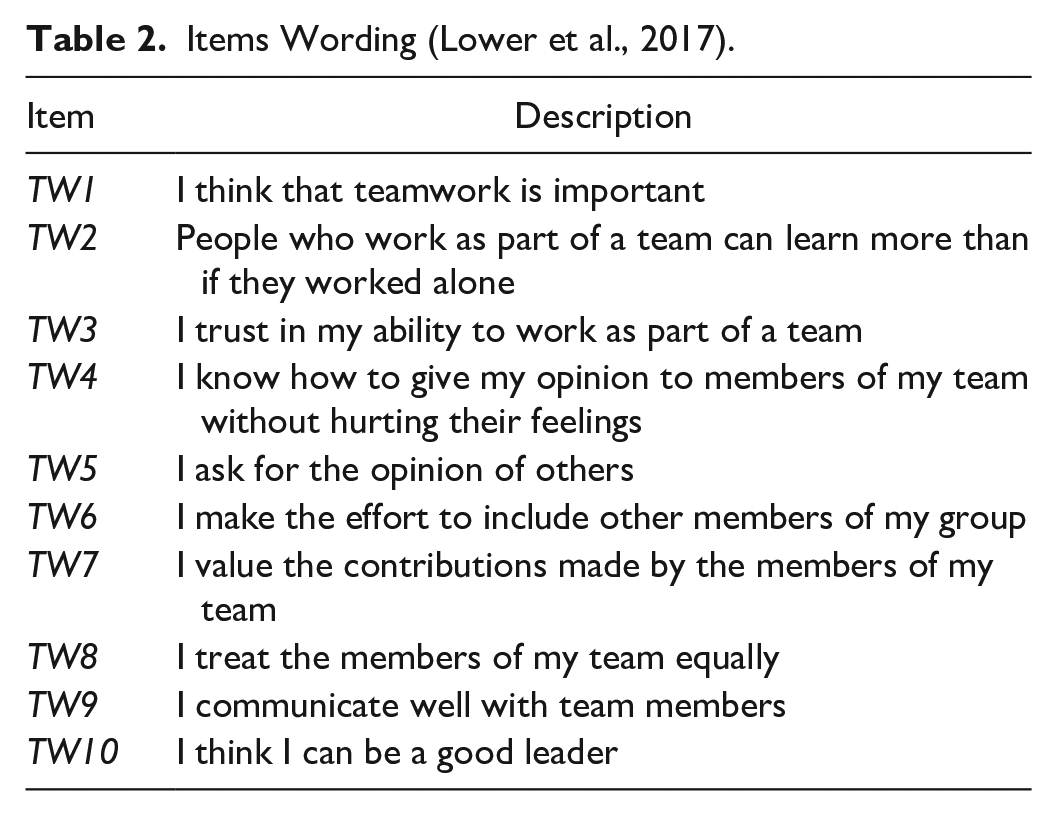
The scale developed by Lower et al. (2017) for measuring perceptions of teamwork skills in young people was used. This tool was conceived by experts on the positive development of young people in order to evaluate perceptions of their ability to collaborate and work with other team members toward a shared goal. The original instrument is composed of 10 items which are rated along a Likert scale with five response options. Responses range from totally disagree (1) to totally agree (5). The scale is relevant to the specific study context, with the items having been translated literally to Spanish from the items provided by Lower et al. (2017). The specific wording of items is given in Table 2.
Items Wording (Lower et al., 2017).
Procedure
The instrument was administered to the sample in order to proceed with the validation process. Administration occurred individually at each of the collaborating vocational schools, following the receipt of authorization from school management team. Likewise, approval was received from the Research Ethics Committee of the University of Granada (reference number: 1678/CEIH/2020).
Data Analysis
All collected data was imported into the software IBM SPSS® version 26 (George & Mallery, 2003) with the aim of conducting preliminary descriptive analysis and examining normality, including perusal of the P–P plot. Following this, exploratory factor analysis was performed, having previously decided to employ the principal axis factoring method with Oblimin rotation as factors are correlated (Yong & Pearce, 2013). Overall scale reliability was determined through the Cronbach alpha coefficient, setting the reliability index at 95%.
In the second phase, confirmatory factor analysis was carried out using the IBM Amos Graphics® package, in its version 23. Goodness of fit criteria established by Kock (2014) and Hu and Bentler (1999) were followed. In order to study model fit, the chi-square statistic was calculated, alongside the comparative fit index (CFI), normalized fit index (NFI), incremental fit index (IFI), root mean square error approximation (RMSEA) and standardized root mean square residual (SRMR). Further, in order to shape the model, prediction error terms were associated with the endogenous variables and parameters were estimated according to the Diagonally Weighted Least Square (DWLS) method, as it is appropriate for categorical ordinal data (Li, 2016; Mîndrilã, 2010; Savalei & Rhemtulla, 2013; Xia & Yang, 2019;).
Results
Test of Normality
Table 3 presents outcomes from the preliminary analysis carried out on the various items that made up the employed scale. This analysis followed calculation of the main statistical tests of dispersion. This included examination of asymmetry and kurtosis and had the aim of determining normality of the data. The principles established by Mayers (2013) were considered when interpreting outcomes. These principles suggest a limit of ±3.29 for both statistics when deciding around normality in samples of more than 100 individuals.
Descriptive Statistics Pertaining to Observed Items.

In addition to this statistical examination, Figure 1 presents the P–P plot which was also observed to confirm the normal distribution of data. As seen in the plots, no significant deviations were seen which could lead to the rejection of the assumption of normality for any item.
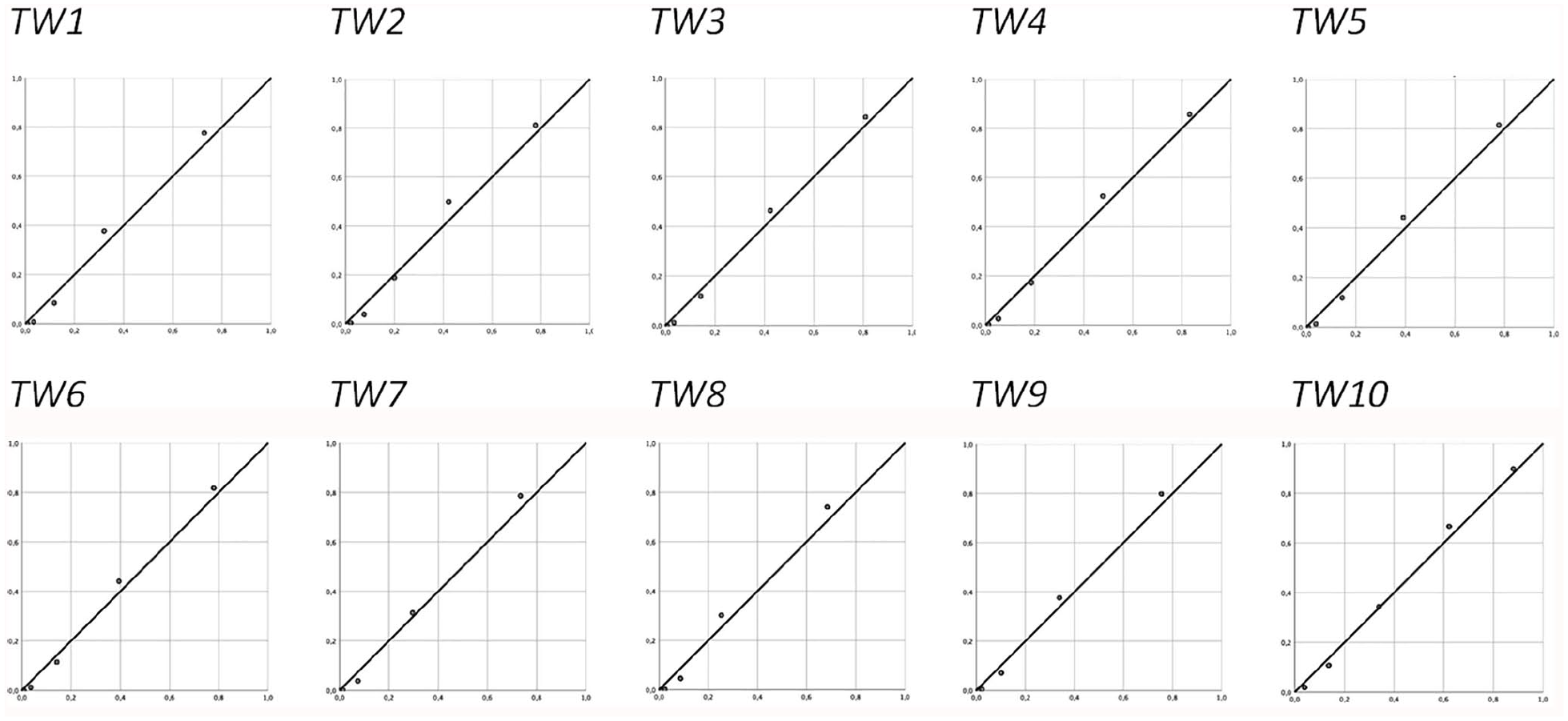
P–P plots for each item as a function of normal distribution.
Although the normality requirement is met at the level of each individual variable, the calculation of the Mardia coefficient to analyse multivariate normality yielded a statistically significant result (m = 17,35269; χ2 = 2539,27735; df = 220; p < .001), understanding that the data may not be normally distributed. This has led us to use the DWLS as the estimation method in the CFA, as it provides more accurate parameter estimates, and a more robust model fit with ordinal data and non-normality (Mîndrilã, 2010).
Exploratory Factor Analysis
Exploratory factor analysis of the 10-item scale was conducted using the principal axis method of factor extraction, using Oblimin rotation as the factors are correlated (Yong & Perce, 2013). The Bartlett statistic produced in relation to this revealed acceptable fit (3,057; df = 45; p < .001), and the Kaiser–Meyer-Olkin (KMO) measure of sampling adequacy (MSA) was equally acceptable (KMO = 0.845). The MSA for each individual variable also denoted acceptable values (MSA.TW1 = 0.847; MSA.TW2 = 0.838; MSA.TW3 = 0.830; MSA.TW4 = 0.859; MSA.TW5 = 0.860; MSA.TW6 = 0.852; MSA.TW7 = 0.858; MSA.TW8 = 0.864; MSA.TW9 = 0.873; MSA.TW10 = 0.608).
Regarding the number of factors to consider, different approaches have been used. By selecting parallel analysis, two factors were detected, one grouping items TW3 and TW10 and a second factor with the rest of the items (TW1, TW2, TW4,. . .., TW9). However, using eigenvalues greater than 1 as a criterion, a factorial solution of three factors was reached (TW1–TW2, TW3–TW10, and TW4. . …TW9). This solution ideally reflects the constructs of teamwork in the context of this research work, since items TW1 and TW2 refer to rating the importance of teamwork, as it already was mentioned by the original authors (Lower et al., 2017), and keeps TW3 and TW10 grouped (as they are indicators or teamwork capability perception).
The outcome grouped the 10 items into three factors which explained a total of 60.7% of the total accumulated variance. The rotated factorial solution (Table 4) did not yield any factorial load below the 0.400 threshold (Stevens, 2002), therefore, it was not necessary to discard any of the items included in the original scale. Following this, internal consistency of the overall scale was verified according to the Cronbach Alpha (α = .801) and McDonald’s Omega (ω = .819), obtaining acceptable values in both calculations. For each of the factors identified in the EFA, the calculations of α and ω yielded consistency levels lower than those obtained for the global scale, as a result of performing the calculation with small factors (Hinton et al., 2014). The values obtained show an acceptable consistency for factor 1 (6 items; α = .8; ω = .8) and moderate for factor 2 (2 items; α = .6; ω = .6) and for factor 3 (2 items; α = .5; ω = .5).
Rotated Factor Matrix (Oblimin Rotation).

Note. Highest factor loadings for each item in bold.
In addition, the Convergent Validity of factors was studied by calculating the Average Variance Extracted (AVE) and the Composite Reliability (CR), obtaining in all cases acceptable values according to Fornell and Larcker (1981): Factor 1 (AVE = 0.5; CR = 0.8), Factor 2 (AVE = 0.7; CR = 0.8), Factor 3 (AVE = 0.5; CR = 0.7).
Considering the communalities, in all cases adequate values have been found, that reinforce the idea of keeping all the items of the original scale. As per the factors detected, the following study dimensions were identified and interpreted:
Factor 1 = Teamwork Behavior (TW_BE) (items TW4, TW5, TW6, TW7, TW8, TW9)
Factor 2 = Teamwork Importance Rating (TW_IR) (items TW1, TW2)
Factor 3 = Teamwork capability perception (TW_CP) (items TW3, TW10)
Confirmatory Factor Analysis
In the second phase, confirmatory factor analysis via a structural equation model (SEM) was performed. The aim was to verify reliability of the outcomes of the preliminary exploratory factor analysis, as well as establishing a comparison of two possible models: A model considering the teamwork scale as a single construct, and a second model in which the three latent variables were presented.
In order to check the fit of the models, two methods were considered (Maximun Likelihood - ML and Diagonally Weighted Least Square—DWLS). In all approaches, the Chi square was statistically significant, but taking into account its high sensitivity to sample size, the fit level was measured using the CFI, NFI, IFI, RMSEA, SRMR coefficients. Furthermore, for the ML estimations, the AIC (Akaike information criterion) and the BBC (Browne–Cudek fit criterion) were calculated in order to detect the lowest values as an indication of a better fit with respect to the alternative model.
As can be seen in Table 5, the model with the best fit and that confirms the factorial structure resulting from the exploratory analysis, is the three-factor model estimated using the DWLS method (CFI = 0.984; NFI = 0.978; IFI = 0.984; RMSEA = 0.037; SRMR = 0.044). All values are indicative of a good model fit (Hu & Bentler, 1999; Kock, 2014).
Fit Measures of 1 and 3 Factors Models.

Standardized regression weights for the associations examined by the proposed structural model in relation to the three factors emerging from the exploratory factor analysis and their indicators are presented in Table 6. All of the examined associations were found to be positive and significant (p < .001).
Standardized Regression Weights Three Factor Model.

Note. SRW = Standardized regression weight; SE = Std. error; CR = Critical ratio.
Statistically significant differences at the level of p < .001.
Based on the standardized regression weights, the indicators that exert greatest influence over each of the evaluated dimensions can be analyzed. With regards to the dimension describing teamwork behaviors, the items with higher regression weights and, thus, the greatest contribution to this dimension were items TW7 (I value the contributions made by the members of my team) (b = 0.718; p < .001), TW9 (I communicate well with team members) (b = 0.663; p < .001), TW6 (I make the effort to include other members of my group) (b = 0.654; p < .001) and TW5 (I ask for the opinion of others) (b = 0.654; p < .001). In relation to the dimension pertaining to rating the importance of teamwork, the most important item was TW1 (I think that teamwork is important) (b = 0.818; p < .001). Finally, for the dimension describing perceptions of teamwork capability, item TW3 (I trust in my ability to work as part of a team) (b = 0.994; p < .001) was the most important. The item with the lowest standardized weight is TW10 (I think I can be a good leader) (b = 0.364; p < .001), so it can be considered as the observable variable that exerts the least influence on the construct to which it belongs.
With regards to the extent of the associations between the resultant dimensions, In general, we can ascertain that the three study dimensions are highly correlated (>0.6 in all cases). The strongest correlation was produced between the dimension describing teamwork behaviors and the one that rates the importance of teamwork (0.725). Between the dimensions describing teamwork behaviors and capability perceptions the correlation level is moderate-high (0.663). Between the dimension rating the importance of teamwork and the construct measuring the capability perception the correlation level is also moderate-high (0.602).
Figure 2 represents the structural model obtained after carrying out the confirmatory factor analysis, indicating the standardized regression weights, as well as associations among endogenous variables.

Structural model elaborated from CFA.
Besides, an additional CFA analysis was performed, using a second-order measurement model in order to assess the feasibility of a teamwork skills factor grouping the three dimensions of the scale. This model produced identical fit indices to those obtained in the previous model (CFI = 0.984; NFI = 0.978; IFI = 0.984; RMSEA = 0.037; SRMR = 0.044), as well as high standardized regression weights in every case (0.87; 0.83; 0.73) (see Figure 3). This result allows us to consider the advisability of calculating a total score for the instrument.

Second-order measurement model elaborated from CFA.
Discussion
The present research work seeks to analyse the psychometric properties of a scale estimating teamwork skills in students undertaking vocational training. This was done via exploratory factor analysis and was based on the premises laid out by Lower et al. (2017). Likewise, confirmatory factor analysis was carried out through a structural equation model which grouped a total of nine items, or observable variables, into three factors, or endogenous variables. A study was therefore proposed to validate the instrument in a similar way to that carried out by Maggiori et al. (2017), Martínez-Clares et al. (2019), and Martínez-Martínez et al. (2019).
Initial basic descriptive calculations, applying the premises laid out by Mayers (2013) to the examination of asymmetry, variance and kurtosis cut-points, did not call for the elimination of any of the items considered by Lower et al. (2017). On the other hand, the percentage of explained variance (60.7%) suggested that the model was acceptable according to recommendations of George and Mallery (2003) for a study of this type.
The analysis of factor loadings for the three-factor solution produced after application of the principal axis factoring method, it was not necessary to eliminate any of the items from the study, considering recommendations stipulated by Stevens (2002). After this initial process, two confirmatory models were proposed, the one with a single factor considering the scale as a global construct versus the factorial solution of three dimensions found in the EFA. The calculated fit indices showed a better fit of the three-dimensional model (teamwork behaviors, rating of the importance of teamwork and perceived teamwork capability).
The influence exerted by the different items on each of the dimensions can also be observed. With regards to the factor grouping together variables pertaining to student’s teamwork behaviors, the strongest influence was produced for items describing ratings of the contributions made by other team members, the communication with other team members and the interest shown in including other team members. In the same sense, Cater and Jones (2014) highlighted the capacity to attribute importance to the contributions of others as a relevant factor of teamwork. In accordance with this issue, Salas et al. (2005) established confidence in the performance of colleagues as one of a “big five” of mechanisms coordinating teamwork. In relation to this dimension, the item pertaining to “I ask for the opinions of others” also produced a relatively high regression weight. In regards to this issue, Sheng et al. (2010) have already outlined the importance of trusting others as a determining factor of effective teamwork.
With regards to the second dimension, the item to exert greatest influence meant to valuing the importance of teamwork. It is a very relevant issue in the context of vocational education and training, as collaboration with others and teamwork are essential transversal skills for professionals of the future, bringing their professional profiles in line with the demands and needs of the current productive sector (Guibert-Beunza & Lera-López, 2020).
The third dimension grouped items pertaining to self-perceptions of teamwork capabilities and leadership. These abilities have been examined in a general way by a number of studies (Bainbridge et al., 2010; Kavanagh & Drennan, 2008). Further, a validation study of a scale measuring teamwork leadership and self-efficacy conducted by Deemer et al. (2020), demonstrated the existence of a positive correlation between both constructs.
With regards to the existing correlations between these three constructs, high positive values were found in all cases, denoting that the factorial solution offers an adequate structuring of the scale around these three dimensions, which are relevant to measure aspects related to teamwork, an essential skill in the context of Vocational Education and Training given its closeness and connection with the laboral environment.
Finally, it is worth highlighting the main limitations presented by this research work. The first relates to the participating sample which came from a single Spanish region (Andalusia) and so is relevant only to a specific socio-educational context. On the other hand, the study has been carried out with students from a subset of the existing professional categories within the framework of the vocational education and training offer in Spain. In consideration of that discussed above, it is proposed that the present study should be broadened to the national context. Future studies should also continue to stratify according to the full extent of professional categories found in the present day.
Conclusion
As main findings, the present study reports the adaptation of a scale of attitudes toward teamwork in a sample of students undertaking vocational training in the south of Spain. The scale obtained good fit indices at both an exploratory and confirmatory level. The resulting scale was composed of a total of 10 items, with acceptable values being obtained for kurtosis, asymmetry and variance. Coefficients of KMO, Cronbach alpha, CFI, NFI, IFI, RMSEA, and SRMR were also acceptable. It serves to highlight that the present study contributes an appropriate, reliable and robust scale for examining reflections of Vocational Education and Training students in relation to teamwork from an individual-centered perspective. The scale considers three dimensions describing teamwork behaviors, rating the importance of teamwork and self-perceptions of teamwork capabilities.
We also consider of great interest the conduct of studies after this, under a multi-group approach, with the intention of discovering the variation in the results based on different sociodemographic variables such as gender, course, level of VET or work experience.
Footnotes
Acknowledgements
The research team acknowledges the collaboration of all vocational schools that agreed to be part of this study.
Declaration of Conflicting Interests
The author(s) declared no potential conflicts of interest with respect to the research, authorship, and/or publication of this article.
Funding
The author(s) disclosed receipt of the following financial support for the research, authorship, and/or publication of this article: This study has been carried out and financed within the framework of the RDI project entitled “Skills for the future workforce H2020 in Andalusia (Spain)”.
Project ID: B-SEJ-192-UGR18.
Financing Agency: Junta de Andalucía (Spain)
Financing Program: FEDER Andalusia 2014-2020
Ethics Statement
Prior to its initiation, this study was approved by the Research Ethics Committee of the University of Granada, Spain (reference number: 1678/CEIH/2020).
