




Abstract
Leaders have become a key factor in determining the future of an organization. For this reason, support from leaders is very influential on work engagement and employee performance in the organization. Leaders can form a conducive work atmosphere so that employees can be motivated to work. This study aims to link person supervisor fit to employee performance and work engagement mediated by a leader-member exchange. Respondents in this study were employees of six Islamic banks in the province of DIY. Collecting data through questionnaires were distributed online and offline to 158 employees of Islamic Banks. Data were analyzed through SEM-PLS using SMART-PLS software. The results of this study prove that PS-Fit can have a positive effect on employee performance and work engagement. In addition, this study can also examine the role of LMX as a mediating variable that connects PS-Fit to employee performance and employee work engagement. For this reason, managers at Islamic Banks need to optimize the role of leaders in the company, such as improving interpersonal relationships with employees in order to improve employee performance and employee work engagement.
Plain language summary
Having the right supervisor is crucial for employees’ success in the workplace. This study explores how the fit between employees and their supervisors (known as Person-Supervisor Fit or PS-Fit) can influence the performance and work engagement of those employees. We found that when an employee feels aligned with their supervisor in terms of values, personality, and work style, they tend to develop a closer and higher-quality relationship. This high-quality relationship between supervisors and subordinates, known as Leader-Member Exchange (LMX), acts as a crucial bridge between PS-Fit and employee work outcomes. When employees have a good LMX relationship with their supervisors, they feel more trusted, respected, and supported. As a result, employees are more motivated, deeply engaged in their work, and demonstrate higher performance as a form of reciprocity. These findings highlight the importance of promoting alignment between employees and supervisors, as well as building high-quality leader-subordinate relationships in the workplace. By managing these factors effectively, organizations can encourage employees to reach their full potential and contribute optimally to the company’s success. In summary, this research provides new insights into how individual-environment fit can be translated into beneficial work attitudes and behaviors through high-quality leader-follower relationships.
Introduction
High-quality employees are one of the determinants of the company’s success in competing. This success cannot be separated from the high employee performance, which is the main factor in the business processes of a company. Several previous studies have proven the role of employee performance in improving company performance (Lajili et al., 2020; Makarius & Stevens, 2019; Otoo & Mishra, 2018; Salman et al., 2020). Companies that consider employees as company assets have spent a lot of budgets investing in improving employee performance (Lajili et al., 2020; S. Lee, 2018). Dankyi et al. (2020) explain that human capital is a company’s valuable asset in increasing competitive advantage in a sustainable manner. Other studies explain that good employee performance can meet customer expectations (Leung et al., 2020), customer satisfaction and loyalty (Maxham et al., 2008), high peer helping behavior (Pradhan & Jena, 2017), good decision making (Jordan & Audia, 2012), and increased salary (Banker et al., 2013). The performance itself can be formed from the ability to do work and previous experience (Pradhan & Jena, 2017). For these reasons, this study tries to see the role of those factors toward employee performance.
In addition to employee performance, work engagement is also seen as important in indirectly improving company performance. Employees who dedicate themselves to their work will be more serious in their work so that they will indirectly contribute to the company’s performance. Employees who have high work engagement also directly love their work so they are more productive than employees with low work engagement. A literature review by Wood et al. (2020) explains that work engagement is an antecedent of work-life balance. Seeing the importance of employee work engagement, several recent studies have examined the positive impact of work engagement on employees and companies (Decuypere & Schaufeli, 2020; Eldor et al., 2020; Lai et al., 2020; Mostafa & Abed El-Motalib, 2020; Zheng et al., 2020).
One of the most influential factors in increasing employee performance and work engagement is the role of the leader in the company. Apart from being an administrative function in the company, a leader also plays a very important role in communication and increasing employee work motivation so that a quality leader can improve employee performance and create employee work engagement. Regts et al. (2019) argue that leaders in companies can directly improve employee performance. Another study by Sheikh et al. (2019) also argues that leaders in companies can create employee work engagement. However, a leader can also have a negative impact on employees with the incivility/abusive behaviors carried out by the leader. Several previous studies have explained that incivility/abusive behavior by leaders can have a negative impact on employees (Alola et al., 2019; Burton et al., 2012; K. Y. Kim et al., 2019; A. C. Peng et al., 2019; Thompson et al., 2018; Waldman et al., 2018; Watkins et al., 2019). This behavior can be formed from the experience of the leader’s relationship with his employees so as to shape the behavior of employees and leaders. One of the variables that can explain the relationship between leaders and their subordinates is the Leader-Member Exchange (LMX) which is the most studied dyad relationship variable.
LMX is the closeness of the leader with his subordinates, both formally and informally. LMX is also a situational variable that can explain the influence of the leader’s role in improving employee performance. In addition, employees who are close to their leaders (LMX in-group) get more information, attention, and motivation compared to employees who only have work contracts with their leaders (LMX out-group). A high LMX can also minimize psychological uncertainty experienced by employees, so employees feel calmer in carrying out their work and have clarity about their future in the company (Zakiy, 2019). Leaders who are close to employees are also more willing to help employees who experience difficulties in their work so that employee work engagement can be created. Several previous studies have confirmed the role of LMX in improving employee performance and work engagement (Johnson et al., 2017; M. S. Kim & Koo, 2017; Quade et al., 2020; Regts et al., 2019; S. Singh & Vidyarthi, 2018).
High LMX between leaders and subordinates can be created due to several factors such as demographic similarities between leaders and subordinates (Emirza & Katrinli, 2019; Zagenczyk et al., 2015), the personality of superiors (Kahya & Şahin, 2018), subordinates’ efforts in building relationships (Maslyn et al., 2017), rewards from superiors to subordinates (Young et al., 2021) informal communication between leaders and subordinates (J. C. Peng & Lin, 2016). High interaction between leaders and subordinates is carried out continuously, causing both parties to understand each other, thus causing a high LMX between the two. The match between leader and subordinates is the dominant factor in forming LMX. Kristof-brown et al. (2005) explained that Person-Supervisor Fit (PS-Fit) is the most studied dyadic fit between leaders and subordinates in the work environment. Leaders who have a lot of compatibility with their subordinates are more often involved in work that is carried out together. With a high PS-Fit, it will affect the LMX between the two.
In line with social exchange theory, which posits that the relationship between two parties is based on the perceived cost-benefit analysis by each party (Cropanzano & Mitchell, 2005), in the context of this study, employees who have a fit with their supervisors are likely to develop high-quality LMX relationships, characterized by mutual trust, respect, and reciprocal obligations between supervisors and subordinates. These high-quality LMX relationships provide benefits for employees, such as greater access to organizational resources, support from supervisors, and autonomy in their work. In return, employees tend to enhance their performance and work engagement as a form of reciprocity for the benefits they receive. Thus, social exchange theory provides theoretical explanation as to why PS-Fit can enhance employee performance and work engagement through the mediating role of LMX.
In addition to social exchange theory, the relationship between variables in this study can also be explained by the interpersonal attraction theory, which states that similarity or fit between two individuals can enhance interpersonal attraction between them (Byrne et al., 1971). In the context of this study, employees who have a fit with their supervisors, whether in terms of values, personality, or work style, tend to feel more interpersonally attracted to their supervisors (R. Singh et al., 2017). This interpersonal attraction can then facilitate the formation of high-quality LMX relationships, characterized by higher levels of trust, respect, and reciprocal obligations between supervisors and subordinates. As explained in social exchange theory, these high-quality LMX relationships provide benefits for employees, which in turn can enhance their performance and work engagement as a form of reciprocity. Thus, the interpersonal attraction theory offers an alternative explanation as to why PS-Fit can enhance employee performance and work engagement through the mediating role of LMX.
This study tries to look at the role of leaders in influencing the performance and work engagement of Islamic Bank employees. Researchers tried to see the effect of PS-Fit on employee performance and work engagement with LMX as a mediating variable. The LMX variable is placed as a liaison because the role of PS-Fit does not directly affect employee performance and work engagement but must pass LMX first. Employees who are compatible with their leaders will form an LMX in-group to affect the performance and work engagement of these employees. The Path-Goal Theory by House (1971) explains that an effective leader is a leader who can motivate employees to work so that work goals can be achieved. For this reason, the researchers tried to connect PS-Fit with performance and work engagement through LMX.
The selection of Islamic banks as the object of research is because banking services are the primary needs of modern society in carrying out their daily activities. A study from McKinsey & Company in 2012 projected that the saving and investment industry, such as banking, will become one of the highest consumption posts for Indonesians in 2030 (Zakiy, 2021). For this reason, Islamic banking must prepare Human Resources to compete in retaining customers and attracting new customers. We took a study in several private banks because leadership and organizational culture run naturally in private companies, without government intervention that allows it to describe a unique organizational climate in the leadership process. Seeing that most of Indonesia’s population is diverse in Islam, the prospect of Islamic banks in the future is very profitable. In addition, the concept of Islamic banks that offer alternative Islamic-based financial services is welcomed by both Muslim and non-Muslim communities (Adelekan, 2021; Mohd Thas Thaker et al., 2020; Olayiwola, 2021; Wu et al., 2019). During the Covid-19 era, Islamic banking still exists and provided many benefits to the community (AbdulGaniyy et al., 2021; Afandi, 2021).
Theory and Hypotheses
Interpersonal Attraction theories such as social exchange theory explain that individuals will reciprocate the treatment of others as others treat that individual. Leaders who treat employees well will increase social interest between leaders and their subordinates to have a good fit at work. This theory also explains that the reason for attraction between individuals is due to the similarity, closeness and duration of the relationship between these individuals (Lim et al., 2019; Oren et al., 2012; Subramaniam & Sambasivan, 2018). R. Singh et al. (2017) explained that interpersonal attraction, which attracts a person’s heart, has a major influence on social interactions and relationships between individuals. The match between the leader and the subordinates will increase the LMX of both to increase team productivity and organizational performance (Jadmiko, 2021; L. Zhang et al., 2014).
Leader-Member Exchange
LMX theory explains that leaders cannot give equal attention to all their subordinates (Buengeler et al., 2021; Graen & Uhl-Bien, 1995). For this reason, the LMX relationship is very likely to be explained by Social Exchange Theory which emphasizes the reciprocal relationship of individuals with other individuals. (Eichenseer et al., 2020; Jong & Ford, 2021; Thompson et al., 2018). LMX is defined as the quality of the exchange relationship between leaders and members (Graen & Uhl-Bien, 1995; Haggard & Park, 2018; Young et al., 2021). Leaders who treat their subordinates well will be rewarded by their subordinates by increasing their performance and dedicating themselves to work. A. Lee et al. (2019) explain that the LMX relationship is not only a determinant of employee behavior but also affects followers’ perceptions of the leader and the organization. Leaders foster relationships characterized by trust, liking, respect, and social exchange with several subordinates in their workgroups (Liden & Maslyn, 1998). The LMX relationship is also a more proximal determinant of employee behavior than a measure of leadership style (A. Lee et al., 2019). In addition, leader support can strengthen subordinates’ commitment to the organization (Audenaert et al., 2021; Khalid, 2020), OCB (Jong & Ford, 2021; Lloyd et al., 2015) psychological safety (Xu et al., 2019), work engagement (Decuypere & Schaufeli, 2020; Rofcanin et al., 2019).
Person-Supervisor Fit and Leader-Member Exchange
The match between leaders and subordinates can increase work comfort and form a conducive work environment. Subramaniam and Sambasivan (2018) explains that people are more attracted to other people who are similar to them. Interpersonal attraction theory has established various reasons why people are attracted to each other, mainly through closeness, complementarity, and similarity (Lim et al., 2019). Individuals who have similarities tend to express a higher level of liking for the person and want to interact with them more often (T.-Y. Kim & Kim, 2013; Lim et al., 2019; Oren et al., 2012). With the existence of interpersonal attraction, the possibility of transactions that generate profits will increase so that transactions can generate satisfaction for both (Caballero & Resnik, 1986). PS fit refers to the perceived fit between employee and supervisor characteristics (Kristof-brown et al., 2005; van Vianen et al., 2011). The high PS-Fit makes the relationship between leader and subordinates improve. In other words, the similarity of values between employees and their leaders makes the LMX high between the two. In line with research by van Vianen et al. (2011), which proves that PS-Fit has a positive effect on LMX. For this reason, the following hypothesis ensued:
Leader-Member Exchange, Employee Performance and Work Engagement
The leader is one of the dominant factors in shaping the character of his subordinates. Maslyn and Uhl-Bien (2001) explain that the LMX theory is unique among other leadership theories in that it does not consider followers as passive recipients of leadership, but both dyad partners contribute to the formation and development of relationships. By showing openness to discuss, negotiate, and support subordinates, leaders show that they value and trust their subordinates (Anand et al., 2018). The appreciation and trust given by the leader to his subordinates make subordinates feel more valued so that they can improve employee performance. In addition, leaders in a company greatly determine employee work engagement (Decuypere & Schaufeli, 2020; Lai et al., 2020; Sheikh et al., 2019; Zheng et al., 2020) by providing solutions to problems faced by employees (Enwereuzor et al., 2018; Reitan & Stenberg, 2019). It can be said that employees who are close to their leaders are more likely to be able to improve their performance and work engagement than employees who have a low LMX. Several previous studies have proven that high LMX can improve employee performance (Anand et al., 2018; A. Lee et al., 2019; S. Singh & Vidyarthi, 2018) and employee work engagement (Agarwal et al., 2012; M. S. Kim & Koo, 2017). For these reasons, the researchers formed the following hypothesis:
The Mediating Role of LMX
Interpersonal attraction theories explain that the reason for attraction between individuals is because of the similarity, closeness and duration of the relationship between these individuals (Lim et al., 2019; Oren et al., 2012; Subramaniam & Sambasivan, 2018). The existence of a match between the leader and subordinates causes subordinates to have more access to information and how the work must be done. High PS-Fit also indicates the satisfaction felt by employees and their supervisors (T.-Y. Kim & Kim, 2013; Kristof-brown et al., 2005). With high PS-Fit, it can positively affect employee performance and work engagement. Previous research did not directly link PS-Fit to employee performance and work engagement. However, PS-Fit is associated with job satisfaction (Klaic et al., 2018; Maden & Kabasakal, 2014), LMX (van Vianen et al., 2011). This study shows that LMX will explain the relationship. In particular, PS-Fit increased LMX through interpersonal compatibility, high encounter duration and high sense of interaction. Subordinates who have a close relationship with their leader will be more willing to involve themselves in carrying out their work and maximize their work output. Employees who have values that are in accordance with their leaders then there is a closeness between the two which can improve the performance and work engagement of these employees. For this reason, this study proposes that LMX will mediate the positive effect of PS-Fit on employee performance and work engagement:
Methods
Sample and Procedure
A total of 169 samples were collected from employees at Bank Muamalat Indonesia, Bank Bukopin Syariah, BCA Syariah, BPD DIY Syariah, BPRS Mitra Harmoni Yogyakarta and BPRS Barokah Dana Sejahtera. This data was collected through offline and online questionnaires with purposive sampling technique, and the collection was cross-sectional. Respondents who filled out data from the online questionnaire were 37 employees and 132 employees offline, so the total respondents who filled out the questionnaire were 169 employees. However, 11 respondents did not complete the questionnaire and were less serious in answering the questionnaire questions, so the final data that could be processed in this study were 158 (93.5%) respondent data. Male respondents dominate for the gender category as many as 84 employees or 53.2%. The average age of the respondents in this study was 20to 30 years, as many as 81 employees (51.3%), and for the job tenure category, they were relatively similar, ranging from 1 to 3 years with 43 employees (27.5%), 3 to 5 years with 41 employees (25.9%), 5 to 7 years with 39 employees (24.7%), and over 7 years old with 35 employees (22.2%).
Measures
The measurement items of this study were adopted from previous studies and then translated into Indonesian using a back translate technique, and employees were asked to fill out the questionnaire. The measurement technique for all variables used in this study is a Likert scale that has been modified with conditions in Indonesia with a choice of 5 points, namely 1 = strongly disagree and 5 = strongly agree with a neutral choice in the middle. Respondents will be asked to choose one of five options regarding their level of agreement (Cooper & Schindler, 2018). This data is then tested using Smart-PLS, which consists of a measurement model and a structural model.
PS-Fit
PS-Fit was measured using a 6-item questionnaire taken from Schoon (2008). This item is taken to measure the match between the leader and his followers. An example of a statement item is “My personality matches with my boss.” Cronbach alpha (.927).
LMX
LMX was measured using an 11-item statement developed by Liden and Maslyn (1998). This item measures the relationship between leaders and subordinates with the dimensions of effect, loyalty, contribution and professional respect. An example of the statement item is “I am impressed with my superior’s knowledge of his/her work.” Cronbach alpha (.966).
Employee Performance
Employee performance is measured using five statement items developed by Robbins and Judge (2016). This item measures the quality, quantity, duration of output, workplace attendance, and cooperative nature. An example of a statement item is “I am able to achieve the quality standards set by the company.” Cronbach alpha (.932).
Work Engagement
Work engagement was measured using 16 statement items developed by Schaufeli et al. (2006). This item measures the positive attitude of employees toward their work with the dimensions of vigor, dedication and absorption. An example of a statement item is “I feel like time flies when I work.” Cronbach alpha (.975).
Table 1 provides a comprehensive overview of the sample characteristics and the relationships between variables in this study. The mean values for demographic variables such as gender (M = 1.47) indicate a relatively balanced composition of the sample between males and females. The relatively high average values for the main variables, namely LMX (M = 3.80), PS-Fit (M = 3.80), work engagement (M = 3.81), and employee performance (M = 3.75), suggest that the majority of respondents perceive positive quality in their relationships with their supervisors, fit with their supervisors, engagement in their work, and performance achievement within the organization. The relatively low standard deviations (less than 1) for each variable indicate that responses tend to cluster around these mean values. Additionally, the significant positive correlations between key variables provide initial support for the expected relationships in the research model. The highest correlation occurs between work engagement and employee performance (r = .819, p < .01), suggesting that employees who are deeply engaged in their work tend to have higher performance. LMX and PS-Fit also show strong correlations with work engagement (r = .659 and .681, p < .01) as well as employee performance (r = .658 and .650, p < .01), supporting the important roles of both variables in influencing employee attitudes and behaviors at work.
Descriptive Statistics and Correlation.
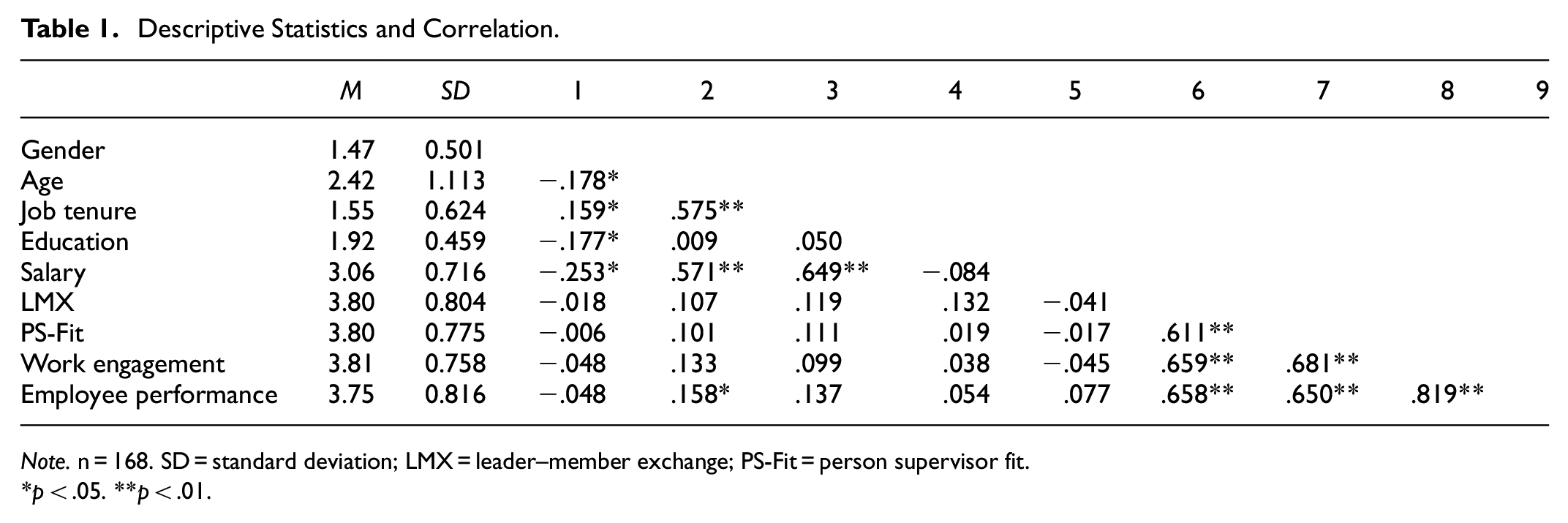
Note. n = 168. SD = standard deviation; LMX = leader–member exchange; PS-Fit = person supervisor fit.
*p < .05. **p < .01.
Results
Instrument Quality Test
Validity Test
Validity test using confirmatory factor analysis with SEM-PLS can be seen from the loading factor of each item 0.70. In this research, we use convergent validity, and discriminant validity approaches to test the validity. For convergent validity, the researcher requires a loading factor of 0.70 so that the validity indicator is more convincing. This validity test can be seen in Figure 1 below:

Confirmatory factor analysis diagram of research construct.
Convergent Validity
To measure convergent validity, it can be seen in Figure 1 and Table 2 in this study. From Figure 1, it can be seen that all the questions used from the four variables in this study are valid because the factor loading value of each item is above 0.7. For this reason, the PS-Fit variable indicator is 6 items, the LMX variable indicator is 11 items, the employee performance variable indicator is 5 items, and work engagement is 17 items. For the Average Variance Extracted (AVE) test, it can be seen that all variables have an AVE value above 0.5, such as PS-Fit 0.733, LMX 0.745, employee performance 0.786, and work engagement 0.711. The results of the AVE test can be seen in Table 2 below:
Average Variance Extracted (AVE) Test Results.
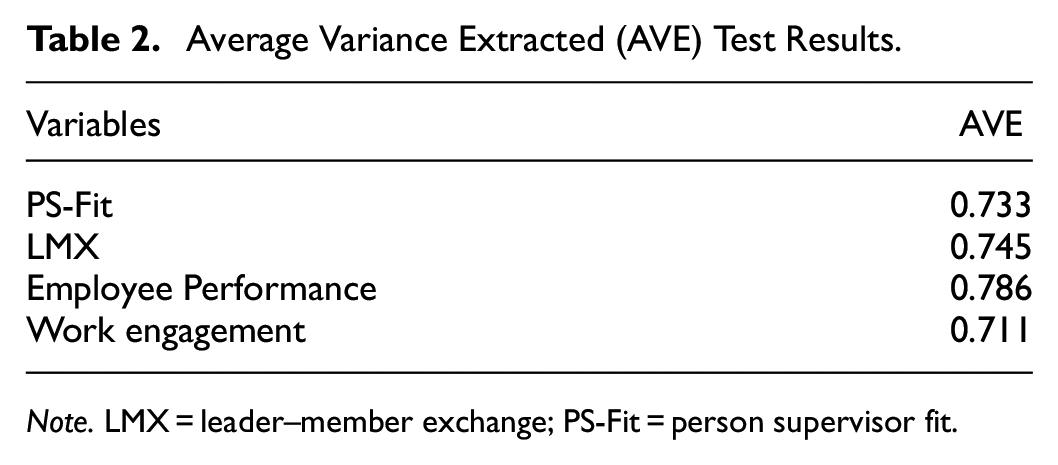
Note. LMX = leader–member exchange; PS-Fit = person supervisor fit.
Discriminant Validity
To test discriminant validity, it can be seen from the cross-loading value of each variable with its construct, or it can also be done by comparing the AVE roots. From the results of the discriminant validity test, it can be concluded that the cross-loading value of each variable is greater than the loading of a variable with other variables. The measurement of discriminant validity can be seen in Table 3.
Discriminant Validity.

Note. LMX = leader–member exchange; PS-Fit = person supervisor fit.
Hypotheses Test
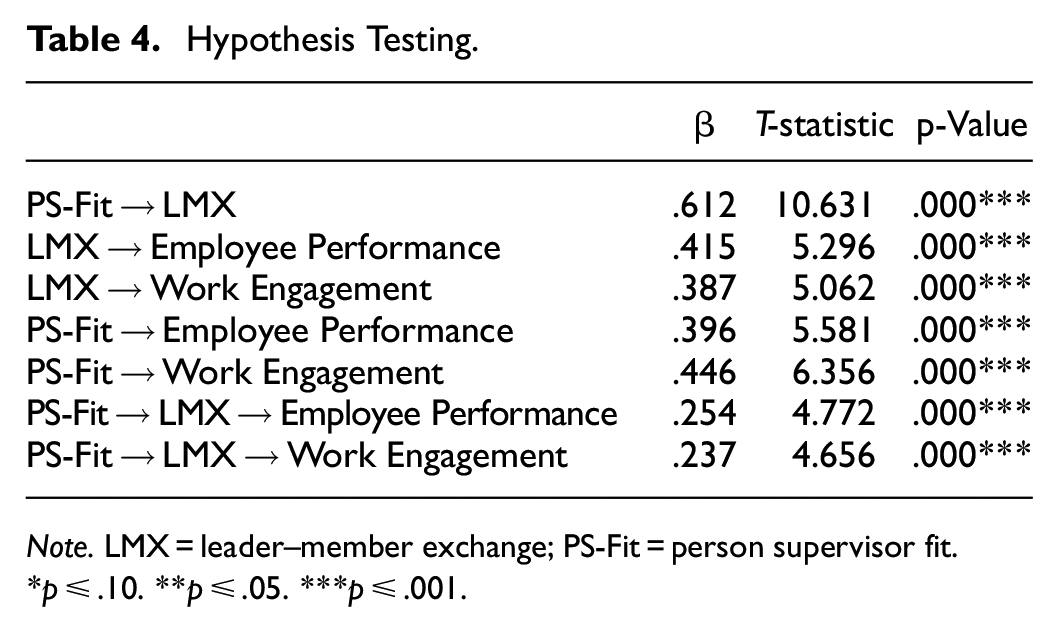
Hypothesis testing in this study is intended to answer research questions by analyzing the structural model. Structural analysis in this study can be seen from the value of standardized regression weight, which explains the coefficient of influence between variables in this study. An explanation of the causal relationship from this research can be seen in Table 4.
Hypothesis Testing.
Note. LMX = leader–member exchange; PS-Fit = person supervisor fit.
*p ≤ .10. **p ≤ .05. ***p ≤ .001.
From the results of hypothesis testing in Table 4 above, it is known that the regression coefficient of PS-Fit’s effect on LMX (β = .612; t = 10.631; p < .010) indicates that PS-Fit has a positive effect on LMX. The results of testing the hypothesis show support for the first hypothesis, which says that PS-Fit has a positive effect on LMX. This means that the better the PS-Fit in the Islamic bank, the closer the leader and subordinates will be.
From the results of hypothesis testing in Table 4 above, it is known that the regression coefficient of the effect of LMX on employee performance (β = .415; t = 5.296; p < .010) shows that LMX has a positive effect on employee performance. The results of testing the hypothesis support the second hypothesis, which says that LMX has a positive effect on employee performance. This means that the better the LMX, the better the employee performance of Islamic banks.
From the results of hypothesis testing in Table 4 above, it is known that the regression coefficient of the effect of LMX on work engagement is (β = .387; t = 5.062; p < .010), which shows that LMX has a positive effect on work engagement. The results of testing the hypothesis show support for the third hypothesis, which says that LMX has a positive effect on work engagement. This means that the better the LMX, the higher the work engagement of Islamic banks.
From the results of hypothesis testing in Table 4 above, it is known that the regression coefficient of the effect of PS-Fit on employee performance through LMX is (β = .254; t = 4.772; p < .010), which indicates that LMX is able to mediate the effect of PS-Fit on employee performance. These results indicate the role of LMX as a partial mediation of the effect of PS-Fit on employee performance. This is because the influence of PS-Fit on employee performance is significant either directly or through LMX. The results of hypothesis testing support the fourth hypothesis, which explains that LMX mediates the effect of PS-Fit on employee performance.
From the results of hypothesis testing in Table 4 above, it is known that the regression coefficient of the influence of PS-Fit on work engagement through LMX is (β = .237; t = 4.656; p < .010), which indicates that LMX is able to mediate the effect of PS-Fit on work engagement. These results indicate the role of LMX as a partial mediation of the effect of PS-Fit on work engagement. This is because the influence of PS-Fit on work engagement is significant either directly or through LMX. The results of testing these hypotheses support the fifth hypothesis, which explains that LMX mediates the effect of PS-Fit on work engagement.
Discussion
The results of testing the first hypothesis in this study indicate that PS-Fit has a positive effect on LMX. It can be said that the more in line with the values held by employees and their leaders, the closeness between the two increases. Conformity between employees and leaders can be shown from the similarity of personality, values and goals between the two. Frequent interactions between employees and their leaders can show interest in each other which will increase their closeness which is shown by mutual respect, protection, and self-sacrifice between one another. The Interpersonal Attraction theory explains that leaders are attracted to subordinates because they are complementary and have something in common (Lim et al., 2019). The compatibility between the two makes them interact more, complement each other and need each other compared to other employees.
Social exchange theory also states that employees who have a fit with their supervisors are likely to develop high-quality LMX relationships because such fit promises mutually beneficial reciprocal relationships (Cropanzano & Mitchell, 2005). Meanwhile, the interpersonal attraction theory explains that similarity or fit between two individuals can enhance interpersonal attraction between them (Byrne et al., 1971), which then facilitates the formation of high-quality LMX relationships. Consistent with both theories, previous studies have found that PS-Fit has a significant positive influence on LMX (Breevaart et al., 2015; van Vianen et al., 2011; Z. Zhang et al., 2012) Thus, both theories along with empirical evidence from previous studies support the hypothesis that PS-Fit has a positive influence on the formation of high-quality LMX between supervisors and subordinates.
The results of testing the second hypothesis in this study indicate that LMX has a positive effect on employee performance. It can be said that the better the LMX level, the higher the employee performance. Mutual respect and mutual help between leaders and subordinates can improve employee performance through extra roles between the two (Anvari et al., 2015; Heriyadi et al., 2020; Sumarmi & Tjahjono, 2021). Employees who are close to their leaders are more receptive to instructions given by their leaders so that coordination between the two can work well, which will improve employee performance. Leaders who are close to their subordinates also always provide solutions to problems faced by employees (Enwereuzor et al., 2018; Reitan & Stenberg, 2019). Zakiy (2019) explains that employees who are close to their leaders (in the group of LMX) are more trusted and get more information than employees who only have work contracts (out of the group of LMX). For this reason, employees who gain a lot of trust from their leaders will always maintain that trust by improving their performance.
Social exchange theory and interpersonal attraction theory consistently explain why LMX positively influences employee performance. Social exchange theory states that when employees have high-quality LMX relationships with their supervisors, they are listened to more and receive more resources, support, and autonomy, leading them to feel obligated to reciprocate by enhancing performance or even undertaking tasks beyond their responsibilities (Breevaart et al., 2015; Cropanzano & Mitchell, 2005; Zakiy & Ramadhani, 2024). Meanwhile, interpersonal attraction theory asserts that high-quality LMX relationships are based on interpersonal attraction between supervisors and subordinates, which can motivate employees to be more engaged in their work, thus enhancing performance (Byrne et al., 1971; Kahya & Şahin, 2018) Consistent with both theories, a meta-analysis study by Martin et al. (2016) found that LMX significantly influences task performance, while other research concludes that LMX is consistently associated with performance improvement (Anand et al., 2018; A. Lee et al., 2019; S. Singh & Vidyarthi, 2018). Thus, both theory and empirical evidence support the hypothesis that high-quality LMX can enhance employee performance through social exchange processes and interpersonal attraction.
The results of testing the third hypothesis in this study indicate that LMX has a positive effect on work engagement. It can be said that the higher the closeness between the leader and his subordinates, the higher the work engagement of employees. Employees close to their leaders get more priority than other employees who are not close to their leaders. In addition, leaders who are close to their subordinates always provide motivation in interpreting a job encourage and always inspire employees to love their work. In line with the interpersonal attraction theory, which states that high-quality LMX relationships are based on interpersonal attraction that can enhance employees’ intrinsic motivation to engage with their work (Nahrgang et al., 2009). In other words, employee work engagement can be created because of the leader’s role in providing direction and input to employees. The results of this study are in line with previous research, which said that high LMX could increase employee work engagement (Agarwal et al., 2012; M. S. Kim & Koo, 2017).
The results of testing the fourth hypothesis in this study indicate that LMX is able to mediate the effect of PS-Fit on employee performance. It is not only the compatibility of employees with their organizations that can cause employee performance to increase (Wulandari, 2021), but the compatibility between employees and their leaders also greatly determines the working conditions of employees. The similarity of values between employees and their leaders makes the closeness between the two increase, which can improve employee performance. As previously explained, the important factor in the formation of LMX is the compatibility of goals, values and personality between the leader and his subordinates, and this can make employees focus on their performance and strive to improve their performance. In other words, these results explain that LMX has succeeded in connecting PS-Fit with employee performance. The interpersonal closeness between leaders and subordinates makes closeness between individuals (Lim et al., 2019; Subramaniam & Sambasivan, 2018), which has a major influence on social interactions and relationships between individuals (R. Singh et al., 2017). This causes the closeness between the two to increase, which leads to an increase in employee performance.
The results of testing the last hypothesis in this study indicate that LMX can mediate the effect of PS-Fit on work engagement. Besides being able to mediate PS-Fit on employee performance, LMX can also mediate the effect of PS-Fit on employee work engagement in this study. The similarity of goals, personality and values shared by both of them can make LMX increase so that it has an effect on increasing employee work engagement. This suitability is manifested by the high interaction between leaders and subordinates in both formal and informal forums, which makes employees get more information about work, so they can maximize the work they do. This study confirms the Social Exchange Theory, which explains that the reciprocal relationship between leaders and subordinates can lead to mutual benefits (Decuypere & Schaufeli, 2020) by increasing more effort at work (Regts et al., 2019). This can cause employees to better understand the meaning of work and be more involved in their work.
This study makes a significant contribution to theory development, particularly in the realms of social exchange theory and interpersonal attraction theory. Firstly, the findings of this research reinforce the validity of both theories in explaining the dynamics of leader-subordinate relationships and their consequences on employee attitudes and behaviors at work. Similar to other research by Zheng et al. (2020), which also supports social exchange theory and interpersonal attraction theory as explanations for why high-quality LMX enhances performance and positive work attitudes among employees. The discovery that PS-Fit positively influences LMX, and subsequently LMX contributes to the improvement of employee performance and work engagement, aligns with the core premises of both theories. Therefore, this research provides additional empirical evidence supporting the application of social exchange theory and interpersonal attraction theory in the context of leadership relationships, consistent with previous empirical studies (Sheer, 2015; Whitney et al., 2022).
Secondly, this study broadens the literature’s understanding of the processes and mechanisms behind the influence of PS-Fit on performance and work engagement by placing LMX as a crucial mediating mechanism. This research identifies an indirect path from PS-Fit to performance through LMX, offering fresh insights into how leader-subordinate fit is translated into positive work outcomes for employees. These findings suggest that PS-Fit is not a direct predictor of job outcomes but operates through the formation of high-quality relationships between supervisors and subordinates. Thus, this research enriches both theories by identifying indirect pathways that explain how individual-environment fit can translate into beneficial work outcomes for both employees and organizations.
Conclusion
The number of job choices in the modern era makes employees less focused on their work. This can cause employees’ performance and meaning of their work to fade. One alternative solution to overcome this problem is to increase the role of a company leader. This study proves the compatibility of values, personality and goals between the leader and subordinates can increase the closeness between the two, which leads to increased performance and work engagement of employees. In addition, the results of this study also prove the role of LMX as a liaison between PS-Fit with employee performance and employee work engagement. In the end, this research succeeded in strengthening the Interpersonal Attraction theory, which explains the relationship between individuals in a company.
Managerial Implications
There are several contributions of research results to the Islamic Bank to be followed up as policy recommendations made related to the management of employees in the company. Companies can maximize the role of managers in making interpersonal proximity to employees in order to create emotional closeness between leaders and their subordinates. This is necessary for Islamic banks to improve the performance and work engagement of their employees. The need for this step is because employees are company assets who have feelings and emotions that need to be maintained in order to be able to contribute to the company by maximizing performance and involving themselves with their work.
Limitations and Directions for Further Research
As in other studies, this study has several weaknesses that can be improved in future research. First, a self-reported assessment allows respondents to answer in accordance with subjective norms that apply in their environment, so it is very likely to cause bias in the answers given. Researchers have taken action to minimize this by presenting this study only for academic purposes and not reported individually but collectively. Further research needs to add confirmation to colleagues and organizations regarding the performance of their colleagues. Second, limited permits and time for employees to fill out questionnaires made only six research objects out of ten targeted. Banking is one of the industries with a high level of service mobility, so researchers have limitations in accessing Islamic bank customers. Future research should prepare for this well.
Footnotes
Acknowledgements
Thank you to the Center for Higher Education Funding (BPPT) and the Indonesia Endowment Fund for Education (LPDP) for providing funding for the preparation of this manuscript.
Author Contributions
All the authors have legitimate contributions to this paper.
Declaration of Conflicting Interests
The author(s) declared no potential conflicts of interest with respect to the research, authorship, and/or publication of this article.
Funding
The author(s) disclosed receipt of the following financial support for the research, authorship, and/or publication of this article: This work is funded by the Center for Higher Education Funding (BPPT) and the Indonesia Endowment Fund for Education (LPDP) with registration number B3172022010629180911.

Data Availability Statement
The data that supported the findings of this study are available online in the database and can be accessed and downloaded from anywhere. The data that supported the findings of this study are available from the corresponding authors upon reasonable request.