




Abstract
The process of managing change, which distinguishes conservation from other interventions in historic settings, frequently astounds us when design approaches overlook the underlying urban “DNA” (attributes) of historic contexts with heterogeneous character. Such actions could potentially harm the unique aspects of any additions and disrupt the overall historical context in the future. This issue becomes particularly relevant in answering which lines to follow when making new additions. This study explores lines for forming unobstructed architectural additions in North Nicosia’s Walled City, considering reflective design schemes and continuity. A comparative analysis of texts, and case studies from the study area constituted the methods. The results showed two distinct sensitivities: reflective design schemes caused disorganized and negative visual effects, while continuity strategies triggered a positive visual representation. We propose new additions with forward-thinking design strategies that engage the past harmoniously to maintain the city’s significance for future generations.
Plain language summary
Introduction
The medieval era in Cyprus brought significant urban transformation in all its historical cities especially Nicosia which was configured the center of administration. Although medieval cities possess walls and nearness to a consistent large natural source of water supply, the case of Nicosia’s Walled City shows the opposite by it location away from the Mediterranean Sea. This study leverages on what the Ottoman cultural civilization did as observed from other studies as the pace setters for new additions in the existing architectural and urban fabric left by the Lusignan and Venetian imperialists (1200–1500) who are part of the Middle Ages empires. Creating an urban formation characterized by the city fortification, cathedrals, monasteries, castles, organic streets patterns, and etc. The Ottoman administration in Cyprus started in 1571. They adopted a robust conservation approach within the version (Breen, 2019) conceptualized as “Ottomanization.” Further interpreted as minimal demolition, which emphasized on adaptive reuse, and mild new additions interventions (Ukabi & Akçay, 2023a). More construction of fountains were eminent and since family ties social cultural indicators was given priority in domestic compound architecture. Another researcher had earlier identified that the existing medieval religious buildings were reused for different functions except for new additions like fountains, public baths, and the Sultan Mahmut II Library (Özgüven, 2004). The local residential neighborhoods created a notable Cypriot architectural heritage assets, environmentally-friendly by design approach (Philokyprou et al., 2014). The domestic building’s layout and orientation created boundaries between the family cycles daily life from the public on the streets with courtyards (Fasli, 2010, p. 177) that are fenced above human-eye level, greenly, socially, folkloric and utilitarian structured. The enclaves identity configured with household building blocks balances with what (Carr, 1994) mentioned in “Cyprus and the Crusades” as cultural maturation along the Mediterranean settlements.
In this case, stylistic spatial boundaries within a diversified universal city fortification undoubtedly differentiated the Walled City of Nicosia from other Cypriots locale. Such spatial order (Łaszkiewicz et al., 2022) aligns with the conditionsã war, lifestyle, and environment that affect city identity spell-out by Öngül (2012). Based on this character, site layout, construction techniques, construction materials/decorations several scholars had earlier conceptualized these architectural objects as “Traditional houses,”“Traditional Turkish houses,” or “sachnisis” (Danilo, 1997; Dikaiakou & Chrysanthou, 2003; Pulhan & Numan, 2006; Thravalou & Philokyprou, 2021; Turkan, 2016). The large transfer of Anatolian craft workers and their families contributed to the formation of the Ottoman Turkish Oriental architectural style. Another important Ottoman image in Nicosia is the re-adoption of the architectural references of the Byzantine and Lusignan features. In continuity, conceptualizing them to create their niche for example in the design of monumental buildings in this context (Figure 1).

Ottoman additions in North Nicosia Walled City: (a) south view of ArabAhmet Mosque; (b) Mevlevi Tekke (lodge) museum; (c) Yunus Emre Enstitüsü (use for Turkish teaching and history from 2007, but was a religious center in Ottoman Period); (d) the Buyuk Khan (The Great Inn); and (e) the Kumarcilar Khan (Gamblers’ Inn).
This paper’s background was based on three-level elucidation of conservation instruments (Amsterdam, ICOMOS, 1975), several conservation groups (Royal Fine Arts Commission in Cantacuzino, 1994; English Heritage, 2008; Getty Conservation Institute, 2013; Institute of Historic Building Conservation, 2021). The others are diverse scholars (Jokilehto, 2007, p. 33; Tiesdell et al., 1996; Toprak, 2020; Toprak & Sahil, 2019), whose exposition agrees with the meanings of the typological value of the historical environment. In the rehabilitation of old places “the new buildings of today will be the heritage of tomorrow, every effort must be made to ensure that contemporary architecture is of a high quality” (Amsterdam, ICOMOS, 1975). In circles that regulate contemporary works in historical context, the Royal Fine Arts Commission in 1994 was one group that decried how designers ignored the Town Planning Act of 1947. They spotted how such a practice consequentially sprout pastiche approaches in all the rehabilitation projects. In order to negotiate further measures, the Commission has issued the following principles in the spirit of “good judgment and confidence in building styles, materials, and construction methods”: The new should be original and innovative design; it contrast should be tolerable; design in existing context should take the inwards-outwards approach and not outward-inwards; style should not be foremost to function and purpose.
English Heritage (2008), submitted one of their six points on the historic environment as “the inputs of each generation on the historic environment should pave the path for users’ benefits without preventing future generations from reaping their endowment.” Every historic environment has intrinsic values (social, cultural, educational, and spiritual), and provides sustainable scenarios for inner-city revitalization and iconic architecture (Institute of Historic Building Conservation, 2021). Meanwhile, the Getty Conservation Institute (2013) proposed four key ideas to support the representation of the traces of present and future generations: Time is visible in the city and generations interact through architecture; architecture is a scene and meanings in buildings is calling for attention; introducing new to old does not have a single approach, situations will determine where each designer falls within the range and design is also many layers of things; architecture that perceives the demand for change and growth would be open to dialogue and fitting-in to achieve harmony.
A clear controlling mechanism necessary to monitor all physical, economic, and social changes in the historic quarters will ensure sustainable use of cultural traces for present and future generations (Tiesdell et al., 1996). Toprak (2020) reaffirmed this by proposing the cultural, technological imprints, of our era to be reflected in our environment rather than simply replicating existing historic settings ensembles. Furthermore, Jokilehto (2007) emphasized the importance of quality design principles, cautioning against design universality in favor of only bringing out past memories of urban heritages. Toprak and Sahil (2019) investigated the excessive repetition of design methods in historic environments. They noted that this led to a lack of environmental dynamism, particularly when there is contrasting harmony in the existing urban setting. In response, Navickiené (2012) examined documents produced by the Council of Europe (CoE), the International Council on Monuments and Sites (ICOMOS), and the United Nations Educational, Scientific and Cultural Organization (UNESCO). Eglė Navickiené’s goal of reviewing principles focused on the conservation and development of urban heritage sites. In addition, four categories of guidelines for incorporating new designs into historic environments and matching them to their respective periods were presented. That is: Visual compatibility with historic buildings, 1964 to 1972; contextuality by identifying a character of place, 1975 to 1982; on-going evolution of multidimensional traditional patterns, 1987 to 1999; toward high-quality interventions, 2000.
From the three types of design reflection paradigms put forward: reflection-in-action, reflection-on-action, and reflection-on-practice by Schön (1983), this study relates to the “reflection-on-practice.” Reflection-on-practice focuses on design context as a methodology to direct future design schemes that help to identify patterns of good and bad practices as empirical data for future projects (Norman, 2013; Reyman, 2003; Schön & Wiggins, 1992). A conceptual semantic stance was anchored on the connotative meaning of reflective design in the context of historical places. Thus, reflective design schemes are design typologies that mirror previous characters and patterns of the past, a condition where new additions select certain elements or components of the old with the goal of evoking a nostalgic environmental perception (Ukabi & Akçay, 2023a). On the contrary, continuity presents a resounding grip with the concept of reflection-on-practice, which Wood (1999, p. 17) conceptualized as “sense of orientation and beautification through preserving past structures and present objects. It stimulates a sense of belonging, described as a continuum for psychological and emotional well-being, and an interface between the past, the present, and the future (Mayes, 2013). Continuity in relation to human experience integrates space habitation and time cycles, and architecture constitutes the platform where these processes of history are systematically visualized (Pallasmaa, 1994). Goldberger (2007) further argues that preservation success lies in making us feel connected to the past in a positive way. It should make us appreciate the present more and see it as part of a larger, ongoing story. Preservation should not just preserve old buildings but also the spirit of the places they represent holistically. This phenomenon was similarly debated by Karim (2019), who likened it to a battle between “memory and modernity.” Challenging architects on the design aspects of retaining the past built form while still expressing a positive change to the future of society (Chang, 2020).
The outcome of when intervention turns 180 degrees to lightly re-interpret the past was demonstrated in the design of Demir Holiday Village, Bodrum, Turkey, in 1987 (Kamal, 2015). A new architectural urban social housing solution that re-images the past monolithic-ally from a single local material dominance Mausoleum (stones) to create a homogeneous reflective design scheme in an historically medieval context with diverse attributes (sea, forest, hills, etc.) for creativity. An examination of the visual impacts of this example reminds us of the famous quote of Hassan Fathy (an advocate of sustainable re-interpretation of vernacular architecture), here rephrased as tradition is not the same as stagnation (Fathy, 1973). As a result, the continuity of this context has been compromised because future architectural additions will struggle to break this uniformity (Figure 2).

Demir Holiday Village, Bodrum, Turkey.
An example of intervention that depicts continuity was the Cultural Center Extension within the historic center of Peccioli, Italy between 2016 and 2018. Where the scheme revived the Medieval Tuscan built heritage of this hilltop settlement through the merger of past architectural expression with the new era contemporary stamp organically (Mario Cucinella Architects, 2021). In this example, the concept of continuity was interpreted as “open-air laboratory for experimentation with resilience, art, culture, architecture and community” (Schianchi et al., 2021) (Figure 3).

Palazzo Senza Tempo in Peccioli, Italy.
In comparison, Alderson (2006) stressed that dynamic environments stimulate creativity, but delicate contexts dampen it due to a lack of an appropriate vision of an urban design framework. Breathtakingly, existing international and national conservation legal documents do not sufficiently address this determinants. Because of differences in their defining characteristics, some policies that work for one may not work for the other. To avoid becoming a colorless generation, P. F. Smith (1975) opined that, maintaining continuity could be difficult, and buildings can serve as a connector between cities’ past, present, and future. According to Taraszkiewicz (2002), each generation seeks its image in symbols, and architecture houses such symbol because it represents both a creative and aesthetic community and society. Based on this viewpoint, Groat (1988) proposed contextual infill design schemes that focused on reflecting the existing context’s features, with the exception of contextual continuity that looked beyond the horizon. As demonstrated by Davies (2019) and other previous researchers, the aftermath from late 1900 to early 2000 limited design outcomes to only contextual design strategies.
Based on this theoretical framing between design schemes that anchor on either reflecting the existing context’s features or considering its continuity aspects, this study aimed to explore these two poles in order to substantiate new additions that adopt forward design lines of dialogue with the old to keep the historic city’s spine and its environmental significance to the future. Especially in a heterogeneous historic contexts like the Walled City of Nicosia which historical picturesque was diversified. This study will fulfill the following objectives: (1) to form unobstructed architectural lines in new additions into heterogeneous historic contexts; (2) to relay how design schemes passively relate with historic environmental sensitivity; and (3) to explain why designers should reinterpret history holistically and not partially on new additions. In the areas of environmental resilience and the “build back better agenda,” this study hopes to contribute to the narratives on built heritage conservation, sustainable development, and material culture diversity of cities.
Materials and Methods
This qualitative research adopted comparative analysis of texts in it conceptual semantic composition, and the evaluation of case studies selected from the northern side of Nicosia’s Walled City, Cyprus. Comparative analysis, according to Drobnič (2014), deals with the similarities and differences between conditions or outcomes, and it can be useful in studying various concepts, dataset, and social units. Today, the discourse of built heritage is intertwined within these social systems (Mahn, 2021; Wu & Hou, 2015). Mualam and Barak (2019) used comparative research to compare the attributes, scales, and interconnections of built heritage studies and sustainable urban development. Gonçalves et al. (2018) examined existing methods for surveying and inspecting the state of conservation of ancient buildings using comparative analysis and a bibliographical survey. Nesticò and Somma (2019) used a comparative analysis of Multi-Criteria Methods to develop an Analytic Hierarchy Process (AHP) to help with the challenges of selecting rational design alternatives based on multiple criteria. Comparative analysis is a valuable research tool that can assist researchers in developing a deeper understanding of a problem, providing objective insights, identifying strengths and weaknesses, making informed decisions, and improving performance as articulated by M. F. Smith et al. (2018).
The research process was simplified as follows:
First stage, the review of texts on the two concepts of reflective design schemes and continuity, incorporating context examples where these concepts were practiced directly or indirectly on the one-hand and on the other hand, the historical description of the study area and related conservation bodies involved in the preservation and research dissemination of built heritage. The goal was to provide a theoretical base for the study and give us an understanding of the study area-North Nicosia Walled City.
The second stage was the evaluation of the case studies as both dependent and independent indicators of the process. The four cases were selected from a particular study area-North Nicosia Walled City—that qualified their dependence on the first stage of this research process. They were considered independent because the evaluation criteria engaged the RET (Relational Evaluation Tool), whose five variables are nuanced in composition: (1) design approaches composed of indicative, reflective, selective-reflective, resiliency, progressive, and fashionista (2) principles ranking, which are conservation guidelines criteria ranked from 1st to 6th. (3) Historic environment character captures the character type of the setting, either heterogeneous or homogeneous. (4) Visual appreciation concerns the environmental perception of the historic place, nostalgia, freshness, and wow. (5) Relationship with context embrace sub-variables like uniformity, harmony with contrast, and too contrast. This stage provided a clear picture of the cases sensitivity to the evaluation criteria listed and helped identify the common reactions and differences among the cases under the same conditions.
The study was wrapped up at stage three, where the argument correlated the ideas from the literature reviewed, the contextual examples in the body of the essay, and the outcomes of the cases, linking the findings to the propositions of the Charter on New Urbanism of 1996 and the International Network for Traditional Building, Architecture, and Urbanism, which are advocates of continuity. The sum of these various stages led to the conclusion of this study, and the study limitations and direction for future research were explained at this stage.
The sources of research materials and data were diverse, books, peer review journals and conference papers, book chapters, magazines, blogs, and institutes dealing with historic preservation issues. The physical survey of the study context, taking photographs, research review sections, and informal talks with staff of the Antiquities Department of TRNC and processing visual materials using visualization techniques.
Study Area
Although Nicosia in Cyrus was known for its multiplicity of cultures and ethnicities, only two major communities stood out after the severe 1974 divide with territorial jurisdictions. The Turkish Cypriot communities to the northern side and Greek Cypriot communities to the southern side of the green-line and buffer zone of the partition. The city is located on Longitude 33° 22′ 56.1900″ E and Latitude 35°11′ 8.0376″ N. Aside from the administration function, which is supported by historical precedents in both sectors. The north of the Walled City (Lefkosa) is a hub for culture and history tourism. Although it has a rich heritage deposit, international restrictions on the northern side due to the division (Mahn, 2021) pose a huge heritage conservation challenge. Nowadays, the introduction of some universities in ArabAhmet and Abdu Çavus neighborhoods and the inclusive nature of the market through selling African foodstuffs in Selimiye area have fostered vibrancy of the northern sector of the Nicosia’s Walled City. Efforts by stakeholders to restored sick buildings is ongoing but the rate of decay remains rapid in some neighborhoods especially on the neighborhoods at proximity with the buffer zone (Figure 4).
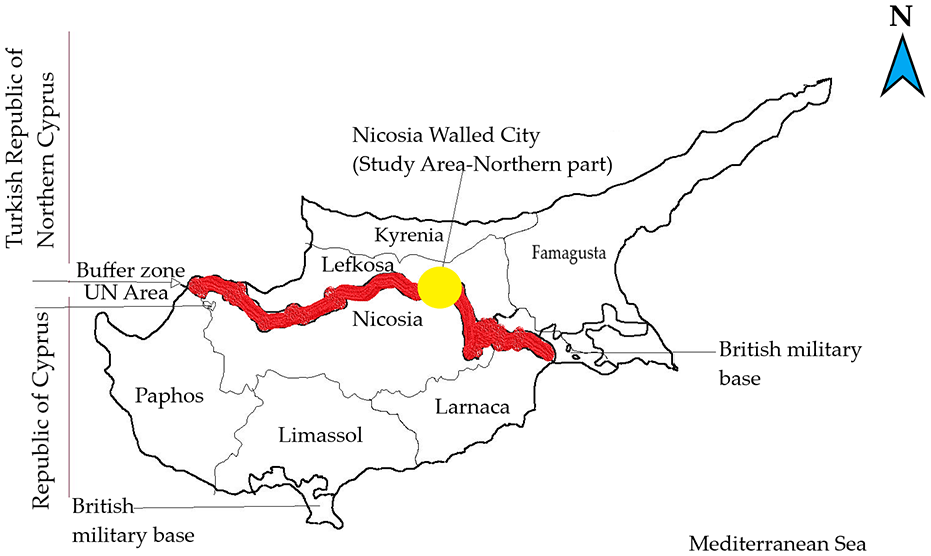
Map of Cyprus showing the study area.
Since this study focused on the North Nicosia Walled City because of border crossing restrictions, four case studies that where added during the Turkish Republic of Northern Cyprus (TRNC) are selected for analysis from three neighborhoods. The description of the cases are provided. The criteria followed for the selection was based on: (1) new additions constructed in the TRNC Period 1983 to now, (2) randomly selected from different quarters within the study area according to their visual impression, (3) The study lens for reflective schemes and continuity were leveraged, two cases per each to provide a fair assessment. (4) Their inter-relatedness in their location, (5) a 5-point Relational Evaluation Tool (RET) tested by Ukabi and Akçay (2023b) was also adopted: Design approaches, principles, relationship with context, visual appreciation, and historic environment character. The cases are: (a) Enkaya Hotel (Selimiye neighborhood); (b) Employment Protection Office (Selimiye neighborhood); (c) Djumba Hotel and Cafe (ArabAhmet neighborhood); and (d) Light Bookshop (Ibrahim Paşa neighborhood; Figure 5).

Cases map and photographs.
In Figure 5:
“Case a”. En Kaya Hotel is located within the historic core of North Nicosia Walled City in the Selimiye neighborhood, which has a rich variety of architectural heritage. It is also close to the historic Ataturk Square (Sarayönü Square). The hotel offers 3-star accommodations and provides a bar service along with continental and halal breakfasts, a review of 1996 to 2023 (Booking.com, n.d.). Although it has three floors as opposed to the dominant two floors traditional houses of the historic city, its overall height balances with the adjoining buildings in the street. The design style as a new addition around the early 21st century in the TRNC Era depicts Neoclassical architecture that had existed before in the city during the Ottoman and British eras. Such a tendency places it under reflective design schemes, despite the elegant scale displayed.
“Case b”, situated on the northwest side of the Selimiye Mosque (former St. Sophia Cathedral), is an office for Employment Protection. Its new material composition and construction contrast with the surrounding context. Although it retains some elements of British colonial architecture, such as the semi-open balcony, arcaded facade and flat roof, this hybridized design style points to the continuity of the area. The building blends in with the street, but its visual appearance attempts to accelerate the context while relating harmoniously with the existing street setback and skyline.
“Case c” is a hotel and cafe, Djumba Hotel designed in the same style as the Ottoman-Turkish traditional houses. It is located opposite the ArabAhmet Mosque. The common elements that define this building are a central courtyard and symmetrical facade elements. The design reflected the past aspirations of the client’s parents to awaken the traditional building vocabulary of nostalgia as common practice with Turkish Cypriots, which is now a common practice nowadays in the study area.
“Case d” is Light Bookshop, a new addition used as a bookshop designed during the early years of the 21st century. The building aligns with the setback and the skyline of the street. Behind it are the Samanbache residential quarters realized during the early British Era in Nicosia, Cyprus. In equal parts, the design incorporated both contemporary elements (glass and white reinforced concrete horizontal perforated canopies) and local brown stones. Such integration can be called hybridization in a continuous manner.
The TRNC Antiquities Laws followed for the development of the above cases explained that new buildings should be compatible with the character of the environment and/or sites, properties, heights, architectural construction materials, and the buildings and the environment. It also states that the perception of environmental issues should be taken into consideration (Kuzey Kıbrıs Türk Cumhuriyeti, 2009).
Results and Discussion
Based on the description provided about the study context and the selected cases, the cases are further evaluated using the Relational Evaluation Tool (RET) to ascertain the reflective tendencies and continuity positions of each (Table 1). As part of the related tools, for clarity the authors also extracted two conceptual details from the recent research that categorized contemporary architecture conservation principles into six ranks and design approaches into six groups to enhance the discussion (see Appendix 1).
RET Evaluation of Case Studies.

Source. Developed by authors.
In Table 1, some variables show similarities while others depict differences to validate the results based on the considerations designers and regulators give to reflective design schemes and continuity. Under similarities, two cases (a and c) responded to two variables similarly:
Principle ranking (first, second, and third).
Historic environment character (heterogeneous).
On the aspects of differences, two sets of cases (a, c and b, d) responded with three variables (design approaches, visual appreciation, and relationship with context). On the one hand, cases (a and c) formed one set of sensitivity, and on the other-hand cases (b and d) constituted another set of reactions. The results of these sets are summarized in Table 2 for clarity.
Cases Reaction with RET Variables.

Source. Developed by authors.
From Tables 2, the outcome of the cases evaluated corresponded with the ideas and examples demonstrated in the existing literature. First, when new additions copy past historic urban fabric without counterbalancing empathizing, ideation, and application with the present time aspirations, a disconnect manifests, especially in heterogeneous historic contexts. This is because existing characters are multilayered and derived from consecutive periods of settlement evolution, which were partly natural, communal, and at the same time a product of traditional or modern design experimentation. Cases a and c belong in this category because of the two repeated layers of past eras. The variables that best describe this scenario are reflective and selective reflective design approaches, nostalgia, and uniformity (see Tables 1 and 2). Several researchers have criticized this kind of practice. Likewise, the works cited in Appendix 1 also show that more than 50% of the design approaches used by architects to introduce new additions to historical contexts are reflective-based. The Demir holiday homes in Turkey exemplified this type of tendency. This type of design approaches can arose imitation when executed without technical care.
Second, cases b and d integrated the past features and those of the present and created a connector between these time intervals. These sets of cases settled at a neutral level while communicating the continuum of the context without interrupting the various layers, especially in resilient urban environments, as advocated by UNESCO and other heritage conservation agencies. The variables that supported this continuity tendency are resiliency, freshness, and harmony with contrast (see Table 1). The Palazzo Senza Tempo in Peccioli, Italy, was a good example from another European country among countries that have adopted the new preservation strategies. Similarly, in Appendix 1, the sum of design approaches that would stimulate continuity used by architects equals approximately 40%.
The results also show that dependence on only 1st to 3rd ranking of contemporary conservation principles in historic contexts with diverse layers may propel uncontrollable repetition or reflective-based designs, and the study area focused on at the moment aligns with this ranking. The findings also identified that the tastes and perceptions of the locals’ heirs like to move in the direction of reconstructing the past visual characters of their parents. Such claims are not obsolete from preservation perspective, but require caution because of the temptation of energizing overwhelming imitations in place of continuity. Such phenomena in the long run can contribute to the obsolescence of the historic context, like “the case of Qishla Castle in Koya City” (Mustafa, 2023).
The Ottoman period marked the starting point for new additions without damaging the existing historic context’s fabric but inserted their aspirations, as exemplified in (see Figure 1). Although the British Era demolished most of the historic buildings, they managed to still relate to the past and the future of the context studied. The decolonization period brought new additions that climbed beyond hybridization to progressiveness before the fluctuating periods of separation that bewildered this historic context. The Turkish Republic of Northern Cyprus (TRNC) Period now faces the challenge of continuing different layers while attempting to add their niches from the present to the future. Although equal examples were selected to support this study’s argument, physical survey and observation in each neighborhood of the study area show that different factors of sociocultural, environmental perceptions, economics, policy and control, and political and international restrictions are contributing to more new additions’ turning to the past.
In the general context of this discourse, these findings, aligned with the important arguments about the city of contrasts, will help us create a city of continuity. This is a city where the present and past, and the urban and building scales, work together instead of obstructing each other. This is the vision of the Charter of New Urbanism of 1996, which focuses on human-scaled urban design (INTBAU, 2007; Semes, 2007).
Conclusion
This study has illuminated two concepts that are often misinterpreted in built heritage discourses. One of the terms has been conceptualized as reflective design schemes connotatively on purpose because the literal meaning of reflective practice is still commendable in design thinking in both architecturally related design process and product designs, and the other is continuity. Within this main stream, this study identified an over-dependence on reflective design schemes than continuity approaches when introducing new additions to historical context. These two sets of sensitivities affect heterogeneous historic contexts differently, as shown by the findings of North Nicosia Walled City. On one end of the spectrum, a complete return to only reflective-related approaches produces new additions with negative visual energies and a cluttered appearance, and this study interpreted it as a contributor to static development. On the other end of the spectrum, a merging of the past qualities of the historic context with contemporary features stimulates the urban fabric of the historic context with a positive visual impact and provides a rhythmic signification. This study concludes that although reflective design schemes and continuity are similar in policy-related matters like conservation principles and historic environmental character, they absolutely differ in application aspects like design approaches, visual appreciation, and relationship with context. The mirrored design types produce interrupted visual composition, whereas the continuity practice ends up creating unobstructed historic layers. Based on this evidence, this study put forwards the following suggestions for the urban development decision-makers and architects involved with the management and development of historic places with similar character like North Nicosia Walled City:
The local regulatory document should be enlarged to accommodate new design criteria that fall in the 6th rank of the International/National legal framework.
Designers’ proposals should be reviewed for quality and continuity relationship aspects to keep the historic city alive dynamically into the future.
The environmental significance specifics should drive the new additions process.
iv. NGOs involved with heritage conservation should work with the Antiquities department to implement environmental awareness of the locals and runners of businesses in the historic city.
Issues of commercial brands gaining visual dominance are widening nowadays in this historic city, the control authority and Antiquities department should regulate facades advertising installations.
Study Limitation and Future Research Direction
This study practically analyzed case studies from the Walled City of North Nicosia, Cyprus which possesses a heterogeneous character and based on this limitation the outcomes are directly for this historic context but other similar settings with similar urban fabric composition can also benefit from it. Future research can consider the dark colors scheming delineation that is morphing at different new interventions in this study area, especially with the commercial outfits. At a general scale, a global compendium of cases which engaged either of the two concepts, reflective design tendencies or continuity could provide a broader sense of understanding and rethink about the treatment of new additions in historical contexts.
Footnotes
Appendix 1

| Newly injected design approaches | |||
|---|---|---|---|
| Design approaches (newly added) | Design typologies | Brief notes | Frequency (%) |
| Indicative approaches | Philosophical, genius loci, prescriptive. | Approaches that serve as a sign and bring about the attributes of similarities of new with the old. | 7.0 |
| Reflective approaches | Facadism, re-founding, morphological, parody, impressionistic, contextual uniformity, pastiche, literal replication, imitation, referential, simulation. | Approaches that reflect previous character and patterns of the old. | 25.6 |
| Selective-reflective approaches | Collage city, contextual continuity, abstract symbolism, stylistic, intention within a style, abstract reference, version, harmonic contrast, differential, integration, partitioning, traditional. | New select certain elements or components of old preference. | 27.9 |
| Resiliency approaches | Intellectual, strategic, neutral, participatory, subtle, humanistic. | Design approaches that are neither old bias nor new motivated | 14.0 |
| Progressive approaches | Spatialism, contextual juxtaposition, opposite, analogy, contrast, spectrum interpretation, modern, picturesque. | New work grows in innovative stages with age without a common language. | 18.6 |
| Fashionista approaches | Intentional opposition, contrasting, freestyle, arrogant. | Approaches that insert surprise. | 7.0 |
Source. The Appendix 1 was extracted from (Table 4 of the research on “Enhancing policy and design tools for the coexistence of new and old architectural objects in historic precincts by exploring conservation principles and design approaches” [Ukabi & Akçay, 2023a] and Table 3 from “Conserving the Historic Identity of North Nicosia Walled City” [Ukabi & Akçay, 2023a]).
Declaration of Conflicting Interests
The author(s) declared no potential conflicts of interest with respect to the research, authorship, and/or publication of this article.
Funding
The author(s) received no financial support for the research, authorship, and/or publication of this article.
Informed consent
The authors affirmed that there was no human research participants.

Data Availability Statement
All the data analyzed in this article in the form of visuals are prepared and adapted by the authors and where required we have given credit to the sources.