




Abstract
Environmental leadership has received continuous attention from the business sector in recent years, yet few studies have examined the internal mechanisms and contingent conditions that link environmental leadership to firm performance. The aim of this article is to advance research by investigating the relationship between environmental leadership and firm performance by considering the mediating role of green innovation practices and the moderating role of environmental knowledge learning. A questionnaire survey is used to collect data from 353 agricultural products corporations in China. Empirical results show that environmental leadership has a positive relationship with the two dimensions of firm performance, namely, environmental performance and financial performance. Results also indicate that green innovation practices (including green innovation strategy and actions) play a mediating role between environmental leadership and firm performance. Meanwhile, it is also found that environmental knowledge learning positively moderates the effect of environmental leadership on green innovation practices. This study adds value to the environmental management literature by introducing leadership style as an antecedent variable to examine the impact of environmental leadership on firm performance in China. And the study also highlights the important moderating effect of environmental knowledge learning on the relationship between environmental leadership and green innovation practices. The findings of this article could be important in terms of both management and policy implications.
Keywords
Introduction
Today, organizations are facing severe environmental challenges, including global warming, oil crisis, water pollution, haze, and so on. As the society has progressed to emphasize environmental issues and governments have also been implementing stricter environmental regulations, huge impacts will influence business in China. In response to pressures from various stakeholders, firms’ managers are taking more active involvement to adapt their strategies, total quality environmental management, and in-house green innovation activities to address ecological concerns. Porter and van der Linde (1995) thought that pollution was a concrete evidence of ineffective or inefficient uses of resources. To achieve better balance of economic and environmental performance, many corporations have been pushed to be low-carbon and environmentally proactive by carrying out green innovation practices. There is a rich body of literature investigating environmental management which underscores that green innovation practices wound bring efficiency improvement, cost savings, and environmental benefits (Chen et al., 2006; Pan & Tian, 2017; Zhang et al., 2015).
Different from other environmental behaviors which merely aim to meet the minimum environmental standards, green innovation practices put more emphasis on pollution prevention (Brunnermeier & Cohen, 2003) and release of environmental burden by introducing new systems, products, and processes (G. Zhang and Zhang, 2011) so as to bring economic value (Horbach, 2008) and competitive advantages (Hart & Sharma, 2004) to enterprises. Gradually, green innovation practices have evolved and served as a bridge between firms’ activities and the satisfaction of various stakeholders, namely, governments, consumers, business partners, employees within the organization, and communities (DiPietro et al., 2013).
Various studies have explored the relationship between green innovation practices and corporate performance from different perspectives, but no consensus conclusion has been reached yet. Some scholars believe that environmental management or innovation will increase the cost of the enterprises, so it is an unnecessary investment and even hinders the development of the enterprises (Pan & Tian, 2017). But others insist that enterprises implement environmental management and green innovation which will help them achieve sustainable competitive advantage (Hart, 1995; Porter & Van der Linde, 1995). Such controversy indicates that the influencing factors of green innovation practices need to be further explored.
In recent years, the research focus has gradually shifted to the antecedents of corporate green innovation. Extant literature on the driving factors of green innovation can be divided into three categories, namely, institutional level, organizational level, and individual level. Institutional-level research mainly emphasizes stakeholder theory and institutional theory. Stakeholder theory believes that stakeholder pressure from governments, customers, suppliers, and competitors is the main factor influencing the needs and actions of enterprises (Dubey et al., 2015; Peng & Wei, 2015). Institutional theory holds that the implementation of green innovation practices is a way to improve organizational legitimacy in response to institutional pressure, which is usually divided into regulatory pressure, normative pressure, and imitation pressure. A large number of studies have shown that institutional pressure is a key driving force for green behavior of enterprises (M. A. Delmas, 2002; Schaefer, 2007). There is also a view that institutional theory can better explain the social responsibility of organizations compared with stakeholder theory (Dacin et al., 2002). Organization-level research mainly focuses on resource-based view, which considers that the basic characteristics of the organization (Pereira & Vence, 2012; for example, firm size, age, types), organizational resources/capabilities (Fong & Chang, 2012; Marchi, 2012; for example, organizational redundancy, network embedding, innovation capabilities), and strategy orientation (e.g., green innovation strategy) are the main drivers of green innovation practices. Individual-level research mainly emphasizes top managers’ cognition (environmental awareness, environmental support and commitment, and environmental behavioral intentions; Sharma, 2000; Xu et al., 2017; Zhang et al., 2015).
Although there is a significant corpus of work on the driving factors of green innovation practices, there is surprisingly lack of studies looking at leaders’ management styles, which may vary considerably from one individual to the other. Although green innovation practices are critical to corporate performance, the readiness of leaders within the organization to actively accept green business, which emphasizes environmental sustainability, is essential as well (Daily et al., 2009). Boiral et al. (2014) also argue that corporate greening behavior depends greatly on the involvement and leadership of top managers, who play a significant role in implementing policies and practices in their operation (Graci & Dodds, 2008). Leaders’ perception of external events and view toward environmental problems as opportunities or treats will largely determine the commitment and actions of greening behaviors (Sharma, 2000). In other words, the top managers’ leadership style motivates their organization to achieve environmental goals and performance by doing business in an environmental-proactive manner (Mittal & Dhar, 2016).
Top managers who engage in a particular leadership style would affect an organization’s internal values, culture, beliefs, and orientation, which has a great impact at the functional and operational levels (Banerjee et al., 2003). Of the various types of leadership, the role of environmental leadership has been associated with the implementation of various environmental practices and top managers’ responsibilities in promoting changes (Boiral et al., 2014). Environmental leadership has received continuous attention from the business sector in recent years. However, few empirical research works, to the best of our knowledge, have examined the relationship between environmental leadership and firms’ green innovation practices. What’s more, a systematic understanding of how environmental leadership contributes to both a firm’s environmental performance and financial performance is still lacking (Liu et al., 2018). And whether green innovation practices serve as a bridging tie between environmental leadership and firm performance is still unknown. This results in a disjointed transformation from leadership styles to actual corporate performance. Thus, it provides an opportunity for our study to further enrich the literature by examining the link. Given that environmental knowledge is involved in the design and implementation of green innovation strategy and actions, we identify environmental knowledge learning that should impact the extent to which environmental leadership is capitalized upon versus squandered. J. Li et al. (2019) argue that environmental knowledge learning indicates an organization’s ability of the acquisition, retention, transfer, creation, and application of environmental knowledge. A higher level of environmental knowledge learning would help organization members better understand environmental leaders’ vision and behavior, and effectively facilitate a firm’s green innovation practices. Green innovation practice is a complex process, so we theorize that environmental knowledge learning will strengthen the impact of environmental leadership on green innovation. But few studies have explored this important boundary condition.
As we lack empirical studies on the above topic, we try to fill these research gaps by examining the role of environmental leadership in enhancing the organization’s green innovation practices to boost the overall firm performance. Furthermore, we also extend previous studies by uncovering under what circumstances environmental leadership more (less) motivated green innovation practices. Overall, our model answers both why and under what conditions environmental leadership is likely to have positive impact on a firm’s performance. The next sections of this study proceed as follows. First, we hypothesize a universal effect model to explain the relationship among environmental leadership, green innovation practices, and firm performance. Second, we describe the research method including sampling, measures, and result analysis. We then test our hypotheses. Finally, we discuss in detail the results, including implications for management practitioners and policy makers.
Literature Review and Hypothesis Development
Social Learning Theory
The social learning theory proposed by Albert Bandura has become perhaps the most influential theory of learning and has been widely used to explain a variety of organizational behaviors. This theory argues that people can learn new information and behaviors by watching other people. Known as observational learning (or modeling), this type of learning consists of four steps: attention, retention, reproduction, and motivation. In organizations, leaders possess higher status, formal authority, and control of resources, and they are more likely to be role models for the follower to observe and learn (Brown et al., 2005). First, environmental leaders will clearly explain environmental values to followers and take practical actions to implement environmental protection concepts. Such behaviors show an important signal to followers, that is, environmental practices are encouraged in the organization, which will enhance employees’ willingness to participate in environmental practices (Robertson & Barling, 2013). In addition, by demonstrating environmental behaviors in person, leaders can show employees how to participate in environmental practices in the workplace. What’s more, environmental leaders will also provide employees with corresponding learning opportunities to help them improve their ability to cope with environmental issues, thereby promoting the overall organization’s environmental practices (J. Li et al., 2019).
Environmental Leadership and Firm Performance
The research on environmental leadership stems from organizations’ need for transformation into sustainable development (Liu et al., 2018). On the one hand, increasingly serious global environmental problems have forced organizations, who are the main producer of environmental pollution, to take responsibility for addressing ecological concerns. Pressures from various stakeholders, namely, governments, consumers, communities, and competitors, also require organization leaders to be environmentally proactive (Bansal & Roth, 2000; Wu, 2014). On the other hand, the Natural-Resource-Based View incorporates environmental factors into the framework of corporate competitive advantage analysis, emphasizing that the achievement of competitive advantage to a large extent depends on organization’s management capabilities that facilitate environmentally sustainable economic activity. Berry and Gordon (1993) consider environmental leadership as an individual’s ability to lead a positive shift toward a future environmental vision. From a stakeholder perspective, Jang et al. (2017) define environmental leadership as “the capabilities or acts that promote internal and external stakeholders to achieve environmentally sustainable goals.” Compared with other leadership styles, environmental leadership highlights stronger environmental values, which is also implemented during related organizational processes, activities, and networking. Following this, Egri and Herman (2000) defined environmental leadership as the ability to influence individuals and mobilize organizations to achieve a goal of long-term ecological sustainability. This definition has been widely recognized and adopted by numerous scholars (Boiral et al., 2009; Crossman, 2011; Moe, 2012). But recently, some scholars define environmental leadership as transformational behavior (Chen & Chang, 2013; Graves et al., 2013; Robertson & Barling, 2013). Robertson and Barling (2013) propose that environmentally specific transformational leadership focuses on encouraging followers to take environmental-proactive behaviors. Chen and Chang (2013) defined green transformational leadership as leaders’ behavior to inspire employees to achieve environmental goals and exceed expected environmental performance. And this article also adopts the perspective of behavior, and we define environmental leadership as leaders’ behaviors to motivate followers to take green practices so as to achieve a firm’s sustainable development.
There are numerous studies investigating environmental leadership and firm performance. As there is growing awareness of the balance between environment benefits and financial (economic) growth, this article argues that firm performance includes both environment performance and financial performance (Y. Li & Xu, 2017). There is rich literature associating environmental leadership with various organizational environmental benefits. The survey of Greenwood et al. (2012) showed that environmental managers play a key role in promoting sustainable development of organizations. Dubey et al. (2015) found that environmental leadership positively influences organizations’ overall quality management and supplier relationship management, thereby improving the organization’s environmental performance. Pan and Tian’s (2017) research also shows that environmental leadership will influence green organization identity, thereby improving the performance of green innovation. In addition to ecological aspects, environmental leadership has also been linked to other organizational benefits: improvement of the corporate image, enhanced reputation, better employee motivation, higher productivity (Ambec & Lanoie, 2008; Kim & Stepchenkova, 2018; Roy et al., 2001), and higher market performance, which are closely related to corporate financial performance. Top managers with environmental orientation tend to be better at balancing environmental protection with other financial stakeholders’ requirements to guarantee a firm’s economic growth (Banerjee et al., 2003; Kim & Stepchenkova, 2018). Thus, this study proposes the following:
Green Innovation Practice as a Mediator
The strategic management literature has pointed out that the role of the top management is critical in the process of determining a strategic choice, which in turn influences organizational outcome (Peterson et al., 2003). M. Delmas and Toffel (2004) also argued that leadership is one of the central determinants for adoption of management practices by firms. According to the social learning theory, top managers’ environmental awareness and behavior is an important signal to their followers that green innovation practices that are beneficial for the overall organizational performances will be encouraged. Following this, leadership with environmental orientation and capability is an important motivation for developing and implementing proactive green innovation practices during the organization’s daily management activities. Many scholars suggest that green innovation practices should be categorized as green innovation strategy (“eco-design”) and concrete green innovation actions (“green operation”) (Srivastav, 2007; Xu et al., 2017; Zhang et al., 2015). Green innovation practices concern the policies and procedures of environmental management and ultimately the operation of the best green practices (Sroufe & Gopalakrishna-Remani, 2018). Green innovation strategy refers to an overall plan and identifiable processes of corporation’s environmental management practices (Eisenhardt & Martin, 2000), which are designed and proposed by top management within the organization. Concrete green innovation actions are detailed activities toward environmental protection which are carried out by the employees. Such actions can be product eco-design, renewable energy application, green supply chain management, or eco-efficiency process. Undoubtedly, there should be a positive relationship between green innovation strategy and concrete actions because concrete green innovation behaviors are often carried out under the directive instruction of strategy.
Aldieri et al. (2019) found that the adoption of green innovations will show positive effects on productivity. Both green innovation strategy and concrete actions are designed to minimize adverse environmental consequences, such as air pollution, material waste, and product dumping. Previous research shows the evidence that a well-prepared strategy is beneficial for the improvement of environmental performance (Wagner & Schaltegger, 2004). On the one hand, the development and implementation of green innovation strategy can satisfy the requirements of various stakeholders and avoid the occurrence of environmental violation costs. On the other hand, by designing and establishing related environmental regulations and process, the corporation will behave more environmentally proactive according to the eco-standards, thus maintaining the sustainable development of the firm. According to Marshall and Mayer (1992), environmental orientation and management will create potential benefits for an organization. To be specific, green innovation practices can help a firm to establish environmental image, which will generate a better positive organizational reputation to increase the firm’s sales and open a new market of hidden capital (Fraj-Andrés et al., 2009). Green innovation practices are helpful to improve the efficient use of raw materials, energy, and labors, thus increasing resource productivity and discovering new sources of profit. It can not only partially or completely offset the cost of environmental protection, but can also achieve greater competitive advantages. What’s more, green innovation action is also essential for the improvement of organizational legitimacy and image. A good green image can help corporations to obtain government resources, stimulate customers’ purchase willingness, improve employee satisfaction, and enable corporations to gain green competitive advantages and corporate performance. Thus, this study proposes the following:
Environmental Knowledge Learning as a Moderator
In theory, knowledge learning is a major driving factor in promoting the enterprise’s sustainable innovation (Hult et al., 2004) and has a positive impact on firm performance. Environmental knowledge is the expansion of knowledge learning theory in the field of environmental management, reflecting the corporation’s ability to acquire, maintain, transfer, create, and use environmental knowledge (Tseng, 2010). The dynamics and complexity of green innovation require corporations’ continuous learning of environmental knowledge (J. Li et al., 2019). Only when environmental knowledge is linked to environmental protection can they effectively stimulate green innovation (Redman, 2014). As green innovation strategies and concrete actions are designed and proposed by senior management, leaders’ knowledge sharing about environment is essential to the process. Cortés et al. (2001) pointed out that knowledge learning can improve the environmental decision support system, thus minimizing the negative impact of wrong decision-making and maximizing decision-making performance. Environmental knowledge learning will promote the generation of creative ideas about environment management, which in turn will improve overall performance (Poch et al., 2004). If both leaders and their followers learn more about environmental knowledge, they will be better at developing green innovation practices, solving complex environmental problems, and increasing sales of environmentally friendly products, thus maximizing corporate profits. Environmental knowledge learning can also help environmental leaders to improve existing green technologies, green products, and green process, which will have an important impact on the firm’s performance.
Data Source and Collection
Questionnaire Survey for Data Collection
A questionnaire survey was used to collect data. Our sample consists of agricultural products enterprises located in Fujian, Jiangxi, Guangzhou, and Zhejiang of China. This industry was chosen because it is currently facing increasing pressure of government regulation and environment concern of the public, providing an ideal situation in which to examine our conceptual model.
The survey was conducted with the help of local universities during January to July 2019. Before we conducted the survey, we had an informal meeting with the teachers in charge of MBA courses. We were luckily to have their approval for doing the survey and were kindly provided the name list of students. Hence, we identified the target population in a short time. It consists of representative managers and employees, who were working in agricultural products enterprises that had adopted green innovation practices. These respondents were knowledgeable about the environmental leadership styles of their top management (e.g., CEO or president), the adopted green innovation strategies and concrete operations, as well as the performance of the corporation they were working for.
A large majority of respondents were invited to participate in the questionnaire survey before they started or after they finished classes during the school term. They were each given an envelope with questionnaires, which were accompanied by a letter that briefly introduced the goal of the survey. And the confidentiality and anonymity of the answers were also emphasized. After they have filled out the questionnaires, they were kindly requested to return envelopes to a special box outside the classroom. Some other potential respondents were approached through personal contacts via email and were asked to participate in the survey. They were also given a brief introduction of the purpose of the survey and ensured the confidentiality and anonymity of answers. The procedure of data collection is shown in Figure 1. Totally, we distributed 400 questionnaires, of which 381 were returned. Of the returned questionnaires, 353 were found usable, yielding a valid response rate of 92.65%. Description of sampling characteristics and distribution in the survey is shown in Table 1.

The procedure of questionnaire designing and data collection.
Description of Sampling Characteristics and Distribution in the Survey.

Measures
All constructs were measured with multiple items which were adopted from previous literature. Each measurement item was rated in terms of agreement using a 7-point Likert-type scale from 1 = “strongly disagree” to 7 =“strongly agree.” All the items used in the questionnaire are shown in Table 2. The environmental leadership construct was measured using the eight items developed by Bass (1985). Green innovation practices (including both green innovation strategies and concrete actions) were measured with eight items based on a scale used by Zhang et al. (2015). Firm performance was measured using the eight items that were adapted from the work of Y. Li and Ye (2011) and Daugherty et al. (2002). Firm performance includes environmental performance and financial performance of the firm. The moderating variable environmental knowledge learning was measured with seven items which were adopted from the work of Lee et al. (2005) and J. Li et al. (2019). As the size (i.e., number of employees) and the age of the firm may influence the leadership style, green innovation practices, and firm performance, they were also included as the control variables.
Measurement Items.

As some scales used in this article were adopted from the literature written in English, we took critical steps to make sure that the translated version was acceptable and appropriate for Chinese respondents. We organized an editing “committee” consisting of four people. In addition to two scholars in related research field, we also invited two overseas students who were native English speaker and were also good at speaking Chinese. As both the scholars and students were chosen from Management College at our university, their participation was beneficial for the translation and adaption of the questionnaire items. First, the two students separately translated the items into Chinese version. After that, the differences of translation were checked and discussed by the whole “committee.” The revised version could not be accepted until the whole “committee” had reached agreement on it. The final version of measurement items is shown in Table 2.
Results
Reliability and Validity Tests
Before testing the research hypotheses, the reliability and validity of the measurement model were assessed in our analysis. Cronbach’s alpha coefficient was used to test the reliability of the measurement model (Churchill & Peter, 1984). The results are shown in Table 3. The Cronbach’s α coefficients of all the constructs are greater than .8, indicating an acceptable result for the reliability test. In addition, we also consider both the convergent and discriminant validity of the scales. Factor loading and average variance extracted (AVE) values were used to assess the convergence validity. Factor loading of each questionnaire item is greater than .8, and the AVE value is greater than .6 (Fornell & Larcker, 1981), indicating that the scale has good convergence efficiency. Table 3 also shows the correlation coefficient results of variables. It can be seen that the square root of the AVE value for each construct is greater than its correlation coefficient with the remaining variables, indicating that discriminant validity of the overall scale is supported.
Reliability and Validity of Measures.

Note. Alpha refers to Cronbach’s α. The boldface diagonal values are the square roots of AVE. The other values in the table are Pearson correlation coefficients. AVE = average variance extracted.
p < 0.01.
We also used AMOS24.0 to further conduct a confirmatory factor analysis (CFA) of all the latent variables examined in our research. The software AMOS24.0 provides several indexes to assess the goodness-of-fit of the model, which includes chi-square (χ2), the comparative fit index (CFI), the root mean square error of approximation (RMSEA), the goodness-of-fit index (GFI), and the Bentler–Bonett normed fit index (NFI). Among these indicators, the RMSEA is suggested to be .08 or below, whereas the acceptable values of CFI, GFI, and NFI are suggested to be .90 or above.
The results showed that a six-factor measurement model (environmental leadership, green innovation strategy, green innovation action, financial performance, environmental performance, and environmental knowledge learning) has the best good fit with the data (Table 4), with χ2 = 289.947, CFI = .995, GFI = .941, NFI = .954, and RMSEA = .018. Therefore, this six-factor model was used for further assessment of the structural model in the next step.
Assessment of the Measurement Model.

Note. CFI = comparative fit index; GFI = goodness-of-fit Index; NFI = Bentler–Bonett normed fit index; RMSEA = root mean-square error of approximation; EL = environmental leadership; GIS = green innovation strategy; GIA = green innovation action; EKL = environmental knowledge learning; EP = environmental performance; FP = financial performance.
Common-Method Variance (CMV)
We use three different techniques to check the potential common method bias. First, the correlation matrix of all the latent constructs was examined. As shown in Table 3, we found that .382 is the greatest value in the correlation matrix, which is less than the threshold limit of .90. According to Podsakoff et al. (2003), the possibility of CMV can also be examined by employing Harman’s single-factor test. This was conducted by loading all the items into an exploratory factor analysis. The result shows that there are six factors that are extracted with eigenvalues greater than 1. And the largest loading variance accounts for 23.484%, which is far less than 50%, indicating that no single factor accounts for the majority of the covariance among the measures. As the approach of Harman’s single-factor test has been proved to be insufficient, we further deal with the CMV issue using the single-method-factor approach. Based on the process of CFA, we add a latent CMV factor. Items are allowed to load on their theoretical constructs, as well as a latent CMV factor. But the result shows that the model fitness indexes (χ2/df = 1.144, CFI = .994, GFI = .945, NFI = .958, RMSEA = .020) do not become significantly better after the CMV factor was added. Hence, common-method bias is not a problem in our survey.
Hypothesis Test
Direct effect test
The developed hypotheses (shown in Figure 2) were tested by running regression analysis in SPSS21.0. Table 5 shows the results. Model 1 includes the control variables of firm size and firm age, which shows that the firm size has significant impact on firm performance but firm age does not. Based on the controlling of firm size and firm age, we included environmental leadership as the independent variable. It is found that environmental leadership has a positive impact on both environmental performance (Model 7: β = 0.080, p < .01) and financial performance (Model 12: β = 0.143, p < .001). Hypotheses 1 and 2 are therefore supported.
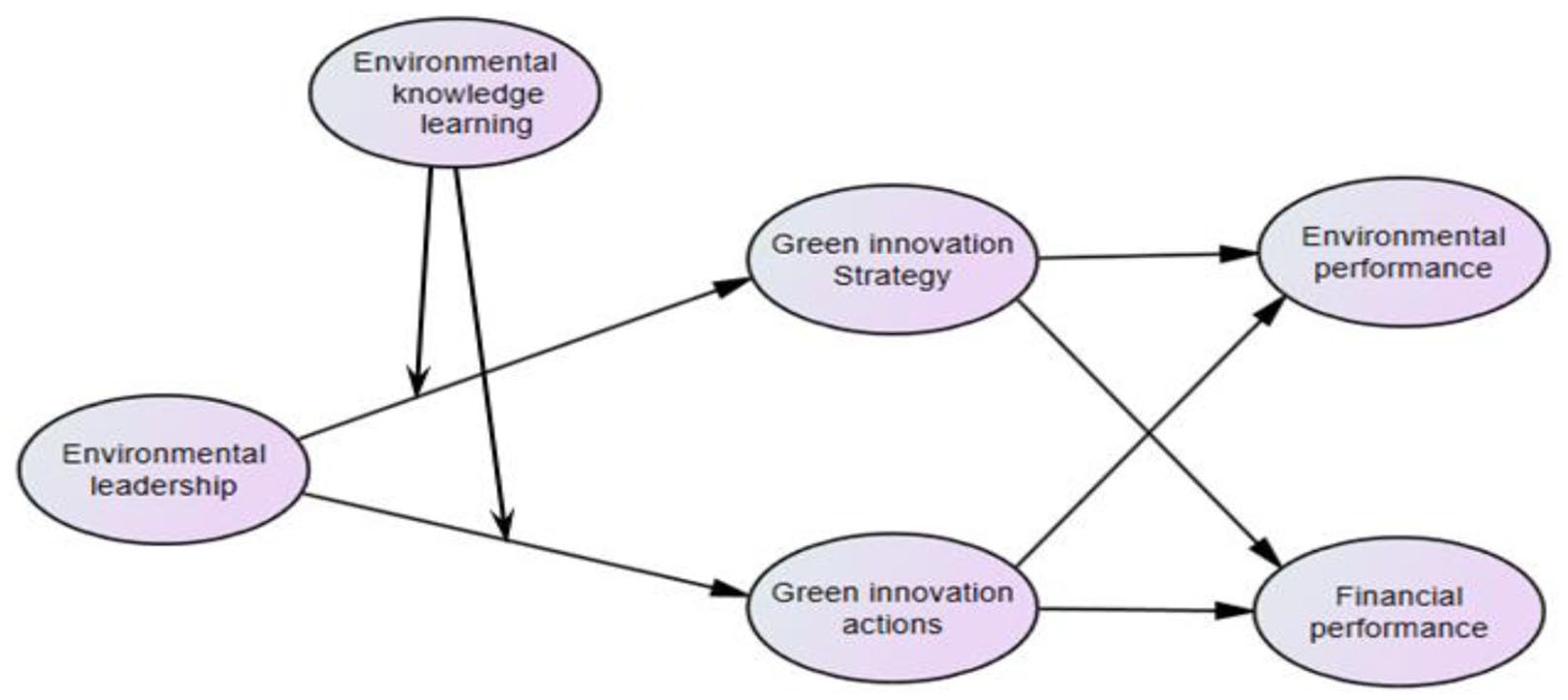
The proposed model.
Regression Results.
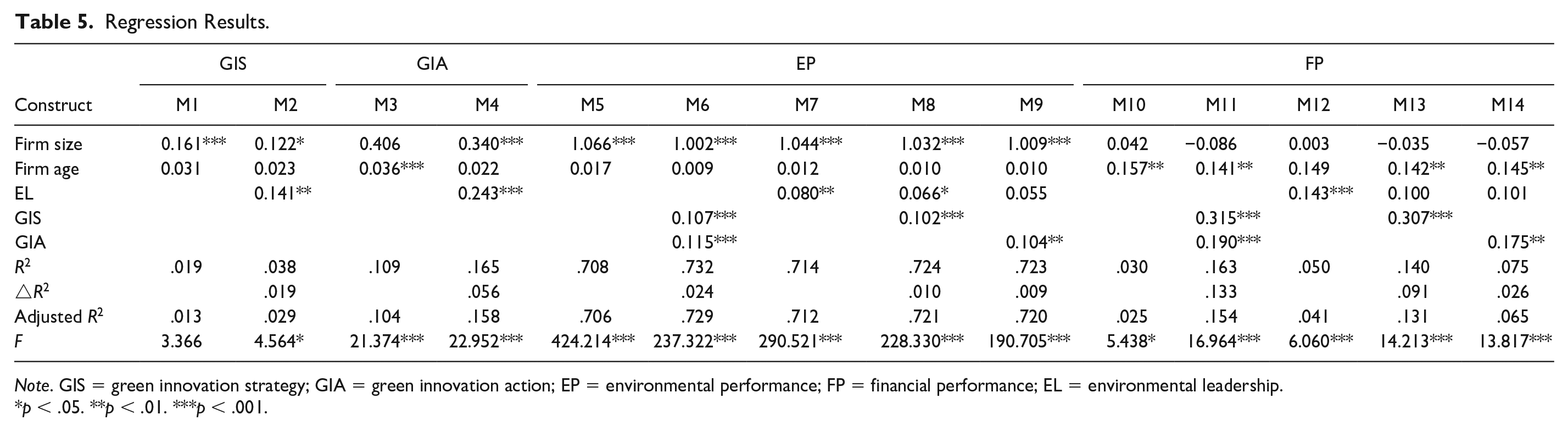
Note. GIS = green innovation strategy; GIA = green innovation action; EP = environmental performance; FP = financial performance; EL = environmental leadership.
p < .05. **p < .01. ***p < .001.
Mediating effect test
The mediating effect of a firm’s green innovation practices (including both green innovation strategy and green innovation actions) are discussed further. According to Wen et al. (2004), there are three critical steps required to test the effects of mediating variable. First, the relationship of independent with dependent variables should be tested, which has been conducted in the above. Then, the impact of the independent variable on the mediating variable should be examined. Finally, the influence of the mediator on the dependent variable should be controlled to predict whether the initial effect of the independent variable on the dependent variable has been weakened or has disappeared. If the independent variable has a weakened positive impact on the dependent variable due to the inclusion of the mediator, then the mediator shows a partial mediating effect. Otherwise, if the direct effect of the independent variable on the dependent variable has disappeared due to the inclusion of the mediator, then we can conclude that mediator plays a full mediating effect.
It is observed from the results that environmental leadership has a positive impact on green innovation practices, including green innovation strategy (Model 2: β = 0.141, p < .001) and green innovation actions (Model 4: β = 0.243, p < .001), respectively. In addition, green innovation practices also have a positive influence on firm performance. To be specifically, green innovation strategy has a positive impact on both environmental performance (Model 6: β = 0.107, p < .001) and financial performance (Model 11: β = 0 .315, p < .001). And green innovation actions also have a positive impact on both environmental performance (Model 6: β = 0.115, p < .001) and financial performance (Model 11: β = 0.190, p < .001).
Because of the inclusion of the mediator of green innovation strategy, the direct effect of environmental leadership on environmental performance (Model 8: β = 0.066, p < .05) has been weakened. That is to say, green innovation strategy plays a partially mediating role in the relationship between environmental leadership and environmental performance. And after including the mediator, the direct effect of environmental leadership on financial performance (Model 13: β = 0.100, n.s.) has disappeared. Hence, green innovation strategy plays a full mediating role in the relationship between environmental leadership and financial performance. Therefore, both Hypotheses 3 and 4 are supported.
We then further tested the mediating effect of green innovation actions. Because of the inclusion of the mediator of green innovation actions, the direct effect of environmental leadership on environmental performance (Model 9: β = 0.055, n.s.) and financial performance (Model 14: β = 0.101, n.s.) has disappeared, respectively. That is to say, green innovation actions play a full mediating role between environmental leadership and environmental performance. What’s more, green innovation actions also fully mediate the relationship between environmental leadership and financial performance. Therefore, both Hypotheses 5 and 6 are supported.
Moderating effect test
We used SPSS21.0 to examine the moderating effect of environmental knowledge learning. To address the potential problem of multicollinearity among the variables, we first centralized all the data. And we included the interaction term (Environmental Leadership × Environmental Knowledge Learning) into regression models. The results in Table 6 show that the interaction term positively influences green innovation strategy (β = 0.198, p < .05) with an increased R2 of .017 (Model 18). Besides, the interaction term also has a positive impact on a firm’s concrete green innovation actions (β = 0.415, p < .001), with an increased R2 of .075 (Model 22). What’s more, the largest VIF (variance inflation factor) of the independent variables in each regression model is 1.238, which is far less than 10, so there is no serious multicollinearity problem among the variables.
Test Results of Moderating Effect.
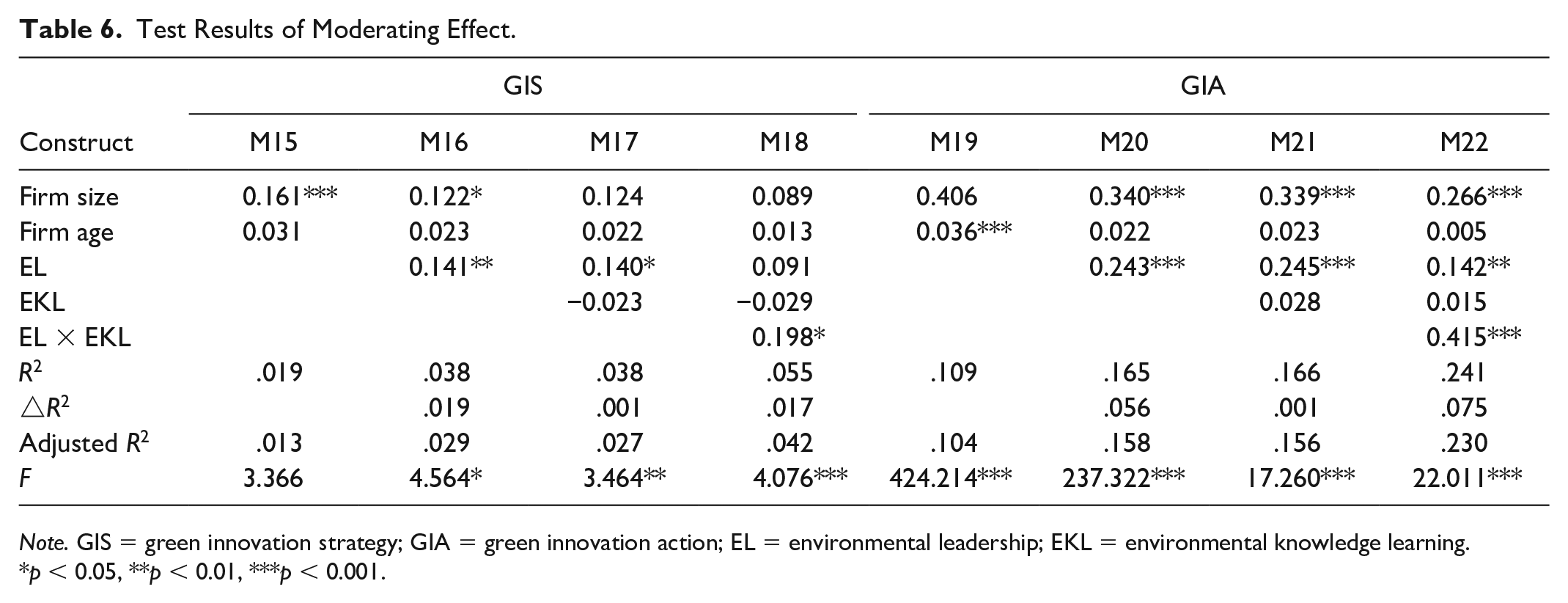
Note. GIS = green innovation strategy; GIA = green innovation action; EL = environmental leadership; EKL = environmental knowledge learning.
p < 0.05, **p < 0.01, ***p < 0.001.
Discussion and Conclusion
We develop a “leadership style—organizational practice—outcome” framework. This research helps us understand the mechanism of environmental leadership’s effect on firm performance. Agricultural products enterprises were chosen as the sample of survey because leadership style and practices related to green innovation played a very important role in the firm’s survival and sustainable development. The results demonstrated that environmental leadership has a positive impact on firm performance, namely, environmental performance and financial performance, and green innovation practice plays a mediating role between environmental leadership and firm performance. In addition, it is also found that environmental knowledge learning positively moderates the effect of environmental leadership on green innovation practice. Empirically, these findings respond to the call for the investigation of environmental leadership’s impact on organizational environmental innovation and firm performance (Liu et al., 2018).
Theoretical Contributions
Theoretically, our research offers several important contributions. First, we extend the emerging research on environmental leadership by focusing its influence on the two dimensions of firm performance. Previous literature about environmental leadership’s outcome variable mainly focused on the firm’s environmental performance, but limited studies have explored its influence on the firm’s financial performance (Liu et al., 2018). We complement this line of work by suggesting that environmental leadership has positive impact on both environmental performance and financial performance. Empirically, the finding of this article is also consistent with this notion.
Second, we also contribute to the few studies on environmental leadership as an antecedent of green innovation practices. Environmental leaders believe in the new ecological paradigm and they are able to integrate seemingly contradictory corporate visions. Leaders play a key role in identifying and addressing environmental issues. Managers’ and employees’ concerns about environmental management behavior often come from the influence of senior leaders. Due to the pressure of stakeholders’ environmental expectations and demands, environmental leaders will actively think about and implement corporate green practices to improve environmental benefits and produce green products that better meet consumers’ needs. In other words, managers with high level of environmental leadership will look at environmental issues as an opportunity, which may influence an organization’s reforming direction. Thus, more energy and effort to innovation for environmental protection will be invested. Hence, environmental leadership is essential for the implementation of green innovation practices.
Third, we contribute to the understanding of environmental leadership’s influence on firm performance by exploring the mediating role of green innovation practices. Drawing on the social learning theory, this study explores the mechanism through which environmental leadership affects firm performance. It is found that green innovation practice serves as a bridge between environmental leadership and firm performance. It is the obligation of top management to formulate long-term green innovation strategy for their firms and stimulate their followers to execute concrete green operations. Environmental leaders will positively influence the organization’s overall quality management, designing and production of supplier relationship management products, and introduction of new technology, thereby reducing environmental pollution, building green image, and broadening market share of agricultural products for the corporation. So, green innovation practices are important ties bridging environmental leadership and firm’s sustainable development.
Finally, we also extend the research in that we found environmental knowledge learning is an important boundary condition under which environmental leadership has positive impact on green innovation practices. Knowledge learning about environment is a main factor driving the continuous green innovation of enterprises. The more the environmental knowledge learning, the better environmental leaders will make decisions and maximize firm performance. Overall, our research answers the call for studies on why and under what conditions environmental leadership has positive impact on the firm’s performance.
Managerial Implications
Together with prior studies (e.g., Graves et al., 2013; Liu et al., 2018; Pan & Tian, 2017; Robertson & Barling, 2013), our findings underscore the significant role leaders play in organizational development sustainability. As such, our study stresses the value of the environmental leadership development training. Leaders are suggested to be trained to improve the ability to develop and implement green actions, thus increasing environmental performance. Furthermore, our research suggests that corporation can also benefit by hiring environmental leaders. It is argued that proenvironment values and attitudes are considered as antecedents to environmental leadership (Egri & Herman, 2000; Zhang et al., 2015). Thus, it is recommended that during the process of hiring environmental leaders, organizations should take some measures to effectively assess managerial candidates’ proenvironmental values and attitudes and then make final selection decisions accordingly.
The findings of this study implicate that it is critical for firms to carry out green innovation practices to improve the overall performance of firms. Senior management should put green innovation at a strategic level, truly integrate it into the actual management and production, and promote cross-sector cooperation within the enterprise. Second, pay close attention to relevant environmental regulations, policies, green innovation practices, and consumers’ awareness of environmental protection to timely adjust corporate strategy. Third, corporations should guide the establishment of social environmental awareness to increase market competitiveness through green innovation practices, thus opening up new markets for green agricultural products.
In addition, the results further show that environmental knowledge learning positively affects environmental leadership’s impact on firm performance. Therefore, top management ought to pay more attention to knowledge management activities and use them as a strategic weapon to improve overall performance. For example, leaders should motivate employees to accumulate more information and different experiences. Besides, an efficient system of environmental knowledge sharing should be developed to strengthen internal communication and information exchange. Meanwhile, communication with various external partners to absorb different new environmental knowledge is also helpful for the adjusting of green innovation strategy and operations.
Finally, our finding is also important in terms of policy implications. Effective policy-induced green innovations will have positive impact on firms’ productivity in the medium/long run (Aldieri et al., 2019). To achieve the most efficient environmental and financial performance, policy makers should take the factors such as regional differences, economic conditions, and social environment into account when they are formulating regulations. What’s more, policy makers should also fully consider the tax burden of enterprises and provide appropriate support subsidies to the start-up and growth of agricultural enterprises. And firms that have met environmental protection standards through various green innovation practices should be provided with some efficient incentives, such as subsidies supports or tax reductions.
Limitations and Future Research
There are still some limitations in this research that need to be further explored in the future. First, only agricultural products enterprises are taken as research objects, but there are still many other industries facing severe environmental challenges. Future research can consider some other industries or regions as research samples to improve the general applicability of research findings. Second, our research examined the developed hypotheses through questionnaire survey. But respondents’ subjective perception and judgment may not fully reflect the objective situation of firm performance. Hence, future research can include the corporation’s financial indicators for reliable basis and comprehensive guidance of green management. Third, only size and age were included as control variables in our study. But many other factors can affect firm performance, and thus only including two control variables may not be enough. Future research may include some other widely used control variables, such as the scale of assets, ownership, and R&D.
Footnotes
Authors’ Note
Songtao Liu is now affiliated to College of Economics, Fujian Agriculture and Forestry University, Fuzhou, China. All authors contributed equally to this work.
Declaration of Conflicting Interests
The author(s) declared no potential conflicts of interest with respect to the research, authorship, and/or publication of this article.
Funding
The author(s) disclosed receipt of the following financial support for the research, authorship, and/or publication of this article: This study is supported by Fujian Provincial Social Science Major Project “Study on Environmental Knowledge, Environmental Attitude and Environmental Behavior of Ecotourism Visitors in Fujian Province” (FJ2018JDZ063).
