




Abstract
Drawing upon social amplification of risk framework, this study examines the influencing mechanism of artificial intelligence (AI) awareness on employees’ digital innovativeness. Through a two-stage questionnaire survey involving 227 employees from three Chinese intelligent manufacturing enterprises, the findings demonstrated that AI awareness had a negative effect on digital innovativeness. Resistance to change played a negative mediating role in the relationship between AI awareness and digital innovativeness. Employees’ approach tendency moderated this relationship by attenuating the positive effect of AI awareness on resistance to change, thereby mitigating the negative indirect effect of AI awareness on digital innovativeness through resistance to change. From a micro-level perspective, this study reveals the negative impact of AI implementation in organizations on employee innovativeness. It also highlights the need for timely technical support and psychological counseling for employees during digital transformation.
Plain language summary
The widespread adoption of artificial intelligence (AI) in professional fields threatens the job security of many workers. Fear of being replaced by AI often leads employees to resist these technologies, potentially limiting their creativity. However, our study reveals that individuals with an optimistic attitude toward digital technologies are more likely to adopt AI in their workflows. As a result, this group demonstrates higher levels of creative performance.
Keywords
Introduction
In the Industry 4.0 era, Chinese organizations are progressively intensifying their strategic focus on AI implementation (Y. Liu et al., 2024). Particularly within the intelligent manufacturing sector, AI has demonstrated significant potential in optimizing production processes and enhancing automation capabilities (Zong & Guan, 2024). While AI plays a pivotal role in intelligent manufacturing, employee innovativeness remains the fundamental driver of enterprise competitive advantage (Yin et al., 2024). Therefore, managers in intelligent manufacturing enterprises are increasingly concerned about whether AI adoption can foster employees’ innovation behavior. Existing research presents mixed findings on this relationship. Studies have identified positive impacts of AI characteristics such as agility (X. Wang et al., 2022), relative advantage (Gupta et al., 2022), and information-processing capabilities (Le & Cayrat, 2024) on innovation. However, other studies report weak correlations between AI adoption and innovation (e.g., Sawng et al., 2018; Stornelli et al., 2021). Scholars find that technological immaturity and implementation costs hinder employee innovation within AI implementation contexts (Du & Xie, 2021).
While existing studies have extensively explored the relationship between AI and innovation, present research exhibits three critical limitations. First, existing research has extensively explored AI applications in the service sector (Kong et al., 2021), yet their role in intelligent manufacturing remains understudied. In contrast to service-sector, which prioritizes customer-centric outcomes, manufacturing AI drives tangible improvements in product quality, process efficiency, and firm-level competitiveness (Arias-Pérez & Vélez-Jaramillo, 2022). This oversight may expose managers to three critical decision-making dilemmas: lacking industry benchmarks to evaluate smart production line investment risks; aligning training programs with manufacturing operational needs; and balancing technological investments against human capital development (Dong et al., 2025). This study concentrates on AI applications within manufacturing environments, analyzing their influence on employees’ innovativeness, and examining how human resource (HR) strategy improvements can better enable AI-empowered innovation.
Second, existing scholarship predominantly examines the direct effects of AI technological attributes on employee innovativeness, while neglecting the pivotal role of employee AI awareness (G. Xu et al., 2023). AI awareness refers to “employees feel their job could be replaced by these types of technology” (Brougham & Haar, 2018, p. 239). Beyond individual-level concerns, it also carries significant organizational and industrial implications. As organizational AI integration progresses from auxiliary tools to collaborative partners (Yam et al., 2023), this paradigm shift reshapes organizational ecosystems and modifies employee behavioral responses (Y. Liu et al., 2024). This transformation necessitates a clearer understanding of how employees’ AI perceptions influence their innovativeness. Failure to address employees’ cognitive responses during AI deployment impedes technology integration and innovation (Y. Zhang et al., 2025). This oversight may trigger a chain of organizational problems, such as friction during production handovers, reluctance to share operational knowledge, and more errors in human-AI collaboration (Dong et al., 2025). These operational constraints directly diminish the benefits of digital transformation (Zong & Guan, 2024). By examining the AI awareness-innovativeness relationship, this study tries to explain inconsistent research findings on AI applications and employee innovation, while practically informing manufacturing managers on optimizing human-AI collaboration.
Third, although extant literature has established direct correlations between AI adoption and innovativeness (Grashof & Kopka, 2023), the psychological mechanisms and contextual contingencies governing these relationships remain underexplored. This theoretical gap impedes revealing the cognitive pathways through which AI shapes workplace behaviors and identifying contextual factors that amplify or inhibit AI’s impacts (Y. Liu et al., 2024). This lack of clarity about how AI systems work creates challenges for HR teams in the AI era, especially when designing collaboration guidelines or hiring employees who can work effectively with AI (Tu et al., 2024). Investigating mediating pathways and boundary conditions enables organizations to intervene promptly in employee attitudes and select suitable personnel (Q. Lin & He, 2024). Therefore, this study addresses the following research questions: whether, when, and how AI awareness affects the innovativeness of employees in the manufacturing industry.
To address the research question, this study investigates the impact of AI awareness on employees’ digital innovativeness. Digital innovativeness, defined as an individual’s capacity to innovate within digital domains (Mancha & Shankaranarayanan, 2021), represents employees’ confidence in learning and applying digital technologies. AI awareness operationalizes employees’ cognition of career vulnerability (Kong et al., 2021). Empirical studies utilizing service industry samples have demonstrated that AI awareness can result in work disengagement and diminished organizational commitment (Yam et al., 2023). Furthermore, research has indicated that AI awareness can impede service innovation behaviors (Liang et al., 2022). These findings suggest that heightened AI awareness may lead employees to concentrate on the adverse implications of AI technology, potentially suppressing innovativeness. Therefore, this study primarily examines the negative relationship between AI awareness and digital innovativeness.
Based on social amplification of risk framework (SARF), this study investigates the impact of AI awareness on employees’ digital innovativeness. Proposed by Kasperson et al. (1988), SARF integrates psychological, sociological, and cultural perspectives, incorporating elements such as technical risk assessment, socio-cultural environments, and institutional factors. The framework comprises two core mechanisms: information dissemination and social response (Kasperson et al., 1988). The information dissemination mechanism posits that risk events influence risk behavior through altered risk perceptions, while the social response mechanism explains the amplification process of risk events within social systems. Based on SARF (Kasperson et al., 1988), this study proposes that resistance to change may function as a mediating mechanism linking AI awareness and digital innovativeness. Resistance to change refers to employees’ tendency to maintain the status quo and their reluctance to adopt new digital technologies (Hampel et al., 2024). While employees’ risk perceptions regarding AI technology may vary, the intensity of these perceptions typically manifests through their level of resistance to change (Hampel et al., 2022). Employees’ resistance to change hinders their ability to leverage AI for innovativeness. Therefore, this study explores the mediating role of resistance to change in the relationship between AI awareness and digital innovativeness.
This study further examines the boundary conditions under which AI awareness exerts varying degrees of influence on employees’ digital innovativeness. According to the social response mechanism of SARF, individuals’ reactions to risk events are shaped by multiple factors, including personal experiences, cultural backgrounds, and psychological states (Kasperson et al., 1988). Given the broad nature of this theoretical framework, this study incorporates the approach-avoidance tendency model to specifically investigate the boundary conditions of AI awareness. Developed by Elliot and Thrash (2002), the approach-avoidance tendency model explains the psychological conflicts individuals experience when making complex decisions. This model suggests that individuals’ differential focus on the advantages and disadvantages of AI may lead to variations in risk perception and subsequent behavior (Tan et al., 2024). Approach tendency refers to individuals’ psychological and behavioral predisposition to move toward or pursue particular stimuli (Elliot & Thrash, 2002). When activated, this tendency typically generates positive affective states, such as excitement and hope, motivating individuals to engage in reward-seeking behaviors (Elliot, 2006). We posit that employees with a strong approach tendency are more likely to perceive AI positively, thereby mitigating the negative relationship between AI awareness and digital innovativeness through resistance to change. The theoretical framework of this study is presented in Figure 1.

The theoretical model.
Theoretical Backgrounds
AI Awareness
As the global economy transitions into the Fourth Industrial Revolution, AI has emerged as a central driving force (Baslom & Tong, 2019). While organizations increasingly adopt AI to improve productivity, this technological transformation simultaneously reshapes traditional work practices (J. Li et al., 2019). The organizational deployment of AI yields ambivalent consequences, fostering new employment prospects while inducing adaptation anxiety (Kong et al., 2021). Within this context, scholars have increasingly focused on the concept of AI awareness. Empirical research has demonstrated that AI awareness leads to various negative consequences, including emotional exhaustion (Liang et al., 2022), job burnout (Yam et al., 2023), and depression (G. Xu et al., 2023). Furthermore, AI awareness has been shown to reduce work engagement (Kong et al., 2021), promote service sabotage (Ma & Ye, 2022), increase work withdrawal tendencies (Teng et al., 2024), and cause knowledge-hiding behaviors (Arias-Pérez & Vélez-Jaramillo, 2022). These findings indicate employees perceive AI as a substantial threat to their professional roles (Ding, 2022). Such perceptions often trigger resistance to change, with employees viewing AI-driven transformations as challenges to job security. This resistant mindset toward AI adoption further leads to risk-averse behaviors, manifesting as employees’ avoidance of innovative experimentation (C. Li et al., 2023).
Resistance to Change
To maintain competitive advantage, organizations inevitably undergo transformations, where employees’ attitudes toward organizational change play a pivotal role in determining the success of these initiatives (M. J. Zhang et al., 2021). Resistance to change, defined as an individual’s opposition to alterations of the status quo, manifests through reluctance to engage with or deliberate ignorance of new technologies (Rahaman et al., 2020). Oreg (2006) conceptualized resistance to change through four dimensions: routine seeking, emotional reactivity, short-term focus, and cognitive rigidity. Fundamentally, resistance to change represents an individual’s adverse response to organizational transformation processes. Aligning with Hampel et al. (2022), we operationalize resistance to change as an undifferentiated construct through their integrative theoretical lens. Existing research has identified several antecedents of resistance to change across different levels. At the individual level, job insecurity (García & García, 2014) and perceived benefits of change (Peccei et al., 2011) significantly influence resistance to change. At the leadership level, leader-member exchange (Furst & Cable, 2008) and ethical leadership (Rahaman et al., 2020) can mitigate resistance to change. At the organizational level, organizational support (Kiefer, 2005) and organizational justice (Jones & Van de Ven, 2016) impact resistance to change. Regarding consequences, resistance to change has been demonstrated to reduce employees’ willingness to adopt new technologies (Heidenreich & Spieth, 2013). These empirical findings suggest that resistance to change may function as a mediating mechanism in the relationship between AI awareness and digital innovativeness. AI awareness undermines workplace psychological safety, which may trigger resistance to organizational change (S. Liu & Cheng, 2025). Such resistance hinders AI adoption and may create barriers to innovativeness.
Digital Innovativeness
Individual innovativeness represents the degree to which individuals embrace novel ideas and make innovative decisions (Agarwal & Prasad, 1998). In today’s digitally advanced environment, creativity finds new avenues for development and expression (Alshammari & Thomran, 2023). Digital innovativeness specifically measures “the capacity or the ability of the individual to be innovative in the digital domain” (Mancha & Shankaranarayanan, 2021, p. 322). Unlike digital innovation, which emphasizes substantial changes in products or services, digital innovativeness focuses on employees’ state of learning and proficiency in digital technologies (Ruiz-Alba et al., 2022). At the individual level, research demonstrates that entrepreneurial orientation and digital technology self-efficacy constitute the key determinants of digital innovativeness (Mancha & Shankaranarayanan, 2021). At the organizational level, information technology culture (Abubakre et al., 2022) and dynamic competitive environments (X. Zhang et al., 2022) significantly impact employees’ digital innovativeness. Highly digitally innovative employees typically demonstrate proactive behaviors (Abubakre et al., 2022). However, when employees perceive AI as a threat, their motivation for creative problem-solving may diminish (Y. Liu et al., 2024). The perception that AI could outperform them in creativity may lead employees to view their efforts as futile (Tan et al., 2024). Consequently, they may disengage from innovative activities, focusing instead on short-term task rather than long-term innovation (He et al., 2024).
Approach Tendency
The approach-avoidance tendency model elucidates the contradictory psychological states individuals experience during decision-making processes (Elliot, 2006). Confronted with multiple options, each offering different benefits and drawbacks, individuals frequently struggle to make a decision (Elliot & Thrash, 2002). Positive stimuli within these options are typically perceived as beneficial, while negative stimuli are viewed as detrimental (Elliot & Thrash, 2010). This model identifies two fundamental behavioral responses to such situations, namely approach-avoidance tendency. The approach tendency is defined as “the energization of behavior by, or the direction of behavior toward, positive stimuli (objects, events, possibilities)” (Elliot, 2006, p. 111). This tendency manifests through three key evaluative dimensions, specifically perceived usefulness, stimulus likability, and overall desirability (Elliot & Thrash, 2002). When individuals assess the stimuli as positive, they either endeavor to maintain existing positive conditions or attempt to transform negative stimuli into positive outcomes (Elliot, 2006). The approach tendency demonstrates strong associations with specific personality traits, such as core self-evaluations (Aryee et al., 2017) and trait promotion focus (Tu et al., 2024). Employees with a strong approach tendency typically display voice behaviors (Aryee et al., 2017), enhance knowledge-sharing activities (X. Lin et al., 2023), and engage more in challenge-seeking behaviors (Tu et al., 2024).
Hypothesis Development
AI Awareness and Digital Innovativeness
AI awareness refers to employees’ perception that AI threatens their job security, organizational stability, and industry development prospects (Y. Zhang et al., 2025). This study posits that AI awareness negatively affects digital innovativeness. The primary reason for this relationship may be job insecurity. The rapid advancement and widespread adoption of AI technology, particularly in replacing tasks that are highly repetitive and time-consuming, lead employees to fear that their job positions may be at risk (Yin et al., 2024). This anxiety, in turn, causes them to perceive low self-esteem, making investments in risky innovation appear futile (Yam et al., 2023), thereby diminishing digital innovativeness. Furthermore, this study identifies work stress stemming from heightened skill requirements as another critical reason. The integration of AI technology typically necessitates an elevation in job skills and competencies (Brougham & Haar, 2018). Employees are required to engage in continuous learning and adapt to emerging technologies to maintain their competitiveness (Mikalef & Gupta, 2021). However, this pressure to learn and adapt can induce stress and depression among employees. Negative emotional states reduce employees’ mental capacity for creative thinking (Ding, 2022). Resource allocation dynamics further exacerbate AI awareness’ detrimental effects. Organizational AI adoption frequently disrupts traditional resource distribution structures (Brougham & Haar, 2020). While automation replaces conventional roles, emerging digital workflows demand greater resource investments (Kong et al., 2021). Employees may perceive insufficient support and inadequate rewards for innovation efforts under these conditions (Tang et al., 2022).
Empirical research corroborates this phenomenon. Studies by Liang et al. (2022) and Dong et al. (2025) demonstrate that AI awareness inhibits service innovation behaviors and that hindrance stress from AI adoption decreases knowledge workers’ creativity. The findings of Arias-Pérez and Vélez-Jaramillo (2022) also confirm that AI awareness leads employees to exhibit negative behaviors such as neglect or suboptimal use of digital technologies. When organizational AI readiness is low, AI assistance reduces employees’ AI-enabled innovation via AI awareness in service industries (Yin et al., 2024). Therefore, this study posits the following hypothesis:
AI Awareness and Resistance to Change
SARF conceptualizes risk perception as emerging from dynamic interactions across psychological, social, institutional, and cultural domains (Kasperson et al., 1988; Renn et al., 1992). Building on this theoretical foundation, we propose that AI awareness exerts a positive influence on resistance to change. We believe that this relationship may be related to the following three main factors. First, the accelerated automation of routine tasks elevates employees’ consciousness of AI-induced job displacement (Teng et al., 2024). This heightened awareness amplifies work-related anxiety (Presbitero & Teng-Calleja, 2023), promoting hostile and defensive attitudes toward AI technologies. Second, AI awareness accentuates employees’ perceived mismatch between existing skills and emerging workplace demands (Ma & Ye, 2022). Employees skeptical of their ability to bridge this skills gap cling to familiar work routines, fostering resistance to change. Third, AI awareness disrupts long-established workflows built through professional expertise, creating cognitive dissonance (Doan & Nguyen, 2025). This perceived devaluation of specialized knowledge often triggers resistance behaviors as employees seek to restore organizational self-esteem (Ma & Ye, 2022).
Empirical evidence demonstrates that AI awareness can lead to counterproductive behaviors in sales teams (Bai et al., 2024) and result in AI boycott among hospitality workers (S. Liu & Cheng, 2025). Kim (2024) found that AI’s threat to human creativity and intellectual labor drives resistance among IT professionals. S. Xu et al. (2024) identified a progressive negative attitudinal shift toward AI adoption as perceived threats intensify. Doan and Nguyen (2025) revealed that AI awareness increases interpersonal conflicts, and turnover intentions. Y. Zhang et al. (2025) further found that AI awareness induces ego depletion in service employees, leading to deviant behaviors. Therefore, we posit the following hypothesis:
Resistance to Change and Digital Innovativeness
We posit that resistance to change is negatively associated with digital innovativeness. This relationship may operate through two interdependent organizational dynamics. First, resistance to change manifests as organizational inertia, where employees adhere to entrenched cognitive routines. This cognitive inflexibility curtails their exploration of technological novelty (Prakash & Das, 2021). During AI-driven automation, employees with a high level of inertia favors familiar workflows over experimentation (Malodia et al., 2022). Such rigidity prevents employees from recognizing new technologies (Mikalef & Gupta, 2021), leading to complacent skill development and conventional thinking (H. Wang et al., 2022). These conservative attitudes directly constrain digital innovativeness (Mancha & Shankaranarayanan, 2021). Second, resistance to change erodes work motivation through cognitive resource misallocation. When resistance to change is high, employees disproportionately focus on technological skepticism rather than value exploration (Hampel et al., 2024), diminishing their investment in innovative initiatives (Hon et al., 2014). Empirical research confirms that resistance to change limits the absorption and utilization of new knowledge (Nowak, 2023). As Alshammari and Thomran’s (2023) interview study notes, resistance to change constitutes a primary barrier to developing creativity and innovation skills. Empirical evidence demonstrates negative associations between resistance to change and creativity (Hon et al., 2014), as well as innovative work behaviors (Battistelli et al., 2013; Haesevoets et al., 2022). Based on the above inferences, we propose the following hypothesis:
The Mediating Role of Resistance to Change
Building on the aforementioned hypotheses, this study proposes that resistance to change mediates the relationship between AI awareness and digital innovativeness. Grounded in SARF (Kasperson et al., 1988), technological risk influences individuals’ behavioral intentions and actions through their risk appraisal. In the context of AI adoption, we propose resistance to change functions as a perceptual filter that bridges AI awareness and digital innovativeness through two complementary appraisal pathways.
First, as employees recognize AI’s accelerating complexity and unpredictable evolution, their sense of technological uncertainty heightens (Teng et al., 2024). This cognitive state often triggers anxiety, which leads to work withdrawal (Yin et al., 2024). Particularly in digital experimentation environments, risk-averse attitudes constrain employees’ proactive engagement in innovative behaviors. Second, AI awareness makes employees fear their skills may become outdated (He et al., 2024). Employees often cling to established workflows to maintain their organizational status and professional dignity (Liang et al., 2022). This defensiveness reduces tolerance for technological ambiguity, suppressing enthusiasm for innovative work methods (Cheng et al., 2025). These appraisal processes operate synergistically—technological uncertainty reduces experimental risk-taking, while vulnerability assessments institutionalize conservative behaviors (Y. Liu et al., 2024). Within this dual appraisal framework, employees often fall into a cycle where technology anxiety strengthens conservative work habits, ultimately inhibiting innovativeness (Q. Lin & He, 2024). Collectively, resistance to change may mediate the negative effect of AI awareness on digital innovativeness.
According to Arias-Pérez and Vélez-Jaramillo (2022), employees’ resistance to AI technologies serves as a strategic defense mechanism against unemployment risks. This resistance constitutes an adaptive response to technological substitution pressures. Their findings reveal that employees’ technological anxiety inhibits organizational innovation through defensive behaviors. AI awareness also undermines voice behavior by exacerbating job insecurity (He et al., 2025), amplifies silence behavior through psychological contract violations (Cheng et al., 2025), and intensifies work withdrawal via negative work rumination and emotional exhaustion (Teng et al., 2024). Based on these theoretical and empirical insights, this study proposes the following hypothesis:
The Moderating Role of Approach Tendency
Drawing upon SARF (Kasperson et al., 1988; Renn et al., 1992), this study examines how personal attributes can amplify an individual’s risk assessment. By integrating the approach-avoidance tendency model (Elliot, 2006), we propose that approach tendency may serve as a moderating factor. According to this model, employees with a high approach tendency typically exhibit greater curiosity, a stronger thirst for knowledge, and enhanced adaptability (Elliot & Thrash, 2010). They are more likely to embrace challenges and seek new opportunities rather than resist or avoid them (Elliot & Thrash, 2002). This mindset enables individuals to perceive the opportunities created by AI technologies. Therefore, this study hypothesizes that approach tendency may attenuate the positive relationship between AI awareness and resistance to change.
When employees demonstrate a high level of approach tendency, the positive effect of AI awareness on resistance to change may be mitigated. Employees with a strong approach tendency tend to adopt an open and optimistic attitude toward AI technology (Aydınlıyurt et al., 2021). They readily recognize AI as a transformative tool for enhancing work efficiency, optimizing processes, and creating new business opportunities (C. R. Li et al., 2020). This constructive outlook helps people see AI as helpful rather than harmful, making them more open to technological changes. Furthermore, employees with a high approach tendency exhibit greater adaptability (Aydınlıyurt et al., 2021). AI awareness often leads employees to perceive a lack of competence in keeping pace with technological shifts, triggering feelings of frustration and powerlessness (Brougham & Haar, 2020). High-approach-tendency employees, equipped with strong learning and adaptability skills, can quickly adjust to changes brought about by new technologies. They actively navigate transformations through prompt cognitive and behavioral adjustments (Carver & White, 1994). This robust adaptability enhances professional confidence, alleviates feelings of powerlessness, and facilitates integration into the AI era, thus weakening the link between AI awareness and resistance to change.
Conversely, when employees exhibit a low approach tendency, the impact of AI awareness on resistance to change is likely to be more pronounced. On the one hand, employees with a low approach tendency may overestimate the threat of AI technology to their work (C. R. Li et al., 2020). These employees worry that adapting to AI-driven work may prove challenging, potentially threatening their job security (Y. Liu et al., 2024). When confronted with AI technology, they attempt to preserve the existing work order and their self-identity through resistance to change (C. Li et al., 2023). On the other hand, the implementation of AI technology requires employees to continuously acquire new skills (Brougham & Haar, 2020). However, employees with a low approach tendency often lack the motivation and perseverance to learn new skills (Aydınlıyurt et al., 2021). The demand for proactive learning in AI-driven environments conflicts with the passive and conservative work styles of these employees (C. R. Li et al., 2020), potentially intensifying the positive effect of AI awareness on resistance to change. Based on these theoretical and empirical insights, this study proposes the following hypothesis:
The Moderated-Mediation Effect of Approach Tendency
By integrating Hypotheses 4 and 5, this study further proposes a moderated-mediation hypothesis. We argue that under conditions of high approach tendency, the positive effect of AI awareness on resistance to change will be attenuated, thereby reducing its negative impact on digital innovativeness. This phenomenon can be explained by two primary mechanisms. First, employees with a high approach tendency are more likely to adapt to AI-induced disruptions by recalibrating their cognitive frameworks (X. Lin et al., 2023). They actively embrace challenges and demonstrate a willingness to experiment with novel approaches (Elliot, 2006). When confronted with AI’s potential threat to their jobs, these employees adopt a more optimistic perspective, recognizing that AI technology is not merely a replacement for human labor but rather a tool for improving work efficiency (C. R. Li et al., 2020). Their proactive mindset and adaptability help minimize resistance to change, fostering greater acceptance and willingness to engage with AI technologies (Exner et al., 2023). As resistance to change diminishes, employees are more likely to view AI as a complementary tool, leveraging it to handle repetitive tasks (Rahaman et al., 2020), thereby freeing up time and cognitive resources for creative thinking and strategic decision-making (C. Li et al., 2023). Second, employees with a high approach tendency exhibit heightened sensitivity to reward signals and tend to perceive external pressures as opportunities for personal and professional growth (Elliot & Thrash, 2010). The increased demands for skill development posed by AI applications motivate these employees to proactively acquire AI-related knowledge, facilitating the establishment of effective human-AI collaboration (X. Lin et al., 2023). This collaborative synergy reduces resistance to change and encourages employees to embrace AI as a workplace partner, engaging in various forms of productive collaboration (Haesevoets et al., 2022). In this context, employees can achieve tasks more efficiently while maintaining their enthusiasm for innovation (Jones & Van de Ven, 2016), thereby mitigating the negative effects of AI awareness on digital innovativeness.
Conversely, under conditions of low approach tendency, AI awareness may amplify the effect of resistance to change, subsequently exerting a stronger inhibitory influence on digital innovativeness. This can be attributed to two key factors. First, employees with a low approach tendency tend to be more conservative (Elliot & Thrash, 2002). Faced with potential career threats from AI, employees may perceive AI as immature or unreliable (Exner et al., 2023). This intensifies biases toward AI technology and reinforces their resistance to change. This resistance may discourage employees from integrating AI into their work, limiting their potential to leverage it for innovativeness (Jones & Van de Ven, 2016). Second, employees with a low approach tendency lack initiative and an exploratory mindset, making them less adept at pursuing change and innovation (Elliot, 2006). Faced with disruptions caused by AI technology, they may choose to maintain the status quo instead of exploring synergies with AI (C. R. Li et al., 2020). In this scenario, employees’ reluctance to adopt AI tools further diminishes their digital innovativeness (Rahaman et al., 2020). Therefore, we propose the following hypothesis:
Research Methodology
Sample and Research Procedure
We utilized the questionnaire survey method to examine this theoretical model. To clearly delineate the methodological approach adopted in this study, we created a flowchart illustrating the research design. The methodological framework is presented in Figure 2.
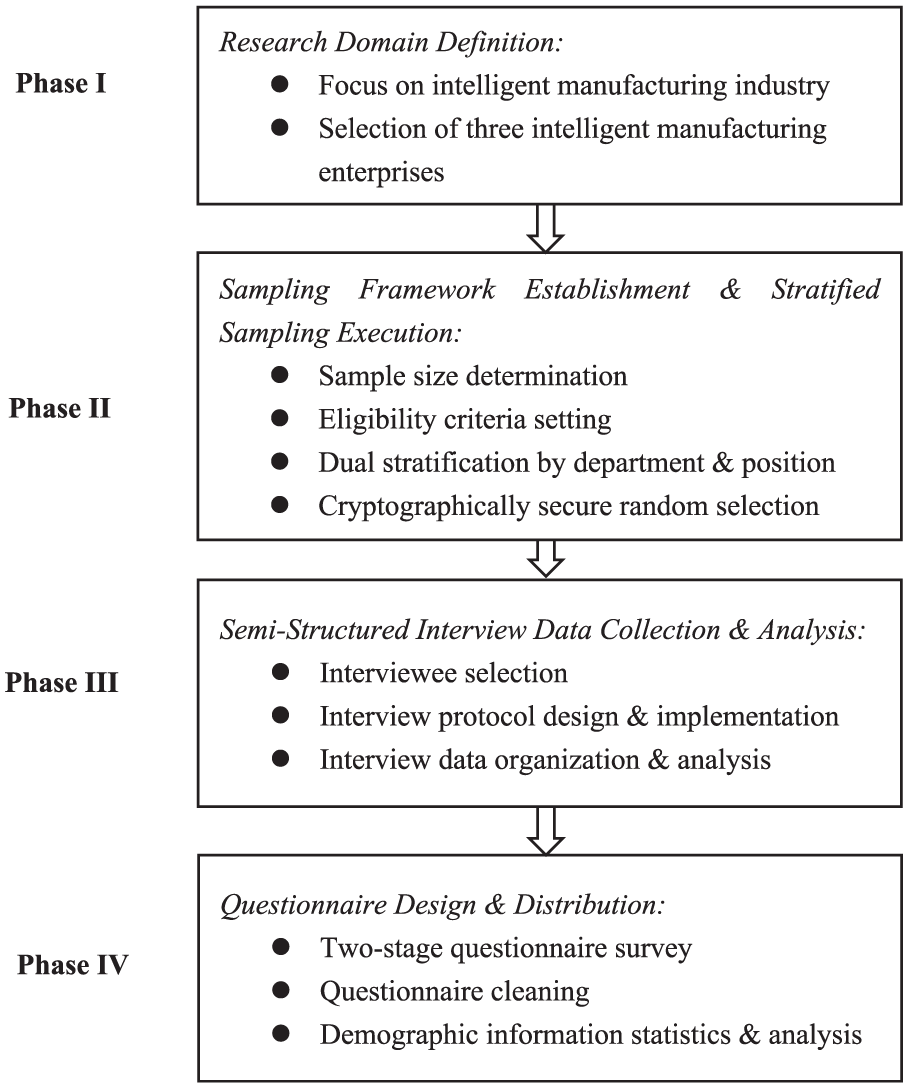
The flowchart of the deployed methodology.
The research methodology comprised four key steps. The initial phase of our research methodology focused on defining the sampling scope. While previous studies on AI awareness have predominantly examined the hospitality industry, where substantial investments are directed toward enhancing customer experience and service quality, this study shifts its focus to the smart manufacturing sector. In this domain, AI applications extend beyond service enhancement to include automation, predictive maintenance, and other sophisticated implementations that necessitate close human-AI collaboration. This collaborative environment presents enhanced opportunities for innovation, significantly influencing organizational competitiveness. Therefore, the level of AI integration and the expectations for employee-driven AI innovation are more substantial in smart manufacturing sector (Baslom & Tong, 2019). Empirical evidence supports this focus. Arias-Pérez and Vélez-Jaramillo (2022) examined AI awareness’s impact on knowledge hiding using a sample of 136 technology manufacturing employees. Zong and Guan (2024) investigated AI-driven data analytics’ effect on economic efficiency through a sample of 286 manufacturing managers. Building upon these studies, our research targets professionals within the intelligent manufacturing industry. Specifically, we examined three smart manufacturing demonstration factories located in southern China. These facilities are characterized by their extensive implementation of AI technologies across various operational aspects, including intelligent production systems, network integration, quality inspection processes, and logistics optimization.
In the second phase of our methodology, we employed G*Power software (Faul et al., 2009) to determine the required sample size. The power analysis indicated that a minimum of 119 participants would be necessary to achieve a statistical power of 0.80 (for f2 = 0.15, α = .05). We established collaboration with HR managers from the three selected smart manufacturing enterprises to define our target population. All claims underwent three-tier verification. Eligibility required: (a) roles in production engineering, supply chain optimization, or predictive maintenance with company-verified AI integration records; (b) minimum 15 weekly hours of AI-system engagement; and (c) ≥6 months’ hands-on industrial AI experience. Participants held four key positions: (a) algorithm engineers for quality control (QC) modeling, (b) manufacturing execution system (MES) maintenance engineers, (c) production-line AI deployment managers, and (d) robotic process automation (RPA) solution specialists. Their work routinely involved industry-specific AI tools such as Fusion 360, SolidWorks Simulation Premium, and Siemens NX CAM. After compiling a roster of eligible participants, we implemented a random sampling strategy to select participants, ensuring equal selection probability for all individuals within the target population. This methodological approach effectively minimizes selection bias while enhancing sample representativeness. Potential departmental bias was addressed through dual stratification criteria: (a) departmental distribution (production/R&D 45%, supply chain 35%, maintenance 20%), and (b) hierarchical composition (frontline staff 60%, middle management 30%, senior leaders 10%). Within each stratum, participants were selected using a random number generator, ensuring methodological rigor. Ultimately, 264 employees were selected as the survey sample.
In the third phase of our methodology, we conducted a semi-structured interview with five selected participants representing distinct functional roles in intelligent manufacturing, including an RPA specialist, a QC algorithm engineer, an MES system developer, a robotics maintenance technician, and a digital transformation manager. The interview protocol was refined via three pilot tests with industry consultants to optimize question flow and phrasing, producing a finalized guide covering four themes: (a) firsthand AI implementation experiences, (b) cognitive/emotional reactions to technological shifts, (c) innovation strategy development, and (d) ethical boundaries negotiation. Core questions included “How do you perceive AI implementation in your organization?”; “Do you generally respond to AI integration with enthusiasm or caution?”; and “How do you approach innovation using AI technology?” We employed a mixed-mode interview approach, combining online and offline methods to accommodate participant preferences and logistical considerations. To ensure data integrity, we used a rigorous verification process where one researcher organized the interview transcripts and another team member cross-verified them. This dual-review process enhanced the reliability and accuracy of our qualitative data. Using a hybrid inductive-deductive approach with NVivo 14, our analysis revealed critical contextual mechanisms. Most notably, insufficient AI literacy (noted in four-fifths interviews) amplified resistance behaviors, subsequently constraining innovativeness—a dynamic under-specified in survey data. Interviews also revealed latent ethical concerns about algorithmic accountability (three-fifths participants). Perceived violations of procedural fairness mediated the AI awareness–resistance to change linkage. The semi-structured interviews enhanced our comprehension of AI awareness impacts and guided subsequent validation of the theoretical model.
In the final phase of our research methodology, we implemented a two-stage questionnaire survey process. Each distributed questionnaire was assigned a unique number to facilitate matching between the two stages. We communicated with participants via email, emphasizing the survey’s complete anonymity and exclusive use for academic research, while assuring voluntary participation. The first stage focused on measuring participants’ AI awareness, resistance to change, approach tendency, and demographic characteristics including gender, age, educational background, and position. From the initial distribution of 264 questionnaires, we obtained 243 valid responses after eliminating incomplete or inconsistent submissions (e.g., responses with insufficient completion time or uniform answer patterns). Following a 2-week interval, we conducted the second stage, which specifically assessed participants’ digital innovativeness. We distributed 243 questionnaires during this phase, collecting 227 valid responses, achieving an effective response rate of 93%.
Table 1 presents the demographic profile of the 227 valid survey respondents. The sample consisted predominantly of male participants (67%), with ages ranging from 18 to 56 years (M = 33 years). Regarding educational background, 45% of participants held bachelor’s degrees, while 28.6% possessed 3-year college diplomas. In terms of organizational hierarchy, 60.8% occupied non-managerial positions. The sample’s organizational tenure distribution revealed that 28% had 4 to 6 years of service, and 27.3% had accumulated 7 to 10 years of experience within their respective organizations.
Sample Characteristics (n = 227).

Measures
The scales used in this study were derived from well-established research instruments in Western literature. The Chinese version of the scales was developed using the translation-back translation method (Brislin, 1970). Unless otherwise specified, a five-point Likert scale was utilized, where 1 = complete disagreement and 5 = complete agreement.
AI Awareness
The four-item scale developed by Brougham and Haar (2018) was adopted. A sample item is “I am personally worried about my future in my industry due to AI replacing employees.” In this study, the Cronbach’s α was .94.
Resistance to Change
Two items developed by Hampel and Sassenberg (2021) were adopted. The items are “If AI is introduced in production, I prefer to continue my usual activity without AI” and “AI makes my work more difficult than easier.” In this study, the Cronbach’s α was .80.
Approach Tendency
The 13-item scale developed by Carver and White (1994) was adopted. A sample item is “I’m always willing to try something new if I think it will be fun.” In this study, the Cronbach’s α was .71.
Digital Innovativeness
The six-item scale developed by Agarwal and Prasad (1998) and used by Mancha and Shankaranarayanan (2021) was adopted. A sample item is “I am creative when I interact with information technologies.” In this study, the Cronbach’s α was .73.
Control variables
In the context of organizational AI adoption, Liang et al. (2022) examined employees’ service innovation behaviors, providing a theoretical foundation for the selection of control variables in this study. Following their methodological approach, we included gender, age, educational background, position, and organizational tenure as control variables. Concerning the relationship between demographic variables and resistance to change, Hampel et al. (2022) demonstrated a positive correlation between age and resistance to change. Specifically, younger employees, who typically demonstrate greater familiarity with AI technologies, tend to exhibit higher receptivity to organizational changes. In contrast, older employees may display stronger resistance, potentially due to reduced adaptability to technological innovations. To empirically validate these findings, this study incorporates the aforementioned demographic variables as control variables in the analytical framework.
Results
Confirmatory Factor Analysis and Common Method Bias Test
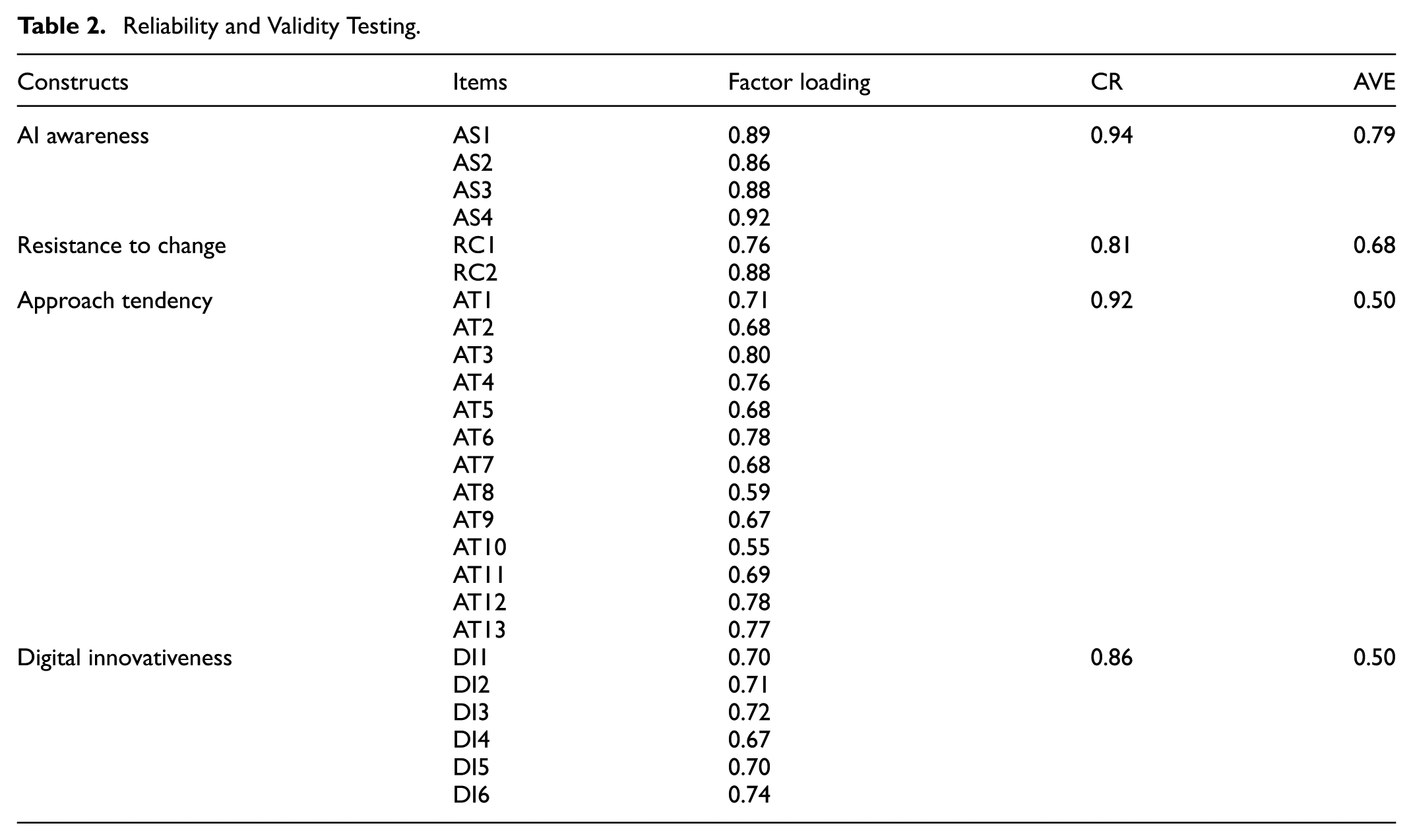
We first examined whether the research variables had good reliability and validity. The factor loadings of each survey item were tested via AMOS 21.0. We also used AMOS 21.0 to test composite reliability (CR) and the average variance extracted (AVE) index. The results are shown in Table 2. Most of the measurement items had factor loadings of 0.7 or above, and the CR values were also 0.7 or above. These results showed that the variables investigated in this study had good reliability (Hu & Bentler, 1999). The AVE values of all variables were 0.5 or above, and the square root of the AVE value of a variable was higher than the correlation coefficient between this variable and the other variables, indicating that the variables investigated in this study had good convergent validity (Hu & Bentler, 1999).
Reliability and Validity Testing.
Confirmatory factor analysis was conducted using AMOS 21.0 to assess discriminant validity among AI awareness, resistance to change, approach tendency, and digital innovativeness. To maintain a suitable balance between the number of observed variables and the sample size (Zheng et al., 2021), approach tendency was initially grouped into three observed variables based on the dimensions of reward response, drive, and pleasure pursuit, as proposed by Carver and White (1994). These packaged observed variables together with AI awareness, resistance to change, and digital innovativeness were then subjected to confirmatory factor analysis. The results, as shown in Table 3, indicated that all fit indices of the four-factor model met the corresponding requirements. Furthermore, compared with the other models, the four-factor model exhibited the best fit (χ2/df = 2.62, CFI = 0.93, TLI = 0.91, RMSEA = 0.08). These findings demonstrate satisfactory discriminant validity among the study variables. To test for common method bias, poor fit indices were observed in the single-factor model, as displayed in Table 3. Additionally, the Harman single-factor method was employed for testing, and the results revealed that the first factor accounted for 22.59% of the variance, falling below the 50% threshold (Podsakoff et al., 2003). Based on these outcomes, it can be concluded that this study did not exhibit significant common method bias.
Confirmatory Factor Analysis Results.

AI awareness; Resistance to change; Approach tendency; Digital innovativeness.
AI awareness + Resistance to change; Approach tendency; Digital innovativeness.
AI awareness + Resistance to change + Approach tendency; Digital innovativeness.
AI awareness + Resistance to change + Approach tendency + Digital innovativeness.
Descriptive Statistics and Correlation Analysis
The descriptive statistics and correlation analysis results are presented in Table 4. There was a positive correlation between AI awareness and resistance to change (r = .65, p < .01). AI awareness was negatively correlated with digital innovativeness (r = −.36, p < .01). Resistance to change also exhibited a negative correlation with digital innovativeness (r = −.41, p < .01). Furthermore, approach tendency was negatively correlated with resistance to change (r = −.24, p < .01), but positively correlated with digital innovativeness (r = .33, p < .01).
Descriptive Statistics and Correlation Analysis.

p < .05. **p < .01.
Test of Hypotheses
This study employed regression analysis to examine the validity of the relevant research hypotheses. The hypotheses were tested using SPSS version 23.0, while the mediating effect and the moderated-mediation effect were examined via PROCESS V3.3, which was developed by Hayes (2013). To mitigate the potential influence of multicollinearity on the research findings, all variables were standardized before the regression analysis. Specifically, Table 5 presents the results when digital innovativeness and resistance to change were considered the dependent variables.
Regression Analysis Results.

Note. LLCI = 95% Lower level confidence interval; ULCI = 95% Higher level confidence interval; b was unstandardized regression coefficients.
p < .05. ***p < .001.
First, we examined the impact of AI awareness on digital innovativeness (H1), the impact of AI awareness on resistance to change (H2), the impact of resistance to change on digital innovativeness (H3), and the mediating role of resistance to change (H4). According to the findings in Table 5, AI awareness was negatively related to digital innovativeness (b = −0.18, 95% CI [−0.34, −0.03]). Hypothesis 1 was supported. AI awareness was positively related to resistance to change (b = 0.60, 95% CI [0.50, 0.70]), thereby confirming Hypothesis 2. In Table 5, resistance to change displayed a negative relationship with digital innovativeness (b = −0.29, 95% CI [−0.44, −0.13]). Hypothesis 3 was supported. These results suggest that resistance to change may act as a mediator in the relationship between AI awareness and digital innovativeness. The bootstrapping method was utilized to examine the mediating effect, and the results revealed its significance (effect = −0.18, boot SE = 0.08, 95% CI [−0.34, −0.04]), thereby supporting Hypothesis 4.
By observing Table 5, we identified a significant negative correlation between education level and digital innovativeness. While counterintuitive, this relationship may be explained by two key factors. First, highly educated employees with rigorous professional training often develop fixed cognitive frameworks and standardized workflows (Sterling & Boxall, 2013). When encountering emerging digital technologies, they may tend to rely on established knowledge systems, potentially limiting openness to novel approaches. Second, these employees typically face heightened societal expectations and self-imposed performance pressures (Ferrante, 2017), which may inadvertently suppress creative problem-solving. In this study, the digital innovativeness (measured through six items) demonstrated a mean score of 4.34 on a 1 to 5 scale, indicating relatively high levels of innovativeness. This result aligns with the sample’s educational profile, where only 6% of participants held postgraduate degrees.
Although demographic variables investigated in this study did not significantly influence resistance to change. We employed independent sample t-tests and one-way analysis of variance (ANOVA) method, yielding several interesting findings. The analysis revealed that male participants exhibited significantly lower resistance to change compared to their female counterparts, t (df) = 2.54 (225), p < .05. We suggest this may reflect female employees’ heightened sensitivity to AI-related ethical concerns such as gender bias and privacy risks (S. Liu & Cheng, 2025). The four-item AI awareness scale yielded a mean score of 2.23, and the two-item resistance to change measure showed a mean of 1.95 (both on 1–5 scales), indicating relatively low levels. This pattern aligns with the sample composition, where 67% of participants were male.
Regarding organizational hierarchy, a significant difference emerged between frontline employees and middle-level managers (diff = 0.34, SD = 0.13, p < .05), with managers demonstrating greater receptivity to organizational changes. However, no significant differences in resistance to change were observed across age groups, educational levels, or years of work experience. We propose that frontline workers’ limited control over workplace AI systems may fuel unwarranted skepticism. When organizational changes impact workflows, job roles, or career paths, frontline employees often express heightened concerns about AI-driven uncertainties compared to middle managers (Q. Lin & He, 2024). Given that nearly 60% of participants were frontline employees, this sample composition likely amplified the observed positive relationship between AI awareness and resistance to change. These findings underscore the need for organizations to develop targeted strategies that address employee concerns and reduce resistance to change.
Furthermore, we examined the moderating effect of approach tendency on the relationship between AI awareness and resistance to change (H5). Table 5 shows that the interaction term of AI awareness and approach tendency had a negative relationship with resistance to change (b = −0.20, 95% CI [−0.32, −0.09]). In line with the recommendations presented by Aiken and West (1991), a simple slope test was conducted to assess the moderating effect. The outcome is depicted in Figure 3. When approach tendency was higher, the relationship between AI awareness and resistance to change was weaker (b = 0.40, p < .001). Conversely, when approach tendency was lower, the relationship between AI awareness and resistance to change was stronger (b = 0.80, p < .001). Thus, Hypothesis 5 was supported.

The moderating role of approach tendency on the relationship between AI awareness and resistance to change.
We subsequently tested the moderating effect of approach tendency on the mediating role of resistance to change (H6). The PROCESS plug-in (MODEL7) was employed to test whether approach tendency moderated the indirect effect of AI awareness on digital innovativeness through resistance to change. The results are presented in Table 6. When the approach tendency was low, the impact of AI awareness on digital innovativeness through resistance to change intensified (effect = −0.23, boot SE = 0.10, 95% CI [−0.44, −0.04]), whereas a higher approach tendency yielded a weaker impact (effect = −0.11, boot SE = −0.06, 95% CI [−0.25, −0.02]). The mediating effects under differing levels of approach tendency were found to be significantly different (diff = 0.12, boot SE = 0.07, 95% CI [0.01, 0.28]), which confirmed the presence of a moderated-mediation effect (effect = 0.06, boot SE = 0.04, 95% CI [0.01, 0.14]). Consequently, Hypothesis 6 was supported.
The Moderated-Mediation Effect Test.

Discussion
Drawing upon SARF, this study developed a moderated-mediation model to examine the mechanisms through which AI awareness affects digital innovativeness. The empirical results demonstrate that AI awareness negatively impacts employees’ digital innovativeness by increasing their resistance to change. Furthermore, approach tendency serves as a significant moderator in the relationship between AI awareness and resistance to change. Specifically, employees with higher approach tendencies exhibit a weakened positive relationship between AI awareness and resistance to change. Additionally, approach tendency moderates the mediating effect of resistance to change on the AI awareness-digital innovativeness relationship. When employees demonstrate strong approach tendencies, the negative indirect effect of AI awareness on digital innovativeness through resistance to change is significantly attenuated.
Theoretical Implications
First, establishing a connection between AI awareness and digital innovativeness advances our understanding of AI-related outcomes. While existing literature predominantly examines AI awareness’s direct effects on career development (Kong et al., 2021) and work behaviors (Ma & Ye, 2022), this study establishes a negative relationship between AI awareness and digital innovativeness, offering novel insights into AI-enhanced workplace. This discovery aligns with Tang et al.’s (2022) core premise that when emerging technologies threaten practitioners’ professional identity, they may trigger irrational defense mechanisms. Within China’s manufacturing context, this identity threat manifests uniquely. Engineering professionals have historically constructed their professional value systems through technical expertise (An et al., 2024), yet intelligent systems simultaneously erode their technical authority and undermine their professional identity as ultimate problem-solvers (Yam et al., 2023). This dual assault fosters a distinctive competency anxiety spiral within China’s innovation culture that emphasizes technical competitiveness (Teng et al., 2024). Furthermore, China’s collectivist cultural norms potentially amplify this suppression effect. Unlike Western individualism, Chinese workers’ technological anxiety stems not merely from individual skill obsolescence concerns but also from heightened sensitivity to collective evaluation systems (Ding, 2022). When collaborative robots enter production lines, operators confront two key anxieties, namely technological displacement and the perception by peers as adaptation-deficient laggards. This collective cognitive pressure redirects employees’ mental resources toward maintaining group-approved technical personas rather than pursuing digital innovativeness that might expose knowledge gaps (H. Wang et al., 2022).
Second, this study reveals that resistance to change is the key mechanism through which AI awareness reduces digital innovativeness, enhancing our understanding of AI’s psychological impacts. While technology acceptance model (TAM) emphasizes perceived usefulness and ease of use as determinants of technology adoption (Davis et al., 1989), our findings uncover the obstructive effect of resistance to change in intelligent technology acceptance. When employees perceive AI technology as a threat to professional identity, they may exhibit irrational inhibition of innovative behaviors despite acknowledging its technical advantages (Ma & Ye, 2022). Within the Chinese context, this resistance to change carries unique cultural significance. Semi-structured interviews revealed that manufacturing workers’ opposition to AI technology stems not only from individual skill anxiety but also from the need to preserve established relational networks. When intelligent systems alter traditional workshop collaboration norms, they disrupt the implicit skill compensation relationships between technical experts and ordinary workers (G. Xu et al., 2023). These informal cooperation patterns rooted in guanxi originally compensated effectively for individual capability disparities (Chen & Chen, 2009). AI implementation dissolves the experiential advantages of skilled workers through algorithmic systems, depriving them of both authoritative status within teams and opportunities to maintain interpersonal connections through mentorship (An et al., 2024). Therefore, employees may resist adopting digital innovativeness to maintain their professional standing within established workplace networks. Such mechanisms prove particularly pronounced in collectivist environments emphasizing role stability, where individual innovative actions must evaluate not only technical feasibility but also potential impacts on group harmony (Q. Lin & He, 2024).
Third, the findings enhance our understanding of risk amplification within SARF. This study extends SARF’s application to micro-level organizational behavior, revealing how risk perception operates during technological transitions. While existing SARF research predominantly examines media dissemination and social interactions in amplifying public risks, our empirical evidence demonstrates that within tightly-knit Chinese professional communities, individual AI risk perceptions rapidly escalate into collective concerns through informal networks. Employees’ anxieties about intelligent equipment often evolve into group concerns through informal discussions with technical experts (C. Li et al., 2023). Such risk diffusion intensifies in collectivist environments emphasizing group monitoring. For instance, an engineer’s public skepticism about AI system reliability can swiftly reduce overall team acceptance through mentor-protégé networks (Sharma et al., 2022). Moreover, China’s distinctive face culture (mianzi) may cultivate unique socio-psychological conditions for risk amplification. During manufacturing upgrades, employees often resist AI not due to technical flaws but from fears that exposing skill gaps might tarnish professional standing (Nowak, 2023). For example, quality inspectors receiving frequent algorithmic corrections to their experiential judgments may adopt face-saving behaviors, persisting with inefficient manual methods to avoid appearing incompetent before peers (Gulanowski & Zheng, 2024). This cultural logic forges a connection between technological risk perceptions and professional identity crises, triggering a chain reaction where competence challenges prompt face preservation behaviors, ultimately resulting in innovation avoidance. Our research in China’s collectivist context reveals that SARF’s risk construction process fundamentally manifests through the interplay between technological cognition and reputation management.
Fourth, this study investigates how employees’ approach tendency may mitigate the adverse effects of AI awareness. While previous research has identified influential factors including perceived organizational support, competitive psychological climate (J. (. Li et al., 2019), transformational leadership (Yu et al., 2022), future orientation (Liang et al., 2022), and AI-related knowledge (He et al., 2024), the specific personality traits facilitating adaptation to AI remain underexplored. Our research addresses this theoretical gap by employing the approach-avoidance tendency model to examine the moderating role of proactive disposition. The findings substantiate the theoretical premise that when approach tendency is high, individuals tend to preserve existing positive stimuli or cognitively reframe negative stimuli into positive constructs. This study integrates the approach-avoidance tendency model with SARF, revealing individual variations in risk perception mechanisms and behavioral responses while clarifying how AI awareness influences digital innovativeness.
Finally, we move beyond the cognitive core of TAM by integrating a socio-affective dimension centered on professional identity threat (Davis et al., 1989). We empirically demonstrate that during profound technological shifts like AI integration, the anticipated psychological cost associated with professional identity reconstruction can emerge as another force, potentially outweighing instrumental rationality in driving behavioral outcomes (Marangunić & Granić, 2015). This provides a more nuanced understanding of technology acceptance under conditions of high identity salience. Furthermore, by uncovering approach tendency as a boundary condition that weakens the relationship between AI awareness and resistance to change, we introduce individual agency into TAM. This challenges deterministic views of AI-driven disruption and highlights how employees’ proactive traits can recalibrate socio-affective responses (S. Liu & Cheng, 2025), thereby bridging micro-psychological perspectives with macro-change management paradigms.
Our findings also advance change management theory by refining the ADKAR model (Hiatt, 2006). ADKAR represents five critical phases of the change process: Awareness, Desire, Knowledge, Ability, and Reinforcement (Hiatt, 2006). ADKAR model highlights the importance of individual attitudes, capabilities, and behaviors during organizational transformation. While ADKAR conceptualizes resistance as a barrier to overcome during the ’Desire’ stage, we empirically identify professional identity threat as the specific antecedent rooted in self-concept disruption. This explains why identical AI change initiatives trigger heterogeneous resistance among professionals facing comparable technical demands (He et al., 2025). Furthermore, we expand the conceptual boundaries of ADKAR’s “Knowledge” and “Ability” stages. Traditional ADKAR’s “Knowledge” stage focuses on technical skill acquisition, but our discovery of approach tendency as a boundary condition reveals that psychological adaptability serves as a critical complement to technical competency (Doan & Nguyen, 2025). Similarly, while ADKAR’s “Ability” stage emphasizes organizational support systems, our evidence demonstrates that targeted identity reconstruction interventions constitute a prerequisite for effective skill deployment in AI transitions (Yin et al., 2024).
Practical Implications
First, AI awareness has been shown to negatively impact employees. To effectively address these challenges, organizations can implement the following management strategies. Given China’s strong emphasis on technological proficiency, organizations should prioritize investment in training programs aimed at enhancing employees’ digital skills and AI literacy (H. Lin et al., 2020). Such initiatives can help employees view AI as a catalyst for innovation rather than a threat to their professional expertise. Additionally, providing psychological counseling services can support employees in identifying and managing the negative emotions associated with AI awareness (J. Liu et al., 2020). Moreover, organizations should establish reward and recognition systems for employees who actively embrace AI-driven changes and demonstrate exceptional performance in their roles (Ding, 2021). In the Chinese context, where employees often take pride in their technical competencies, the introduction of AI may challenge their sense of professional superiority (An et al., 2024). To mitigate this, managers should frame AI as a complement to human skills rather than a replacement. For example, they can highlight how AI augments employees’ capabilities, enabling them to focus on higher-value tasks and strategic initiatives. Furthermore, organizations can foster partnerships with leading Chinese technology companies to provide employees with access to state-of-the-art AI tools and platforms. This approach not only enhances employees’ digital innovativeness but also ensures the organization remains competitive in the rapidly evolving technological landscape.
Second, this study demonstrates that employees with a strong approach tendency exhibit significantly lower resistance to change when faced with AI awareness. This finding offers valuable organizational insights regarding recruitment, employee development, and workforce motivation. Regarding recruitment strategies, organizations should consider expanding their evaluation criteria beyond professional skills and experience (Tu et al., 2024). By incorporating psychological assessments, structured behavioral interviews, and other validated methods, organizations can effectively identify candidates with higher approach tendencies who demonstrate greater receptiveness to innovation and technological change (X. Lin et al., 2023). In terms of employee development, organizations should implement tailored training programs specifically designed for AI technologies. For employees with high approach tendencies, customized AI training programs can accelerate their technological proficiency and enhance work efficiency (Haesevoets et al., 2022). Additionally, establishing an AI mentorship system, where experienced employees or external experts guide those with lower approach tendencies, can facilitate better adaptation to AI-driven work environments (Hampel et al., 2024). Furthermore, for employee utilization and motivation, organizations should optimize job allocation strategies by aligning roles with employees’ approach tendencies and skill sets. This strategic alignment enables employees with high approach tendencies to thrive in positions that best match their capabilities and predispositions (Ding, 2021).
Moreover, while the primary rationale for organizations adopting AI technologies is to enhance operational efficiency and foster technological innovation (Kong et al., 2021), this study reveals contrasting findings. These results highlight the critical need for organizations to facilitate employee adaptation and acceptance of technological changes (G. Xu et al., 2023). Organizations should establish robust mechanisms that encourage employees to voice their opinions and provide suggestions regarding AI implementation, while collecting and addressing their feedback (He et al., 2024). Particular attention must be given to maintaining a balance between technological advancement and humanistic considerations during AI integration (Ma & Ye, 2022). Organizations can protect employee rights and interests through communication strategies and support systems. It is essential to cultivate a psychologically safe environment where employees feel comfortable expressing AI-related concerns and experimenting with new technologies without fear of failure or criticism. This consideration is especially crucial in high-power-distance cultures like China, where hierarchical structures may inhibit open expression of opinions (He et al., 2025). Leadership plays a pivotal role in this transition. In China’s hierarchical cultural context, where employees typically seek guidance from authority figures, leaders should actively champion AI initiatives and demonstrate unwavering commitment to digital transformation (Haesevoets et al., 2022). Furthermore, developing an organizational culture that celebrates innovation and views failures as learning opportunities is crucial for empowering employees to experiment with emerging technologies and methodologies (Malodia et al., 2022). Recognition and reward systems for employees demonstrating digital innovativeness can be particularly effective, aligning with China’s cultural emphasis on achievement and excellence. In China’s collectivist cultural framework, employees are more likely to embrace AI when they perceive its benefits for the collective good (He et al., 2025). Managers should emphasize how AI adoption contributes to shared organizational objectives, such as enhanced efficiency and competitive advantage.
Limitations and Future Research
This study has several limitations that should be acknowledged. First, from a methodological perspective, the simultaneous measurement of AI awareness and resistance to change poses challenges in establishing causal relationships between these variables. Future research could employ a three-wave longitudinal survey design to temporally separate the measurement of AI awareness and resistance to change, thereby enabling more robust causal inferences. It should be noted that the findings in this study are context-specific, requiring caution when generalizing beyond similar Chinese manufacturing contexts. The study’s focus on employees from three intelligent manufacturing factories in southern China introduces geographical and sample-related limitations that affect the generalizability of the findings. Compared to the central and western regions of China, southern China’s manufacturing sector is more technologically advanced, with more prevalent AI applications. Therefore, the observed negative effects of AI awareness may be more pronounced in this region. Although the sample size meets basic statistical requirements, the use of nonprobability sampling techniques restricts the broader applicability of the findings, necessitating further verification. Future research should address these limitations by incorporating larger, more diverse samples across wider geographical areas. Additionally, the study could enhance its analytical rigor by refining the use of control variables. Specifically, future investigations should differentiate between employees in augmented positions (where AI enhances human capabilities) and those in substitutable positions (where AI may replace human roles) to identify which occupational contexts are more likely to elicit resistance to change.
Second, regarding research content, this study investigates the relationship between AI awareness and digital innovativeness. However, AI awareness likely represents only one facet of the factors influencing employees’ innovation capabilities. To develop a more comprehensive understanding of digital innovativeness, future research should explore how digital innovation awareness shapes its development. While this study examines resistance to change as a mediator within SARF, future research could apply affective events theory to investigate how AI awareness shapes emotional responses (e.g., work flourishing) and ultimately impacts digital innovativeness (L. Zhang et al., 2023). Furthermore, although this study focuses on the moderating effect of individual traits, future research could expand this perspective by examining the moderating role of individual moral characteristics, particularly employees’ AI ethical anxiety (Zhu et al., 2025). Additionally, the potential buffering effects of leadership approaches (e.g., servant or transformational leadership) on AI awareness’s negative consequences also merit exploration. From an organizational perspective, researchers should investigate how organizational AI readiness and innovation climate moderate the AI awareness–innovativeness relationship (C. Li et al., 2023). Future research on moderating variables should also consider incorporating traditional Chinese cultural elements such as guanxi, mianzi, and collectivism. These context-specific factors may critically shape how individuals interpret and respond to technological disruptions, particularly in AI adoption scenarios. This study establishes the negative impact of AI awareness on digital innovativeness, an important avenue for future research would be to examine whether AI awareness might positively influence digital innovativeness. For instance, studies could examine whether strong team ethical climates neutralize employees’ negative perceptions of AI awareness, enabling digital innovativeness through job crafting behaviors (H. Wang et al., 2022).
Conclusion
This study constructs a moderated mediation model to explore how AI awareness influences employees’ digital innovativeness. The findings suggest that a significant reason why organizations find it difficult to increase innovativeness is due to the threat that employees experience when faced with AI technologies. This research suggests that organizations should thoroughly understand employees’ AI awareness and implement proactive measures to encourage AI adoption, thereby reducing resistance to change. Additionally, organizations should integrate employees’ personality traits into job design considerations. Specifically, employees with a high approach tendency can be strategically assigned to roles that are undergoing significant transformation due to AI integration.
Footnotes

Ethical Considerations
All procedures performed in studies involving human participants were in accordance with the ethical standards of the institutional and/or national research committee and with the 1964 Helsinki declaration and its later amendments or comparable ethical standards.
Consent to Participate
Informed consent was obtained from all individual participants included in the study.
Funding
The authors disclosed receipt of the following financial support for the research, authorship, and/or publication of this article: This work was supported by the General Projects for Research in Philosophy and Social Sciences at Jiangsu Universities [2024SJYB0665], Wuxi University Research Start-up Fund for Introduced Talents [2023r053], and the General Projects for Humanities and Social Sciences Research in Universities in Henan Province [2025-ZZJH-035].
Declaration of Conflicting Interests
The authors declared no potential conflicts of interest with respect to the research, authorship, and/or publication of this article.
Data Availability Statement
The datasets generated during and/or analyzed in the current study are available from the corresponding author on reasonable request.