




Abstract
The social value created by organizations has been in the spotlight during periods of rapid social change, such as COVID-19. However, the existing literature has been limited by the inability to demonstrate the cumulative effects of social value over time, which has led to academic and practical limitations. Drawing on stakeholder theory, socially responsible customer behavior, and institutional theory, the author collected data from 208 social enterprises in South Korea over 3 years, from 2017 to 2019, and tested hypotheses using latent growth modeling. This analytical technique, which uses structural equation modeling, estimates the latent growth rate of each data measure by year and analyzes the causal relationship between the growth rate of each variable. The results show that higher levels of social entrepreneurship are associated with higher growth rates of total employment and vulnerable worker employment, followed by higher growth rates of financial performance. The implications of this paper are as follows. First, this study reports that social entrepreneurship can help social enterprises develop sustainably by increasing financial performance. Second, this study overcomes the methodological limitations of the existing literature by reporting the relationship between growth rates. Third, this study reports that social enterprises can help solve employment problems for vulnerable populations, who are often the first to be affected by the economic crisis. Fourth, this study contributes to resolving the conflicting and contradictory perspectives of practitioners and academics on the relationship between social and economic value. Fifth, it offers suggestions for the future direction of the academic field.
Plain Language Summary
Corporate social responsibility (CSR); environmental, social, and governance (ESG); and the social value that companies create are gaining increasing attention. Corporate stakeholders, including governments, shareholders, investors, and customers, are demanding financial growth while also expecting companies to respond to social needs. The hybrid role of corporations makes their goals ambiguous and unclear. This study shows that social entrepreneurship creates employment value and leads to financial growth. Through latent growth modeling analysis of 208 South Korean social enterprises, the author presents findings on growth rates not yet presented in previous studies. The results of the analysis show that social entrepreneurship increases the growth rate of employment value, such as employment of the underprivileged, and increases the growth rate of financial value, such as sales and return on equity. The author presents the results of the study, revealing the importance of corporate goal-setting in response to social needs and suggesting policy implications.
Keywords
Introduction
Every business is a social entity and, therefore, has social obligations. Through employment, companies maintain and manage the human resources needed for services and production, simultaneously contributing to the stability of society (Schumpeter, 1942). However, in times of economic crisis, such as COVID-19, the first response of businesses is to reduce employment to cut costs (Bluedorn et al., 2023). The employment created by companies is paradoxically the least when it is most needed by society. For instance, during the 2008 U.S. financial crisis, unemployment in the U.S. increased by 2.6 million, mostly among vulnerable workers (Haltiwanger et al., 2011). During the 1997 Asian financial crisis, unemployment in South Korea increased by two million, with 90% of the unemployment among low-wage, unskilled workers (Kang et al., 2001). In recent years, informal employment in Iran has emerged as a major problem for the Iranian economy (Shafiee & Samani, 2022a). Previous studies have shown that the presence of vulnerable workers in informal employment in Iran has a negative impact on the Iranian economy as a whole, as well as on the development of individual workers (Shafiee & Samani, 2022b). As a result, the creation of social value through employment has gained a lot of traction. (Greer et al., 2020). Social enterprises seek to grow and develop financially by pursuing economic value, just like traditional businesses. However, social enterprises also aim to create social value for the survival of the country or region in which they operate (Klarin & Suseno, 2023). The decrease in employment due to the economic crisis increases the importance of the employment value created by social enterprises, which increases the organization’s legitimacy. Therefore, the employment-creation effect of social enterprises is important as an alternative to overcome the employment crisis caused by the economic crisis. This paper aims to confirm the effectiveness of social entrepreneurship as an alternative to the social value crisis by determining the growth rate of the employment effect created by social entrepreneurship in South Korean social enterprises.
The research gaps and divergent and conflicting perspectives from the literature that this paper addresses are as follows: although research on social entrepreneurship is growing rapidly (Halberstadt & Kraus, 2016), there are two unanswered questions and conflicting perspectives in the literature on social entrepreneurship. The first question is whether social entrepreneurship provides an additional explanation for each dependent variable compared to traditional entrepreneurship. Mair and Martí (2006) limit social entrepreneurship to cases where traditional entrepreneurship is practiced only in the public sector or non-profit organizations. Dart (2004) and Nicholls (2010) argue that it is highly contextual and therefore contestable to be studied with this single definition. On the other hand, Thompson et al. (2000) argue that it has explanatory power that traditional entrepreneurship does not have in solving increasingly complex social problems. Wallace (1999) argues that it differs from traditional entrepreneurship by breaking down the traditional barriers between the private and public sectors and building hybrid enterprises in their place. Therefore, this study aims to answer questions by verifying that social entrepreneurship can explain the employment creation effects and employment of vulnerable groups that have not been explained in the existing entrepreneurship literature, and that it generates quantitative and qualitative financial outcomes. The second question is whether social entrepreneurs can create enough financial value for their business to achieve sustainable growth. Existing studies report conflicting results on the relationship between social and financial value. Some studies have found that social value hinders financial value (Cordeiro & Sarkis, 1997; Khan et al., 2022), while others have found that it enhances financial value (Omidi & Shafiee, 2016, 2018; Orlitzky et al., 2003). These contradictory findings have conflicting implications for many organizations working to create social value through environmental, social, and governance (ESG), corporate social responsibility (CSR), and more, and have led to confusion and conflict in academia and practice. This study therefore seeks to answer this question by determining whether the employment value created by social entrepreneurs generates economic value, including sales and return on equity.
In addition, existing research, regardless of perspective, shares a common methodological limitation. Despite the fact that social entrepreneurship, employment value, and financial value should be studied from a continuous perspective rather than at a single point in time, existing studies are either cross-sectional (Cherrier et al., 2018) or report simple trends through panel analysis (Borzaga & Defourny, 2001). This paper is the first to include changes over time in social enterprise research through growth rate analysis using a latent growth model. In doing so, this paper aims to overcome the limitations of the existing literature.
To address the above, the research objectives of this paper are as follows: (1) to determine whether social entrepreneurship has a significant impact on total employment and employment of vulnerable workers; (2) to determine whether these employment outcomes have a positive impact on financial performance; (3) to examine the relationship between the employment value and financial value of social enterprises in terms of growth rate by using latent growth modeling. In doing so, this study aims to extend the boundaries of existing research and contribute to the literature. Specifically, this paper (1) contributes to the definition of social entrepreneurship by showing that social value orientation adds explanatory power to the traditional entrepreneurial process; (2) discusses policy implications by showing that social entrepreneurs can grow their firms sustainably by sequentially creating social and financial value; and (3) overcomes methodological limitations by providing growth rate information that has not been reported in the existing literature. (4) contributes to the resolution of existing research gaps and divergent and conflicting perspectives, and provides suggestions for future research to have practical implications.
Theory and Hypothesis
Social Entrepreneurship and the Growth Rate of Employment Value
Social entrepreneurship originated from entrepreneurship and has built its own academic area on social value. However, the definition of social entrepreneurship remains vague and lacks consensus (Peredo & McLean, 2006). The literature suggests that social entrepreneurship needs to be clearly distinguished from traditional entrepreneurship for three reasons (e.g., Haugh, 2005; Peredo & McLean, 2006). First, social entrepreneurship differs from entrepreneurship in its antecedents and outcome variables. Second, if social entrepreneurship is supposed to meet social needs, it is subject to social policies. Third, entrepreneurship and social entrepreneurship differ in their stance on profit maximization. Although, according to Venkataraman (1997), it is “impossible” to come up with a consensus definition, entrepreneurship can be summarized as sharing the characteristics of innovativeness, proactiveness, and risk-taking. These three characteristics allow entrepreneurs to project their vision into a business idea that creates new value, which is then injected back into the vision (Metallo et al., 2021). According to Dees (2018), social entrepreneurship has been studied as a type of entrepreneurship. It utilizes the characteristics of entrepreneurship to create social value and is, therefore, inevitably multi-dimensional. This concept is also similar to public entrepreneurship proposed by Funko et al. (2023). They provide a comprehensive review of research on entrepreneurship in the public sector, showing that corporate entrepreneurship can contribute to social value creation and explaining the need for a public dimension of entrepreneurship. According to Sullivan Mort et al. (2003), social entrepreneurs are risk-tolerant and balance the interests of multiple stakeholders with social and moral intricacies in creating the social value for which they aim. Therefore, this study defines social entrepreneurship as social value orientation along with innovativeness, proactiveness, and risk-taking.
Social entrepreneurs are sensitive to and strive to address the social needs of the society they serve. They function best in the gap between government limitations and private company unwillingness, and they find business opportunities in socially valuable needs (Halberstadt & Kraus, 2016). They act as altruistic brokers and structural holes (Goduscheit et al., 2021). They create social value by bridging, enabling and bonding social needs and resources. Vulnerable workers are defined as a population group whose individual vulnerability leads to a disadvantage in the labor market (Kim & Kim, 2003). This group mainly consists of temporary workers, seniors, youth, foreigners, women, and people with disabilities who are opposed to social power groups in labor (Kim & Kim, 2003). Social entrepreneurship has a positive impact on employment. In particular, it positively impacts the employment of vulnerable groups. According to stakeholder theory, social entrepreneurs create employment outcomes to address their social mission and make their enterprises sustainably viable (Rowley, 1997). Harris et al. (2014) found that groups with high levels of social entrepreneurship provided equal participation opportunities for people with disabilities in the labor market. Džunić et al. (2018) also found that social entrepreneurship had a positive impact on employment for socially excluded groups. Moreover, Stephan and Drencheva (2017) found that social entrepreneurship is a personality trait that has a lasting impact on the way entrepreneurs run their businesses. Therefore, this study expects that social entrepreneurship creates social value in employment outcomes, especially in the employment of vulnerable working groups, and that the effects are cumulative.
Hypothesis 1. Social entrepreneurship is positively related to the growth rate of employment value.
The Growth Rate of Employment Value and Financial Performance
For any enterprise, creating financial value is essential for its survival and growth. The literature on social entrepreneurship emphasizes the innovativeness and risk-taking of social entrepreneurs while simultaneously studying their return on financial value because of the importance of the organization’s survival. Therefore, Haugh (2005) stated that the main research area of social entrepreneurship is financial sustainability and argued that the balance between social and financial value is important. This study hypothesizes that if social entrepreneurship increases the growth rate of employment value, it will lead to the growth rate of their financial value for the following reasons. First, customers of social entrepreneurs consider social implications when judging the value of a product or service. According to socially responsible customer behavior, they consume and pay for the social value created by the social entrepreneur (e.g., Lichtenstein et al., 2004; Wattanakamolchai et al., 2016), thus rewarding employment value and driving financial value growth. This can also be understood as cause-related marketing (Varadarajan & Menon, 1988). Second, from the perspective of institutionalism, social entrepreneurship attempts to balance multi-stakeholder interests (Bird et al., 2007). Thus, the cumulative growth of employment value creation increases the legitimacy of social entrepreneurs, which in turn increases their financial performance. According to a study by Zhao et al. (2023), attentional resources as a manifestation of legitimacy are crucial for social entrepreneurs. By acquiring this resource, they can increase the sustainability of their enterprise. Third, employees of social entrepreneurs develop their own entrepreneurial spirit by imitating their leaders (Stephan & Drencheva, 2017). They become innovative and proactive in their own entrepreneurial activities, which have a lasting positive impact on the financial performance of their organizations. Shafiee et al. (2020) found that employees’ perceptions of themselves lead to evaluative customer experiences, which in turn affect company performance. Zhang and Swanson (2014) reported that social entrepreneurship increases the economic self-reliance of organizations and their viability by increasing their environmental compatibility. Guo et al. (2022) found that innovation in value proposition, capture, and creation is key to firm performance. According to Mair and Martí (2006), social entrepreneurs pursue their economic interests in ways that increase the benefits of the community. Furthermore, in a study of 1156 firms, Gali et al. (2020) found that entrepreneurs’ social value orientation increased their social performance, which increased their financial performance, with a significant mediation effect. A study by Méndez-Picazo et al. (2021) found that both sociocultural and economic factors play an important role in how social entrepreneurship leads to sustainable development. Social entrepreneurship reconciles the social and economic value objectives of a firm (Tobias et al., 2013). Therefore, this study expects social entrepreneurship to have a cumulative effect on employment value creation, which in turn increases financial value growth.
Hypothesis 2. The growth rate of employment value is positively related to the growth rate of financial value.
Hypothesis 3. The growth rate of employment value mediates the relationship between social entrepreneurship and the growth rate of financial value.
Methods
Sample and Procedure
This study focuses on the social entrepreneurship of social enterprise managers and the growth rate of employment value and financial value of each enterprise. Data on social enterprises measured by the Center for Social Value Enhancement Studies in South Korea were used to test the hypotheses. The Center for Social Value Enhancement Studies is a social value measurement and enhancement research center jointly established by the Korea Social Enterprise Promotion Agency, a government agency, the Korea Social Enterprise Central Council, an association of social enterprises, and academia. It has been operating since 2015, measuring the financial and social performance of social enterprises in Korea and making it available to researchers. Each social enterprise reports annually to the center on the employment, environmental, and social welfare outcomes they create, and the center evaluates their social performance based on that. The center then analyzes their financial statements to determine funding and provide financial rewards. The average size of the grant is KRW 0.5 billion per company. Therefore, the data is compiled on an annual basis, and this study analyzes 3 years of data from 2017 to 2019. The total number of companies utilized in the analysis is 208.
Measure
Social Entrepreneurship
For social entrepreneurship, social value orientation was added to the existing dimensions of innovativeness, enterprising, and risk-taking, which are sub-dimensions of entrepreneurship, for a total of four dimensions. It was measured using 16 questions, with four questions for each dimension. For example, for Innovativeness, “My company’s manager strives to improve performance through innovative changes.” Second, for proactiveness, “My company’s manager likes to take on new tasks and challenges.” Third, for risk-taking, “My company’s manager prefers projects with high performance to stability.” Finally, for social value orientation, “My company’s manager seeks to achieve socially desirable goals.”Table 1 shows the measurement items and reliability.
Social Entrepreneurship Questionnaire Items.

Employment Value
Total employment and vulnerable worker employment were used to analyze employment value. Total employment was calculated by adding direct and transition employment by year. Vulnerable worker employment was defined as all vulnerable workers, including temporary workers, seniors, youth, foreigners, women, and people with disabilities, working for the organization in a given year.
Financial Value
For the financial value created by social enterprises, the quantitative aspect of sales and the qualitative aspect of return on equity (ROE) were calculated and utilized. The data required for the calculation was collected based on the data reported by each company.
Statistical Analysis Method
This study focuses on the growth rate of employment value and financial value. Latent growth modeling is a statistical technique that considers the initial value and the growth rate as latent variables and estimates the path coefficients between them to utilize the direction and significance (Duncan et al., 1999). The latent growth model for hypothesis testing can be represented as Figure 1. This analysis was performed using MPLUS version 8.4.

The path diagram of the latent growth model.
Results
The model fit of the structural equation model was calculated before the hypothesis testing. It is shown in Table 2. The model fit of each model for hypothesis testing passed the usual criteria and was used for hypothesis testing (Hu & Bentler, 1999).
Model Fit of Latent Growth Models.

Note. CFI = Comparative Fit Index; TLI = Tucker Lewis index; RMSEA = Root Mean Square Error of Approximation.
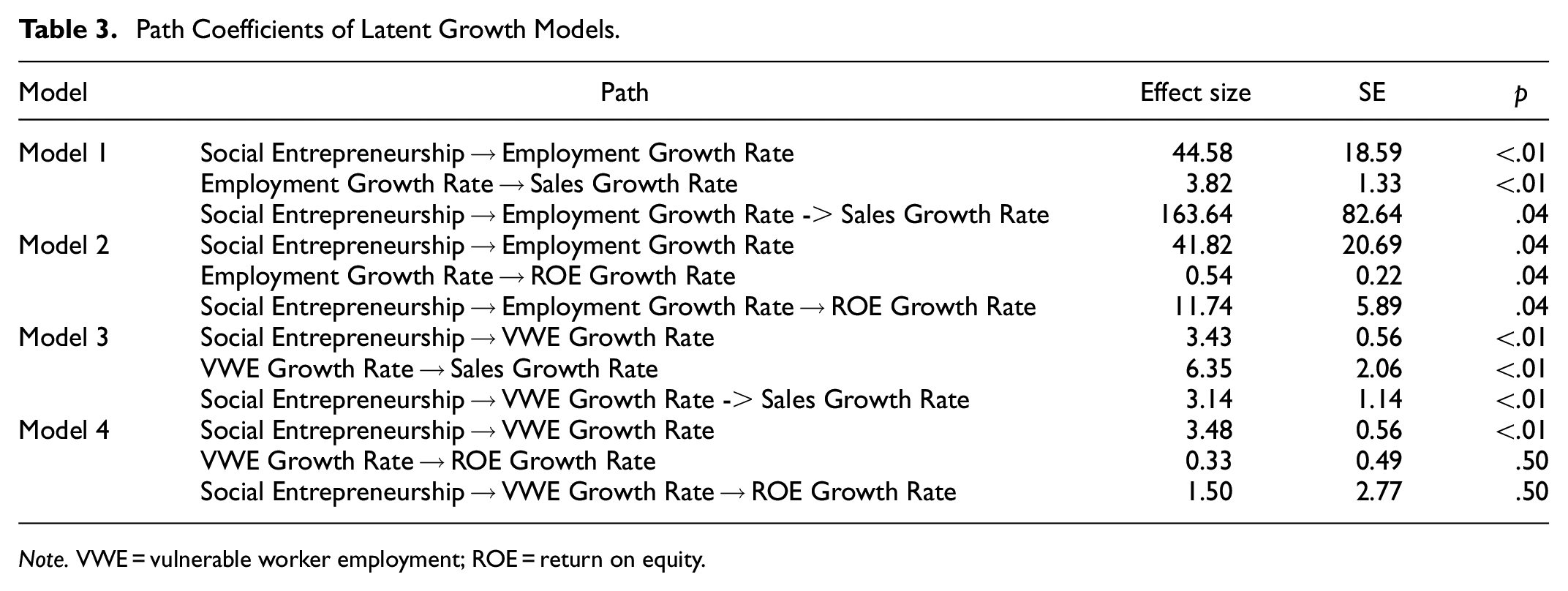
The effect size, standard deviation, and significance of each path coefficient for hypothesis testing were calculated and displayed in Table 3. The results of the analysis showed that the impact of social entrepreneurship on the growth rate of employment value and vulnerable worker employment was statistically significant with a positive effect size. Hypothesis 1 is, therefore, supported.
Path Coefficients of Latent Growth Models.
Note. VWE = vulnerable worker employment; ROE = return on equity.
The effect of the total employment growth rate on sales and the return on equity growth rate is also significant and positive. Thus, Hypothesis 2 on total employment is supported. The indirect effect of social entrepreneurship on the growth rate of sales and return on equity through the growth rate of total employment is also significant and positive with a significant effect size. Mediation Hypothesis 3 on total employment is, therefore, supported.
The effect of the growth rate of vulnerable worker employment on the growth rate of sales is significant and positive, and the indirect effect is also significant. However, the effect on the growth rate of return on equity is not statistically significant. Hypotheses 2 and 3 on the growth rate of vulnerable worker employment are partially supported for sales only.
Discussion
Summary of Findings and Implications
Based on the results of the hypothesis testing, as predicted by Hypothesis 1, social entrepreneurship had a positive effect on the growth rate of employment value, including vulnerable worker employment. In other words, the higher the level of social entrepreneurship among entrepreneurs running social enterprises, the higher the social contribution to employment, especially the effect on vulnerable workers. The growth rate of employment value in social enterprises also positively influenced the growth rate of their sales and return on equity, supporting Hypothesis 2. This finding aligns with the previous meta-analysis (Orlitzky et al., 2003), which found a proportional relationship between the social and economic value generated by common enterprises. Also, this is consistent with research showing that internal branding can drive brand loyalty (Soleimani et al., 2023). Social enterprises shape their branding through social values, which in turn drives loyalty, which leads to increased economic performance. This study also shows that there is a proportional relationship between the growth rate of employment value and financial value. However, the effect of the growth rate of vulnerable worker employment on the growth rate of return on equity is not significant. Compared to the significant proportional relationship of the general employment value growth rate, the relatively weak financial value-creation effect of vulnerable workers weakened that relationship and the statistical significance.
This study has several academic implications. First, it contributes to the research on entrepreneurship by empirically analyzing the impact of social entrepreneurship on financial value creation. The results confirmed the positive impact of social entrepreneurship on employment and financial value creation. The negative aspects of entrepreneurship have also been discussed in the literature (e.g., Beaver & Jennings, 2005; Wright & Zahra, 2011). These studies are mainly based on the negative impact on society through its creative destruction effect (Schumpeter, 1942). This study shows that the negative effects of entrepreneurship can be mitigated through social entrepreneurship by including social value orientation. Second, this study provides a potential solution to the academic debate on the relationship between the social and economic value of firms. Both positive (Tang et al., 2012), negative (Cordeiro & Sarkis, 1997), and non-significant (Abbott & Monsen, 1979) relationships have been reported on the relationship between the social and economic value generated by firms. Margolis et al. (2007) called for a resolution of the debate and emphasized the need for ongoing research. Similar to the findings of Omidi and Shafiee (2018), this study found that the social performance generated by social entrepreneurship is a source of financial performance. This study provides implications for resolving the debate by reporting that a positive relationship can be established through social entrepreneurship. Third, this study contributes to the methodological aspects of entrepreneurship and social value research by analyzing the growth rate through a latent growth modeling rather than a simple causal analysis. Previous studies have often analyzed simple causal relationships, such as cross-sectional or panel analyses. However, social entrepreneurship, employment value, and financial value all have important cumulative effects over time. This study analyzed the changes over a 3-year period through the growth rates and conducted a causal analysis between the growth rates to provide suggestions.
This research has several practical implications. First, many financial investors, including Black Rock, are considering ESG-related investments (Ailman et al., 2017). This study has implications for the valuation and investment industry by demonstrating that the employment value generated by social entrepreneurship is translated into financial value. In the long term, this study shows that socially recognized companies are more likely to survive and grow in their society. Second, this study provides policy implications by demonstrating that hiring vulnerable groups can increase sales. Hiring vulnerable groups has been considered a goal of public welfare policies (Kersten et al., 2023). This study shows that corporate growth and social value creation can coexist through the employment of vulnerable labor groups, suggesting that government welfare policies can also be proposed to generate economic benefits. Third, given that previous research has shown that the lack of financial resources is the most significant limitation to the expression of social entrepreneurship (Salamzadeh et al., 2013), our findings provide practical implications for overcoming this limitation.
Limitations and Future Research
Despite the implications, this study has some limitations, based on which recommendations for future research are presented. First, this study was conducted over a relatively short period of 3 years, from 2017 to 2019. COVID-19 has had a strong impact on corporate performance and the labor market since 2020. Therefore, it is difficult to treat the data from 2020 as equivalent. In the future, a longer period of data should be used to analyze the growth rate. Second, this study was conducted on social enterprises. Since social entrepreneurship was utilized as the main research variable, social enterprise data was used to find a research environment where the influence of this variable is prominent. However, social entrepreneurship is not a variable that is only expressed in social enterprises. Based on the results of this study, further analysis should be conducted in general companies. Third, this study was conducted in East Asian cultures, which may have overestimated the impact of social value. The collectivistic tendencies of East Asian cultures such as China, Korea, and Japan tend to place a high premium on social values (Sheikh & Jamshed, 2023). Therefore, it is necessary to confirm the results of the study in cultures with strong individualism. In the future, research should be conducted to address the research gaps identified in the introduction and contribute to the social entrepreneurship literature. First, as suggested by Funko et al. (2023), research should be conducted to identify characteristics of social value, such as employment value creation, that can foster entrepreneurial resilience during crises such as Covid-19. Second, research should be conducted to find boundary conditions to confirm the causal relationship between social value creation and financial value creation (Méndez-Picazo et al., 2021). Third, research should be conducted to analyze the long-term impact of social entrepreneurship on the sustainable development of firms. Fourth, the number of ICT-based social enterprises has increased recently (Salamzadeh et al., 2017). It is necessary to conduct research that reflects the characteristics of ICT-based industries as well as traditional social enterprises.
Footnotes
Declaration of Conflicting Interests
The author declared no potential conflicts of interest with respect to the research, authorship, and/or publication of this article.
Funding
The author received no financial support for the research, authorship, and/or publication of this article.
Ethics Declaration
As this study analyzed secondary data made available by the Center for Social Value Enhancement Studies in South Korea, there was no need to obtain ethics clearance, nor informed consent from survey participants as this was already obtained by the Center for Social Value Enhancement Studies in South Korea ( ).
).
Data Availability
The data that support the findings of this study are available from the corresponding author upon reasonable request.